The Numbers Game: New Research Shows that US has Saved Millions of Iraqi Lives.

Standard

[Warning: this is satire. I apologise for any confusion. If I offend anyone I want to make absolutely certain that they are the right people.]

In 2006 The Lancet published the second of two ideologically driven mortality “surveys” which claimed that the US had caused over 600,000 deaths in Iraq. This was followed by other such “research” conducted by those who made no effort to conceal their own political bias against George W. Bush’s decision to invade Iraq. Some of these organizations claimed to have found astronomical numbers of fatalities, even over a million. One of those who has led the fight to correct these subjective and biased studies is Jim Slobberdrib. For eight years Slobberdrib headed Applied Research Science Enterprises prestigious Iraq Death List project. More recently Slobberdrib has overseen a new study which, by applying newer and even less biased techniques and standards, has found that US actions actually saved many thousands of Iraqis who would otherwise have perished. Since the release of these explosive findings Slobberdrib has been very busy promoting the work by granting interviews to the media. Fortunately, however, he was able to take time out from all of that in order to grant me an interview:

KK: If I could turn first to your work with the respected Iraq Death List project – how exactly did you get the inspiration to start the project, and what were its aims?

JS: Well, it is funny how inspiration can strike at any moment. I was working for Blush, McLieberger and Koch, the PR firm, and, I don’t know, I… I must have been quite dissatisfied with the meaninglessness of it. So much so, I think, that my boss could actually tell even before I really knew myself. He told me that I needed something more meaningful in my life, a chance to give back. As it happened, he said, our firm had a relationship Applied Research Science Enterprises…

KK: A relationship?

JS: Yes, I think they shared office space in Kuala Lumpur or something. And they shared other things – you know, photocopying costs, long-arm staplers and so forth. They also had the same Human Resources department, funnily enough. It worked out quite well for me in the end, because it meant that I could just stay on the payroll despite suddenly and drastically and ummm…

KK: Boldly?

JS: Yes, yes, boldly. Boldly changing my career completely. Of course, there was a significant pay rise and I think that this shows that being daring and taking risks can be quite rewarding in that sense. The rewards are more than merely material, they are also monetary.

Anyway, I am getting ahead of myself. Basically, I came up with the idea of doing a truly definitive body count in Iraq which would ensure that the Bush and Blair regimes were absolutely accountable for every single death of every single innocent but only if we could truly verify their innocence and their deadness. I believed utterly, then as now, that it would be wrong to hold someone accountable for abstract statistics, it is only when we can absolutely verify absolute innocence and absolute death that we can think of holding those in power accountable.

KK: So it was a sudden inspiration born out of an urgent humanitarian impulse?

JS: Exactly. They sent me along to meet the people at Applied Research Science Enterprises. They could also tell that I was stricken with a Humanitarian Impulse. They said it made me look troubled and intriguing. They mentioned that the main humanitarian concern in the world was probably the impact of the US invasion of Iraq and that people desperately needed reliable information to make judgements on the moral dimensions of the US action. I said something like: “Hey, wait a minute. If you guys are a research company, why not do some research about the effects of the invasion?” They were really impressed with my idea.

KK: So you didn’t have any directly training or experience as a statistician or epidemiologist or researcher of any sort did you?

JS: Yes, well, I think that this was the greatest strength that I brought to the job. I was an outsider, with a fresh perspective, not some stale old bean-crunching maths person. I wasn’t like The Count from Sesame Street being all mathematical about everything but losing sight of the human picture. I was there because of my Humanitarian Impulse and I could feel it getting stronger all of the time. Some people said I was becoming quite Bohemian. I even thought about writing a poem. I was the ideas man – the humanitarian ideas man. I could do the numbers too, if I wanted. I was used to it. In PR and marketing, we live by the numbers. I was never one of those people who actually makes the numbers, but I was around lots of numbers. Some of these numbers were really big numbers. I mean really big numbers, but they didn’t scare me. I can talk about infinity without getting scared.

KK: Walk us through what Iraq Death List actually did?

JS: Well, we collated reports of fatalities, but we would only actually include a reported fatality if it was independently verified by two Western media sources who had access to eyewitnesses of unimpeachable character. After that it was necessary for us to conduct our own independent verification to absolutely ensure that the eyewitnesses could be relied on.

KK: And then the first Lancet study came out in 2004. According to one of the researchers, they had initially expected that they might see an increase in mortality due to increased rates of disease or disruption to health and sanitation services, but instead they found that tens of thousands of people had been violently killed.

JS: Well, it just goes to show how political and unscientific they were. How are you going to show that someone died of disease because of the invasion? Did George W. Bush come up to them with a syringe full of dysentery or thyphus and inject them? A disease isn’t like a bullet. No one shoots someone with a disease. They were just going to count up some dead people and use some fancy number trick to say if was America’s fault. It’s like If I said that 78 percent of people who died of cancer died because they listened to rap music.

KK: But that wasn’t their main finding.

JS: Sure, but what they did was just as bad. They went around just asking Iraqis if anyone they knew had died and they just took their word for it that. These are Iraqis. They’re the ones who, I mean they’re practically the same people as… well, you know, they hate America. Of course they’re just going to say that the Americans killed my habeebi, or whatever. Hey, that reminds me of a joke a Marine told me: What did the Haji taxi driver say when he saw his child’s severed foot in the middle of the road?

KK: Umm, maybe just tell me later.

JS: Anyway, that wasn’t even the worst of it. They took those claims and then said that if these people said that their loved ones had died it must mean lots of other people had died well. They just made up all of these fictitious dead people. Completely made up. I don’t know how they thought they’d get away with this nonsense, but luckily we had our own definitive Iraq Death List and we could categorically refute their findings.

KK: So this is when you first began to clash with people like Gilbert Burnham and Les Roberts?

JS: Yeah.

KK: So, to set the scene, by this stage it is the end of 2004. A year and a half has passed since the invasion. What confirmed mortality figures did Iraq Death List have at this stage?


JS:
That’s the amazing thing, these jokers were claiming that 100,000 people had died but our confirmed fatalities were zero.

KK: Zero?

JS: Yeah.

KK: That’s quite conservative.

JS: Thanks. Well, anyway you can imagine how ridiculous these people looked, claiming that these nameless 100,000 people had died when we could show that there were no confirmed deaths at all.

KK: But surely some people must have died by this stage.

JS: People die all the time, but none of these deaths could be properly confirmed as being the result of US actions and confirmed as being real.

KK: Being real?

JS: Yeah. I guess one of the greatest challenges we faced at that point was the security situation. Our confirmation protocol is rigorous and we often found it impossible to deploy the hologram team to the areas in which fatalities were witnessed.

KK: Hologram team?

JS: It was vital that we assured ourselves that eyewitnesses had in fact witnessed real events, in those cases where eyewitnesses were considered sufficiently credible. We had to eliminate the most obvious possibility – that eyewitnesses had in fact witnessed only a clever projection made with hologram technology. But, there were often unacceptable risks in deploying the team.

KK: You mean that these alleged fatalities tended to occur in violent hotspots, in neighborhoods that were too dangerous to send a team into?

JS: I mean in deploying the team to Iraq. It was a very violent place…

KK: Despite having no actual confirmed fatalities?

JS: I know what I’m saying. Let’s not forget that American heroes were dying there every day. If we’d actually had a hologram team, we could never have risked sending them to the country.

KK: You didn’t even have a hologram team?

JS: Apparently it is difficult to find personnel who are appropriately trained and qualified to analyze this sort of technology.

KK: Because it doesn’t exist?

JS: Well, it is definitely cutting edge technology, maybe a bit beyond cutting edge. Anyway, one of our interns proposed a workaround and the “powers that be” decided that this was the way to go. It was decided that a quick trip to the morgue would serve to confirm that the dead were not holograms but in fact corporeal. I was against the decision. You know, I could understand the public relations aspect to it. People were thinking that zero fatalities was too low a figure. Edward Bernays understood this sort of thing. He invented public relations and he knew that ordinary people were very stupid. He called the average man “Dumb Jack” and he would have understood that “Dumb Jack” would never accept that the most scientific and objective measure of fatalities in Iraq was no fatalities at all. I understood the PR aspect of it, but by this time I had my scientist hat firmly on my head and my scientist hat told me it was all wrong.

KK: This was quite a dark time for you, wasn’t it?

JS: Yes, I did suffer from this sense of being conflicted. I was haunted by a recurrent nightmare. I would see “Dumb Jack” who looked just like my dad in his work coveralls. Then “Dumb Tariq” the suicide bomber would come along and decapitate my dad while singing “I Got You Under My Skin” in Frank Sinatra’s voice. Then me and “Dumb Tariq” would kick the head around like a soccer ball. Suddenly I’d realize that all along, every time I opened my mouth a stream of foul brown liquid would gush out, as if I was literally spouting liquid diarrhea. My therapist told me that it meant that when confronting trauma I became fecund with insight.

KK: “Fecund with insight”?

JS: Yeah, full of it apparently.

KK: But eventually you adjusted?

JS: Things got worse before they got better. My proposal that we initiate a capture and release program where Arabs would be banded and, if feasible, microchipped did not go down well. Detractors said that having such a program in the continental US would be of little use in determining death levels in Iraq. I tried to point out that this very same technique had been invaluable in studying declining numbers among Whooping Cranes and that the Arabs in question must themselves be migratory, otherwise they would not be in the continental US if the first place. I was widely pilloried for these ideas. I guess, in hindsight, that I should have talked them through with someone before calling a press conference.

KK: So if we move forward to 2006, and the release of the second Lancet study, widely referred to as “L2”. They estimated a very high mortality at this stage. In fact they estimated around 650,000 excess deaths, with 600,000 due to violence. What was the death toll according to IDL at this time?

JS: In approximate terms it was roughly around 3.

KK: Could you be more precise?

JS: It was 3.

KK: So there was an even bigger difference between your figures than there had been in 2004?

JS: In absolute terms, perhaps, but in percentage terms the gap had narrowed and I…

KK: Sorry, you say the gap had narrowed? What to?

JS: Well, a little over 20 million percent. That sounds a lot, but remember that in 2004 the percentage difference between our estimates was infinity. Infinity is much much larger than 20 million. 20 million is nothing compared to infinity. It’s like comparing, say, the size of a tennis ball with, umm, I don’t know, something infinitely bigger than a tennis ball.

KK: The universe?

JS: OK, maybe not that much bigger, but you get the point. I was very alarmed by the way politics had interfered with our science as if we should just compromise our methods in order to fit in with some antiwar malcontents and their made-up death study. Still, a difference of 20 million percent was just enough to show people once again that the Lancet study was dangerous nonsense.

KK: And now the Democrats in Washington started to take notice?

JS: Yes, they realized that our confirmed and undisputed body count was an invaluable weapon against the President. Of course, Republicans were not happy with me at that point. Senator Oren Stretchy (R-KY) physically threatened me with a yoghurt at a breakfast meeting. Bill O’Reilly said he wanted to chop me to pieces with his hedge-trimmer and feed me to his neighbor’s dachshund, but I think he might have mistaken me for Bernie Sanders’ cousin.

KK: And then, of course, that all changed when Bush actually admitted that your figures were correct.

JS: It was a great moment. Not just for me. Not just for IDL. But for the entire country. The President himself came out and admitted three innocent people had been killed due to his actions. He had saved us from Saddam’s weapons of mass destruction and from the smoking gun that could come in the form of a mushroom cloud. He had finally brought the justice that would give peace to the restless souls of those lost on 9/11, in the Maine and at the Alamo. He had saved the lives of millions of Americans and the price he paid was to carry the burden of guilt forever for those innocent lives lost because of his actions. It was a great moment from a great leader.

You know, people like to compare Bush to Reagan or to Teddy Roosevelt, but to me his greatness transcends the parochial confines of US politics. If the great Winston Churchill and the beloved Mahatma Gandhi had through some miracle conceived a love child, that love child would be George W. Bush.

KK: This was, indeed, a great moment. Bush showed a humble and saintly side to himself that clearly moved people. But there were still those who questioned the actual figure of 3 killed, suggesting that it was on the low side. Perhaps if you gave more detail about IDL‘s methods. I mean, surely there must have been a lot more than 3 people confirmed killed in nearly 4 years of occupation.

JS: More “people” maybe. If you could call them that. But “people” could mean anything. “People” could be insurgents, or terrorists, or militant Islamic extremist fundamentalist Muslim militants. If you think those people are actual “people” then you go ahead and call them that. But you’ll excuse us if we don’t take the same stance. IDL was created out of a Humanitarian Impulse to definitively document the deaths of innocents so that the powerful can be held to account. You can’t treat the good killing, where we kill the bad guys, as being like the bad killing. In fact it should really be set up so that each good killing is subtracted from the number of bad killings.

KK: That would be another reason for saying that the US has killed a negative number of people. Sorry, I guess that is getting a bit ahead of your narrative.

JS: No, you are right though. The US has probably negatively killed much higher numbers of people than we outlined in our latest study. We should maybe revise our findings to take into account the negative killing aspect of killing bad guys. Sorry, where was I?

KK: I think you were about to outline the methods you used to make sure that you only counted the bad killing and not the good killing that we want our politicians to carry out.

JS: Oh, yeah. Right, you see the way I saw it was that we needed unimpeachable character witnesses who could testify to the goodness and innocence of the stiff. You see, one of the problems America faces is that its enemies don’t fight fair. They don’t wear uniforms. They don’t carry weapons. And they aren’t all military age males. You can’t even trust the kids and the babies. These people are so fanatical and so full of hatred that they sew explosives up into their own babies and then fire them out of modified mortar tubes. It was just the same in Vietnam. As one soldier said: The old men, the women, the children – the babies – were all VC or would be VC in about three years. And inside of VC women, I guess there were about a thousand little VC now.”

KK: Who was that?

JS: That was Lieutenant William Calley. He had a breakdown, like combat fatigue, and then they just persecuted him because they needed some sort of scapegoat. Luckily President Nixon knew a thing or two about being the victim of a witch hunt, and he gave him a pardon.

Anyway, so we needed a way to tell who were the fanatic insurgent terrorist Islamists. In a real country we would ask the priest or the preacher, but obviously we couldn’t ask Muslim priests. We couldn’t say that they needed the testimony of a Christian priest either, because that might seem insensitive. I still thought that a respected religious figure was the right sort of person to give this testimony. It finally came to me that the ideal religious personage, who was not objectionable and who commanded very wide respect, was an ordained Tibetan Buddhist monk.

KK: So you would accept that someone who had been killed was, in fact, innocent if in life they had been known to an ordained Tibetan Buddhist monk who was prepared to vouch for their character?

JS: Obviously there is a fine balance that must be achieved here, but we thought that our approach was very reasonable.

KK: And do you still think it was a reasonable approach?

JS: Of course.

KK: Despite what occurred near Kut al-Farraj in mid-2008?

JS: I’m not sure what you are referring to.

KK: Perhaps I can refresh your memory. August the second? A village near Kut al-Farraj? An airstrike using multiple 500lb J-DAM against farm buildings which US personnel described as “hardened”? Surely you must remember that the official IDL mortality count jumped overnight from 4 to 179? Does it ring a bell yet? The airstrike at the village where the Venerable Abdallah al-Bakr happened to live?

JS: Yeah. I’ll never really get that. How can someone called Abdallah be ordained as a Tibetan Buddhist monk? Don’t you need to be Tibetan?

KK: No. Tibetan is also a type of Buddhism. Allen Ginsberg was an ordained Tibetan Buddhist monk.

JS: Wasn’t he some sort of Nazi or Communist or something?

KK: You’re thinking of someone else.

JS: Look, our results were sound and the Kut al-Farraj incident only strengthened the validity of our results. It showed that our method was flexible and responsive.

KK: “Strengthened the validity”? Are you really still defending this now? You had assured people for such a long time that the definitive and absolutely reliable death toll was 4 and suddenly almost in an instant it jumped by over 4000 per cent! How can you possibly justify that?

JS: Look, as a layman you might not understand that the best and most definitive figure isn’t some sort of happy medium that corresponds with common sense and accords with a full holistic picture of the context in which the events occur, it comes from taking the most narrow, restrictive and conservative approach possible. For a layman that might seem outwardly to throw up anomalies, like overnight jumps in the figures, but that is exactly how we ensure that our figures are utterly sound and definitive.

And anyway, a 4000 percent jump is tiny compared to a jump of infinity.

KK: This isn’t even particularly relevant because the percentage jump is actually the least of the problems with the new tally.

JS: I know where you are going with this. I just want to say that we had been using a set statistical method for years. We produced the definitive mortality data using that method and as I said before just because the method throws up results which, to a layman might seem really stupid, that does not invalidate the method.

KK: You know what I’m going to ask. The 175 killed Kut al-Farraj in 2008 – were they people?

JS: Look these were 175 certified innocent lives lost. I mean, the word “people” could, you know…

KK: Were they human?

JS: Not as such.

KK: They were…?

JS: OK, they were ducks.

KK: They were ducks. Innocent ducks maybe, but they weren’t people.

JS: Well, from the perspective of an ordained Tibetan Buddhist monk they actually are people.

KK: Alright, fine, they were innocent dead duck people. But that doesn’t alter the fact that after more than 5 years of brutal war, your official respected mortality figure was that 179 innocents had been killed of whom the vast majority, 175 out of 179, were, in fact, innocent ducks! 175 out of 179!

JS: Could you express that as a percentage?

KK: No.

JS: But you would agree that it is quite a lot less than infinity percent?

KK: If you keep this up, I am going to terminate this interview.

JS: Okay, alright. But you are really missing the most important aspect of this whole thing. The Venerable Abdallah al-Bakr had given names to every single one of the sadly departed innocent ducks, and we knew the names of the four humans. It is only because we know these names that we can honor these innocent lost lives. It is only because they are named and documented that we can give them a measure of justice. It is only because we know exactly who they are and the exact circumstances of their deaths that we can seek accountability or, at the very least, acknowledgement of wrongdoing. Those who die without us documenting and naming them died pointless deaths that made their whole lives totally futile and meaningless. They are nothings and nobodies.

KK: What about those people who have lost loved ones that you have not named? Aren’t they liable to think that you are a self-satisfied insensitive shithead who should have his face smashed in?

JS: Well, people do post that comment on my Facebook wall a lot, but really, I believe that in circumstances like these violence is not the answer.

KK: The whole “innocent ducks of Kut al-Farraj” incident caused quite a loss of confidence in IDL, didn’t it?

JS: We lost a lot of institutional support including that of some of the most prominent US lawmakers and congressional representatives.

KK: Isn’t that the same thing?

JS: No, I’m sure the lawmakers are the ones who write the laws, mostly lobbyists I think. Anyway, then they give the laws to the congress people who, I don’t know, I think they give it to the President to sign or something. Maybe they have to, you know, fight each other to get to the President with their favorite law. They must do something.

Anyway, the real loss, and it was a bitter blow, was the loss of support from some of the most respected foundations. Those guys have got real deep pockets. And do they know how to give a guy a good time? I did a dinner with Ford Foundation once – man, I was seeing double for a week afterwards. Oh God, yeah, I remember now – I had to go on a 4 week course of antibiotics and I had this discharge that I swear to God actually glowed in the dark. It really did!

KK: Right, umm, OK. I think we get the picture, although I am trying very hard not to get an actual mental picture. To get back to the loss of credibility, it must have caused a loss of confidence in the public also.

JS: I never had any confidence in the public.

KK: I mean, the other way around. The public lost confidence in you.

JS: Yeah, like we really cared. Look, I don’t think the public ever really supported our efforts. We took that as a good sign. Our work was clearly too scientifically valid for the layperson to grasp, but people in power could immediately see how useful it was. I think that this is the true test of rigor and validity. This is the way things are heading now. This is the future of science and research because it is usefulness to power that ultimately is the true measure of what is valid and true.

KK: OK. But regardless of that the “innocent ducks of Kut al-Farraj” did spell the end of the IDL project.

JS: Well, that was the foundations, like I said. Our parent company realized that the profits from IDL were on a death spiral downwards and decided to pull the plug before the rot set in. They told me that I felt like I needed a change and funnily enough they had this relationship with a publishing firm.

KK: And the resultant memoir was Slobberdrib: Saint or Savior? It did well?

JS: Yes it did extremely well. Incredibly well really. It was really really successful. Not so much in terms of sales. But it was an incredibly rewarding experience. It was really about the whole process, you know, like writing things and that sort of process stuff.

KK: There were also financial rewards. I believe that despite never having published a book before you were given a 2.8 million US dollar advance. How much of that advance have the publisher made back from sales of the book?

JS: As a percentage it would be about, umm…. Can you think of something that is 176 times as big as a tennis ball?

KK: And then things changed for you once again?

JS: Well I was in Jordan on location with the cast and crew of the new biopic Slobberdrib: Shake Hands with Satan – actually that’s coming out in the fall and it’s got George Clooney playing yours truly and that black guy from Homeland (did you know that he’s actually British?) Anyway, it’s got him playing my best buddy in military intelligence. It’s gonna be a hit movie. Anyway, so there’s me in Jordan, consulting for the film – telling Clooney how to be more, you know, like me, and I get this call…

KK: No, wait, wait, wait… I’m sorry to interrupt, but I need to clarify. You said Jordan, but you never actually went to the Middle East before?

JS: No this was my first visit. It’s pretty amazing, especially in the desert. It’s like, really sandy just like it is in the movies.

KK: The point I was trying to make, or ask maybe, is, why are they filming your life story in the Middle East when you were never in the Middle East?

JS: Oh yeah, I mean no. Yeah, no they decided that to make the story more accessible they would have my character as some sort of maverick humanitarian who struggles against the powers that be to save his buddies and to do the right thing. That’s basically me, but they gave me a slightly different back-story. In the movie I’m a bomb disposal expert who dedicates his life to protecting the innocent after the trauma of seeing a duck killed due to the callous indifference of a French rival bomb disposal guy. I kill the baddies and win the girl from the French baddy (who actually turns out to be Muqtada al-Sadr in a rubber mask – so I kill him too).

KK: So it’s more like some sort of fantasy version, not the humdrum reality of a guy working from an office in DC?

JS: I wouldn’t call it fantasy. There’s no dragons or orcs or whatever. They didn’t even use my idea about finding Aladdin’s lamp and rescuing the sexy Princess in those see-through culottes or whatever they’re called.

KK: OK, can we get back to the call you got in Jordan? Could I just guess that your employer had suddenly realized that you needed a drastic change in career?

JS: There’s no need to be facetious. It was actually the old crew from Applied Research Science Enterprises. New techniques and new approaches had been developed that virtually threw the whole issue of mortality in Iraq on its head. They needed me to come back to head a new study. This one would be far less restrictive than the last. It would be more of a totally inclusive survey of excess mortality.

KK: Like the Lancet surveys?

JS: No, not like those, obviously. They were political, we wanted to to do a survey that was purely scientific without all that politics. A recent study found that there were nearly 500,000 excess deaths in Iraq. As every reputable newspaper pointed out, this totally destroyed the findings of the Lancet studies. It absolutely blew those bastards out of the water.

KK: But surely these figures were much closer to the Lancet results than, say, your own results?

JS: Read the papers man! Don’t take my word for it. It just blew those bastards away. Totally discredited the washed up hacks. But we were still worried that there was some sort of political antiwar bias. Like I said, I don’t care if your politics are antiwar, but if you’re going to do science then, Brother, you gotta leave that shit at the door. You know what I’m saying? You can do science and say that lots of Iraqis died, but it becomes political when you say Americans killed them. That is just projecting your antiwar anti-America bias onto the figures. So even though some of the latest work to be done on Iraq suggests that lots of people died, over time we are seeing that less and less political bias is included in the figures.

KK: So it’s not political to say that Iraqis were killed by other Iraqis?

JS: No of course not. I like to explain it this way; back home we have a big problem with what we call black-on-black violence in the inner cities. Now, if you say a black man killed another black man that’s just saying something because it happened. It happens all the time. But if you say that a white cop killed a black man that’s political. You’re not describing a fact, you’re making a political statement. Now maybe if you’re wanting to run for mayor of, oh I don’t know, some black city, you might say a white cop killed a black guy. You might get lots of votes for saying that. But science isn’t about winning votes and there’s no room in science for politics like that.

KK: Reporters Without Borders put out a report about journalists killed in Iraq and it basically said that 83% of the killers of journalists were unidentified, but were enemies of the United States. Someone, someone who I actually know personally, criticized them for blithely characterizing unknown murderers this way without evidence. I think she even used the word “political”.

JS: Well, obviously that’s not political is it? Enemies of the USA hate our freedoms and hate our free press. My God, its the First Amendment – the First! Obviously our enemies kill journalists. Its dog-bites-man stuff. Perfectly non-political. Absolutely scientific. As for your friend – you know I think some people are so politicized they don’t even know what the word political actually means. Really, I could say some stuff myself about that Reporters Without Borders outfit and their so-called “report”. You know how they said that 9% of reporters were killed by US forces? Well, it turns out that two of those so-called “reporters” were insurgents on that film they put out with the helicopter shooting.

KK: You mean the Reuters employees whose deaths were shown in the Collateral Murder video?

JS: Buddy, they might have taken a paycheck from Reuters and done some journalism on the side, but those guys were fully-fledged one thousand percent insurgents. The Army even said they were insurgents. I’m pretty sure I saw that Collateral Damage thing and those guys were shooting rockets at our boys in the Apaches and then these reinforcements drive up using their own kids as human shields, and then they were just shooting off their AKs, a total killer frenzy. They were even shooting themselves just to make our boys look bad.

KK: Are you sure you actually watched Collateral Murder?

JS: I’m 98 percent certain. All I’m going to say is that if Reporters Without Borders researched those alleged Reuters employees they wouldn’t have found a single ordained Tibetan Buddhist monk who would testify that they definitely weren’t insurgents, and I bet the same is true of every one of those guys that our boys killed.

But going back to our new project, we saw our job as being to produce research a product that reflected a high mortality expectation, which we find a lot of the audience demands, but doesn’t have this distorted political component of US forces killing Iraqis. Our focus groups found that the best way to present the most credible results that the public would actually believe in (but were actually really really scientific and in no way political) was to have a very high mortality rate but to say that it was all brought about by Iraqi on Iraqi violence.

Things have changed a bit since the early days of IDL and that sort of approach wasn’t possible back then.

KK: Why is that, exactly?

JS: Well, you know, the whole invasion and occupation of Iraq was a very sensitive issue. There was a lot of misunderstanding. The President did his best to enlighten people. But even after Donald Rumsfeld explained all about “unknown unknowns”, a lot of people thought that Saddam’s WMD’s would either be found, or they didn’t exist. It’s just one of those “unknown unknowns”. He could have developed weaponized sand for all we know, and just left it in the desert to degrade into inert form. We will never ever know.

So the whole situation was very political, and I guess that is why the reporting was political too. For the first few years it was all about Coalition forces fighting against Iraqis. There was hardly anything about Iraqi-on-Iraqi violence. Maybe it’s not the journalists’ fault. They would wander along and than see a bunch of dead Iraqis and think: OK the US is fighting a war here, and war is hell, so they must have killed these guys. We now know, of course, that these Iraqis were almost certainly killed by other Iraqis. Iraqis kill each other all of the time, and the great irony of the situation was that it was only the mass-murdering genocidal maniac tyrant Saddam who, like Tito in Yugoslavia, stopped them from their traditional fratricidal violence. It’s like that British guy said a century ago, Iraqis “love fighting for fighting’s sake” and “they have no objection to being killed”.

I guess after that, you know from 2006 onwards, the news started to cover more and more Iraqi-on-Iraqi violence until that was all they covered. All of that political stuff about Americans killing Iraqis kind of faded away and we saw that it was all really about the same thing its always about – the same thing we see in movies and on TV – it was all about fanatical Islamists, terrorists, suicide bombers and cruel barbarians who chop people’s heads off.

KK: So the predictive programming of the entertainment media which unrelentingly pounds people with notions of Eastern barbarity and Western superiority made it natural for people to gravitate to this new narrative of incomprehensibly violent Iraqis who just kill each other for no reason that a civilized Westerner could ever really understand?

JS: Did you mean to say that?

KK: No, it just kind of slipped out. Do continue.

JS: Well, I guess I really have to confess now that I’d really got it all wrong earlier with the IDL. You see, you remember how I told you that there was good killing and bad killing? Well, that’s a perfectly good scientific way of understanding the difference between, well you know, the difference between good killing and bad killing. Anyway, it might be great science, but it’s not actually very mathematical. After talking it over with my people I came up with this great inspiration. Instead of good and bad killing, we should be talking about positive and negative killing in the mathematical sense. So when you positively kill someone there’s one less person in the world but when you negatively kill someone then there is one more person in the world. Now so there is no confusion let me make it absolutely clear that this is not about procreation. These are processes which we refer to as dekilling, or unkilling, or enlifing. This might be confusing initially, but when you enlife someone it means, well it doesn’t usually mean that there’s this person that you actually see that you’ve actually somehow enlifed. It’s more like say if there was a unit and at the end of a tour we calculated that they have killed negative 100 people, that means that by their actions there are 100 more people alive today than there would have been otherwise.

KK: Is that an indicative example. Would, say, a company have that sort of negative kill rate in a one year tour?

JS: Look, this is all new science and we really haven’t gone through the individual outfits completely yet, but our initial findings are phenomenal. We have some outfits that racked up huge negative kill rates. I even joked with a Sergeant from a mortar battalion that they should change their motto to “Life from Above”.

KK: Just so our audience understands, negative killing isn’t the same as killing bad guys? It’s not just another name for “good killing” is it?

JS: Oh no. Nothing could be further from the truth. No, negative killing is the sum total of all of those actions which are, in fact, life giving or life preserving. I need to emphasize again that this is not about procreation. The Pentagon would never countenance that sort of thing, not with Iraqi’s anyway. Like a lot of military outfits around the world they do have a long and proud tradition of having a “don’t ask, don’t tell” approach to sexual violence, but they really draw the line at fraternization. And they especially draw the line at there being a bunch of half-Iraqi half-White-Christian-American babies. I think you can see how that would not be in the interests of national security.

Negative killing is more about those things that save people from short or long term mortal threats. So, say, you might go into a house and in the confusion shoot dead one of the members of a family, but if by way of compensation you give the remaining family members a lifetime supply of chlorine tablets and that saves all eleven survivors from a deadly cholera outbreak, that means you’ve actually got a net negative kill rate of 10 people.

KK: So the negative killings come mainly from, say, civic action programs? From those outfits who build the wells and vaccinate the kids and have slogans like “we care, so you don’t have to”?

JS: Well, obviously that is a major part of the US military’s negative killing capacity. But our research has shown that often it in those activities that attract the most criticism from the bleeding-heart antiwar douchebags that actually have the greatest capacity to give life. Often people say our boys are trigger happy to the point of being a rampaging murdering horde. You have GIs just shooting up Iraqi cars just because they’re on the road, more or less, and people get wasted for almost any dumb reason. I mean, in 2005 we shot over one billion bullets during a period when our best estimates were that there were only 30,000 insurgents. That means we shot over 30,000 bullets for every insurgent in the whole country. That’s a lot of bullets, and those things are dangerous. It’s almost like you’d think that those guys who did the Lancet studies were on to something after all.

KK: Okay. I’m sure this is leading somewhere.

JS: Just hang on a sec, I’m getting there, but first you’ve got to think about the kind of firepower our grunts are packing these days. I mean a platoon of these guys could just about take out a city block as long as there weren’t any enemy soldiers or anything. Imagine you’ve got a mounted patrol. Every fourth GI has an M249 light machine gun. Every vehicle is mounted with maybe a .50 caliber machine gun or a Mk 19 grenade launcher which is like a sort of machine gun which fires 40mm grenades at a rate of about one every second. So, when this patrol hits an IED what they do is that they all just open up with all their weapons. Sounds like a recipe for a lot of dead civilians, right?

KK: If you say so.

JS: Well it’s true. Doing things like that does actually generate a positive kill rate, but have you thought about how much of a negative kill rate this could generate?

KK: Err…?

JS: Picture this: A cute little baby girl at home with mom. Mom’s proud of her beautiful first-born. Daddy’s out working his job at the office. It’s Friday, he’s planning on doing some renovations on the weekend and he’s going to drop by the Haji Home Depot after work. Mom’s feeding her beautiful baby girl from her firm young breast, little knowing that outside there creeps the dirty swarthy misshapen figure of an Islamic fundamentalist terrorist insurgent laying his filthy coward IED bomb. Mom puts baby down for an afternoon nap. Feeling good about herself she glances out through the window and waves to the friendly and handsome GI’s who wave back and make playful boyish remarks to each other about the beautiful young Haji woman. Then wham! The explosion throws mom back against the wall and she slumps unconscious. But oh no! What’s happened to baby girl? Unfortunately, Haji homes are flimsy, and Daddy hasn’t had the chance to fix up that sagging detached wall. The wall has fallen on baby’s crib! She has no air, and Mommy’s lying unconscious! Just then, like the ferocious thunder of freedom, the sound rings out of a couple of dozen really heavily armed red-blooded American boys letting loose with all they have. Just in the nick of time a .50 cal round punches a hole through the flimsy Haji wall and the baby is saved. What do ya think of that?

KK: It sounds a little umm… specific or, I don’t know, maybe a little unlikely.

LS: You might well think that. But remember just how many bullets we fired in Iraq – about a billion each year, right? Well if each bullet was the size of a tennis ball, then a billion bullets would be like infinity or even bigger.

KK: So, if you fire enough bullets at inhabited buildings you will save lots of lives by punching air holes in collapsed masonry?

LS: Well, were not completely stupid, you know. We do realize that there is a limited number of people who actually end up in the situation of being trapped under rubble without air, even during a US-led occupation. (We did actually offer an infantry regiment to China to shoot up the city where they had that last quake, but they declined due to security concerns.) Anyway, it’s not just about that, there are many other ways in which stray bullets can save lives. Picture now 36 year old Mohammed al-Derpderp. He’s just got that promotion he’s been after for years. He’s regional sales manager for the Haji vacuum-cleaner company. Finally, after all of those years of hard work he has his feet on the ladder. The only way is up. But, uh-oh! What is that on his neck? Could it be a pre-cancerous mole that is destined in ten years time to bring about poor Mohammed’s death in the most painful, degrading and lingeringly awful way possible? Why yes it is. Luckily he’s walking down the street one day and he’s coming up to where his uncouth Haji neighbours have left a pile of their shitty junk lying blocking a side road. Now, the nearby friendly US dismounted patrol heard AK’s firing earlier that day, so they know that the bad guys are around. They see the junk and they know it could have been put there by the bad guys. The leader decides that it’s time for some reconnaissance by fire. He tells his men to open up and they let loose steel hail like the volley of the titans! A round hits the wall near our friend Mohammed, it shatters and a searing fragment zips through the air slicing off the offending mole and cauterizing the wound to boot. Hey-presto and Allahu-fucking-akbar – 53 years later Mohammed al-Derpderp dies in bed surrounded by weeping relatives while from outside he can hear his great-grandkids laughing as they chase the Haji chickens around the dusty yard. Now that’s a happy ending.

KK: I see. So US forces have “enlifed” (if I have the terminology right) lots of Iraqis with stray bullets. Anything else?

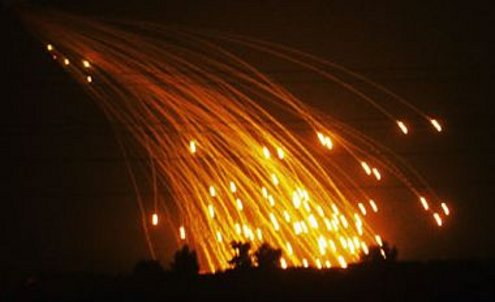
JS: You bet there is. The list is as long as your arm. Airstrikes taking out dangerously substandard housing. White phosphorus sterilizing contaminated chicken. Fuel-air bombs taking out colonies of plague-bearing rats. We’ve found that people who have been exposed to toxins from our burn pits are significantly more likely to quit smoking, for example.

KK: So what does this all add up to, in terms of numbers of negative kills?

JS: Well, I haven’t even got to the best part yet. You see, we started thinking about what was the greatest threat to Iraqis, and you know what we came up with don’t you?

KK: Ummm.

JS: You’ll kick yourself. … Give up? Alright I’ll tell you – the biggest mortal threat to the life of an Iraqi is another Iraqi. You see now? That’s right, it’s just what we were talking about before. So we sat down and we calculated just how much risk Iraqis posed to other Iraqis. Are you ready for this? Yes? Alright. We calculated that over the average lifespan, taking all possible deadly acts and working out, conservatively, the likelihood that they would undertake such acts, we calculated that over the average lifespan the average Iraqi kills approximately 2.8 other Iraqis. You know what that means, don’t you?

KK: That means that every time you kill an Iraqi, you actually save Iraqi lives. Extraordinary.

JS: Well, once we realized that, it was a whole new ball game. We started looking way further back, right back to 1990. Do you know what we found? This will blow your freaking mind. We found that if you look at all the demographic data and look at the overall increased mortality form all causes there have been an excess of 4.6 million deaths. Because of our bombing and sanctions before our invasion and occupation, the good old US of A can take credit for nearly every single damn one of those Iraqi deaths! Conservatively, we can claim at least for at least 4 million of those deaths, which translates to us saving 11.2 million Iraqi lives. That means that we have saved the life of nearly half of every single Iraqi alive today by killing their neighbors and loved ones.

KK: Amazing. Well that seems as good a point as any to wrap this up. It just remains for me to thank my guest Jim Slobberdrib…

JS: My pleasure.


KK:
…and I’d also like to thank the National Security Agency for allowing us to publish their transcript of our conversation. Next week I will be discussing the issue of Palestine with a woman who sounds caring, but advocates genocide. Be sure to tune in.
Kieran Kelly blogs at On Genocide.

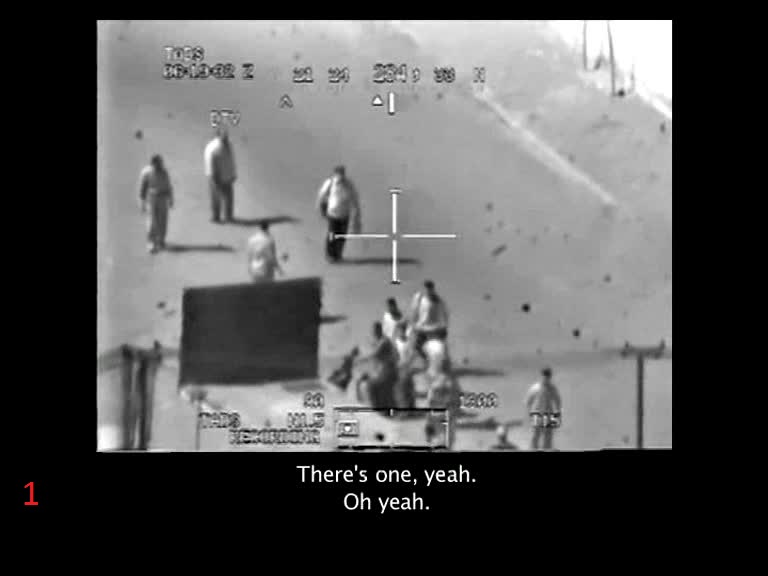
“Collateral Murder”: Evidence of Genocide

Standard

In Iraq, you can’t put pink gloves on Apache helicopter pilots and send them into the Ultimate Fighting ring and ask them to take a knee. These are attack pilots wearing gloves of steel, and they go into the ring throwing powerful punches of explosive steel. They are there to win, and they will win.” Lt. Col. Chris Wallach

The video known as “Collateral Murder” is strong evidence of genocide being carried out by the US against the people of Iraq. Hidden in the horrors of its brutality is a rich historical record revealing an armed force which systematically targets and kills non-combatants. The events shown are war crimes violating the principle of non-combatant immunity in numerous clearly illegal ways including attacking those rendering aid to the wounded. They are also evidence of genocide because there are clear indications that these war crimes are representative of enshrined procedures. They indicate that the ambiguities of the US Rules of Engagement mandate the systematic mass murder of civilians when applied by US personnel. They indicate something of a tactical, strategic and doctrinal approach that radically violates the fundamental obligations to distinguish between civilians and enemy personnel and the combatant status of enemies. Finally they indicate something about the way in which the US indoctrinates its personnel in a way guaranteed to create murderers.

Lt. Col. Wallach was the commander of the aircrew. He recently said: “Ultimately, my combat pilots at the scene did the best they could under extreme and surreal conditions.” However, we now know that the only incident to occur before we are able to see what is occurring was a report of small arms fire being heard. If there is a surreal aspect to any of this it comes from the minds of the aircrew and those who command both air and ground forces. I am going to go through exactly what it is that the gun camera footage shows. It shows a massacre of non-combatants, followed by the murder of rescuers, and finally a more obscure sequence which definitely involves another murder of rescuers.

Former US Secretary of Defense Robert Gates said of this footage: “You’re looking at a situation through a soda straw, and you have no context or perspective.” Therefore, after describing exactly what is shown, taking into account exactly what is known and exactly what is not known from the footage, I will provide that context that Gates calls for. But the context does not, or should not, counter what our eyes and ears reveal to us. On the contrary, the very evidence that apologists like Gates and Wallach produce to show that the aircrew were legitimate in their actions is in fact evidence that their behaviours are not isolated. This is very strong evidence that by the manner in which, in practice, the US defines “hostile intent”; the manner in which it practices its doctrine of “force protection”; and the manner in which it indoctrinates and situates its forces, the US was systematically murdering non-combatants. In this case killing non-combatants inextricably means killing civilians. Placed in the context of more than two decades of direct and indirect destruction of Iraq in social, political, biological, economic, cultural, ecological, and physical terms, this systematic killing is clear and compelling evidence of genocide. Those who insist that this is merely warfare join the vast ranks of genocide perpetrators, deniers and apologists who insist that other genocides were warfare with inevitable, if regrettable, instances of civilian death.

As I have written elsewhere, all of the common claims of genocide deniers are regularly applied to US “military” actions, but they tend to be overlooked as they are so pervasive that they are seldom examined or challenged. Ultimately denial of US genocide relies on people having a vague notion that genocide involves actions like the mass gassings at Nazi death camps. But the word genocide was coined by someone who did not know at that time about the mass gassings and who applied the word to far more that the Nazi project to exterminate Europe’s Jews.

Genocide??

So, what exactly is genocide? The man who coined the term, Raphäel Lemkin, was a Polish Jew and a legal scholar. Impelled by knowledge of the Armenian Holocaust as well as the history of state sanctioned or controlled pogroms against Jews, Lemkin devoted much of his life to understanding mass violence against ethnic populations. In 1933 he proposed that there be an international law which, among other acts, prohibited acts of “barbarity” and “vandalism”. “Barbarity” was conceived as violence against members of a “collectivity” on the basis that they were of that “collectivity” and “with the goal of its extermination”. “Vandalism” was the destruction of the “cultural or artistic heritage” of a “collectivity … with the goal of its extermination”.

The German occupation of most of Europe was the horrific crucible in which Lemkin synthesised “vandalism” and “barbarity”. He recognised a greater process of which they were both part – the process he called “genocide”. Genocide was “a war not merely against states and their armies but against peoples.” Extermination, or the intent to exterminate, was no longer a requisite. The occupant could impose a “national pattern” onto the land, once it was cleansed by killing or forced migration, or onto the people themselves. And despite knowing that Europe’s Jews were slated for complete annihilation, Lemkin’s examples of genocide included such things as forcing the people of Luxembourg to take German names. His most common exemplar of genocide was the treatment of Poland – a comprehensive and systematic genocide in which killing people was only one of many forms of genocidal destruction.

I think it is important that we realise that the fluidity of identity does not allow for actual extermination to be undertaken as a project. Genocide is a schizophrenic undertaking full of bizarre contradictions such that it cannot truly be said that the Germans attempted to exterminate the Jews, or even Europe’s Jews. The Germans had immense difficulties in even defining who was Jewish for a start. They said Jews were a “race” but ultimately they relied on confessional identification to define them. As Yehuda Bauer wrote: “One can see how confused Nazi racism was when Jewish grandparents were defined by religion rather than so-called racial criteria.”(1) As well as the fact that many with Jewish heritage would inevitably successfully evade detection, in the Nuremburg Laws (and later when deciding who to kill at Wannsee), exemptions were made on various criteria, such as being a decorated war hero. However defined, there were Jews in the German military(2) and there were Jewish civilians living unincarcerated in Berlin when Soviet troops arrived.(3)

Mischling exemption application

“Half-Jew” Anton Mayer. Such photos accompanied applications for “exemptions”.

So, as the Genocide Convention outlines, genocide is an attack on people, rather than states, with the “intent to destroy in whole or in part, a national, ethnical, racial or religious group, as such….” Lemkin referred to these collectivities as having a “biological structure”. There is a genetic interconnection involved here, but that does not mean that Lemkin believed in Nazi racial theories or any racist or racialist notions. The most evident proof of this is the inclusion in both his own work and in the Genocide Convention the practice of “transferring the children of the group to another group”. If genocides were truly about racial hygiene and racial hatred that would hardly be a recognised component, would it?

If it is not about race, then what is it about? Though he never articulated it, the answer stared Lemkin right in the face and he obviously grasped it at an unconscious or intuitive level. If we refer to one of these collectivities as a genos, what ties the genos together is not “biological interrelation” but rather personal interconnection and, most particularly, familial interrelation.

Genocide is about Power not Hatred

I want to outline a simplified cartoon narrative, just to illustrate a point: In feudal Europe mass violence was used in acts of war or banditry which were only distinguishable from each other by scale and the rank of participants. A Baron might conquer the demesne of another Baron just as one King might conquer the realm of another King. In relative terms the peasants of the demesne or the realm might have had very little concern over who exactly ruled. The change in rulers would not be akin to a foreign occupation as we would currently understand it. By the time of Napoleon, however, it was beginning to be a little different. People had started to develop a national consciousness. The national genos associated itself with a territory of land and aspired to a nation-state polity based on that (often rather generous) sense of territorial entitlement. By 1871, the inhabitants of Alsace-Lorraine were quite unhappy at being made German. Nationalism would become the dominant political ideology for the entire twentieth century. The multinational and largely interchangeable feudal ruling class was gone. This was not an unprecedented situation, but it was something that Europe had not faced for since the times of Charlemagne (well, in reality it had, but I’m still in cartoon generalisation mode here, so bear with me).

There are many ways in which an external imperial power might exercise hegemony over the territory of a national genos in various ways, but they are limited by the strength of national feeling and, perhaps more importantly, the hegemony cannot be stable because national sentiment might at any time cohere around demands for the end to imperial hegemony. A transnational quasi-imperial system of governance has arisen specifically to limit economic sovereignty, for example. There are good arguments to be made that this is in itself genocidal and that the poorer nations of the world are subject to “structural genocide”. The carrots and sticks of global governance, however, do not apply to nation states that are reasonably populous, but more generously resourced, with a strong potential for industrial development. If they have a national consciousness that does not allow foreign dominance, which includes rule by those who are not loyal to the national genos, then there is no military way of establishing dominance. It is not the sovereign that is the problem, it is the people, hence the recourse to genocide.

War or Genocide?
If genocide is “war against peoples” how can it be distinguished from normal war? If we go back to German conquests in World War II, it is quite easy to distinguish between primarily military operations in the West and the largely genocidal actions in the East. The conquest and occupation of Western Europe was undeniably brutal but (leaving aside the genocide of Jews and Roma) German actions, including the killing of innocents, were taken as a means of countering physical threats to German forces. In the East, by contrast, inflicting starvation was more for the purposes of cleansing land of unwanted inhabitants than for feeding German troops. Security was the excuse for massacres, not the reason for massacres. When armed resistance began behind the advancing German front in the East, Hitler himself said: “This partisan war has its advantages as well. It gives us the opportunity to stamp out everything that stands against us.”(5)

As a general rule of thumb, then, one might look at a conquest and occupation and ask: does this more resemble what the Germans did in Belgium or what they did in Poland? For anyone acquainted with the comprehensive and widespread nature of destruction inflicted on Iraq during the occupation – destruction which was economic, political, cultural, moral, intellectual, social and environmental as well as physically deadly to Iraqis – the answer is all too clear. More Poles died than Iraqis, but to say of that the US occupation of Iraq was not as bad as the German occupation of Poland is to say very little indeed. The Germans wanted to go much further in a shorter time than did the US. They wanted to extinguish Poland as an entity. In contrast the systematic destruction of Iraq began 23 years ago with sanctions and bombing. 7 million Poles died in less than 6 years – most were killed directly. Around 2.5 million Iraqis have died, perhaps more – roughly half through violence and half through malnutrition and disease. Despite this, the similarities are more striking than the differences. Much like the German view of Poland, US policy elites (such as Joe Biden, Peter Galbraith and the Council on Foreign Relations) openly talked of “the end of Iraq” – proposing a partition which would be the destruction of Iraq as a nation-state.

What does the Collateral Murder Video Reveal?
Along with the bigger picture of comprehensive and manifold destruction that is the Iraq Genocide, it is possible to see indications of genocide at a smaller scale. If there are two types of war – genocide and military war – then which sort involves the systematic killing of civilians? The Collateral Murder video leaves many unanswered questions, but one thing it does show is that the killing that occurs is indicative of more widespread behaviours.

1) Are the Victims Combatants? Are they Armed?
The footage we see is from one of two participating Apache helicopter gunships. The call-sign of the gunship, or rather its “Aerial Weapons Team”, is Crazy Horse One Eight. The voice of the gunner who shoots is distinguishable throughout. He is controlling the gun camera and we can see what he sees. Further, it is clear from the fact he refers to things indicated by his sights that someone else, presumably the pilot, is seeing the same video feed and using it to make judgements. This is very important because the viewer can tell that they did not make a positive identification of weapons when initially claimed as, even with the benefit of going through one frame at a time, it is not possible to make a positive identification of weapons. It is also possible to tell that they are lying frequently about what they can see.
vlcsnap-2013-10-14-14h27m37s122vlcsnap-2013-10-03-12h12m14s124

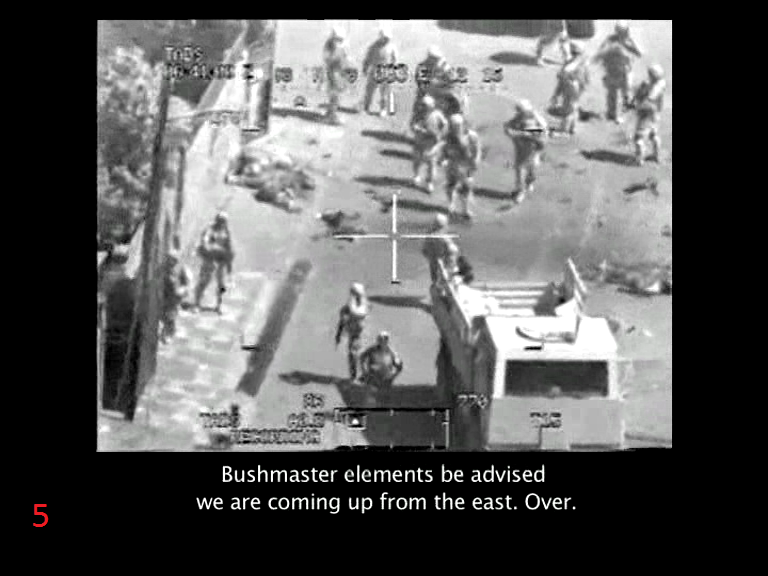
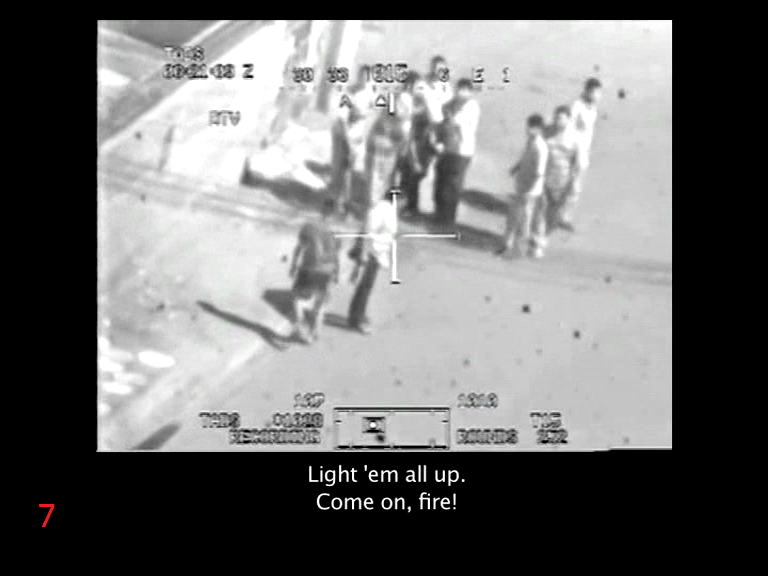
Our first view of the first group of victims (Pic 1) shows over a dozen men who are clearly acting in a casual manner. In general they are progressing but here is also milling and conversation going on amongst them. Two of them have visible shoulder straps. These are from cameras and they look like cameras considerably more than they look like weapons. They identify one other “weapon” which is inflated to the claim that there are “five to six” armed individuals. Pic 2 and the frame immediately preceding it show a long object that could easily be mistaken for an RPG (rocket propelled grenade launcher). However this is not what the gunner will later claim is an RPG and having viewed the entire footage it seems almost inconceivable that the object is in fact an RPG.
vlcsnap-2013-10-03-12h27m46s82
vlcsnap-2013-10-03-12h23m03s22
In Pic 3 we can see the object that the gunner claims is an RPG. It is a camera. It looks a lot more like a camera than an RPG. The reader is invited to review the footage starting at about 00:02:30 and determine whether they think it is feasible that the gunner has made a “positive identification” as required by the ROE (rules of engagement). As for the long object that looked a little like an RPG we can see in Pic 4 that it is now being used like a crutch. In our next fleeting glimpse it looks fairly insubstantial, lending some credence to the speculation that it might actually have been a tripod. There is no visible RPG tube later. Mention is made by ground forces that they believe there might be an RPG round under a body, but bear in mind the only claim that there was an RPG was of something we know for certain was a camera. Further, if it had been an RPG it would pose no threat to the gunship which was far beyond its effective range and too fast to be effectively targeted by a weapon designed for use against armoured ground vehicles. One writer described it as like trying to hit a wasp with a slingshot. And then there is the unexplained statement by the gunner: “Yeah, we had a guy shooting – and now he’s behind the building.” Someone responds as if he was referring to something else (30 minutes earlier small arms fire was heard in the area but its source never identified – that is the only evidence of hostile activity in the area at this point) but the context seems to suggest that he is saying that the “guy shooting” was journalist Namir Noor-Eldeen who may well have been “shooting” his camera.

An hour after these events we do see armed individuals – after an unexplained 30 minute gap in the footage. Before I turn to that, however, I would like to turn to the elephant in the room which seems utterly absent from discussions of whether or not the group of victims carried weapons – that is the fact that so many are quite clearly unarmed.
vlcsnap-2013-10-08-14h26m12s79
vlcsnap-2013-10-14-16h35m29s115

Pics 5 and 6 show armed men. The two men in pic 6 are not visible for very long, but one in particular is so obviously armed that it is quite unmistakeable. Likewise with the US personnel in pic 5. Uniforms aside, the fact that they carry long arms is very distinct. The demeanour and behaviour is clearly different also. The visibly armed men in both instances move in a purposeful manner, often briskly, and they pay attention to those in front. When Namir Noor-Eldeen was aiming his camera lens at the gunship his companions were just standing around having a chat. The gunships were clearly both seen and heard by the men. The gunner who will soon murder these men is quite able to see that they are in no way preparing for an engagement. Though two carry cameras and one a long object, it is clear that all others are plainly unarmed. Here is the ICRC’s (International Committee of the Red Cross) one sentence heading describing “Chapter 1, Rule 1” of customary International Humanitarian Law: Rule 1. The parties to the conflict must at all times distinguish between civilians and combatants. Attacks may only be directed against combatants. Attacks must not be directed against civilians.”
vlcsnap-2013-10-05-14h03m41s218
vlcsnap-2013-10-08-16h32m22s42
In the second attack the two armed men from pic 6 seem to have entered a building. After that this is heard from the gunner [G] and what is almost certainly the pilot [P] of Crazy Horse 18:

31:21 (add 26 seconds to get time on Wikileaks video) …[P] So there’s at least six individuals in that building with weapons.

31:30 [G] We can put a missile in it.

31:31 [P] If you’d like, ah, Crazyhorse One-Eight could put a missile in that building.

31:46 [P] It’s a triangle building. Appears to be ah, abandoned.

31:51 [G] Yeah, looks like it’s under construction, abandoned.

31:52 [P]Appears to be abandoned, under construction.

31:56 [P] Uh, like I said, six individuals walked in there from our previous engagement.

The footage shows nothing of these armed men in the building. The entrance is obscured for 30 seconds and then the gun camera is pointed at the sky for a further minute. When it swings back we see two unarmed men entering the building. Moments later (pic 8) we see another unarmed man walking in front of the building just before the first hellfire missile hits where he stands. 

2) Targeting Rescuers

Rescuers are specifically targeted in the first engagement and seem to be specifically targeted in the second. In the second the footage shows three rescuers (indicated by arrows in pic 9) have arrived after the first missile strike. The gun camera swings away before the second missile is fired. (The camera shows a rectangular reticule while a round dot seems to indicate the point at which the weapon systems are aimed. These are kept aligned at most times but it is very interesting to trace the separation and realignment of these that occurs during this second engagement. It certainly seems conceivable that the camera is deliberately trained away from the aim point of the weapons at times in order to conceal visible events.) While target is out of view we hear:

36:49 Firing.

36:53 There it goes! Look at that bitch go!

36:56 Patoosh!

37:03 Ah, sweet.

37:07 Need a little more room.

37:09 Nice missile.

37:11 Does it look good?

37:12 Sweet!
vlcsnap-2013-10-08-16h36m39s65
vlcsnap-2013-10-08-13h55m59s123
Pic 10 shows some people who were passing and tried to rescue the wounded Reuters worker Saeed Chmagh. A man runs ahead of the van to the victim. Never at any stage do any people or the van give any indication that they are approaching the dead, and yet:
07:07 Yeah Bushmaster, we have a van that’s approaching and picking up the bodies.

07:14 Where’s that van at?

07:15 Right down there by the bodies.

07:16 Okay, yeah.

07:18 Bushmaster; Crazyhorse. We have individuals going to the scene, looks like possibly uh picking up bodies and weapons.

07:25 Let me engage.

07:28 Can I shoot?

07:31 Roger. Break. Uh Crazyhorse One-Eight request permission to uh engage.

07:36 Picking up the wounded?

07:38 Yeah, we’re trying to get permission to engage.

07:41 Come on, let us shoot!

07:44 Bushmaster; Crazyhorse One-Eight.

07:49 They’re taking him.

07:51 Bushmaster; Crazyhorse One-Eight.

07:56 This is Bushmaster Seven, go ahead.

07:59 Roger. We have a black SUV-uh Bongo truck [van] picking up the bodies. Request permission to engage.

08:02 Fuck.

08:06 This is Bushmaster Seven, roger. This is Bushmaster Seven, roger. Engage.

08:12 One-Eight, engage.

Note firstly that they are being dishonest when talking about “bodies and weapons” but that the pretence is fairly thin. When asked “Picking up the wounded?” the voice I have identified as [P] replies “Yeah, we’re trying to get permission to engage.” Then the gunner’s voice says with some agitation, “They’re taking him.” They know full well that they are targeting innocent rescuers and others who hear their radio discussion must also have known.

To properly contextualise this we should look at the US propensity for “double tap” strikes. In it’s use of drones the US has for years been conducting delayed second strikes on targets for the express purpose of killing to who attempt to rescue or treat the wounded. These practices have continued until now despite massive negative publicity, and despite the fact that such actions are war crimes.

This practice can be further contextualised. The sanctions imposed on Iraq caused very, very serious degradation to Iraqi health system, including the hospital system. This worked in conjunction with the malnutrition caused by the sanctions and caused hundreds of thousands to die prematurely, particularly infants and children. During the occupation the degradation of Iraq’s hospitals continued even further. Dahr Jamail produced a report in 2005 that detailed a shocking situation. The ability of the Iraqi medical establishment to attend to the urgent needs of the Iraqi people was abysmal. Most of the urgent medical needs were caused by US actions and the near total disablement of Iraq’s health system was also caused by US actions. Among those who were unable to access adequate care were those wounded by the US. Among the most prominent, and certainly most dramatic, causes of degraded medical care were direct attacks on medical personnel, on clinics and hospitals, on ambulances and on civilian rescuers.

It seems clear from the audio of Collateral Murder that it is normal to target rescuers. Even though the rescuers in the van were nothing but people stopping to help, and the aircrew had no reason to think otherwise, they are clearly transformed into combatants in the delusional world of the gunner, particularly when he utters those chilling words: “Well it’s their fault for bringing their kids into a battle.”

3) “Delightful Bloodlust”

The pretrial testimony of Bradley Manning (now Chelsea Manning), which was smuggled out of a courtroom in May 2013, became most noted for the phrase: “delightful bloodlust”. It is an unusual usage and clearly Manning wished to make people think about what he was saying and to draw attention to the “delight” shown by the killers. There is delight shown. There is eagerness to kill and there is pleasure shown at killing the completely helpless victims. But there are also notes of strain and mental compulsion. The transcript printed above clearly shows the extreme agitation that having to wait for permission to kill more people causes. One can certainly here it in the gunner’s voice when he says “Come on, let us shoot!” In the minutes preceding this is a sequence of events which even more clearly show the “delightful bloodlust” of the Aerial Weapons Team.

Perhaps the most harrowing and disturbing part of Collateral Murder is not either of the times where we can see them mowing down innocent civilians, nor the two visible instances of missiles exploding and killing what seem to be innocent civilians, but the time the camera spends tracking a wounded victim – Reuters worker Saeed Chmagh. The speakers exaggerate when they say he is crawling. What we see is someone too badly wounded to crawl. His suffering is so readily apparent, like his helplessness and his desperation, that it is shockingly offensive when we here:

06:33 Come on, buddy.

06:38 All you gotta do is pick up a weapon.

What weapon do they expect Saeed Chmagh to pick up? How could they possibly expect someone too badly hurt to even crawl to pick up a weapon? What do they suppose he would do with a weapon? If you ask these questions you begin to realise the degree to which gunner is subject to an irrational delusion. He is unable to see a human being. If he saw a human being he would immediately realise that a human being in that state, and in those circumstances, is not going to pick up a weapon no matter how hard you wish him to do so. He might just as reasonably been begging for him to turn into a twelve-point buck. What the gunner sees is a target. He wants to kill the target because he has been trained to believe that is the most meritorious act possible – one which will earn him applause from superiors and peers, and bounteous admiration, if not envy, from the civilian community back home. In order to be able to kill the target the must be able to indicate that certain criteria have been met.

The US has long sought to create military personnel who kill discriminatingly but without volition. In World War II US studies led by Brigadier General S. L. A. Marshall found that only 15 to 20 per cent of riflemen would fire at the enemy in an engagement:

And thus, since World War II, a new era has quietly dawned in modern warfare: an era of psychological warfare — psychological warfare conducted not upon the enemy, but upon one’s own troops. Propaganda and various other crude forms of psychological enabling have always been present in warfare, but in the second half of this century psychology has had an impact as great as that of technology on the modern battlefield.

When S. L. A. Marshall was sent to the Korean War to make the same kind of investigation that he had done in World War II, he found that (as a result of new training techniques initiated in response to his earlier findings) 55 percent of infantrymen were firing their weapons — and in some perimeter-defense crises, almost everyone was. These training techniques were further perfected, and in Vietnam the firing rate appears to have been around 90 to 95 percent. The triad of methods used to achieve this remarkable increase in killing are desensitization, conditioning, and denial defense mechanisms. (6)

The result of the strength, intensity and sophistication of US military indoctrination is to make US personnel into killers and the sort of military code which other nations historically use (not necessarily successfully) to prevent their killers from becoming murderers is largely absent. The US military does not mandate killing innocents, instead it redefines the concepts of innocence, of combatant status, and even of civilian status. For example, in 1969 the top US commander in Viet Nam, Gen. William Westmoreland, claimed that absolutely no civilians had ever been killed by the US in designated free-fire zones, because no-one in a free-fire zone was a civilian, by definition.(7) In Iraq the most disturbing manifestation of this must be the use of the term “bad guys”. This is infantilisation taken to the point of complete insanity. This all-pervasive term (used throughout the chain of command, and used in official documents) maintains the projection of a Hollywood narrative onto real events of violence and, perhaps more importantly, means that personnel do not have to reflect on the nature of their victims.
This is the opening paragraph of the introduction of Chris Hedges and Laila al-Arian’s book Collateral Damage:

Troops, when they battle insurgent forces, as in Iraq, or Gaza, or Vietnam, are placed in “atrocity-producing situations.” Being surrounded by a hostile population makes simple acts such as going to a store to buy a can of Coke dangerous. The fear and stress pushes troops to view everyone around them as the enemy. The hostility is compounded when the real enemy, as in Iraq, is elusive, shadowy, and hard to find. The rage soldiers feel after a roadside bomb explodes, killing or maiming their comrades, is one that is easily directed over time to innocent civilians, who are seen to support the insurgents. Civilians and combatants, in the eyes of the beleaguered troops, merge into one entity. These civilians, who rarely interact with soldiers or Marines, are to most of the occupation troops nameless, faceless, and easily turned into abstractions of hate. They are dismissed as less than human. It is a short psychological leap but a massive moral leap. It is a leap from killing—the shooting of someone who has the capacity to do you harm—to murder. The war in Iraq is now primarily about murder. There is very little killing.(8)

There are two things that must be added to that. One is that the US military is very good at making its personnel want to kill. Killing becomes a matter that defines the identity of the GI. In the US military culture the combatant identity and, to be frank, the sense of manhood is linked to killing. Acts of killing are, as mentioned, lauded and rewarded with everything from badges to beer to R and R leave passes. Commanders, like General Mattis, tell personnel such things as: “It’s fun to shoot some people. You know, its a hell of a hoot. I like brawling. You go into Afghanistan, you got guys who slap around women for five years because they didn’t wear a veil. You know, guys like that ain’t got no manhood left anyway. So its a hell of a lot of fun to shoot them.”(9) The results can be seen in reports such as Neil Shea’s “Afghanistan: A Gathering Menace” which shows a norm of violent, racist and angry men among whom mass murderers are bound to arise. Even back in the US the prevalence of serious violence is alarming. In 2009 David Philipps investigated an infantry brigade stationed in Colorado Springs whose murder rate was 114 times as high as that of their community (he also published a book on the brigade in 2010).

More important even than the strong desire to kill is the fact of the “atrocity producing situations” in which US personnel are placed. The term was coined by Robert Jay Lifton with regard to US actions in Indochina. Naturally it has lent itself incredibly well to biased apologism. If a Japanese psychiatrist had implied that Japanese atrocities in China had been “produced” by “situations” it would undoubtedly be condemned. In fact at the individual level it is the situational factors more than the indoctrination that cause personnel to commit murders and other atrocities but, just as with military mass rape, the most important thing to understand is that these situations don’t simply arise but are created by doctrine and strategy and shaped by tactical practices. Both Japanese and US personnel were immersed in “atrocity producing situations” because the “military” strategy pursued in Manchuria, China, Indochina, and Iraq was a genocidal strategy.

US practices have ensure that US personnel are as alienated from the civilian population as possible. The dividing lines between civilian and combatant are deliberately and systematically blurred. They are manipulated into a sense of enmity with the local population. Threats are more prevalently defined in racial, ethnic, national, political or religious terms rather than military status (which might include arms, training, rank, or membership in a given military or paramilitary formation). No areas, or few areas, outside of bases are made secure from attack. The result is that the entire occupied country of people homes and farms and workplaces becomes viewed as a battlefield and all the people of it become threats. Far from the traditional approach of military organisations seeking to quell or overcome fear, the US military seeks to enhance fear and to channel using “reactive firing”. The fearfulness of US personnel was one of the things that Iraqi’s found surprising and noteworthy. Even US reporter Dahr Jamail wrote that he “marvelled at how scared they were, despite being the ones with the biggest guns.”(10)

Along with the irrational fear was the very real fact that US personnel were often gratuitously put into circumstance where they really were risking their own lives if they were not prepared to kill civilians. For example, they might be deployed to unmarked traffic control points (TCPs) which civilians had great difficulty in even being able to see (imagine how easy it would be at dusk to miss the presence of personnel in camouflaged uniforms at an unmarked TCP) but at the same time left the US personnel extremely vulnerable to suicide bomb attacks.

Fear may or may not be considered a factor in the actions of the murderers in Collateral Murder but it does shape the situation in which they are acting. The US doctrine of “force protection” is explained as being a result of the extreme US aversion to casualties.(11) (I should further refine this to say aversion to battlefield casualties. The US is not averse to producing its own psychological casualties or toxicological and radiological casualties. There widespread exposure to Agent Orange in Indochina, and in the “Gulf War”, when the US had 114 personnel killed by enemy action, an utterly astronomical 250,000 of 697,000 who served contracted Gulf War Syndrome. Apart from exposure to burning oil wells the causes of Gulf War Syndrome, which are understood to be multiple, are the result of US actions. A recent report has detailed the horrific impact of the reckless use of burn pits by the US military which once again illustrates a fundamental lack of concenr for the health and wellbeing of their own). The US officials and commanders may genuinely fear the negative publicity that battlefield casualties might cause, but the actual doctrine of “force protection” becomes a blatant war crime in its application:

A reactive, ‘‘kinetic’’ strategy has lowered the threshold for the use of violence and, in many cases, transferred risk from soldiers to civilians. Particularly in areas designated as hostile, hard-charging house raids, belligerent street patrols, and tense checkpoints make up for a shortage of soldiers on the ground and direct violence away from soldiers and toward civilians. Defying virtually every theory of counterinsurgency, military officials have pursued force protection even at the expense of mission accomplishment. (12)

Transferring risk from soldiers to civilians is a war crime in itself. If you read, for example, the tactical choices made in the Second Battle of Fallujah under the rationale of “force protection” they become a clearly genocidal when applied in a city that still had many tens of thousands of civilian residents. What now seems most poignant is that not only was white phosphorous use to clear bunkers in “shake ‘n’ bake” fire missions (a war crime) but also depleted uranium munitions were used when there was a belief that armed resistors were using walls for cover. One “lessons learned” report from Fallujah II mandates tactics that would almost amount to annihilating all human life in a piecemeal manner: always fire into every room when clearing and always use fragmentation grenades. Use 120 mm tank shells on all buildings before approach. On any enemy contact, burn the place down or use c4 plus propane to create suffocating fuel-air explosive. Marines also used large numbers of demolition charges and thermobaric weapons which cause “concussions, collapsed lungs, internal hemorrhaging and eardrum ruptures.”(13)

This is the background to the events of Collateral Murder and in it we can see common themes. The first is that the “combat” is not some exchange of violent acts, but a one-sided act. In the past the word “combat” would not have been applied to such actions which, depending on one’s moral stance, might have been described as slaughter, murder, assassination or butchery. The second is that, in practice, the transfer of risk is extreme and clearly criminal. Despite seeing nothing that was definitely a weapon, the gunner “positively identifies” six AK-47s and then “positively identifies” a camera as being an RPG launcher. Following this the crew simply murder outright some people who stop to aid the wounded. Afterwards, those killed were designated as insurgents.

The “hostile intent” or “hostile action” which would trigger killings under the Rules of Engagement (ROE) varied widely, and it is clear that even at the time of Collateral Murder when there was a clear single document of “Rules of Engagement” the practice was far more liberal but also clearly codified (and once again a clear war crime). Veteran testimony demonstrates that “hostile intent” or “hostile actions” could be seen in wearing certain clothes, being out after curfew, carrying binoculars or a camera or talking on the phone. The film The Hurt Locker is an extraordinarily offensive collection of some of the rationalisations under which US personnel murdered civilians, presented as if all of these fantasies were in fact real even when they are clearly ridiculous and risible.

4) Lies

One of the most interesting things about Collateral Murder is the lying that goes on. Initially Wikileaks released an edited version of the footage and enraged opponents released extra footage which “proved” that Wikileaks was distorting reality by omitting those parts which show that the aircrew were responding to serious threats to ground forces who had come under fire. Then Wikileaks released all the footage that they had and it was clear that far from giving a context of armed conflict, the aircrew were just inventing things and saying them on air. We’ve already seen them conjure 6 AK-47’s and an RPG launcher from thin to non-existent visual evidence.

When a van appears they claim it is picking up bodies for no apparent reason. Then apparently they are “picking up bodies and weapons” despite a lack of any indication that they are doing so or that there are actually any weapons to be retrieved. The gunner then seeks permission to fire, perhaps on this basis, and does nothing to correct the distortion that was created even when it is amply clear that the targets are fully engaged in trying to rescue Saeed Chmagh and not collecting bodies nor weapons.

And then there is this:

11:11 Hey yeah, roger, be advised, there were some guys popping out with AKs behind that dirt pile break. 

11:19 We also took some RPGs off, uh, earlier, so just uh make sure your men keep your eyes open.

It is such a bald and bold lie that it almost makes one question one’s own eyes. They seem to be lying to the ground forces, but I’m not entirely certain that that is logical. I believe that the ground forces were close to the scene throughout the previous action and thus would have heard that there was no small arms fire (if that is indeed what was being claimed). As for the meaning of the second line it is ambiguous, clearly, but it is obviously part of the warning. The question is whether the lies are really addressed to the ground troops or whether they are more for the sake of recording for posterity and to aid in future legal situations.

5) Killing Journalists

One of the salient aspects of the loose application of the ROE with regard to “hostile intent” is the fact that it clearly causes disproportionate deaths among journalists. Iraq was the deadliest war ever for journalists. In the first three years 71 were killed, more than the 63 killed in Vietnam, the 17 killed in Korea, and even the 69 killed in World War II. The BRussells Tribunal counts a total of 352 Iraqi and 30 non-Iraqi fatalities among media workers up until December 2012. Other reports suggest less, but all reports agree that the majority were killed in a targeted fashion by unknown groups. I would invite the reader to read analyses such as this report by Reporters Without Borders which states that “at least 16 journalists” were killed by the US and then goes on to give details of 15 presumed killed by the US which does not even count the 3 Al-Jazeera staff killed in April 2003. Given that we know that the US considered actions common to journalists to be evidence of “hostile intent”, given that we can see in Collateral Murder that US personnel will seek and receive permission to engage journalists engaged in reporting, and given that we know the US was behind death squads who were killing dissidents, intellectuals, and inconvenient people, does it seem at all acceptable to state that only 16 (or 22) were killed by the US while 83% of deaths were caused by unknown parties who, despite being unknown, are described as “resisting coalition forces and Iraqi authorities”?

It is much more reasonable to draw the inference that directly or through proxies the US was engaged in an unprecedented series of journalists’ murders. If it should also be true that their enemies (who owe their existence to the US occupation) are also guilty of an unprecedented campaign of journalists’ murders, that does not alter the basic truth about US actions. Given that this is the case, it may be that the gun camera footage is actually showing a targeted murder of media personnel. If you saw the footage with the sound turned off that is exactly what you would conclude is occurring in the first ten minutes. Perhaps, given the amount of lies being told, that is what is deliberately concealed. This would resolve a number of outstanding mysteries. It would explain the desperation to kill Saeed Chmagh, first when begging him to pick up a weapon and then when waiting for permission to engage when he is being rescued. It would explain why the gunner gets so agitated waiting for permission to fire when there seems a possibility that the wounded man might be rescued. It might help explain why the other speaker in the same gunship (whom I think of as the pilot) seems to be censoring himself when he says things such as “This is Operation, ah, Operation Secure” (which sounds as if he had meant to say something different and rethought). It might also give a partial explanation for the circumstances which he was commenting on, the sudden rapid appearance of large numbers of ground forces whom had evidently been in waiting nearby and had been told: “Hotel Two-Six, you need to move to that location once Crazyhorse is done and get pictures.”

If it was an assassination deliberately made to look like something else, then it would certainly make it less valuable as evidence of genocide but I thought it would be irresponsible not to mention the possibility. There are mysteries and questions regarding this footage. One source of uncertainty is the unexplained 30 minute ellipsis. The entire sequence which follows is equally mysterious. We cannot really discern what is occurring but the shot of the two seemingly unarmed men entering the half-built building is suggestive of another possible assassination. They certainly appear as if going to meet someone in the building.

Conclusion

Leaving aside the possibility that this was this footage shows targeted killing missions, what is shown is the application of rules and policy based procedures which involve the murder of noncombatants and the targeting and murder of rescuers. The real context of these event is that after 12 years of genocidal sanctions the US invaded and instituted an occupation regime that furthered instability, made reconstruction impossible, created a violent insurgency and then created a bitter sectarian civil war. Of particular significance is the tactic of attacking rescuers, one which is being applied elsewhere. This is an appalling way of psychologically attacking and traumatising the entire genos terrorising those who would act out of humanitarian impulses and giving the entire population a sense of helplessness and utter impotence. On these counts what is shown is evidence of genocide.

This footage reveals an aircrew for whom mass-murder is part of their job. The gunner is eager to the point of desperation to kill men who pose no evident threat. Put within the context of US military indoctrination and the way in which US practices create “atrocity producing situations” this is also evidence of genocide. This can occur with or without racial hatred. Indeed, the violent racial and religious hostility which exists in the US military (descending from the highest levels) is merely useful for the purposes of genocide in the same way the fanatical nationalism and military chauvinism are useful for the purposes of genocide.

Iraq is potentially one of the wealthiest countries on the planet. It has the longest history of any nation. Before reaching the 10th anniversary of the overthrow of it had exported $100 billion in oil and yet it still struggles with shattered infrastructure. Electricity generation is less than half that which was generated before 1990. It remains unstable and vulnerable. By committing genocide the US empire has effectively quelled a threat to its imperial hegemony for more than a generation. Michael Leunig drew a cartoon that explains exactly how to do it:
Leunig - How to do it

(1) Yehuda Bauer, “The Evolution of Nazi Jewish Policy, 1933-1938,” excerpt from A History of the Holocaust, New York: Franklin Watts, 1982. Reprinted in Frank Chalk and Kurt Jonassohn, The History and Sociology of Genocide: Analyses and Case Studies, New Haven: Yale University Press, 1990, p 345.

(2) There were about 150,000 “Jews” in the German military. The vast majority were “Mischlinge” (“part-Jews” who would be slated for extermination if detected in Poland, for example) were but there were at least a few completely Jewish personnel including at least one who was religiously observant.

(3) Vasili Grossman (a Soviet war correspondent) wrote of: “Thousands of encounters. Thousands of Berliners in the streets. A Jewish woman with her husband. An old man, a Jew, who burst into tears when he learned about the fate of those who went to Lublin.” Illustrating not only the capriciousness of a system of mass murder which saw a higher percentage of German Jews survive than Polish Jews, but also the lingering doubt of knowing but not knowing the fate of “evacuees”.(4)

(4) In this, as in so much else, the German Judeocide serves as an extreme example of the insane schizophrenia common to genocides. Genocide, in its essence, is the province of “shoot then cry”. It is nation building with napalm. For every ten hamlets you destroy you build a well and call yourself humanitarian. It is the madness of starting a “quit smoking” campaign in Iraq in 2004 when US personnel were killing hundreds each day. It is, in Fred Branfman’s words“U.S. Ambassador to Laos G. McMurtrie Godley III… moving happily through a Lao refugee camp, friendly and genial to the survivors of his mass murder…” [from personal email]. Branfman went on to write: “…- one cannot imagine a Nazi acting similarly at Aushchwitz. I do think it’s important to understand the new age we have entered in which human beings are mere blips on a radar screen, of no more importance than cockroaches or flies, to U.S. Leaders.” All true, of course, but the Germans did, in even more grotesque ways, evince the same forms of cognitive dissonance. For example, they made a propaganda film about how good life in the Warsaw Ghetto was. They made anti-Soviet propaganda out of the massacre of Poles in Katyn while they were themselves massacring many more Poles, and anti-British propaganda about the famines which British policies created in India while carrying out the same policies to the same effect in occupied Soviet territory. The German people somehow knew, but didn’t know that Jews were being killed in mass executions. They knew, but somehow didn’t know, about the conditions inside the concentration camps.

Our desire to make the Judeocide somehow unique and totally unrepeatable and unrelated to other genocide is as dangerous as it is understandable. (Not that Branfman is subject to that delusion. He wrote that after witnessing the effects of the bombing in Laos: “Without any conscious decision on my part, I immediately found myself committing to do whatever I could to try and stop this unimaginable horror. As a Jew steeped in the Holocaust, I felt as if I had discovered the truth of Auschwitz and Buchenwald while the killing was still going on.”)

Unfortunately, Branfman is wrong to so distinguish between German hatred and US callousness on two grounds. One is that hatred of coloured people in general and East Asians in particular was not in short supply. Anti-Semitism has deep roots, but white supremacy is powerful, sharp and so prevalent that it goes almost unnoticed. Hatred of “Gooks” had been further inflated by the Phillipines War, the brutal Pacific War, and the Korean Genocide. The second is that hate, whether in the Judeocide or in the Indochina Genocide, is of secondary importance. Those who actually undertook to kill millions of Jews, the actual planners of the Endlösung (“Final Solution”) took the same attitude as those who killed hundreds of thousands of Laotians. They pursued concrete strategic objectives (as they phrased things) and the Jews were no more than inconvenient unpeople. The public rhetoric of extermination expounded by Hitler and other German leaders seems ultimately to have little proven concrete relevance to high level policy. One of the most chilling realisations I have ever had is that from the outside there is nothing much to distinguish those who plan the systematic mass killing of civilians by high-altitude bombardment and those who plan the systematic mass killing of civilians by gas. I don’t want to overstate this (there is certainly room to infer a different mental state among Nazi mass murderers) but for me there is no longer the comfort of believing that if we avoid trappings like brown-shirts, the Fuhrerprinzip and militarised mass rallies we are safe from committing crimes akin to those of the Third Reich.

(5) Geoffrey P. Megargee, War of Annihilation: Combat and Genocide on the Eastern Front, 1941, Lanham: Rowman and Littlefield, 2006, p 65.

(6) Dave Grossman, On Killing: The Psychological Cost of Learning to Kill in War and Society. New York, Boston: Back Bay Books, 1995, p 251.

(7) James William Gibson, The Perfect War: Technowar in Vietnam, New York: The Atlantic Monthly Press, 2000 (1986), p 135.

(8) Chris Hedges and Laila Al-Arian, Collateral Damage: America’s War against Iraqi Civilians, New York: Nation Books, 2008, p viii.

(9) Thomas E. Ricks, Fiasco: The American Military Adventure in Iraq, London: Penguin, 2007, p 409.

(10) Dahr Jamail, Beyond the Green Zone: Dispatches from an Unembedded Journalist in Occupied Iraq, Chicago: Haymarket Books, 2007, p 48.

(11) Andrew J. Bacevich, The New American Militarism: How Americans are Seduced by War, Oxford: Oxford University Press, 2005, p 58.

(12) Thomas W. Smith, “Protecting Civiliansor Soldiers? Humanitarian Law and the Economy of Risk in Iraq”, International Studies Perspectives(2008) 9, p 145.

(13) Thomas E. Ricks, Fiasco: The American Military Adventure in Iraq, London: Penguin, 2007, pp 403-4.

The United States of Genocide

Standard

Putting the US on trial for genocide against the peoples of Korea, Laos, Viet Nam, Cambodia, Iraq and elsewhere.

The United States of America was built on a foundation of genocide against the indigenous peoples of North America. In fact, all successful settler colonial societies are founded in genocide. The process is one of dispossession – the erasure of one group identity and the imposition of another on the people and/or on the land. But genocide is not merely the foundation of the US nation state, it is also the foundation of the US empire. The US habit of genocide has not died, but has transformed. The US has become a serial perpetrator of genocide with the blood of many millions of innocents spilled in pursuit of imperial hegemony.

There is a fight going on for the very meaning of the term “genocide”. Western powers assert their right to accuse enemies of committing genocide using the broadest possible definitions whilst also touting a twisted undefined sense of “genocide” which can never, ever be applied to their own actions. New Zealand Prime Minister John Key, apparently taking his cue from the US, is currently pushing for reform of the UN Security Council such that the veto power would be unavailable in cases of “genocide”. The UNSC is a political body and “genocide” will simply become a political term cited by powerful states to rationalise aggression against the weak.

Key notoriously said that his country was “missing in action” because it did not invade Iraq in 2003, reminding Kiwis that “blood is thicker than water”. If his desired reforms existed now, the US would probably have a UN Security Council resolution authorising the use of force against Syria on the grounds of “genocide”.

john-key-hot-dog1

John Key – Prime Minister of Aotearoa (NZ); former Merill-Lynch Currency Trader

All of those who oppose Western aggression justified as humanitarian intervention under the “responsibility to protect” must stop burying their heads in the sand over this matter. This is a very real fight for the future of humanity. We can either learn and propagate the understanding that US imperial interventions are, by nature, genocidal. Or we can just pretend the word has no meaning; indulge our childish moral impulses and the lazy fatuousness of our scholars and pundits; and let Western mass-murderers use this Orwellian buzzword (for that is what “genocide” currently is) to commit heinous acts of horrific violence which ensure the continued domination of the world’s masses by a tiny imperial elite.

(An aside: apparently people like a pragmatic focus to accompany a call to action. So, am I making the most obvious appeal – that US officials be tried for committing genocide? No I am not. They can be tried for war crimes if people really think that “holding people accountable” is more important than preventing suffering and protecting the vulnerable. But it has been a terrible mistake to construct genocide as being an aggravated crime against humanity committed by individuals, as if it were simply a vicious felony writ large. This has played completely into the hands of those propagandists for whom every new enemy of the West is the new Hitler. The means by which genocides are perpetrated are the crimes of individuals – war crimes, for example – but genocide itself is the crime of a state or para-state regime. That is the proper target of inquisition and censure. Though the attempt was tragically abortive, the Kuala Lumpur War Crimes Tribunal recently began hearing charges of genocide against Israel. We need this sort of process to hear charges of genocide against the US. I fully support such efforts, but my real call to action is a call for thought, for clarity and for self-discipline. People are drawn to using woolly thinking over genocide, wishing to use it as the ultimate condemnation of mass violence without reference to any actual meaning of the term. We must not tolerate it in ourselves or others. We are a hair’s breadth away from the point where “genocide prevention” will be used by major Western powers to justify genocidal mass violence)

US “Wars” are Actually Genocides

Every major military action by the US since World War II has first and foremost been an act of genocide. I do not state this as a moral condemnation. If I were seeking to condemn I would try to convey the enormous scale of suffering, death, loss and misery caused by US mass violence. My purpose instead is to correct a terrible misconception of US actions – their nature, their meaning and their strategic utility. This understanding which I am trying to convey is a very dangerous notion with an inescapable moral dimension because the US has always maintained that the suffering, death and destruction it causes are incidental to military purposes – they are instances of “collateral damage”. But, with all due respect to the fact that US personnel may face real dangers, these are not real wars. These are genocides and it is the military aspect that is incidental. In fact, it is straining credulity to continue believing in a string of military defeats being sustained by the most powerful military in the history of the world at the hands of impoverished 3rd World combatants. The US hasn’t really been defeated in any real sense. They committed genocide in Indochina, increasing the level of killing as much as possible right through to the clearly foreseen inevitable conclusion which was a cessation of direct mass violence, not a defeat. The US signed a peace agreement which they completely ignored. The Vietnamese did not occupy US territory and force the US to disarm and pay crippling reparations.

There is no question that the US has committed actions which fit the description of genocide. Genocide does not mean the successful extermination of a defined group (there is no such thing as “attempted genocide”). It was never conceived that way, but rather as any systematic attack on “a national, ethnical, racial or religious group, as such.” Those who deny US genocides usually only deny that there is any intent to commit genocide. The UN definition of genocide (recognised by 142 states) is:

“…any of the following acts committed with intent to destroy, in whole or in part, a national, ethnical, racial or religious group, as such:

(a) Killing members of the group;

(b) Causing serious bodily or mental harm to members of the group;

(c) Deliberately inflicting on the group conditions of life calculated to bring about its physical destruction in whole or in part;

(d) Imposing measures intended to prevent births within the group;

(e) Forcibly transferring children of the group to another group.”

The US has committed these acts many times over and in many different countries. Some people object that this is some watered down version of genocide that risks diluting the significance of this “ultimate crime”. However, bear in mind that the victims of US armed violence are not usually combatants and even if they are they are not engaged in some sort of contested combat that gives them some ability to defend themselves or to kill or be killed. They are helpless as they die of incineration, asphyxiation, dismemberment, cancer, starvation, disease. People of all ages die in terror unable to protect themselves from the machinery of death. Make no mistake, that is what it is: a large complex co-ordinated machinery of mass killing. There is nothing watered down about the horrors of the genocides committed by the US, and their victims number many millions. The violence is mostly impersonal, implacable, arbitrary and industrial.

12turnley3

There are at least three specific times at which US mass violence has taken lives in the millions through direct killing: the Korean War, the Vietnam War, and the wars and sanctions against Iraq in combination with the occupation of Iraq. I refer to them as the Korea Genocide (which was against both South and North Koreans), the Indochina Genocide (against Laotians, Cambodians, and Vietnamese), and the Iraq Genocide (which took place over at least a 20 year period).

There are many ways to show that the US committed genocides in these cases. On one level the case is straightforward. For example, if the US commits acts of “strategic bombing” which systematically kill civilians by the hundreds of thousands, and it turns out that not only is there no rational proportionate military reason, but that US military and intelligence analysis is clear that these are in fact militarily counter-productive acts of gratuitous mass-murder, then by any reasonable definition these must be acts of genocide. The logic is simple and inescapable. I have written lengthy pieces showing in detail that these were large scale systematic and intentional genocides which you can read here, and here, and here, and here, and here, and here, and here.

For a long time I have tried to think of ways in which I condense this in a readable form. The problem in many respects lies with the necessity of overcoming misapprehensions. Genocide is an emotive topic, whilst people are very reluctant to read that those who rule in their name (with whom they sometimes actively identify) are in the moral vicinity of the Nazi leaders of Germany. Permeating every level of the discourse is the constant position (whether as the unspoken assumption or as the active assertion) that the US has never acted with genocidal intent. Intentionality is a topic in its own right, but to be brief I will point out that intent does not require that “genocide” be its own motive. If I kill someone because I want their watch, I can’t turn around and say it isn’t murder because I didn’t intend to kill them because I was really just intending to take their watch. It may seem a ridiculous example, but the discourse of genocide is so twisted that it is the norm even amongst genocide scholars. We keep looking for the people, the bloodthirsty psychopathic monsters, who kill people just for the fun of it and grab their watch afterwards as an afterthought. Unsurprisingly, we find those people among the leaders of those countries who oppose Western political power. Now that includes Syria’s Bashar al-Assad.

The best way of demonstrating US intentionality is to demonstrate the consistency of their approach in different times and places. However, this is a necessarily exhaustive approach, so I have decided to take a different tack here. I wish to sketch a fragment of autobiography here – an outline of the process by which I came to my current understanding of the topic. I want readers to understand that I didn’t seek these conclusions out. I have had it made clear to me, by rather comfortably embedded scholars, that they think that I am being provocative out of ambition. It is a testament to the self-satisfaction of such people that they somehow think that being provocative is some advantage. Academia thrives on the journal-filling peer-reviewed “controversies” of rival schools and scholars, but they aren’t really keen on anything that might actually be of any interest to anyone else. The fact is that I didn’t seek this out and it certainly has not endeared me to anyone that I can think of. On the other, hand I have had people act as if I had smeared my own faeces all over myself for using the g-word with respect to Iraq, and I have had many metaphorical doors slammed in my face. As I hope the following will indicate, at least partially, I cannot but characterise US genocides as such and I cannot but view the subject of absolute urgent fundamental importance.

Coming to Understand

The Vietnam War loomed large in my childhood. I was five when it ended. I watched the critical documentary series  Vietnam: The 10,000 Day War when I was ten or eleven years old. During the 1980s Vietnam War movie craze I was sucked into that powerful quagmire of pathos and adrenaline – not to mention the evocative music. But even then, as a teen, I could not abide the apologism and the way in which American lives and American suffering were privileged. The US personnel were portrayed as the victims, even in films which showed US atrocities. I knew far too much about things such as the nature of the atrocities carried out by the Contras to find that sort of propaganda palatable. For one thing, I had read William Blum’s The CIA: A Forgotten History. This book (now titled Killing Hope and still available) doesn’t leave the reader much room for illusions about the US role in international politics. Perhaps if I had been a little older I might have been “educated” enough to be blind to the obvious, but I wasn’t. While most people managed to avoid facing the facts, I knew from this book and others like it that although the atrocities of the Soviet Bloc were substantial, they were dwarfed by those of the US and its closest clients. If Cuba, for example, has been repressive, then what words remain to describe the US installed regimes in the Dominican Republic, Haiti, El Salvador, or Chile?

pb-120213-massgrave-02.photoblog900

How could one characterise a state that backed and created death squad regimes that massacred entire villages, that tortured children to death in front of parents? How does one describe a militarised country whose meticulously planned and executed bombing raids systematically visited untold death and suffering on innocents as an intended purpose. Any informed person who had an objective proportionate viewpoint could only conclude, as Martin Luther King Jr. had already concluded, that the US government and the wider US corporate state were “the greatest purveyor of violence in the world today.” Fred Branfman, who saw the results of US bombing first-hand in Laos, has more recently concluded that the executive branch of the US government is “the world’s most evil and lawless institution”.

So that is where I was coming from. On moral terms I could not have been more condemnatory of the US government. I considered the US government and military-corporate-intelligence complex to be the worst thing in the world since the demise of the Third Reich. I believed this on the basis that they had demonstrably brought about more suffering, death and destruction than anyone else. If someone had tried to claim that it was for “freedom” I would have laughed bitterly, thinking of the brutally crushed democracies and popular movements that were victims of the US. But if someone had said to me that the US had committed genocide in Korea and Indochina I would have most likely dismissed the claim as emotive overstatement. I didn’t actually know what the word genocide meant precisely, but I would still have seen its use as being a form of exaggeration. Implicitly that means that I took the word “genocide” to be a form of subjective moral condemnation as if it were an inchoate scream rather than a word that might have a consistent meaning. (You can’t exaggerate by calling something “arson”, for example. It is either a lie or it is the truth. Genocide is the same). However, “genocide”, as a word, has been subjected to the ideological processes (described so well by Orwell in Nineteen Eighty-Four) which destroy the meaning of words. Here is how I put it in an academic piece:

Certain words are so highly politicised in their usage that, in Orwellian fashion, they are stripped of all meaning and become merely signals designed to provoke in impassioned unreasoning involuntary response. In this fashion ‘democracy’ means ‘double-plus good’ and the Party members1 respond with cheers and tears of joy. Equally, ‘terrorism’ means ‘double-plus bad’ provoking among Party members, ‘[a] hideous ecstasy of fear and vindictiveness, a desire to kill, to torture, to smash faces in with a sledge-hammer….’2 Genocide plays a starring role in an entire discourse shaped in such a way as to not only excuse but to facilitate the perpetration of war crimes and crimes against humanity. Stripped of any actual meaning but given the significance of being the ‘ultimate crime’ it becomes a tool by which powerful Western states are able to threaten or carry out attacks against weaker states – attacks which are in themselves criminal and which in some instances are actually genocidal. The emotive misuse of the term genocide has become a powerful political tool. As Jeremy Scahill reveals after accusations of genocide by Arabs against black Africans, “even at antiwar rallies, scores of protesters held signs reading, ‘Out of Iraq, into Darfur.’” Scahill adds that, ‘[a] quick survey of Sudan’s vast natural resources dispels any notion that U.S./corporate desires to move into Sudan derive from purely humanitarian motives.’3

30out-of-iraq-into-darfur

What brought me around to using the term genocide was realising that there was no other word to describe what the US did in South Viet Nam. I had been aware that the vast majority of victims of the US military were civilians. It was commonplace to say that 90% of casualties were civilian. (Tellingly Western commentators, including those in the peace movement, would vouch that the figure of 90% civilian casualties was proof of how cruel and deadly “modern war” had become – as if US practices were some sort of universal standard and as if the fact that other belligerents did not produce such high rates of civilian death was not of any interest whatsoever.)

So, US violence mostly caused civilian deaths and the vast majority of those civilians were, in fact, subjects of the US installed puppet [sic] regime in Saigon. They were killing their own supposed allies. I have read all of the rationalisations for why the US thought it was a good idea to kill the civilians of their own client state, and they are all completely insane. I don’t even believe that killing the civilian populations of enemy countries is militarily effective and in that belief I am supported by the strategic analyses of the US itself going back to 1944. Killing the civilian population of an allied state makes no military sense whatsoever. Often killing civilians was rationalised in terms of counterinsurgency (usually crudely reversing Maoist doctrine about the relationship between the guerrilla and the rural population) despite the fact that it was recognised from very early on that the civilian deaths were recruiting and strengthening the enemy.

17bombers_b52_0008

That was the other striking thing about US activities in Indochina – they were systematically killing civilians without apparent purpose, but they were also undermining their own political and military efforts. This happened at all levels. As I was reading and coming to grips with this aspect of history, it seemed that exactly the same thing was playing out in Iraq. In 2003, as invasion loomed, I had initially expected that the US would conduct a fast vicious campaign particularly aimed at inflicting maximum damage to economic infrastructure. They would then leave, crowing about their surgical use of force and minuscule US fatalities. The US would continue to enhance the perceived legitimacy of its acts of aggression and would be able to use economic blackmail to exert neocolonial control. However, I was woefully naïve for believing that. In contrast, Paul Wolfowitz was  absolutely clear on this point – you cannot use normal neocolonial power on Iraq: “…[W]e just had no choice in Iraq. The country swims on a sea of oil.” Instead, the US invaded, occupied and then acted repeatedly and systematically in ways which would very predictably cause armed resistance, just as they had in Indochina. But without that resistance they could not have justified a major military presence and the proconsular rule of the occupation imposed on Iraq.

In 2006 I was able to devote quite a lot of time to the subject of genocide in Indochina as it was the topic of my Honours research paper. My initial understanding of genocide was pretty thin and one-dimensional, but it was sound in the given context. The most important aspect for me was that genocide matched means with ends. War is always a matter of uncertain outcome. To wage war is to wager (the words are cognates). Indeed that is why we use such terms as “wage” and “adventure” for military action. If memory serves, Carl von Clausewitz himself even wrote that a belligerent will never be able to attain their intended war aims because the war they pursue will itself change matters and impose its own realities. In that sense war is a gamble which will always be lost. Genocide is not a gamble.

I saw genocide as being an attack on the peoples of Indochina which avoided the uncertainties of waging military war. The maximal aim of the genocide was the eventual neocolonial domination of Indochina. It worked. In Viet Nam the war and subsequent US economic sanctions were devastating. By 1990 the per capita GDP was only $114.4 Under doi moi liberalisation, Viet Nam has achieved much greater formal economic activity (GDP), but only by submitting to the “Washington Consensus”, which means no price supports for staples such as rice, which in turn means that the real income of the poorest urban dwellers has dropped 5 Former US military commander in Vietnam Gen. Westmoreland characterised doi moi as proof of US victory.6 The point is, though, that genocide doesn’t need an end goal such as such as submitting to neoliberal WTO regulations and IMF conditions. Chomsky called Vietnamese poverty “a vivid refutation of the claim that the US lost,”7 Similar stories could be related with regard to Laos and Cambodia. Whether these nation states are considered enemies or vanquished vassals or friends is of no relevance, the weakness of their populations is a gain in relative power for the US empire, and empires intrinsically function on relative gains.

This is what I wrote in 2006:

…[A]clever strategist, where possible, matches means and ends, thus making results more predictable. In a situation where there is a stated end and a given means are employed and continue to be employed despite continued demonstrable “failure” and are then employed elsewhere under the same rationale with the same results – in such a situation it is possibly worth considering that the “means” are themselves the end. In the case of the Second Indochina War, I will argue the means were widespread general destruction, employed on as many of the people and as much of the societal fabric or infrastructure as was physically and politically feasible. If those were the means, I will suggest, they were also the end. The results are predictable. The dead stay dead.

As I would later discover, when he first coined the word “genocide”, Raphaël Lemkin wrote that “genocide is a new technique of occupation aimed at winning the peace even though the war itself is lost.” He also wrote: “Genocide is the antithesis of the … doctrine [which] holds that war is directed against sovereigns and armies, not against subjects and civilians. In its modern application in civilized society, the doctrine means that war is conducted against states and armed forces and not against populations. … [T]he Germans prepared, waged, and continued a war not merely against states and their armies but against peoples. For the German occupying authorities war thus appears to offer the most appropriate occasion for carrying out their policy of genocide.”

(At this point I would like to urge people to read what Lemkin actually wrote when trying to describe genocide. It is not a time consuming task. You can find the chapter here.)

What I had found was that the US was maintaining the “war”. It helped to recruit its enemies, to arm them, finance them, and to supply them. Just as I was researching this, a book by David Keen was published about the “War on Terror” which claimed that it was a self-perpetuating endless “war system”. It focussed on clearly “counterproductive” actions undertaken by the US, belying its stated aims:

When it comes to war in other words, winning is not everything; it may be the taking part that counts. Indeed, as Orwell saw in his novel Nineteen Eighty-Four, certain kinds of regimes may thrive off energies and perpetual war. The irrationality of counterproductive tactics, in short, may be more apparent than real, and even an endless war may not be endless in the sense of lacking aims or functions.8

Keen never mentioned Indochina. The precedents he cited of were civil wars in Africa. However it was as if the idea of a war system was, in a sense, on the tip of people’s tongues towards the end of the US involevment in Indochina, as if they knew deep-down that the US was not trying to win the war. It seems almost the implicit subtext of Magnum photographer Philip Jones Griffiths’ book Vietnam Inc. which by its title alone suggests an enterprise quite differently conceived than war. Even the orthodox political discourse (with talk of quagmires and a “stab in the back” story of brave soldiers hamstrung by politicians) hints at a war system. What the US did in Indochina was an absolute textbook example of what Keen was describing.

Vietnam_Inc_(Philip_Jones_Griffiths_book)_cover_art

As I found this way of understanding the past, I was also viewing events in Iraq with the same apprehension. What was occurring on a daily basis was very clearly indicating a parallel process. Captured weapons were dumped unsecured in the countryside. Efforts to secure borders (to at least impede the flow of weapons, resistance fighters and money) were systematically undermined. Just as in Viet Nam, diverted cash sloshed through networks of corruption and was available to resistance groups. People were driven into the arms of the resistance by the random brutality of US personnel, the murderous use of indiscriminate ordnance, and the systematic degradation of the civilian economic sphere. On top of this, the US fomented a civil war.

It is a pity that Keen did not know of the Indochina precedent, because what we know of it goes much deeper and reaches much higher than the what we know of the “War on Terror” (which Keen takes to include Iraq and Afghanistan interventions). Keen discusses various tactics and policies which are counterproductive. But it is not just the counterproductive things which sustain US enemies, it is the ways in which US leaders ensure that they cannot ever achieve a victory. This is what I wrote:

Numerous people, including Jeffrey Record9 and Harry Summers,10 have in effect suggested that the US lacked any winning strategy. In fact, what they had were three no-win strategies – strategies which did not, even in theory, have an end point at which a military victory would be obtained. These were the fire-power/attrition, the graduated response and the enclave strategies. The only strategy by which the US could have attained its stated objective was the pacification strategy, but this too was no threat because the pacification strategy was only weakly implemented while being misapplied, subverted, sabotaged and contravened – not least by the more vigorous application of the fire-power/attrition and graduated response strategies.

You can read all about thatstuffin detail if you want, otherwise you’ll just have to take my word for it. The US systematically ensured that it could never achieve “victory” in Indochina. Perhaps the most blatant example was the brutal genocide unleashed on Cambodia from 1970 until 1975. Not the “genocide” or “autogenocide” of the Khmer Rouge, but the genocide before that, without which there would never have been a Khmer Rouge takeover. Here’s a long excerpt from my Honours piece:

When the the US generated a war in Cambodia they had already had a great deal of experience in Viet Nam and Laos, and what occurred in Cambodia is, in many ways, a naked exposure of the logic behind the genocidal war system, less obfuscated because, ironically, Cambodia was a “sideshow” where it was not the details but the whole war which was kept obscure from the public.

Within a year of Lon Nol’s coup, as mentioned, the economy of Cambodia was virtually destroyed, not only by bombing, but also by US aid. Aid was channelled to the import of commodities and surplus US agricultural goods. It also underwrote the Cambodian government and armed forces: “By the end of 1970, the government was spending five times its revenue and earning nothing abroad.”11 Most of the population became reliant on US aid to eat, and rice supplies were kept at the minimum level needed to prevent food riots. By 1975, malnutrition was widespread and many children starved to death.12

Less than two months after the coup that brought Lon Nol to power, the US invaded Cambodia, along with ARVN forces. They did not bother to forewarn Lon Nol who found out after Richard Nixon had announced the invasion publicly.13 This invasion along US and RVN bombing and the civil war made refugees of around half of the Cambodian population.14 Lon Nol was outraged by the invasion and when later briefed by Alexander Haig (then military assistant to Kissinger) about US intentions he wept with frustration. According to Shawcross, “He wished that the Americans had blocked the communists’ escape route before attacking, instead of spreading them across Cambodia. … The Cambodian leader told Haig that there was no way his small force could stop them. … [Haig] informed Lon Nol that President Nixon intended to limit the involvement of American forces…. They would be withdrawn at the end of June. The the President hoped to introduce a program of restricted military and economic aid. As the implications of Haig’s words for the future of Cambodia became clear to Lon Nol, he began to weep. Cambodia, he said, could never defend itself.”15

As has been detailed, US actions, particularly in bombing, were directly responsible for creating the communist enemy which overthrew Lon Nol. The bombing between 1969 and 1973 took up to 150,000 lives.16 If averaged out, over 33 tons of ordnance were used to kill each Khmer Rouge insurgent.17 Despite the fact that Vietnamese pilots bombed any Cambodian they could, which aided only the Khmer Rouge, Lon Nol acceded to a US demand that he request an increase in VNAF bombing in 1971.18

By May 1972, the Lon Nol regime had control of perhaps 10 per cent of the country and continued to lose territory which was thereafter fragmented into ever smaller enclaves.19 The result was by that stage foregone, and yet the war dragged on for three years with the greater part of the 1 million casualties occurring after that point.

In 1970, when Henry Kissinger briefed Jonathan “Fred” Ladd, who was slated to conduct the war in Cambodia, he told him: “Don’t even think of victory; just keep it alive.”20

When the US Congress finally blocked aid to Cambodia and South Viet Nam, it was with the belated realisation that such aid would not give any hope of victory or improve a bargaining position. Senator Mike Mansfield spoke out, “Ultimately Cambodia cannot survive…. Additional aid means more killing, more fighting. This has got to stop sometime.”21

It was pretty clear that the US was maintaining the situation of armed conflict in order to commit genocide. This was a comprehensive act of genocide which did not merely involve the systematic killing of the target populations, it also involved every other “technique of genocide” described by Lemkin. There was systematic economic, social, cultural, political, and religious destruction. There was the systematic and deliberate ecocidal poisoning of the land and people with defoliants. There was very raw brutality. People were slaughtered by bombs, but there was also murder, rape and torture on a scale beyond imagining. In one book co-written by Nick Turse he finds that when he sets out to find the site of a massacre in Vietnam it becomes like trying to find a needle in a haystack of massacre sites.22 In his next book Kill Anything that Moves Turse tries to show that haystack for what it is. The results would be hard to believe if they were not so well documented. I cannot reduce its contents here, I can only recommend that people acquire and read the book. It is a litany of slaughter that seems almost endless and through it all the command structure and the political structure provide the framework for the personnel to commit atrocities.

MERE GOOKS

This is not just about the choice of tactics – it is also about “grand tactics”, strategy, doctrine, and indoctrination. Psychiatrist and author Robert Jay Lifton famously discussed “atrocity producing situations” as a driving factor behind US war crimes, and I believe we can now conclude these situations were deliberately created, not just because we have other evidence that atrocities were tacitly encouraged, but because the US went to great lengths to replicate these these “atrocity producing situations” in Iraq.

Why Genocide and Not War?

By the end of my honours thesis I was convinced that both the 2nd Indochina War and the “Iraq War” were “genocidal war systems”. Since then I have learnt a great deal more, and my thinking has developed a great deal more. I won’t bore you with the detail, but I came to realise the the “war system” appellation was largely redundant. Genocides are “war systems” by nature. Almost every perpetrator of genocide explains their violence as fighting war.

Genocide was a key means by which the US secured global hegemony in the post-WWII era. I learnt that Korea was also a case of US genocide. US actions there were as shocking, as deadly and as militarily nonsensical as they were in Indochina. Hundreds of thousands were massacred and hundreds of thousands incinerated. 25% of the entire population of North Korea was killed and we should not forget that many hundreds of thousands of the ostensibly allied South Koreans died at US hands or those of US commanded troops. The whole war became widely recognised as a pointless killing machine (described as “the meatgrinder”) while the US needlessly sabotaged and prolonged armistice negotiations.

16Bombing_onto_Pyongyang

I can’t explain in this space why Korea, Vietnam and Iraq posed such great threats to US imperial hegemony, but they did and the US successfully dealt with those dangers by committing genocide. These are successful uses of genocide to establish, deepen and maintain imperial hegemony, but we have wilfully blinded ourselves to their nature. Critics of US interventions have evidently been scared to entertain the notion that there was some successfully applied rationale to US behaviour. They have joined with the lovers of war, the nationalists, the racists and the fanatics in declaring over and over and over again the wrong-headedness and failures of US military endeavours. The victims of US genocide quite understandably prefer to see themselves as the plucky Davids that beat the Pentagon Goliath. These are all lies.

US forces storm into one house after another, claiming to be trying to kill flies with sledgehammers. Given that they have entirely demolished several houses and severely damaged many others; and given that they have been caught red-handed releasing flies into targeted houses; and given that they forcibly try to make people buy very expensive fly “insurance”; maybe it is time we consider that neither they, nor their sledgehammers, are concerned in any way with flies (except as a pretext).

Where people might once have been terrified that to suggest any cogent purpose to US actions for fear of giving credit to warmongers, we need not be so worried now. It is very clear that the US does not exert imperial hegemony for the sake of peace and stability, or even for the sake of the enrichment of the US and its people. They never protected us from the nefarious threat of communism and they don’t protect us from the nefarious threat of Islam. A very narrow group of imperialists who share a cohesive long-term hegemonic programme have successfully concentrated power and wealth levels of disparity akin to those in slavery-based economies. They have also created a neofeudal framework of privatised regnal rights. No doubt many of these people have noble intentions, believing that only by such ruthless action can they exert enough control to save humanity from its self-destructive impulses. Many elitists will openly express such opinions and we can certainly understand having concern over the future of the planet. But such people are, in fact, completely insane and they should be taken out of circulation and treated exactly like any other dangerous megalomaniac who believes that they are the new Napoleon. It is not the masses that are threatening the planet. It is not the masses who bring about wars. And though communal violence seems almost the epitome of the mob in action, I know of no genocide that did not result from the actions of a narrow elite.

The reason that we must view US genocides as being genocides and not wars is that we cannot ever understand the logic of their actions in any other way. People shy away from the term genocide and people react violently to what they perceive as its misuse. That indicates just how important it is. I mentioned Nick Turse’s Kill Anything that Moves which is an entire book devoted primarily to the systematic killing of non-combatants. He never uses the term “genocide”. In a work based on veteran testimony, Chris Hedges and Laila al-Arian explain that the very nature of the Iraq occupation is that of an atrocity producing situation and that US personnel have gone “from killing – the shooting of someone who [can] harm you – to murder. The war in Iraq is primarily about murder. There is very little killing.”23 They are talking about the systematic murder of civilians in small increments multiplied many times over, but they never use the term “genocide”. This despite the fact that US actions in Indochina have widely been adjudged genocidal and despite the fact that it was very strongly argued that the US and UK controlled sanctions against Iraq were genocidal. Ask yourself this: if someone was documenting the same thing being perpetrated by Sudan, or by Zimbabwe do you think the word “genocide” would be left out of such works?

Above all we must end the continuing fatuous nonsense spouted by security geeks (including high ranking military and civilian personnel) who seem to believe every exaggerated claim about threats from the Cubans, the Iranians, the Soviets, Al Qaeda in the Falklands (AQIF) or whomever. The morons with their clichés about “fighting the last war” will never ever tire of telling us how the US just doesn’t know how to do counterinsurgency. Really? The question must be, then how did they manage to remain so bad at counterinsurgency when they have spent more person hours on counterinsurgency and counter-guerilla warfare that all other states throughout the entirety of humanity added together? (I could list a few examples here starting with the Indian Wars, mentioning 200 years of interventions in the Western hemisphere, Cuba, Philippines, Pacific War, Korea and Indochina. Then there is also the institutional knowledge built and disseminated by “security co-operation”. Moreover, the US is trains many of the rest of the world’s military leaders to conduct counterinsurgency at Fort Benning).

The point is that you can’t understand what the US does through the lens of war. It is very satisfying, no doubt, for young liberal reporters to outsmart generals (who clearly have no idea how to fight wars because they are just stupid Republicans), but it is seriously delusional. There is an instant exculpation given when these genocides are misrepresented as wars. It is very, very important for perpetrators of aggression or genocide (or both) to conceal their intentionality. The UK government and Tony Blair, in particular, showed far more concern with convincing people that they themselves believed in their fictitious casus belli, than with convincing people that Iraq really did have pose a threat. All of the British media seemed to echo the mantra that you might not agree with Blair but, “no one can doubt his sincerity”. So for moral reasons, in order to end the impunity of the worlds worst war criminals, as well as for intellectual reasons we must grasp the nettle and begin using the term genocide.

Textbook Cases

There are many problematic areas in the subject of genocide. Sometimes it is hard to tell when war ends and genocide begins. It can be hard to tell where state repression becomes persecution and when persecution becomes genocide. Were not the Nuremburg Laws an epitome of what we now call apartheid? Is apartheid a form of slow genocide? Is there structural genocide? Should something only be called genocide if there are mass fatalities?

These are all important considerations and questions, but none of them are relevant here. The genocides I have referenced are absolute textbook cases of genocide. It is impossible to create a coherent and rational definition of the term “genocide” which does not include these genocides.

These genocides were more demonstrably genocidal in nature than the Armenian Holocaust. We should always remember that for the Turkish government, and for most Turks, there was no such thing as a genocide of Armenians. In their own eyes they were fighting a war against Armenian insurgents. Sound familiar?

1In Orwell’s allegory the ‘Party’ represented the ‘educated’ sector of society – people such as the central character Winston Smith, who worked as a journalist.

2George Orwell, Nineteen Eighty-Four. London: Penguin, 1983.

3Jeremy Scahill, Blackwater: The Rise of the World’s Most Powerful Mercenary Army, London: Serpent’s Tail, 2007, p 350.

4Hy V. Luong, ‘Postwar Vietnamese Society: An Overview of Transformational Dynamic’ in Hy V. Luong (ed.), Postwar Vietnam: Dynamics of a Transforming Society. Oxford: Rowman and Littlefield, 2003, pp 12, 14.

5Nicholas Minot; Francesco Goletti, ‘Export Liberalization and Household Welfare: The Case of Rice in Vietnam’ in American Journal of Agricultural Economics, Vol. 80, No. 4. (Nov., 1998), p 743. Minot and Goletti actually (to their own evident surprise) projected a slight overall drop in poverty, but they do so on the basis of changes in real income which do not take into account that rural persons are better able to acquire food without income expenditure. They also slightly underestimate the level of urbanisation – they use the 1990 figure of 20 per cent, when by the time of their writing the figure was over 23 per cent (Michael DiGregorio, A. Terry Rambo, Masayuki Yanagisawa, ‘Clean, Green, and Beautiful: Environment and Development under the Renovation Economy’ in Hy V. Luong (ed.), Postwar Vietnam: Dynamics of a Transforming Society. Oxford: Rowman and Littlefield, 2003, p 189.) and do not account for future urbanisation. Michel Chossudovsky suggests that the Vietnamese did, in the actual event, become considerably poorer (Michel Chossudovsky, The Globalisation of Poverty and the New World Order. Shanty Bay, Ontario: Global Outlook, 2003, p 168).

6Marc Jason Gilbert, “Introduction”, in Marc Jason Gilbert (ed), Why the North Won the Vietnam War. New York: Palgrave, 2002, p 26.

7Rethinking Camelot: JFK, the Vietnam War, and US Political Culture. Boston: South End Press, 1993, p 30.

8David Keen, Endless War? Hidden functions of the ‘War on Terror’. London, Ann Arbor: Pluto Press, 2006, p 51.

9Record, “How America’s Military Performance…”, in Gilbert (ed.), Why the North Won the Vietnam War, p 117.

10Harry G. Summers Jr., On Strategy: A critical analysis of the Vietnam War. New York: Presidio Press, 1995 (1982), p 103.

11William Shawcross, Sideshow: Kissinger, Nixon and the Destruction of Cambodia. London: Fontana, 1980 (1979), p 220.

12Ibid, pp 317-9.

13Ibid, p 149.

14Sorpong Peou, Intervention & Change in Cambodia: Towards Democracy? Singapore: Institute of Southeast Asian Studies, 2000, p 127.

15Shawcross, Sideshow, p 163.

16Ben Kiernan, The Pol Pot Regime: Race, Power, and Genocide in Cambodia under the Khmer Rouge. New Haven and London: Yale University Press, 1996, p 24.

17Ibid, p 19.

18Shawcross, Sideshow, p 186.

19Ibid, pp 254-5.

20Ibid, p 169.

21Nigel Cawthorne, Vietnam: A War Lost and Won. London: Arcturus Publishing, 2003, p 213; Westmoreland, ‘A Look Back’.

22Deborah Nelson, The War Behind Me: Vietnam Veterans Confront the Truth about U.S. War Crimes, New York: Basic Books, 2008, p 127.

23Chris Hedges and Laila Al-Arian, Collateral Damage: America’s War against Iraqi Civilians, New York: Nation Books, 2008, p xiii.

The Korean Genocide – Part 1, Before the US Occupation.

Standard

(Author’s note: I was intending to be writing a long overdue piece about why the one should never refer to “The Iraq War” but rather “The Iraq Genocide”. It is daunting. You cannot simply make such a case in 1000 words, at least not in any way that convince or even empower anyone who was not already firmly of that opinion.  In these circumstances I feel it is worth going back to another enormous brutal US genocide which is never, ever discussed as such – the Korean Genocide. A Korean had commented on my facebook page that my cover photo, Picasso’s Massacre in Korea depicted the “genocide of antiimperialists”.
It is no coincidence that I chose that painting. Korea saw the development of a style of genocide which was later to be repeated by the US in Laos, Viet Nam, Cambodia, Afghanistan and Iraq. In a four part series (adapted from an even longer work) I will detail 1) Korea before US Occupation, 2) US Occupation Period and the US Imperial Context, 3) June 1950: Who Started It?, and (by far the longest part) 4) Korean War or Korean Genocide?)

PicassoMassakervonKorea1951
The premise of this blog is that the most significant post-World War II US military actions are acts of genocide. Genocide can be said to mean “war” undertaken against a whole population, not against its military nor, in any immediate sense, its military capacity (see my previous post about the nature and meaning of genocide). Further, the manner in which the US commits genocide is under the guise of fighting wars. In fact, these are best viewed as “war systems” in that, far from seeking military victory, the US sought to avoid decisions (even victorious decisions) in favour of extending the period of violence for as long as was feasible. The prototypical example was the Korean War, wherein attempts to achieve a military decision were abandoned in favour of an “attrition” strategy. This was putatively aimed at forcing a negotiated settlement, but the US itself was clearly the greatest impediment to reaching a settlement.
Korea, like Viet Nam and Iraq, was targeted because of two crucial circumstances. Firstly, it was potentially strong independent nation state and, secondly, it was vulnerable. The Korean Genocide served the ends of both the US and the USSR. The origins of the military advance south by DPRK forces on June 25, 1950 that initiated the “Korean War” are still surrounded by impenetrable mysteries and unanswered questions, and there is legitimate space for the intriguing possibility of tacit or conspiratorial collusion between the US and USSR.
The reader may well object already to my misuse of the term genocide, but allow me to anticipate some objections and make some observations. Genocide does not mean extermination or even intended extermination. The United Nations Convention on the Prevention and Punishment of the Crime of Genocide (UNCG) specifically uses the phrase “in whole or in part”, and for good reason.
Consider what is generally held as the ultimate exemplar of genocide, the Judeocide committed by Germany in Europe. The Germans never intended to exterminate all of the world’s Jews. Even confining the matter to European Jewry, there was a huge problem simply in defining who was and was not a Jew. They had to rely ultimately on confessional identification to define an alleged ‘race’.
As Yehuda Bauer wrote: “One can see how confused Nazi racism was when Jewish grandparents were defined by religion rather than so-called racial criteria.”1 As well as the fact that many with Jewish heritage would inevitably successfully evade detection, in the Nuremburg Laws (and later when deciding who to kill at Wannsee), exemptions were made on various criteria, such as being a decorated war hero. In fact, when it comes to the killing aspect of genocide, inconsistency, hypocrisy and schizophrenic dissonances are the norm.
Equally, genocide is not the exclusive domain of irrational and evil perpetrators. The very point of coining the term genocide, as will be explained, was to indicate a strategic paradigm with a functional logic. Irrationality is therefore a moot point and I prefer to distinguish between “functional” and “dysfunctional” genocides. Equally, “evil” is in the eye of the beholder. The hateful and racist rhetoric of the Nazis is an unavoidable feature of their existence, but in most instances of genocide there is a predilection for highlighting the evidence of fanaticism and hatred for the official villains (those at odds with Western interests)2 while ignoring identical statements made by Western personnel or their allies. In the case of the US there are plenty of instances of significant officials using fanatical, hateful or exterminationist language regarding communists, Asians, Arabs or Muslims.
Racism is a consciously inculcated trait used by the US, as by others, to harness not just hateful and violent tendency, but also infantilisation and a elevated sense of self which conveys both the right and duty of intervention and the wielding of imperial power (the “White Man’s Burden”). Racism also has its own logic, which may cause dysfunction when applied by the overzealous. On the whole, however, US genocides are highly functional strategically oriented imperial genocides. A point I neglected to make in my previous post about the meaning of genocide, and one well worth remembering, is that genocide is employed in order to achieve goals that cannot be achieved by military means. Lemkin related this back to the “imposition of [the genocidal power’s] national pattern” on the victim group, or on the land which they inhabit (after they have been cleansed therefrom). That is, however, to impose a predetermined end to genocide, whereas in empires which are not based around contiguous land formations it is not exceptional for genocide to be used simply as a way of weakening and immiserating a local population to facilitate the imposition of imperial power (which is itself often defined as the replication of power structure not dissimilar to Lemkin’s description but without reference to “nation”). In King Leopold’s Congo, for example, of an estimated 30 million there was a population decline of ten to thirteen million people from 1885 to 1908 from “murder, starvation, exhaustion and exposure, disease, and plummeting birth rates.”
There was little effort, at that stage, to impose a national pattern on the people or the land (although that did come later when Belgium took over). In fact, further to what has already been mentioned with regard to genocide being used for ends which cannot be achieved with military means, it may be obvious to some readers that in fact there is more strategic incentive to commit genocide in instances of informal imperialism or neocolonialism. Formal imperialism can be imposed by military means, taking over the reins of power from above. It only runs into trouble when it is imposed on a genos with enough consciousness to expect self-determination. This is what occurred in Iraq under the British (which I will discuss at some future time) and Korea poses similar challenges to imperial power.

Korea has a long stable history of political unity dating from 668 CE until it was divided in 1945.3
As impressive as that is, the Koreans go further, tracing the origins of their nation to the 3rd millennium BCE,4 and their written history (albeit initially written by Chinese) precedes political unity by a millennium.5 Relations with neighbours Japan and China have varied considerably over the centuries, but it is fair to say that, as with many other Asian polities a national identity cohered sharply in reaction to the inescapable presence of China. Before there even was a Korea, there was an established tradition of heroic resistance to foreign incursion,6 and another, seen by some as portentous, of drawing foreign powers into internecine conflict.7 The 16th and 17th centuries saw Korea fight off major Japanese and Manchu invasions.8 By the time Western interests turned their eyes towards Korea, there was a general hostility towards all foreigners, which probably had its first inklings in the Mongol invasions of the 13th century.9 The attitude of what is referred to as the “Hermit Kingdom” is summarised by Cumings as: “We have nothing. We need nothing. Please go away.”10

Council_of_War_USS_Colorado_June_1871
Western liberal imperialists did not, and do not, recognise anyone’s right to be left alone. Kanghwa Island, near Inchon, became a magnet for foreign gunboats. The French landed in 1866 and were pushed back. A heavily armed US schooner in that same year sailed up the Taedong river towards Pyongyang, opening fire on the angry crowd which gathered on the banks only to be grounded by the tide, the crew massacred. Five years later this provided the pretext for a US attack on Kanghwa.
650 Koreans were killed in what was referred as the “Little War with the Heathen”.11 Japan, like the Western powers, also sent gunboats to Kanghwa.12 In the end it was the US that succeeded first in “opening” the Hermit Kingdom. Britain, France and the US imposed conditions, such as extraterritoriality for their citizens (meaning they weren’t subject to Korean law when in Korea), which violated Korean sovereignty. In Cumings’s words: “Korea was now fully hooked into the system of unequal treaties….”13
Cumings makes the following comparison between liberal imperialism and the long-standing tributary relationship between Korea and China, a summary which works equally well for contemporary neocolonialism:

“The Sino-Korean tributary system was one of inconsequential hierarchy and real independence, if not equality. The Western system that Korea encountered, however, was one of fictive equality and real subordination. It was the British who did the most to propel the doctrine of sovereign equality around the world, confounding and undermining their imperial practice with an abstract, idealist theory that transferred notions about the free market to international politics…. [A]s Karl Polanyi put it, ‘in the liberal theory, Great Britain was merely another atom in the universe… and ranked precisely on the same footing as Denmark and Guatemala.'”14

It was Japan, however, that came to dominate, albeit in a very Western mode of domination, based on “unequal treaties” and economic “advisers”.15 Japan felt that to even keep pace with the West, it had to dominate Korea.16 Its initial inroads were made in pursuing the same policy as the British in exploiting late 19th century droughts to subvert Korean sovereignty, establishing the ability to force Korea to export food during subsequent droughts, causing devastating suffering.17 From the 1880s onwards Japan aspired to complete domination of Korea.18 This led to war with China in 1894-5,19 and Japan’s acquisition of Taiwan.20 Russia was the next obstacle, rebuffing a Japanese offer of accommodation over Manchuria and Korea due to what is generally held to be racist arrogance.21
The 1904-5 Russo-Japanese war, fought mostly over Manchuria,22 ended in Japanese victory. The door was open to complete Japanese domination, and in 1910 Korea was annexed.23 Western powers extended their blessing in exchange for Japanese recognition of their own colonial privileges.24
The Japanese occupation of Korea was brutal and it was hated. Gavan McCormack poses the question of whether it could be considered genocide:

In the Korean context, Japanese colonialist policy was undoubtedly designed to destroy “Korea” as a “national group” by assimilating it within Japan. However, such measures by other twentieth-century colonialist regimes have not elsewhere been held genocidal. There has been, so to speak, a colonialist exemption, and if that exemption is to be now closed, both logic and morality demand that it be closed against all colonialist powers, not just Japan. In the overall context of the century, the use of the term “genocide” carrying as it does extreme legal and moral oppobrium, to describe acts committed by imperial Japan but not to describe any acts committed by the Western powers must be problematic. If Japan was genocidal in China or elsewhere in Asia, what then shall we say of the French in Algeria or Indochina, the Americans in Korea and Indochina and the Gulf, the Russians in Chechyna?25

For obvious reasons I do not believe that there should be or is a “colonialist exemption”. People do not exempt Germany for colonialist genocide in Southern Africa nor in Eastern Europe which was an equally colonial enterprise. What they exempt is the acts of the Western powers who were victors in WWII which and thus have to be circumspect when (accurately) accusing Italy and Japan of genocides which bear such a close resemblance to these unmentionable instances. McCormack is suggesting that the norm of a politicised discourse is a definitional norm because one simply cannot apply “extreme legal and moral opprobrium” to the actions of Western imperialists, notwithstanding the immense death and suffering brought about. Once again “genocide” loses all meaning and becomes simply another term for “evil” reserved for those who are official enemies.
Prior to annexation the Japanese faced considerable guerilla resistance, but this was all but wiped out by 1910.26 When the annexation did take place:

At least half a million Koreans took part in demonstrations in March and April, with disturbances in more than six hundred different places. In one of the most notorious episodes, Japanese gendarmes locked protesters inside a church and burned it to the ground. In the end Japanese officials counted 553 killed and over 12,000 arrested, but Korean nationalist sources put the totals at 7,500 killed and 45,000 arrested.27

Once annexation had taken place there was a decade of particularly oppressive rule:

…[T]he Government General had grown into a powerful machine of centralized bureaucratic control that undertook the wholesale transformation of Korea’s political, educational, and social structures. It also created the institutions of a modern economy by building a transportation and communications network linking the entire country and creating new monetary and financial systems. In the process of these modernizing efforts, the Koreans were effectively deprived of freedom of assembly, association, press, and speech, and initial efforts were made to liquidate the very concept of a Korean identity. Under the draconian administration of Governor General Terauchi, Korea now entered that dark epoch of developmental shock known to its chroniclers as the “period of military rule,” a term that in English hardly conveys the crushing impact of the Japanese army and police on every aspect of Korean life.28

March_1st_movement

The memorial tablet for March 1st Movement in Pagoda park, Seoul.

The military rule period culminated in a mass mobilisation of protest in 1919 and a particularly bloody repression, but one which provoked international outrage and a backlash in Japan itself.29
After this period the level of oppression gradually and unevenly diminished – “if neither the depth nor the tempo of colonial reform went far in meeting the Koreans’ legitimate demands, the more overtly arbitrary and oppressive aspects of Japanese administration were at least muted throughout the empire during this decade, and the effort to construct modern economic facilities and institutions in the colonies continued apace.”30 The Koreans were not to be “assimilated” as McCormack suggests, but rather incorporated, as Koreans, under Japanese hegemony (another indication that the “national pattern” imposed by genocide does not need to be that of the nation of those who commit genocide). In light of this, Japan was now viewed as a “respectable colonial power”31 which tells us something about the standards of the time. If anything the promise of assimilation into a “Greater Japanese Race” was a false one akin to British promises to coloured people that they too could essentially become British though they would never be accepted as such.
Even now “Koreans” who have lived in Japan for multiple generations are denied citizenship and “Japanese families still pore over genealogies to make sure their daughters’ fiancés have no ‘Korean blood.’”32 There were however, significant efforts to degrade Korean culture (and emplace aspects of Japanese culture) which amply fulfil Lemkin’s cultural criteria for genocide.33
The Japanese brought considerable economic infrastructure, industrial development and education.
They acted in the developmentalist manner often falsely attributed to Western imperialists more inclined to extraction of raw materials and the destruction of local economies. Even this, however, was of little or no immediate benefit to the mass of Koreans whose national economy was enslaved to the needs of Japan. Indeed, it seems inevitable that this colonial developmentalism had nothing to do with paternalistic ideologies of empire (although the Japanese did have their own equivalent of the White Man’s Burden) and everything to do with strategic considerations. One of two strategic approaches in Japanese thought was the “northern advance” strategy which held sway in the Army.
This would see the Japanese project power into North East Asia, ostensibly as a defence against Russian/Soviet threats.34 The obvious role for the Korean peninsula in such a scenario was as a form of beachhead with a developed industrial and transport infrastructure along with a native population capable of operating such.

Groundbreaking_ceremony_of_Gyeongbu_Line_at_Busan,_1901
Groundbreaking ceremony of Gyeongbu Line at Busan, 1901.
World War II saw an elevation of some loyal Koreans by the manpower hungry Japan to positions of bureaucratic power and to commissions within the military.35 Simultaneously there was a surge of active resistance with Koreans making up the largest single ethnic group among the guerillas resisting the Japanese in Manchuria.36 Anti-Japanese activity was to become the key source of legitimacy in the post-war era based on perceived dedication, sacrifice and efficacy. As Keith Pratt puts it the Koreans populated their world with heroes and villains and up until June 1950 (and to a large extent thereafter) the only significant factor in terms of leadership (notwithstanding differences in ideology) was whether one had been a resistor (hero) or a collaborator (villain).37 This greatly favoured Kim Il Sung, who was particularly effective as an anti-Japanese guerilla leader and whom the Japanese had inadvertently boosted by media features pitting him against Korean quislings such Kim Sok-won [later an important General in the Army of the Republic of Korea (ROKA)] who was part of the “Special Kim Detachment” of the Japanese Army (specifically formed to combat Kim Il Sung).38
The communists were aware of Kim’s standing and “just before the Manchurian guerrillas returned to Korea, the top leaders such as Kim Il Sung, Kim Chaek, Choe Hyon, Kim Il, and Choe Yong-gon agreed among themselves to promote Kim Il Sung as the maximum figure, for reasons that included his wider reputation and his personal force. By some indexes the others outranked him; Kim Chaek and Choe Hyon stood higher than Kim in Chinese communist hierarchy.”39 Kim wasn’t in the same completely unrivalled position that Ho Chi Minh was consolidating in Vietnam, but he was a clear front runner and was both charismatic and politically able. Years of bitter violent struggle alongside disparate inchoate guerillas “left Kim Il Sung with a conviction: unity above all else, and by whatever means necessary….”40 That is to say, Korean unity, not proletarian and/or peasant unity.

Undated-KimIlSungwithAntiJapaneseGuerillaArmy
Something of the significance of Kim’s success as a guerilla can be gleaned from the fact that the ROK insisted that the DPRK leader was an imposter, a criminal who had taken the famous guerilla’s name. This lie was adhered to and believed by South Koreans until 1989.41 Indeed, it was not only Kim who sported such nationalist credentials in the DPRK regime. The DPRK would become what Cumings refers to as a “guerilla state” with positions of authority occupied by those who had fought the Japanese and had “impeccable credentials” of suffering and loss.42
The DPRK regime came about due to the Soviet occupation of North Korea. The day after the bombing of Nagasaki, the US unilaterally declared a division of Korea along the 38th parallel and an intention to occupy the southern part.43 From the Soviet perspective this meant ceding control of Seoul to the US. It meant that the greatest concentration of communists, in the South, would be under US occupation while the greatest concentration of Christians would be under Soviet occupation. It meant dividing the agricultural South from a North which was not, and is still not, able to even securely feed its population. Yet the Soviets acceded with great willingness. To understand why this occurred in such a manner and to understand subsequent US/USSR actions is quite straightforward. All of these events make perfect sense if one abandons notions of the relevance not only of ideology, but of culture and, for that matter, of leader’s personalities. If it helps, one might abandon the baggage that is attached when discussing state acts by envisaging instead competing criminal syndicates engaged in a constant dialectic of conflict, accommodation and co-operation in various areas of interest.
The Soviets stood to gain access to ice free ports. This was more tangible than anything the US might want, but fundamentally less important. Hence Stalin was quite prepared to cede the entire peninsula to the US rather than risk the consequences of a US defeat after the Chinese entered the war in force.44 The USSR was faced with a problem in that they stood to gain precisely nothing, in all likelihood, from a unified Korea under Kim Il Sung. Though Kim’s faction of communist guerillas had been based in the Soviet Union for a time, he was fiercely nationalistic and, for good reasons, had no great love or trust for Stalin’s regime (even though Stalin was officially the “Great Leader” to all Korean and Chinese Communists).45 Further, all Korean Communist factions had, to a greater or lesser extent, very strong bonds with the CCP and PLA in China, whose potentially dangerous independence was soon to loom much larger in Soviet calculations than access to Korean ports. Thus the Soviets stood to gain far more from a constrained and dependent Communist regime ruling a fragile half-state than it would gain with an officially ideologically aligned, but fully independent, Communist regime ruling over a potentially strong state of unified Korea. As William Stueck comments, “…for the present a divided peninsula served Soviet interests better than a unified one….”46 Where I would differ from Stueck is in his clear implication that a unified Korea would ever be likely to serve “Soviet interests” in the Cold War paradigm of imperialism.

1 Yehuda Bauer, “The Evolution of Nazi Jewish Policy, 1933-1938,” excerpt from A History of the Holocaust, New
York: Franklin Watts, 1982. Reprinted in Frank Chalk and Kurt Jonassohn, The History and Sociology of Genocide:
Analyses and Case Studies, New Haven: Yale University Press, 1990, p 345.
2  I will use the notion of “the West” which has connotations of Eurocentric culture (and cultural
imperialism), whiteness, liberalism/”capitalism” and material/economic hegemony; as well being redolent of a
hegemonic/imperial history. For consistency I do not use the alternative terminology of “the North” even in instances
where it might be more relevant.
3 Peter Lowe, The Origins of the Korean War (2nd ed.), London and New York: Longman, 1997, p 2.
4 Bruce Cumings, Korea’s Place in the Sun: A Modern History, New York: W. W. Norton, 1997, p 23.
5 Ibid, p 25.
6 Ibid, p 33.
7 Ibid, p 34.
8 Ibid, pp 76-9.
9 Ibid, p 89.
10 Ibid, p 87.
11 Ibid, pp 96-7.
12 Ibid, p 99.
13 Ibid, p 107.
14 Ibid, p 95-6.
15 Mark R. Peattie, “The Japanese Colonial Empire, 1895-1945” Peter Duus (ed.), The Cambridge History of Japan:
Volume 6, The Twentieth Century, Cambridge: Cambridge University Press, 1988, p 225.
16 Akira Iriye, “Japan’s Drive to Great Power Status” in Marius B. Jansen (ed.), The Cambridge History of Japan:
Volume V, The Nineteenth Century, Cambridge: Cambridge University Press, 1989, p 758.
17 Mike Davis, Late Victorian Holocausts: El Niño Famines and the Making of the Third World. London, New York: Verso, 2001 , p 92.
18 Peattie, “The Japanese Colonial Empire, 1895-1945”, p 224.
19 Iriye, “Japan’s Drive to Great Power Status”, p 759.
20 Ibid, p 767.
21 Peattie, “The Japanese Colonial Empire, 1895-1945”, p 226.
22 William C. Fuller Jr., “The Imperial Army” in Dominic Lieven (ed.), The Cambridge History of Russia: Volume II,
Imperial Russia, 1689-1917. Cambridge: Cambridge University Press, 2006, p 542.
23 Cumings, Korea’s Place in the Sun, p 145.
24 Hata, “Continental expansion, 1905-1941”, p 278.
25 McCormack, “Reflections on Modern Japanese History in the Context of the Concept of Genocide”, p 270.
26 Cumings, Korea’s Place in the Sun, p 146.
27 Ibid, p 145.
28 Peattie, “The Japanese Colonial Empire, 1895-1945”, pp 230-1.
29 Ibid, p 234.
30 Ibid, p 235.
31 Ibid.
32 Bruce Cumings, “Why Memory Lingers in East Asia”, Current History, September 2007, p 259.
33 Keith Pratt, Everlasting Flower: A History of Korea, London: Reaktion Books, 2006, p 225 et passim.
34 ‘Northern advance and southern advance were somewhat more ambiguous terms. The first was generally understood
to mean a policy of continental expansion from the Korean peninsula through Manchuria into China proper; the
second was understood to mean expansion from Taiwan into south China and Southeast Asia. Army-first meant that
the army would carry the main burden of expansion, whereas navy-first implied that the navy would. There was a
tendency for greater Japanism [which sought to make Japan a Great Power] to go hand in hand with northern
advance, which in turn implied continental expansion and an army-first policy. Little Japanism tended to be
associated with the southern advance and navy-first positions.’ Hata, “Continental expansion, 1905-1941”, p 271.
35 Cumings, Korea’s Place in the Sun, p 176.
36 Ibid, p 160.
37 Pratt, Everlasting Flower, pp 235-40.
38 Bruce Cumings, The Korean War, New York: The Modern Library, 2010, pp 53-4.
39 Cumings, Korea’s Place in the Sun, p 195.
40 Cumings, The Korean War, p 55.
41 Ibid, p 46.
42 Ibid, p 56.
43 Ibid, p 104.
44 Ibid, p 30.
45 Ibid, p 57.
46 William Stueck, Rethinking the Korean War: A New Diplomatic and Strategic History, Princeton and Oxford:
Princeton University Press, 2002, p 33.

A follow up to my piece on Guardian Death Squad doco – Maggie O’Kane on Democracy Now!

Standard

http://www.democracynow.org/2013/3/22/new_expos_links_torture_centers_in

Further to my last post, producer/writer Maggie O’Kane has appeared on Democracy Now! to talk about “James Steele: America’s Mystery Man in Iraq”. Democracy Now! is not really a mainstream media product with a mainstream audience and it appears that some things are slightly altered for such an audience, but not all. One thing that is interesting is that DN! shows a preference for referring to “James Steele: America’s Mystery Man in Iraq” as “Searching for Steele”. Whose choice that was, I don’t know. It may have been felt that to original title was too unsubtle in emphasising Steele, or it may have been too reminiscent of Austin Powers, or both. It is a good reminder, however, that choosing to emphasise Steele in the title is an editorial decision taken at the expense of both credibility and sensation – something that should in theory be total anathema.

  1. Now O’Kane makes explicit the link that the film was so pointedly coy about – Steele was sent by Rumsfeld in order to create a torture programme (she still avoids that he was sent to create a death squad programme as such). Now we have three US officials inculpated – Steele, Rumsfeld and Coffman – while the carefully constructed question mark remains over Petraeus. Still no mention of Negroponte and Casteel, nor any mention of the innumerable officers and officials in the military, the DoD and the State Dept. who knew exactly what the “Salvador Option” meant and who were all actively or passively complicit. Instead we have a little potted narrative (O’Kane doesn’t have time to read the full script) about how all the grunts that witnessed the horrors in Samarra were too scared to talk to the Guardian because of Bradley Manning’s fate (why?) apart from one brave soul, Neil Smith, who was 21 at the time (20 according to the Guardian article), lives in Detroit and is a born again Christian. O’Kane was quite eager to provide the colour of the biographical detail – a standard journalistic practice, but nevertheless a propaganda technique.
  2. Thanks in part to the real journalism of Allan Nairn (discussing El Salvador) O’Kane is forced to follow Goodman’s lead in acknowledging that the main victims were civilians. However, despite the obvious contradiction, she clings throughout to the “counterinsurgency” and “human intelligence” claims. You can’t get “human intelligence” (“humint”) for use in “counterinsurgency” (“COIN”) by torturing civilians. I’ve already detailed this, but it is worth watching the way O’Kane goes to some effort to apply the “counterinsurgency” frame. She summarises the official punchline at the end of the interview. She takes the very well trodden path of pretending to be almost caught off-guard by being asked to give an editorialised summary. This too is pretty standard for journalists, but is a propaganda or rhetorical technique. A long segment on DN! such as this always ends with Goodman inviting a summary. Obviously O’Kane expects it, but she pretends to do the whole “well, if I was forced to summarise, I’d have to say…” technique which BBC always uses to allow its reporters in the field to tell the audience what to think. Using that platform she tells us torturing 14 year old boys is just what war is all about “…and that’s called counterinsurgency.”
  3. Once again, nothing new is revealed. We are told again that the Wikileaks revelations of FRAGO 242 in 2011 are inexplicably more important than the hundreds of eyewitness accounts, and thousands of mutilated corpses, and stunningly frank official admission that happened 7 or 8 years ago. (For me, this is particularly fascinating. I sometimes analyse propaganda as a necessary adjunct to doing other stuff, but this is the first time that I have become aware that there is a specific alternative dialect of Newspeak. In this case “Wikileaks” means “double-plus good” on DN! in exactly the same way that “patriot” means “double-plus good” on Fox. Whether employed by instinct or by calculation, there is a different idiom or register that is used in exactly the same way as mainstream Newspeak to exactly the same effect. This excites me quite a bit because I think this will give me a much better insight into the likes of the Guardian and also alternative media such as Democracy Now! I may start compiling mainstream and alternative Newspeak dictionaries – reader submissions welcome). O’Kane’s explanation for rehashing old material is that, apparently, no one ever put two and two together before. Once again, these universalising claims are a very standard part of British propaganda. Every time the media colludes with power to lie to people in Britain, they later use phrases like, “nobody could have predicted…”, “everybody felt…”, “we all believed…” “no-one doubted…”. It is a natural outgrowth of a very standard British rhetoric/propaganda technique. If someone on the BBC wants to tell you what to believe they don’t say that to believe otherwise is unpatriotic, or wimpy and effeminate, or evil and against motherhood – they tell you that everyone already believes it “without doubt”. This is much more effective if you have the gravitas to pull it off. So when O’Kane tells us that no-one really put it together before, what she means is that people like herself, and organs like the Guardian, studiously ignored the blindingly obvious and now she feels compelled to point out that “everybody” did.
  4. Far from providing anything new, O’Kane re-restates the orthodox line restated in the “James Steele: America’s Mystery Man in Iraq” (“JS:AMMI”) that was the normal journalistic “wisdom” from 2005 onwards, but she elaborates a little on what the documentary restates. The US started a brutal, torturing interrogation programme to get “humint” for “COIN”, but the nasty Shia militias took over and turned it into a death squad programme. Again, I’ve covered this already – the problems are that this ignores the evidence that the US deliberated sowed the sectarian strife and ignores the indications that the Western media wilfully pushed the sectarian aspect of the death squad programme while suppressing evidence of US co-ordination. This line also relies on a touch of cognitive dissonance on the part of viewers, made easier by the avoidance of facts in “JS:AMMI”. In over 50 minutes there is a lot of “colour” and emotive content in “JS:AMMI”, but some fairly basic facts are left out. Along with the aforementioned restriction of named conspirators, there are very important details left out. One of which is the tactical similarities in the way terror was systematically used by the death squads under Steele in El Salvador, and the way terror was systematically used by the death squads under Steele in Iraq. When one considers that they targeted the same sorts of civilians, disappeared them in the same way, and dumped their mutilated corpses in the same way, it seems a little odd to claim that there was a counterinsurgency programme committing torture, but the widespread death squad violence just arose when Shia militias took over. Is this insulting to the audience intelligence? Maybe, but they have actually managed to split the audience attention, as if they were dealing with two separate stories, and thus people don’t notice that they actually contradict their own apologism. That too, is a known rhetorical/propaganda trick, most famously exploited by O’Kane’s namesake Maggie Thatcher. Thatcher would never deceptively answer a potentially delicate question with first misdirecting the audience into simultaneously thinking about something else so that they would no notice whatever critical falsehood she slipped in in order to advance the false narrative.

The Guardian’s Death Squad Documentary May Shock and Disturb, But the Truth is Far Worse

Standard

In what to many must seem a shocking exposé, the Guardian and BBC, after a 15 month investigation have produced a dramatic full-length documentary about US involvement in the formation and running of death squads in Iraq. One journalist describes the result as a “staggering… blockbuster”. But, by creating a false context, by omission, by deceptive emphasis and by specious analysis the Guardian and BBC have create a false and toothless critique. Indeed, though the authors would probably deny it vehemently, the impression given in this documentary is not inconsistent with the villain of the piece, James Steele, being a rogue Kurtz-like figure, with Col. James Coffman cast in the role of faithful sidekick. Other links to the established death squad practices are conspicuously absent – links such as John Negroponte’s appointment as Ambassador to Iraq and Steven Casteel’s role in forming the Police Commando units which functioned as death squads (not to mention ordering the Oregon National Guard to return rescued prisoners to their torturers). Even at the most basic level, the fundamental context was obscured, including one fact that the widespread use of death squads confirmed – the US-led “counterinsurgency” was not war, it was genocide.

Perhaps the most striking thing of all is that, after 15 months of investigation and nearly ten years after US officials set in motion the “Salvador option” in Iraq, this documentary reveals much less of substance than was being reported in 2005. In fact, it is a triumph of style over substance which packs an emotive punch, but disarms watchers by its lack of informational revelation. In January of 2005 it became public knowledge that the US was pursuing a death squad programme. In May 2005 the New York Times published the story showing Steele’s involvement in torture. In the intervening years people like Dahr Jamail continued to report on the US orchestration of death squad activity. And Max Fuller spent years and numerous articles (not to mention a website and the book Crying Wolf: Selling Counterinsurgency as Sectarian Civil War) documenting the death squad programme as well as revealing a deliberate ploy to misrepresent US-run death squads as sectarian murder.

Here is what I found wrong with James Steele: America’s mystery man in Iraq:

1) Mortality Data

One of the key distortions here is something very basic, the use of “more than 120,000” as a mortality figure. Some may argue that given the controversy over the mortality, it is only sensible to be conservative. But these figures are more than simply abstract numbers. When some people, most notoriously David Irving, put the case that only one million European Jews died during World War II, the media didn’t suddenly adopt the more conservative figure. In fact, Irving was thrown in prison. Irving’s casualty figure was crucial to his genocide denial, and the same is true of the lower figure used in “James Steele: America’s mystery man in Iraq”. A mortality of 120,000 immediately colours the way in which we perceive US actions in Iraq.

While many simply accept such figures on the basis of faith, the origins of the lowee estimates lie entirely in the work of scoundrels and fools. The figures produced by the two Lancet (“L1 and “L2)surveys indicate a far higher level of mortality and have been reinforced by sources such as the ORB poll. The nail in the coffin of these lower estimates (based on adding the Iraq Body Count figure to those in the Iraq War Logs) came when Les Roberts and students at Columbia subjected the two data sets to analysis, by pains-taking cross-referencing, showed that the two sets of data should be extrapolated to indicate a figure of a similar order, though slightly lower, than the ORB survey suggested. IBC claim that they have a different analysis of the correspondence between IWL and IBC wherein the vast majority of the IWL fatalities are in the IBC count (81%). They also claim, completely speciously, that they can distinguish combatant and non-combatant casualties. However, IWL is thought to cover only about 50% of US military reports (omitting special forces actions, for example, not to mention the incident shown in the footage released as Collateral Murder). Also remember that, as with the “mere gook rule” in Vietnam,1 US forces regularly report civilian deaths at their own hands, such as those in Collateral Murder, as being combatant deaths as a matter of policy.2 You can either conclude that IBC made an honest mistake, trust them on their analysis, and simply add another 15,000 deaths whilst also conveniently ignoring the undisputed fact that the US systematically mischaracterised non-combatant deaths as combatant deaths, or you might think that maybe IBC are not to be trusted. After all, they swore blind in defence of their figure before IWL came out, and barely skipped a beat when the figure jumped over 10% overnight.

We can also use our own brains on this topic. In 2006, the Baghdad morgue received 16,000 bodies of whom 80-85% were victims of violence. In 2005 Robert Fisk wrote: “…in July 2003 – three months after the invasion – 700 corpses were brought to the mortuary in Baghdad. In July of 2004, this rose to around 800. The mortuary records the violent death toll for June of this year as 879 – 764 of them male, 115 female. Of the men, 480 had been killed by firearms, along with 25 of the women. By comparison, equivalent figures for July 1997, 1998 and 1999 were all below 200.” We are really talking about an average of (if you will excuse some arguable rounding up) 1000 per month violent deaths until at least the end of 2007 (with the “surge” being the most violent time of the entire occupation). That gives a figure of 59,000 violent deaths. Let’s be conservative and say that right through to the withdrawal of US troops 50,000 people killed by violence ended up in the Baghdad morgue. What percentage of Iraq’s fatalities does it seem likely to you will have passed through the morgue of Baghdad? Just over 20% of Iraq’s population live in Baghdad, and many who died in Baghdad would not have been taken to the morgue. I think that estimating the Baghdad morgue data as representing any more than 10-15% of Iraqi mortality would be an offence against basic rationality and numeracy, so that too indicates that the figure of 120,000 is a massive underestimate, possibly of entirely the wrong order of magnitude. Another simple and universal yardstick is the number of orphans. The Iraqi Ministry of Labour and Social Affairs estimates that there are 4.5 million orphans (presumably those who have lost at least on parent) of whom 70% have lost parents since 2003. Is it possible that the 120,000 (which includes children) could have an average of 26.25 offspring? What about the number of widows in Iraq. One estimate is that 2.5 million Iraqi women have been widowed by the war. That seems inexplicably high, and in fact estimates range from 1 million to 3 million total Iraqi widows, but it is another indication that 120,000 is simply untenable and far below an actual conservative figure.

2) US War Aims

One of the central lies of the Iraq occupation, one of the greatest frauds ever perpetrated perhaps, is not just that the US sought some sort of peaceful independent democratic Iraq, but that it sought to impose any sort of stable unified regime at all. No doubt many US personnel were genuinely engaged in attempting to create stability, but from the beginning decisions made at cabinet level and later those emanating from the CPA, very effectively and systematically continued the work that began in 1990, and continued through years of bombing and sanctions and military action. That work was to inflict maximum damage on the fabric of Iraq’s society through attacks on social, political, intellectual, religious and economic health, and through the direct killing and immiseration of the Iraqi people. That process is called genocide.

The only evidence that the US ever sought stability is their own say so, and this is hardly surprising if you consider how unlikely it would be for them to admit instead to a desire to destabilise, weaken and fracture Iraq even further than they already had. The reader may recall that famously Gen. Eric Shinseki was over-ruled on the required number of troops for an effective occupation, and only one third of that number was committed. Some readers may be aware that State Department planning for a successful post-invasion occupation (the “Future of Iraq” project) was systematically sabotaged and subverted. Then the original occupying authority, ORHA (Office of Reconstruction and Humanitarian Assistance) was fatally undermined by understaffing, lack of resources, and lack of standing within a chain of command. It was a joke, the only real resources and agency in the country were US military, which ORHA could not exert authority over, or the extant Iraqi institutions, which the US repudiated. After 61 days ORHA was replaced with the next seemingly Joseph Heller inspired spoof of governance – Bremer’s “Coalition Provisional Authority” (CPA).

With the CPA nominally in charge, actual power devolved to a confusing patchwork of military authorities whose only focus was security. Those who have read Imperial Life in the Emerald City know that there was systematic waste, fraud and mismanagement which ensured that reconstruction money belonging to the peoples of Iraq and the US was never successfully used for reconstruction. Everything was undermined. Even James Steele: America’s mystery man in Iraq showed that a mere 6 senior civilian police were supposed to train 30,000 police in 18 months. This sort of thing happened in every imaginable area of governance. So strong is the pattern that explanations of coincidence or incompetence cannot be borne, nor can explanations of systemic failure due to virulent partisan ideology (such as Rajiv Chandrasekaran puts forward).

In the meantime, abetted by the CPA, the US military was actually generating the very insurgency that this documentary would have us believe that the US sought desperately to avoid. As David Keen, author of Endless War, discusses here a function of the “war on terror” is to generate the very enemies which the US can use to justify its “war”. I myself have written about a prior instance of this pattern of US behaviour, the Second Indochina War, wherein the US acted to create recruit, arm and finance its insurgent opposition in order to effectuate genocide against the peoples of Indochina.

In Iraq too, the US actually became the midwives and nurturers of the very insurgency they claimed to be combating. The most obvious example is that by attacking or mistreating civilians, the US acted to recruit survivors and the bereaved as their enemies. In addition, though, accounts from early on in the occupation, in amongst the chaos, US forces left massive amounts of ordnance unguarded in the middle of the desert.3 A wild goose chase for WMD that the administration knew did not exist kept US personnel from securing actual conventional ordnance.4 And in one instance the US Marines more or less simply handed 800 assault rifles, 27 pick-up trucks and 50 radios over to a newly formed Fallujan brigade which promptly and predictably continued in its established role of armed resistance to Coalition occupation in spite of this generosity.5

The US regime also subverted its own personnel’s attempts to secure Iraq’s borders from the arrival of money, arms and fighters. Luis Montalvan gives an extraordinary testimony of obfuscation over the installation of a system for tracking migration, concluding: “From 2007—from 2003 to 2007, no computer systems for tracking immigration or emigration installed—were installed along the Syrian-Iraqi border. This surely contributed to the instability of Iraq. Foreign fighters and criminals were free to move transnationally with little fear of apprehension. It is probable that significant numbers of Americans and Iraqis were wounded and killed as a result of this.”

And then there was the infamous CPA Executive Order Number 2. At a stroke it made 500,000 often armed Iraqi military personnel unemployed. Where there had been none, there was now an insurgency. It should also be noted that the first executive order droves tens of thousands of government employees out of work and inevitably the two together were a massive jump start to insurgency where no serious organised armed resistance had existed to that point.

Also, as will be discussed below, the documentary distinctly gives the impression that US backed death squad activities inadvertently helped fuel sectarian civil war. This relies on the fallacy that death squads are a “dirty war” technique of genuine counterinsurgency (which I will counter below) and ignores the evidence that the US deliberately acted to sow ethnic and sectarian division in Iraq.

3) The “Dirty War” Fallacy

The phrase “dirty war” is used in this documentary to connote that the death squads are a form of counterinsurgency, if perhaps a morally questionable one. But the phrase “dirty war” was first applied to the killings and disappearances in Argentina, not by the Junta’s critics, but by the Junta itself. It is an excuse and a rationalisation of political terror. The Argentine politicide was part of a plan of drastic, if not revolutionary, societal transformation, referred to as el Proceso. The Junta who seized power in 1976 sought a “sanitized, purified culture”.6 Under cover of fighting “terrorism” and insurgency, the Junta implemented a totalitarian anticommunist “free-market” regime by destroying any possible ideological opposition or potentially rival power structures. Feierstein writes: “All those targeted had in common not their political identity, but rather the fact that they participated in the social movements of that time.”7 Those targeted were unionists, leaders of agrarian leagues, and community workers working with the urban poor. This was done over a period of years under the guise of fighting the “dirty war” against “terrorist” guerrillas, despite the fact that Argentina’s Montonero guerrillas were a spent force within 6 months of the coup.8 Some social structures (principally the Church) were cleansed rather than disintegrated, becoming instruments of furthering authoritarian obedience.9 To further ensure unquestioning obedience, books were burned and banned, then a blanket law criminalised writing, publishing, printing, distributing or selling anything found to be “subversive” after the fact. This created a sense of uncertainty and fear. As Galeano puts it: “In this program for a society of deaf mutes, each citizen has to become his own Torquemada.”10

What stands out most in el Proceso is the disappearances. Argentina has the sad distinction of being the first place to nominalise “disappear” into “the disappeared”, just as Guatemala had earlier made its unhappy linguistic contribution with the transitive verb “to disappear [someone]”.11 To disappear someone, rather than to simply gun them down in the streets, is to bring about awful uncertainties about their fate – for the loved ones of the disappeared uncertainty prevents the grieving process and even hope becomes a torment, for everyone the imaginings of protracted torture, usually all too real, become a source of great terror. According to Antonius Robben: “Argentine society became terror-stricken. The terror was intended to debilitate people politically and emotionally without them ever fathoming the magnitude of the force that hit them.”12

I would argue that what distinguishes Argentina from “dirty wars” in Colombia, El Salvador, Guatemala, or Afghanistan and Iraq is that the Argentine Junta, perhaps unwisely in the circumstances, defeated the actual guerillas rather than ensuring their continuance to provide better cover for their ongoing autogenocide. But the pretence of war is often rather thin, surviving only because it is never challenged. Moreover, certain tactics and certain weapons systems are not even suited for military conflict at all. Look, for example, at the armed unmanned aerial vehicles which are currently used by the US government for a “targeted killing” programme. A Predator drone may carry a very lethal payload and the Reaper (formerly “Predator-B”) may carry 4 Hellfire missiles and 2 500-lb bombs. They are not suited for “fighting” opponents with an opportunity to fight back. In fact, while Obama is set on expanding drone usage even further, the US military is set to cut back on drone production because drones are not suited to “contested airspace” and require “permissive” conditions. Reading between those lines you can see that “combat” drones are in fact nothing of the sort because they do not engage in actual combat. The “hunter-killer” appellation is more honest. Reapers and Predators are for use against those who cannot fight back – like aerial death squads.

Death squads, by nature, are not a military tactic whatever their “counterinsurgency” or “counterterror” pretensions. Indeed, to the best of my knowledge, it is a universal trait for death squad programmes to seek to conflate combatant targets with non-combatant. This is not restricted to death squad activity itself, but it part of the belligerent political discourse of the putative counterinsurgent regime. During the Cold War, the enemies were the “communists” and deliberate efforts were made to create the impression that the ideological identification was equivalent to combatant status, at least in as much as legitimising killing. The same applies to the uses of the terms “Islamist” and “militant”. Part of this process is to divide the world up into two camps – as Bush Jr said “Either you are with us, or you are with the terrorists”.

But Bush wasn’t stating anything new. Early in the Cold War, in Guatemala the motto was “’For liberation or against it.’ From this Manichean vision sprung the paranoid anti-communist taxonomy that added to the list of enemies not only communists, but ‘philocommunists,’ ‘crypto-communists,’ ‘castro-communists,’ ‘archi-communists,’ ‘pro-communists,’ and finally the ‘useful fools.’”13 In 1962, the US Joint Chiefs of Staff defined “insurgency” as any illegal form of opposition to regime rule, thus including passive resistance, joining banned unions or strikes, or anything else deemed illegal by a given regime. At this time they openly embraced terror tactics, such as those conducted by death squads, as “counterterror”.14 In South Vietnam, before there was any armed insurgency, the Diem regime conducted an horrific terror (seemingly forgotten to history) thought to have cost 75,000 lives.15 Mobile guillotines travelled the countryside to execute those denounced as communists and the campaign came to a head in 1959 with the notorious Decree 10/59 under which all forms of political opposition were made treason and any act of sabotage was punishable by death. Local officials could label anyone they wished “communist” and thus secure summary sentences of death or life imprisonment.16 Then, the US deliberately created the term Viet Cong, to conflate political dissent with combatant status, and then, when their own personnel began to reinterpret VC as referring solely to combatants, the US military then came up with another term – ‘Viet Cong infrastructure’. Prados defines them as “a shadowy network of Viet Cong village authorities, informers, tax collectors, propaganda teams, officials of community groups, and the like, who collectively came to be called the Viet Cong Infrastructure (VCI).” “Sympathizers” were also counted.17 It was the “VCI” that were the main supposed targets of the “Phoenix Programme” – the US run dedicated death squad programme. Those targeted were usually tortured and/or killed,18 so the programme was a war crime in any respect, but when it was expanded throughout South Viet Nam, it was run in such a way that the vast majority of victims were not in any manner involved with the NLF. Instead of using specific intelligence to target people with at least some known connection to the NLF, lists of names were coerced from detainees physically. Cash incentives were also offered for informers, while President Thieu used the programme to kill political rivals.19 “Neutralizations” resulting from the programme were about 20,000 each year. In 1969, out of a US figure of 19,534 “neutralizations” less than 150 were believed to be senior NLF cadres and only 1 (one) had been specifically targeted.20

In Argentina most victims were not guerillas but union leaders, young students, journalists, pacifists, nuns, priests and friends of such people. 21% of victims were students; 10.7% were professionals and 5.7% were teachers or professors. 10% were Jews who were tortured in specific anti-Semitic ways. CIA noted at the time the use of “torture, battlefield ‘justice,’ a fuzzing of the distinction between active guerilla and civilian supporter…arbitrary arrest… death ‘squads’….” Generals increasingly come to understand the threats as being Peronism and unionism. “One Argentine general is quoted as having said that ‘in order to save 20 million Argentines from socialism, it may be necessary to sacrifice 50,000 lives.’”21 General Jorge Rafael Videla defined his “enemy” in the following terms: “a terrorist is not only someone with a weapon or a bomb, but anyone who spreads ideas which are contrary to our western and Christian civilization.”22

As you can see there is a crossover between main force military “counterinsurgency” activities and death squad activities. In El Salvador, by 1992 there were 6800 guerilla’s and they were faced with over 60,000 regular military and over 50,000 ORDEN paramilitaries (many acting as death squads). The UN found the government side responsible for 95% of deaths, concluding that the violence was not guerilla war, but rather repression. This was also true of the 35 year “guerilla war” in Guatemala. UN estimates over 200,000 were killed. 93% of torture, disappearance and execution committed by government forces; 3% by guerillas and 4% described as “private”. The army was involved in 90.52% of massacres, alone in 55% of cases, in collaboration for the others. “In a majority of the massacres committed by the state, especially by the army, the counterinsurgency strategy led to multiple acts of savagery such as the killing of defenceless children, often by beating them against walls…; impaling the victims; amputating their limbs; burning them alive; extracting their viscera while still alive and in the presence of others… and opening the wombs of pregnant women.” A favoured way of torturing to death was to stab someone then throw them into a pit where they would be burnt to death. Specific deliberate raping torturing killing of women and children was a “counterinsurgency” tactic. “The murder of children was adopted by the army as terrorism – as a counterinsurgency tactic, part of a scorched earth operation.” It was a way of further attacking social cohesion – destroy the graves and the children and there are no ancestors or descendants. Rape was used as weapon to destroy social cohesion.23

The same blurring even applies to the current UAV “targeted killing” programme. The targets are “militants”, not combatants, and in the Israeli “targeted killing” programme (on which the US programme is apparently modelled), though Israeli courts use an “immanent threat” justification to legitimise the strikes,24in practice no victims pose an immanent threat and less than half are even wanted militants, while the rest are, once again, community leaders or political activists.25 If, like Israel and the US, “targeted killings” are carried out with missiles, then it is guaranteed that the majority of victims will not be those specifically targeted. Thus in 2002 when the US conducted a strike on an Afghan villager because he was tall (and therefore may have been Osama Bin Laden who was also tall and may have been in Afghanistan) they also killed two bystanders who were innocent of being tall.26 In the US case, they use “signature strikes”, where there is no known target, more often than “personality strikes”, which ensures that many innocents are killed. In addtion the US uses “double tap” strikes which are follow up attacks designed to kill those who come to help the wounded. It is estimated that about 50 civilians are killed for each known terrorist, but the US has a long standing habit of labelling anyone it murders a combatant by definition.27 William Westmoreland confidently proclaimed that no civilians had ever been killed in a free-fire zone, because people in free-fire zones, whether 9 weeks old or 90 years old, were not civilians by definition.28 Similarly the US government currently defines any “military age male” as a militant unless proven otherwise, and not only do they not investigate such matters, we have no evidence that the US even tries to ascertain whom it has killed other than “military age males”.

As counterinsurgency death squad or targeted killing programmes can only be counterproductive in practical terms, not least because actual combatants are considerably harder to kill than civilians. These are much more efficient at eliminating political dissidents, activists and organisers, but at the same time inflicting terror on the general populace. We have already seen how this occurred in Argentina, but a recent report Living Under Dronesdevotes 30 pages to the non-lethal effects of social disintegration, mental trauma, economic and educational damage, health impacts, and cultural destruction. The constant presence of Reaper and Predator UAV’s audibly buzzing overhead and the constant threat of sudden incineration that accompanies the noise, creates constant grinding stress: “Drones are always on my mind. It makes it difficult to sleep. They are like a mosquito. Even when you don’t see them, you can hear them, you know they are there”. This plays the same role that disappearances do, heightening terror and trauma through “a chronic state of intense uncertainty [while] the later reappearance of highly mutilated corpses instils fear of the unknown rather than the known.”29 Signs of torture and mutilation on the bodies of loved ones creates deep psychological scars, but also militates against compromise promotes armed resistance over unarmed resistance.

The result is what is referred to as the “culture of terror” (a phrase also used to describe the post-2001 interventionism of the US). It inflicts exactly that state earlier mentioned wherein “each citizen has to become his own Torquemada.” This “culture of terror” and, indeed, the very use of deaths squads as a tactic are symptomatic of genocide, in as much as genocide was coined to denote war against peoples rather than armies. The inventor of the term “genocide”, Raphäel Lemkin, put it this way: “Genocide is the antithesis of the Rousseau-Portalis Doctrine, which may be regarded as implicit in the Hague Regulations. This doctrine holds that war is directed against sovereigns and armies, not against subjects and civilians. In its modern application in civilized society, the doctrine means that war is conducted against states and armed forces and not against populations.” It is part of a “composite and manifold” set of behaviours that signify a “coordinated plan of different actions aiming at the destruction of the essential foundations of life of a group”. The claim of those committing genocide that they are fighting “dirty wars” against insurgents has not merely been made in Argentina and Guatemala, but in every major act of genocide including the Herero genocide, the Armenian genocide, the Tutsi genocide in Rwanda (usually known as the Rwanda Genocide), the subsequent genocide against the Hutu in Rwanda and Eastern Congo, and the Bangladesh Genocide (in what was then “East Pakistan”).

If you really want to give proper context to the US backed death squads in Iraq, it is essential to recognise them as a functional part of an ongoing genocide. It is increasingly difficult to seriously maintain that two decades of systematic destruction unleashed on Iraq by the US and allies were somehow unintended. And it is more evidently fatuous than ever to make the false distinction between the genocidal sanctions period and the occupation period which only saw an increase in the tempo of death and destruction. Each period saw a multiplicity of tactics and policies which worked together in exactly the manner originally described by Lemkin when he sought to explain the new concept which he called “genocide”. As Max Fuller wrote in 2006:

Iraq’s ‘democratic opening’ was just as vital a fig leaf for all-out dirty war as Duarte’s civilian presidency was in El Salvador. At this moment all of the voices are telling us the same thing and that is that US-trained, armed and backed forces are committing yet another genocide. Islamofascism is just another cover for ruthless political, economic and social repression, with Shiite militiamen in Iraq no more needing to take their orders from Tehran than Guatemalan death squads needed to take theirs from the Vatican. The objective is not a mystery. It is total neo-colonial domination.”

4) Steele in the Heart of Darkness

One version of the Steele documentary opens with an ominous soundtrack and describes him: “…a shadowy figure, always in the background….” The impression given is that Steele was a radical and puissant figure, and there is a definite implication that he was a rogue (with the possibility left open to viewers that US officials turned a wilful blind eye). In terms of relationships with other US personnel, Steele is placed in a very short vertical chain. Top officials may have valued his knowledge and analysis, but the death squad activities are subject only to a lack of oversight by unnamed officials, with one very important exception. Steele’s sidekick, Colonel Coffman, reported to General David Petraeus, but as to how much Petraeus actually knew, we are left doubting. That is quite literally all of the interconnection shown in this documentary – it implicates two US personnel and leaves one with a question mark. The problem is that this is a completely specious, irrational and amnesiac image of the evolution of US founded death squad programmes in Iraq.

In October of 2003, Steven Casteel arrived in Iraq to become the senior US advisor to the Iraqi Ministry of the Interior. Fuller describes his background thus:

Whilst Casteel’s background is said to be Drug Enforcement Administration (DEA), the operation against Escobar was a joint intelligence effort, involving the CIA, DEA, Delta Force and a top-secret military intelligence surveillance unit knows as Centra Spike (Marihemp, SpecWarNet). The operation had no impact on Colombia’s position as the world’s major source of cocaine… with the centre of gravity ultimately shifting to dozens of micro cartels (Houston Chronicle). However, the operation did lead to the formation of a death squad known as Los Pepes, which was to form the nucleus for Colombia’s present paramilitary death-squad umbrella organisation, the AUC, responsible for over 80 percent of the country’s most serious human-rights abuses (Colombia Journal). Whilst no official connection was ever admitted, Los Pepes relied on the intelligence data held in the fifth-floor steel vault at the US Embassy in Bogota that served as the operation’s nerve centre. Lists of the death squad’s victims rapidly came to mirror those of Escobar’s associates collated at the embassy headquarters (Cocaine.org, Cannabis News).

Casteel’s background is significant because this kind of intelligence-gathering support role and the production of death lists are characteristic of US involvement in counterinsurgency programs and constitute the underlying thread in what can appear to be random, disjointed killing sprees.”

In December of 2003 Robert Dreyfuss reported that money had been set aside to form a paramilitary militia which analysts immediately pegged as being a death squad programme akin to Phoenix. The programme would bring together both former exile group members and “senior Iraqi intelligence people” from the notorious Mukhabarat of the former regime. James Steele arrived early in 2004 to run the paramilitaries which Casteel was creating, Steele had been in and out of Iraq during 2003, but wasn’t actually assigned to the paramilitaries until after June 2004 when David Petraeus took charge of the newly created “Multi-National Security Transition Command” which trained and equipped Iraqi forces. Also in June 2004 John Negroponte began his tenure as US ambassador to Iraq. It is in no way possible for me to any justice here to the intimate association that Negroponte has to death squad activities, but his record in Latin America is highly enlightening reading. Here’s a taste of his records from Dahr Jamail:

In Honduras he earned the distinction of being accused of widespread human rights violations by the Honduras Commission on Human Rights while he worked as “a tough cold warrior who enthusiastically carried out President Ronald Reagan’s strategy,” according to cables sent between Negroponte and Washington during his tenure there. The human rights violations carried out by Negroponte were described as “systematic.”

The violations Negroponte oversaw in Honduras were carried out by operatives trained by the CIA. Records document his “special intelligence units,” better known as “death squads,” comprised of CIA-trained Honduran armed units which kidnapped, tortured and killed hundreds of people. Negroponte had full knowledge of these activities while making sure U.S. military aid to Honduras increased from $4 million to $77.4 million a year during his tenure. Under his watch civilian deaths sky-rocketed into the tens of thousands. Negroponte has been described as an “old fashioned imperialist” and got his start during the Vietnam War in the CIA’s Phoenix program….”

The first of the paramilitaries under Steele’s guidance was publicly acknowledged in September 2004. In charge of one of the first Brigades was General Rashid Flayih, a former Ba’athist General who played a key role in crushing the 1991 uprising in southern Iraq (itself often misleadingly described as sectarian in nature). Moreover, as Fuller writes: “Even more significantly than the continued tenure of General Rashid Flayih, is that of General Adnan Thabit. Adnan was instrumental in establishing the Police Commandos according to Maas and is currently [ in charge of all of the Interior Ministry’s extensive security forces. Adnan is a Sunni and was a Baathist intelligence officer. Like Rashid, Adnan has a history of collaboration with the CIA.” The original prime targets were not the “Sunni insurgents” but the Mehdi Army. This Shia militia is, in US media discourse, an implacable enemy of the Sunni “insurgents” despite the fact that the Mehdi army’s leader, Moqtada al-Sadr, gave such vocal and voluble support to Sunni resistance in Falluja – even sending aid and personnel to Fallujah. Just as today Sadr’s support of the “Sunni uprising” and its demands is an unmentionable sour note spoiling the self-serving Western discourse of ethnic and sectarian fragmentation and calls for partition (Peter Galbraith, a major and influential partition advocate, has been allowed to make hundreds of millions of dollars out of his Iraq dealings).

So the death squads were US planned and run and though the sectarian aspect was deliberately inbuilt, it was both Sunni and Shia. The documentary leaves intact the impression that infiltration by Shia militias was the driving force behind the sectarian tensions, and a probable force driving the brutal excesses, rather than a calculated deliberate aspect of the death squad programme as designed by the US. Fuller shows that the implementation of the “Salvador option” created sectarian division by design to further the push for partition. Scott Ritter predicted that “the Salvador option will serve as the impetus for all-out civil war. In the same manner that the CPA-backed assassination of Baathists prompted the restructuring and strengthening of the Sunni-led resistance, any effort by US-backed Kurdish and Shia assassination teams to target Sunni resistance leaders will remove all impediments for a general outbreak of ethnic and religious warfare in Iraq.”

Rather than enlighten viewers to the comprehensive and intentional nature of the US death squad policy, the documentary makes it seem as if the callous and scary Steele had, in his ruthless pursuit of counterinsurgency, unleashed sectarian hatreds and opened up the paramilitaries to Shia militia infiltration because their vicious hatefulness and violence, though morally unacceptable to we civilised Westerners, could be harnessed to suppressing the anti-occupation resistance.

There is the deliberate implication that Steele was valued for his ability to utilise “human intelligence” and in the alternative version he is even touted as an expert as getting “actionable intelligence”. Indeed the entire documentary barely mentions the key death squad trait associated with these Special Police Commandos (disappearing live people and producing mutilated corpses). Instead it concentrates on detentions and torture under interrogation. However, I believe that the reason that the “actionable intelligence” quote is dropped from the official version is that it cannot be reconciled with the reality of the death squad activity in Iraq. The documentary, in either version, insinuates that officials did not enquire too closely into Steele’s methods because he got results. But the implication that these results had something to do with counterinsurgency is patent nonsense. At the height of death squad activity hundreds of corpses were turning up each week with signs of torture, only someone seriously deluded would believe that this torture was all done as a way of gathering real intelligence about insurgent threats to the Occupation and the puppet regime. Torture is not a very effective way of getting reliable intelligence from detainee interrogations.

In a “culture of terror” obviously torture promotes terror as has been discussed, but in death squad terror systems torture may also serve other purposes. One already touched upon is the production of what might be called “actionable intelligence” if one acknowledges that “actionable” need not mean “truthful”. As mentioned, in the Phoenix programme, torture was used to generate lists of names simply to perpetuate a largely indiscriminate terror programme. Former UK Ambassador to Uzbekistan, Craig Murray, found that pro-democracy Uzbek activists were being tortured to produce “intelligence” about “terrorists” in other countries for the use by the US and UK: “The information may be untrue, but it is valuable because it feeds into the US agenda.” (Incidentally, the same Craig Murray said of the Salvador option: “The evidence that the US directly contributed to the creation of the current civil war in Iraq by its own secretive security strategy is compelling. Historically of course this is nothing new – divide and rule is a strategy for colonial powers that has stood the test of time.”) Murray testified to the “Bush Commission” to the effect that “they needed false intelligence from torture chambers” in order to justify the war on terror. Indeed, even the justification for the invasion of Iraq had an integral element gained by torturing false intelligence from Ibn al-Shaykh al-Libi. The intelligence produced allows some officials to claim innocence or honest error. Other functionaries are genuinely innocent, actually believing the falsehoods, while others maintain ignorance with varying degrees of wilfulness. This includes those in the media, who are as much a part of this system as CIA or Pentagon employees. So if Steele was actually valued for his “human intelligence” gathering (and I think that much less likely than that he was valued for his skill at repression, terror and genocide) then the “actionable intelligence” was known to be false.

On the subject of torture, it remains to be noted that in a process similar to that used to produce self-justifying “intelligence”, there is a psychology of confession and the reification of the victim as malefactor in the mind of the persecutor. Whether in Argentine torture camps, or in the Khmer Rouge’s notorious Tuol Sleng, torturers force confessions not for external consumption, but to create a reality which justifies their cruelty even if that reality extends no further than the four walls of a single cell. In this instance, however, the US created a grotesque high-tech dystopian version, like Soviet show trials but with Hollywood pizazz. In a reality show called Terrorists in the Grip of Justice a “parade” of torture victims provided by the SPC Wolf Brigade, confessed to heinous crimes including the murders of people later revealed to be alive.

5) Reel Bad Arabs

One of the strongest distortions in this documentary is the way it isolates the Iraqi paramilitaries’ actions from those of US occupation forces. We are left with the impression that no matter what degree of knowledge US officials possessed, their crime was one of inaction – not putting a stop to things getting out of hand as their ruthless Kurtz built his private army of thugs, and as that very army was infiltrated by vengeful sectarian militias. But as with Indochina or Argentina or Guatemala or El Salvador, the existence of dedicated death squads, or paramilitaries that function as death squads does not preclude death squad type activities from regular forces. The “counterinsurgency” tactics used in South Vietnam, in El Salvador, and in Iraq essentially involve all military personnel in a campaign of terror, in which many, even if quite unwillingly, will find themselves in the role of death squad executioner.

Let us examine the realities of detention at the hands of US occupation forces in Iraq. Many men were detained in “house raids” which seemed almost invariably based on false or faulty intelligence. If that seems unlikely, consider that the US was using torture on detainees to gain information when the vast majority (estimated at 70%-90%) were innocent. Just like the paramilitary death squads, the US forces right from the beginning were torturing innocent people to get “actionable intelligence” on other innocent people. After just 6 months of US occupation, Abu Ghraib alone was crowded with 10,000 detainees. The US also gained intelligence by buying it, and replicated all of the venality and private vengeance that they cannot but have known (having gone down this road before) is an inevitable result of a denunciation system of bribery and coercion.

So within months of the invasion, terror spread to every Iraqi, because none was safe. Each night going to sleep brought the possibility of awakening suddenly to the violent invasion of a US house raid. “Military age” males were subject to detention. They were then “Persons Under Control” or PUCs. They would then pass through a chain of custody. Even before they reached the destination where interrogators were authorised to torture information out of them that they did not possess, the guards along the way might take the opportunity to “fuck a PUC” or “smoke a PUC”. The radically dehumanised process (wherein human beings labelled as “PUC”s) would make detainees inot nothing but anonymous living meat with bags on their heads in a factory-like process. Those who arrested them might understand that they are innocent of wrongdoing, they will have seen the humanity in their eyes, but, like so much else in this dystopian nightmare, all humanity was systematically effaced. So to the next tiers of people in the PUC production line, they are nothing more than a “bad guy”. Ricks even documents that some US personnel maliciously wrote “IED” on the bags of innocent detainees, just in order to prompt abuse which might easily prove fatal.30

Torture of detainees not an aberration for the US. According to Darius Rejali, contemporary US torture combines two distinct styles which he labels “French Modern” and “Anglo-Saxon Modern”.31 Key features include electrotorture, water torture, sleep deprivation and positional torture. These are what he labels “clean torture” techniques, meaning that they are physical tortures which, no matter how much agony they produce, leave no lasting scars: “Used by authoritarian states abroad, it is torture; but used at home, it is probably good policing.”32 Although Rejali emphasises on innumerable occasions that clean tortures occur in response to monitoring, I think that it is reasonable in this instance to take a more nuanced approach. The US doesn’t fear monitoring. Aside from the facts that a former President has happily admitted ordering torture and that Donald Rumsfeld is one of only very few high officials in modern times known to have ordered specific torture techniques to be used,33 systematic US torture is also well documented by NGOs, the UN, and many major news organisations outside of the US. In fact, the utility of “clean” torture is that it allows people, including torturers, to rationalise the effects as being primarily emotional or mental when they may, like water-boarding, cause excruciating physical pain. As Rejali points out even sleep deprivation causes physical pain.34 And yet these are widely understood to be psychological techniques, inducing fear and breaking down resistance.

Of course there is a great deal done by US personnel that is not among these “clean” tortures. Former interrogator Tony Lagouranis describes how “North Babel was probably the place where I saw the worst evidence of abuse. This was from August to October of 2004, so, it was well after the Abu Ghraib scandal. And we were no longer using any harsh tactics within the prison, but I was working with a marine unit, and they would go out and do a raid and stay in the detainee’s homes, and torture them there. They were far worse than anything that I ever saw in a prison. They were breaking bones. They were smashing people’s feet with the back of an axe head. They burned people. Yeah, they were doing some pretty harsh stuff.”

Somehow, however, these non-“clean”acts are erased when it comes to analysis. The entire world saw that attack dogs were made to bite naked restrained prisoners with photos such as these:

Yet whenever the use of dogs is mentioned something strange happens. For Rejali, the Nazis “set

dogs” on prisoners, but the US “threatens” with them.35 Alfred McCoy, another torture specialist

and strong critic of the US, takes the same approach, emphasising on multiple occasions the Arab

cultural sensitivities and fear of dogs. (Apparently Arabs are peculiarly sensitive to being bound

naked and blindfolded while military attack dogs savage them. Who would have thought?)

Our attitude seems to be that above all, though they might trick people into feeling fear or trick them into a “simulation” of drowning, US terror is somehow fake and unthreatening. But, for the loved ones of those taken by the US military, they were disappeared as effectively as if they had been taken by a Guatemalan death squad. Relatives would have no way of knowing where they were or even whether they were still alive for days, but often that might turn into weeks or even months. These were carceral disappearances with most victims entering a Kafkaesque realm of capricious abuse and arbitrary treatment within a characteristically massive and inhuman prison machinery. The prospect of dying in custody was also very real.

The terror inflicted through these indiscriminate detention policies as not the only way in which the US (and to a lesser degree Coalition partners) created a “culture of terror” which was part of their genocide in Iraq. US forces used ordnance guaranteed to kill civilians, such as white phosphorous, depleted uranium, cluster munitions, and large explosive munitions such as 1000lb and 2000lb JDAMs:

In addition, US forces were more intimately killing. As I have written previously:

…in excess of 100,000, civilians have been killed in a very atomised and geographically dispersed pattern with small arms by coalition forces. The closest parallel to this would be something like the Herero genocide, an early 20th Century colonial genocide.

In a work based on veteran testimony, Chris Hedges and Laila al-Arian explain that US personnel have gone“from killing – the shooting of someone who [can] harm you – to murder. The war in Iraq is primarily about murder. There is very little killing.”36 They are talking about the systematic murder of civilians in small increments multiplied many times over. This is the result of a disproportionate fear and lack of security induced within US personnel as well as such policies and tactics as: force protection; reactive firing; suppressive fire; reconnaissance by fire. These are of relevance during convoy operations, house raids and at checkpoints and I am quite confident that each of these situations has been shaped by US policy in such a way as to maximise civilian deaths, often putting US personnel in the situation of being unwilling murderers. Joshua Key describes, from early in the occupation, having to build a “corpse shack” where Iraqis could go to collect the bodies of relatives killed by his company. It was “near our front gate, so relatives could retrieve their loved ones without entering our compound.”37

And then there are also those instances when, given legitimacy by rules of engagement, US personnel quite eagerly commit murder. International Humanitarian Law and even US Field Manuals forbid the killing of non-combatants, but if the ROE redefines a civilian as a combatant, because they stopped to help a wounded person, or carry a shovel, or do something suspicious, then considerable eagerness to kill people may take over. “Delightful bloodlust” as Bradley Manning terms it. This bloodlust is systematically induced in personnel subjected to intense military indoctrination using psychologically sophisticated techniques.

The same fundamental rules of representation and discourse apply to all mainstream Western media products, including both Hollywood blockbusters and “James Steele: America’s mystery man in Iraq”. Above all, the average US person, including their heavily armed military personnel, can never be shown as a threat to the innocent. For Arabs (as for Chinese, Koreans, Vietnamese, Africans etc. etc.), one is allowed to say that violence is part of their culture, but only the bad apples of the US commit abuses. Above all, one can never suggest that civilians might fear US personnel.

Kieran Kelly blogs at On Genocide.

1 Jeffrey Record, “How America“s Own Military Performance in Vietnam Abetted the “North“s” Victory“ in Marc Jason Gilbert (ed), Why the North Won the Vietnam War, New York: Palgrave, 2002, p 125.

2 Stjepan Gabriel Meštrović, Rules of engagement?: a social anatomy of an American war crime – Operation Iron Triangle, Iraq, New York: Algora, 2008, p 171.

3 Joshua Key writes of loading 1000 rpg and mortar rounds on to a truck, driving it into the middle of the desert and just leaving it. (Joshua Key and Lawrence Hill, The Deserter’s Tale: Why I Walked Away from the War in Iraq, Melbourne: Text Publishing, 2007, pp 78-9.)

4 Thomas E. Ricks, Fiasco: The American Military Adventure in Iraq, London: Penguin, 2007, p 156.

5 Jeremy Scahill, Blackwater: The Rise of the World’s Most Powerful Mercenary Army, London: Serpent’s Tail, 2007, p 142.

6 Naomi Klein, The Shock Doctrine: The Rise of Disaster Capitalism, New York: Henry Holt, 2007, p 105.

7 Daniel Feierstein, “Political violence in Argentina and its genocidal characteristics,” Journal of Genocide Research (2006), 8(2),June, p 150.

8 Klein, The Shock Doctrine, pp 107-9.

9 Ibid, p 110.

10 Eduardo Galeano, The Open Veins of Latin America (1973), New York: Monthly Review Press, 1997, p 282.

11 Frank M. Afflito, “The Homogenizing effects of State-Sponsored Terrorism: The Case of Guatemala”, in Jeffrey A. Sluka (ed.), Death Squad: The Anthropology of State Terror. Philadelphia: University of Pennsylvania Press, 2000, pp 116.

12 Antonius C. G. M. Robben, “Disappearance and Reburial in Argentina”, in Jeffrey A. Sluka (ed.), Death Squad: The Anthropology of State Terror. Philadelphia: University of Pennsylvania Press, 2000, p 96.

13 Carlos Figueroa Ibarra, “The culture of terror and Cold War in Guatemala,” Journal of Genocide Research (2006), 8(2), June, p 198.

14 Frederick H. Gareau, State Terrorism and the United States: From Counterinsurgency to the War on Terror, Atlanta and London: Clarity Press and Zed Books, 2004, pp 29-30.

15 William S. Turley, The Second Indochina War. Boulder, Colorado: Westview, 1986, p 32 n 6.

16 David W. P. Elliott, The Vietnamese War: Revolution and Social Change in the Mekong Delta 1930-1975, Volume 1. London and Armonk, NY: East Gate, 2003, p 195-6.

17 John Prados, The Hidden History of the Vietnam War, Chicago: Ivan R. Dee, 1995, pp 204-5, 210.

18 Tucker gives figures which suggest that just less than one third: “Between 1968 and 1972 it accounted for the deaths of 26,369 people; another 33,358 were captured and 22,013 surrendered,” (Spencer C. Tucker, Vietnam, Lexington, Kentucky: University Press of Kentucky, 1999, p 151). These overly precise figures, however, should in themselves arouse suspicion, and accounts of the functioning of the programme make it seem unlikely that any accurate count of those killed was kept, although sometimes, in the words of an officer who helped oversee the programme, “they’d come back to camp with ears to prove they’d killed people,” (Christian Appy, Vietnam: The Definitive Oral History Told from all Sides. London: Ebury Press/Random House, 2006 (2003), p 361).

19 Jonathan Neale, A People’s History of the Vietnam War. New York: The New Press, 2003, p 116.

20 John Prados, ‘Impatience, Illusion and Assymetry’ in Marc Jason Gilbert (ed), Why the North Won the Vietnam War. New York: Palgrave, 2002, p 142.

21 Gareau, State Terrorism and the United States, pp 96-8

22 Feierstein, “Political violence in Argentina…” p 153.

23 Gareau, State Terrorism and the United States, pp 41-9.

24 Michael L. Gross, “Killing civilians intentionally: double effect, reprisal, and necessity in the Middle East”, Political Science Quarterly, 120.4 (Winter 2005), p569.

25 Norman G. Finkelstein, Beyond Chutzpah: On the Misuse of Anti-Semitism and the Abuse of History, London: Verso, 2005, p 132.

26 Michael Mandel, How America Gets Away with Murder: Illegal Wars, Collateral Damage and Crimes Against Humanity, London, Ann Arbor: Pluto Press, 2004, p 29.

27 See above n 1 and n 2.

28 James William Gibson, The Perfect War: Technowar in Vietnam. New York: The Atlantic Monthly Press, 2000 (1986), p 135.

29 Afflito, “The Homogenizing effects…”, p 118.

30 Ricks, Fiasco, p 271.

31 Darius Rejali, Torture and Democracy. Princeton and Oxford: Princeton University Press, 2007, pp 20; 420.

32 Ibid, p 255.

33 Ibid, p 412.

34 Ibid, p 290.

35 Ibid, p 433.

36 Chris Hedges and Laila Al-Arian, Collateral Damage: America’s War against Iraqi Civilians, New York: Nation Books, 2008, p xiii.

37 Key, Deserter’s Tale, p 84.

Bomber in Chief: 20,000 Airstrikes in the President’s First Term Cause Death and Destruction From Iraq to Somalia | Alternet by Nicolas J.S. Davies

Standard

Bomber in Chief: 20,000 Airstrikes in the President’s First Term Cause Death and Destruction From Iraq to Somalia | Alternet.

http://youtu.be/eHVwLgvIPN

Bomber in Chief: 20,000 Airstrikes in the President’s First Term Cause Death and Destruction From Iraq to Somalia

AlterNet / By Nicolas J.S. Davies

Day after day, U.S. air strikes have conclusively answered the familiar question of 9/11: “Why do they hate us?”

Photo Credit: AFP

Many people around the world are disturbed by U.S. drone attacks in Afghanistan, Pakistan, Yemen, Somalia and elsewhere. The illusion that American drones can strike without warning anywhere in the world without placing Americans in harm’s way makes drones dangerously attractive to U.S. officials, even as they fuel the cycle of violence that the “war on terror” falsely promised to end but has instead escalated and sought to normalize. But drone strikes are only the tip of an iceberg, making up less than 10 percent of at least 20,130 air strikes the U.S. has conducted in other countries since President Obama’s inauguration in 2009.

The U.S. dropped  17,500 bombs during its invasion of Afghanistan in 2001. It conducted  29,200 air strikes during the invasion of Iraq in 2003. U.S. air forces conducted at least another  3,900 air strikes in Iraq over the next eight years, before the Iraqi government finally negotiated the withdrawal of U.S. occupation forces. But that pales next to at least 38,100 U.S. air strikes in Afghanistan since 2002, a country already occupied by U.S. and NATO forces, with a government pledged by its U.S. overlords to bring peace and justice to its people.
The Obama administration is responsible for  at least 18,274 air strikes in Afghanistan since 2009, including at least 1,160 by pilotless drones. The U.S. conducted at least 116 air strikes in Iraq in 2009 and about  1,460 of NATO’s 7,700 strikes in Libya in 2011. While the U.S. military does not publish figures on “secret” air and drone strikes in other countries, press reports detail a five-fold increase over Bush’s second term, with at least  303 strikes in Pakistan125 in Yemen and 16 in Somalia.
Aside from the initial bombing of Afghanistan in 2001 and the “shock and awe” bombing of Iraq in March and April 2003, the Obama administration has conducted more air strikes day-in day-out than the Bush administration. Bush’s roughly 24,000 air strikes in seven years from 2002 to 2008 amounted to an air strike about every 3 hours, while Obama’s 20,130 in four years add up to one every 1-3/4 hours.
The U.S. government does not advertise these figures, and journalists have largely ignored them. But the bombs and missiles used in these air strikes are powerful weapons designed to inflict damage, death and injury over a wide radius, up to hundreds of feet from their points of impact. The effect of such bombs and shells on actual battlefields, where the victims are military personnel, has always been deadly and gruesome. Many soldiers who lived through shelling and bombing in the First and Second World Wars never recovered from “shell-shock” or what we now call PTSD.
The use of such weapons in America’s current wars, where “the battlefield” is often a euphemism for houses, villages or even urban areas densely populated by civilians, frequently violates otherwise binding rules of international humanitarian law. These include the  Fourth Geneva Convention, signed in 1949 to protect civilians from the worst effects of war and military occupation.
Beginning in 2005, the U.N. Assistance Mission for Iraq (UNAMI) issued quarterly reports on human rights in Iraq. They included details of U.S. air strikes that killed civilians, and UNAMI called on U.S. authorities to fully investigate these incidents.  A UNAMI human rights report published in October 2007 demanded, “that all credible allegations of unlawful killings by MNF (multi-national force) forces be thoroughly, promptly and impartially investigated, and appropriate action taken against military personnel found to have used excessive or indiscriminate force.”
The UN human rights report included a reminder to U.S. military commanders that, “Customary international humanitarian law demands that, as much as possible, military objectives must not be located within areas densely populated by civilians. The presence of individual combatants among a great number of civilians does not alter the civilian nature of an area.”
But no Americans have been held criminally accountable for civilian casualties in air strikes, either in Iraq or in the more widespread bombing of occupied Afghanistan. U.S. officials dispute findings of fact and law in investigations by the UN and the Afghan government, but they accept no independent mechanism for resolving these disputes, effectively shielding themselves from accountability.
Besides simply not being informed of the extent of the U.S. bombing campaigns in Iraq and Afghanistan, the U.S. public has been subject to military propaganda about the accuracy and effectiveness of “precision” weapons. When military forces detonate tens of thousands of powerful bombs and missiles in a country, even highly accurate weapons are bound to kill many innocent people. When we are talking about 33,000 bombs and missiles exploding in Iraq, 55,000 in Afghanistan and 7,700 in Libya, it is critical to understand just how accurate or inaccurate these weapons really are. If only 10 percent missed their targets, that would mean nearly 10,000 bombs and missiles blowing up something or somewhere else, killing and maiming thousands of unintended victims.
But even the latest generation of “precision” weapons is not 90 percent accurate. One of the world’s leading experts on this subject, Rob Hewson, the editor of the military journal Jane’s Air Launched Weapons, estimated that  20 to 25 percent of the 19,948 precision weapons used in the “shock and awe” attack on Iraq in 2003 completely missed their targets. The other 9,251 bombs and missiles were not classified as “precision” weapons in the first place, so that only about 56 percent of the total 29,199 “shock and awe” weapons actually performed with “precision” by the military’s own standards. And  those standards define precision for most of these weapons only as striking within a 29 foot radius of the target.
To an expert like Rob Hewson who understood the real-world effects of these weapons, “shock and awe” presented an ethical and legal problem to which American military spokespeople and journalists seemed oblivious. As he told the Associated Press, “In a war that’s being fought for the benefit of the Iraqi people, you can’t afford to kill any of them. But you can’t drop bombs and not kill people. There’s a real dichotomy in all of this.”The actual results of U.S. air strikes were better documented in Iraq than in Afghanistan. Epidemiological studies in Iraq bore out Hewson’s assessment, finding that tens of thousands, maybe hundreds of thousands, of Iraqi civilians were killed by U.S. air strikes.  The first major epidemiological study conducted in Iraq after 18 months of war and occupation concluded:

Violent deaths were widespread … and were mainly attributed to coalition forces. Most individuals reportedly killed by coalition forces were women and children … Violence accounted for most of the excess deaths and air strikes from coalition forces accounted for most violent deaths.

When the same team from Johns Hopkins and Baghdad’s Al Mustansariya University did  a more extensive study in Iraq in 2006 after three years of war and occupation, it found that, amidst the proliferation of all kinds of violence, U.S. air strikes by then accounted for a smaller share of total deaths, except in one crucial respect: they still accounted for half of all violent deaths of children in Iraq.
No such studies have been conducted in Afghanistan, but hundreds of thousands of Afghans now living in refugee camps tell of  homes and villages destroyed by U.S. air strikes and of family members killed in the bombing. There is no evidence that the pattern of bombing casualties in Afghanistan has been any kinder to children and other innocents than in Iraq. Impossibly low figures on civilian casualties published by the U.N. mission in Afghanistan are the result of small numbers of completed investigations, not comprehensive surveys. They therefore give a misleading impression, which is then amplified by wishful and uncritical Western news reports.
When the UN identified only 80 civilians killed in U.S. Special Forces night raids in 2010, Nader Nadery of the Afghanistan Independent Human Rights Commission, who worked on the UN report, explained that  this was based on completed investigations of only 13 of the 73 incidents reported to the UN for the year. He estimated the number of civilians killed in all 73 incidents at 420. But most U.S. air strikes and special forces raids occur in resistance-held areas where people have no contact with the UN or the Human Rights Commission. So even thorough and complete UN investigations in the areas it has access to would only document a fraction of total Afghan civilian casualties. Western journalists who report UN civilian casualty figures from Afghanistan as if they were estimates of total casualties unwittingly contribute to a propaganda narrative that dramatically understates the scale of violence raining down from the skies on the people of Afghanistan.
President Obama and the politicians and media who keep the scale, destructiveness and indiscriminate nature of U.S. air strikes shrouded in silence understand only too well that the American public has in no way approved this shameful and endless tsunami of violence against people in other countries. Day after day for 11 years, U.S. air strikes have conclusively answered the familiar question of 9/11: “Why do they hate us?” As Congressmember Barbara Lee warned in 2001, we have “become the evil we deplore.” It is time to change course. Ending the daily routine of deadly U.S. air strikes, including but by no means limited to drone strikes, should be President Obama’s most urgent national security priority as he begins his second term in office.

Nicolas J. S. Davies is author of Blood On Our Hands: The American Invasion and Destruction of Iraq. He wrote the chapter on “Obama At War” for the just released book, Grading the 44th President: A Report Card on Barack Obama’s First Term as a Progressive Leader.

Amnesty International and Liberal Imperialism – Video, Audio, Illustrated Transcript.

Standard

The following is a commentary, meaning that it is me editorialising a lot. Some listeners or readers may find some of what is said to be opaque. I am particularly aware that my use of the term “liberal” may be unfamiliar and problematic. I won’t go into what it is exactly that I mean by “liberal”, but it is broadly consonant with the usages in political science when describing regimes, policies or ideological formations. It is a definition of liberal that doesn’t fall apart when one tries to put it in a broader context.

In contrast, Chris Hedges has recently written of The Death of the Liberal Class. Everything Hedges writes makes perfect sense and everyone knows what he means when he uses the term ‘liberal’. What Hedges would be hard-pressed to do is to reconcile this usage of the term liberal with other unavoidable usages such as as a way of describing the inescapably (if not virulently) liberal policies of “conservatives” and “neo-conservatives”. I’m sure that Hedges is aware of this. What he is doing is referring to self-identified “liberals” which roughly corresponds to what US political scientists refer to as “welfare liberals”.

I don’t believe that there is any such thing as a “welfare liberal”. It is very well understood in political science that most in the US who identify as “conservative” are actually liberals, and I would argue that anti-socialist sentiment has driven many to misidentify themselves as liberals. Most “welfare liberals” are very much at one with their fellow liberals in the “conservative” camp. The putative divide between them is much as the divide between Republican and Democrat – not really a divide at all.

If, at times, it seems that I am overstating matters out of some callow need to dramatise and you feel that my credibility is tarnished, I would urge consideration of the following. 1) It is not possible in this medium to demonstrate the evidence and reasoning behind every position I take; 2) conservatism is not neutral – it is a positive affirmation of an orthodox position; 3) in many cases the orthodox position is not even a reasoned position, but rather simply unexamined “commonsense” received ideology, in other cases it is specious; 4) thus by the avoidance of statements which cannot be demonstrated I would, of necessity, be promulgating fallacies; 5) if there really are things that you simply cannot allow to pass unremarked, please feel free to contact me with and questions and I will happily explain the basis of any such assertions on my part.

I hope that makes this talk a little clearer.

Here is a video version.

Or download audio from here:

Intro

Hello and welcome to this On Genocide audioblog commentary. Today I tackle the vexed question of whether Amnesty International are still the profoundly compassionate force for good which inspired millions like me in past times or have become a pack of mass-murdering sociopaths or are merely the pandering toadies of a pack of mass murdering sociopaths? I can reveal in advance that the answer is yes.

Part 1: The KONYism of Amnesty International

I received a phone call the other day from a telemarketer working for Amnesty International. He informed me that he was calling to raise awareness about events in Syria. He cited an urgent need for international action under the United Nations Security Council. Part of my response was to ask why Amnesty International felt a need to “raise awareness” over Syria, which is hardly absent from mainstream news reporting, while not having done so with their own reports of atrocities and ethnic cleansing in post-Gadaffi Libya.

Image

In a formal sense, Amnesty International remains politically neutral, however, Amnesty has an extremely problematic record. In October 1990 Amnesty gave crucial support to the fraudulent, and now infamous claim that Iraqi personnel had murdered premature babies by removing them from incubators. Image

They would later retract that support, but less than three weeks after the incubator lies Amnesty released a report on atrocities carried out by Iraqis in Kuwait. The report contained unconfirmed as well as independently verified reports of atrocities. Atrocities were definitely taking place, but why dramatise the report with unconfirmed allegations? Amnesty’s answer: to “raise awareness”? But, the entire world was already watching. Saddam Hussein was the most vilified person on the planet (except among some Arabs). George Bush had labelled him as worse than Hitler.

Image

And it was not as there were no atrocities taking place elsewhere such as Myanmar and Honduras, nor even that they were not occurring in military occupations such as those of Western Sahara, East Timor, Palestine and West Papua.

Amnesty produced this report as the US was trying to gain support for unleashing the greatest mass violence on the world since the invasion of Afghanistan by Soviet forces. Amnesty must have known that this was going to involve massive suffering. To be absolutely clear, bombs dropped by US warplanes (even smart bombs) do not build schools, they do not organise elections, and they do not emancipate women (except in giving the equality of the grave).

Image

I mention this because most news and entertainment media treatment of the subject would have you believe that they do these things. What bombs actually do is kill, maim and destroy bringing the suffering of physical pain, fear, grief and material loss.

Amnesty International played a crucial role in in unleashing Desert Storm and the repercussions dwarf by far any good that Amnesty has done in this world since its inception.

Part 2: What did Amnesty enable in Mesopotamia?

It is worth understanding just how much the scale of suffering brought about with Amnesty’s crucial support outweighs the suffering they prevent in their fights against political imprisonment, torture, and capital punishment. The numbers are simply beyond a level that Amnesty could realistically dream of helping. But these victims suffered too, and their suffering is equally tragic, equally unjustified and equally obsene.

Operations Desert Shield, Desert Storm and Desert Sabre can now be seen as the inauguration of a two decades long genocide which took hundreds of thousands of Iraqi lives – probably in excess of 2 million.(1)

Image

The US was never interested in any human rights as their betrayal of anti-Baathist rebels revealed. Famously, General Norman Schwartzkopf gratuitously allowed the rather surprised Iraqi military to use helicopter gunships against the uprisings that President Bush had personally and explicitly encouraged to take up arms against the Iraqi regime. Also, while US forces had allowed Iraq’s Republican Guard to withdraw intact from Kuwait, on the so called “highway of death”, they massacred hapless conscripts who, by some accounts, were mutineers.

Image

In these accounts by exiles (who had fled Iraq after the Basra uprising was brutally crushed) those killed on Highway 80’s Mutla Ridge were conscripts headed to join the anti-Saddam uprising which had grown out of the antiwar movement in and around Basra.

There is some controversy over the numbers killed by US warplanes on the Mutla ridge. Initial military eyewitnesses and journalists such as Peter Turnley described and documented a large scale of mortality (perhaps thousands).

Image

Later arriving journalists, most notably Michael Kelly, saw less evidence of mortality but given the undenied disposal of bodies by US personnel this is hardly surprising.(2) The explanation given later was that vehicles were abandoned before being attacked. Photographs of the vehicles are widely available, although they are often from long after the event. It is clear that they were almost all attacked, whether it is conceivable that most were abandoned at this point, or indeed whether it is conceivable that they were not abandoned at this point, I leave to the reader’s judgement.

Image

Regardless of what exact portion of vehicles were occupied when attacked hundreds or maybe thousands of human beings died. Violent death is always obscene, but the photographs and descriptions of the victims here seem sometimes beyond obscenity. Helpless, fleeing, posing no conceivable threat to Allied forces, many victims were burnt alive while trapped in their vehicles.

Image

Schwarzkopf said: “This was a bunch of rapists, murderers and thugs who had raped and pillaged downtown Kuwait City and now were trying to get out of the country before they were caught.” It is exactly this sort of application of mass condemnation (in this case, given substance and verisimilitude by Amnesty itself) that often underlies massacres and other atrocities, but along with reports of a column of mutineers, there are also reports of Palestinian refugees and even Kuwaiti hostages who were among those fleeing along Highway 80.

In Desert Storm, (the bombing campaign conducted under a specious air power doctrine which, like “Shock and Awe”, invented a military significance for civilian infrastructure(3)) the US had attacked all sorts of civilian targets including power generation and water treatment and so forth. It is a war crime to attack such targets, of course, and it is difficult to see how the US could even claim some military advantage. It made no difference to the military outcome what civilians were killed and what civilian infrastructure was destroyed. The military “contest” was so uneven, the opposing forces so disparate, that even the killing of Iraqi military personnel was gratuitous as well as grotesque.

What followed thereafter was the “sanctions regime”, a cruel slow form of genocide inflicting the greatest suffering of all on children. As water-borne disease and malnutrition condemned tens of thousands of under-5’s to avoidable deaths, ironically it was Iraq’s premature infants that were forced to share incubators and were dying for lack of simple bottled oxygen.

Image

(In another irony, Madeleine Albright, who felt that 500,000 dead infants was “worth it” as a price for Iraqi containment, would in 2012 be the keynote speaker at an Amnesty International event, but I’m getting ahead of myself.) Maybe in 1990 Amnesty was doing nothing more that to report Iraqi atrocities in that same way as any other, but the context of impending war was unmistakeable and they helped bring about one of the greatest mass atrocities of the post-WWII era.

Part 3: Unrepentant

Did Amnesty, seeing this horrifying mistake, take steps to ensure that in future it would not simply become a source of atrocity propaganda for Western warmongers? Clearly not. Instead its formal neutrality and its original central purpose are being corrupted by expedience and by the corrosive permeation of the Western discourse of humanitarian intervention.

The context is this: Since World War II the state that has committed the most war crimes is the United States; the state that has caused the most deaths of innocents (notwithstanding China’s Great Leap Forward) is likewise the US. One might use different modes and criteria of calculus, but any consistent and defensible reckoning will return the same answer. When it comes to the use of mass violence, when it comes to the use of deadly ordnance, none can even be considered in the same league as the US. Horrible atrocities such as the Soviet bombing of Herat, the Russian bombing of Grozny or the Syrian shelling of Hama are as buckets next to the swimming pools of blood from North Korea, South Korea, North Vietnam, South Vietnam, Laos, Cambodia, Afghanistan and Iraq.

Image

Further context: every large-scale mass atrocity and the majority of those on a smaller scale is preceded by atrocity propaganda wherein the future victim group is portrayed as perpetrators. Sometimes the atrocities are fictitious or massively exaggerated; sometimes one blames one’s own atrocities on an enemy; sometimes false-flag atrocities are actually staged; and sometimes the atrocities are real. The attribution and contextualisation, however, are fantastically important. The actual perpetrators (often impossible to distinguish in any event) become of no importance whatsoever, the perpetrators become defined instead by a group membership. They become, as Schwarzkopf put it “a bunch”.

ImageImageImage

But, instead of learning the lesson of 1990, instead of taking steps to avoid becoming a source of atrocity propaganda which facilitates massive suffering and death, Amnesty has more often acted to embrace the very same US imperialist causes which facilitate atrocities. But Amnesty and others, including some alternative news outlets, actively jump at any opportunity to join with the US State Dept. and White House in condemnation of human rights abuses. It is as if they wish to ensure that everyone knows that they aren’t really anti-American, or anti-government, they do have haircuts, they do have jobs. It is as if the tension of having to oppose authority is suddenly released and they can get on with their job of righteous opposition to wrongdoing without fear of being criticised, misapprehended, scorned or argued with. Like the dissidents who, after years of hopeless opposition to Bush Jr’s crimes of aggression, so passionately embraced the slogan “Out of Iraq, into Darfur”, they themselves embrace the advocacy and support of war crimes.

Image

By not rejecting outright the discourse of humanitarian intervention and of “R2P” Amnesty may become a party to war crimes while its history of refusing to determine the legality of military actions as a whole (for example, the Iraq Invasion or Operation Cast Lead) means that only selected suffering and death is worthy of protest. This is an extremely dangerous mixture. It means that as long as the conduct of the war is in accordance with International Humanitarian Law they are not going to comment on “lawful” killings, even in cases of aggression wherein these “lawful” killings are actually unlawful murders. They deal with “human rights” and apparently there is no right not to be maimed or painfully killed, or to have your family killed, or your children killed by a foreign military power.

Image

In addition, Amnesty International has of late, like so many others, been embracing what might be described as KONYism. By this term I mean the enthusiastic and rigid insistence on criminal proceedings be taken against official villains who are generally not powerful (often spent forces and no longer a threat); are generally non-Caucasian and certainly not Westerners; and, ipso facto, are from the poorer countries in the world.

Image

This functions to put a black face in people’s minds when thinking of atrocities, the face of savagery – a twisted uncivilised creature of personal violence and sadism. But the greatest culpable mass-murderers sit in offices, no matter what their skin colour, and usually don’t personally torture maim and kill. Amnesty has become a keen proponent of prosecutions in the International Criminal Tribunals for the former Yugoslavia and for Rwanda as well as the International Criminal Court.

Image

Both the ICTY and ICTR are seen by critics as overly politicised at the expense of justice. As ad hoctribunals they are unavoidably selective, while the ICC seems merely to be avoidably selective but selective nonetheless. Its indictments are, without exception, against the enemies and defiers of the US, a state which itself refuses to allow its own personnel to be subject to ICC prosecution. By analogy, it is as if the Mafia controlled a criminal court and used it against small-time rivals – sure those prosecuted may be guilty of heinous crimes, but there is still a massive injustice in that their very indictment advances the purposes of even greater criminals.

Image

Supporters of such courts claim that we cannot allow impunity. Indeed, there are many times when impunity is tantamount to incitement. Some claim that the culture of tit-for-tat atrocities in some civil conflicts stems in part from impunity. So Amnesty International, set up to oppose political imprisonment, is a big proponent of this system which arguably creates political prisoners and inarguably creates selective impunity along strict and consistent lines of privileging the most powerful state actors and their leaders, who, not coincidentally, are quantifiably the greatest abusers of human rights. But its actually even worse than that because the current ‘international justice’ regime has become a massive impediment to conflict resolution. Evincing at all times self-righteous condemnation for the irredeemable evil malefactors, it is made increasingly clear to the enemies of the West that they will not escape Western vengeance. What, for example, can Bashar al-Assad glean about Western intentions? Should he look to Saddam Hussein’s fate?

ImageImage

Or maybe Gaddaffi’s? In the latter instance the ICC was so prompt in announcing an intent to prosecute and issuing an arrest warrant that Gaddaffi knew from very very early in the piece that his fate, at best, would be to end his days in prison. Not a great incentive to find a peaceful solution. What about Charles Taylor? His immunity under peace accords which had ended conflict and killingwas immediately undermined by the US Congress inducement of $2 million for his capture. The precedents all send a very clear message. Or how about Sudan’s OmarHassan al-Bashir, a man who now knows that his safety and freedom requires that he cling to power no matter what the cost?

Amnesty would claim, no doubt, that its stance stems from principles – they don’t change whether the perpetrator state is China or the US, Iran or Israel, Syria or Turkey. Is this true? In reality they exclude from their remit the most serious crimes committed by the US. Moreover, they clearly have decided, in the cases of Syria or Joseph Kony for example, to emphasise those instances where they are in accord with Western governments. Without shame they refer to this as “awareness raising” when it is clear that these are the instances of very heightened public awareness in the West. In these instances groups like Amnesty International and Human Rights Watch are massive force multipliers in propaganda wars waged by Western institutions and leaders who might otherwise have fragile credibility on the subject of human rights and be vulnerable to countercharges.

If Amnesty wanted to base itself on principle, it would base itself around opposition to the suffering caused by state violence. In conflict it can’t simply choose only to oppose jus in bello infringements (those relating to the conduct of war) as if jus ad bellum matters (the legality of the war itself) were of no relevance. Firstly, one cannot simply treat something as presumed legal because one does not wish to determine its legality. Secondly, Amnesty can’t ethically justify ignoring suffering simply because it may be legal – much of their energies are spent opposing the use of the death penalty which in most relevant jurisdictions is completely legal.

Image

Consider the implications of Amnesty’s stance. Amnesty strongly condemned Israel’s use of white phosphorous in Gaza on the ground that it was indiscriminate, hence illegal. But that immediately means that Amnesty’s area of concern is not whether Israel inflicted horrible suffering and death, but whether this was lawful. Consider a child – it could be in Fallujah, it could be in Gaza, it could be in the next place – a victim of white phosphorous (WP). WP wounds and fatalities are particularly horrific in all instances. Fragments of WP can burn right through flesh and bone – they may continue burning until surgically removed. The remnants may still cause problems through toxicity and the very nature of the burns may cause crippling and agonising complications that last a lifetime. More horrifying than that, however, is that fine partially oxidised particles of WP can form a cloud where in both oxygen and moisture are depleted, a cloud that is forced downwards by airbursts as practiced in Fallujah and Gaza.Image

We know that in Fallujah this property must have been deliberately exploited because “shake ‘n bake” fire missions were described in a US military journal as being used against positions immune to high explosive artillery. Such a cloud might penetrate, for example, into the shelter of a family. Imagine this hypothetical child, cowering fearfully in a shelter, whose eyes start to burn as the phosphorous particles ignite on the eyeball itself. The child draws breath to scream and the child is as good as dead, because now the particles are in the lungs themselves. Many square meters of surface area are burning, a child is actually dying from being burnt from the inside out. This is not completely speculative. There are photographs from Fallujah of children who seem to have died in this manner.

Image

Amnesty’s stance is to oppose the illegal use of white phosphorous, but this death could have resulted from the legal use of WP (except of course that it is not legal if the war isn’t legal, but that’s no concern of Amnesty’s). So you can see why I believe that the only possible stance of principle is to oppose the suffering caused by state violence. How can anyone say that its sometimes OK to inflict agonising death on a child as long as it is “lawful”? Yes, I do inevitably mean that Amnesty must oppose all war casualties, but remember that under international law (including the UN Charter) war is actually illegal. All casualties of war are crimes, and rightly so since these are actual human beings and there is no morally justifiable reason for saying its OK to kill some of them. Even if they are military personnel they still feel pain and fear, their passing still leaves grief. If a party is forced to take life out of a need for national self-defence, then the aggressor, under a precedent established at Nuremburg, is culpable for that loss of life.

So what should Amnesty do? Well, the fact is that there are more limits on doing good than there are on doing harm. On Syria they need to revert to marshaling intelligence and moral force and eschew alignment with state actors and advocacy of any form of “international action” based on a UNSC resolution. In general, advocacy of an international governmental response should be confined to cases of international aggression, Amnesty should harness citizen activism, not lobby states or international bodies. The whole world should, in addition, move away from the self-righteous demonisation of the ICC and strengthen the International Court of Justice or other mechanisms for holding states (not individuals) accountable and for putting an end to ongoing crimes such as occupations, blockades or aggressive sanctions regimes which inflict mass suffering.

Part 4: Or are Amnesty Really Evil Lizards Psychopaths After All?

Image

The vast majority of people are in one of two camps – either Amnesty is a bunch of misguided bleeding heart lefties unintentionally helping the terrorists of this world, or they are unimpeachable fighters for justice, human rights and dignity. If one reads the Global Research website, however, it is replete with admirable writers and thinkers, such as Francis Boyle and Felicity Arbuthnot, for whom Amnesty is more of less The Enemy, whether they like it or not. Of course such critics understand that Amnesty members and activists try to live up to Amnesty’s founding principles, but in practical terms they have to deal with an organisation that is far more effective in promoting injustice, indignity and human suffering. It is probably worth contemplating this vast disparity between the commonplace perceptions of of Amnesty and those of what, in the final analysis, are a small subset of radical dissidents. Nevertheless it is these few dissidents who tend to have fact and logic on their side. In the final analysis Amnesty might as well be run by the evil alien lizards, and I think the explanation for this state of affairs lies in the nature of liberalism.

John Pilger recently described liberalism as the world’s most powerful and violent ‘ism’” in an article linking liberal ideology to imperial state policies. At a later date I will doubtless be detailing all of the evils which can be ascribed to liberalism (always a fun topic) but here I will confine myself to saying that any ideology which claims to have tenets which are “good” in moral terms and by extension whose adherents are “good” as adherents (and inescapably better morally than non-adherents) is prone to violent hypocrisy and cognitive dissonance. A liberal can enthusiastically endorse condemnations of liberal atrocities, because those atrocities aren’t really liberal because liberal means good. You could ascribe the same behaviour to a Communist, a Muslim, or a Christian. The more predominant and self-satisfied an ideology is, the more violent and schizophrenic it becomes. There are two differences between liberalism and and other such ideologies. The first is that liberalism has made a quantum leap in its ability to subsume and subvert its own critics and their condemnations. The second is that liberal schizophrenia is being deliberately harnessed by the most massive imperial military in human history.

Imagine liberal interventionismn as being a call to enforce liberal political and economic governance within which is a “bundle”. The liberal “bundle” includes humanitarian aspects, or at least it seems to. Take women’s rights, liberals believe that imposing liberal governance and norms improves women’s rights. If women actually suffer under the imposition of liberalism, then things aren’t liberal enough. Either that or the liberal will trot out racist or cryptoracist rationalisations which either blame the victim directly or blame their, often equally suffering, male compatriots. In the final analysis, the imposition of liberal governance has not been a great boon for women and girls in places such as Southeast Asia and Latin America. In fact, compared with advances for women’s rights under socialist regimes of various types, liberal feminism has been beyond pathetic. Even in the West the women’s rights for which liberals claim credit have mostly come through grassroots left-wing agitation, like many other progressive changes.

So the liberal “bundle” is really kind of agnostic when it comes to humanitarian matters. Their ideology says that they have the cure, but they don’t care if the cure actually works. Likewise the economic aspects of the bundle are supposed to do all sorts of wonderful things, but they don’t and when liberals bother to concern themselves with that inconvenient fact, they tend to say that more drastic liberalisation is the answer.

Image

Liberal interventionism is now often expressed as humanitarian interventionism. This is one of several Newspeak terms which attend the liberal interventionist discourse. “Intervention” being understood to be military in nature, it means that causing destruction and death is “humanitarian”. Here is where the creepy post-Orwellian brilliance of it comes, through: out of two sets of strident fanatics for explicitly liberal intervention in the US, one bunch deliberately positions itself as being right-wing and calls itself neoconservative and another lot characterises itself as being left-wing and calls itself liberal. They use exactly the same tropes, evince exactly the same motives and call for exactly the same interventions. There is only one significant difference, and I’ll get to that shortly. Perhaps the epitome of the latter variety, the liberals, is Samantha Power, the very image of a bleeding heart who wants to drop humanitarian bombs.

Image

Journalist David Reiff tells of her response to his suggestion that “her reasoning on foreign policy was similar to that of neoconservatives who supported the Iraq War. “She said, jokingly, ‘I am not Paul Wolfowitz,’ and I said, ‘Yeah, actually, I think you are,’”

Power, along with Clinton and Obama, thrives by taking the moral high ground and harnessing opposition to the liberal imperialism of neocons and others who identify themselves as more right-wing (and may or may not take more socially and culturally conservative positions). The take the very energy of outrage at US imperialism and channel into support for… US imperialism. Pretty nifty, huh?

There is another of that ilk named Susanne Nossel – a former State Department employee who “would have worked for and with Hillary Clinton, Madeleine Albright, Samantha Power and Susan Rice, and undoubtedly helped them successfully implement their “Right to Protect (R2P)” – otherwise known as “humanitarian intervention” – as well as the newly created “Atrocities Prevention Board.”

ImageShe credits herself with having come up with the term “Smart Power” which is so often now on Clinton’s lips.(4) I won’t go into the complicated process of paring away the meaningless rhetoric around the term “smart power”. What it means, put simply, is exactly the same liberal imperialism pursued by Bush and his neocon allies, dressed up a bit differently. One can already detect that a key differentiation is in the way these costumes are gendered – smart power is sly and feminine whereas Bush era cowboy style is masculine and muscular. Thus, one could summarise the Obama vs. Romney foreign policy debate in two short lines (saving us a great deal of time). Romney calls Obama a wimp. Obama calls Romney an idiot. Then we all go home.

It is all just making a virtue of necessity. Bush era unilateralism isn’t practicable, nor realistically desirable for current imperial geostrategic wants. If, for example, they wished to repeat their actions against Iraq on Iran they would be looking at a decade or so of genocidal sanctions that isolate the Iranian people and increase an inescapable dependency on their increasingly oppressive regime. Only then, when international public revulsion and regional disobedience among client states threaten to destroy the genocide regime – would it be desirable to unleash the gung ho bulldozer of a Bush/neocon style war machine.

So that’s what Nossel is about, and guess what her job is now? That’s right, she’s the CEO of Amnesty International USA. That’s why people are referring to Amnesty as a “shill” or the “propaganda arm” of NATO or as an “imperialist tool”. Consternation has particularly been fueled by Amnesty USA’s crucial support for NATO’s ongoing occupation of Afghanistan. In an excellent article Ann Wright and Colleen Rowley write of “announcements posted online as well as billboard advertisements on Chicago bus stops, telling ‘NATO: Keep the Progress Going!‘” these “beckoned us to find out more on Sunday, May 20, 2012, the day thousands of activists marched in Chicago in protest of NATO’s wars.” Image

Another article is worth quoting at length where it takes up the same story of what Amnesty was doing on the very day that people were mobilising to oppose war:

…Amnesty USA put on a “shadow summit” of its own during the NATO meeting, featuring Madeleine Albright, Bill Clinton’s notorious secretary of state, who will be forever remembered for her chilling response to a question on 60 Minutes about sanctions imposed on Iraq in the 1990s. Correspondent Lesley Stahl asked, “We have heard that a half million children have died. I mean that’s more children than died in Hiroshima. And, you know, is the price worth it?” Albright responded, “I think this is a very hard choice, but the price–we think the price is worth it.”

With a veritable war criminal as one of its star speakers, Amnesty USA’s shadow summit launched a campaign that, for all intents and purposes, called for the extension of NATO’s “good works” in Afghanistan. Its speakers and promotional materials recycled George Bush’s “feminist” justification of the invasion and occupation–that NATO would liberate women from Taliban rule.

Image

The article then examines the realities of womens lives in occupied Afghanistan, finding claims of progress “laughable” – “As Sonali Kolhatkar, founder of the Afghan Women’s Mission, and Mariam Rawi, of the Revolutionary Association of Women of Afghanistan, wrote:

Under the Taliban, women were confined to their homes. They were not allowed to work or attend school. They were poor and without rights. They had no access to clean water or medical care, and they were forced into marriages, often as children. Today, women in the vast majority of Afghanistan live in precisely the same conditions, with one notable difference: they are surrounded by war.”

Part 5: Conclusions

  1. Yes to mass-murdering sociopaths. People like Nossels are mass murderers. OK she may not be a sociopath, but then again she might be. We don’t know, and why would we care. Some mass murders believe deeply that they will make the world a better place; others are driven by hatred, fear or insanity; and others still are monstrously callous and simply don’t care for the suffering they cause. In this I agree with the biblical sentiments – know people from their actions, but leave the judging to some hypothesised supernatural omniscient being because we aren’t in a position to judge.
  2. Yes to toadies enabling mass-murder. Amnesty members want to do good, but self-satisfaction is unreflexive and causes complacency. Amnesty members need to discriminate more in terms of what they support and what they don’t. It might sound complicated, but it isn’t. When Amnesty is calling for petition writing and pressure to be put on a government which is commiting abuses it’s all good. When they are calling for petitions and pressure to be put on a government to “intervene” in another state, it is not good at all, it is the opposite of good, which some of us like to refer to as “bad”.
  3. Yes to compassionate voice for good. Of course most Amnesty members, volunteers and staff are fundamentally committed to alleviating human suffering. Perhaps it should be no surprise then, that there is a movement to reform Amnesty International from within. Staff and members have expressed disquiet and there is also a Code Pink petition campaign.

I would argue that reform of Amnesty is worth pursuing. It might be too much to expect deep principled reform, but even at worst a curtailing of pro-imperialist efforts in order to regain lost credibility and avoid critical scrutiny deprives the empire of a very significant tool, albeit temporarily. A more confrontational approach, aiming to publicise Amnesty’s “true nature” and reveal it for what it effectively is might seem attractive and understandable, but most people are never really going to understand the premise that this renowned humanitarian organisation is engaged in warmongering with postmodern jingoism. That makes Amnesty and suchlike a bit of a tarbaby, which is also quite handy for the US empire as a form of distraction. If you want to attack something just attack the policies and the false justifications behind them. People will work out for themselves that Amnesty is behaving inappropriately from that context.

I would like to thank you for listening to this commentary. A transcript, complete with photographs, hyperlinks and even a few good old fashioned endnote citations is available at the On Genocide blog, which is at ongenocide.wordpress.com. There is also a facebook page called – you guessed it – On Genocide. If you like the facebook page I promise to post no more than 3 or 4 items a day, including, of course, updates to the blog.
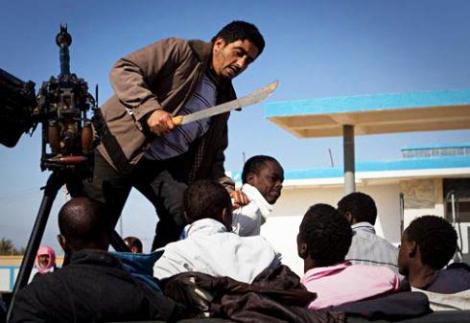
(1) Kieran Kelly, Context of the Iraq Genocide (https://ongenocide.com/wp-content/uploads/2012/02/context-of-iraq-genocide.pdf), pp 176-9.

(2) Michael Kelly, Martyr’s Day: Chronicle of a Small War, New York: Random House, 1993.

(3) Michael R. Gordon and Bernard E. Trainor, The Generals’ War, Boston: Little, Brown and Company, 1995, p 80.

(4) Wright and Rowley, op cit.

Other links:

Great article on Suzanne Nossel

RAWA – Revolutionary Association of Women of Afghanistan