Argo: Time to Grow Up and Get Angry?

Standard

The truth will set you free, but first it will piss you off” – Gloria Steinem.

Image

There have been a number of critical condemnations of the film Argo. The most thoroughgoing that I have read is this one. What seems to me to be missing is any critique that successfully conveys the utter ludicrousness of expecting something other than lying propaganda to come out of a Hollywood film about the CIA in 1979. It is like expecting the Soviets to have made an accurate and unbiased account of KGB activities during the Prague Spring. I saw the preview before the film’s release, and after about 5 or 10 seconds of suspense it became apparent that it was a load of crap – the usual Orientalist stuff, straight out of the Reel Bad Arabs playbook, except with Persians instead of Arabs. The film mirrors the preview – at first it seems possible that one might be about to see a balanced and thoughtful movie, and then… not. Decidedly not.

Let me begin with some historical context. The CIA’s first coup in Iran, considered at the time “its greatest single triumph”,1 brought the Shah Mohammed Reza Pahlevi to a position of supreme power. The CIA “wove itself into Iran’s political culture”.2 They created SAVAK, a notorious “intelligence” agency, trained in torture by the CIA3 and supported by the CIA and DIA in a domestic and international dissident assassination programme.4 Repression was at its peak between 1970 and 1976 resulting in 10,000 deaths.5 By 1976 Amnesty International’s secretary general commented that Iran had “the highest rate of death penalties in the world, no valid system of civilian courts and a history of torture that is beyond belief. No country in the world has a worse record of human rights than Iran.”6

Nafeez Ahmed cites the Federation of American Scientists (FAS) who detail an extensive police state of intense surveillance and informant networks and torture “passed on to it” by US, UK and Israeli intelligence. Ahmed quotes the FAS on methods including “electric shock, whipping, beating, inserting broken glass and pouring boiling water into the rectum, tying weights to the testicles, and the extraction of teeth and nails.”7 Racism allows commentators such as Tim Weiner to blithely exculpate the CIA of fundamental guilt: “The CIA wanted SAVAK to serve as its eyes and ears against the Soviets. The shah wanted a secret police to protect his power.”8 After all, what could civilised Westerners teach Orientals about torture? But something of the real US attitude to such repression can be seen in the official reaction to the unrest developing in the late 1970s. Aside from US officials consistently urging and praising military responses to protest action, including inevitable massacres,9 the US ambassador objected strongly to a reduction in repression. In June 1978 he reported his finding that, “the Shah’s new directives to his security forces, such as instructions to desist from torture… are disorienting.”10 The funny thing about this was that it occurred after the US had forced the Shah into the liberalisation that set loose the forces that were to rip his régime apart.11 This may seem puzzling, but it made more sense for the US to push Iran into the easily vilified “enemy” hands of an Islamic theocracy than to try to maintain control over a Shah who, however repressive, was determined to develop his populous oil-rich country independently.

That is the key point that you will almost never hear about: the US was sick of the Shah. He had become too nationalistic and developmentally inclined, and they didn’t want him any more. They may not have really wanted a revolution in Iran, but they weren’t going to shed tears over the Shah’s departure. Their main fear was the strength of the secular revolutionary left, which had more popular power than the Islamists (despite SAVAK’s repression) so the US helped nurture the Islamist factions.

The CIA were far from unaware of the impending fall of the Shah’s régime, here is a quote in the film which is an instance of absolute barefaced deception: “Iran is 100% not in a pre-revolutionary state. CIA brief, November first, 1979.” Let’s not be stupid here – it is one thing to claim not to know of an impending revolution, but the film is claiming that the CIA were unaware of a revolution that had already happened. Of course some people in the CIA knew that revolution was brewing and the actual CIA brief was from August 1978 and was plainly dishonest even then. By that stage even the State Department was planning for a post-Shah Iran.12 The revolution had actually happened nearly a year before Argo claims that the CIA believed it wasn’t going to happen (the Shah fled Iran in January, Khomeini returned from exile on February 1). But Argo makers really, really, really want you to “know” that the CIA were caught flat-footed and are willing to go to considerable lengths to make you believe this lie.

Image

[By XcepticZP at en.wikipedia [GFDL (http://www.gnu.org/copyleft/fdl.html), CC-BY-SA-3.0 (http://creativecommons.org/licenses/by-sa/3.0/), GFDL (http://www.gnu.org/copyleft/fdl.html) or CC-BY-SA-3.0 (http://creativecommons.org/licenses/by-sa/3.0/)%5D, from Wikimedia Commons]

There is another deception in the film which indicates a conscious systematic attempt to indoctrinate the audience. Some describe Argo as “well-intentioned but fatally flawed”, but these “good intentions” cannot possibly be reconciled with the disgusting propaganda treatment of the issue of the shredded documents put together by Iran. The documents seized by radicals in the embassy takeover were the Wikileaks of their time. Most seized documents were not shredded and they exposed massive systematic illegality and wrongdoing by US personnel, especially the CIA. They were extremely historically significant. Iran spent years piecing together the shreds and the reconstruction was a major intelligence and propaganda coup. In the film, however, we see a very different narrative played out, and we are shown a set of very different images.

In the film, for some inexplicable reason, there were xeroxed photographic images of the staff who had escaped from the embassy when it was seized by radicals. Could this simply be a cinematic plot device for generating suspense? Not really. Any number of other devices might have been used – such as a dragnet, or informants, or surveillance (mobile or static), signals interception and cryptography. You name it, if you are willing to make stuff up, then there is quite a lot you could make up that would be potentially more suspenseful and, unlike this particular conceit, wouldn’t run such a risk of the audience losing their suspension of disbelief because of such an obvious unrealism.

Realism”, I should add, is a very import aspect of this film. It is not done in a documentary style, but is presented as a dramatisation of historical events. Let me illustrate with a quote at length from Wide Asleep in America:

[Salon’s Andrew] O’Hehir perfectly articulates the film’s true crime, its deliberate exploitation of “its basis in history and its mode of detailed realism to create something that is entirely mythological.” Not only is it “a trite cavalcade of action-movie clichés and expository dialogue,” but “[i]t’s also a propaganda movie in the truest sense, one that claims to be innocent of all ideology.”

Such an assessment is confirmed by Ben Affleck’s own comments about the film.  In describing “Argo” to Bill O’Reilly, Affleck boasted, “You know, it was such a great story. For one thing, it’s a thriller. It’s actually comedy with the Hollywood satire. It’s a complicated CIA movie, it’s a political movie. And it’s all true.”  He told Rolling Stone that, when conceiving his directorial approach, he knew he “absolutely had to preserve the central integrity and truth of the story.”

“It’s OK to embellish, it’s OK to compress, as long as you don’t fundamentally change the nature of the story and of what happened,” Affleck has remarked, even going so far as to tell reporters at Argo’s BFI London Film Festival premier, “This movie is about this story that took place, and it’s true, and I go to pains to contextualize it and to try to be even-handed in a way that just means we’re taking a cold, hard look at the facts.”

In an interview with The Huffington Post, Affleck went so far as to say, “I tried to make a movie that is absolutely just factual. And that’s another reason why I tried to be as true to the story as possible — because I didn’t want it to be used by either side. I didn’t want it to be politicized internationally or domestically in a partisan way. I just wanted to tell a story that was about the facts as I understood them.”

Image

[Angela George [CC-BY-SA-2.0 (http://creativecommons.org/licenses/by-sa/2.0)%5D, via Wikimedia Commons]

To emphasise this point, the initial part of the end credits juxtaposes images from the film with real documentary images. They show how much the actors look like the people they portray. The show how they had faithfully recreated scenes from the revolution. And they show the teeny tiny hands a the poor slave children forced to piece together shredded CIA documents. Wait a second though… don’t the hands in the real photo, despite severe cropping, look more like a woman’s hands? And why would young children be used to piece together valuable and vulnerable documents written in a language that they could not possibly understand?

For some reason the film makers took it upon themselves to invent a whole bunch of “sweatshop kids” putting together these documents. There is no conceivable reason to do so that does not involve conscious deceptive propaganda. In this case, the intent is to make deliberate emotive subliminal association. What do I mean by subliminal? As Joe Giambrone explains:

The father of modern propaganda, Edward Bernays, wrote in the late 1920s:

The American motion picture is the greatest unconscious carrier of propaganda in the world to-day. It is a great distributor for ideas and opinions.  The motion picture can standardize the ideas and habits of a nation.” (Bernays 1928)

Bernays noted the “unconscious” character of much film propaganda.  It was not necessary to directly state messages, but to let the scenarios and the story world carry the messages in the background.  Once immersed in the foreground story — whatever it was — the “unconscious” background elements were passed to the audience without critical interference and often without the viewer’s knowledge.

This subliminal quality is praised by Bernays as a positive thing, in his view. This is hardly surprising as Bernays’ concept of propaganda is broad in scope encompassing every medium and method of communication that exists.  Bernays’ seminal book Propaganda begins:

The conscious and intelligent manipulation of the organized habits and opinions of the masses is an important element in democratic society. Those who manipulate this unseen mechanism of society constitute an invisible government which is the true ruling power of our country.  We are governed, our minds are molded, our tastes formed, our ideas suggested, largely by men we have never heard of. This is a logical result of the way in which our democratic society is organized.” (Bernays 1928)”

Subliminality doesn’t mean that images are flashed too quickly to be noticed, rather that associations are made without conscious thought. It is true that you can find a great number of deliberately concealed images in advertising, but the claim that this is all that constitutes subliminal advertising is itself a deception. Advertising, in particular television advertising, is dominated by subliminal messaging, and it is not about tricky concealment. It uses repetition more than anything else, to make associations between advertised products and services with other desires – particularly, but not exclusively, sexual. If you want to sell a car, you don’t generally use brake horsepower or fuel consumption statistics. You associate it with a lifestyle, with attractive people, with status, with sex, with success, with normalcy, with excitement, with fine wine and food, and so forth. That is subliminal.

Obviously when film makers are unconsciously disseminating their own internalised propaganda they convey such messages subliminally. Subliminal means below the threshold, meaning, in this case, below the threshold of consciousness. This is a very, very significant manner in which an orthodox ideology, such as chauvinist US exceptionalism, is deepened and perpetuated. However the deliberate use of techniques designed to manipulate people by subliminal means can be far more powerful still. As an apposite example, let us examine Michelle Obama’s Oscar night appearance. Some have pointed out that Obama being flanked by military personnel as “props” suggests a desire to subliminally associate the First Lady and the presidency with military virtues. That may well be the case, but think how common it is to see faces arrayed behind political speakers in our times. Every time it is possible to do so nowadays, major US politicians will have a bunch of people in uniform behind them when they speak. But it is not strictly about the association with uniforms. Press conferences often pose colleagues behind the speaker – including military briefings almost as a matter of course – and when politicians speak to political rallies or party conferences, they are framed by a sea of supporters’ faces behind them.

Image

You see, we automatically respond to other people’s facial expressions. In fact eliciting an emotional response is as much a component of facial expression as conveying emotion is, and this occurs subliminally. Now think again of Giambrone’s description: “… the ‘unconscious’ background elements were passed to the audience without critical interference and often without the viewer’s knowledge….” The people behind the speaker are being used as a way of evoking an emotional reaction like some science fiction mind control ray. Fortunately, people are fickle creatures and often their reaction to watching the back of a speaker’s head, no matter how eloquent, is to look bored or embarrassed. But clearly the technique is being perfected, and the people chosen are those who can be relied upon to convey the right emotions, hence the predilection for military personnel and partisan enthusiasts.

Similarly, subliminal messaging in advertising and film is often also aimed at a gut level. They are not conveying particular ideas, but emotions. The victim (I mean viewer) can rationalise these emotions any way they might later choose, and the brilliance of the system is that it enlists every victim’s own inventiveness tailored in response to each specific circumstance that might challenge or belie the conditioned sentimental sense of reality. So where does this leave us with regards to Argo‘s mythical “sweatshop kids”? We have precisely four references to them. The first is in our hero’s initial briefing: “The bastards are using these [pause and do gesture to indicate need to convey novel concept] mmm sweatshop kids.” Nearly an hour later, we are shown about 5 seconds of the “sweatshop”. It actually looks very stupid if you pay attention to it, but it is over too quickly to register (more subliminality similar to that used in The Hurt Locker). What it actually shows, when the camera pulls back to reveal the scene for around one second, is dozens of children aged about five to eight sitting amidst piles of paper shreds. There is an unnatural hush, redolent with a sense of fear. Half of them are just staring into space, and there is no conceivable way that any of them could actually be doing any useful work. Accompanying the scene is one of the 16 tracks on the official soundtrack. It is called “Sweatshop” and here it is:

Note the image chosen for the album cover.

The third sweatshop scene is also brief. A boy succeeds in producing a usable image. The image is taken without thanks or reward. Then there is a cut to a particularly young and vulnerable looking child. His expression is not inconsistent with a look of anxiety. He looks to the side, as if watching the successfully reconstructed image being taken. But there is only the merest hint of curiosity or concern as his head turns back and down almost immediately, as if returning to work. This is the culmination of this sweatshop depictions.

Inevitably now you feel a queasiness and a sense of concealed horror. The coda to this, the fourth reference, is the already mentioned juxtaposition of the film scene with the documentary photo. Just to tidy away any niggling sense that the film makers might be playing you like an idiot violin.

So why the “sweatshop kids”? As I’ve mentioned the whole pictures-from-shredded-mugshots scenario is a bit too cheesy and overtly Hollywood to make great suspense. It is true that the film has some other rather implausible nail-biting parts, but these are all last minute glitches. The sweatshop storyline carries on throughout most of the movie. And there is no need at all, other than propaganda, to just decide that it should be a bunch of oppressed kids who are doing the work of putting together paper shreds. Not only is it a very silly idea – risking the onset of disbelief – but it actually destroys the main potential for suspense. Engaged adults committed to reconstructing pictures because they actively wish to apprehend the fugitives are inherently far more suspenseful than a bunch of sullen, frightened and apathetic children forced to reconstruct documents without any understanding of why they must do so.

The answer to why this is done is that one of the purposes of this film is to transform, disrupt or destroy certain “memes”. I’m quite serious in writing that. “Meme” might be a buzzword (so to speak), or even worse, yesterday’s buzzword, but it is a very appropriate word to use for those quanta of information that convey a “truth”. In particular, and far more to the point, a “meme” can belie an entire orthodox discourse. The Iranian revolution created many such memes, their power being almost entire due to the fact that they ran counter to the established official discourse. In many instances, not least those coming out of the hostage taking at the embassy, one might see young impassioned revolutionaries animated by a desire for justice and freedom who gave of themselves bravely, sacrificing without hesitation. To present that as being all there was to the story would be ludicrous. One cannot, and should not, ignore the violence and excesses of revolution whether their source is secular or religious in its expression. But to erase it altogether is equally wrong, but hardly surprising on the US part.

A proper narrative of the hostage crisis in Tehran would juxtapose the aspirations of brave, intelligent, dedicated, moral revolutionaries; the vicious excesses of revolutionary violence; the repressive nature of Shah’s régime; the repression of the revolution and the republican régime; the role of the US and the ongoing role of the CIA operating out of the Tehran embassy; the suffering and ill-treatment of the hostages in a 444 day ordeal. But that sort of narrative is balanced. It does two unwelcome things – it humanises Iranians as victims of the US régime; and it indicts the régimes of the Shah; the US, and the Islamic Republic, but not the peoples of the US or Iran. Another undesirable thing is that the idea that a CIA officer could be a hero is risible. Indeed, without trying to sound too anarchistic here, a balanced view of what the history tells us with regard to the actions of individuals is that when they act out of individual conscience they may be “heroic”, but when they act under orders as agents of régimes they will almost always be either victims or “villains” or both. So, for example, Lt. Calley and Capt. Medina were ordered to “kill anything that moves” at My Lai; but W.O. Hugh Thompson who risked his own life, the lives of his men, and threatened to kill his compatriots in order to bring that same slaughter to an end, did so because of his own sense of humanity, not from orders, or duty, or military indoctrination. Indeed, the history of Iran-US relations going back to 1953 can be seen as two peoples who share exactly the same two enemies – their own and the other’s state régimes which would have them slaughter each other. As with the trenches of the Western Front in WWI, the revelation of common humanity and circumstance is a serious threat to the “fighting spirit” required to achieve the geostrategic goals of the ruling class. In the trenches, among the troops of WWI, demonisation and atrocity propaganda were common techniques to combat the threat of “live and let live”.13 Image

The point is to ensure that people don’t start seeing anything admirable in Iran’s revolutionaries, nor see them as potential agents of their own liberation. The US will bring them “democracy” in its own time. In the lens through which the West is meant to view the lesser beings of the East – Persians (like Filipinos) are “half devil and half child”, or maybe about four-fifths devil in this instance. The point is this, the US did a bad thing by overthrowing Mossadeq – that is the official reality, complete with official apology (unlike all of the other places where the US has overthrown the rightful government). However, the way they are constructing the meaning of this fact echoes Colin Powell’s “pottery barn rule” – you know, the one that says that if you illegally invade a country you are morally obligated to occupy it for years, steal billions from its people, kill hundreds of thousands, rewrite its constitution to your own liking; and so forth. I think you get the picture. The admission of guilt in the Mossadeq overthrow is being rewritten as license, nay duty, to deal with the consequences (the repressive régime of the Islamic Republic) while the Iranian people are necessarily recast as the monstrous creations of US intervention who can only be redeemed by further US intervention – 80% devil, 20% child (the approved portions for victims of Islamofascism).Image

The shredded documents are of central importance. The makers of Argo went to extraordinary lengths to subliminally create negative associations with the issue, though not that issue alone. The entirety of the Iranian revolution is sullied, not by the association of revolutionaries with the suffering brought about by the revolution in reality, but by filthying the very characters of the participants in the same way that the orators of Occupy Wall Street movement are smeared with ordure and disfigured (figuratively) in The Dark Knight Rises. Not only was this a serious undertaking, but it was a risky one too. If someone of prominence had, in timely fashion, started pulling at the “sweatshop kids” thread they could might have caused considerable unravelling long before Oscar time. I cannot help but think of Glenn Greenwald. But Greenwald, like many other astute political critics, has been so busy critiqueing the even more repugnant CIA propaganda of the year, that it is only now after Argo has won best picture that people are posting trenchant, but comparatively simple posts criticising Argo‘s historical inaccuracy, racist monolithic depictions of fanatical Iranians, and CIA/US boosterism. Image

In a sane world, the Hollywood critics would have so totally panned Zero Dark Thirty that it was never an Oscar contender, nor seen as anything but a prurient sadistic flick for maladjusted teenagers – the contemporary equivalent of another ambivalent CIA assassination/torture propaganda flick from the previous millenium, The Evil Men Do (the difference being that while Charles Bronson was known to some as “Mr Monkey Scrotum Features”, director Kathryn Bigelow more subtly manages to place the ugliness inside of her characters, like cancerous pus that oozes just below the surface).

In a sane world? One cogent blogger writes: “What if instead of making a movie about the hostage situation and replaying the same narrative of victim Americans, villain Iranians, Ben Affleck made a movie about the 1953 coup? What if someone made a movie about the CIA teaching the Iranian intelligence agency torture methods copied from the Nazis? What if we gave a little bit more background before jumping to make labels of good guy and bad guy?” But is the audience living in a sane world?

In a sane world the audience would never accept such a portrayal of the CIA. It might be possible to have a CIA hero, if, and only if, s/he was just doing a job in an Agency context of, in film terms, rampant evil villainy. I do hate to break it to everyone, but in cinema conventions the scheming, murdering, corrupt torturers are supposed to be the “bad guys”. At best, people should perceive the idea of CIA heroes as a bit off and uncomfortable, if not disgusting or simply comical. The irony is that the hostage crisis occurred in the middle of a period when no one would have dared make a film with a CIA officer as hero unless they were a renegade being persecuted by the agency (or unless it was some violent b-grade right-wing action film starring Charles Bronson). I am not merely referring to a matter of taste here. There is something utterly basic at issue as well. Something so fundamental that it strikes at the roots of the entire film, making a nonsense of everything that is projected on to the screen.

In a sane world the central premise that the CIA was animated by a concern for the preservation of the lives of 6 human beings, just because they were US citizens and innocent of wrongdoing, would be widely and immediately apparent as utter unadulterated nonsense. In 1979 many people were aware, and they seem to have since forgotten, that the CIA was happy enough to kill innocent US citizens themselves when it seemed expedient. Unknown numbers of deaths were brought about by the reckless drug experiments undertaken on thousands of unwitting victims. As investigations such as those of the “Church Committee” showed the CIA’s lack of concern for their victims’ safety alone established that these innocent US citizens were as disposable to the CIA as toilet paper. Enough people would have known this that no such movie as Argo could have been a large mainstream Hollywood hit without it raising serious questions about what exactly the CIA’s real motives were.

What were the CIA’s real motives? Let me begin by saying that I can understand why the fugitive diplomats would have feared for their lives at the hands of the Iranian government. I understand why Western diplomats such as the Canadians and the gratuitously maligned UK and New Zealand diplomats took steps to help them evade capture and escape. Nevertheless, in the cold light of day and historical retrospect, the greatest risk to the lives of the fugitives was from the CIA, not the Iranian régime. The film as much as gives that away at one point when a CIA character says: “Six Americans get pulled out of a Canadian diplomat’s house and executed it’s a world outrage. Six Americans get caught playing movie make-believe with the CIA at the airport and executed, it’s a national embarrassment.” The audience doesn’t see a problem with that, because they are preconditioned to expect that the “Mad Mullahs” will gladly cause “world outrage” because they froth at the mouth and hate everyone and everything Western, and because the film keeps telling us that they will execute them publicly and juxtaposing such claims with grotesque imagery based on real executions.

Let us take a step back from our conditioning here and remember that:

  1. contrary to the depiction of the film (which would have us believe that the embassy was stormed three days after the CIA reported no sign of “pre-revolutionary” activity) the revolutionary régime had been in power for over 9 months – long enough to stop screaming fanatical slogans and spraying spittle everywhere; and long enough to develop a degree of concern about international perceptions and diplomacy.
  2. One very central point about the hostage crisis which is omitted is the shady US role in its origins. Even if one dismisses some things as conspiracy nonsense, the perfectly well established and uncontroversial facts of the “October Surprise” conspiracy were also omitted from Argo. They were omitted because they would show that the US establishment tended to see the hostages as disposable pawns
  3. If the “mad mullahs” really were so determined to do public beheadings of US citizens as Argo claims, they had reasonably easy access to 52 others, some of whom they could very credibly have tried for spying and for committing other crimes in Iran.
  4. Another point about the hostage crisis, so crucial and central to the history that it absolutely had to be obscured, is that the Iranian régime was making a show of being at arm’s length from the actions of the kidnappers. You see they had learnt a thing or two from being at the receiving end of the CIA’s dirty tricks – (im)plausible denial being one of them.
  5. The US discourse around these events was ripe, it was fecund, it was completely laden with what I call “stuff”. The blindfolded hostages. The young radicals. The red headbands. The yellow ribbons. The counting of the days. And above it all the stern visage of the Grand Ayatollah (Big Brother) Khomeini.
    Image

[By Mr.minoque (Own work) [CC-BY-3.0 (http://creativecommons.org/licenses/by/3.0)%5D, via Wikimedia Commons]

Tropes were flying through the air thick and fast, attaching themselves to memes with such violence that if you weren’t careful you could lose an eye. The resulting one-eyed narrative is positively mythic in quality.

The mythic narrative (where everything was larger than life) was a propaganda coup for the US régime, particularly for the CIA, who had been having a hard time of it since 1974 and weren’t exactly anyone’s favourite people, as has already been mentioned. The US government got to pull its “helpless giant” act – always a favourite, particularly to distract from dirty hands. The CIA and their Hawk allies were able to use the whole thing as leverage against Carter and do their bit to get him replaced by Reagan (that was the essence of the aforementioned “October surprise”).

Taking all of this into account, we can conclude that if the Iranian régime had gotten hold of the fugitives, then they might have simply put them with the other hostages, but that would have spoilt the pretence of the independence of the kidnappers. They might have killed them, furthering their international pariah status. Or, they might have done the thing that posed the greatest threat to the CIA. They might have protected them from those whom they would explain as being regrettably but understandably over-enthusiastic young revolutionaries. They might have interrogated them to check that they weren’t spies (for form’s sake), and then given them a nice escort to the airport for a civilised journey home as seen on TV by the entire globe. Having done that, the Iranian régime would suddenly look more reasonable, especially to non-aligned countries, and a little bit of a crack would appear in the US demonisation discourse. A crucial crack, because although the Iranian régime would remain brutally repressive to its own people, it would be plainly apparent that it was actually rational and subject to appeals other than brute force.

So you tell me: Is it more realistic that the CIA, an organisation that had shown itself in no uncertain terms to be both brutal and callous, would care deeply for the lives of 6 citizens? Or would they care more about geopolitical manoeuvres and the domestic political game against Carter? We need to get back to where we were in 1979 with regards to what was considered credible in film. In their own way of distorting history and privileging US personnel’s suffering over that inflicted by US personnel, films of the time like The Deer Hunter and Apocalypse Now were bad enough, but Argo would not have been seen as a serious film in 1979. 1979 was more than 10 years after Patrick McGoohan’s The Prisoner had taken a postmodern pickaxe to the serious dramatic pretensions of spy adventures. In 1979, the small screen saw Alec Guiness playing George Smiley in an adaptation of Tinker, Tailor, Soldier, Spy that was at least as grim and disillusioned and unheroic as the more recent film adaptation, while on the big screen Roger Moore’s James Bond saved the word from evil space shuttle hijackers in Moonraker (featuring that guy with steel teeth!). There was no in-between. That should tell you all you need to know.

Conclusion – Get Angry

In Sheldon Wolin’s conception of “inverted totalitarianism” one of the few differences between US totalitarianism and Fascist or Communist totalitarianism is that under Fascist corporatism or Communism the state exerts a central control over corporations and in inverted totalitarianism that arrangement is, umm, inverted. I’m always a bit sceptical about the use of the word totalitarian. It functions better, to my mind, at highlighting a tendency rather than being used as some absolute characterisation. But Wolin’s usage can easily accommodate this, and he is absolutely correct in characterising the locus of state power in US society. (Some people might pick a fight with him over the locus of power in Fascist and Nazi societies, but there are two sides to that argument.) The point is, however, that restricting our understanding of what constitutes the “state” in the US to government only and not including corporate power is foolish and untenable.

Hollywood produces state propaganda not because Karl Rove tells them to – he just gives them some suggestions and they are happy to oblige. Hollywood produces state propaganda because Hollywood is part of the state, a big and important part of the state. As I have written elsewhere, the corporatist powers of the US régime form an “empire complex”, a team that might squabble, but pulls in the same direction. Newscorp stands shoulder to shoulder with the DoD, Goldman Sachs walks arm in arm with the Dept. of Treasury, while the FDA seems little more than a deformed growth and mildly irritating growth on Monsanto’s back. You get the picture anyway. The non-governmental “stakeholders” of the imperial state are more numerous and often bigger than the biggest governmental peers. This is state propaganda – straight from the politburo with the rubber stamp of approval as state propaganda given by the people who made the film in the first place, because they are part of the politburo.

So we must stop catering to those who claim that Ben Affleck means well, or that Hollywood liberals are not jingoistic right-wing scumbags, or that the CIA was ever anything but rotten at the core. Mark Ames writes a fantastic retrospective on some of the unsavoury violence of the CIA. The only time they ever had real limitations put on them was during the administration of this guy called Jimmy Carter:

As everyone knows, Carter’s presidency was one long bummer. But what most people don’t know — or have forgotten — is that Carter did more than any president to bring the national security state under control. Especially the CIA, which Carter gutted, purged, and chained down with a whole set of policies and guidelines meant to protect American citizens’ civil liberties.

In his first year in office, Carter purged nearly 20% of the Agency’s 4500 employees, gutting the ranks of clandestine operatives, sending hundreds of dirty trickster vets into the private sector to seethe for the next few years. Carter signed an executive order worked out with Frank Church and the Senate committee on intelligence putting more serious limits on the CIA’s powers — unequivocally banning assassinations, restricting the CIA’s ability to spy domestically, and putting their covert operations under strict oversight under the president, Congressional committees and the attorney general. The CIA’s paramilitary was even disbanded, though not banned.

What happened to Carter, according to former US, Iranian, Israeli and Russian officials, is that there was this, like, hostage crisis thing, right? It was in Tehran in Iran, OK? Maybe you’ve heard of it? Anyway, this guy who worked for the CIA, called George H. W. Bush, went to Paris in October of 1980 to make deal with Iranian officials to delay reaching a deal with the US on releasing the hostages because any such deal might have gained Carter some votes. It worked. Carter was voted out. The CIA found new funds, new respectability, new drugs and arms to sell, new torturers and death squads to train, and new lies to tell. Yay.

And then liberal Ben Affleck and liberal George Clooney made a movie about what great guys the CIA are. How should we act when the wilfully blind watch this smug flag-waving offensive propaganda and tell us that we’re being unfair and political to criticise it? Do we go on the defensive? “Yes, but Edward Said wrote…”; “It is entertainment, but…”; “Yes, but when you analyse the protrayal of the Islamic male…”? Or do we show them our anger, our distaste, and our disdain? Why the hell should we be apologising for just pointing out basic known facts that people like to forget as much as possible? They’re the CIA. They are murderers. They were murderers. That is the reality. Grow up. Santa Claus does not exist, and if there is any such thing as a “hero” in real life then, by definition, they aren’t loyal CIA officers. Grow up.

Get angry.

1Tim Weiner, Legacy of Ashes: The History of the CIA, London: Penguin, 2007, p 105.

2Ibid.

3William Blum, Killing Hope: U.S. Military and C.I.A. Interventions Since World War II (2nd ed.), Monroe:

Common Courage Press, 2004, p 72.

4Roger Morris, “The Undertaker’s Tally (Part 1): Sharp Elbows,” TomDispatch, 1 February 2007. Retrieved 2

February 2007 from http://www.tomdispatch.com/index.mhtml?pid=165669.

5 Frederick H. Gareau, State Terrorism and the United States: From Counterinsurgency to the War on Terror,Atlanta and London: Clarity Press and Zed Books, 2004, p 172.

6 Blum, Killing Hope, p 72.

7 Nafeez Mosaddeq Ahmed, Behind the War on Terror: Western Secret Strategy and the Struggle for Iraq,

Gabriola Island, BC: New Society, 2003, pp 38-9.

8 Tim Weiner, Legacy of Ashes, p 105.

9 Ahmed, Behind the War on Terror, pp 43-5.

10 Ibid.

11 Amin Saikal, Islam and the West: Conflict or Cooperation, New York: Palgrave MacMillan, 2003, p 73.

12 Gary Sick, All Fall Down: America’s Tragic Encounter with Iran. New York: Penguin Books, 1986, p 98.

13 Eric J. Leed, No Man’s Land: Combat and Identity in World War I, Cambridge: Cambridge University Press,1979, p 107; J.G. Fuller, Troop Morale and Popular Culture in the British and Dominion Armies 1914-1918, Oxford: Clarendon Press, 1990, p 17.

The Cambodia Precedent: Justifying New Crimes on the Basis of Past Crimes

Standard

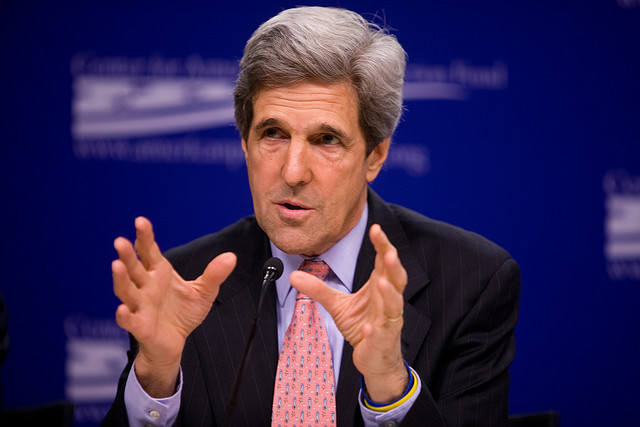
For John Kerry the incoming Secretary of State, the bombing of Cambodia by the US was illegal. But, even as Kerry reaffirms his condemnation of US actions in Cambodia, it comes to light that in June his colleagues in the Senate Judiciary and Intelligence committees were issued a white paper from the Department of Justice which claimed US intervention in Cambodia as being a legal precedent for the administrations use of targeted killings using drone strikes. In fact, “legal precedent” might be too strong a term, because what is actually cited is an address given by legal counsel to the State Department to a legal forum. Yes, they are using a speech rather than an adjudication as a claim of precedence, much as one might in some future time quote John Yoo as the legal precedent for a systematic programme of child torture by testicular crushing. On the other hand, the carpet bombing of Cambodia was one of the most brutal and notorious war crimes of the post-WWII era and not only has no one been prosecuted for the crime, but the principle perpetrator was awarded the Nobel Peace Prize a few years later – perhaps this is exactly the sort of precedent that the Obama administration looks towards.

With all of that in mind, it is worth revisiting exactly what the US did to the people of Cambodia. Then we can understand exactly what sort of moral precedent applies here – the sort that would make almost any organised crime boss, or terrorist, or psychopathic serial killer blanch with horrified disgust. If you think I’m exaggerating, read on.

3488968132_5ebe2568e7_z

In 2007 Barack Obama said: “The President does not have power under the Constitution to unilaterally authorize a military attack in a situation that does not involve stopping an actual or imminent threat to the nation.” In questioning John Kerry about Obama’s departure from that principle in Libya, Rand Paul elicited from Kerry, a reaffirmation that he, Kerry, still believed that the bombing of Cambodia was illegal. One might wonder, then, whether Obama’s new Secretary of State is going to oppose his famous “drone” assassination programme. I broach the subject because the Department of Justice rationalised the use of deadly force in other sovereign territories citing Cambodia as a precedent. This is an excerpt from their recently released White paper:

The Department has not found any authority for the proposition that when one of the parties to an armed conflict plans and executes operations from a base in a new nation, an operation to engage the enemy in that location cannot be part of the original armed conflict, and thus subject to the laws of war governing that conflict, unless the hostilities become sufficiently intense and protracted in the new location. That does not appear to be the rule of the historical practice, for instance, even in a traditional international conflict. See John R. Stevenson, Legal Adviser, Department of State, United States Military Action in Cambodia: Questions of International Law, Address before the Hammarskjold Forum of the Association of the Bar of the City of New York (May 28,1970)…, (arguing that in an international armed conflict, if a neutral state has been unable for any reason to prevent violations of its neutrality by the troops of one belligerent using its territory as a base of operations, the other belligerent has historically been justified in attacking those enemy forces in that state).

Now, let me start off by saying something absolutely clearly. The idea that the US can legally engage in a programme of assassinations using hellfire missiles fired from unmanned aerial vehicles is a patent falsehood – a complete joke – a non-starter – a parody – a stupid idea that no one should take seriously. A single ad hoc emergency strike might be justified as self-defence under Article 51 of the UN Charter, but a programme cannot be as self-defence because, under the charter, it can only be applied to imminent threats. This aspect of law isn’t rocket science, nor hidden within some mystical realm of legalese. The standard legal textbook dealing with this subject is Yoram Dinstein’s, War, Aggression and Self-Defense, now in its 4th edition. It is a pretty straightforward book (and I’m no lawyer) and on this particular subject it is so unequivocal that it is impossible that any superior authority might find some crucial flaw which would invalidate Dinstein. The reason it is so unequivocal is that the US arguments have already been ruled against by no lesser body than the International Court of Justice. The reason for this is that the US has already deployed almost the exact same reasoning to justify its actions against Nicaragua.

On Nicaragua v. United States of America, the ICJ ruled “By twelve votes to three, Rejects the justification of collective self-defence maintained by the United States of America in connection with the military and paramilitary activities in and against Nicaragua the subject of this case; …. By twelve votes to three, Decides that the United States of America, by training, arming, equipping, financing and supplying the contra forces or otherwise encouraging, supporting and aiding military and paramilitary activities in and against Nicaragua, has acted, against the Republic of Nicaragua, in breach of its obligation under customary international law not to intervene in the affairs of another State….” And goes on to add other grounds of violation, including a similar finding against the US mining of Nicaragua’s main port. Dinstein explores the US self-defence claims and notes that although self-defence was ruled out on other grounds this did not prevent judges from further noting that the three requisite conditions of immediacy, necessity, and proportionality were also unsustainable.1

In the Nicaragua case, as now, the US argued that conditions of immediacy, necessity and proportionality were met, but then, as now, these are just empty words disproved by the simplest of geographical facts. Such claims are even further disproved by publicly available details of the US assassination programme, such as the use of “signature strikes” and the use of “double tap” follow up strikes. These practices demolish self-defence arguments even as they raise further questions about breaches of International Humanitarian Law (such as the Fourth Geneva Convention (1949)) and International Human Rights Law (such as Article 3 of the Universal Declaration of Human Rights which affirms “the right to life, liberty and security of person”).

So, how much does citing US actions in Cambodia strengthen the feeble claims of legal rationale for drone strikes? I would say somewhat less than not at all, partly because US military actions in Cambodia were clearly not legal and partly because they too failed the test of self-defence (hence arguably being crimes against the peace) but they were also gross breaches of International Humanitarian Law, and should be classified as genocide – which is considered an “aggravated crime against humanity

2478271872_9763673fd7_z

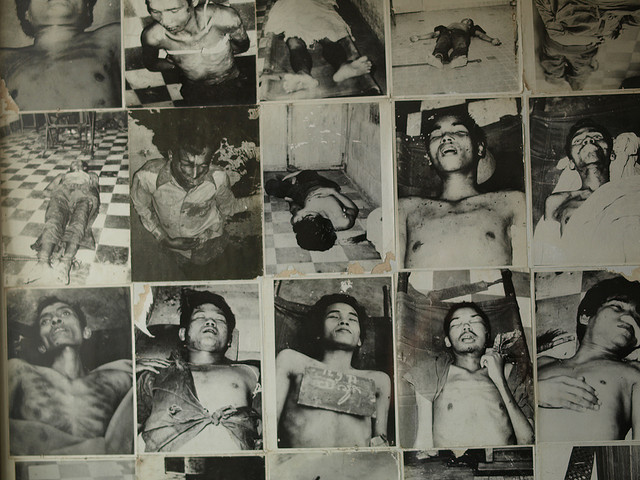
When people think of genocide and Cambodia, they tend to think of the Khmer Rouge, and the “Killing Fields”; of their evidently insane Democratic Kampuchea regime which began its “Year Zero” in 1975. But a Finnish Inquiry Commission designated the years 1969 to 1975 in Cambodia (a time of massive aerial bombardment by the US and of bitter civil war wholly sustained by the US) as Phase 1 of the ‘Decade of Genocide’.2Estimates of Cambodian deaths resulting from the 1969-75 war range from Vickery’s 500,000 killed3 to a credible 1 million excess deaths estimated by Sorpong Peou.4 Given that the Cambodian population was an estimated 6 or 7 million in the period of the Second Indochina War, this gives us a figure of between 1 in 6 and 1 in 14 of all Cambodians killed.

US actions inside Cambodian borders began years before the devastating carpet bombing. The US ‘Studies and Operations Group’ conducted attacks with US Special Forces personnel in Cambodia throughout the 1960s. In 1967 these were institutionalised as “Salem House” (later known as “Daniel Boone”). This programme was kept secret from the US congress and conducted a total of 1,835 missions. Their primary activity appears to have been the laying of “sanitized self-destruct antipersonnel” mines anywhere up to 30 kilometres beyond the border. Their supposed mission was intelligence gathering, but throughout the whole programme they only captured 24 prisoners.5 The Special Forces troops usually disguised themselves as Vietnamese PLAF fighters and sometimes murdered civilians in false-flag operations.6

In 1970 Sihanouk was overthrown by General Lon Nol7 and Prince Sirik Matak with tacit support from Washington and probable assistance by the CIA. Washington recognised the new regime within hours.8 So fast was recognition of Lon Nol’s government that it must have precluded any possibility that the changes on the ground were being assessed, which strongly suggests that the US must have had detailed foreknowledge in order to have any confidence in its judgement. Sihanouk’s overthrow made civil war unavoidable.

In 1969, before the above events, the US began bombing Cambodia in what was known as “Operation Menu”. From Saigon, US General Creighton Abrams insisted that he had “hard evidence” that the Central Office for South Vietnam headquarters (COSVN HQ) had been located in the “Fish Hook” salient of Cambodia.9 The problem was that no such place ever existed, though for years the US had mounted operations to crush it when they claimed it was located in South Vietnam.10 Once under way, Operation Menu spread to other areas. Despite the carpet bombing of area supposed to contain COVSN HQ, in April 1970 Abrams claimed that the headquarters still existed as a fortified underground bunker with 5000 personnel.11 In May US and RVN forces invaded Cambodia, the action justified in part as an attempt, yet again, to wipe out the COVSN HQ “which had become the Holy Grail of the American war”.12 The US/RVN invasion simply, and predictably, drove communist forces deeper into Cambodia.13

It is a known and predictable effect that the killing of civilians drives people to take up arms, it is a “counterproductive” counter-insurgency tactic which actually strengthens the enemy.14 It is worth remembering that the famous maverick US Army officer John Paul Vann made the same observation in 1962.15One of the most striking examples of generating an enemy by killing civilians, is what occurred in Cambodia from 1969 onwards. Ben Kiernan repeatedly cites evidence in numerous consecutive instances that US/RVN aerial bombardment strengthened the Khmer Rouge insurgency, and, more specifically the anti-Vietnamese faction of the Khmer Rouge under Pol Pot.16 In 1969, the Khmer Rouge consisted of perhaps 4000 – an ultimately unthreatening insurgency. By the end of 1972, they were able, with DRV logistical support, to “hold their own” against Lon Nol’s armed forces, which, at US instigation, had been enlarged to between 132,000 and 176,000 (not counting “ghost” soldiers, who existed only on the books of the corrupt officers who collected their pay) and had massive US/RVN air support.17 In William Shawcross’s words, “the new war was creating enemies where none previously existed”18 and by this stage, Lon Nol’s regime was already reduced to the control of shrinking and fragmenting enclaves.19

When the the US generated a war in Cambodia they had already had a great deal of experience in Vietnam and Laos, and what occurred in Cambodia is, in many ways, a naked exposure of the logic behind the genocidal war system, less obfuscated because, ironically, Cambodia was a “sideshow” where it was not the details but the whole war which was kept obscure from the public.

Within a year of Lon Nol’s coup, as mentioned, the economy of Cambodia was virtually destroyed, not only by bombing, but also by US aid. Aid was channelled to the import of commodities and surplus US agricultural goods. It also underwrote the Cambodian government and armed forces: “By the end of 1970, the government was spending five times its revenue and earning nothing abroad.”20 Most of the population became reliant on US aid to eat, and rice supplies were kept at the minimum level needed to prevent food riots. By 1975, malnutrition was widespread and many children starved to death.21

Going back in time to 1970, less than two months after the coup that brought Lon Nol to power, the US invaded Cambodia, along with ARVN forces. They did not bother to forewarn Lon Nol who found out after Richard Nixon had announced the invasion publicly.22 This invasion along US and RVN bombing and the civil war made refugees of around half of the Cambodian population.23Lon Nol was outraged by the invasion and when later briefed by Alexander Haig (then military assistant to Kissinger) about US intentions he wept with frustration. According to Shawcross, “He wished that the Americans had blocked the communists’ escape route before attacking, instead of spreading them across Cambodia. … The Cambodian leader told Haig that there was no way his small force could stop them. … [Haig] informed Lon Nol that President Nixon intended to limit the involvement of American forces…. They would be withdrawn at the end of June. The the President hoped to introduce a program of restricted military and economic aid. As the implications of Haig’s words for the future of Cambodia became clear to Lon Nol, he began to weep. Cambodia, he said, could never defend itself.”24

B-5222

As has been detailed, US actions, particularly in bombing, were directly responsible for creating the communist enemy which overthrew Lon Nol. The bombing between 1969 and 1973 took up to 150,000 lives.25 If averaged out, over 33 tons of ordnance were used to kill each Khmer Rouge insurgent.26 Despite the fact that Vietnamese pilots bombed any Cambodian they could, which aided only the Khmer Rouge, Lon Nol acceded to a US demand that he request an increase in VNAF bombing in 1971.27 By May 1972, the Lon Nol regime had control of perhaps 10 per cent of the country and continued to lose territory which was thereafter fragmented into ever smaller enclaves.28 The result was by that stage foregone, and yet the war dragged on for three years with the greater part of the 1 million deaths occurring after that point.

In 1970, when Henry Kissinger briefed Jonathan “Fred” Ladd, who was slated to conduct the war in Cambodia, he told him, “Don’t even think of victory; just keep it alive.”29 The point of the US bombing was not to win a military victory – it was to destroy Cambodia as part of an Indochina “exit strategy” – and that is a clear instance of genocide under the United Nations Convention on the Prevention and Punishment of the Crime of Genocide. When the US Congress finally blocked aid to Cambodia and South Vietnam, it was with the belated realisation that such aid would not give any hope of victory or improve a bargaining position. Senator Mike Mansfield spoke out, “Ultimately Cambodia cannot survive…. Additional aid means more killing, more fighting. This has got to stop sometime.”30

So that was the end of the US involvement in Cambodia, and their legal culpability. The Khmer Rouge took over Phnom Penh, and the refugees were shocked to see that the black-clad cadres were mostly young teens, fanatical and brutalised by half a young lifetime of fighting and death. The US was not responsible for the fantasies of the Pol Pot clique, who believed that supernatural amounts of food could be produced without recourse to machine power, nor for their refusal to accept aid. But the US had deliberately brought the Cambodian population to the brink of starvation – destroying farmland and driving peasants off the land. Perhaps 500,000 or more died of starvation. Hundreds of thousands were executed for political or ideological reasons, murdered by the Khmer Rouge who the US had largely brought into existence. And when the Vietnamese put the regime to an end (and despite what you may read about this being justifiable as “humanitarian intervention” it was in fact legitimate self-defence – if you don’t believe me you can read about Khmer Rouge foreign policy, border attacks, and espoused official desire to exterminate all Vietnamese) when the Khmer Rouge were supplanted, the US insisted that they retain a seat at the UN and started giving aid to their guerilla forces.

Drone 5860787655_2b5f5feff3_z

So, do I think that the Cambodia precedent is a good one to justify an assassination programme? No, I do not. But then again I am not from the US, and perhaps I am failing to grasp the subtle point that next to no “Americans” died in Cambodia (none that were officially acknowledged) therefore it did not happen. I don’t want to be offensive, but if they do not wish to be complicit with the crimes of the US regime, US anti-drone campaigners must avoid all trace of exceptionalism. I am sure they mean no harm, but why allow yourselves to be drawn into this ridiculous framework of seeing the drone programme as being primarily a question of “the targeting of Americans without due process.” There have been 5 US citizens killed with US drones whereas at least 4000 non-US citizens have been killed. Why would anyone, in those circumstances, give primacy to concern over “US citizens” and “due process”? This fetishisation of the idolised US Constitution is getting old. Besides which, the US Constitution’s “Supremacy Clause” (Article 6, Clause 2) actually gives treaties the same status as federal law – which would include the Nuremberg Charter and the UN Charter, among other things. Furthermore, by allowing the issue to be framed in such a manner, psychologically you set yourself and others up for being mollified by cosmetic measures offered to guarantee the rights of US citizens while retaining the right to kill foreigners at will. Do you really believe that being a US citizen or being born in Denver makes someone more human?

1 Yoram Dinstein, War, Aggression and Self-Defence (3rd ed.), Cambridge: Cambridge University Press, 2001, pp 184-5.

2 Edward Herman and Noam Chomsky, Manufacturing Consent: The Political Economy of the Mass Media. London: Vintage, 1994 (1988), p 260.

3 Ibid, p 263.

4 Sorpong Peou, Intervention & Change in Cambodia: Towards Democracy? Singapore: Institute of Southeast Asian Studies, 2000, p 54.

5 Ibid, pp 64-5.

6 Ben Kiernan, The Pol Pot Regime: Race, Power, and Genocide in Cambodia under the Khmer Rouge. New Haven and London: Yale University Press, 1996, p 18.

7 The US had developed ties with Lon Nol in the 1950s and by 1970, according to CIA officer Frank Snepp, he was one of two candidates being groomed by the CIA to take Sihanouk’s place (William Shawcross, Sideshow: Kissinger, Nixon and the Destruction of Cambodia. London: Fontana, 1980 (1979), pp 114-5).

8 Ibid, pp 114-23; William Blum, Killing Hope: U.S. Military and C.I.A. Interventions Since World War II (2nd ed.), Monroe: Common Courage Press, 2004, pp 137-8; Peou, Intervention & Change in Cambodia, pp 125-6.

9 Shawcross, Sideshow, p 19.

10 Marilyn Young, The Vietnam Wars 1945-1990, New York: Harper Perennial, 1991, pp 72, 186; Tucker, Vietnam, p 129; Turley, The Second Indochina War, pp 79-80.

11 Shawcross, Sideshow, p 140.

12 Young, The Vietnam Wars, p 245.

13 Shawcross, 1979, p 151.

14 David Keen, Endless War? Hidden functions of the ‘War on Terror’. London, Ann Arbor: Pluto Press, 2006, pp 58-61.

15 Neil Sheehan, A Bright Shining Lie: John Paul Vann and America in Vietnam (New York: Vintage 1989 (1988), p pp 106-111.

16 Kiernan, The Pol Pot Regime, pp 19-23. Also see Peou, Intervention & Change in Cambodia, p 128.

17 Shawcross, Sideshow, pp 73, 180, 194-5, 261.

18 Ibid, p 249.

19 Ibid, p 254.

20 Ibid, p 220.

21 Ibid, p 317-9.

22 Ibid, p 149.

23 Peou, Intervention & Change in Cambodia , p 127.

24 Shawcross, Sideshow, p 163.

25 Kiernan, The Pol Pot Regime, p 24.

26 Ibid, p 19.

27 Shawcross, Sideshow, p 186.

28 Ibid, pp 254-5.

29 Ibid, p 169.

30 Nigel Cawthorne, Vietnam: A War Lost and Won. London: Arcturus Publishing, 2003, p 213.

Bomber in Chief: 20,000 Airstrikes in the President’s First Term Cause Death and Destruction From Iraq to Somalia | Alternet by Nicolas J.S. Davies

Standard

Bomber in Chief: 20,000 Airstrikes in the President’s First Term Cause Death and Destruction From Iraq to Somalia | Alternet.

Bomber in Chief: 20,000 Airstrikes in the President’s First Term Cause Death and Destruction From Iraq to Somalia

AlterNet / By Nicolas J.S. Davies

Day after day, U.S. air strikes have conclusively answered the familiar question of 9/11: “Why do they hate us?”

Photo Credit: AFP

Many people around the world are disturbed by U.S. drone attacks in Afghanistan, Pakistan, Yemen, Somalia and elsewhere. The illusion that American drones can strike without warning anywhere in the world without placing Americans in harm’s way makes drones dangerously attractive to U.S. officials, even as they fuel the cycle of violence that the “war on terror” falsely promised to end but has instead escalated and sought to normalize. But drone strikes are only the tip of an iceberg, making up less than 10 percent of at least 20,130 air strikes the U.S. has conducted in other countries since President Obama’s inauguration in 2009.

The U.S. dropped  17,500 bombs during its invasion of Afghanistan in 2001. It conducted  29,200 air strikes during the invasion of Iraq in 2003. U.S. air forces conducted at least another  3,900 air strikes in Iraq over the next eight years, before the Iraqi government finally negotiated the withdrawal of U.S. occupation forces. But that pales next to at least 38,100 U.S. air strikes in Afghanistan since 2002, a country already occupied by U.S. and NATO forces, with a government pledged by its U.S. overlords to bring peace and justice to its people.
The Obama administration is responsible for  at least 18,274 air strikes in Afghanistan since 2009, including at least 1,160 by pilotless drones. The U.S. conducted at least 116 air strikes in Iraq in 2009 and about  1,460 of NATO’s 7,700 strikes in Libya in 2011. While the U.S. military does not publish figures on “secret” air and drone strikes in other countries, press reports detail a five-fold increase over Bush’s second term, with at least  303 strikes in Pakistan125 in Yemen and 16 in Somalia.
Aside from the initial bombing of Afghanistan in 2001 and the “shock and awe” bombing of Iraq in March and April 2003, the Obama administration has conducted more air strikes day-in day-out than the Bush administration. Bush’s roughly 24,000 air strikes in seven years from 2002 to 2008 amounted to an air strike about every 3 hours, while Obama’s 20,130 in four years add up to one every 1-3/4 hours.
The U.S. government does not advertise these figures, and journalists have largely ignored them. But the bombs and missiles used in these air strikes are powerful weapons designed to inflict damage, death and injury over a wide radius, up to hundreds of feet from their points of impact. The effect of such bombs and shells on actual battlefields, where the victims are military personnel, has always been deadly and gruesome. Many soldiers who lived through shelling and bombing in the First and Second World Wars never recovered from “shell-shock” or what we now call PTSD.
The use of such weapons in America’s current wars, where “the battlefield” is often a euphemism for houses, villages or even urban areas densely populated by civilians, frequently violates otherwise binding rules of international humanitarian law. These include the  Fourth Geneva Convention, signed in 1949 to protect civilians from the worst effects of war and military occupation.
Beginning in 2005, the U.N. Assistance Mission for Iraq (UNAMI) issued quarterly reports on human rights in Iraq. They included details of U.S. air strikes that killed civilians, and UNAMI called on U.S. authorities to fully investigate these incidents.  A UNAMI human rights report published in October 2007 demanded, “that all credible allegations of unlawful killings by MNF (multi-national force) forces be thoroughly, promptly and impartially investigated, and appropriate action taken against military personnel found to have used excessive or indiscriminate force.”
The UN human rights report included a reminder to U.S. military commanders that, “Customary international humanitarian law demands that, as much as possible, military objectives must not be located within areas densely populated by civilians. The presence of individual combatants among a great number of civilians does not alter the civilian nature of an area.”
But no Americans have been held criminally accountable for civilian casualties in air strikes, either in Iraq or in the more widespread bombing of occupied Afghanistan. U.S. officials dispute findings of fact and law in investigations by the UN and the Afghan government, but they accept no independent mechanism for resolving these disputes, effectively shielding themselves from accountability.
Besides simply not being informed of the extent of the U.S. bombing campaigns in Iraq and Afghanistan, the U.S. public has been subject to military propaganda about the accuracy and effectiveness of “precision” weapons. When military forces detonate tens of thousands of powerful bombs and missiles in a country, even highly accurate weapons are bound to kill many innocent people. When we are talking about 33,000 bombs and missiles exploding in Iraq, 55,000 in Afghanistan and 7,700 in Libya, it is critical to understand just how accurate or inaccurate these weapons really are. If only 10 percent missed their targets, that would mean nearly 10,000 bombs and missiles blowing up something or somewhere else, killing and maiming thousands of unintended victims.
But even the latest generation of “precision” weapons is not 90 percent accurate. One of the world’s leading experts on this subject, Rob Hewson, the editor of the military journal Jane’s Air Launched Weapons, estimated that  20 to 25 percent of the 19,948 precision weapons used in the “shock and awe” attack on Iraq in 2003 completely missed their targets. The other 9,251 bombs and missiles were not classified as “precision” weapons in the first place, so that only about 56 percent of the total 29,199 “shock and awe” weapons actually performed with “precision” by the military’s own standards. And  those standards define precision for most of these weapons only as striking within a 29 foot radius of the target.
To an expert like Rob Hewson who understood the real-world effects of these weapons, “shock and awe” presented an ethical and legal problem to which American military spokespeople and journalists seemed oblivious. As he told the Associated Press, “In a war that’s being fought for the benefit of the Iraqi people, you can’t afford to kill any of them. But you can’t drop bombs and not kill people. There’s a real dichotomy in all of this.”The actual results of U.S. air strikes were better documented in Iraq than in Afghanistan. Epidemiological studies in Iraq bore out Hewson’s assessment, finding that tens of thousands, maybe hundreds of thousands, of Iraqi civilians were killed by U.S. air strikes.  The first major epidemiological study conducted in Iraq after 18 months of war and occupation concluded:

Violent deaths were widespread … and were mainly attributed to coalition forces. Most individuals reportedly killed by coalition forces were women and children … Violence accounted for most of the excess deaths and air strikes from coalition forces accounted for most violent deaths.

When the same team from Johns Hopkins and Baghdad’s Al Mustansariya University did  a more extensive study in Iraq in 2006 after three years of war and occupation, it found that, amidst the proliferation of all kinds of violence, U.S. air strikes by then accounted for a smaller share of total deaths, except in one crucial respect: they still accounted for half of all violent deaths of children in Iraq.
No such studies have been conducted in Afghanistan, but hundreds of thousands of Afghans now living in refugee camps tell of  homes and villages destroyed by U.S. air strikes and of family members killed in the bombing. There is no evidence that the pattern of bombing casualties in Afghanistan has been any kinder to children and other innocents than in Iraq. Impossibly low figures on civilian casualties published by the U.N. mission in Afghanistan are the result of small numbers of completed investigations, not comprehensive surveys. They therefore give a misleading impression, which is then amplified by wishful and uncritical Western news reports.
When the UN identified only 80 civilians killed in U.S. Special Forces night raids in 2010, Nader Nadery of the Afghanistan Independent Human Rights Commission, who worked on the UN report, explained that  this was based on completed investigations of only 13 of the 73 incidents reported to the UN for the year. He estimated the number of civilians killed in all 73 incidents at 420. But most U.S. air strikes and special forces raids occur in resistance-held areas where people have no contact with the UN or the Human Rights Commission. So even thorough and complete UN investigations in the areas it has access to would only document a fraction of total Afghan civilian casualties. Western journalists who report UN civilian casualty figures from Afghanistan as if they were estimates of total casualties unwittingly contribute to a propaganda narrative that dramatically understates the scale of violence raining down from the skies on the people of Afghanistan.
President Obama and the politicians and media who keep the scale, destructiveness and indiscriminate nature of U.S. air strikes shrouded in silence understand only too well that the American public has in no way approved this shameful and endless tsunami of violence against people in other countries. Day after day for 11 years, U.S. air strikes have conclusively answered the familiar question of 9/11: “Why do they hate us?” As Congressmember Barbara Lee warned in 2001, we have “become the evil we deplore.” It is time to change course. Ending the daily routine of deadly U.S. air strikes, including but by no means limited to drone strikes, should be President Obama’s most urgent national security priority as he begins his second term in office.

Nicolas J. S. Davies is author of Blood On Our Hands: The American Invasion and Destruction of Iraq. He wrote the chapter on “Obama At War” for the just released book, Grading the 44th President: A Report Card on Barack Obama’s First Term as a Progressive Leader.

Intro of Intros – The scope of topics discussed

Standard

Generally speaking, genocide does not necessarily mean the immediate destruction of a nation, except when accomplished by mass killings of all members of a nation. It is intended rather to signify a coordinated plan of different actions aiming at the destruction of essential foundations of the life of national groups, with the aim of annihilating the groups themselves. The objectives of such a plan would be disintegration of the political and social institutions, of culture, language, national feelings, religion, and the economic existence of national groups, and the destruction of the personal security, liberty, health, dignity, and even the lives of the individuals belonging to such groups. Genocide is directed against the national group as an entity, and the actions involved are directed against individuals, not in their individual capacity, but as members of the national group.
The following illustration will suffice. The confiscation of property of nationals of an occupied area on the ground that they have left the country may be considered simply as a deprivation of their individual property rights. However, if the confiscations are ordered against individuals solely because they are Poles, Jews, or Czechs, then the same confiscations tend in effect to weaken the national entities of which those persons are members.
Genocide has two phases: one, destruction of the national pattern of the oppressed group; the other, the imposition of the national pattern of the oppressor. This imposition, in turn, may be made upon the oppressed population which is allowed to remain or upon the territory alone, after removal of the population and the colonization by the oppressor’s own nationals. – Lemkin, Axis Rule in Occupied Europe, p 79.

That is how the inventor of the term ‘genocide’ introduced the concept.  There is a certain problem in that the ‘destruction of the national pattern’ cannot be taken as an absolute, but I will save that for another post.  Instead I will use Lemkin’s image of genocide as  ‘a composite of different acts of persecution or destruction’ (Axis Rule, p 92) as an entrée into the wide range of topics which pertain to the subject of genocide.

To start with there are the elements of genocide enumerated by Lemkin himself: Economic, social, physical, biological, cultural, political, religious, and moral.  Each of these is a separate topic in its own right, but in genocide a number work in synergistic union in a ‘coordinated plan’.  Popular imagination for understandable reasons gives primacy to the physical aspect of destruction – the acts of mass murder.  For me also, and within this blog, it is the systematic killing of civilians that is of salient importance.*  That said, however, it should be recognised that, taking a dispassionate view, the central aspect of genocide is economic destruction (known in and of itself as econocide).  Economic destruction is the only single aspect listed by Lemkin that can be realistically utilised to effect all others, including physical destruction (notwithstanding that all of these things are inter-related such that any social destruction, for example, may have an economic effect).  A later post will discuss econocide and contentions that it alone may constitute genocide (‘economic genocide’) and the contention that ongoing structural violence against the peoples of poorer states is a form of genocide (‘structural genocide’).

Economics, therefore, will be central to much of the the writing within this blog.  They are a key aspect of the perpetration of genocide, and no exception need be made here for the Holocaust or the Shoah, and there is often an economic strategic consideration which provides a central motive in the perpetration of genocide.  Of particular interest, something which will be recurrent in posts, is the adoption of an antidevelopmental approach which may come in the form of econocide, but which may also be an impelling strategic factor motivating genocide itself.

Imperialism is linked to both an antidevelopmental paradigm of domination (dating back to the early modern period) and to genocide itself.  Lemkin explicitly linked genocide to colonialism (meaning ‘settler colonialism’) but in practice it is almost as intrinsic to imperial hegemony as it is to colonialism.  One may see that this is implicitly hinted at in the third paragraph quoted above, although one must expand and elaborate on ‘the imposition of the national pattern of the oppressor.’

War and the military provide another set of topics.  Most genocides** involve military personnel as the main direct perpetrators of mass murder.  Moreover, most genocides** are characterised by perpetrators as a form of warfare.  The creation of a perpetrator of genocide begins with whatever chauvinist or other enabling ideologies are abroad in civilian life, continues with military indoctrination and training, and is brought to fruition by the situational*** elements generated in alleged wars.

This brings me to ideology.  Ideology is of crucial importance, but it is not, as it is so often portrayed, the driving force behind genocides.  Every indication is that genocide is not prompted by a particular hatred, but rather that a pre-existing ideology of hatred is an element that is less motive than enabling.  Further, it is clear that those who would undertake genocide deliberately stoke the flames of hatred, while genocide itself fans those very flames among perpetrators.  I aim to demonstrate that the seeming ‘chicken-and-egg’ problem posed by the role of ideology can be resolved in favour of regarding ideology as distinctly subservient to strategic considerations among planners of genocide.

Ideology is also distinctly subservient in a arena of international relations, but nevertheless may be of some import if it, for example, facilitates inadmissable independent development and economic sovereignty.  More relevant concerns are geostrategic in nature.  More to the point are those strategic concerns which are affected by populations – thus, for example, an oil rich state with a small population does not present the same challenges to US imperial hegemony that an oil rich state with a large population does.  The religious, cultural, ideological, political and social nature of these populations also has a bearing.  ‘Geostrategy’ doesn’t really convey the full sense of this aspect, indeed it really refers to distinct matter, so I am forced to coin the phrase ‘demostrategy’.****

I could continue, but I bet this sort of generalised and abstract exposition is pretty boring to read.  The point I wanted to make is that genocide relates directly to a very wide variety of topics.  Economics, imperialism, military matters, ideology, geostrategy and demostrategy are not exhaustive by any means.  And as the reader will find, if they read further, there is also a great deal to be added on the subject of the misuse of the term genocide.

* I will be posting on the issue of systematic mass murder in contrast to extermination or intended extermination at some point, hopefully soon.

** Strictly speaking I should not claim to be writing of ‘most genocides’ without explaining why I exclude those sets of acts which fit the definition of genocide but which do not involve mass murder.  Arguably such ‘genocides’ are greater in number than those involving mass murder, but I am arbitrarily excluding from my considerations all putative genocides which do not bring about mortalities of 100,000 or more.  That is very crude and baseless, I do understand, but there is a method in my madness which will be elucidated upon at a later date.

*** A jargon word meaning ‘circumstantial’, presumably adopted because of the confusing connotations given to the term ‘circumstantial’ by literature, film and television dealing with issues of criminal justice.

**** I don’t like the academic tendency to coin terms at the drop of a hat, so when this one sprung from my head like some scholarly demon-spawn, dripping the ichor of tautology, I recoiled.  Unfortunately the beast insinuated itself into my thoughts because it just such a useful catch-all for the sort of strategic factors which I consider to be paramount in motivating genocide.