MP from Aotearoa so Islamophobic that even the Israeli Ambassador calls his remarks “vicious”

Standard

Image

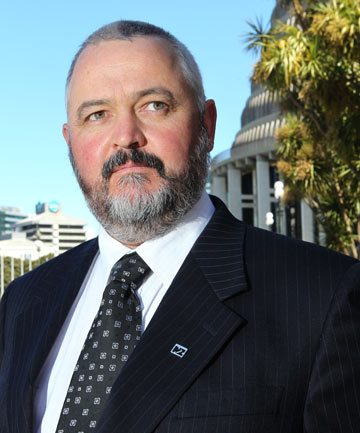
An MP from the “New Zealand First” party wrote an opinion piece in which he wrote:

“If you are a young male, aged between, say, about 19 and about 35, and you’re a Muslim, or you look like a Muslim, or you come from a Muslim country, then you are not welcome to travel on any of the West’s airlines . . .” He then referred to New Zealanders lossing their rights because of “a sorry pack of misogynist troglodytes from Wogistan”.

He also claimed that El Al did not allow Muslims to travel in their aircraft, which made them one of the safest airlines in the world. Israeli Ambassador Shemi Tzur said: “Claims by MP Prosser that Israeli airline El Al bans passengers on the basis of their ethnicity or religion are not only false but also vicious in character. All travellers are equally important on El Al and in Israel”.

Prosser’s party leader is standing by him in the face of calls for resignation, but he may be liable to legal action under the Human Rights Act and the race relations laws. Nevertheless, it is essential that Prosser be forced to resign. It cannot be acceptable to have a representative of the people of Aotearoa who uses a word like “Wogistan”.

As such, I would humbly like to implore those of you who are not residents of Aotearoa (AKA New Zealand) to contact a New Zealand embassy or consulate in order to register your disgust and call for Prosser’s resignation. Please help. How would you feel if a democratic representative of your country lost the moral high ground to the Israeli ambassador?

Genocide, Fuck Yeah! How The Hurt Locker Put the Fun Back into Mass Murder

Standard

Image

CC. Attribution and sharealike david_shankbone at http://flickr.com/photos/27865228@N06/4596336419

There is a question used to illustrate the way in which presuppositions can constrain discourse: “Have you stopped beating your wife yet?” The discourse of US international relations is somewhat like the inverse of that question – perhaps equivalent to “have you been awarded the Nobel Peace Prize yet?” It appears that people find it very difficult not to become apologists for the US when they set out to critique the US. For example a recent paper on possible violations of International Humanitarian Law (IHL) and International Human Rights Law (IHRL) in US drone “signature strikes” takes as written that there is a sustainable claim that these strikes are legitimate self-defence. This is in order to make the point that even acts of self-defence must conform to IHL and IHRL. You might think that is a reasonable stance, but how can anyone possibly think that signature strikes are legitimate self-defence? These are attacks carried out against unknown individuals based on patterns of behaviour such as visiting suspect buildings. This simply cannot be reconciled with the right of self-defence given under Article 51 of the UN Charter, so why on Earth would anyone simply concede this utter lie? Even the Obama administration prefers (citing US officials’ opinions as sufficient legal precedent) to claim that it is killing as part of an ongoing war, and that its violations of sovereignty are legitimate because the US has done the same thing in the past (and gotten away with it).

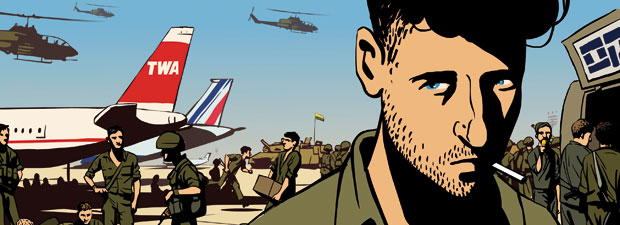
Sometimes, however, you don’t need to concede anything to have a critique subverted by the power of the hegemonic discourse. You stick your black spike of dissent in the path of the giant snowball of empire, and with barely a jolt or change in direction the ball gobbles up your spike which is soon obscured and does no more than add its weight to the thundering behemoth. For example, I greatly like the films Full Metal Jacket and Waltz with Bashir. They are both unflattering depictions of war from a conscript’s viewpoint. The problem is that they exist in a distorted context. It is good to humanise the forces of an aggressor, especially the actual grunts who have to face the dangers and do the most intimate dirty work. But to have a context wherein only the aggressors are humanised is sick and depraved, and I don’t mean that these films are sick and depraved. I mean the society we live in, that has never accorded such a deep three-dimensional humanity to Palestinians, Lebanese or Vietnamese, is sick and depraved – utterly sick and depraved.

Image

Waltz with Bashir deserves an acknowledgement in that, in its final moments, it very movingly humanises the victims of the Sabra and Shatila massacres through still photographs (similar to the approach of DePalma’s Redacted). However, through no fault of the film-maker (who had his own story to tell), the victims were not protagonists; they were not actors; they were not agents. Both of these films unintentionally act to support Israeli or US aggression. Whenever Israel or the US invades a new country, our imaginations are embedded with their personnel. We think about their fears and their suffering, not the greater fears and suffering of their victims. The emotions of their victims can’t be shown in any significant way, because then the US and Israel would look like the “Bad Guys” and people might find it difficult to believe that their violence is founded in the fight against the “Bad Guys”.

It is not just perceptions of real life that are altered by this one-sidedness. The boundaries of what is allowable within the cinematic discourse may, because of this context, allow utterly toxic pieces of propaganda to pass unnoticed. They fit comfortably within the normal practice of privileging Western lives and Western stories. They blame the victims and revere the sacrifice of the perpetrators. They may even be ostensibly antiwar, but they are pro-war crime. Such a work is The Hurt Locker.

The film Zero Dark Thirty has rightly attracted criticism for being a repugnant pro-torture piece of propaganda. For example the Political Film Blog has quite a collection of posts from various writers on many different aspects of why it is a repulsive work. But writer, Mark Boal, and director, Kathryn Bigelow, received almost universal praise for their previous work, The Hurt Locker, and what criticism there was of this movie made it seem almost as if it was a vapid and empty thriller that, by default, promoted a nihilistic love of US muscularity and capacity for destruction. As one writer puts it: “When the film ends with James marching defiantly toward yet another bomb in slow motion, one can practically hear the parody song, ‘America, Fuck Yeah!’ playing in the background.”

Image

But The Hurt Locker is far worse than just that, and I think that the fact that it passed with so little criticism shows that it was more insidious than Zero Dark Thirty. You see, when people perceive the Hurt Locker as somehow devoid of some level of commentary, what they are failing to see is that it is absolutely full of the sort of things that pass unremarked. It is deliberately constructed that way, and this construction is then used to promote the genocidal mass murder of civilians in a deliberately deceptive but direct manner. The only parallels I can think of are the Nazi propaganda film “that juxtaposed staged scenes of Jews living a life of luxury in the Warsaw Ghetto with chilling images that required no staging at all”; or Philip K. Dick’s rather misunderstood Do Androids Dream of Electric Sheep?(itself inspired by reading an S.S. soldier’s journal from Warsaw as research for The Man in the High Castle) which draws the reader into siding with the murderers of children. Perhaps a better understanding, though, can be gained from reading After Dachau. This book is another sci-fi allegory in which the world’s historical discourse has reconstructed Dachau as having been a major battle – a military conflict and not a one-sided slaughter. If it had not been written years beforehand, After Dachau might have been modelled on The Hurt Locker.

To explain why I take this view of the Hurt Locker I first have to explain what I mean by the “genocidal mass murder of civilians” in Iraq. Genocide, by its original conception or by its legal definition, may involve a combination of many different actions such as restricting a population’s food intake or destroying cultural items. It does not necessarily require that there is systematic killing. However, if the civilians of another country are systematically killed in large numbers, it is clearly an instance of genocide. What made the Iraq genocide unique when it entered the Occupation Period was that hundreds of thousands of civilians were systematically killed, but not in large scale massacres using air or ground based weapons. Civilians were not rounded up and shot en masse and there was no carpet bombing. The truly unique aspect of this period of the Iraq genocide was that the majority of civilian casualties were from coalition small arms in incidents wherein the number of victims was small. We know this because a group published the results of mortality studies in the Lancet in 2004 and 2006 (known as L1 and L2). Using a baseline mortality from January 2002 the 2006 study had the following findings:

[D]ata from 1849 households that contained 12801 individuals in 47 clusters was gathered. 1474 births and 629 deaths were reported during the observation period. Pre-invasion mortality rates were 5.5 per 1000 people per year (95% CI 4.3–7.1), compared with 13.3 per 1000 people per year (10.9–16.1) in the 40 months post-invasion. We estimate that as of July, 2006, there have been 654,965 (392,979–942,636) excess Iraqi deaths as a consequence of the war, which corresponds to 2.5% of the population in the study area. Of post-invasion deaths, 601,027 (426,369–793,663) were due to violence, the most common cause being gunfire.

Image

This is the only study that gives us this clarity on causes of death. The majority of those violent deaths attributable to a given party were caused by coalition forces. The data reveals that many tens of thousands of Iraqis were shot to death by coalition forces. The Lancet studies were attacked, of course, but on grounds which were either completely innumerate or deliberately deceptive. In January 2008, UK polling company Opinion Research Business completed a survey and released the following:

Following responses to ORB’s earlier work, which was based on survey work undertaken in primarily urban locations, we have conducted almost 600 additional interviews in rural communities. By and large the results are in line with the ‘urban results’ and we now estimate that the death toll between March 2003 and August 2007 is likely to have been of the order of 1,033,000. If one takes into account the margin of error associated with survey data of this nature then the estimated range is between 946,000 and 1,120,000.

The circumstances in which Iraqi civilians are killed are complicated and subject to debate. This is itself symptomatic for the current need of deniability and dissimulation when committing mass murder. One can no longer build massive gas chambers and crematoria, but equally urban firebombing or carpetbombing may be altogether too obvious a means to be deployed in this era. Mass murder in this sense follows a grotesque fashionability. Those actions which are too closely associated with prior genocide or mass murder must be avoided. In Iraq this has led full circle to a return to very personal violence in which in excess of 100,000, civilians have been killed in a very atomised and geographically dispersed pattern with small arms by coalition forces. The closest parallel to this would be something like the Herero genocide, an early 20th Century colonial genocide.

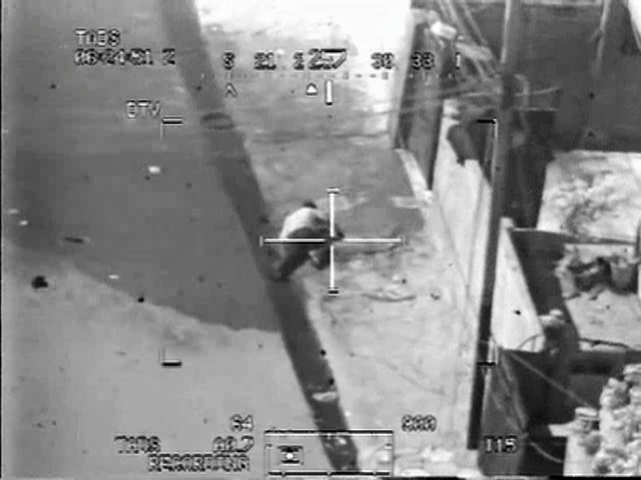
In a work based on veteran testimony, Chris Hedges and Laila al-Arian explain that US personnel have gonefrom killing – the shooting of someone who [can] harm you – to murder. The war in Iraq is primarily about murder. There is very little killing.1 They are talking about the systematic murder of civilians in small increments multiplied many times over. This is the result of a disproportionate fear and lack of security induced within US personnel as well as such policies and tactics as: force protection; reactive firing; suppressive fire; reconnaissance by fire. These are of relevance during convoy operations, house raids and at checkpoints and I am quite confident that each of these situations has been shaped by US policy in such a way as to maximise civilian deaths, often putting US personnel in the situation of being unwilling murderers. Joshua Key describes, from early in the occupation, having to build a “corpse shack” where Iraqis could go to collect the bodies of relatives killed by his company. It was “near our front gate, so relatives could retrieve their loved ones without entering our compound.”2 Those who doubt the systematic manner in which the US killed civilians need only view the gun camera footage from an Apache helicopter released by Wikileaks under the title of Collateral Murder. It reveals the psychological state of US personnel desperate to kill when, despite the evinced outrage at spotting what they claim to be an ‘RPG’ (which was actually a camera), those personnel were never endangered. As a Syrian blogger explained: ‘I also have to add that RPGs used by the insurgents are anti-tank weapons and not a ground-to-air weapon. Trying to hit an Apache with these is similar to trying to kill a flying wasp with a slingshot. Suspecting the journalist’s camera to be an RPG which is quite an outrageous mistake to make and still does not hold as an excuse for the trigger-happy soldier operating that 30mm machine gun.’

Image

Permission to fire is sought properly through the chain of command and all that occurs is according to the official Rules of Engagement (ROE), including the murder of those who innocently stopped to help the injured. This contravenes International Humanitarian Law on a number of grounds including protection for civilians but also Article 49 of the additional protocol to the 1949 Geneva Convention which protects combatants rendered hors de combat. The fact that it is legitimate according to ROE means that it is systematically applied murder which in turn means that the US is in clear breach of the UN Genocide Convention.

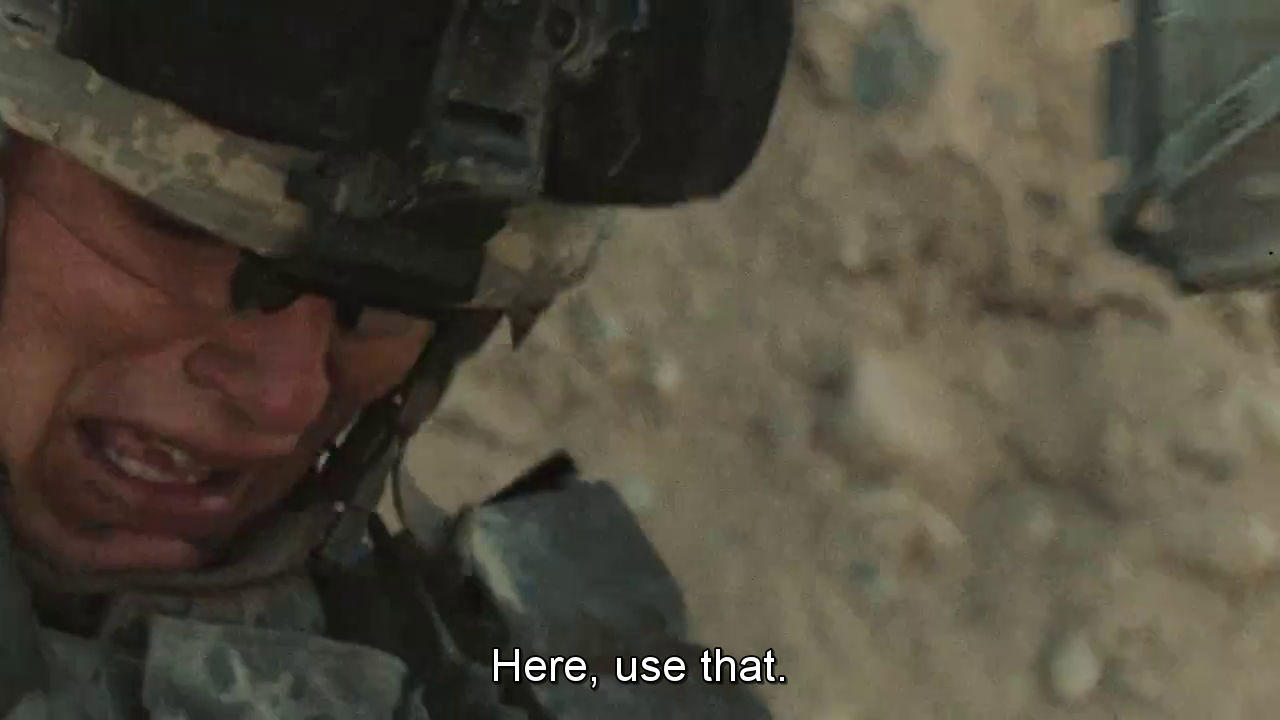
This brings us back to The Hurt Locker. It is somewhat surprising that the film garnered so much critical praise when its flaws, as a film, are really very large. The main character (Sgt James) has no sensible underlying psychology and of his two sidekicks one (Sgt Shelborn) has no character to speak of (except for being extremely callous, but that is presented as pure pragmatism) and the other (Spc Eldridge) is – like James – a nonsensical pastiche. Eldridge’s character is a very ugly marriage of the “nuh-nuh-nuh-nuh-nineteen” year-old conscript who fought in Vietnam (as seen in every Vietnam war film) and Yossarian from Catch-22. Though I couldn’t possibly deal with every sick aspect to this movie, it is worth noting here that a key turning point in Eldridge’s narrative journey comes when he is sucking a dead man’s blood from a large round of sniper ammunition while James says the following: “Just spit and rub. Spit and rub, man. Here, take it out. Take it out…. Just breathe, buddy. Come on. Just breathe in. You got it. You’re doing good. Here, just squeeze. Got it? Rub that ogive baby. Come on, you got it. Here.”

Image

Eldridge is central for two reasons. He is needed because while the proper manly men (James and Shelborn) do not show fear, we need to be told that death waits at every crossroads: “I mean, anyone comes alongside a Humvee, we’re dead. Anybody even looks at you funny, we’re dead. Pretty much the bottom line is, if you’re in Iraq, you’re dead.” You might be getting to notice that the dialogue of The Hurt Locker is pretty weird: “Anybody even looks at you funny, we’re dead.” Odd words, but they serve a purpose – as will be seen.

The very first scene is a characteristically stupid scenario. The team leader (Thompson) of an Explosive Ordnance Disposal (EOD) team goes to disarm an IED. As he walks away from the bomb to retrieve something his team mate spots an Iraqi with a cellphone. The Iraqi is standing in the open, fidgeting. Why he didn’t depart the area when the IED was first discovered we are not shown. Why, if he was determined to blow up an EOD team leader, he waited until after said target was moving away from the bomb is not explained. Why he would expose himself completely unnecessarily to armed US soldiers when wishing to explode the device is not readily apparent, although it must be said that the bulk of the rest of the film does try very hard to suggest that Iraqi’s act completely irrationally and have no instinct for self-preservation whatsoever.

Image

The real point to the fidgeting cellphone bomber is finally made clear when Eldridge is doing his Yossarian Jr. act with an Army psychiatrist: “What if all I can be is dead on the side of an Iraqi road? I mean, I think it’s logical. This is a war. People die all the time. Why not me? … You want to know what I’m thinking about, Doc?…This is what I’m thinking about, Doc. Here’s Thompson, okay. He’s dead. [gun clicks as Eldridge dry-fires his rifle] He’s alive. Here’s Thompson. He’s dead. [gun clicks] He’s alive. He’s dead. [gun clicks] He’s alive.” You get it? If you stop to think rather than immediately killing any Iraqi you see with a cellphone, your friend will die.

It is no joke that all sorts of conditions such as carrying shovels, using cellphones, binoculars or cameras were considered sufficient to warrant lethal violence under ROE’s in Iraq. US personnel were made to feel constantly insecure and constantly put in situations where their own security might be at risk if they did not use violence. They were given to understand that they would be protected from repercussions if fear should cause them to take actions which might constitute crimes. As one Sergeant said“All you got to say is, ‘I feel threatened,…’ and you shoot. They have no remorse.”3

Image

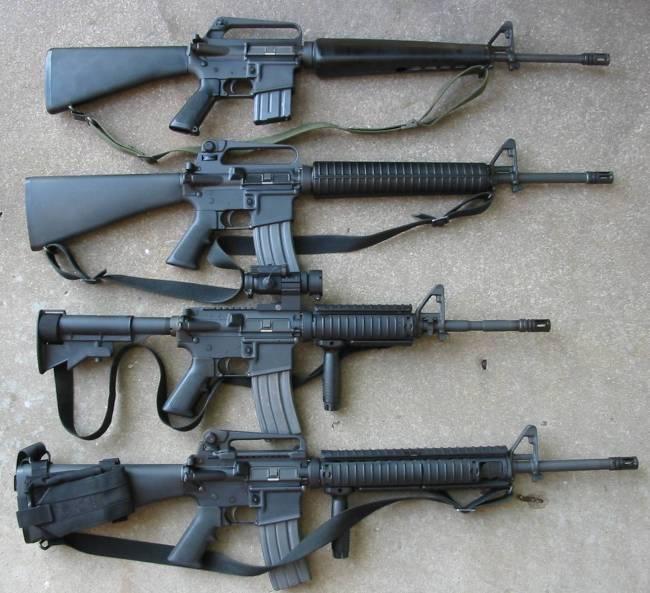
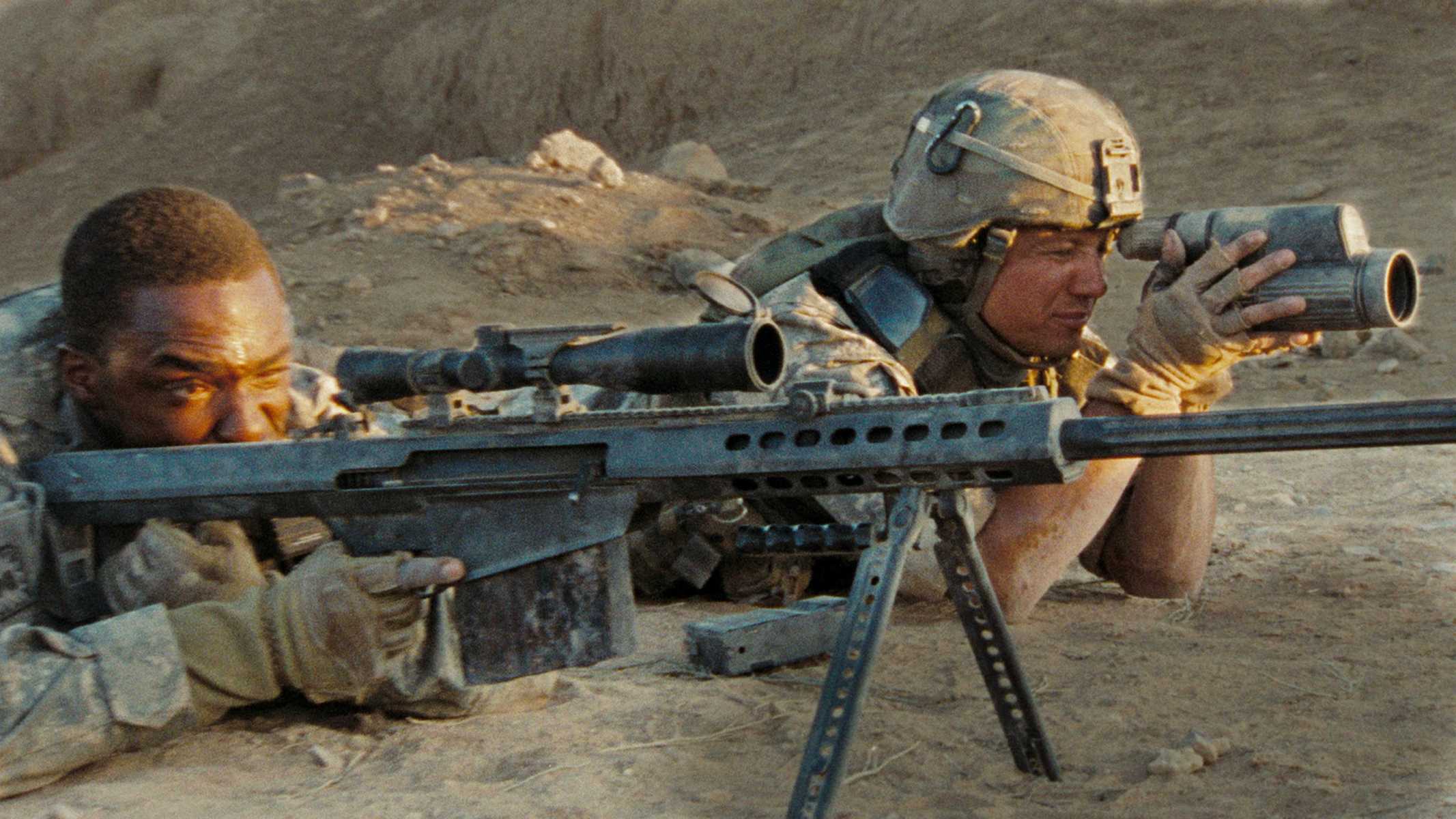
Following an already established cinematic trope, one of the almost mystically powerful forces faced by the GI in The Hurt Locker is the dreaded AK-47. Yes, 60 years after first being made, in movieland the AK-47 is still more terrifying than all of the firepower that a US infantry unit can muster. In this instance, reports unheard, bullets zzzwap into hapless English idiots from snipers unseen causing instant and very accurately placed death. It later is revealed that the Iraqis are firing from 850 metres away. Now, the Iraqi army did in fact use a Kalashnikov variant as a sniper rifle, but it had an effective range of 600 metres and could not penetrate body armour. We are then treated to a long sniper duel with the Shelborn using some sort of tripod mounted, super long-barrelled, high-powered sniper rifle as if the film-makers were at this point actually mocking their know-nothing audience. So Kalashnikovs are another overblown threat. I’m not saying that assault rifles are not threatening, merely pointing out the inversion which suggests that, as in Indochina, GIs were seriously outgunned. Those who followed events in Iraq will know that among the patchwork quilt of military occupation authorities imposed on Iraq, many allowed private possession of assault rifles to continue for a very long time, but policies were confused and changeable. Being spotted bearing such a weapon would certainly have been considered reasonable grounds to use lethal force given that carrying a shovel was considered sufficient (in Vietnam, GIs would carry “drop weapons” to place on the corpses of unarmed victims, in Iraq they used “drop shovels” in the same manner).

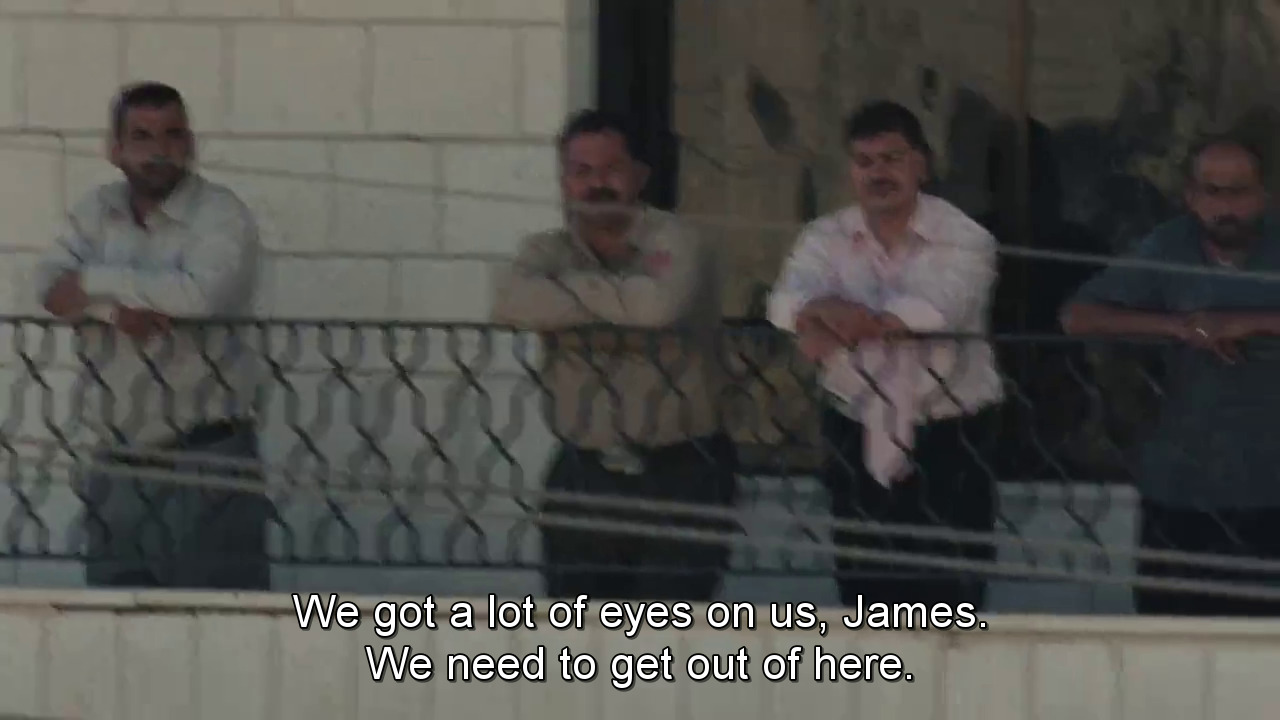
But, for all the reasons the The Hurt Locker gives for why Iraqis might pose a threat, it is the “look at you funny” one that is the most menacing in the film. All of the male Iraqis (females are not much in evidence) tend to move in and to surround. They exude sullen hostility and seem to be deliberately maintaining a concealing blankness of expression. Often they move unpredictably, for unknown purposes. Friendly expressions are seemingly forced or possibly aggressive, certainly impossible to trust. The overall image given is that they all want to kill you, but only some of them are actually trying to kill you at any given moment.

Image

So, the GI mentality, which the film would have us share, is that danger is constant and the enemy is every Iraqi. Worse than that, though, and far more chilling is the deadly combination creating an extravagant desire to kill through indoctrination, and the replacement of morality with considerations of formal “Rules of Engagement” criteria. At “boot camp” they are told that their whole reason for being is to kill, and to make the point sink in they get them to scream “Kill! Kill!” while bayoneting dummies and get them to chant desensitising cadences, like “Napalm sticks to kids” (which sound like ironic or even antiwar sentiments but take on a different character in the context of a military culture where “Er, kill babies” is a common greeting intended to be motivational).4 Moreover, I could devote a great deal of time to the racism and its role in dehumanising, desensitising and in creating hatred and an active desire to kill, but I will leave that to the reader’s imagination or their own research.

Along with the induced desire to kill, murder is legitimised through the formal criteria of the ROE and the chain of command. Again, one can hear this in operation as the gunner in Collateral Murder seeks permission to kill people. These are acts of murder – war crimes – but the murderers are absolutely convinced of their legality. Further, these acts are morally legitimised by formal criteria. After the fact it makes obvious sense that those who have killed harmless civilians would take comfort in having adhered to procedure and protocol. I have read many accounts, for example, of innocent civilians being killed at traffic control points by those who, in the final analysis, were equally innocent – forced into having to kill because of a situation deliberately created by the Bush administration itself. In such instances we know exactly who the criminals are. But the fear induced in US personnel, and the formalism, also combine in a truly frightening manner with a severely reductive Manichaeanism. Their purpose as soldiers or marines is to kill “Bad Guys”. Kill “Bad Guys”. Kill “Bad Guys”. Kill “Bad Guys”.

You kill “Bad Guys” and that is what makes you good. Kill Bad Guys and you are a Good Guy. You kill to save lives. But who is a Bad Guy? Someone with a shovel, or a camera, or a cellphone? They might not be posing any direct threat. They might have no way of fighting back. You might actually be cold-bloodedly gunning down a helpless person who has no means of resistance or flight, but they are Bad Guys and the use of lethal force is authorised – you are a Good Guy. If you don’t kill them it is an immoral act of cowardice, because they might kill your buddy. There is an implicit message here about the value of Iraqi lives and US lives. This is formalised under the doctrine of “Force Protection” which is in itself a blatant contravention of the 4th Geneva Convention. The message is quite simple – there is no upper limit to the number of Iraqis you should kill in order to save a US life. No limit – the difference in value between Iraqi and US lives is qualitative.

Image

This brings us back to Eldridge of The Hurt Locker. He is set up as the one who failed to kill – the cowardly transgressor. He is further denigrated by his patronage of a therapist. The therapist himself is interesting – a liberal Yale type called “’Doc’ Cambridge” (subtle, huh?) he tries to reason with Iraqis only to be confronted with their sullen irrationality and immense obtuseness. He finally learns the lesson that force is the only language Iraqis understand and having served his purpose he is promptly blown up in a deliberately cartoon style. Eldridge wanders around with the dead man’s helmet crying out “Doc! Doc!”, but, befitting the style of this film, the scene changes before we begin to wonder why it has turned into a live-action version of South Park.

Looking at where Eldridge starts, it is pretty easy to see where he might go, but there are several tricks here. Not only is Eldridge lower status than James and Shelborn, we are led to expect, if only unconsciously, that he is the minor character of the three and that his arc will be simplest. Whilst our expectations are that the clash of personalities and philosophies between James and Shelborn will be used to make statements about the world, in fact it is nothing but a vapid pissing contest, while Eldridge is the vehicle for most of the messaging. From his introduction, we expect Eldridge to be “the kid” who gains his manhood, perhaps in the form of an old pearl-handled .45 or a trophy from a defeated adversary – you know, a penis (apparently you are not a man until you get one from somewhere). The fate of “Doc” Cambridge, though, should be considered fair warning. In this film nobody is allowed to change or “grow”. You see, throughout the film Eldridge is presented as being at least half female. He is, without a doubt, a pussy. After the scene with the “rub that ogive” line (which in visual terms is also presented like a form of violation – sickening in the light of the epidemic of sexual assaults and rapes in the US military) Eldridge kills an Iraqi, and we think right, well now he is on his way to the lofty goal of masculinity, but the very next scene has him as the girly bystander to the manly men who are hitting each other for fun. In his final scene he condemns James for reckless adventurism – asking, why chase the Bad Guys into a dark alley? Meaning, symbolically, why invade Iraq in the first place? There he is on a stretcher getting a medevac from a helicopter, the iconic image of the young Vietnam draftee whining like a bitch because he’s too much of a pussy to see that you don’t invade Iraq because you have too, you invade Iraq because you can. Fuck yeah!

Image

Compared to Eldridge, James and Shelborn are pretty straightforward. James is a bit mad, and even a touch Iraqi in a funny way. Like the Iraqis he doesn’t have very good instincts for self-preservation. He keeps trying to cross over into the world of Iraqis, but every time there are obstacles that make human communication impossible. He can’t befriend a kid, talk to an urbane professor, nor save a middle-class family man. Though more puissant, he’s not a killer like Shelborn. He’s an adrenaline junky – good for blowing shit up, symbolically raping Eldridge, and demonstrating that there is never any point in communicating or negotiating with Arabs.

Shelborn is the everyman of the film. He embodies the baseline of the movie. We might sympathise with James for deciding to invade Iraq out of both noble Bad Guy killing desires and an urge to have fun and blow shit up, but we are meant to identify more closely with Shelborn. Stay safe. Keep your buddies safe. Do your job and come home at the end of your tour. You don’t try to talk to Iraqis – hating them is a natural state of being that Shelborn evinces in the film but which is not explored one bit. Hating Iraq is normal too – you, the audience, should be in no doubt that if you were in Iraq you would hate Iraq and its people, how could it be any other way (except for wierdos like James)? Above all, the rule that Shelborn lives by: when in doubt kill Iraqis. It’s not a big thing. Even Eldridge kills one. You gotta do these things to come home safe.

There is one last thing to note, something not unique to The Hurt Locker but which is taken to levels which verge on the ridiculous in this film. None of the Iraqis ever shows the least bit of fear of the US personnel. They passively watch or sometimes actively approach to pester with broken English. Even the professor is inhumanly sanguine – when a gun-toting foreigner breaks into his house and points his weapon directly at his head, he says, “You are CIA. No? I am very pleased to see CIA in my home. Please, sit.” A taxi driver barely flinches when James shoots right past his face, and doesn’t react at all to having a gun barrel placed to his forehead. This isn’t just a cinematic reiteration of Sir Hugh Trenchard’s claim that Iraqis “have no objection to being killed.”5 No, this is some serious hardcore propaganda here, and it is even little children who very pointedly show no iota of concern about heavily armed US personnel even as they run about discharging weapons and suchlike. The fact is that if you show Iraqis as being scared of US personnel, you threaten the narrative of this movie and much more. The people the US kills must be the Bad Guys. Why would children have any fear of the Good Guys? There was an Iraq War, not an Iraq Genocide, right?

1 Chris Hedges and Laila Al-Arian, Collateral Damage: America’s War against Iraqi Civilians, New York: Nation Books, 2008, p xiii.

2 Joshua Key and Lawrence Hill, The Deserter’s Tale: Why I Walked Away from the War in Iraq, Melbourne: Text Publishing, 2007.

3 Thomas E. Ricks, Fiasco: The American Military Adventure in Iraq, London: Penguin, 2007, p 258.

4 Aaron Glantz, Iraq Veterans Against the War, Winter Soldier, Iraq and Afghanistan: Eyewitness Accounts of the Occupations, Chicago: Haymarket Books, 2008, p 79.

5 Barry M. Lando, Web of Deceit: The History of Western Complicity in Iraq, from Churchill to Kennedy to George W. Bush, New York: Other Press, 2007, p 17.

The Cambodia Precedent: Justifying New Crimes on the Basis of Past Crimes

Standard

For John Kerry the incoming Secretary of State, the bombing of Cambodia by the US was illegal. But, even as Kerry reaffirms his condemnation of US actions in Cambodia, it comes to light that in June his colleagues in the Senate Judiciary and Intelligence committees were issued a white paper from the Department of Justice which claimed US intervention in Cambodia as being a legal precedent for the administrations use of targeted killings using drone strikes. In fact, “legal precedent” might be too strong a term, because what is actually cited is an address given by legal counsel to the State Department to a legal forum. Yes, they are using a speech rather than an adjudication as a claim of precedence, much as one might in some future time quote John Yoo as the legal precedent for a systematic programme of child torture by testicular crushing. On the other hand, the carpet bombing of Cambodia was one of the most brutal and notorious war crimes of the post-WWII era and not only has no one been prosecuted for the crime, but the principle perpetrator was awarded the Nobel Peace Prize a few years later – perhaps this is exactly the sort of precedent that the Obama administration looks towards.

With all of that in mind, it is worth revisiting exactly what the US did to the people of Cambodia. Then we can understand exactly what sort of moral precedent applies here – the sort that would make almost any organised crime boss, or terrorist, or psychopathic serial killer blanch with horrified disgust. If you think I’m exaggerating, read on.

3488968132_5ebe2568e7_z

In 2007 Barack Obama said: “The President does not have power under the Constitution to unilaterally authorize a military attack in a situation that does not involve stopping an actual or imminent threat to the nation.” In questioning John Kerry about Obama’s departure from that principle in Libya, Rand Paul elicited from Kerry, a reaffirmation that he, Kerry, still believed that the bombing of Cambodia was illegal. One might wonder, then, whether Obama’s new Secretary of State is going to oppose his famous “drone” assassination programme. I broach the subject because the Department of Justice rationalised the use of deadly force in other sovereign territories citing Cambodia as a precedent. This is an excerpt from their recently released White paper:

The Department has not found any authority for the proposition that when one of the parties to an armed conflict plans and executes operations from a base in a new nation, an operation to engage the enemy in that location cannot be part of the original armed conflict, and thus subject to the laws of war governing that conflict, unless the hostilities become sufficiently intense and protracted in the new location. That does not appear to be the rule of the historical practice, for instance, even in a traditional international conflict. See John R. Stevenson, Legal Adviser, Department of State, United States Military Action in Cambodia: Questions of International Law, Address before the Hammarskjold Forum of the Association of the Bar of the City of New York (May 28,1970)…, (arguing that in an international armed conflict, if a neutral state has been unable for any reason to prevent violations of its neutrality by the troops of one belligerent using its territory as a base of operations, the other belligerent has historically been justified in attacking those enemy forces in that state).

Now, let me start off by saying something absolutely clearly. The idea that the US can legally engage in a programme of assassinations using hellfire missiles fired from unmanned aerial vehicles is a patent falsehood – a complete joke – a non-starter – a parody – a stupid idea that no one should take seriously. A single ad hoc emergency strike might be justified as self-defence under Article 51 of the UN Charter, but a programme cannot be as self-defence because, under the charter, it can only be applied to imminent threats. This aspect of law isn’t rocket science, nor hidden within some mystical realm of legalese. The standard legal textbook dealing with this subject is Yoram Dinstein’s, War, Aggression and Self-Defense, now in its 4th edition. It is a pretty straightforward book (and I’m no lawyer) and on this particular subject it is so unequivocal that it is impossible that any superior authority might find some crucial flaw which would invalidate Dinstein. The reason it is so unequivocal is that the US arguments have already been ruled against by no lesser body than the International Court of Justice. The reason for this is that the US has already deployed almost the exact same reasoning to justify its actions against Nicaragua.

On Nicaragua v. United States of America, the ICJ ruled “By twelve votes to three, Rejects the justification of collective self-defence maintained by the United States of America in connection with the military and paramilitary activities in and against Nicaragua the subject of this case; …. By twelve votes to three, Decides that the United States of America, by training, arming, equipping, financing and supplying the contra forces or otherwise encouraging, supporting and aiding military and paramilitary activities in and against Nicaragua, has acted, against the Republic of Nicaragua, in breach of its obligation under customary international law not to intervene in the affairs of another State….” And goes on to add other grounds of violation, including a similar finding against the US mining of Nicaragua’s main port. Dinstein explores the US self-defence claims and notes that although self-defence was ruled out on other grounds this did not prevent judges from further noting that the three requisite conditions of immediacy, necessity, and proportionality were also unsustainable.1

In the Nicaragua case, as now, the US argued that conditions of immediacy, necessity and proportionality were met, but then, as now, these are just empty words disproved by the simplest of geographical facts. Such claims are even further disproved by publicly available details of the US assassination programme, such as the use of “signature strikes” and the use of “double tap” follow up strikes. These practices demolish self-defence arguments even as they raise further questions about breaches of International Humanitarian Law (such as the Fourth Geneva Convention (1949)) and International Human Rights Law (such as Article 3 of the Universal Declaration of Human Rights which affirms “the right to life, liberty and security of person”).

So, how much does citing US actions in Cambodia strengthen the feeble claims of legal rationale for drone strikes? I would say somewhat less than not at all, partly because US military actions in Cambodia were clearly not legal and partly because they too failed the test of self-defence (hence arguably being crimes against the peace) but they were also gross breaches of International Humanitarian Law, and should be classified as genocide – which is considered an “aggravated crime against humanity

2478271872_9763673fd7_z

When people think of genocide and Cambodia, they tend to think of the Khmer Rouge, and the “Killing Fields”; of their evidently insane Democratic Kampuchea regime which began its “Year Zero” in 1975. But a Finnish Inquiry Commission designated the years 1969 to 1975 in Cambodia (a time of massive aerial bombardment by the US and of bitter civil war wholly sustained by the US) as Phase 1 of the ‘Decade of Genocide’.2Estimates of Cambodian deaths resulting from the 1969-75 war range from Vickery’s 500,000 killed3 to a credible 1 million excess deaths estimated by Sorpong Peou.4 Given that the Cambodian population was an estimated 6 or 7 million in the period of the Second Indochina War, this gives us a figure of between 1 in 6 and 1 in 14 of all Cambodians killed.

US actions inside Cambodian borders began years before the devastating carpet bombing. The US ‘Studies and Operations Group’ conducted attacks with US Special Forces personnel in Cambodia throughout the 1960s. In 1967 these were institutionalised as “Salem House” (later known as “Daniel Boone”). This programme was kept secret from the US congress and conducted a total of 1,835 missions. Their primary activity appears to have been the laying of “sanitized self-destruct antipersonnel” mines anywhere up to 30 kilometres beyond the border. Their supposed mission was intelligence gathering, but throughout the whole programme they only captured 24 prisoners.5 The Special Forces troops usually disguised themselves as Vietnamese PLAF fighters and sometimes murdered civilians in false-flag operations.6

In 1970 Sihanouk was overthrown by General Lon Nol7 and Prince Sirik Matak with tacit support from Washington and probable assistance by the CIA. Washington recognised the new regime within hours.8 So fast was recognition of Lon Nol’s government that it must have precluded any possibility that the changes on the ground were being assessed, which strongly suggests that the US must have had detailed foreknowledge in order to have any confidence in its judgement. Sihanouk’s overthrow made civil war unavoidable.

In 1969, before the above events, the US began bombing Cambodia in what was known as “Operation Menu”. From Saigon, US General Creighton Abrams insisted that he had “hard evidence” that the Central Office for South Vietnam headquarters (COSVN HQ) had been located in the “Fish Hook” salient of Cambodia.9 The problem was that no such place ever existed, though for years the US had mounted operations to crush it when they claimed it was located in South Vietnam.10 Once under way, Operation Menu spread to other areas. Despite the carpet bombing of area supposed to contain COVSN HQ, in April 1970 Abrams claimed that the headquarters still existed as a fortified underground bunker with 5000 personnel.11 In May US and RVN forces invaded Cambodia, the action justified in part as an attempt, yet again, to wipe out the COVSN HQ “which had become the Holy Grail of the American war”.12 The US/RVN invasion simply, and predictably, drove communist forces deeper into Cambodia.13

It is a known and predictable effect that the killing of civilians drives people to take up arms, it is a “counterproductive” counter-insurgency tactic which actually strengthens the enemy.14 It is worth remembering that the famous maverick US Army officer John Paul Vann made the same observation in 1962.15One of the most striking examples of generating an enemy by killing civilians, is what occurred in Cambodia from 1969 onwards. Ben Kiernan repeatedly cites evidence in numerous consecutive instances that US/RVN aerial bombardment strengthened the Khmer Rouge insurgency, and, more specifically the anti-Vietnamese faction of the Khmer Rouge under Pol Pot.16 In 1969, the Khmer Rouge consisted of perhaps 4000 – an ultimately unthreatening insurgency. By the end of 1972, they were able, with DRV logistical support, to “hold their own” against Lon Nol’s armed forces, which, at US instigation, had been enlarged to between 132,000 and 176,000 (not counting “ghost” soldiers, who existed only on the books of the corrupt officers who collected their pay) and had massive US/RVN air support.17 In William Shawcross’s words, “the new war was creating enemies where none previously existed”18 and by this stage, Lon Nol’s regime was already reduced to the control of shrinking and fragmenting enclaves.19

When the the US generated a war in Cambodia they had already had a great deal of experience in Vietnam and Laos, and what occurred in Cambodia is, in many ways, a naked exposure of the logic behind the genocidal war system, less obfuscated because, ironically, Cambodia was a “sideshow” where it was not the details but the whole war which was kept obscure from the public.

Within a year of Lon Nol’s coup, as mentioned, the economy of Cambodia was virtually destroyed, not only by bombing, but also by US aid. Aid was channelled to the import of commodities and surplus US agricultural goods. It also underwrote the Cambodian government and armed forces: “By the end of 1970, the government was spending five times its revenue and earning nothing abroad.”20 Most of the population became reliant on US aid to eat, and rice supplies were kept at the minimum level needed to prevent food riots. By 1975, malnutrition was widespread and many children starved to death.21

Going back in time to 1970, less than two months after the coup that brought Lon Nol to power, the US invaded Cambodia, along with ARVN forces. They did not bother to forewarn Lon Nol who found out after Richard Nixon had announced the invasion publicly.22 This invasion along US and RVN bombing and the civil war made refugees of around half of the Cambodian population.23Lon Nol was outraged by the invasion and when later briefed by Alexander Haig (then military assistant to Kissinger) about US intentions he wept with frustration. According to Shawcross, “He wished that the Americans had blocked the communists’ escape route before attacking, instead of spreading them across Cambodia. … The Cambodian leader told Haig that there was no way his small force could stop them. … [Haig] informed Lon Nol that President Nixon intended to limit the involvement of American forces…. They would be withdrawn at the end of June. The the President hoped to introduce a program of restricted military and economic aid. As the implications of Haig’s words for the future of Cambodia became clear to Lon Nol, he began to weep. Cambodia, he said, could never defend itself.”24
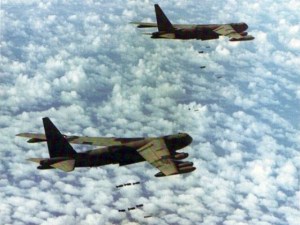
B-5222

As has been detailed, US actions, particularly in bombing, were directly responsible for creating the communist enemy which overthrew Lon Nol. The bombing between 1969 and 1973 took up to 150,000 lives.25 If averaged out, over 33 tons of ordnance were used to kill each Khmer Rouge insurgent.26 Despite the fact that Vietnamese pilots bombed any Cambodian they could, which aided only the Khmer Rouge, Lon Nol acceded to a US demand that he request an increase in VNAF bombing in 1971.27 By May 1972, the Lon Nol regime had control of perhaps 10 per cent of the country and continued to lose territory which was thereafter fragmented into ever smaller enclaves.28 The result was by that stage foregone, and yet the war dragged on for three years with the greater part of the 1 million deaths occurring after that point.

In 1970, when Henry Kissinger briefed Jonathan “Fred” Ladd, who was slated to conduct the war in Cambodia, he told him, “Don’t even think of victory; just keep it alive.”29 The point of the US bombing was not to win a military victory – it was to destroy Cambodia as part of an Indochina “exit strategy” – and that is a clear instance of genocide under the United Nations Convention on the Prevention and Punishment of the Crime of Genocide. When the US Congress finally blocked aid to Cambodia and South Vietnam, it was with the belated realisation that such aid would not give any hope of victory or improve a bargaining position. Senator Mike Mansfield spoke out, “Ultimately Cambodia cannot survive…. Additional aid means more killing, more fighting. This has got to stop sometime.”30

So that was the end of the US involvement in Cambodia, and their legal culpability. The Khmer Rouge took over Phnom Penh, and the refugees were shocked to see that the black-clad cadres were mostly young teens, fanatical and brutalised by half a young lifetime of fighting and death. The US was not responsible for the fantasies of the Pol Pot clique, who believed that supernatural amounts of food could be produced without recourse to machine power, nor for their refusal to accept aid. But the US had deliberately brought the Cambodian population to the brink of starvation – destroying farmland and driving peasants off the land. Perhaps 500,000 or more died of starvation. Hundreds of thousands were executed for political or ideological reasons, murdered by the Khmer Rouge who the US had largely brought into existence. And when the Vietnamese put the regime to an end (and despite what you may read about this being justifiable as “humanitarian intervention” it was in fact legitimate self-defence – if you don’t believe me you can read about Khmer Rouge foreign policy, border attacks, and espoused official desire to exterminate all Vietnamese) when the Khmer Rouge were supplanted, the US insisted that they retain a seat at the UN and started giving aid to their guerilla forces.

Drone 5860787655_2b5f5feff3_z

So, do I think that the Cambodia precedent is a good one to justify an assassination programme? No, I do not. But then again I am not from the US, and perhaps I am failing to grasp the subtle point that next to no “Americans” died in Cambodia (none that were officially acknowledged) therefore it did not happen. I don’t want to be offensive, but if they do not wish to be complicit with the crimes of the US regime, US anti-drone campaigners must avoid all trace of exceptionalism. I am sure they mean no harm, but why allow yourselves to be drawn into this ridiculous framework of seeing the drone programme as being primarily a question of “the targeting of Americans without due process.” There have been 5 US citizens killed with US drones whereas at least 4000 non-US citizens have been killed. Why would anyone, in those circumstances, give primacy to concern over “US citizens” and “due process”? This fetishisation of the idolised US Constitution is getting old. Besides which, the US Constitution’s “Supremacy Clause” (Article 6, Clause 2) actually gives treaties the same status as federal law – which would include the Nuremberg Charter and the UN Charter, among other things. Furthermore, by allowing the issue to be framed in such a manner, psychologically you set yourself and others up for being mollified by cosmetic measures offered to guarantee the rights of US citizens while retaining the right to kill foreigners at will. Do you really believe that being a US citizen or being born in Denver makes someone more human?

1 Yoram Dinstein, War, Aggression and Self-Defence (3rd ed.), Cambridge: Cambridge University Press, 2001, pp 184-5.

2 Edward Herman and Noam Chomsky, Manufacturing Consent: The Political Economy of the Mass Media. London: Vintage, 1994 (1988), p 260.

3 Ibid, p 263.

4 Sorpong Peou, Intervention & Change in Cambodia: Towards Democracy? Singapore: Institute of Southeast Asian Studies, 2000, p 54.

5 Ibid, pp 64-5.

6 Ben Kiernan, The Pol Pot Regime: Race, Power, and Genocide in Cambodia under the Khmer Rouge. New Haven and London: Yale University Press, 1996, p 18.

7 The US had developed ties with Lon Nol in the 1950s and by 1970, according to CIA officer Frank Snepp, he was one of two candidates being groomed by the CIA to take Sihanouk’s place (William Shawcross, Sideshow: Kissinger, Nixon and the Destruction of Cambodia. London: Fontana, 1980 (1979), pp 114-5).

8 Ibid, pp 114-23; William Blum, Killing Hope: U.S. Military and C.I.A. Interventions Since World War II (2nd ed.), Monroe: Common Courage Press, 2004, pp 137-8; Peou, Intervention & Change in Cambodia, pp 125-6.

9 Shawcross, Sideshow, p 19.

10 Marilyn Young, The Vietnam Wars 1945-1990, New York: Harper Perennial, 1991, pp 72, 186; Tucker, Vietnam, p 129; Turley, The Second Indochina War, pp 79-80.

11 Shawcross, Sideshow, p 140.

12 Young, The Vietnam Wars, p 245.

13 Shawcross, 1979, p 151.

14 David Keen, Endless War? Hidden functions of the ‘War on Terror’. London, Ann Arbor: Pluto Press, 2006, pp 58-61.

15 Neil Sheehan, A Bright Shining Lie: John Paul Vann and America in Vietnam (New York: Vintage 1989 (1988), p pp 106-111.

16 Kiernan, The Pol Pot Regime, pp 19-23. Also see Peou, Intervention & Change in Cambodia, p 128.

17 Shawcross, Sideshow, pp 73, 180, 194-5, 261.

18 Ibid, p 249.

19 Ibid, p 254.

20 Ibid, p 220.

21 Ibid, p 317-9.

22 Ibid, p 149.

23 Peou, Intervention & Change in Cambodia , p 127.

24 Shawcross, Sideshow, p 163.

25 Kiernan, The Pol Pot Regime, p 24.

26 Ibid, p 19.

27 Shawcross, Sideshow, p 186.

28 Ibid, pp 254-5.

29 Ibid, p 169.

30 Nigel Cawthorne, Vietnam: A War Lost and Won. London: Arcturus Publishing, 2003, p 213.

Is Obama Really Batman?

Standard

You can be excused just about anything if you’re a hero, because no one asks inconvenient questions. – Terry Pratchett.

Image

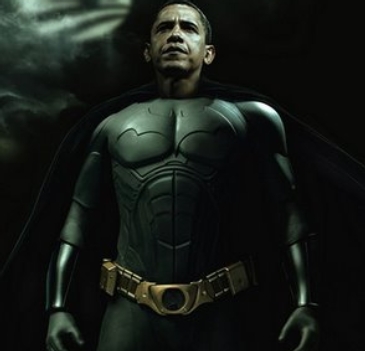
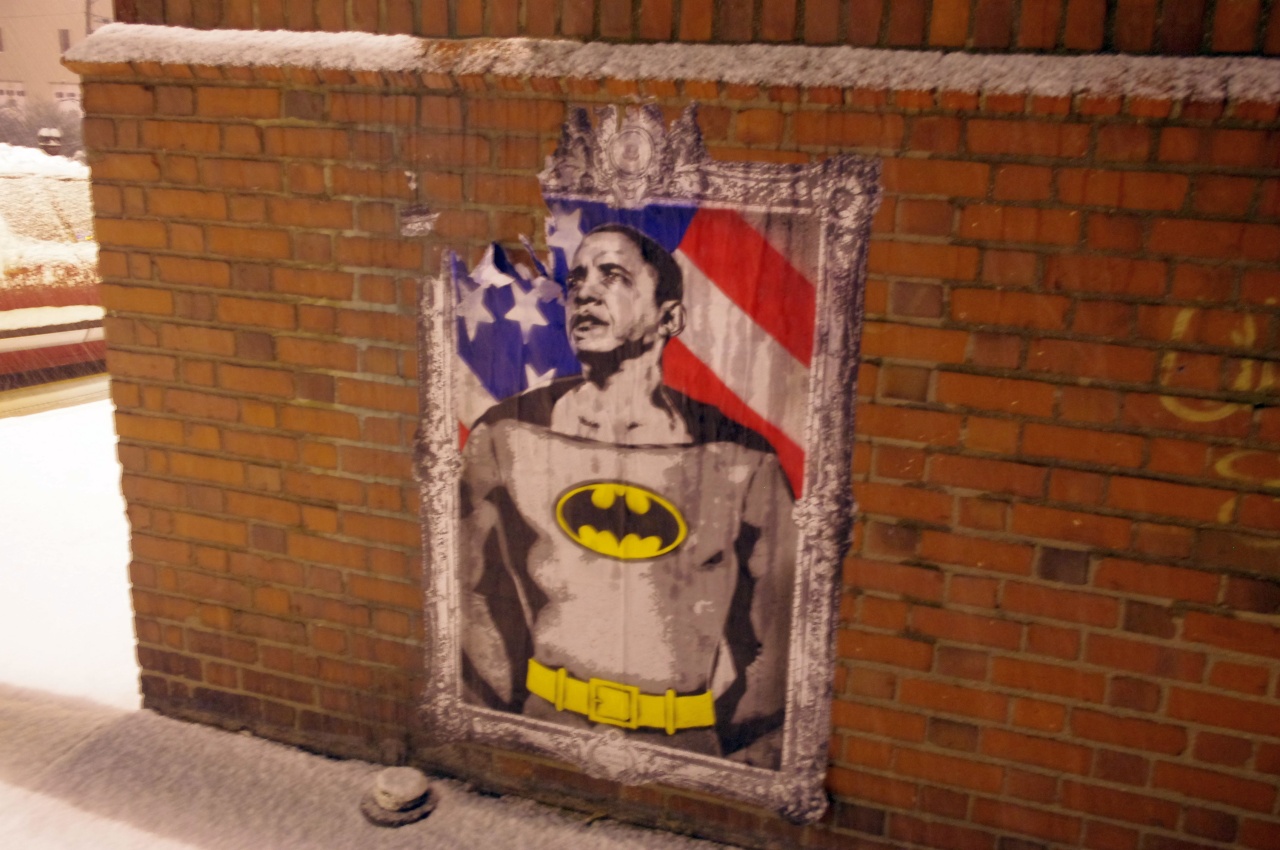
There are many ways in which various incarnations of Batman have appealed to people over the years, but central is the trope of counterterror – the revenge fantasy of the impotent. You see, Batman has superhuman powers. Yes, I am aware that the authors make it very clear that he does not have superhuman powers, but then they depict him doing things which are beyond human capabilities – hence he actually has superhuman powers. Using his super powers he brings fear to those who inflict fear. He is the victim who has become the righteous assailant. But there is a little bit of a problem here – if the “hero” is a violent nutcase with an odd costume fetish, why would we trust his moral compass? Why would we rely on his literally self-righteous narrative? In the same vein, why should we take Obama’s word that he has to kill people to prevent terrorism when the alleged terrorists cause much less terror and death than Obama? It turns out that people tolerate Obama because he seems to face an evil more unspeakable, more terrible, and yet more outrageous and comical than any evil known to history. It is not al-Qaeda, nor is it Kim Jong Un. It is the same evil that Batman faces.

Image

Nerd Rage Revenge Fantasy

There is reassurance in the idea of a powerful paternal figure that protects. But when you have been bullied; when you have been made to feel helpless, weak and scared; when your delusions of potency are shattered, maybe you want more than reassurance – maybe you want VENGEANCE. The tables must be turned. The tormentor must become the tormented. You don’t need a father figure anymore, you need a you figure. But an empowered you, a superhuman you, a terrifying you. You need the superhuman powers because you face a superhuman threat – the villains.

The villains are given superhuman power by the scary demon mask which is given to them by magic storytellers known as the corporate media. They terrorise. The mask they wear is the horror mask of primal and basic fear. Criminals and terrorists are not represented as human beings but as crime and terror made flesh. You cannot reason with them. You cannot even buy their forbearance. They will take your money and kill you anyway – because they are driven to kill. There are no ways of mediating or ameliorating the risk of becoming a victim. You hide behind locks, gates and guards, and you cheer for the preventive violence of vigilantes in or out of uniform.

If you are thinking that they take the horror villain mask from the fictional murderer of Hollywood and place it on the real murderers of the evening news, you would only be partly right. The horror mask is used, of course, but there are no “real” murderers on the evening news. Instead of a human being the news media version of a murderer is a cypher, a vehicle for the urge to kill, murder itself embodied and made flesh. They are even less real than their fictional Hollywood counterparts and it is the same when the murderers are “terrorists”. Proof of the unreality is in the irrelevance of actual guilt. The Central Park Five wore the horror mask, as did Damien Echols, and many other innocents such as those imprisoned and tortured in Guantánamo. These are all fictional unreal murderers and terrorists (despite the fact that they correspond to actual real people) who epitomise murder and terror. Their alien nature, their irrationality, their opacity all make them much greater sources of fear. But then there is the intriguing thought that one can also fight terror with terror.

Image

Enter the Batman!

The nature of Batman is such that he takes the terror felt by the public and projects it back at the supposed source of their terror. No, he doesn’t go around scaring the crap out of studio owners and heads of news departments, that would be too sensible. He terrorises the “baddies”, and a central part of the canonical backstory is that he too is a victim, having seen his parents senselessly gunned down as a child. The fear makes everyone a victim, and he is the victim granted the power to fight back.

Out of the dark, just as the tattoed thug is in the act of terrorising (his victim usually a woman), a dark figure drops from above. The tables are turned – the terroriser is now the terrorised – a highly gendered process in which the “bad guy” suddenly develops a very high pitched squeaky voice which is decidedly girly. Usually there is also some sort of phallic kerfuffle occuring – the bad guy’s pistol droops impotently, or Batman’s weapon is bigger, or disarmament is shown as symbolic castration. All good family fun.

This all occurs in exactly the same way in the world of Obama. The discourse of terrorism is one of the horror mask beneath which is the simplistic fiction of cardboard-cutout evil. Terrorists, like violent urban criminals, are animated by innate animus – a pure and unadulterated hatred. They hate our freedoms, we were told, and Obama has done almost nothing but reinforce that notion. Terrorists are killing machines. It is in their nature. You cannot negotiate with terrorists because they are all irrational fanatics. And so, like the urban criminals, the only choice is to incapacitate or eliminate them. As Prince Harry put it: “If there’s people trying to do bad stuff to our guys, then we’ll take them out of the game.” (He didn’t preface the comment with “Holy Playstation Batman!”, but he might well have, because the UK really does good line in being sidekick to a deranged vigilante).

The fear of the terrorist or criminal actually relies on the deliberate omission of any hint of rational motive or circumstantial cause. There is “no negotiating with terrorists”. The only admissable response is the response of the strongman, the Obataman who fights terror with terror. Otherwise people might think that all of this counterterror stuff (which actually creates more terrorists than it kills) is really about deliberately sowing instability and strife in order maintain a US strategic predominance which is, in fact, counter to the interests of the US people (but pretty good if you happen to be ExxonMobil).

Is the analogy with Batman a fair one? To be strictly honest, while Dick Cheney rather overtly embraced what he himself described as “the dark side”, Obama is in a sense more discreet than Cheney or Batman. Part of the appeal of the use of drones is that it seems clinical and detached. Obama specifically claimed “very few” civilian casualties from “very precise, precision strikes against Al Qaeda and their affiliates” in a programme that is “kept on a very tight leash.” So it seems like a programme that just gets “the worst of the worst”. Just like Guantánamo. The frequency of the drone strikes just goes to show how serious the threats to the US are. It also reveals the vigilance of the intelligence forces who strike at every credible threat as soon as it is detected. It is a bit like a whack-a-mole game. The public can be very reassured by the frequency of lethal action without having to ask themselves irrelevant questions such as: who?; where?; how old?; or, how can some impoverished person from one of the most undeveloped regions of the planet pose a credible threat against a country that spends such obscene amounts on “defense” and “homeland security”?

On the other hand, to give Batman his due, despite his broody wierdness and silly voice, he usually resists the temptation to actually murder people, and he doesn’t kill children at all. Obama, by contrast, murders children on a very regular basis, which is not a normal part of the “hero” job description.

Image

The Credibility Problem

Batman and Obama do share a certain fundamental problem, and their propagandists resolve this problem in the same manner. In the final analysis, Batman is an extremely emotionally disturbed vigilante who dresses up as a bat. Yes, this is obvious, and he is a superhero (sort of) but he dresses up as a bat to fight crime. That’s pretty loopy. Likewise, Obama is a serial murderer and war criminal. It might be difficult for people to grasp this at first, but many political leaders in the world are not murderers or war criminals. I know that seems completely mad, but it is true. Heaps and heaps of world leaders don’t even have assasination programmes!

Obama and Batman each have a kind of lame excuse. In the case of Batman it is that while he is actually a bit mad, he almost always has certain internal constraints on his behaviour. It isn’t that comforting really. It is a little like claiming that a sexually motivated burglar who likes to sniff underwear and watch people sleeping is actually alright because, out of hundreds of break-ins, the perpetrator has only sexually assaulted a sleeping victim on a couple of occasions. Similarly, Obama assures us that the people he murders aren’t really murdered, because he has some lawyers who have written down some very important legal words which explain exactly why it is not actually murder but perfectly legal killing and we would be able to see these very important words but they have to be secret because of security. This is nothing more than a sophisticated Third Millenium version of the Nixon defence (if the President does it, it must be legal). These first-line excuses would not protect Obama and Batman from the derision, condemnation and legal proceedings they so richly deserve, but they are supplemented by something far more powerful – flattering contrasts.

How do you make a violent mentally disturbed vigilante in an outrageous costume seem morally acceptable? By pitting him against villains who are even more violent, more mentally disturbed, and more outrageously costumed. Yes, I’m talking about people like Michelle Bachmann and Glenn Beck. You might ask, what about Osama Bin Laden, Muammar Gaddafi and the new kid on the block, Mokhtar Belmokhtar? They are all very well, but for all of their rather suspiciously excessive and picturesque fiendishness, eventually people start to notice that they kill a lot less people than the “good guys”. That is one of the reasons why Bush kept sliding in the polls, eventually even the most brainwashed had to notice that he had lost the moral high ground (and the only excuse that he ever had for pursuing a very criminal foreign policy was to cite moral righteousness). So they had to change from a John Wayne president to a Bruce Wayne president. And you have to admit that Obama seems inherently sane and reasonable when juxtaposed with supervillains like The Newt, Bibi Yahoo, The Enarray, Doctor Romnesia and “Whitey” O’Reilly.

I could probably just start listing completely freakish and weird individuals and groups who position themselves to the right of Obama and it would be a very long list indeed. But you can probably think of a few without my assistance. Obama has managed to seem extremely rational, humane, caring and progressive merely by rejecting some extremely deranged stances taken by his domestic political opponents. Take the Republican primary circus, for example. That was one hell of a freak show and the national convention was a suitably bizzarre coda. And the Republican candidate? A completely unelectable billionaire who refuses to release his tax returns, probably because it would show people how he managed to score millions in taxpayer bailout money by holding the government to ransom in 2008 (the deal was legal, just very very immoral, and concealing it may yet land Romney in prison). And yet they managed to make the election into a credible two-horse race, though only with the mainstream media bending over backwards to keep pretending that Romney’s assertions were worthy of report despite 533 documented lies over the space of 30 weeks of campaigning.

The fact is that Obama only has to say the sort of things that a ten-year old kid would say about the day’s issues, and it seems as if he were the only help of salvation in the face of the sort of reactions his opponents evince. Take the issue of mentally ill people massacring children with weapons which are purpose-built for killing people. Obama said: “We’re going to need on making access to mental health at least as easy as access to a gun. We’re going to need to look more closely at a culture that, all too often, glorifies guns and violence.” Those words almost made him sound like a radical, because very powerful voices were saying that the answer to mass shootings was more guns.

Other issues where Obama’s opponents manage to make him look reasonable even when he is being inhumane or criminal include foreign policy and immigration. Obama has deported record numbers of people (400,000 last year) at enormous expense (ICE and Customs and Border enforcement cost at least $19 billion in 2012). Yet, because he says much less callous things than Republicans, he gets a free ride on the issue. Obama presided over 20,000 air strikes in his first term, nearly equal to the number in both Bush Jr. terms. But Romney’s neocon studded team and the Iran War enthusiasts make Obama seem restrained if not dovish. Obama has been steadfast and seemingly obsequious in support of Israel, but the inevitable opposition to illegal Israeli settlements in the West Bank and Netanyahu’s silly charade of insulted objection, make Obama seem like an “honest broker” (the US has to oppose the illegal settlements, otherwise they could not pretend to support the “peace process” to find a “two-state” solution).

Image

How Many Jokers?

So there we have it. Batman needs The Joker, otherwise he looks too much like a dangerous lunatic himself. For Obama, one joker is not enough. It takes a whole slew of maniac clowns to make Obama seem alright, and for good reason. Here is a test. Read the list of children killed by drone strikes in Pakistan and Yemen compiled by the Bureau of Investigative Journalism. Think about the dead children. (It is an incomplete list. Many victims will never be known.) Then some day when you are in a crowd, picture Obama and think “This guy kills kids. He actually kills children.” Then look at all of the people around you. Do any of them kill children? Not very likely, is it? Normal people don’t kill children. If you found out that one of the people around you had murdered numerous children, how would you react? Now ask yourself, why don’t you react that way to Obama? Isn’t it time to forget about the freakish clowns and see him for what he really is?

Bomber in Chief: 20,000 Airstrikes in the President’s First Term Cause Death and Destruction From Iraq to Somalia | Alternet by Nicolas J.S. Davies

Standard

Bomber in Chief: 20,000 Airstrikes in the President’s First Term Cause Death and Destruction From Iraq to Somalia | Alternet.

Bomber in Chief: 20,000 Airstrikes in the President’s First Term Cause Death and Destruction From Iraq to Somalia

AlterNet / By Nicolas J.S. Davies

Day after day, U.S. air strikes have conclusively answered the familiar question of 9/11: “Why do they hate us?”

Photo Credit: AFP

Many people around the world are disturbed by U.S. drone attacks in Afghanistan, Pakistan, Yemen, Somalia and elsewhere. The illusion that American drones can strike without warning anywhere in the world without placing Americans in harm’s way makes drones dangerously attractive to U.S. officials, even as they fuel the cycle of violence that the “war on terror” falsely promised to end but has instead escalated and sought to normalize. But drone strikes are only the tip of an iceberg, making up less than 10 percent of at least 20,130 air strikes the U.S. has conducted in other countries since President Obama’s inauguration in 2009.

The U.S. dropped  17,500 bombs during its invasion of Afghanistan in 2001. It conducted  29,200 air strikes during the invasion of Iraq in 2003. U.S. air forces conducted at least another  3,900 air strikes in Iraq over the next eight years, before the Iraqi government finally negotiated the withdrawal of U.S. occupation forces. But that pales next to at least 38,100 U.S. air strikes in Afghanistan since 2002, a country already occupied by U.S. and NATO forces, with a government pledged by its U.S. overlords to bring peace and justice to its people.
The Obama administration is responsible for  at least 18,274 air strikes in Afghanistan since 2009, including at least 1,160 by pilotless drones. The U.S. conducted at least 116 air strikes in Iraq in 2009 and about  1,460 of NATO’s 7,700 strikes in Libya in 2011. While the U.S. military does not publish figures on “secret” air and drone strikes in other countries, press reports detail a five-fold increase over Bush’s second term, with at least  303 strikes in Pakistan125 in Yemen and 16 in Somalia.
Aside from the initial bombing of Afghanistan in 2001 and the “shock and awe” bombing of Iraq in March and April 2003, the Obama administration has conducted more air strikes day-in day-out than the Bush administration. Bush’s roughly 24,000 air strikes in seven years from 2002 to 2008 amounted to an air strike about every 3 hours, while Obama’s 20,130 in four years add up to one every 1-3/4 hours.
The U.S. government does not advertise these figures, and journalists have largely ignored them. But the bombs and missiles used in these air strikes are powerful weapons designed to inflict damage, death and injury over a wide radius, up to hundreds of feet from their points of impact. The effect of such bombs and shells on actual battlefields, where the victims are military personnel, has always been deadly and gruesome. Many soldiers who lived through shelling and bombing in the First and Second World Wars never recovered from “shell-shock” or what we now call PTSD.
The use of such weapons in America’s current wars, where “the battlefield” is often a euphemism for houses, villages or even urban areas densely populated by civilians, frequently violates otherwise binding rules of international humanitarian law. These include the  Fourth Geneva Convention, signed in 1949 to protect civilians from the worst effects of war and military occupation.
Beginning in 2005, the U.N. Assistance Mission for Iraq (UNAMI) issued quarterly reports on human rights in Iraq. They included details of U.S. air strikes that killed civilians, and UNAMI called on U.S. authorities to fully investigate these incidents.  A UNAMI human rights report published in October 2007 demanded, “that all credible allegations of unlawful killings by MNF (multi-national force) forces be thoroughly, promptly and impartially investigated, and appropriate action taken against military personnel found to have used excessive or indiscriminate force.”
The UN human rights report included a reminder to U.S. military commanders that, “Customary international humanitarian law demands that, as much as possible, military objectives must not be located within areas densely populated by civilians. The presence of individual combatants among a great number of civilians does not alter the civilian nature of an area.”
But no Americans have been held criminally accountable for civilian casualties in air strikes, either in Iraq or in the more widespread bombing of occupied Afghanistan. U.S. officials dispute findings of fact and law in investigations by the UN and the Afghan government, but they accept no independent mechanism for resolving these disputes, effectively shielding themselves from accountability.
Besides simply not being informed of the extent of the U.S. bombing campaigns in Iraq and Afghanistan, the U.S. public has been subject to military propaganda about the accuracy and effectiveness of “precision” weapons. When military forces detonate tens of thousands of powerful bombs and missiles in a country, even highly accurate weapons are bound to kill many innocent people. When we are talking about 33,000 bombs and missiles exploding in Iraq, 55,000 in Afghanistan and 7,700 in Libya, it is critical to understand just how accurate or inaccurate these weapons really are. If only 10 percent missed their targets, that would mean nearly 10,000 bombs and missiles blowing up something or somewhere else, killing and maiming thousands of unintended victims.
But even the latest generation of “precision” weapons is not 90 percent accurate. One of the world’s leading experts on this subject, Rob Hewson, the editor of the military journal Jane’s Air Launched Weapons, estimated that  20 to 25 percent of the 19,948 precision weapons used in the “shock and awe” attack on Iraq in 2003 completely missed their targets. The other 9,251 bombs and missiles were not classified as “precision” weapons in the first place, so that only about 56 percent of the total 29,199 “shock and awe” weapons actually performed with “precision” by the military’s own standards. And  those standards define precision for most of these weapons only as striking within a 29 foot radius of the target.
To an expert like Rob Hewson who understood the real-world effects of these weapons, “shock and awe” presented an ethical and legal problem to which American military spokespeople and journalists seemed oblivious. As he told the Associated Press, “In a war that’s being fought for the benefit of the Iraqi people, you can’t afford to kill any of them. But you can’t drop bombs and not kill people. There’s a real dichotomy in all of this.”The actual results of U.S. air strikes were better documented in Iraq than in Afghanistan. Epidemiological studies in Iraq bore out Hewson’s assessment, finding that tens of thousands, maybe hundreds of thousands, of Iraqi civilians were killed by U.S. air strikes.  The first major epidemiological study conducted in Iraq after 18 months of war and occupation concluded:

Violent deaths were widespread … and were mainly attributed to coalition forces. Most individuals reportedly killed by coalition forces were women and children … Violence accounted for most of the excess deaths and air strikes from coalition forces accounted for most violent deaths.

When the same team from Johns Hopkins and Baghdad’s Al Mustansariya University did  a more extensive study in Iraq in 2006 after three years of war and occupation, it found that, amidst the proliferation of all kinds of violence, U.S. air strikes by then accounted for a smaller share of total deaths, except in one crucial respect: they still accounted for half of all violent deaths of children in Iraq.
No such studies have been conducted in Afghanistan, but hundreds of thousands of Afghans now living in refugee camps tell of  homes and villages destroyed by U.S. air strikes and of family members killed in the bombing. There is no evidence that the pattern of bombing casualties in Afghanistan has been any kinder to children and other innocents than in Iraq. Impossibly low figures on civilian casualties published by the U.N. mission in Afghanistan are the result of small numbers of completed investigations, not comprehensive surveys. They therefore give a misleading impression, which is then amplified by wishful and uncritical Western news reports.
When the UN identified only 80 civilians killed in U.S. Special Forces night raids in 2010, Nader Nadery of the Afghanistan Independent Human Rights Commission, who worked on the UN report, explained that  this was based on completed investigations of only 13 of the 73 incidents reported to the UN for the year. He estimated the number of civilians killed in all 73 incidents at 420. But most U.S. air strikes and special forces raids occur in resistance-held areas where people have no contact with the UN or the Human Rights Commission. So even thorough and complete UN investigations in the areas it has access to would only document a fraction of total Afghan civilian casualties. Western journalists who report UN civilian casualty figures from Afghanistan as if they were estimates of total casualties unwittingly contribute to a propaganda narrative that dramatically understates the scale of violence raining down from the skies on the people of Afghanistan.
President Obama and the politicians and media who keep the scale, destructiveness and indiscriminate nature of U.S. air strikes shrouded in silence understand only too well that the American public has in no way approved this shameful and endless tsunami of violence against people in other countries. Day after day for 11 years, U.S. air strikes have conclusively answered the familiar question of 9/11: “Why do they hate us?” As Congressmember Barbara Lee warned in 2001, we have “become the evil we deplore.” It is time to change course. Ending the daily routine of deadly U.S. air strikes, including but by no means limited to drone strikes, should be President Obama’s most urgent national security priority as he begins his second term in office.

Nicolas J. S. Davies is author of Blood On Our Hands: The American Invasion and Destruction of Iraq. He wrote the chapter on “Obama At War” for the just released book, Grading the 44th President: A Report Card on Barack Obama’s First Term as a Progressive Leader.

Standard

aletho's avatarAletho News

By Sara Kozameh | CEPR The Americas Blog | January 18, 2013

On January 14th, a day marking the one-year anniversary of his administration, Guatemalan president Otto Pérez Molina presented his first annual report on the state of the country. In his speech, Pérez Molina, a former general, graduate of the School of the Americas and accused of being  a war criminalimplicated in the systematic use of torture and acts of genocide, hailed a “historic 10 percent reduction in violent crime” and “an almost five point drop in the homicide rate per every 100,000 inhabitants” from the previous year. Guatemala currently has one of the highest murder rates in the world (41 murders per every 100,000 inhabitants); it had a total of 5,122 murders in 2012. Ironically, while President Pérez Molina was reporting back to the nation on crime statistics and murder rates that morning, the…

View original post 601 more words

Standard

aletho's avatarAletho News

By Saed Bannoura | IMEMC & Agencies | January 21, 2013

The Israeli Defense Ministry announced on Sunday that they will re-route a section of the Wall east of Jerusalem in order to close off an existing gap and fully annex the city of Jerusalem into Israel. The new route means the complete encirclement of the Palestinian village of Al-Zaim, with the Wall to the West and a security fence to the east.

IMG_0446-600x400Other Palestinian towns are also completely isolated and encircled into ghettoes, including the town of Sheikh Sa’ed and the city of Qalqilya. Israeli authorities isolated these towns in order to create Palestinian-free zones and routes throughout the West Bank to allow Israeli settlers to travel unencumbered without either having to stop at checkpoints or to drive on the same roads as Palestinians. But in order to do that, Israeli forces have had to maintain over 600 checkpoints…

View original post 340 more words

Shedding crocodile tears while collaborating with US-led sanctions

Standard
 As with Iran, the sanctions regime against the Syrian people is beginning to show its genocidal character.
Franklin Lamb
Are the Arab League and Organization of Islamic Cooperation targeting Syria’s civilian population?Damascus– One powerful image from Damascus that has become seared into this observers mind these days is when I walk by a Western Union office. Most of them remain open despite the brutal US-led sanctions which in their pervasive effects target almost entirely the civilian population.
Obama mulling Syria

But all Western Union offices were closed last Thursday and Friday due to heavy snowfall, some say the deepest here for more than a quarter century. Still, some Syrians braved the extreme cold and could be seen huddled outside some branches, evidently in vain hope that they might open and their families might eat.

One of the few economic lifelines not yet cut by the ever strangling, profoundly immoral and illegal US-led sanctions with their throat-hold tightening around the civilian population in Syria in order to achieve regime change, “WU” as it’s known, has become, for some, literally a lifesaver. This is because its money transfer service is still allowing family and friends from abroad to send in assistance to Syria for their desperate families caught up in this regional contest between Resistance and a return to Western hegemony.

Peering in the window or stepping inside a Western Union outlet in Damascus, reminds this observer of scenes from Western Unionthe floor of the New York Stock Exchange or a European bourse wherein traders wave pieces of paper or other objects trying to get the attention of someone. But in Syria those trying to submit their ten digit Money Control Transfer Number (MTCN) numbers and ID’s in order to collect cash, are not wearing clothes from the fashion houses. Rather, given the frigid temperatures and lack of mazot(heating oil that 90% of the population here relies on for heat) they are tightly bundled. Women and kids generally wrapped tight in thick head scarves.

Last week this observer went into the Western Union office in central Damascus to collect some cash sent from Canada for a family that had managed to escape from Aleppo. The place was packed but orderly. I smiled to myself as I thought about my own country when sometimes during a Black Friday type sale, the scene of waiting in queue collapses into yelling, insults, fights, throwing objects, threats, all to save a few dollars or get one’s hands on the, soon to be trashed, “must have” sale item.

The stressed but committed staff behind the WU counter could not give assurance how long I would have to wait but graciously did agree to take my passport and I could return later. On arriving after about three hours, my MCTN # had just been processed and I was in and out fast. I can’t imagine that I will see a yellow and black Western Union sign ever again without thinking about US sanctions targeting the Syrian civilian population.Hiram Sibley

An historical irony is that it was a Syrian gentlemen, Mr. Hiram Sibley, one of the thousands of Syrians who emigrated to the United States in the mid-19th Century (the first and largest Arab migration then and since came from Syria) who in 1851 established the New York and Mississippi Valley Printing Telegraph Company with the goal of creating one great telegraph system with unified and efficient operations. Four years later Western Union was born and became an American icon and thirty three years on it had become one of the top ten companies listed on the New York Stock Exchange the day it opened in 1888.

The reason Western Union is able to avoid the US-led sanctions that include medicines and food (White House claims to the contrary notwithstanding), is quite simply that the US Treasury Department cannot easily face the domestic American political fallout from curtailing Western Union anywhere.

According to a July 2012 US Senate Banking Committee memo, were Treasury to be seen as tampering with Western Union’s $7 billion annual revenues, there would be a significant problem. Already there are growing complaints from US businesses flooding the White House & Congress claiming that sanctions imposed on Syria are costing American businesses hundreds of millions of dollars in lost profits — even more regarding US sanctions on Iran. So to date the Office of Financial Assets Control (OFAC) at Treasury has kept its hands off Western Union and this is good for Syrian civilians.

For these reasons a thin lifeline — a reed really — exists for many in Syria with families and friends abroad able to use WU’s “Money in Minutes” to help them. It’s a relatively small factor in the larger Syrian crisis but it does help many.

Much more significant than Western Union remaining open, and the subject of much current criticism here, is the lack of assistance to Syria’s severely sanctioned civilian population from the Arab League and the Organization of Islamic Cooperation, neither of which lack officials who are wringing their hands in public these days, in mock anguish it is claimed, over their brothers and co-religionists “victimization.”

Claiming solidarity with the Syrian people, on 11/12/2011 the Arab League suspended the membership of Syria (Lebanon and Yemen voted no and Iraq abstained) and cancelled its monitoring mission in Syria on 1/28/12. The Organization of Islamic Cooperation suspended Syria’s membership on 5/15/12 at a summit of Muslim leaders in Mecca. Saudi Arabia, the summit’s host, has led all Arab League and OIC calls for the Syrian rebel opposition
to be armed, which Foreign Minister Saud al-Fasial described in February and since as “an excellent idea.”

By their actions, the OIC and the Arab League are themselves sanctioning the Syrian people in brutal forms and doing nothing to object to the immoral and illegal aspects of the American sanctions. Both organizations stand accused of abandoning their charters in order to maintain profitable relations with NATO countries as they funnel large sums of money and weapons to various militias inside Syria. It is their “agents,” the jihadist groups, who have turned on the Syrian civilian population increasingly resorting to theft, kidnapping for ransom, rape, sale of children and killing hundreds according to UN agencies.

In one poignant interview near Omayyad Square the other day, a solemn, long bearded Sunni Sheik told this observer that the American sanctions are also directly targeting Islam because the sanctions constitute an attack on Islamic values. When pressed for specifics, he reluctantly replied, “Because your countries sanctions are impoverishing our people and forcing our Muslim women into prostitution. These sanctions are also flooding the streets with Muslim beggars, both adults and children. I am sure you have seen them, here in Damascus, across Syria and in bordering countries. But the claimed protectors of our holy sites are silent and shed only insincere tears in public. But if they resisted these sanctions they could defeat them. What is required in a 1970’s type Arab boycott of American and western companies until these anti-Muslim sanctions are lifted.”

The honorable gentleman has a point.

UNHCRThe Arab League’s recent ministerial-level meeting held in Cairo was called to focus on the Syrian refugees file. But the rather pathetic quick one day deliberations ignored the causes of the suffering of the civilian population as well as the fact that most of the 22 countries comprising the Arab League have been a main cause behind the displacement of the Syrian civilian population. Both the AL and the OIC stand accused here in Syria of participation in the sanctions which are decimating the Syrian people’s livelihood. Some AL and OIC officials are shedding crocodile tears about
the miserable living conditions of the Syrian refugees “in spite of spending millions on recruiting mercenaries and salifi-takfiries, training them and purchasing weapons for the terrorists,” the Sheik explained.

One frustrated American NGO director, affiliated loosely with the World Food Program, expressed her frustration: “If these organizations (AL and OIC) wanted to aid Syrian refugees they should stop supplying the gunmen with weapons and money and stop inciting sedition in Syria.”

The Arab League Secretary General, Nabil al-Arabi, still does not get it.

He used last week’s Arab League session to insist on foreign intervention and regime change, renewing the AL demand that the UN Security Council deploy international forces in Syria.

The Lebanese Foreign Minister, Adnan Mansour, offered his views of the Syrian refugee’s displacement. Notable causations, he claimed, are the flow of weapons and money into Syria, the entry of foreign gunmen and not joining a political dialogue. To his credit, Mansour called on the AL and OIC to “shoulder their responsibilities towards the refugees through ensuring their humanitarian, medical, livelihood, educational and services requirements in order to ease their daily suffering.”

As for the Kuwaiti Minister, he considered that the US-led sanctions were not a problem but rather that the suffering of the Syrian people was caused by the failure of the UN Security Council to meet the demands of the AL for immediate military intervention in Syria. He also insisted that Kuwait has mobilized all its resources to ensure that financial and relief resources alleviated the suffering of the Syrian refugees.

To date, the Syrian refugees, victims of US led and AL-OIC complicity, have not received any of the assistance Kuwait, the Arab League or the Organization of the Islamic Conference has promised. Rather, these organizations appear to be propping up the US-led sanctions.

Meanwhile, according to officials, Syria’s government has just authorized the UN World Food Program to extend its reach in the country where 2.5 million people are suffering from hunger. Ertharin Cousin, spokeswoman of the WFP, announced on Tuesday that Syria is allowing the organization to work with local aid groups to reach more of those in need. To boost the number of people receiving emergency assistance, the Syrian government last week drew up a list of 110 local NGOs authorized to participate in the aid effort.

WFP is working closely with the Syrian Arab Republic Red Crescent Society (SARCS) which, thanks to more than 9000 volunteers, are operating the following facilities to serve every Syrian and Palestinian without consideration of sect or political views: Damascus 15, Damascus countryside 68, Suwayda 2, Homs 71, Idelb 2, Aleppo 185, al-Raqqah 52, al-Hasakah 52, Dayr al-Zawr 4, and Quneitra 12.

Unlike the Arab League and the Organization of the Islamic Conference, SARCS, the World Food Program, and more than 40 other NGO’s can be observed any day of the week confronting and attempting to ameliorate the profoundly immoral and illegal US-led sanctions — manifold actions, not crocodile tears — in aid of the civilian population of Syria.

Franklin Lamb is doing research in Syria and can be reached c/o fplamb@gmail.com

Source: Al-Manar Website

19-01-2013 – 09:47 Last updated 19-01-2013 – 10:41 | 1525 View

moorbey's avatarDogma and Geopolitics

http://www.almanartv.com.lb/english/catpage.php?frid=41

Are the Arab League and Organization of Islamic Cooperation targeting Syria’s
civilian population?

Franklin Lamb

Damascus — One powerful image from Damascus that has become seared
into this observers mind these days is when I walk by a Western Union
office. Most of them remain open despite the brutal US-led sanctions which in
their pervasive effects target almost entirely the civilian population.
But all Western Union offices were closed last Thursday and Friday due to
heavy snowfall, some say the deepest here for more than a quarter century.
Still, some Syrians braved the extreme cold and could be seen huddled outside
some branches, evidently in vain hope that they might open and their
families might eat.

One of the few economic lifelines not yet cut by the ever strangling,
profoundly immoral and illegal US-led sanctions with their throat-hold
tightening around the civilian population in Syria in order…

View original post 1,658 more words

Standard

Nina Westbury's avatarcrimson satellite

Felicity Arbuthnot

It is the first genocide of the 21th century. Poor Iraq and Iraqis. The silence of the world pushes me to lose faith in humanity.” (Anonymous)

Incredibly it is twenty two years to the day since the telephone rang in the early hours and a friend said:

“They are bombing Baghdad.”

It was not only Baghdad, of course, Iraq was being systematically destroyed, from ancient southern Basra to haunting, historic Mosul in the north – in the West destruction was such that it was not even noticed by the outside world that about seventy miles of Iraq had been entirely illegally donated to Jordan, the border was simply “moved.” Kuwait, bordering of Iraq’s southern border benefited similarly illegally.

Then Secretary of State James Baker’s vow to: “reduce Iraq to a pre-industrial age” was being minutely executed over what was to become a forty three day blitz, which morphed…

View original post 572 more words

The Israel Lobby Thing – A New Improved Formula Commentary, Now with Hitler Jokes and 18% More Verbiage at No Extra Cost!

Standard

01israel_lobby_home_book[1][1]

For those of you who are unfamiliar with the issue, some people claim that the “Israel Lobby” shapes US foreign policy in the Middle East. I disagree, and the reasons why I disagree are explained in the following commentary. There are two accompanying written pieces which are cited. The first, here, is an orphan fragment from an abandoned draught dealing with attributes of US imperialism. Grafted on to the end is another orphan fragment about the qualities which made Iraq a natural target for US genocide in the imperial context. And here is a second piece which deals with US neocolonialism with the most relevant part (at the start) describing the reasons behind the US tendency to align with kleptocratic and violently authoritarian client regimes. A few other interesting links can be found in the transcript below.

The audio can be downloaded or streamed at A-Infos and comes in 32Kbps or 128Kbps.

UPDATE 20130116:

I have already received a comment that it seems as if I am accusing all users of terms like “Jewish Lobby” and “Jewish Money” of being hateful racists in this commentary. I don’t mean too, but I do stand by my use of the term “bigotry”. This form of usage (e.g. “Jewish Money”) marries a prejudicial negative connotation to a particular group of people – hence it is bigotry. But I don’t mean to suggest that everyone who employs such language is a bigot. They may quite innocently be partaking in a discourse of bigotry without actually thinking through the implications of what is being said or written. The hazard is in letting that sort of thing stand unchallenged, which is how deep-seated bigotry can often take root. 

What I wanted to suggest in my commentary is not that you have to hate Jews to believe the W&M thesis, but rather that people who do hate Jews find it really, really attractive. I was genuinely shaken by how quickly my online disputants back in 2006 turned to racism. I think that Israeli policy is creating a whole new generation of anti-Jewish racists in many countries around the world, and I think that in the US the Walt and Mearsheimer thesis gives them a very sharp and dangerous focus in providing a discourse of treason against the United States. Zunes is absolutely correct to point out the parallels between this and that scapegoating of Jews that has occurred historically.

Zunes articles on the Israel lobby issue can be found here and here and here.

I know that this is going to confuse people, but here is where I stand: I support a one state-solution in Palestine; I support the BDS movement; I believe that the Israel lobby has a ridiculously disproportionate influence over US domestic politics at the congressional level and, more importantly, at the street level, but I firmly believe that the idea that the Israel lobby determines in any manner or degree US foreign policy is utterly stupid. I admire Jeff Blankfort and Noam Chomsky; Stephen Zunes and Stephen Gowans, but see ways in which every single one of them is guilty of inadvertantly (though sometimes rather wilfully) becoming apologists for and ideological supporters of US imperialism. On the other hand I see nothing admirable, nor even excusable in Stephen Walt and John Mearsheimer who are not only more fatuous than the aforementioned, but also, given their Professorial positions as political scientists and so-called “neo-Realists”, do not have any excuse for being such idiots.

So, how did I get to be this “neither fish nor fowl” creature? And how can I persuade you to join me in this annoying world where weighty matters are not reducible to sound bites? Firstly I can point out that there is a simple way of looking at these things. The idea that a tiny state such as Israel, a virtual dependency of the US, dictates US foreign policy is silly. It is that simple. It is the very same far-fetched excuse as those who suggest that the US was drawn into the Korean War by the machinations of Syngman Rhee, and drawn into Indochina by systemic inertia. This is blatant apologism for repeated acts of genocide whose fundamental similarities alone are enough to indicate intentionality. But I am aware they my simply stating this stuff leaves much to be desired and much to be answered, particularly “what are the drivers of US foreign policy?”, and why do I so confidently discount the role of the Israel lobby in this when it is demonstrably powerful in US politics?

05045-0419064645-AIPAC_Lobby

Before I start however, I want to have a bit of a self-pitying whinge. I’m aware that I’m probably making no friends by taking a stance which contradicts everyone else’s stance. But instead of getting angry at me for taking much the same line as Zunes and Chomsky, remember that I am also alienating those people who agree with Chomsky on the subject of Palestine (a dying breed, admittedly). Before you write to gainsay my claims I would ask that the following matters be of consideration: One, that you ask yourself, can your stance be reconciled with the pattern of historical events (including analogous situations) such that you are not claiming some peculiar exceptionalism for US society that you would find unreasonable in other societies? Two, is there a theoretical consistency to what you are claiming, or does the attempt to translate into theoretical terms expose contradictions which once again are suggestive of an insupportable claim of exceptionalism. You might ask yourself, “what theory? What is this guy on about?” The fact is, however, that each time you link a cause with an effect, you are doing so in theoretical terms. What I am concerned about is those who have a world view wherein theories contradict themselves.

On last thing remains with regard to the fact that I chose to comment on matters where I disagree with everyone. I could do otherwise, I could choose a more agreeable path of greater agreement, but the result might be a little bit like – “so I hear that the Earth actually circles the Sun, I reckon that’s probably true, so that’s maybe something we can agree on. They tell me that the majority of dogs have four legs and, well its only anecdotal, I know, but almost every single dog I’ve seen has four legs, and I’ve seen quite a few dogs. They also say that Hitler wasn’t a very nice person. I’d more or less agree with that proposition. They didn’t give him a Nobel Peace prize, which is probably a good thing I think we can agree. I mean, they must have been tempted, if they’re like they are now. You know, that whole non-aggression pact with the Soviet Union, I reckon that nowadays that’d probably have netted Hitler and Stalin a peace prize each. Hitler, instead of killing himself, could have simply pointed out that he was sincere, that he sincerely believed that Jews were a form of demographic Weapon of Mass Destruction and that Poland was in possession of millions of Weapons of Mass Destruction with the potential to reach as far as New York city, if they weren’t denied entry. He could have become a peace envoy just like Tony Blair, trying to find common ground in decolonising struggles such as in Indonesia or Indochina. Ahh, if only they were as civilised then as we are now….” Sorry, got a bit off-track there, but hopefully you get my point, which is that if I talked about what I agreed with, it would be boring and pointless and then I’d just start making stupid jokes just to relieve the tedium.

15qKu1rvr6cco1_500

At this point I was going to introduce matters with a brief summary of what I had written in another context about the US empire, but it is too complicated and it can’t be presented in theoretical terms because existing theory, as we shall see, is woefully inadequate. So I have created a pdf from the exerpt with a grafted on bit about why there was a strategic imperative for the US empire to commit genocide in Iraq. OK, it’s massive, but at least look through it and I will summarise the pertinent bits for you here and, hopefully, you can see that my reasoning is based on solid evidence.

The US empire is based on power structures which are now often referred to, not unreasonably, as corporatist. Corporatism is as good a word as any, but it should not be linked explicitly with Fascism per se. Structurally it is akin to feudalism in that it accords so-called “regnal rights” to entities which are not theoretically sovereign. Indeed US “corporatism” is the continuity of that form of regime which has persisted through transitions from feudal, to early modern mercantilist, to liberal. In the year 1900 its highest expression was in the liberal British Empire. There was no “revolving door” at this time, government and private interests only separated when circumstances dictated that they must. The supposedly sovereign governmental structure constituted far, far less than half of the state power wielded in the imperial polity. In 1902 John Hobson noted that the British Empire was a drain on the wealth of the majority of the people of Britain and the majority of the capitalist enterprises of Britain. He wrote: “Seeing that the Imperialism of the last three decades is clearly condemned as a business policy, in that at enormous expense it has procured a small, bad, unsafe increase of markets, and has jeopardised the entire wealth of the nation in rousing the strong resentment of other nations, we may ask, “How is the British nation induced to embark upon such unsound business”; The only possible answer is that the business interests of the nation as a whole are subordinated to those of certain sectional interests that usurp control of the national resources and use them for their private gain.”

16Britishempire

But the nature of these “certain sectional interests” was far from random: shipping, coal, arms, finance, and military contracting. These were the beneficiaries of empire, but they were also the tools. These are strategic industries. They were the British military-industrial complex – the empire complex if you will. None of these interests were separable from the Crown, nor, more to the point, was the reverse the case. The English had transitioned from feudalism by transforming it into mercantile terms (awarding charters and patents and so-forth) and into liberal Locke-ian terms by allowing enclosure and outright ownership to effectively deepen privilege, rather than challenge it. It is true that they instituted direct rule in India and ended private imperialism through the East India company, but this was occuring at a time of the expansion of scope, depth and complexity of state power and much of it was in non-governmental hands (The Bank of England serves as a good example here). After this British corporate rule was part of the “informal” empire which included more-or-less the entirety of South America, and semi-formal possessions like Egypt. These places were run by private British finance interests, interpenetrated with other empire complex interests which were of course interpenetrated with Her Majesty’s Government and could rely on military incursions and other interstate actions when required.

If there were strategic sectional interests making up the empire complex, there were also strategic resources. Mainly this meant coaling stations at this level, and the British were able to use their naval supremacy to ensure their naval supremacy. Gold, however, was also a form of strategic resource, and it is important to note that the British view of gold was that strategic denial was a good as possession. If they couldn’t have it then they would make sure no one else would get it, thus bolstering the value of their own reserves. Then the British discovered the potential of oil, a strategic resource like no other. While the French were bled white on the Western Front the British used the cover of the Great War to grab oil. By 1920 they had virtually cornered the entire world supply outside of the United States, but they had ceded financial hegemony to New York and Washington thanks to war costs.

An Anglo-US petroleum condominium later formed and became the basis of a shared empire complex in which the UK is the junior partner. Domination of oil meant the ability to deny all hard power (economic or military) to those reliant on those petrochemical resources. For complicated reasons (which you can read about if you want) the US also chose to tie its financial hegemony directly to its ability to militarily dominate oil resources. Nowadays the empire complex is far more expanded than that of the British empire. It includes a large array of “sectional interests” which are all of direct strategic relevance. Many are directly related to matters of life-and-death – arms and military; water; energy; pharmaceuticals and food – others are similarly fundamental to societal funtioning such as finance and media. It is not just about an “iron triangle” these are interlocking iron triangles and profit is both central and incidental at the same time. That is how it works. The “sectional interests” are the imperial state, but they cannot dominate the imperial state for some hypothetical private ends that are separate from imperial ends.

11petrodollar-system-101

The other thing to note is that imperial elites are not tied to the interests of the mother state, nor the people thereof, nor the people of subjugated regions. They are almost entirely independent of the welfare of nations and their peoples and almost entirely dependent on the massive unrelenting centripetal coercive power which holds empires together. That is why they kill so many people and ravage whole societies and economies. That is, in very simple terms, why empires are as inherently genocidal as settler-colonial enterprises. This is also why many empires all but destroy their home economies. The Romans did, the Spanish did, the British did and now the US does with deindustrialisation, outsourcing and so forth. (There is also the need to maintain stratification domestically, which you may also read about at some length if you wish).

In theory terms what I am proposing here is a form of Realism, in that it doesn’t have anything to do with national character or ethics or specific ideologies and so forth. The power relations determine the behaviours. Traditionally Realism is often distrusted as being inherently amoral and for being a kind of apologism because it implies that horrendous behaviour is the result of inevitable laws. There is a logical fallacy in this, however, in that Realists might recognise potential ways of diminishing the capacity to inflict mass violence and the possible advantages to be gained through mass violence. What they tend to emphasise, however, is the continuity of strategic interests that are not altered by idealism or ideology; the personality of rulers or the theology of governments. Realism is about power relations.

One result of this is that it may have a “normative” aspect, which is the term used by academics to describe their own prescriptiveness. Thus a Realist might proclaim that it was a horrible mistake by France to alienate and attack the newly formed Soviet Union when they had inevitable shared interests. It is quite a strong Realist current that includes progenitors such as Hobbes and Machiavelli, but in modern self-professed “Realists” it does tend to beg the question of why (if reality is failing to live up to allegedly “Realist” norms) the term Realism is applied to what, in the final analysis, is the promotion of an ideal of amoral power relations. The fact is that if you are going to call yourself a “Realist” then more than a tiny bit of normative content indicates a broken model. Realism, by its very nature, should be able to accommodate actuality within its analytical framework and, to be quite honest, it could only be academics that might seriously take real political actors to task for not acting “real” enough.

So proper Realism requires a model which reflects actuality. Realism evolved in a fairly empirical manner, as a counter to mythologised anthropomorphism and idealism. It was clear that changes in regime and ruler did not prevent repeated patterns of behaviour. I planned to say more on this, but I’m going to have to cut it short. Suffice it to say that Realism evolved from being centred on the nation-state to neo-realism (or structural realism) which posits constraints on nation-state behaviour through international structure, which has been built upon and challenged in various ways.

Standing apart from this are a bunch of lowercase realists – people who are basically realistic, but not aligned to a given dogma. The most obvious one of these in Noam Chomsky, who takes a clearly realist stance, but one that emphasises elite interests and elite power over the nation-state and its security. Others are similarly realistic in outlook, but unattached to a school of thought – they are agnostic realists and tend to look for confluences of imperatives and powers rather than impose a prior framework.

So here is where my stance fits in with all of that. And I apologise for any jargon and over-simplification, but this is all taking too long to explain as it is. 1) Nation-states belong in the classical Realist model to a large extent. 2) Empires do not. 3) The world and its people do not function under a paradigm of relative gains (except in some immediate circumstances), but imperial power does. 4) Nation-state elites are tied to the welfare of the nation-state and its people; imperial elites are less so, or not so, or even benefit in relative gains terms from immiseration. I’m using “nation-state” here to stand for any unitary polity which, in some degree, might even include some historical empires, but if you squint your eyes, you’ll see what I’m getting at.

You can see a good example of this in Mike Davis’s Late Victorian Holocausts wherein the British Empire destroyed communal economic resources and famine protections causing many millions to die, when neighbouring princely states, though much weaker and poorer, saw no famine despite a devastating drought.

So, I am saying in realist terms that empires are run by imperialists who cannot but serve the imperial interest, such as it is. The US empire has committed genocides in Korea, Indochina and Iraq and each time Pollyanna’ish opponents have squealed that such things are not in the “national interest”. Well, maybe not, but as the US continues its rollout of new regimes in the Middle East and bullies most of the states of the world most of the time into doing its bidding, it is very difficult to see how so much power was accrued through so many “mistakes”.

Security” is often fetish for political analysts, and not just Realists, which I believe has more to do with a desire for vicarious drama and a sense of self-importance than with actual issues of security. There is a whole bunch of academics who I tend to think of as the “security geeks”. They style themselves as latterday players of the “Great Game” on the “Grand Chessboard”, living out peurile fantasies of power and relevance. Most of them are uppercase Realists, and they tend to be in think tanks or University departments with “Strategic” in the title. These people believe that US, UK and NATO actions are undertaken for genuine security reasons. If not security reasons they are inclined to accept humanitarian intervention or reject it, but they don’t question its sincerity. In other words, these people are hopelessly naïve and easy prey for ruthless political and military leaders. What makes them more to be loathed than pitied is their unbelievable arrogance. Iraq is the perfect example – a security threat that even these idiots couldn’t believe in. When faced with the plain and very clear fact that political leaders were lying about a security threat…. No, let me be very specific – when faced with the fact that political leaders were engaged in a very complex systematic attempt to deceive not only through lying but through misrepresentation, dissimulation, and the manufacture of fraudulent evidence – when faced with that, did they say “Oh my goodness! These people are lying to us. They are making huge efforts to try and deceive us. They must be covering something up”? No. Not a chance. They smugly pronounced that they were not deceived, unlike the political leaders who were so incredibly less intelligent than clever people like them that they believed their own lies.

Well done guys. You spotted that Iraq wasn’t really a security threat (even if some of you were a bit slow on it). That’s right, not a big security threat to the United States like all of those other really threatening poor countries such as Laos, Haiti, and Panama. Let’s not forget that tropical menace to world peace known as Grenada. What about Nicaragua and Reagan’s assertion that if the Sandinistas weren’t defeated there would be Soviet tanks rolling across the Rio Grande? Do you remember Jack Nicholson in that movie saying “You can’t handle the truth!”? The “truth” referred to, and embraced by the movie, was that only savage men like Nicholson could “provide freedom”. How? By occupying Guantánamo, that well known bastion of freedom. According to the movie, lives are saved by vicious thuggish frontiersmen who have to face down the iron disciplined and robotically fanatical Cubans – yes the Cubans, all of that rum and jazz and partying is just a front – in an eyeball to eyeball macho contest. But if Cuba is such a threat, why exactly do they continue to allow the US to occupy part of their country? Surely, if they were really all that, they could chuck Jack Nicholson and any number of wannabe Davy Crocketts out.

102150898483_aae3daec96

So, these Realists and assorted security geeks (all of whom probably love that movie and think that it raises substantive issues) get all tetchy at people like George W. Bush, because he’s so frustratingly stupid. Not smart like them. Imagine a weedy self-important accountant sneering at Tony Soprano because he had failed to claim on the hardhats in his construction business and thus had paid several hundred dollars more tax than required. The US has used international mass violence so many times since World War II that it really is impossible to quantify. It would be fairly impossible to point to any one of these and say with any sort of assurance that they made the US more secure, yet there are many instances when a fairly robust argument could be made that they made the US less secure. Hmmmm…, nearly 70 years of frequent interventions that don’t make the US more secure? Maybe, I know this is a bit of a weird thing to say, but maybe US security is not the goal. Let us not forget also, that despite 50 years of very clever people pointing out that the US empire is destroying itself with its hubris and over-reach, it is now quantifiably more strategically predominant and far more comfortable about acting outside of international law, defying the bulk of other nations, and enforcing its will on the majority, if not the entirety of the planet. Personally, I do believe that this is the high tide mark, and the beginning of the end, but I also know that others in the past have misinterpreted the active consolidation of imperial power as weakness, failure and loss, because of the naïve beliefs I have already mentioned.

There is another matter, in that, in the US it seems that some of those who would oppose imperial aggression feel that they must point out its wrongheaded counterproductive stupidity. Again, their ability to believe themselves so much more intellectually able to determine policy than those who actually do so is quite something to behold, but I feel too that there is an element of fear that accompanies this arrogance. The fear seems to be that any suggestion that there might be an ounce of rationality and purpose in US aggression would be to concede far too much in the battle for the hearts and minds of “Middle America”. It is always funny that the bourgeois fear the fascist instincts of the working class (who don’t tend to have any) while ignoring the growing tendency of their own kind to be goosestepping around the place.

This, to me, is where Walt and Mearsheimer come in. The first aspect of their appeal to anti-imperialists is that they tick this box, the box that says that the Iraq invasion was a horrible mistake from the perspective of maintaining US power in the international arena. But that is far from the end of it. There is an unreasonable and quite irrational tendency to give these guys far more credit than they deserve and the causes are actually quite broad.

Firstly there is their academic standing. On this, I would have to say that they are actually letting themselves down as much as anyone else. It is not their theoretical content that is at fault (though clearly insufficient) it is this silly, naïve understanding of US interventions, the basis of which is both the academic arrogance I have already discussed, and a chauvinist and ultimately exceptionalist reading of US interventions.

07jewish_lobby

The next reason for cleaving to Walt and Mearsheimer is the nature of their most strident critics. Who doesn’t want to believe these guys when their critics include Dershowitz, Kissinger and Albright? That is only scratching the surface of repugnant people who criticise them and the nature of these criticisms tends to be exactly the same sort of specious bullying that is systematically used to silence real criticism of Israel and Zionism.

Then there is anti-Jewish bigotry. In 2006 I debated the Walt/Mearsheimer thesis on comment sections online, and it didn’t take very long before those I was debating tended to forget that they were supposed to be referencing Israeli policy and Zionism and started referencing “The Jews”, sometimes with supplementary epithets. I was shocked. These young educated people obviously hated “The Jews” and weren’t that reticent to show it. Two things were obvious from this: one was that Israeli policy was fueling hatred of Jews (this was obvious from the context of what was written); and also that the Walt and Mearsheimer thesis is immensely appealing to people who hate Jews. But there is another aspect of anti-Jewish bigotry which is more subtle and widespread. Perhaps it is ironic in a world where one may be accused of being a Nazi just for supporting Palestinian human rights, but a sort of anti-Jewish bigotry is widely accepted. One, it seems, can talk about individual or collective US Jews with the inextricable inference that they are supporters of Zionism and Israeli aggression and oppression. The discourse of the “Israel Lobby” over and over again references “Jewish backers”; “Jewish money” and “Jewish voters”. This is a form of prejudice generally known as bigotry. The weird thing is that US Jews are increasingly cool towards Israel, while Zionists (including non-Jewish Zionists) are very keen on suggesting that to be Jewish is to support Israel and to oppose Israel is to hate Jews.

08iraq_iran_odometer2

The last thing that causes people to love Walt and Mearsheimer so much is the thing that disturbs me the most. What seems to be a desire to avoid facing up to the reality of US genocides, a need to cling on to the myths of childhood. I’m not just talking here about a need to see the US as the Good Guys, I’m talking more than that about the need to see the cartoon villain behind genocide. Genocide needs to be committed by sadistic brutal twisted Nazis; fanatically inhuman communist Asians; or brutal bestial savage Africans. I honestly think that this need to find some sort of exogenous force to explain US brutality makes people very irrational.

Let us be very clear: the Walt and Mearsheimer thesis is that the US national interest was harmed by the 2003 invasion of Iraq and that it happened because of the pernicious and powerful Israel lobby. Listen to these excerpts from the 2006 Working Paper:

Most recently, the Bush Administration’s attempt to transform the region into a community of democracies has helped produce a resilient insurgency in Iraq, a sharp rise in world oil prices, and terrorist bombings in Madrid, London, and Amman. With so much at stake for so many, all countries need to understand the forces that drive U.S. Middle East policy.

The U.S. national interest should be the primary object of American foreign policy. For the past several decades, however, and especially since the Six Day War in 1967, the centerpiece of U.S. Middle East policy has been its relationship with Israel. The combination of unwavering U.S. support for Israel and the related effort to spread democracy throughout the region has inflamed Arab and Islamic opinion and jeopardized U.S. security.

.

…[T]the overall thrust of U.S. policy in the region is due almost entirely to U.S. domestic politics, and especially to the activities of the “Israel Lobby.” Other special interest groups have managed to skew U.S. foreign policy in directions they favored, but no lobby has managed to divert U.S. foreign policy as far from what the American national interest would otherwise suggest, while simultaneously convincing Americans that U.S. and Israeli interests are essentially identical.

So the US was trying to turn the Middle East into a “community of democracies” was it? Does that sound sensible to you guys? I don’t know whether I need to refute Walt and Mearsheimer or whether, in the cold light of day it is obvious to anyone listening or reading that they are talking utter crap. I also love the way they slipped in a racist swipe at the democracy hating Arabs and Muslims.

06anti_semitism_by_latuff2

The problem with the Walt/Mearsheimer paper is its depiction of the United States. Israel is described in realistic and accurately cynical terms, its myths debunked fearlessly, but the US is in no way analysed in such terms. The vision is instead of a Disney version of the US, benevolent not because it tries to be, but because it is inherently so. Doing bad things is abberrant, not natural to the US. Israeli apartheid is against US “core values” and so forth.

W&M actually use the term “tail wagging the dog” to explain US Middle East policy, but what do they think real US national interest is? In some matters, there’s room for debate that their simple-minded approach just does not acknowledge. So, for example, they decry the antagonism generated amongst the Arab populace when, in fact, an inimical “Arab street” is probably of more use to US empire than a friendly one. In other matters they just simply have it back-to-front. For example, they condemn US policies which drive up oil prices, but not only have these high oil prices brought about an extraordinary run of record profits for giant oil companies (in which Bush administration members had very strong interests) but the high prices and continued control of oil resources (including options for strategic denial) has maintained US dollar hegemony and ensured the continued interdependence of China with the US.

13petrodollar75

So let me once more emphasise that “The Israel Lobby and US Foreign Policy” is not serious analysis. Call it silly, call it fatuous, call it fantasy – it is junk, just like junk science or junk economics. O.K. these guys probably weren’t paid to come up with this, but junk humanities like this are often paid for at the bookstand. This stuff belongs alongside Huntington’s Clash of Civilisations; or The Tragedy of the Commons; or Niall Fergusson; or Max Boot; or Thomas Friedman.

Obviously I have a problem with the fact that W&M do not distinguish between national interest and imperial interest – which has been THE driving force in US foreign policy even before it was formalised when NSC-68 was adopted in 1950. More than that however, the problem is that they portray the Iraq invasion of 2003 as some sort of outgrowth of an aberrant Middle East policy – the result of the tail wagging the dog. But how abberant is it? Iraq is the third genocide committed by the US since World War II in which they have systematically killed civilians in the millions. Much of the death comes about through repeated systematic bevaviours extended over periods of years such that the orthodox denials of intentionality are simply ludicrous. In Korea, in Indochina and in Iraq the systematic mass murder of civilians has been a central policy of the US, and this is beyond dispute. (Iraq is problematic in that there was no self-evident systematic intense aerial bombardment specifically aimed at civilians, but along with the established fact of systematic killing though sanctions, mortality data from the occupation period indicate systematic, if atomised, killing by occupation forces induced to commit acts of murder by deliberately created situational, procedural, and psychological conditions). These are just the three most obvious and most deadly genocides by an imperial polity that is genocidal by inclination and whose interventions are usually somewhere along a genocidal spectrum even if the term “genocide” itself is reserved only for certain cases. Of its own accord, or through proxies, the US has an many occasions encompassed the deaths of thousands, tens of thousands or sometime hundreds of thousands of civilians. It is also a central actor in a global system of structural violence which has taken tens of millions of lives and which Nafeez Mossadeq Ahmed argues is a system of “structural genocide”.

So here is my synthetic bit. I propose that the dog wags the tail. Israel is a strategic asset to US empire and that is why the “Israel lobby” is allowed so much influence domestically. More than that, the “Israel lobby” is a strategic asset to the empire complex within the US itself, as a means of disciplining legislators and countering democratic forces. Suitably, since democratic forces are so seldom a major driver of legislators’ actions, there is a far more important accompanying movement to silence dissent at the community level, in the media, within universities, and so forth.

04obama-aipac

How then is Israel a strategic asset? There is more to this than just the MENA region, but that is as good a place to start as any. When the British first decided to give support to Zionism in Palestine, there was dissent and differences of opinion, but one of the most important strains – really a deciding one even as far back as 1916 – was the belief that a Jewish state surrounded by Arabs would be an inevitable dependency and a strategic asset against those Arabs. Remember that this came when the British had decided that they wanted to control all of the world’s oil. According to W&M Israel was of limited strategic utility during the Cold War, but now only fuels Middle East instability and Islamic extremism. But the US empire relies on Middle East instability and, for similar reasons, has quite a love affair with Islamic extremism. After all, it is getting a little difficult to sustain this line of Al Qaeda as the quintessential existential enemy when the US is so often aligned with or even providing material support for them and affiliate groups. They’ve inherited this love of fundamantalist Islam from the Brits, who used it to head off secular modernism and Islamic modernism in Egypt, first in the late nineteenth century, then in the twenties and thirties where their support was crucial in the formation of the Muslim Brotherhood. It is the same as Israel’s role in the formation of Hamas. Sure, these Islamists don’t make great clients, but they make much better enemies than secular nationalists and socialists. The US even helped steer the Iranian revolution into the hands of the theocrats, creating a fantastic enemy and one that totally hated the Soviet Union to boot. Quite a strategic coup really, and the US still reaps the benefits today.

Once again let me say that the US needs instability. It can’t intervene without instability and it can’t threaten to intervene. The US doesn’t spend loads of money “projecting power” into the region with air, naval and ground troop presences to prevent the Red Army from taking over, it does it to make sure that oil profits are spent on US military hardware or used to buy US treasury bonds or kept in Western financial institutions as US dollar reserves. Iraq, for example, is aiming to have 110 billion in US dollar reserves in 2013. Imagine that, a country torn by strife, riven by poverty and unemployment and they just put all of that money into the US treasury. Wow! I guess they learnt a lesson somewhere along the line.

US military presence is also to ensure that oil is only sold for US dollars so that an other surplus producers also maintain dollar reserves. Having Israel there, a very well-armed military dependency constantly claiming to be existentially threatened by its neighbours, is a massive strategic boon to the US. It is a classic divide-and-rule strategy in a form not dissimilar to the manner in which the US chose Christian minorities as clients in Korea and Indochina and privileged landowners as clients in Latin America. Choosing a privileged minority to form a “comprador” class is a very old imperial tactic dating back at least as far as the Han and Roman empires. I’d be very surprised not to find evidence going as far back as the Assyrians who had the first empire as we would understand it. The British practised it as a matter of course, and while their alignment with the Sunni Arab world is an exception which I am not informed enough to explain, it is both noteworthy and fateful firstly that this choice would later allow the imposition of Sunni client monarchies in areas where Shi’i happened to inhabit the oilfields; and secondly that long before any thought of Zionism in Palestine the British acted to separate Jewish populations from the other peoples of the Middle East, notably in Baghdad.

This isn’t a secret either – this is enunciated doctrine. The Nixon Doctrine, which was a doctrine of informal imperialism, was translated by Melvin Laird in its applicability to the Middle East as support for “cops on the beat” explicitly there to discipline Arab populations. But Israel’s utility is also outside of the region. Israel is the tool which the US uses for dirty tricks in many parts of the world, parts in which Israel has no discernible interest at all. These include a history of providing support for apartheid South Africa and arms and support to authoritarian Latin American regimes when the US (and other Western nations) could not allow itself to provide direct support.

Now, I would like to remind people here that what I am discussing is the Israel Lobby’s influence on US foreign policy. The influence of bullying Zionists on the political discourse within the US is not something I would seek to deny or minimise. But let me now put the decision to invade Iraq into context. Let’s start with neoconservatives. Yes, neoconservatives are vehement supporters of Israel. Yes, disproportionate numbers are Jewish. But if you actually look at the history of the neoconservative movement, it is not just about Leo Strauss and Irving Kristol. The whole public intellectual side of neoconservatism has always been married to an institutional side, which predates it, dedicated to extending US influence into global domination. Most prominently it uses organisations like the Committee for the Present Danger or the Project for a New American Century to create the illusion of threats or idealistic goals as a means of justifying brutal imperialism. Using false pretexts, such as the defence of Israel, is bread and butter for these people. Now let us look at Richard Perle. This is a guy who is a born-and-bred Usaian, who has dedicated his political career to spreading US global dominance. So what is more striking – that whilst serving in the Bush administration he is actually formally giving policy advice to Israel or that he has dual citizenship and therefore might possibly be of dubious loyalty.

0369268

But the neocons and the Israel lobby were not alone in supporting the invasion of Iraq. In fact, despite the ostentatious enthusiasm of the neocons, it is worth considering the other interests that stood to gain from the Iraq invasion and had obvious influence. Take the oil industry. The Bush administration was so tied to the oil industry it isn’t funny. In 2005 Exxon Mobil became the largest corporation by revenues on the planet and posted world record breaking annual profits 5 times. Then there is the military-industrial complex. The arms industry not only has capacious lobbying power, it has penetrated every single congressional district as an employer. It is not hard to see what effect that has on congressional voting behaviours. But that isn’t all, because really there is an empire complex bigger than the direct military-industrial aspect. During the war in Indochina, the US government inducted certain non-armaments industries into a war economy based not on the exploitation of conquest, but solely on funneling taxpayer monies to these corporations under the guise of prosecuting war. Prominent among these were Halliburton (which owned Brown and Root); Dow chemical; Monsanto; and Bechtel. Need I belabour the interconnection here with the US government in general, or the Bush administration in particular?

And then, there is the government itself. In the lovely little fantasy land that W&M infest, the US national interest is best guarded by robust, but fundamentally honourable means. Off course, sometimes you’ve got to break eggs to make an omelet, but on the whole, despite their hard-nosed pretensions, W&M are suckers for the US pretence of fundamental righteousness. Many within the bureaucratic state apparatus share that belief, but the actual tenor of US strategic behaviour is different, and it is not hard to perceive that difference. US imperial policy has quite aptly been compared to pre-WWII Japanese imperial policy. There is a putatively defensive purpose, but translated into unlimited aggression by a belief that only unchalleged dominance provides security. Global “Full Spectrum Dominance” is an official policy aim. Obama’s rhetorical shift towards multilateralism does nothing to change that underlying fact. Believing that the US can attempt to achieve “Full Spectrum Dominance” without committing genocidal mass murder is like believing that the Third Reich could achieve its desired Lebensraum without genocidal mass murder. So it is the people who are willing to take the steps which the vast majority would reject as morally unacceptable who dictate policy despite the qualms of their colleagues, and they do so by dissimulation (as with the neocon pretence of a fanatical desire to spread democracy).

So how does the Israel lobby stack up against these forces? It doesn’t. It is puny in comparison. What makes the W&M hypothesis even sillier is that they themselves claim that Israel doesn’t benefit from the the policies dictated by the Israel lobby. I’m not kidding. For Jeff Blankfort (and I should say here that despite disagreeing vehemently on this issue, I have as much respect for Blankfort as I have disdain for Walt and Mearsheimer), for Blankfort the fact that Israel does not benefit from US foreign policy supposedly dictated by the Israel Lobby justifies the label “the Jewish Lobby”. Why is that acceptable? Because the backers and lobbyists are Jewish, so forget Jewish people because only the rich scumbags actually count? If that’s the “Jewish Lobby” imagine what the “Caucasian Lobby” must be like!

So here is my synthetic contribution: the Israel Lobby is as powerful as it is because it is a dependant subsidiary of the Empire Lobby, which is the enforcement arm of the Empire Complex, the part used to ensure that any vestigial remnants of democratic governance are fully suppressed. It is not entirely an original idea. Norman Finkelstein incidentally but unavoidably showed the historical evolution of the Israel Lobby as subservient to US imperialism. He documents this in his book The Holocaust Industry which can be downloaded for free, so I suggest actually reading it rather than dismissing Finkelstein because of his wrongheadedness over the BDS movement and the idea of a one-state solution in Palestine.

This brings me to my final point, more an addendum than a conclusion. I am taking a stance which puts me in some unfortunate company. It is not that I have anything against Norman Finkelstein as a whole, he has done some fantastic work. But his BDS stance is silly. Likewise Chomsky, who is still astute on most issues at 84, sounds like he is completely senile and out of touch every time I have heard him discuss Palestine in the last few years (not least because he devotes more attention to what activists should be doing than what Israel and the US should be doing). I think that maybe they fear that a bottom-up movement will cause a sudden collapse of the Zionist apartheid state which will cause chaos and suffering. I too fear that that might be the case, but I know that the continued push for a so-called “two-state solution” through the “peace process” is nothing but camouflage for slow cruel genocide. It is a risk, but we must bet that the better aspects of human nature will win through if we empower the people, because the institutions that are currently empowered are inhuman by nature.

Then there is my closest ally on the subject of the Israel Lobby, Stephen Zunes. OK, so I’ll begin with what I think is wrong with Zunes. I’m not sure when I read his book Tinderbox but, naturally, I didn’t have a problem with him pointing to Zionism as the driving force behind US policy in the ME as being a red herring. But he had his own red herrings. He kept on about how much of a policy mistake it was to alienate the Arab Street and how they inadvertantly or through short-sighted amoral expedience keep accidently promoting Islamist terrorists. OK, I have already mentioned this stuff, but let me be quite clear – from what I think is a more rigorous theoretical position the US empire benefits from a hostile Arab mass (preferably alienated from an elite who are dependent on US support to maintain their dominance – another common imperial practice perfected by the US which you can read about at the blog if you so desire) and the US empire gains a great deal from the existence of credible Islamist terrorist organisations whose efficacy is greatly exaggerated to justify attacks on peoples in Muslim dominated countries. You can argue that my theory reads too much into US intentions and that (and this is often reported by insiders) things are much less co-ordinated and much more myopic in the actual halls of power. I would counter this by saying that my theory actually coincides with real observed events – you cannot explain decades upon decades of consistent systematic repetition as being a series of errors.

(A quick aside here to say that theoretical approaches positing some systemic cause for a systematic but unintentional and counterproductive sequence of actions and policies are completely untenable. Without directed and knowledgeable human intent, such systems would be destroyed or derailed very quickly by changing circumstances. In my honours thesis, which you can read at the On Genocide blog, I demonstrate this with regard to such theories when applied to the US genocides in Indochina. Like a Law of Large Numbers, you can be certain that within any large polity with complex power structures, someone with influence intends that an action taken have the foreseeable outcome which follows. Thus, systemic theories should explain how structures reliably empower certain agents over others, not seek to say that structures themselves cause events. That sounds obvious when I say it, but believe me it is a point that escapes political scientists regularly, and I think that this is driven by the psychological imperative to avoid at all costs the realisation that our own peers commit the inexcusable acts that we like to ascribe only to those whom we dehumanise and demonise).

So that was my problem with Zunes’s Tinderbox. It had the same sort of built in apologism as Walt and Mearsheimer (albeit to a lesser extent) because instead of acknowledging full US culpability for its most heinous and bloody acts it is constantly portraying them as errors. This isn’t a minor point, either. The idea of blundering (whether the motive is idealism, venality, or amoral realism) is THE central prop of US public diplomacy. Look at any insider exposé that criticises US policy but which does not result in the author being hounded, prosecuted, persecuted, exiled and/or bumped off. You will not find a single one of these that does not frame everything as a series of mistakes, and in most cases (to ensure the point is taken) these books are even given titles that tells the reader that without even having to open the book.

Stephen Gowans has also levelled criticisms at Zunes with which I concur. Zunes promotes US imperial interests by critiqueing Third World enemies of Western Imperialism and supporting so-called “democracy-promotion” efforts which are aimed at destabilisation and regime change. Previously, when discussing Amensty International, I dealt with the tendency of some supposed critics of US foreign policy who so bend over backwards to demonstrate an even-handed ability to critique enemies of the US that they actually become vicious interventionists promoting war crimes. The regimes targetted are not necessarily the most pleasant, but in 1939 Poland had an oppressive authoritarian government and supporting German effort to destabilise it would not have been morally justifiable. No Third World regime is so bad that the Balkanised, destabilised, neoliberal, neocolonial fake democracy that the West seeks to impose would not be far, far worse. Look at Iraq. Saddam Hussein was one of the most horrible murderous dictators of the era, yet his crimes against Iraqis pale in comparison to those committed by the US and UK. This applies to Syria and Libya, where Western inflicted suffering has only just begun. This applies to Sudan, now split into two countries with two sets of civil wars. As Gowans points out, Zunes is involved in organisations which are controlled and funded by proven scumbag imperialists.

Where Gowans goes wrong is in overegging the case. In a 2008 article he made wildly exaggerated claims which portrayed Zunes as being “tightly connected to Western governments and ruling class activist foundations” and as a systematic promoter of Western imperialism. I would invite listeners and readers to check out Zunes’s work and see whether they think that this is feasible. Listen to the recent interview on KPFA’s Flashpoints and ask yourself – is this really an imperialist?

No. Sorry. The idea is stupid. And because of the wrongheadedness of Gowans’s over-reach, Zunes wrote a very robust rebuttal of Gowans’s 2008 article, and didn’t even have to deal with the crux issue of aiding US imperialism by supporting the destabilisation of US enemies. Now Gowans, and others of a similar inclination are convinced that Zunes is “the enemy” though his stupidity or worse, and that they can respond to his contentions with ad hominem dismissals. That’s just crap. Get a grip people, and a sense of perspective. Zunes is clearly a cogent and effective critic of US imperialism, whatever mistakes he might make. Likewise, anyone who has a profile dominated by persuasive anti-imperial influence cannot be treated as being a crypto-imperialist. We all make mistakes, and most people are actually at least a little compromised by institutional affiliation, but Gowans’s attitude towards Zunes is a bit like those who claim that Noam Chomsky is actually in the pay of the Pentagon (a rumour Chomsky inadvertantly started many years ago by highlighting the irony that he worked from a building built and furnished with Defense Department money).

So that is why I don’t accept ad hominem attacks on Zunes (because they mischaracterise him) but I should remind you that ad hominem arguments are widely considered invalid in any respect. If someone is right, they are right. Stephen Zunes writings on the Israel lobby are analytically sound and have an empirical backing (in that he actually tests W&M’s contentions by looking at campaign contributions, congressional voting records, and electoral circumstances). If anyone knows of any actual contending analysis – not gainsaying Zunes on ad hominem or baseless theoretical grounds – let me know and I will read it.

There I will have to leave it.