Israel’s War Against Morale and Morality: Learned Helplessness, Elite Capture, Managed Fascism, and How to Fight Back.

Standard

To begin I cried every day,

then every day,

then every day.

No shock, only churning

yearning helpless sadness.

A living emotion

that has grown tough and bitter:

A wiry weed

hugging dark cracks so that

tears are hard to reach.

Part of me has died.

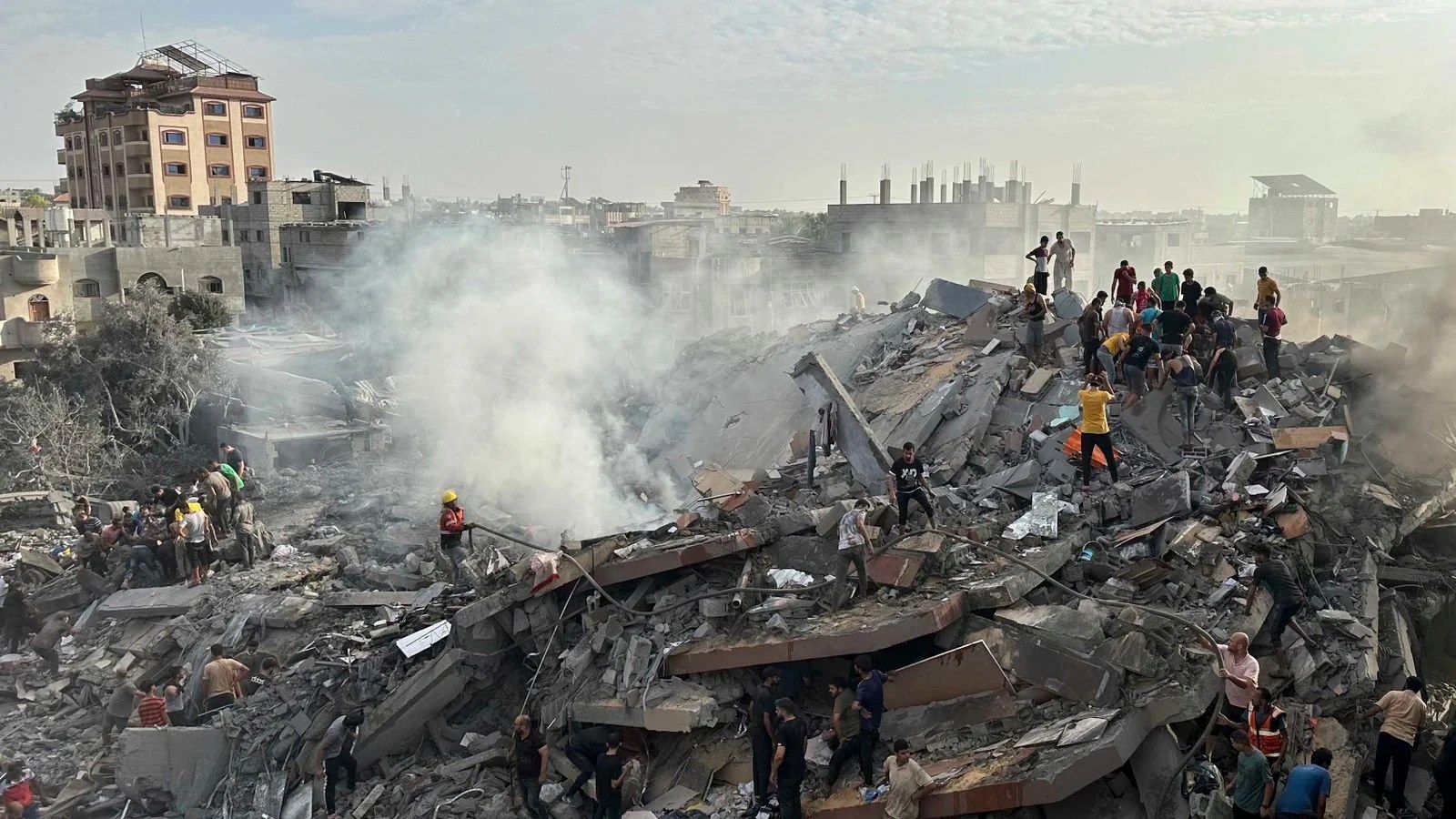
A percentage is now rubble.

Last week a heartbreaking message was delivered on twitter: “This will be the last post we share here. We believe there is no point in telling our human stories anymore; everyone has grown accustomed to seeing us killed. It’s no longer worth the risk to send our voice out to a world that is content with mere solidarity. Even many of our human stories no longer interest people (even our voice is being ignored). It’s time to stop waiting for a savior and to help ourselves survive. Please try to keep us in your prayers.” 

These words came from @GazaMartyrs, an account dedicated to naming and humanising people killed by Israel’s genocidal violence in Gaza. The decision to end these activities came after another post that read: “Nothing has ever shaken or broken me before like Mohamed did today during our filming. There is nothing in this world that justifies killing a man’s children, mother, and wife all at once. He went from being the happiest man because of his children to being completely shattered in a single moment. This is the reality for all of us here in this hell. We are being killed here, losing our dearest loved ones and friends, and all we have met with is abandonment and silence.”

That earlier post came in response to a particularly cruel story. Readers may be familiar with the tragic details. Muhammad Abu al-Qumsan left his wife, mother-in-law and newborn twins to obtain birth certificates for his babies. Social media posts show how happy Muhammad and his wife were with their beautiful and beloved new arrivals. An Israeli strike hit precisely the 5th storey apartment where the proud new mother, Dr Jumana Abu al-Qumsan, was standing at the window trying to get an internet signal. 

Given what we know of the timing and precision of the strike it seems very likely that Israel deliberately timed the murders so as to leave the father bereft. This is an act of psychological warfare. It may seem counter-intuitive to suggest that Israel would deliberately leave a survivor whose tragic loss becomes a global news story, but, as the reaction of @GazaMartyrs shows, such actions can be very demoralising. Thankfully @GazaMartyrs have resumed their work, but the source of their despair is ongoing. Israel is selectively using ostentatious atrocities to make Palestinians feel powerless and isolated while also creating a divide between the global Palestine solidarity activist population and less engaged majority populations in Western countries. 

We cannot know for certain that this or any particular act of murder was also a macabre form of psychological operation, but if it’s not true in this case it is certainly true in others. The killing of Hind Rajab and the paramedics sent to her aid took place over many hours, took great coordination, and was clearly intentional and purposive. Equally in the initial months of the assault on Gaza an IDF run Telegramsocial media account shared many explicit posts by IDF personnel showing themselves committing clear war crimes. There are many other instances where Israeli officials and personnel have gone out of their way to show cruelty, viciousness and illegality. There is no real dispute that this is happening, but it seems natural to assume that this action is counterproductive to Israeli strategy and it is a product of dysregulated ideological fervour. This is by no means a safe or sound assumption. There are clear benefits for Israel in ostentatiously promulgating terrible crimes, beginning with the effect of terrorising people in Gaza and demoralising Palestinians and their allies throughout the world.

Israel is using its acts of brutality to wage psychological war on Palestinians and those who oppose the violence and oppression visited upon them. These acts work on different levels and it is clear to see that currently Israel seeks to avoid publicising its acts in the West Bank and in East Jerusalem, but allows acts perpetrated in Gaza and on Palestinians taken from Gaza to be seen widely. In doing so they show how little they fear losing support among the international general public. They do this all knowing that a significant minority of Westerners, mostly due to racist views about Palestinians, will never waver in their support for Israeli violence even at its most inhumane and extreme. 


Powerlessness

Many people reading this will bear emotional scars from these months of slaughter and suffering and fear and grief. We have witnessed so much of the violence in graphic and often intimate detail. How can any activist, doing whatever they can to bring an end to the horror, not feel a sense of impotence? There seems to be no avenue to make our voices heard, to exert our will. We are constantly reminded that our efforts seem to change nothing. Each new obscenity feels like another gut-punch meant to teach us again and again that there are no limits. There is no red line.

There is a reason for the feeling of helplessness in that it is the product of design. Israel is using its ability to act with impunity to create that sense of impotence and futility.  At the same time the parade of atrocities we see, whether by accident or design, also serves to distance activists from our compatriots. Even though most people in the general public favour peace in Gaza, they are woefully misinformed about the nature of the violence there. Those people are led to believe it is a military conflict, in which civilian deaths are collateral damage. They do not understand what genocide means and they think that activists who use the term are either exaggerating for rhetorical reasons or are deranged fanatics. If you try to explain by using illustrations of what is going on each day in Gaza, they will think you a wide-eyed partisan and are highly unlikely to believe you. They will make the reasonable seeming inference that if what you are claiming were true then it would be talked about on the news and our political leaders would behave much more assertively in reaction to these atrocious crimes.

At times it has seemed that each atrocity by Israel is concealed and effaced by the next, like a deadly form of Gish-galloping. (Gish-galloping is a bad faith rhetorical technique, used often by Zionists, where instead of explaining a position cogently you simply overload people with a stream of arguments, many or all of which may be indefensible individually). As well as doing that on our screen, it feels as if Zionists are also enacting this as a violent psychological warfare technique. We are being deliberately overwhelmed by a relentless grinding tempo of massacre upon massacre. Events such as the Superbowl final are exploited for their distracting power, but more prominent acts of Israeli violence are themselves used as camouflage for further murder, such as when the IDF used the aftermath of the Flour Massacre to kill many aid workers. 

When it suits them, Israeli officials know that they can lower the rate of death so that, having themselves set a bar of what is newsworthy violence, they know with certainty that news media will ignore or bury this increasingly banal mass killing. They have completely corrupted the news media through manipulation of their established practices – the “news values” that guide them on what is and is not worthy of passing on to the masses. This works alongside practices of direct control, covert control, lobbying, and flak to create a system in which the critical reporting of Israeli violence is disproportionately infrequent and is always blunted leaving the talking points of apologists unchallenged. For the general public this means that the deaths and mutilations they see become a form of background noise because the root causes seem disputable and the complicity of our own governments is made to seem at least excusable if not tactically merited in the apparently confusing and contended circumstances. Israel does not seek to win public support for its genocide, it seeks to control the nature of public disapprobation by ensuring that the stark one-sided nature of its genocidal onslaught is hidden.

Every military action of the IDF has a propaganda dimension. This is the culmination of a long history of violent psychological operations developed by the US in the last seventy years. From Edward Lansdale hanging the bodies of exsanguinated rebels from trees in the Philippines after WWII, to the hybrid military/psychological/political onslaught of “Shock and Awe” unleashed on Iraq in 2003, the distinction between warfare and propaganda has become non-existent. Clearly the main approach for the IDF is to maximise the power of indirect violence through hunger, exposure, deprivation and disease. The violent agonies of displacement and famine have never been understood by the general public, and the situation in Gaza has few parallels because of its sustained and inescapable nature. Yet while they exploit the media habit of silence on this form of violence to assuage the general public, they also use targeted dissemination of more shocking violence that they know will reach only those who already oppose their oppression. For example, there is the aforementioned Telegramchannel that an IDF psychological warfare unit created to disseminate images of graphic violence, destruction and overt war crimes. Their material reached the activist population of the West through social media, and may have featured in news of non-Western countries, but did not reach the general Western public.

The invisible violence of diseases, homelessness, fear, dislocation, constant exposure to discomfort, lives arrested and deprived of aspiration and meaning is as nothing to the Western public. At the same time the more shocking graphic images of violence are also absent from their lives. But while the opiated masses live in the smog of manufactured acquiescence, activists are bombarded with a surfeit of graphic imagery that may also serve to dull the emotions. Israel can choose to attack the morale of the activist population by creating messages through acts that we can read but the general public cannot, acts that we know are true but can never prove. They can sadistically terrorise, hunt and murder Refaat Alareer. They can take their time massacring Hind Rajab, her family, and her rescuers. They can deliberately leave Muhammad Abu al-Qumsan alive to spread the sense of terror and helplessness. All or most of it must be deliberate, but we cannot demonstrate this let alone prove it to such a degree that people who assume that such things can never happen will change their worldview.

Israel uses its impunity to display its impunity. The sadism is functional. The Palestinians in Gaza become like mice cornered by a cruel cat while we watch in horror unable to intervene, unable to reach, unable even to comfort. In Gaza the people are subject to every imaginable attack. True to the nature of genocide the onslaught occurs at once on many levels, each multiplying the damage of the others. Outside of Gaza, though, we are all subject to a psychological attack. They are using the techniques of “learned helplessness” on us all.

Absurdities and Epistemic Bifurcation

There is a saying derived from Voltaire that has been honed over a few centuries to: “Those who can persuade us to believe absurdities can make us commit atrocities.” Our society produces absurdity by controlling what is and what is not speakable. This is a self-perpetuating system as each incident that is interpreted in that restricted light is another data point proving that the sort of event that is excluded from consideration must never happen because there are no examples of it happening. Certain historical analyses that are plausible according to the specifically pertinent facts are considered inadmissible because they contravene a predetermined framework of the way the world works. Most commonly we see such contentions labelled as “conspiracy theories” (CT).

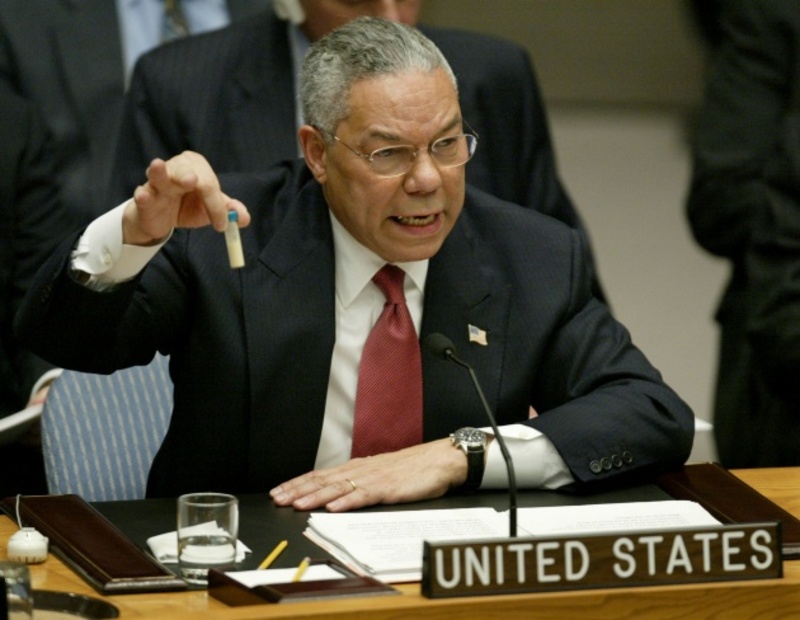
I do not want to alienate those who struggle against the right-wing CT community, but the term itself is toxic. What is and is not labelled “conspiracy theory” has nothing to do with whether or not something involves a conspiracy, nor is it valid to criticise a theory on the grounds that it posits a conspiracy. Those people who use the term seem to have no idea of the weight of the anti-intellectual shackles that they are helping to fetter humanity with. That which is and is not considered CT is determined by naked power. For example, in a thousand years historians will look at the invasion and occupation of Iraq and will probably take it as read that the war occurred due to the quantity and high quality oil in Iraqi territory. Tony Blair, however, successfully argued that “the oil conspiracy is honestly one of the most absurd when you analyse it.” So instead of a banal imperial reality that is in total accord with overt US foreign policy doctrine (the “Carter doctrine”), the news media gave far more credence to the elaborate tales of intelligence sources such as “Curveball”, tales of mobile weapons labs, yellowcake lies, the “dodgy dossier”, fever-dreams of missiles hitting “British soil”, and so forth. The banal and historically normal explanation was a “conspiracy theory”, but the elaborate and unrealistic tissue of complex fabrications was acceptable even though each contention involved a high number of conspiracies. So much for “conspiracy theory”.

Thus there is a growing two-way credibility gap. There is an epistemic bifurcation that is part of a wider atomisation that is creating a world of mutually exclusive realities. The empire has taken the Roman principle of divide et impera and worked out how to send it through our eyes and into our brains on an individual level. I have long remarked on the fact that US actions are often clearly meant to be read in two ways – one message to the imperial masses, and a very different one to those who resist. To the disempowered masses of the  “Arab street”, for example, they are often sending the message that they are a ruthless, savage, mass-murdering genocidal power. The very same acts used to send that message, though, are often framed in the West as being acts against the barbaric violence of the people they are killing. Nor do they have any scruples about re-imagining themselves as victims. Their prolific expansive use of unmatched military violence against much weaker people becomes something they have had forced upon them by their unwitting well-intentioned entanglement with the dark quagmire of non-Western incivility. And then, as per Frankie Boyle’s famous quip, “they’ll come back 20 years later and make a movie about how killing your people made their soldiers sad.” That heart-of-darkness shit just keeps happening to the poor bastards, and somehow they never learn. The Panglossian optimism of the “Whig theory of history” has been replaced with the whingeing narcissism of the “Shitlib theory of history” where the perpetrators are always the victims (and Trump was, would be, and always will be 100 times worse). 

The absurdity of the mainstream worldview does not come from any individual incident, it comes from the cumulative effect of excluding certain possibilities from consideration over and over again. This feeds the vulgar empiricism of those who always insist that positive proof is necessary for some interpretations, but not for others. Such people do not like any suggestion that a pattern might be discerned, or even sought to be discerned, among events which share common characteristics. Ironically (but not really ironically) right-wing activists who oppose the “mainstream” will sometimes exploit these behaviours to create bad faith attacks on the bad faith orthodoxy. For example, some anti-vaccination activists question the viral origins of AIDS and SARSCov2 on the basis of a vulgar empiricist claim that ignores all of the statistical links as being insufficient as they are not direct demonstrations of a laboratory infection leading to the attributed disease. These people are ridiculous, but effectively this is what orthodox scholars in some fields do all the time. The thing that makes this apparent right-wing dissent ironically unironic is that these dissident activists are largely controlled by a bunch of astroturfing billionaires and their toadies. I would go so far as to say that I have a theory that there is a conspiracy among some very wealthy people to control public policy by creating flak for governments through loud and over-resourced fake activists. 

Now that I have accidentally outed myself as a proud conspiracy theorist, I feel empowered to say that sometimes we should consider that things may be as they first appear rather than insisting that things must be explained in a certain way. There is always an assumption that “civilised” governments and their military arms will not do certain things like killing their own civilians or committing genocidal violence against others. No number of proven historical cases of US, UK or Israel doing such things will be taken into account. In reality, governments in general are well demonstrated to frequently exceed the bounds of behaviour that any normal person would consider tolerable. The Zionist 3 (US, UK, Israel) even more regularly exceed the violent inhumanity of most contemporary societies. I am not going to list proven crimes here, but if I did so it would show that no action of these governments should be judged on the basis that they would not cross certain lines or that they are constrained in any way by morality. No doubt there are people and institutions that limit some atrocities, but what is limited is determined by pragmatic considerations of power. The moral calculus is complex and contended, but the most important fact to remember is that there is no ultimate red line. If the stars align the right way for the worst amongst them, they will begin implementing a “final solution” for the Palestinian people and we are already well along the road to that horrific destination.

In April, a World Central Kitchen team of 7 aid workers was slaughtered with thorough and deliberate overkill in the “deconflicted zone” of Deir al-Balah. Orders passed through multiple channels to achieve this. Israel’s non-explanation was that they thought that armed militants had taken one of the vehicles. They initially mentioned a possible kidnapping, but that was not part of the later report possibly because outside of Israel it is not considered normal to respond to a suspected kidnapping by killing the victims. The Israeli report claims that they mistook a guard for a militant and thought that one of the aid workers was another militant because someone allegedly thought that a bag was a gun. At no stage was there a suggestion that the imaginary militants posed any immediate threat to anyone. That would suggest that they were not looking for people they needed to target, nor people they should target, but rather the people they could get away with targeting and killing. Command gave permission to engage the vehicle with the suspected militants. After attacking that one vehicle Israel claims that two soldiers went against procedure by attacking the other two without permission. According to Israel it was all done in error. It was a very thorough mistake to take the lives of every one of the seven aid workers in the convoy.

This all happened at a time when the Israeli government was fighting diplomatically to be allowed to block aid entering Gaza altogether and many Israelis have shown a violent antagonism against humanitarian aid and to aid workers. The IDF report begs so many questions that even if taken at face value it does not preclude premeditated murder. It is not an exoneration of criminal intent it is a narrative framework provided for those who already assume that these deaths cannot have been purposive. Yet it was such a very comprehensive attack and Israelis have no lack of motive at a collective or individual level. Whether seen as a military strategy to deny supplies to armed militants, or an intrinsic part of the genocidal war against the Palestinian people, or a product of anger and hatred towards those who seek to give succour to the enemies of Israel, there are clear reasons why someone might deliberately use a pretext to kill an entire aid team. 

We don’t know for sure that Israeli individuals at some level in the chain of command decided to kill an entire aid team, but the circumstances and results certainly lend themselves to that possibility. These killings led to a result that the Israeli government desired. Some aid organisations halted operations meaning that aid was further restricted, as was the number of outsiders coming into Gaza to help and (perhaps more crucially) to bear witness. Like the 2010 killings of 9 activists trying to deliver aid to Gaza by sea, the WCK killings sent a message. These deaths set a precedent and as we have seen in the case of recent attacks on aid vehicles in Gaza, Israel can attack without consequence any time it wants and aid organisations have no choice but to suspend operations.

Many of you reading this may be feeling uneasy that I am suggesting that in all probability someone with some level of authority in Israel decided to kill an entire aid team. The conventional wisdom is that, as Carl Sagan said, “extraordinary claims require extraordinary evidence”. Absent some genuine scientific or statistical expectation, though, this is the fallacy of conservatism – the idea that of two or more interpretations of events one is to be preferred as being more mundane. In political matters the weight of conservatism is usually purely ideological and has nothing to do with any scientific criteria.

Is it shocking to think that some Israelis actually intended all of the WCK workers to be killed? Perhaps it is shocking, but it is anything but extraordinary. Some might object that they wouldn’t risk it because they could not necessarily get away with it. But they can get way with it, and they know it. As long as Israel itself investigates and exonerates itself of intent in the short-term it doesn’t matter if later investigations bring that into question. Our leaders in politics and media do not ask for truth, they ask for fig leaves. Once they have the fig leaf, they add it as a page to the Encyclopedia of Official Truth. Thus, the lie that a possible thing is not possible, becomes the absurdity of claiming that these perfectly plausible things can never happen. 

All of this is made even more sickening and alienating by the overt way that Israel can systematically kill Palestinian aid workers. The absurdity of the Encyclopedia of Official Truth is deepened in these cases, not by the insufficiency, but by complete silence. Israelis can openly share footage of themselves committing atrocities and other war crimes, but despite the unimpeachable source, it is not considered newsworthy. The victims are not considered newsworthy. The violence of the genocide in Gaza has become unremarkable, as has the violence of settlers and security forces in the West Bank and East Jerusalem. It is not news, they may say, but there is a bit of a catch here. The existence of passenger aircraft is not news either, but news media do not act as if they don’t exist. When discussing Palestine the media are like people who try to explain air disasters without ever admitting that aeroplanes exist. That is because, on the one hand, the ongoing systematic violence against Palestinians is too banal and well-understood to bear reporting on but on the other hand the systematic genocidal nature of violence, which is the key context, is politically controversial. Therefore, the thing that is too well known in one sense must become a complete unknown when reporting on related events. Just how did the lifeless bodies of these 83 people end up scattered here amidst this metallic debris less than an hour after departing from an airport? What could explain the event? Is it because they were being used as human shields, or might a stray Hamas rocket have killed them?


Elite Capture and the Bonds of Shame

On The Daily Show Rob Corddry responded to the Abu Ghraib scandal by satirising the collective US position, “…the Arab world has to realize that the US shouldn’t be judged on the actions of a … well, we shouldn’t be judged on actions. It’s our principles that matter, our inspiring, abstract notions. Remember: just because torturing prisoners is something we did, doesn’t mean it’s something we would do.” The political leaders of the Western world and most other countries went along with exactly that contention, and they continually reaffirm it to this day. They do exactly the same with regard to Israel, but the results are far more grotesque. Israel doesn’t have the soft-power of the US and its image as a liberal Western nation doesn’t have as much sway in convincing us to ignore reality. 

It is increasingly hard for people to believe the narrative of plucky little Israel, living at the outer edge of civilisation withstanding the onslaughts of the barbarian hordes that surround it. Some people have clearly internalised a racist blind hatred of Palestinians as such, but for those who haven’t the pretextual nature of Israel’s “security” narrative is wearing thin as they continue relentless violence and unconcealed dispossession of Palestinians. Even the average regular Western consumer of “Islamist terrorist” content is likely to find the generic conventions weakened if not violated by the glimpses and hints that slip through to them of house demolitions, land theft and infrastructure destruction. A glimpse of a road being destroyed as shown above may not immediately cause a rethink, but it will sow the seeds of dissonance and the Zionist “security” narrative will seem stretched thinner and thinner until one day it just snaps, and that person is lost forever to the Zionist cause. Meanwhile the Israelis themselves are finding it hard to maintain the façade of civilised morality as the culture of fanatical racial hatred deepens. Their public relations on social media now feature gleefully captioned images of the bloody bodies of slain enemies. They are speaking more and more to a narrow group of fanatics who have no interest in outdated imagery of liberal Israel as the bulwark against extremism. They are speaking to a racist core that want a fascistic militaristic muscular Israel standing against the barbarian Asiatic hordes like the 300 at Thermopylae.

Our beloved leaders in the Western political, media, business and academic world largely speak as the racist Zionists do, but without the foaming mouths and spray of spittle. They are not enthusiasts. They are not ideologues. They are measured and pragmatic. They are not ideological fanatics, rather they are fanatical Panzaists who believe this to be the most banal of all possible worlds.i If a giant were to suddenly appear and swipe them with a massive spiked club, their last words as they lay mangled and dying would be a warning about the dangers of windmills. They know that Israel is a bastion of Western civilisation and embodies the values of the West. Historical reality notwithstanding, Western values include the knowledge that all of the horrific violence they commit is only ever because they had really good reasons and ultimately had no real choice in the matter. In fact not doing the violence would be a complete dereliction of Western values. To eschew righteous killing would be insulting to the memory of those who died in far jungles to protect our freedoms. It would be like wiping your arse with the Declaration of the Rights of Man and of Citizen, the Magna Carta, and the screenplay to the beloved M*A*S*H finale “Goodbye, Farewell and Amen” .

Western atrocities are always undertaken to prevent something that we are assured will be worse, not just for “interests” but generally speaking for the people that will be shelled, bombed, shot, displaced, and starved. When the West kills people it is really in those people’s interests if they could but see it. As an unnamed US Army Major told Peter Arnett in 1968, “It became necessary to destroy the town [Bến Tre] to save it.” Scaled up the Western attitude could accurately be parodied as, “the only thing worse than committing genocide is not committing genocide”.ii

Little that has come after October 7 2023 really supports Israel’s counterterrorism discourse, but each day brings more evidence that belies it. The numbers of dead are bad. The optics are bad. The logic is bad. The sheer duration is bad. The reports from third parties are bad. The diplomacy is bad. The court cases are bad. The polls are bad. The context is screaming in the ears of our leaders: “THIS IS GENOCIDE!” Despite this, they still live in a world where it is very costly to call the genocide a genocide, and there is no cost at all for outright genocide denial. Yet as “Israel’s right to defend itself” becomes ever more self-evidently detached from reality, none of these people are shifting their opinions, in fact many are hardening.

If the world worked the way it is meant to work, world leaders should fear the consequences of supporting a genocide. It is a crime to support genocide, whereas there is no crime of being insufficiently helpful to Israel (they just act like there is). In political reality (which influences realms beyond politics) the formal and theoretical situation is reversed. Some people, such as the leader from a small leftist party or a lecturer in Middle Eastern history, can say “genocide”, but those with the authority to speak as part of the establishment must prevaricate or make an outright denial using the aforementioned fallacy of conservatism. As typically seen in the academic world (for example) to speak certain truths you must declare yourself to be partisan or “critical” and banish yourself to the fenced-off free-speech zone where dangerous truths are quarantined in containment. In contrast, those who speak for power (such as those with administrative positions) must privilege power over evidence as a source of truth.

As the distance between the evidence and the official “truth” grows ever starker, you might expect that people’s positions might change, but we can see that this is not happening. Leaders will not change unless they are pushed with extreme force. They are trapped, you see. The worse things get the more they are psychologically and politically tied to being genocide enablers. At high levels of any hierarchy there is always a survivorship bias in favour of expediency. Those who act inexpediently do not keep climbing the rungs of the power ladder. Expediency is the water in which our fishy leaders swim, breathe and defecate, but even they must morally rationalise to tell themselves that their self-interested actions are for the greater good. For most (apart from a few sociopaths and outright neofeudalists) their careers are built on the foundation that they must advance themselves in order to advance humanity. Once they have decided on the righteousness of their position they have access to all of the human arts of evading, ignoring, or explaining away undesirable evidence.

As the visible evidence of terrible suffering grows, those who support the causes of that suffering become morally tied to the position. From what may have been a relatively mild support, as time and body count grows it becomes ever more necessary to believe in the value of the cause while the atrocious cost skyrockets. Those who keep acting in support of the violence become de facto members of a baby-killer club. Like those in clubs whose initiations involve social transgressions, such as humiliation or violence or unusual shared sexual behaviour, they become tied by bonds of shame that are also potential bonds of blackmail. The leaders are detached from the herd of the naive public – the masses that do not and cannot ever understand the sordid but unavoidable realities of real power and true politics. This is wonderful news for Imperialists and Zionists. The Zionist 3 cannot maintain a legitimacy that will convince a rational person to support the genocide, so they want to trap an elite class in an irrational state that is isolated from democratic influences.

In far more basic practical terms it is also impossible for leaders, especially those directly involved in politics, to change position on something that is so significant and has such a naked moral dimension. The reality of our politics is that any admission of, well, anything at all is a weakness to be exploited. That is even more so if one chooses to betray the cause of Israel and the US empire. In the media world, for example (though equally in other areas) the flak machinery in the “propaganda model” theorised by Edward Herman and Noam Chomsky in Manufacturing Consent is now reinforced by what appears to be a fascist 5th column within leadership roles who exploit any weakness as an occasion for oppressive over-reaction. Thus, any number of people can complain about media bias against Palestinians and it will be greeted at best with empty gestures but in contrast any accusations that criticism of Israel is “antisemitism” may be bring serious consequence even when completely without merit. Some of this is due to the work that has been done (for example with the IHRA definition of “antisemitism”) to create an institutional bias, but it seems equally clear that ideologues or corrupt agents will seize on any pretext to purge the heretic.

The more absurd the elite position the more defensive and hostile to questioning they become. The Marie Antoinette vibes are getting stronger and stronger as they do everything to isolate themselves from the wrong voices or the wrong questions. Some of us masochistically geek-out to footage of Mark Miller and similar creatures contorting words into unrecognisable abstract sculpture, but we are a small minority of connoisseurs of political bollocks. We are, to coin a term, wank wonks.iii By contrast, normal people only experience the political speech of proper leaders, not spokespeople. None of the reporters who push Miller into verbal nonsense by being direct and persistent will ever be allowed to ask such questions of Biden, Trump or Harris. No Western leader will be pressed with hard factual details on the realities of the genocide, and we all know it. So, presumably, do any political reporters who value the “access” that lets them earn a living.

The walls of allowable thought become ever thicker and opaque to those ensconced within, but equally they are brittle. The organisers of the Democratic National Convention did not even allow a pro-Harris Palestinian-American delegate to deliver a vetted speech because even letting her humanity be seen is a political cost to them, regardless of her co-opted words. Things are so delicate that they could not accord a reminder of the plight of millions of Palestinians be seen as valid in the same sense that the plight of 100 Israeli hostages is seen as valid. Violent societies often employ selective sentimentality to erase the humanity of the enemy, even to the point of total hypocrisy.


Our Fascist Reality and How to Fight Back

People are tired. People are demoralised. Yet people are persisting. There seems to be no diminution of anti-genocide activism despite the hollow feeling of impotence that pervades. Stopping now seems unthinkable, despite having so little to show for extraordinary amounts of time, energy, imagination, tears and anger. One of the problems is that a lot that we do is premised on the idea of changing public opinion. This is difficult when access to the eyes and ears of the public is dominated by bad faith equivocation and outright lies, but it is essential. It is essential, but unfortunately it is by no means sufficient.

If we were a democratic civilisation then winning over the public would be the end-game, but it isn’t. Even if we can’t persuade a majority in the West that the genocide is a genocide, they have at least come to understand that an attack on Hamas does not justify the death and destruction that is happening. Unfortunately the public doesn’t have any say in government policy in general and international relations in particular. The traditional view is that we inhabit “distorted polyarchies” which are pluralistic but in which political power is highly skewed in favour of those with wealth and status. Part of this system has long been the manipulation of the public through indoctrination and censorship. Great figures in what liberals stupidly refer to as “democratic” theory such as Walter Lippmann openly despised the intellects of the vulgar masses and believed that “democracy” required the “manufacture of consent” (hence the title of the Herman/Chomsky classic). Sheldon Wolin referred “managed democracy” leading to a resultant “inverted totalitarianism” where a demoralised confused public is dominated by corporate power. In the 20 years since Wolin wrote that, however, we have seen the rise of a global fascist movement that exists in the same structure of inverted totalitarianism. “Managed democracy” has become “managed fascism”.

In managed fascism anomie pervades the dispirited and/or precarious masses. The resulting discontent is increasingly harnessed by the very people causing discontent, harnessed and used to create a force of reactionary ideologues empowered to crush any who threaten to enact reform or revolt. These new brownshirts are not just in the streets. There are keyboard brownshirts, thinktank brownshirts and boardroom brownshirts. They belong to no single party, but they tend to follow their leaders with such fervent myopia that they might not notice the core of reactionary patriarchal racial-supremacy that they are signing up for. The fascist ideology of our age may not have a single Führer, but it has a single essence that is cohering rapidly.

The good news is that the steps we must follow to force our own countries to fight against genocide in Gaza will also serve to weaken inverted totalitarianism and to combat the burgeoning fascism of our age. We must work to infiltrate actual democracy into our political institutions, we must work to make leaders fear the public, and we must force reason and intellect back into the public political discourse in place of dishonesty and bullying. An awful lot of groundwork has been laid by the posting and postering and protesting of the last year. Possibilities are opening, though the road ahead is not short nor easy.

The first thing that needs to be understood is that any ceasefire will not be a ceasefire. The past has show that when Israel raises the bar on its levels of slaughter that bar is never subsequently lowered. Permanent violent assault is the future of the entirety of the occupied Palestinian territories. Ever deeper immiseration, ever deeper control, and ever deeper humiliation. Israel has gone all in and there is no real going back, only further charades and chicanery. For this reason we can safely commit to the long haul rather than succumb to the sense of immediate need. If public opinion is reset by a pretense of peace, we need to show people that there is no peace and continue from that point. One thing should now be clear to most activists – something that has been true from the start but has been well hidden – the genocide will not end until Palestine is free. That can only mean one democratic state from the river to the sea. If some of the citizens refer to that state as Israel then let them as long as others can call it Palestine and all the people that belong there can call it home.

People will need patience and diligence more than anything. The long haul means knowing that you will just keep coming back to the work when you can. It means thinking of angles and approaches when you can. It means cultivating yourself and others when you can. It means switching from thinking of goals to thinking of processes.

The long haul approach means approaching the heights of power by building power, not arriving as a petitioner with doffed cap asking for justice from the lord. What I mean by that is using the force of democracy to change things at the attainable level and building upwards from there. A successful model in the past has been to bring activism to local bodies, even if only for symbolic resolutions. It works because the core of activists are not a “vanguard” or in any way analogous to the brownshirts mentioned above. It works because activists represent the public sentiment and, at the local level, you can face down politicians who can’t spin their way out of the fact.

People have been building connections within unions and associations, places that hold vestiges of democratic power in our pluralistic fascist societies. Once these bodies are forced to take an anti-genocide stance there is much that can be achieved. For example, if medical unions are made to engage in the issues they can issue statements over hospital attacks or murders of health workers and agitate for the media to cover the issues in a manner that focuses on the Israel’s intentional targeting of medical personnel.

All aspects of activism aim at the same thing, exerting moral, intellectual and democratic power in polities governed by people to whom these are all alien concepts. In these times of dire democratic deficit the power of the people is more or less the same as it is under a dictatorship, but that power is not to be despised. If the masses speak with one voice they have all the power – well sort of. An important caveat is that they have to speak with one predominant voice and that voice must be issuing a demand. It is not sufficient that the majority of the public oppose the genocide, it must be that a clear self-conscious and confident majority makes it known to the government that they will not tolerate continued collaboration with genocide. This is a blunt instrument. The public cannot demand specific policies as easily as it can veto broad flavours of policy.

Public intolerance of government complicity in genocide does not necessarily entail specific disruptions such as riots or strikes or direct action. All that is needed is that a norm against genocide denial is established in the collective consciousness. We already know that this works because such a norm already exist regarding the Holocaust. Mainstream public figures cannot support genocide denial in that instance and it must be extended to this genocide. The key is that people at all levels know that their complicity will be visible such that a politician dare not deny the genocide because the journalist would not dare normalise their denial nor fail to mention it. To create that new political reality is going to take a broad-front approach. All avenues of intellectual resistance must be pursued at all times until the war is won. There can be no half-measures because we know beyond all reasonable doubt that half-measures or compromises are merely false hopes, rest stops on the long road to defeat. Ending the genocide means ending the genocide, and that means ending the occupation.

The fight for Palestinian freedom is the fight for our own freedom. This creeping managed fascism is no joke. The 1930s showed that once fascism got its jackboots under the table, though it may have been a fringe belief to begin, its values grew within the wider society. The same is happening now. In the US and the UK particularly we have seen increased activity of right-wing racist mobs. While there has been a selectively firm and rapid response against some of the rank-and-file racist rioters in the UK, the leading provocateurs are unmolested. Meanwhile peaceful direct action on the left is punished far more severely while terrorism laws are being used to oppress selected individuals for opposing genocide. Over time fascist politics create fascist populations. There can be no better illustration of this fact than what has happened to the minds of Israelis in the past few decades.

The reason that what is happening is fascistic rather than simply plutocratic and authoritarian is because of the power that old and new media to create cadres of hateful fanatics – useful cadres. The logic is the same as that which led Stalin to become such an enthusiastic exponent of Russian nationalism despite a lifetime devoted to an internationalist ideology and despite not even being Russian. Nationalism was a tool of power that had been lying around. The aspect of fascism that is relevant here is the epistemic ideology of combat and enmity that followers take on. They become anti-intellectual self-programming robots who do not build an episteme from observed facts, but rather populate their own and each other’s mind with “facts” created from the predetermined worldview. The manipulation of old media by people like Rupert Murdoch has fed this, but we also need to bear in mind the harmful effects of the ideological isolation present in the online world. Each person’s phone becomes a pocket beer hall where thousands of impassioned preachers of hate can be watched holding forth on the need for action, the need to violently punish the malefactors who (in their fevered heads) have wronged them.

Israel has effectively lost its battle to colonise Palestine. The only future for the project would be an ethnic cleansing and annexation of all the occupied territories, which the world cannot tolerate if it claim to respect law and rights. The only path for Zionist victory is through an international regime of fascism – a world where the most powerful countries reject the rule of law and in which the only reality the masses ever experience is that which the rich wish them to see. So, you may ask, what’s new? What is new is the matter of degree that will be required. Israel must now defeat the growing legion of institutions that, after decades of bending over backwards to create a Palestine exception, have been forced by the hard work of grassroots activists to accept the humanity of Palestinians and the inadmissibility of denying otherwise universal rights on the basis of statelessness (and/or the special pleading of the “Jewish” state).

I am not suggesting that increasing fascism will be forced on the entire Western world just to support Zionism. If anything I feel it works the other way around. Support for Israel is more useful as a pretext for suppressing political dissent than the inverse. At the same time the utterly unmoving steadfast support shown by the US regime for Israel shows how important this is to the empire. When US officials cite US “interests” we need to pay very close heed. In 1986 Joe Biden said would have to “invent an Israel to protect US interests in the region” if Israel didn’t exist. Nearly four decades later he reiterated, “If there were not an Israel, we’d have to invent one.” We should also recall that we are in the third decade of what some US officials referred to as the “Long War”, a war they predicted was going to take 30 years. The scope of the Long War was global, but of the known prominent targets all have been targeted with hybrid or outright warfare and all suffer ongoing violence. The “War on Terror” was the pretext for the Long War, but as the history of Africom shows, the war has a tendency to start before the terror. (The same can be said of the Iraq insurgency which was in response to the depredations of “counterinsurgency” and the NLF insurgency in late 50s South Viet Nam which was prompted by the suppression supposedly meant to quell it).

I cannot even imagine what the ultimate aim of the Long War is, if such a thing exists. All I can say is that this seems like a very dangerous period in terms of a possible overt World War, and Palestine seems to be at the centre. The end of a 30 year Long War also roughly coincides with the believed 2000 year anniversary of the crucifixion of Christ. Many millenarian Christians feel that this time the end really is nigh. As frightening as the prospect of an apocalyptic war is, we cannot assuage or mollify the aggressors because they are beyond such measures. We can only constrain them by defeating them and if there is a risk of wider war it only grows with the diplomatic and military empowerment of Israel’s genocide.

This is our fight, and by “our” I mean everyone who is sane. Will enough people realise this? I don’t know, but I will end this article with an observation made by TikTok and Twitter user @highlyvibey: “anyone who’s okay with slaughtering children for their political ambitions is okay with killing you too”.


If this article was not too noxious for you, please consider giving some money to me via https://ko-fi.com/krkelly

iWith apologies to Miguel de Cervantes (Don Quixote), Voltaire(Candide), and Robert Sheckley (Mindswap).

iiFurther apologies, this time to Oscar Wilde (The Picture of Dorian Gray).

iiiApologies, in this instance, are owed directly to the reader.

Israel’s Big Lie of “Self-Defence”

Standard

An occupier does not have the right to use arms in “self-defence”.

Is the mass slaughter of civilians self-defence? Every person has the right to life and to self-defence, but Israel’s “right to self-defence” is constantly being used to obfuscate the non-defensive nature of it’s military violence in Palestinian territory. Israel’s self-defence is a lie, not just because their actions are not defensive but because Israel cannot legally use its military in self-defence against Palestinians. Let me repeat that, Israel cannot legally use its military against Palestinians in self-defence. That is the big lie at the heart of the current horrors

There are four reasons why Israel cannot cite a legal right to self defence in response to Palestinian violence. First and foremost is that the ability of a very strong military power to achieve anything defensive by the attrition of a much weaker military power is spurious and leads into the genocidal logic of attempting to deprive a people of all capacity for violence.

The second reason is that Israel is actively contravening UN Security Council resolutions and the UN Charter is very clear on the fact that the right to self-defence exists “until the Security Council has taken measures necessary to maintain international peace and security.” A state that works to thwart UNSC measures to maintain peace and security cannot logically be extended the unimpaired right to self defence.

On the third count Israel is an occupying power and the occupied have a legal right to armed resistance. It would be nonsensical to accord a legal right to use arms to defend against another’s legal resistance. Fourthly, it would be equally paradoxical to allow each party to act in self-defence against each other’s acts of self defence. Thus one of the parties must be the aggressor. On several counts, not least its defiance of UNSC resolutions, Israel must be considered the aggressor.

Israel’s only legitimate way of defending itself begins with ending its occupation. Israelis have a right to life and they deserve peace and security as we all do, but they have no right to kill Palestinians and claim that they are pursuing those things.

Before tackling the specifics we should question the general validity of military violence as a form of self-defence. At this time hundreds of people are killed by Israel every day under the pretext of seeking to render Hamas 100% ineffective. This is a tacit claim of self-defence linked to the notion that Hamas is an ongoing source of potential violence to Israelis. However it is hard to reconcile this rationale with the actualities when one sees a parade of children’s corpses. One body after another with the increasingly familiar pall of concrete dust on their lifeless faces. Thinking of all of that pain, fear and suffering should make it impossible to somehow see killing those children as an act of self-defence. The human instinct to reject this monstrosity is not mere sentimentality. It would be impossible to make a sound detailed argument to show how the killing of any one of these children contributed materially to the increased security of Israelis. In truth it is far easier to argue that each dead Palestinian child makes Israeli people less secure.

Israel relies on broad and vague notions of “self-defence” to enact mass violence that does nothing to make any person safer and, in fact, is certain to cost the lives of many Israel personnel and any number of hostages. Military violence can only achieve so much as no amount of attrition will deprive a people of all ability to commit violence in return short of extermination. Beyond a point violence becomes waged “not merely against states and their armies but against peoples.” These were the words that Raphäel Lemkin when he first described the concept of genocide. Military violence can be used in ways that can only be called “self-defence” through the logic of genocide that situates the threat within the people and their intrinsic capacity for violence (also known as resistance). This is not legitimate self-defence, yet it is clearly part of the racist thinking of some Israelis and their apologists elsewhere.

It is actually normal that the logic of genocide presents itself as self-defence. Consider this quote by Arnon Soffer, the pre-eminent alarmist in Israel over the “demographic” threat of Palestinians:

“When 2.5 million people live in a closed-off Gaza, it’s going to be a human catastrophe. Those people will become even bigger animals than they are today … The pressure at the border will be awful. It’s going to be a terrible war. So, if we want to remain alive, we will have to kill and kill and kill. All day, every day … the only thing that concerns me is how to ensure the boys and men who are going to have to do the killing will be able to return home to their families and be normal human beings.” This is the reasoning of someone who has no concern for military power, who will never accept Israel’s overwhelming military might and nuclear deterrent as a sufficient lever ensure that Israel can be secure in a time of peace. These words are shockingly Himmleresque in labelling a people animals; in stating that mass killing is neither choice nor desire, but necessity; and in the sickening concern that mass killing might cause psychological harm to Israeli personnel. Adolf Eichmann and others at the Wannsee Conference shared Himmler’s fear of the effect of killing on the murderers and it was a major consideration in their adoption of the “Final Solution” which industrialised the mass-murder of Jews.

Soffer later explained: “I didn’t recommend that we kill Palestinians. I said we’ll have to kill them. I was right about mounting demographic pressures. I am also entitled to defend myself and my country.” It is difficult to imagine any Israeli getting closer to Nazi rhetoric than this, but it says something that his ideas were not immediately denounced by everyone in Israel for what they are. This is the essence of genocide. Though referencing the circumstances in Gaza, he is openly saying that Palestinians must be killed because they are Palestinians.

In contrast to genocidal notions, the theory behind using military power in self-defence draws on the idea that warfare is a contestation of belligerents using violence in a manner, as Clausewitz suggested, of wrestlers: “Each strives by physical force to compel the other to submit to his will….” This begins from the presupposition that each belligerent has diametrically opposed aims, which might have sufficed in the 19th Century, but does not suit our more complex polities today.

In reality, war is not a chess game and killing babies is not in any way the same as taking a pawn from the board, yet the use of aerial and ground artillery on populated areas implies that this brutal madness makes sense. We are tricked by the notion that the “self-defence” of nations is truly analogous to the self-defence of an individual using a weapon to counter an assailant. That analogy breaks down in an era of high-tech weaponry and in circumstances of asymmetry where the strong are killing the weak. Leaders and pundits often twist the notion of asymmetry itself to suggest that the strong are more vulnerable to the weak and are thus the real victims, but this is just one of those lies that are repeated so constantly that it becomes a commonplace.

Despite the clear disproportionate asymmetry of violence and the ever-growing numbers of people killed by Israel the media discourse enforces a framework that decontextualises Israeli violence, presenting it as a reaction to the violence of Hamas. Pro-Palestinian and pro-peace interviewees on Western media cannot speak without first making pronouncements affirming that they condemn Hamas’ “terrorist” violence and affirming Israel’s “right to defend itself”. These statements function as “thought-terminating clichés”, though in such instances they might be more aptly called “thought-terminating pieties”. Pieties go beyond mere clichés to invoke moralistic religious, patriotic, or other emotive ideological beliefs that create both a dominant sentiment as well as a constrictive framework of discourse. They close off certain avenues of speech, so that those who speak for Palestinians must begin by stating that Israel has a legal and moral right to kill Palestinians, and then take the stance of a supplicant begging for moderation, clemency, or mercy.

Of late Palestinians and others have pushed back against the pressure to commence their testimony and commentary with a condemnation of Hamas. They are trying to evade a narrative in which events commence with a condemnable act by Hamas and thus Israel’s massive surge of killing and destruction is framed as a reaction to Palestinian violence. This framework decontextualises events from the occupation and oppression including the ongoing acts of killing and destruction which Israeli personnel enact every single day in Palestine.

The “self-defence” argument is even more insidious than the attempt to frame all Israeli military violence as being in reaction to “terrorism”. It relies on a persistent but unrecognised one-sidedness. One cannot deny the right for Israelis to defend their lives, but nor can one deny the right of Palestinians to defend their lives. If Israel can kill Palestinian civilians in “self-defence” and present its own reasons to explain why such killings are necessary, then logic dictates that Hamas can do the exactly the same. Thus it may seem that if applied even-handedly “self-defence” becomes totally meaningless.

It may surprise people to know that in legal terms the problem of self-defence is not tricky nor intractable. Israel very clearly does not have the right to use military violence and claim self-defence on several grounds. Firstly, an occupied people has the right to resistance, including armed resistance, “in or outside their own territory”. Obviously it would be illogical to accord a legal right to armed resistance and then accord a legal right to collective self-defence against that legal resistance.

Thankfully the United Nations Charter has a way out of the paradoxes of allowing two belligerents the right to self-defence against each other’s self-defence and that of allowing self-defence against legal acts of resistance. Chapter VII of Article 51 states “Nothing in the present Charter shall impair the inherent right of individual or collective self-defence if an armed attack occurs against a Member of the United Nations, until the Security Council has taken measures necessary to maintain international peace and security.” Clearly “peace and security” has not been established but the United Nations Security Council (UNSC) has passed many resolutions on Palestine. Israel is currently violating a very large number of these resolutions ranging at least as far back as UNSCR 242 in 1967 through to UNSCR 2334 in 2016. These violations are occurring despite the fact that the US constantly vetoes UNSC resolutions that it deems detrimental to Israel. Logically cannot claim a legal right to self-defence if it violates the UNSC resolutions designed to bring “peace and security” thus its real path to legitimate self-defence lies first and foremost in complying with all relevant resolutions. In simple terms Israel must end its occupation as the very first of any acts of self-defence. Thus it does have the right to self defence but it must cease its own belligerency first.

I want to complicate this further here, but in a way that will lead to greater elegance and certainty, by explaining the onus on the aggressor. In 1946 the International Military Tribunal described waging a war of aggression as “the supreme international crime” that “contains within itself the accumulated evil of the whole.” Placing the onus on the aggressor (which is the government of the state not its people) in this way does not exonerate those who commit crimes in self-defence, but it means that the aggressor is also guilty. It is only thus that we can preserve the principle that all people have the right to life. Without the aggressor being morally and legally culpable it would mean not only that the military personnel of the aggressor belligerent have no right to life, but also that civilians of that state have no right to life if they should become legitimate collateral damage in legal military operations by the defending belligerent. This emphasis on the culpability of the aggressor is very satisfying because it closes these loopholes and also satisfies our moral instinct that a sovereign that wages aggressive war, knowingly sacrificing the lives of their own people, is guilty of the murder of those killed.

We need to pause here to reflect on our habitual callousness towards death in times of conflict. Death in wartime is so inevitable that we become inured to to its nature. Deaths caused by armed conflict tend to be terrifying, agonising, lonely, and brutally untimely. The grief of needless loss over those who usually have health and life to spare is not lessened because death becomes so statistical when the machinery of killing is unleashed. War is an abomination and every person who is currently working to prevent a ceasefire in Gaza is a criminal.

As things currently stand Israel has such a grip on the framing of the Western media coverage that it can get away with claiming its murders in Gaza are all part of a campaign to eradicate Hamas and that this is a legitimate act of self-defence. Of course, anyone who goes beyond the Western media (Al Jazeera being the easiest outlet to escape the censored narrative) will know that Israel is targeting civilians, hospitals, churches, ambulances, and so forth. For those who see only the Western media they must deal with the cognitive dissonance of seeing the death, destruction, and suffering and being told that it is arguably some form of self-defence. The trick with the Western media is not to state outright that Israel’s self-defence claims are true, but to avoid all facts or basic reasoning that gives lie to that claim.

Once those who support peace and humanity learn to counter Israel’s claims to the right to use violence in “self-defence” it will be another foundation of the propaganda narrative removed. Brave individuals are challenging the demand to begin all media interviews by condemning Hamas and refusing to accept timelines that always assert that cycles of violence begin with Palestinian actions. They need to add to that by rejecting Israel’s right to use arms in self-defence.

The way to counter the distortions of the Western media is to attack the borders of the narrative where they are thinnest and most strained. Some ideas are the sledgehammers that break through walls of cognitive dissonance, forcing people to unite what their eyes see and what their emotional and moral senses tell them with their intellectual framework – the story that they force facts and feelings into. When people see bombing, missiles and siege warfare against a powerless people the imagery does not naturally lend itself to a conclusion of violence waged for defensive purposes. To break the argument we need to attack the very validity of Israel’s claims.

An occupier cannot use arms in self-defence until they cease being the occupier.

The aggressor cannot be the defender.

Genocide is never justified. The violence of those who see others as a threat because of their membership in a “national, ethnical, racial or religious group” is the defining character of genocide. It is always framed as self-defence.

The Shame of Anzac Day

Standard

IMG0049

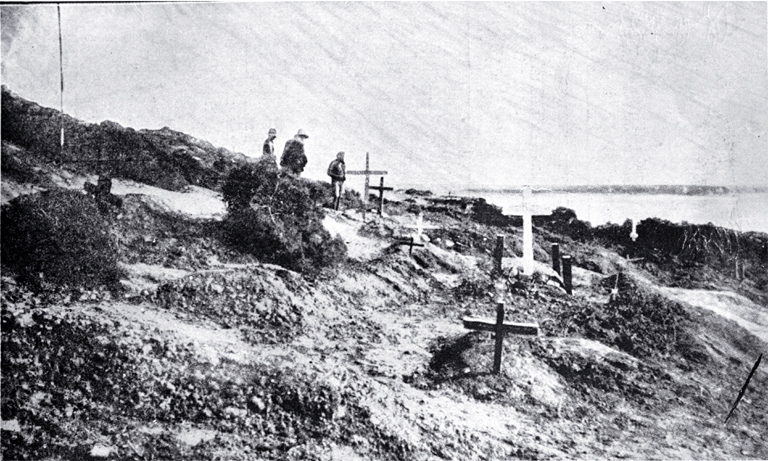
In Aotearoa (New Zealand) and in Australia we observe Anzac day, commemorating the first landings at Gallipoli in 1915 on April 25. The Dardanelles campaign that followed this landing was 8 months of futile slaughter that ended in complete withdrawal. In the century since the sense of loss and the rightful condemnation of the vicious military folly were always muted and buried under tales of honour and national pride, but now we are forgetting altogether. In our fatuous nationalistic self-love we are telling our children that the war was a noble endeavour. History is being rewritten in the most offensive and disgusting manner and we need to finally confront the fact that Anzac Day should be a day of shame, not of pride.

After the Armistice in 1918 people began in many ways to commemorate the war. The event and monuments are solemn. Tombs or tomb-like memorials and plaques listing the fallen became commonplace. Events were also solemn. The Anzac Day service that we observe here in Aotearoa is based on funeral rites. Much of the memorialisation implicitly or explicitly promised to struggle against further war and bloodshed. For many this had been the war to end war, and that was the only meaning and consolation they could find in the futility of the carnage that had occurred. At the same time nationalism and the need to find positive meaning to soften grief shifted people from mourning the loss of lives to honouring the sacrifice of lives. But sacrifice implies that something was gained. Increasingly our commemoration of events that should fill us with deep shame has become an occasion for mistaken pride. We have forgotten the ugly truths of the Great War. Even though wars are happening now in which we have moral, if not material entanglement, we are as foolish as the people of 1914 who thought the War was a romantic adventure and would be “over by Christmas”.

We need to remember the forgotten truths, some of which were buried right from the start. To begin with, there is the fact that large numbers of British people actually opposed the war. On August the 2nd 1914 there was a massive antiwar rally in Trafalgar Square, London. The Manchester Guardian reported that it was “far larger, for example, than the most important of the suffragist rallies”. On that very day the British government decided to go to war. 4 cabinet ministers and one junior minister resigned and the government seemed in danger of falling, but on the 4th of August Germany invaded Belgium and Britain officially declared war. They now had the pretext of protecting Belgian neutrality, though they later violated Greek neutrality in the same manner. In truth, for Britain and for us, this was a war for Empire.

Less than 4 hours after Britain declared war Lord Liverpool, the Governor General of New Zealand, stood on Parliament steps in Wellington are read a proclamation from the Emperor King George. We were ordered to war. Many New Zealanders were wildly enthusiastic but the voices of those opposed to war were never heard. There was no debate and, as a country, we had no voice in this matter.

Young men who had no idea what they would face clamoured to volunteer. 2 years later conscription was introduced and about one third of the men sent overseas from Aotearoa were conscripts. Whether conscript or volunteer, though, the lives of military personnel during wartime are a form of regulated slavery. When ordered to die, they must die. New Zealanders died in numbers that can be hard for us to grasp. It was not lawful to act in the interests of self-preservation regardless of what you thought of the futile slaughter and stalemate that lasted for years on the Western Front. 23 New Zealanders were killed by firing squad for desertion.

April 25 is Anzac day. For both Australia and Aotearoa the formation of the Australian and New Zealand Army Corps was an occasion of national maturation, but we have always been too polite to admit that our national spirit developed in a very ignoble disdain for the weakness of ordinary Britons. For ordinary soldiers the Anzac spirit came from embarking thinking of themselves as somewhat inferior Britons, but on arrival discovering not only a commonality of culture between the two countries, but also a new sense of self for each. Far from being inferior, the Anzac troops soon developed the belief that they were superior to British soldiers and developed a degree of contempt for them and their murderous officers. British soldiers were physically and mentally weak for the simple reason that the British working class was the most malnourished in Europe. 50% of British military aged men were not even considered fit for military service. The Anzacs thought that they lacked strength, endurance, morale and initiative. That contempt for the less fortunate is how they overcame their sense of colonial inferiority.

As a result of the relative individual weakness of the British troops, British commanders used Canadian and Anzac troops as shock troops throughout the war. Because of this personnel from Aotearoa were over 50% more likely to be killed in the war than their British counterparts.

After three years of often horrific fighting – including the Battle of the Somme which left 2111 New Zealanders dead and 5848 wounded – New Zealand’s military effort culminated in the Third Battle of the Ypres, better known to us as Passchendaele. On the 12th of October 1917 New Zealand forces were ordered to advance in muddy conditions into machine gun fire. On that day alone 800 Kiwis died. Over all, the 3rd Ypres cost New Zealand 1796 lives. In a letter home Private Leonard Hart wrote:

Dozens got hung up in the wire and shot down before their surviving comrades’ eyes. It was now broad daylight and what was left of us realised that the day was lost. We accordingly lay down in shell holes or any cover we could get and waited. Any man who showed his head was immediately shot. They were marvellous shots those Huns. We had lost nearly eighty per cent of our strength and gained about 300 yards of ground in the attempt. This 300 yards was useless to us for the Germans still held and dominated the ridge.”

He also wrote about seeing British wounded who were abandoned by their commanders:

“These chaps, wounded in the defence of their country, had been callously left to die the most awful of deaths in the half frozen mud while tens of thousands of able bodied men were camped within five miles of them behind the lines.”

After Passchendaele the New Zealand Division, worn down by horrible misuse and deprivation, was as broken and lacklustre as their British comrades.

Indeed, the conditions faced by all frontline troops of all nations in the War were enough to break any normal human being. On arrival at the front they were confronted with overwhelming noise and disorientation in time and space. They had to contend with stench, filth, mud, vermin and cold. They were constantly fatigued from hard labour at or behind the front line. They suffered chronic sleep deprivation exacerbated by the reversal of day/night patterns of activity in the front trenches. They were malnourished and extremely prone to physical disease, but were often treated punitively, cruelly or callously on falling ill. They were starved of any, even basic, strategic information and and were frequently blind and helpless as death and danger stalked them or exploded all around them. Their lives were thrown away by others as if they had no value. In these circumstances the front line soldier inevitably came to see some actions of military superiors and politicians (and by association the “home”) as either gratuitously idiotic or insane, or even as intentionally murderous. This was not entirely irrational as many of the commanding officers of Britain and Europe were known to loathe the men they sent into battle. However, along with hatred of those in the rear echelons, frontline soldiers often developed a hatred for women and older men. Some even imagined that women were rejoicing in the slaughter of their own sons.

Deaths in the Great War were often lingering, agonising and horrific. That is the norm for the violence of death in war, yet the technology and the conditions of the fields of battle made this even more so in World War One. Only a lucky few died clean deaths, and many who died slowly would have died unattended, alone with their grief, fear, pain and loneliness. Others might have been dragged away by brave stretcher bearers, only to end up living with horrifying incurable mutilations. These men with lost limbs, crushed joints or incinerated flesh would live in chronic pain, often as beggars.

The sense of helplessness common to soldiers seems to have been a major factor in causing acute psychiatric casualties. Men would break down completely in various ways and there was considerable risk that such people would be tried in a court martial and even shot. Others were sent for treatment and for the first time, but not the last, military psychiatrists struggled with the fact that their job was not to make people better, but to make them effective again and send them back into the situation that was destroying them. We now know that those acute psychiatric cases were the tip of the iceberg. Post-traumatic stress disorder generally develops over many years or even decades. The war created an epidemic of family violence and alcoholism that wreaked havoc on the homefront, but did so behind closed doors.

Some of the men brutalised in the War became violent official or unofficial paramilitary squadrists. The notorious “Black and Tans” sent by Britain to Ireland were largely veterans of the Great War.

Similarly the Fascist and Nazi militias that became active throughout Europe were originally veterans. The violence of fascism was born in the trenches. Like the Spanish Flu that killed up to 50 million people, no mutation of ideology could have been so virulent and so deadly had it not been cultivated in the brutality of the Great War. This is what led to another 60 million dead in the bombed cities, on the battlefields, and in the gas chambers of World War II. As Holocaust scholar Yehuda Bauer tells us: “The killing, mutilation and gas poisoning of millions of soldiers on both sides had broken taboos and decisively blunted moral sensitivities. Auschwitz cannot be explained without reference to World War I.”

The violence that sprang from the Great War did not end when the next war ended in the nuclear incinerations of Hiroshima and Nagasaki. The British Empire had devoted fully 25% of its troops to fighting in the Middle East, and in doing so it directly set in motion events that are still causing death and destruction through war as I speak to you now. Men and women are fighting and dying right now, be they volunteers or conscripts. Bombs are dropping on civilians whose homelands may not have known real peace for 2, 3 or even as much as 5 decades.

The British effort in the Middle East was a war for oil. While France pleaded for help and saw one half of her young men die in battle (one half of all French men between the ages of 20 and 32 were killed in the war), but Britain ignored the desperation of her closest ally and invaded first Turkey and then Iraq. They treated their allies very badly. They betrayed their Arab allies by signing the Sykes/Picot agreement that carved up all of the Arab Middle East for Britain and France. They then betrayed the French by redrawing the boundaries of that agreement to put further distance between French territories and the oilfields that were the British goal. Then two days after an armistice that was supposed to end hostilities between Turkey and Britain, a British force invaded Mosul vilayet in what is now northern Iraq. After nearly two weeks of fighting they secured the area and now they had established control over every known source of petroleum in the Middle East. They created the countries of Iraq, Saudi Arabia, Syria, Lebanon, Palestine, Yemen and more. In a year or so the British were dropping poison gas on rebellious Iraqi villages.

That is the empire that New Zealand soldiers died for. That is the future that their sacrifice brought us: burning cities, mass graves and wars that now seem destined to simply continue in perpetuity, as if the very idea of peace is lost to us. If we want to honour their memory, we cannot lie to ourselves about the crime perpetrated on them – on all of us. This country sent 10% of its population overseas. We lost less than countries like France, Serbia or Austria (where many civilians starved to death) but look at an atlas. Those countries had little choice. What madness made us do this to our young men? In economic terms alone we crippled ourselves, wasting years of development, not for a worthwhile cause, not even for empty gains, but to help make a world that was much much worse for our efforts and our loss. It is a hard pill to swallow, but it is worse than if they had died for nothing. That is the truth, and if we want to honour their memories we have to work to end the suffering that still follows in the wake of their deaths. Those people who are dying right now in the Middle East are most often dying from arms made by our allies in the US while US and UK based oil companies reap record profits on a new tide of blood. We were craven and wilfully blind to the immorality of the British Empire, but we still provide intelligence, diplomatic and military support to their equally immoral successors. Is that too political? Well war is political and if you don’t talk about politics you cannot talk sensibly about war.

When the Great War was first commemorated it was in the spirit that we must never let this happen again. Antiwar sentiment was the norm, not least in the RSA. In 1922 if you bought one of the first red poppies sold here, you were donating to an organisation that was committed to peace. Now, I fear, we have forgotten the lessons of two world wars and Anzac Day is increasingly nationalistic and militaristic. This is not a day for pride. Pride is the greatest offence against the memories of the fallen.

The Choice

Standard

You are at the edge of a canyon. Below you is a procession of thousands upon thousands of gagged people marching forward, their hands behind them in steel handcuffs. The sun mercilessly beats down on you and on the marchers causing real pain and distress. From your vantage you can see that they are marching to a cliff and to their certain deaths. You have been yelling and screaming to warn them, but your voice is distant and it is growing hoarse. It is never completely hopeless because occasionally people look up. Sometimes small groups together follow the gaze of someone who has heard you yelling. You wave frantically.

This has gone on for hours that seem like centuries.

When people see you their reactions vary. Some shrug in disbelief or denial. Others panic. Those who panic understand that they face death but instead of giving them salvation, all you have done is add more suffering to their last moments of helpless torment. Some manage to scramble out of the press of bodies to outcrops or scraps of shelter that vary in their levels of discomfort and precariousness. Some of those who stop try to gesture warnings to marchers with head and eyes. Others try to shield themselves from the merciless sun. After a time of watching hundreds marching by, many of those you warned decide that you must be wrong, or at least that all the other people might be right. They rejoin the death march, relieved to once again be going with the flow. The marchers have been promised that shelter and freedom lie ahead of them. They may be sceptical about that, but all you can offer is struggle and suffering.

There seems little hope. Your skin blisters and your voice is nearly gone.

There is a pool of water. Sometimes you leave the cliff edge to quickly drink. If you didn’t your voice would already have given out. There are also materials around to with which you could build a shelter. You would love to just build that shelter. You could even build a shade that kept the sun off the marchers as they pass your section of cliff. One time you splashed water on the marchers and they loved it. It was genuine joy. You could be sheltering yourself, alleviating suffering, and providing genuine happiness instead of giving only the bitter curse of impotent truth. It is the obvious thing to do.

The problem is that the pool of water gives the best view of people dying.

When they reach the cliff people try to scream through their gags. Some marchers turn on others, kicking and butting. Some are simply paralysed with fear. Many, perhaps even most, secretly thought that this might come and they go to their deaths hating themselves for not having fought back. They fooled themselves and now they realise that they should have paid any price to avoid this fate – for them and for their loved ones. No one at the cliff will thank you for having once splashed them with water.

You could build a screen to block the view of voiceless death and suffering, but you couldn’t live with the screen.

If you close your mind, then your acts and the choices you make will be part of the concealment of the truth. If you can’t bear to bring joy or alleviate suffering without denying the truth, then your acts will perpetuate the lie that sends people to their deaths. You will be complicit in mass murder.

The only answer to the cliff, is to keep screaming.

You know that there is just a small chance that enough people will stop marching and will accumulate at the sides of the canyon. Or maybe enough will look up and see you at one time. Enough to make a real difference. Then….

…Things could go very badly. It could create a stampede. The death might be worse than the cliff itself. Maybe that might be worth it if it ended the death march for good, but there is no guarantee that the march won’t just start again after the stampede. Marchers will go right over the bodies of the trampled if they have to. It only makes them more resolute and narrow-minded in going forward.

On the other hand….

…If the marchers can fight fear, if they can hold firm despite the discomforts of the canyon, a ripple of refusal might travel back right through the march. The marchers aren’t stupid. Most harbour serious doubts about the march, but they have no access to other voices. They have no access to each other’s voices – except for incoherent grunts, tweets, status updates, and moans. That is the only thing that gives power to the distant shouts of a lone lunatic.

They don’t like the source, but deep down many marchers feel that the screeching wierdo might be the only one who is being honest with them.

Once they stop the death march, they will realise that they have no choice but to bear the sun while they work together to get rid of the gags and handcuffs and try to find or make ways out of the canyon. Not easy tasks, but better than marching enslaved in the blazing sun to certain death.

It is not much hope, but it is hope. So you can’t quit.

Human Rights in North Korea

Standard

War by Other Means: The Violence of North Korean Human Rights

When the US Wants to Start a War, it Lies …

Link

As the Obama administration maneouvres to get traction for more overt and deadly military intervention in Syria, it may be time to reflect on other times at which a US administration has tried to legitimise a military response. There were Colin Powell’s 2003 lies about WMD. In 1990 there were lies about babies being thrown out of incubators.

Susan Rice lied by telling the world that Libyan loyalist troops were being issued Viagra and instructed to commit mass rapes. When the US wants to start a war, it lies, and these are very big lies. What is more, even once the lies are discovered and broadcast our historical narrative is somehow contrived to seem as if there were no such lies. With a rigidity that rivals any “totalitarian” regime you could name it becomes impossible to deviate. Just because the US put huge amounts of time and effort into deceiving everyone in order to go to war, it doesn’t mean they wanted war. On the contrary, they were victims of their own lies. In Stalin’s or Hitler’s regimes it was unthinkable to accuse the authorities of any mistakes, in our totalitarianism it is impossible to accuse the US regime of doing anything on purpose.

The greatest and most successful of US lies is that of the first Tonkin Gulf incident. Contrary to widespread belief, a US Naval vessel opened fire on Vietnamese vessels first on the occasion of that first incident. The US was guilty of an act of aggression. This was confirmed and aggravated by its lies about the incident, its subsequent lies about a second incident, and above all by the criminal bombing campaign it immediately launched. The truth of this has been public since 2005, but is hardly widespread knowledge. Worse still, the knowledge wasn’t even really hidden before that. Anyone with basic mathematical knowledge could work out from the official Naval history that the US initiated the exchange, and there is no evidence that the Vietnamese even tried to fire torpedoes in return. More to the point (in comparison with current accusations against Syria), no one stopped to question the underlying contention that a weak and poor state would gratuitously go out of its way to provide the US (then and now the world’s most terrifyingly armed state) with exactly the pretext it desired to wage the war it desired at the time it desired.

Moreover, it seems that Western pedagogical discourse (as embodied in textbooks) is not even capable of conveying the known information due to ideological constraints. Our level of indoctrination is such that there is no foreseeable time when a student might read a balanced account such as: “Having determined to unleash its massive military might against the Democratic People’s Republic of Vietnam, the Johnson administration sought to create a pretext. On August the 2nd a US Navy vessel attacked Vietnamese craft that were within their own territorial waters. The US claimed, rather unbelievably, that it was they who had been attacked. Following this a second ‘incident’ took place which seems to have resulted from interference with sonar and radar aboard two US vessels. Though there were no enemy vessels involved at all, this was accompanied by deliberately fabricated signals intelligence designed to convince elements within the US military and civilian command that the Vietnamese had attacked a second time, when they had never attacked at all. The Tonkin Gulf incidents were a highly successful staged pretext for open warfare that rightly should be placed alongside the Marco Polo bridge incident or the Gleiwitz incident.”

What became the Tonkin Gulf Resolution was drafted by Johnson administration and US military officials in Honolulu two months before any incidents took place.(1)This means that the Johnson administration was already intending to widen the war and, given the domestic political circumstances, must have been very desirous of a pretext. The US was conducting a series of provocations, amphibious military raids, known as “OPLAN 34a”, conducted by Republic of Vietnam (RVN) commandos under US command. These were considered militarily useless and “essentially worthless” by US officials and tended to result in great numbers of commandos killed or captured.(2)

At the same time the US Navy was conducting “DESOTO” intelligence gathering missions by using destroyers to “stimulate and record” Democratic Republic of Vietnam (DRV) defences in order to locate radar installations.(3) For obvious reasons this meant that they had to manoeuvre in such a way as to cause the Vietnamese to believe that there was a potential attack, violating waters that the DRV claimed as territorial. Though officially separate, there were linkages between these US Navy operations and the commando raids sufficient to lead Spencer Tucker to conclude that “[i]t was thus not unreasonable for the DRV to assume that the two programmes were one and the same.”(4) In mid-July 1964 a DESOTO mission was authorised for the USS Maddox. It was to approach up to 4 miles from islands which were the subject of simultaneous OPLAN raids.(5)

On July 30-31 an OPLAN raid was carried out on Hon Me island. On August the 2nd the USS Maddox, which was in the vicinity of Hon Me, fired on Vietnamese torpedo boats before any fire from the Vietnamese. This is not usually the accepted version of events, so it is worth replicating John Prados’ description, which is based on the US Navy’s own records:

“Now the records show that the Maddox commenced fire at 9,000 yards at precisely 4:08 p.m. local time, three minutes after firing initial warning shots.

…the navy’s official history shows that the Maddox made a positive identification of the PT boats at 9800 yards, but that the lead Vietnamese warship launched its first torpedo-“unobserved by the Maddox-somewherebetween9,000and5,000yardsfromthespeedingU.S.destroyer.

… Captain Herrick’s messages to higher command make clears more-over, that he considered the Maddox threatened and expected to defend her. Mission commander and commander of Destroyer Division 192, Herrick had been warned by his NSA detachment of a probable attack, estimated the risk as unacceptable, and asked higher authority to cancel the patrol.

… All evidence indicates the Maddox opened fire based on the approach of the North Vietnamese vessels; initiation of engagement was thus on the basis of perceived intent, without reference to an actual attack.”(6)

The point is that anyone who has even a vague grasp of mathematics can discern from the US Navy’s official history that the US fired first in the first Tonkin Gulf incident. This was confirmed in a 1998 article for the National Security Agency (NSA) journal Cryptological Quarterly (declassified in 2005).(7) The same article points out that “Hanoi’s tactical specifications for its P-4s called for torpedo launches at ranges under 1,000 yards. At over 6,000 yards, it was unlikely a torpedo launched at a moving target could hit anything.”(8)

After this attack by the US it was announced that the DRV had attacked US vessels in international waters, but since the only damage sustained by the Maddox was a single bullet hole, Johnson decided on the minimal reaction of a diplomatic protest. Two days later the Maddox was joined by another destroyer, the USS C. Turner Joy which opened fire on non-existent torpedo boats on the basis of false radar and sonar signals.(9) An engagement was briefly reported before being thrown into severe doubt within hours. Within an hour of the second “incident” the DRV had denied any activity.(10) Herrick sent the following about 4 hours after reporting the incident:

“Review of action makes many reported contacts and torpedoes fired appear doubtful. … No actual visual sighting by Maddox. Suggest complete evaluation before any further action taken.”

Nonetheless an allegedly “furious” Lyndon Johnson ordered air strikes.(11) Even more brazenly McNamara lied to congress, telling them that both destroyers had been attacked. This helped secure the Gulf of Tonkin Resolution, which had very broad provisions including the right to instantly respond with force in the case of attack on US forces and, on request by any Southeast Asian government, to use “all measures including the use of armed force to assist that nation in the defense of its political independence and territorial integrity against aggression or subversion.”(12) That was what facilitated the full-scale invasion of Vietnam; when the illegitimate government that the US had installed over the fictional sovereign state that the US created dutifully invited the “assistance” of the US.

The events are, admittedly, complicated. For example, I have not even mentioned yet that the DRV boats on August 2nd were apparently intending to attack the Maddox. I am not sure how much credence one should put into these claims, but it seems that Prime Minister Le Duan had gone behind the backs of President Ho Chi Minh and armed forces commander Vo Nyuyen Giap to order attacks and that those orders had been countermanded but that this was not received by the DRV torpedo boats.(13) Nor does it alter the fact that the US was engaged in offensive operations against the DRV, and in fact had been attacking with US personnel since no later than 1961.(14) The question is whether to examine the events by emphasizing US mistakes and confusion, or whether base an analysis or narrative on the deliberate and calculated acts of the US. It is, of course, the former which dominates the scholarly discourse.

By concentrating on known deliberate provocations and deceptions we can construct a narrative which completely obviates any need to refer to US mistakes and misunderstandings. That the US wanted to start bombing the DRV and make a major ground force commitment should not be in doubt. As mentioned, the resolution which would make use of the Tonkin Gulf incidents to achieve those ends was already drafted, and US officials where convinced (rightly) that without a major escalation of US involvement they would “fail”.(15) “Failure” for the US meant a negotiated solution between the leaders in Saigon and other parties, primarily the National Liberation Front (NLF). “Failure” meant the advent of peace.(16)

The various commando raids committed under US command, usually by RVN personnel who were very callously expended, were clearly deliberate provocations. As mentioned, they were not considered militarily useful. The explanation given by scholars to explain why the US would thus choose to sacrifice lives and resources thus is that they sought to reassure the Saigon regime. As Hanyok puts it, “if America’s determination to succeed could be communicated to Khanh, then the South Vietnamese might be reassured of the prospects for victory.”(17) This begs the question of what exactly is supposed to be reassuring in the US demonstrating that they are willing to sacrifice the lives of the most highly trained and dedicated RVN personnel in militarily useless endeavours? Either scholars have a rather racially informed view of RVN leader General Nguyen Khanh’s intellect and military acumen, or the actual reassurance could only be derived from the knowledge that these were provocations undertaken in order to lay the groundwork for a massive expansion of the war. As it happens Khanh demonstrably was not reassured, not that any scholars seem to think that this fact might be relevant. He sought to neutralise South Vietnam after the passage of the Tonkin Gulf Resolution, but when the US found out that he sought negotiations with the NLF to end the war they overthrew him.(18)

Having provoked a minor response, the only damage to the Maddox being a single bullet hole, clearly the Johnson administration felt that the incident was not sufficient to persuade Congress to authorize full-scale war. They warned Hanoi that “any further unprovoked offensive military action against United States forces” would “inevitably” result in “grave consequences.”(19) Those scholars who note Johnson’s limited reaction suggest that it indicates his reluctance to take that step, but this is to ignore the wealth of evidence that he actively sought this massive expansion of the war. Among other things Johnson lied about the nature of the first incident, making it seem like a completely unprovoked attack by the DRV in international waters. Had he wished to avoid war in any way he might still have lied, but using a very different cover story emphasizing the potential for mistakes in areas of tension and calling for calm, not accusing the DRV of an act of aggression. Had the US wished in any way to avoid war, they would not have scheduled and conducted another OPLAN raid on the night of 4-5 August. But they did exactly that.(20) At the same time, immediately after the first incident, the Maddox and C. Turner Joy were authorized to approach to 11 miles of the DRV coastline (well within range of the destroyers’ 5 inch guns)(21), deliberately breaking the territorial limit claimed by the DRV.(22)

The second Tonkin Gulf incident and Johnson’s reaction to it reinforce the following position: the US persistently and consistently pursued actions designed to prevent a negotiated settlement of the insurgency in the South and simultaneously to facilitate the expansion of the war with major US troop commitments and massive bombing campaigns which would come to engulf most of Indochina. Further, Johnson’s appearance of having been deceived is belied by his acts and words at the time and later. As such, the fact that Johnson created deniability over his decision to bomb the DRV is actually suggestive of premeditation.

On August 4 a series of cables arrived at the Pentagon detailing extraordinary events. Daniel Ellsberg gives the following account:

The messages were vivid. Herrick must have been dictating them from the bridge in between giving orders, as his two ships swerved to avoid torpedoes picked up on the sonar of the Maddox and fired in the darkness at targets shown on the radar of the Turner Joy: “Torpedoes missed. Another fired at us. Four torpedoes in water. And five torpedoes in water. . . . Have … successfully avoided at least six torpedoes.”

Nine torpedoes had been fired at his ships, fourteen, twenty-six. More attacking boats had been hit; at least one sunk. This action wasn’t ending after forty minutes or an hour. It was going on, ships dodging and firing in choppy seas, planes overhead firing rockets at locations given them by the Turner Joy’s radar, for an incredible two hours before the stream of continuous combat updates finally ended. Then, suddenly, an hour later, full stop. A message arrived that took back not quite all of it, but enough to put everything earlier in question.”(23)

In fact, there were no attacks at all, nor enemy vessels. It was also clear even during the “engagement” that both radar and sonar aboard both destroyers were giving unreliable readings. With reports from the field immediately thrown into doubt, it was signals intelligence which was used as the final justification, the only problem being that someone somewhere fabricated the most crucial message. Before this, however, a misinterpretation of a partial intercept warned of a possible attack. Next, a report based on a complete intercept contradicting that was issued at about the exact time that the destroyers opened fire:

For NSA and the rest of the SIGINT participants, the second Phu Bai report should have acted as a brake to any further reporting about an attack. It directly contradicted the interpretation – remember, it was an interpretation only – contained in the initial Critic which claimed an attack was being prepared. At this point, all the SIGINT community could accurately state was that there was no signals intelligence reflecting a planned or ongoing attack against the Desoto mission.”(24)

With the PT boats being ruled out as attackers the NSA decided that it must be SWATOW boats which were attacking. The problem with this being that these boats were not equipped with torpedoes and were not close enough to have reached the destroyers after the alleged attack order had been issued.(25) Thus signals intelligence fairly well ruled out an attack at an early stage. A complete lack of intercepts, such as DRV radar activity, that would confirm an attack made this a certainty, as Hanyok points out it was the dog that didn’t bark in the night.(26)

The intercept which was used, by Robert McNamara, to “prove” that an attack took place was an after-action report. The original decryption, in Vietnamese, is lost and the translation seems somewhat incoherent, however it is known that the translation altered some of the original message. Additionally, the first version of this “after-action” report was issued at or before the time at which the destroyers opened fire, but somehow the translation failed to highlight the original transmission time. Worse still, the translation was actually made up from two different intercepts and, as Hanyok points out, it is clear that the original reports were being discussed among intelligence and defense officials.(27)

Johnson and McNamara both deliberately deceived by covering up the doubts to which both were privy. Even if Johnson was himself misled, as Gareth Porter contends,(28) he was still aware that matters left room for doubt, but chose to present the attack as a complete certainty and launched airstrikes with incredible haste. There was no posturing brinksmanship, no ultimatum, no summits, not even bullying, just destruction and death dropped abruptly from above.

The Tonkin Gulf Resolution, passed on August the 7th, was nearly as hasty as the air strikes. It is not merely hard but impossible to seriously conceive that the rapidity of these actions was prompted by anything so much as by a knowledge that the casus belli would soon disintegrate. Johnson was on record as expressing doubt before the resolution was passed.(29) McNamara was definitely apprised of ample evidence to conclude that there had been no attacks, but used the fabricated intercept as his “smoking gun” proof in addressing Congress.(30) Congress believed McNamara’s story, as did the media. I. F. Stone was a lone voice when he pointed out that reprisal strikes were illegal in peacetime(31), so from this point on the precedent for bombing the DRV had been created and the President had been granted virtually unlimited powers with which to prosecute a full-scale war.

The purpose of spending so much space on the Tonkin Gulf incidents is primarily historiographical. With regard to the first incident, most works touching on the subject will implicitly or explicitly characterize the incident as an unprovoked Vietnamese attack. Until 2005, no one at all acknowledged that the US had attacked first despite the fact that the evidence (namely those numbers that appear in the official US Navy history) had been widely available for decades. Now you would still find it very hard to find any historical account which did not falsify the events. Morevover, the second incident is very odd in its historiography.

Often the second incident is mentioned as if it were roughly equivalent the Gleiwitz incident, staged by the Germans as a pretext for invading Poland. Yet when discussed in more detail, the narrative of the second incident tends to be overtaken with supposed misapprehensions, technical failures, psychological failings. By directing critics of US actions, including scholarly critics, into the contemplation of the strange non-events of the second incident, the US has managed to perpetrate a Gleiwitz-like incident but to maintain the central deception for half a century. Most disturbing of all, not only did the academic world ignore clear evidence of US aggression, but now, years after the declassification of an intelligence study that implicitly documented a US act of aggression, there is no sign that the broader historical discourse will change to reflect this.


 Notes

1 Robert Schulzinger, A Time for War: The United States And Vietnam, 1941-1975, Oxford: Oxford University Press, 1997, p 151; Howard Zinn, A People’s History of the United States, London: Longman, 1980, p 476.

2 Eric Alterman, When Presidents Lie: A History of Official Deception and its Consequences, New York: Viking, 2004, p 160.

3 Robert J. Hanyok, “Skunks, Bogies, Silent Hounds, and the Flying Fish: The Gulf of Tonkin Mystery, 2-4August 1964”, Cryptological Quarterly, Winter 1998, FOIA case # 43933, p 6.

4 Spencer C. Tucker, Vietnam, Lexington, Kentucky: University Press of Kentucky, 1999, p 107.

5 Hanyok, “Skunks, Bogies…”, p 6.

6 John Prados, The Hidden History of the Vietnam War, Chicago: Ivan R. Dee, 1995, pp 50-1.

7 Hanyok, “Skunks, Bogies…”, p 6.

8 Ibid, p 22.

9 Prados, The Hidden History of the Vietnam War, p 53.

10 Tucker, Vietnam, p 108.

11 Langguth, Our Vietnam, pp 301-2.

12 Schulzinger, A Time for War, pp 151-2.

13 Mark Moyar, Triumph Forsaken: The Vietnam War, 1945-65. New York: Cambridge University Press, 2006, pp 310-1.

14 Prados, The Hidden History of the Vietnam War, p 37.

15 Daniel Ellsberg, Secrets: A Memoir of Vietnam and the Pentagon Papers, London: Penguin, 2003, pp 1-2.

16 Kieran Kelly, Beyond Stalemate: The Second Indochina War as a Genocidal War System, Saarbrücken, LAP, 2013, pp 75-6.

17 Hanyok, “Skunks, Bogies, Silent Hounds….’, p 9.

18 Ironically Khanh had gained US support for his overthrow of his predecessor, General Minh, by citing the threat of neutralism. Obviously, once he gained power he also gained some perspective on the likely outcome of a wider war.

19 Hanyok, “Skunks, Bogies, Silent Hounds….’, p 18.

20 Ibid, p 30.

21 Langguth, Our Vietnam, p 300.

22 Schulzinger,ATimeforWar,p151.

23 Ellsberg,Secrets,p6.

24 Hanyok,Skunks,Bogies,SilentHounds….’,p28.

25 Ibid,p29.

26 Ibid,p31.

27 Ibid, pp 34-7.

28 Gareth Porter, Perils of Dominance: Imbalance of Power and the Road to War in Vietnam. Berkeley, Los Angeles, London: University of California Press, 2006, pp 193-200.

29 Ibid, p 200.

30 Schulzinger, A Time for War, pp 151-2.

31 Langguth, Our Vietnam, p 305.

The Korean Genocide Part 2: The US Occupation and its Imperial Context

Standard

Yaltagroup-4

(In the first part of this four part post, I detailed something of the history of Korea
before US partition. I showed that a strong sense of national unity among Koreans
had, if anything, only been strengthened by Japanese imperial rule. I ended by
mentioning the strategic situation which faced the Soviet Union when the US
decided to partition Korea. As I continue, readers may be surprised by much of
what I detail herein, but these are not previously unknown facts, they are simply
things that are studiously neglected by teachers and textbook writers.)
The US strategic approach to the world mutated during World War II. At first the strategic plan
for the post-War world had called for the retention of a “Grand Area” under German
hegemony. That planning changed as it became clear that the Soviets were winning against Germany, eventually transforming into an uneven global bipolar paradigm which was the basis for the “Cold War”.1 Germany was no longer to be at the centreof a Grand Area, while Russia was. Moreover, of the four Grand Areas, the three notunder Soviet control were to be a Western condominium under US hegemony. Indeed, one of the many things that the Korean War allowed the US to achieve was the stimulation of the Japanese economy desired because it was to be the centre of one of the Grand Areas.2
The strategic logic of the Grand Area strategy was that of securing strategic
resources, the same type of logic which had led the Japanese into potentially openended
imperial aggression. The “Grand Area Strategy” was not about opposing
communism, it was about US domination. It was intended to secure the “limitation of
any exercise of sovereignty” in “an integrated policy to achieve military and
economic supremacy for the United States.”3 This strategy came from planning
conducted by the Council on Foreign Relations (CFR) prior to the US entry into the
war. Seeing the potential disruption to trade of the nascent World War, the council
concluded that “as a minimum, the American ‘national interests’ involved the free
access to markets and raw materials in the British Empire, the Far East, and the
entire Western hemisphere.”4 Their recommendation, therefore, was for “complete
re-armament”, but as Hossein-zadeh points out they were soon thinking beyond the
defeat of the Axis powers:

Although the Grand Area was designed as a war-time economic and military
framework in reaction to Germany’s expansionist policies, the United States
also simultaneously made tentative plans for beyond the war: to expand the
Grand Area to include continental Europe once the Axis Alliance was
defeated, thereby making the Grand Area global: The Grand Area, as the
United States-led non-German bloc was called during 1941, was only an
interim measure to deal with the emergency situation of 1940 and early 1941.
The preferred ideal was even more grandiose – one world economy
dominated by the United States. The Economic and Financial Group [of the
Council] said in June 1941, “the Grand Area is not regarded by the Group as
more desirable than a world economy, nor as an entirely satisfactory
substitute.”5

imperialism

The creation of a bipolar system favoured both sides, facilitating the construction of
a Soviet empire as well as that of US empire. This would certainly explain the
contradiction between Stalin’s rhetoric and behaviour. Many see Stalin as having
been obeisant to superior Western strength: “To accommodate the United States
and other Western powers in the hope of peaceful coexistence, Stalin often
advised, and sometimes ordered, the pro-Moscow communist/leftist parties in
Europe and elsewhere in the world to refrain from revolutionary policies that might
jeopardize the hoped-for chances of coexistence. The Soviet leader ‘scoffed at
communism in Germany,’ writes historian [D.F.] Fleming, ‘urged the Italian Reds to
make peace with the monarchy, did his best to induce Mao Tsetung to come to
terms with the Kuomintang and angrily demanded of Tito that he back the
monarchy, thus fulfilling his (Stalin’s) bargain with Churchill.’”6 But Stalin also threw
the first punch in the war of words which was a key element of the Cold War – if
only as a disingenuous theatrical display. Indeed, both Stalin and Churchill
preceded US officials in both declaring implacable enmity for implicit or explicit
ideological reasons in February and March of 1946.7
But Churchill spoke at the behest of US officials. Moreover, out of the public arena,
also in February, George Kennan’s “Long Telegram” was written. In this Kennan
concurred that the Soviet Union was by its very nature an enemy. Of course, the
Soviet Union had been severely battered by World War II and was not naturally as
wealthy and powerful as the US so Kennan could not actually make any claims that
such enmity constituted a military threat. He concluded, “it is not entirely a military
threat, I doubt that it can be effectively met entirely by military means.”8
Nevertheless he made the danger posed seem high and Dean Acheson
commented that ‘his predictions and warning could not have been better.’9
Acheson’s emphasis should be seen in context of his later comment that he felt it
necessary “to bludgeon the mass mind of ‘top government’ with the Communist
threat.”10 He described this process in the following terms, recalling an address in
1947: “In the past eighteen months, I said, Soviet pressure on the Straits, on Iran,
and on northern Greece had brought the Balkans to the point where a highly
possible Soviet breakthrough there might open three continents to Soviet
penetration. Like apples in a barrel… the corruption of Greece would infect Iran and
all to the east. It would also carry infection to Africa through Asia Minor and Egypt,
and to Europe through Italy and France….” Such hyperbole, as Chomsky points out,
was patently disingenuous as Acheson was in a position to know that his threats
were completely implausible.11 Fear of the Soviet threat began to make an impact in
the US news media in 1948, at a time when Soviet society, and in particular the Red
Army, was on the verge of total collapse.

12

The other key part of the containment paradigm under which the US was to operate
was established by the passage of NSC-68 through Congress. In Mark Moyar’s
words President Harry Truman “was reluctant to embrace NSC-68, but events –
especially the Korean War – led him to accept its main tenets by the middle of
1950.”12 Brian Bogart has this to say: “Along with then Secretary of State Dean
Acheson, and without any expertise in Russian history or Soviet affairs, Nitze
convinced – some say coerced – Truman into recognizing the Soviet Union as an
evil and imminent threat, and into signing NSC-68 and launching the Cold War. After
NSC-68 was signed, it needed the approval of Congress. Post-Cold War documents
suggest that the Korean War was triggered by Americans and South Koreans for
this purpose.”13 The Soviet Union was officially designated as an inextricably
essential enemy, eternally hostile and aggressive, who could never be negotiated
with unless they completely renounced their ideology and embraced Western norms
and systems of governance.14 This established the preeminence of the military as
the key economic consideration for US governments. It also enshrined a policy of
the perpetual maintenance of US military supremacy.15 In other words the US was
to be put in a endless state of wartime economic functioning. The espoused
ideological opposition to communism was merely a tool to facilitate a highly
militarised interventionist global hegemony. Ironically, or perhaps revealingly,
Kennan’s famous ‘X’ article (an article published in Foreign Affairs under the
pseudonym ‘X’ which many consider the ideological basis of containment) about
Soviet power made much the same observation of the instrumental motives behind
the Soviet Union’s show of adherence to Marxist-Leninist ideology.16
The fact is that the US aimed to create, almost at a stroke, the largest empire in
human history, trading on unprecedented economic and military predominance to
create permanent dominion. Where all other major industrial areas of the world had
been destroyed or crippled by the war, US industry had grown rapidly, accounting
for fully half of the entire world’s manufacturing capacity by the war’s end, and
growing to 60% by 1950.17 They had retained all of their gold reserves which had
reached 75% of the world’s total reserves in the 1930s thanks to the dogged
pursuance of debts incurred in the previous World War.18 On the same subject, they
had broken their previous record as the largest creditor state in history.19 The US
had an unparalleled degree of political capital, the cruelties of Axis occupation
making it widely seen as a liberator. Less tainted than other allies by imperialist
practices, colonial people’s viewed it as genuinely adherent to the Atlantic Charter’s
prromise to “respect the right of all peoples to choose the form of government under
which they will live….”20 The US was able to use such advantages to further its
dominance by creating supranational economic institutions – the Bretton Woods
institutions of the “World Bank” and the International Monetary Fund (IMF) – which it
could effectively control. The US directly appoints the president of the World Bank,
while both it and the IMF were created with voting powers assigned almost
exclusively on the basis of who put the most money in. The US thus bought over
one third of the votes of the World Bank at the outset, and had a similar percentage
of IMF votes.21 (Since that time voting rights have become even more skewed in
favour of powerful states and the Bretton Woods institutions have been transformed
into a tool for allowing those powerful states to exercise effective economic
sovereignty becoming, in Naomi Klein’s words, “the primary vehicles for the
advancement of the corporatist crusade.”)22
The US also played a large role in deciding the constitution of the United Nations. In
effect the United Nations became a tool of US foreign policy. As Noam Chomsky
explains:

The dominant élite [US] view with regard to the UN was well expressed in
1992 by Francis Fukuyama, who had served in the Reagan-Bush State
Department: the UN is “perfectly serviceable as an instrument of American
unilateralism and indeed may be the primary mechanism through which that
unilateralism will be exercised in the future.” His prediction proved accurate,
presumably because it was based on consistent practice going back to the
early days of the UN. At that time, the state of the world guaranteed that the
UN would be virtually an instrument of US power. The institution was greatly
admired, though élite distaste for it increased notably in subsequent years.
The shift of attitude roughly traced the course of decolonization, which
opened a small window for “the tyranny of the majority”: that is, for concerns
emanating from outside the centers of concentrated power that the business
press calls the “de facto world government” of “the masters of the universe.”
When the UN fails to serve as “an instrument of American unilateralism” on
issues of élite concern, it is dismissed. One of many illustrations is the record
of vetoes. Since the 1960s the US has been far in the lead in vetoing Security
Council resolutions on a wide range of issues, even those calling on states to
observe international law. Britain is second, France and Russia far behind.
Even that record is skewed by the fact that Washington’s enormous power
often compels the weakening of resolutions to which it objects, or keeps
crucial matters off the agenda entirely Washington’s wars in Indochina, to cite
one example that was of more than a little concern to the world.23

united nations building in nyc

Thus the Korean War served as a crucial catalyst to achieving the crucial militarised
component of US dominance, and Cumings joins those who focus more broadly on
US imperialism (Chomsky, Kolko, Hossein-Zadeh, Bacevich, Johnson and many
more) in iterating the centrality of the Korean War in transforming US society,
creating the “military-industrial complex” and facilitating global domination, because
it allowed NSC-68 to be enacted and validated, however deceptively. Cumings also
emphasises the late-1949 NSC-48 which established a “Monroe Doctrine”-like right
of intervention to prevent sovereign entities from, among other things, “general
industrialisation” which might come at the cost of “comparative advantage”.24 Thus
the Korean War was not merely a catalyst for the establishment of domestic and
international institutions of empire, it was a prime exemplar of the manner in which
military force was to be used to enforce imperial hegemony. To understand why
genocide was employed, it is necessary to examine precedents adopted by the US
from the British empire.
The use of the term “comparative advantage” is telling. Taken from the classical
economist David Ricardo, it is, consciously or unconsciously, a dishonest way of
referring to Kennan’s “pattern of relationships which will permit us to maintain a
position of disparity.”25 Thus the continuity of imperial practices with those of the
British, who also utilised Ricardo as an excuse for preventing development among
dependencies. Ricardian liberalism played the role that the Friedmanite
neoliberalism and monetarism of the Washington Consensus plays today – that of
“useful foolishness” to use Hudson’s words.26 In arrogating to itself such a wide
imperium, the US had a problem. Billions of people were in the process of achieving
independence from formal colonial control, how then would the US ensure that their
resources remained at its disposal as was called for in Grand Area planning? In
order to do that one must maintain the dependency that attends colonial economic
relations. In the early 19th century Britain had already started extending such
relations without formal control as has already been described. To do so, they
employed Ricardo and Adam Smith. Korean economist Ha Joon Chang quotes
Friedrich List in 1840 who wrote:

It is a very common clever device that when anyone has attained the summit
of greatness he kicks away the ladder by which he has climbed up in order
to deprive others of the means of climbing up after him. In this lies the secret
of the cosmopolitical doctrine of Adam Smith, and of the cosmopolitical
tendencies of his great contemporary William Pitt and of all his successors in
the British Government administrations.
Any nation which by means of protective duties and restrictions on navigation
has raised her manufacturing power and her navigation to such a degree of
development that no other nation can sustain free competition with her. can
do nothing wiser than to throw away these ladders of her greatness. To
preach to other nations the benefits of free trade, and to declare in penitent
tones that she has hitherto wandered in the paths of error. and has now for
the first time succeeded in discovering the truth.27

Kicking away 9781843310273_1_1

There was a further problem for the US explained by Michael Hudson:

…[T]he U.S. balance of payments had reached a surplus level unattained by
any other nation in history. It had an embarrassment of riches, and now
required a payments deficit to promote foreign export markets and world
currency stability. Foreigners could not buy American exports without a means
of payment, and private creditors were not eager to extend further loans to
countries that were not creditworthy.
The Korean War seemed to resolve this set of problems by shifting the U.S.
balance of payments into deficit. Confrontation with Communism became a
catalyst for U.S. military and aid programs abroad. Congress was much more
willing to provide countries with dollars via anti-Communist or national
defense programs than by outright gifts or loans, and after the Korean War
America’s military spending in the NATO and SEATO countries seemed to be
a relatively bloodless form of international monetary support. In country after
country, military spending and aid programs provided a reflux of some of the
foreign gold that the United States had absorbed during the late 1940s.28

Obviously, this was not a sustainable solution – in fact it was the 2nd Indochina War
which half-forced and half-facilitated a more long-term solution. Unsustainable it
may have been, but there is a certain elegance to combining in one single
programme a massive change (the creation of the Cold War) which militarised
society and provided both the weaponry and ideological pretext for intervention in
maintaining a newly minted empire while yet addressing the unwelcome effects of
the desired economic predominance by providing currency but in such a way that,
since it came in the form of military aid, could be used to deepen dependency whilst
not providing any means for unwelcome economic development.
To understand how such a system might work it is necessary to examine some
exemplars of US “neocolonial” practices. For clients the US may often choose the
established latifundistas29 of the traditional imperialist. Galeano describes the role
of the latifundia: “Subordinated to foreign needs and often financed from abroad…
the present-day latifundio [is] one of the bottlenecks that choke economic
development and condemn the masses to poverty and a marginal existence in Latin
America today. … [I]t merely needs to pay ridiculously low or in-kind wages, or to
obtain labor for nothing in return for the laborer’s use of a minute piece of land.”30
Simultaneously, however, the US has shown a preference for two other forms of
client oligarchy – kleptocracy and militarised authoritarianism. These are not
exclusive categories, with many regimes embodying all three.
The US love of kleptocrats can be seen in their choice of whom to elevate when
overthrowing or attempting to overthrow various governments. US invasions of
Nicaragua, Cuba and Haiti led to the instalation of Batista, the Duvaliers, and the
Somozas – all notorious for corruption and brutality.31 Mobutu Sese Seko, who
came to power “in a military coup designed by the United States,”32 would steal an
estimated $5 billion in his US supported time as dictator.33 The Contras were mainly,
according to one NSC staffer, “liars motivated by greed and the desire for power,
and charged that the war had become a business for them. They attacked bridges,
electric generators, but also state-owned agricultural co-operatives, rural health
clinics, villages and non-combatants.”34 Manuel Noriega was known for certain to be
dealing drugs from 1971, but remained on the US payroll and continued to get
diplomatic support until 1986. By this stage he was no longer involved in the drug
trade.35
This is very far from a complete list of corrupt US clients, and is not because, as is
often construed, the US was completely amoral with regard to its choice of clients,
not caring if they were brutal and venal. The orthodox criticism is that the US only
cared for leaders that were friendly to US commercial interests and (during the Cold
War) were steadfastly anticommunist, without any reference to their venality or
brutal treatment of their own people. This attitude is supposedly exemplified by
Franklin Roosevelt’s comment about Somoza: “He may be a son of a bitch, but he’s
our son of a bitch.” 36 Far from being neutral on the question of venality, there is an
obvious strategic imperative which explains why, despite some political cost, the US
has preferred to extend patronage to those it knows to be corrupt, namely that the
corrupt and the greedy will put the interests of their paymasters ahead of those of
their own people.
A similar logic to the preference for venality also applied to a preference for brutal
authoritarianism. The US developed a particular facility for creating military
dependence by fostering a military élite reliant on US military aid and faced with a
hostile populace, often accompanied by varying degrees of insurgent activity or civil
war which bore the hallmarks of war systems.37 In Iran, for example, the CIA’s first
coup, considered at the time “its greatest single triumph,”38 installed the Shah
Mohammed Reza Pahlevi in a position of supreme power. The CIA “wove itself into
Iran’s political culture.”39 They created SAVAK, a notorious “intelligence” agency,
trained in torture by the CIA40 and supported by the CIA and DIA in a domestic and
international dissident assassination programme.41 Repression was at its peak
between 1970 and 1976 resulting in 10,000 deaths.42 By 1976 Amnesty
International’s secretary general commented that Iran had ‘the highest rate of death
penalties in the world, no valid system of civilian courts and a history of torture that
is beyond belief. No country in the world has a worse record of human rights than
Iran.’43 Nafeez Ahmed cites the Federation of American Scientists (FAS) who detail
an extensive police state of intense surveillance and informant networks and torture
“passed on to it” by US, UK and Israeli intelligence. Ahmed quotes the FAS on
methods including “electric shock, whipping, beating, inserting broken glass and
pouring boiling water into the rectum, tying weights to the testicles, and the
extraction of teeth and nails.”44 The US attitude to such repression can be seen in
the official reaction to the unrest developing in the late 1970s. Aside from US
officials consistently urging and praising military responses to protest action,
including inevitable massacres,45 the US ambassador objected strongly to a
reduction in repression. In June 1978 he reported his finding that, “the Shah’s new
directives to his security forces, such as instructions to desist from torture… are
disorienting.”46

iran-vittime_savak
Hard on the heels of Operation Ajax, which overthrew Iran’s government, was
Operation Success in Guatemala. According to Carlos Figueroa Ibarra, the US
operation was the “principle cause” of the overthrow of the Arbenz government47 –
not a communist government but in the words of Ambassador “Pistol-packing” Jack
Puerifoy, who had worked closely with the CIA, “if the president is not a communist,
he will certainly do until one comes along.”48 What followed was a 35 year “dirty
war”. As I have already pointed out the “dirty war” designation is a myth, often used
as a cover for genocide. Although there were guerillas in Guatemala the findings of
two truth commissions make it clear that this was a case of “government repression
and terror rather than guerilla warfare.”49 The UN estimates that over 200,000 were
killed. 93% of tortures, disappearances and executions were committed by
government forces; 3% by guerilla’s and 4% described as “private”. “In a majority of
the massacres committed by the state, especially by the army, the
counterinsurgency strategy led to multiple acts of savagery such as the killing of
defenceless children, often by beating them against walls…; impaling the victims;
amputating their limbs; burning them alive; extracting their viscera while still alive
and in the presence of others… and opening the wombs of pregnant women.” A
favoured way of torturing to death was to stab someone then throw them into a pit
where they would be burnt to death.50 As Adam Jones notes: “Finally, the
Commission’s report took the important step of labeling the Guatemalan
government’s campaign as genocidal. All Maya had been designated as supporters
of communism and terrorism, the report noted, leading to ‘aggressive, racist and
extremely cruel . . . violations that resulted in the massive extermination of
defenseless Mayan communities.’”51
In 1963 when the President, General Manuel Ydigoras Fuentes who was nearing
the end of a 6 year term, allowed the return of a popular reformist exile, who the US
felt likely to become the next president, the US instigated a coup to bring Colonel
Enrique Peralta Azurdia to power. Peralta inaugurated his presidency by having
eight political and union leaders murdered by means of driving over them in rockladen
trucks.52 By this time Guatemala was experiencing protest action in cities and
a small guerilla movement in the country, incorporating remnants of a nationalist
military uprising crushed in 1960, largely by the CIA’s aerial bombardment.53 The
US pushed for a military response.54 From 1960 military assistance began a steady
climb, peaking in 1963 at the time of the coup but continued at a high level
thereafter.55 In 1966 the US began taking more of an active role.56 From this point,
and through the seventies, death squads increased in number, coinciding with an
increase in US personnel – reaching 1000 Green Berets in addition to advisors,57 in
a country with an army of only 5000.58 The Green Berets gave instruction on
“interrogation”, while US pilots dropped napalm on those unfortunate enough to be
in a ‘zona libre’ – a free-fire zone.59
The “war” was conducted primarily against noncombatants, involving mainly
massacres of Mayans and “forced disappearances” or tortures and executions of
those considered politically suspect. This is true to such an extent that none of the
accounts I have read of the “war” actually mentions combat or the deaths of
guerillas.60 The initial guerilla movement was “all but wiped-out” by 1968,61 but a
stronger movement arose in 1970s.62 As with Argentina’s “dirty war” the guerillas
became the rationale for a war against the civilian population.63 The atrocities, in
turn, must surely have fuelled the insurgency. As Greg Grandin remarks,
“Guatemala was one of the first Latin American countries to develop both a socialist
insurgency and an anticommunist counterinsurgency. Practices the United States
rehearsed in Guatemala would be applied throughout Latin America in the coming
decades.”64
Guatemala went through the transition to “façade democracy” of the kind that was
to become notorious under the regime of José Napoléon Duarte in El Salvador, and
might equally be equated to Nuri al-Maliki’s sectarian terror state in Iraq. As Julio
Godoy wrote in The Nation in 1990: “In Guatemala and El Salvador the electoral
alternative that emerged during the 1980s as a response to the 1979 Sandinista
triumph in Nicaragua, and to the guerilla warfare at home, is hypocritical and empty
of democratic content. Under the electoral façade – the civilian regimes in
Guatemala and El Salvador are just a public relations game, aimed at the
international community – almighty armies rule these countries, with a discretionary
degree of public presence.”65 In Guatemala this transition saw “a passing from the
open terror that distinguished old dictatorships to the clandestine terror that was the
most popular resource amongst the military dictatorship.”66 “Clandestine terror” and
military dictatorship disguised in “façade democracy” was far bloodier than “open
terror” with the greatest single period of genocidal mass murder occurring in the
early 1980s. As Jones relates: “In just six years, some 440 Indian villages were
obliterated and some 200,000 Indians massacred, often after torture, in scenes fully
comparable to the early phase of Spanish colonization half a millennium earlier. The
genocide proceeded with the enthusiastic support of the Reagan administration in
the US, which reinstated aid to the Guatemalan military and security forces when it
took power in 1981.”67

pb-120213-massgrave-02.photoblog900
On the surface events in Iran and Guatemala suggest that US neocolonialism
follows a materialist pattern, with events being driven by the profit motive. In Iran
events were triggered by a threat to the extremely lucrative agreement between Iran
and the Anglo-Iranian Oil Corporation. In 1950 “the AIOC earned some £200 million
profit from its Iranian operations, but only paid the Iranian government £16 million in
royalties, profit share and taxes. … In fact, the British government, a Labour
government, was receiving substantially more in taxes from the AIOC’s Iranian
operations than the Iranian government itself. And this was a company in which the
British government held a 51 percent interest. The injustice was compounded by
the fact that Iranian oil cost more in Iran than it did in Britain with the Royal Navy in
particular, receiving substantial discounts. The Iranians could buy oil from the Soviet
Union at a cheaper price than they could buy it from the AIOC.”68 Popular opposition
to the renewal of the agreements set in train events which ended with the
nationalisation of Iran’s oil industry.69 In response the UK enlisted US co-operation
in a very comprehensive and meticulous plan for destabilisation and overthrow of
the Iranian government, beginning with two years of very severe economic warfare
which dragged Iran to the edge of a precipice.70 Planning began in Nicosia,
involving both the CIA and the Security Intelligence Service (SIS, also known as
MI6)71 but was finalised by the SIS.72 The CIA’s involvement was in direct
contravention of US policy, which supported Mossadeq, and Frank Wisner, head of
covert operations, commented that at times the “CIA makes policy by default.”73
The “London Draft” of “Operation Ajax” clearly drew on more than a century of
British experience in informal imperialist manipulation. It must have been quite an
education for the CIA as it became the standard model for many future overthrow
operations. The irony is that almost none of it went according to plan. The
propaganda and economic warfare programmes were very successful but all of the
clever manoeuvres planned for the actual coup fell flat.74 The US succeeded in the
end by throwing money at the problem, hiring goons to riot,75 attack Tudeh
(communist) gatherings,76 and even to conduct false-flag riots disguised as Tudeh.77
The US bribed Mullahs78 and used a combination of threats and bribery on
officials.79 The US had learnt from the British, but had invented their own style of
using massive injections of cash and profligate violence which was not clandestine,
but was loosely deniable.
Though not intended for public consumption,80 the draft Ajax plan typified the
duplicity and Orwellianism of Cold War documents. It opened: “The policy of both
the U.S. and UK governments requires replacement of Mossadeq as the alternative
to certain economic collapse in Iran and the eventual loss of the area to the Soviet
orbit. Only through a planned and controlled replacement can the integrity and
independence of the country be ensured.”81 Of course, the circumstances which
were cited as justification were entirely and deliberately the result of the British led
economic warfare programme, but, in case the point had been missed, it continued
later: “Both governments consider the oil issue of secondary importance at this
time, since the major is the resolve for both governments to maintain the
independence of Iran.”82
In Guatemala the profit motive is even further to the fore. As mentioned, Walter
Bedell Smith and Allen Dulles, planners of both Iran and Guatemala coups, had
links to the United Fruit Company (UFC). The reformist Arbenz government
expropriated uncultivated UFC land for the purposes of land reform and paid only
the $525,000 at which the UFC had valued the land for tax purposes. The UFC
wanted $16 million.83 In the final analysis, however, maintaining a situation of
economic dependence is not only a means by which surpluses can be extracted to
the benefit of commercial interests, the neglected fact is that it is also a mode of
domination, and the ongoing decades of US intervention in Guatemala cannot be
explained by an immediate concern for the profits of the UFC, no matter how well
connected. The overthrow of the Arbenz government ended reformist, redistributive
and developmentalist programmes.84 The cost of the ensuing “war”, in both the
destruction of property and the diversion of economic resources, was estimated to
have reached 121 percent of gross domestic product by 1990.85 The burden of this
fell on the poor, and more particularly on the Mayan majority, ensuring the
continuance of the crushing genocidal poverty alluded to by Eduardo Galeano:

The slaughter that is greater but more hidden – the daily genocide of poverty
– also continues. In 1968 another expelled priest, Father Blase Bonpane,
reported on this sick society in the Washington Post: “Of the 70,000 people
who die each year in Guatemala, 30,000 are children. The infant mortality rate
in Guatemala is forty times higher than in the United States”.86

The inevitable stratification leads to a situation where the interests of landowning
oligarchs, like those of the military, are tied firmly to those of the imperial power, not
those of Guatemala. Likewise, a corrupt comprador class, not necessarily separate
from the military and landowners, receives the benefit of US “aid” by acting as local
intermediaries.87
Thus one can see that there truly was an elegance to the militarised imperial
system invented by the US. Client leaders needed the military aid furnished to them
in order to suppress populations made restive by the very economic policies forced
on them by the US. They were not only economic dependencies, but military
dependencies, not dependent to guard against foreign aggression but to guard
against their own people. At the same time, in Hobsonian fashion, the military aid
involved funnelled public monies from the US (taken as tax from the citizenry) into
the hands of military industrialists who constituted a strategic asset. When things
weren’t going the right way, as with Guatemala, the produce of the military-industrial
complex would be brought to bear in order to inflict genocide and thus weaken the
nation-state sufficiently to impose or re-impose dependence. In less drastic cases,
the US might use other strategic capabilities, particularly covert and financial, which
while not perhaps constituting genocide per se are certainly undertaken in the spirit
of genocide.
Moreover, the Korean War was not merely crucial in creating the military and
ideological institutions of imperial dominance, it was more specifically crucial in
constituting one of the Grand Areas centred on a reconstructed industrially powerful
Japan.88 Essentially they recreated exactly Japan’s imperial East Asian Co-
Prosperity Sphere after having sacrificed so much to destroy it, but this time it was a
securely subordinated dependency of the US.
As I have already detailed, however, perpetual weakness can only be imposed on
those who were already weak, and those who have access to independent power,
such as the Shah, cannot be relied on to remain faithful. Korea already had
sophisticated industry and infrastructure and an educated population. Since the
former were owned by Japan, nationalisation would be cost-free and was nigh
inevitable. As Harry Truman’s friend Edwin Pauley, would report to him in 1946:
“Communism in Korea could get off to a better start than practically anywhere else
in the world. The Japanese owned the railroads, all of the public utilities including
power and light, as well as all of the major industries and natural resources.
Therefore, if these are suddenly found to be owned by The People s Committee
(The Communist Party). They will have acquired them without any struggle of any
kind or any work in developing them. This is one of the reasons why the U.S should
not waive its title or claim to Japanese external assets located in Korea until a
democratic (capitalistic) form of Government is assured.”89
Being dominated by nationalist sentiment Korea made a poor candidate as a
dependency of the West or even, as has been discussed, of the USSR. Further,
with the political landscape being dominated by those on the left who had most
effectively resisted the Japanese, the chances of a unified Korean regime arising
which would go along with privatisation, foreign ownership of industry, and
liberalisation were about nil. Added to this was the situation in China, where the
sustainability of the feckless, corrupt, fascistic Guomindang (GMD) must surely
have been doubted by some in US policy circles.

army.mil-86654-2010-09-24-1509551-620x340
The US occupation of South Korea began ominously. Famously the soon to be
commander of the US occupation, General Hodge, was widely, if inaccurately,
reported as referring to the Koreans as “the same breed of cat as the Japanese.”90
Ironically Hodge actually opined that Koreans viewed collaborator police as the
“same breed of cat” as Japanese police,91 but the apocryphal version would, as it
turned out, be far more truly reflective of Hodge’s future actions than his actual
words. Despite a State Department determination that Korea was a “pacific” victim
of Japan’s imperialism,92 Hodge, reflecting other opinions in Washington, declared
prior to the arrival of US occupation forces that Korea was “an enemy of the United
States . . . subject to the provisions and the terms of the surrender”.93 The US acted
to maintain the Japanese occupation of Korea, not disarming the Japanese and
thrice advancing the arrival of US forces at the behest of the Japanese in Korea.94
When Hodge announced the retention of the Japanese regime soon after arriving
on September 8, the uproar was so great that General MacArthur in Tokyo
intervened to replace the Japanese Governor-General95 and Chief of Police with US
personnel after Japanese MPs shot dead two Korean protesters on September
10.96
In August, before US forces arrived, many People’s Committees sprang up in the
south.97 This led to the declaration in Seoul of a Korean People’s Republic on
September 6 distinct from that declared in the north.98 This KPR was left-wing in
orientation but did include centrist and right-wing leaders and had a broad popular
base,99 though many conservatives refused invitations to join.100 The key figure of
this movement was Yo Un-hyong whose “political views were a mixture of
Christianity, Wilsonian democracy, and socialism.” He was popular with Koreans
and many from the US.101 Other founder members of People’s Committees included
Kim Dae Jung, the distinctly non-Communist Catholic who would later become ROK
president (his participation in a People’s Committee being one of the grounds under
which he was condemned to death by the military government in 1980).102 Hodge,
however, refused to recognise or deal with the southern KPR.103 In December of
1945 he declared war of the People’s Committees and on communism, in which
category he included “leftists, anticolonial resistors, populists and advocates of land
reform….”104
It should be remembered that years of Japanese rule had exacerbated the already
stark inequality of Korean society, the rural masses of the south, their plight greatly
worsened by war, were in 1945 in not merely a miserable state, but a desperate
one.105 The only people who opposed land reform and the redistribution of
Japanese property were a very narrow group mainly consisting of wealthy
collaborators who feared that the taking of Japanese property would lead to further
redistribution, and poorer collaborators such as those who had served in the police
forces.106 A report to Washington from September 15, 1945 reads:

The most encouraging single factor in the political situation is the presence in
Seoul of several hundred conservatives among the older and better educated
Koreans. Although many of them have served the Japanese, that stigma
ought eventually to disappear. Such persons favor the return of the
Provisional Government and although they may not constitute a majority they
are probably the largest single group.

But, as Cumings points out, they were very clearly intervening on behalf of the
smallest group, not the largest.107
Syngman Rhee was picked as presumptive leader of South Korea by some in the
US, and flown in on MacArthur’s personal aeroplane on October 16. This was done
against US State Department objections.108 Rhee in many respects can be seen as
a model of the sort of “nationalist” leader that the US would later install in Viet Nam
and Afghanistan and would attempt to install in Iraq. One can compile a list of
remarkably similar characteristics that could, with little alteration, be applied to
Ahmed Chalabi, Ngo Dinh Diem or Hamid Karzai:

Syngman_Rhee

1) US residency – Rhee had lived most of his long life in exile, primarily (nearly
40 years) in the US. He was educated in the US. In fact, October 1945 was
the first time he had set foot in Korea for 26 years.109
2) Intelligence ties – Rhee was transported to Korea by the Office of Strategic
Services (OSS) who wished to pre-empt the return of other exile leaders and
to circumvent the State Department.110 He was accompanied by an “advisor”
named M. Preston Goodfellow, a former newspaper owner and editor who
had been deputy director of the OSS.111 Goodfellow was retained on active
service as an adviser to Rhee.112
3) Limited political base – Rhee had headed the exile Korean Provisional
Government from 1919 until 1925 when he was impeached and expelled
from the KPG for embezzling funds.113 From then on he “haunted and
irritated Foggy Bottom”,114 alienating the State Department by falsely claiming
leadership of the ineffectual KPG.115 Some (for example Carter Malkasian)116
claim that somehow Rhee’s WWII era anti-Japanese rhetoric made him
popular in Korea. Somewhat more realistically Stueck writes: “Despite his
absence in the United States, he was widely known in Korea and highly
respected, in part because of his advanced age… which in Korea’s
patriarchal society was considered a source of wisdom.”117 What this meant,
though, was that he was suitable as a figurehead not as a leader, so much
so that even the left-wing dominated KPR named him as Chairman without
his knowledge.118 He was also that thing most beloved of all empires for
thousands of years – part of a distinct minority. He was a Christian, a
Protestant even, and, as in Viet Nam, Christians were more inclined than
others to adopt the anti-Communist cause as evidenced by the flight south of
Christians in both countries.
4) Nationalist veneer – I use the word veneer in part because there are some
who see Rhee’s entire career as a power and money grab.119 Indeed, there is
not one thing that I know of that Rhee did which could not be interpreted as
being about the advancement and enrichment of Syngman Rhee. Remember
that his vocal anti-Japanese stance first gained him power (and access to
funds) in the KPG and then was part of his incessant attempts to establish
his non-existent leadership in US eyes. His subsequent anti-Communist
stance was equally the only way of maintaining the US support which was
his only real source of power. It is true that as a young man he was a political
prisoner, but unfortunately for those who would use this to establish his antiimperialist
credentials, it was the Korean Yi dynasty which locked him up. As
mentioned, corrupt individuals are also beloved of US imperialists and
corruption militates against nationalism. Rhee had a style of corporatist
clientalist corruption akin to the “crony capitalism” of Ferdinand Marcos. By
1960 his government’s corruption (coinciding with election rigging) had
“reached unbearable levels” and protest was so widespread that he was
forced to resign.120
5) Brutal authoritarianism – This has already been discussed as a propensity,
like corruption, in the US empire’s choice of clients. Rhee’s regime and
successor dictatorships were highly repressive. Rhee himself presided over
the killing of far more of his own people than the brutal regime of the DPRK,
did (as will be discussed in Part 4 of this post). Cumings avers that:
“American policy, of course, never set out to create one of the worst police
states in Asia.”121 This is a bold but completely baseless assertion. Naturally
there are unlikely to be any documents in which officials put forward the
suggestion or imperative to create a brutal police state, but if this was a
matter of policy then one would hardly expect to find such a document
anyway. The available evidence is that the US cleaved to him when his
record of political violence was amply clear and that there is an established
pattern of preference for repressive rulers. This applies to the military
dictators who would later rule Korea, under whom the CIA created Korean
CIA (KCIA) became a watchword for torture and murder by the early
1970s.122
6) Disapprobation of US analysts – As mentioned the US State Department had
little love for Rhee. This puzzling commonality is part of a broader trend –
that of actual policy being in direct opposition to the recommendations of top
analysts. I have discussed this trend or tendency in considerable detail with
relation to Indochina. Rhee was also an early example of a client opposed by
CIA analysts. As early as March 1948 a CIA report read: “The Korean
leadership is provided by that numerically small class which virtually
monopolizes the native wealth and education of the country… Since this
class could not have acquired and maintained its favored position under
Japanese rule without a certain minimum of collaboration, it has experienced
difficulty in finding acceptable candidates for political office and has been
forced to support imported expatiate politicians such as Syngman Rhee and
Kim Ku. These, while they have no pro-Japanese taint, are essentially
demagogues bent on autocratic rule.” It was noted that the unpopular regime
was “ruthlessly brutal”, made up of “extreme rightists” who retained
“substantially the old Japanese machinery” which effected “a high degree of
control over virtually all phases of the life of the people.”123 This seeming
incoherence of contradictory views can actually be interpreted as evidence of
the strength of coherence in imperial policies which continue in a systematic
fashion with very little reference to the stated policies of those who
theoretically should be shaping actual policy, as will hopefully become ever
more obvious in the reading of this work.

Thus, early in the occupation the US had thrown it’s weight behind a small grouping
of collaborator oligarchs to which they had added Syngman Rhee and the KPG.
What this grouping had going for it was control of the police forces and of gangs of
murderous fascist-style street gangs – the most notorious of whom were made up
of exiles from the north. Opposing them were the southern Communist Pak Honyong
and the aforementioned Yo Un-hyong.124 The latter had plenty of charisma and
political appeal, but neither youth gangs or police support “both essentials for
leadership in the increasingly violent climate of South Korean politics.”125 Those who
weren’t of the right-wing also had to contend with repression by the US occupation
forces who soon became so unpopular that after a mere three months of occupation
even Hodge reported that “[t]he word pro-American is being added to pro-Jap,
national traitor and collaborator.”126 Cumings explains that “[t]he American
occupation chose to bolster the status quo and resist a thorough reform of colonial
legacies, it immediately ran into monumental opposition from the mass Of South
Koreans. Most of the first year of the occupation, 1945-46, was given over to
suppression of many people’s committees that had emerged in the provinces. This
provoked a massive rebellion that spread over four provinces in the fall of
1946….”127 The US response was brutal, and involved the first of a 7 year long
“series of massacres” that would take hundreds of thousands of lives.128
The right-wing, however, was seriously split, particularly between Rhee and KPG
leader Kim Ku.129 After a 1946 election which extended only a very limited franchise
to male property owners and in which “[p]artisan police activity ensured that Rhee’s
forces would win a sizable majority…”,130 Rhee’s faction took control of an “Interim
Legislative Assembly”. Rhee and Kim Ku, however, were still at each other’s throats.
Each aimed to establish themselves as autocrat and in 1947 the CIA warned that
the authoritarianism of the right-wing would drive moderates into the left-wing camp,
which it duly did.131
A further election in May 1948 was opposed by leftists, centrists and many on the
right because it was a clear step towards the permanent division of Korea.
According to Stueck: “Ultimately, their failure to participate, together with the highly
partisan activities of police and youth groups, enabled Rhee and his allies to win
handily.”132 600 people were killed in the months leading up to the election and once
more major and bloody guerilla revolts broke out.
On the island of Cheju (Jeju), completely cut off from any DPRK involvement,
rebellion occurred in response to the violent repression of a political demonstration
in March of 1948.133 The response which involved US personnel, ROKA, and rightwing
paramilitaries brought over from the mainland, was one of incredible brutality.
Cheju had a population of 300,000134 and at the peak of the rebellion had only
30,000 “guerillas”.135 In fact the armed core of real “guerillas” who had firearms
numbered only 500136 the rest were peasants armed with farm implements and
sharpened bamboo resisting the widespread destruction of villages (20,000 homes
were destroyed)137 and the murders and massacres of those individuals or
communities deemed to be supporters of the rebellion.138 The normal enumeration
of civilian deaths on Cheju is given as “more than 30,000”. 33,000 was the amount
admitted to by the ROK news agency itself.139 Estimates of 100,000 deaths are not
unknown, however, and a recent study suggests 80,000 deaths, more than one
quarter of the population.140

korea_cheju_massacre43-1
In Yosu ROKA troops who refused to deploy to Cheju formed the basis of another
rebellion, again brutally suppressed with US involvement and supervision:141 “This
unorganized rebellion of the ROK army’s Fourteenth Regiment in Yosu was soon
suppressed under the direction of the KMAG, but the operation was also
accompanied by widespread violence by rightists against innocent civilians, as was
the case in Cheju.”142 The rebels executed hundreds of police, officials and
landlords, but even after the rebellion was quelled rightist revenge was brutal. A US
source reported that “loyal troops were shooting people who they had the slightest
suspicion… of giving cooperation to the communist uprising.”143
About 1000 Yosu rebels fled to the mountains and formed the nucleus of a more
organised guerilla movement. A CIA estimate put guerilla numbers at 3500-6000 in
early 1949, but many were armed only with clubs and bamboo spears.144 Those
small arms that were used seemed entirely of Japanese or US origin with no Soviet
weapons ever being captured.145 The methods of repression remained similar under
the continued leadership of James Hausman, who styled himself “father of the
Korean Army”.146 The US had made it clear to Rhee through Goodfellow that
continued US support was contingent on brutal repression of guerilla activity.147
Ostensibly US occupation forces left in June 1949, but there was a continuity of
“advisers” who were “constantly shadowing their Korean counterparts and urging
them to greater efforts.”148 The guerilla movement was effectively crushed by early
1950, but with links now established to the DPRK, US analysts believed there was a
likelihood of further “subversion”.149 Moreover even without communist activity there
was no long-term consolidation of even the ROK as a state and of the division of
Korea, let alone of the Rhee regime which remained as unpopular as ever. Rhee
ran the country with a fairly isolated clique, his “kitchen cabinet” being made up
primarily of people from the US and Koreans who had, like him, spent lengthy times
as residents of the US.150 On 30 May 1950, less than a month before what is
conventionally termed the outbreak of the Korean War, a comparatively “free”
election proved utterly disastrous for Rhee. By this stage his regime was already in
what Cumings describes as “total disarray”151 and the election resulted in only 49
seats out of 210 for the coalition which supported Rhee.152 Indeed, despite
restricted suffrage favouring the more wealthy only 31 of 210 incumbents were
returned. 126 independents were elected and Rhee’s own KNP only had 24
candidates of 154 elected.153 The National Assembly was now dominated by
moderates, many associated with Yo Un-hyong.154 (Yo had been assassinated in
1947 having become known as “the most shot at man in South Korea”155 and having
been refused, despite multiple requests, any protection by the US authorities.156)
During the period from World War II to 1950 major US actions had consistently
worked to create a lasting division of Korea. For example, when in 1947 a “Joint
Commission” was reconvened to consult with Korean groups over “unification” (a
word whose very usage implies that there were two distinct Koreas), the US
submitted a list of groups which must be consulted which included at least one
entirely fictional union of 1 million members and whose total membership was
calculated at about 70 million, 8 times the population of South Korea.157 The USSR,
whose strategic interests coincided to a degree, certainly seemed more supportive
of moves towards unification. This may, however, have been mostly a matter of
empty gestures required in order assuage their somewhat independent clients. It
was the continued Soviet insistence that no party who did not agree to a period of
trusteeship could be consulted by the aforementioned Joint Commission which
combined with the actions of the US and its clients to create an unbreakable
impasse.158 It was also the Soviet Union which took one of the most fateful steps of
all. When cholera broke out in the US zone in 1946 the Soviets blocked the
shipment of desperately needed chlorine south.159 This was the groundwork for the
economic separation of two fundamentally interdependent parts of a single country.
This was more profound, certainly, than the political division which would hardly
have been sustainable if economic intercourse remained. It left a North
Korea/DPRK with only 14% arable land and a relatively dense population which has
not been able to reliably supply its own people with food.160 It left the agricultural
South Korea/ROK stuck in a state of “underdevelopment”, medieval land tenure
conditions, and considerable grave poverty which a contemporary journalist
described as “primitive misery… squalor and poverty and degradation.”161

1 Ismael Hossein-zadeh, The Political Economy of US Militarism, New York: Palgrave MacMillan, 2006, pp 45-6.
2 Reinhard Drifte, “Japan’s Involvement in the Korean War”, in James Cotton and Ian Neary (eds), The Korean War in History, Manchester: Manchester University Press, 1989, pp 120-134.
3 The Council on Foreign Relations, quoted in Chomsky, Hegemony or Survival, p 15.
4 Hossein-zadeh, The Political Economy of US Militarism, pp 44-5.
5 Ibid, pp 45-6.
6 Ibid, pp 77-8, quote from D. F. Fleming, The Cold War and Its Origins ,New York: Double Day, 1961, p 1060.
7 Steven L. Spiegel and Fred L. Wehling, World Politics in a New Era (2nd ed.), Fort Worth: Harcourt Brace, 1999, pp
136, 143.
8 Efstathios T. Fakiolas, ‘Kennan’s long telegram and NSC-68: a comparative theoretical analysis.’ East European Quarterly, Vol. 31, No.4 (Jan 1998), p 420.
9 Ibid.
10 Quoted in Noam Chomsky, World Orders Old and New. New York: Columbia University Press, 1994, p 27.
11 Noam Chomsky, ‘The Old and the New Cold War’ (1980) in Noam Chomsky, The Chomsky Reader. New York:
Pantheon, 1987, p 211.
12 Moyar, Triumph Forsaken, p 426 n 53.
13 Brian Bogart, ‘America Programmed for War’, Zmag, 25 September 2005. Retrieved 29 December 2005 from http://www.zmag.org/content/showarticle.cfm?ItemID=8819. Note that Bogart cites as his source Uncertain Partners: Stalin, Mao and the Korean War, by Sergei N. Goncharov, Lewis, and Xue Litai which is generally taken as indicating the opposite conclusion. This issue will be examined further.
14 Nitze, “NSC 68: United States Objectives and Programs for National Security”.
15 Fakiolas, “Kennan’s long telegram and NSC-68”, pp 421-3.
16 Robert L. Hutchings, ‘X + 9/11: everything I needed to know about fighting terrorism I learned from George F. Kennan’, Foreign Policy, 143 (July-August 2004), p 70.
17 Stuart Bruchey, “Some Deeper Currents in the Recent Past”, in John F. Walker and Harold G. Vatter (eds), The History of the U.S. economy since World War II, New York: M. E. Sharpe, 1996, p 33.
18 Michael Hudson, Super Imperialism: The Economic Strategy of American Empire (2nd ed.), London: Pluto Press,
2003, p 23.
19 Ibid., p 16.
20 Franklin D. Roosevelt and Winston S. Churchill, The Atlantic Charter, 14 August 1941. Retrieved 8 January 2010
from http://avalon.law.yale.edu/wwii/atlantic.asp.
21 The Bretton Woods Agreements, 31 July 1945, Article V, Section 3; Article XI, Section 3; Article XX, Section 4. Retrieved 10 January 2010 from http://avalon.law.yale.edu/20th_century/decad047.asp.
22 Klein, The Shock Doctrine, p 163.
23 Chomsky, Hegemony or Survival, pp 29-30.
24 Cumings, The Korean War, pp 211-4 et passim.
25 ‘Our real task in the coming period is to devise a pattern of relationships which will permit us to maintain a position
of disparity… We should cease to talk about vague and… unreal objectives such as human rights, the raising of
living standards, and democratization.’ ‘Policy Planning Study 23’, 1948. Quoted in Noam Chomsky, What Uncle Sam Really Wants, Berkeley: Odonian Press, 1992, pp 9-10.
26 Hudson, Super Imperialism, p 32.
27 Ha Joon Chang, “Kicking away the ladder: globalisation and economic development in historical perspective”, in Jonathan Michie (ed.) The Handbook of Globalisation, Cheltenham and Northampton, MA: Edward Elgar, 2003, p 388.
28 Hudson, Super Imperialism, pp 24-5.
29 A Spanish term for large landowners.
30 Galeano, The Open Veins of Latin America, p 60.
31 James W. Loewen, Lies My Teacher Told Me: Everything Your American History Textbook Got Wrong, New York: The New Press, 1994, p 14;
32 Blum, Killing Hope, p 158.
33 Gareau, State Terrorism and the United States, p 169.
34 Ibid, p 166.
35 Blum, Killing Hope, pp 306-8.
36 Saul Landau, “Bolivia’s Election Deserves a History Lesson,” Progreso Weekly, 15-21 December 2005. Retrieved 8 January 2006 from http://www.progresoweekly.com/index.php?progreso=Landau&otherweek=1134626400.
37 The essence of a war system is that no decision should be reached.
38 Tim Weiner, Legacy of Ashes: The History of the CIA, London: Penguin, 2007, p 105.
39 Ibid.
40 Blum, Killing Hope, p 72.
41 Roger Morris, “The Undertaker’s Tally (Part 1): Sharp Elbows,” TomDispatch, 1 February 2007. Retrieved 2 February 2007 from http://www.tomdispatch.com/index.mhtml?pid=165669.
42 Gareau, State Terrorism and the United States, p 173.
43 Blum, Killing Hope, p 72.
44 Nafeez Mosaddeq Ahmed, Behind the War on Terror: Western Secret Strategy and the Struggle for Iraq, Gabriola Island, BC: New Society, 2003, pp 38-9.
45 Ahmed, Behind the War on Terror, pp 43-5.
46 Ibid, p 45.
47 Carlos Figueroa Ibarra, “The culture of terror and Cold War in Guatemala,” Journal of Genocide Research (2006), 8(2), June, p 192.
48 Tim Weiner, Legacy of Ashes, p 107.
49 Frederick H. Gareau, State Terrorism and the United States: From Counterinsurgency to the War on Terror, Atlanta and London: Clarity Press and Zed Books, 2004, p 45.
50 Ibid, pp 45-7.
51 Jones, Genocide, p 77.
52 Blum, Killing Hope, p 231.
53 Ibid, p 148.
54 Ibid, p 230.
55 Ibarra, “The culture of terror and Cold War in Guatemala”, p 199.
56 Blum, Killing Hope, p 232.
57 Ibarra, “The culture of terror and Cold War in Guatemala”, p 201.
58 Blum, Killing Hope, p 232.
59 Ibid, p 233.
60 Admittedly this is due to their focus on genocide or human rights abuses, but it is indicative of how, as with the Argentine “dirty war” actual combat was a secondary consideration.
61 Blum, Killing Hope, p 235. According to Blum this was the indirect result of the terrorism directed against the rural
population.
62 Jones, Genocide, p 77.
63 See https://ongenocide.wordpress.com/2013/03/19/the-guardians-death-squad-documentary-may-shock-and-disturb-but-the-truth-is-far-worse/
64 Greg Grandin, “History, Motive, Law, Intent: Combining Historical and Legal Methods in Understanding Guatemala’s 1981–1983 Genocide,” in Robert Gellately and Ben Kiernan (eds), The Specter of Genocide: Mass Murder in Historical Perspective, Cambridge: Cambridge University Press, p 339.
65 Julio Godoy, “Return to Guatemala: Unlike East Europe Fear Without Hope,” The Nation, 5 March 1990, p 310.
66 Ibarra, “The culture of terror and Cold War in Guatemala,”, p 201.
67 Jones, Genocide, p 77.
68 Newsinger, The Blood Never Dried, p 165.
69 Roger Owen, State, Power and Politics in the Making of the Middle East (3rd ed.), London: Routledge, 2004, p 80.
70 Engdahl, A Century of War, p 111.
71 Donald Wilber, CIA Clandestine Service History, “Overthrow of Premier Mossadeq of Iran, November 1952-August
1953,”, 1954, p 5. Retrieved 16 April 2010 from http://www.gwu.edu/~nsarchiv/NSAEBB/NSAEBB28/2-Orig.pdf.
72 Ibid, p 9.
73 Tim Weiner, Legacy of Ashes, p 95.
74 Ibid, p 99.
75 Ibid, p 103.
76 Ibid, p 95.
77 Ibid, p 102.
78 Ibid, p 95.
79 Ibid, passim.
80 It was not available to the public until 2000.
81 London Draft of the TPAJAX Operational Plan, 1953, p 1. Retrieved 16 April 2010 from
http://www.gwu.edu/~nsarchiv/NSAEBB/NSAEBB28/appendix%20B.pdf.
82 Ibid, p 5.
83 Blum, Killing Hope, p 75.
84 Gareau, State Terrorism and the United States, p 43.
85 Ibid, p 47.
86 Galeano, The Open Veins of Latin America, p 113.
87 Godoy, “Return to Guatemala”, p 309.
88 Doug Stokes, “Why the end of the Cold War doesn’t matter: the US war of terror in Colombia” Review of International Studies (2003), 29, p 585.
89 FRUS (1946). Vol. 8, pp. 706-9, quoted in Cumings, Korea’s Place in the Sun, p 199.
90 William Stueck and Boram Yi, “’An Alliance Forged in Blood’: The American Occupation of Korea, the Korean War, and the US-South Korean Alliance”, Journal of Strategic Studies, 33:2 (2010), p 184.
91 FRUS, 1945, Volume 6, p 1135.
92 Cumings, The Korean War, p 104.
93 Stueck and Yi, “’An Alliance Forged in Blood’”, p 183.
94 Cumings, Korea’s Place in the Sun, p 189.
95 Stueck and Yi, “’An Alliance Forged in Blood’”, p 186.
96 William Stueck, The Korean War:An International History, Princeton: Princeton University Press, 1995, p 20.
97 Cumings, The Korean War, p 106.
98 Ibid, p 108.
99 Stueck, The Korean War, p 20.
100Stueck and Yi, “’An Alliance Forged in Blood’”, p 181.
101Cumings, Korea’s Place in the Sun, p 191.
102Cumings, The Korean War, p 114.
103Stueck, The Korean War, p 20.
104Cumings, The Korean War, p 110.
105Jeon and Kim, “Land Reform, Income Redistribution and Agricultural Production in Korea”, pp 255-7.
106Stueck and Yi, “’An Alliance Forged in Blood’”, p 181.
107Cumings, Korea’s Place in the Sun, pp 193-4.
108Ibid, p 195.
109Ibid.
110Cumings, The Korean War, p 58.
111Ibid, p 135.
112Allan R. Millett, The War for Korea, 1945-1950: A House Burning, Lawrence: Kansas University Press, 2005, p 64.
113Stueck, The Korean War, p 15.
114Cumings, The Korean War, p 106.
115Ibid, p 58.
116Carter Malkasian, The Korean War: 1950-1953, Oxford: Osprey, 2001, p 11.
117Stueck, The Korean War, pp 20-1.
118Ibid, p 20.
119Lee Wha Rang, “Who Was Rhee Syngman?”, Kimsoft, 22 February 2000. Retrieved 5 October 2011 from http://www.hartford-hwp.com/archives/55a/186.html.
120Stephen Kotkin and András Sajó, Political Corruption in Transition: A Skeptic’s Handbook, Budapest: Central European University Press, 2002, p 171.
121Cumings, Korea’s Place in the Sun, p 209.
122Press reports began to surface in the early 1970s. The ‘revelations’ were not news to people in the ROK, but culminated in an Amnesty International report in 1975 with testimony such as: ‘I was taken to KCIA headquarters, my hands tied together and I was tied to a chair. I was not allowed to have any sleep. At night they would drag me to the basement where they would beat me with a long heavy stick, and jump on me. By morning I would not be able to walk, I would be forced to crawl back upstairs. They were trying to make me confess that I was a spy. This kind of treatment went on for several days, and for a time I was unable to use my legs. Even so, they continued to tie me onto a chair every day for five days. Of course my legs were terribly swollen. Finally I put my thumbprint on the confession they had prepared. At my trial I denied what I had confessed under torture. On cloudy days now I have a lot of pain in my body.’ (Amnesty International, Report of an Amnesty International Mission to the Republic of Korea: 27 March – 9 April 1975 (2nd Printing), London: Amnesty International Publications, 1977, p 37.) It should be understood that the exposure of these practices of torture did not bring them to an end.
123Cumings, The Korean War, pp 106-8.
124Stueck, The Korean War, p 23.
125Stueck, Rethinking the Korean War, p 45.
126Cumings, Korea’s Place in the Sun, p 198.
127Ibid, p 192.
128Dong Choon Kim, “Forgotten war, forgotten massacres: the Korean War (1950-1953) as licensed mass killings,” Journal of Genocide Research (2004), 6(4), December, p 528.
129Stueck, The Korean War, p 23.
130Ibid.
131Cumings, Korea’s Place in the Sun, p 211, n. 36.
132Stueck, The Korean War, p 27.
133Halliday and Cumings, Korea, p 36.
134Cumings, The Korean War, p 121.
135Ibid, p 123.
136Kim, “Forgotten War…”, p 528.
137Halliday and Cumings, Korea, p 36.
138Kim, “Forgotten War…”, p 528.
139Halliday and Cumings, Korea, p 38.
140Cumings, The Korean War, p 121.
141Halliday and Cumings, Korea, p 41.
142Kim, “Forgotten War…”, p 528.
143Halliday and Cumings, Korea, p 40.
144Ibid, p 43.
145Ibid, p 47.
146Cumings, The Korean War, p 134.
147Ibid, pp 135-6.
148Halliday and Cumings, Korea, p 48.
149Stueck, The Korean War, p 30.
150Cumings, Korea’s Place in the Sun, p 214.
151Cumings, The Korean War, p 145.
152Gye-Dong Kim, “Who Initiated the Korean War”, in James Cotton and Ian Neary (eds), The Korean War in History, Manchester: Manchester University Press, 1989, p 40.
153Stueck, Rethinking the Korean War, p 196.
154Halliday and Cumings, Korea, p 64.
155Ibid, p 24.
156Marilyn B. Young, “Sights of an Unseen War”, review of Bruce Cumings The Origins of the Korean War. Vol. 2: The Roaring of the Cataract, Princeton: Princeton University Press, 1990, in Diplomatic History, 1 June 1993, pp
495-502.
157Lowe, The Origins of the Korean War, p 39.
158Stueck, The Korean War, p 24.
159Millett, The War for Korea, p 50.
160John Feffer, “Mother Earth’s Triple Whammy: Are We All North Koreans Now?”, Foreign Policy in Focus, 17 June
2008. Retrieved 20 June 2008 from
http://www.fpif.org/articles/mother_earths_triple_whammy_are_we_all_north_koreans_now.
161Harold R. Isaacs, No Peace in Asia, pp 7–8. Quoted in Stueck and Yi, “’An Alliance Forged in Blood’”, p 192.

The Korean Genocide – Part 1, Before the US Occupation.

Standard

(Author’s note: I was intending to be writing a long overdue piece about why the one should never refer to “The Iraq War” but rather “The Iraq Genocide”. It is daunting. You cannot simply make such a case in 1000 words, at least not in any way that convince or even empower anyone who was not already firmly of that opinion.  In these circumstances I feel it is worth going back to another enormous brutal US genocide which is never, ever discussed as such – the Korean Genocide. A Korean had commented on my facebook page that my cover photo, Picasso’s Massacre in Korea depicted the “genocide of antiimperialists”.
It is no coincidence that I chose that painting. Korea saw the development of a style of genocide which was later to be repeated by the US in Laos, Viet Nam, Cambodia, Afghanistan and Iraq. In a four part series (adapted from an even longer work) I will detail 1) Korea before US Occupation, 2) US Occupation Period and the US Imperial Context, 3) June 1950: Who Started It?, and (by far the longest part) 4) Korean War or Korean Genocide?)

PicassoMassakervonKorea1951
The premise of this blog is that the most significant post-World War II US military actions are acts of genocide. Genocide can be said to mean “war” undertaken against a whole population, not against its military nor, in any immediate sense, its military capacity (see my previous post about the nature and meaning of genocide). Further, the manner in which the US commits genocide is under the guise of fighting wars. In fact, these are best viewed as “war systems” in that, far from seeking military victory, the US sought to avoid decisions (even victorious decisions) in favour of extending the period of violence for as long as was feasible. The prototypical example was the Korean War, wherein attempts to achieve a military decision were abandoned in favour of an “attrition” strategy. This was putatively aimed at forcing a negotiated settlement, but the US itself was clearly the greatest impediment to reaching a settlement.
Korea, like Viet Nam and Iraq, was targeted because of two crucial circumstances. Firstly, it was potentially strong independent nation state and, secondly, it was vulnerable. The Korean Genocide served the ends of both the US and the USSR. The origins of the military advance south by DPRK forces on June 25, 1950 that initiated the “Korean War” are still surrounded by impenetrable mysteries and unanswered questions, and there is legitimate space for the intriguing possibility of tacit or conspiratorial collusion between the US and USSR.
The reader may well object already to my misuse of the term genocide, but allow me to anticipate some objections and make some observations. Genocide does not mean extermination or even intended extermination. The United Nations Convention on the Prevention and Punishment of the Crime of Genocide (UNCG) specifically uses the phrase “in whole or in part”, and for good reason.
Consider what is generally held as the ultimate exemplar of genocide, the Judeocide committed by Germany in Europe. The Germans never intended to exterminate all of the world’s Jews. Even confining the matter to European Jewry, there was a huge problem simply in defining who was and was not a Jew. They had to rely ultimately on confessional identification to define an alleged ‘race’.
As Yehuda Bauer wrote: “One can see how confused Nazi racism was when Jewish grandparents were defined by religion rather than so-called racial criteria.”1 As well as the fact that many with Jewish heritage would inevitably successfully evade detection, in the Nuremburg Laws (and later when deciding who to kill at Wannsee), exemptions were made on various criteria, such as being a decorated war hero. In fact, when it comes to the killing aspect of genocide, inconsistency, hypocrisy and schizophrenic dissonances are the norm.
Equally, genocide is not the exclusive domain of irrational and evil perpetrators. The very point of coining the term genocide, as will be explained, was to indicate a strategic paradigm with a functional logic. Irrationality is therefore a moot point and I prefer to distinguish between “functional” and “dysfunctional” genocides. Equally, “evil” is in the eye of the beholder. The hateful and racist rhetoric of the Nazis is an unavoidable feature of their existence, but in most instances of genocide there is a predilection for highlighting the evidence of fanaticism and hatred for the official villains (those at odds with Western interests)2 while ignoring identical statements made by Western personnel or their allies. In the case of the US there are plenty of instances of significant officials using fanatical, hateful or exterminationist language regarding communists, Asians, Arabs or Muslims.
Racism is a consciously inculcated trait used by the US, as by others, to harness not just hateful and violent tendency, but also infantilisation and a elevated sense of self which conveys both the right and duty of intervention and the wielding of imperial power (the “White Man’s Burden”). Racism also has its own logic, which may cause dysfunction when applied by the overzealous. On the whole, however, US genocides are highly functional strategically oriented imperial genocides. A point I neglected to make in my previous post about the meaning of genocide, and one well worth remembering, is that genocide is employed in order to achieve goals that cannot be achieved by military means. Lemkin related this back to the “imposition of [the genocidal power’s] national pattern” on the victim group, or on the land which they inhabit (after they have been cleansed therefrom). That is, however, to impose a predetermined end to genocide, whereas in empires which are not based around contiguous land formations it is not exceptional for genocide to be used simply as a way of weakening and immiserating a local population to facilitate the imposition of imperial power (which is itself often defined as the replication of power structure not dissimilar to Lemkin’s description but without reference to “nation”). In King Leopold’s Congo, for example, of an estimated 30 million there was a population decline of ten to thirteen million people from 1885 to 1908 from “murder, starvation, exhaustion and exposure, disease, and plummeting birth rates.”
There was little effort, at that stage, to impose a national pattern on the people or the land (although that did come later when Belgium took over). In fact, further to what has already been mentioned with regard to genocide being used for ends which cannot be achieved with military means, it may be obvious to some readers that in fact there is more strategic incentive to commit genocide in instances of informal imperialism or neocolonialism. Formal imperialism can be imposed by military means, taking over the reins of power from above. It only runs into trouble when it is imposed on a genos with enough consciousness to expect self-determination. This is what occurred in Iraq under the British (which I will discuss at some future time) and Korea poses similar challenges to imperial power.

Korea has a long stable history of political unity dating from 668 CE until it was divided in 1945.3
As impressive as that is, the Koreans go further, tracing the origins of their nation to the 3rd millennium BCE,4 and their written history (albeit initially written by Chinese) precedes political unity by a millennium.5 Relations with neighbours Japan and China have varied considerably over the centuries, but it is fair to say that, as with many other Asian polities a national identity cohered sharply in reaction to the inescapable presence of China. Before there even was a Korea, there was an established tradition of heroic resistance to foreign incursion,6 and another, seen by some as portentous, of drawing foreign powers into internecine conflict.7 The 16th and 17th centuries saw Korea fight off major Japanese and Manchu invasions.8 By the time Western interests turned their eyes towards Korea, there was a general hostility towards all foreigners, which probably had its first inklings in the Mongol invasions of the 13th century.9 The attitude of what is referred to as the “Hermit Kingdom” is summarised by Cumings as: “We have nothing. We need nothing. Please go away.”10

Council_of_War_USS_Colorado_June_1871
Western liberal imperialists did not, and do not, recognise anyone’s right to be left alone. Kanghwa Island, near Inchon, became a magnet for foreign gunboats. The French landed in 1866 and were pushed back. A heavily armed US schooner in that same year sailed up the Taedong river towards Pyongyang, opening fire on the angry crowd which gathered on the banks only to be grounded by the tide, the crew massacred. Five years later this provided the pretext for a US attack on Kanghwa.
650 Koreans were killed in what was referred as the “Little War with the Heathen”.11 Japan, like the Western powers, also sent gunboats to Kanghwa.12 In the end it was the US that succeeded first in “opening” the Hermit Kingdom. Britain, France and the US imposed conditions, such as extraterritoriality for their citizens (meaning they weren’t subject to Korean law when in Korea), which violated Korean sovereignty. In Cumings’s words: “Korea was now fully hooked into the system of unequal treaties….”13
Cumings makes the following comparison between liberal imperialism and the long-standing tributary relationship between Korea and China, a summary which works equally well for contemporary neocolonialism:

“The Sino-Korean tributary system was one of inconsequential hierarchy and real independence, if not equality. The Western system that Korea encountered, however, was one of fictive equality and real subordination. It was the British who did the most to propel the doctrine of sovereign equality around the world, confounding and undermining their imperial practice with an abstract, idealist theory that transferred notions about the free market to international politics…. [A]s Karl Polanyi put it, ‘in the liberal theory, Great Britain was merely another atom in the universe… and ranked precisely on the same footing as Denmark and Guatemala.'”14

It was Japan, however, that came to dominate, albeit in a very Western mode of domination, based on “unequal treaties” and economic “advisers”.15 Japan felt that to even keep pace with the West, it had to dominate Korea.16 Its initial inroads were made in pursuing the same policy as the British in exploiting late 19th century droughts to subvert Korean sovereignty, establishing the ability to force Korea to export food during subsequent droughts, causing devastating suffering.17 From the 1880s onwards Japan aspired to complete domination of Korea.18 This led to war with China in 1894-5,19 and Japan’s acquisition of Taiwan.20 Russia was the next obstacle, rebuffing a Japanese offer of accommodation over Manchuria and Korea due to what is generally held to be racist arrogance.21
The 1904-5 Russo-Japanese war, fought mostly over Manchuria,22 ended in Japanese victory. The door was open to complete Japanese domination, and in 1910 Korea was annexed.23 Western powers extended their blessing in exchange for Japanese recognition of their own colonial privileges.24
The Japanese occupation of Korea was brutal and it was hated. Gavan McCormack poses the question of whether it could be considered genocide:

In the Korean context, Japanese colonialist policy was undoubtedly designed to destroy “Korea” as a “national group” by assimilating it within Japan. However, such measures by other twentieth-century colonialist regimes have not elsewhere been held genocidal. There has been, so to speak, a colonialist exemption, and if that exemption is to be now closed, both logic and morality demand that it be closed against all colonialist powers, not just Japan. In the overall context of the century, the use of the term “genocide” carrying as it does extreme legal and moral oppobrium, to describe acts committed by imperial Japan but not to describe any acts committed by the Western powers must be problematic. If Japan was genocidal in China or elsewhere in Asia, what then shall we say of the French in Algeria or Indochina, the Americans in Korea and Indochina and the Gulf, the Russians in Chechyna?25

For obvious reasons I do not believe that there should be or is a “colonialist exemption”. People do not exempt Germany for colonialist genocide in Southern Africa nor in Eastern Europe which was an equally colonial enterprise. What they exempt is the acts of the Western powers who were victors in WWII which and thus have to be circumspect when (accurately) accusing Italy and Japan of genocides which bear such a close resemblance to these unmentionable instances. McCormack is suggesting that the norm of a politicised discourse is a definitional norm because one simply cannot apply “extreme legal and moral opprobrium” to the actions of Western imperialists, notwithstanding the immense death and suffering brought about. Once again “genocide” loses all meaning and becomes simply another term for “evil” reserved for those who are official enemies.
Prior to annexation the Japanese faced considerable guerilla resistance, but this was all but wiped out by 1910.26 When the annexation did take place:

At least half a million Koreans took part in demonstrations in March and April, with disturbances in more than six hundred different places. In one of the most notorious episodes, Japanese gendarmes locked protesters inside a church and burned it to the ground. In the end Japanese officials counted 553 killed and over 12,000 arrested, but Korean nationalist sources put the totals at 7,500 killed and 45,000 arrested.27

Once annexation had taken place there was a decade of particularly oppressive rule:

…[T]he Government General had grown into a powerful machine of centralized bureaucratic control that undertook the wholesale transformation of Korea’s political, educational, and social structures. It also created the institutions of a modern economy by building a transportation and communications network linking the entire country and creating new monetary and financial systems. In the process of these modernizing efforts, the Koreans were effectively deprived of freedom of assembly, association, press, and speech, and initial efforts were made to liquidate the very concept of a Korean identity. Under the draconian administration of Governor General Terauchi, Korea now entered that dark epoch of developmental shock known to its chroniclers as the “period of military rule,” a term that in English hardly conveys the crushing impact of the Japanese army and police on every aspect of Korean life.28

March_1st_movement

The memorial tablet for March 1st Movement in Pagoda park, Seoul.

The military rule period culminated in a mass mobilisation of protest in 1919 and a particularly bloody repression, but one which provoked international outrage and a backlash in Japan itself.29
After this period the level of oppression gradually and unevenly diminished – “if neither the depth nor the tempo of colonial reform went far in meeting the Koreans’ legitimate demands, the more overtly arbitrary and oppressive aspects of Japanese administration were at least muted throughout the empire during this decade, and the effort to construct modern economic facilities and institutions in the colonies continued apace.”30 The Koreans were not to be “assimilated” as McCormack suggests, but rather incorporated, as Koreans, under Japanese hegemony (another indication that the “national pattern” imposed by genocide does not need to be that of the nation of those who commit genocide). In light of this, Japan was now viewed as a “respectable colonial power”31 which tells us something about the standards of the time. If anything the promise of assimilation into a “Greater Japanese Race” was a false one akin to British promises to coloured people that they too could essentially become British though they would never be accepted as such.
Even now “Koreans” who have lived in Japan for multiple generations are denied citizenship and “Japanese families still pore over genealogies to make sure their daughters’ fiancés have no ‘Korean blood.’”32 There were however, significant efforts to degrade Korean culture (and emplace aspects of Japanese culture) which amply fulfil Lemkin’s cultural criteria for genocide.33
The Japanese brought considerable economic infrastructure, industrial development and education.
They acted in the developmentalist manner often falsely attributed to Western imperialists more inclined to extraction of raw materials and the destruction of local economies. Even this, however, was of little or no immediate benefit to the mass of Koreans whose national economy was enslaved to the needs of Japan. Indeed, it seems inevitable that this colonial developmentalism had nothing to do with paternalistic ideologies of empire (although the Japanese did have their own equivalent of the White Man’s Burden) and everything to do with strategic considerations. One of two strategic approaches in Japanese thought was the “northern advance” strategy which held sway in the Army.
This would see the Japanese project power into North East Asia, ostensibly as a defence against Russian/Soviet threats.34 The obvious role for the Korean peninsula in such a scenario was as a form of beachhead with a developed industrial and transport infrastructure along with a native population capable of operating such.

Groundbreaking_ceremony_of_Gyeongbu_Line_at_Busan,_1901
Groundbreaking ceremony of Gyeongbu Line at Busan, 1901.
World War II saw an elevation of some loyal Koreans by the manpower hungry Japan to positions of bureaucratic power and to commissions within the military.35 Simultaneously there was a surge of active resistance with Koreans making up the largest single ethnic group among the guerillas resisting the Japanese in Manchuria.36 Anti-Japanese activity was to become the key source of legitimacy in the post-war era based on perceived dedication, sacrifice and efficacy. As Keith Pratt puts it the Koreans populated their world with heroes and villains and up until June 1950 (and to a large extent thereafter) the only significant factor in terms of leadership (notwithstanding differences in ideology) was whether one had been a resistor (hero) or a collaborator (villain).37 This greatly favoured Kim Il Sung, who was particularly effective as an anti-Japanese guerilla leader and whom the Japanese had inadvertently boosted by media features pitting him against Korean quislings such Kim Sok-won [later an important General in the Army of the Republic of Korea (ROKA)] who was part of the “Special Kim Detachment” of the Japanese Army (specifically formed to combat Kim Il Sung).38
The communists were aware of Kim’s standing and “just before the Manchurian guerrillas returned to Korea, the top leaders such as Kim Il Sung, Kim Chaek, Choe Hyon, Kim Il, and Choe Yong-gon agreed among themselves to promote Kim Il Sung as the maximum figure, for reasons that included his wider reputation and his personal force. By some indexes the others outranked him; Kim Chaek and Choe Hyon stood higher than Kim in Chinese communist hierarchy.”39 Kim wasn’t in the same completely unrivalled position that Ho Chi Minh was consolidating in Vietnam, but he was a clear front runner and was both charismatic and politically able. Years of bitter violent struggle alongside disparate inchoate guerillas “left Kim Il Sung with a conviction: unity above all else, and by whatever means necessary….”40 That is to say, Korean unity, not proletarian and/or peasant unity.

Undated-KimIlSungwithAntiJapaneseGuerillaArmy
Something of the significance of Kim’s success as a guerilla can be gleaned from the fact that the ROK insisted that the DPRK leader was an imposter, a criminal who had taken the famous guerilla’s name. This lie was adhered to and believed by South Koreans until 1989.41 Indeed, it was not only Kim who sported such nationalist credentials in the DPRK regime. The DPRK would become what Cumings refers to as a “guerilla state” with positions of authority occupied by those who had fought the Japanese and had “impeccable credentials” of suffering and loss.42
The DPRK regime came about due to the Soviet occupation of North Korea. The day after the bombing of Nagasaki, the US unilaterally declared a division of Korea along the 38th parallel and an intention to occupy the southern part.43 From the Soviet perspective this meant ceding control of Seoul to the US. It meant that the greatest concentration of communists, in the South, would be under US occupation while the greatest concentration of Christians would be under Soviet occupation. It meant dividing the agricultural South from a North which was not, and is still not, able to even securely feed its population. Yet the Soviets acceded with great willingness. To understand why this occurred in such a manner and to understand subsequent US/USSR actions is quite straightforward. All of these events make perfect sense if one abandons notions of the relevance not only of ideology, but of culture and, for that matter, of leader’s personalities. If it helps, one might abandon the baggage that is attached when discussing state acts by envisaging instead competing criminal syndicates engaged in a constant dialectic of conflict, accommodation and co-operation in various areas of interest.
The Soviets stood to gain access to ice free ports. This was more tangible than anything the US might want, but fundamentally less important. Hence Stalin was quite prepared to cede the entire peninsula to the US rather than risk the consequences of a US defeat after the Chinese entered the war in force.44 The USSR was faced with a problem in that they stood to gain precisely nothing, in all likelihood, from a unified Korea under Kim Il Sung. Though Kim’s faction of communist guerillas had been based in the Soviet Union for a time, he was fiercely nationalistic and, for good reasons, had no great love or trust for Stalin’s regime (even though Stalin was officially the “Great Leader” to all Korean and Chinese Communists).45 Further, all Korean Communist factions had, to a greater or lesser extent, very strong bonds with the CCP and PLA in China, whose potentially dangerous independence was soon to loom much larger in Soviet calculations than access to Korean ports. Thus the Soviets stood to gain far more from a constrained and dependent Communist regime ruling a fragile half-state than it would gain with an officially ideologically aligned, but fully independent, Communist regime ruling over a potentially strong state of unified Korea. As William Stueck comments, “…for the present a divided peninsula served Soviet interests better than a unified one….”46 Where I would differ from Stueck is in his clear implication that a unified Korea would ever be likely to serve “Soviet interests” in the Cold War paradigm of imperialism.

1 Yehuda Bauer, “The Evolution of Nazi Jewish Policy, 1933-1938,” excerpt from A History of the Holocaust, New
York: Franklin Watts, 1982. Reprinted in Frank Chalk and Kurt Jonassohn, The History and Sociology of Genocide:
Analyses and Case Studies, New Haven: Yale University Press, 1990, p 345.
2  I will use the notion of “the West” which has connotations of Eurocentric culture (and cultural
imperialism), whiteness, liberalism/”capitalism” and material/economic hegemony; as well being redolent of a
hegemonic/imperial history. For consistency I do not use the alternative terminology of “the North” even in instances
where it might be more relevant.
3 Peter Lowe, The Origins of the Korean War (2nd ed.), London and New York: Longman, 1997, p 2.
4 Bruce Cumings, Korea’s Place in the Sun: A Modern History, New York: W. W. Norton, 1997, p 23.
5 Ibid, p 25.
6 Ibid, p 33.
7 Ibid, p 34.
8 Ibid, pp 76-9.
9 Ibid, p 89.
10 Ibid, p 87.
11 Ibid, pp 96-7.
12 Ibid, p 99.
13 Ibid, p 107.
14 Ibid, p 95-6.
15 Mark R. Peattie, “The Japanese Colonial Empire, 1895-1945” Peter Duus (ed.), The Cambridge History of Japan:
Volume 6, The Twentieth Century, Cambridge: Cambridge University Press, 1988, p 225.
16 Akira Iriye, “Japan’s Drive to Great Power Status” in Marius B. Jansen (ed.), The Cambridge History of Japan:
Volume V, The Nineteenth Century, Cambridge: Cambridge University Press, 1989, p 758.
17 Mike Davis, Late Victorian Holocausts: El Niño Famines and the Making of the Third World. London, New York: Verso, 2001 , p 92.
18 Peattie, “The Japanese Colonial Empire, 1895-1945”, p 224.
19 Iriye, “Japan’s Drive to Great Power Status”, p 759.
20 Ibid, p 767.
21 Peattie, “The Japanese Colonial Empire, 1895-1945”, p 226.
22 William C. Fuller Jr., “The Imperial Army” in Dominic Lieven (ed.), The Cambridge History of Russia: Volume II,
Imperial Russia, 1689-1917. Cambridge: Cambridge University Press, 2006, p 542.
23 Cumings, Korea’s Place in the Sun, p 145.
24 Hata, “Continental expansion, 1905-1941”, p 278.
25 McCormack, “Reflections on Modern Japanese History in the Context of the Concept of Genocide”, p 270.
26 Cumings, Korea’s Place in the Sun, p 146.
27 Ibid, p 145.
28 Peattie, “The Japanese Colonial Empire, 1895-1945”, pp 230-1.
29 Ibid, p 234.
30 Ibid, p 235.
31 Ibid.
32 Bruce Cumings, “Why Memory Lingers in East Asia”, Current History, September 2007, p 259.
33 Keith Pratt, Everlasting Flower: A History of Korea, London: Reaktion Books, 2006, p 225 et passim.
34 ‘Northern advance and southern advance were somewhat more ambiguous terms. The first was generally understood
to mean a policy of continental expansion from the Korean peninsula through Manchuria into China proper; the
second was understood to mean expansion from Taiwan into south China and Southeast Asia. Army-first meant that
the army would carry the main burden of expansion, whereas navy-first implied that the navy would. There was a
tendency for greater Japanism [which sought to make Japan a Great Power] to go hand in hand with northern
advance, which in turn implied continental expansion and an army-first policy. Little Japanism tended to be
associated with the southern advance and navy-first positions.’ Hata, “Continental expansion, 1905-1941”, p 271.
35 Cumings, Korea’s Place in the Sun, p 176.
36 Ibid, p 160.
37 Pratt, Everlasting Flower, pp 235-40.
38 Bruce Cumings, The Korean War, New York: The Modern Library, 2010, pp 53-4.
39 Cumings, Korea’s Place in the Sun, p 195.
40 Cumings, The Korean War, p 55.
41 Ibid, p 46.
42 Ibid, p 56.
43 Ibid, p 104.
44 Ibid, p 30.
45 Ibid, p 57.
46 William Stueck, Rethinking the Korean War: A New Diplomatic and Strategic History, Princeton and Oxford:
Princeton University Press, 2002, p 33.

Beyond Stalemate now available in paperback!

Standard

My first book has just been published, which is all very exciting. For a mere 79.00 € you can get a paperback copy of Beyond Stalemate. Alternatively, for those who have not just recently won a major lottery while simultaneously operating under diminished mental capacities (perhaps due to inebriation, concussion and/or accidental overdose on unexpectedly heady cough medicine) there is the slightly more modestly priced option of downloading the pdf version which costs approximately zero Euros (I’m not sure what that converts to in $US, but it can’t be too much more).

Be warned, this book uses footnotes. Indeed in the first part of chapter one the footnotes virtually take over the page as I give a straightforward account in the body text, but give details of historiographical debates and other matters of context in the footnotes. Please do consider the inclusion of these footnotes as an act of resistance and rebellion. The approved contemporary style would not have them incorporated within the body text, nor even rendered as endnotes, but rather the bulk would be cut out altogether. We live in a time where fatuousness is mistaken for elegance and clarity. Sometimes it is perfectly elegant to put details as parenthetical asides, which the reader may choose to ignore, but our anti-intellectual culture indulges those who find such a thing intimidating (ensuring that they do not overcome this pointless debility). I could also mention a thing or two about the abuses which many authors (who sell a lot more books than I ever will) only get away with because they can hide their notes and citations (or non-citations) at the back where they know that most readers will never check. I just let it all hang out. I’m evidentially well-endowed and have nothing to hide.

As to what the book is, here’s the blurb:

In the historiography of the 2nd Indochina War (commonly referred to as the Vietnam War) areas where one would expect some sort of common-knowledge consensus are, contrary to expectation, diverging rather than moving towards agreement. For example, the issue of who won the war is by no means settled. Also up for debate are questions such as when the war occurred; why the war occurred; how the war was fought; what sort of war it was; and who, if anyone, started the war? Thus it can be said that the ‘controversies’ of this conflict are qualitatively different from normal historical controversies. This arises because of the immense reluctance in the Western discourse to deal directly with the fact that the intentional and systematic mass killing of civilians (primarily through aerial bombardment) was a major component of the US effort. When this central fact, along with other neglected but salient matters, is fully incorporated into an analysis of US tactics, it becomes clear that they were never engaged in an attempt to win victory in war, but rather in an attempt to inflict the maximum level of destruction of the countries and peoples of Indochina – an act of genocide.

Anyway, if there are any out there who fit the wealthy but deranged characteristics I outlined above, below is a link to an outlet to buy the book. More to the point, however, if you know of an institution such as a university library where the benefit of having this would outweigh the silly pricetag (which is, in fact, not sillier than the cost of many acquisitions in such places) please let them know. ISBN is 978-3-659-33964-6.

https://www.morebooks.de/store/gb/book/beyond-stalemate:-the-second-indochina-war-as-a-genocidal-war-system/isbn/978-3-659-33964-6Image

Genocide, Fuck Yeah! How The Hurt Locker Put the Fun Back into Mass Murder

Standard

Image

CC. Attribution and sharealike david_shankbone at http://flickr.com/photos/27865228@N06/4596336419

There is a question used to illustrate the way in which presuppositions can constrain discourse: “Have you stopped beating your wife yet?” The discourse of US international relations is somewhat like the inverse of that question – perhaps equivalent to “have you been awarded the Nobel Peace Prize yet?” It appears that people find it very difficult not to become apologists for the US when they set out to critique the US. For example a recent paper on possible violations of International Humanitarian Law (IHL) and International Human Rights Law (IHRL) in US drone “signature strikes” takes as written that there is a sustainable claim that these strikes are legitimate self-defence. This is in order to make the point that even acts of self-defence must conform to IHL and IHRL. You might think that is a reasonable stance, but how can anyone possibly think that signature strikes are legitimate self-defence? These are attacks carried out against unknown individuals based on patterns of behaviour such as visiting suspect buildings. This simply cannot be reconciled with the right of self-defence given under Article 51 of the UN Charter, so why on Earth would anyone simply concede this utter lie? Even the Obama administration prefers (citing US officials’ opinions as sufficient legal precedent) to claim that it is killing as part of an ongoing war, and that its violations of sovereignty are legitimate because the US has done the same thing in the past (and gotten away with it).

Sometimes, however, you don’t need to concede anything to have a critique subverted by the power of the hegemonic discourse. You stick your black spike of dissent in the path of the giant snowball of empire, and with barely a jolt or change in direction the ball gobbles up your spike which is soon obscured and does no more than add its weight to the thundering behemoth. For example, I greatly like the films Full Metal Jacket and Waltz with Bashir. They are both unflattering depictions of war from a conscript’s viewpoint. The problem is that they exist in a distorted context. It is good to humanise the forces of an aggressor, especially the actual grunts who have to face the dangers and do the most intimate dirty work. But to have a context wherein only the aggressors are humanised is sick and depraved, and I don’t mean that these films are sick and depraved. I mean the society we live in, that has never accorded such a deep three-dimensional humanity to Palestinians, Lebanese or Vietnamese, is sick and depraved – utterly sick and depraved.

Image

Waltz with Bashir deserves an acknowledgement in that, in its final moments, it very movingly humanises the victims of the Sabra and Shatila massacres through still photographs (similar to the approach of DePalma’s Redacted). However, through no fault of the film-maker (who had his own story to tell), the victims were not protagonists; they were not actors; they were not agents. Both of these films unintentionally act to support Israeli or US aggression. Whenever Israel or the US invades a new country, our imaginations are embedded with their personnel. We think about their fears and their suffering, not the greater fears and suffering of their victims. The emotions of their victims can’t be shown in any significant way, because then the US and Israel would look like the “Bad Guys” and people might find it difficult to believe that their violence is founded in the fight against the “Bad Guys”.

It is not just perceptions of real life that are altered by this one-sidedness. The boundaries of what is allowable within the cinematic discourse may, because of this context, allow utterly toxic pieces of propaganda to pass unnoticed. They fit comfortably within the normal practice of privileging Western lives and Western stories. They blame the victims and revere the sacrifice of the perpetrators. They may even be ostensibly antiwar, but they are pro-war crime. Such a work is The Hurt Locker.

The film Zero Dark Thirty has rightly attracted criticism for being a repugnant pro-torture piece of propaganda. For example the Political Film Blog has quite a collection of posts from various writers on many different aspects of why it is a repulsive work. But writer, Mark Boal, and director, Kathryn Bigelow, received almost universal praise for their previous work, The Hurt Locker, and what criticism there was of this movie made it seem almost as if it was a vapid and empty thriller that, by default, promoted a nihilistic love of US muscularity and capacity for destruction. As one writer puts it: “When the film ends with James marching defiantly toward yet another bomb in slow motion, one can practically hear the parody song, ‘America, Fuck Yeah!’ playing in the background.”

Image

But The Hurt Locker is far worse than just that, and I think that the fact that it passed with so little criticism shows that it was more insidious than Zero Dark Thirty. You see, when people perceive the Hurt Locker as somehow devoid of some level of commentary, what they are failing to see is that it is absolutely full of the sort of things that pass unremarked. It is deliberately constructed that way, and this construction is then used to promote the genocidal mass murder of civilians in a deliberately deceptive but direct manner. The only parallels I can think of are the Nazi propaganda film “that juxtaposed staged scenes of Jews living a life of luxury in the Warsaw Ghetto with chilling images that required no staging at all”; or Philip K. Dick’s rather misunderstood Do Androids Dream of Electric Sheep?(itself inspired by reading an S.S. soldier’s journal from Warsaw as research for The Man in the High Castle) which draws the reader into siding with the murderers of children. Perhaps a better understanding, though, can be gained from reading After Dachau. This book is another sci-fi allegory in which the world’s historical discourse has reconstructed Dachau as having been a major battle – a military conflict and not a one-sided slaughter. If it had not been written years beforehand, After Dachau might have been modelled on The Hurt Locker.

To explain why I take this view of the Hurt Locker I first have to explain what I mean by the “genocidal mass murder of civilians” in Iraq. Genocide, by its original conception or by its legal definition, may involve a combination of many different actions such as restricting a population’s food intake or destroying cultural items. It does not necessarily require that there is systematic killing. However, if the civilians of another country are systematically killed in large numbers, it is clearly an instance of genocide. What made the Iraq genocide unique when it entered the Occupation Period was that hundreds of thousands of civilians were systematically killed, but not in large scale massacres using air or ground based weapons. Civilians were not rounded up and shot en masse and there was no carpet bombing. The truly unique aspect of this period of the Iraq genocide was that the majority of civilian casualties were from coalition small arms in incidents wherein the number of victims was small. We know this because a group published the results of mortality studies in the Lancet in 2004 and 2006 (known as L1 and L2). Using a baseline mortality from January 2002 the 2006 study had the following findings:

[D]ata from 1849 households that contained 12801 individuals in 47 clusters was gathered. 1474 births and 629 deaths were reported during the observation period. Pre-invasion mortality rates were 5.5 per 1000 people per year (95% CI 4.3–7.1), compared with 13.3 per 1000 people per year (10.9–16.1) in the 40 months post-invasion. We estimate that as of July, 2006, there have been 654,965 (392,979–942,636) excess Iraqi deaths as a consequence of the war, which corresponds to 2.5% of the population in the study area. Of post-invasion deaths, 601,027 (426,369–793,663) were due to violence, the most common cause being gunfire.

Image

This is the only study that gives us this clarity on causes of death. The majority of those violent deaths attributable to a given party were caused by coalition forces. The data reveals that many tens of thousands of Iraqis were shot to death by coalition forces. The Lancet studies were attacked, of course, but on grounds which were either completely innumerate or deliberately deceptive. In January 2008, UK polling company Opinion Research Business completed a survey and released the following:

Following responses to ORB’s earlier work, which was based on survey work undertaken in primarily urban locations, we have conducted almost 600 additional interviews in rural communities. By and large the results are in line with the ‘urban results’ and we now estimate that the death toll between March 2003 and August 2007 is likely to have been of the order of 1,033,000. If one takes into account the margin of error associated with survey data of this nature then the estimated range is between 946,000 and 1,120,000.

The circumstances in which Iraqi civilians are killed are complicated and subject to debate. This is itself symptomatic for the current need of deniability and dissimulation when committing mass murder. One can no longer build massive gas chambers and crematoria, but equally urban firebombing or carpetbombing may be altogether too obvious a means to be deployed in this era. Mass murder in this sense follows a grotesque fashionability. Those actions which are too closely associated with prior genocide or mass murder must be avoided. In Iraq this has led full circle to a return to very personal violence in which in excess of 100,000, civilians have been killed in a very atomised and geographically dispersed pattern with small arms by coalition forces. The closest parallel to this would be something like the Herero genocide, an early 20th Century colonial genocide.

In a work based on veteran testimony, Chris Hedges and Laila al-Arian explain that US personnel have gonefrom killing – the shooting of someone who [can] harm you – to murder. The war in Iraq is primarily about murder. There is very little killing.1 They are talking about the systematic murder of civilians in small increments multiplied many times over. This is the result of a disproportionate fear and lack of security induced within US personnel as well as such policies and tactics as: force protection; reactive firing; suppressive fire; reconnaissance by fire. These are of relevance during convoy operations, house raids and at checkpoints and I am quite confident that each of these situations has been shaped by US policy in such a way as to maximise civilian deaths, often putting US personnel in the situation of being unwilling murderers. Joshua Key describes, from early in the occupation, having to build a “corpse shack” where Iraqis could go to collect the bodies of relatives killed by his company. It was “near our front gate, so relatives could retrieve their loved ones without entering our compound.”2 Those who doubt the systematic manner in which the US killed civilians need only view the gun camera footage from an Apache helicopter released by Wikileaks under the title of Collateral Murder. It reveals the psychological state of US personnel desperate to kill when, despite the evinced outrage at spotting what they claim to be an ‘RPG’ (which was actually a camera), those personnel were never endangered. As a Syrian blogger explained: ‘I also have to add that RPGs used by the insurgents are anti-tank weapons and not a ground-to-air weapon. Trying to hit an Apache with these is similar to trying to kill a flying wasp with a slingshot. Suspecting the journalist’s camera to be an RPG which is quite an outrageous mistake to make and still does not hold as an excuse for the trigger-happy soldier operating that 30mm machine gun.’

Image

Permission to fire is sought properly through the chain of command and all that occurs is according to the official Rules of Engagement (ROE), including the murder of those who innocently stopped to help the injured. This contravenes International Humanitarian Law on a number of grounds including protection for civilians but also Article 49 of the additional protocol to the 1949 Geneva Convention which protects combatants rendered hors de combat. The fact that it is legitimate according to ROE means that it is systematically applied murder which in turn means that the US is in clear breach of the UN Genocide Convention.

This brings us back to The Hurt Locker. It is somewhat surprising that the film garnered so much critical praise when its flaws, as a film, are really very large. The main character (Sgt James) has no sensible underlying psychology and of his two sidekicks one (Sgt Shelborn) has no character to speak of (except for being extremely callous, but that is presented as pure pragmatism) and the other (Spc Eldridge) is – like James – a nonsensical pastiche. Eldridge’s character is a very ugly marriage of the “nuh-nuh-nuh-nuh-nineteen” year-old conscript who fought in Vietnam (as seen in every Vietnam war film) and Yossarian from Catch-22. Though I couldn’t possibly deal with every sick aspect to this movie, it is worth noting here that a key turning point in Eldridge’s narrative journey comes when he is sucking a dead man’s blood from a large round of sniper ammunition while James says the following: “Just spit and rub. Spit and rub, man. Here, take it out. Take it out…. Just breathe, buddy. Come on. Just breathe in. You got it. You’re doing good. Here, just squeeze. Got it? Rub that ogive baby. Come on, you got it. Here.”

Image

Eldridge is central for two reasons. He is needed because while the proper manly men (James and Shelborn) do not show fear, we need to be told that death waits at every crossroads: “I mean, anyone comes alongside a Humvee, we’re dead. Anybody even looks at you funny, we’re dead. Pretty much the bottom line is, if you’re in Iraq, you’re dead.” You might be getting to notice that the dialogue of The Hurt Locker is pretty weird: “Anybody even looks at you funny, we’re dead.” Odd words, but they serve a purpose – as will be seen.

The very first scene is a characteristically stupid scenario. The team leader (Thompson) of an Explosive Ordnance Disposal (EOD) team goes to disarm an IED. As he walks away from the bomb to retrieve something his team mate spots an Iraqi with a cellphone. The Iraqi is standing in the open, fidgeting. Why he didn’t depart the area when the IED was first discovered we are not shown. Why, if he was determined to blow up an EOD team leader, he waited until after said target was moving away from the bomb is not explained. Why he would expose himself completely unnecessarily to armed US soldiers when wishing to explode the device is not readily apparent, although it must be said that the bulk of the rest of the film does try very hard to suggest that Iraqi’s act completely irrationally and have no instinct for self-preservation whatsoever.

Image

The real point to the fidgeting cellphone bomber is finally made clear when Eldridge is doing his Yossarian Jr. act with an Army psychiatrist: “What if all I can be is dead on the side of an Iraqi road? I mean, I think it’s logical. This is a war. People die all the time. Why not me? … You want to know what I’m thinking about, Doc?…This is what I’m thinking about, Doc. Here’s Thompson, okay. He’s dead. [gun clicks as Eldridge dry-fires his rifle] He’s alive. Here’s Thompson. He’s dead. [gun clicks] He’s alive. He’s dead. [gun clicks] He’s alive.” You get it? If you stop to think rather than immediately killing any Iraqi you see with a cellphone, your friend will die.

It is no joke that all sorts of conditions such as carrying shovels, using cellphones, binoculars or cameras were considered sufficient to warrant lethal violence under ROE’s in Iraq. US personnel were made to feel constantly insecure and constantly put in situations where their own security might be at risk if they did not use violence. They were given to understand that they would be protected from repercussions if fear should cause them to take actions which might constitute crimes. As one Sergeant said“All you got to say is, ‘I feel threatened,…’ and you shoot. They have no remorse.”3

Image

Following an already established cinematic trope, one of the almost mystically powerful forces faced by the GI in The Hurt Locker is the dreaded AK-47. Yes, 60 years after first being made, in movieland the AK-47 is still more terrifying than all of the firepower that a US infantry unit can muster. In this instance, reports unheard, bullets zzzwap into hapless English idiots from snipers unseen causing instant and very accurately placed death. It later is revealed that the Iraqis are firing from 850 metres away. Now, the Iraqi army did in fact use a Kalashnikov variant as a sniper rifle, but it had an effective range of 600 metres and could not penetrate body armour. We are then treated to a long sniper duel with the Shelborn using some sort of tripod mounted, super long-barrelled, high-powered sniper rifle as if the film-makers were at this point actually mocking their know-nothing audience. So Kalashnikovs are another overblown threat. I’m not saying that assault rifles are not threatening, merely pointing out the inversion which suggests that, as in Indochina, GIs were seriously outgunned. Those who followed events in Iraq will know that among the patchwork quilt of military occupation authorities imposed on Iraq, many allowed private possession of assault rifles to continue for a very long time, but policies were confused and changeable. Being spotted bearing such a weapon would certainly have been considered reasonable grounds to use lethal force given that carrying a shovel was considered sufficient (in Vietnam, GIs would carry “drop weapons” to place on the corpses of unarmed victims, in Iraq they used “drop shovels” in the same manner).

But, for all the reasons the The Hurt Locker gives for why Iraqis might pose a threat, it is the “look at you funny” one that is the most menacing in the film. All of the male Iraqis (females are not much in evidence) tend to move in and to surround. They exude sullen hostility and seem to be deliberately maintaining a concealing blankness of expression. Often they move unpredictably, for unknown purposes. Friendly expressions are seemingly forced or possibly aggressive, certainly impossible to trust. The overall image given is that they all want to kill you, but only some of them are actually trying to kill you at any given moment.

Image

So, the GI mentality, which the film would have us share, is that danger is constant and the enemy is every Iraqi. Worse than that, though, and far more chilling is the deadly combination creating an extravagant desire to kill through indoctrination, and the replacement of morality with considerations of formal “Rules of Engagement” criteria. At “boot camp” they are told that their whole reason for being is to kill, and to make the point sink in they get them to scream “Kill! Kill!” while bayoneting dummies and get them to chant desensitising cadences, like “Napalm sticks to kids” (which sound like ironic or even antiwar sentiments but take on a different character in the context of a military culture where “Er, kill babies” is a common greeting intended to be motivational).4 Moreover, I could devote a great deal of time to the racism and its role in dehumanising, desensitising and in creating hatred and an active desire to kill, but I will leave that to the reader’s imagination or their own research.

Along with the induced desire to kill, murder is legitimised through the formal criteria of the ROE and the chain of command. Again, one can hear this in operation as the gunner in Collateral Murder seeks permission to kill people. These are acts of murder – war crimes – but the murderers are absolutely convinced of their legality. Further, these acts are morally legitimised by formal criteria. After the fact it makes obvious sense that those who have killed harmless civilians would take comfort in having adhered to procedure and protocol. I have read many accounts, for example, of innocent civilians being killed at traffic control points by those who, in the final analysis, were equally innocent – forced into having to kill because of a situation deliberately created by the Bush administration itself. In such instances we know exactly who the criminals are. But the fear induced in US personnel, and the formalism, also combine in a truly frightening manner with a severely reductive Manichaeanism. Their purpose as soldiers or marines is to kill “Bad Guys”. Kill “Bad Guys”. Kill “Bad Guys”. Kill “Bad Guys”.

You kill “Bad Guys” and that is what makes you good. Kill Bad Guys and you are a Good Guy. You kill to save lives. But who is a Bad Guy? Someone with a shovel, or a camera, or a cellphone? They might not be posing any direct threat. They might have no way of fighting back. You might actually be cold-bloodedly gunning down a helpless person who has no means of resistance or flight, but they are Bad Guys and the use of lethal force is authorised – you are a Good Guy. If you don’t kill them it is an immoral act of cowardice, because they might kill your buddy. There is an implicit message here about the value of Iraqi lives and US lives. This is formalised under the doctrine of “Force Protection” which is in itself a blatant contravention of the 4th Geneva Convention. The message is quite simple – there is no upper limit to the number of Iraqis you should kill in order to save a US life. No limit – the difference in value between Iraqi and US lives is qualitative.

Image

This brings us back to Eldridge of The Hurt Locker. He is set up as the one who failed to kill – the cowardly transgressor. He is further denigrated by his patronage of a therapist. The therapist himself is interesting – a liberal Yale type called “’Doc’ Cambridge” (subtle, huh?) he tries to reason with Iraqis only to be confronted with their sullen irrationality and immense obtuseness. He finally learns the lesson that force is the only language Iraqis understand and having served his purpose he is promptly blown up in a deliberately cartoon style. Eldridge wanders around with the dead man’s helmet crying out “Doc! Doc!”, but, befitting the style of this film, the scene changes before we begin to wonder why it has turned into a live-action version of South Park.

Looking at where Eldridge starts, it is pretty easy to see where he might go, but there are several tricks here. Not only is Eldridge lower status than James and Shelborn, we are led to expect, if only unconsciously, that he is the minor character of the three and that his arc will be simplest. Whilst our expectations are that the clash of personalities and philosophies between James and Shelborn will be used to make statements about the world, in fact it is nothing but a vapid pissing contest, while Eldridge is the vehicle for most of the messaging. From his introduction, we expect Eldridge to be “the kid” who gains his manhood, perhaps in the form of an old pearl-handled .45 or a trophy from a defeated adversary – you know, a penis (apparently you are not a man until you get one from somewhere). The fate of “Doc” Cambridge, though, should be considered fair warning. In this film nobody is allowed to change or “grow”. You see, throughout the film Eldridge is presented as being at least half female. He is, without a doubt, a pussy. After the scene with the “rub that ogive” line (which in visual terms is also presented like a form of violation – sickening in the light of the epidemic of sexual assaults and rapes in the US military) Eldridge kills an Iraqi, and we think right, well now he is on his way to the lofty goal of masculinity, but the very next scene has him as the girly bystander to the manly men who are hitting each other for fun. In his final scene he condemns James for reckless adventurism – asking, why chase the Bad Guys into a dark alley? Meaning, symbolically, why invade Iraq in the first place? There he is on a stretcher getting a medevac from a helicopter, the iconic image of the young Vietnam draftee whining like a bitch because he’s too much of a pussy to see that you don’t invade Iraq because you have too, you invade Iraq because you can. Fuck yeah!

Image

Compared to Eldridge, James and Shelborn are pretty straightforward. James is a bit mad, and even a touch Iraqi in a funny way. Like the Iraqis he doesn’t have very good instincts for self-preservation. He keeps trying to cross over into the world of Iraqis, but every time there are obstacles that make human communication impossible. He can’t befriend a kid, talk to an urbane professor, nor save a middle-class family man. Though more puissant, he’s not a killer like Shelborn. He’s an adrenaline junky – good for blowing shit up, symbolically raping Eldridge, and demonstrating that there is never any point in communicating or negotiating with Arabs.

Shelborn is the everyman of the film. He embodies the baseline of the movie. We might sympathise with James for deciding to invade Iraq out of both noble Bad Guy killing desires and an urge to have fun and blow shit up, but we are meant to identify more closely with Shelborn. Stay safe. Keep your buddies safe. Do your job and come home at the end of your tour. You don’t try to talk to Iraqis – hating them is a natural state of being that Shelborn evinces in the film but which is not explored one bit. Hating Iraq is normal too – you, the audience, should be in no doubt that if you were in Iraq you would hate Iraq and its people, how could it be any other way (except for wierdos like James)? Above all, the rule that Shelborn lives by: when in doubt kill Iraqis. It’s not a big thing. Even Eldridge kills one. You gotta do these things to come home safe.

There is one last thing to note, something not unique to The Hurt Locker but which is taken to levels which verge on the ridiculous in this film. None of the Iraqis ever shows the least bit of fear of the US personnel. They passively watch or sometimes actively approach to pester with broken English. Even the professor is inhumanly sanguine – when a gun-toting foreigner breaks into his house and points his weapon directly at his head, he says, “You are CIA. No? I am very pleased to see CIA in my home. Please, sit.” A taxi driver barely flinches when James shoots right past his face, and doesn’t react at all to having a gun barrel placed to his forehead. This isn’t just a cinematic reiteration of Sir Hugh Trenchard’s claim that Iraqis “have no objection to being killed.”5 No, this is some serious hardcore propaganda here, and it is even little children who very pointedly show no iota of concern about heavily armed US personnel even as they run about discharging weapons and suchlike. The fact is that if you show Iraqis as being scared of US personnel, you threaten the narrative of this movie and much more. The people the US kills must be the Bad Guys. Why would children have any fear of the Good Guys? There was an Iraq War, not an Iraq Genocide, right?

1 Chris Hedges and Laila Al-Arian, Collateral Damage: America’s War against Iraqi Civilians, New York: Nation Books, 2008, p xiii.

2 Joshua Key and Lawrence Hill, The Deserter’s Tale: Why I Walked Away from the War in Iraq, Melbourne: Text Publishing, 2007.

3 Thomas E. Ricks, Fiasco: The American Military Adventure in Iraq, London: Penguin, 2007, p 258.

4 Aaron Glantz, Iraq Veterans Against the War, Winter Soldier, Iraq and Afghanistan: Eyewitness Accounts of the Occupations, Chicago: Haymarket Books, 2008, p 79.

5 Barry M. Lando, Web of Deceit: The History of Western Complicity in Iraq, from Churchill to Kennedy to George W. Bush, New York: Other Press, 2007, p 17.