
(In the first part of this four part post, I detailed something of the history of Korea before US partition. I showed that a strong sense of national unity among Koreans had, if anything, only been strengthened by Japanese imperial rule. I ended by mentioning the strategic situation which faced the Soviet Union when the US decided to partition Korea. As I continue, readers may be surprised by much of what I detail herein, but these are not previously unknown facts, they are simply things that are studiously neglected by teachers and textbook writers.)
The US strategic approach to the world mutated during World War II. At first the strategic plan for the post-War world had called for the retention of a “Grand Area” under German
hegemony. That planning changed as it became clear that the Soviets were winning against Germany, eventually transforming into an uneven global bipolar paradigm which was the basis for the “Cold War”.1 Germany was no longer to be at the centreof a Grand Area, while Russia was. Moreover, of the four Grand Areas, the three not under Soviet control were to be a Western condominium under US hegemony. Indeed, one of the many things that the Korean War allowed the US to achieve was the stimulation of the Japanese economy desired because it was to be the centre of one of the Grand Areas.2
The strategic logic of the Grand Area strategy was that of securing strategic resources, the same type of logic which had led the Japanese into potentially open-ended imperial aggression. The “Grand Area Strategy” was not about opposing communism, it was about US domination. It was intended to secure the “limitation of any exercise of sovereignty” in “an integrated policy to achieve military and economic supremacy for the United States.”3 This strategy came from planning conducted by the Council on Foreign Relations (CFR) prior to the US entry into the war. Seeing the potential disruption to trade of the nascent World War, the council concluded that “as a minimum, the American ‘national interests’ involved the free access to markets and raw materials in the British Empire, the Far East, and the entire Western hemisphere.”4 Their recommendation, therefore, was for “complete re-armament”, but as Hossein-zadeh points out they were soon thinking beyond the defeat of the Axis powers:
Although the Grand Area was designed as a war-time economic and military framework in reaction to Germany’s expansionist policies, the United States also simultaneously made tentative plans for beyond the war: to expand the Grand Area to include continental Europe once the Axis Alliance was defeated, thereby making the Grand Area global: The Grand Area, as the United States-led non-German bloc was called during 1941, was only an interim measure to deal with the emergency situation of 1940 and early 1941.
The preferred ideal was even more grandiose – one world economy dominated by the United States. The Economic and Financial Group [of the Council] said in June 1941, “the Grand Area is not regarded by the Group as more desirable than a world economy, nor as an entirely satisfactory substitute.”5
The creation of a bipolar system favoured both sides, facilitating the construction of a Soviet empire as well as that of US empire. This would certainly explain the contradiction between Stalin’s rhetoric and behaviour. Many see Stalin as having been obeisant to superior Western strength: “To accommodate the United States and other Western powers in the hope of peaceful coexistence, Stalin often advised, and sometimes ordered, the pro-Moscow communist/leftist parties in Europe and elsewhere in the world to refrain from revolutionary policies that might jeopardize the hoped-for chances of coexistence. The Soviet leader ‘scoffed at communism in Germany,’ writes historian [D.F.] Fleming, ‘urged the Italian Reds to make peace with the monarchy, did his best to induce Mao Tsetung to come to terms with the Kuomintang and angrily demanded of Tito that he back the monarchy, thus fulfilling his (Stalin’s) bargain with Churchill.’”6 But Stalin also threw the first punch in the war of words which was a key element of the Cold War – if only as a disingenuous theatrical display. Indeed, both Stalin and Churchill preceded US officials in both declaring implacable enmity for implicit or explicit ideological reasons in February and March of 1946.7
But Churchill spoke at the behest of US officials. Moreover, out of the public arena, also in February, George Kennan’s “Long Telegram” was written. In this Kennan concurred that the Soviet Union was by its very nature an enemy. Of course, the Soviet Union had been severely battered by World War II and was not naturally as wealthy and powerful as the US so Kennan could not actually make any claims that such enmity constituted a military threat. He concluded, “it is not entirely a military threat, I doubt that it can be effectively met entirely by military means.”8
Nevertheless he made the danger posed seem high and Dean Acheson commented that ‘his predictions and warning could not have been better.’9 Acheson’s emphasis should be seen in context of his later comment that he felt it necessary “to bludgeon the mass mind of ‘top government’ with the Communist threat.”10 He described this process in the following terms, recalling an address in 1947: “In the past eighteen months, I said, Soviet pressure on the Straits, on Iran, and on northern Greece had brought the Balkans to the point where a highly possible Soviet breakthrough there might open three continents to Soviet penetration. Like apples in a barrel… the corruption of Greece would infect Iran and all to the east. It would also carry infection to Africa through Asia Minor and Egypt, and to Europe through Italy and France….” Such hyperbole, as Chomsky points out, was patently disingenuous as Acheson was in a position to know that his threats were completely implausible.11 Fear of the Soviet threat began to make an impact in the US news media in 1948, at a time when Soviet society, and in particular the Red Army, was on the verge of total collapse.

The other key part of the containment paradigm under which the US was to operate was established by the passage of NSC-68 through Congress. In Mark Moyar’s words President Harry Truman “was reluctant to embrace NSC-68, but events – especially the Korean War – led him to accept its main tenets by the middle of 1950.”12 Brian Bogart has this to say: “Along with then Secretary of State Dean Acheson, and without any expertise in Russian history or Soviet affairs, Nitze convinced – some say coerced – Truman into recognizing the Soviet Union as an evil and imminent threat, and into signing NSC-68 and launching the Cold War. After NSC-68 was signed, it needed the approval of Congress. Post-Cold War documents suggest that the Korean War was triggered by Americans and South Koreans for this purpose.”13 The Soviet Union was officially designated as an inextricably essential enemy, eternally hostile and aggressive, who could never be negotiated with unless they completely renounced their ideology and embraced Western norms and systems of governance.14 This established the preeminence of the military as the key economic consideration for US governments. It also enshrined a policy of the perpetual maintenance of US military supremacy.15 In other words the US was to be put in a endless state of wartime economic functioning. The espoused ideological opposition to communism was merely a tool to facilitate a highly militarised interventionist global hegemony. Ironically, or perhaps revealingly, Kennan’s famous ‘X’ article (an article published in Foreign Affairs under the pseudonym ‘X’ which many consider the ideological basis of containment) about Soviet power made much the same observation of the instrumental motives behind the Soviet Union’s show of adherence to Marxist-Leninist ideology.16
The fact is that the US aimed to create, almost at a stroke, the largest empire in human history, trading on unprecedented economic and military predominance to create permanent dominion. Where all other major industrial areas of the world had been destroyed or crippled by the war, US industry had grown rapidly, accounting for fully half of the entire world’s manufacturing capacity by the war’s end, and growing to 60% by 1950.17 They had retained all of their gold reserves which had reached 75% of the world’s total reserves in the 1930s thanks to the dogged pursuance of debts incurred in the previous World War.18 On the same subject, they had broken their previous record as the largest creditor state in history.19 The US had an unparalleled degree of political capital, the cruelties of Axis occupation making it widely seen as a liberator. Less tainted than other allies by imperialist practices, colonial people’s viewed it as genuinely adherent to the Atlantic Charter’s prromise to “respect the right of all peoples to choose the form of government under which they will live….”20 The US was able to use such advantages to further its dominance by creating supranational economic institutions – the Bretton Woods institutions of the “World Bank” and the International Monetary Fund (IMF) – which it could effectively control. The US directly appoints the president of the World Bank, while both it and the IMF were created with voting powers assigned almost exclusively on the basis of who put the most money in. The US thus bought over one third of the votes of the World Bank at the outset, and had a similar percentage of IMF votes.21 (Since that time voting rights have become even more skewed in favour of powerful states and the Bretton Woods institutions have been transformed into a tool for allowing those powerful states to exercise effective economic sovereignty becoming, in Naomi Klein’s words, “the primary vehicles for the advancement of the corporatist crusade.”)22
The US also played a large role in deciding the constitution of the United Nations. In effect the United Nations became a tool of US foreign policy. As Noam Chomsky explains:
The dominant élite [US] view with regard to the UN was well expressed in 1992 by Francis Fukuyama, who had served in the Reagan-Bush State Department: the UN is “perfectly serviceable as an instrument of American unilateralism and indeed may be the primary mechanism through which that unilateralism will be exercised in the future.” His prediction proved accurate, presumably because it was based on consistent practice going back to the early days of the UN. At that time, the state of the world guaranteed that the UN would be virtually an instrument of US power. The institution was greatly admired, though élite distaste for it increased notably in subsequent years.
The shift of attitude roughly traced the course of decolonization, which opened a small window for “the tyranny of the majority”: that is, for concerns emanating from outside the centers of concentrated power that the business press calls the “de facto world government” of “the masters of the universe.”
When the UN fails to serve as “an instrument of American unilateralism” on issues of élite concern, it is dismissed. One of many illustrations is the record of vetoes. Since the 1960s the US has been far in the lead in vetoing Security Council resolutions on a wide range of issues, even those calling on states to observe international law. Britain is second, France and Russia far behind.
Even that record is skewed by the fact that Washington’s enormous power often compels the weakening of resolutions to which it objects, or keeps crucial matters off the agenda entirely Washington’s wars in Indochina, to cite
one example that was of more than a little concern to the world.23

Thus the Korean War served as a crucial catalyst to achieving the crucial militarised component of US dominance, and Cumings joins those who focus more broadly on US imperialism (Chomsky, Kolko, Hossein-Zadeh, Bacevich, Johnson and many more) in iterating the centrality of the Korean War in transforming US society, creating the “military-industrial complex” and facilitating global domination, because it allowed NSC-68 to be enacted and validated, however deceptively. Cumings also emphasises the late-1949 NSC-48 which established a “Monroe Doctrine”-like right of intervention to prevent sovereign entities from, among other things, “general industrialisation” which might come at the cost of “comparative advantage”.24 Thus the Korean War was not merely a catalyst for the establishment of domestic and international institutions of empire, it was a prime exemplar of the manner in which
military force was to be used to enforce imperial hegemony. To understand why genocide was employed, it is necessary to examine precedents adopted by the US from the British empire.
The use of the term “comparative advantage” is telling. Taken from the classical economist David Ricardo, it is, consciously or unconsciously, a dishonest way of referring to Kennan’s “pattern of relationships which will permit us to maintain a position of disparity.”25 Thus the continuity of imperial practices with those of the British, who also utilised Ricardo as an excuse for preventing development among dependencies. Ricardian liberalism played the role that the Friedmanite neoliberalism and monetarism of the Washington Consensus plays today – that of “useful foolishness” to use Hudson’s words.26 In arrogating to itself such a wide imperium, the US had a problem. Billions of people were in the process of achieving independence from formal colonial control, how then would the US ensure that their resources remained at its disposal as was called for in Grand Area planning? In order to do that one must maintain the dependency that attends colonial economic relations. In the early 19th century Britain had already started extending such relations without formal control as has already been described. To do so, they employed Ricardo and Adam Smith. Korean economist Ha Joon Chang quotes Friedrich List in 1840 who wrote:
It is a very common clever device that when anyone has attained the summit of greatness he kicks away the ladder by which he has climbed up in order to deprive others of the means of climbing up after him. In this lies the secret of the cosmopolitical doctrine of Adam Smith, and of the cosmopolitical tendencies of his great contemporary William Pitt and of all his successors in the British Government administrations.
Any nation which by means of protective duties and restrictions on navigation has raised her manufacturing power and her navigation to such a degree of development that no other nation can sustain free competition with her can do nothing wiser than to throw away these ladders of her greatness. To preach to other nations the benefits of free trade, and to declare in penitent tones that she has hitherto wandered in the paths of error. and has now for the first time succeeded in discovering the truth.27

There was a further problem for the US explained by Michael Hudson:
…[T]he U.S. balance of payments had reached a surplus level unattained by any other nation in history. It had an embarrassment of riches, and now required a payments deficit to promote foreign export markets and world currency stability. Foreigners could not buy American exports without a means of payment, and private creditors were not eager to extend further loans to countries that were not creditworthy.
The Korean War seemed to resolve this set of problems by shifting the U.S. balance of payments into deficit. Confrontation with Communism became a catalyst for U.S. military and aid programs abroad. Congress was much more willing to provide countries with dollars via anti-Communist or national defense programs than by outright gifts or loans, and after the Korean War America’s military spending in the NATO and SEATO countries seemed to be a relatively bloodless form of international monetary support. In country after country, military spending and aid programs provided a reflux of some of the foreign gold that the United States had absorbed during the late 1940s.28
Obviously, this was not a sustainable solution – in fact it was the 2nd Indochina War which half-forced and half-facilitated a more long-term solution. Unsustainable it may have been, but there is a certain elegance to combining in one single programme a massive change (the creation of the Cold War) which militarised society and provided both the weaponry and ideological pretext for intervention in maintaining a newly minted empire while yet addressing the unwelcome effects of the desired economic predominance by providing currency but in such a way that, since it came in the form of military aid, could be used to deepen dependency whilst not providing any means for unwelcome economic development.
To understand how such a system might work it is necessary to examine some exemplars of US “neocolonial” practices. For clients the US may often choose the established latifundistas29 of the traditional imperialist. Galeano describes the role of the latifundia: “Subordinated to foreign needs and often financed from abroad… the present-day latifundio [is] one of the bottlenecks that choke economic development and condemn the masses to poverty and a marginal existence in Latin America today. … [I]t merely needs to pay ridiculously low or in-kind wages, or to obtain labor for nothing in return for the laborer’s use of a minute piece of land.”30
Simultaneously, however, the US has shown a preference for two other forms of client oligarchy – kleptocracy and militarised authoritarianism. These are not exclusive categories, with many regimes embodying all three.
The US love of kleptocrats can be seen in their choice of whom to elevate when overthrowing or attempting to overthrow various governments. US invasions of Nicaragua, Cuba and Haiti led to the instalation of Batista, the Duvaliers, and the Somozas – all notorious for corruption and brutality.31 Mobutu Sese Seko, who came to power “in a military coup designed by the United States,”32 would steal an estimated $5 billion in his US supported time as dictator.33 The Contras were mainly, according to one NSC staffer, “liars motivated by greed and the desire for power, and charged that the war had become a business for them. They attacked bridges, electric generators, but also state-owned agricultural co-operatives, rural health clinics, villages and non-combatants.”34 Manuel Noriega was known for certain to be dealing drugs from 1971, but remained on the US payroll and continued to get diplomatic support until 1986. By this stage he was no longer involved in the drug trade.35
This is very far from a complete list of corrupt US clients, and is not because, as is often construed, the US was completely amoral with regard to its choice of clients, not caring if they were brutal and venal. The orthodox criticism is that the US only cared for leaders that were friendly to US commercial interests and (during the Cold War) were steadfastly anticommunist, without any reference to their venality or brutal treatment of their own people. This attitude is supposedly exemplified by Franklin Roosevelt’s comment about Somoza: “He may be a son of a bitch, but he’s our son of a bitch.” 36 Far from being neutral on the question of venality, there is an obvious strategic imperative which explains why, despite some political cost, the US has preferred to extend patronage to those it knows to be corrupt, namely that the corrupt and the greedy will put the interests of their paymasters ahead of those of their own people.
A similar logic to the preference for venality also applied to a preference for brutal authoritarianism. The US developed a particular facility for creating military dependence by fostering a military élite reliant on US military aid and faced with a hostile populace, often accompanied by varying degrees of insurgent activity or civil war which bore the hallmarks of war systems.37 In Iran, for example, the CIA’s first coup, considered at the time “its greatest single triumph,”38 installed the Shah Mohammed Reza Pahlevi in a position of supreme power. The CIA “wove itself into Iran’s political culture.”39 They created SAVAK, a notorious “intelligence” agency, trained in torture by the CIA40 and supported by the CIA and DIA in a domestic and international dissident assassination programme.41 Repression was at its peak between 1970 and 1976 resulting in 10,000 deaths.42 By 1976 Amnesty International’s secretary general commented that Iran had ‘the highest rate of death penalties in the world, no valid system of civilian courts and a history of torture that is beyond belief. No country in the world has a worse record of human rights than Iran.’43 Nafeez Ahmed cites the Federation of American Scientists (FAS) who detail an extensive police state of intense surveillance and informant networks and torture “passed on to it” by US, UK and Israeli intelligence. Ahmed quotes the FAS on methods including “electric shock, whipping, beating, inserting broken glass and pouring boiling water into the rectum, tying weights to the testicles, and the extraction of teeth and nails.”44 The US attitude to such repression can be seen in the official reaction to the unrest developing in the late 1970s. Aside from US officials consistently urging and praising military responses to protest action, including inevitable massacres,45 the US ambassador objected strongly to a reduction in repression. In June 1978 he reported his finding that, “the Shah’s new directives to his security forces, such as instructions to desist from torture… are disorienting.”46

Hard on the heels of Operation Ajax, which overthrew Iran’s government, was
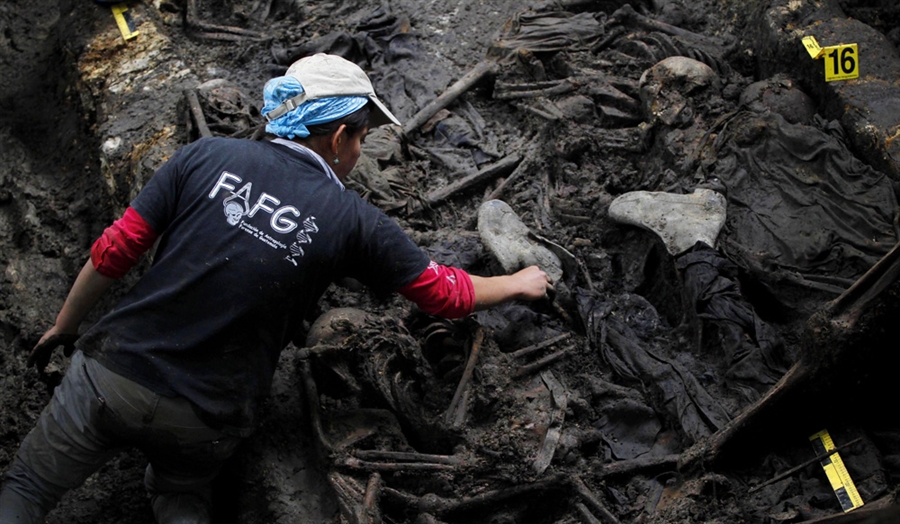
Operation Success in Guatemala. According to Carlos Figueroa Ibarra, the US operation was the “principle cause” of the overthrow of the Arbenz government47 – not a communist government but in the words of Ambassador “Pistol-packing” Jack Puerifoy, who had worked closely with the CIA, “if the president is not a communist, he will certainly do until one comes along.”48 What followed was a 35 year “dirty war”. As I have already pointed out the “dirty war” designation is a myth, often used as a cover for genocide. Although there were guerillas in Guatemala the findings of two truth commissions make it clear that this was a case of “government repression and terror rather than guerilla warfare.”49 The UN estimates that over 200,000 were killed. 93% of tortures, disappearances and executions were committed by government forces; 3% by guerilla’s and 4% described as “private”. “In a majority of the massacres committed by the state, especially by the army, the counterinsurgency strategy led to multiple acts of savagery such as the killing of defenceless children, often by beating them against walls…; impaling the victims; amputating their limbs; burning them alive; extracting their viscera while still alive and in the presence of others… and opening the wombs of pregnant women.” A favoured way of torturing to death was to stab someone then throw them into a pit where they would be burnt to death.50 As Adam Jones notes: “Finally, the Commission’s report took the important step of labeling the Guatemalan government’s campaign as genocidal. All Maya had been designated as supporters of communism and terrorism, the report noted, leading to ‘aggressive, racist and extremely cruel . . . violations that resulted in the massive extermination of defenseless Mayan communities.’”51
In 1963 when the President, General Manuel Ydigoras Fuentes who was nearing the end of a 6 year term, allowed the return of a popular reformist exile, who the US felt likely to become the next president, the US instigated a coup to bring Colonel Enrique Peralta Azurdia to power. Peralta inaugurated his presidency by having eight political and union leaders murdered by means of driving over them in rock-laden trucks.52 By this time Guatemala was experiencing protest action in cities and a small guerilla movement in the country, incorporating remnants of a nationalist military uprising crushed in 1960, largely by the CIA’s aerial bombardment.53 The US pushed for a military response.54 From 1960 military assistance began a steady climb, peaking in 1963 at the time of the coup but continued at a high level thereafter.55 In 1966 the US began taking more of an active role.56 From this point, and through the seventies, death squads increased in number, coinciding with an increase in US personnel – reaching 1000 Green Berets in addition to advisors,57 in a country with an army of only 5000.58 The Green Berets gave instruction on “interrogation”, while US pilots dropped napalm on those unfortunate enough to be in a ‘zona libre’ – a free-fire zone.59
The “war” was conducted primarily against noncombatants, involving mainly massacres of Mayans and “forced disappearances” or tortures and executions of those considered politically suspect. This is true to such an extent that none of the accounts I have read of the “war” actually mentions combat or the deaths of guerillas.60 The initial guerilla movement was “all but wiped-out” by 1968,61 but a stronger movement arose in 1970s.62 As with Argentina’s “dirty war” the guerillas became the rationale for a war against the civilian population.63 The atrocities, in turn, must surely have fuelled the insurgency. As Greg Grandin remarks, “Guatemala was one of the first Latin American countries to develop both a socialist insurgency and an anticommunist counterinsurgency. Practices the United States rehearsed in Guatemala would be applied throughout Latin America in the coming decades.”64
Guatemala went through the transition to “façade democracy” of the kind that was to become notorious under the regime of José Napoléon Duarte in El Salvador, and might equally be equated to Nuri al-Maliki’s sectarian terror state in Iraq. As Julio Godoy wrote in The Nation in 1990: “In Guatemala and El Salvador the electoral alternative that emerged during the 1980s as a response to the 1979 Sandinista triumph in Nicaragua, and to the guerilla warfare at home, is hypocritical and empty of democratic content. Under the electoral façade – the civilian regimes in Guatemala and El Salvador are just a public relations game, aimed at the international community – almighty armies rule these countries, with a discretionary degree of public presence.”65 In Guatemala this transition saw “a passing from the open terror that distinguished old dictatorships to the clandestine terror that was the most popular resource amongst the military dictatorship.”66 “Clandestine terror” and military dictatorship disguised in “façade democracy” was far bloodier than “open terror” with the greatest single period of genocidal mass murder occurring in the early 1980s. As Jones relates: “In just six years, some 440 Indian villages were obliterated and some 200,000 Indians massacred, often after torture, in scenes fully comparable to the early phase of Spanish colonization half a millennium earlier. The genocide proceeded with the enthusiastic support of the Reagan administration in the US, which reinstated aid to the Guatemalan military and security forces when it took power in 1981.”67
On the surface events in Iran and Guatemala suggest that US neocolonialism follows a materialist pattern, with events being driven by the profit motive. In Iran events were triggered by a threat to the extremely lucrative agreement between Iran and the Anglo-Iranian Oil Corporation. In 1950 “the AIOC earned some £200 million profit from its Iranian operations, but only paid the Iranian government £16 million in royalties, profit share and taxes. … In fact, the British government, a Labour government, was receiving substantially more in taxes from the AIOC’s Iranian operations than the Iranian government itself. And this was a company in which the British government held a 51 percent interest. The injustice was compounded by the fact that Iranian oil cost more in Iran than it did in Britain with the Royal Navy in particular, receiving substantial discounts. The Iranians could buy oil from the Soviet Union at a cheaper price than they could buy it from the AIOC.”68 Popular opposition to the renewal of the agreements set in train events which ended with the nationalisation of Iran’s oil industry.69 In response the UK enlisted US co-operation in a very comprehensive and meticulous plan for destabilisation and overthrow of the Iranian government, beginning with two years of very severe economic warfare which dragged Iran to the edge of a precipice.70 Planning began in Nicosia, involving both the CIA and the Security Intelligence Service (SIS, also known as MI6)71 but was finalised by the SIS.72 The CIA’s involvement was in direct contravention of US policy, which supported Mossadeq, and Frank Wisner, head of covert operations, commented that at times the “CIA makes policy by default.”73
The “London Draft” of “Operation Ajax” clearly drew on more than a century of British experience in informal imperialist manipulation. It must have been quite an education for the CIA as it became the standard model for many future overthrow operations. The irony is that almost none of it went according to plan. The propaganda and economic warfare programmes were very successful but all of the clever manoeuvres planned for the actual coup fell flat.74 The US succeeded in the end by throwing money at the problem, hiring goons to riot,75 attack Tudeh (communist) gatherings,76 and even to conduct false-flag riots disguised as Tudeh.77 The US bribed Mullahs78 and used a combination of threats and bribery on officials.79 The US had learnt from the British, but had invented their own style of using massive injections of cash and profligate violence which was not clandestine, but was loosely deniable.
Though not intended for public consumption,80 the draft Ajax plan typified the duplicity and Orwellianism of Cold War documents. It opened: “The policy of both the U.S. and UK governments requires replacement of Mossadeq as the alternative to certain economic collapse in Iran and the eventual loss of the area to the Soviet orbit. Only through a planned and controlled replacement can the integrity and independence of the country be ensured.”81 Of course, the circumstances which were cited as justification were entirely and deliberately the result of the British led economic warfare programme, but, in case the point had been missed, it continued later: “Both governments consider the oil issue of secondary importance at this time, since the major is the resolve for both governments to maintain the independence of Iran.”82
In Guatemala the profit motive is even further to the fore. As mentioned, Walter Bedell Smith and Allen Dulles, planners of both Iran and Guatemala coups, had links to the United Fruit Company (UFC). The reformist Arbenz government expropriated uncultivated UFC land for the purposes of land reform and paid only the $525,000 at which the UFC had valued the land for tax purposes. The UFC wanted $16 million.83 In the final analysis, however, maintaining a situation of economic dependence is not only a means by which surpluses can be extracted to the benefit of commercial interests, the neglected fact is that it is also a mode of domination, and the ongoing decades of US intervention in Guatemala cannot be explained by an immediate concern for the profits of the UFC, no matter how well connected. The overthrow of the Arbenz government ended reformist, redistributive and developmentalist programmes.84 The cost of the ensuing “war”, in both the destruction of property and the diversion of economic resources, was estimated to have reached 121 percent of gross domestic product by 1990.85 The burden of this fell on the poor, and more particularly on the Mayan majority, ensuring the continuance of the crushing genocidal poverty alluded to by Eduardo Galeano:
The slaughter that is greater but more hidden – the daily genocide of poverty – also continues. In 1968 another expelled priest, Father Blase Bonpane, reported on this sick society in the Washington Post: “Of the 70,000 people who die each year in Guatemala, 30,000 are children. The infant mortality rate in Guatemala is forty times higher than in the United States”.86
The inevitable stratification leads to a situation where the interests of landowning oligarchs, like those of the military, are tied firmly to those of the imperial power, not those of Guatemala. Likewise, a corrupt comprador class, not necessarily separate from the military and landowners, receives the benefit of US “aid” by acting as local intermediaries.87
Thus one can see that there truly was an elegance to the militarised imperial system invented by the US. Client leaders needed the military aid furnished to them in order to suppress populations made restive by the very economic policies forced on them by the US. They were not only economic dependencies, but military dependencies, not dependent to guard against foreign aggression but to guard against their own people. At the same time, in Hobsonian fashion, the military aid involved funnelled public monies from the US (taken as tax from the citizenry) into the hands of military industrialists who constituted a strategic asset. When things weren’t going the right way, as with Guatemala, the produce of the military-industrial complex would be brought to bear in order to inflict genocide and thus weaken the nation-state sufficiently to impose or re-impose dependence. In less drastic cases, the US might use other strategic capabilities, particularly covert and financial, which while not perhaps constituting genocide per se are certainly undertaken in the spirit of genocide.
Moreover, the Korean War was not merely crucial in creating the military and ideological institutions of imperial dominance, it was more specifically crucial in constituting one of the Grand Areas centred on a reconstructed industrially powerful Japan.88 Essentially they recreated exactly Japan’s imperial East Asian Co- Prosperity Sphere after having sacrificed so much to destroy it, but this time it was a securely subordinated dependency of the US.
As I have already detailed, however, perpetual weakness can only be imposed on those who were already weak, and those who have access to independent power, such as the Shah, cannot be relied on to remain faithful. Korea already had sophisticated industry and infrastructure and an educated population. Since the former were owned by Japan, nationalisation would be cost-free and was nigh inevitable. As Harry Truman’s friend Edwin Pauley, would report to him in 1946:
“Communism in Korea could get off to a better start than practically anywhere else in the world. The Japanese owned the railroads, all of the public utilities including power and light, as well as all of the major industries and natural resources.
Therefore, if these are suddenly found to be owned by The People s Committee (The Communist Party). They will have acquired them without any struggle of any kind or any work in developing them. This is one of the reasons why the U.S should not waive its title or claim to Japanese external assets located in Korea until a democratic (capitalistic) form of Government is assured.”89
Being dominated by nationalist sentiment Korea made a poor candidate as a dependency of the West or even, as has been discussed, of the USSR. Further, with the political landscape being dominated by those on the left who had most effectively resisted the Japanese, the chances of a unified Korean regime arising
which would go along with privatisation, foreign ownership of industry, and
liberalisation were about nil. Added to this was the situation in China, where the
sustainability of the feckless, corrupt, fascistic Guomindang (GMD) must surely
have been doubted by some in US policy circles.
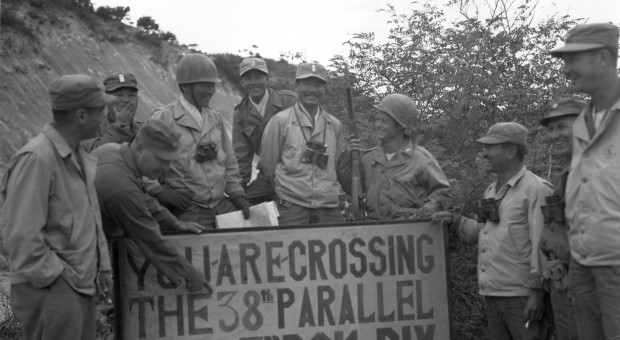
The US occupation of South Korea began ominously. Famously the soon to be commander of the US occupation, General Hodge, was widely, if inaccurately, reported as referring to the Koreans as “the same breed of cat as the Japanese.”90
Ironically Hodge actually opined that Koreans viewed collaborator police as the “same breed of cat” as Japanese police,91 but the apocryphal version would, as it turned out, be far more truly reflective of Hodge’s future actions than his actual words. Despite a State Department determination that Korea was a “pacific” victim of Japan’s imperialism,92 Hodge, reflecting other opinions in Washington, declared prior to the arrival of US occupation forces that Korea was “an enemy of the United States . . . subject to the provisions and the terms of the surrender”.93 The US acted to maintain the Japanese occupation of Korea, not disarming the Japanese and thrice advancing the arrival of US forces at the behest of the Japanese in Korea.94
When Hodge announced the retention of the Japanese regime soon after arriving on September 8, the uproar was so great that General MacArthur in Tokyo intervened to replace the Japanese Governor-General95 and Chief of Police with US personnel after Japanese MPs shot dead two Korean protesters on September 10.96
In August, before US forces arrived, many People’s Committees sprang up in the south.97 This led to the declaration in Seoul of a Korean People’s Republic on September 6 distinct from that declared in the north.98 This KPR was left-wing in orientation but did include centrist and right-wing leaders and had a broad popular base,99 though many conservatives refused invitations to join.100 The key figure of this movement was Yo Un-hyong whose “political views were a mixture of Christianity, Wilsonian democracy, and socialism.” He was popular with Koreans and many from the US.101 Other founder members of People’s Committees included Kim Dae Jung, the distinctly non-Communist Catholic who would later become ROK president (his participation in a People’s Committee being one of the grounds under which he was condemned to death by the military government in 1980).102 Hodge, however, refused to recognise or deal with the southern KPR.103 In December of 1945 he declared war of the People’s Committees and on communism, in which category he included “leftists, anticolonial resistors, populists and advocates of land reform….”104
It should be remembered that years of Japanese rule had exacerbated the already stark inequality of Korean society, the rural masses of the south, their plight greatly worsened by war, were in 1945 in not merely a miserable state, but a desperate one.105 The only people who opposed land reform and the redistribution of Japanese property were a very narrow group mainly consisting of wealthycollaborators who feared that the taking of Japanese property would lead to further redistribution, and poorer collaborators such as those who had served in the police forces.106 A report to Washington from September 15, 1945 reads:
The most encouraging single factor in the political situation is the presence in Seoul of several hundred conservatives among the older and better educated Koreans. Although many of them have served the Japanese, that stigma ought eventually to disappear. Such persons favor the return of the Provisional Government and although they may not constitute a majority they are probably the largest single group.
But, as Cumings points out, they were very clearly intervening on behalf of the smallest group, not the largest.107
Syngman Rhee was picked as presumptive leader of South Korea by some in the US, and flown in on MacArthur’s personal aeroplane on October 16. This was done against US State Department objections.108 Rhee in many respects can be seen as a model of the sort of “nationalist” leader that the US would later install in Viet Nam and Afghanistan and would attempt to install in Iraq. One can compile a list of remarkably similar characteristics that could, with little alteration, be applied to Ahmed Chalabi, Ngo Dinh Diem or Hamid Karzai:

1) US residency – Rhee had lived most of his long life in exile, primarily (nearly 40 years) in the US. He was educated in the US. In fact, October 1945 was the first time he had set foot in Korea for 26 years.109
2) Intelligence ties – Rhee was transported to Korea by the Office of Strategic Services (OSS) who wished to pre-empt the return of other exile leaders and to circumvent the State Department.110 He was accompanied by an “advisor” named M. Preston Goodfellow, a former newspaper owner and editor who had been deputy director of the OSS.111 Goodfellow was retained on active service as an adviser to Rhee.112
3) Limited political base – Rhee had headed the exile Korean Provisional Government from 1919 until 1925 when he was impeached and expelled from the KPG for embezzling funds.113 From then on he “haunted and irritated Foggy Bottom”,114 alienating the State Department by falsely claiming leadership of the ineffectual KPG.115 Some (for example Carter Malkasian)116 claim that somehow Rhee’s WWII era anti-Japanese rhetoric made him popular in Korea. Somewhat more realistically Stueck writes: “Despite his absence in the United States, he was widely known in Korea and highly respected, in part because of his advanced age… which in Korea’s patriarchal society was considered a source of wisdom.”117 What this meant, though, was that he was suitable as a figurehead not as a leader, so much so that even the left-wing dominated KPR named him as Chairman without his knowledge.118 He was also that thing most beloved of all empires for thousands of years – part of a distinct minority. He was a Christian, a Protestant even, and, as in Viet Nam, Christians were more inclined than others to adopt the anti-Communist cause as evidenced by the flight south of Christians in both countries.
4) Nationalist veneer – I use the word veneer in part because there are some who see Rhee’s entire career as a power and money grab.119 Indeed, there is not one thing that I know of that Rhee did which could not be interpreted as being about the advancement and enrichment of Syngman Rhee. Remember that his vocal anti-Japanese stance first gained him power (and access to funds) in the KPG and then was part of his incessant attempts to establish his non-existent leadership in US eyes. His subsequent anti-Communist stance was equally the only way of maintaining the US support which was his only real source of power. It is true that as a young man he was a political prisoner, but unfortunately for those who would use this to establish his antiimperialist credentials, it was the Korean Yi dynasty which locked him up. As mentioned, corrupt individuals are also beloved of US imperialists and corruption militates against nationalism. Rhee had a style of corporatist clientalist corruption akin to the “crony capitalism” of Ferdinand Marcos. By 1960 his government’s corruption (coinciding with election rigging) had “reached unbearable levels” and protest was so widespread that he was forced to resign.120
5) Brutal authoritarianism – This has already been discussed as a propensity, like corruption, in the US empire’s choice of clients. Rhee’s regime and successor dictatorships were highly repressive. Rhee himself presided over the killing of far more of his own people than the brutal regime of the DPRK, did (as will be discussed in Part 4 of this post). Cumings avers that:
“American policy, of course, never set out to create one of the worst police states in Asia.”121 This is a bold but completely baseless assertion. Naturally there are unlikely to be any documents in which officials put forward the suggestion or imperative to create a brutal police state, but if this was a matter of policy then one would hardly expect to find such a document anyway. The available evidence is that the US cleaved to him when his record of political violence was amply clear and that there is an established pattern of preference for repressive rulers. This applies to the military dictators who would later rule Korea, under whom the CIA created Korean CIA (KCIA) became a watchword for torture and murder by the early 1970s.122
6) Disapprobation of US analysts – As mentioned the US State Department had little love for Rhee. This puzzling commonality is part of a broader trend – that of actual policy being in direct opposition to the recommendations of top analysts. I have discussed this trend or tendency in considerable detail with relation to Indochina. Rhee was also an early example of a client opposed by CIA analysts. As early as March 1948 a CIA report read: “The Korean leadership is provided by that numerically small class which virtually monopolizes the native wealth and education of the country… Since this class could not have acquired and maintained its favored position under Japanese rule without a certain minimum of collaboration, it has experienced difficulty in finding acceptable candidates for political office and has been forced to support imported expatiate politicians such as Syngman Rhee and Kim Ku. These, while they have no pro-Japanese taint, are essentially demagogues bent on autocratic rule.” It was noted that the unpopular regime was “ruthlessly brutal”, made up of “extreme rightists” who retained “substantially the old Japanese machinery” which effected “a high degree of control over virtually all phases of the life of the people.”123 This seeming incoherence of contradictory views can actually be interpreted as evidence of the strength of coherence in imperial policies which continue in a systematic fashion with very little reference to the stated policies of those who theoretically should be shaping actual policy, as will hopefully become ever more obvious in the reading of this work.
Thus, early in the occupation the US had thrown it’s weight behind a small grouping of collaborator oligarchs to which they had added Syngman Rhee and the KPG. What this grouping had going for it was control of the police forces and of gangs of murderous fascist-style street gangs – the most notorious of whom were made up of exiles from the north. Opposing them were the southern Communist Pak Honyong and the aforementioned Yo Un-hyong.124 The latter had plenty of charisma and political appeal, but neither youth gangs or police support “both essentials for leadership in the increasingly violent climate of South Korean politics.”125 Those who weren’t of the right-wing also had to contend with repression by the US occupation forces who soon became so unpopular that after a mere three months of occupation even Hodge reported that “[t]he word pro-American is being added to pro-Jap, national traitor and collaborator.”126 Cumings explains that “[t]he American occupation chose to bolster the status quo and resist a thorough reform of colonial legacies, it immediately ran into monumental opposition from the mass Of South Koreans. Most of the first year of the occupation, 1945-46, was given over to suppression of many people’s committees that had emerged in the provinces. This provoked a massive rebellion that spread over four provinces in the fall of 1946….”127 The US response was brutal, and involved the first of a 7 year long “series of massacres” that would take hundreds of thousands of lives.128
The right-wing, however, was seriously split, particularly between Rhee and KPG leader Kim Ku.129 After a 1946 election which extended only a very limited franchise to male property owners and in which “[p]artisan police activity ensured that Rhee’s forces would win a sizable majority…”,130 Rhee’s faction took control of an “Interim Legislative Assembly”. Rhee and Kim Ku, however, were still at each other’s throats. Each aimed to establish themselves as autocrat and in 1947 the CIA warned that the authoritarianism of the right-wing would drive moderates into the left-wing camp, which it duly did.131
A further election in May 1948 was opposed by leftists, centrists and many on the right because it was a clear step towards the permanent division of Korea.
According to Stueck: “Ultimately, their failure to participate, together with the highly partisan activities of police and youth groups, enabled Rhee and his allies to win handily.”132 600 people were killed in the months leading up to the election and once more major and bloody guerilla revolts broke out.
On the island of Cheju (Jeju), completely cut off from any DPRK involvement, rebellion occurred in response to the violent repression of a political demonstration in March of 1948.133 The response which involved US personnel, ROKA, and rightwing paramilitaries brought over from the mainland, was one of incredible brutality.
Cheju had a population of 300,000134 and at the peak of the rebellion had only 30,000 “guerillas”.135 In fact the armed core of real “guerillas” who had firearms numbered only 500136 the rest were peasants armed with farm implements and sharpened bamboo resisting the widespread destruction of villages (20,000 homes were destroyed)137 and the murders and massacres of those individuals or communities deemed to be supporters of the rebellion.138 The normal enumeration of civilian deaths on Cheju is given as “more than 30,000”. 33,000 was the amount admitted to by the ROK news agency itself.139 Estimates of 100,000 deaths are not unknown, however, and a recent study suggests 80,000 deaths, more than one quarter of the population.140

In Yosu ROKA troops who refused to deploy to Cheju formed the basis of another rebellion, again brutally suppressed with US involvement and supervision:141 “This unorganized rebellion of the ROK army’s Fourteenth Regiment in Yosu was soon suppressed under the direction of the KMAG, but the operation was also accompanied by widespread violence by rightists against innocent civilians, as was the case in Cheju.”142 The rebels executed hundreds of police, officials and landlords, but even after the rebellion was quelled rightist revenge was brutal. A US source reported that “loyal troops were shooting people who they had the slightest suspicion… of giving cooperation to the communist uprising.”143
About 1000 Yosu rebels fled to the mountains and formed the nucleus of a more organised guerilla movement. A CIA estimate put guerilla numbers at 3500-6000 in early 1949, but many were armed only with clubs and bamboo spears.144 Those small arms that were used seemed entirely of Japanese or US origin with no Soviet weapons ever being captured.145 The methods of repression remained similar under the continued leadership of James Hausman, who styled himself “father of the Korean Army”.146 The US had made it clear to Rhee through Goodfellow that continued US support was contingent on brutal repression of guerilla activity.147
Ostensibly US occupation forces left in June 1949, but there was a continuity of “advisers” who were “constantly shadowing their Korean counterparts and urging them to greater efforts.”148 The guerilla movement was effectively crushed by early 1950, but with links now established to the DPRK, US analysts believed there was a likelihood of further “subversion”.149 Moreover even without communist activity there was no long-term consolidation of even the ROK as a state and of the division of Korea, let alone of the Rhee regime which remained as unpopular as ever. Rhee ran the country with a fairly isolated clique, his “kitchen cabinet” being made up primarily of people from the US and Koreans who had, like him, spent lengthy times as residents of the US.150 On 30 May 1950, less than a month before what is conventionally termed the outbreak of the Korean War, a comparatively “free” election proved utterly disastrous for Rhee. By this stage his regime was already in what Cumings describes as “total disarray”151 and the election resulted in only 49 seats out of 210 for the coalition which supported Rhee.152 Indeed, despite restricted suffrage favouring the more wealthy only 31 of 210 incumbents were returned. 126 independents were elected and Rhee’s own KNP only had 24 candidates of 154 elected.153 The National Assembly was now dominated by moderates, many associated with Yo Un-hyong.154 (Yo had been assassinated in 1947 having become known as “the most shot at man in South Korea”155 and having been refused, despite multiple requests, any protection by the US authorities.156)
During the period from World War II to 1950 major US actions had consistently worked to create a lasting division of Korea. For example, when in 1947 a “Joint Commission” was reconvened to consult with Korean groups over “unification” (a word whose very usage implies that there were two distinct Koreas), the US submitted a list of groups which must be consulted which included at least one entirely fictional union of 1 million members and whose total membership was calculated at about 70 million, 8 times the population of South Korea.157 The USSR, whose strategic interests coincided to a degree, certainly seemed more supportive of moves towards unification. This may, however, have been mostly a matter of empty gestures required in order assuage their somewhat independent clients. It was the continued Soviet insistence that no party who did not agree to a period of trusteeship could be consulted by the aforementioned Joint Commission which combined with the actions of the US and its clients to create an unbreakable impasse.158 It was also the Soviet Union which took one of the most fateful steps of all. When cholera broke out in the US zone in 1946 the Soviets blocked the shipment of desperately needed chlorine south.159 This was the groundwork for the economic separation of two fundamentally interdependent parts of a single country.
This was more profound, certainly, than the political division which would hardly have been sustainable if economic intercourse remained. It left a North Korea/DPRK with only 14% arable land and a relatively dense population which has not been able to reliably supply its own people with food.160 It left the agricultural South Korea/ROK stuck in a state of “underdevelopment”, medieval land tenure conditions, and considerable grave poverty which a contemporary journalist described as “primitive misery… squalor and poverty and degradation.”161
1 Ismael Hossein-zadeh, The Political Economy of US Militarism, New York: Palgrave MacMillan, 2006, pp 45-6.
2 Reinhard Drifte, “Japan’s Involvement in the Korean War”, in James Cotton and Ian Neary (eds), The Korean War in History, Manchester: Manchester University Press, 1989, pp 120-134.
3 The Council on Foreign Relations, quoted in Chomsky, Hegemony or Survival, p 15.
4 Hossein-zadeh, The Political Economy of US Militarism, pp 44-5.
5 Ibid, pp 45-6.
6 Ibid, pp 77-8, quote from D. F. Fleming, The Cold War and Its Origins ,New York: Double Day, 1961, p 1060.
7 Steven L. Spiegel and Fred L. Wehling, World Politics in a New Era (2nd ed.), Fort Worth: Harcourt Brace, 1999, pp
136, 143.
8 Efstathios T. Fakiolas, ‘Kennan’s long telegram and NSC-68: a comparative theoretical analysis.’ East European Quarterly, Vol. 31, No.4 (Jan 1998), p 420.
9 Ibid.
10 Quoted in Noam Chomsky, World Orders Old and New. New York: Columbia University Press, 1994, p 27.
11 Noam Chomsky, ‘The Old and the New Cold War’ (1980) in Noam Chomsky, The Chomsky Reader. New York:
Pantheon, 1987, p 211.
12 Moyar, Triumph Forsaken, p 426 n 53.
13 Brian Bogart, ‘America Programmed for War’, Zmag, 25 September 2005. Retrieved 29 December 2005 from http://www.zmag.org/content/showarticle.cfm?ItemID=8819. Note that Bogart cites as his source Uncertain Partners: Stalin, Mao and the Korean War, by Sergei N. Goncharov, Lewis, and Xue Litai which is generally taken as indicating the opposite conclusion. This issue will be examined further.
14 Nitze, “NSC 68: United States Objectives and Programs for National Security”.
15 Fakiolas, “Kennan’s long telegram and NSC-68”, pp 421-3.
16 Robert L. Hutchings, ‘X + 9/11: everything I needed to know about fighting terrorism I learned from George F. Kennan’, Foreign Policy, 143 (July-August 2004), p 70.
17 Stuart Bruchey, “Some Deeper Currents in the Recent Past”, in John F. Walker and Harold G. Vatter (eds), The History of the U.S. economy since World War II, New York: M. E. Sharpe, 1996, p 33.
18 Michael Hudson, Super Imperialism: The Economic Strategy of American Empire (2nd ed.), London: Pluto Press,
2003, p 23.
19 Ibid., p 16.
20 Franklin D. Roosevelt and Winston S. Churchill, The Atlantic Charter, 14 August 1941. Retrieved 8 January 2010
from http://avalon.law.yale.edu/wwii/atlantic.asp.
21 The Bretton Woods Agreements, 31 July 1945, Article V, Section 3; Article XI, Section 3; Article XX, Section 4. Retrieved 10 January 2010 from http://avalon.law.yale.edu/20th_century/decad047.asp.
22 Klein, The Shock Doctrine, p 163.
23 Chomsky, Hegemony or Survival, pp 29-30.
24 Cumings, The Korean War, pp 211-4 et passim.
25 ‘Our real task in the coming period is to devise a pattern of relationships which will permit us to maintain a position
of disparity… We should cease to talk about vague and… unreal objectives such as human rights, the raising of
living standards, and democratization.’ ‘Policy Planning Study 23’, 1948. Quoted in Noam Chomsky, What Uncle Sam Really Wants, Berkeley: Odonian Press, 1992, pp 9-10.
26 Hudson, Super Imperialism, p 32.
27 Ha Joon Chang, “Kicking away the ladder: globalisation and economic development in historical perspective”, in Jonathan Michie (ed.) The Handbook of Globalisation, Cheltenham and Northampton, MA: Edward Elgar, 2003, p 388.
28 Hudson, Super Imperialism, pp 24-5.
29 A Spanish term for large landowners.
30 Galeano, The Open Veins of Latin America, p 60.
31 James W. Loewen, Lies My Teacher Told Me: Everything Your American History Textbook Got Wrong, New York: The New Press, 1994, p 14;
32 Blum, Killing Hope, p 158.
33 Gareau, State Terrorism and the United States, p 169.
34 Ibid, p 166.
35 Blum, Killing Hope, pp 306-8.
36 Saul Landau, “Bolivia’s Election Deserves a History Lesson,” Progreso Weekly, 15-21 December 2005. Retrieved 8 January 2006 from http://www.progresoweekly.com/index.php?progreso=Landau&otherweek=1134626400.
37 The essence of a war system is that no decision should be reached.
38 Tim Weiner, Legacy of Ashes: The History of the CIA, London: Penguin, 2007, p 105.
39 Ibid.
40 Blum, Killing Hope, p 72.
41 Roger Morris, “The Undertaker’s Tally (Part 1): Sharp Elbows,” TomDispatch, 1 February 2007. Retrieved 2 February 2007 from http://www.tomdispatch.com/index.mhtml?pid=165669.
42 Gareau, State Terrorism and the United States, p 173.
43 Blum, Killing Hope, p 72.
44 Nafeez Mosaddeq Ahmed, Behind the War on Terror: Western Secret Strategy and the Struggle for Iraq, Gabriola Island, BC: New Society, 2003, pp 38-9.
45 Ahmed, Behind the War on Terror, pp 43-5.
46 Ibid, p 45.
47 Carlos Figueroa Ibarra, “The culture of terror and Cold War in Guatemala,” Journal of Genocide Research (2006), 8(2), June, p 192.
48 Tim Weiner, Legacy of Ashes, p 107.
49 Frederick H. Gareau, State Terrorism and the United States: From Counterinsurgency to the War on Terror, Atlanta and London: Clarity Press and Zed Books, 2004, p 45.
50 Ibid, pp 45-7.
51 Jones, Genocide, p 77.
52 Blum, Killing Hope, p 231.
53 Ibid, p 148.
54 Ibid, p 230.
55 Ibarra, “The culture of terror and Cold War in Guatemala”, p 199.
56 Blum, Killing Hope, p 232.
57 Ibarra, “The culture of terror and Cold War in Guatemala”, p 201.
58 Blum, Killing Hope, p 232.
59 Ibid, p 233.
60 Admittedly this is due to their focus on genocide or human rights abuses, but it is indicative of how, as with the Argentine “dirty war” actual combat was a secondary consideration.
61 Blum, Killing Hope, p 235. According to Blum this was the indirect result of the terrorism directed against the rural
population.
62 Jones, Genocide, p 77.
63 See https://ongenocide.wordpress.com/2013/03/19/the-guardians-death-squad-documentary-may-shock-and-disturb-but-the-truth-is-far-worse/
64 Greg Grandin, “History, Motive, Law, Intent: Combining Historical and Legal Methods in Understanding Guatemala’s 1981–1983 Genocide,” in Robert Gellately and Ben Kiernan (eds), The Specter of Genocide: Mass Murder in Historical Perspective, Cambridge: Cambridge University Press, p 339.
65 Julio Godoy, “Return to Guatemala: Unlike East Europe Fear Without Hope,” The Nation, 5 March 1990, p 310.
66 Ibarra, “The culture of terror and Cold War in Guatemala,”, p 201.
67 Jones, Genocide, p 77.
68 Newsinger, The Blood Never Dried, p 165.
69 Roger Owen, State, Power and Politics in the Making of the Middle East (3rd ed.), London: Routledge, 2004, p 80.
70 Engdahl, A Century of War, p 111.
71 Donald Wilber, CIA Clandestine Service History, “Overthrow of Premier Mossadeq of Iran, November 1952-August
1953,”, 1954, p 5. Retrieved 16 April 2010 from http://www.gwu.edu/~nsarchiv/NSAEBB/NSAEBB28/2-Orig.pdf.
72 Ibid, p 9.
73 Tim Weiner, Legacy of Ashes, p 95.
74 Ibid, p 99.
75 Ibid, p 103.
76 Ibid, p 95.
77 Ibid, p 102.
78 Ibid, p 95.
79 Ibid, passim.
80 It was not available to the public until 2000.
81 London Draft of the TPAJAX Operational Plan, 1953, p 1. Retrieved 16 April 2010 from
http://www.gwu.edu/~nsarchiv/NSAEBB/NSAEBB28/appendix%20B.pdf.
82 Ibid, p 5.
83 Blum, Killing Hope, p 75.
84 Gareau, State Terrorism and the United States, p 43.
85 Ibid, p 47.
86 Galeano, The Open Veins of Latin America, p 113.
87 Godoy, “Return to Guatemala”, p 309.
88 Doug Stokes, “Why the end of the Cold War doesn’t matter: the US war of terror in Colombia” Review of International Studies (2003), 29, p 585.
89 FRUS (1946). Vol. 8, pp. 706-9, quoted in Cumings, Korea’s Place in the Sun, p 199.
90 William Stueck and Boram Yi, “’An Alliance Forged in Blood’: The American Occupation of Korea, the Korean War, and the US-South Korean Alliance”, Journal of Strategic Studies, 33:2 (2010), p 184.
91 FRUS, 1945, Volume 6, p 1135.
92 Cumings, The Korean War, p 104.
93 Stueck and Yi, “’An Alliance Forged in Blood’”, p 183.
94 Cumings, Korea’s Place in the Sun, p 189.
95 Stueck and Yi, “’An Alliance Forged in Blood’”, p 186.
96 William Stueck, The Korean War:An International History, Princeton: Princeton University Press, 1995, p 20.
97 Cumings, The Korean War, p 106.
98 Ibid, p 108.
99 Stueck, The Korean War, p 20.
100Stueck and Yi, “’An Alliance Forged in Blood’”, p 181.
101Cumings, Korea’s Place in the Sun, p 191.
102Cumings, The Korean War, p 114.
103Stueck, The Korean War, p 20.
104Cumings, The Korean War, p 110.
105Jeon and Kim, “Land Reform, Income Redistribution and Agricultural Production in Korea”, pp 255-7.
106Stueck and Yi, “’An Alliance Forged in Blood’”, p 181.
107Cumings, Korea’s Place in the Sun, pp 193-4.
108Ibid, p 195.
109Ibid.
110Cumings, The Korean War, p 58.
111Ibid, p 135.
112Allan R. Millett, The War for Korea, 1945-1950: A House Burning, Lawrence: Kansas University Press, 2005, p 64.
113Stueck, The Korean War, p 15.
114Cumings, The Korean War, p 106.
115Ibid, p 58.
116Carter Malkasian, The Korean War: 1950-1953, Oxford: Osprey, 2001, p 11.
117Stueck, The Korean War, pp 20-1.
118Ibid, p 20.
119Lee Wha Rang, “Who Was Rhee Syngman?”, Kimsoft, 22 February 2000. Retrieved 5 October 2011 from http://www.hartford-hwp.com/archives/55a/186.html.
120Stephen Kotkin and András Sajó, Political Corruption in Transition: A Skeptic’s Handbook, Budapest: Central European University Press, 2002, p 171.
121Cumings, Korea’s Place in the Sun, p 209.
122Press reports began to surface in the early 1970s. The ‘revelations’ were not news to people in the ROK, but culminated in an Amnesty International report in 1975 with testimony such as: ‘I was taken to KCIA headquarters, my hands tied together and I was tied to a chair. I was not allowed to have any sleep. At night they would drag me to the basement where they would beat me with a long heavy stick, and jump on me. By morning I would not be able to walk, I would be forced to crawl back upstairs. They were trying to make me confess that I was a spy. This kind of treatment went on for several days, and for a time I was unable to use my legs. Even so, they continued to tie me onto a chair every day for five days. Of course my legs were terribly swollen. Finally I put my thumbprint on the confession they had prepared. At my trial I denied what I had confessed under torture. On cloudy days now I have a lot of pain in my body.’ (Amnesty International, Report of an Amnesty International Mission to the Republic of Korea: 27 March – 9 April 1975 (2nd Printing), London: Amnesty International Publications, 1977, p 37.) It should be understood that the exposure of these practices of torture did not bring them to an end.
123Cumings, The Korean War, pp 106-8.
124Stueck, The Korean War, p 23.
125Stueck, Rethinking the Korean War, p 45.
126Cumings, Korea’s Place in the Sun, p 198.
127Ibid, p 192.
128Dong Choon Kim, “Forgotten war, forgotten massacres: the Korean War (1950-1953) as licensed mass killings,” Journal of Genocide Research (2004), 6(4), December, p 528.
129Stueck, The Korean War, p 23.
130Ibid.
131Cumings, Korea’s Place in the Sun, p 211, n. 36.
132Stueck, The Korean War, p 27.
133Halliday and Cumings, Korea, p 36.
134Cumings, The Korean War, p 121.
135Ibid, p 123.
136Kim, “Forgotten War…”, p 528.
137Halliday and Cumings, Korea, p 36.
138Kim, “Forgotten War…”, p 528.
139Halliday and Cumings, Korea, p 38.
140Cumings, The Korean War, p 121.
141Halliday and Cumings, Korea, p 41.
142Kim, “Forgotten War…”, p 528.
143Halliday and Cumings, Korea, p 40.
144Ibid, p 43.
145Ibid, p 47.
146Cumings, The Korean War, p 134.
147Ibid, pp 135-6.
148Halliday and Cumings, Korea, p 48.
149Stueck, The Korean War, p 30.
150Cumings, Korea’s Place in the Sun, p 214.
151Cumings, The Korean War, p 145.
152Gye-Dong Kim, “Who Initiated the Korean War”, in James Cotton and Ian Neary (eds), The Korean War in History, Manchester: Manchester University Press, 1989, p 40.
153Stueck, Rethinking the Korean War, p 196.
154Halliday and Cumings, Korea, p 64.
155Ibid, p 24.
156Marilyn B. Young, “Sights of an Unseen War”, review of Bruce Cumings The Origins of the Korean War. Vol. 2: The Roaring of the Cataract, Princeton: Princeton University Press, 1990, in Diplomatic History, 1 June 1993, pp
495-502.
157Lowe, The Origins of the Korean War, p 39.
158Stueck, The Korean War, p 24.
159Millett, The War for Korea, p 50.
160John Feffer, “Mother Earth’s Triple Whammy: Are We All North Koreans Now?”, Foreign Policy in Focus, 17 June
2008. Retrieved 20 June 2008 from
http://www.fpif.org/articles/mother_earths_triple_whammy_are_we_all_north_koreans_now.
161Harold R. Isaacs, No Peace in Asia, pp 7–8. Quoted in Stueck and Yi, “’An Alliance Forged in Blood’”, p 192.


Pingback: The United States of Genocide | On Genocide