In the second of two parts I discuss how contemporary fascism doesn’t announce itself; how creeping fascism has come to predominate in the West and other countries; and how once fascism becomes normal normal people become fascists. Eventually society will be one in which the only people who aren’t fascist are the conscious antifascists. Liberals and conservatives, for example, are by no means immune from being fascists.
Category Archives: Uncategorized
Ep 07: We Need to Talk About Fascism Pt 1
StandardIn the first of two parts I discuss how contemporary fascism doesn’t announce itself; how creeping fascism has come to predominate in the West and other countries; and how once fascism becomes normal normal people become fascists. Eventually society will be one in which the only people who aren’t fascist are the conscious antifascists. Liberals and conservatives, for example, are by no means immune from being fascists.
We Need to Talk About the Ceasefire: Part 2 – An Endless Nightmare of Torment
Standard
“In the Greek myth, Sisyphus, a mortal, is condemned by the gods to endlessly roll a rock up a mountain, only to have it fall back down again. Each time the rock rolls down the mountain, he pushes it up, and in the most optimistic telling of the story, he hopes that it will be the final time. This is his punishment for defying the gods and for imagining his life, his fate, equal to their own.”
Edwidge Danticat “We Are Tired but not Defeated”
In 2011 Edwidge Danticat made a comparison between Haiti and Sisyphus and my immediate reaction was to wonder if Prometheus was a better analogy. Both men were punished by the gods for daring to challenge their low station as mortals, but it was Prometheus who suffered the greater agony of daily torture. It seems to me that Haiti suffers a similar excruciation and torture that never ends. Their crime was to throw off the shackles of slavery rather than allowing their masters exploit them for another half century before generously freeing them to live in a country where everything, including all necessities of survival, would be owned by their former masters (the racist violent former masters who view them as subhuman animals).
Haiti’s punishment began with France returning, decades after Haiti broke free, to demand that they pay for the privilege of being independent or face military action. It took 122 years to pay the debt, which kept Haiti in chains of underdevelopment and is estimated to have cost a total of $US115 billion in lost wealth due to the compounding effects of underinvestment. That is over $US21,000 per adult in a country that has the lowest median wealth in the world ($US207 per adult). This impoverishment, though, is never enough. Every time the people of Haiti try to raise themselves the US (with the collusion of France and Canada) has been there to drag them down, sometimes through direct military intervention. The US occupied the country from 1915 to 1934, then supported the brutal regime of the Duvaliers, and helped oust Jean-Bertrand Aristide and the subsequent suppression of Fanmi Lavalas, the only popular political faction with a potential to govern democratically to exist in decades. While US clients enforce neoliberal piracy and police brutality, they have sham elections with pitiful turnouts so they can call themselves leaders. The instability has lead to gang warlordism. While wealth is shipped offshore, and US companies profiteer by lining their pockets with aid money, the people suffer violence, poverty and disease. In 2009 the US intervened to try to keep the Haitian government from implementing a rise in the minimum wage which was 22 US cents an hour. In 2010 a US contractor dumped raw sewerage from a UN peacekeeper base causing a cholera outbreak that killed about 9000 people and has yet to be eradicated.
Once the imperial mechanisms of oppression and greed are unleashed they are tireless and merciless. There is no room for peace and justice, nor room for simple honesty. The abusers paint themselves as saviours and camouflage their brigandage as “aid”. Those Westerners who do seek to act from fairness are overwhelmed by the greedy, the racist, the fanatical, and the paranoiac. Many Western officials, oligarchs and functionaries embody all of these traits. They loathe, they covet, they despise and they fear the possibility that their victims might one day develop strength. Unions, socialism, nationalisation, independent foreign policy, control of natural resources are all anathema. As circumstances change they alter the methodology of oppression. This creates phases, and what is happening in Palestine with a ceasefire can be seen as a phase-change in an ongoing genocide.
The nature and dimensions of this next phase can best be understood through an examination of the evolution of Balkanisation, neocolonialism and structural violence in the 20th century. To really understand what happens, though, it is necessary to leave aside any notions that legal concerns or humane sentiments play a role in these actions. This is a cycle of repeated and relentless violence premised on abstract notions of weakening and controlling nations as. Very few civilian or military personnel ever lose faith because they become aware of the human cost; in fact it is far more likely that people will question the morality of causing mass death and misery if they begin to question underlying mythology of moral righteousness at the centre of their imperialist ideology. This is very alarming in light of the current chauvinistic exceptionalism in the West generally, in Israel, and in the USA most especially.
The ancient imperialist practice of divide-and-rule finds modern expression in practices such as partition, Bantustanisation, and sponsorship of separatism. The imperial and Great Power practice of fomenting and sponsoring ethnic separatism amongst enemy polities grew in the 20th century to include ideological, religious and sectarian forms of division which can be seen in US-backed colour revolutions and the sudden rise of the Islamic State. Currently the US empire has created a situation in which countries must either be “open” societies into which it can pour money and corrupt the system through overt and covert means, or they must choose to be undemocratic thus giving a pretext to the US to impose sanctions and use other covert means of destabilisation and enfeeblement.
Division and destabilisation operations are used as a form of undeclared warfare, notably being used to precede US-backed coups. TP-AJAX, the plan to overthrow the Mossadegh government in Iran, was originally a British plan taken over by the US. They started by attacking the economy, causing instability and scarcity, but above all causing fear. They fomented discontent and paid people to demonstrate, often with violence and destruction. As with roughly contemporaneous actions in Viet Nam and Guatemala they created false-flag communist terror attacks so that right-wing puppets could switch between denouncing the reformist government as themselves being crypto-communists, or as being incapable of dealing with communist insurgency. In the victim country and in the beltway halls of power, a wave of paranoiac fabulism is unleashed by imperial agents that would make a Q-anon fanatic seem like a Chomskyan realist. The terrorists are under the beds, in the wall cavities, and ready to leap out of laundry hampers. This creates a sense of panic; a sense of both a need and a license to use violence; and a sense that those who do not side with you are siding with the enemy. Variations on this playbook have continued to this day in dozens of different interventions.
The next part of the sequence is the most overt period of violence and destruction. This is the sort of shock that Naomi Klein wrote about in The Shock Doctrine. Discord and instability are sown to effect regime change and then the true violence is unleashed. For example, the destabilisation leads to a coup as above or as in 1965 Indonesia, 1973 Chile or 1993 Russia. Then, once a new regime is in place, they generally unleash mass violence and dismantle social and economic institutions (possibly facilitating mass expropriation by US, and possibly collaborator, profiteers). This pattern is not confined to coups. Regime change, in this instance, means substantively changing the way a target country works generally. Libya in 2011, for example, experienced a structural analogue in that the first shock of destabilisation created a new “regime” by creating the pretext for the second shock in terms of the violent aerial campaign launched by NATO. Equally, consistent with Klein’s depiction of the shock doctrine, you can see the same one-two punch system in the 1980 US presidential election where a radically neoliberal regime change (that arguably took hold while Carter was still in office) led to sudden “privatisation” and structural violence.
The third part is the new normal, which is likely to be a state of extreme deprivation and may involve intractable armed conflict and political fragmentation. It entails more divide-and-rule among other things. If a puppet leader has been put in place it is highly desirable that they be politically weak – divided from their own people and reliant on US support to survive. Though the US called its Cold War puppets “nationalists” (in contradistinction to the “internationalists” of the left) this was a heavy irony. The leftist enemies of US imperialism tended to be nationalist by default. Moreover US clients who developed nationalist tendencies were anathema and had to be removed if they put their own country first. In Viet Nam in 1963 and 1964 alone the US caused the overthrow of three leaders it had previously chosen, each on the basis of doing things they thought best for their country rather than doing what they were told. Similar things happened in other countries with one such incident bringing Saddam Hussein to power.
During this period many people suffer greatly, but their suffering is rendered mute and, more importantly, the hand behind it is made invisible. It took many years of activism, including difficult investigative journalism, to alert people of the mass deaths being inflicted on the people of Iraq by the US and UK. Desert Storm, the 1991 bombing campaign against Iraq, inflicted the sort of shock and degradation that created the vulnerability for later quieter forms of genocidal mass-murder. The following is an excerpt from my own previously published work:
“Desert Storm…, was as genocidal as previous bombing campaigns, the use of laser-guided weaponry and the incessant propaganda about accuracy serving only, in a sober analysis, to underscore the intentionality of the crime. The targeting of civilian infrastructure which had absolutely no bearing on the uneven military contest was the norm. For example, a baby milk factory was targeted and destroyed while the Pentagon blithely lied and said it was involved in making biological weapons. Ramsey Clark wrote afterwards that there were:
One hundred ten thousand aerial sorties in forty-two days by the United States alone. That’s one every 30 seconds. In an admission against interest, the Pentagon says U.S. aircraft alone dropped the equivalent of 7.5 Hiroshimas – 88,500 tons of explosives.
They say about 7% were directed…. They were intended specifically to destroy the life-support system of the whole country. … This is an assault you can’t resist. … The United States lost fewer aircraft in 110,000 aerial sorties than it lost in war games for NATO where no live ammunition was used. … There is not a reservoir, a pumping station, the filtration plant that wasn’t deliberately destroyed by U.S. bombing to deprive the people of water.
We knocked out the power. It doesn’t sound like a big deal. … But it meant, among other things, that 90 percent of the poultry was lost in a matter of days…. They lost over a third of all their livestock…. Another third was driven out of the country to save them. Because you couldn’t pump water.”
… From prewar levels of 450 litres per person per day in Baghdad, supplies were 30-40 litres. This was not safe to drink but while “the water authority has warned that the water must be boiled, there is little fuel to do this and what exists is diminishing.” Conditions outside of Baghdad were most probably worse in most instances. “The mission concluded that a catastrophe could be faced at any time if conditions do not change…”
Professor Thomas Nagy found declassified documents, Defense Intelligence Agency (DIA) studies, which showed that the US clearly calculated and comprehensively understood that its bombing and subsequent embargoes would cause massive civilian deaths, particularly to children. Nagy concludes:
For more than ten years, the United States has deliberately pursued a policy of destroying the water treatment system of Iraq, knowing full well the cost in Iraqi lives. The United Nations has estimated that more than 500,000 Iraqi children have died as a result of sanctions, and that 5,000 Iraqi children continue to die every month for this reason.
No one can say that the United States didn’t know what it was doing.
The figure of 500,000 dead children comes from a 1996 UN Food and Agriculture Organisation report which has been seriously criticised for its methodology. The absolute numbers were, at this time, debatable but according to first-hand accounts disease and malnutrition had reached levels which beggar belief. I could here quote John Pilger, Robert Fisk, Patrick Cockburn, Kathy Kelly, or a number of others who saw with their own eyes and documented the suffering, but I will return to Ramsey Clark:
During last week, which I spent in Iraq, my fifth annual inspection since the sanctions were imposed, I visited ten hospitals in four governates which have nearly 15 percent of all hospital beds in the country. Conditions are tragic. Lighting is dim, even in operating theaters, for lack of bulbs. Wards are cold. Pharmacies are nearly empty with only a minor fraction of needed medicines and medical supplies. Most equipment, X-ray, CAT scan, incubators, oxygen tanks, dialysis machines, tubes and parts for transfusions and intravenous feeding, and other life-saving items are lacking, scarce, or inoperable for lack of parts. Simple needs like sheets, pillows, pillowcases, towels, bandages, cotton balls, adhesive tape, antiseptic cleaning liquids are unavailable or scarce. Surgery is at levels below 10 percent of the 1989 numbers in all ten hospitals.”
By 1995 it was known that Iraq’s weapons of mass destruction had been effectively neutralised, but once the UN security council authorised the use of force in 1990 it was possible for the US and/or UK to veto any rescinding of that authorisation, so they started a cruel game of pretending that there were still WMD while undermining the inspections regime in numerous ways. The sanctions were to continue for another 8 deadly years, and if the UNFAO figure of 1 million excess deaths including 500,000 children might have been exaggerated in 1996 it should be remembered that this was less than halfway into the genocidal sanctions period.
As outcry began to grow, the sanctions were transitioned to a new “oil-for-food” programme. This was no real change. The programme was under the umbrella of the UN but was controlled by the US and UK. In 1989 the United Nations Humanitarian Coordinator in Iraq, Denis Halliday, resigned citing the sanctions and “oil-for-food” programme as “genocide”. His successor Hans van Sponeck would also resign and then write a book called “A Different Kind of War” which detailed the genocide, while avoiding the use of the term (perhaps because of the politics of a German national using the term), though he would later admit the validity of its usage.
The sanctions regime might have succumbed to international pressure if it were not for the advent of the Global War on Terror. By the time public pressure had rallied once more to end the genocidal sanctions the US was ready for the next phase of genocide – another shock campaign then a genocidal occupation, fomenting a civil war and trying to further partition the country, then arming their putative enemy, which would become the Islamic State, to inflict further chaos and suffering on the people of Iraq. The cycle is never meant to end and you can guarantee that right now there are plans in the US to enact further attacks on the nation and people of Iraq under the rationale of the “containment” of Iran.
Iraq is only an illustrative example. The same logic applies in other places, always slightly different, but always with merciless resolve. Many places that the US decides to view with interest end up in a state of permanent low-intensity conflict. Places like Somalia join Haiti in being sights of normalised dysfunction. Afghanistan was inflicted with a brutal and pointless 2 decades of war only for the US and its collaborators to hand back a much more divided and degraded country to a much more bitter and stubborn Taliban. Everywhere Africom’s “anti-terror” tentacles reached found themselves facing vastly increased terrorism and everywhere in Latin America that the War on Drugs penetrates finds themselves with more drugs and more violence. Yugoslavia, on the other hand, they simply looted then destroyed. Palestine stands out for a number of reasons, but it is not exceptional. That is why historical analogues can point us to what happens next.
During the oil-for-food programme in Iraq the stated humanitarian purpose of the system became a cruel irony. The main mechanism used to this end was the control the US and UK wielded over what was allowed in to Iraq. They would deem certain essential items to be “dual use” – meaning that they might be used for military purposes. This is self-evidently open for abuse.
In 1991 Israel started controlling the entry of goods into the Gaza Strip. This intensified after the 2005 withdrawal of Israeli settlers from the strip and then became a full-time blockade in 2007. Israel uses exactly the same “dual use” pretext as was weaponised against the people of Iraq. The most prominent basic needs that are denied as dual-use are drugs and medical equipment and construction materials. The denial of these items after assaults such as Israel has executed against the territory causes predictable suffering and predictable excess death. It is intentional pre-meditated structural violence causing death. It is a war crime and it is an act of genocide as detailed under Article II (c) of the United Nations Convention on the Prevention and Punishment of the Crime of Genocide.
The sooner we mobilise against these acts of “deliberately inflicting on the group conditions of life calculated to bring about its physical destruction”, the fewer people will die. If it is not stopped then ultimately this phase of genocide will take more lives than the Holocaust that has just ended. Ultimately, though, the genocide against all Palestinians will continue. Every day brings more news of increasing violence in The West Bank and East Jerusalem. The only end to this is a free Palestine. We can and must exert as much pressure as humanly possible to bring as much relief and safety to people in the Gaza Strip, but they will never be safe until they are have full political control and human rights. It is the need to suppress them as a people, to prevent them from exercising their autonomy and inalienable rights, that causes Israel to keep inflicting violence as if somehow this will rewrite history and erase the right of Palestinians to live freely in their recognised land of origin.
The question is how can we change things now that the newsworthy part of the genocide is over, and that is exactly why the US and Israel have done things this way. Many people know about the NATO air campaign against Libya, but regardless of their feelings on that intervention, very few people in the Western public know what has happened in the country since then. Once something drops from the top headlines of a 24-hour news cycle the number of people who know of it shrinks drastically. When people are better informed through alternative media, actively searching for information, or a social media feed based on their own predilections, they are liable to overestimate how broadly such things are known.
People are mostly opposed to Israel’s violence in Gaza, but it pays to think about the emotional affect as well. The emotive stories that have been in the headlines are the deaths on October 7 2023, the plight of Israeli hostages and their deaths or repatriations, the mass rapes on October 7, and the beheaded babies on October 7. Two of those things are completely fictional, but they provide more passionate intensity than the many actual Palestinian beheaded babies and raped Palestinian prisoners. We need to provide the greater context and since we don’t get to choose the bulletin headlines that means getting people to expand the amount of education they allow in to their unquiet and overstimulated brains.
If 25% of the population are committed anti-Palestinian and 25% are committed pro-Palestinian, then it is really the other 50% that we must concentrate on. Because of the emotional weight of the information (and, frankly, conditioning) they have received they view Hamas as barbaric savages and Israelis as being like us (though perhaps with the Israeli government being a bad right-wing government). Israel, by these lights, has every legitimate reason to attack and indeed to wipe out the intractable irrational savage murderers of Hamas. These are, after all, fanatical animals that will never accept Israel’s right to resist. But then, Israel has killed a lot of civilians and you can’t really blame everyone for what Hamas does; but then, you kind of can because they clearly support Hamas; but then, some of them are just kids; but then, Hamas is using them as human shields and Israel has no choice; but then, they seem to be taking things to excess; but then, if they don’t finish the job this may all have to happen again and that means even more dead children; and so forth ad infinitum.
Our challenge is to break through the manufactured synthetic ambivalence enthralling half of the population. One advantage that we have is that the numbers do not lie. Palestinian deaths so greatly exceed Israeli deaths that the Israeli narrative cannot withstand the weight. We must push for real estimates of total deaths caused and fight to correct those that misrepresent the body count as an “estimate” when it must clearly understate the total number of deaths. The current body count of around 46,000 Palestinians is likely to represent less than 20% of the total. We must also work to make people know that the violent deaths and the deaths through deprivation are all brutal and tragic. There is no hierarchy of suffering nor of victimhood. People’s suffering should be measured by the number affected, not some qualitative distinction that effectively makes some people less human than others.
Our efforts also have the advantage that any role-reversal will immediately reveal the double-standards involved. If we aim some of our informational effort at getting people to reflect on how they would feel if the identities of the actors were reversed this can create a permanent habit of mind. Our greatest asset, though, may be the anti-Palestinians. They have no room for adjustment. Any significant challenge will lead to outright denial and aggression because their narrative is too fragile for them to concede anything. We will win once half of the confused public starts to see the anti-Palestinian people for what they are. They have been accorded an unearned legitimacy for far too long and once people see them for what they are the media and politicians will have to adjust.
To effect these changes we must maintain our visibility and extend educational outreach. We have to keep Palestine on people’s minds and show them that the genocide continues and that Israeli aggression was not a finite response to Hamas, but rather a permanent state of affairs. Most people’s minds are part of the way there already, but we need their hearts. We need them to feel the pain of the daily humiliation and persecution and the unending insecurity. We need them to see the cruelty of the apartheid – both the callous impersonal cruelty and the personal fascistic aggression.
In short, the real job in front of us is simply to get about 25% of the population to think what it must be like to be Palestinian.
Episode 5: We Need to Talk About Professional Wrestling
StandardIn the second part of Part 2 of “We Need to Talk About That F*g Election that Just Happened” I finally get to the bit about wrestling.
World Wrestling Entertainment makes content that is a form of melodramatic theatre centred around partially improvised but largely scripted “wrestling”. Over the last few decades, though, the content occurring outside of the ring has become more complex, with ever more convoluted storylines.
WWE provided a model for and a lens with which to view modern Western electoral politics. Many of the techniques of professional wrestling have entered the world of politics.
In this episode I explore what that can mean.
Episode 3: We Need to Talk About That Fucking Election that Just Happened – Part 1
StandardIn a different approach to a postmortem of the US 2024 Presidential Election I try to avoid focusing on the campaigning choices of each party and look instead at the systemic constraints that have made US presidential elections into a spectacle – a spectacle almost devoid of actual politics. The history of US presidential politics has been dominated by public sentiments about their policies on issues of war and peace, but the electoral politics have evolved to keep such issues well away from the ballot box.
I run through the history from Woodrow Wilson deceptively running as the antiwar candidate in 1916 under the slogan “He Kept Us Out of the War”, while already intending to put the US into the War, to Lyndon Johnson running as the antiwar candidate while engineering a massive genocidal onslaught in Indochina.
In Part 2 I will explore the way in which US elections are constrained to produce only pro-empire, pro-genocide results and the way in which the system is simultaneously a means of controlling public opinion.
A Fiction of War
Standard
To continue its genocide Israel must first convince the world that it is fighting a war. It targets civilians and claims they are “human shields” who have become collateral damage. It leaves Palestinians with no choices, demanding of them the impossible, and then claims that they are choosing war. Israel simulates war to commit genocide.
The “thinking” behind Israel’s tactics of genocide in Gaza is not directly practical. In practical terms it would be easier to simply name a “final solution” of extermination and work from that basis. Yet the current modalities of genocide are crucial in creating a fiction of war, a lie that the one-sided violence of genocide is warfare in the sense characterised by Clausewitz as being “policy carried out by other means”, which is often quoted with the word “policy” replaced by “diplomacy”. In the case of Israel we can also say that diplomacy is genocide carried out by other means. Israeli diplomacy invariably aims to create the fiction of war – a sense that the violence inflicted by Israel is a form of two-sided “conflict” rather than the one-sided murder that it is.
None of this is without precedent. Genocide is always a process, not an event. Colonial genocides in particular are seen at the time as a series of asymmetric wars, each treated by the aggressor as having separate causes and aims.
The most complete sequence of colonial genocide can be seen over the centuries violent expansion by the English, then British, then USA killing and dispossessing the indigenous people of what is now the continental USA. This genocide (or these genocides) began as discrete events of massacre and warfare, becoming increasingly more asymmetric. Treaties and interregna of “peace” became means of ethnic cleansing and periods of “[d]eliberately inflicting on the group conditions of life calculated to bring about its physical destruction in whole or in part” (a punishable act of genocide as described in the UN Convention on the Prevention and Punishment of the Crime of Genocide). Through this time clearly genocidal non-warfare acts such the slaughter of bison and the promulgation of genocidal ideology were ongoing. The genocide grew in sophistication as it moved West, reaching California as a combination of bureaucratised and systematic mass-murder that would be a direct inspiration for Adolf Hitler’s genocidal policies.
When the victims are reduced to a tiny fraction of the original population with an even tinier fraction of the dominion that they once held the genocide does not end. Genocidal policies enter new phases. Some tribes are declared extinct so that survivors have no recognised identity nor historical claim against dispossession. Children are taken then sent to residential schools to “kill the Indian, and save the man” (frequently without achieving the latter). Other policies aim to destroy languages and other foundations of cultural identity. This leads to the last phase, that of assimilating the remnants. This phase is perhaps better exemplified in Aotearoa, Canada and Australia but is broadly indicative of the sequence of genocide in the US. In the last phase the surviving population is inducted at the bottom of the class system. The systems of class oppression are used on them as inherited from British class society, but enhanced by a racial element into “structural racism”. In this phase (which may still be considered genocidal) state instruments of coercion fall unevenly on the remaining indigenous population. Ideologically, like the lower classes, it is made to seem natural that they would need to be subject to greater surveillance, control and correction by the state. This expresses itself through the violence of policing and criminal justice and through the violent and prescriptive aspects of the state “welfare” apparatus. One indication that this can legitimately be thought of as genocide is the sobering fact, for example, that more Canadian indigenous children are taken from parents now by the state than were taken at the height of the acknowledged “genocide” enacted through the residential school system.
I have gone on this digression regarding genocide in the US because it is such a comprehensive example of genocide. It is not only complete but it is fractal, such that different pieces can be carved out and will still show much the same thing an a smaller scale in time and space. The elements of genocide tend to follow a progression, but when one modality is to the fore it does not mean that others are absent. This is true of the genocide against Palestinians which is expressed differently for Palestinians in Gaza, those in Areas A, B, and C of occupied West Bank and East Jerusalem, and those Palestinians who are citizens of Israel. All of the elements of colonial genocide that I have described are there.
The dominant modality or idiom of genocide against Palestinians we see at the moment is akin to that of nineteenth century California such as described in Benjamin Madley’s eye-opening 2017 book An American Genocide: The United States and the California Indian Catastrophe, 1846-1873. The most obvious differences come from the vastly expanded capabilities that technology gives the state of Israel, but the basic structure is the same – the maximum amount of surveillance, control and categorisation juxtaposed with systematic mass killing. The killing can be linked to open espousal of extermination by some elements of the Israeli state (military, government, capital and ideological/media) but the exterminatory nature is deniable in that it is not implemented in a direct comprehensive manner. The logic of extermination is there in the totalising nature of the choice of whom to kill. Though Israel often effects genocide by eliminating crucial people, such as medical or educational staff, we have ample evidence now that on the whole Israel’s violence is aimed at all Palestinians as such. The fact that there is no “final solution” does not mean that it is not a process of extermination. Over time, however, if not ended this genocide will follow the same path that other colonial genocides have followed, destroying Palestinians as such. If the current upsurge in genocidal violence becomes a new norm (like Operation Cast Lead which became a precedent for systematic mass-murder carried out with impunity) then Palestinians will effectively be cleansed from the occupied territories in one or two decades at most.
This genocidal slaughter is all underwritten by fake peace processes, the fake “two-state solution” and a form of diplomacy that (as I already stated) amounts to genocide carried out by other means. In the recently published What Does Israel Fear from Palestine? author Raja Shehadeh tells of personally attending a fake peace conference at which he was scolded for calling the occupied territories “occupied”. Shehadeh concludes that “[r]eal peace would mean a reconfiguration of the myth….” A peaceful democratic Jewish state is no longer possible and the actual apartheid state that exists cannot and could never survive without conflict.
Fake “peace” diplomacy is in fact conflict diplomacy designed to ensure that a plausible state of conflict always exists as cover for a genocidal process (which has a clear direction of travel along a road towards total erasure of Palestinians as such from the occupied Palestinian territories). I have referred to this as Israeli diplomacy, but in truth it is US diplomacy also. The Oslo process was designed by the US and it led to an impossible situation for Palestinians. There was literally nothing real that they could concede in return for peace and statehood, but Israel was able to create and maintain a façade of making demands for security. It is a paper-thin pretence that is completely belied by their settlement activities and much else besides. There is no legitimate reason why the US would accept any of this if they were at all invested in the “Oslo process”, the “peace process”, or the “roadmap for peace”. On the contrary, the US spent decades repeatedly insisting that “final status issues” (i.e. those that actually lead to peace) are an exclusively bilateral concern and did not shift that position as Israel systematically and ostentatiously made any promised resolution impossible. The consistency of the US in this regard reveals the bad faith in which they drew up the parameters of this “peace process”. This means, ipso facto, that they are the knowing architects of the fake peace process, which is to say the permanent conflict process that is a crucial foundation of the ongoing genocide. Therefore, this is a US genocide.
It is by no means abnormal for those committing genocide to use a pretext of armed conflict as cover for their activities. When Lemkin invented the term genocide he stated that: “For the German occupying authorities war thus appears to offer the most appropriate occasion for carrying out their policy of genocide.” This sentiment seems to be echoed in the words of another person – Adolf Hitler (also, in a way, an authority on genocide). Hitler wrote: “This partisan war has its advantages as well. It gives us the opportunity to stamp out everything that stands against us.” As a rule, if armed conflict is serving as a pretext for another undeclared policy, that policy must certainly be genocide.
There are good reasons for believing that Israel cannot achieve its aims through genocide because the world has changed since similar colonial genocides succeeded. But that is only true if we make it true. Those people lost to historic genocides were almost voiceless, but the problem now is not voicelessness, it is deafness. The deafness of Western leaders and those of certain lackey countries. They cling to a malicious malevolent mendacious obtuseness. It is violent genocidal racism that hides behind specious arguments and a phoney concern for Jewish safety. Central to all of this toxic hatred is the fiction of war – the pretence that a stateless impoverished people pose a threat to the 6th most powerful military in the world – a contention based on the racist notion that Palestinians reject peace because they have an irrational hatred that drives them to perpetuate a conflict in which they lose much more than their powerful enemies.
It is foul fascist nonsense, this victim-blaming fiction of war. There are no half-measures left to us in response. We need to drive the genocide supporters and genocide deniers off the air and out of office. Moreover, the genocide will not end until Palestine is free. A ceasefire will not bring real peace, just a different phase of genocide. Only a single democratic state and an international commitment to reparation and stability will bring peace, justice and an end to genocide.
Podcast: Ep 02: “We Need to Talk About ‘Them'”
StandardNew podcast: Ep 01 We Need to Talk About Antisemitism
StandardA new podcast by me: Ep 01 We Need to Talk About Antisemitism
Israel’s War Against Morale and Morality: Learned Helplessness, Elite Capture, Managed Fascism, and How to Fight Back.
StandardTo begin I cried every day,
then every day,
then every day.
No shock, only churning
yearning helpless sadness.
A living emotion
that has grown tough and bitter:
A wiry weed
hugging dark cracks so that
tears are hard to reach.
Part of me has died.
A percentage is now rubble.
Last week a heartbreaking message was delivered on twitter: “This will be the last post we share here. We believe there is no point in telling our human stories anymore; everyone has grown accustomed to seeing us killed. It’s no longer worth the risk to send our voice out to a world that is content with mere solidarity. Even many of our human stories no longer interest people (even our voice is being ignored). It’s time to stop waiting for a savior and to help ourselves survive. Please try to keep us in your prayers.”
These words came from @GazaMartyrs, an account dedicated to naming and humanising people killed by Israel’s genocidal violence in Gaza. The decision to end these activities came after another post that read: “Nothing has ever shaken or broken me before like Mohamed did today during our filming. There is nothing in this world that justifies killing a man’s children, mother, and wife all at once. He went from being the happiest man because of his children to being completely shattered in a single moment. This is the reality for all of us here in this hell. We are being killed here, losing our dearest loved ones and friends, and all we have met with is abandonment and silence.”
That earlier post came in response to a particularly cruel story. Readers may be familiar with the tragic details. Muhammad Abu al-Qumsan left his wife, mother-in-law and newborn twins to obtain birth certificates for his babies. Social media posts show how happy Muhammad and his wife were with their beautiful and beloved new arrivals. An Israeli strike hit precisely the 5th storey apartment where the proud new mother, Dr Jumana Abu al-Qumsan, was standing at the window trying to get an internet signal.
Given what we know of the timing and precision of the strike it seems very likely that Israel deliberately timed the murders so as to leave the father bereft. This is an act of psychological warfare. It may seem counter-intuitive to suggest that Israel would deliberately leave a survivor whose tragic loss becomes a global news story, but, as the reaction of @GazaMartyrs shows, such actions can be very demoralising. Thankfully @GazaMartyrs have resumed their work, but the source of their despair is ongoing. Israel is selectively using ostentatious atrocities to make Palestinians feel powerless and isolated while also creating a divide between the global Palestine solidarity activist population and less engaged majority populations in Western countries.
We cannot know for certain that this or any particular act of murder was also a macabre form of psychological operation, but if it’s not true in this case it is certainly true in others. The killing of Hind Rajab and the paramedics sent to her aid took place over many hours, took great coordination, and was clearly intentional and purposive. Equally in the initial months of the assault on Gaza an IDF run Telegramsocial media account shared many explicit posts by IDF personnel showing themselves committing clear war crimes. There are many other instances where Israeli officials and personnel have gone out of their way to show cruelty, viciousness and illegality. There is no real dispute that this is happening, but it seems natural to assume that this action is counterproductive to Israeli strategy and it is a product of dysregulated ideological fervour. This is by no means a safe or sound assumption. There are clear benefits for Israel in ostentatiously promulgating terrible crimes, beginning with the effect of terrorising people in Gaza and demoralising Palestinians and their allies throughout the world.
Israel is using its acts of brutality to wage psychological war on Palestinians and those who oppose the violence and oppression visited upon them. These acts work on different levels and it is clear to see that currently Israel seeks to avoid publicising its acts in the West Bank and in East Jerusalem, but allows acts perpetrated in Gaza and on Palestinians taken from Gaza to be seen widely. In doing so they show how little they fear losing support among the international general public. They do this all knowing that a significant minority of Westerners, mostly due to racist views about Palestinians, will never waver in their support for Israeli violence even at its most inhumane and extreme.
Powerlessness
Many people reading this will bear emotional scars from these months of slaughter and suffering and fear and grief. We have witnessed so much of the violence in graphic and often intimate detail. How can any activist, doing whatever they can to bring an end to the horror, not feel a sense of impotence? There seems to be no avenue to make our voices heard, to exert our will. We are constantly reminded that our efforts seem to change nothing. Each new obscenity feels like another gut-punch meant to teach us again and again that there are no limits. There is no red line.
There is a reason for the feeling of helplessness in that it is the product of design. Israel is using its ability to act with impunity to create that sense of impotence and futility. At the same time the parade of atrocities we see, whether by accident or design, also serves to distance activists from our compatriots. Even though most people in the general public favour peace in Gaza, they are woefully misinformed about the nature of the violence there. Those people are led to believe it is a military conflict, in which civilian deaths are collateral damage. They do not understand what genocide means and they think that activists who use the term are either exaggerating for rhetorical reasons or are deranged fanatics. If you try to explain by using illustrations of what is going on each day in Gaza, they will think you a wide-eyed partisan and are highly unlikely to believe you. They will make the reasonable seeming inference that if what you are claiming were true then it would be talked about on the news and our political leaders would behave much more assertively in reaction to these atrocious crimes.
At times it has seemed that each atrocity by Israel is concealed and effaced by the next, like a deadly form of Gish-galloping. (Gish-galloping is a bad faith rhetorical technique, used often by Zionists, where instead of explaining a position cogently you simply overload people with a stream of arguments, many or all of which may be indefensible individually). As well as doing that on our screen, it feels as if Zionists are also enacting this as a violent psychological warfare technique. We are being deliberately overwhelmed by a relentless grinding tempo of massacre upon massacre. Events such as the Superbowl final are exploited for their distracting power, but more prominent acts of Israeli violence are themselves used as camouflage for further murder, such as when the IDF used the aftermath of the Flour Massacre to kill many aid workers.
When it suits them, Israeli officials know that they can lower the rate of death so that, having themselves set a bar of what is newsworthy violence, they know with certainty that news media will ignore or bury this increasingly banal mass killing. They have completely corrupted the news media through manipulation of their established practices – the “news values” that guide them on what is and is not worthy of passing on to the masses. This works alongside practices of direct control, covert control, lobbying, and flak to create a system in which the critical reporting of Israeli violence is disproportionately infrequent and is always blunted leaving the talking points of apologists unchallenged. For the general public this means that the deaths and mutilations they see become a form of background noise because the root causes seem disputable and the complicity of our own governments is made to seem at least excusable if not tactically merited in the apparently confusing and contended circumstances. Israel does not seek to win public support for its genocide, it seeks to control the nature of public disapprobation by ensuring that the stark one-sided nature of its genocidal onslaught is hidden.
Every military action of the IDF has a propaganda dimension. This is the culmination of a long history of violent psychological operations developed by the US in the last seventy years. From Edward Lansdale hanging the bodies of exsanguinated rebels from trees in the Philippines after WWII, to the hybrid military/psychological/political onslaught of “Shock and Awe” unleashed on Iraq in 2003, the distinction between warfare and propaganda has become non-existent. Clearly the main approach for the IDF is to maximise the power of indirect violence through hunger, exposure, deprivation and disease. The violent agonies of displacement and famine have never been understood by the general public, and the situation in Gaza has few parallels because of its sustained and inescapable nature. Yet while they exploit the media habit of silence on this form of violence to assuage the general public, they also use targeted dissemination of more shocking violence that they know will reach only those who already oppose their oppression. For example, there is the aforementioned Telegramchannel that an IDF psychological warfare unit created to disseminate images of graphic violence, destruction and overt war crimes. Their material reached the activist population of the West through social media, and may have featured in news of non-Western countries, but did not reach the general Western public.
The invisible violence of diseases, homelessness, fear, dislocation, constant exposure to discomfort, lives arrested and deprived of aspiration and meaning is as nothing to the Western public. At the same time the more shocking graphic images of violence are also absent from their lives. But while the opiated masses live in the smog of manufactured acquiescence, activists are bombarded with a surfeit of graphic imagery that may also serve to dull the emotions. Israel can choose to attack the morale of the activist population by creating messages through acts that we can read but the general public cannot, acts that we know are true but can never prove. They can sadistically terrorise, hunt and murder Refaat Alareer. They can take their time massacring Hind Rajab, her family, and her rescuers. They can deliberately leave Muhammad Abu al-Qumsan alive to spread the sense of terror and helplessness. All or most of it must be deliberate, but we cannot demonstrate this let alone prove it to such a degree that people who assume that such things can never happen will change their worldview.
Israel uses its impunity to display its impunity. The sadism is functional. The Palestinians in Gaza become like mice cornered by a cruel cat while we watch in horror unable to intervene, unable to reach, unable even to comfort. In Gaza the people are subject to every imaginable attack. True to the nature of genocide the onslaught occurs at once on many levels, each multiplying the damage of the others. Outside of Gaza, though, we are all subject to a psychological attack. They are using the techniques of “learned helplessness” on us all.
Absurdities and Epistemic Bifurcation
There is a saying derived from Voltaire that has been honed over a few centuries to: “Those who can persuade us to believe absurdities can make us commit atrocities.” Our society produces absurdity by controlling what is and what is not speakable. This is a self-perpetuating system as each incident that is interpreted in that restricted light is another data point proving that the sort of event that is excluded from consideration must never happen because there are no examples of it happening. Certain historical analyses that are plausible according to the specifically pertinent facts are considered inadmissible because they contravene a predetermined framework of the way the world works. Most commonly we see such contentions labelled as “conspiracy theories” (CT).
I do not want to alienate those who struggle against the right-wing CT community, but the term itself is toxic. What is and is not labelled “conspiracy theory” has nothing to do with whether or not something involves a conspiracy, nor is it valid to criticise a theory on the grounds that it posits a conspiracy. Those people who use the term seem to have no idea of the weight of the anti-intellectual shackles that they are helping to fetter humanity with. That which is and is not considered CT is determined by naked power. For example, in a thousand years historians will look at the invasion and occupation of Iraq and will probably take it as read that the war occurred due to the quantity and high quality oil in Iraqi territory. Tony Blair, however, successfully argued that “the oil conspiracy is honestly one of the most absurd when you analyse it.” So instead of a banal imperial reality that is in total accord with overt US foreign policy doctrine (the “Carter doctrine”), the news media gave far more credence to the elaborate tales of intelligence sources such as “Curveball”, tales of mobile weapons labs, yellowcake lies, the “dodgy dossier”, fever-dreams of missiles hitting “British soil”, and so forth. The banal and historically normal explanation was a “conspiracy theory”, but the elaborate and unrealistic tissue of complex fabrications was acceptable even though each contention involved a high number of conspiracies. So much for “conspiracy theory”.
Thus there is a growing two-way credibility gap. There is an epistemic bifurcation that is part of a wider atomisation that is creating a world of mutually exclusive realities. The empire has taken the Roman principle of divide et impera and worked out how to send it through our eyes and into our brains on an individual level. I have long remarked on the fact that US actions are often clearly meant to be read in two ways – one message to the imperial masses, and a very different one to those who resist. To the disempowered masses of the “Arab street”, for example, they are often sending the message that they are a ruthless, savage, mass-murdering genocidal power. The very same acts used to send that message, though, are often framed in the West as being acts against the barbaric violence of the people they are killing. Nor do they have any scruples about re-imagining themselves as victims. Their prolific expansive use of unmatched military violence against much weaker people becomes something they have had forced upon them by their unwitting well-intentioned entanglement with the dark quagmire of non-Western incivility. And then, as per Frankie Boyle’s famous quip, “they’ll come back 20 years later and make a movie about how killing your people made their soldiers sad.” That heart-of-darkness shit just keeps happening to the poor bastards, and somehow they never learn. The Panglossian optimism of the “Whig theory of history” has been replaced with the whingeing narcissism of the “Shitlib theory of history” where the perpetrators are always the victims (and Trump was, would be, and always will be 100 times worse).
The absurdity of the mainstream worldview does not come from any individual incident, it comes from the cumulative effect of excluding certain possibilities from consideration over and over again. This feeds the vulgar empiricism of those who always insist that positive proof is necessary for some interpretations, but not for others. Such people do not like any suggestion that a pattern might be discerned, or even sought to be discerned, among events which share common characteristics. Ironically (but not really ironically) right-wing activists who oppose the “mainstream” will sometimes exploit these behaviours to create bad faith attacks on the bad faith orthodoxy. For example, some anti-vaccination activists question the viral origins of AIDS and SARSCov2 on the basis of a vulgar empiricist claim that ignores all of the statistical links as being insufficient as they are not direct demonstrations of a laboratory infection leading to the attributed disease. These people are ridiculous, but effectively this is what orthodox scholars in some fields do all the time. The thing that makes this apparent right-wing dissent ironically unironic is that these dissident activists are largely controlled by a bunch of astroturfing billionaires and their toadies. I would go so far as to say that I have a theory that there is a conspiracy among some very wealthy people to control public policy by creating flak for governments through loud and over-resourced fake activists.
Now that I have accidentally outed myself as a proud conspiracy theorist, I feel empowered to say that sometimes we should consider that things may be as they first appear rather than insisting that things must be explained in a certain way. There is always an assumption that “civilised” governments and their military arms will not do certain things like killing their own civilians or committing genocidal violence against others. No number of proven historical cases of US, UK or Israel doing such things will be taken into account. In reality, governments in general are well demonstrated to frequently exceed the bounds of behaviour that any normal person would consider tolerable. The Zionist 3 (US, UK, Israel) even more regularly exceed the violent inhumanity of most contemporary societies. I am not going to list proven crimes here, but if I did so it would show that no action of these governments should be judged on the basis that they would not cross certain lines or that they are constrained in any way by morality. No doubt there are people and institutions that limit some atrocities, but what is limited is determined by pragmatic considerations of power. The moral calculus is complex and contended, but the most important fact to remember is that there is no ultimate red line. If the stars align the right way for the worst amongst them, they will begin implementing a “final solution” for the Palestinian people and we are already well along the road to that horrific destination.
In April, a World Central Kitchen team of 7 aid workers was slaughtered with thorough and deliberate overkill in the “deconflicted zone” of Deir al-Balah. Orders passed through multiple channels to achieve this. Israel’s non-explanation was that they thought that armed militants had taken one of the vehicles. They initially mentioned a possible kidnapping, but that was not part of the later report possibly because outside of Israel it is not considered normal to respond to a suspected kidnapping by killing the victims. The Israeli report claims that they mistook a guard for a militant and thought that one of the aid workers was another militant because someone allegedly thought that a bag was a gun. At no stage was there a suggestion that the imaginary militants posed any immediate threat to anyone. That would suggest that they were not looking for people they needed to target, nor people they should target, but rather the people they could get away with targeting and killing. Command gave permission to engage the vehicle with the suspected militants. After attacking that one vehicle Israel claims that two soldiers went against procedure by attacking the other two without permission. According to Israel it was all done in error. It was a very thorough mistake to take the lives of every one of the seven aid workers in the convoy.
This all happened at a time when the Israeli government was fighting diplomatically to be allowed to block aid entering Gaza altogether and many Israelis have shown a violent antagonism against humanitarian aid and to aid workers. The IDF report begs so many questions that even if taken at face value it does not preclude premeditated murder. It is not an exoneration of criminal intent it is a narrative framework provided for those who already assume that these deaths cannot have been purposive. Yet it was such a very comprehensive attack and Israelis have no lack of motive at a collective or individual level. Whether seen as a military strategy to deny supplies to armed militants, or an intrinsic part of the genocidal war against the Palestinian people, or a product of anger and hatred towards those who seek to give succour to the enemies of Israel, there are clear reasons why someone might deliberately use a pretext to kill an entire aid team.
We don’t know for sure that Israeli individuals at some level in the chain of command decided to kill an entire aid team, but the circumstances and results certainly lend themselves to that possibility. These killings led to a result that the Israeli government desired. Some aid organisations halted operations meaning that aid was further restricted, as was the number of outsiders coming into Gaza to help and (perhaps more crucially) to bear witness. Like the 2010 killings of 9 activists trying to deliver aid to Gaza by sea, the WCK killings sent a message. These deaths set a precedent and as we have seen in the case of recent attacks on aid vehicles in Gaza, Israel can attack without consequence any time it wants and aid organisations have no choice but to suspend operations.
Many of you reading this may be feeling uneasy that I am suggesting that in all probability someone with some level of authority in Israel decided to kill an entire aid team. The conventional wisdom is that, as Carl Sagan said, “extraordinary claims require extraordinary evidence”. Absent some genuine scientific or statistical expectation, though, this is the fallacy of conservatism – the idea that of two or more interpretations of events one is to be preferred as being more mundane. In political matters the weight of conservatism is usually purely ideological and has nothing to do with any scientific criteria.
Is it shocking to think that some Israelis actually intended all of the WCK workers to be killed? Perhaps it is shocking, but it is anything but extraordinary. Some might object that they wouldn’t risk it because they could not necessarily get away with it. But they can get way with it, and they know it. As long as Israel itself investigates and exonerates itself of intent in the short-term it doesn’t matter if later investigations bring that into question. Our leaders in politics and media do not ask for truth, they ask for fig leaves. Once they have the fig leaf, they add it as a page to the Encyclopedia of Official Truth. Thus, the lie that a possible thing is not possible, becomes the absurdity of claiming that these perfectly plausible things can never happen.
All of this is made even more sickening and alienating by the overt way that Israel can systematically kill Palestinian aid workers. The absurdity of the Encyclopedia of Official Truth is deepened in these cases, not by the insufficiency, but by complete silence. Israelis can openly share footage of themselves committing atrocities and other war crimes, but despite the unimpeachable source, it is not considered newsworthy. The victims are not considered newsworthy. The violence of the genocide in Gaza has become unremarkable, as has the violence of settlers and security forces in the West Bank and East Jerusalem. It is not news, they may say, but there is a bit of a catch here. The existence of passenger aircraft is not news either, but news media do not act as if they don’t exist. When discussing Palestine the media are like people who try to explain air disasters without ever admitting that aeroplanes exist. That is because, on the one hand, the ongoing systematic violence against Palestinians is too banal and well-understood to bear reporting on but on the other hand the systematic genocidal nature of violence, which is the key context, is politically controversial. Therefore, the thing that is too well known in one sense must become a complete unknown when reporting on related events. Just how did the lifeless bodies of these 83 people end up scattered here amidst this metallic debris less than an hour after departing from an airport? What could explain the event? Is it because they were being used as human shields, or might a stray Hamas rocket have killed them?
Elite Capture and the Bonds of Shame
On The Daily Show Rob Corddry responded to the Abu Ghraib scandal by satirising the collective US position, “…the Arab world has to realize that the US shouldn’t be judged on the actions of a … well, we shouldn’t be judged on actions. It’s our principles that matter, our inspiring, abstract notions. Remember: just because torturing prisoners is something we did, doesn’t mean it’s something we would do.” The political leaders of the Western world and most other countries went along with exactly that contention, and they continually reaffirm it to this day. They do exactly the same with regard to Israel, but the results are far more grotesque. Israel doesn’t have the soft-power of the US and its image as a liberal Western nation doesn’t have as much sway in convincing us to ignore reality.

It is increasingly hard for people to believe the narrative of plucky little Israel, living at the outer edge of civilisation withstanding the onslaughts of the barbarian hordes that surround it. Some people have clearly internalised a racist blind hatred of Palestinians as such, but for those who haven’t the pretextual nature of Israel’s “security” narrative is wearing thin as they continue relentless violence and unconcealed dispossession of Palestinians. Even the average regular Western consumer of “Islamist terrorist” content is likely to find the generic conventions weakened if not violated by the glimpses and hints that slip through to them of house demolitions, land theft and infrastructure destruction. A glimpse of a road being destroyed as shown above may not immediately cause a rethink, but it will sow the seeds of dissonance and the Zionist “security” narrative will seem stretched thinner and thinner until one day it just snaps, and that person is lost forever to the Zionist cause. Meanwhile the Israelis themselves are finding it hard to maintain the façade of civilised morality as the culture of fanatical racial hatred deepens. Their public relations on social media now feature gleefully captioned images of the bloody bodies of slain enemies. They are speaking more and more to a narrow group of fanatics who have no interest in outdated imagery of liberal Israel as the bulwark against extremism. They are speaking to a racist core that want a fascistic militaristic muscular Israel standing against the barbarian Asiatic hordes like the 300 at Thermopylae.
Our beloved leaders in the Western political, media, business and academic world largely speak as the racist Zionists do, but without the foaming mouths and spray of spittle. They are not enthusiasts. They are not ideologues. They are measured and pragmatic. They are not ideological fanatics, rather they are fanatical Panzaists who believe this to be the most banal of all possible worlds.i If a giant were to suddenly appear and swipe them with a massive spiked club, their last words as they lay mangled and dying would be a warning about the dangers of windmills. They know that Israel is a bastion of Western civilisation and embodies the values of the West. Historical reality notwithstanding, Western values include the knowledge that all of the horrific violence they commit is only ever because they had really good reasons and ultimately had no real choice in the matter. In fact not doing the violence would be a complete dereliction of Western values. To eschew righteous killing would be insulting to the memory of those who died in far jungles to protect our freedoms. It would be like wiping your arse with the Declaration of the Rights of Man and of Citizen, the Magna Carta, and the screenplay to the beloved M*A*S*H finale “Goodbye, Farewell and Amen” .
Western atrocities are always undertaken to prevent something that we are assured will be worse, not just for “interests” but generally speaking for the people that will be shelled, bombed, shot, displaced, and starved. When the West kills people it is really in those people’s interests if they could but see it. As an unnamed US Army Major told Peter Arnett in 1968, “It became necessary to destroy the town [Bến Tre] to save it.” Scaled up the Western attitude could accurately be parodied as, “the only thing worse than committing genocide is not committing genocide”.ii
Little that has come after October 7 2023 really supports Israel’s counterterrorism discourse, but each day brings more evidence that belies it. The numbers of dead are bad. The optics are bad. The logic is bad. The sheer duration is bad. The reports from third parties are bad. The diplomacy is bad. The court cases are bad. The polls are bad. The context is screaming in the ears of our leaders: “THIS IS GENOCIDE!” Despite this, they still live in a world where it is very costly to call the genocide a genocide, and there is no cost at all for outright genocide denial. Yet as “Israel’s right to defend itself” becomes ever more self-evidently detached from reality, none of these people are shifting their opinions, in fact many are hardening.
If the world worked the way it is meant to work, world leaders should fear the consequences of supporting a genocide. It is a crime to support genocide, whereas there is no crime of being insufficiently helpful to Israel (they just act like there is). In political reality (which influences realms beyond politics) the formal and theoretical situation is reversed. Some people, such as the leader from a small leftist party or a lecturer in Middle Eastern history, can say “genocide”, but those with the authority to speak as part of the establishment must prevaricate or make an outright denial using the aforementioned fallacy of conservatism. As typically seen in the academic world (for example) to speak certain truths you must declare yourself to be partisan or “critical” and banish yourself to the fenced-off free-speech zone where dangerous truths are quarantined in containment. In contrast, those who speak for power (such as those with administrative positions) must privilege power over evidence as a source of truth.
As the distance between the evidence and the official “truth” grows ever starker, you might expect that people’s positions might change, but we can see that this is not happening. Leaders will not change unless they are pushed with extreme force. They are trapped, you see. The worse things get the more they are psychologically and politically tied to being genocide enablers. At high levels of any hierarchy there is always a survivorship bias in favour of expediency. Those who act inexpediently do not keep climbing the rungs of the power ladder. Expediency is the water in which our fishy leaders swim, breathe and defecate, but even they must morally rationalise to tell themselves that their self-interested actions are for the greater good. For most (apart from a few sociopaths and outright neofeudalists) their careers are built on the foundation that they must advance themselves in order to advance humanity. Once they have decided on the righteousness of their position they have access to all of the human arts of evading, ignoring, or explaining away undesirable evidence.
As the visible evidence of terrible suffering grows, those who support the causes of that suffering become morally tied to the position. From what may have been a relatively mild support, as time and body count grows it becomes ever more necessary to believe in the value of the cause while the atrocious cost skyrockets. Those who keep acting in support of the violence become de facto members of a baby-killer club. Like those in clubs whose initiations involve social transgressions, such as humiliation or violence or unusual shared sexual behaviour, they become tied by bonds of shame that are also potential bonds of blackmail. The leaders are detached from the herd of the naive public – the masses that do not and cannot ever understand the sordid but unavoidable realities of real power and true politics. This is wonderful news for Imperialists and Zionists. The Zionist 3 cannot maintain a legitimacy that will convince a rational person to support the genocide, so they want to trap an elite class in an irrational state that is isolated from democratic influences.
In far more basic practical terms it is also impossible for leaders, especially those directly involved in politics, to change position on something that is so significant and has such a naked moral dimension. The reality of our politics is that any admission of, well, anything at all is a weakness to be exploited. That is even more so if one chooses to betray the cause of Israel and the US empire. In the media world, for example (though equally in other areas) the flak machinery in the “propaganda model” theorised by Edward Herman and Noam Chomsky in Manufacturing Consent is now reinforced by what appears to be a fascist 5th column within leadership roles who exploit any weakness as an occasion for oppressive over-reaction. Thus, any number of people can complain about media bias against Palestinians and it will be greeted at best with empty gestures but in contrast any accusations that criticism of Israel is “antisemitism” may be bring serious consequence even when completely without merit. Some of this is due to the work that has been done (for example with the IHRA definition of “antisemitism”) to create an institutional bias, but it seems equally clear that ideologues or corrupt agents will seize on any pretext to purge the heretic.
The more absurd the elite position the more defensive and hostile to questioning they become. The Marie Antoinette vibes are getting stronger and stronger as they do everything to isolate themselves from the wrong voices or the wrong questions. Some of us masochistically geek-out to footage of Mark Miller and similar creatures contorting words into unrecognisable abstract sculpture, but we are a small minority of connoisseurs of political bollocks. We are, to coin a term, wank wonks.iii By contrast, normal people only experience the political speech of proper leaders, not spokespeople. None of the reporters who push Miller into verbal nonsense by being direct and persistent will ever be allowed to ask such questions of Biden, Trump or Harris. No Western leader will be pressed with hard factual details on the realities of the genocide, and we all know it. So, presumably, do any political reporters who value the “access” that lets them earn a living.
The walls of allowable thought become ever thicker and opaque to those ensconced within, but equally they are brittle. The organisers of the Democratic National Convention did not even allow a pro-Harris Palestinian-American delegate to deliver a vetted speech because even letting her humanity be seen is a political cost to them, regardless of her co-opted words. Things are so delicate that they could not accord a reminder of the plight of millions of Palestinians be seen as valid in the same sense that the plight of 100 Israeli hostages is seen as valid. Violent societies often employ selective sentimentality to erase the humanity of the enemy, even to the point of total hypocrisy.
Our Fascist Reality and How to Fight Back
People are tired. People are demoralised. Yet people are persisting. There seems to be no diminution of anti-genocide activism despite the hollow feeling of impotence that pervades. Stopping now seems unthinkable, despite having so little to show for extraordinary amounts of time, energy, imagination, tears and anger. One of the problems is that a lot that we do is premised on the idea of changing public opinion. This is difficult when access to the eyes and ears of the public is dominated by bad faith equivocation and outright lies, but it is essential. It is essential, but unfortunately it is by no means sufficient.
If we were a democratic civilisation then winning over the public would be the end-game, but it isn’t. Even if we can’t persuade a majority in the West that the genocide is a genocide, they have at least come to understand that an attack on Hamas does not justify the death and destruction that is happening. Unfortunately the public doesn’t have any say in government policy in general and international relations in particular. The traditional view is that we inhabit “distorted polyarchies” which are pluralistic but in which political power is highly skewed in favour of those with wealth and status. Part of this system has long been the manipulation of the public through indoctrination and censorship. Great figures in what liberals stupidly refer to as “democratic” theory such as Walter Lippmann openly despised the intellects of the vulgar masses and believed that “democracy” required the “manufacture of consent” (hence the title of the Herman/Chomsky classic). Sheldon Wolin referred “managed democracy” leading to a resultant “inverted totalitarianism” where a demoralised confused public is dominated by corporate power. In the 20 years since Wolin wrote that, however, we have seen the rise of a global fascist movement that exists in the same structure of inverted totalitarianism. “Managed democracy” has become “managed fascism”.
In managed fascism anomie pervades the dispirited and/or precarious masses. The resulting discontent is increasingly harnessed by the very people causing discontent, harnessed and used to create a force of reactionary ideologues empowered to crush any who threaten to enact reform or revolt. These new brownshirts are not just in the streets. There are keyboard brownshirts, thinktank brownshirts and boardroom brownshirts. They belong to no single party, but they tend to follow their leaders with such fervent myopia that they might not notice the core of reactionary patriarchal racial-supremacy that they are signing up for. The fascist ideology of our age may not have a single Führer, but it has a single essence that is cohering rapidly.
The good news is that the steps we must follow to force our own countries to fight against genocide in Gaza will also serve to weaken inverted totalitarianism and to combat the burgeoning fascism of our age. We must work to infiltrate actual democracy into our political institutions, we must work to make leaders fear the public, and we must force reason and intellect back into the public political discourse in place of dishonesty and bullying. An awful lot of groundwork has been laid by the posting and postering and protesting of the last year. Possibilities are opening, though the road ahead is not short nor easy.
The first thing that needs to be understood is that any ceasefire will not be a ceasefire. The past has show that when Israel raises the bar on its levels of slaughter that bar is never subsequently lowered. Permanent violent assault is the future of the entirety of the occupied Palestinian territories. Ever deeper immiseration, ever deeper control, and ever deeper humiliation. Israel has gone all in and there is no real going back, only further charades and chicanery. For this reason we can safely commit to the long haul rather than succumb to the sense of immediate need. If public opinion is reset by a pretense of peace, we need to show people that there is no peace and continue from that point. One thing should now be clear to most activists – something that has been true from the start but has been well hidden – the genocide will not end until Palestine is free. That can only mean one democratic state from the river to the sea. If some of the citizens refer to that state as Israel then let them as long as others can call it Palestine and all the people that belong there can call it home.
People will need patience and diligence more than anything. The long haul means knowing that you will just keep coming back to the work when you can. It means thinking of angles and approaches when you can. It means cultivating yourself and others when you can. It means switching from thinking of goals to thinking of processes.
The long haul approach means approaching the heights of power by building power, not arriving as a petitioner with doffed cap asking for justice from the lord. What I mean by that is using the force of democracy to change things at the attainable level and building upwards from there. A successful model in the past has been to bring activism to local bodies, even if only for symbolic resolutions. It works because the core of activists are not a “vanguard” or in any way analogous to the brownshirts mentioned above. It works because activists represent the public sentiment and, at the local level, you can face down politicians who can’t spin their way out of the fact.
People have been building connections within unions and associations, places that hold vestiges of democratic power in our pluralistic fascist societies. Once these bodies are forced to take an anti-genocide stance there is much that can be achieved. For example, if medical unions are made to engage in the issues they can issue statements over hospital attacks or murders of health workers and agitate for the media to cover the issues in a manner that focuses on the Israel’s intentional targeting of medical personnel.
All aspects of activism aim at the same thing, exerting moral, intellectual and democratic power in polities governed by people to whom these are all alien concepts. In these times of dire democratic deficit the power of the people is more or less the same as it is under a dictatorship, but that power is not to be despised. If the masses speak with one voice they have all the power – well sort of. An important caveat is that they have to speak with one predominant voice and that voice must be issuing a demand. It is not sufficient that the majority of the public oppose the genocide, it must be that a clear self-conscious and confident majority makes it known to the government that they will not tolerate continued collaboration with genocide. This is a blunt instrument. The public cannot demand specific policies as easily as it can veto broad flavours of policy.
Public intolerance of government complicity in genocide does not necessarily entail specific disruptions such as riots or strikes or direct action. All that is needed is that a norm against genocide denial is established in the collective consciousness. We already know that this works because such a norm already exist regarding the Holocaust. Mainstream public figures cannot support genocide denial in that instance and it must be extended to this genocide. The key is that people at all levels know that their complicity will be visible such that a politician dare not deny the genocide because the journalist would not dare normalise their denial nor fail to mention it. To create that new political reality is going to take a broad-front approach. All avenues of intellectual resistance must be pursued at all times until the war is won. There can be no half-measures because we know beyond all reasonable doubt that half-measures or compromises are merely false hopes, rest stops on the long road to defeat. Ending the genocide means ending the genocide, and that means ending the occupation.
The fight for Palestinian freedom is the fight for our own freedom. This creeping managed fascism is no joke. The 1930s showed that once fascism got its jackboots under the table, though it may have been a fringe belief to begin, its values grew within the wider society. The same is happening now. In the US and the UK particularly we have seen increased activity of right-wing racist mobs. While there has been a selectively firm and rapid response against some of the rank-and-file racist rioters in the UK, the leading provocateurs are unmolested. Meanwhile peaceful direct action on the left is punished far more severely while terrorism laws are being used to oppress selected individuals for opposing genocide. Over time fascist politics create fascist populations. There can be no better illustration of this fact than what has happened to the minds of Israelis in the past few decades.
The reason that what is happening is fascistic rather than simply plutocratic and authoritarian is because of the power that old and new media to create cadres of hateful fanatics – useful cadres. The logic is the same as that which led Stalin to become such an enthusiastic exponent of Russian nationalism despite a lifetime devoted to an internationalist ideology and despite not even being Russian. Nationalism was a tool of power that had been lying around. The aspect of fascism that is relevant here is the epistemic ideology of combat and enmity that followers take on. They become anti-intellectual self-programming robots who do not build an episteme from observed facts, but rather populate their own and each other’s mind with “facts” created from the predetermined worldview. The manipulation of old media by people like Rupert Murdoch has fed this, but we also need to bear in mind the harmful effects of the ideological isolation present in the online world. Each person’s phone becomes a pocket beer hall where thousands of impassioned preachers of hate can be watched holding forth on the need for action, the need to violently punish the malefactors who (in their fevered heads) have wronged them.
Israel has effectively lost its battle to colonise Palestine. The only future for the project would be an ethnic cleansing and annexation of all the occupied territories, which the world cannot tolerate if it claim to respect law and rights. The only path for Zionist victory is through an international regime of fascism – a world where the most powerful countries reject the rule of law and in which the only reality the masses ever experience is that which the rich wish them to see. So, you may ask, what’s new? What is new is the matter of degree that will be required. Israel must now defeat the growing legion of institutions that, after decades of bending over backwards to create a Palestine exception, have been forced by the hard work of grassroots activists to accept the humanity of Palestinians and the inadmissibility of denying otherwise universal rights on the basis of statelessness (and/or the special pleading of the “Jewish” state).
I am not suggesting that increasing fascism will be forced on the entire Western world just to support Zionism. If anything I feel it works the other way around. Support for Israel is more useful as a pretext for suppressing political dissent than the inverse. At the same time the utterly unmoving steadfast support shown by the US regime for Israel shows how important this is to the empire. When US officials cite US “interests” we need to pay very close heed. In 1986 Joe Biden said would have to “invent an Israel to protect US interests in the region” if Israel didn’t exist. Nearly four decades later he reiterated, “If there were not an Israel, we’d have to invent one.” We should also recall that we are in the third decade of what some US officials referred to as the “Long War”, a war they predicted was going to take 30 years. The scope of the Long War was global, but of the known prominent targets all have been targeted with hybrid or outright warfare and all suffer ongoing violence. The “War on Terror” was the pretext for the Long War, but as the history of Africom shows, the war has a tendency to start before the terror. (The same can be said of the Iraq insurgency which was in response to the depredations of “counterinsurgency” and the NLF insurgency in late 50s South Viet Nam which was prompted by the suppression supposedly meant to quell it).
I cannot even imagine what the ultimate aim of the Long War is, if such a thing exists. All I can say is that this seems like a very dangerous period in terms of a possible overt World War, and Palestine seems to be at the centre. The end of a 30 year Long War also roughly coincides with the believed 2000 year anniversary of the crucifixion of Christ. Many millenarian Christians feel that this time the end really is nigh. As frightening as the prospect of an apocalyptic war is, we cannot assuage or mollify the aggressors because they are beyond such measures. We can only constrain them by defeating them and if there is a risk of wider war it only grows with the diplomatic and military empowerment of Israel’s genocide.
This is our fight, and by “our” I mean everyone who is sane. Will enough people realise this? I don’t know, but I will end this article with an observation made by TikTok and Twitter user @highlyvibey: “anyone who’s okay with slaughtering children for their political ambitions is okay with killing you too”.
If this article was not too noxious for you, please consider giving some money to me via https://ko-fi.com/krkelly
iWith apologies to Miguel de Cervantes (Don Quixote), Voltaire(Candide), and Robert Sheckley (Mindswap).
iiFurther apologies, this time to Oscar Wilde (The Picture of Dorian Gray).
iiiApologies, in this instance, are owed directly to the reader.
Israel’s Big Lie of “Self-Defence”
StandardAn occupier does not have the right to use arms in “self-defence”.
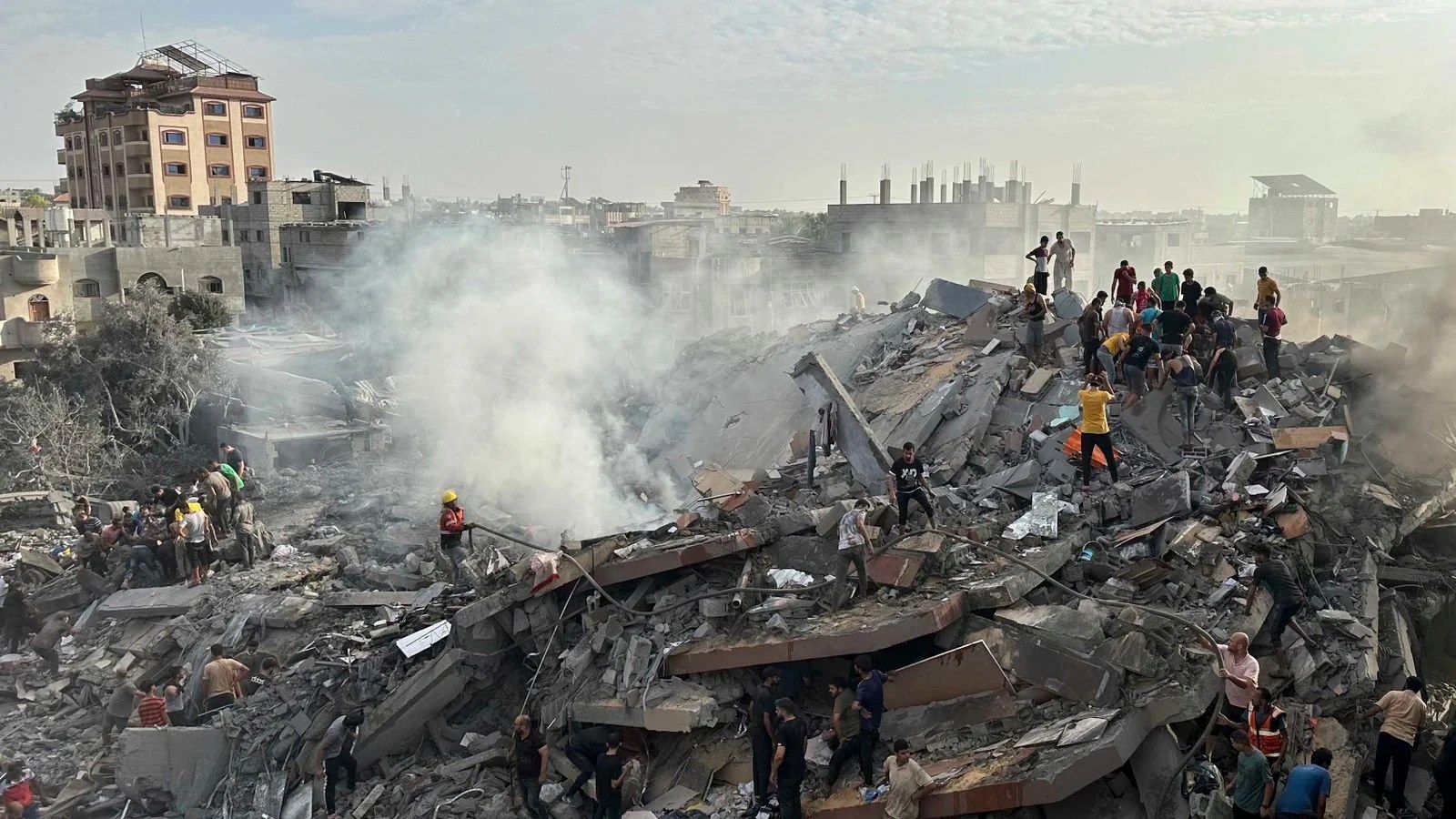
Is the mass slaughter of civilians self-defence? Every person has the right to life and to self-defence, but Israel’s “right to self-defence” is constantly being used to obfuscate the non-defensive nature of it’s military violence in Palestinian territory. Israel’s self-defence is a lie, not just because their actions are not defensive but because Israel cannot legally use its military in self-defence against Palestinians. Let me repeat that, Israel cannot legally use its military against Palestinians in self-defence. That is the big lie at the heart of the current horrors
There are four reasons why Israel cannot cite a legal right to self defence in response to Palestinian violence. First and foremost is that the ability of a very strong military power to achieve anything defensive by the attrition of a much weaker military power is spurious and leads into the genocidal logic of attempting to deprive a people of all capacity for violence.
The second reason is that Israel is actively contravening UN Security Council resolutions and the UN Charter is very clear on the fact that the right to self-defence exists “until the Security Council has taken measures necessary to maintain international peace and security.” A state that works to thwart UNSC measures to maintain peace and security cannot logically be extended the unimpaired right to self defence.
On the third count Israel is an occupying power and the occupied have a legal right to armed resistance. It would be nonsensical to accord a legal right to use arms to defend against another’s legal resistance. Fourthly, it would be equally paradoxical to allow each party to act in self-defence against each other’s acts of self defence. Thus one of the parties must be the aggressor. On several counts, not least its defiance of UNSC resolutions, Israel must be considered the aggressor.
Israel’s only legitimate way of defending itself begins with ending its occupation. Israelis have a right to life and they deserve peace and security as we all do, but they have no right to kill Palestinians and claim that they are pursuing those things.
Before tackling the specifics we should question the general validity of military violence as a form of self-defence. At this time hundreds of people are killed by Israel every day under the pretext of seeking to render Hamas 100% ineffective. This is a tacit claim of self-defence linked to the notion that Hamas is an ongoing source of potential violence to Israelis. However it is hard to reconcile this rationale with the actualities when one sees a parade of children’s corpses. One body after another with the increasingly familiar pall of concrete dust on their lifeless faces. Thinking of all of that pain, fear and suffering should make it impossible to somehow see killing those children as an act of self-defence. The human instinct to reject this monstrosity is not mere sentimentality. It would be impossible to make a sound detailed argument to show how the killing of any one of these children contributed materially to the increased security of Israelis. In truth it is far easier to argue that each dead Palestinian child makes Israeli people less secure.
Israel relies on broad and vague notions of “self-defence” to enact mass violence that does nothing to make any person safer and, in fact, is certain to cost the lives of many Israel personnel and any number of hostages. Military violence can only achieve so much as no amount of attrition will deprive a people of all ability to commit violence in return short of extermination. Beyond a point violence becomes waged “not merely against states and their armies but against peoples.” These were the words that Raphäel Lemkin when he first described the concept of genocide. Military violence can be used in ways that can only be called “self-defence” through the logic of genocide that situates the threat within the people and their intrinsic capacity for violence (also known as resistance). This is not legitimate self-defence, yet it is clearly part of the racist thinking of some Israelis and their apologists elsewhere.
It is actually normal that the logic of genocide presents itself as self-defence. Consider this quote by Arnon Soffer, the pre-eminent alarmist in Israel over the “demographic” threat of Palestinians:
“When 2.5 million people live in a closed-off Gaza, it’s going to be a human catastrophe. Those people will become even bigger animals than they are today … The pressure at the border will be awful. It’s going to be a terrible war. So, if we want to remain alive, we will have to kill and kill and kill. All day, every day … the only thing that concerns me is how to ensure the boys and men who are going to have to do the killing will be able to return home to their families and be normal human beings.” This is the reasoning of someone who has no concern for military power, who will never accept Israel’s overwhelming military might and nuclear deterrent as a sufficient lever ensure that Israel can be secure in a time of peace. These words are shockingly Himmleresque in labelling a people animals; in stating that mass killing is neither choice nor desire, but necessity; and in the sickening concern that mass killing might cause psychological harm to Israeli personnel. Adolf Eichmann and others at the Wannsee Conference shared Himmler’s fear of the effect of killing on the murderers and it was a major consideration in their adoption of the “Final Solution” which industrialised the mass-murder of Jews.
Soffer later explained: “I didn’t recommend that we kill Palestinians. I said we’ll have to kill them. I was right about mounting demographic pressures. I am also entitled to defend myself and my country.” It is difficult to imagine any Israeli getting closer to Nazi rhetoric than this, but it says something that his ideas were not immediately denounced by everyone in Israel for what they are. This is the essence of genocide. Though referencing the circumstances in Gaza, he is openly saying that Palestinians must be killed because they are Palestinians.
In contrast to genocidal notions, the theory behind using military power in self-defence draws on the idea that warfare is a contestation of belligerents using violence in a manner, as Clausewitz suggested, of wrestlers: “Each strives by physical force to compel the other to submit to his will….” This begins from the presupposition that each belligerent has diametrically opposed aims, which might have sufficed in the 19th Century, but does not suit our more complex polities today.
In reality, war is not a chess game and killing babies is not in any way the same as taking a pawn from the board, yet the use of aerial and ground artillery on populated areas implies that this brutal madness makes sense. We are tricked by the notion that the “self-defence” of nations is truly analogous to the self-defence of an individual using a weapon to counter an assailant. That analogy breaks down in an era of high-tech weaponry and in circumstances of asymmetry where the strong are killing the weak. Leaders and pundits often twist the notion of asymmetry itself to suggest that the strong are more vulnerable to the weak and are thus the real victims, but this is just one of those lies that are repeated so constantly that it becomes a commonplace.
Despite the clear disproportionate asymmetry of violence and the ever-growing numbers of people killed by Israel the media discourse enforces a framework that decontextualises Israeli violence, presenting it as a reaction to the violence of Hamas. Pro-Palestinian and pro-peace interviewees on Western media cannot speak without first making pronouncements affirming that they condemn Hamas’ “terrorist” violence and affirming Israel’s “right to defend itself”. These statements function as “thought-terminating clichés”, though in such instances they might be more aptly called “thought-terminating pieties”. Pieties go beyond mere clichés to invoke moralistic religious, patriotic, or other emotive ideological beliefs that create both a dominant sentiment as well as a constrictive framework of discourse. They close off certain avenues of speech, so that those who speak for Palestinians must begin by stating that Israel has a legal and moral right to kill Palestinians, and then take the stance of a supplicant begging for moderation, clemency, or mercy.
Of late Palestinians and others have pushed back against the pressure to commence their testimony and commentary with a condemnation of Hamas. They are trying to evade a narrative in which events commence with a condemnable act by Hamas and thus Israel’s massive surge of killing and destruction is framed as a reaction to Palestinian violence. This framework decontextualises events from the occupation and oppression including the ongoing acts of killing and destruction which Israeli personnel enact every single day in Palestine.
The “self-defence” argument is even more insidious than the attempt to frame all Israeli military violence as being in reaction to “terrorism”. It relies on a persistent but unrecognised one-sidedness. One cannot deny the right for Israelis to defend their lives, but nor can one deny the right of Palestinians to defend their lives. If Israel can kill Palestinian civilians in “self-defence” and present its own reasons to explain why such killings are necessary, then logic dictates that Hamas can do the exactly the same. Thus it may seem that if applied even-handedly “self-defence” becomes totally meaningless.
It may surprise people to know that in legal terms the problem of self-defence is not tricky nor intractable. Israel very clearly does not have the right to use military violence and claim self-defence on several grounds. Firstly, an occupied people has the right to resistance, including armed resistance, “in or outside their own territory”. Obviously it would be illogical to accord a legal right to armed resistance and then accord a legal right to collective self-defence against that legal resistance.
Thankfully the United Nations Charter has a way out of the paradoxes of allowing two belligerents the right to self-defence against each other’s self-defence and that of allowing self-defence against legal acts of resistance. Chapter VII of Article 51 states “Nothing in the present Charter shall impair the inherent right of individual or collective self-defence if an armed attack occurs against a Member of the United Nations, until the Security Council has taken measures necessary to maintain international peace and security.” Clearly “peace and security” has not been established but the United Nations Security Council (UNSC) has passed many resolutions on Palestine. Israel is currently violating a very large number of these resolutions ranging at least as far back as UNSCR 242 in 1967 through to UNSCR 2334 in 2016. These violations are occurring despite the fact that the US constantly vetoes UNSC resolutions that it deems detrimental to Israel. Logically cannot claim a legal right to self-defence if it violates the UNSC resolutions designed to bring “peace and security” thus its real path to legitimate self-defence lies first and foremost in complying with all relevant resolutions. In simple terms Israel must end its occupation as the very first of any acts of self-defence. Thus it does have the right to self defence but it must cease its own belligerency first.
I want to complicate this further here, but in a way that will lead to greater elegance and certainty, by explaining the onus on the aggressor. In 1946 the International Military Tribunal described waging a war of aggression as “the supreme international crime” that “contains within itself the accumulated evil of the whole.” Placing the onus on the aggressor (which is the government of the state not its people) in this way does not exonerate those who commit crimes in self-defence, but it means that the aggressor is also guilty. It is only thus that we can preserve the principle that all people have the right to life. Without the aggressor being morally and legally culpable it would mean not only that the military personnel of the aggressor belligerent have no right to life, but also that civilians of that state have no right to life if they should become legitimate collateral damage in legal military operations by the defending belligerent. This emphasis on the culpability of the aggressor is very satisfying because it closes these loopholes and also satisfies our moral instinct that a sovereign that wages aggressive war, knowingly sacrificing the lives of their own people, is guilty of the murder of those killed.
We need to pause here to reflect on our habitual callousness towards death in times of conflict. Death in wartime is so inevitable that we become inured to to its nature. Deaths caused by armed conflict tend to be terrifying, agonising, lonely, and brutally untimely. The grief of needless loss over those who usually have health and life to spare is not lessened because death becomes so statistical when the machinery of killing is unleashed. War is an abomination and every person who is currently working to prevent a ceasefire in Gaza is a criminal.
As things currently stand Israel has such a grip on the framing of the Western media coverage that it can get away with claiming its murders in Gaza are all part of a campaign to eradicate Hamas and that this is a legitimate act of self-defence. Of course, anyone who goes beyond the Western media (Al Jazeera being the easiest outlet to escape the censored narrative) will know that Israel is targeting civilians, hospitals, churches, ambulances, and so forth. For those who see only the Western media they must deal with the cognitive dissonance of seeing the death, destruction, and suffering and being told that it is arguably some form of self-defence. The trick with the Western media is not to state outright that Israel’s self-defence claims are true, but to avoid all facts or basic reasoning that gives lie to that claim.
Once those who support peace and humanity learn to counter Israel’s claims to the right to use violence in “self-defence” it will be another foundation of the propaganda narrative removed. Brave individuals are challenging the demand to begin all media interviews by condemning Hamas and refusing to accept timelines that always assert that cycles of violence begin with Palestinian actions. They need to add to that by rejecting Israel’s right to use arms in self-defence.
The way to counter the distortions of the Western media is to attack the borders of the narrative where they are thinnest and most strained. Some ideas are the sledgehammers that break through walls of cognitive dissonance, forcing people to unite what their eyes see and what their emotional and moral senses tell them with their intellectual framework – the story that they force facts and feelings into. When people see bombing, missiles and siege warfare against a powerless people the imagery does not naturally lend itself to a conclusion of violence waged for defensive purposes. To break the argument we need to attack the very validity of Israel’s claims.
An occupier cannot use arms in self-defence until they cease being the occupier.
The aggressor cannot be the defender.
Genocide is never justified. The violence of those who see others as a threat because of their membership in a “national, ethnical, racial or religious group” is the defining character of genocide. It is always framed as self-defence.
 On Genocide