The Numbers Game: New Research Shows that US has Saved Millions of Iraqi Lives.

Standard

[Warning: this is satire. I apologise for any confusion. If I offend anyone I want to make absolutely certain that they are the right people.]

In 2006 The Lancet published the second of two ideologically driven mortality “surveys” which claimed that the US had caused over 600,000 deaths in Iraq. This was followed by other such “research” conducted by those who made no effort to conceal their own political bias against George W. Bush’s decision to invade Iraq. Some of these organizations claimed to have found astronomical numbers of fatalities, even over a million. One of those who has led the fight to correct these subjective and biased studies is Jim Slobberdrib. For eight years Slobberdrib headed Applied Research Science Enterprises prestigious Iraq Death List project. More recently Slobberdrib has overseen a new study which, by applying newer and even less biased techniques and standards, has found that US actions actually saved many thousands of Iraqis who would otherwise have perished. Since the release of these explosive findings Slobberdrib has been very busy promoting the work by granting interviews to the media. Fortunately, however, he was able to take time out from all of that in order to grant me an interview:

KK: If I could turn first to your work with the respected Iraq Death List project – how exactly did you get the inspiration to start the project, and what were its aims?

JS: Well, it is funny how inspiration can strike at any moment. I was working for Blush, McLieberger and Koch, the PR firm, and, I don’t know, I… I must have been quite dissatisfied with the meaninglessness of it. So much so, I think, that my boss could actually tell even before I really knew myself. He told me that I needed something more meaningful in my life, a chance to give back. As it happened, he said, our firm had a relationship Applied Research Science Enterprises…

KK: A relationship?

JS: Yes, I think they shared office space in Kuala Lumpur or something. And they shared other things – you know, photocopying costs, long-arm staplers and so forth. They also had the same Human Resources department, funnily enough. It worked out quite well for me in the end, because it meant that I could just stay on the payroll despite suddenly and drastically and ummm…

KK: Boldly?

JS: Yes, yes, boldly. Boldly changing my career completely. Of course, there was a significant pay rise and I think that this shows that being daring and taking risks can be quite rewarding in that sense. The rewards are more than merely material, they are also monetary.

Anyway, I am getting ahead of myself. Basically, I came up with the idea of doing a truly definitive body count in Iraq which would ensure that the Bush and Blair regimes were absolutely accountable for every single death of every single innocent but only if we could truly verify their innocence and their deadness. I believed utterly, then as now, that it would be wrong to hold someone accountable for abstract statistics, it is only when we can absolutely verify absolute innocence and absolute death that we can think of holding those in power accountable.

KK: So it was a sudden inspiration born out of an urgent humanitarian impulse?

JS: Exactly. They sent me along to meet the people at Applied Research Science Enterprises. They could also tell that I was stricken with a Humanitarian Impulse. They said it made me look troubled and intriguing. They mentioned that the main humanitarian concern in the world was probably the impact of the US invasion of Iraq and that people desperately needed reliable information to make judgements on the moral dimensions of the US action. I said something like: “Hey, wait a minute. If you guys are a research company, why not do some research about the effects of the invasion?” They were really impressed with my idea.

KK: So you didn’t have any directly training or experience as a statistician or epidemiologist or researcher of any sort did you?

JS: Yes, well, I think that this was the greatest strength that I brought to the job. I was an outsider, with a fresh perspective, not some stale old bean-crunching maths person. I wasn’t like The Count from Sesame Street being all mathematical about everything but losing sight of the human picture. I was there because of my Humanitarian Impulse and I could feel it getting stronger all of the time. Some people said I was becoming quite Bohemian. I even thought about writing a poem. I was the ideas man – the humanitarian ideas man. I could do the numbers too, if I wanted. I was used to it. In PR and marketing, we live by the numbers. I was never one of those people who actually makes the numbers, but I was around lots of numbers. Some of these numbers were really big numbers. I mean really big numbers, but they didn’t scare me. I can talk about infinity without getting scared.

KK: Walk us through what Iraq Death List actually did?

JS: Well, we collated reports of fatalities, but we would only actually include a reported fatality if it was independently verified by two Western media sources who had access to eyewitnesses of unimpeachable character. After that it was necessary for us to conduct our own independent verification to absolutely ensure that the eyewitnesses could be relied on.

KK: And then the first Lancet study came out in 2004. According to one of the researchers, they had initially expected that they might see an increase in mortality due to increased rates of disease or disruption to health and sanitation services, but instead they found that tens of thousands of people had been violently killed.

JS: Well, it just goes to show how political and unscientific they were. How are you going to show that someone died of disease because of the invasion? Did George W. Bush come up to them with a syringe full of dysentery or thyphus and inject them? A disease isn’t like a bullet. No one shoots someone with a disease. They were just going to count up some dead people and use some fancy number trick to say if was America’s fault. It’s like If I said that 78 percent of people who died of cancer died because they listened to rap music.

KK: But that wasn’t their main finding.

JS: Sure, but what they did was just as bad. They went around just asking Iraqis if anyone they knew had died and they just took their word for it that. These are Iraqis. They’re the ones who, I mean they’re practically the same people as… well, you know, they hate America. Of course they’re just going to say that the Americans killed my habeebi, or whatever. Hey, that reminds me of a joke a Marine told me: What did the Haji taxi driver say when he saw his child’s severed foot in the middle of the road?

KK: Umm, maybe just tell me later.

JS: Anyway, that wasn’t even the worst of it. They took those claims and then said that if these people said that their loved ones had died it must mean lots of other people had died well. They just made up all of these fictitious dead people. Completely made up. I don’t know how they thought they’d get away with this nonsense, but luckily we had our own definitive Iraq Death List and we could categorically refute their findings.

KK: So this is when you first began to clash with people like Gilbert Burnham and Les Roberts?

JS: Yeah.

KK: So, to set the scene, by this stage it is the end of 2004. A year and a half has passed since the invasion. What confirmed mortality figures did Iraq Death List have at this stage?


JS:
That’s the amazing thing, these jokers were claiming that 100,000 people had died but our confirmed fatalities were zero.

KK: Zero?

JS: Yeah.

KK: That’s quite conservative.

JS: Thanks. Well, anyway you can imagine how ridiculous these people looked, claiming that these nameless 100,000 people had died when we could show that there were no confirmed deaths at all.

KK: But surely some people must have died by this stage.

JS: People die all the time, but none of these deaths could be properly confirmed as being the result of US actions and confirmed as being real.

KK: Being real?

JS: Yeah. I guess one of the greatest challenges we faced at that point was the security situation. Our confirmation protocol is rigorous and we often found it impossible to deploy the hologram team to the areas in which fatalities were witnessed.

KK: Hologram team?

JS: It was vital that we assured ourselves that eyewitnesses had in fact witnessed real events, in those cases where eyewitnesses were considered sufficiently credible. We had to eliminate the most obvious possibility – that eyewitnesses had in fact witnessed only a clever projection made with hologram technology. But, there were often unacceptable risks in deploying the team.

KK: You mean that these alleged fatalities tended to occur in violent hotspots, in neighborhoods that were too dangerous to send a team into?

JS: I mean in deploying the team to Iraq. It was a very violent place…

KK: Despite having no actual confirmed fatalities?

JS: I know what I’m saying. Let’s not forget that American heroes were dying there every day. If we’d actually had a hologram team, we could never have risked sending them to the country.

KK: You didn’t even have a hologram team?

JS: Apparently it is difficult to find personnel who are appropriately trained and qualified to analyze this sort of technology.

KK: Because it doesn’t exist?

JS: Well, it is definitely cutting edge technology, maybe a bit beyond cutting edge. Anyway, one of our interns proposed a workaround and the “powers that be” decided that this was the way to go. It was decided that a quick trip to the morgue would serve to confirm that the dead were not holograms but in fact corporeal. I was against the decision. You know, I could understand the public relations aspect to it. People were thinking that zero fatalities was too low a figure. Edward Bernays understood this sort of thing. He invented public relations and he knew that ordinary people were very stupid. He called the average man “Dumb Jack” and he would have understood that “Dumb Jack” would never accept that the most scientific and objective measure of fatalities in Iraq was no fatalities at all. I understood the PR aspect of it, but by this time I had my scientist hat firmly on my head and my scientist hat told me it was all wrong.

KK: This was quite a dark time for you, wasn’t it?

JS: Yes, I did suffer from this sense of being conflicted. I was haunted by a recurrent nightmare. I would see “Dumb Jack” who looked just like my dad in his work coveralls. Then “Dumb Tariq” the suicide bomber would come along and decapitate my dad while singing “I Got You Under My Skin” in Frank Sinatra’s voice. Then me and “Dumb Tariq” would kick the head around like a soccer ball. Suddenly I’d realize that all along, every time I opened my mouth a stream of foul brown liquid would gush out, as if I was literally spouting liquid diarrhea. My therapist told me that it meant that when confronting trauma I became fecund with insight.

KK: “Fecund with insight”?

JS: Yeah, full of it apparently.

KK: But eventually you adjusted?

JS: Things got worse before they got better. My proposal that we initiate a capture and release program where Arabs would be banded and, if feasible, microchipped did not go down well. Detractors said that having such a program in the continental US would be of little use in determining death levels in Iraq. I tried to point out that this very same technique had been invaluable in studying declining numbers among Whooping Cranes and that the Arabs in question must themselves be migratory, otherwise they would not be in the continental US if the first place. I was widely pilloried for these ideas. I guess, in hindsight, that I should have talked them through with someone before calling a press conference.

KK: So if we move forward to 2006, and the release of the second Lancet study, widely referred to as “L2”. They estimated a very high mortality at this stage. In fact they estimated around 650,000 excess deaths, with 600,000 due to violence. What was the death toll according to IDL at this time?

JS: In approximate terms it was roughly around 3.

KK: Could you be more precise?

JS: It was 3.

KK: So there was an even bigger difference between your figures than there had been in 2004?

JS: In absolute terms, perhaps, but in percentage terms the gap had narrowed and I…

KK: Sorry, you say the gap had narrowed? What to?

JS: Well, a little over 20 million percent. That sounds a lot, but remember that in 2004 the percentage difference between our estimates was infinity. Infinity is much much larger than 20 million. 20 million is nothing compared to infinity. It’s like comparing, say, the size of a tennis ball with, umm, I don’t know, something infinitely bigger than a tennis ball.

KK: The universe?

JS: OK, maybe not that much bigger, but you get the point. I was very alarmed by the way politics had interfered with our science as if we should just compromise our methods in order to fit in with some antiwar malcontents and their made-up death study. Still, a difference of 20 million percent was just enough to show people once again that the Lancet study was dangerous nonsense.

KK: And now the Democrats in Washington started to take notice?

JS: Yes, they realized that our confirmed and undisputed body count was an invaluable weapon against the President. Of course, Republicans were not happy with me at that point. Senator Oren Stretchy (R-KY) physically threatened me with a yoghurt at a breakfast meeting. Bill O’Reilly said he wanted to chop me to pieces with his hedge-trimmer and feed me to his neighbor’s dachshund, but I think he might have mistaken me for Bernie Sanders’ cousin.

KK: And then, of course, that all changed when Bush actually admitted that your figures were correct.

JS: It was a great moment. Not just for me. Not just for IDL. But for the entire country. The President himself came out and admitted three innocent people had been killed due to his actions. He had saved us from Saddam’s weapons of mass destruction and from the smoking gun that could come in the form of a mushroom cloud. He had finally brought the justice that would give peace to the restless souls of those lost on 9/11, in the Maine and at the Alamo. He had saved the lives of millions of Americans and the price he paid was to carry the burden of guilt forever for those innocent lives lost because of his actions. It was a great moment from a great leader.

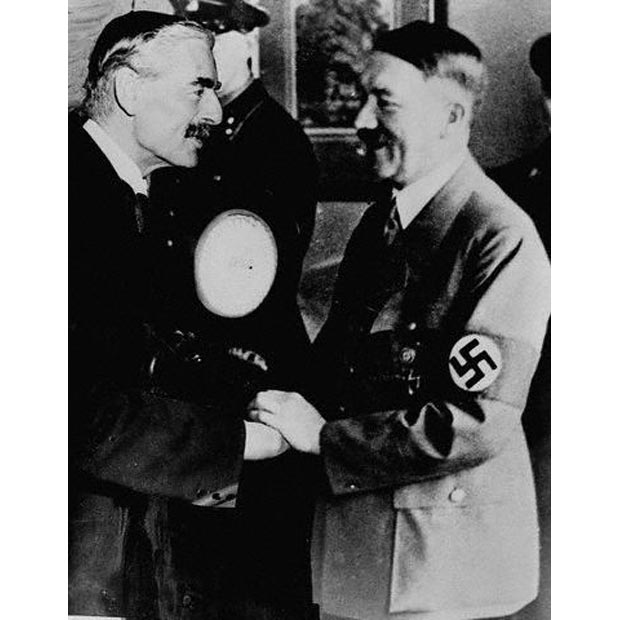
You know, people like to compare Bush to Reagan or to Teddy Roosevelt, but to me his greatness transcends the parochial confines of US politics. If the great Winston Churchill and the beloved Mahatma Gandhi had through some miracle conceived a love child, that love child would be George W. Bush.

KK: This was, indeed, a great moment. Bush showed a humble and saintly side to himself that clearly moved people. But there were still those who questioned the actual figure of 3 killed, suggesting that it was on the low side. Perhaps if you gave more detail about IDL‘s methods. I mean, surely there must have been a lot more than 3 people confirmed killed in nearly 4 years of occupation.

JS: More “people” maybe. If you could call them that. But “people” could mean anything. “People” could be insurgents, or terrorists, or militant Islamic extremist fundamentalist Muslim militants. If you think those people are actual “people” then you go ahead and call them that. But you’ll excuse us if we don’t take the same stance. IDL was created out of a Humanitarian Impulse to definitively document the deaths of innocents so that the powerful can be held to account. You can’t treat the good killing, where we kill the bad guys, as being like the bad killing. In fact it should really be set up so that each good killing is subtracted from the number of bad killings.

KK: That would be another reason for saying that the US has killed a negative number of people. Sorry, I guess that is getting a bit ahead of your narrative.

JS: No, you are right though. The US has probably negatively killed much higher numbers of people than we outlined in our latest study. We should maybe revise our findings to take into account the negative killing aspect of killing bad guys. Sorry, where was I?

KK: I think you were about to outline the methods you used to make sure that you only counted the bad killing and not the good killing that we want our politicians to carry out.

JS: Oh, yeah. Right, you see the way I saw it was that we needed unimpeachable character witnesses who could testify to the goodness and innocence of the stiff. You see, one of the problems America faces is that its enemies don’t fight fair. They don’t wear uniforms. They don’t carry weapons. And they aren’t all military age males. You can’t even trust the kids and the babies. These people are so fanatical and so full of hatred that they sew explosives up into their own babies and then fire them out of modified mortar tubes. It was just the same in Vietnam. As one soldier said: The old men, the women, the children – the babies – were all VC or would be VC in about three years. And inside of VC women, I guess there were about a thousand little VC now.”

KK: Who was that?

JS: That was Lieutenant William Calley. He had a breakdown, like combat fatigue, and then they just persecuted him because they needed some sort of scapegoat. Luckily President Nixon knew a thing or two about being the victim of a witch hunt, and he gave him a pardon.

Anyway, so we needed a way to tell who were the fanatic insurgent terrorist Islamists. In a real country we would ask the priest or the preacher, but obviously we couldn’t ask Muslim priests. We couldn’t say that they needed the testimony of a Christian priest either, because that might seem insensitive. I still thought that a respected religious figure was the right sort of person to give this testimony. It finally came to me that the ideal religious personage, who was not objectionable and who commanded very wide respect, was an ordained Tibetan Buddhist monk.

KK: So you would accept that someone who had been killed was, in fact, innocent if in life they had been known to an ordained Tibetan Buddhist monk who was prepared to vouch for their character?

JS: Obviously there is a fine balance that must be achieved here, but we thought that our approach was very reasonable.

KK: And do you still think it was a reasonable approach?

JS: Of course.

KK: Despite what occurred near Kut al-Farraj in mid-2008?

JS: I’m not sure what you are referring to.

KK: Perhaps I can refresh your memory. August the second? A village near Kut al-Farraj? An airstrike using multiple 500lb J-DAM against farm buildings which US personnel described as “hardened”? Surely you must remember that the official IDL mortality count jumped overnight from 4 to 179? Does it ring a bell yet? The airstrike at the village where the Venerable Abdallah al-Bakr happened to live?

JS: Yeah. I’ll never really get that. How can someone called Abdallah be ordained as a Tibetan Buddhist monk? Don’t you need to be Tibetan?

KK: No. Tibetan is also a type of Buddhism. Allen Ginsberg was an ordained Tibetan Buddhist monk.

JS: Wasn’t he some sort of Nazi or Communist or something?

KK: You’re thinking of someone else.

JS: Look, our results were sound and the Kut al-Farraj incident only strengthened the validity of our results. It showed that our method was flexible and responsive.

KK: “Strengthened the validity”? Are you really still defending this now? You had assured people for such a long time that the definitive and absolutely reliable death toll was 4 and suddenly almost in an instant it jumped by over 4000 per cent! How can you possibly justify that?

JS: Look, as a layman you might not understand that the best and most definitive figure isn’t some sort of happy medium that corresponds with common sense and accords with a full holistic picture of the context in which the events occur, it comes from taking the most narrow, restrictive and conservative approach possible. For a layman that might seem outwardly to throw up anomalies, like overnight jumps in the figures, but that is exactly how we ensure that our figures are utterly sound and definitive.

And anyway, a 4000 percent jump is tiny compared to a jump of infinity.

KK: This isn’t even particularly relevant because the percentage jump is actually the least of the problems with the new tally.

JS: I know where you are going with this. I just want to say that we had been using a set statistical method for years. We produced the definitive mortality data using that method and as I said before just because the method throws up results which, to a layman might seem really stupid, that does not invalidate the method.

KK: You know what I’m going to ask. The 175 killed Kut al-Farraj in 2008 – were they people?

JS: Look these were 175 certified innocent lives lost. I mean, the word “people” could, you know…

KK: Were they human?

JS: Not as such.

KK: They were…?

JS: OK, they were ducks.

KK: They were ducks. Innocent ducks maybe, but they weren’t people.

JS: Well, from the perspective of an ordained Tibetan Buddhist monk they actually are people.

KK: Alright, fine, they were innocent dead duck people. But that doesn’t alter the fact that after more than 5 years of brutal war, your official respected mortality figure was that 179 innocents had been killed of whom the vast majority, 175 out of 179, were, in fact, innocent ducks! 175 out of 179!

JS: Could you express that as a percentage?

KK: No.

JS: But you would agree that it is quite a lot less than infinity percent?

KK: If you keep this up, I am going to terminate this interview.

JS: Okay, alright. But you are really missing the most important aspect of this whole thing. The Venerable Abdallah al-Bakr had given names to every single one of the sadly departed innocent ducks, and we knew the names of the four humans. It is only because we know these names that we can honor these innocent lost lives. It is only because they are named and documented that we can give them a measure of justice. It is only because we know exactly who they are and the exact circumstances of their deaths that we can seek accountability or, at the very least, acknowledgement of wrongdoing. Those who die without us documenting and naming them died pointless deaths that made their whole lives totally futile and meaningless. They are nothings and nobodies.

KK: What about those people who have lost loved ones that you have not named? Aren’t they liable to think that you are a self-satisfied insensitive shithead who should have his face smashed in?

JS: Well, people do post that comment on my Facebook wall a lot, but really, I believe that in circumstances like these violence is not the answer.

KK: The whole “innocent ducks of Kut al-Farraj” incident caused quite a loss of confidence in IDL, didn’t it?

JS: We lost a lot of institutional support including that of some of the most prominent US lawmakers and congressional representatives.

KK: Isn’t that the same thing?

JS: No, I’m sure the lawmakers are the ones who write the laws, mostly lobbyists I think. Anyway, then they give the laws to the congress people who, I don’t know, I think they give it to the President to sign or something. Maybe they have to, you know, fight each other to get to the President with their favorite law. They must do something.

Anyway, the real loss, and it was a bitter blow, was the loss of support from some of the most respected foundations. Those guys have got real deep pockets. And do they know how to give a guy a good time? I did a dinner with Ford Foundation once – man, I was seeing double for a week afterwards. Oh God, yeah, I remember now – I had to go on a 4 week course of antibiotics and I had this discharge that I swear to God actually glowed in the dark. It really did!

KK: Right, umm, OK. I think we get the picture, although I am trying very hard not to get an actual mental picture. To get back to the loss of credibility, it must have caused a loss of confidence in the public also.

JS: I never had any confidence in the public.

KK: I mean, the other way around. The public lost confidence in you.

JS: Yeah, like we really cared. Look, I don’t think the public ever really supported our efforts. We took that as a good sign. Our work was clearly too scientifically valid for the layperson to grasp, but people in power could immediately see how useful it was. I think that this is the true test of rigor and validity. This is the way things are heading now. This is the future of science and research because it is usefulness to power that ultimately is the true measure of what is valid and true.

KK: OK. But regardless of that the “innocent ducks of Kut al-Farraj” did spell the end of the IDL project.

JS: Well, that was the foundations, like I said. Our parent company realized that the profits from IDL were on a death spiral downwards and decided to pull the plug before the rot set in. They told me that I felt like I needed a change and funnily enough they had this relationship with a publishing firm.

KK: And the resultant memoir was Slobberdrib: Saint or Savior? It did well?

JS: Yes it did extremely well. Incredibly well really. It was really really successful. Not so much in terms of sales. But it was an incredibly rewarding experience. It was really about the whole process, you know, like writing things and that sort of process stuff.

KK: There were also financial rewards. I believe that despite never having published a book before you were given a 2.8 million US dollar advance. How much of that advance have the publisher made back from sales of the book?

JS: As a percentage it would be about, umm…. Can you think of something that is 176 times as big as a tennis ball?

KK: And then things changed for you once again?

JS: Well I was in Jordan on location with the cast and crew of the new biopic Slobberdrib: Shake Hands with Satan – actually that’s coming out in the fall and it’s got George Clooney playing yours truly and that black guy from Homeland (did you know that he’s actually British?) Anyway, it’s got him playing my best buddy in military intelligence. It’s gonna be a hit movie. Anyway, so there’s me in Jordan, consulting for the film – telling Clooney how to be more, you know, like me, and I get this call…

KK: No, wait, wait, wait… I’m sorry to interrupt, but I need to clarify. You said Jordan, but you never actually went to the Middle East before?

JS: No this was my first visit. It’s pretty amazing, especially in the desert. It’s like, really sandy just like it is in the movies.

KK: The point I was trying to make, or ask maybe, is, why are they filming your life story in the Middle East when you were never in the Middle East?

JS: Oh yeah, I mean no. Yeah, no they decided that to make the story more accessible they would have my character as some sort of maverick humanitarian who struggles against the powers that be to save his buddies and to do the right thing. That’s basically me, but they gave me a slightly different back-story. In the movie I’m a bomb disposal expert who dedicates his life to protecting the innocent after the trauma of seeing a duck killed due to the callous indifference of a French rival bomb disposal guy. I kill the baddies and win the girl from the French baddy (who actually turns out to be Muqtada al-Sadr in a rubber mask – so I kill him too).

KK: So it’s more like some sort of fantasy version, not the humdrum reality of a guy working from an office in DC?

JS: I wouldn’t call it fantasy. There’s no dragons or orcs or whatever. They didn’t even use my idea about finding Aladdin’s lamp and rescuing the sexy Princess in those see-through culottes or whatever they’re called.

KK: OK, can we get back to the call you got in Jordan? Could I just guess that your employer had suddenly realized that you needed a drastic change in career?

JS: There’s no need to be facetious. It was actually the old crew from Applied Research Science Enterprises. New techniques and new approaches had been developed that virtually threw the whole issue of mortality in Iraq on its head. They needed me to come back to head a new study. This one would be far less restrictive than the last. It would be more of a totally inclusive survey of excess mortality.

KK: Like the Lancet surveys?

JS: No, not like those, obviously. They were political, we wanted to to do a survey that was purely scientific without all that politics. A recent study found that there were nearly 500,000 excess deaths in Iraq. As every reputable newspaper pointed out, this totally destroyed the findings of the Lancet studies. It absolutely blew those bastards out of the water.

KK: But surely these figures were much closer to the Lancet results than, say, your own results?

JS: Read the papers man! Don’t take my word for it. It just blew those bastards away. Totally discredited the washed up hacks. But we were still worried that there was some sort of political antiwar bias. Like I said, I don’t care if your politics are antiwar, but if you’re going to do science then, Brother, you gotta leave that shit at the door. You know what I’m saying? You can do science and say that lots of Iraqis died, but it becomes political when you say Americans killed them. That is just projecting your antiwar anti-America bias onto the figures. So even though some of the latest work to be done on Iraq suggests that lots of people died, over time we are seeing that less and less political bias is included in the figures.

KK: So it’s not political to say that Iraqis were killed by other Iraqis?

JS: No of course not. I like to explain it this way; back home we have a big problem with what we call black-on-black violence in the inner cities. Now, if you say a black man killed another black man that’s just saying something because it happened. It happens all the time. But if you say that a white cop killed a black man that’s political. You’re not describing a fact, you’re making a political statement. Now maybe if you’re wanting to run for mayor of, oh I don’t know, some black city, you might say a white cop killed a black guy. You might get lots of votes for saying that. But science isn’t about winning votes and there’s no room in science for politics like that.

KK: Reporters Without Borders put out a report about journalists killed in Iraq and it basically said that 83% of the killers of journalists were unidentified, but were enemies of the United States. Someone, someone who I actually know personally, criticized them for blithely characterizing unknown murderers this way without evidence. I think she even used the word “political”.

JS: Well, obviously that’s not political is it? Enemies of the USA hate our freedoms and hate our free press. My God, its the First Amendment – the First! Obviously our enemies kill journalists. Its dog-bites-man stuff. Perfectly non-political. Absolutely scientific. As for your friend – you know I think some people are so politicized they don’t even know what the word political actually means. Really, I could say some stuff myself about that Reporters Without Borders outfit and their so-called “report”. You know how they said that 9% of reporters were killed by US forces? Well, it turns out that two of those so-called “reporters” were insurgents on that film they put out with the helicopter shooting.

KK: You mean the Reuters employees whose deaths were shown in the Collateral Murder video?

JS: Buddy, they might have taken a paycheck from Reuters and done some journalism on the side, but those guys were fully-fledged one thousand percent insurgents. The Army even said they were insurgents. I’m pretty sure I saw that Collateral Damage thing and those guys were shooting rockets at our boys in the Apaches and then these reinforcements drive up using their own kids as human shields, and then they were just shooting off their AKs, a total killer frenzy. They were even shooting themselves just to make our boys look bad.

KK: Are you sure you actually watched Collateral Murder?

JS: I’m 98 percent certain. All I’m going to say is that if Reporters Without Borders researched those alleged Reuters employees they wouldn’t have found a single ordained Tibetan Buddhist monk who would testify that they definitely weren’t insurgents, and I bet the same is true of every one of those guys that our boys killed.

But going back to our new project, we saw our job as being to produce research a product that reflected a high mortality expectation, which we find a lot of the audience demands, but doesn’t have this distorted political component of US forces killing Iraqis. Our focus groups found that the best way to present the most credible results that the public would actually believe in (but were actually really really scientific and in no way political) was to have a very high mortality rate but to say that it was all brought about by Iraqi on Iraqi violence.

Things have changed a bit since the early days of IDL and that sort of approach wasn’t possible back then.

KK: Why is that, exactly?

JS: Well, you know, the whole invasion and occupation of Iraq was a very sensitive issue. There was a lot of misunderstanding. The President did his best to enlighten people. But even after Donald Rumsfeld explained all about “unknown unknowns”, a lot of people thought that Saddam’s WMD’s would either be found, or they didn’t exist. It’s just one of those “unknown unknowns”. He could have developed weaponized sand for all we know, and just left it in the desert to degrade into inert form. We will never ever know.

So the whole situation was very political, and I guess that is why the reporting was political too. For the first few years it was all about Coalition forces fighting against Iraqis. There was hardly anything about Iraqi-on-Iraqi violence. Maybe it’s not the journalists’ fault. They would wander along and than see a bunch of dead Iraqis and think: OK the US is fighting a war here, and war is hell, so they must have killed these guys. We now know, of course, that these Iraqis were almost certainly killed by other Iraqis. Iraqis kill each other all of the time, and the great irony of the situation was that it was only the mass-murdering genocidal maniac tyrant Saddam who, like Tito in Yugoslavia, stopped them from their traditional fratricidal violence. It’s like that British guy said a century ago, Iraqis “love fighting for fighting’s sake” and “they have no objection to being killed”.

I guess after that, you know from 2006 onwards, the news started to cover more and more Iraqi-on-Iraqi violence until that was all they covered. All of that political stuff about Americans killing Iraqis kind of faded away and we saw that it was all really about the same thing its always about – the same thing we see in movies and on TV – it was all about fanatical Islamists, terrorists, suicide bombers and cruel barbarians who chop people’s heads off.

KK: So the predictive programming of the entertainment media which unrelentingly pounds people with notions of Eastern barbarity and Western superiority made it natural for people to gravitate to this new narrative of incomprehensibly violent Iraqis who just kill each other for no reason that a civilized Westerner could ever really understand?

JS: Did you mean to say that?

KK: No, it just kind of slipped out. Do continue.

JS: Well, I guess I really have to confess now that I’d really got it all wrong earlier with the IDL. You see, you remember how I told you that there was good killing and bad killing? Well, that’s a perfectly good scientific way of understanding the difference between, well you know, the difference between good killing and bad killing. Anyway, it might be great science, but it’s not actually very mathematical. After talking it over with my people I came up with this great inspiration. Instead of good and bad killing, we should be talking about positive and negative killing in the mathematical sense. So when you positively kill someone there’s one less person in the world but when you negatively kill someone then there is one more person in the world. Now so there is no confusion let me make it absolutely clear that this is not about procreation. These are processes which we refer to as dekilling, or unkilling, or enlifing. This might be confusing initially, but when you enlife someone it means, well it doesn’t usually mean that there’s this person that you actually see that you’ve actually somehow enlifed. It’s more like say if there was a unit and at the end of a tour we calculated that they have killed negative 100 people, that means that by their actions there are 100 more people alive today than there would have been otherwise.

KK: Is that an indicative example. Would, say, a company have that sort of negative kill rate in a one year tour?

JS: Look, this is all new science and we really haven’t gone through the individual outfits completely yet, but our initial findings are phenomenal. We have some outfits that racked up huge negative kill rates. I even joked with a Sergeant from a mortar battalion that they should change their motto to “Life from Above”.

KK: Just so our audience understands, negative killing isn’t the same as killing bad guys? It’s not just another name for “good killing” is it?

JS: Oh no. Nothing could be further from the truth. No, negative killing is the sum total of all of those actions which are, in fact, life giving or life preserving. I need to emphasize again that this is not about procreation. The Pentagon would never countenance that sort of thing, not with Iraqi’s anyway. Like a lot of military outfits around the world they do have a long and proud tradition of having a “don’t ask, don’t tell” approach to sexual violence, but they really draw the line at fraternization. And they especially draw the line at there being a bunch of half-Iraqi half-White-Christian-American babies. I think you can see how that would not be in the interests of national security.

Negative killing is more about those things that save people from short or long term mortal threats. So, say, you might go into a house and in the confusion shoot dead one of the members of a family, but if by way of compensation you give the remaining family members a lifetime supply of chlorine tablets and that saves all eleven survivors from a deadly cholera outbreak, that means you’ve actually got a net negative kill rate of 10 people.

KK: So the negative killings come mainly from, say, civic action programs? From those outfits who build the wells and vaccinate the kids and have slogans like “we care, so you don’t have to”?

JS: Well, obviously that is a major part of the US military’s negative killing capacity. But our research has shown that often it in those activities that attract the most criticism from the bleeding-heart antiwar douchebags that actually have the greatest capacity to give life. Often people say our boys are trigger happy to the point of being a rampaging murdering horde. You have GIs just shooting up Iraqi cars just because they’re on the road, more or less, and people get wasted for almost any dumb reason. I mean, in 2005 we shot over one billion bullets during a period when our best estimates were that there were only 30,000 insurgents. That means we shot over 30,000 bullets for every insurgent in the whole country. That’s a lot of bullets, and those things are dangerous. It’s almost like you’d think that those guys who did the Lancet studies were on to something after all.

KK: Okay. I’m sure this is leading somewhere.

JS: Just hang on a sec, I’m getting there, but first you’ve got to think about the kind of firepower our grunts are packing these days. I mean a platoon of these guys could just about take out a city block as long as there weren’t any enemy soldiers or anything. Imagine you’ve got a mounted patrol. Every fourth GI has an M249 light machine gun. Every vehicle is mounted with maybe a .50 caliber machine gun or a Mk 19 grenade launcher which is like a sort of machine gun which fires 40mm grenades at a rate of about one every second. So, when this patrol hits an IED what they do is that they all just open up with all their weapons. Sounds like a recipe for a lot of dead civilians, right?

KK: If you say so.

JS: Well it’s true. Doing things like that does actually generate a positive kill rate, but have you thought about how much of a negative kill rate this could generate?

KK: Err…?

JS: Picture this: A cute little baby girl at home with mom. Mom’s proud of her beautiful first-born. Daddy’s out working his job at the office. It’s Friday, he’s planning on doing some renovations on the weekend and he’s going to drop by the Haji Home Depot after work. Mom’s feeding her beautiful baby girl from her firm young breast, little knowing that outside there creeps the dirty swarthy misshapen figure of an Islamic fundamentalist terrorist insurgent laying his filthy coward IED bomb. Mom puts baby down for an afternoon nap. Feeling good about herself she glances out through the window and waves to the friendly and handsome GI’s who wave back and make playful boyish remarks to each other about the beautiful young Haji woman. Then wham! The explosion throws mom back against the wall and she slumps unconscious. But oh no! What’s happened to baby girl? Unfortunately, Haji homes are flimsy, and Daddy hasn’t had the chance to fix up that sagging detached wall. The wall has fallen on baby’s crib! She has no air, and Mommy’s lying unconscious! Just then, like the ferocious thunder of freedom, the sound rings out of a couple of dozen really heavily armed red-blooded American boys letting loose with all they have. Just in the nick of time a .50 cal round punches a hole through the flimsy Haji wall and the baby is saved. What do ya think of that?

KK: It sounds a little umm… specific or, I don’t know, maybe a little unlikely.

LS: You might well think that. But remember just how many bullets we fired in Iraq – about a billion each year, right? Well if each bullet was the size of a tennis ball, then a billion bullets would be like infinity or even bigger.

KK: So, if you fire enough bullets at inhabited buildings you will save lots of lives by punching air holes in collapsed masonry?

LS: Well, were not completely stupid, you know. We do realize that there is a limited number of people who actually end up in the situation of being trapped under rubble without air, even during a US-led occupation. (We did actually offer an infantry regiment to China to shoot up the city where they had that last quake, but they declined due to security concerns.) Anyway, it’s not just about that, there are many other ways in which stray bullets can save lives. Picture now 36 year old Mohammed al-Derpderp. He’s just got that promotion he’s been after for years. He’s regional sales manager for the Haji vacuum-cleaner company. Finally, after all of those years of hard work he has his feet on the ladder. The only way is up. But, uh-oh! What is that on his neck? Could it be a pre-cancerous mole that is destined in ten years time to bring about poor Mohammed’s death in the most painful, degrading and lingeringly awful way possible? Why yes it is. Luckily he’s walking down the street one day and he’s coming up to where his uncouth Haji neighbours have left a pile of their shitty junk lying blocking a side road. Now, the nearby friendly US dismounted patrol heard AK’s firing earlier that day, so they know that the bad guys are around. They see the junk and they know it could have been put there by the bad guys. The leader decides that it’s time for some reconnaissance by fire. He tells his men to open up and they let loose steel hail like the volley of the titans! A round hits the wall near our friend Mohammed, it shatters and a searing fragment zips through the air slicing off the offending mole and cauterizing the wound to boot. Hey-presto and Allahu-fucking-akbar – 53 years later Mohammed al-Derpderp dies in bed surrounded by weeping relatives while from outside he can hear his great-grandkids laughing as they chase the Haji chickens around the dusty yard. Now that’s a happy ending.

KK: I see. So US forces have “enlifed” (if I have the terminology right) lots of Iraqis with stray bullets. Anything else?

JS: You bet there is. The list is as long as your arm. Airstrikes taking out dangerously substandard housing. White phosphorus sterilizing contaminated chicken. Fuel-air bombs taking out colonies of plague-bearing rats. We’ve found that people who have been exposed to toxins from our burn pits are significantly more likely to quit smoking, for example.

KK: So what does this all add up to, in terms of numbers of negative kills?

JS: Well, I haven’t even got to the best part yet. You see, we started thinking about what was the greatest threat to Iraqis, and you know what we came up with don’t you?

KK: Ummm.

JS: You’ll kick yourself. … Give up? Alright I’ll tell you – the biggest mortal threat to the life of an Iraqi is another Iraqi. You see now? That’s right, it’s just what we were talking about before. So we sat down and we calculated just how much risk Iraqis posed to other Iraqis. Are you ready for this? Yes? Alright. We calculated that over the average lifespan, taking all possible deadly acts and working out, conservatively, the likelihood that they would undertake such acts, we calculated that over the average lifespan the average Iraqi kills approximately 2.8 other Iraqis. You know what that means, don’t you?

KK: That means that every time you kill an Iraqi, you actually save Iraqi lives. Extraordinary.

JS: Well, once we realized that, it was a whole new ball game. We started looking way further back, right back to 1990. Do you know what we found? This will blow your freaking mind. We found that if you look at all the demographic data and look at the overall increased mortality form all causes there have been an excess of 4.6 million deaths. Because of our bombing and sanctions before our invasion and occupation, the good old US of A can take credit for nearly every single damn one of those Iraqi deaths! Conservatively, we can claim at least for at least 4 million of those deaths, which translates to us saving 11.2 million Iraqi lives. That means that we have saved the life of nearly half of every single Iraqi alive today by killing their neighbors and loved ones.

KK: Amazing. Well that seems as good a point as any to wrap this up. It just remains for me to thank my guest Jim Slobberdrib…

JS: My pleasure.


KK:
…and I’d also like to thank the National Security Agency for allowing us to publish their transcript of our conversation. Next week I will be discussing the issue of Palestine with a woman who sounds caring, but advocates genocide. Be sure to tune in.
Kieran Kelly blogs at On Genocide.

“Collateral Murder”: Evidence of Genocide

Standard

In Iraq, you can’t put pink gloves on Apache helicopter pilots and send them into the Ultimate Fighting ring and ask them to take a knee. These are attack pilots wearing gloves of steel, and they go into the ring throwing powerful punches of explosive steel. They are there to win, and they will win.” Lt. Col. Chris Wallach

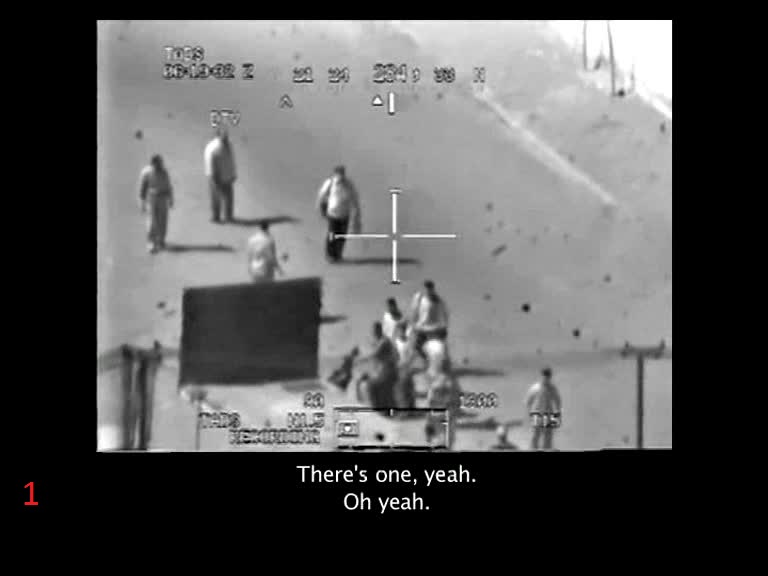
The video known as “Collateral Murder” is strong evidence of genocide being carried out by the US against the people of Iraq. Hidden in the horrors of its brutality is a rich historical record revealing an armed force which systematically targets and kills non-combatants. The events shown are war crimes violating the principle of non-combatant immunity in numerous clearly illegal ways including attacking those rendering aid to the wounded. They are also evidence of genocide because there are clear indications that these war crimes are representative of enshrined procedures. They indicate that the ambiguities of the US Rules of Engagement mandate the systematic mass murder of civilians when applied by US personnel. They indicate something of a tactical, strategic and doctrinal approach that radically violates the fundamental obligations to distinguish between civilians and enemy personnel and the combatant status of enemies. Finally they indicate something about the way in which the US indoctrinates its personnel in a way guaranteed to create murderers.

Lt. Col. Wallach was the commander of the aircrew. He recently said: “Ultimately, my combat pilots at the scene did the best they could under extreme and surreal conditions.” However, we now know that the only incident to occur before we are able to see what is occurring was a report of small arms fire being heard. If there is a surreal aspect to any of this it comes from the minds of the aircrew and those who command both air and ground forces. I am going to go through exactly what it is that the gun camera footage shows. It shows a massacre of non-combatants, followed by the murder of rescuers, and finally a more obscure sequence which definitely involves another murder of rescuers.

Former US Secretary of Defense Robert Gates said of this footage: “You’re looking at a situation through a soda straw, and you have no context or perspective.” Therefore, after describing exactly what is shown, taking into account exactly what is known and exactly what is not known from the footage, I will provide that context that Gates calls for. But the context does not, or should not, counter what our eyes and ears reveal to us. On the contrary, the very evidence that apologists like Gates and Wallach produce to show that the aircrew were legitimate in their actions is in fact evidence that their behaviours are not isolated. This is very strong evidence that by the manner in which, in practice, the US defines “hostile intent”; the manner in which it practices its doctrine of “force protection”; and the manner in which it indoctrinates and situates its forces, the US was systematically murdering non-combatants. In this case killing non-combatants inextricably means killing civilians. Placed in the context of more than two decades of direct and indirect destruction of Iraq in social, political, biological, economic, cultural, ecological, and physical terms, this systematic killing is clear and compelling evidence of genocide. Those who insist that this is merely warfare join the vast ranks of genocide perpetrators, deniers and apologists who insist that other genocides were warfare with inevitable, if regrettable, instances of civilian death.

As I have written elsewhere, all of the common claims of genocide deniers are regularly applied to US “military” actions, but they tend to be overlooked as they are so pervasive that they are seldom examined or challenged. Ultimately denial of US genocide relies on people having a vague notion that genocide involves actions like the mass gassings at Nazi death camps. But the word genocide was coined by someone who did not know at that time about the mass gassings and who applied the word to far more that the Nazi project to exterminate Europe’s Jews.

Genocide??

So, what exactly is genocide? The man who coined the term, Raphäel Lemkin, was a Polish Jew and a legal scholar. Impelled by knowledge of the Armenian Holocaust as well as the history of state sanctioned or controlled pogroms against Jews, Lemkin devoted much of his life to understanding mass violence against ethnic populations. In 1933 he proposed that there be an international law which, among other acts, prohibited acts of “barbarity” and “vandalism”. “Barbarity” was conceived as violence against members of a “collectivity” on the basis that they were of that “collectivity” and “with the goal of its extermination”. “Vandalism” was the destruction of the “cultural or artistic heritage” of a “collectivity … with the goal of its extermination”.

The German occupation of most of Europe was the horrific crucible in which Lemkin synthesised “vandalism” and “barbarity”. He recognised a greater process of which they were both part – the process he called “genocide”. Genocide was “a war not merely against states and their armies but against peoples.” Extermination, or the intent to exterminate, was no longer a requisite. The occupant could impose a “national pattern” onto the land, once it was cleansed by killing or forced migration, or onto the people themselves. And despite knowing that Europe’s Jews were slated for complete annihilation, Lemkin’s examples of genocide included such things as forcing the people of Luxembourg to take German names. His most common exemplar of genocide was the treatment of Poland – a comprehensive and systematic genocide in which killing people was only one of many forms of genocidal destruction.

I think it is important that we realise that the fluidity of identity does not allow for actual extermination to be undertaken as a project. Genocide is a schizophrenic undertaking full of bizarre contradictions such that it cannot truly be said that the Germans attempted to exterminate the Jews, or even Europe’s Jews. The Germans had immense difficulties in even defining who was Jewish for a start. They said Jews were a “race” but ultimately they relied on confessional identification to define them. As Yehuda Bauer wrote: “One can see how confused Nazi racism was when Jewish grandparents were defined by religion rather than so-called racial criteria.”(1) As well as the fact that many with Jewish heritage would inevitably successfully evade detection, in the Nuremburg Laws (and later when deciding who to kill at Wannsee), exemptions were made on various criteria, such as being a decorated war hero. However defined, there were Jews in the German military(2) and there were Jewish civilians living unincarcerated in Berlin when Soviet troops arrived.(3)

Mischling exemption application

“Half-Jew” Anton Mayer. Such photos accompanied applications for “exemptions”.

So, as the Genocide Convention outlines, genocide is an attack on people, rather than states, with the “intent to destroy in whole or in part, a national, ethnical, racial or religious group, as such….” Lemkin referred to these collectivities as having a “biological structure”. There is a genetic interconnection involved here, but that does not mean that Lemkin believed in Nazi racial theories or any racist or racialist notions. The most evident proof of this is the inclusion in both his own work and in the Genocide Convention the practice of “transferring the children of the group to another group”. If genocides were truly about racial hygiene and racial hatred that would hardly be a recognised component, would it?

If it is not about race, then what is it about? Though he never articulated it, the answer stared Lemkin right in the face and he obviously grasped it at an unconscious or intuitive level. If we refer to one of these collectivities as a genos, what ties the genos together is not “biological interrelation” but rather personal interconnection and, most particularly, familial interrelation.

Genocide is about Power not Hatred

I want to outline a simplified cartoon narrative, just to illustrate a point: In feudal Europe mass violence was used in acts of war or banditry which were only distinguishable from each other by scale and the rank of participants. A Baron might conquer the demesne of another Baron just as one King might conquer the realm of another King. In relative terms the peasants of the demesne or the realm might have had very little concern over who exactly ruled. The change in rulers would not be akin to a foreign occupation as we would currently understand it. By the time of Napoleon, however, it was beginning to be a little different. People had started to develop a national consciousness. The national genos associated itself with a territory of land and aspired to a nation-state polity based on that (often rather generous) sense of territorial entitlement. By 1871, the inhabitants of Alsace-Lorraine were quite unhappy at being made German. Nationalism would become the dominant political ideology for the entire twentieth century. The multinational and largely interchangeable feudal ruling class was gone. This was not an unprecedented situation, but it was something that Europe had not faced for since the times of Charlemagne (well, in reality it had, but I’m still in cartoon generalisation mode here, so bear with me).

There are many ways in which an external imperial power might exercise hegemony over the territory of a national genos in various ways, but they are limited by the strength of national feeling and, perhaps more importantly, the hegemony cannot be stable because national sentiment might at any time cohere around demands for the end to imperial hegemony. A transnational quasi-imperial system of governance has arisen specifically to limit economic sovereignty, for example. There are good arguments to be made that this is in itself genocidal and that the poorer nations of the world are subject to “structural genocide”. The carrots and sticks of global governance, however, do not apply to nation states that are reasonably populous, but more generously resourced, with a strong potential for industrial development. If they have a national consciousness that does not allow foreign dominance, which includes rule by those who are not loyal to the national genos, then there is no military way of establishing dominance. It is not the sovereign that is the problem, it is the people, hence the recourse to genocide.

War or Genocide?
If genocide is “war against peoples” how can it be distinguished from normal war? If we go back to German conquests in World War II, it is quite easy to distinguish between primarily military operations in the West and the largely genocidal actions in the East. The conquest and occupation of Western Europe was undeniably brutal but (leaving aside the genocide of Jews and Roma) German actions, including the killing of innocents, were taken as a means of countering physical threats to German forces. In the East, by contrast, inflicting starvation was more for the purposes of cleansing land of unwanted inhabitants than for feeding German troops. Security was the excuse for massacres, not the reason for massacres. When armed resistance began behind the advancing German front in the East, Hitler himself said: “This partisan war has its advantages as well. It gives us the opportunity to stamp out everything that stands against us.”(5)

As a general rule of thumb, then, one might look at a conquest and occupation and ask: does this more resemble what the Germans did in Belgium or what they did in Poland? For anyone acquainted with the comprehensive and widespread nature of destruction inflicted on Iraq during the occupation – destruction which was economic, political, cultural, moral, intellectual, social and environmental as well as physically deadly to Iraqis – the answer is all too clear. More Poles died than Iraqis, but to say of that the US occupation of Iraq was not as bad as the German occupation of Poland is to say very little indeed. The Germans wanted to go much further in a shorter time than did the US. They wanted to extinguish Poland as an entity. In contrast the systematic destruction of Iraq began 23 years ago with sanctions and bombing. 7 million Poles died in less than 6 years – most were killed directly. Around 2.5 million Iraqis have died, perhaps more – roughly half through violence and half through malnutrition and disease. Despite this, the similarities are more striking than the differences. Much like the German view of Poland, US policy elites (such as Joe Biden, Peter Galbraith and the Council on Foreign Relations) openly talked of “the end of Iraq” – proposing a partition which would be the destruction of Iraq as a nation-state.

What does the Collateral Murder Video Reveal?
Along with the bigger picture of comprehensive and manifold destruction that is the Iraq Genocide, it is possible to see indications of genocide at a smaller scale. If there are two types of war – genocide and military war – then which sort involves the systematic killing of civilians? The Collateral Murder video leaves many unanswered questions, but one thing it does show is that the killing that occurs is indicative of more widespread behaviours.

1) Are the Victims Combatants? Are they Armed?
The footage we see is from one of two participating Apache helicopter gunships. The call-sign of the gunship, or rather its “Aerial Weapons Team”, is Crazy Horse One Eight. The voice of the gunner who shoots is distinguishable throughout. He is controlling the gun camera and we can see what he sees. Further, it is clear from the fact he refers to things indicated by his sights that someone else, presumably the pilot, is seeing the same video feed and using it to make judgements. This is very important because the viewer can tell that they did not make a positive identification of weapons when initially claimed as, even with the benefit of going through one frame at a time, it is not possible to make a positive identification of weapons. It is also possible to tell that they are lying frequently about what they can see.
vlcsnap-2013-10-14-14h27m37s122vlcsnap-2013-10-03-12h12m14s124

Our first view of the first group of victims (Pic 1) shows over a dozen men who are clearly acting in a casual manner. In general they are progressing but here is also milling and conversation going on amongst them. Two of them have visible shoulder straps. These are from cameras and they look like cameras considerably more than they look like weapons. They identify one other “weapon” which is inflated to the claim that there are “five to six” armed individuals. Pic 2 and the frame immediately preceding it show a long object that could easily be mistaken for an RPG (rocket propelled grenade launcher). However this is not what the gunner will later claim is an RPG and having viewed the entire footage it seems almost inconceivable that the object is in fact an RPG.
vlcsnap-2013-10-03-12h27m46s82
vlcsnap-2013-10-03-12h23m03s22
In Pic 3 we can see the object that the gunner claims is an RPG. It is a camera. It looks a lot more like a camera than an RPG. The reader is invited to review the footage starting at about 00:02:30 and determine whether they think it is feasible that the gunner has made a “positive identification” as required by the ROE (rules of engagement). As for the long object that looked a little like an RPG we can see in Pic 4 that it is now being used like a crutch. In our next fleeting glimpse it looks fairly insubstantial, lending some credence to the speculation that it might actually have been a tripod. There is no visible RPG tube later. Mention is made by ground forces that they believe there might be an RPG round under a body, but bear in mind the only claim that there was an RPG was of something we know for certain was a camera. Further, if it had been an RPG it would pose no threat to the gunship which was far beyond its effective range and too fast to be effectively targeted by a weapon designed for use against armoured ground vehicles. One writer described it as like trying to hit a wasp with a slingshot. And then there is the unexplained statement by the gunner: “Yeah, we had a guy shooting – and now he’s behind the building.” Someone responds as if he was referring to something else (30 minutes earlier small arms fire was heard in the area but its source never identified – that is the only evidence of hostile activity in the area at this point) but the context seems to suggest that he is saying that the “guy shooting” was journalist Namir Noor-Eldeen who may well have been “shooting” his camera.

An hour after these events we do see armed individuals – after an unexplained 30 minute gap in the footage. Before I turn to that, however, I would like to turn to the elephant in the room which seems utterly absent from discussions of whether or not the group of victims carried weapons – that is the fact that so many are quite clearly unarmed.
vlcsnap-2013-10-08-14h26m12s79
vlcsnap-2013-10-14-16h35m29s115

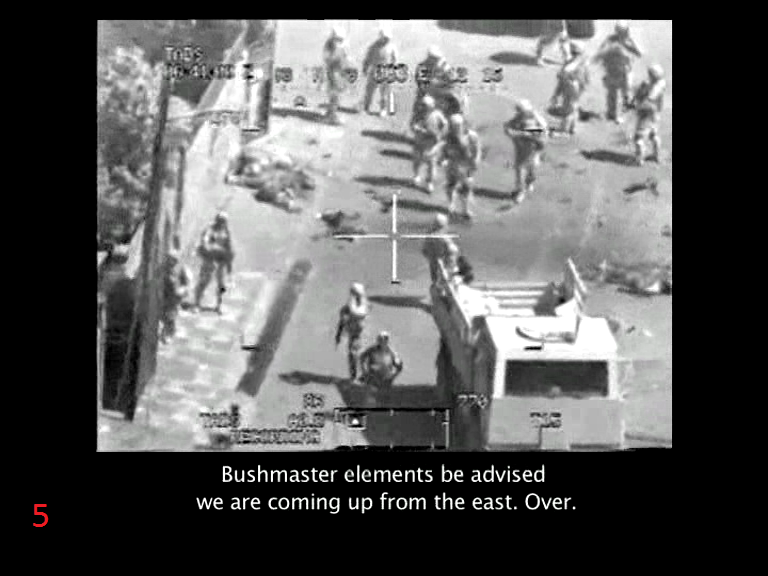
Pics 5 and 6 show armed men. The two men in pic 6 are not visible for very long, but one in particular is so obviously armed that it is quite unmistakeable. Likewise with the US personnel in pic 5. Uniforms aside, the fact that they carry long arms is very distinct. The demeanour and behaviour is clearly different also. The visibly armed men in both instances move in a purposeful manner, often briskly, and they pay attention to those in front. When Namir Noor-Eldeen was aiming his camera lens at the gunship his companions were just standing around having a chat. The gunships were clearly both seen and heard by the men. The gunner who will soon murder these men is quite able to see that they are in no way preparing for an engagement. Though two carry cameras and one a long object, it is clear that all others are plainly unarmed. Here is the ICRC’s (International Committee of the Red Cross) one sentence heading describing “Chapter 1, Rule 1” of customary International Humanitarian Law: Rule 1. The parties to the conflict must at all times distinguish between civilians and combatants. Attacks may only be directed against combatants. Attacks must not be directed against civilians.”
vlcsnap-2013-10-05-14h03m41s218
vlcsnap-2013-10-08-16h32m22s42
In the second attack the two armed men from pic 6 seem to have entered a building. After that this is heard from the gunner [G] and what is almost certainly the pilot [P] of Crazy Horse 18:

31:21 (add 26 seconds to get time on Wikileaks video) …[P] So there’s at least six individuals in that building with weapons.

31:30 [G] We can put a missile in it.

31:31 [P] If you’d like, ah, Crazyhorse One-Eight could put a missile in that building.

31:46 [P] It’s a triangle building. Appears to be ah, abandoned.

31:51 [G] Yeah, looks like it’s under construction, abandoned.

31:52 [P]Appears to be abandoned, under construction.

31:56 [P] Uh, like I said, six individuals walked in there from our previous engagement.

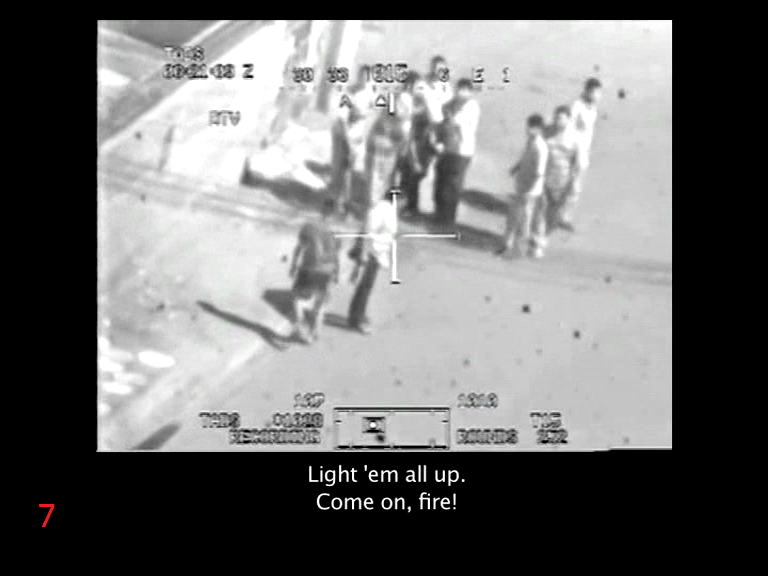
The footage shows nothing of these armed men in the building. The entrance is obscured for 30 seconds and then the gun camera is pointed at the sky for a further minute. When it swings back we see two unarmed men entering the building. Moments later (pic 8) we see another unarmed man walking in front of the building just before the first hellfire missile hits where he stands. 

2) Targeting Rescuers

Rescuers are specifically targeted in the first engagement and seem to be specifically targeted in the second. In the second the footage shows three rescuers (indicated by arrows in pic 9) have arrived after the first missile strike. The gun camera swings away before the second missile is fired. (The camera shows a rectangular reticule while a round dot seems to indicate the point at which the weapon systems are aimed. These are kept aligned at most times but it is very interesting to trace the separation and realignment of these that occurs during this second engagement. It certainly seems conceivable that the camera is deliberately trained away from the aim point of the weapons at times in order to conceal visible events.) While target is out of view we hear:

36:49 Firing.

36:53 There it goes! Look at that bitch go!

36:56 Patoosh!

37:03 Ah, sweet.

37:07 Need a little more room.

37:09 Nice missile.

37:11 Does it look good?

37:12 Sweet!
vlcsnap-2013-10-08-16h36m39s65
vlcsnap-2013-10-08-13h55m59s123
Pic 10 shows some people who were passing and tried to rescue the wounded Reuters worker Saeed Chmagh. A man runs ahead of the van to the victim. Never at any stage do any people or the van give any indication that they are approaching the dead, and yet:
07:07 Yeah Bushmaster, we have a van that’s approaching and picking up the bodies.

07:14 Where’s that van at?

07:15 Right down there by the bodies.

07:16 Okay, yeah.

07:18 Bushmaster; Crazyhorse. We have individuals going to the scene, looks like possibly uh picking up bodies and weapons.

07:25 Let me engage.

07:28 Can I shoot?

07:31 Roger. Break. Uh Crazyhorse One-Eight request permission to uh engage.

07:36 Picking up the wounded?

07:38 Yeah, we’re trying to get permission to engage.

07:41 Come on, let us shoot!

07:44 Bushmaster; Crazyhorse One-Eight.

07:49 They’re taking him.

07:51 Bushmaster; Crazyhorse One-Eight.

07:56 This is Bushmaster Seven, go ahead.

07:59 Roger. We have a black SUV-uh Bongo truck [van] picking up the bodies. Request permission to engage.

08:02 Fuck.

08:06 This is Bushmaster Seven, roger. This is Bushmaster Seven, roger. Engage.

08:12 One-Eight, engage.

Note firstly that they are being dishonest when talking about “bodies and weapons” but that the pretence is fairly thin. When asked “Picking up the wounded?” the voice I have identified as [P] replies “Yeah, we’re trying to get permission to engage.” Then the gunner’s voice says with some agitation, “They’re taking him.” They know full well that they are targeting innocent rescuers and others who hear their radio discussion must also have known.

To properly contextualise this we should look at the US propensity for “double tap” strikes. In it’s use of drones the US has for years been conducting delayed second strikes on targets for the express purpose of killing to who attempt to rescue or treat the wounded. These practices have continued until now despite massive negative publicity, and despite the fact that such actions are war crimes.

This practice can be further contextualised. The sanctions imposed on Iraq caused very, very serious degradation to Iraqi health system, including the hospital system. This worked in conjunction with the malnutrition caused by the sanctions and caused hundreds of thousands to die prematurely, particularly infants and children. During the occupation the degradation of Iraq’s hospitals continued even further. Dahr Jamail produced a report in 2005 that detailed a shocking situation. The ability of the Iraqi medical establishment to attend to the urgent needs of the Iraqi people was abysmal. Most of the urgent medical needs were caused by US actions and the near total disablement of Iraq’s health system was also caused by US actions. Among those who were unable to access adequate care were those wounded by the US. Among the most prominent, and certainly most dramatic, causes of degraded medical care were direct attacks on medical personnel, on clinics and hospitals, on ambulances and on civilian rescuers.

It seems clear from the audio of Collateral Murder that it is normal to target rescuers. Even though the rescuers in the van were nothing but people stopping to help, and the aircrew had no reason to think otherwise, they are clearly transformed into combatants in the delusional world of the gunner, particularly when he utters those chilling words: “Well it’s their fault for bringing their kids into a battle.”

3) “Delightful Bloodlust”

The pretrial testimony of Bradley Manning (now Chelsea Manning), which was smuggled out of a courtroom in May 2013, became most noted for the phrase: “delightful bloodlust”. It is an unusual usage and clearly Manning wished to make people think about what he was saying and to draw attention to the “delight” shown by the killers. There is delight shown. There is eagerness to kill and there is pleasure shown at killing the completely helpless victims. But there are also notes of strain and mental compulsion. The transcript printed above clearly shows the extreme agitation that having to wait for permission to kill more people causes. One can certainly here it in the gunner’s voice when he says “Come on, let us shoot!” In the minutes preceding this is a sequence of events which even more clearly show the “delightful bloodlust” of the Aerial Weapons Team.

Perhaps the most harrowing and disturbing part of Collateral Murder is not either of the times where we can see them mowing down innocent civilians, nor the two visible instances of missiles exploding and killing what seem to be innocent civilians, but the time the camera spends tracking a wounded victim – Reuters worker Saeed Chmagh. The speakers exaggerate when they say he is crawling. What we see is someone too badly wounded to crawl. His suffering is so readily apparent, like his helplessness and his desperation, that it is shockingly offensive when we here:

06:33 Come on, buddy.

06:38 All you gotta do is pick up a weapon.

What weapon do they expect Saeed Chmagh to pick up? How could they possibly expect someone too badly hurt to even crawl to pick up a weapon? What do they suppose he would do with a weapon? If you ask these questions you begin to realise the degree to which gunner is subject to an irrational delusion. He is unable to see a human being. If he saw a human being he would immediately realise that a human being in that state, and in those circumstances, is not going to pick up a weapon no matter how hard you wish him to do so. He might just as reasonably been begging for him to turn into a twelve-point buck. What the gunner sees is a target. He wants to kill the target because he has been trained to believe that is the most meritorious act possible – one which will earn him applause from superiors and peers, and bounteous admiration, if not envy, from the civilian community back home. In order to be able to kill the target the must be able to indicate that certain criteria have been met.

The US has long sought to create military personnel who kill discriminatingly but without volition. In World War II US studies led by Brigadier General S. L. A. Marshall found that only 15 to 20 per cent of riflemen would fire at the enemy in an engagement:

And thus, since World War II, a new era has quietly dawned in modern warfare: an era of psychological warfare — psychological warfare conducted not upon the enemy, but upon one’s own troops. Propaganda and various other crude forms of psychological enabling have always been present in warfare, but in the second half of this century psychology has had an impact as great as that of technology on the modern battlefield.

When S. L. A. Marshall was sent to the Korean War to make the same kind of investigation that he had done in World War II, he found that (as a result of new training techniques initiated in response to his earlier findings) 55 percent of infantrymen were firing their weapons — and in some perimeter-defense crises, almost everyone was. These training techniques were further perfected, and in Vietnam the firing rate appears to have been around 90 to 95 percent. The triad of methods used to achieve this remarkable increase in killing are desensitization, conditioning, and denial defense mechanisms. (6)

The result of the strength, intensity and sophistication of US military indoctrination is to make US personnel into killers and the sort of military code which other nations historically use (not necessarily successfully) to prevent their killers from becoming murderers is largely absent. The US military does not mandate killing innocents, instead it redefines the concepts of innocence, of combatant status, and even of civilian status. For example, in 1969 the top US commander in Viet Nam, Gen. William Westmoreland, claimed that absolutely no civilians had ever been killed by the US in designated free-fire zones, because no-one in a free-fire zone was a civilian, by definition.(7) In Iraq the most disturbing manifestation of this must be the use of the term “bad guys”. This is infantilisation taken to the point of complete insanity. This all-pervasive term (used throughout the chain of command, and used in official documents) maintains the projection of a Hollywood narrative onto real events of violence and, perhaps more importantly, means that personnel do not have to reflect on the nature of their victims.
This is the opening paragraph of the introduction of Chris Hedges and Laila al-Arian’s book Collateral Damage:

Troops, when they battle insurgent forces, as in Iraq, or Gaza, or Vietnam, are placed in “atrocity-producing situations.” Being surrounded by a hostile population makes simple acts such as going to a store to buy a can of Coke dangerous. The fear and stress pushes troops to view everyone around them as the enemy. The hostility is compounded when the real enemy, as in Iraq, is elusive, shadowy, and hard to find. The rage soldiers feel after a roadside bomb explodes, killing or maiming their comrades, is one that is easily directed over time to innocent civilians, who are seen to support the insurgents. Civilians and combatants, in the eyes of the beleaguered troops, merge into one entity. These civilians, who rarely interact with soldiers or Marines, are to most of the occupation troops nameless, faceless, and easily turned into abstractions of hate. They are dismissed as less than human. It is a short psychological leap but a massive moral leap. It is a leap from killing—the shooting of someone who has the capacity to do you harm—to murder. The war in Iraq is now primarily about murder. There is very little killing.(8)

There are two things that must be added to that. One is that the US military is very good at making its personnel want to kill. Killing becomes a matter that defines the identity of the GI. In the US military culture the combatant identity and, to be frank, the sense of manhood is linked to killing. Acts of killing are, as mentioned, lauded and rewarded with everything from badges to beer to R and R leave passes. Commanders, like General Mattis, tell personnel such things as: “It’s fun to shoot some people. You know, its a hell of a hoot. I like brawling. You go into Afghanistan, you got guys who slap around women for five years because they didn’t wear a veil. You know, guys like that ain’t got no manhood left anyway. So its a hell of a lot of fun to shoot them.”(9) The results can be seen in reports such as Neil Shea’s “Afghanistan: A Gathering Menace” which shows a norm of violent, racist and angry men among whom mass murderers are bound to arise. Even back in the US the prevalence of serious violence is alarming. In 2009 David Philipps investigated an infantry brigade stationed in Colorado Springs whose murder rate was 114 times as high as that of their community (he also published a book on the brigade in 2010).

More important even than the strong desire to kill is the fact of the “atrocity producing situations” in which US personnel are placed. The term was coined by Robert Jay Lifton with regard to US actions in Indochina. Naturally it has lent itself incredibly well to biased apologism. If a Japanese psychiatrist had implied that Japanese atrocities in China had been “produced” by “situations” it would undoubtedly be condemned. In fact at the individual level it is the situational factors more than the indoctrination that cause personnel to commit murders and other atrocities but, just as with military mass rape, the most important thing to understand is that these situations don’t simply arise but are created by doctrine and strategy and shaped by tactical practices. Both Japanese and US personnel were immersed in “atrocity producing situations” because the “military” strategy pursued in Manchuria, China, Indochina, and Iraq was a genocidal strategy.

US practices have ensure that US personnel are as alienated from the civilian population as possible. The dividing lines between civilian and combatant are deliberately and systematically blurred. They are manipulated into a sense of enmity with the local population. Threats are more prevalently defined in racial, ethnic, national, political or religious terms rather than military status (which might include arms, training, rank, or membership in a given military or paramilitary formation). No areas, or few areas, outside of bases are made secure from attack. The result is that the entire occupied country of people homes and farms and workplaces becomes viewed as a battlefield and all the people of it become threats. Far from the traditional approach of military organisations seeking to quell or overcome fear, the US military seeks to enhance fear and to channel using “reactive firing”. The fearfulness of US personnel was one of the things that Iraqi’s found surprising and noteworthy. Even US reporter Dahr Jamail wrote that he “marvelled at how scared they were, despite being the ones with the biggest guns.”(10)

Along with the irrational fear was the very real fact that US personnel were often gratuitously put into circumstance where they really were risking their own lives if they were not prepared to kill civilians. For example, they might be deployed to unmarked traffic control points (TCPs) which civilians had great difficulty in even being able to see (imagine how easy it would be at dusk to miss the presence of personnel in camouflaged uniforms at an unmarked TCP) but at the same time left the US personnel extremely vulnerable to suicide bomb attacks.

Fear may or may not be considered a factor in the actions of the murderers in Collateral Murder but it does shape the situation in which they are acting. The US doctrine of “force protection” is explained as being a result of the extreme US aversion to casualties.(11) (I should further refine this to say aversion to battlefield casualties. The US is not averse to producing its own psychological casualties or toxicological and radiological casualties. There widespread exposure to Agent Orange in Indochina, and in the “Gulf War”, when the US had 114 personnel killed by enemy action, an utterly astronomical 250,000 of 697,000 who served contracted Gulf War Syndrome. Apart from exposure to burning oil wells the causes of Gulf War Syndrome, which are understood to be multiple, are the result of US actions. A recent report has detailed the horrific impact of the reckless use of burn pits by the US military which once again illustrates a fundamental lack of concenr for the health and wellbeing of their own). The US officials and commanders may genuinely fear the negative publicity that battlefield casualties might cause, but the actual doctrine of “force protection” becomes a blatant war crime in its application:

A reactive, ‘‘kinetic’’ strategy has lowered the threshold for the use of violence and, in many cases, transferred risk from soldiers to civilians. Particularly in areas designated as hostile, hard-charging house raids, belligerent street patrols, and tense checkpoints make up for a shortage of soldiers on the ground and direct violence away from soldiers and toward civilians. Defying virtually every theory of counterinsurgency, military officials have pursued force protection even at the expense of mission accomplishment. (12)

Transferring risk from soldiers to civilians is a war crime in itself. If you read, for example, the tactical choices made in the Second Battle of Fallujah under the rationale of “force protection” they become a clearly genocidal when applied in a city that still had many tens of thousands of civilian residents. What now seems most poignant is that not only was white phosphorous use to clear bunkers in “shake ‘n’ bake” fire missions (a war crime) but also depleted uranium munitions were used when there was a belief that armed resistors were using walls for cover. One “lessons learned” report from Fallujah II mandates tactics that would almost amount to annihilating all human life in a piecemeal manner: always fire into every room when clearing and always use fragmentation grenades. Use 120 mm tank shells on all buildings before approach. On any enemy contact, burn the place down or use c4 plus propane to create suffocating fuel-air explosive. Marines also used large numbers of demolition charges and thermobaric weapons which cause “concussions, collapsed lungs, internal hemorrhaging and eardrum ruptures.”(13)

This is the background to the events of Collateral Murder and in it we can see common themes. The first is that the “combat” is not some exchange of violent acts, but a one-sided act. In the past the word “combat” would not have been applied to such actions which, depending on one’s moral stance, might have been described as slaughter, murder, assassination or butchery. The second is that, in practice, the transfer of risk is extreme and clearly criminal. Despite seeing nothing that was definitely a weapon, the gunner “positively identifies” six AK-47s and then “positively identifies” a camera as being an RPG launcher. Following this the crew simply murder outright some people who stop to aid the wounded. Afterwards, those killed were designated as insurgents.

The “hostile intent” or “hostile action” which would trigger killings under the Rules of Engagement (ROE) varied widely, and it is clear that even at the time of Collateral Murder when there was a clear single document of “Rules of Engagement” the practice was far more liberal but also clearly codified (and once again a clear war crime). Veteran testimony demonstrates that “hostile intent” or “hostile actions” could be seen in wearing certain clothes, being out after curfew, carrying binoculars or a camera or talking on the phone. The film The Hurt Locker is an extraordinarily offensive collection of some of the rationalisations under which US personnel murdered civilians, presented as if all of these fantasies were in fact real even when they are clearly ridiculous and risible.

4) Lies

One of the most interesting things about Collateral Murder is the lying that goes on. Initially Wikileaks released an edited version of the footage and enraged opponents released extra footage which “proved” that Wikileaks was distorting reality by omitting those parts which show that the aircrew were responding to serious threats to ground forces who had come under fire. Then Wikileaks released all the footage that they had and it was clear that far from giving a context of armed conflict, the aircrew were just inventing things and saying them on air. We’ve already seen them conjure 6 AK-47’s and an RPG launcher from thin to non-existent visual evidence.

When a van appears they claim it is picking up bodies for no apparent reason. Then apparently they are “picking up bodies and weapons” despite a lack of any indication that they are doing so or that there are actually any weapons to be retrieved. The gunner then seeks permission to fire, perhaps on this basis, and does nothing to correct the distortion that was created even when it is amply clear that the targets are fully engaged in trying to rescue Saeed Chmagh and not collecting bodies nor weapons.

And then there is this:

11:11 Hey yeah, roger, be advised, there were some guys popping out with AKs behind that dirt pile break. 

11:19 We also took some RPGs off, uh, earlier, so just uh make sure your men keep your eyes open.

It is such a bald and bold lie that it almost makes one question one’s own eyes. They seem to be lying to the ground forces, but I’m not entirely certain that that is logical. I believe that the ground forces were close to the scene throughout the previous action and thus would have heard that there was no small arms fire (if that is indeed what was being claimed). As for the meaning of the second line it is ambiguous, clearly, but it is obviously part of the warning. The question is whether the lies are really addressed to the ground troops or whether they are more for the sake of recording for posterity and to aid in future legal situations.

5) Killing Journalists

One of the salient aspects of the loose application of the ROE with regard to “hostile intent” is the fact that it clearly causes disproportionate deaths among journalists. Iraq was the deadliest war ever for journalists. In the first three years 71 were killed, more than the 63 killed in Vietnam, the 17 killed in Korea, and even the 69 killed in World War II. The BRussells Tribunal counts a total of 352 Iraqi and 30 non-Iraqi fatalities among media workers up until December 2012. Other reports suggest less, but all reports agree that the majority were killed in a targeted fashion by unknown groups. I would invite the reader to read analyses such as this report by Reporters Without Borders which states that “at least 16 journalists” were killed by the US and then goes on to give details of 15 presumed killed by the US which does not even count the 3 Al-Jazeera staff killed in April 2003. Given that we know that the US considered actions common to journalists to be evidence of “hostile intent”, given that we can see in Collateral Murder that US personnel will seek and receive permission to engage journalists engaged in reporting, and given that we know the US was behind death squads who were killing dissidents, intellectuals, and inconvenient people, does it seem at all acceptable to state that only 16 (or 22) were killed by the US while 83% of deaths were caused by unknown parties who, despite being unknown, are described as “resisting coalition forces and Iraqi authorities”?

It is much more reasonable to draw the inference that directly or through proxies the US was engaged in an unprecedented series of journalists’ murders. If it should also be true that their enemies (who owe their existence to the US occupation) are also guilty of an unprecedented campaign of journalists’ murders, that does not alter the basic truth about US actions. Given that this is the case, it may be that the gun camera footage is actually showing a targeted murder of media personnel. If you saw the footage with the sound turned off that is exactly what you would conclude is occurring in the first ten minutes. Perhaps, given the amount of lies being told, that is what is deliberately concealed. This would resolve a number of outstanding mysteries. It would explain the desperation to kill Saeed Chmagh, first when begging him to pick up a weapon and then when waiting for permission to engage when he is being rescued. It would explain why the gunner gets so agitated waiting for permission to fire when there seems a possibility that the wounded man might be rescued. It might help explain why the other speaker in the same gunship (whom I think of as the pilot) seems to be censoring himself when he says things such as “This is Operation, ah, Operation Secure” (which sounds as if he had meant to say something different and rethought). It might also give a partial explanation for the circumstances which he was commenting on, the sudden rapid appearance of large numbers of ground forces whom had evidently been in waiting nearby and had been told: “Hotel Two-Six, you need to move to that location once Crazyhorse is done and get pictures.”

If it was an assassination deliberately made to look like something else, then it would certainly make it less valuable as evidence of genocide but I thought it would be irresponsible not to mention the possibility. There are mysteries and questions regarding this footage. One source of uncertainty is the unexplained 30 minute ellipsis. The entire sequence which follows is equally mysterious. We cannot really discern what is occurring but the shot of the two seemingly unarmed men entering the half-built building is suggestive of another possible assassination. They certainly appear as if going to meet someone in the building.

Conclusion

Leaving aside the possibility that this was this footage shows targeted killing missions, what is shown is the application of rules and policy based procedures which involve the murder of noncombatants and the targeting and murder of rescuers. The real context of these event is that after 12 years of genocidal sanctions the US invaded and instituted an occupation regime that furthered instability, made reconstruction impossible, created a violent insurgency and then created a bitter sectarian civil war. Of particular significance is the tactic of attacking rescuers, one which is being applied elsewhere. This is an appalling way of psychologically attacking and traumatising the entire genos terrorising those who would act out of humanitarian impulses and giving the entire population a sense of helplessness and utter impotence. On these counts what is shown is evidence of genocide.

This footage reveals an aircrew for whom mass-murder is part of their job. The gunner is eager to the point of desperation to kill men who pose no evident threat. Put within the context of US military indoctrination and the way in which US practices create “atrocity producing situations” this is also evidence of genocide. This can occur with or without racial hatred. Indeed, the violent racial and religious hostility which exists in the US military (descending from the highest levels) is merely useful for the purposes of genocide in the same way the fanatical nationalism and military chauvinism are useful for the purposes of genocide.

Iraq is potentially one of the wealthiest countries on the planet. It has the longest history of any nation. Before reaching the 10th anniversary of the overthrow of it had exported $100 billion in oil and yet it still struggles with shattered infrastructure. Electricity generation is less than half that which was generated before 1990. It remains unstable and vulnerable. By committing genocide the US empire has effectively quelled a threat to its imperial hegemony for more than a generation. Michael Leunig drew a cartoon that explains exactly how to do it:
Leunig - How to do it

(1) Yehuda Bauer, “The Evolution of Nazi Jewish Policy, 1933-1938,” excerpt from A History of the Holocaust, New York: Franklin Watts, 1982. Reprinted in Frank Chalk and Kurt Jonassohn, The History and Sociology of Genocide: Analyses and Case Studies, New Haven: Yale University Press, 1990, p 345.

(2) There were about 150,000 “Jews” in the German military. The vast majority were “Mischlinge” (“part-Jews” who would be slated for extermination if detected in Poland, for example) were but there were at least a few completely Jewish personnel including at least one who was religiously observant.

(3) Vasili Grossman (a Soviet war correspondent) wrote of: “Thousands of encounters. Thousands of Berliners in the streets. A Jewish woman with her husband. An old man, a Jew, who burst into tears when he learned about the fate of those who went to Lublin.” Illustrating not only the capriciousness of a system of mass murder which saw a higher percentage of German Jews survive than Polish Jews, but also the lingering doubt of knowing but not knowing the fate of “evacuees”.(4)

(4) In this, as in so much else, the German Judeocide serves as an extreme example of the insane schizophrenia common to genocides. Genocide, in its essence, is the province of “shoot then cry”. It is nation building with napalm. For every ten hamlets you destroy you build a well and call yourself humanitarian. It is the madness of starting a “quit smoking” campaign in Iraq in 2004 when US personnel were killing hundreds each day. It is, in Fred Branfman’s words“U.S. Ambassador to Laos G. McMurtrie Godley III… moving happily through a Lao refugee camp, friendly and genial to the survivors of his mass murder…” [from personal email]. Branfman went on to write: “…- one cannot imagine a Nazi acting similarly at Aushchwitz. I do think it’s important to understand the new age we have entered in which human beings are mere blips on a radar screen, of no more importance than cockroaches or flies, to U.S. Leaders.” All true, of course, but the Germans did, in even more grotesque ways, evince the same forms of cognitive dissonance. For example, they made a propaganda film about how good life in the Warsaw Ghetto was. They made anti-Soviet propaganda out of the massacre of Poles in Katyn while they were themselves massacring many more Poles, and anti-British propaganda about the famines which British policies created in India while carrying out the same policies to the same effect in occupied Soviet territory. The German people somehow knew, but didn’t know that Jews were being killed in mass executions. They knew, but somehow didn’t know, about the conditions inside the concentration camps.

Our desire to make the Judeocide somehow unique and totally unrepeatable and unrelated to other genocide is as dangerous as it is understandable. (Not that Branfman is subject to that delusion. He wrote that after witnessing the effects of the bombing in Laos: “Without any conscious decision on my part, I immediately found myself committing to do whatever I could to try and stop this unimaginable horror. As a Jew steeped in the Holocaust, I felt as if I had discovered the truth of Auschwitz and Buchenwald while the killing was still going on.”)

Unfortunately, Branfman is wrong to so distinguish between German hatred and US callousness on two grounds. One is that hatred of coloured people in general and East Asians in particular was not in short supply. Anti-Semitism has deep roots, but white supremacy is powerful, sharp and so prevalent that it goes almost unnoticed. Hatred of “Gooks” had been further inflated by the Phillipines War, the brutal Pacific War, and the Korean Genocide. The second is that hate, whether in the Judeocide or in the Indochina Genocide, is of secondary importance. Those who actually undertook to kill millions of Jews, the actual planners of the Endlösung (“Final Solution”) took the same attitude as those who killed hundreds of thousands of Laotians. They pursued concrete strategic objectives (as they phrased things) and the Jews were no more than inconvenient unpeople. The public rhetoric of extermination expounded by Hitler and other German leaders seems ultimately to have little proven concrete relevance to high level policy. One of the most chilling realisations I have ever had is that from the outside there is nothing much to distinguish those who plan the systematic mass killing of civilians by high-altitude bombardment and those who plan the systematic mass killing of civilians by gas. I don’t want to overstate this (there is certainly room to infer a different mental state among Nazi mass murderers) but for me there is no longer the comfort of believing that if we avoid trappings like brown-shirts, the Fuhrerprinzip and militarised mass rallies we are safe from committing crimes akin to those of the Third Reich.
(5) Geoffrey P. Megargee, War of Annihilation: Combat and Genocide on the Eastern Front, 1941, Lanham: Rowman and Littlefield, 2006, p 65.

(6) Dave Grossman, On Killing: The Psychological Cost of Learning to Kill in War and Society. New York, Boston: Back Bay Books, 1995, p 251.

(7) James William Gibson, The Perfect War: Technowar in Vietnam, New York: The Atlantic Monthly Press, 2000 (1986), p 135.

(8) Chris Hedges and Laila Al-Arian, Collateral Damage: America’s War against Iraqi Civilians, New York: Nation Books, 2008, p viii.

(9) Thomas E. Ricks, Fiasco: The American Military Adventure in Iraq, London: Penguin, 2007, p 409.

(10) Dahr Jamail, Beyond the Green Zone: Dispatches from an Unembedded Journalist in Occupied Iraq, Chicago: Haymarket Books, 2007, p 48.

(11) Andrew J. Bacevich, The New American Militarism: How Americans are Seduced by War, Oxford: Oxford University Press, 2005, p 58.

(12) Thomas W. Smith, “Protecting Civiliansor Soldiers? Humanitarian Law and the Economy of Risk in Iraq”, International Studies Perspectives(2008) 9, p 145.

(13) Thomas E. Ricks, Fiasco: The American Military Adventure in Iraq, London: Penguin, 2007, pp 403-4.

The United States of Genocide

Standard

Putting the US on trial for genocide against the peoples of Korea, Laos, Viet Nam, Cambodia, Iraq and elsewhere.

The United States of America was built on a foundation of genocide against the indigenous peoples of North America. In fact, all successful settler colonial societies are founded in genocide. The process is one of dispossession – the erasure of one group identity and the imposition of another on the people and/or on the land. But genocide is not merely the foundation of the US nation state, it is also the foundation of the US empire. The US habit of genocide has not died, but has transformed. The US has become a serial perpetrator of genocide with the blood of many millions of innocents spilled in pursuit of imperial hegemony.

There is a fight going on for the very meaning of the term “genocide”. Western powers assert their right to accuse enemies of committing genocide using the broadest possible definitions whilst also touting a twisted undefined sense of “genocide” which can never, ever be applied to their own actions. New Zealand Prime Minister John Key, apparently taking his cue from the US, is currently pushing for reform of the UN Security Council such that the veto power would be unavailable in cases of “genocide”. The UNSC is a political body and “genocide” will simply become a political term cited by powerful states to rationalise aggression against the weak.

Key notoriously said that his country was “missing in action” because it did not invade Iraq in 2003, reminding Kiwis that “blood is thicker than water”. If his desired reforms existed now, the US would probably have a UN Security Council resolution authorising the use of force against Syria on the grounds of “genocide”.

john-key-hot-dog1

John Key – Prime Minister of Aotearoa (NZ); former Merill-Lynch Currency Trader

All of those who oppose Western aggression justified as humanitarian intervention under the “responsibility to protect” must stop burying their heads in the sand over this matter. This is a very real fight for the future of humanity. We can either learn and propagate the understanding that US imperial interventions are, by nature, genocidal. Or we can just pretend the word has no meaning; indulge our childish moral impulses and the lazy fatuousness of our scholars and pundits; and let Western mass-murderers use this Orwellian buzzword (for that is what “genocide” currently is) to commit heinous acts of horrific violence which ensure the continued domination of the world’s masses by a tiny imperial elite.

(An aside: apparently people like a pragmatic focus to accompany a call to action. So, am I making the most obvious appeal – that US officials be tried for committing genocide? No I am not. They can be tried for war crimes if people really think that “holding people accountable” is more important than preventing suffering and protecting the vulnerable. But it has been a terrible mistake to construct genocide as being an aggravated crime against humanity committed by individuals, as if it were simply a vicious felony writ large. This has played completely into the hands of those propagandists for whom every new enemy of the West is the new Hitler. The means by which genocides are perpetrated are the crimes of individuals – war crimes, for example – but genocide itself is the crime of a state or para-state regime. That is the proper target of inquisition and censure. Though the attempt was tragically abortive, the Kuala Lumpur War Crimes Tribunal recently began hearing charges of genocide against Israel. We need this sort of process to hear charges of genocide against the US. I fully support such efforts, but my real call to action is a call for thought, for clarity and for self-discipline. People are drawn to using woolly thinking over genocide, wishing to use it as the ultimate condemnation of mass violence without reference to any actual meaning of the term. We must not tolerate it in ourselves or others. We are a hair’s breadth away from the point where “genocide prevention” will be used by major Western powers to justify genocidal mass violence)

US “Wars” are Actually Genocides

Every major military action by the US since World War II has first and foremost been an act of genocide. I do not state this as a moral condemnation. If I were seeking to condemn I would try to convey the enormous scale of suffering, death, loss and misery caused by US mass violence. My purpose instead is to correct a terrible misconception of US actions – their nature, their meaning and their strategic utility. This understanding which I am trying to convey is a very dangerous notion with an inescapable moral dimension because the US has always maintained that the suffering, death and destruction it causes are incidental to military purposes – they are instances of “collateral damage”. But, with all due respect to the fact that US personnel may face real dangers, these are not real wars. These are genocides and it is the military aspect that is incidental. In fact, it is straining credulity to continue believing in a string of military defeats being sustained by the most powerful military in the history of the world at the hands of impoverished 3rd World combatants. The US hasn’t really been defeated in any real sense. They committed genocide in Indochina, increasing the level of killing as much as possible right through to the clearly foreseen inevitable conclusion which was a cessation of direct mass violence, not a defeat. The US signed a peace agreement which they completely ignored. The Vietnamese did not occupy US territory and force the US to disarm and pay crippling reparations.

There is no question that the US has committed actions which fit the description of genocide. Genocide does not mean the successful extermination of a defined group (there is no such thing as “attempted genocide”). It was never conceived that way, but rather as any systematic attack on “a national, ethnical, racial or religious group, as such.” Those who deny US genocides usually only deny that there is any intent to commit genocide. The UN definition of genocide (recognised by 142 states) is:
“…any of the following acts committed with intent to destroy, in whole or in part, a national, ethnical, racial or religious group, as such:

(a) Killing members of the group;

(b) Causing serious bodily or mental harm to members of the group;

(c) Deliberately inflicting on the group conditions of life calculated to bring about its physical destruction in whole or in part;

(d) Imposing measures intended to prevent births within the group;

(e) Forcibly transferring children of the group to another group.”

The US has committed these acts many times over and in many different countries. Some people object that this is some watered down version of genocide that risks diluting the significance of this “ultimate crime”. However, bear in mind that the victims of US armed violence are not usually combatants and even if they are they are not engaged in some sort of contested combat that gives them some ability to defend themselves or to kill or be killed. They are helpless as they die of incineration, asphyxiation, dismemberment, cancer, starvation, disease. People of all ages die in terror unable to protect themselves from the machinery of death. Make no mistake, that is what it is: a large complex co-ordinated machinery of mass killing. There is nothing watered down about the horrors of the genocides committed by the US, and their victims number many millions. The violence is mostly impersonal, implacable, arbitrary and industrial.

12turnley3

There are at least three specific times at which US mass violence has taken lives in the millions through direct killing: the Korean War, the Vietnam War, and the wars and sanctions against Iraq in combination with the occupation of Iraq. I refer to them as the Korea Genocide (which was against both South and North Koreans), the Indochina Genocide (against Laotians, Cambodians, and Vietnamese), and the Iraq Genocide (which took place over at least a 20 year period).

There are many ways to show that the US committed genocides in these cases. On one level the case is straightforward. For example, if the US commits acts of “strategic bombing” which systematically kill civilians by the hundreds of thousands, and it turns out that not only is there no rational proportionate military reason, but that US military and intelligence analysis is clear that these are in fact militarily counter-productive acts of gratuitous mass-murder, then by any reasonable definition these must be acts of genocide. The logic is simple and inescapable. I have written lengthy pieces showing in detail that these were large scale systematic and intentional genocides which you can read here, and here, and here, and here, and here, and here, and here.

For a long time I have tried to think of ways in which I condense this in a readable form. The problem in many respects lies with the necessity of overcoming misapprehensions. Genocide is an emotive topic, whilst people are very reluctant to read that those who rule in their name (with whom they sometimes actively identify) are in the moral vicinity of the Nazi leaders of Germany. Permeating every level of the discourse is the constant position (whether as the unspoken assumption or as the active assertion) that the US has never acted with genocidal intent. Intentionality is a topic in its own right, but to be brief I will point out that intent does not require that “genocide” be its own motive. If I kill someone because I want their watch, I can’t turn around and say it isn’t murder because I didn’t intend to kill them because I was really just intending to take their watch. It may seem a ridiculous example, but the discourse of genocide is so twisted that it is the norm even amongst genocide scholars. We keep looking for the people, the bloodthirsty psychopathic monsters, who kill people just for the fun of it and grab their watch afterwards as an afterthought. Unsurprisingly, we find those people among the leaders of those countries who oppose Western political power. Now that includes Syria’s Bashar al-Assad.

The best way of demonstrating US intentionality is to demonstrate the consistency of their approach in different times and places. However, this is a necessarily exhaustive approach, so I have decided to take a different tack here. I wish to sketch a fragment of autobiography here – an outline of the process by which I came to my current understanding of the topic. I want readers to understand that I didn’t seek these conclusions out. I have had it made clear to me, by rather comfortably embedded scholars, that they think that I am being provocative out of ambition. It is a testament to the self-satisfaction of such people that they somehow think that being provocative is some advantage. Academia thrives on the journal-filling peer-reviewed “controversies” of rival schools and scholars, but they aren’t really keen on anything that might actually be of any interest to anyone else. The fact is that I didn’t seek this out and it certainly has not endeared me to anyone that I can think of. On the other, hand I have had people act as if I had smeared my own faeces all over myself for using the g-word with respect to Iraq, and I have had many metaphorical doors slammed in my face. As I hope the following will indicate, at least partially, I cannot but characterise US genocides as such and I cannot but view the subject of absolute urgent fundamental importance.

Coming to Understand

The Vietnam War loomed large in my childhood. I was five when it ended. I watched the critical documentary series  Vietnam: The 10,000 Day War when I was ten or eleven years old. During the 1980s Vietnam War movie craze I was sucked into that powerful quagmire of pathos and adrenaline – not to mention the evocative music. But even then, as a teen, I could not abide the apologism and the way in which American lives and American suffering were privileged. The US personnel were portrayed as the victims, even in films which showed US atrocities. I knew far too much about things such as the nature of the atrocities carried out by the Contras to find that sort of propaganda palatable. For one thing, I had read William Blum’s The CIA: A Forgotten History. This book (now titled Killing Hope and still available) doesn’t leave the reader much room for illusions about the US role in international politics. Perhaps if I had been a little older I might have been “educated” enough to be blind to the obvious, but I wasn’t. While most people managed to avoid facing the facts, I knew from this book and others like it that although the atrocities of the Soviet Bloc were substantial, they were dwarfed by those of the US and its closest clients. If Cuba, for example, has been repressive, then what words remain to describe the US installed regimes in the Dominican Republic, Haiti, El Salvador, or Chile?

pb-120213-massgrave-02.photoblog900

How could one characterise a state that backed and created death squad regimes that massacred entire villages, that tortured children to death in front of parents? How does one describe a militarised country whose meticulously planned and executed bombing raids systematically visited untold death and suffering on innocents as an intended purpose. Any informed person who had an objective proportionate viewpoint could only conclude, as Martin Luther King Jr. had already concluded, that the US government and the wider US corporate state were “the greatest purveyor of violence in the world today.” Fred Branfman, who saw the results of US bombing first-hand in Laos, has more recently concluded that the executive branch of the US government is “the world’s most evil and lawless institution”.

So that is where I was coming from. On moral terms I could not have been more condemnatory of the US government. I considered the US government and military-corporate-intelligence complex to be the worst thing in the world since the demise of the Third Reich. I believed this on the basis that they had demonstrably brought about more suffering, death and destruction than anyone else. If someone had tried to claim that it was for “freedom” I would have laughed bitterly, thinking of the brutally crushed democracies and popular movements that were victims of the US. But if someone had said to me that the US had committed genocide in Korea and Indochina I would have most likely dismissed the claim as emotive overstatement. I didn’t actually know what the word genocide meant precisely, but I would still have seen its use as being a form of exaggeration. Implicitly that means that I took the word “genocide” to be a form of subjective moral condemnation as if it were an inchoate scream rather than a word that might have a consistent meaning. (You can’t exaggerate by calling something “arson”, for example. It is either a lie or it is the truth. Genocide is the same). However, “genocide”, as a word, has been subjected to the ideological processes (described so well by Orwell in Nineteen Eighty-Four) which destroy the meaning of words. Here is how I put it in an academic piece:

Certain words are so highly politicised in their usage that, in Orwellian fashion, they are stripped of all meaning and become merely signals designed to provoke in impassioned unreasoning involuntary response. In this fashion ‘democracy’ means ‘double-plus good’ and the Party members1 respond with cheers and tears of joy. Equally, ‘terrorism’ means ‘double-plus bad’ provoking among Party members, ‘[a] hideous ecstasy of fear and vindictiveness, a desire to kill, to torture, to smash faces in with a sledge-hammer….’2 Genocide plays a starring role in an entire discourse shaped in such a way as to not only excuse but to facilitate the perpetration of war crimes and crimes against humanity. Stripped of any actual meaning but given the significance of being the ‘ultimate crime’ it becomes a tool by which powerful Western states are able to threaten or carry out attacks against weaker states – attacks which are in themselves criminal and which in some instances are actually genocidal. The emotive misuse of the term genocide has become a powerful political tool. As Jeremy Scahill reveals after accusations of genocide by Arabs against black Africans, “even at antiwar rallies, scores of protesters held signs reading, ‘Out of Iraq, into Darfur.’” Scahill adds that, ‘[a] quick survey of Sudan’s vast natural resources dispels any notion that U.S./corporate desires to move into Sudan derive from purely humanitarian motives.’3

30out-of-iraq-into-darfur

What brought me around to using the term genocide was realising that there was no other word to describe what the US did in South Viet Nam. I had been aware that the vast majority of victims of the US military were civilians. It was commonplace to say that 90% of casualties were civilian. (Tellingly Western commentators, including those in the peace movement, would vouch that the figure of 90% civilian casualties was proof of how cruel and deadly “modern war” had become – as if US practices were some sort of universal standard and as if the fact that other belligerents did not produce such high rates of civilian death was not of any interest whatsoever.)

So, US violence mostly caused civilian deaths and the vast majority of those civilians were, in fact, subjects of the US installed puppet [sic] regime in Saigon. They were killing their own supposed allies. I have read all of the rationalisations for why the US thought it was a good idea to kill the civilians of their own client state, and they are all completely insane. I don’t even believe that killing the civilian populations of enemy countries is militarily effective and in that belief I am supported by the strategic analyses of the US itself going back to 1944. Killing the civilian population of an allied state makes no military sense whatsoever. Often killing civilians was rationalised in terms of counterinsurgency (usually crudely reversing Maoist doctrine about the relationship between the guerrilla and the rural population) despite the fact that it was recognised from very early on that the civilian deaths were recruiting and strengthening the enemy.

17bombers_b52_0008

That was the other striking thing about US activities in Indochina – they were systematically killing civilians without apparent purpose, but they were also undermining their own political and military efforts. This happened at all levels. As I was reading and coming to grips with this aspect of history, it seemed that exactly the same thing was playing out in Iraq. In 2003, as invasion loomed, I had initially expected that the US would conduct a fast vicious campaign particularly aimed at inflicting maximum damage to economic infrastructure. They would then leave, crowing about their surgical use of force and minuscule US fatalities. The US would continue to enhance the perceived legitimacy of its acts of aggression and would be able to use economic blackmail to exert neocolonial control. However, I was woefully naïve for believing that. In contrast, Paul Wolfowitz was  absolutely clear on this point – you cannot use normal neocolonial power on Iraq: “…[W]e just had no choice in Iraq. The country swims on a sea of oil.” Instead, the US invaded, occupied and then acted repeatedly and systematically in ways which would very predictably cause armed resistance, just as they had in Indochina. But without that resistance they could not have justified a major military presence and the proconsular rule of the occupation imposed on Iraq.

In 2006 I was able to devote quite a lot of time to the subject of genocide in Indochina as it was the topic of my Honours research paper. My initial understanding of genocide was pretty thin and one-dimensional, but it was sound in the given context. The most important aspect for me was that genocide matched means with ends. War is always a matter of uncertain outcome. To wage war is to wager (the words are cognates). Indeed that is why we use such terms as “wage” and “adventure” for military action. If memory serves, Carl von Clausewitz himself even wrote that a belligerent will never be able to attain their intended war aims because the war they pursue will itself change matters and impose its own realities. In that sense war is a gamble which will always be lost. Genocide is not a gamble.

I saw genocide as being an attack on the peoples of Indochina which avoided the uncertainties of waging military war. The maximal aim of the genocide was the eventual neocolonial domination of Indochina. It worked. In Viet Nam the war and subsequent US economic sanctions were devastating. By 1990 the per capita GDP was only $114.4 Under doi moi liberalisation, Viet Nam has achieved much greater formal economic activity (GDP), but only by submitting to the “Washington Consensus”, which means no price supports for staples such as rice, which in turn means that the real income of the poorest urban dwellers has dropped 5 Former US military commander in Vietnam Gen. Westmoreland characterised doi moi as proof of US victory.6 The point is, though, that genocide doesn’t need an end goal such as such as submitting to neoliberal WTO regulations and IMF conditions. Chomsky called Vietnamese poverty “a vivid refutation of the claim that the US lost,”7 Similar stories could be related with regard to Laos and Cambodia. Whether these nation states are considered enemies or vanquished vassals or friends is of no relevance, the weakness of their populations is a gain in relative power for the US empire, and empires intrinsically function on relative gains.

This is what I wrote in 2006:

…[A]clever strategist, where possible, matches means and ends, thus making results more predictable. In a situation where there is a stated end and a given means are employed and continue to be employed despite continued demonstrable “failure” and are then employed elsewhere under the same rationale with the same results – in such a situation it is possibly worth considering that the “means” are themselves the end. In the case of the Second Indochina War, I will argue the means were widespread general destruction, employed on as many of the people and as much of the societal fabric or infrastructure as was physically and politically feasible. If those were the means, I will suggest, they were also the end. The results are predictable. The dead stay dead.

As I would later discover, when he first coined the word “genocide”, Raphaël Lemkin wrote that “genocide is a new technique of occupation aimed at winning the peace even though the war itself is lost.” He also wrote: “Genocide is the antithesis of the … doctrine [which] holds that war is directed against sovereigns and armies, not against subjects and civilians. In its modern application in civilized society, the doctrine means that war is conducted against states and armed forces and not against populations. … [T]he Germans prepared, waged, and continued a war not merely against states and their armies but against peoples. For the German occupying authorities war thus appears to offer the most appropriate occasion for carrying out their policy of genocide.”

(At this point I would like to urge people to read what Lemkin actually wrote when trying to describe genocide. It is not a time consuming task. You can find the chapter here.)

What I had found was that the US was maintaining the “war”. It helped to recruit its enemies, to arm them, finance them, and to supply them. Just as I was researching this, a book by David Keen was published about the “War on Terror” which claimed that it was a self-perpetuating endless “war system”. It focussed on clearly “counterproductive” actions undertaken by the US, belying its stated aims:

When it comes to war in other words, winning is not everything; it may be the taking part that counts. Indeed, as Orwell saw in his novel Nineteen Eighty-Four, certain kinds of regimes may thrive off energies and perpetual war. The irrationality of counterproductive tactics, in short, may be more apparent than real, and even an endless war may not be endless in the sense of lacking aims or functions.8

Keen never mentioned Indochina. The precedents he cited of were civil wars in Africa. However it was as if the idea of a war system was, in a sense, on the tip of people’s tongues towards the end of the US involevment in Indochina, as if they knew deep-down that the US was not trying to win the war. It seems almost the implicit subtext of Magnum photographer Philip Jones Griffiths’ book Vietnam Inc. which by its title alone suggests an enterprise quite differently conceived than war. Even the orthodox political discourse (with talk of quagmires and a “stab in the back” story of brave soldiers hamstrung by politicians) hints at a war system. What the US did in Indochina was an absolute textbook example of what Keen was describing.

Vietnam_Inc_(Philip_Jones_Griffiths_book)_cover_art

As I found this way of understanding the past, I was also viewing events in Iraq with the same apprehension. What was occurring on a daily basis was very clearly indicating a parallel process. Captured weapons were dumped unsecured in the countryside. Efforts to secure borders (to at least impede the flow of weapons, resistance fighters and money) were systematically undermined. Just as in Viet Nam, diverted cash sloshed through networks of corruption and was available to resistance groups. People were driven into the arms of the resistance by the random brutality of US personnel, the murderous use of indiscriminate ordnance, and the systematic degradation of the civilian economic sphere. On top of this, the US fomented a civil war.

It is a pity that Keen did not know of the Indochina precedent, because what we know of it goes much deeper and reaches much higher than the what we know of the “War on Terror” (which Keen takes to include Iraq and Afghanistan interventions). Keen discusses various tactics and policies which are counterproductive. But it is not just the counterproductive things which sustain US enemies, it is the ways in which US leaders ensure that they cannot ever achieve a victory. This is what I wrote:

Numerous people, including Jeffrey Record9 and Harry Summers,10 have in effect suggested that the US lacked any winning strategy. In fact, what they had were three no-win strategies – strategies which did not, even in theory, have an end point at which a military victory would be obtained. These were the fire-power/attrition, the graduated response and the enclave strategies. The only strategy by which the US could have attained its stated objective was the pacification strategy, but this too was no threat because the pacification strategy was only weakly implemented while being misapplied, subverted, sabotaged and contravened – not least by the more vigorous application of the fire-power/attrition and graduated response strategies.

You can read all about thatstuffin detail if you want, otherwise you’ll just have to take my word for it. The US systematically ensured that it could never achieve “victory” in Indochina. Perhaps the most blatant example was the brutal genocide unleashed on Cambodia from 1970 until 1975. Not the “genocide” or “autogenocide” of the Khmer Rouge, but the genocide before that, without which there would never have been a Khmer Rouge takeover. Here’s a long excerpt from my Honours piece:

When the the US generated a war in Cambodia they had already had a great deal of experience in Viet Nam and Laos, and what occurred in Cambodia is, in many ways, a naked exposure of the logic behind the genocidal war system, less obfuscated because, ironically, Cambodia was a “sideshow” where it was not the details but the whole war which was kept obscure from the public.

Within a year of Lon Nol’s coup, as mentioned, the economy of Cambodia was virtually destroyed, not only by bombing, but also by US aid. Aid was channelled to the import of commodities and surplus US agricultural goods. It also underwrote the Cambodian government and armed forces: “By the end of 1970, the government was spending five times its revenue and earning nothing abroad.”11 Most of the population became reliant on US aid to eat, and rice supplies were kept at the minimum level needed to prevent food riots. By 1975, malnutrition was widespread and many children starved to death.12

Less than two months after the coup that brought Lon Nol to power, the US invaded Cambodia, along with ARVN forces. They did not bother to forewarn Lon Nol who found out after Richard Nixon had announced the invasion publicly.13 This invasion along US and RVN bombing and the civil war made refugees of around half of the Cambodian population.14 Lon Nol was outraged by the invasion and when later briefed by Alexander Haig (then military assistant to Kissinger) about US intentions he wept with frustration. According to Shawcross, “He wished that the Americans had blocked the communists’ escape route before attacking, instead of spreading them across Cambodia. … The Cambodian leader told Haig that there was no way his small force could stop them. … [Haig] informed Lon Nol that President Nixon intended to limit the involvement of American forces…. They would be withdrawn at the end of June. The the President hoped to introduce a program of restricted military and economic aid. As the implications of Haig’s words for the future of Cambodia became clear to Lon Nol, he began to weep. Cambodia, he said, could never defend itself.”15

As has been detailed, US actions, particularly in bombing, were directly responsible for creating the communist enemy which overthrew Lon Nol. The bombing between 1969 and 1973 took up to 150,000 lives.16 If averaged out, over 33 tons of ordnance were used to kill each Khmer Rouge insurgent.17 Despite the fact that Vietnamese pilots bombed any Cambodian they could, which aided only the Khmer Rouge, Lon Nol acceded to a US demand that he request an increase in VNAF bombing in 1971.18

By May 1972, the Lon Nol regime had control of perhaps 10 per cent of the country and continued to lose territory which was thereafter fragmented into ever smaller enclaves.19 The result was by that stage foregone, and yet the war dragged on for three years with the greater part of the 1 million casualties occurring after that point.

In 1970, when Henry Kissinger briefed Jonathan “Fred” Ladd, who was slated to conduct the war in Cambodia, he told him: “Don’t even think of victory; just keep it alive.”20

When the US Congress finally blocked aid to Cambodia and South Viet Nam, it was with the belated realisation that such aid would not give any hope of victory or improve a bargaining position. Senator Mike Mansfield spoke out, “Ultimately Cambodia cannot survive…. Additional aid means more killing, more fighting. This has got to stop sometime.”21

It was pretty clear that the US was maintaining the situation of armed conflict in order to commit genocide. This was a comprehensive act of genocide which did not merely involve the systematic killing of the target populations, it also involved every other “technique of genocide” described by Lemkin. There was systematic economic, social, cultural, political, and religious destruction. There was the systematic and deliberate ecocidal poisoning of the land and people with defoliants. There was very raw brutality. People were slaughtered by bombs, but there was also murder, rape and torture on a scale beyond imagining. In one book co-written by Nick Turse he finds that when he sets out to find the site of a massacre in Vietnam it becomes like trying to find a needle in a haystack of massacre sites.22 In his next book Kill Anything that Moves Turse tries to show that haystack for what it is. The results would be hard to believe if they were not so well documented. I cannot reduce its contents here, I can only recommend that people acquire and read the book. It is a litany of slaughter that seems almost endless and through it all the command structure and the political structure provide the framework for the personnel to commit atrocities.

MERE GOOKS

This is not just about the choice of tactics – it is also about “grand tactics”, strategy, doctrine, and indoctrination. Psychiatrist and author Robert Jay Lifton famously discussed “atrocity producing situations” as a driving factor behind US war crimes, and I believe we can now conclude these situations were deliberately created, not just because we have other evidence that atrocities were tacitly encouraged, but because the US went to great lengths to replicate these these “atrocity producing situations” in Iraq.

Why Genocide and Not War?

By the end of my honours thesis I was convinced that both the 2nd Indochina War and the “Iraq War” were “genocidal war systems”. Since then I have learnt a great deal more, and my thinking has developed a great deal more. I won’t bore you with the detail, but I came to realise the the “war system” appellation was largely redundant. Genocides are “war systems” by nature. Almost every perpetrator of genocide explains their violence as fighting war.

Genocide was a key means by which the US secured global hegemony in the post-WWII era. I learnt that Korea was also a case of US genocide. US actions there were as shocking, as deadly and as militarily nonsensical as they were in Indochina. Hundreds of thousands were massacred and hundreds of thousands incinerated. 25% of the entire population of North Korea was killed and we should not forget that many hundreds of thousands of the ostensibly allied South Koreans died at US hands or those of US commanded troops. The whole war became widely recognised as a pointless killing machine (described as “the meatgrinder”) while the US needlessly sabotaged and prolonged armistice negotiations.

16Bombing_onto_Pyongyang

I can’t explain in this space why Korea, Vietnam and Iraq posed such great threats to US imperial hegemony, but they did and the US successfully dealt with those dangers by committing genocide. These are successful uses of genocide to establish, deepen and maintain imperial hegemony, but we have wilfully blinded ourselves to their nature. Critics of US interventions have evidently been scared to entertain the notion that there was some successfully applied rationale to US behaviour. They have joined with the lovers of war, the nationalists, the racists and the fanatics in declaring over and over and over again the wrong-headedness and failures of US military endeavours. The victims of US genocide quite understandably prefer to see themselves as the plucky Davids that beat the Pentagon Goliath. These are all lies.

US forces storm into one house after another, claiming to be trying to kill flies with sledgehammers. Given that they have entirely demolished several houses and severely damaged many others; and given that they have been caught red-handed releasing flies into targeted houses; and given that they forcibly try to make people buy very expensive fly “insurance”; maybe it is time we consider that neither they, nor their sledgehammers, are concerned in any way with flies (except as a pretext).

Where people might once have been terrified that to suggest any cogent purpose to US actions for fear of giving credit to warmongers, we need not be so worried now. It is very clear that the US does not exert imperial hegemony for the sake of peace and stability, or even for the sake of the enrichment of the US and its people. They never protected us from the nefarious threat of communism and they don’t protect us from the nefarious threat of Islam. A very narrow group of imperialists who share a cohesive long-term hegemonic programme have successfully concentrated power and wealth levels of disparity akin to those in slavery-based economies. They have also created a neofeudal framework of privatised regnal rights. No doubt many of these people have noble intentions, believing that only by such ruthless action can they exert enough control to save humanity from its self-destructive impulses. Many elitists will openly express such opinions and we can certainly understand having concern over the future of the planet. But such people are, in fact, completely insane and they should be taken out of circulation and treated exactly like any other dangerous megalomaniac who believes that they are the new Napoleon. It is not the masses that are threatening the planet. It is not the masses who bring about wars. And though communal violence seems almost the epitome of the mob in action, I know of no genocide that did not result from the actions of a narrow elite.

The reason that we must view US genocides as being genocides and not wars is that we cannot ever understand the logic of their actions in any other way. People shy away from the term genocide and people react violently to what they perceive as its misuse. That indicates just how important it is. I mentioned Nick Turse’s Kill Anything that Moves which is an entire book devoted primarily to the systematic killing of non-combatants. He never uses the term “genocide”. In a work based on veteran testimony, Chris Hedges and Laila al-Arian explain that the very nature of the Iraq occupation is that of an atrocity producing situation and that US personnel have gone “from killing – the shooting of someone who [can] harm you – to murder. The war in Iraq is primarily about murder. There is very little killing.”23 They are talking about the systematic murder of civilians in small increments multiplied many times over, but they never use the term “genocide”. This despite the fact that US actions in Indochina have widely been adjudged genocidal and despite the fact that it was very strongly argued that the US and UK controlled sanctions against Iraq were genocidal. Ask yourself this: if someone was documenting the same thing being perpetrated by Sudan, or by Zimbabwe do you think the word “genocide” would be left out of such works?

Above all we must end the continuing fatuous nonsense spouted by security geeks (including high ranking military and civilian personnel) who seem to believe every exaggerated claim about threats from the Cubans, the Iranians, the Soviets, Al Qaeda in the Falklands (AQIF) or whomever. The morons with their clichés about “fighting the last war” will never ever tire of telling us how the US just doesn’t know how to do counterinsurgency. Really? The question must be, then how did they manage to remain so bad at counterinsurgency when they have spent more person hours on counterinsurgency and counter-guerilla warfare that all other states throughout the entirety of humanity added together? (I could list a few examples here starting with the Indian Wars, mentioning 200 years of interventions in the Western hemisphere, Cuba, Philippines, Pacific War, Korea and Indochina. Then there is also the institutional knowledge built and disseminated by “security co-operation”. Moreover, the US is trains many of the rest of the world’s military leaders to conduct counterinsurgency at Fort Benning).

The point is that you can’t understand what the US does through the lens of war. It is very satisfying, no doubt, for young liberal reporters to outsmart generals (who clearly have no idea how to fight wars because they are just stupid Republicans), but it is seriously delusional. There is an instant exculpation given when these genocides are misrepresented as wars. It is very, very important for perpetrators of aggression or genocide (or both) to conceal their intentionality. The UK government and Tony Blair, in particular, showed far more concern with convincing people that they themselves believed in their fictitious casus belli, than with convincing people that Iraq really did have pose a threat. All of the British media seemed to echo the mantra that you might not agree with Blair but, “no one can doubt his sincerity”. So for moral reasons, in order to end the impunity of the worlds worst war criminals, as well as for intellectual reasons we must grasp the nettle and begin using the term genocide.

Textbook Cases

There are many problematic areas in the subject of genocide. Sometimes it is hard to tell when war ends and genocide begins. It can be hard to tell where state repression becomes persecution and when persecution becomes genocide. Were not the Nuremburg Laws an epitome of what we now call apartheid? Is apartheid a form of slow genocide? Is there structural genocide? Should something only be called genocide if there are mass fatalities?

These are all important considerations and questions, but none of them are relevant here. The genocides I have referenced are absolute textbook cases of genocide. It is impossible to create a coherent and rational definition of the term “genocide” which does not include these genocides.

These genocides were more demonstrably genocidal in nature than the Armenian Holocaust. We should always remember that for the Turkish government, and for most Turks, there was no such thing as a genocide of Armenians. In their own eyes they were fighting a war against Armenian insurgents. Sound familiar?

1In Orwell’s allegory the ‘Party’ represented the ‘educated’ sector of society – people such as the central character Winston Smith, who worked as a journalist.

2George Orwell, Nineteen Eighty-Four. London: Penguin, 1983.

3Jeremy Scahill, Blackwater: The Rise of the World’s Most Powerful Mercenary Army, London: Serpent’s Tail, 2007, p 350.

4Hy V. Luong, ‘Postwar Vietnamese Society: An Overview of Transformational Dynamic’ in Hy V. Luong (ed.), Postwar Vietnam: Dynamics of a Transforming Society. Oxford: Rowman and Littlefield, 2003, pp 12, 14.

5Nicholas Minot; Francesco Goletti, ‘Export Liberalization and Household Welfare: The Case of Rice in Vietnam’ in American Journal of Agricultural Economics, Vol. 80, No. 4. (Nov., 1998), p 743. Minot and Goletti actually (to their own evident surprise) projected a slight overall drop in poverty, but they do so on the basis of changes in real income which do not take into account that rural persons are better able to acquire food without income expenditure. They also slightly underestimate the level of urbanisation – they use the 1990 figure of 20 per cent, when by the time of their writing the figure was over 23 per cent (Michael DiGregorio, A. Terry Rambo, Masayuki Yanagisawa, ‘Clean, Green, and Beautiful: Environment and Development under the Renovation Economy’ in Hy V. Luong (ed.), Postwar Vietnam: Dynamics of a Transforming Society. Oxford: Rowman and Littlefield, 2003, p 189.) and do not account for future urbanisation. Michel Chossudovsky suggests that the Vietnamese did, in the actual event, become considerably poorer (Michel Chossudovsky, The Globalisation of Poverty and the New World Order. Shanty Bay, Ontario: Global Outlook, 2003, p 168).

6Marc Jason Gilbert, “Introduction”, in Marc Jason Gilbert (ed), Why the North Won the Vietnam War. New York: Palgrave, 2002, p 26.

7Rethinking Camelot: JFK, the Vietnam War, and US Political Culture. Boston: South End Press, 1993, p 30.

8David Keen, Endless War? Hidden functions of the ‘War on Terror’. London, Ann Arbor: Pluto Press, 2006, p 51.

9Record, “How America’s Military Performance…”, in Gilbert (ed.), Why the North Won the Vietnam War, p 117.

10Harry G. Summers Jr., On Strategy: A critical analysis of the Vietnam War. New York: Presidio Press, 1995 (1982), p 103.

11William Shawcross, Sideshow: Kissinger, Nixon and the Destruction of Cambodia. London: Fontana, 1980 (1979), p 220.

12Ibid, pp 317-9.

13Ibid, p 149.

14Sorpong Peou, Intervention & Change in Cambodia: Towards Democracy? Singapore: Institute of Southeast Asian Studies, 2000, p 127.

15Shawcross, Sideshow, p 163.

16Ben Kiernan, The Pol Pot Regime: Race, Power, and Genocide in Cambodia under the Khmer Rouge. New Haven and London: Yale University Press, 1996, p 24.

17Ibid, p 19.

18Shawcross, Sideshow, p 186.

19Ibid, pp 254-5.

20Ibid, p 169.

21Nigel Cawthorne, Vietnam: A War Lost and Won. London: Arcturus Publishing, 2003, p 213; Westmoreland, ‘A Look Back’.

22Deborah Nelson, The War Behind Me: Vietnam Veterans Confront the Truth about U.S. War Crimes, New York: Basic Books, 2008, p 127.

23Chris Hedges and Laila Al-Arian, Collateral Damage: America’s War against Iraqi Civilians, New York: Nation Books, 2008, p xiii.

Keep Your Guard Up: Why the World Should Not Relax Over Syria

Standard

Though apparently thwarted in its efforts to justify action against Syria, the US is likely to continue looking for cracks in the wall of opposition and will exploit any opportunity to act, relying on its well established impunity.

Image

Two Superpowers and Two Toadies

By early 2003, fear of the United States had reached remarkable heights throughout the world, along with distrust of and often loathing for the political leadership.”

Noam Chomsky, Hegemony or Survival, 2003.

In 2003 Noam Chomsky was one of those who embraced the idea that there are two superpowers in the world – the United States and world public opinion (WPO). Clearly it was the US that won the fight in 2003, but there is a sense that things may be different at this time as the two superpowers end Round 1 of a rematch. Unfortunately a sense of difference is all that there is. In matters of substance, there is nothing which we should really take as comforting, and nothing that we can really point to that will ensure a different outcome. One of the most serious problems is the WPO can only block US moves and has no effective way of fighting back. Even if the US finds its fanciest and most energetic combination blocked and foiled it can just dance around jabbing, waiting for an opening to land a serious blow.

It only takes one blow for the US to be declared the winner, and it doesn’t need to be a great one. The killer punch of Colin Powell’s 2003 UN presentation was actually barely felt by WPO, but as WPO stood by helplessly, the US was declared the winner. The problem lies with the two referees of the fight. One is a weedy and unctuous streak of nothing, with the manner of a Peter Lorre character. This is the UN Secretariat (the primary bureaucracy of the UN). Sometimes it defiantly squeaks at the US, berating it for biting and hitting below the belt, but it can always be relied on to ratify victory like the compliant minion that it is. If this seems overly cynical, we should remember that much the same behaviour is displayed by completely dependent puppet leaders installed by the US (such as Thieu and Ky in Saigon; Karzai in Kabul; Rhee in Seoul; Lon Nol; Mobutu; Suharto; and any number of Latin American dictators who have not been averse to appropriating anti-imperialist rhetoric to further the imperial project). Shows of defiance help build the flimsy constituencies of puppet regimes, but also lend credence to US claims that they are independent actors. This is not a jaded view of the UN Secretariat but a realistic one. To illustrate, I need only point out that there is no obligation whatsoever to be amnesiac. The UN Secretariat does not need to pretend that there was no invasion of Iraq, no bombing of Serbia, no invasions of Granada or Panama, no bombings of Laos and Cambodia. Try as I might, I cannot find that part in the UN Charter that reads: “Never mind. What is done is done and there’s no use crying over spilt milk.” In fact, it seems rather hollow to forbid something if, when those warnings and protestations are ignored, you simply roll your eyes. This is not the way the UN Secretariat behaves towards rivals and enemies of the US such as Iran, North Korea and Sudan whose past sins are never forgotten.

Working closely with the UN Secretariat is a dim-witted giant – the UN itself. The United Nations is a collection of member states, and should not be confused with the UN Secretariat. In practice that means that the UN is the governments of those member states. Collectively they make up this lumbering moron that is quite resentful of the US but far more afraid of it. The confused ambivalence of the UN makes quite a contrast with the clarity of WPO. In theory, the UN should reflect the WPO and be in the WPO’s corner. It should untie the WPO’s hands, and then the US would never even dare step in the ring. If the UN had the clarity of the WPO then its fellow referee would be forced to concur on its decisions. But the UN is ensorcelled – rendered stupid by the glamour of meaningless baubles and flattery while genuinely fearful of the unpredictably psychopathic US. The question of the moment is whether the UN is starting to think that the WPO might also be dangerous, and perhaps rethinking its allegiance.

This is Serious Business

I am going to abandon the boxing analogy now, but I must ask why the US feels compelled to go up against WPO. It is not merely some whim, nor a clash of personalities, nor a money-making scheme for Raytheon. Morevover, Obama and Kerry are utterly incidental – as Tony Cartalucci details, specific plans to foment armed insurgency in Syria were set in motion in 2007. Before that Syria was on a “hit list” of 7 countries dating from 2002. There is also no truth in Washington’s claimed motive of humanitarian concern and a self-declared “red-line”. Many, including John Pilger, have pointed out the sheer breathtaking hypocrisy of citing humanitarian concerns by a power which remains, in MLK’s words, “the greatest purveyor of violence in the world”. Others have been specifically enraged by the Obama repeatedly citing the “norms” against using chemical weapons when the US has caused such immense amounts of death and suffering with chemicals such as Agent Orange. For example, Wesley Messamore outlines 10 mass death causing chemical attacks conducted by the US, with US approval, or with US assistance.

In short, US pretensions of humanitarian concern and righteous outrage are a bald-faced and contemptuous deception. Equally, the evinced concern for US credibility is no more than a twisted joke. As I detailed in a recent article, Obama is using language very similar to that used by Richard Nixon in 1970. He explained that the US needed to invade Cambodia otherwise people would think it “a pitiful helpless giant”. Needless to say that any President modelling his words on those of Nixon is truly scraping the bottom of the propaganda barrel. These are rationalisations only liable to persuade the most credulous, the most craven, and the most pious believers in the infallible goodness of the authorities. As indicated in the previous section, this broadly excludes the peoples of the world, but mostly includes their governments.

The stated reasons for US intervention are clearly inaccurate. Here is another explanation given by Daniel Drezner in Foreign Policy:

“To your humble blogger, this is simply the next iteration of the unspoken, brutally realpolitik policy towards Syria that’s been going on for the past two years. To recap, the goal of that policy is to ensnare Iran and Hezbollah into a protracted, resource-draining civil war, with as minimal costs as possible. This is exactly what the last two years have accomplished…. at an appalling toll in lives lost.

This policy doesn’t require any course correction… so long as rebels are holding their own or winning. A faltering Assad simply forces Iran et al into doubling down and committing even more resources. A faltering rebel movement, on the other hand, does require some external support, lest the Iranians actually win the conflict. In a related matter, arming the rebels also prevents relations with U.S. allies in the region from fraying any further.”

This implies that the concern is somehow with Iran and Hezbollah as military powers, but I think security, in that sense, is distinctly secondary. Neither of these parties pose a threat to the US. As to the threat they pose to Israel, US strikes against Syria actually increase that threat immensely. A more realistic realist concern is with Syria itself in petroleum related strategic terms. Nafeez Ahmed outlines the direct interest in gas and oil pipelines involving Syria as well as the wider regional project to control petrochemicals through military force and regime change. If this seems to contradict Drezner’s suggestion that the US is fomenting open-ended deadly conflict, we should remember that oil and gas are strategic resources, not mere commodities. Strategic denial is as important as acquisition of such resources. This means that preventing their exploitation increases the value of other exploitable sources. This was the approach to gold taken by the British Empire, and has been the US approach to oil since 1974 when US client states, Saudi Arabia and Iran, created a sudden 400% rise in oil prices. US destabilisation regionally is already pushing up oil prices which is a big bonus to the likes of Exxon-Mobil and other well connected energy companies. Not to mention the fact that the value of the US dollar and its reserve currency status rely on “interventions” which have become rolling acts of serial genocide. (Some see Syria as the “last line of defense for the US Dollar and the exalted position of OPEC”, but personally I have to think that if it had come to that the US would be seeking to wind down its empire not create an apocalyptic confrontation merely to delay the inevitable.)

To summarise, the plans are old and the stakes are high. I refer to US actions as a rolling serial genocide because it is a war against peoples not their governments or armies, that is the defining characteristic of genocide. The US is systematically fomenting the “bloody civil war”. David Malone, after a detailed 3-part analysis of material/strategic interests, writes of “a dark thought”:

“This is speculation but I think worth keeping in mind. I think certain parts of the US military and intelligence have learned a lesson from Iraq and Afghanistan; that imposing stability is not as easy as they once imagined it might be. Instead Iraq and Afghanistan showed them how a country riven with factions, some of them violent and fundamentalist, can, given enough arms and encouragement, keep a country in a state of barely contained anarchy and chaos for years on end. Just enough order to extract wealth but not enough to ever unify.”

It is a dark thought, but the assertion that the US tried and failed to create stability in Iraq and Afghanistan is simply untrue. The US never attempted to create stability. After more than 12 years of genocidal sanctions on Iraq, the US by direct means did to Iraq exactly what it is doing indirectly to Syria, and in even bloodier fashion. They destabilised, they killed, they destroyed, they poisoned, they unleashed death squads and they deliberately created a civil war. As the list of “failed states” left in the wake of US direct and indirect, overt and covert interventions continues to grow; as the numbers of victims mount and surpass those of past brutal regimes, perhaps it is time for us to shed our denial over the nature of the US empire.

Time is on Their Side

The redoubtable Glen Ford of Black Agenda Report writes that Obama will “soon be back on the warpath, meaner and more aggressive than ever.” That may come to pass, but I am not sure that Obama needs to be more aggressive. The real danger now is that Obama successfully feigns a change of heart and in doing so finesses some form of “authorization” which may be exploited. Historically speaking when the US congress authorised the President to use force in 1964 and 2001, those authorisations were taken as carte blanche for multiple acts of aggression.

Already Obama and Kerry have stated that a credible threat of force is necessary for what they refer to in Orwellian fashion as “diplomacy”. Threats of force are, in fact, illegal under Article 2 of the UN Charter, and one would not normally describe coercing someone into compliance as being diplomatic. There is, however, a relevant precedent. As Noam Chomsky indicated on a recent appearance on Democracy Now! it was the efficacy of threats of force that secured the Sudetenland for Germany in 1938. That too was referred to as diplomacy, and the Germans justified their intervention on humanitarian grounds. But John Kerry has something that Hitler never had – the Munich analogy. He actually said, “this is our Munich moment.” John Kerry gets to justify acting like Hitler by implying that if he doesn’t then Assad will be the next Hitler. If Adolph were around, he’d be green with envy.

Perhaps even more sickening than the Munich analogy is the Obama’s use of the Rwanda analogy. Most people in the world know only the Hollywood version of what happened in Rwanda, as embodied in the film Hotel Rwanda. But the man whose life and actions inspired that film, has said the following about the Hollywood version in a recent interview: “When we hear about this from outside, we take it like something that came out of nowhere and disappeared. The victors, the Rwandan Patriotic Front, told us that it had disappeared, which is not true, because killing, massacres, crimes against humanity, war crimes, kept repeating themselves, not only in Rwanda but also in the Congo.”

Unfortunately Rwanda before 1994 does bear some resemblance to current Syria, for all the wrong reasons. The US backed and armed an unbelievably vicious insurgency which lacked popular support. The insurgent Rwandan Patriotic Army (RPA) was better armed than the actual Armed Forces of Rwanda (FAR). The RPA inverted the normal practices of traditional insurgents who draw on the support of local populations. Instead they conducted a scorched earth, cleansing, refugee generation and mass destabilisation that centred around massacring civilians to create terror. The achieved the same thing through demonstrative atrocities that the US bombing campaign in Cambodia achieved, emptying the best farmland and creating a volatile tinderbox of frightened refugees. Genocide scholar Alan Kuperman studied the RPA and concluded that they deliberately provoked the genocide against their fellow Tutsi. (The RPA was made up of exiled Tutsi and did not scruple to massacre Tutsi themselves if they were in an area which was to be cleansed). After the RPA won, the massacres continued. The Rwandan regime became, according to the Economist “the most repressive regime in Africa”. Over 100,000 people were imprisoned awaiting trial in the year 2000. Speech crimes such such as “negationism” attract sentences of 10 to 50 years. 2 million fled when the RPA secured victory, of whom 500,000 died in neighbouring Zaire/DRC in what a UN team describes as genocide carried out by Rwanda.

So there is the Rwanda analogy for you. Unfortunately I believe it only too plausible that the US sees parallels between the two situations. The US uses Rwanda as an example of the dangers of inaction but it was the US that actually blocked a Belgian initiative that would have prevented the horrific genocide. In both instances the US level of calculation and degree of control make it morally culpable for every death and every injury.

The US is not omnipotent, but it is very powerful, sophisticated and subtle. It cultivates an image of blundering idiocy, just as the British Empire did before it, but it is in a controlling position. The Obama administration needs only one trigger to attack Syria. This could be an AUMF from US Congress, a “multilateral” agreement, or a UNSC authorisation. The administration will try to convince congress that it should authorise force simply to further “diplomacy”. A multilateral agreement need not be from NATO, but could be a defensive pretext involving a neighbour of Syria. The point is that any trigger could be seized upon. US aggression has not been prevented by widespread public anger, at least not directly, it has been stopped by the lack of such a trigger. If you want to know how important world public opinion is to the US empire, look at the 2003 quote from Chomsky at the top of this article. If “fear”, “distrust” and “loathing” were high in 2003 what exactly has the US done to assuage that feeling since? Fallujah? Abu Ghraib? Guantánamo? Libya? World financial crisis? The US acts with complete impunity and as per the boxing analogy, WPO has no way of fighting back. In fact it gets exhausted by the constant assaults – exhausted and distracted.

Any possible excuse for the use of force will be taken much further than stated which is exactly why no one this far has given the Obama administration the excuse it is seeking. The worst would be a UNSC resolution authorising force under Chapter VII. The US clearly misused the UNSC resolution authorising the use of force to protect civilians in Libya. More striking, however, was the resolution authorising force against Iraq passed in 1990 in response to Iraq’s invasion of Kuwait. It was this that was used to justify the genocidal sanctions campaign, the invasion and the occupation of Iraq. What people might not realise is that once a Chapter VII provision is in place, permanent UNSC members can veto its lifting. That means that once such a resolution is in place, the US, UK or France can ensure that it continues indefinitely. In the case of Iraq, Chapter VII authorisation was not lifted until this year – more than 22 years after Iraqi forces left Kuwait and 10 years after Saddam Hussein was ousted.

Keep Fighting

The only answer for now is to keep opposing any US action without ever letting our guard down, but it is about time that the people of the world were given a chance to fight back. We need to create actual democracies. To start making our governments act according to the wishes of the people. The fight against this war, the fight against the TPPA, the fight against GMOs, against corporate and financial corruption, against government surveillance, against paramilitary policing, against the Global Education Reform Movement (GERM), against austerity, and against privatisation – these are all fights against empire. Oddly our fight to democratise our governments and win them back from the imperial thrall (our fight for sovereignty) is exactly the same in the US itself. The people of the US are in exactly the same boat as the rest of us with only slight differences in detail. Fred Branfman has recently concluded that the executive branch of the US government is “the world’s most evil and lawless institution”. The fight in the US is a struggle to force the legislative branch to oppose the imperial executive on behalf of the people. I think, though, that we ought to view the executive branch as the visible tip of the US empire iceberg.

Son of Credibility Gap: Johnson and Nixon Rhetoric Reborn

Standard

Make no mistake – this has implications beyond chemical warfare. If we won’t enforce accountability in the face of this heinous act, what does it say about our resolve to stand up to others who flout fundamental international rules? To governments who would choose to build nuclear arms? To terrorist who would spread biological weapons? To armies who carry out genocide?

We cannot raise our children in a world where we will not follow through on the things we say, the accords we sign, the values that define us.” – Barack Hussein Obama 2013.

If, when the chips are down, the world’s most powerful nation, the United States of America, acts like a pitiful, helpless giant, the forces of totalitarianism and anarchy will threaten free nations and free institutions throughout the world.” – Richard Milhous Nixon 1970.

Nixon_Cambodia

When the US claims that its reasons for using military mass violence are to maintain credibility it is really scraping the bottom of the rhetorical barrel. But is this desperation, or is it simply that they no longer even care enough to lie convincingly? Or is it that the price of being seen as a liar is less than the price of revealing the true motives and reasons for US government actions?

Our Soviet Moment

Even lies can only do half of the work of engineering the consent or assent (or mere apathy) required to launch a war. Lies provide a pretext which gives moral legitimacy and emotive force to the case for war. Lies are also used to adopt a mantle of formal legitimacy under international law. But there is a third component, necessary but so de-emphasised that it may pass entirely unnoticed. It is the component of reason or rational justification. You can establish your moral and legal right to act, but you still have to give some sort of case, however cursory and pathetic, to explain why the use of mass violence and mass killing actually makes some sort of sense. To give an example, lies were told to the about Kuwaiti newborns being dumped to die of exposure by Iraqis to give moral impetus to US intervention, but the rationalisation given for bombing and killing so many Iraqis was encapsulated in the Munich analogy highlighting the dangers of “appeasement”. This was more important and more emphasised than justifying the use of force as a means of liberating Kuwait.

(The essence of the Munich analogy is that if you do not use military force to oppose acts of international aggression you are simply emboldening the perpetrator and ensuring greater aggression – and hence war and suffering – in the future. The analogy doesn’t actually stand up because the Munich Agreement was actually collaboration not appeasement, but most people don’t know that. In 1990 the fundamental reason given that military action, as opposed to other forms of action, was a rational response to the aggression and atrocities of Iraqis was the threat of further aggression. We were told that Iraq was poised to attack Saudi Arabia. Naturally it was a lie, but it was a necessary lie.)

chamberlain-hitler_1523823i

9-11 was crucial not just for the fact that it caused emotions to over-ride sapience, but because it provided that implicit rationale of using force to kill those who would do harm to you. It is true that this does not bear much thoughtful reflection, but those given to thoughtful reflection tend to oppose wars anyway. This and the Munich analogy are veneer rationalisations designed mainly for those who have faith in the judgements and goodwill of authorities – authorities who have successfully persuaded them to distrust their own perception and mental capacities. The danger for the US government is that these latter people – those whom they count on to support wars – start to think that their leaders are habitual liars. This is called a “credibility gap” a key component of the “Vietnam Syndrome” which prevented overt US aggression for over a few years. The “Vietnam Syndrome” meant that people would not accept further major acts of war.

But the way people seem to feel right now isn’t quite the way they felt when the “Vietnam Syndrome” held sway. It is both a cause for alarm and a great source of hope that the situation faced by the West now resembles the jaded scepticism of the peoples of the Soviet Bloc in 1980 more than it does the uncertain distrust of 1980 Western Bloc peoples. In 1980 radical and dissident voices were, as always, excluded from the public discourse of the mass media, but in the West at least the scepticism of the majority was acknowledged and represented. Now, like the mass media of the Soviet Union, our mass media have become totally detached from public opinion. There is a sense of piety which would view honesty as heresy – even those journalists who harbour the heresy themselves would not dare utter such dangerous notions, while the truly faithful act with such spittle-flecked fervour as would warm the heart of Torquemada. The heresy in question, the unspeakable notion of this moment, is that it makes no sense whatsoever for the Syrian government to have used chemical weapons at this time and therefore Obama and Kerry are probably just bald-faced liars.

It is no coincidence that our decaying Soviet moment is coming at a time when ordinary people can no longer sustain the illusion that there is a fundamental fairness in our system of governance. As with the Soviet Union, the links between political power and material wealth throw a spotlight on the fundamental corruption of a system of power referred to by the meaningless term of “capitalism”. People have long accepted the concept that those who acquire greater wealth wield greater political power, but now that we can no longer deny that it is in fact those who wield greater political power who acquire greater wealth. It was always so, but used to be arranged on a class basis in order that it would seem that some neutral economic mechanics of market functions made certain people wealthier than others. Now we can see quite plainly that the wealthy write laws to make themselves more wealthy at the expense of the poor. People are pissed off, but more to the point they are literally dis-illusioned. It is also no coincidence that this occurs at a time when the fist of the police state is ever more evident in both the use of physical force and in the unprecedented level of surveillance. Our society resembles the late era of the Soviet Union right down to the denial of the metastasised systemic malignancies of a régime that eats its own rotten flesh and sweeps the victims of its dysfunction under a rug bearing a bread-and-circus motif.

Another Reluctant Warmonger

Those who are familiar with the history of the US decision to launch all-out war in Vietnam may get déja vu. Those who already experienced déja vu over the Iraq occupation maybe feeling déja vu encore. (We may not have been impressed with what occurred in Iraq, but clearly someone gave it a standing ovation). Once again the US is proposing that a failure to act will make it appear weak and proposing instead to act in a way which its own analysis suggests will reveal it to be impotent. With regard to Viet Nam concern for “credibility” is still widely accepted as a motive for US aggression. After all, even if it seems a stupid rationale, US policy makers might really have believed it, surely? But, there is a difference between stupid and nonsensical. I don’t personally believe that the US policy makers were individually or collectively stupid, but even if they were that would not be sufficient to give weight to these claims. To claim that the US acted to maintain its “credibility” would be to suggest that they believed their credibility would be heightened by what Kissinger described as, “victory by a third class Communist peasant state.” That, after all, is what their most comprehensive analyses kept suggesting would be the outcome if they continued their escalating commitment, and so, logically, they chose this outcome (being “defeated” by a small nation of peasant farmers) over any other options such as neutralisation or simple unilateral withdrawal and the disowning of the GVN. To reitierate: the idea we are supposed to believe is that being militarily defeated by the poorly armed peasants a small underdeveloped state is supposed to be better for US credibility than doing nothing or bullying said state into massive concessions at the negotiating table.

The credibility motive idea also requires a belief in the highly exaggerated vulnerability of the US evidenced in Nixon’s “pitiful helpless giant” speech. The fact is that all other state actors during the Cold War were at all times very reluctant to really offend or provoke the US. The US no more needed to show a propensity to use its unparalleled might than a 200 kilogram gorilla would have to do so in order to induce those nearby to be cautious. The sheer irrationality of this is perhaps most clearly shown by McGeorge Bundy’s February 1965 memorandum suggesting that the US should bomb the DRV to demonstrate to everyone that the US was willing to bomb the DRV.

In the more recent case Obama is proposing to strike Syria because to leave Syria unpunished is to appear weak, but what exactly are the proposed cruise missile strikes supposed to achieve? They will not diminish anyone’s chemical weapons capacity. They will not achieve régime change. They won’t improve the negotiating position of the rebels. But missile strikes on Syria will demonstrate that the US can conduct missile strikes on Syria. Sound familiar? This weird contention that a message must be sent to Iran and North Korea is to suggest that if either régime attacks its own people with “weapons of mass destruction” the US will also attack their people with weapons that cause mass destruction (not to be confused with “weapons of mass destruction” which are only used by evil régimes).

Abroad in the echoing canyon of mainstream mass yodels is the floating signifier of presidential reluctance. Before the British parliament voted against action, some alleged journalists were trying to say that Obama was having his arm twisted by allied countries. Others say Obama painted himself into a corner with his own rhetoric of a “red line”. More say that the unprecedented nature of these alleged crimes places demands on Obama that he cannot ignore. For those who actually believe that the Syrian army are responsible (given what we know about far more deadly chemical attacks by Iraq) the unprecedented aspect must be the alleged fact that these attacks would have been conducted without US approval and assistance (such as the US supplied to Iraq in numerous ways when it was using CW against Iranian soldiers and civilians. I will admit that it is pretty shocking and chilling to think that people would commit atrocities without Henry Kissinger’s involvement at some level, but I have it on good authority that mass murders occurred before Henry was even born. Strange, I know, but there it is.)

It used to be said of Israel that the Labour Zionist approach to Palestinians was “shoot, then cry”, but for sheer histrionic reluctance while committing mass-murder nothing can quite compare to a Democrat in the Whitehouse. Some point to Wilson’s 1916 campaign pledge to stay out of the Great War and decision to send troops in 1917, but for my money nothing will ever match Br’er Johnson’s “please don’t throw me in the Vietnam quagmire” performance. Johnson made a very vocal show of having his hand forced. He famously, after the fact, referred to the conflict as that “bitch of a war”. In addition, he called it a “god-awful mess”, and himself as “hooked like a catfish” and “trapped”. He had a habit of thinking out loud with regard to the war, wondering how he could maintain his “posture as a man of peace” and making it clear that all the options available to him were unpalatable. He would have frequent theatrical outbursts of indignation against hawkish advisers and, on one occasion, the constant changes of régime in the RVN (brought about by his own administration).

The most bizarre Johnson outburst I have come across is an instance where a Major was, for no apparent reason, made to hold a map during a meeting between Johnson and the JCS, becoming “an easel with ears”. Later he described the event to Christian Appy:

“…Johnson exploded. I almost dropped the map. He just started screaming these obscenities. They were just filthy. It was something like: “You goddamn fucking assholes. You’re trying to get me to start World War III with your idiotic bullshit – your ‘military wisdom.’” He insulted each of them individually. “You dumb shit. Do you expect me to believe that kind of crap? I’ve got the weight of the Free World on my shoulders and you want me to start World War III?” He called them shitheads and pompous assholes and used the f-word more freely than a marine in boot camp. He really degraded them and cursed at them. The he went back to a calm voice, as if he’d finished playing his little role….”

Historian Fred Logevall describes Johnson’s behaviour as a “charade” undertaken because “Johnson wanted history to record that he agonised.”

450px-37_Lyndon_Johnson_3x4

Tinkerbell Gets the Clap

Sometimes the more ridiculous and stupid one’s beliefs, the harder to let go of them simply because of the pain of realisation. I recently heard a story of a foreign student in my country who, after an accident, had ended up in hospital with a broken neck, arm, and ribs. She insisted that the sign indicating the suggested speed at which one should take the corner was in fact indicating the number of degrees of bend. She insisted despite being told otherwise by her native-born teacher. She insisted despite the fact that a hairpin bend is obviously not a mere 15 degrees and despite the fact that labelling bends in degrees is a facially ridiculous and unworkable idea. She insisted despite actually being in hospital because of this idiotic belief. However it is tempting to think that if she had been told of her foolishness before her accident she might have been more accepting, so really she insisted because she was in hospital. The problem is that after the event, telling the young woman that she had been really stupid and the author of her own woes does not endear one to her.

I have no doubt that if there is one thing that keeps me isolated from potential intellectual allies it is the fact that I will not soften the blow or sweeten the bitter pill of telling people who oppose US aggression that they are being complete morons every time they smugly condemn the stupidity of US political and military leaders. After 1965 proving that you were smarter that the “best and the brightest” was all the rage for the better and brighter among journalists. Of course the journalists’ problem was that they were fighting the last war (actually the war before that, but a favourite accusation of such iconoclastic journalists is that the US military is “fighting the last war” – there is nothing like a good facile cliché to destroy reflection). They were assuming that the US was losing a war for national security, national self-interest or, at the very least, the enrichment of the national bourgeois ruling class. Instead an imperial cabal was successfully committing an imperial genocide but doing so at a considerable cost to national security, national self-interest and the enrichment of the national bourgeoisie. Some corporate interests did profit immensely, but they were not the “capitalists” who make cars and fridges and such-like, they were imperial interests whose activities (arms, media, finance, oil/energy, biochemical, water) give direct control over populations. The profits they made were also not from the looting of Indochina but from the looting of the US taxpayer in payment for their role in inflicting genocidal death and destruction on Laos, Cambodia and Viet Nam.

Beginning with US actions in Indochina, but certainly aided by Ronald Reagan and Dan “Potatoe” Quayle, opposition to US foreign policy became ever more mired in self-congratulatory armchair generalisms. The apex of this was the George W. Bush era. Bush was like the Stupid Fairy (Dumberbell). Every time he should have been politically dead (Enron, 9-11, Tora Bora, Katrina) he was resurrected, not by the meathead war lovers, but by the smug liberals who shut their eyes and clapped: “I believe in the Stupid Fairy! I believe in the Stupid Fairy!” And because they believed, and because their hearts were true and pure, nobody said “hey, this guy is doing all of this stuff on purpose”. With the invasion of Iraq Bush engaged in sophisticated and systematic deception in order to justify the continuation of genocide in a new and more brutal phase using invasion and occupation. Even those who knew he was lying completely about his motives still said he was doing it just because he was stupid.

This brings us back to present-day Obama. Already alternative media commentators who are convinced that Obama is lying are equally certain that he doesn’t have any real reason for attacking Syria. It’s all one big mistake because Obama is stupid, or because he is too proud to back down from his unwise and disingenuous mention of a “red line” (which was just innocently thrown out there as a warning to Syria, and was definitely not a keynote in an ongoing campaign to build support for military action). I can already imagine that the academic hacks who indulge in “psychopolitics” are beginning to see how his absent father and lack of ethno-racial peers in childhood would incline Obama to want to attack Syria in a maverick gunslinger at high-noon sort of way. But one does not construct an elaborate deception without having something to conceal. And one does not use this deception to commit a war crime without a pretty serious motive.

The Real Reason

The helpless giant rhetoric currently being used by Obama and Kerry is incredibly weak. Many millions in the US and throughout the Western world, already much more jaded than during Obama’s first term, will become permanently distrusting of the US government. The very fact that Obama was supposed to be different than Bush has been a huge advantage which has enabled Obama to act in ways that Bush would never have been allowed to act. But now those that lose faith in Obama are liable to lose faith in the régime altogether, and they are likely to stay that way for a very long time if not until the day they die. Outside of the West, the fact that even the lies and rationalisations are so pathetic quite understandably fuels an extreme level of anger and directs that anger far more at the people of the US and the West than Bush’s actions ever could. The Obama administration would not create this situation without significant reasons.

With regard to the the specific instance of the threatened cruise missile strikes against Syria I must be speculative, but with regard to the context of ongoing support for armed rebels in Syria I can speak more firmly. I have heard it said that the US encouraged or allowed its Syrian National Council allies or clients to repudiate offers of negotiations on the basis that the US was hoping for military victory. But without a major outside military intervention there has never been any realistic prospect of a rebel victory. When I outlined to an acquaintance the factors which show that the US is, in fact, trying to ensure that conflict continues without a decision there was a reflexive response that the the driving force must be the US arms manufacturers seeking profits. It think that such a response would be common but, in my opinion, it borders on magic thinking. In general, if you think that the tail is wagging the dog then you do not understand how the dog works. Instead it should be clear that the US ensures the continuation of conflict in Syria because the conflict weakens Syria. The conflict destroys Syrian property, divides Syrian society, and kills Syrians.

There must be a real and substantive motive behind US behaviour. These are matters of extreme weight undertaken by an enormous bureaucratic machine. Between the State Department, the National Security Council, the “intelligence community” and the Department of Defense it is not as if Obama could or would just poke his head around the door one Tuesday afternoon and say: “Hey Chuck, how about we arm those FSA dudes?” If there is reason and consideration behind US actions then, why do they not just share those reasons with us? George Orwell had the answer to that question back in 1946: “In our time, political speech and writing are largely the defense of the indefensible. Things like the continuance of British rule in India, the Russian purges and deportations, the dropping of the atom bombs on Japan, can indeed be defended, but only by arguments which are too brutal for most people to face, and which do not square with the professed aims of the political parties.”

The fact is the Obama and Kerry could honestly explain what they are doing in Syria, but to do so would cause worldwide riots; would see allies repudiating their relationship with the US; and might even spawn serious moves towards war-crimes trials perhaps even in the US itself. The US needs to exert some form of control over the Middle East because of its oil resources. Since it cannot rule directly or even indirectly (because the interests of most Middle Eastern people are not compatible with US imperial interests) it must seek to enfeeble these inherently inimical societies through destabilisation and direct or indirect destruction. This is very deadly and very brutal behaviour.

In Iraq it was exactly this sort of behaviour, working on exactly this sort of rationale, that saw the US by direct means cause over 2 million Iraqi deaths in the space of 20 years and leave a shattered and poisoned land of ongoing mass violence behind. This was war conducted against the nation of Iraq – not the government of Iraq, nor the army of Iraq, but the people of Iraq. When Raphaël Lemkin wanted to describe the “antithesis of the … doctrine [which] holds that war is directed against sovereigns and armies, not against subjects and civilians” he came up with a brand new term. That term was “genocide”. That is what genocide means, it means war conducted against a people, their society, their culture, their economy and not their government’s army. In this sense, and under the law contained in the United Nations Convention on the Prevention and Punishment of the Crime of Genocide, there is no question that the US committed genocide in Iraq. If it were ever to be argued properly in court, the case would be open and shut regardless of the fact that many Iraqis died at the hands of the avowed enemies of the US.

Am I then suggesting that the US is committing genocide in Syria when it is not directly involved and when it is the Syrian government forces that have caused many if not most of the fatalities? Yes and no. It is not important whether people apply the term “genocide” or not. What is important is that people realise that the logic behind US actions is the logic of genocide. Some might say that if you are going to look at things this way, you might just as well say that almost everything the US government does is genocidal, including most of its behaviour towards the people of the US itself. Again, that is for the reader to decide. You can make up all the conditions you want for what is and is not genocide as long as they are cogent and applied consistently, but bear in mind that Lemkin invented the term to describe the German approach to all occupied Europe as a whole, not just to certain minorities. Genocide denoted the general strategic approach to direct rule by the Germans (including many actions which were not direct violence) but Lemkin applied the term to imperialist and colonialist dominance and would certainly have applied it to neocolonial violence and control where it was merited.

That is why the Obama has to recycle some of the lamest Johnson, Nixon and Bush rhetoric. That is why Kerry is comparing Assad to Saddam Hussein and Hitler. These are not words which endear the US régime to the world. They don’t inspire confidence or belief. They sound strained and desperate. But the Obama administration is willing to lose credibility at home and abroad because the cost of explaining it real motives would be far far higher.

As to the specifics of why this current behaviour of deliberately and theatrically telegraphing an intent to deliver illegal “punishment” it is probably both a show of force and impunity and a provocation. Given that calling for US attacks is not going to win the SNC and FSA many friends in Syria, it seems a little like the last throw of the dice, but remember that the US has nothing to lose but its credibility. Even if the bulk of the armed resistance to Assad is crushed or quits in disgust at the actions of the US and the most fanatical Islamists, there will be ample opportunity for the US, Saudi Arabia, Qatar and whomever else wishes to continue destabilisation operations that continue to push Syria ever and ever closer to failed statehood and a permanent crisis of violence and misery.

That is a good point to end on – a reminder that 20 years ago there was no such thing as a “failed state”. It is true that we could have applied the term to Lon Nol’s Cambodia and to the Democratic Kampuchea régime that followed (Kissinger could take the bulk of the credit for both). There would have been other scattered instances before, but on the whole it is a new phenomenon. US destabilisation programmes and warfare, often undertaken by proxies, are responsible for creating these failed states. Events in the Eastern Congo (part of the Democratic Republic of Congo) have shown that having a society being ripped apart and the violent deaths of millions need not interfere with mineral extraction and obscene profits – quite the contrary. This is the neocolonial equivalent of King Leopold’s holocaust. Even if at lower intensities, it is applied throughout the poor states of the world, particularly those rich in resources. This is a genocidal approach aimed at “the destruction in whole or part” of underdeveloped peoples and ultimately even the peoples of the global North.

In the case of Syria, from an imperialist perspective it may be that the horrors of this civil war are doing their job quite well. With 100,000 dead and 2 million external refugees, Israel has decided to allow oil and gas exploration in the Golan Heights. Given that the Golan Heights are part of Syria, Israel would never have dared such a move if the Syria had not been drastically weakened. The contract has been awarded to Genie energy, a company whose “strategic advisory board” include Dick Cheney, Jacob Rothschild and Rupert Murdoch.


When the US Wants to Start a War, it Lies …

Link

As the Obama administration maneouvres to get traction for more overt and deadly military intervention in Syria, it may be time to reflect on other times at which a US administration has tried to legitimise a military response. There were Colin Powell’s 2003 lies about WMD. In 1990 there were lies about babies being thrown out of incubators.

Susan Rice lied by telling the world that Libyan loyalist troops were being issued Viagra and instructed to commit mass rapes. When the US wants to start a war, it lies, and these are very big lies. What is more, even once the lies are discovered and broadcast our historical narrative is somehow contrived to seem as if there were no such lies. With a rigidity that rivals any “totalitarian” regime you could name it becomes impossible to deviate. Just because the US put huge amounts of time and effort into deceiving everyone in order to go to war, it doesn’t mean they wanted war. On the contrary, they were victims of their own lies. In Stalin’s or Hitler’s regimes it was unthinkable to accuse the authorities of any mistakes, in our totalitarianism it is impossible to accuse the US regime of doing anything on purpose.

The greatest and most successful of US lies is that of the first Tonkin Gulf incident. Contrary to widespread belief, a US Naval vessel opened fire on Vietnamese vessels first on the occasion of that first incident. The US was guilty of an act of aggression. This was confirmed and aggravated by its lies about the incident, its subsequent lies about a second incident, and above all by the criminal bombing campaign it immediately launched. The truth of this has been public since 2005, but is hardly widespread knowledge. Worse still, the knowledge wasn’t even really hidden before that. Anyone with basic mathematical knowledge could work out from the official Naval history that the US initiated the exchange, and there is no evidence that the Vietnamese even tried to fire torpedoes in return. More to the point (in comparison with current accusations against Syria), no one stopped to question the underlying contention that a weak and poor state would gratuitously go out of its way to provide the US (then and now the world’s most terrifyingly armed state) with exactly the pretext it desired to wage the war it desired at the time it desired.

Moreover, it seems that Western pedagogical discourse (as embodied in textbooks) is not even capable of conveying the known information due to ideological constraints. Our level of indoctrination is such that there is no foreseeable time when a student might read a balanced account such as: “Having determined to unleash its massive military might against the Democratic People’s Republic of Vietnam, the Johnson administration sought to create a pretext. On August the 2nd a US Navy vessel attacked Vietnamese craft that were within their own territorial waters. The US claimed, rather unbelievably, that it was they who had been attacked. Following this a second ‘incident’ took place which seems to have resulted from interference with sonar and radar aboard two US vessels. Though there were no enemy vessels involved at all, this was accompanied by deliberately fabricated signals intelligence designed to convince elements within the US military and civilian command that the Vietnamese had attacked a second time, when they had never attacked at all. The Tonkin Gulf incidents were a highly successful staged pretext for open warfare that rightly should be placed alongside the Marco Polo bridge incident or the Gleiwitz incident.”

What became the Tonkin Gulf Resolution was drafted by Johnson administration and US military officials in Honolulu two months before any incidents took place.(1)This means that the Johnson administration was already intending to widen the war and, given the domestic political circumstances, must have been very desirous of a pretext. The US was conducting a series of provocations, amphibious military raids, known as “OPLAN 34a”, conducted by Republic of Vietnam (RVN) commandos under US command. These were considered militarily useless and “essentially worthless” by US officials and tended to result in great numbers of commandos killed or captured.(2)

At the same time the US Navy was conducting “DESOTO” intelligence gathering missions by using destroyers to “stimulate and record” Democratic Republic of Vietnam (DRV) defences in order to locate radar installations.(3) For obvious reasons this meant that they had to manoeuvre in such a way as to cause the Vietnamese to believe that there was a potential attack, violating waters that the DRV claimed as territorial. Though officially separate, there were linkages between these US Navy operations and the commando raids sufficient to lead Spencer Tucker to conclude that “[i]t was thus not unreasonable for the DRV to assume that the two programmes were one and the same.”(4) In mid-July 1964 a DESOTO mission was authorised for the USS Maddox. It was to approach up to 4 miles from islands which were the subject of simultaneous OPLAN raids.(5)

On July 30-31 an OPLAN raid was carried out on Hon Me island. On August the 2nd the USS Maddox, which was in the vicinity of Hon Me, fired on Vietnamese torpedo boats before any fire from the Vietnamese. This is not usually the accepted version of events, so it is worth replicating John Prados’ description, which is based on the US Navy’s own records:

“Now the records show that the Maddox commenced fire at 9,000 yards at precisely 4:08 p.m. local time, three minutes after firing initial warning shots.

…the navy’s official history shows that the Maddox made a positive identification of the PT boats at 9800 yards, but that the lead Vietnamese warship launched its first torpedo-“unobserved by the Maddox-somewherebetween9,000and5,000yardsfromthespeedingU.S.destroyer.

… Captain Herrick’s messages to higher command make clears more-over, that he considered the Maddox threatened and expected to defend her. Mission commander and commander of Destroyer Division 192, Herrick had been warned by his NSA detachment of a probable attack, estimated the risk as unacceptable, and asked higher authority to cancel the patrol.

… All evidence indicates the Maddox opened fire based on the approach of the North Vietnamese vessels; initiation of engagement was thus on the basis of perceived intent, without reference to an actual attack.”(6)

The point is that anyone who has even a vague grasp of mathematics can discern from the US Navy’s official history that the US fired first in the first Tonkin Gulf incident. This was confirmed in a 1998 article for the National Security Agency (NSA) journal Cryptological Quarterly (declassified in 2005).(7) The same article points out that “Hanoi’s tactical specifications for its P-4s called for torpedo launches at ranges under 1,000 yards. At over 6,000 yards, it was unlikely a torpedo launched at a moving target could hit anything.”(8)

After this attack by the US it was announced that the DRV had attacked US vessels in international waters, but since the only damage sustained by the Maddox was a single bullet hole, Johnson decided on the minimal reaction of a diplomatic protest. Two days later the Maddox was joined by another destroyer, the USS C. Turner Joy which opened fire on non-existent torpedo boats on the basis of false radar and sonar signals.(9) An engagement was briefly reported before being thrown into severe doubt within hours. Within an hour of the second “incident” the DRV had denied any activity.(10) Herrick sent the following about 4 hours after reporting the incident:

“Review of action makes many reported contacts and torpedoes fired appear doubtful. … No actual visual sighting by Maddox. Suggest complete evaluation before any further action taken.”

Nonetheless an allegedly “furious” Lyndon Johnson ordered air strikes.(11) Even more brazenly McNamara lied to congress, telling them that both destroyers had been attacked. This helped secure the Gulf of Tonkin Resolution, which had very broad provisions including the right to instantly respond with force in the case of attack on US forces and, on request by any Southeast Asian government, to use “all measures including the use of armed force to assist that nation in the defense of its political independence and territorial integrity against aggression or subversion.”(12) That was what facilitated the full-scale invasion of Vietnam; when the illegitimate government that the US had installed over the fictional sovereign state that the US created dutifully invited the “assistance” of the US.

The events are, admittedly, complicated. For example, I have not even mentioned yet that the DRV boats on August 2nd were apparently intending to attack the Maddox. I am not sure how much credence one should put into these claims, but it seems that Prime Minister Le Duan had gone behind the backs of President Ho Chi Minh and armed forces commander Vo Nyuyen Giap to order attacks and that those orders had been countermanded but that this was not received by the DRV torpedo boats.(13) Nor does it alter the fact that the US was engaged in offensive operations against the DRV, and in fact had been attacking with US personnel since no later than 1961.(14) The question is whether to examine the events by emphasizing US mistakes and confusion, or whether base an analysis or narrative on the deliberate and calculated acts of the US. It is, of course, the former which dominates the scholarly discourse.

By concentrating on known deliberate provocations and deceptions we can construct a narrative which completely obviates any need to refer to US mistakes and misunderstandings. That the US wanted to start bombing the DRV and make a major ground force commitment should not be in doubt. As mentioned, the resolution which would make use of the Tonkin Gulf incidents to achieve those ends was already drafted, and US officials where convinced (rightly) that without a major escalation of US involvement they would “fail”.(15) “Failure” for the US meant a negotiated solution between the leaders in Saigon and other parties, primarily the National Liberation Front (NLF). “Failure” meant the advent of peace.(16)

The various commando raids committed under US command, usually by RVN personnel who were very callously expended, were clearly deliberate provocations. As mentioned, they were not considered militarily useful. The explanation given by scholars to explain why the US would thus choose to sacrifice lives and resources thus is that they sought to reassure the Saigon regime. As Hanyok puts it, “if America’s determination to succeed could be communicated to Khanh, then the South Vietnamese might be reassured of the prospects for victory.”(17) This begs the question of what exactly is supposed to be reassuring in the US demonstrating that they are willing to sacrifice the lives of the most highly trained and dedicated RVN personnel in militarily useless endeavours? Either scholars have a rather racially informed view of RVN leader General Nguyen Khanh’s intellect and military acumen, or the actual reassurance could only be derived from the knowledge that these were provocations undertaken in order to lay the groundwork for a massive expansion of the war. As it happens Khanh demonstrably was not reassured, not that any scholars seem to think that this fact might be relevant. He sought to neutralise South Vietnam after the passage of the Tonkin Gulf Resolution, but when the US found out that he sought negotiations with the NLF to end the war they overthrew him.(18)

Having provoked a minor response, the only damage to the Maddox being a single bullet hole, clearly the Johnson administration felt that the incident was not sufficient to persuade Congress to authorize full-scale war. They warned Hanoi that “any further unprovoked offensive military action against United States forces” would “inevitably” result in “grave consequences.”(19) Those scholars who note Johnson’s limited reaction suggest that it indicates his reluctance to take that step, but this is to ignore the wealth of evidence that he actively sought this massive expansion of the war. Among other things Johnson lied about the nature of the first incident, making it seem like a completely unprovoked attack by the DRV in international waters. Had he wished to avoid war in any way he might still have lied, but using a very different cover story emphasizing the potential for mistakes in areas of tension and calling for calm, not accusing the DRV of an act of aggression. Had the US wished in any way to avoid war, they would not have scheduled and conducted another OPLAN raid on the night of 4-5 August. But they did exactly that.(20) At the same time, immediately after the first incident, the Maddox and C. Turner Joy were authorized to approach to 11 miles of the DRV coastline (well within range of the destroyers’ 5 inch guns)(21), deliberately breaking the territorial limit claimed by the DRV.(22)

The second Tonkin Gulf incident and Johnson’s reaction to it reinforce the following position: the US persistently and consistently pursued actions designed to prevent a negotiated settlement of the insurgency in the South and simultaneously to facilitate the expansion of the war with major US troop commitments and massive bombing campaigns which would come to engulf most of Indochina. Further, Johnson’s appearance of having been deceived is belied by his acts and words at the time and later. As such, the fact that Johnson created deniability over his decision to bomb the DRV is actually suggestive of premeditation.

On August 4 a series of cables arrived at the Pentagon detailing extraordinary events. Daniel Ellsberg gives the following account:

The messages were vivid. Herrick must have been dictating them from the bridge in between giving orders, as his two ships swerved to avoid torpedoes picked up on the sonar of the Maddox and fired in the darkness at targets shown on the radar of the Turner Joy: “Torpedoes missed. Another fired at us. Four torpedoes in water. And five torpedoes in water. . . . Have … successfully avoided at least six torpedoes.”

Nine torpedoes had been fired at his ships, fourteen, twenty-six. More attacking boats had been hit; at least one sunk. This action wasn’t ending after forty minutes or an hour. It was going on, ships dodging and firing in choppy seas, planes overhead firing rockets at locations given them by the Turner Joy’s radar, for an incredible two hours before the stream of continuous combat updates finally ended. Then, suddenly, an hour later, full stop. A message arrived that took back not quite all of it, but enough to put everything earlier in question.”(23)

In fact, there were no attacks at all, nor enemy vessels. It was also clear even during the “engagement” that both radar and sonar aboard both destroyers were giving unreliable readings. With reports from the field immediately thrown into doubt, it was signals intelligence which was used as the final justification, the only problem being that someone somewhere fabricated the most crucial message. Before this, however, a misinterpretation of a partial intercept warned of a possible attack. Next, a report based on a complete intercept contradicting that was issued at about the exact time that the destroyers opened fire:

For NSA and the rest of the SIGINT participants, the second Phu Bai report should have acted as a brake to any further reporting about an attack. It directly contradicted the interpretation – remember, it was an interpretation only – contained in the initial Critic which claimed an attack was being prepared. At this point, all the SIGINT community could accurately state was that there was no signals intelligence reflecting a planned or ongoing attack against the Desoto mission.”(24)

With the PT boats being ruled out as attackers the NSA decided that it must be SWATOW boats which were attacking. The problem with this being that these boats were not equipped with torpedoes and were not close enough to have reached the destroyers after the alleged attack order had been issued.(25) Thus signals intelligence fairly well ruled out an attack at an early stage. A complete lack of intercepts, such as DRV radar activity, that would confirm an attack made this a certainty, as Hanyok points out it was the dog that didn’t bark in the night.(26)

The intercept which was used, by Robert McNamara, to “prove” that an attack took place was an after-action report. The original decryption, in Vietnamese, is lost and the translation seems somewhat incoherent, however it is known that the translation altered some of the original message. Additionally, the first version of this “after-action” report was issued at or before the time at which the destroyers opened fire, but somehow the translation failed to highlight the original transmission time. Worse still, the translation was actually made up from two different intercepts and, as Hanyok points out, it is clear that the original reports were being discussed among intelligence and defense officials.(27)

Johnson and McNamara both deliberately deceived by covering up the doubts to which both were privy. Even if Johnson was himself misled, as Gareth Porter contends,(28) he was still aware that matters left room for doubt, but chose to present the attack as a complete certainty and launched airstrikes with incredible haste. There was no posturing brinksmanship, no ultimatum, no summits, not even bullying, just destruction and death dropped abruptly from above.

The Tonkin Gulf Resolution, passed on August the 7th, was nearly as hasty as the air strikes. It is not merely hard but impossible to seriously conceive that the rapidity of these actions was prompted by anything so much as by a knowledge that the casus belli would soon disintegrate. Johnson was on record as expressing doubt before the resolution was passed.(29) McNamara was definitely apprised of ample evidence to conclude that there had been no attacks, but used the fabricated intercept as his “smoking gun” proof in addressing Congress.(30) Congress believed McNamara’s story, as did the media. I. F. Stone was a lone voice when he pointed out that reprisal strikes were illegal in peacetime(31), so from this point on the precedent for bombing the DRV had been created and the President had been granted virtually unlimited powers with which to prosecute a full-scale war.

The purpose of spending so much space on the Tonkin Gulf incidents is primarily historiographical. With regard to the first incident, most works touching on the subject will implicitly or explicitly characterize the incident as an unprovoked Vietnamese attack. Until 2005, no one at all acknowledged that the US had attacked first despite the fact that the evidence (namely those numbers that appear in the official US Navy history) had been widely available for decades. Now you would still find it very hard to find any historical account which did not falsify the events. Morevover, the second incident is very odd in its historiography.

Often the second incident is mentioned as if it were roughly equivalent the Gleiwitz incident, staged by the Germans as a pretext for invading Poland. Yet when discussed in more detail, the narrative of the second incident tends to be overtaken with supposed misapprehensions, technical failures, psychological failings. By directing critics of US actions, including scholarly critics, into the contemplation of the strange non-events of the second incident, the US has managed to perpetrate a Gleiwitz-like incident but to maintain the central deception for half a century. Most disturbing of all, not only did the academic world ignore clear evidence of US aggression, but now, years after the declassification of an intelligence study that implicitly documented a US act of aggression, there is no sign that the broader historical discourse will change to reflect this.


 Notes

1 Robert Schulzinger, A Time for War: The United States And Vietnam, 1941-1975, Oxford: Oxford University Press, 1997, p 151; Howard Zinn, A People’s History of the United States, London: Longman, 1980, p 476.

2 Eric Alterman, When Presidents Lie: A History of Official Deception and its Consequences, New York: Viking, 2004, p 160.

3 Robert J. Hanyok, “Skunks, Bogies, Silent Hounds, and the Flying Fish: The Gulf of Tonkin Mystery, 2-4August 1964”, Cryptological Quarterly, Winter 1998, FOIA case # 43933, p 6.

4 Spencer C. Tucker, Vietnam, Lexington, Kentucky: University Press of Kentucky, 1999, p 107.

5 Hanyok, “Skunks, Bogies…”, p 6.

6 John Prados, The Hidden History of the Vietnam War, Chicago: Ivan R. Dee, 1995, pp 50-1.

7 Hanyok, “Skunks, Bogies…”, p 6.

8 Ibid, p 22.

9 Prados, The Hidden History of the Vietnam War, p 53.

10 Tucker, Vietnam, p 108.

11 Langguth, Our Vietnam, pp 301-2.

12 Schulzinger, A Time for War, pp 151-2.

13 Mark Moyar, Triumph Forsaken: The Vietnam War, 1945-65. New York: Cambridge University Press, 2006, pp 310-1.

14 Prados, The Hidden History of the Vietnam War, p 37.

15 Daniel Ellsberg, Secrets: A Memoir of Vietnam and the Pentagon Papers, London: Penguin, 2003, pp 1-2.

16 Kieran Kelly, Beyond Stalemate: The Second Indochina War as a Genocidal War System, Saarbrücken, LAP, 2013, pp 75-6.

17 Hanyok, “Skunks, Bogies, Silent Hounds….’, p 9.

18 Ironically Khanh had gained US support for his overthrow of his predecessor, General Minh, by citing the threat of neutralism. Obviously, once he gained power he also gained some perspective on the likely outcome of a wider war.

19 Hanyok, “Skunks, Bogies, Silent Hounds….’, p 18.

20 Ibid, p 30.

21 Langguth, Our Vietnam, p 300.

22 Schulzinger,ATimeforWar,p151.

23 Ellsberg,Secrets,p6.

24 Hanyok,Skunks,Bogies,SilentHounds….’,p28.

25 Ibid,p29.

26 Ibid,p31.

27 Ibid, pp 34-7.

28 Gareth Porter, Perils of Dominance: Imbalance of Power and the Road to War in Vietnam. Berkeley, Los Angeles, London: University of California Press, 2006, pp 193-200.

29 Ibid, p 200.

30 Schulzinger, A Time for War, pp 151-2.

31 Langguth, Our Vietnam, p 305.

The Obscenities of the Great War

Standard

World-War-1-war-dead

.

The killing, mutilation and gas poisoning of millions of soldiers on both sides had broken taboos and decisively blunted moral sensitivities. Auschwitz cannot be explained without reference to World War I.” – Yehuda Baueri

World War I brought about great political and strategic changes. We acknowledge the political and strategic links joining World Wars I and II, but we seldom acknowledge the link of trauma that ties the brutalities visited on the combatants of the first war to the systematic mass killings of civilians in the second. The impact of the Great War echoes strongly through the generations, but to understand its impact we need to remind ourselves of the conditions endured by combatants. This was like a holocaust of young men, a multinational holocaust which even enemy states shared in common. It was one of histories great obscenities akin to a genocide or the horrors of the Atlantic slave trade, and it sowed the seeds of even greater future suffering.

The factors acting to derange the senses of the front line troops began even before enlistment with unrealistic, romantic and chauvinistic expectations of violence, combat and war;ii masculinity;iii and the martial prowess of their nation.iv As to the Great War itself, they genuinely expected it to be “over by Christmas”.v They, and those who were to remain home, felt that war would cleansevi and unite societyvii – renewing lost values and providing an “escape from modernity”.viii

In training troops were intentionally degraded, brutalised and stripped of individuality.ix Perhaps more importantly their training did next to nothing to prepare them for the realities of the front line, and very little to help them fight or survive.x

On arrival at the front they were confronted with overwhelming noisexi and disorientation in time and space,xii producing an immediate and lasting sense of befuddlement.xiii They had to contend with stench, filth, mud, vermin and, above all, cold.xiv They were constantly fatigued from hard labour at or behind the front line,xv they suffered chronic sleep deprivation exacerbated by the reversal of day/night patterns of activity in the front trenches.xvi They were malnourished in the field, and many had been malnourished in earlier life.xvii They were extremely prone to physical disease and were often treated punitively, cruelly or callously on falling ill.xviii They were starved of any, even basic, strategic informationxix and deprived, by physical realities, of a visual or tactical understanding of their situation – living in what Leed refers to as the “labyrinth”.xx Winter suggests that these factors caused “mental depression and physical sluggishness… from… lack of sleep combined with a total lack of information, which added to the lack of a sense of purpose.”xxi Their lives were expended with what can only be described as great profligacy. In these circumstances the front line soldier inevitably came to see some actions of military superiors and politicians (and by association the “home”) as either gratuitously idiotic or insane,xxii or as intentionally murderous.xxiii

The three greatest factors impacting the combatants’ psyches were the prevalences of fear, immobility and death. Leed emphasises the impact of immobility, contending that it destroyed any sense of identity as an “offensive” soldier.xxiv Psychiatric casualty rates certainly reflect the impact of static warfare.xxv This is most clearly illustrated by the fact that rates were lower during mobile war phases despite higher death and injury rates.xxvi On a more basic level than that of identity, however, soldiers were exposed to danger, provoking fear and adrenal response, and prevented from the active defence that both self-preservative cognition and biochemistry demanded. It is only too reasonable to expect that in these circumstances they would become neurasthenic and, as Aldington hinted, begin to morbidly fear fear itself.xxvii They were also constantly confronted with manifest death, the importance of which is shown by the centrality of encounters with corpses in both memoryxxviii and in the way combatants framed and interpreted the meaning of the war.xxix Killing could prompt guilt (although it should be remembered that only a small minority of infantry soldiers would have killed anyone). The loss of comrades could be a source of grief which, because of the necessarily close bonding of military units, caused “a large vertiginous emotional drain, and… a seemingly endless process of mourning.”xxx Combatants were radically desensitised, losing their normal reactions to both death and decay.xxxi Leed describes an instance where a soldier is blown by a shell onto the rotten stomach of an enemy, causing the excreta and rotten entrails of the corpse to enter his mouth – a single incident that illustrates the violation of profound values which confronted soldiers.xxxii The most damaging aspect of the confrontation with death was the reminder of one’s own mortality. In a war where front line soldiers were only too aware that they had little or no agency in their own self-preservation, each corpse represented the viewer’s own death save for a small sliver of fate or fortune. All agency and the disbursement of death was relegated to technology, the war-machine,xxxiii the soldiers were “unprotected by anything but cloth”.xxxiv They could not physically defend themselves and took refuge in superstitions talismans ritual and spells,xxxv largely abandoning established religion which offered only post-mortem salvation.xxxvi

The above is but a short list of some of the more prominent aspects of the front line that served to alienate and to enact profound psychic changes. These are two faces of the same coin – the war altered combatants but it was a “silent teacher” imparting a “secret which can never be communicated”.xxxvii Walter Benjamin noted that returning soldiers had “grown silent – not richer but poorer in communicable experience.”xxxviii The incommunicability of experience could make home leave unbearable because by itself it could be so intensely alienating.xxxix

The “silence” of the front line soldier was exacerbated by their lack of a military “offensive” identity.xl Soldiers are meant to be killers, shooters, attackers – they are trained as such and people, even today, believe it is their role. This derangement is not merely one affecting the popular imagination and popular culture, but is entrenched even in the scholarship of the subject. Joanna Bourke opens An Intimate History of Killing with the sentence, “The characteristic act of men at war is not dying, it is killing.” However, although she seeks to include the imaginary in constructing the meaning of war to participants, the point is not sustained even by her own selected evidence and although she deals with the fear of death she does not draw a link between it and the interpretation of the act of killing.xli Denis Winter makes the point that “danger was the most crucial trigger of aggression and sustainer of it….” Thus death precedes and shapes the act of killing.xlii Also in his reconstruction of the experience of battle it is fear of death that preconditions the soldier so intensely that its release leads to an immediate sense of euphoria, but also of detachment and unreality, which could change into positive enjoyment.xliii As discussed below this can have seldom been linked to killing in reality, and the sequence would suggest that the killing imaginary, and the narrative conventions of killing, are the product of the fear of death and a way of reclaiming agency after profound feelings of helplessness. Bourke herself cites an example of euphoric sensations and coital associations, identical to those that she suggests are associated with killing, deriving from a situation of danger where there was no remote possibility of the subject killing anyone, nor did he envisage or imagine doing so.xliv Similarly David Grossman is utterly insistent on seeing an erotic aspect to the act of killing when, if the only evidence by which to judge this is that offered by Grossman, there is more to be gleaned about the predispositions of Grossman and Bourke than any true erotic element to killing.xlv

Whether eroticised or not, the fascination with the ground soldier’s lethal agency, their acts of killing, seriously interfere with our ability to understand the soldier’s situation and the long-term effects of immersion in this situation. In fiction it is hard to find an infantry protagonist who does not kill an enemy soldier at some stage. However in reality, most front line soldiers were not killed, and 58 per cent of deaths that did occur were caused by shellfire.xlvi Of the remainder snipers, machine-guns, accident, disease, gas, aircraft and other causes would have accounted for so many that, given the relatively even matching of forces, only a tiny percentage of infantry could have actually killed someone with rifle, bayonet or grenade. The role of the infantry was not to kill but to occupy space. This is a source of cognitive dissonance to the soldier who has been instilled with an “offensive” identity, but also a source of cognitive estrangement from civilians and the values of a “society at war”.xlvii

The front and the home were also polarised in their attitudes towards the enemy. Civilian hatred towards the enemy was frequently a source of bitter anger for those serving at the front.xlviii The front line soldiers tended to lack hatred towards the enemy and often felt identification or even empathy.xlix To Stevenson this arose from the fact that they were all “trapped in a killing machine by pressure from above”.l The hatred of the enemy, and the pro-war patriotism of the home front was a source of bitter alienation in itself,li greatly aggravated by a blithe ignorance of the horrors facing combatants and a frequent expectation that the soldier should conform to preconceptions and be actively desirous of combat.lii The home front’s enthusiasm for slaughter was not simply a matter of estrangement of perceptions and beliefs, it made them part of the “killing machine”, as much a part of the apparatus as the staff officers in the rear lines. Some soldiers felt that civilians were responsible for maliciously and knowingly sending young men to die for their own profit or enjoyment, deceiving them as to the nature of military life and the reality of war.liii To Sassoon war was a “dirty trick” on his generationliv perpetuated by the “callous complacence” of civilians.lv There was not only bitterness but immense disdain directed at the older generation.lvi Remarque writes of their “moral bankruptcy”, his protagonist is “forced to conclude that our generation is more honourable than theirs.”lvii It was strongly felt that those staying behind were profiting from suffering and death of the front line troops, be they “profiteers” or armaments workers.lviii

Even more acute than the anger felt towards elders was that felt towards women.lix Some held that they derived positive enjoyment from young men’s sufferings. Aldington went so far as to write that the news of a son’s death was “almost wholly erotic” to a mother and that “all the dying and wounds… [from] a safe distance… gave [women] a great kick….lx More commonly women were blamed as active recruiters, although not entirely without reason.lxi

Psychologically the world was primed for an unprecedented turn towards genocide. We cannot forget that the experiences of Great War combatants were diverse, but at the same time we would be extremely foolish not to acknowledge the singular historical significance of the unprecedented sharing of such extreme conditions among tens of millions of young men. Never before have so many from so many nations shared so much with each other that they did not share with the rest of humanity. The reactions were also diverse among returned servicemen. An societal embrace of pacifism was a natural reaction, often shared by veterans, but other brutalised men were all too ready to don the uniforms of paramilitary police or fascist militias. The resentment of civilian impunity worked its way into military doctrine. Three early advocates of mass aerial bombardment were Giulio Douhet (Italy), Hugh Trenchard (Britain), and Billy Mitchell (US). Douhet and Trenchard argued against the distinction between civilian and combatant, Mitchell was an advocate of incendiary bombing, and all three argued that mass bombing of urban areas would shorten wars, preventing the horrors of drawn out trench warfare.lxii Thus, even without recourse to Nazi racial theories, it became quite normal in some circles to think that the mass-murder of civilians was a normal and desirable part of warfare. The callousness with which war leaders had used young men in the Great War sowed the seeds of genocidal brutality for the next generation of war leaders. These leaders would lay waste to entire countries and collectively slaughter tens of millions of civilians.

iYehuda Bauer, A History of the Holocaust. New York: Franklin Watts, 1982, pp 58-9, quoted in Eric Markusen and David Kopf, The Holocaust and Strategic Bombing: Genocide and Total War in the Twentieth Century. Boulder, San Francisco, Oxford: 1995, p 30.

iiMichael C.C. Adams, The Great Adventure: Male Desire and the Coming of World War I, Bloomington: Indiana University Press, 1990, pp 71-2.

iiiIbid p 30.

ivEric J. Leed, No Man’s Land: Combat and Identity in World War I, Cambridge: Cambridge University Press, 1979, p 40; J.G. Fuller, Troop Morale and Popular Culture in the British and Dominion Armies 1914-1918, Oxford: Clarendon Press, 1990, p 37.

vDenis Winter, Death’s Men: Soldiers of the Great War, London: Penguin, 1979, p 32.

viMichael C.C. Adams, The Great Adventure: Male Desire and the Coming of World War I, Bloomington, Indiana University Press, 1990, p 61.

viiLeed, No Man’s Land, pp 44-5.

viiiIbid pp 58-72.

ixWinter, Death’s Men, pp 41-3. The destruction of individuality was also ipso facto the destruction of identity, or more specifically civilian identity, which was, in theory replaced with a less individual identity as a soldier. The problem, as we shall see, is that a soldier identity, as everyone understood it and as the military attempted to instil it, was totally untenable in the conditions of trench warfare (see below).

xIbid pp 36, 39-40.

xiLeed, No Man’s Land, pp 126, 131.

xiiIbid pp 124-5; Winter, Death’s Men, p 101.

xiiiWinter, Death’s Men:, pp 82, 226; Leed, No Man’s Land, p 21.

xivWinter, Death’s Men, pp 95-8.

xvIbid p 86, David Stevenson, 1914-1918:The History of the First World War, London: Penguin 2004, p 185; Fuller, Troop Morale and Popular Culture, pp 76-8.

xviDenis Winter, Death’s Men: Soldiers of the Great War, London: Penguin, 1979, p 100.

xviiIbid pp 30, 102; Jock Phillips, Nicholas Boyack, and E.P. Malone (eds), The Great Adventure: New Zealand Soldiers Describe the First World War, Wellington: Allen and Unwin, 1988, p 9; Fuller, Troop Morale and Popular Culture…, p 60.

xviiiWinter, Death’s Men, pp 99, 201-2.

xixFuller, Troop Morale and Popular Culture…, pp 62-4.

xxLeed, No Man’s Land , pp 77-80.

xxiWinter, Death’s Men, p 100.

xxiiIbid, pp 213; Leed, No Man’s Land, p 99.

xxiiiLeed, No Man’s Land, pp 106-7.

xxivIbid 180-6.

xxvJoanna Bourke, An Intimate History of Killing: Face-to-Face Killing in Twentieth-Century Warfare, London: Granta, 1999, p 249. See also note 8 above.

xxviStevenson, 1914-1918, p 215.

xxviiWinter, Death’s Men, p 133. Winter paraphrases Aldington as suggesting that men were ‘horribly afraid of seeming afraid’, however it is a reasonable inference to suggest that, given the risk of death or insanity that uncontrolled fear brought, they truly did fear fear. Such safety as there was against shelling required immobility, which required the control of fear. Again there are resonances with Catch-22.

xxviiiIbid p 181.

xxixIbid p 206-8. There is also the strong, if not cliché, narrative convention of the encounter with an enemy corpse prompting a realisation of the humanity of the enemy. For example, Erich Maria Remarque, All Quiet on the Western Front, London: Vintage, 2005, pp 153-9, wherein the protagonist is also confronted by a protracted death at his own hands.

xxxLeed, No Man’s Land, p 210.

xxxiJoanna Bourke, Dismembering the Male, Chicago: University of Chicago Press, 1996, p 77.

xxxiiLeed, No Man’s Land, p 19.

xxxiiiIbid pp 29-33.

xxxivJohn Keegan, The First World War, New York: Vintage, 2000, p 273.

xxxvLeed, No Man’s Land, pp 127-8; Winter, Death’s Men, p 118.

xxxviStevenson, 1914-1918, p 215.

xxxviiCharles Carrington quoted in Leed, No Man’s Land, p 12.

xxxviiiIbid p 209.

xxxixStevenson, 1914-1918, p 212.

xlLeed, No Man’s Land, p 113.

xliBourke, An Intimate History of Killing, pp 1-3.

xliiWinter, Death’s Men, p 216.

xliiiIbid, pp 179-81.

xlivBourke, An Intimate History of Killing, pp 150-1.

xlvDavid Grossman, On Killing: The Psychological Cost of Learning to Kill in War and Society, New York: Back Bay Books / Little, Brown and Company, 1995.

xlviStevenson, 1914-1918, p 184.

xlviiLeed, No Man’s Land, p 110.

xlviiiIbid 106

xlixIbid p 107; in contrast Winter perceives more hatred, or rather ‘dislike’, but suggests that it seems to have been linked to the degree of danger and to have rapidly disappeared in time of truce, (Death’s Men, pp 209-13).

lStevenson, 1914-1918, p 92.

liWinter, Death’s Men, p 167.

liiFuller, Troop Morale and Popular Culture…, p 17.

liiiAdams, The Great Adventure, pp 125-133; Leed, No Man’s Land, pp 206-7

livAdams, The Great Adventure, p 133.

lvLeed, No Man’s Land, p 207.

lviIbid p 74.

lviiRemarque, All Quiet on the Western Front, p 9.

lviiiLeed, No Man’s Land, p 206; Adams, The Great Adventure, p 116; Fuller, Troop Morale and Popular Culture…, p 60; Winter, Death’s Men, pp 167-8.

lixAdams, The Great Adventure, p 108.

lxIbid p 128. Women were psychologically mobilised for the war effort and part of this was an effort to consciously indoctrinate them into viewing the death of their loved one’s as a positive sacrifice and a source of satisfaction. It seems unlikely that women were quite so thrilled at losing their sons as Aldington suggests, but the very existence of widespread propaganda to that effect makes Aldington’s viewpoint seem less extreme. See Nicoletta F. Gullace, The Blood of our Sons: Men Women and the Renegotiation of British Citizenship During the Great War, New York: Palgrave MacMillan, 2002, p 63.

lxiDavid Stevenson, 1914-1918:The History of the First World War, London: Penguin 2004, p 292; Nicoletta F. Gullace, The Blood of our Sons: Men Women and the Renegotiation of British Citizenship During the Great War, New York: Palgrave MacMillan, 2002, pp 3-4, 53-60, 81-3.

lxiiEric Markusen and David Kopf, TheHolocaustandStrategicBombing:GenocideandTotalWarintheTwentiethCentury, Boulder, San Francisco, Oxford: Westview Press, 1995, pp 201-2

The Korean Genocide Part 4: War or Genocide?

Standard

The Korean Genocide Part 4: War or Genocide?

(In Part 3 I presented matters relating to the opening of “major hostilities” in late June of 1950. I eschewed conclusions because of the unanswered questions around events. However I believe that it would be possible to present the case that the US was the instigator of these events due to the circumstance which surround the events (even if those events are themselves are difficult to discern). There is no smoking gun, as such, but there is a very strong case. The US desired this “war”, they had foreknowledge of the timing of its outbreak, and the window of time in which the US could benefit (by forestalling the impending conquest of Taiwan and the looming collapse of the Rhee regime) was very, very, narrow by this point. The US was actively deceptive in claiming to be unprepared to intervene, yet the rapidity of the deployment of the US Navy to the Taiwan Straits, and the instantaneous commitment of troops to Korea showed that planning and decision-making had taken place already. There is also a clear flurry of secretive activity by US officials and personnel leading up to the outbreak of hostilities as well as inter-client activity between the Guomindang and the Rhee régime. Lastly, though the unpreparedness of the ROK Army can be explained as a deliberate softening in order to draw forces into the equivalent of the “centre”, nothing on Earth can explain the depth of DPRK unpreparedness. And, as Sherlock Holmes tells us, when faced with choosing between the unlikely and the impossible, the unlikely must be true. )

https://i0.wp.com/factsanddetails.com/media/2/20080310-Korean%20war%2C%20anti%20American%202.jpg

The period which begins on 25 June 1950 and ends 27 July 1953 is conventionally termed “The Korean War”. A war of three years, as with wars in general, is almost inevitably going to be described in narrative terms and there are good reasons for this. Peoples’ lives were utterly dominated by major discreet events with distinct chronological placements – significant military actions; a front which swept south then north then south in the initial stage and then a completely different stage with virtually no such movement; notable political events; notable massacres; notable bombing raids. The Korean people were living through the “interesting times” referred to in the apocryphal Chinese curse – times when the narrative of “major” historical events is actually the most important factor in shaping the lives of the masses.

A narrative has a beginning, a middle and an end. The beginning describes a status quo. The middle is a series of transformative events which follow an initiation event which disturbs the status quo. The end is the establishment of a new status quo. This is all convention, of course, and it is understood that the beginning and end points are static only in terms relative to the defined boundaries of the middle – boundaries of both chronology and of type when including or excluding transformative events. What then should one expect from a narrative of war? More to the point, what would one expect the end to look like? Innumerable examples of war narratives end (by any reckoning) in a manner which accords with Clausewitz’s description of the nature of war. From the Punic Wars to the World Wars, they end with one side imposing its political will on the other, at least to some extent. Before World War II, stalemates were broken when one side gained the advantage. Only very small wars would actually end with a stalemate in place. The Korean War simply does not fit that aspect of the war narrative. The very simple trick of looking at the end of the narrative, one can already discern that the events of 25/06/1950 to 27/07/1953 are more likely to conform to a narrative wherein the “middle” is characterised by genocide rather than war.

In politico-military-strategic terms the end results of the Korean War are insignificant in terms of the scale of military action. There was no regime change. There wasn’t even a change in the balance of power on the peninsula except a growth of deterrence. If anything the war acted to stop change at this level, to halt transformative events and reimpose a more stable form of the status quo ante as if to defy the rules of narrative. However, on another level the transformation was profound and shocking. Around 10 percent of Koreans, or slightly more, were dead. In the DPRK about 2 million civilians and 500,000 military had died according to Halliday and Cumings.i That is more than one of every four human beings exterminated in a three year span. Others give lower figures, but still produce shocking mortality rates such as 1 in 5, though there is the ever-present confusion of specifying only “casualties” without distinguishing killed and wounded. One estimate is that one ninth of North Korean civilians (1,000,000 people) were killed in air raids alone.ii Additionally, according to Stueck,[i]n property, North Korea put its losses at $1.7 billion, South Korea at $2 billion, the equivalent of its gross national product for 1949. North Korea lost some 8,700 industrial plants, South Korea twice that number. Each area saw 600,000 homes destroyed.”iii The urban destruction in the DPRK was unparalleled before or since,at least 50 percent of eighteen out of the Norths twenty-two major cities were obliterated. A partial table looks this:

Pyongyang, 75%

Chongjin, 65%

Hamhung, 80%

Hungnam, 85%

Sariwon, 95%

Sinanju, 100%

Wonsan, 80%.”iv

https://i0.wp.com/farm4.staticflickr.com/3041/2960710443_fd7727a187.jpg

Pyongyang

Within months the US had run out of military targets and in less than a year they were running out of significant civilian targets and began bombing the countryside.v

The US also bombed south of the 38th parallel, when the KPA occupied areas or when there was guerilla activity. Hundreds of thousands were also massacred, almost exclusively by US and right-wing formations. Millett observes that[i]t is no accident that Koreans often compare themselves to Jews, Poles, and Irish.”vi In the ROK there is even a word, han, which specifically denotes the repressed and accumulated grief and rage that was produced in those who loved ones were killed by the regime but who avoided even mentioning the departed, let alone grieving their loss, for fear of being killed themselves.vii If this level of trauma is present in the ROK, one can only imagine the level of psychic devastation in the DPRK.

From the point of view of narrative, then, it would seem from the end point of the narrative arc that the middle, the crucial transformational events which are the stuff of traditional history, would be more likely to take the form of genocide than that of war. It’s not quite that simple though. It cannot be denied that there was a war going on. Baudrillard could not claim that “the Korean War did not happen”, although one might observe in events embryonic forms of the sort of “simulation” that led him to claim “the Gulf War did not happen”. What one can say is that in the narrative of war US actions often seem to be difficult to explicate, especially if its role in peace negotiations is incorporated. Claims of US naivety, idealism, stupidity and arrogance are all deployed to explain US actions, along with analyses of domestic political matters and inter-élite conflict. This sort of approach is no different from that used with respect to Indochina, Iraq, Afghanistan, and many sites of lesser US involvement which would include most of the very long list of US interventions. In contrast a narrative of genocide requires no such explications. Indeed, it is almost eerie that events unfold as if smoothly following a predetermined plan of genocide, notwithstanding that prosecuting genocide does not require the precision of prosecuting war and is thus not subject to uncertainty and reversal in the same manner.

Before narrating the events of the front line, it is worth describing the genocidal character of US actions in rear areas, which is ultimately a more fundamental defining characteristic of what occurred than the battles at the front. As Cho writes:

Targeting a civilian population would be a strategy that the U.S. militaryperfectedduring the Korean War, leaving three million people, or 10 percent of the population, dead. The horrors that began to unravel on the Korean peninsula on June 25, 1950, were already reminiscent of a future of U.S. military domination in Asia, flashing forward to images of napalmed children running through the streets….viii

It is worth contextualising US and ROK atrocities by making a comparison with Communist atrocities. Firstly, it is worth noting that the Chinese are not linked to massacres. Their treatment of POWs was far from what one would hope, and yet far better than that meted out by other belligerents. During 1951 the Chinese even took over custody of nearly all Western prisoners due to concerns over their treatment at Korean hands and were mostly at pains to treat them reasonably (in fairly grim circumstances) and protect them from the vengeance of Korean citizens.ix The Chinese example alone should be enough to belie completely any apologistic discourse which seeks to suggest that the sort of atrocities committed by the US were some innate by-product of the type of war fought.

North Korean atrocities differed form those of the US and ROK in three ways. Firstly there is the matter of scale. Cumings estimates that KPA atrocities were about one sixth compared to around 100,000 dying at the hands of ROK security forces and right-wing paramilitaries.x It may be that Cumings is being conservative with both numbers here, but if we assume from this a figure of 17,000 victims of Communist atrocities then it becomes more like one tenth or twentieth if one accounts in addition for US massacres and ROK massacres in captured or recaptured territories. If one factors in the civilians who died under US aerial bombardment the figure becomes less than 2%.xi

Secondly, there is the matter of authorisation. As Dong Choon Kim writes:North Korea’s Kim Il Sung strongly emphasized the prohibition against civilian killings, which seemed quite natural because the [KPA], as a revolutionary army, had to win the hearts and minds of the South Korean people.”xii Kim Il Sung also condemned revenge killingsxiii which were rife at the village level with reciprocal atrocities occurring as territory changed hands.xiv Furthermore, though the killing of POWs on or soon after capture was common, KPA officers at all levels strove constantly to end these murders.xv The authorised atrocities were restricted to the murder of political prisoners after a show of formal legal proceedings. On an individual level this is no less an atrocity than the same act carried out without the pretence of a trial, perhaps more so especially if confessions are produced through torture. It does, however, greatly restrict the scale of murder to a more individual rather than mass event. It also restricts the nature of the victims. Children, for example, would not be subject to this violence, nor generally would the apolitical, nor those without some significant form of political power.

This brings us to the third factor, the matter of discrimination. Communist atrocities particularly targetted specific individuals.xvi This was true of both authorised and unauthorised atrocities. Even surrendering soldiers and POWs are specifically “enemy combatants” who, by their nature, are or have been involved in conflict. The agency of, say, an infantryman may be virtually non-existent (outside of the fantasies promoted by recruiters), but that makes them pawns, not bystanders. There is no inherent moral difference between murdering a soldier and murdering a civilian, but there is a distinct difference. It is almost inevitable that military personnel are viewed as enemies, but enmity towards civilians, if defined innational, ethnical, racial or religious”xvii terms, is at the very least a prerequisite for genocide. Arguably it might be said that any mass killings and/or major destruction under this condition is definable as genocide in line with Lemkin’s definition of genocide as being “against populations”.xviii

Leaving aside the POW issue, given the conditions under which the Communists committed atrocities, it seems reasonable to accept Cumings’ implicit figure of roughly 17,000 civilians killed. This means that the US and ROK forces under US command killed more than 50 times as many civilians as the Communists.xix That is a substantive difference, not only in moral terms. Behind this massive disparity is a mountain of corpses. Explanations are given which rely on the atomisation of various forms of massacre, an artificial separation of methods and circumstances of mass slaughterpanic at the advance of the KPA; fanatical anticommunism; racism; superior firepower; and the USairpower fetish”. The disparity, however, gives lie to this because at every turn the Communists opposed the mass killing of civilians while, as will be shown; each instance of US/ROK mass murder was the result of policy. The disparate levels of atrocity mean exactly what they should suggest at first glanceone side was fighting a war, the other was committing a genocide.

To begin with the UN side of the frontline, the most well known massacre carried out by US personnel was that of No Gun Ri. This occurred from 26 July to 29 July 1950, that is to say over the space of about 3 days. The massacre began when refugees fleeing across a bridge were strafed and mortared. This much is not disputed.xx Controversy arose over the circumstances soon after the massacre rose to prominence in 1999. A narrative was promulgated throughout most of the US media thatthe incident took place because the military was ill-trained and ill-equipped during the early stages of the war”xxi with the result thatthe No Gun Ri story became sanitized as just another anecdotal war story that asks to be forgotten.”xxii In fact it is well documented that the US had on numerous occasions been directly ordered to open fire on refugees.xxiii According to the BBC: “Declassified military documents recently found in the US National Archives show clearly how US commanders repeatedly, and without ambiguity, ordered forces under their control to target and kill Korean refugees caught on the battlefield.”xxiv On 26 July, the day the massacre began, a letter from the US Ambassador to the ROK detailed to the State Department the US Army’s plan to open fire on refugees if they did not heed warning shots.xxv However, warning shots do not seem to have played a role in these events. According to the ROK Truth and Reconciliation Commission (TRCK) in 2007:

On July 25th, 1950, Korean villagers were forced by U.S. soldiers to evacuate their homes and move south. The next day, July 26, the villagers continued south along the road. When the villagers reached the vicinity of No Gun Ri, the soldiers stopped them at a roadblock and ordered the group onto the railroad tracks, where the soldiers searched them and their personal belongings. Although the soldiers found no prohibited items (such as weapons or other military contraband), the soldiers ordered an air attack upon the villagers via radio communications with U.S. aircraft. Shortly afterwards, planes flew over and dropped bombs and fired machine guns, killing approximately one hundred villagers on the railroad tracks.xxvi

That is the context, which became a centre of controversy (albeit specious controversy) which in turn managed to leave most people with the impression of some sort of panicked response by US personnel who were not coping. The reader may well be wondering how this could possibly address all of the issues involved in a 3 day long massacre, a period longer than panic or unpreparedness could possibly account for.

After the initial attack, the refugees fled into a culvert and a tunnel beneath the bridge. US forces set up machine guns at either end of the culvert and tunnel. For over three entire days the machine gunners killed those who tried to leave, killing, according to the TRCK, an additional 300:xxvii‘There was a lieutenant screaming like a madman, fire on everything, kill ’em all,’ recalls 7th Cavalry veteran Joe Jackman. ‘I didn’t know if they were soldiers or what. Kids, there was kids out there, it didn’t matter what it was, eight to 80, blind, crippled or crazy, they shot ’em all.’xxviii Soldiers with small arms would, as time passed, approach the culvert to pick off any survivors. A survivor, 12 at the time, said:The American soldiers played with our lives like boys playing with flies.”xxix Bruce Cumings believes that there was a concerted effort to ensure that there were no surviving witnesses.xxx

We know these events occurred because of eye-witness statements, both those of survivors and those of 35 veterans who corroborate these events.xxxi Further corroboration exists in the bullet holes that remain to be seen, though plastered over, in the culvert and the tunnel to this day.xxxii Eye-witness testimony is the central evidence of these occurrences. Even the journal Archival Science is forced to concede that documents are supplementary, corroborating details rather than constituting an account.xxxiii This is true for all the massacres that occurred south of the 38th parallel. The orders that set the machinery of death in motion may be documented, but the events were not. The substance of eye-witness testimony, however, has been borne out by the mass graves to which witnesses were often able to lead investigators.xxxiv

No Gun Ri was not isolated. Over 60 further such massacres at US hands have been reported:

For example, on 11 July 1950, the US Air Force bombed the peaceful Iri railway station located far south of the combat line and killed about 300 civilians, including South Korean government officials. US warplanes also bombed and strafed gathered inhabitants or refugees in Masan, Haman, Sachon, Pohang, Andong, Yechon, Gumi, Danyang and other regions. Roughly 50 to 400 civilians were killed at each site and several times of that number were severely wounded. In dozens of villages across southern South Korea, US planes engaged in repeated low-level strafing runs of the ‘people in white,’ In the southeast seaside city of Pohang in August of 1950, US naval artillery bombarded the calm villages and killed more than 400 civilians. In addition, another fifty-four separate cases of attacks equivalent to No Gun Ri are logged with South Korean authorities but have not yet been investigated.xxxv

The one salient point that is repeated most often by veteran pilots is that they were told to target thepeople in white”. White clothing was the normal and traditional Korean attire, the most common form of dress among the rural majority.xxxvi But No Gun Ri is symptomatic of more than just the systematic targeting of refugees, it also shows the gratuitous violence of individual soldiers fuelled by racism. Hungarian reporter Tibor Meray described US personnel shooting Koreans for sport at the time and stated that neither the KPA nor the ROKA could compare to US forces in brutality.xxxvii In Viet Nam years later, a veteran of the Korean War told Philip Caputo:I saw men sight their rifles in by shooting at Korean farmers. Before you leave here, sir, youre going to learn that one of the most brutal things in the world is your average nineteen-year-old American boy.”xxxviii

The racist violence of US personnel had begun during the occupation. Here it is worth contrasting again. Soviet troops had entered Korea as conquerors, war weary, barefoot, and brutalised. They stole, they raped and they killed. After dark they had to travel in groups of no less than three to avoid reprisals from enraged Koreans.xxxix But the official reaction was swift. Their superiors stamped out such behaviour in a matter of weeks and the damage in relations began to heal.xl In contrast, Koreans greeted the US occupation warmly,xli but after 3 months of occupation Hodge reported that hatred of US was increasing,the word ‘pro-American’ is being added to ‘pro-Jap’, ‘national traitor’ and ‘Jap collaborator’.xlii This wasn’t just the result of US policies, but also of the behaviour of the occupation forces:

By December 1945 most of the specific acts with which the US command contended as the occupation proceededopen expressions of disrespect toward Koreans, lack of care in avoiding Korean pedestrians while driving American military vehicles, offensive advances toward Korean women, looting and larcenywere common.xliii

When thereplacements” arrived, conscripts taking over from Pacific War veterans, things got worse – “they lacked the training and discipline of their predecessors in the Army while possessing all the provincialism and sense of superiority of their older comrades, if not their dehumanizing experience in fighting the Japanese.”xliv Western reporters at the time found that racist contempt was the norm and that insurmountable alienation was more or less universal.xlv I cannot provide a full analysis of Hodge’s response, but it was inadequatelong on rhetoric (such as letters of exhortation to the troops), short on efficacious measures (such as widespread curfews and bans of off-duty personnel or rigorous prosecution of the more common offences, which were not necessarily minor). The fact that a commander with an entire machinery of military discipline at his disposal chose what amounted to begging his personnel to be nice shows that he was (as many have pointed out) a battlefield commander unsuited to the task of running an occupation. The fact that neither subordinates nor superiors did anything about his inefficacy, however, shows a fundamental disinterest in improving the behaviour of US personnel, a lack of will which supersedes in relevance any lack in capability on Hodge’s part.

glorybrigadetc

Racist violence was fully unleashed once the War was under way. Just as the Germans had conflated Jewishness and Bolshevism, the US in propaganda and military indoctrination conflatedAsiatic”-ness and Communism.xlvi Instead of reserving animus for combatant enemies animus was directed atgooks”, which meant all Koreans regardless of combatant status, political orientation, or gender. It is true that risks vastly differed for different locales and statuses, but it is also true the every single Korean faced at least some risk of being killed by US forces and local allies were not an exception (a circumstance also seen in South Vietnam, Iraq, Afghanistan and any other place where US forces are directly deployed). A US correspondent wrote that it wasnot a good time to be a Korean, for the Yankees are shooting them all”, while a British war correspondent recorded that GIsnever spoke of the enemy as though they were people…. …[E]very man’s dearest wish was to kill a Korean. ‘Today… I’ll get me a gook.’xlvii

When US forces went north of the 38th parallel massacres also occurred. Details are, of course, sketchier, with DPRK officialdom being an unreliable source. However, as Dong Choon Kim points out:While it must be acknowledged that the North has politically exploited such claims, the facts on the ground force us to not discount their veracity.”xlviii In one instance an estimated 35,380 people in Sinchon were massacred but whereas the DPRK leaders claim that US personnel committed the massacre, it was in fact ROK paramilitary police and militias who were sent north (by the US) in the tens of thousands.xlix

Although subject to commands from the Rhee regime, ROK security forces were ultimately under US command.l The US military may have been involved in formulating the “special decree” which initiated widespread massacres south of the 38th parallel, but there is no doubt that it was the US which initiated the massacres by ROK security forces north of the 38th. An order was issued toliquidate the North Korean Workers’ Party”, a mass movement which had 14% of the DPRK population as members. Mass arrests were to be followed by the production by the US ofblack lists”, the unstated purpose of which is easy enough to guess.li A partial list of occasions when the US has provided clients with lists of persons who the US wishes dead due to their political beliefs or activism includes: Guatemala, 1953;lii Iraq 1963,liii 2002-3,liv 2005-7;lv Indonesia 1965;lvi Indochina 1950-75;lvii Argentina, Chile, Brazil, Bolivia, Paraguay, Uruguay, Peru, and Ecuador mid-1970s (Operation Condor);lviii Latin America 1982-91lix (note that in the latter two instances most targets were not directly chosen by the US, but under guidelines created by the US). It is pretty easy to establish that these murders are eliticidal in nature by looking at the nature of the victims. They target leading intelligentsia and students, unionists, and peasant organisers. In Viet Nam, for instance, the US even invented the termViet Cong Infrastructure”. PradosdefinesthemasashadowynetworkofVietCongvillageauthorities,informers,taxcollectors,propagandateams,officialsofcommunitygroups,andthelike,whocollectivelycametobecalledtheVietCongInfrastructure(VCI).”Sympathizers”werealsocounted.lx The victims are very clearly non-combatants. For example, in William Blum’s survey of US interventions (Killing Hope) there is no index entry given forunionists”,subversives” ordissidents”; however, quite tellingly, one can get a fair idea of the approach to such individuals through looking up the entries ontorture, US connection to.” Out of 14 entries there are three relating to interrogation;lxi three where armed activists/guerillas/insurgents were tortured alongside unarmed political activists;lxii and 7 entries where only political dissidents are mentioned as victims.lxiii

We don’t know how many died in massacres north of the 38th parallel, but we do have some idea (very roughly) of how many died in mass executions in the south. Of 30,000 political prisoners at the outbreak of war almost all were disposed of (except for 7000 fortunate enough to be imprisoned in Seoul).lxiv This was the tip of the iceberg. An estimated 350,000 people were enrolled in the Bodoyeonmang (National Guidance League, NGL). It was putatively an organisation for monitoring and rehabilitating left-wing activists, but up to 70% of its members were simply apolitical peasants.lxv In a series of enormous mass executions (evidenced by mass graves which, again, provide grim proof of eyewitness testimony) somewhere between 100,000 and 200,000 people were slaughtered (some estimates go as high as 300,000).lxvi In Taejon, for instance, 4000-7000 were executed, and when the town was recaptured the mass graves were used as propaganda under the false claim that it was in fact the Communists who had committed the atrocity.lxvii Probably those US personnel and Western reporters who saw the bodies believed it to be true (after all the Communists were the savages) but the massacre had in fact been attended by US officials.lxviii

k19_00901090

Victims at Taejon. Note, I found this picture at a site which replicates the lie that communists committed this massacre. Of 48 photos in this 2010 retrospective 4 are depicting communist atrocities (or claim to be) while only 1 depicts an ROK/UN atrocity (below).

https://i0.wp.com/www.japanfocus.org/data/5643_image002.jpg

In recaptured territory, as in the North, many deemed politically suspect due to their activities during the DPRK occupation were liquidated. In the Seoul area, for instance, 50,000 were killed by one estimate.lxix In addition, civilians in areas where guerillas operated were at risk of being murdered throughout the war. Counterinsurgency often meant slaughtering civilian men, women and children deemed by geographical criteria to be supportive of the guerrillas. In Guchang, for instance,several thousand civilians, including babies, women, and elderly, were killed during the operations named ‘Keeping the Position by Cleansing the Fields….’lxx The US was also using airpower against parts of the countryside deemed inimical. From 5 January 1951 the US began the wholesale use of napalm against villages deemed to be willingly or unwillingly providing some form of support for guerrillas. As Suh Hee-Kyung writes:The objects of the bombings now included not only military targets but also civilian homes and towns suspected of harboring communist guerrillas and/or North Korean soldiers. Especially in areas that the North Korean Army and the Chinese Army had invaded, the U.S. Army applied a ‘scorched earth policy’ even if the targeted area was residential.”lxxi On 25 January 1951 Lt. General Edward Almond (commander of X Corps) defended the bombing in terms paraphrased by Cumings as,the local population was being killed, true, but the meager population remaining appears sympathetic to and harbors the enemy.”lxxii

The US also began its bombing campaign in the North. Most of the 1 million tons of US ordinance dropped from the air in the War were used instrategic” bombing in the North.lxxiii It is fair to say that in this small and highly urbanised half-country, this tonnage caused a greater degree of destruction than in any other time and place in human history (not counting single cities).By 1952 just about everything in northern and central Korea was completely levelled. What was left of the population survived in caves, the North Koreans creating an entire life underground, in complexes of dwellings, schools, hospitals, and factories.”lxxiv The rough consensus figure is that 1 million civilians died from the US bombing campaign. As Cumings notes:

The United Nation’s Genocide Convention defined the term as acts committed “with intent to destroy, in whole or in part, a national, ethnical, racial or religious group.” This would include “deliberately inflicting on the group conditions of life calculated to bring about its physical destruction in whole or in part.” It was approved in 1948 and entered into force in 1951 – just as the USAF was inflicting genocide, under this definition and under the aegis of the United Nations Command, on the citizens of North Korea. Others note that area bombing of enemy cities was not illegal in World War II, but became so only after the Red Cross Convention on the Protection of Civilians in Wartime, signed in Stockholm in August 1948.

Kim Dong Choon is cautious about the subject of genocide, despite writing in the Journal Of Genocide Studies:As we usually label genocide when the shooting and strafing were aimed at a certain race or community with clear cut boundaries and characteristics, America’s military actions towards Korean civilians may not be regarded as a genocidal incident. ([Interjects in endnote]However, as Bertrand Russell and Jean Paul Sartre argued when they established a ‘War Crimes Tribunal’… the ‘genocidal intent’ of war may be identified even when official military policies may deny such an ambition.)lxxv Of critical importance, however, is the fact that the US soldiers killed civilian refugees lacking even a modicum of self-defense, including women and children, even when no North Korean soldiers or grass-root guerilla forces threatened them.lxxvi This needless caution on Kim’s part is saddening. The US (and the ROK forces under US command) systematically killed civilians in various completely different circumstances, and they did so under orders from the very top of the chain of command. One need only to glimpse through the various levels of mortality produced bystrategic bombing”, “counterinsurgency”, and mass executions to see that, taken as a whole, this was a staggering amount of death and (perhaps more importantly) a staggering amount of co-ordinated labour employed in causing mass civilian deaths. The level of proof required here is, in fact, far lower than that required to label the mass killings in Rwanda or Cambodia as genocides. Likewise, the economic and social destruction wrought in the North was so comprehensive that it can only be matched by the most widely acknowledged genocides.

There is more. By deliberately drawing out the negotiations for an armistice while instituting a strategy ofattrition” the war, although a very real war, was made primarily an engine of genocide by the US. In this it became a progenitor of later genocidal war systems. To illustrate this evolution it is necessary to trace the progress of the war. The narrative produced is, like that of the origins of the war, distinctly anomalous at points. In the framework of war, as it is generally understood, such actions were difficult to explain and caused alarm among allies, US personnel themselves, and even US political leaders. The US public, on the other hand, simply hated the war and it destroyed the Truman presidencyTruman holding the record for least popular President on record (with 77% disapproval) until the advent of George W. Bush.lxxvii But while from a military perspective many US actions seemed counterproductive or at least completely pointless it should be remembered that the narrative ends with the US having won for itself every single advantage that it could have won, at least from an imperial perspective. The previously fragile division of Korea was now stable and consolidated as was the US client regime in the ROK. Each half of the peninsula was tied more firmly in dependency to its superpower patron. Taiwan was saved from unification with China, while the infant PRC was greatly retarded in its development. The US was now in a state of enduring militarisation, armed with both the weaponry and the ideology which would allow the US to exert coercive imperial power over most of the globe. From this perspective an outright military victory would have been considerably less attractive, not least because US interventions would rely on the (false) implication that the Communist Bloc posed a military threat to the US.

Korea is not particularly suited to blitzkrieg, it is narrow and hilly with poor roading generally at the bottom of valleys, and a climate which makes operations of any sort difficult. Carter Malkasian describes it as suited forstrong in-depth defense”, by which he means using elevated positions of the sort which would be so bloodily contested later in the war. Inexplicably, however, the ROKA commanderwanted to contain any North Korean attack at the 38th Parallel and rejected a planned withdrawal to stronger positions, such as behind the Han river. The 38th Parallel was on comparatively flat ground, lacking ridges or river-lines on which to form a defensive.lxxviii That is to say, such a stance is inexplicable unless it is explained, like so much else must be, as a deliberate softening of ROKA defences.

After capturing Seoul, the KPA waited about a week, apparently awaiting artillery and other supplies, before the next concentrated offensive.lxxixLacking detailed plans for operations south of Seoul, North Korean forces had been slow to proceed beyond the Han River.” On July 5 the KPA fought their first engagement with US forces, who did have anti-tank weapons but were nevertheless defeated. “American combatants had inadequate firepower to resist Soviet-built tanks, and North Korean soldiers were not intimidated by opponents simply because their skin was white….”lxxx On the contrary, the KPA continued to push, over-running an entire US division when Taejon was captured a week later. It took only until August 1 for the KPA to reach a point less than 50 km west of Pusan.lxxxi By this stage the KPA faced superior numbers 92,000 (47,000 of them US) to the 70,000 it could bring to the front known as the Pusan perimeter.lxxxii Only a tiny chunk of the peninsula was unconquered, but more critical for the KPA than being outnumbered was the fact that they had never prepared for this. They could not replace casualties, communications were still far from desirable efficacy, and their stretched supply lines combined with US air and naval power to make resupply difficult.lxxxiii As Malkasian explains the chance to end the war quickly was slipping away: “Better American bazookas and heavy M-26 Pershing tanks had arrived that could counter the T-34s. The North Koreans waited until 3 September to make their major assault in the Second Battle of the Naktong Bulge. However, by then North Korean strength was ebbing. With only 98,000 men, they faced 180,000 UNC soldiers.”lxxxiv

On September 15 the US X Corps made a bold and extremely well executed amphibious landing at Incheon, the port adjacent to Seoul. The DPRK expected this move but had little choice but to throw everything they could at the Pusan perimeter (in the abovementioned Second Battle of the Naktong Bulge).lxxxv It seems apparent, however, that the DPRK had prepared for withdrawal, and for troops who were cut-off to become guerillas in the hills.lxxxvi Nevertheless, this was a terrible defeat for the KPA who were more or less routed from the South, sustaining heavy casualties and equipment losses. UN forces broke out of the Pusan perimeter on September 23. Seoul fell on the 27th after bitter fighting which caused many civilian deaths.lxxxvii Only around 25,000 KPA reached the 38th parallel before UN forces.lxxxviii

The KPA continued retreating and X Corps pressed northwards. The 38th parallel, crossing which had been condemned as an act of aggression by the UNSC was, little over 2 months later, of no significance. An “imaginary line” as MacArthur put it,lxxxix the same phrase being used soon after by the US ambassador to the UN.xc (Malkasian claims that UNGAR 376, passed on October 7, authorised UN forces to proceed north of the 38th.xci The two major problems with such a contention are that a) by October the 7th UN forces were in places already more than 100 km north of the 38th and b) the resolution says no such thing.xcii)

https://i0.wp.com/upload.wikimedia.org/wikipedia/commons/4/41/Korean_War_HA-SN-98-07085.JPEG

The US rationalised crossing the 38th as a measure to prevent further aggression, but then changed to the annunciated aim of military unification.xciii The Chinese openly avowed that they would respond militarily to a march on the Yalu with PLA Chief of Staff (on Sept 26) and Chou En Lai both telling the Indian ambassador for conveyance to the US. US intelligence agencies claimed, however, to have believed otherwise.xciv When China entered the war, the US reacted at first as if nothing significant had happened then, after suffering defeats in October and November, as if a large portion of the PLA had crossed the border en masse:

As American forces rushed pell-mell back down the peninsula, observers at the time wondered why they were moving so fast, often breaking contact with an enemy not necessarily pursuing them. On December 15 a British military attaché wrote, ‘The withdrawal continues without any major enemy pressure. There were no signs of defense lines being used to halt the enemy march; it looked like a phony war, or a great hoax.’ British military attachés said in early December that the numbers of Chinese were quite exaggerated, with very few confirmed contacts with the Chinese ; furthermore, it was often impossible to judge the nationality of enemy units. The number of Chinese POWs being taken did not indicate huge numbers of troops.xcv

So yet again US led forces were inexplicably retreating rather than using the defensibility of the hilly terrain, this time back to the 38th parallel in what was known as the “Big Bug-Out”.xcvi Hyperbole exploded in Washington. This was the longest retreat in US military history, but it became transformed into the greatest defeat in US history leading to panic in the corridors of power and many very serious moves towards the use of atomic weapons.xcvii This even went as far as the transfer of necessary bomb components to Japan and Guam.xcviii The “Big Bug-Out” didn’t merely facilitate a vastly heightened level of threats from the US, it also gave a boost to the racist propaganda deployed on Western peoples, particularly those of the US. Hollywood films (more likely to be about the Pacific War than the unpopular Korean “police action”) featured scenes “of marauding Oriental troops; of bearded, unkempt American fighters inhabiting alien hovels in alien lands and dauntlessly improvising devices and designs as they go.”xcix Public affairs programming on television was unabashedly infected by official propaganda. One NBC programme was produced out of the White House by a presidential aide, who used it to declare that[t]he barbarous aggression of the Chinese hoards [sic] in Korea is not only an attack upon the forces of the United Nationsit is an attack upon civilization itselfit is an effort to destroy all the rights and privileges for which mankind has fought and bled since the dawn of time.”c

In coming months China really did commit massive numbers of personnel (officiallyvolunteers”) to a series of offensives, perhaps 400,000 by mid-January.ci The KPA and the Chinese People’s Volunteers (CPV) managed to advance about 100km south of the 38thby the end of January, but by February UN counteroffensives had pushed them back across the Han and Seoul was evacuated after massive casualties on 14 March.cii The KPA and CPV continued to mount offensives, but shortages and heavy casualties inflicted by UN forces brought them inevitably to a stop.ciii

Seoul had by this stage changed hands 4 times. As UN forces retreated in January they more or less destroyed the port at Inchon and burnt down large parts of Seoul, just as they had on retreating from northern cities.civ As the UN was preparing to re-enter the city, US air and ground artilleryblasted” the city.cv Indeed, one neglected aspect of the war was that during the mobile phase (which, as has been shown, seemed a little artificial at times) all but some small pockets of the countryside were swept over at least once by the battlefront. In addition to the 1 million tons or ordnance dropped by US aircraft, US guns fired a total of 2.1 million tons of ordnanceon a peninsula less than four-fifths the size of New Zealand the US used 43% as much explosive power as it did in the entirety of World War II.cvi Massive amounts of Korean property were destroyed by UN scorched earth policies and by the profligate use of artillery in addition to the massive bombing campaign.

https://ongenocide.com/wp-content/uploads/2013/04/koreanwarartillerycasings.jpg

In late December 1950, General Matthew Ridgway took over command of the 8th Army which faced the KPA/CPF offensives. In April he was made Supreme Commander of UN forces.cvii From the first he created an offensive spirit and tactics to match. An infantryman put it thus:We were there to kill Chinese. That’s what they told us. The army was done with retreating. General Ridgway was in charge now, and he wasn’t a retreating general. We heard it every day from the officers. ‘Fix ’em, find ’em, kill ’em.’ We went out every day and we attacked. Seems like that’s all we did was attack. We hardly ate. We hardly slept. We just attacked.”cviii

The doctrine under which this occurred was referred to asattrition”. On the surface it seemed to have a military logic, at least in the time from January to March of 1951 in which the Communists were conducting major offensives and the UN conducting counteroffensives. In Malkasian’s words Ridgwaysought to wear down their manpower. To do so, superior UNC firepower was to be exploited to the maximum effect. The hallmark of Ridgway’s doctrine of attrition was his directive to his subordinates to maximize enemy casualties while minimizing those of the Eighth Army. Given the daunting Communist numerical superiority, conserving casualties was absolutely crucial.”cix

Implicit in the logic of this “attrition” were three concepts which as yet had no terminology, but would become central in later genocides – “body count”, “kill ratio”, and “force protection”. To understand let us contrast this “attrition” with attrition as it was understood previously by theorists such as Clausewitz. When Clausewitz wrote of a “war of attrition” he referred to the gradual wearing down of strength through the requirement of movement which fatigued personnel and caused supply problems.cx Attrition is primarily a function of ‘war of manouevre’ with the center of gravity here being lines of communication.cxi In the World Wars attrition was notably aimed at and achieved by the deprivation of strategic resources – the single most successful way of reducing the military strength of an adversary which was based so firmly in productive capacities. In Korea this sort of attrition was achieved by stretching supply lines, and this certainly provides one explanation for the two major retreats by ROK/US/UN forces. Interdiction was also a way open to the US to cause attrition. The US interdiction campaign during the Korean War was only very modestly successful. The main challenge to it was the fact that Communist forces used a far smaller tonnage of supplies than UN, or more acutely, US forces. They ran, as it were, on the smell of an oily rag.cxii Bear in mind, however, that the CPV were poorly equipped and the Communists lacked the ability to supply sustained offensives of more than about 14 days,cxiii but as the war progressed their diversified logistical operations supplied ever greater amounts of materièl to the front.cxiv (Communist logistics may have been robust and decentralised, but there was no Ho Chi Minh Trail, and one gets the inevitable impression from the partial success of the interdiction campaign that the Communists would have been highly vulnerable to a programme of interdiction which was as profligately supported as the “strategic” bombing and the “meatgrinder” version of attrition described below.)

https://i0.wp.com/www1.korea-np.co.jp/pk/101st_issue/Triumph_return.jpg

My point, and I will return to and illustrate the point, is that the Communist forces had to be more vulnerable in their materièl inferiority than in their numerical superiority. This is true notwithstanding the early Chinese belief that “deception, stealth, and night fighting would enable their poorly armed soldiers to overcome Western technological and materiel superiority.cxv With offensives severely limited by logistical concerns the Communists could only hope to chip away slowly at UN positions, but there was nothing to stop the UN from using its superior firepower to regain ground as proved to be the case in early 1951. Malkasian writes:

Ridgway’s first use of attrition was successful. [CPV commander] Peng [Dehuai] launched the Third Phase Offensive in sub-zero conditions on 31 December 1950. Although Ridgway was forced to abandon Seoul, his withdrawal stretched the Communist supply lines to breaking point, forcing Peng to call off the offensive. Ridgway was anxious to seize the initiative. On 15 January 1951, he mounted a reconnaissance in force, Operation Wolfhound, followed by a full-blown counteroffensive.cxvi

Others agree that it was the logistical difficulties that ended Chinese offensive actions.cxvii After the failure of the Third Phase Offensive, Peng returned to Beijing to inform Mao that the Communists could not win the war because supply lines had reached their maximum length.cxviii

Apart from the withdrawal during the Third Phase Offensive, however, Ridgway’s “attrition” had little to do with exploiting and exacerbating logistical weakness. It was about killing. After the capture of Seoul Ridgway ordered a limited offensive north of the 38th to establish the “Kansas Line” on high ground, but his whole doctrine was more generally to avoid taking territory or holding positions at the expense of casualties, while at the same time inflicting as many casualties as possible through the offensive “attrition” that became known to soldiers as the “meat grinder”. This involved staging attacks purely aimed at inflicting as many casualties as possible.cxix This was “limited war”. In fact, near the start of the “Big Bug-Out”, only 12 days after the Chinese entry into the war, and only 8 days after threatening the use of atomic weapons, Truman publicly abandoned the goal of military unification.cxxLimited war” meant, therefore, killing as many people as possible while maintaining a military stalemate, bearing in mind that bombing and massacres were ongoing.

Mao, however, was not to reach the same conclusion as Peng regarding the impossibility of significant military gain until the failure of the Fifth Phase Offensive which came to a halt because of a lack of food and ammunition. The hungry and ill-armed CPV troops were panicked by the inevitable counteroffensive and the UN advanced somewhat north of the Kansas Line, and then stopped.cxxi Neither side was trying to win the war now, and the Chinese also began using “attrition” in the sense of trying to inflict disproportionate casualties in terms relative to total numbers available.cxxii Perhaps it made slightly more sense for the numerically superior force to engage in this behaviour, but in the broader picture it was really just playing into the US hands, allowing them to maintain deadly conflict when there was really no military purpose in the killing.

Whether one dates it to the end of the Fifth Phase Offensive or the end of the subsequent UN counteroffensive, the stalemate phase lasted more than twice as long as the mobile phase of the war, and cost more lives. The stalemate was characterised by “see-saw” battles, wherein the same ground was taken and retaken many times overcxxiii in a manner akin to the mindless butchery of World War I. But this time, off centre stage, civilians were dying in numbers much greater than the battlefield deaths and a bitter guerilla war was fought with napalm and atrocities.

Cease-fire negotiations began on 10 July 1951 and continued for just over two years. One writer characterises them thus: “Throughout the duration of the negotiations U.S. leaders produced harsh ultimatums rather than workable bargaining positions, thereby presumably obviating any form of enemy flexibility.cxxiv The Communists tried to maximise the propaganda value of the talks, setting things up originally to give an impression of the UN being there to sue for peace,cxxv and they were able to capitalise on US dishonesty by the use of dissident Western journalists.cxxvi Early on armed Chinese troops paraded bymistake” through the demilitarized area. They had mortars and machine guns, but the Chinese claimed that they were military police (MPs).cxxvii The US, however, made even more drasticmistakes”. On August 22 the conference site was bombed and strafed by aplane of unknown origin but flying from the south”.cxxviii In September the UN apologised for twoaccidental” attacks the second of which took the life of a 12 year old.cxxix According to Halliday and Cumings, the Communistsclaimed that these were deliberate attempts by sectors of the US military to sabotage the talks at key momentsand possibly to assassinate communist delegates. At the time the USA denied most of the charges. The official US military history later acknowledged that the USA carried out a large number of violations, including strafing and bombing the neutral zone and bombing the communist negotiators’ convoy en route to the site.”cxxx

If I were to characterise, very roughly, the nature of the negotiations it would be something like this: Often the Communists didn’t take the negotiations that seriously because the US positions were themselves so extreme as to render seriousness difficult. Nevertheless, on a number of issues the Communists would make major concessions, although with minor face-saving conditions. US officials would then vastly exaggerate the significance of such conditions and a compliant Western news media would follow the official line that it was in fact the Communists who were demonstrating a lack of good faith. The US was the only UN party at the talks and their British allies were frustrated and blamed the US rather than the Communists for the lack of progress in talks. They also believed that US military actions, publicly rationalised as being designed to force the Communists to negotiate in earnest, actually caused the Communists to harden their line.cxxxi When talks stalled over the issue of POW repatriation, the UK Foreign Office again held US intransigence to be the cause. From their Korea desk J. M. Addis minuted with words such asrapid and unexplained changes of front on the main question and a policy of stepping up demands after concessions have been madehas not contributed to removing the suspicion that undoubtably exists on the Communist side that the Americans do not sincerely want an armistice.”cxxxii

A compromise proposed by the PRC wherein POW’s who did not wish to be repatriated could be interviewed by a neutral country was scuppered by the US bombing of 5 power stations on Yalu undertaken without consulting the British. Omar Bradley claimed it was apurely military operation” designed to apply pressure for negotiations.cxxxiii The proposal had been a major concession by the PRC because the 1949 Geneva Convention Article 118 made repatriation compulsory without exception. At the outbreak of war the US (a ratified signatory) and the DPRK (a non-signatory) announced adherence to extant Geneva Conventions (the PRC, a non-signatory, made such an announcement in 1952).cxxxiv Additionally, while within in the camps their were many who wished to defect, others were coerced by right-wing elements by threatened starvation and torture sessions.cxxxv

On the 13th of May the US began a series of bombing raids against DPRK dams. Timed just after the laborious work of rice transplantation, before plants had taken root, the resultant floods cause utter devastation. The bombing of the Toksan dam, for example,scooped clean 27 miles of valley” with floodwaters reaching and inundating large parts of Pyongyang. Many thousands must have drowned.cxxxvi Both stores and people were made more vulnerable by having been driven underground. But the direct mortality may be less significant than that which was to follow due to the destruction of the rice crop. As a US intelligence report puts it:The Westerner can little conceive the awesome meaning which the loss of this staple food commodity has for the Asianstarvation and slow death.”cxxxvii

An armistice was finally signed on 27 July 1953, but Korean suffering was far from over. Today one is accustomed, for very good reasons, to contrasting the impoverished and repressive DPRK with the wealthy and democratic ROK. One might think that the massive destruction and proportionately far greater death in the DPRK would leave them much worse off than those to the South. On the contrary, however, the people of the ROK were in fact worst off. The US was determined that the ROK should be a Third World state producing primary goods only.cxxxviiiIn 1961, eight years after the end of its fratricidal war with North Korea, South Koreas yearly income stood at $82 per person. The average Korean earned less than half the average Ghanaian citizen ($179).”cxxxix They were ruled by a US client who allowed the US to dictate economic policy and then blamed him for the policies they themselves forced on the ROK.cxl The US pursued a policy of keeping de-industrialisation,cxli it destabilised the ROK economy even during the war,cxlii it caused destructive inflation,cxliii used coercion to get the ROK to effectively abdicate economic sovereignty in 1952,cxliv and when people were starving to death due to these policies, the US repressed reports of this and created false statistics claiming that ROK citizens ate more food than they had before the war.cxlv As Tony Mitchell observes, the poverty and dependency thus created acted to increase US power, US control.cxlvi

In 1961 the new military dictatorship forced the US to accept a programme of economic nationalism in the ROK, something which was probably only possible because of the existence of the DPRK. Nevertheless it is a testament to the destructiveness of the antidevelopmentalist economic regime forced on poorer states by the US that it was not until at least the mid-1970s that ROK living standards caught up with those of the DPRK, reaching an average $1000 per capita per annum income in 1977.cxlvii

In terms of repression, the torture and killings under military rule have been discussed, and it was only with great sacrifice and bravery that the South Korean people seized democracy from below in 1987. North Korea also remained a dependencyso much so that the collapse of the Soviet Union destabilised the heavily industrialised and petrochemical dependent agriculture required in a state which is sorely lacking in fertile land. This led within a few years to devastating famines precipitated by flooding.cxlviii

For US imperialists the Korean War must be counted as a resounding success. Koreans were weakened and divided into two dependencies, China weakened and tied more firmly to the USSR, Japan and Taiwan were both strengthened economically but yet made increasingly dependent on the US. The US inaugurated an interventionist imperial military system, complemented by economic, ideological and political power, which allowed it almost free rein to intervene in any state outside of the Soviet Bloc up to and including full-scale military interventions where such a thing was practicable.

What had happened to Korea can be understood in those terms used by Lemkin to subdivide elements of genocide. They had suffered genocide in the physical, social, economic, political, cultural and moral senses, leaving out only the religious and biological elements which complete Lemkin’s enumeration. The trauma lasts even to this day, even south of the “demilitarized zone” (DMZ). The suffering, the loss and grief, the crushing of the national hopes of an oppressed people, the social disintegration, the loss of heritage, the millions of dead – these were not unfortunate by-products, these were not “collateral damage”, they were the means. The US had conducted a successful functional genocide, and its very success was to bring about repetition.

iHalliday and Cumings, Korea, p 200.

iiChristopher Coker, Humane Warfare, London: Routledge, 2001, p 2.

iiiStueck, The Korean War, p 361.

ivCumings, The Korean War, p 160.

vCoker, Humane Warfare, p 80.

viMillett, The War for Korea, p 4.

viiGrace M. Cho, HauntingtheKoreanDiaspora:Shame,Secrecy,andtheForgottenWar,Minneapolis:UniversityofMinnesotaPress,2008, p 82

viiiCho, Haunting the Diaspora, p 75.

ixHalliday and Cumings, Korea, p 180.

xCumings, The Korean War, p 202.

xiThe figures on which this is based are discussed below.

xiiKim,Forgottenwar,forgottenmassacres…,p537.

xiiiCumings, The Korean War, p 186.

xivKim,Forgottenwar,forgottenmassacres…,p529.

xvCumings, The Korean War, p 187.

xviCumings, The Korean War, p 202.

xviiSee Appendix 1.

xviiiLemkin, Axis Rule, p 80.

xixFigures for civilian deaths at US and ROK hands are given below. I have not encountered any suggestion that other United Nations forces committed atrocities on a scale which would change the proportions by inclusion or exclusion from the total.

xxJudith Greer, “What Really Happened at No Gun Ri?”, Salon, 4 June 2002. Retrieved 17 November 2010 from http://www.salon.com/2002/06/03/nogunri_2/.

xxiSuhi Choi, “Silencing SurvivorsNarratives: Why Are We Again Forgetting the No Gun Ri Story?, Rhetoric & Public Affairs, 11:3, 2008, p 373.

xxiiIbid, p 367.

xxiiiCharles J. Hanley and Martha Mendoza, “US Policy was to Shoot Korean Refugees”, Associated Press, 29 May 2006. Retrieved 17 November 2010 from http://www.washingtonpost.com/wp-dyn/content/article/2006/05/29/AR2006052900485.html.

xxivJeremy Williams,Kill ’em All’: The American Military in Korea, BBC, updated 17 February 2011. Retrieved 15 November 2011 from http://www.bbc.co.uk/history/worldwars/coldwar/korea_usa_01.shtml.

xxvCharles J. Hanley, “No Gun Ri: Official Narrative and Inconvenient Truths”, Critical Asian Studies, 42:4, 2010, p 589.

xxviIbid, p 590.

xxviiIbid.

xxviiiWilliams, “Kill ’em All….”

xxixCumings, The Korean War, p 167.

xxxIbid, p 168.

xxxiWilliams, “Kill ’em All….”

xxxiiValerie Perry, LookingforNoGunRi,KyotoJournal,49,2001.Retrieved15November2011fromhttp://www.kyotojournal.org/kjencounters/NoGunRi.html.

xxxiiiDonghee Sinn, “Room for archives? Use of archival materials in No Gun Ri research, Archival Science, 10, 2010, pp 117-40.

xxxivKim, “Forgotten War…’, p 534.

xxxvIbid, p 523.

xxxviStueck and Yi, “An Alliance Forged in Blood…”, p 192.

xxxviiCumings, The Korean War, p 158.

xxxviiiPhilip Caputo, A Rumour of War, London: Arrow, 1978, p 137.

xxxixStueck, The Korean War, p 20.

xlAndrei Lankov, From Stalin to Kim Il Song: the formation of North Korea, 1945-1960, London: C. Hurst, 2002, p 6.

xliStueck and Yi, “An Alliance Forged in Blood…”, p 185.

xliiCumings, Korea’s Place in the Sun, p 198.

xliiiStueck and Yi, “An Alliance Forged in Blood…”, p 190.

xlivIbid, p 194.

xlvIbid, pp 195-6.

xlviBrewer, Why America Fights?…, p 142.

xlviiKorea, p 88.

xlviiiKim, “Forgotten War…”, p 531.

xlixIbid, p 536.

lIbid, p 532.

liCumings, The Korean War, p 195.

liiIbarra, “The Culture of Terror…”, p 198.

liiiTariq Ali, Bush in Babylon: The Recolonisation of Iraq, London: Verso, 2003, pp 87-8.

livMax Fuller, “Crying Wolf: Media Disinformation and Death Squads in Occupied Iraq, GlobalResearch, 10 November 2005. Retrieved 16 April 2006 from http://www.globalresearch.ca/index.php?context=viewArticle&code=FUL20051110&articleId=1230.

lvMichael Moss, “How Iraq Police Reform Became Casualty of War”, New York Times, 22 May 2006; Max Fuller, “Silence of the Lambs? Proof of US orchestration of Death Squads Killings in Iraq”, GlobalResearch, 14 March 2007. Retrieved 16 April 2007 from http://www.globalresearch.ca/index.php?context=va&aid=5081.

lviPeter Dale Scott, “The United States and the Overthrow of Sukarno, 1965-1967”, Pacific Affairs, Summer 1985, pp 239-264.

lviiFrankL.Jones,‘Blowtorch:RobertKomerandtheMakingofViet NamPacificationPolicy’,Parameters, Vol.35,No.3 (Autumn2005),p104;Prados,The Hidden History of the Viet Nam War,pp204-5.

lviiiRoger Morris, “Donald Rumsfeld’s Long March”.

lixStokes, “Why the End of the Cold War…”, pp 583-4.

lxPrados, The Hidden History of the Viet Nam War, pp 204-5, 210.

lxiBlum, Killing Hope, pp 38, 226, 279.

lxiiIbid, pp 128-9, 200-5, 239.

lxiiiIbid, pp 72, 116, 171, 219-21, 232, 359-61, 375.

lxivKim, “Forgotten War…”, p 533.

lxvIbid, p 534.

lxviIbid, p 535.

lxviiCumings, The Korean War, p 173.

lxviiiIbid, p 175.

lxixKim, “Forgotten War…”, p 536.

lxxIbid, p 532.

lxxiSuh Hee-Kyung, “Atrocities Before and During the Korean War”, Critical Asian Studies, 42:4, p 579.

lxxiiCumings, Korea’s Place in the Sun, p 295.

lxxiiiKolko, Century of War, p 404.

lxxivCumings, Korea’s Place in the Sun, pp 295-6.

lxxvKim, “Forgotten War…”, p 542, n 31.

lxxviIbid, p 532.

lxxviiCumings, The Korean War, p 149.

lxxviiiMalkasian, The Korean War, p 20.

lxxixHalliday and Cumings, Korea, p 82.

lxxxStueck, The Korean War, p 47.

lxxxiMalkasian, The Korean War, p 24.

lxxxiiHalliday and Cumings, Korea, p 82.

lxxxiiiStueck, The Korean War, p 48.

lxxxivMalkasian, The Korean War, p 24.

lxxxvIbid, p 26.

lxxxviHalliday and Cumings, Korea, p 97.

lxxxviiMalkasian, The Korean War, p 29.

lxxxviiiStueck, The Korean War, p 86

lxxxixMichael Walzer, Just and Unjust Wars: A Moral Argument with Historical Illustrations (4th ed.), New York: Basic Books, 2006, p 118.

xcCumings, The Korean War, p 23.

xciMalkasian, The Korean War, p 29.

xciiUNGAR 376, The Problem of the Independence of Korea, 7 October 1950. Retrieved 24 November 2011 from http://daccess-dds-ny.un.org/doc/RESOLUTION/GEN/NR0/059/74/IMG/NR005974.pdf?OpenElement.

xciiiWalzer, Just and Unjust Wars, p 118.

xcivCumings, Korea’s Place in the Sun, pp 283-4.

xcvIbid, p 287.

xcviMalkasian, The Korean War, p 36.

xcviiCumings, Korea’s Place in the Sun, pp 289-91.

xcviiiIbid, pp 292-3.

xcixMarilyn Young, “Hard Sell: The Korean War” quoted in Steven Casey, Selling the Korean War: Propaganda, Politics, and Public Opinion in the United States, 1950-1953, Oxford: Oxford University Press, 2008, 19501953, p 221.

cBrewer, Why America Fights, p 159.

ciHalliday and Cumings, Korea, p 144.

ciiIbid.

ciiiMalkasian, The Korean War, p 45.

civHalliday and Cumings, Korea, p 141.

cvIbid, p 144.

cviKolko, Century of War, p 404.

cviiI am not going to delve into the ‘controversy’ of MacArthur’s dismissal, except to point out that one possible interpretation was that MacArthur would have been very unlikely to have supported the stalemated ‘attrition’ strategy – the ‘meatgrinder’ – that was to be employed for the rest of the war.

cviiiMalkasian, The Korean War, p 38.

cixIbid, pp 38-9.

cxClausewitz, On War, 8.1, p 264.

cxiSee for example discussion of those times when a belligerent does not seek a decisive (or any) engagement, 7.16.

cxiiBilly C. Mossman, The Effectiveness of Air Interdiction During the Korean War, Arlington: Office of the Chief of Military History, 1966. Historical Manuscripts Collection, file number 2-3.7 AD.H.

cxiiiIbid, p 5.

cxivIbid, pp 16-7.

cxvMalkasian, The Korean War, p 30.

cxviIbid, p 39.

cxviiHalliday and Cumings, Korea, p 144; Stueck, The Korean War, p 232.

cxviiiHalliday and Cumings, Korea, p 144.

cxixMalkasian, The Korean War, p 40.

cxxStueck, The Korean War, p 138.

cxxiMalkasian, The Korean War, p 45.

cxxiiIbid, p 46.

cxxiiiIbid, p 48.

cxxivRon Robin,Behavioral Codes and Truce Talks: Images of the Enemy and Expert Knowledge in the Korean Armistice Negotiations, Diplomatic History, 25:4 (Fall, 2001), p 625.

cxxvStueck, Rethinking the Korean War, p 151.

cxxviHalliday and Cumings, Korea, p 162.

cxxviiIbid, p 160.

cxxviiiStueck, Rethinking the Korean War, p 153.

cxxixIbid, p 156.

cxxxHalliday and Cumings, Korea, p 161.

cxxxiDockrill,The Foreign Office, Anglo-American Relations…, pp 101-2.

cxxxiiIbid, p 105.

cxxxiiiIbid, p 107.

cxxxivCallum A. MacDonald, “’Heroes Behind Barbed Wire’: The US, Britain and the POW issue in the Korean War”, in James Cotton and Ian Neary (eds), The Korean War in History, Manchester: Manchester University Press, 1989, p 135.

cxxxvIbid, pp 136-7.

cxxxviHalliday and Cumings, Korea, p 195.

cxxxviiIbid, p 196.

cxxxviiiTony Mitchell,Control of the Economy During the Korean War: The 1952 Co-ordination Treaty and its Consequences, in James Cotton and Ian Neary (eds), The Korean War in History, Manchester: Manchester University Press, 1989, p 152.

cxxxixHa Joon Chang, Bad Samaritans: The Myth of Free Trade and the Secret History of Capitalism, London: Bloomsbury, 2008, p ix.

cxlMitchell, “Control of the Economy…”, p 154.

cxliIbid, pp 152-3.

cxliiIbid, p 156.

cxliiiIbid, pp 156-7.

cxlivIbid, p 159.

cxlvIbid, pp 159-60.

cxlviIbid, p 160.

cxlviiChang, Bad Samaritans, xiii.

cxlviiiMarcus Noland, “Famine and Reform in North Korea”, Asian Economic Papers, 3:2, pp 1-40.

The Korean Genocide Part 3: June 1950 – Who Started It?

Standard

(In Part 2 of this post I detailed the US propensity for installing and maintaining
corrupt and brutal clients as leaders, and their preference for those with a limited
popular base of support amongst their own countrymen. I showed that south of the 38th parallel on the Korean peninsula, whilst under US military occupation, this immediately unfolded as a combination economic, political and military repression. The inevitable resistance prompted massacres at the hands of US or US-led proxy forces. I now continue with the subject of the outbreak of “major hostilities” on the 23rd or 25th of June 1950. I think the thing that will interest readers most in this is the significant circumstantial evidence which indicates the real possibility of a tacit or explicit agreement to foment war by US and USSR leaders.)

http://www.mtholyoke.edu/~park25h/classweb/worldpolitics/images/KoreanWar4.jpg
We now come to the vexed issue of the events of 25 June 1950, or as the North Koreans would have it the 23rd of June when, according to them, the ROK initiated major hostilities.1 This is when “major hostilities” broke out – the start of “The Korean War”.
However, one defensible stance is that it is a nonsense to state that the war broke out on that day. Not only had guerrilla conflict and mass-murder already claimed over 100,000 lives south of the 38th parallel, but there was ongoing extensive border fighting which was particularly intense in 1949. It was mostly, but not solely by any means, the ROK which was the initiator of hostilities.2 As Stueck writes: “Who started the firing in the predawn hours of this dreary morning remains in doubt. The Ongjin region had long been the setting for border skirmishes between North and South Korean troops, and often the South had initiated the combat. The evidence for this day in June is ambiguous, even contradictory.”3 Peter Lowe concludes that it is “impossible to determine” who attacked first.4
The conundrum of the outbreak of major hostilities tends to suggest that simple
solutions of either a “South attacks North” or “North attacks South” scenario do not fit the unusual circumstances. To begin with, as Cumings points out with regard to the question of aggression this amounts to “Korea invades Korea”.5 Yes, there were two different armies with two different associated territories, but his was not anything like the German invasion of Poland. It wasn’t even like a normal civil war. The only reason that there were two armies in the first place was the US decision to unilaterally divide the country and the subsequent US and USSR actions which destroyed the normal intercourse between the two parts. There is no historical precedent to this, but as unusual a background as this provides to June 1950, it is only the tip of the iceberg. There are what Stueck terms “ambiguous, even contradictory” factors. As will be described, both sides had plans for military unification and were building forces towards that end, but neither was actually prepared for the sudden outbreak of a major war when it did happen. I would go so far as to suggest that the unusual circumstances themselves tend to necessitate a more complex answer than simply one side attacked the other.
In this work, of course, the point of interest is the US role in the outbreak major
hostilities. Those who concern themselves with this question often characterise US
actions as a “failure of deterrence” or “failing to deter” or virtually invariant phrases.6
One writer in The Journal of Conflict Resolution, (not where one would normally expect
the advocacy of more robust militarism) wrote: “By strongly implying that it would not defend Korea… the United States had invited attack”’7 It is also in the canon of failed deterrence as standing alongside the “failure to deter” Saddam Hussein’s invasion of Kuwait.8 The problem with this is that it relies on an assumption which seems to be contradicted by the evidence, the assumption that an entity called the US actually did not want a war. One can compare this thesis with a counter-thesis thus: 1) the “failed deterrence” thesis in which a monolithic US undertook insufficient actions to prevent war; 2) the “successful provocation” thesis in which individuals from the US (including those in the Rhee regime) successfully caused the outbreak of major hostilities at a time which was entirely propitious for the US in strategic terms. An intriguing potential corollary to the latter is that, whether through coordinated collusion or merely coincident interests, this seems to have occurred with crucial support from the USSR.
It is interesting to note here that if the US failed to deter the DPRK, then the logical
implication is that it must have been the DPRK which attacked first on 25 June 1950.
Thus Stueck, who is unable to directly confirm DPRK initiation of hostilities, is able to write at great length about a “failure of deterrence” which constantly reinforces this nonfact as being factual in the reader’s mind. When dealing with only the “failure of deterrence” DPRK initiation is assumed9 and never is the possibility of deterring the ROK discussed, except to suggest that success in deterring the ROK was partly behind the failure to deter the DPRK.10 If evidence comes to light that the ROK did launch an offensive on 23 June then all of this “failed deterrence” discourse will be revealed as rather silly propaganda akin to the Germans suggesting that they had failed to deter Polish aggression in 1939, and since we can’t actually discount that possibility – it is silly propaganda. There are those who claim that we can in fact conclude that it was the DPRK which initiated major hostilities, and I will weigh such claims shortly. But before I do, I should emphasise that the only evidence we have is circumstantial, and
furthermore is violently contradictory.

Former secretary of state Dean Acheson in 1965. (Lyndon Baines Johnson Library and Museum)
In 1981 and 1990 Bruce Cumings released the two seminal volumes of his work The
Origins of the Korean War. I have been unable to acquire this work, however some have
interpreted it as pointing to a US/ROK initiation or deliberate provocation of the Korean War.11 Another viewpoint is that: “In contrast to many historians… who maintained that by his remarks, Acheson unintentionally gave North Korea the green light to invade South Korea, Cumings argues that Acheson knew precisely what he was doing and that the speech had little to do with why North Korea invaded South Korea. ‘The Press Club Speech,’ he remarks, ‘was … consistent with his conception of Korean containment in 1947, and with his world view: and so was the intervention in June 1950’ (p. 423).”12
Marilyn Young writes that Cumings largely rejects the relevance of “who started it” but outlines three hypotheses in what seem to be roughly ordered as least to most likely: an unprovoked ROK attack; an unprovoked DPRK attack; or a successfully provoked
DPRK attack which young describes as “the preferred Achesonian stance: the offence demonstrably defensive.”13
I mention this work of Cumings at this point because the traction that this work might have gained was interrupted to some extent in 1993 (not long in academic terms after the publication of the more relevant second volume of The Origins of the Korean War) by the publication of a book seized on by many as the definitive proof of an unprovoked DPRK attack. Uncertain Partners: Stalin, Mao and the Korean War14 is a diplomatic history of Sino-Soviet relations and, despite its name, only the final two chapters (about 35% of the main body) deal with the Korean war directly. One deals with the DPRK build-up to military reunification, the last with China’s entry into the war.
It is difficult to decide how much space to devote to a critique of Uncertain Partners,
but I think I must confine myself to a symptomatic exemplar. For reasons which are not at all apparent to me, several pages are devoted to describing two meetings that never occurred. The reason given?

We do so partly to suggest the kinds of information that appear to have been exchanged between Moscow and Pyongyang in these months (on which the archives do have significant documents) and partly to indicate how pseudohistory can become widely implicated in efforts to explain the origins of one of history’s tragedies.15

Their actual interest in the role of “pseudohistory” ends right there never to be
mentioned again. Instead the narrative of these meetings is simply incorporated (with a couple of reminders that these were fictional meetings) into the general flow of the chapter. One might wonder why they did not instead utilise the “significant documents” as their sources, but these are neither cited here, nor are they to be found among the 82 documents appended. In fact none of these documents deals with the subject of Korea before one dated 28 June 1950.16 Indeed throughout the chapter there was only one point made which seemed at first to support the conclusion that the DPRK attacked on 25 June, mention made of the “fact” that Mao was “in no doubt” that Kim Il Sung had launched the war.17 The supporting citation, however, merely quotes a Chinese official noting the Korean Workers Party’s determination to “wage a revolutionary war of liberation”.18 Intent, however, is not the issue, as will be shown.
The gist of this chapter of Uncertain Partners (either with or without the inclusion of
clearly unreliable sources) is that Stalin, Mao and Kim Il Sung had developed a coordinated plan of attack. This proves little, however, because Rhee also planned a
military reunification, and made no secret of the fact. He seems to have originally
envisioned invading at some time early in 1950, saying on 7 October 1949 that it would be only “3 days to Pyonyang”, while defence minister Shin Sung-Mo, after 25 October meeting with MacArthur, stated that the ROKA was “ready to drive into North Korea, If we had had our own way we would have started already….”19 Dean Acheson’s Press Club speech on 12 January 1950 explicitly rejected an US force being used to protect the ROK, putting Rhee’s plans on hold, but invasion plans were revived after Rhee met with MacArthur in February.20


Truman and Acheson had both effectively stated early in 1950 that the US would not
defend Korea militarily (even MacArthur had said as much in March 1949),21 and, on 2 May 1950, Senator Tom Connally, chairman of Committee on Foreign Relations, said that a communist take-over of Korea and Taiwan was inevitable: “the US would not go to fight for Korea”.22 However, Rhee must have either been given contrary assurances in private or have correctly read between the lines of these statements which were shown by subsequent events to be complete falsehoods. On 11 January the ROK ambassador to the US sent the following to Rhee:

I give you some encouraging news which I have received confidentially from a top level, reliable source in the Pentagon. I am informed that the State Department and the Pentagon are planning a firm stand with respect to the U.S. Oriental policy. In this anti-Communist plan, Korea will occupy an important position…President Truman will sign, very soon, authorization which will grant permission for armament for Korean ships and planes.23

Around March 1950 the DPRK achieved military superiority over the ROK24 and thus
US involvement became essential. Aware that the US could not support an attack north, the focus in the ROK became an effort to “provoke an ‘unprovoked assault’”.25
In the DPRK, meanwhile, preparations for military unification had begun in earnest in late April with major arms shipments from the USSR.26 This followed Stalin’s assent to conduct an offensive.27 Here’s where things get a little contradictory, because the Soviets sent a group of advisers to Pyongyang, supposedly as a response to Kim Il Sung’s determination to conquer the whole peninsula, but it seems that it was the Soviet advisers who took the initiative in making this happen. In Uncertain Partners a lengthy testimony from KPA Operations Director Yu Sung Chul states that the Soviet advisers took an operations plan (“[e]very army, of course, has an operations plan”) and unilaterally rewrote it entirely. The Soviets considered it too “defensive”. The original
operations plan was for a counteroffensive, but the new Soviet plan was entitled the
“Preemptive Strike Operations Plan”, though the DPRK leadership insisted immediately that it only be referred to as the “counterattack” plan.28 Goncharov et al. maintain that Kim Il Sung was the driving force behind the offensive, suggesting effectively that Kim was the tail wagging the Soviet dog29 despite also claiming that the DPRK was a “wholly dependent… Soviet satellite”.30 The story of the operations plan, however, suggests instead that this was Stalin’s war, not Kim’s, just as was claimed by the US government at the time.31
Kathryn Weathersby deals with this issue and this is how she concludes:

From 1945 to early 1950, Moscow’s aim was not to gain control over the Korean peninsula. Instead, the Soviet Union sought to protect its strategic and economic interests through the traditional Tsarist approach of maintaining a balance of power in Korea. However, in the context of the postwar Soviet-American involvement on the peninsula, such a balance could only be maintained by prolonging the division of the country, retaining effective control over the northern half.
The North Korean attempt to reunify the country through a military campaign clearly represented a sharp departure from the basic Soviet policy toward Korea. The initiative for this departure came from Pyongyang, not Moscow. In the spring of 1950 Stalin approved Kim’s reunification plan and provided the necessary military support, but only after repeated appeals from Kim and only after having been persuaded that the United States would not intervene in the conflict. Conclusive evidence of Stalin’s reasons for finally supporting the North Korean reunification plan has not yet been released, but it appears that Stalin’s motive may well have been to tie the Chinese communists more firmly to the USSR, to prevent a rapprochement between the PRC and the United States. If this interpretation is correct, it means that it was Soviet weakness that drove Stalin to support the attack on South Korea, not the unrestrained expansionism imagined by the authors of NSC-68.32

Indeed, Weathersby reveals that from the latter stages of World War II the Soviet Union was utterly consistent in recognising that it was best served by a divided Korea and that unification would risk that advent of a hostile entity in a threatening position: “Given the impossibility of establishing a ‘friendly’ government for the entire country, Moscow sought to protect Soviet security by maintaining a compliant government in power in the northern half of the country and shoring up the military strength of that client state.”33
The situation was mirrored on the US side, as has been suggested.
The obvious question here is why, if the USSR considered its interests best served by a divided Korea, did it force an aggressive “preemptive strike” plan on the DPRK and
begin immediately making substantial arms shipments beyond those required for
defence? In the situation there was ample scope for temporising and prevarication. But Soviet concerns also seem to have revolved around the situation of China and Taiwan, and here too the interests coincided to a great degree with those of the US. Here, I am sad to say, the picture gets even more confused.

http://diogenesii.files.wordpress.com/2012/06/north-korean-army-tank-regiment-during-the-korean-war-1950-1953.jpg
I return again to the narrative of Uncertain Partners wherein the contradictions of the
circumstances are unwittingly laid bare by the authors. Their understanding is that Kim Il Sung was single-mindedly driven to unify Korea by force, and that the plan was assented to by Stalin and Mao. The Chinese were focussed on finishing their civil war by eliminating the final GMD stronghold in Taiwan, but at the same time faced an urgent need to improve the desperate domestic economic situation which they believed necessitated massive demobilisations of troops. The Chinese were convinced that a DPRK offensive would bring about the direct involvement of the US and allow the US to prevent their final offensive against the GMD, while many feared that it would allow the US to attack the PRC itself.34 According to the authors “a race had begun between Kim and Mao. Each rushed to fire the first volley, an act that could doom the other’s plans.”35 The problem here is that it is difficult to see how a PRC conquest of Taiwan would have negatively affected DPRK plans. There was no claim on any side that there was such a state as Taiwan, this was a civil conflict between two formations which each claimed to be the legitimate government of China. On 5 January 1950, Truman had acknowledged Taiwan as being part of China and pledged not to intervene in the civil war, while Acheson’s 12 January Press Club speech omitted not just Korea but Taiwan from the perimeter which the US claimed as its right to defend.36 The US people, by and large, viewed the Taiwan issue as part of a civil war, not any business of the US.37
Moreover, the PRC did not act very much like it was in a “race”. To be certain it wished to take Taiwan as soon as possible, but it had every reason to do so without any consideration of possible events in Korea. The other major offshore island, Hainan, had been taken in April 195038 and in that month PLA forces began to amass for the invasion of Taiwan, but demobilisations were also an ongoing priority. Early in June the invasion of Taiwan was postponed until the summer of 1951. On June 15 Mao ordered a previously planned demobilisation of 1,500,000 troops to commence.39 On June 23, less than 48 hours from the putative outbreak of the Korean War, orders were made out to transfer 3-4 corps out of the northeast sector.40 It is true that the Chinese had transferred 40,000 Koreans from the PLA to the KPA beginning at the end of 1949, and these battlehardened troops probably gave the KPA more of an advantage over the ROKA by June 25 than the increased arms supply from the USSR, which had commenced only two months prior.41 But, the Chinese may have expected these personnel to be used defensively or to create a deterrent, after all it makes little sense for them to have knowingly provided crucial support for an offensive which they quite correctly predicted would be a disastrous setback for themselves.
From the US and USSR perspective, however, the defeat of the GMD in Taiwan was not a pleasing prospect. Stalin appears to have firstly hoped that the US would prevent the PRC conquest of Taiwan42 and secondly he hoped that China and the US would be drawn further into enmity. Weathersby recounts: “A Russian scholar who has seen the relevant documents has recounted to me that Stalin calculated that even though the United States might not defend the ROK, once it lost South Korea it would not then allow itself to suffer the additional loss of Taiwan. The United States would move in to protect Jiang Jieshi (Chiang Kai-shek), thereby preventing a rapprochement between the US and the PRC. Mao would thus be forced to continue to turn to the Soviet Union for economic and military aid.”43
So the US and USSR interests regarding the dispositions of Korea and Taiwan were identical. Additionally one might argue that it was in the US interest that China remain for the time being a comparatively weak state tied to the USSR, rather than an independent left-wing non-aligned state. What then would be the optimal outcome for both imperial powers? That somehow, against all odds, Korea would be overcome by a major war but not unified, leaving two weakened dependencies divided much as they were in 1945; that the US be given a serviceable pretext/distraction allowing it to intercede in the final stages of China’s civil war; and, perhaps more than anything else, that China, so ripe with potential, be prevented from demobilisation and an end to nearly a century of destruction and instead be drawn into even greater enfeebling conflict. No outside observer would have picked this as the likely outcome, but this is exactly what happened.

https://i0.wp.com/www.commandposts.com/wp-content/uploads/2011/06/38thPar.jpg
All accounts agree that 3 a.m. 25 June 1950 Kim Il Sung announced to his cabinet that the ROKA had launched an offensive and that in 1 hour the KPA would launch its planned counterattack. Whether there was or was not an ROKA provocation, the one thing that can be said with certainty is that either Kim was fooled, or he fooled himself.
The planned campaign to unify Korea is widely understood to have been intended to have been enacted at a later date, possibly in early August when it was expected that Rhee would refuse to comply with a DPRK proposal of nationwide elections.44 Gye-Dong Kim points to the following indications of unpreparedness: 1) the mobilisation plan was not put in place, only 6 full divisions were ready when plans called for 13 to 15; 2) “the North Koreans were not sufficiently well equipped at the time” having mostly Japanese weapons of pre-1945 manufacture.45 I would add that given that the DPRK’s military build-up was proceeding faster than that of the ROK, premature action, whether offensive or counter-offensive, must have been powerfully motivated.
The explanation given by Gye-Dong Kim is that the offensive/counter-offensive was launched at this unpropitious time because Kim sought to take advantage of the unpopularity and instability of the Rhee regime.46 The Soviet, Chinese and defector sources used by the likes of Goncharov et al., are consistent in claiming that when touting his plans for a military unification Kim would evince a conviction that 200,000 guerrillas would rise up to defeat the Rhee regime.47 In the most widely known account, given by Khrushchev, Kim claimed that he wished to “touch the south with the tip of a bayonet” which would spark internal explosion.48 One way of looking at things, therefore, is that Kim, an autocrat with unquestioned authority, was possessed of a longstanding idée fixe, an obsessive and (in the circumstances) irrational belief that demonstrative military action on the part of the KPA would spark a southern revolution.
But, another way of looking at things, one which throws very serious doubts on the “tip of the bayonet” hypothesis, is that Kim was an experienced and successful guerrilla leader who was surrounded by and incredible wealth of knowledge gained by fighting the Japanese and the GMD for decades. Along with those of Moscow faction, the Yenan faction and Kim Il Sung’s faction, these included indigenous fighters such as the the southerner Pak Hon-yong,49 who was the foreign minister.50 The leaders of Cumings’s “guerrilla state” also had some experience, in China, of conventional and mixed warfare and were advised by Soviets from an army which had fought its way from Stalingrad to Berlin. These were hard-nosed experienced leaders who had won very hard fought desperate wars, and they had not done so by being prone to wishful thinking.
Guerrilla activity in the south was at this time hugely diminished. According to US intelligence “small bands of fifteen to thirty still operated in various areas but were generally quiet.”51 The political situation in the south may have provided the opportunity for reconstituting a more formidable guerrilla movement, but such things take time.52 It seems very unlikely that the DPRK leadership really believed that 200,000 guerrillas would arise spontaneously which is what a defector claimed to have been stated by Pak Hon-yong to a secret conference on 11 May 1950.53 In fact, Goncharov et al. claim that it was the failure of the guerrilla movement which prompted the DPRK to begin planning a major military effort,54 as do Stueck,55 and Kim.56 If the DPRK really was pinning its hopes on a southern uprising, it also seems rather odd that those guerrillas that remained were not informed or prepared in any way.57
A salient matter which I have not yet mentioned is an aspect of the “counterattack” plan.
This plan, which, as will be recalled, was written by Soviet advisers without consultation, stopped at Seoul. That is to say that the planning did not extend any further than the capture of Seoul which lies only about 50 kilometres from the 38th parallel.58 The war was supposed to “only last a few days” according to Yu Sung Chul and others. Continuing after the capture of Seoul required a completely new offensive plan (again authored by the Soviets) and a complete reorganisation of the KPA into two distinct corps which were lacking in communications leaving, according to one defector, “divisions, corps and armies… disconnected” to the extent that “[e]ach unit moved on its own and each had its own plan.”59 Gye-Dong Kim’s explanation is that the actual plan was to seize Seoul as a prelude to opening negotiations. He cites a 20 June 1950 decree by the Presidium of the Supreme People’s Assembly in the DPRK which contained demands which could be read as a basis for negotiations.60 Given that the “counterattack” plan was drafted in early April, and that it replaced another that was too “defensive”, this must in fact have been the basis of planning from the beginning. This contradicts a great deal of the tenor and detail of the narrative of the planning phase constructed from various sources by Kim himself (along with Stueck, Weathersby, Goncharov et al.). The fact is that whether attack or counter-attack, there are many questions arising about the KPA’s actions on 25 June, but to even attempt answers I must first turn to the events occurring on the other side of the 38th parallel, and in Taiwan, Japan and the US.
Direct evidence is slim that the ROKA launched an attack somewhere between 10 pm on 23 June (the time claimed by the DPRK and PRC to this day)61 and 4 am on 25 June (when all parties agree the KPA guns opened fire, though not in any account along the whole front). The ROKA 17th regiment claimed to have captured Haeju by 11 am of 26 June.62 As William Blum points out, this feat would have been impossible if the KPA really were launching a co-ordinated all-out attack.63 This unit was commanded by a committed right-wing ideologue,64 and its actions may have fitted a scenario of a unilateral attack without a broader mobilisation designed to “provoke an unprovoked” response from the DPRK. This may or may not have been accompanied by over 24 hours of preliminary artillery barrage as claimed by the DPRK. There is also the possibility, however, that the capture of Haeju was simply a lie. The ROK government later retracted its claim to have captured Haeju and claimed that it was all an exaggeration by a military officer.65

Rhee, Hodge and Kim Koo
One town south of the 38th parallel was prepared for fighting to break out on the 25th.66
However, in more general terms, the ROKA was even less prepared than was the KPA for the outbreak of major hostilities. A UN inspection on 23 June found the ROKA unprepared for war and they began writing a report detailing as much on the 24th which, by the 26th, had become a report claiming an unprovoked attack by the DPRK. Of course, this is rather astonishingly suspicious timing and, as Halliday and Cumings point out, their sources were purely ROK and US officials,67 but subsequent events show that the ROKA really was unprepared for the KPA onslaught even though we can quite confidently say that the KPA itself was not bringing its full potential force to bear.
What does this all mean? Well, if the thesis tested with regard to DPRK, USSR and PRC actions was that of a co-ordinated unprovoked attack at a time of USSR and/or DPRK choosing, then the thesis I will test with regard to ROK, US and GMD actions is one of a successful provocation taking place at a time of ROK and/or US choosing. Of necessity this would mean that the Rhee regime and/or the US deliberately left their own forces unprepared for an offensive which was both expected and desired. In fact, there would have to be posited a cultivated unpreparedness, both as an alibi and as a means of luring the DPRK into attacking.
I will set the tone here with a lengthy quote, with lengthier subquotes, from Peter Dale Scott. This is what he culls from Cumings’s Origins of the Korean War:

The historian Bruce Cumings, in a volume of 957 pages, has recalled the curious behavior in previous weeks of high levels in Washington:
The CIA predicts, on June 14, a capability for invasion [of South Korea] at any time. No one disputes that. Five days later, it predicts an impending invasion. . . . Now, Corson … says that the June 14 report leaked out to “informed circles,” and thus “it was feared that administration critics in Congress might publicly raise the issue. In consequence, a White House decision of sorts was made to brief Congress that all was well in Korea.” . . . Would it not be the expectation that Congress would be told that all was not well in Korea? That is, unless a surprised and outraged Congress is one’s goal.
In his exhaustive analysis of the war’s origins, Cumings sees this U.S. deception by high level officials as a response to manipulated events, which in turn were the response to the threat of an imminent expulsion of the Chinese Nationalist KMT68 from Taiwan, together with a peaceful reunification of Korea. ….
By late June, [U.S. Secretary of State Dean] Acheson and Truman were the only high officials still balking at a defense of the ROC [the “Republic of China,” the KMT Chinese Nationalist remnant on Taiwan]….Sir John Pratt, an Englishman with four decades of experience in the China consular service and the Far Eastern Office, wrote the following in 1951: “The Peking Government planned to liberate Formosa on July 15 and, in the middle of June, news reached the State Department that the Syngman Rhee government in South Korea was disintegrating. The politicians on both sides of the thirty-eighth parallel were preparing a plan to throw Syngman Rhee out of office and set up a unified government for all Korea.”….Thus the only way out, for Chiang [Kai-shek, the KMT leader], was for Rhee to attack the North, which ultimately made Acheson yield and defend Nationalist China [on Taiwan].
Meanwhile, in South Korea,
an Australian embassy representative sent in daily reports in late June, saying that “patrols were going in from the South to the North, endeavouring to attract the North back in pursuit. Plimsoll warned that this could lead to war and it was clear that there was some degree of American involvement as well.” [According to former Australian prime minister Gough Whitlam,] “The evidence was sufficiently strong for the Australian Prime Minister to authorize a cable to Washington urging that no encouragement be given to the South Korean government.”
Cumings also notes the warning in late April from an American diplomat, Robert Strong, that “desperate measures may be attempted by [the Chinese] Nationalist Government to involve [U.S.] in [a] shooting war as [a] means of saving its own skin.” In chapters too complex to summarize here, he chronicles the intrigues of a number of Chiang’s backers, including the China Lobby in Washington, General Claire Chennault and his then nearly defunct airline CAT (later Air America), former OSS chief General William Donovan, and in Japan General MacArthur and his intelligence chief Charles Willoughby. He notes the visit of two of Chiang’s generals to Seoul, one of them on a U.S. military plane from MacArthur’s headquarters. And he concludes that “Chiang may have found …on the Korean peninsula, the provocation of a war that saved his regime [on Taiwan] for two more decades:”
Anyone who has read this text closely to this point, and does not believe that Willoughby, Chiang, [Chiang’s emissary to Seoul, General] Wu Tieh Cheng, Yi Pōm-sōk, [Syngman] Rhee, Kim Sōkwon, Tiger Kim, and their ilk were capable of a conspiracy to provoke a war, cannot be convinced by any evidence.
He adds that anti-conspiratorialist Americans “are prey to what might be called the fallacy of insufficient cynicism”69

(Yi Pom-sok, Kim Sok-won and Tiger Kim were all involved in the 17th regiment which may, or may not, have captured Haeju on or before 26 June.)70

https://i0.wp.com/www.japanfocus.org/data/ChangTaekSangKim2.jpg

Police Chief Chang Taek-sang with a man who may be Tiger Kim (left)
Indeed, there was a flurry of diplomatic activity centred around the ROK which seems very suspiciously timed in retrospect. I can add one more prominent diplomatic event to those mentioned above. The event that looms (and loomed) large in DPRK propaganda was the visit of John Foster Dulles in mid-June 1950. In particular, a photograph of Dulles with the ROK defence minister and military officers peering across the 38th parallel has been used as the iconic visual signifier of aggressive intent.71 Lowe writes that the “murky” talks leave room for “legitimate speculation”,72 adding later that:
“Mystery surrounds the precise motives for Dulles’s visit to Seoul”73 On 6 April 1950, John Foster Dulles was reappointed as an adviser to the State Department. The Republican hard-liner had been chosen reluctantly by Democrat Truman administration as a salve to “the explosion of McCarthyism”. In a broadcast dated 14 May 1950 he suggested that the US needed to “develop better techniques’ because the Soviets ‘could win everything by the Cold War they could win in a hot war.’”74https://i0.wp.com/www.kingsacademy.com/mhodges/03_The-World-since-1900/09_The-Cold-War/pictures/EVN-420-1_Dulles-at-the-38th-parallel_1950.jpgJohn Foster Dulles peers across the 38th parallel.

I. F. Stone in his 1952 classic The Hidden History of the Korean War wrote:

Chiang Kai-shek and Rhee…feared that peace would be the end of them. Dulles feared that peace would fatally interfere with the plan to rebuild the old Axis powers for a new anti-Soviet crusade…the dominant trend in American political, economic and military thinking was fear of peace. General Van Fleet summed it all up in speaking to a visiting Filipino delegation in January, 1952: ‘Korea has been a blessing. There had to be a Korea either here or someplace in the world.’ In this simple-minded confession lies the key to the hidden history of the Korean War.75

https://i0.wp.com/www.chinasmack.com/wp-content/uploads/2009/12/chiang-kai-shek-time-magazine-cover-1955-april-18.JPG

Generalissimo Jiang Jieshi (Chang Kai-Shek)

On the 18th Dulles addressed the ROK national assembly, pledging US support “both moral and material”.76 The next morning Rhee requested an unscheduled interview with Dulles. According to the official US State Department history:

Mr Dulles went to considerable lengths to explain that formal pacts, allegiences or treaties were not necessary prerequisites to common action against a common foe and that the important thing was for a government to prove by its actions that it was in fact a loyal [my emph.] member of the free world in which case it could count on the support of other members of the free world against the forces of communism.77

This is, of course, quite a testament in itself to the power that the not-as-yet fully realised Cold War paradigm, Dulles, a mere adviser to the Secretary of State, felt he could openly demand loyalty (and one may pause here to think what it could mean to be “a loyal member of the free world”) in exchange for protection.
Dulles was in Tokyo on 25 June, able to communicate directly with MacArthur as events unfolded. He was thus able to advocate an immediate aggressive response.78
What evidence, then, exists that the US actively sought to bring about war? If one hypothesises that the desirable way to bring about war would be to make the ROK an attractive target for a DPRK offensive, there are certainly considerable factors which accord with such a course of action.
To begin with, there are the “failures of deterrence” embodied in US officials’ declarations that they would not intervene militarily if either the ROK or Taiwan were attacked. On 5 January 1950, at a press conference, Truman stated: “The United States has no predatory designs on Formosa, or on any other Chinese territory. The United States has no desire to obtain special rights or privileges, or to establish military bases on Formosa at this time. Nor does it have any intention of utilizing its Armed Forces to interfere in the present situation. The United States Government will not pursue a course which will lead to involvement in the civil conflict in China.”79
On 12 January Dean Acheson gave his speech to the Press Club: “Beyond Japan, the Ryukyus, and the Philippines, the United States could not guarantee areas in the Western Pacific ‘against military attack.’ The people in such areas must rely initially on their own efforts to defend themselves, but then on ‘the United Nations which so far has not proved a weak read to lean on by . . . [those] who are determined to protect their independence against outside aggression.’”80 Mention of the United Nations is interesting because the USSR had a veto over UNSC resolutions and yet, as will be seen, failed to use it under rather strange circumstances, thus allowing the US to intervene directly but under a UN mandate.
As has already been mentioned, in May Senator Tom Connally was even more explicit that “the US would not go to fight for Korea”. Yet the US committed forces to fight in Korea and to intervene to save Taiwan with extreme alacrity. In fact, in Japan the response seems to have started some days before 25 June when “many vehicles were taken out of store facilities and… American military activities increased.”81 After less than 48 hours the US had decided on committing troops. Halliday and Cumings state that the “United Nations was used to ratify American decisions,” quoting an official JCS study: “Having resolved upon armed intervention for itself, the US government the next day sought the approval and the assistance of the United Nations.”82 On 27 June, Truman announced that the US 7th Fleet was in the Taiwan strait.83 On that same day the US began aerial and naval bombardments which included targets above the 38th parallel. On 28 June the 24th US Infantry Division had landed and took command of all ground forces in Korea.84
A threat is when party a informs party b that if b undertakes action set x then a will undertake action set y which will cause a negative impact on b. If a does not actually intend to undertake action set y then this is commonly referred to as a bluff. It is intended to deter b from doing x. If a leads b to believe that it will not undertake y and then does so this, is the opposite of a bluff. In practical terms it is a form of inducement.
Most commentators suggest that probably neither Stalin nor Kim Il Sung took US implications of non-intervention seriously, but it is absolutely clear that if the DPRK had anticipated the actual US reaction that eventuated they would not have ventured in force below the 38th parallel.
There is another manner by which the ROK was made a more tempting target than might have otherwise been the case, and that is the restrictions placed on its military build-up. The ROKA was even more poorly equipped than the KPA on 25 June 1950. The following table is taken from a Russian history of the war:85

TypeofUnit KPAForces

ROKforces

ForceRatio

Battalions

51

39

1.3:1

GunsandMortars

787

699

1.1:1

TanksandSPGuns

185

31

5.9:1

Aircraft

32

25

1.2:1

Ships

19

43

1 : 2.2

(The KPA had 172 combat aircraft, but only 32 trained pilots,86 another factor suggesting a mysteriously premature action on 25 June.)
The failure to provide tanks, aircraft and self-propelled artillery is entirely consistent with deterring any ROK offensives, but the ROKA lacked more defensive armaments also. The most noted factor is the lack of usable anti-tank weapons, something which must assuredly be of more use in deterring KPA offensive action than it would be in facilitating ROKA offensive action.87
There are hints then that the DPRK may have been deceived into thinking that the time was ripe for a push south when in fact this was most advantageous to their enemies.
I have already mentioned the ways in which the USSR, US, GMD (Guomindang) and Rhee regime benefited from an outbreak of war at this time, but it is worth elaborating further on the benefits to the US. To begin with, there is the matter of NSC-68 and the rearmament of the US. The outbreak of the Korean War is held to have been crucial in bringing about the implementation of NSC-68. The importance of this document is amply demonstrated by the fact that its fundamental structuring of the US political economy has lasted now for over 60 years, more than 2 decades longer than the
“Communist threat” it was putatively created to address. Chris Floyd describes it as “the document that more than any other engineered the militarisation of America”.88 David
Fautua writes: “Truman finally approved NSC 68 as a national security policy on 30 September 1950. By 31 May 1951, the military budget swelled to $48,000,000,000,
nearly quadrupling the prewar authorization [of $13.5 billion].”89 Winston Churchill considered that the entire importance of the Korean War was that it led to US
rearmament.90 Not only that, but the outbreak of the Korean War prompted the rearmament of NATO turning it into “an effective alliance”,91 and prompting an increase
of 3 million personnel.92 By 1953 the US had achieved and enormous “strategic asymmetry” in its favour over the Soviet Union to an extent “approaching absolute
strategic dominance”.93

https://i0.wp.com/www.history.com/images/media/slideshow/korean-war/kim-il-sung-speaks-at-mass-rally.jpg
Nor was it only the Rhee regime that was looking unsustainable on 25 June. Jiang Jieshi’s grip on power had become so tenuous that the US covert officers were themselves planning a coup against him. This, however, was a move of desperation, the GMD were widely considered to be a lost cause.94 The US had led the effort to prevent the PRC from being recognised the legitimate Chinese state in the UN,95 but the sheer ridiculousness of leaving the GMD in place as “China” while the PRC constituted the entire mainland had brought about a tide of international opinion which was getting hard to resist.96 If the PRC gained UN membership there would be absolutely no way that the US could intervene in its civil war without attracting condemnation as an aggressor. It should be noted too that, unlike Korea, Taiwan was considered to have considerable military strategic significance: “’An unsinkable aircraft carrier’ positioned 100 miles off the China coast, as General MacArthur characterized it, Taiwan was regarded by military leaders as more important than South Korea.”97 Of course, it would be inconsistent of me not to point out that such strictly military strategic matters are less significant than broader economic, geographical and demographic strategic concerns of imperial hegemony, but nevertheless this sort of “power projection” asset has a key role such considerations as well as in its own right .
UNSC Resolutions 82 to 85 are all titled “Complaint of aggression upon the Republic of Korea”. UNSCR 82, which was passed on the 25 June no less, “notes with grave concern the armed attack on the Republic of Korea by forces from North Korea” and “determines that this action constitutes a breach of the peace.”98 Two days later UNSCR 83 recommended that “members of the United Nations furnish such assistance to the Republic of Korea as may be necessary to repel the armed attack….”99 UNSCR 84 (7 July) arrogated unified command of UN forces to the US.100 There was no hurry, of course, because no other troops would arrive for a month or so, and at all stages of the war US troop numbers far outnumbered the combined numbers of other UN forces.101 In all practical senses this was a unilateral US intervention, but one occurring under a UN banner, an interesting eventuality when one reflects on Acheson’s words of January the 12th.
In fact the US was only able to obtain such timely UN facilitation due to a couple of rather felicitously timed events. The aforementioned UN report revealing, largely on the say-so of US and ROK personnel, that the ROK was not engaging in offensive actions, had actually been commenced on the 24th and a draft was available by the 26th. Halliday and Cumings summarise the circumstances of the writing process:

UNCOK members woke up in Seoul on Sunday morning to a war, wrote a report based on the limited observations of two people and whatever the Koreans and Americans chose to tell them, and then were in the care of the American military for the next three days. They left all their archives behind in Seoul, making it impossible to verify the information that UNCOK had at its disposal.102

The other fortuitous circumstance is the absence of the USSR from the UNSC. “In mid-January the Soviets walked out of the UN Security Council, allegedly to protest its failure to seat Communist China but probably actually to freeze the Mao regime out of the international organization….”103 Had the USSR been sitting it would have seemed very odd had it not vetoed UNSCRs 82 to 85. As it is, the Soviet ambassador was perfectly capable of attending just the sessions in question to exercise a veto but did not do so on direct instructions from Stalin himself, against objections from Andrei Gromyko.104 Goncharov et al. speculate that allowing UN cover obviated the risk that a subsequent formal declaration of war between the US and China would draw the USSR into World War III due to its treaty obligations.105 The US did not need to start such a war, but whether Stalin feared that they wished to or not, he was once again going above-and-beyond the call of prudent enmity and providing crucial support for the US in its attacks on those who were the Soviet Union’s supposed allies by dint of ideology, and (in this case) formal ties.
The question still remains then, why did the KPA advance south of the 38th in force at a time so propitious to the US, so seemingly crucial to the survival of Rhee and Jiang, so disadvantageous to the PRC, and so premature with regard to its own preparations? The anomaly does not disappear if one assumes that there was in fact an ROKA offensive against Haeju, or anywhere else. It would seem that some unknown factor caused the DPRK to send its forces south. A logical suspicion would be that the DPRK leadership were victims of a ruse, and exploring this option may clarify matters. Imagine, for example, that the USSR had fed false intelligence to the DPRK suggesting that the ROKA was on the verge of mutiny or ready to disintegrate with only the slightest push.
This is almost exactly what the US did with its unruly quasi-client Saddam Hussein when it supplied false intelligence to his regime in 1980, as Barry Lando explains:

To encourage Saddam to attack, the United States passed on intelligence reports exaggerating the political turmoil in Iran. All Saddam had to do was to dispatch his troops across the border and the regime would collapse. According to Howard Teicher, who served on the White House National Security Council, ‘the reports passed on to Baghdad depicted Iran’s military in chaos, riven by purges and lack of replacement parts for its American-made weapons. The inference was that Iran could be speedily overcome.’
‘We were clearly stuffing his head with nonsense, to make conditions look better than they were,’ commented Richard Sale, who covered the intelligence community for United Press International at the time. ‘The information was deliberately fabricated to encourage him to go in.’106

Such a deception would resolve the enigma of the DPRK attack, and an equivalent ruse would not be beyond the capabilities of the US. Another matter that is both suggestive and offers a shard of illumination is the sudden change of plan by the KPA on reaching Seoul. Whatever they had originally planned to do on reaching Seoul, by its fall on the 28th it was apparently obsolete and, as outlined above, a new plan to take the entire peninsula had to be hastily created. This would suggest that whatever misapprehension the DPRK laboured under was belied very rapidly after the 25th. Given what we understand of the DPRK plan it seems to me most likely that it was the sudden intervention of the US which was the unwelcome surprise. The weight of evidence suggests that the DPRK sought to seize the pretext of some ROKA action to launch a quick offensive with the optimal aim of seizing Seoul. This is how Bruce Cumings describes what some documents related to such planning reveal:

Kim Il Sung’s basic conception of a Korean War, originated at least by August 1949: namely, attack the cul de sac of Ongjin (which no sane blitzkreig commander would do precisely because it is a cul de sac), move eastward and grab Kaesong, and then see what happens. At a minimum this would establish a much more secure defense of P’yôngyang, which was quite vulnerable from Ongjin and Kaesong. At maximum, it might open Seoul to his forces. That is, if the southern army collapses, move on to Seoul and occupy it in a few days.107

In other words the plan to attack Ongjin reinforces that fact that this was intended to be a short offensive leading to negotiations from a position of superiority or, at worst, consolidated territorial gains. This would explain why full preparation and mobilisation was considered less important than seizing a pretext. The DPRK, in this case, must have been very confident that the US would not intervene. The ROK, abandoned by the US and riven by internal discontent and political instability, could be forced to negotiate terms which would lead to eventual political union. If negotiations fail to bring this about, or even while they are ongoing, the DPRK would retain its territorial gains and facilitate the relaunch of a revolutionary guerrilla war in the south which would assure eventual victory. Instead, once it was clear that the US was going to bring as much force to bear as it could as quickly as it could, the DPRK had no choice but to commit the KPA to a blitzkrieg assault, a race to the tip of the peninsula before the US could commit enough forces to prevent such a conquest. This would also explain why, following the sudden change of plan, the KPA was forced, despite being well aware of the dangers posed, to stretch its improvised communications and its supply lines in an attempt to decide the issue before it was too late.
This is all somewhat speculative, but bear in mind that it is the only way of resolving the contradictions and anomalies that appear in our current understanding of these events.
The reader may wonder why I have devoted so much effort to exploring the events culminating on 25 June 1950 when I cannot provide absolute answers as to what happened. What the reader is required to understand is that the balance of probability is firmly on the side of US foreknowledge of these events and, indeed, that it acted in some manner to bring them about. There are far too many putatively coincidental circumstances which favoured the US, and they are far too closely timed to avoid serious suspicion. The means, motive and opportunity are there. The surprise evinced by the US is belied by that haste of its commitment of forces and such postures end by looking more like conscious efforts at establishing alibis. Consider this passage from Cumings:

With all this bubbling activity, the last weekend in June 1950 nonetheless dawned on a torpid, somnolent, and very empty Washington. Harry Truman was back home in Independence. Acheson was at his Sandy Spring country farm, Rusk was in New York, Kennan had disappeared to a remote summer cottage without so much as a telephone, Paul Nitze was salmon fishing, the Joint Chiefs of Staff were occupied elsewhere, and even the United Nations representative, Warren Austin, was not at his post.108

Knowing that there is a strong likelihood of a US role in instigating the “Korean War” is
important in what follows.
1 Halliday and Cumings, Korea, p 71.
2 Ibid, p 54.
3 Stueck, The Korean War, p 10.
4 Lowe, The Origins of the Korean War, p 178.
5 Cumings, The Korean War, p 22.
6 William Stueck, for example, is the leading proponent of this view. See: Stueck and Yi, ‘An Alliance Forged in
Blood….’, p 204; Stueck; The Korean War, p 29; Stueck, Rethinking The Korean War, p 78; Stueck, “The United
States and the Origins of the Korean War: The Failure of Deterrence”, in International Journal of Korean Studies,
24:2, Fall 2010, pp 1-18; for others who echo this see Kim, ‘Who Initiated…’, p 42, and below.
7 Robert Jervis, “The Impact of the Korean War on the Cold War”, The Journal of Conflict Resolution, 24:4,
December 1980, p 581.
8 Austin Long, Deterrence: From Cold War to Long War: Lessons from Six decades of Rand Deterrence Research,
Santa Monica, Arlington, Pittsburg: RAND, 2008, p 9.
9 Stueck, “The United States and the Origins of the Korean War…”, pp 1-2 et passim.
10 Kim, ‘Who Initiated…’, pp 42-3.
11 Peter Dale Scott, “9/11, Deep State Violence and the Hope of Internet Politics”, Global Research, 22 June 2008.
Retrieved 25 June 2008 from http://www.globalresearch.ca/index.php?context=va&aid=9289.
12 Burton I. Kaufman, “Review: Decision-Making and the Korean War”, in Reviews in American History, 20:4,
December 1992, p 564.
13 Young, “Sights of and Unseen War”, p 500.
14 Sergei Goncharov, Lewis, and Xue Litai, Uncertain Partners: Stalin, Mao, and the Korean War, Stanford: Stanford
University Press, 1993.
15 Ibid, p 137.
16 Ibid, p 270.
17 Ibid, p 159.
18 Ibid, p 334, n 140.
19 Kim, ‘Who Initiated…’, p 39.
20 Ibid, p 40.
21 Stueck, The Korean War, p 30.
22 Kim, ‘Who Initiated…’, p 42.
23 Quoted in Appendix to S. Brian Willson, “Korea, Like Viet Nam: A War Originated and Maintained by Deceit”, 1
December 1999. Retrieved 3 November 2011 from http://www.brianwillson.com/korea-like-Viet Nam-a-waroriginated-
and-maintained-by-deceit/.
24 Ibid, p 41.
25 Cumings, The Korean War, p 144.
26 Goncharov et al., Uncertain Partners, p 147.
27 Ibid, p 144.
28 Ibid, p 150.
29 Ibid, pp 132-3 et passim.
30 Ibid, p 131.
31 Kathryn Weathersby, “Soviet Aims in Korea and the Origins of the Korean War, 1945-50: New Evidence
From Russian Archives”, Cold War International History Project, Working Paper No. 8, p 7.
32 Ibid, p 36.
33 Ibid, p 27.
34 Goncharov et al., Uncertain Partners, p 154.
35 Ibid, p 147.
36 Kim, ‘Who Initiated…’, p 35.
37 Stueck, The Korean War, p 75.
38 Anthony Farrar-Hockley, “The China Factor in the Korean War”, in James Cotton and Ian Neary (eds), The Korean
War in History, Manchester: Manchester University Press, 1989, p 5.
39 Goncharov et al., Uncertain Partners, p 152.
40 Ibid, p 153.
41 Farrar-Hockley, “The China Factor”, p 5.
42 Stueck, The Korean War, p 36.
43Weathersby, “Soviet Aims in Korea….”, p 35.
44 Kim, ‘Who Initiated…’, p 35.
45 Ibid, pp 37-8.
46 Ibid, p 38.
47 Goncharov et al., Uncertain Partners, p 144.
48 Ibid, p 138.
49 Lowe, The Origins of the Korean War, p 12.
50 Ibid, p 58.
51 Halliday and Cumings, Korea, p 50.
52 Mao can be used as an authority on the ‘gradual’ nature of the process in which critical developments are said to
occur ‘eventually’ (Mao Tse-tung, Guerrilla Warfare, (Brigadier General Samuel B. Griffith, trans) Fleet Marine
Force Reference Publication (FMFRP) 12-18, Washington D.C.: United States Marine Corps, Department of the
Navy, 1989, passim).
53 Kim, ‘Who Initiated…’, p 37.
54 Goncharov et al., Uncertain Partners, p 136.
55 Stueck, The Korean War, p 31.
56 Kim, ‘Who Initiated…’, p 36.
57 Goncharov et al., Uncertain Partners, p 155.
58 Kim, ‘Who Initiated…’, p 38.
59Goncharov et al., Uncertain Partners, p 155.
60 Kim, ‘Who Initiated…’, p 38.
61 Halliday and Cumings, Korea, p 71.
62 Ibid.
63 Blum, Killing Hope, p 46.
64 Korea, p 71.
65 Blum, Killing Hope, p 46.
66 Korea, p 73.
67 Ibid, p 76.
68 KMT, deriving from Kuomintang, is an alternative acronym to GMD, which derives from the differing
transliteration Guomindang.
69 Scott, “9/11 and Deep State Politics….”
70 Halliday and Cumings, Korea, pp 76-7.
71 Ibid, p 66.
72 Lowe, The Origins of the Korean War, p 174.
73 Ibid, p 183.
74 Kim, ‘Who Initiated…’, p 49, n 57.
75 Quoted in S. Brian Willson, “Korea, Like Viet Nam: A War Originated and Maintained by Deceit”.
76 Kim, ‘Who Initiated…’, p 43.
77 FRUS (1950) Vol. 7, pp 107-8.
78 Ibid, p 186.
79 Harry S. Truman, The President’s News Conference, 5 January 1950. Retrieved 6 November 2011 from
http://www.presidency.ucsb.edu/ws/index.php?pid=13678#ixzz1csnKlJI8.
80 Stueck, The Korean War, p 30.
81 Drifte, “Japan’s Involvement in the Korean War”, p 121.
82 Halliday and Cumings, Korea, pp 74-5.
83 Farrar-Hockley, “The China Factor…”, p 6.
84 I. V. Petrova, The War in Korea 1950-1953, Saint Petersburg: Izdatel’stvo Poligon, 2000, p 65.
85 Ibid, p 59.
86 Ibid.
87 See for example Bong Lee, The Unfinished War: Korea, New York: Algora, 2003, p 67; Norman Friedman, The
Fifty-Year War: Conflict and Strategy in the Cold War, Annapolis: Naval Institute Press, 2000, p 152; Gordon
Tullock, Open Secrets of American Foreign Policy, Singapore: World Scientific, 2007, p 30.
88 Floyd, “The Slander that Launched….”
89 David T. Fautua, “The ‘Long Pull’ Army: NSC-68, the Korean War, and the Creation of the Cold War U.S. Army,”
Journal of Military History, Vol. 61, no. 1 (January 1997).
90 M. L. Dockrill, “The Foreign Office, Anglo-American Relations and the Korean Truce Negotiations July 1951 –
July 1953”, in James Cotton and Ian Neary (eds), The Korean War in History, Manchester: Manchester University
Press, 1989, p 114.
91 Jeremy Black, War Since 1945, London: Reaktion Books, 2004, p 32.
92 Stueck, The Korean War, p 5.
93 Porter, Perils of Dominance, p 5.
94 Halliday and Cumings, Korea, p 67.
95 Stueck, The Korean War, p 45.
96 Kim, “Who Initiated…’, p 34.
97 Stueck, “The United States and the Origins…”, p 9.
98 UNSCR 82: Complaint of aggression upon the Republic of Korea, 25 June 1950. Retrieved 3 November 2011 from
http://daccess-dds-ny.un.org/doc/RESOLUTION/GEN/NR0/064/95/IMG/NR006495.pdf?OpenElement.
99 UNSCR 83: Complaint of aggression upon the Republic of Korea, 27 June 1950. Retrieved 3 November 2011 from
http://daccess-dds-ny.un.org/doc/RESOLUTION/GEN/NR0/064/95/IMG/NR006495.pdf?OpenElement.
100UNSCR 84: Complaint of aggression upon the Republic of Korea, 7 July 1950. Retrieved 3 November 2011 from
http://daccess-dds-ny.un.org/doc/RESOLUTION/GEN/NR0/064/97/IMG/NR006497.pdf?OpenElement.
101Malkasian, The Korean War, p 17.
102Halliday and Cumings, Korea, p 76.
103Stueck, The Korean War, pp 34-5.
104Goncharov et al., Uncertain Partners, p 161.
105Ibid, pp 161-2.
106Lando, Web of Deceit, pp 52-3.
107Bruce Cumings, “Cumings and Weatherby – An Exchange”, Cold War International History Bulletin, 6/7, 7 July
2011, p 121.
108Cumings, Korea’s Place in the Sun, p 260.

The Korean Genocide Part 2: The US Occupation and its Imperial Context

Standard

Yaltagroup-4

(In the first part of this four part post, I detailed something of the history of Korea
before US partition. I showed that a strong sense of national unity among Koreans
had, if anything, only been strengthened by Japanese imperial rule. I ended by
mentioning the strategic situation which faced the Soviet Union when the US
decided to partition Korea. As I continue, readers may be surprised by much of
what I detail herein, but these are not previously unknown facts, they are simply
things that are studiously neglected by teachers and textbook writers.)
The US strategic approach to the world mutated during World War II. At first the strategic plan
for the post-War world had called for the retention of a “Grand Area” under German
hegemony. That planning changed as it became clear that the Soviets were winning against Germany, eventually transforming into an uneven global bipolar paradigm which was the basis for the “Cold War”.1 Germany was no longer to be at the centreof a Grand Area, while Russia was. Moreover, of the four Grand Areas, the three notunder Soviet control were to be a Western condominium under US hegemony. Indeed, one of the many things that the Korean War allowed the US to achieve was the stimulation of the Japanese economy desired because it was to be the centre of one of the Grand Areas.2
The strategic logic of the Grand Area strategy was that of securing strategic
resources, the same type of logic which had led the Japanese into potentially openended
imperial aggression. The “Grand Area Strategy” was not about opposing
communism, it was about US domination. It was intended to secure the “limitation of
any exercise of sovereignty” in “an integrated policy to achieve military and
economic supremacy for the United States.”3 This strategy came from planning
conducted by the Council on Foreign Relations (CFR) prior to the US entry into the
war. Seeing the potential disruption to trade of the nascent World War, the council
concluded that “as a minimum, the American ‘national interests’ involved the free
access to markets and raw materials in the British Empire, the Far East, and the
entire Western hemisphere.”4 Their recommendation, therefore, was for “complete
re-armament”, but as Hossein-zadeh points out they were soon thinking beyond the
defeat of the Axis powers:

Although the Grand Area was designed as a war-time economic and military
framework in reaction to Germany’s expansionist policies, the United States
also simultaneously made tentative plans for beyond the war: to expand the
Grand Area to include continental Europe once the Axis Alliance was
defeated, thereby making the Grand Area global: The Grand Area, as the
United States-led non-German bloc was called during 1941, was only an
interim measure to deal with the emergency situation of 1940 and early 1941.
The preferred ideal was even more grandiose – one world economy
dominated by the United States. The Economic and Financial Group [of the
Council] said in June 1941, “the Grand Area is not regarded by the Group as
more desirable than a world economy, nor as an entirely satisfactory
substitute.”5

imperialism

The creation of a bipolar system favoured both sides, facilitating the construction of
a Soviet empire as well as that of US empire. This would certainly explain the
contradiction between Stalin’s rhetoric and behaviour. Many see Stalin as having
been obeisant to superior Western strength: “To accommodate the United States
and other Western powers in the hope of peaceful coexistence, Stalin often
advised, and sometimes ordered, the pro-Moscow communist/leftist parties in
Europe and elsewhere in the world to refrain from revolutionary policies that might
jeopardize the hoped-for chances of coexistence. The Soviet leader ‘scoffed at
communism in Germany,’ writes historian [D.F.] Fleming, ‘urged the Italian Reds to
make peace with the monarchy, did his best to induce Mao Tsetung to come to
terms with the Kuomintang and angrily demanded of Tito that he back the
monarchy, thus fulfilling his (Stalin’s) bargain with Churchill.’”6 But Stalin also threw
the first punch in the war of words which was a key element of the Cold War – if
only as a disingenuous theatrical display. Indeed, both Stalin and Churchill
preceded US officials in both declaring implacable enmity for implicit or explicit
ideological reasons in February and March of 1946.7
But Churchill spoke at the behest of US officials. Moreover, out of the public arena,
also in February, George Kennan’s “Long Telegram” was written. In this Kennan
concurred that the Soviet Union was by its very nature an enemy. Of course, the
Soviet Union had been severely battered by World War II and was not naturally as
wealthy and powerful as the US so Kennan could not actually make any claims that
such enmity constituted a military threat. He concluded, “it is not entirely a military
threat, I doubt that it can be effectively met entirely by military means.”8
Nevertheless he made the danger posed seem high and Dean Acheson
commented that ‘his predictions and warning could not have been better.’9
Acheson’s emphasis should be seen in context of his later comment that he felt it
necessary “to bludgeon the mass mind of ‘top government’ with the Communist
threat.”10 He described this process in the following terms, recalling an address in
1947: “In the past eighteen months, I said, Soviet pressure on the Straits, on Iran,
and on northern Greece had brought the Balkans to the point where a highly
possible Soviet breakthrough there might open three continents to Soviet
penetration. Like apples in a barrel… the corruption of Greece would infect Iran and
all to the east. It would also carry infection to Africa through Asia Minor and Egypt,
and to Europe through Italy and France….” Such hyperbole, as Chomsky points out,
was patently disingenuous as Acheson was in a position to know that his threats
were completely implausible.11 Fear of the Soviet threat began to make an impact in
the US news media in 1948, at a time when Soviet society, and in particular the Red
Army, was on the verge of total collapse.

12

The other key part of the containment paradigm under which the US was to operate
was established by the passage of NSC-68 through Congress. In Mark Moyar’s
words President Harry Truman “was reluctant to embrace NSC-68, but events –
especially the Korean War – led him to accept its main tenets by the middle of
1950.”12 Brian Bogart has this to say: “Along with then Secretary of State Dean
Acheson, and without any expertise in Russian history or Soviet affairs, Nitze
convinced – some say coerced – Truman into recognizing the Soviet Union as an
evil and imminent threat, and into signing NSC-68 and launching the Cold War. After
NSC-68 was signed, it needed the approval of Congress. Post-Cold War documents
suggest that the Korean War was triggered by Americans and South Koreans for
this purpose.”13 The Soviet Union was officially designated as an inextricably
essential enemy, eternally hostile and aggressive, who could never be negotiated
with unless they completely renounced their ideology and embraced Western norms
and systems of governance.14 This established the preeminence of the military as
the key economic consideration for US governments. It also enshrined a policy of
the perpetual maintenance of US military supremacy.15 In other words the US was
to be put in a endless state of wartime economic functioning. The espoused
ideological opposition to communism was merely a tool to facilitate a highly
militarised interventionist global hegemony. Ironically, or perhaps revealingly,
Kennan’s famous ‘X’ article (an article published in Foreign Affairs under the
pseudonym ‘X’ which many consider the ideological basis of containment) about
Soviet power made much the same observation of the instrumental motives behind
the Soviet Union’s show of adherence to Marxist-Leninist ideology.16
The fact is that the US aimed to create, almost at a stroke, the largest empire in
human history, trading on unprecedented economic and military predominance to
create permanent dominion. Where all other major industrial areas of the world had
been destroyed or crippled by the war, US industry had grown rapidly, accounting
for fully half of the entire world’s manufacturing capacity by the war’s end, and
growing to 60% by 1950.17 They had retained all of their gold reserves which had
reached 75% of the world’s total reserves in the 1930s thanks to the dogged
pursuance of debts incurred in the previous World War.18 On the same subject, they
had broken their previous record as the largest creditor state in history.19 The US
had an unparalleled degree of political capital, the cruelties of Axis occupation
making it widely seen as a liberator. Less tainted than other allies by imperialist
practices, colonial people’s viewed it as genuinely adherent to the Atlantic Charter’s
prromise to “respect the right of all peoples to choose the form of government under
which they will live….”20 The US was able to use such advantages to further its
dominance by creating supranational economic institutions – the Bretton Woods
institutions of the “World Bank” and the International Monetary Fund (IMF) – which it
could effectively control. The US directly appoints the president of the World Bank,
while both it and the IMF were created with voting powers assigned almost
exclusively on the basis of who put the most money in. The US thus bought over
one third of the votes of the World Bank at the outset, and had a similar percentage
of IMF votes.21 (Since that time voting rights have become even more skewed in
favour of powerful states and the Bretton Woods institutions have been transformed
into a tool for allowing those powerful states to exercise effective economic
sovereignty becoming, in Naomi Klein’s words, “the primary vehicles for the
advancement of the corporatist crusade.”)22
The US also played a large role in deciding the constitution of the United Nations. In
effect the United Nations became a tool of US foreign policy. As Noam Chomsky
explains:

The dominant élite [US] view with regard to the UN was well expressed in
1992 by Francis Fukuyama, who had served in the Reagan-Bush State
Department: the UN is “perfectly serviceable as an instrument of American
unilateralism and indeed may be the primary mechanism through which that
unilateralism will be exercised in the future.” His prediction proved accurate,
presumably because it was based on consistent practice going back to the
early days of the UN. At that time, the state of the world guaranteed that the
UN would be virtually an instrument of US power. The institution was greatly
admired, though élite distaste for it increased notably in subsequent years.
The shift of attitude roughly traced the course of decolonization, which
opened a small window for “the tyranny of the majority”: that is, for concerns
emanating from outside the centers of concentrated power that the business
press calls the “de facto world government” of “the masters of the universe.”
When the UN fails to serve as “an instrument of American unilateralism” on
issues of élite concern, it is dismissed. One of many illustrations is the record
of vetoes. Since the 1960s the US has been far in the lead in vetoing Security
Council resolutions on a wide range of issues, even those calling on states to
observe international law. Britain is second, France and Russia far behind.
Even that record is skewed by the fact that Washington’s enormous power
often compels the weakening of resolutions to which it objects, or keeps
crucial matters off the agenda entirely Washington’s wars in Indochina, to cite
one example that was of more than a little concern to the world.23

united nations building in nyc

Thus the Korean War served as a crucial catalyst to achieving the crucial militarised
component of US dominance, and Cumings joins those who focus more broadly on
US imperialism (Chomsky, Kolko, Hossein-Zadeh, Bacevich, Johnson and many
more) in iterating the centrality of the Korean War in transforming US society,
creating the “military-industrial complex” and facilitating global domination, because
it allowed NSC-68 to be enacted and validated, however deceptively. Cumings also
emphasises the late-1949 NSC-48 which established a “Monroe Doctrine”-like right
of intervention to prevent sovereign entities from, among other things, “general
industrialisation” which might come at the cost of “comparative advantage”.24 Thus
the Korean War was not merely a catalyst for the establishment of domestic and
international institutions of empire, it was a prime exemplar of the manner in which
military force was to be used to enforce imperial hegemony. To understand why
genocide was employed, it is necessary to examine precedents adopted by the US
from the British empire.
The use of the term “comparative advantage” is telling. Taken from the classical
economist David Ricardo, it is, consciously or unconsciously, a dishonest way of
referring to Kennan’s “pattern of relationships which will permit us to maintain a
position of disparity.”25 Thus the continuity of imperial practices with those of the
British, who also utilised Ricardo as an excuse for preventing development among
dependencies. Ricardian liberalism played the role that the Friedmanite
neoliberalism and monetarism of the Washington Consensus plays today – that of
“useful foolishness” to use Hudson’s words.26 In arrogating to itself such a wide
imperium, the US had a problem. Billions of people were in the process of achieving
independence from formal colonial control, how then would the US ensure that their
resources remained at its disposal as was called for in Grand Area planning? In
order to do that one must maintain the dependency that attends colonial economic
relations. In the early 19th century Britain had already started extending such
relations without formal control as has already been described. To do so, they
employed Ricardo and Adam Smith. Korean economist Ha Joon Chang quotes
Friedrich List in 1840 who wrote:

It is a very common clever device that when anyone has attained the summit
of greatness he kicks away the ladder by which he has climbed up in order
to deprive others of the means of climbing up after him. In this lies the secret
of the cosmopolitical doctrine of Adam Smith, and of the cosmopolitical
tendencies of his great contemporary William Pitt and of all his successors in
the British Government administrations.
Any nation which by means of protective duties and restrictions on navigation
has raised her manufacturing power and her navigation to such a degree of
development that no other nation can sustain free competition with her. can
do nothing wiser than to throw away these ladders of her greatness. To
preach to other nations the benefits of free trade, and to declare in penitent
tones that she has hitherto wandered in the paths of error. and has now for
the first time succeeded in discovering the truth.27

Kicking away 9781843310273_1_1

There was a further problem for the US explained by Michael Hudson:

…[T]he U.S. balance of payments had reached a surplus level unattained by
any other nation in history. It had an embarrassment of riches, and now
required a payments deficit to promote foreign export markets and world
currency stability. Foreigners could not buy American exports without a means
of payment, and private creditors were not eager to extend further loans to
countries that were not creditworthy.
The Korean War seemed to resolve this set of problems by shifting the U.S.
balance of payments into deficit. Confrontation with Communism became a
catalyst for U.S. military and aid programs abroad. Congress was much more
willing to provide countries with dollars via anti-Communist or national
defense programs than by outright gifts or loans, and after the Korean War
America’s military spending in the NATO and SEATO countries seemed to be
a relatively bloodless form of international monetary support. In country after
country, military spending and aid programs provided a reflux of some of the
foreign gold that the United States had absorbed during the late 1940s.28

Obviously, this was not a sustainable solution – in fact it was the 2nd Indochina War
which half-forced and half-facilitated a more long-term solution. Unsustainable it
may have been, but there is a certain elegance to combining in one single
programme a massive change (the creation of the Cold War) which militarised
society and provided both the weaponry and ideological pretext for intervention in
maintaining a newly minted empire while yet addressing the unwelcome effects of
the desired economic predominance by providing currency but in such a way that,
since it came in the form of military aid, could be used to deepen dependency whilst
not providing any means for unwelcome economic development.
To understand how such a system might work it is necessary to examine some
exemplars of US “neocolonial” practices. For clients the US may often choose the
established latifundistas29 of the traditional imperialist. Galeano describes the role
of the latifundia: “Subordinated to foreign needs and often financed from abroad…
the present-day latifundio [is] one of the bottlenecks that choke economic
development and condemn the masses to poverty and a marginal existence in Latin
America today. … [I]t merely needs to pay ridiculously low or in-kind wages, or to
obtain labor for nothing in return for the laborer’s use of a minute piece of land.”30
Simultaneously, however, the US has shown a preference for two other forms of
client oligarchy – kleptocracy and militarised authoritarianism. These are not
exclusive categories, with many regimes embodying all three.
The US love of kleptocrats can be seen in their choice of whom to elevate when
overthrowing or attempting to overthrow various governments. US invasions of
Nicaragua, Cuba and Haiti led to the instalation of Batista, the Duvaliers, and the
Somozas – all notorious for corruption and brutality.31 Mobutu Sese Seko, who
came to power “in a military coup designed by the United States,”32 would steal an
estimated $5 billion in his US supported time as dictator.33 The Contras were mainly,
according to one NSC staffer, “liars motivated by greed and the desire for power,
and charged that the war had become a business for them. They attacked bridges,
electric generators, but also state-owned agricultural co-operatives, rural health
clinics, villages and non-combatants.”34 Manuel Noriega was known for certain to be
dealing drugs from 1971, but remained on the US payroll and continued to get
diplomatic support until 1986. By this stage he was no longer involved in the drug
trade.35
This is very far from a complete list of corrupt US clients, and is not because, as is
often construed, the US was completely amoral with regard to its choice of clients,
not caring if they were brutal and venal. The orthodox criticism is that the US only
cared for leaders that were friendly to US commercial interests and (during the Cold
War) were steadfastly anticommunist, without any reference to their venality or
brutal treatment of their own people. This attitude is supposedly exemplified by
Franklin Roosevelt’s comment about Somoza: “He may be a son of a bitch, but he’s
our son of a bitch.” 36 Far from being neutral on the question of venality, there is an
obvious strategic imperative which explains why, despite some political cost, the US
has preferred to extend patronage to those it knows to be corrupt, namely that the
corrupt and the greedy will put the interests of their paymasters ahead of those of
their own people.
A similar logic to the preference for venality also applied to a preference for brutal
authoritarianism. The US developed a particular facility for creating military
dependence by fostering a military élite reliant on US military aid and faced with a
hostile populace, often accompanied by varying degrees of insurgent activity or civil
war which bore the hallmarks of war systems.37 In Iran, for example, the CIA’s first
coup, considered at the time “its greatest single triumph,”38 installed the Shah
Mohammed Reza Pahlevi in a position of supreme power. The CIA “wove itself into
Iran’s political culture.”39 They created SAVAK, a notorious “intelligence” agency,
trained in torture by the CIA40 and supported by the CIA and DIA in a domestic and
international dissident assassination programme.41 Repression was at its peak
between 1970 and 1976 resulting in 10,000 deaths.42 By 1976 Amnesty
International’s secretary general commented that Iran had ‘the highest rate of death
penalties in the world, no valid system of civilian courts and a history of torture that
is beyond belief. No country in the world has a worse record of human rights than
Iran.’43 Nafeez Ahmed cites the Federation of American Scientists (FAS) who detail
an extensive police state of intense surveillance and informant networks and torture
“passed on to it” by US, UK and Israeli intelligence. Ahmed quotes the FAS on
methods including “electric shock, whipping, beating, inserting broken glass and
pouring boiling water into the rectum, tying weights to the testicles, and the
extraction of teeth and nails.”44 The US attitude to such repression can be seen in
the official reaction to the unrest developing in the late 1970s. Aside from US
officials consistently urging and praising military responses to protest action,
including inevitable massacres,45 the US ambassador objected strongly to a
reduction in repression. In June 1978 he reported his finding that, “the Shah’s new
directives to his security forces, such as instructions to desist from torture… are
disorienting.”46

iran-vittime_savak
Hard on the heels of Operation Ajax, which overthrew Iran’s government, was
Operation Success in Guatemala. According to Carlos Figueroa Ibarra, the US
operation was the “principle cause” of the overthrow of the Arbenz government47 –
not a communist government but in the words of Ambassador “Pistol-packing” Jack
Puerifoy, who had worked closely with the CIA, “if the president is not a communist,
he will certainly do until one comes along.”48 What followed was a 35 year “dirty
war”. As I have already pointed out the “dirty war” designation is a myth, often used
as a cover for genocide. Although there were guerillas in Guatemala the findings of
two truth commissions make it clear that this was a case of “government repression
and terror rather than guerilla warfare.”49 The UN estimates that over 200,000 were
killed. 93% of tortures, disappearances and executions were committed by
government forces; 3% by guerilla’s and 4% described as “private”. “In a majority of
the massacres committed by the state, especially by the army, the
counterinsurgency strategy led to multiple acts of savagery such as the killing of
defenceless children, often by beating them against walls…; impaling the victims;
amputating their limbs; burning them alive; extracting their viscera while still alive
and in the presence of others… and opening the wombs of pregnant women.” A
favoured way of torturing to death was to stab someone then throw them into a pit
where they would be burnt to death.50 As Adam Jones notes: “Finally, the
Commission’s report took the important step of labeling the Guatemalan
government’s campaign as genocidal. All Maya had been designated as supporters
of communism and terrorism, the report noted, leading to ‘aggressive, racist and
extremely cruel . . . violations that resulted in the massive extermination of
defenseless Mayan communities.’”51
In 1963 when the President, General Manuel Ydigoras Fuentes who was nearing
the end of a 6 year term, allowed the return of a popular reformist exile, who the US
felt likely to become the next president, the US instigated a coup to bring Colonel
Enrique Peralta Azurdia to power. Peralta inaugurated his presidency by having
eight political and union leaders murdered by means of driving over them in rockladen
trucks.52 By this time Guatemala was experiencing protest action in cities and
a small guerilla movement in the country, incorporating remnants of a nationalist
military uprising crushed in 1960, largely by the CIA’s aerial bombardment.53 The
US pushed for a military response.54 From 1960 military assistance began a steady
climb, peaking in 1963 at the time of the coup but continued at a high level
thereafter.55 In 1966 the US began taking more of an active role.56 From this point,
and through the seventies, death squads increased in number, coinciding with an
increase in US personnel – reaching 1000 Green Berets in addition to advisors,57 in
a country with an army of only 5000.58 The Green Berets gave instruction on
“interrogation”, while US pilots dropped napalm on those unfortunate enough to be
in a ‘zona libre’ – a free-fire zone.59
The “war” was conducted primarily against noncombatants, involving mainly
massacres of Mayans and “forced disappearances” or tortures and executions of
those considered politically suspect. This is true to such an extent that none of the
accounts I have read of the “war” actually mentions combat or the deaths of
guerillas.60 The initial guerilla movement was “all but wiped-out” by 1968,61 but a
stronger movement arose in 1970s.62 As with Argentina’s “dirty war” the guerillas
became the rationale for a war against the civilian population.63 The atrocities, in
turn, must surely have fuelled the insurgency. As Greg Grandin remarks,
“Guatemala was one of the first Latin American countries to develop both a socialist
insurgency and an anticommunist counterinsurgency. Practices the United States
rehearsed in Guatemala would be applied throughout Latin America in the coming
decades.”64
Guatemala went through the transition to “façade democracy” of the kind that was
to become notorious under the regime of José Napoléon Duarte in El Salvador, and
might equally be equated to Nuri al-Maliki’s sectarian terror state in Iraq. As Julio
Godoy wrote in The Nation in 1990: “In Guatemala and El Salvador the electoral
alternative that emerged during the 1980s as a response to the 1979 Sandinista
triumph in Nicaragua, and to the guerilla warfare at home, is hypocritical and empty
of democratic content. Under the electoral façade – the civilian regimes in
Guatemala and El Salvador are just a public relations game, aimed at the
international community – almighty armies rule these countries, with a discretionary
degree of public presence.”65 In Guatemala this transition saw “a passing from the
open terror that distinguished old dictatorships to the clandestine terror that was the
most popular resource amongst the military dictatorship.”66 “Clandestine terror” and
military dictatorship disguised in “façade democracy” was far bloodier than “open
terror” with the greatest single period of genocidal mass murder occurring in the
early 1980s. As Jones relates: “In just six years, some 440 Indian villages were
obliterated and some 200,000 Indians massacred, often after torture, in scenes fully
comparable to the early phase of Spanish colonization half a millennium earlier. The
genocide proceeded with the enthusiastic support of the Reagan administration in
the US, which reinstated aid to the Guatemalan military and security forces when it
took power in 1981.”67

pb-120213-massgrave-02.photoblog900
On the surface events in Iran and Guatemala suggest that US neocolonialism
follows a materialist pattern, with events being driven by the profit motive. In Iran
events were triggered by a threat to the extremely lucrative agreement between Iran
and the Anglo-Iranian Oil Corporation. In 1950 “the AIOC earned some £200 million
profit from its Iranian operations, but only paid the Iranian government £16 million in
royalties, profit share and taxes. … In fact, the British government, a Labour
government, was receiving substantially more in taxes from the AIOC’s Iranian
operations than the Iranian government itself. And this was a company in which the
British government held a 51 percent interest. The injustice was compounded by
the fact that Iranian oil cost more in Iran than it did in Britain with the Royal Navy in
particular, receiving substantial discounts. The Iranians could buy oil from the Soviet
Union at a cheaper price than they could buy it from the AIOC.”68 Popular opposition
to the renewal of the agreements set in train events which ended with the
nationalisation of Iran’s oil industry.69 In response the UK enlisted US co-operation
in a very comprehensive and meticulous plan for destabilisation and overthrow of
the Iranian government, beginning with two years of very severe economic warfare
which dragged Iran to the edge of a precipice.70 Planning began in Nicosia,
involving both the CIA and the Security Intelligence Service (SIS, also known as
MI6)71 but was finalised by the SIS.72 The CIA’s involvement was in direct
contravention of US policy, which supported Mossadeq, and Frank Wisner, head of
covert operations, commented that at times the “CIA makes policy by default.”73
The “London Draft” of “Operation Ajax” clearly drew on more than a century of
British experience in informal imperialist manipulation. It must have been quite an
education for the CIA as it became the standard model for many future overthrow
operations. The irony is that almost none of it went according to plan. The
propaganda and economic warfare programmes were very successful but all of the
clever manoeuvres planned for the actual coup fell flat.74 The US succeeded in the
end by throwing money at the problem, hiring goons to riot,75 attack Tudeh
(communist) gatherings,76 and even to conduct false-flag riots disguised as Tudeh.77
The US bribed Mullahs78 and used a combination of threats and bribery on
officials.79 The US had learnt from the British, but had invented their own style of
using massive injections of cash and profligate violence which was not clandestine,
but was loosely deniable.
Though not intended for public consumption,80 the draft Ajax plan typified the
duplicity and Orwellianism of Cold War documents. It opened: “The policy of both
the U.S. and UK governments requires replacement of Mossadeq as the alternative
to certain economic collapse in Iran and the eventual loss of the area to the Soviet
orbit. Only through a planned and controlled replacement can the integrity and
independence of the country be ensured.”81 Of course, the circumstances which
were cited as justification were entirely and deliberately the result of the British led
economic warfare programme, but, in case the point had been missed, it continued
later: “Both governments consider the oil issue of secondary importance at this
time, since the major is the resolve for both governments to maintain the
independence of Iran.”82
In Guatemala the profit motive is even further to the fore. As mentioned, Walter
Bedell Smith and Allen Dulles, planners of both Iran and Guatemala coups, had
links to the United Fruit Company (UFC). The reformist Arbenz government
expropriated uncultivated UFC land for the purposes of land reform and paid only
the $525,000 at which the UFC had valued the land for tax purposes. The UFC
wanted $16 million.83 In the final analysis, however, maintaining a situation of
economic dependence is not only a means by which surpluses can be extracted to
the benefit of commercial interests, the neglected fact is that it is also a mode of
domination, and the ongoing decades of US intervention in Guatemala cannot be
explained by an immediate concern for the profits of the UFC, no matter how well
connected. The overthrow of the Arbenz government ended reformist, redistributive
and developmentalist programmes.84 The cost of the ensuing “war”, in both the
destruction of property and the diversion of economic resources, was estimated to
have reached 121 percent of gross domestic product by 1990.85 The burden of this
fell on the poor, and more particularly on the Mayan majority, ensuring the
continuance of the crushing genocidal poverty alluded to by Eduardo Galeano:

The slaughter that is greater but more hidden – the daily genocide of poverty
– also continues. In 1968 another expelled priest, Father Blase Bonpane,
reported on this sick society in the Washington Post: “Of the 70,000 people
who die each year in Guatemala, 30,000 are children. The infant mortality rate
in Guatemala is forty times higher than in the United States”.86

The inevitable stratification leads to a situation where the interests of landowning
oligarchs, like those of the military, are tied firmly to those of the imperial power, not
those of Guatemala. Likewise, a corrupt comprador class, not necessarily separate
from the military and landowners, receives the benefit of US “aid” by acting as local
intermediaries.87
Thus one can see that there truly was an elegance to the militarised imperial
system invented by the US. Client leaders needed the military aid furnished to them
in order to suppress populations made restive by the very economic policies forced
on them by the US. They were not only economic dependencies, but military
dependencies, not dependent to guard against foreign aggression but to guard
against their own people. At the same time, in Hobsonian fashion, the military aid
involved funnelled public monies from the US (taken as tax from the citizenry) into
the hands of military industrialists who constituted a strategic asset. When things
weren’t going the right way, as with Guatemala, the produce of the military-industrial
complex would be brought to bear in order to inflict genocide and thus weaken the
nation-state sufficiently to impose or re-impose dependence. In less drastic cases,
the US might use other strategic capabilities, particularly covert and financial, which
while not perhaps constituting genocide per se are certainly undertaken in the spirit
of genocide.
Moreover, the Korean War was not merely crucial in creating the military and
ideological institutions of imperial dominance, it was more specifically crucial in
constituting one of the Grand Areas centred on a reconstructed industrially powerful
Japan.88 Essentially they recreated exactly Japan’s imperial East Asian Co-
Prosperity Sphere after having sacrificed so much to destroy it, but this time it was a
securely subordinated dependency of the US.
As I have already detailed, however, perpetual weakness can only be imposed on
those who were already weak, and those who have access to independent power,
such as the Shah, cannot be relied on to remain faithful. Korea already had
sophisticated industry and infrastructure and an educated population. Since the
former were owned by Japan, nationalisation would be cost-free and was nigh
inevitable. As Harry Truman’s friend Edwin Pauley, would report to him in 1946:
“Communism in Korea could get off to a better start than practically anywhere else
in the world. The Japanese owned the railroads, all of the public utilities including
power and light, as well as all of the major industries and natural resources.
Therefore, if these are suddenly found to be owned by The People s Committee
(The Communist Party). They will have acquired them without any struggle of any
kind or any work in developing them. This is one of the reasons why the U.S should
not waive its title or claim to Japanese external assets located in Korea until a
democratic (capitalistic) form of Government is assured.”89
Being dominated by nationalist sentiment Korea made a poor candidate as a
dependency of the West or even, as has been discussed, of the USSR. Further,
with the political landscape being dominated by those on the left who had most
effectively resisted the Japanese, the chances of a unified Korean regime arising
which would go along with privatisation, foreign ownership of industry, and
liberalisation were about nil. Added to this was the situation in China, where the
sustainability of the feckless, corrupt, fascistic Guomindang (GMD) must surely
have been doubted by some in US policy circles.

army.mil-86654-2010-09-24-1509551-620x340
The US occupation of South Korea began ominously. Famously the soon to be
commander of the US occupation, General Hodge, was widely, if inaccurately,
reported as referring to the Koreans as “the same breed of cat as the Japanese.”90
Ironically Hodge actually opined that Koreans viewed collaborator police as the
“same breed of cat” as Japanese police,91 but the apocryphal version would, as it
turned out, be far more truly reflective of Hodge’s future actions than his actual
words. Despite a State Department determination that Korea was a “pacific” victim
of Japan’s imperialism,92 Hodge, reflecting other opinions in Washington, declared
prior to the arrival of US occupation forces that Korea was “an enemy of the United
States . . . subject to the provisions and the terms of the surrender”.93 The US acted
to maintain the Japanese occupation of Korea, not disarming the Japanese and
thrice advancing the arrival of US forces at the behest of the Japanese in Korea.94
When Hodge announced the retention of the Japanese regime soon after arriving
on September 8, the uproar was so great that General MacArthur in Tokyo
intervened to replace the Japanese Governor-General95 and Chief of Police with US
personnel after Japanese MPs shot dead two Korean protesters on September
10.96
In August, before US forces arrived, many People’s Committees sprang up in the
south.97 This led to the declaration in Seoul of a Korean People’s Republic on
September 6 distinct from that declared in the north.98 This KPR was left-wing in
orientation but did include centrist and right-wing leaders and had a broad popular
base,99 though many conservatives refused invitations to join.100 The key figure of
this movement was Yo Un-hyong whose “political views were a mixture of
Christianity, Wilsonian democracy, and socialism.” He was popular with Koreans
and many from the US.101 Other founder members of People’s Committees included
Kim Dae Jung, the distinctly non-Communist Catholic who would later become ROK
president (his participation in a People’s Committee being one of the grounds under
which he was condemned to death by the military government in 1980).102 Hodge,
however, refused to recognise or deal with the southern KPR.103 In December of
1945 he declared war of the People’s Committees and on communism, in which
category he included “leftists, anticolonial resistors, populists and advocates of land
reform….”104
It should be remembered that years of Japanese rule had exacerbated the already
stark inequality of Korean society, the rural masses of the south, their plight greatly
worsened by war, were in 1945 in not merely a miserable state, but a desperate
one.105 The only people who opposed land reform and the redistribution of
Japanese property were a very narrow group mainly consisting of wealthy
collaborators who feared that the taking of Japanese property would lead to further
redistribution, and poorer collaborators such as those who had served in the police
forces.106 A report to Washington from September 15, 1945 reads:

The most encouraging single factor in the political situation is the presence in
Seoul of several hundred conservatives among the older and better educated
Koreans. Although many of them have served the Japanese, that stigma
ought eventually to disappear. Such persons favor the return of the
Provisional Government and although they may not constitute a majority they
are probably the largest single group.

But, as Cumings points out, they were very clearly intervening on behalf of the
smallest group, not the largest.107
Syngman Rhee was picked as presumptive leader of South Korea by some in the
US, and flown in on MacArthur’s personal aeroplane on October 16. This was done
against US State Department objections.108 Rhee in many respects can be seen as
a model of the sort of “nationalist” leader that the US would later install in Viet Nam
and Afghanistan and would attempt to install in Iraq. One can compile a list of
remarkably similar characteristics that could, with little alteration, be applied to
Ahmed Chalabi, Ngo Dinh Diem or Hamid Karzai:

Syngman_Rhee

1) US residency – Rhee had lived most of his long life in exile, primarily (nearly
40 years) in the US. He was educated in the US. In fact, October 1945 was
the first time he had set foot in Korea for 26 years.109
2) Intelligence ties – Rhee was transported to Korea by the Office of Strategic
Services (OSS) who wished to pre-empt the return of other exile leaders and
to circumvent the State Department.110 He was accompanied by an “advisor”
named M. Preston Goodfellow, a former newspaper owner and editor who
had been deputy director of the OSS.111 Goodfellow was retained on active
service as an adviser to Rhee.112
3) Limited political base – Rhee had headed the exile Korean Provisional
Government from 1919 until 1925 when he was impeached and expelled
from the KPG for embezzling funds.113 From then on he “haunted and
irritated Foggy Bottom”,114 alienating the State Department by falsely claiming
leadership of the ineffectual KPG.115 Some (for example Carter Malkasian)116
claim that somehow Rhee’s WWII era anti-Japanese rhetoric made him
popular in Korea. Somewhat more realistically Stueck writes: “Despite his
absence in the United States, he was widely known in Korea and highly
respected, in part because of his advanced age… which in Korea’s
patriarchal society was considered a source of wisdom.”117 What this meant,
though, was that he was suitable as a figurehead not as a leader, so much
so that even the left-wing dominated KPR named him as Chairman without
his knowledge.118 He was also that thing most beloved of all empires for
thousands of years – part of a distinct minority. He was a Christian, a
Protestant even, and, as in Viet Nam, Christians were more inclined than
others to adopt the anti-Communist cause as evidenced by the flight south of
Christians in both countries.
4) Nationalist veneer – I use the word veneer in part because there are some
who see Rhee’s entire career as a power and money grab.119 Indeed, there is
not one thing that I know of that Rhee did which could not be interpreted as
being about the advancement and enrichment of Syngman Rhee. Remember
that his vocal anti-Japanese stance first gained him power (and access to
funds) in the KPG and then was part of his incessant attempts to establish
his non-existent leadership in US eyes. His subsequent anti-Communist
stance was equally the only way of maintaining the US support which was
his only real source of power. It is true that as a young man he was a political
prisoner, but unfortunately for those who would use this to establish his antiimperialist
credentials, it was the Korean Yi dynasty which locked him up. As
mentioned, corrupt individuals are also beloved of US imperialists and
corruption militates against nationalism. Rhee had a style of corporatist
clientalist corruption akin to the “crony capitalism” of Ferdinand Marcos. By
1960 his government’s corruption (coinciding with election rigging) had
“reached unbearable levels” and protest was so widespread that he was
forced to resign.120
5) Brutal authoritarianism – This has already been discussed as a propensity,
like corruption, in the US empire’s choice of clients. Rhee’s regime and
successor dictatorships were highly repressive. Rhee himself presided over
the killing of far more of his own people than the brutal regime of the DPRK,
did (as will be discussed in Part 4 of this post). Cumings avers that:
“American policy, of course, never set out to create one of the worst police
states in Asia.”121 This is a bold but completely baseless assertion. Naturally
there are unlikely to be any documents in which officials put forward the
suggestion or imperative to create a brutal police state, but if this was a
matter of policy then one would hardly expect to find such a document
anyway. The available evidence is that the US cleaved to him when his
record of political violence was amply clear and that there is an established
pattern of preference for repressive rulers. This applies to the military
dictators who would later rule Korea, under whom the CIA created Korean
CIA (KCIA) became a watchword for torture and murder by the early
1970s.122
6) Disapprobation of US analysts – As mentioned the US State Department had
little love for Rhee. This puzzling commonality is part of a broader trend –
that of actual policy being in direct opposition to the recommendations of top
analysts. I have discussed this trend or tendency in considerable detail with
relation to Indochina. Rhee was also an early example of a client opposed by
CIA analysts. As early as March 1948 a CIA report read: “The Korean
leadership is provided by that numerically small class which virtually
monopolizes the native wealth and education of the country… Since this
class could not have acquired and maintained its favored position under
Japanese rule without a certain minimum of collaboration, it has experienced
difficulty in finding acceptable candidates for political office and has been
forced to support imported expatiate politicians such as Syngman Rhee and
Kim Ku. These, while they have no pro-Japanese taint, are essentially
demagogues bent on autocratic rule.” It was noted that the unpopular regime
was “ruthlessly brutal”, made up of “extreme rightists” who retained
“substantially the old Japanese machinery” which effected “a high degree of
control over virtually all phases of the life of the people.”123 This seeming
incoherence of contradictory views can actually be interpreted as evidence of
the strength of coherence in imperial policies which continue in a systematic
fashion with very little reference to the stated policies of those who
theoretically should be shaping actual policy, as will hopefully become ever
more obvious in the reading of this work.

Thus, early in the occupation the US had thrown it’s weight behind a small grouping
of collaborator oligarchs to which they had added Syngman Rhee and the KPG.
What this grouping had going for it was control of the police forces and of gangs of
murderous fascist-style street gangs – the most notorious of whom were made up
of exiles from the north. Opposing them were the southern Communist Pak Honyong
and the aforementioned Yo Un-hyong.124 The latter had plenty of charisma and
political appeal, but neither youth gangs or police support “both essentials for
leadership in the increasingly violent climate of South Korean politics.”125 Those who
weren’t of the right-wing also had to contend with repression by the US occupation
forces who soon became so unpopular that after a mere three months of occupation
even Hodge reported that “[t]he word pro-American is being added to pro-Jap,
national traitor and collaborator.”126 Cumings explains that “[t]he American
occupation chose to bolster the status quo and resist a thorough reform of colonial
legacies, it immediately ran into monumental opposition from the mass Of South
Koreans. Most of the first year of the occupation, 1945-46, was given over to
suppression of many people’s committees that had emerged in the provinces. This
provoked a massive rebellion that spread over four provinces in the fall of
1946….”127 The US response was brutal, and involved the first of a 7 year long
“series of massacres” that would take hundreds of thousands of lives.128
The right-wing, however, was seriously split, particularly between Rhee and KPG
leader Kim Ku.129 After a 1946 election which extended only a very limited franchise
to male property owners and in which “[p]artisan police activity ensured that Rhee’s
forces would win a sizable majority…”,130 Rhee’s faction took control of an “Interim
Legislative Assembly”. Rhee and Kim Ku, however, were still at each other’s throats.
Each aimed to establish themselves as autocrat and in 1947 the CIA warned that
the authoritarianism of the right-wing would drive moderates into the left-wing camp,
which it duly did.131
A further election in May 1948 was opposed by leftists, centrists and many on the
right because it was a clear step towards the permanent division of Korea.
According to Stueck: “Ultimately, their failure to participate, together with the highly
partisan activities of police and youth groups, enabled Rhee and his allies to win
handily.”132 600 people were killed in the months leading up to the election and once
more major and bloody guerilla revolts broke out.
On the island of Cheju (Jeju), completely cut off from any DPRK involvement,
rebellion occurred in response to the violent repression of a political demonstration
in March of 1948.133 The response which involved US personnel, ROKA, and rightwing
paramilitaries brought over from the mainland, was one of incredible brutality.
Cheju had a population of 300,000134 and at the peak of the rebellion had only
30,000 “guerillas”.135 In fact the armed core of real “guerillas” who had firearms
numbered only 500136 the rest were peasants armed with farm implements and
sharpened bamboo resisting the widespread destruction of villages (20,000 homes
were destroyed)137 and the murders and massacres of those individuals or
communities deemed to be supporters of the rebellion.138 The normal enumeration
of civilian deaths on Cheju is given as “more than 30,000”. 33,000 was the amount
admitted to by the ROK news agency itself.139 Estimates of 100,000 deaths are not
unknown, however, and a recent study suggests 80,000 deaths, more than one
quarter of the population.140

korea_cheju_massacre43-1
In Yosu ROKA troops who refused to deploy to Cheju formed the basis of another
rebellion, again brutally suppressed with US involvement and supervision:141 “This
unorganized rebellion of the ROK army’s Fourteenth Regiment in Yosu was soon
suppressed under the direction of the KMAG, but the operation was also
accompanied by widespread violence by rightists against innocent civilians, as was
the case in Cheju.”142 The rebels executed hundreds of police, officials and
landlords, but even after the rebellion was quelled rightist revenge was brutal. A US
source reported that “loyal troops were shooting people who they had the slightest
suspicion… of giving cooperation to the communist uprising.”143
About 1000 Yosu rebels fled to the mountains and formed the nucleus of a more
organised guerilla movement. A CIA estimate put guerilla numbers at 3500-6000 in
early 1949, but many were armed only with clubs and bamboo spears.144 Those
small arms that were used seemed entirely of Japanese or US origin with no Soviet
weapons ever being captured.145 The methods of repression remained similar under
the continued leadership of James Hausman, who styled himself “father of the
Korean Army”.146 The US had made it clear to Rhee through Goodfellow that
continued US support was contingent on brutal repression of guerilla activity.147
Ostensibly US occupation forces left in June 1949, but there was a continuity of
“advisers” who were “constantly shadowing their Korean counterparts and urging
them to greater efforts.”148 The guerilla movement was effectively crushed by early
1950, but with links now established to the DPRK, US analysts believed there was a
likelihood of further “subversion”.149 Moreover even without communist activity there
was no long-term consolidation of even the ROK as a state and of the division of
Korea, let alone of the Rhee regime which remained as unpopular as ever. Rhee
ran the country with a fairly isolated clique, his “kitchen cabinet” being made up
primarily of people from the US and Koreans who had, like him, spent lengthy times
as residents of the US.150 On 30 May 1950, less than a month before what is
conventionally termed the outbreak of the Korean War, a comparatively “free”
election proved utterly disastrous for Rhee. By this stage his regime was already in
what Cumings describes as “total disarray”151 and the election resulted in only 49
seats out of 210 for the coalition which supported Rhee.152 Indeed, despite
restricted suffrage favouring the more wealthy only 31 of 210 incumbents were
returned. 126 independents were elected and Rhee’s own KNP only had 24
candidates of 154 elected.153 The National Assembly was now dominated by
moderates, many associated with Yo Un-hyong.154 (Yo had been assassinated in
1947 having become known as “the most shot at man in South Korea”155 and having
been refused, despite multiple requests, any protection by the US authorities.156)
During the period from World War II to 1950 major US actions had consistently
worked to create a lasting division of Korea. For example, when in 1947 a “Joint
Commission” was reconvened to consult with Korean groups over “unification” (a
word whose very usage implies that there were two distinct Koreas), the US
submitted a list of groups which must be consulted which included at least one
entirely fictional union of 1 million members and whose total membership was
calculated at about 70 million, 8 times the population of South Korea.157 The USSR,
whose strategic interests coincided to a degree, certainly seemed more supportive
of moves towards unification. This may, however, have been mostly a matter of
empty gestures required in order assuage their somewhat independent clients. It
was the continued Soviet insistence that no party who did not agree to a period of
trusteeship could be consulted by the aforementioned Joint Commission which
combined with the actions of the US and its clients to create an unbreakable
impasse.158 It was also the Soviet Union which took one of the most fateful steps of
all. When cholera broke out in the US zone in 1946 the Soviets blocked the
shipment of desperately needed chlorine south.159 This was the groundwork for the
economic separation of two fundamentally interdependent parts of a single country.
This was more profound, certainly, than the political division which would hardly
have been sustainable if economic intercourse remained. It left a North
Korea/DPRK with only 14% arable land and a relatively dense population which has
not been able to reliably supply its own people with food.160 It left the agricultural
South Korea/ROK stuck in a state of “underdevelopment”, medieval land tenure
conditions, and considerable grave poverty which a contemporary journalist
described as “primitive misery… squalor and poverty and degradation.”161

1 Ismael Hossein-zadeh, The Political Economy of US Militarism, New York: Palgrave MacMillan, 2006, pp 45-6.
2 Reinhard Drifte, “Japan’s Involvement in the Korean War”, in James Cotton and Ian Neary (eds), The Korean War in History, Manchester: Manchester University Press, 1989, pp 120-134.
3 The Council on Foreign Relations, quoted in Chomsky, Hegemony or Survival, p 15.
4 Hossein-zadeh, The Political Economy of US Militarism, pp 44-5.
5 Ibid, pp 45-6.
6 Ibid, pp 77-8, quote from D. F. Fleming, The Cold War and Its Origins ,New York: Double Day, 1961, p 1060.
7 Steven L. Spiegel and Fred L. Wehling, World Politics in a New Era (2nd ed.), Fort Worth: Harcourt Brace, 1999, pp
136, 143.
8 Efstathios T. Fakiolas, ‘Kennan’s long telegram and NSC-68: a comparative theoretical analysis.’ East European Quarterly, Vol. 31, No.4 (Jan 1998), p 420.
9 Ibid.
10 Quoted in Noam Chomsky, World Orders Old and New. New York: Columbia University Press, 1994, p 27.
11 Noam Chomsky, ‘The Old and the New Cold War’ (1980) in Noam Chomsky, The Chomsky Reader. New York:
Pantheon, 1987, p 211.
12 Moyar, Triumph Forsaken, p 426 n 53.
13 Brian Bogart, ‘America Programmed for War’, Zmag, 25 September 2005. Retrieved 29 December 2005 from http://www.zmag.org/content/showarticle.cfm?ItemID=8819. Note that Bogart cites as his source Uncertain Partners: Stalin, Mao and the Korean War, by Sergei N. Goncharov, Lewis, and Xue Litai which is generally taken as indicating the opposite conclusion. This issue will be examined further.
14 Nitze, “NSC 68: United States Objectives and Programs for National Security”.
15 Fakiolas, “Kennan’s long telegram and NSC-68”, pp 421-3.
16 Robert L. Hutchings, ‘X + 9/11: everything I needed to know about fighting terrorism I learned from George F. Kennan’, Foreign Policy, 143 (July-August 2004), p 70.
17 Stuart Bruchey, “Some Deeper Currents in the Recent Past”, in John F. Walker and Harold G. Vatter (eds), The History of the U.S. economy since World War II, New York: M. E. Sharpe, 1996, p 33.
18 Michael Hudson, Super Imperialism: The Economic Strategy of American Empire (2nd ed.), London: Pluto Press,
2003, p 23.
19 Ibid., p 16.
20 Franklin D. Roosevelt and Winston S. Churchill, The Atlantic Charter, 14 August 1941. Retrieved 8 January 2010
from http://avalon.law.yale.edu/wwii/atlantic.asp.
21 The Bretton Woods Agreements, 31 July 1945, Article V, Section 3; Article XI, Section 3; Article XX, Section 4. Retrieved 10 January 2010 from http://avalon.law.yale.edu/20th_century/decad047.asp.
22 Klein, The Shock Doctrine, p 163.
23 Chomsky, Hegemony or Survival, pp 29-30.
24 Cumings, The Korean War, pp 211-4 et passim.
25 ‘Our real task in the coming period is to devise a pattern of relationships which will permit us to maintain a position
of disparity… We should cease to talk about vague and… unreal objectives such as human rights, the raising of
living standards, and democratization.’ ‘Policy Planning Study 23’, 1948. Quoted in Noam Chomsky, What Uncle Sam Really Wants, Berkeley: Odonian Press, 1992, pp 9-10.
26 Hudson, Super Imperialism, p 32.
27 Ha Joon Chang, “Kicking away the ladder: globalisation and economic development in historical perspective”, in Jonathan Michie (ed.) The Handbook of Globalisation, Cheltenham and Northampton, MA: Edward Elgar, 2003, p 388.
28 Hudson, Super Imperialism, pp 24-5.
29 A Spanish term for large landowners.
30 Galeano, The Open Veins of Latin America, p 60.
31 James W. Loewen, Lies My Teacher Told Me: Everything Your American History Textbook Got Wrong, New York: The New Press, 1994, p 14;
32 Blum, Killing Hope, p 158.
33 Gareau, State Terrorism and the United States, p 169.
34 Ibid, p 166.
35 Blum, Killing Hope, pp 306-8.
36 Saul Landau, “Bolivia’s Election Deserves a History Lesson,” Progreso Weekly, 15-21 December 2005. Retrieved 8 January 2006 from http://www.progresoweekly.com/index.php?progreso=Landau&otherweek=1134626400.
37 The essence of a war system is that no decision should be reached.
38 Tim Weiner, Legacy of Ashes: The History of the CIA, London: Penguin, 2007, p 105.
39 Ibid.
40 Blum, Killing Hope, p 72.
41 Roger Morris, “The Undertaker’s Tally (Part 1): Sharp Elbows,” TomDispatch, 1 February 2007. Retrieved 2 February 2007 from http://www.tomdispatch.com/index.mhtml?pid=165669.
42 Gareau, State Terrorism and the United States, p 173.
43 Blum, Killing Hope, p 72.
44 Nafeez Mosaddeq Ahmed, Behind the War on Terror: Western Secret Strategy and the Struggle for Iraq, Gabriola Island, BC: New Society, 2003, pp 38-9.
45 Ahmed, Behind the War on Terror, pp 43-5.
46 Ibid, p 45.
47 Carlos Figueroa Ibarra, “The culture of terror and Cold War in Guatemala,” Journal of Genocide Research (2006), 8(2), June, p 192.
48 Tim Weiner, Legacy of Ashes, p 107.
49 Frederick H. Gareau, State Terrorism and the United States: From Counterinsurgency to the War on Terror, Atlanta and London: Clarity Press and Zed Books, 2004, p 45.
50 Ibid, pp 45-7.
51 Jones, Genocide, p 77.
52 Blum, Killing Hope, p 231.
53 Ibid, p 148.
54 Ibid, p 230.
55 Ibarra, “The culture of terror and Cold War in Guatemala”, p 199.
56 Blum, Killing Hope, p 232.
57 Ibarra, “The culture of terror and Cold War in Guatemala”, p 201.
58 Blum, Killing Hope, p 232.
59 Ibid, p 233.
60 Admittedly this is due to their focus on genocide or human rights abuses, but it is indicative of how, as with the Argentine “dirty war” actual combat was a secondary consideration.
61 Blum, Killing Hope, p 235. According to Blum this was the indirect result of the terrorism directed against the rural
population.
62 Jones, Genocide, p 77.
63 See https://ongenocide.wordpress.com/2013/03/19/the-guardians-death-squad-documentary-may-shock-and-disturb-but-the-truth-is-far-worse/
64 Greg Grandin, “History, Motive, Law, Intent: Combining Historical and Legal Methods in Understanding Guatemala’s 1981–1983 Genocide,” in Robert Gellately and Ben Kiernan (eds), The Specter of Genocide: Mass Murder in Historical Perspective, Cambridge: Cambridge University Press, p 339.
65 Julio Godoy, “Return to Guatemala: Unlike East Europe Fear Without Hope,” The Nation, 5 March 1990, p 310.
66 Ibarra, “The culture of terror and Cold War in Guatemala,”, p 201.
67 Jones, Genocide, p 77.
68 Newsinger, The Blood Never Dried, p 165.
69 Roger Owen, State, Power and Politics in the Making of the Middle East (3rd ed.), London: Routledge, 2004, p 80.
70 Engdahl, A Century of War, p 111.
71 Donald Wilber, CIA Clandestine Service History, “Overthrow of Premier Mossadeq of Iran, November 1952-August
1953,”, 1954, p 5. Retrieved 16 April 2010 from http://www.gwu.edu/~nsarchiv/NSAEBB/NSAEBB28/2-Orig.pdf.
72 Ibid, p 9.
73 Tim Weiner, Legacy of Ashes, p 95.
74 Ibid, p 99.
75 Ibid, p 103.
76 Ibid, p 95.
77 Ibid, p 102.
78 Ibid, p 95.
79 Ibid, passim.
80 It was not available to the public until 2000.
81 London Draft of the TPAJAX Operational Plan, 1953, p 1. Retrieved 16 April 2010 from
http://www.gwu.edu/~nsarchiv/NSAEBB/NSAEBB28/appendix%20B.pdf.
82 Ibid, p 5.
83 Blum, Killing Hope, p 75.
84 Gareau, State Terrorism and the United States, p 43.
85 Ibid, p 47.
86 Galeano, The Open Veins of Latin America, p 113.
87 Godoy, “Return to Guatemala”, p 309.
88 Doug Stokes, “Why the end of the Cold War doesn’t matter: the US war of terror in Colombia” Review of International Studies (2003), 29, p 585.
89 FRUS (1946). Vol. 8, pp. 706-9, quoted in Cumings, Korea’s Place in the Sun, p 199.
90 William Stueck and Boram Yi, “’An Alliance Forged in Blood’: The American Occupation of Korea, the Korean War, and the US-South Korean Alliance”, Journal of Strategic Studies, 33:2 (2010), p 184.
91 FRUS, 1945, Volume 6, p 1135.
92 Cumings, The Korean War, p 104.
93 Stueck and Yi, “’An Alliance Forged in Blood’”, p 183.
94 Cumings, Korea’s Place in the Sun, p 189.
95 Stueck and Yi, “’An Alliance Forged in Blood’”, p 186.
96 William Stueck, The Korean War:An International History, Princeton: Princeton University Press, 1995, p 20.
97 Cumings, The Korean War, p 106.
98 Ibid, p 108.
99 Stueck, The Korean War, p 20.
100Stueck and Yi, “’An Alliance Forged in Blood’”, p 181.
101Cumings, Korea’s Place in the Sun, p 191.
102Cumings, The Korean War, p 114.
103Stueck, The Korean War, p 20.
104Cumings, The Korean War, p 110.
105Jeon and Kim, “Land Reform, Income Redistribution and Agricultural Production in Korea”, pp 255-7.
106Stueck and Yi, “’An Alliance Forged in Blood’”, p 181.
107Cumings, Korea’s Place in the Sun, pp 193-4.
108Ibid, p 195.
109Ibid.
110Cumings, The Korean War, p 58.
111Ibid, p 135.
112Allan R. Millett, The War for Korea, 1945-1950: A House Burning, Lawrence: Kansas University Press, 2005, p 64.
113Stueck, The Korean War, p 15.
114Cumings, The Korean War, p 106.
115Ibid, p 58.
116Carter Malkasian, The Korean War: 1950-1953, Oxford: Osprey, 2001, p 11.
117Stueck, The Korean War, pp 20-1.
118Ibid, p 20.
119Lee Wha Rang, “Who Was Rhee Syngman?”, Kimsoft, 22 February 2000. Retrieved 5 October 2011 from http://www.hartford-hwp.com/archives/55a/186.html.
120Stephen Kotkin and András Sajó, Political Corruption in Transition: A Skeptic’s Handbook, Budapest: Central European University Press, 2002, p 171.
121Cumings, Korea’s Place in the Sun, p 209.
122Press reports began to surface in the early 1970s. The ‘revelations’ were not news to people in the ROK, but culminated in an Amnesty International report in 1975 with testimony such as: ‘I was taken to KCIA headquarters, my hands tied together and I was tied to a chair. I was not allowed to have any sleep. At night they would drag me to the basement where they would beat me with a long heavy stick, and jump on me. By morning I would not be able to walk, I would be forced to crawl back upstairs. They were trying to make me confess that I was a spy. This kind of treatment went on for several days, and for a time I was unable to use my legs. Even so, they continued to tie me onto a chair every day for five days. Of course my legs were terribly swollen. Finally I put my thumbprint on the confession they had prepared. At my trial I denied what I had confessed under torture. On cloudy days now I have a lot of pain in my body.’ (Amnesty International, Report of an Amnesty International Mission to the Republic of Korea: 27 March – 9 April 1975 (2nd Printing), London: Amnesty International Publications, 1977, p 37.) It should be understood that the exposure of these practices of torture did not bring them to an end.
123Cumings, The Korean War, pp 106-8.
124Stueck, The Korean War, p 23.
125Stueck, Rethinking the Korean War, p 45.
126Cumings, Korea’s Place in the Sun, p 198.
127Ibid, p 192.
128Dong Choon Kim, “Forgotten war, forgotten massacres: the Korean War (1950-1953) as licensed mass killings,” Journal of Genocide Research (2004), 6(4), December, p 528.
129Stueck, The Korean War, p 23.
130Ibid.
131Cumings, Korea’s Place in the Sun, p 211, n. 36.
132Stueck, The Korean War, p 27.
133Halliday and Cumings, Korea, p 36.
134Cumings, The Korean War, p 121.
135Ibid, p 123.
136Kim, “Forgotten War…”, p 528.
137Halliday and Cumings, Korea, p 36.
138Kim, “Forgotten War…”, p 528.
139Halliday and Cumings, Korea, p 38.
140Cumings, The Korean War, p 121.
141Halliday and Cumings, Korea, p 41.
142Kim, “Forgotten War…”, p 528.
143Halliday and Cumings, Korea, p 40.
144Ibid, p 43.
145Ibid, p 47.
146Cumings, The Korean War, p 134.
147Ibid, pp 135-6.
148Halliday and Cumings, Korea, p 48.
149Stueck, The Korean War, p 30.
150Cumings, Korea’s Place in the Sun, p 214.
151Cumings, The Korean War, p 145.
152Gye-Dong Kim, “Who Initiated the Korean War”, in James Cotton and Ian Neary (eds), The Korean War in History, Manchester: Manchester University Press, 1989, p 40.
153Stueck, Rethinking the Korean War, p 196.
154Halliday and Cumings, Korea, p 64.
155Ibid, p 24.
156Marilyn B. Young, “Sights of an Unseen War”, review of Bruce Cumings The Origins of the Korean War. Vol. 2: The Roaring of the Cataract, Princeton: Princeton University Press, 1990, in Diplomatic History, 1 June 1993, pp
495-502.
157Lowe, The Origins of the Korean War, p 39.
158Stueck, The Korean War, p 24.
159Millett, The War for Korea, p 50.
160John Feffer, “Mother Earth’s Triple Whammy: Are We All North Koreans Now?”, Foreign Policy in Focus, 17 June
2008. Retrieved 20 June 2008 from
http://www.fpif.org/articles/mother_earths_triple_whammy_are_we_all_north_koreans_now.
161Harold R. Isaacs, No Peace in Asia, pp 7–8. Quoted in Stueck and Yi, “’An Alliance Forged in Blood’”, p 192.