US Rule in Occupied Earth (or Everything You Need to Know About Genocide, but Never Knew to Ask), Part 1: State of Exception

Standard

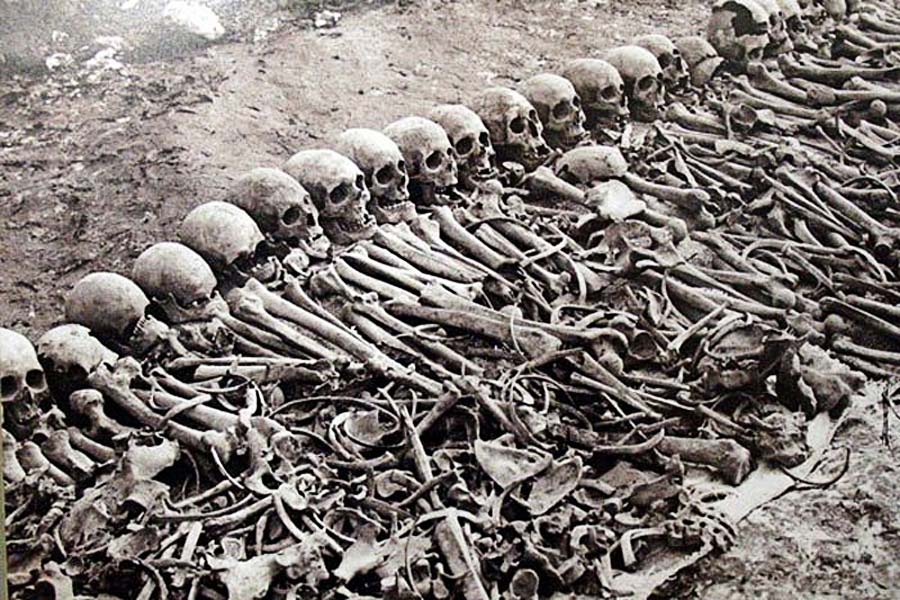
Armenian-genocide-bones

Audio: http://www.radio4all.net/index.php/program/81982

or direct link to mp3: https://ia601504.us.archive.org/29/items/20150728USRulePart1/20150728%20US%20Rule%20Part%201.mp3

[Below is a transcript which is about 95% complete and which contains links to some material that is cited in the commentary]

It would be a vast understatement to say that the word “genocide” is not well understood. In politics, in academia and in normal everyday communication the word is almost exclusively misused and abused.

You might believe that the normal everyday usage (or, sometimes the usage of those with the authority of knowledge) is definitive. What a word means is what meaning is given to it. In most cases I would agree. The usage by ordinary people of a word is where the word usually derives its meaning. Not, however, when that usage contradicts itself. Not when that usage can only misrepresent the actualities that it purports to describe. And not when it is completely divorced from its original meaning.

For example, a recent Buzzfeed article refers several times to the British “attempting” genocide against Aborigines. That makes no sense. Genocide isn’t a single act, like burglary. Genocide either happens, or it doesn’t. We don’t refer to the genocide of Jews in World War II as “attempted genocide”. We don’t even refer to an “attempted genocide” in Rwanda. People have a vague notion that genocide must somehow mean complete extermination, except that they are not consistent in that. Genocide is used in different ways according to political criteria,. This isn’t merely slippage, but it actually requires that people do not have an actual definition of the word. It is a word that has had its meaning suppressed because the concept that the word represents is a dangerous concept. It is a concept which cannot be held on an ideological leash. It will drag the holder into the brambles of radical unorthodoxy rather than let itself be led to the park to chase a frisbee.

Any limit to our vocabulary is a limit to our thinking. Our society, like all others, constrains our vocabularies so that some thoughts are unthinkable. We may live in a pluralistic multinational global culture that is in many ways organic and diverse, but the repression of thought to which I refer is systematic and purposive and it is in the service of power. All languages have words or phrases that others lack, but I am not suggesting that merely lacking the word for a concept is systematic repression. Instead, words like “genocide” or “terrorism” are stripped of stable rational meaning whilst being vested heavily with emotive affect. This is the process that creates an orthodox idiom – which is to say a systematically and coherently circumscribed mode of language and thought.

This meanings are, as I have said, suppressed rather than erased. It would be wrong to view these words simply as “empty signifiers” as if the arbitrary nature of language meant that one could exert one’s will over language with full control. That is a type of vulgar postmodernism – a megalomaniac fantasy such as Karl Rove was indulging when he said: “We’re an empire now, and when we act, we create our own reality. And while you’re studying that reality—judiciously, as you will—we’ll act again, creating other new realities, which you can study too, and that’s how things will sort out.”

Outside of Rove’s self-aggrandising fantasies, you cannot simply assign meanings to words at will. They must fit within a network of intelligibility that is grounded in a history of usage. Instead of simply redefining words what orthodox usage does is to load a word with emotion and political ideology whilst suppressing its basic and fundamental defining characteristics (which may be more or less broad, more or less faceted, and more or less mutable over time). This leads to an unstable and contradictory usage. That isn’t a problem to the orthodox ideologue but rather a great boon. It allows the word to be used differently according to need. Furthermore, because of the emotionality attached people will fight against any attempts to reinstate a stable and comparatively objective usage.

Genocide is exactly such a word. It first appeared in a work called Axis Rule in Occupied Europe, published in 1944. It’s original meaning cannot be erased because it is part of a network of inter-contextualised signifiers which exist in history. At the same time, though, that meaning is thoroughly obscured. People argue that something is genocide because it is really bad, while other people argue that you can’t call something genocide because it is not bad enough and to label it genocide would be an insult to victims of real genocide.

The meaning of “genocide” has not changed over time because the meaning was suppressed from the beginning. It was always a dangerous notion. People wrongly think that it was purely a response to the German atrocities that Winston Churchill referred to as “a crime without a name”. But Raphael Lemkin, who invented the term genocide, had long been thinking on this topic and what he described was a far broader and more historically significant phenomenon which didn’t merely describe acts of mass murder, but made sense of them. Unfortunately for Lemkin’s future career, once the logic of genocide is grasped it will reveal truths that are unpalatable and unacceptable. In the 1950s Lemkin devoted much of his attention to the genocides of indigenous people in the Americas, particularly North America. Lemkin established a clear intrinsic link between settler-colonialism and genocide and had he lived longer he would inevitably had to have recognised that the link between genocide and all forms of imperialism was nearly as inescapable.

Genocide is not, and never has been, something that you switch on and off. It is not a discrete act. It is not distinct from war and militarism, nor authoritarianism and political oppression. The institutions of genocide that a state creates will not end until they are eradicated. The German genocide in East Africa at the beginning of the 20th century created institutions which would later be instruments of genocide, but were also tools of repression used on political dissidents. Likewise, the institutions of genocide that are deployed in the Middle East and Africa are continuations of genocidal practices from Asia and Latin America, and are already imprinted in the nature of policing in the USA and in the authoritarian rhetoric and policies of David Cameron and the Conservative government in the UK.

Many contemporary thinkers from Sheldon Wolin and Giorgio Agamben to Jeff Halper and Chris Hedges are trying to grapple with the increasingly arbitrary nature of the state, its increasing hostility to humanity, and the increasing precarity of the people. (When I refer to the state here, I am referring to the nexus of governmental and “private” power which exercises effective sovereignty, not to the narrow concept of a governmental state power with formally recognised sovereignty). If we are to understand this situation in a way that will help to end its deadly progress, the greatest single step that we could take at this time is to reacquire the term “genocide”. Lemkin used it to describe the phenomenon that was the driving force behind German occupation policies in Europe. This inevitably also applied to Germany itself, though that was not Lemkin’s focus. For Lemkin the concentration camp was the defining institution of genocide. But Lemkin meant the term broadly. He considered Indian Reservations to be a form of concentration camp and would have most likely conceded that its is the power structure created by the barbed wire enclosures that is more important than the wire itself. For Giorgio Agamben the prevailing logic of the concentration camp is that of the “inclusive exclusion” and he has contended that that is the “biopolitical” paradigm of our age. The term “biopolitical” in its broader sense, refers to the way in which power exerts control over bodies, and I will argue that on a large scale the “biopolitical” becomes the “demostrategic”. At the large-scale demostrategic level, this paradigm of power may express itself in the very phenomenon of genocide that Lemkin first described.

In this series of articles I am going to draw threads together that show the need make appropriate usage of the term genocide as a way of revealing a pattern of destruction and mass violence that is interconnected. It is the millions of deaths in the Democratic Republic of the Congo; it is the permanent dysfunction and instability of Somalia and Libya; it is Plan Colombia; it is Iraq and Afghanistan; it is mass surveillance and it is the Trans-Pacific Partnership Agreement; it is Haiti and its is the political and drug related violence in Mexico; it is the “huge concentration camp” of Gaza and it is al-Sisi’s Egypt. This is the nature of US Rule on the Occupied Earth. It is all of a piece. It is all shaped by genocide. It is all becoming more genocidal.

Sadly, even the best intellectuals seem only to vaguely grasp that the term “genocide” has actual an definitional meaning. In contrast those who are more inclined to be opinionated or generally less inclined to to use cogent thinking are only too happy to forcefully tell people that their usage is not only wrong but offensive and dangerous. It is like the poem by Yeats, which, as it happens, foreshadowed the rise of Nazism,

“The best lack all conviction, while the worst

Are full of passionate intensity.”

Israel Shamir, for example, has let his anger at the misuse of the term genocide obliterate his mental faculties. He recently wrote that Lemkin coined the word genocide “in order to stress the difference between murdering Jews and killing lesser breeds. The word is quite meaningless otherwise.” He must know at some level that this is untrue, but he writes with thoughtless rage. The effect is to tell his readers not to even think about genocide – “It would be good to ban this word altogether.” That is not going to prevent the misuse of the word. In fact it plays into the hands of those who misuse the term in order the perpetrate aggression and genocide. The way to end the misuse is to treat the word genocide the way you would treat any other. When genocide is asserted we should expect that the usage is justified based on definitional criteria. As it is, telling a readership that already opposes imperialism and Zionism that the word “genocide” has no meaning only makes it easier to exploit the term for propaganda purposes.

“Genocide” is a word that itself exists in a state of exception. People will scream at you for suggesting that it can be weighed or compared in any way with anything else. Even some genocide scholars call it a “sui generis” phenomenon, meaning that they want to say that it cannot be defined, but they reserve the right to label some things as being genocide on the basis that they themselves know what it is when they see it. Moreover, there is a broad intellectual trend to treat genocide as a sacred word which only special experts may employ, because any improper usage would be hyperbole and damaging to one’s credibility.

Sadly this was the case on the radio programme Against the Grain, which is from broadcast Berkeley by KPFA (a storied non-profit radio station which also broadcasts the superb programme Flashpoints).

Against the Grain is aptly named. In a world of growing anti-intellectualism, interviewers and producers C. S. Soong and Sasha Lilley do their work with a depth that is hard to find elsewhere in political analysis. They interview intellectuals with the sole aim of facilitating the transmission of ideas and information. No words are wasted on flattery or extraneous personal detail. Above all, when Soong or Lilley conduct an interview they are very conversant with the material they are discussing. Most impressive to me, though, is that they never assume that the interviewee can’t explain something to the audience. They don’t try to avoid things on the grounds that they might bore or confuse us mere plebs, instead they chop them up with timely interjections so that they are digestible and so that the flow is maintained. In other words, they make it as easy for the audience as possible, but they don’t pander in any way.

Pandering is, of course, the one of the great intellectual plagues of our age. Ideas that came from the realms of marketing and mass entertainment have spread to infect all corners of society. The ideology of using a restricted vocabulary of words and ideas in order to never tax people’s brains by asking them to learn something new is an obvious recipe for disaster. You cannot learn if you are never presented with anything you do not already know. Pandering makes people stupider on the whole, but it also makes substantive change impossible. Pandering is not just about avoiding inflicting the pain of thought on people, it is also about not disturbing ideology. In political activism pandering is rife, and it is always represented as being “tactical” and “realistic”. That is why I appreciate a programme, like Against the Grain, that pulls no punches and tells it like it is.

However, if there is one thing on which people are guaranteed to pander in both intellectual and ideological terms it is the topic of genocide. People mystify it and misuse it. They sneer at the people who dare to suggest that the US or Israel or the UK is committing genocide, because they “know” that anyone making such an accusation is just engaging in political sloganeering. This is supposedly “debasing the coinage” in the words of the late Michael Mandel, showing that even the most admirable people can be very stupid when it comes to this topic.

Equally admirable people show that there is another face to this debased coin, using the term “genocide” to try to raise the alarm on the world’s horrors. A recent example of this was an interview with Professor David Isaacs on the plight of asylum seekers held on Nauru. What he reveals is an alarming and inhumanly cruel situation. It is a situation that cries out for action. But then he says that he is told “don’t use the g-word, the genocide word, … or people will think you are too extreme”. He is thinking exactly the same way that Mandel thinks, but from the other direction. In their construction “genocide” is a type of currency that is to expended when our subjective sense of alarm tells us that something is really really really bad.

For this reason, I was disappointed but not exactly surprised when the subject of the “g-word” was broached on Against the Grain and then treated as some special mystical term whose applicability could only be determined by the most authoritative authorities. This was towards the end of an otherwise excellent interview about the plight of Sri Lanka’s Tamils now, 6 years after the end of the 26 year-long civil war.

What was described by interviewee Anuradha Mittal is a textbook example of genocide. In genocide the killing of the victim population as such is not the end it is the means. When he first coined the term “genocide” Raphaël Lemkin wrote the following:

“Genocide has two phases: one, destruction of the national pattern of the oppressed group; the other, the imposition of the national pattern of the oppressor. This imposition, in turn, may be made upon the oppressed population which is allowed to remain or upon the territory alone, after removal of the population and the colonization by the oppressor’s own nationals.”

In other words, the Sinhalisation of both the Tamil peoples and the land to which they belong is a defining genocidal characteristic. The direct violence of genocide arises because resistance is inevitable. The deprivation of social, cultural, religious, economic, and linguistic capital is itself a form of violence which victims cannot help but resist.

Mittal’s interview reveals that it was persecution and communal violence that initially drove some Tamils into an armed separatist movement. Now in the aftermath of the long bloody civil war she gives details of conditions based on a recently released report that she authored. Once you understand the concept of genocide, what she is describing in every aspect is symptomatic of genocide. Everything she talks about is characteristically genocidal, from the way the hegemonic victor tries to enforce a certain historical narrative through memorials, to the way the land is imprinted with a state, military, religious or linguistic character to alienate it from Tamils. In fact, the most salient and striking genocidal features are not the mass violence, but the unusual things such as having military run tourist resorts in occupied territory. That sort of behaviour only makes sense in the context of genocide.

At one point Mittal quotes Dr Rajani Thiranagama: “Objectivity, the pursuit of truth and critical, honest positions, is crucial for the community, but is a view that could cost many of us our lives. It is undertaken to revitalize a community sinking into a state of oblivion.” In that spirit, it is absolutely essential that genocide be understood for what it is. Without full and frank comprehension it will never end, even if the intensity of direct violence waxes and wanes.

Consider the persecution of Jews under the Reconquista, when Spain and Portugal were conquered by Christians 500 years ago. The persecution arose from a confluence of interests of state-building political elites, religious authorities seeking to increase power, and individuals looking to acquire land and other property sowed seeds of violence that would continue through the ages. The state sought to integrate Jews as “Conversos”, but the state also sought to repudiate that conversion in order to enforce uniformity, exercise religious authority and sieze property. In other words, the Converso’s became the “included exclusion” – the very circumstance to which concentration camp inmates are subjected. From that came the concept of “Crypto-Jews”, leading to the ideological linking of Judaism with occult conspiracy. Additionally the concept of ineradicable and heritable “blood guilt” was used. This not only fuelled future pogroms, but arguably formed a key ideological foundation of all modern racism. In the same manner, until the genocide of the Sri Lankan state is comprehended, exposed and repudiated by consensus, the ideological tools for future genocidal violence will remain intact. Tamil resistance, whether violent or not, will be delegitimised as “terrorism” and this will in turn be used to legitimate violent and deadly repression.

That is why my heart sank so low when the conversation on Against the Grain turned to genocide. There was a general tone shared by Soong and Mittal that was suggestive of the “ultimate crime” which the exchange portrayed as being beyond mere “war crimes”. Then Mittal said that the question of whether genocide had occurred should not be prejudged but should be decided by the “international community”. This makes me want to ask, what does that mean? Is it somehow above your pay grade to weigh the evidence? Is genocide something so controversial that only the high and mighty can pontificate on it? This is anti-intellectualism. Mittal is tacitly stating that we should not think about such things and that the thinking should be left to authorities. And what authorities are these? The term “international community” effectively means the US State Dept. or what Noam Chomsky has labelled as “IntCom”. This is true regardless of the intent of the speaker because if you promote the “international community” then those who control the usage of that term in political discourse get to decide what it entails and your original intent is meaningless.

Things took a turn for the worse when Mittal brought the ICC into the conversation. I don’t know what mania is gripping people at the moment, but every advocate for victims of persecution seems to think that the solution will be found by putting people in the dock at the Hague. I think that this is some sort of woefully misplaced yearning for a corrective patriarchal authority figure, and it poisons our discourse on genocide and on war crimes. People think that wrongs must be righted by the exercise of power in order to grant some psychologically satisfying sense of balance. This is quite divorced from practical realities including that of actually ending today’s atrocities, rather than fixating on a tiny percentage of those that occurred a generation ago. Does anyone actually look at the record of the ICC? There are some informed apologists for the ICC out there, but even they don’t defend it actions thus far as much as they claim that it will do better things in the future. Critics like David Hoile cannot be countered except with speculation about how wonderful the ICC will be at some future point. Hoile is an old Tory who may or may not be in the pay of Sudanese war criminals, but when he (a right-wing white man who was once photographed with a “Hang Nelson Mandela” sticker on his tie) debated the ICC in the pages of New Internationalist, he was far more convincing in suggesting that the ICC was institutionally racist than Angela Mudukuti, who argued that “attempting to undermine its legitimacy with allegations of racism will take the global international criminal justice project no further.” It is well worth looking up that debate for the sheer surrealism of the fact that the young bleeding-heart African woman effectively tells the old hairy white male Tory that he needs to be more trusting of the authorities or he will harm their efforts to run the world in an orderly manner. Whatever one thinks of Hoile, though, he has published a 600 page volume on the ICC which is full of substantive criticisms that stand regardless of his history or motives.

The fact is that if you don’t accept in advance that the ICC is both benevolent and a repository of expertise and authority, it is pretty difficult to see anything good in its patchy record of expensive and unacceptably lengthy proceedings all of which are against Africans. As an instrument of justice it is inefficient, dysfunctional and pathetic beyond belief; as an instrument of neocolonial domination it is very expensive, but probably considered worth the price by the European powers which bankroll its activities; as a propaganda instrument capable of making slaves scream out for more chains and whips, it is clearly priceless beyond measure.

The fact is that many national courts and international bodies can chose to exercise so-called “universal jurisdiction” over cases of genocide anywhere in the world. The ICC is a very silly place into which to channel one’s energies, but are prosecutions in general any better? There are two problems here. … Labelling genocide as a crime has become a very harmful distraction. It is this, more than anything, that has turned the term into one that is so misused for political ends. Genocide is represented as “an act” and the “crime of crimes” that exists in the world of black-and-white morality where its ultimate evil justifies acts of great violence, and makes people feel the glow of self-righteous anger.

People like to call for prosecutions because it is an instant source of gratification. The judicial system becomes a proxy instrument of violence either as combat or retribution. This is appealing to those who are in one way or another impotent. Prosecutors are symbolically taking the role of their antecedents, champions of weak who fought in trials by combat. Sometimes the most fervent advocates of this form of state violence are “pacifists”. The problem seems particularly acute in the US where the punitive impulse runs very deeply. It seems that US citizens are induced to feel acutely threatened and constrained by the domestic or foreign Other and are thus prone to support police, judicial or military state violence.

You might think that it is good that state violence be used against those found guilty of genocide and, to the extent necessary, those merely accused of the crime. That is fine if you call it what it is – retribution. If you consider that to be justice, then your concept of justice is retributive. I know that some would also argue that victims gain a sense satisfaction and closure, but since the vast majority of the victims of mass violence will never have access to this “satisfaction” it is a rather hollow and bitter virtue.

People talk about prosecutions as if they will have practical beneficial ramifications in ending violence. This flies in the face of the historical record. No one is ever prosecuted before they are in one manner or other defeated. In some cases they might be the sacrificial offering by a criminal grouping that consolidates itself by allowing one member to be culled, but more often it is simply a matter of victor’s justice. The accused is defeated by hard power means before they are ever detained. They might be very guilty of heinous crimes, but guilt is in fact incidental to a thoroughly political process.

Meanwhile, the ICC enthusiasts claim to be all about ending impunity. If you actually just step back for a second you will see that the application of international criminal justice in the ICC, ICTY, ICTR and in national courts does absolutely nothing to end impunity. Instead of viewing Charles Taylor and Slobadan Milosevic as villains who deserved punishment, imagine what message their prosecutions sent to the world. It is the same message sent by the deaths of Saddam Hussein and Muammer Ghaddafi, and that message is that the only hope for someone who is targeted by the US is to fight to the death. Making peace and going into exile is not an option. International criminal justice is only victor’s justice against the vanquished and a neocolonial weapon in fighting Third World nationalists.

The only other way that someone responsible for mass violence might be prosecuted is when the real war is won on their home turf. That real war is the intellectual and moral struggle – the fight to expose the means and ends of those who commit mass atrocities and, above all, the fight to vanquish apologetics. Jay Janson, who writes in Dissident Voice and Counter Currents, castigates people like me for not constantly calling for prosecutions of US officials and for not condemning every single citizen of each and every Western state to be a war criminal. He is right though, to point out that we must never stop referring to the crimes of the US “hyper-empire” as crimes. But history shows that the crimes do not end until the regime itself is recognised as criminal. It is not enough to recognise individual acts as crimes or actors as criminals. A majority of US citizens once recognised US interventions in Indochina as war crimes, but it changed nothing because it was constructed as a failing and a failure, not as a success.

Fatuous pundits and lying politicians like to claim that the US relies on “international legitimacy” and that this makes military interventions failures, but if you examine the history of US war crimes and crimes against humanity you can see that they follow the Maoist principle that all power comes from the barrel of a gun. They coerce other countries, including close allies, into treating them as legitimate. The real problems for the US regime that arose from the aggressions against Indochina were a dispersed and pluralistic domestic insurrection, that might have consolidated into a revolution, and a mutinous military. Once they had those problems solved they went back to serial aggression and serial genocide and many millions have died as a result. Therefore, it is necessary to create a consensus that the political establishment is criminal as a whole. Once that fight is won you can choose to try and move forward with prosecutions, as in Argentina, or with a truth and reconciliation process, as in South Africa.

Prosecutions are not a road to change. You can’t expect the corrupt institutions of a corrupt society to take any action that does not make the problem worse. The best that a campaign calling for prosecutions can be is an awareness raising campaign. If you really think that if you mobilise people and push hard enough some top-down bureaucratic judicial body will make a positive difference, then you need to find out what time it really is. We don’t need to lock Bush and Blair in prison, we need to de-legitimise them, disempower them, disempower those who support them, and end the criminal regimes of which they are merely transient components. It is true that if George W. Bush were in prison he wouldn’t be able to charge $100,000 to give a speech for a charity raising money for amputee veterans. But as grotesque and freakish as that is, the Bushes, the Clintons and Tony Blair only get so much money because a whole stratum of society worships power. In a situation that is equally reminiscent of pre-revolutionary France and Nazi Germany, our elites simply do not have any functioning morals. Without coercion they will never even acknowledge a moral component to the exercise of power, but will fawn all the more over those that commit war crimes because that is an exercise of great power.

Continued in Part 2: “Days of Revolt”.

The ICC Will Only Hurt the Palestinian People, Part 2: These People are Warmongers and We Should Revile Them

Standard

In Part 1 I discussed various things relating to the International Criminal Court. With all its humanitarian rhetoric, the actions of the ICC have consistently been a source of injustice and suffering. Moreover it has been the enemy of truth – perhaps the greatest crime because it can perpetuate suffering for generations to come.

Part 2 deals with, among other things, the undue deference paid to those who professionally don the mantle of humanitarian. These are not great humanitarians, quite the reverse. Just as hierarchies of “knowledge” can produce ignorance so can “humanitarian” hierarchies militate against humanitarianism. By analogy, if I want to hear a cogent perspective on US foreign policy I would almost be better off heading to the pub and looking for someone in the mood to be candid than I would be in heading to a foreign policy think-tank. Equally, once professional “humanitarians” have internalised the idea that they are inherently moral, it is pretty easy for them to neglect morality altogether.

I feel that it is constructive to cultivate contempt and anger at those who are more-than-comfortably well off because of their role within agencies of dysfunction and harm such as the ICC. At the same time I am aware that critics of people within institutions often personalise criticism – not as insults nor ad hominem critiques, but as a presumption that a mistaken intellectual stance must be the result of bad intent. Obviously, I am not saying that we should extend the benefit of doubt to Obama or Kissinger or Power. Sometimes, even if people believe that they are doing the right thing it is not relevant. Pol Pot thought he was doing the right thing, but so what? For people with less executive power, though, it is generally counterproductive to attack their motives.

My answer is to cultivate contempt for the collective, and respect for the individual. Self-satisfaction is destroying the intellects of people who succeed in many walks of life, and none of us plebs should continue to feed that.

Preventing Peace

When an accused criminal is the demonised leader of a Third World state, there can be no compromise according to the pundits. Only prosecution to the utmost extent of the law is acceptable, even if innocent people must die to achieve this.

When official villains, certified by the US State Department, are up for prosecution we enter Oppositeland. War is peace and the rule of law means lawlessness. The pundits enter a cop-show fantasy where law is not an imperfect instrument of ethics, but a tool of righteous justice. The rule of law doesn’t mean abiding by the law even when the results are not to your liking, but it now means breaking the rules to ensure that the bad guy is always punished. For example, in How America Gets Away with Murder, Michael Mandel pointed at the “absurdities” of Western newspapers touting the triumph of the “rule of law” after Slobadan Milosevic was illegally extradited from Serbia under extremely political circumstances.

The bloodlust and the self-righteousness can lead to a lot worse than subverting sovereignty and bringing the law into disrepute. Hard lines on “the end of impunity” are a potential enemy of peace both indirectly and directly. Take the case of Charles Taylor. He ended a civil war and left the country when he was offered exile in Nigeria. The US Congress soon voted to offer a $2 million bounty on Taylor. Richard Falk criticised his later capture, prosecution and conviction on the ground that it was selective prosecution serving US political ends: “…when the application of international criminal law serves the cause of the powerful, it will be invoked, extended, celebrated, even institutionalised, but only so long as it is not turned against the powerful. One face of Janus is that of international justice and the rule of law, the other is one of a martial look that glorifies the rule of power on behalf of the war gods.”

There is hypocrisy, and the direct intervention of neutralising enemies through the courts, and the implicit threat to other Third World leaders that if they do not run their country according to US wishes they may end their lives in a prison cell far from home. But in some ways, those things are not the worst of it. The worst thing is that the next Charles Taylor will look at his future and weigh whether to concede defeat in war and flee the country. Remembering Taylor, he or she will decide instead to fight to the death and thousands of others will die as well.

That is an indirect way of promoting conflict, but ICC indictments can be used to more immediate warmongering effect. Shortly before NATO started an air war against Libya in 2011, the UNSC instructed the ICC to investigate Libya (despite the fact that the US, Russia and China refuse to be subject to the ICC themselves). The probe centred on the killing of political prisoners in a prison in 1996. As Phillippe Sands pointed out at the time the very existence of the investigation made a negotiated settlement to the civil war in Libya less likely. Indictments for Muammer Ghadaffi, his son Saif al Islam and his brother-in-law came less than two months after NATO bombs killed another of Ghadaffi’s sons and three of his grandchildren. Both flight and negotiation became impossible. The indictment ensured that fighting would continue – meaning that people would continue to be killed and maimed.

Given the timing and the political nature of the decision to indict in the midst of war there are really only three possible reasons for the indictment. One is that US and European leaders wanted to make a salient demonstration to the world of what happens to leaders who they dislike and they don’t care how many Libyans are killed in order to make that demonstration. (In retrospect the Panama invasion of 1989 can be seen as such an operation, and the best estimates of Panamanians killed in “Operation Just Cause” are in the thousands.) The second possibility is that the same powers were actually desirous of conflict in Libya as a divide-and-control strategy whereby independent development is curtailed by ongoing destabilisation and ever-renewable civil strife. This would be entirely fitting within a pattern of interventions which has sown conflict and degraded central governance in dozens of countries. The third option is that both of the previous options are true in varying degrees.

Colonisation by NGO

Palestine is one of a number of societies rife with NGOs. Mandy Turner has shown that the “liberal peacebuilding” practiced by these NGOs is a colonial practice and a contemporary “mission civilatrice”. Israel’s colonial practices are “at the expense of Palestinian self-determination”, but Western-backed “peacebuilding” is “at the expense of a development strategy for national liberation”.

The “liberal peacebuilding” prescription of “neoliberal policies of open markets, privatization and fiscal restraint, and governance policies focused on enhancing instruments of state coercion, ‘capacity building’ and ‘good governance’” is simply neocolonialism. These are the practices developed by the British and imposed wherever possible on colonies, former colonies and parts of the formal empire. Once upon a time it was called “liberalism” now it tends to be called “neoliberalism”, but it amounts to the same thing – colonial control that ensures both dependency and impoverishment. The main difference here, and in other neocolonies, is that the former colonial power does not have an exclusive concession and the exploitation and expropriation (which may be of donor money rather than indigenous wealth) is a multinational Western project.

In short, while Palestinians are concentrated into fragmented reservations by Israel’s settler colonial project, within those patches an additional burden of neocolonial servitude suppresses independent development. But as Turner also indicates, part of the neocolonial NGO dominance is the delegitimisation of violent resistance: “…the ability to decide whether someone is or is not a ‘partner for peace’ and thus act on this decision is unequal. This phrase, therefore, made Israel’s attempts to control Palestinian political elites seem innocuous. It also allowed donors to believe that funding and working with Palestinian elites regarded by Israel as being ‘partners for peace’ would assist their mission of supporting the peace process. In its application this paradigm has variously meant Israel justifying cutting off revenue transfers to the PA, arresting and detaining democratically elected Palestinian politicians, extrajudicial executions and military violence. It has also been used by donors to justify cutting off aid, reverting to ‘bad governance’ practices, and supporting regime change. It has been, in effect, the discursive framework that has bound the two practices of control together and has given them common purpose.”

One Person’s Terrorist is Another Person’s Legally Elected Political Representative

Building on Turner’s work another legal scholar, Vicky Sentas, gave this talk on “peacebuilding as counterinsurgency”. Her focus is on the listing of the Kurdish PKK as a terrorist organisation, but the logic applies equally to Palestinian armed resistance formations given that they all have been or could be declared terrorists on the basis of their resistance activities. The terrorist listing is even worse than politically motivated accusations of war crimes or crimes against humanity because it prejudicially criminalises people on the basis of belonging to a designated terrorist entity. If you delegitimise resistance or insurgency on the basis of acts designated as “terrorism” than all personnel become “terrorists” regardless of their own actions.

Of course the main use of the term “terrorist” in the last 100 years has been as a way of delegitimising armed violence from non-state actors. Our elites work hard to avoid any suggestion that terrorism might actually refer to the intentional use of terror per se, because that would inevitably mean that the greatest terrorists are the most powerful states. Noam Chomsky’s famous assertion that we ignore the “wholesale” terrorism of militarised states and concentrate on the “retail” terrorism of armed non-state entities doesn’t really suffice. “Terrorists” means people with weapons or destructive implements who we don’t like and who we can get away with labelling as “terrorist”. Whether they actually practice the use of terror is not relevant. Anticolonial rebels were called terrorists; the resistance to German occupation in Europe were labelled “Bolshevist terrorists”; the Viet Minh and later the National Liberation Front were labelled “Communist terrorists” from which came “Charlie Tango” and hence “Charlie”. The only difference is that now we have an international regime, subject to US hegemony, which makes this political, and inherently oppressive, act into a internationally legalistic one.

The idea of terrorism itself is a way of implying that the organised armed violence or property destruction of a group is illegitimate as being criminal and outside of the behaviour of combatancy. The old-fashioned approach was to suggest that belligerent parties such as insurgents must be treated as combatants. After the cessation of hostilities the victor could legitimately label the defeated foes as traitors and deal with them as such. This is hardly perfect and does nothing to prevent victor’s justice and judicial massacres. On those grounds some might think that it is a pointless distinction to make. But there is a certain sense that if the belligerents were criminals en masse because terrorism is a crime, then they would properly be dealt with by the normal policing and judicial processes of the state in question. If the response to an organised challenge is military violence, paramilitary violence, counterinsurgency, “counter-terror”, political violence and or political terror, then you are in a situation of armed conflict and the enemy should be treated as a combatant, at least for the duration.

Anyone who has Followed the Thread of This Article to This Point…

deserves a medal. But they also might be asking: “Hang on, surely joining the ICC will strengthen Palestinian claims to statehood and make their resistance more, not less, legitimate.” I wish it were so, but it is unfortunately more accurate to say that those countries that are subject to the ICC may find themselves in the same situation as Palestinians if they face aggression or occupation. They may find that politically determined accusations about the manner in which armed resistance is conducted or internal conflict is dealt with are used to delegitimise all resistance either informally or formally through the enforcement of terrorist listings.

Bear in mind, too, that entities like the US and Israel have a long-standing habit of conflating armed and unarmed resistance activities. In Viet Nam the US coined the term “Viet Cong Infrastructure” (VCI) to designate people who had sympathy for the National Liberation Front and the People’s Liberation Armed Forces (PLAF). The term Viet Cong had already conflated combatants and non-combatants who opposed the Saigon regime, now the VCI designation worked in the same way as a “terrorist” or “VC” designation, legitimising deadly violence as if the victims were combatants yet denying the rights accorded to combatants. VCI were the prime target of the notorious Phoenix Programme. Unlike actual NLF officials or PLAF personnel those fingered as VCI, often by tortured suspects, were easy to abduct or kill at their homes.

A similar mentality is even applied now domestically in the US, with the designation of “material support for terrorism”. This sounds like it could only mean substantive support for actual terrorism such as providing money or materiel to suicide bombers. In practice the case of the Holy Land Foundation 5 shows that it is political designation intended to conflate the crime of thinking the wrong thoughts with unlawful acts of violence. The victims of that judicial persecution are serving sentences of up to 65 years for sending money to charities allegedly controlled by Hamas. They were not accused of funding terrorist activities, but of sending funds to a terrorist entity.

The HLF5 defendants are claiming that they were entrapped because they tried to get a State Dept. list of approved charities, but were denied. The point of the exercise is to create a political language in which giving charity to orphans is “terrorism”. This accompanies an ongoing exercise to “rebrand” military violence, including killing civilians, as “humanitarian”. The most important thing to remember is that this has worked. If you put “holy land foundation trial” into a search engine that does not anticipate your desires (such as duckduckgo), you will find that their conviction was a victory against Jihadi terrorism and the plot to enforce Sharia in the United States of America.

This illustrates that we are really faced with two possible ways of dealing with the overall issue of armed mass violence. We can either accept the Nürnberg precedents and the UN Charter. This would mean that war is illegal, all people have a right to life and that the aggressor is culpable for all loss of life and suffering. The UNSC would be able to authorise legitimate military action, but it could only do so in accordance with the UN Charter, which can only mean acting as a collective defence against an aggressor. This is a highly imperfect system and many bad things can happen to people that this particular system does not act to prevent or discourage. On the other hand, this system outlined does not actively facilitate atrocities, while the alternative does.

The system that is favoured by the US, and ultimately promoted by the ICC, is one in which the armed violence is legitimate if carried out by lawful combatants in a lawful manner. Unlawful actions by lawful combatants are not legitimate, but they are a side-issue of individual criminality. In contrast, unlawful acts committed by unlawful combatants are the retrospective rationale for justifying unlawful status and all resistance by unlawful combatants is unlawful. In other words, might makes right. Lawfulness or unlawfulness depend entirely on the ability to control perceptions. The powerful are allowed to commit mass violence against the weak, and the resistance of the weak will make them the perpetrator and justify the acts of the powerful.

Israel’s Persecution Complex

The ICC’s significance is inevitably that of a public relations exercise. Even the “end of impunity” enthusiast must readily admit that the Court’s function is not to provide specific deterrence but to create general deterrence (supposedly by ending impunity). In fact, there is no evidence or concrete reasoning that would support that claim, but it has a veneer of rationality. This isn’t a matter of common ignorance, this is highbrow ignorance for superior idiots only, but even on these terms the putative general deterrent effect is the result of managing perceptions. Thus even the supporters know that ICC activities are a form of display, and their trial are inevitably show trials.

Because the ICC is one big politicised PR exercise, legalistic analyses of the ICC are less important than discursive analyses. I have concentrated on the ways in which the ICC is part of the ongoing process of creating an international political discourse of “good guys” and “bad guys” in which the powerful control the language, the conversation and thus, ultimately, the perception. This is a thought control process aimed largely at the intelligentsia. But in the case of Palestine, ICC membership will further another project of thought control – that of the Great Israeli Persecution Complex.

Historically Jews have suffered a great deal of persecution. In Europe during World War II this persecution became something that truly defies words. Even at a time when unspeakable acts and unimaginable suffering were the experience of many millions throughout the world, the fate of Europe’s Jews stand out. The German concentration camp, slave labour, and extermination camp systems, and the mobile civilian mass-murder systems, exceeded all historical precedents of cruelty. I do not write that lightly and I am not forgetting Potosí, nor the Atlantic slave trade, nor the victims of Japanese occupation, nor the Ukrainian Terror Famine, nor any of the other great obscenities of humanity. Jews were not the only victims, by any means, but in some respects they were the key and exemplary victims.

If Zionism had ever been purely a response to persecution, perhaps the lesson of the Shoah might have been commit to opposing all acts of genocide. It would be an anticolonial movement. But Zionism was never purely about an enduring escape from persecution. It has always accommodated a combination of nationalism, colonialism, racism, chauvinistic religious belief, and Imperial power politics. In addition we must account for the role that greed and love of power play in all political movements that provide outlets for them. Thus, inevitably, the response to the Shoah was not an organic response that would reject all genocidal cruelty, but an exploitative one by a existing system of power hierarchies whose human components seized on the emotional and political capital provided by the murder of millions.

The historical persecution of Jews and the Shoah actually have very little to do with the realities facing Israel. I am not saying that there has never been persecution of Jews in the Arab world, nor that anti-Judaism is no longer a matter of concern in Europe or elsewhere. These are complicated issues which I cannot get into here. I will confine myself to pointing out that when the Argentine junta was detaining Jews and sending them to camps where they were sometimes tortured in front of pictures of Hitler, and many were killed, the Israel’s government sided with the neo-Nazis, not against them.

But when it comes to the occupation of Palestine, the exploitation of past persecution is the gift that keeps on giving. The ICC will provide an ongoing opportunity for the Zionist regime to harp on about how the entire world hates Jews on a regular basis. It will be like the Goldstone Report on a loop track.

To refresh your memory, the Goldstone Report was slanted against Palestinians. Richard Goldstone, the lead author, is an avowed Zionist despite his history of opposing apartheid. This was a fact finding mission, not a judicial inquiry, but it should still have addressed the question of aggression. Instead it misleadingly affirmed Israel’s right to self-defence. Noam Chomsky characterised the report as being pro-Israel on those grounds. It was also disproportionate, devoting considerable wordage to Palestinian militant activities, when if weighted by deaths caused Palestinian activities would barely get a mention.

Goldstone had watered down some aspects of the report against the wishes of his co-authors, yet on its release the Israeli government lead a chorus of Zionists, neocons, white supremacists and Islamophobes around the world that shrieked like stuck pigs. They claimed that the whole thing was part of the giant world-wide conspiracy of the Jew-hating UN. Goldstone later strengthened these cries by undermining the report with his name on it. All three of his fellow authors issued their own contrary statement, but hardly anyone heard about that.

This is another one of those inversions of reality, this time in three steps rather than two. When Operation Cast Lead was occurring the raw images tended to show the truth – a helpless besieged people were being attacked in a one-sided slaughter. But if you try searching “goldstone report bias” in duckduckgo you have to scroll down a great deal to find anything that counters the notion that the report was biased against Israel, and I don’t even know how many hits you would get before the first one that suggested a pro-Israel bias.

Even anti-Zionist outlets like Electronic Intifada devote their attention to decrying Goldstone’s later betrayal and defending the Goldstone Report against accusations of anti-Israel bias and completely neglect to show the important ways in which the report was unreasonably and unfairly biased in Israel’s favour. That, far more than the report’s actual contents, is the contribution of the report to posterity and our understanding of Israel’s actions in Gaza. Expect more of the same.

Binyamin Netanyahu has just succeeded electorally by taking a “hard line” and playing on fear and racism. The Great Israeli Persecution Complex has become part of an ever-intensifying spiral of extremism where each new crime necessitates a more insane world view. The world increasingly sees the bare injustice of the genocidal project of Zionism in Palestine. The response within Israel and for their fanatical supporters, who are increasingly confined to the US, is the paranoiac vision of a world of savage “anti-Semites” who oppose Israel out of hatred for Jews.

In reality the international community and the UN greatly favour Israel at the expense of Palestinians, including the diaspora. The UN was Israel’s midwife (the father of the child, Britain, decided that it was not desirable to be present at the birth). The UN has acted to shield Israel from the consequences of realising the human rights of Palestinians. It is a complicated story which can be found by scrolling halfway down here or you could just watch Vera Gowland-Debbas here and here. In short, what it means is that every single member of the United Nations, meaning your government, has a specific moral and legal obligation to act to secure the long absent rights of the people of Palestine. They have failed to do so for 66 years and the only reason for not doing so is the potential negative impact on Israel. No country has any such obligation to Israel nor, especially, to the “Jewish state of Israel”. Individual Israelis have the same human rights as we all have, but the state of Israel has no rights which can override the human rights of millions of Palestinians.

They Walk Among Us!

And who will stand for Palestinian human rights? Our over-privileged and well-tailored liberal apparatchiks advocate that the world’s problems will be solved by meting out white-man’s justice from on high. Self-appointed as God’s gift to human rights, in reality these individuals act to reproduce the most cruel and destructive imperialist violence. They perpetuate the most deadly circumstances of direct mass violence and of structural violence. These are the clerics of Hernán Cortés (“Cortez the Killer”) singing hymns to the righteousness of his bloodletting. They share their apparently capacious catholic faith with overtly hawkish liberal interventionists and neocons, but in reality this is a narrow orthodoxy fitting the requirements of “ostensible diversity concealing actual uniformity”.

Many people have come to realise that “neconservatives” are just a subset of “liberal interventionists”. The fact that highly prominent liberals have always been part of the neoconservative movement, and the fact that they both have identical “moral” facets of foreign policy prescription should have made more people realise this earlier. Still, even now most people are blind to the fact. This is an understandable result of the manner in which these ideologies are presented to people as contending and the manner in which the ideologues criticise each other. The political “debates” between various foreign policy factions in the US are nothing but frenetic, and ultimately unbelievable, theatre. The rhetoric clashes, but the exceptionalist interventionism matches – as do the concrete deeds.

For me it is no stretch at all to see some prominent “humanitarians” as blood-drenched imperialists. As soon as I read Samantha Power’s A Problem From Hell I knew she was exactly as she now appears to us all. It doesn’t take a genius, it just takes actual thought. The neocons themselves considered her book a must read. And she is far from alone.

Human Rights Watch (HRW) has been described as having a “revolving door” relationship with the US State Dept. Amnesty International (AI), in addition to a long history of providing atrocity propaganda to support US interventions, has been implicated in helping a US regime change plot in Eritrea, along with HRW. The US State Dept in 2011 seems to have specifically funded a joint AI/HRW delegation to Eritrea as part of a destabilisation plan. Many of the people within these organisations are dedicated and well-meaning, but the seem oblivious to the malevolent nature of those running things. The clearest example is Save the Children, whose employees were shocked and appalled at the decision by their superiors to give Tony Blair a “global legacy award”.

What shocks me is that people are actually surprised to find that the folks who run big NGOs are power-loving elitist scumbags. I feel like I’m the guy in the movie They Live who has what Slavoj Žižek describes as “critique of ideology glasses”. When wearing the glasses he sees, among other things, that most rich and powerful people are hideous and foul creatures who are the enemies of humanity.

I am not suggesting here that all rich and powerful people are literally malevolent parasites from another species. What I am suggesting is that their humanity is irrelevant. It doesn’t matter if they are loving parents or kind to animals. It doesn’t matter if they spend at least 20 hours each week washing the feet of lepers. In our unequal society even charities are often dizzyingly steep hierarchies; the dynamics of power, and the group dynamics of elite psychology, mean that with some exceptions these people might just as well be bloodthirsty baby-eating reptiles from outer space.

People reflexively defer to the authority of these “successful” people, because they are programmed to believe that advancement within a hierarchy comes through merit, while at the same time they project their own disinterested humanitarian values on to these people. What I see is what I saw in Susan Power, Tony Blair and Barack Obama. These people are happy to take selfies with Bill Clinton, or share a stage with Henry Kissinger. When they debate a neocon like Robert Kagan it is in an atmosphere of mutual respect, if not admiration. The only powerful Westerners who they don’t love are those who actively play the vicious villain, like Donald Rumsfeld, and even then that is entirely contingent and will change as soon as that villain is reinvented by a PR firm and a couple of journalistic puff-pieces.

People like Susanne Nossel (head of PEN, former executive director of AI USA, and warmonger) should only provoke disgust and anger in anyone who really cares about human rights. It is completely irrelevant if they don’t understand why we hate them and if their precious feelings are hurt. They have drunk so deeply from the well of Western hypocrisy that the only thing that can remain true within them is the love of power. The political powers and functionaries that control the ICC are no different. Some may be perfectly well-meaning, particularly if their involvement has simply followed logically from their area of legal expertise, but most are liable to be slime in human form.

The idea that human rights are advanced by a political process of choosing individual designated criminals and punishing them with maximum possible fanfare is likely to appeal to the worst fake humanitarians. Imprisoning people is not a humanitarian pursuit. A true humanitarian is more concerned with emptying prisons than filling them. Moreover, someone who really cared about justice would want to see a stronger International Court of Justice – able to rectify interstate injustice, not spend billions of dollars on prosecuting a handful of cherry-picked expedient pre-fab demons.

I happen to think that many of the people involved in the ICC are most likely to be horrible self-righteous bastards, but even if many of them are deeply concerned humanitarians it does not change the institution. Hans von Sponeck recently said on Democracy Now! “There is a new chief prosecutor in The Hague. And we are now—in mid-April, on the 18th of April, in fact, the War Crimes Commission will meet yet again in Kuala Lumpur to prepare for the second, and hopefully last, draft submission of this documentation to the International Criminal Court.” Obviously there is no harm in handing reports to the ICC, but why bring up the new prosecutor? In the context which he gives the implication is that there is a prospect of the ICC indicting US officials. Does he believe this? Does he identify with the ICC officials and project his own benevolent intents on to them? Is he confused about the difference between the way people act in the real world and, say, the way they might present their desires at a social occasion?

That is why I hang my head in despair when I hear someone as admirable as Dr Francis Boyle discussing the ICC as if Palestinians have nothing to lose, as if the worst of their worries is simply that the ICC will be unable to act on their behalf. In his own words, Boyle “advised President Abbas to accept the jurisdiction of the International Criminal Court….” And, because I know that Boyle an intelligent and caring man, from my very bowels comes the unstoppable question: “Are you out of your fucking mind?”

Conclusion

Inevitably the ICC will do everything possible to seem as if it is responding to public pressure to prosecute Israeli crimes, but it will not prosecute Israelis. It will be biased in favour of Israel, but that will be represented as being even-handed and objective by some, and as being biased against Israel by others. Many supporters of Palestine will be sucked into defending the ICC against accusations of bias.

Palestinian leaders will be threatened with ICC prosecutions both publicly and in private. This will deepen the already profound constraints and controls imposed on them by Israel and the US. This may be enough to erode the ability to resist armed mass violence by Israel, such as the resistance to “Operation Protective Edge”. That conflict was once again a one-sided act of mass-murder, but armed resistance caused enough IDF fatalities that there must have been some deterrent effect. That deterrence will be eroded if Palestinians do not feel able to use armed resistance.

Already Palestinians are beaten with the stick of the Hamas terrorist designation. On the other hand Al Jazeera‘s “Palestine Papers” illustrate that Palestinian Authority leaders are compromised in other ways. I draw the inference that Israeli actions such arresting legislators or the 2002 siege of Yasser Arafat’s compound were ways of creating threats which are levers with which to control PA leaders. The PA leaders might not be traitors as much as they are responding to the political realities of the world that they live in. The ICC will provide more ways of threatening and controlling some Palestinian leaders while turning the other into outlaws. It is all bad news for Palestinians.

Meanwhile, the goodhearted people of the world will be drawn into a narrative of atrocity calculus. The criminality of all Palestinian resistance will be arranged alongside the criminality of a few Israeli bad apples. When all eyes see mounds of Palestinian dead, we will still have our thinking obfuscated. The victims will be made to seem the criminals. The ICC will turn up the volume of the conversation which avoids, at all costs, trying to examine the deep historical issues of justice, and instead yells stridently and chest-thumpingly about the criminality of the “bad guys”.

Meanwhile Israel’s leaders will exploit the empty threat of ICC prosecutions against them to deepen the sense of the whole world is hostile to Jews. Israelis and Western Zionists will be deafened to criticism of Israel’s crimes, slipping ever deeper into the lake of Kool-Aid beneath the mirror surface of which lies Oppositeland.

The ICC is nothing but bad news for Palestinians.

The ICC Will Only Hurt the Palestinian People, Part 1: Brer Bibi’s Briar Patch

Standard

Part 2

I was bred and born in the briar patch, Brer Fox,” he called. “Born and bred in the briar patch.”

And Brer Rabbit skipped away as merry as a cricket while Brer Fox ground his teeth in rage and went home. – “Brer Rabbit and the Tar Baby” retold by S.E. Schlosser.

I had hoped to be writing of his legacy, but sadly Binyamin Netanyahu is here to stay. Nevertheless, one thing is clear even from the flip-flopping Israeli premier, and that is his strenuous objection to Palestinian accession to the Rome Statute – the treaty governing the International Criminal Court. But all is not as it seems. The ICC is no real threat to Israel, nor its occupation, nor its illegal settlements and creeping annexation, nor the slow genocide of the Palestinian people. Bibi is playing the role of Brer Rabbit – “Please don’t throw us in the ICC briar patch” – safe in the knowledge that the only people likely to be hurt by ICC thorns are the Palestinians.

A Move Against Israel?

Both Hamas and the Palestinian Authority have supported Palestine signing the Rome Statute – a treaty which will make Palestine subject to the International Criminal Court (ICC). This is part of a tactic to establish statehood for Palestine be the establishment of de facto state credentials within multilateral institutions.

I am unsure what sort of fantasy land people inhabit, but supporters of Palestine seem, on this issue, to have decided that black is white and up is down. Their positivity relies on the potential for the ICC to become something which it currently is not, and the potential for Palestine to make use of this future development in some way which would currently be symbolic but somehow maybe might someday be more than symbolic in some manner that we cannot yet foresee. On the negative side of the equation we have the immediate reality that Palestinians are now subject to prosecution by the ICC and Israelis are not.

Just to make sure you get that: becoming signatories to the ICC means that Palestinians are subject to prosecution, not Israelis.

Yet Netanyahu and the US State Department are acting as if Palestinian accession to the Rome Statute were a move against Israel. It can only mean that Israeli and US leaders are deliberately objecting to the Palestine ICC membership as a way of giving credibility to a move which might otherwise greatly alarm supporters of Palestine. Netanyahu is trying to make us all think the the ICC briar patch is his greatest fear, but the ICC is certain to work against Palestinian interests. As I will detail below, the ICC is a tool of neocolonial oppression by design; it will embed a double standard which favours the powerful over the powerless in general, and Israel over Palestine in particular; it will fuel Israel’s self-justifying claims of persecution; and will continue the ongoing imperialist work of undermining the sovereignty of all nations which defy Western domination.

The (New) Scramble for Africa

The ICC throughout its existence has been a political tool of neocolonial oppression aimed specifically at the former colonies in sub-Saharan Africa. 60% of its funding comes from Britain, France, Germany, Italy and Spain, the former colonial powers in Africa. Naturally this gives them considerable control over the Court, but it is also under the direction of the United Nations Security Council (UNSC). Of the 5 permanent UNSC members two have themselves signed and ratified the Rome statute – the UK and France. Between them the British and French empires once ruled half of Africa, with Britain additionally exerting informal hegemony over other areas such as the Belgian Congo.

Normally even critics of the ICC acknowledge the “noble” sentiments and hopes with which the ICC was launched in 2002. I believe that to be a load of crap. The people behind the ICC are not noble at all. Anyone can fall to ignorance or false hope, but those actually involved are highly privileged elitists whose self-deception is only exceeded by self-righteousness, self-regard and self-congratulatory selfies. That may seem harsh, but my condemnation is not gratuitous, as I will explain later.

All 36 indictments issued by the ICC have been against Africans. People act as if its record thus far is some unfortunate aberration which will be rectified, but the politicisation is systemic. David Hoile has written an large comprehensive volume (Justice Denied: The Reality of the International Criminal Court) detailing things that are wrong with the ICC. I cannot do justice – so to speak – to this work, but here is a small sample from the introduction:

The court has claimed to be “economical”, yet it has cost close to a billion euros to conclude one deeply flawed trial. … The court has claimed to bring “swift justice” but it took several years to bring the first accused to trial for allegedly using child soldiers. … The court claims to be fighting impunity, yet it has afforded de facto impunity to several serial abusers of human rights who happen to be friends of the EU and the USA, and granted de jure immunity to non-member states such as the USA.

In the ICC, one has a court whose judges are appointed not because they are the best legal minds in the world, but because of squalid vote trading. Some are appointed because it is a cosy retirement job; some are washed-up politicians; some are diplomats; some use the court as a waiting room before greater things; others are appointed because their governments pay the ICC a lot of money; and some don’t even bother to show up for work because something better came along. We have judges making critical rulings on very difficult issues of law who have never been lawyers, let alone judges. We have judges who have pressed for legal indictments on the basis of what they have seen on CNN. We have judges who cite classical Greek mythology to justify prolonging Africa’s civil wars rather than to put peace before selectively retributive European law. We have judges who are political activists with little practical experience beyond abstract sloganising. And we have judges who have taught law in classrooms without any courtroom experience whatsoever.

The ICC has produced witnesses in several trials who recanted their testimony when in the witness box, admitting that they were coached by non-governmental organisations as to what false statements to make. We have seen prosecutorial decisions that should have ended any fair trial because they compromised the integrity of any subsequent process. We have seen trials stopped because of judicial decisions to add new charges halfway through proceedings. And most telling of all, the court brought into being in 2002 to punish the most serious crimes in the world, the most grave of which being waging a war of aggression, has consciously avoided meaningfully addressing aggression – managing to postpone any action for at least another decade. It has turned a blind eye to the invasion and occupation of both Iraq and Afghanistan by Western military forces.

It certainly can be argued that there are plenty of indictable people in Africa, but indictability is not guilt. We tend to think that prosecutions of African “war criminals” are justified by the inevitability of their guilt, but these are political actors, and politics distorts narratives. What is more, evidence of guilt seems far less relevant to ICC decisions than political concerns. In global terms the cases pursued are not in any way the most urgent in terms of the gravity of the accusations nor the weight of evidence. For example, though it is difficult to summarise, the situation with regard to Kenya makes it very clear that ICC personnel are willing to act with shameless disregard for real issues of justice.

After elections in 2007 Kenya was wracked with communal violence. An estimate 1300 people were killed. The loser of the election was Raila Odinga. He disputed the election and violence followed. Most of the victims were supporters of his opponent. Raila Odinga is the most prominently pro-Western leader in Kenya – a supporter of neoliberalism and foreign investment. It was very clearly Raila’s claims of election fraud which triggered the violence, and I will repeat here most of the victims were supporters of Raila’s opponent. Despite this, the ICC has charged members of both sides as they were at the time. The indicted are charged with being indirect co-conspirators by having organised networks in advance which committed ethnic violence and retaliatory ethnic violence. Raila is not charged with anything.

The narrative that ICC prosecutors are trying to present, then, is that each side had conspired to bring about these acts of violence beforehand. So, for example, Uhuru Kenyatta is accused of having met with others to conspire to commit violence, but the violence was triggered by his political enemy, initiated by followers of his political enemy and was mostly carried out against those perceived as his political supporters. He is alleged to have paid and directed members of the Mau Mau inspired Mungiki – an organised criminal militia/gang which is normally a bitter and deadly enemy of the government – to commit retaliatory violence after the anti-Kikuyu violence begun by the election result. He is alleged to have coordinated police actions to give Mungiki the freedom to carry out the violence. When the a pre-trial Judge summarise the allegations in his dissenting opinion, they sounded rather far-fetched. According to David Hiole, the original key witness against Uhuru recanted, reportedly in early 2009, leaving only those who corroborate a story told by someone who no longer claims it is true. Nothing in the remaining testimony in any way indicates what Uhuru Kenyatta might have hoped to gain by organising mass murder, rape and ethnic cleansing.

You might ask why Uhuru Kenyatta doesn’t just let the case go to trial, if it is so thin. One reason is that since being indicted Uhuru has been elected President of Kenya. It seems that a lot of people in Kenya were of the opinion that the ICC indictments were a political attack against opponents of Western interests and enemies of pro-Western Raila Odinga. Hoile quotes a Chatham House report suggesting that people believe that even the indicted political allies of Raila were, in fact, more rivals than allies. One defected and became Uhuru’s running mate in 2013 despite the ICC allegation that they were engaged in opposing conspiracies of ethnic violence. Both Western interference and the political nature of the ICC charges were more or less confirmed by the reaction of the EU and the US to the growing popularity of Uhuru in as the 2013 elections approached. Individually a number of EU nations threatened diplomatic and economic consequences should Kenyatta be elected. More jaw-dropping, though, was the extremely unsubtle threat that US Ambassador Johnnie Carson made in public by repeatedly telling the Kenyan people they faced “consequences” depending on the way they chose to vote in the election. This is from the representative of a country that passed the American Service-Members’ Protection Act for the explicit purpose of preventing its own citizens from being held accountable for their incredibly large numbers of easily proven war crimes.

The other reason that Uhuru Kenyatta might want to avoid a trial is the legendary slow pace of the ICC. Jean-Pierre Bemba has been in custody for 7 years and he has still never been convicted. Now information has surfaced that members of his defence team have been harassed and interfered with.

Remember that a criminal court is supposed to either prove guilt beyond a reasonable doubt or acquit. The ICC is supposed to afford a presumption of innocence before conviction. In what universe, then, is it considered just to imprison an accused man for 7 years whilst trying to cobble together enough evidence to secure a conviction? Bemba may not actually be innocent, but justice requires that he either be convicted in reasonable time or be released.

To summarise, ICC proponents might see themselves as shining white knights, but everything that the ICC has done thus far has been squalid and foul. Whether or not the given accused are guilty, these are show trials made into grotesque parody by the fact that the lead actors are too stupid to understand the role they are playing. The ICC is the progeny of the equally execrable pantomimes of power that occurred at the International Criminal Tribunals for the Former Yugoslavia (ICTY) and Rwanda (ICTR). You can read more about that here.

Embedding Double Standards and Injustice

I used to work at a stall in a local market that was occasionally frequented by the former Prime Minister of my country, the Right Honourable Geoffrey Palmer QC, and I have often fantasised about what I might say to him in the entirely plausible event that I am able to address him. It is possible that I would use rude words because Palmer was the Chair of the 2010 inquiry by the UN into the Mavi Marmara incident.

The “Palmer Report” was a travesty. As Richard Falk explained, Palmer was not particularly knowledgeable about either the international law of the sea or the law of war. And incredibly, the only other independent member of the Panel was Alvaro Uribe, the former President of Colombia, with no professional credentials relevant to the issues under consideration, and notorious both for his horrible human rights record while holding office and forging intimate ties with Israel by way of arms purchases and diplomatic cooperation that was acknowledged by ‘The Light Unto The Nations’ award given by the American Jewish Committee that should have been sufficient by itself to cast doubt on his suitability for this appointment. His presence on the panel compromised the integrity of the process, and made one wonder how could such an appointment can be explained, let alone justified.”

The Palmer Report found that Israel used excessive force, but that its blockade was legal. However, in point of fact it was not really an investigation but rather a PR exercise that was a predetermined endorsement of Israel’s blockade of Gaza in particular and its occupation of Palestine in general. The terms of reference excluded the overall legality of the occupation and thus made it inevitable that the blockade of Gaza, an intrinsic part of the occupation, would be deemed legal. By analogy, if a bank robber shot someone during a robbery you wouldn’t accept a plea of self-defence on the basis that the victim lunged and caused the robber genuine fear. You can’t refuse to examine the context of the greater crime and make reasonable judgements. The fact that the shooter is robbing the bank cannot be excluded from consideration.

Let us be quite clear, accepting Israel’s claimed right to intercept the Mavi Marmara is much more insane than accepting a self-defence plea from someone who murders a hostage in a bank robbery. For a start it would mean that Israeli officials had reasonable cause to believe that there were weapons aboard the vessel. But the flotilla of the Mavi Marmara was an extremely public action, not a weapons smuggling operation. Israel’s rationale for its blockade is self-defence, but it doesn’t show any way in which this is linked to the interception of the flotilla. Israel does make claims about small arms and “paramilitary equipment”, but they are less to justify the raid itself than to justify the deadly violence.

The fact is that Israel claimed that this was a deliberate provocation aiming at destroying the blockade, but if Israel’s justification of the blockade is self-defence it cannot claim the right to enforce the blockade against vessels which it does not suspect of carrying weapons shipments. As it happens Israel cannot even legally invoke self-defence until it has ended its occupation – another factor conveniently overlooked by top legal thinkers like Palmer. I have previously described the limits on self-defence claims:

Israel claims the right of self-defence, but what does Article 51 of the UN Charter actually authorise? “Nothing in the present Charter shall impair the inherent right of individual or collective self-defence if an armed attack occurs against a Member of the United Nations, until the Security Council has taken measures necessary to maintain international peace and security. Measures taken by Members in the exercise of this right of self-defence shall be immediately reported to the Security Council and shall not in any way affect the authority and responsibility of the Security Council under the present Charter to take at any time such action as it deems necessary in order to maintain or restore international peace and security.” Well, the UNSC has indeed been apprised of this situation and has passed resolutions to restore international peace and security, but Israel will not comply with those resolutions. In order to claim the right of self-defence Israel would first have to relinquish all occupied territories, among other things. And that is a normal established understanding. An occupying force does not have a right to self-defence. Nor is it permissible to blockade a country and then “defend” against their armed resistance to that blockade. If these things were not true then you would have a situation where both sides can claim self-defence with each supposedly defending against the other’s defence.

The fact that Israel is using force to prevent humanitarian aid encapsulates the fact that the blockade is an illegitimate act of aggression which, in turn, gives legitimacy to armed resistance by Palestinians. You cannot judge the actions of any party in a conflict without examining the legal context of that conflict – or you end up spouting irrational victim-blaming nonsense like the Palmer Report.

Everything that applies to the Palmer Report in this regard also applies to the Goldstone Report. Law dealing with the legality of a conflict is called jus ad bellum, whilst law dealing with the legality of conduct during conflict is called jus in bello. By only dealing with jus in bello questions we end up in a morass of illogic, but we also inevitably privilege the most powerful party and the aggressor in any conflict as well as disadvantaging the party whose territory is the site of the conflict.

But jus ad bellum matters cannot be ignored. They are fundamental. People have a right to life and it does not just disappear because there is a war on. It is not legitimate to kill people in war, rather the illegitimacy and the criminal culpability are, all things being equal, located with the aggressor. The personnel that actually commit acts of violence are allowed to do so on two grounds, one is that there is reciprocal risk faced by belligerent personnel, and the other is that criminal responsibility for causing violent death and destruction lies with the aggressor.

This raises a side matter which is very relevant to the moral legitimacy of Israel’s state violence against Palestinians: Sebastian Kaempf argues that the moral legitimacy of the use of violence by combatants has been disintegrated by the asymmetry that exists in current warfare. The moral justification which allows a soldier to kill is based on reciprocal risk between belligerent personnel. One might argue that at least morally, and possibly legally, someone who is engaged in risk-free killing is not a “combatant” by any reasonable understanding of the term “combat”. A related legal question is whether UAV operators or even Special Forces personnel are entitled to “combatant privilege”, which is the legal basis for their violence and destruction. It was arguably stretched by powerful artillery and aircraft, but it is comprehensively broken by the one-sided and very low risk warfare engaged in by the US. This is especially so in the case of drones, but it is also true of helicopter gunships such as this one: or the Collateral Murder video; or the sequence at the end of Fallujah: The Hidden Massacre.

The technology allows US personnel to commit distant leisurely cold-blooded precision killing of people who have no chance of striking back and no chance of escape. Two of this videos show the deliberate murder of wounded people, but all of the victims here are effectively hors de combat. One might argue that these are war crimes on those grounds. Killing unarmed wounded people is definitely a war crime. Killing people on suspicion of being engaged in insurgent activity is murder in any respect. And when insurgents attempted to surrender to personnel in an Apache gunship, the crew were ordered to murder them an the ground that they were not allowed to surrender to airborne personnel – a crystal-clear example of a war crime.

Israel’s attacks on Palestinians fall into the same category. The moral justification for armed violence is destroyed by the disparity of risks, notwithstanding the number of fatalities sustained by the Israeli occupation forces. In addition the actual applications of force against alleged combatants become either arguably or inarguably criminal acts in and of themselves due to the incapacity of the victims. Also there is a prohibition on placing civilians at risk in order to reduce risk to your own personnel. We are aware of this with regard to the use of “human shields”, but it also applies to airstrikes which kill civilians in order to reduce risks to combatants.

Supreme Crime

The Nürnberg (Nuremberg) Tribunal ruled “to initiate a war of aggression…is not only an international crime; it is the supreme international crime, differing only from other war crimes in that it contains within itself the accumulated evil of the whole.” This suited the victorious Allies, of course, but it also means that the law relating to war can be reconciled with the fundamental right to life. Anything else would mean that when if anyone rich or powerful enough to start a war decides that their ends are best served by war, then ordinary people’s lives are simply forfeit – to be taken without any repercussions. Wars kill people therefore, unless you think that the powerful have the self-arrogated right to take lives “for reasons of state”, wars must be illegal.

People seem to think that war is somehow morally distanced from the individual acts of violence which occur in war. We seem to have forgotten the lessons learned from German aggression and we have slid back into voluntarily abdicating our morality in favour of allowing authorities to make such decisions for us. We just follow orders.

A case in point is the ruling by judge Anne Mactavish [sic] in Canada against the application for refugee status by US deserter Jeremy Hinzman. “An individual must be involved at the policy-making level to be culpable for a crime against peace … the ordinary foot soldier is not expected to make his or her own personal assessment as to the legality of a conflict,” Mactavish wrote in her 2006 decision. “Similarly, such an individual cannot be held criminally responsible for fighting in support of an illegal war, assuming that his or her personal war-time conduct is otherwise proper.” This is directly contrary to the spirit of two the Nuremberg principles. She is basically saying that she is happy if he is coerced into committing violent crimes because he himself will not be prosecuted.

If the war wasn’t clearly illegal Mactavish would probably have cited arguments for its legality rather than ruling that legality irrelevant. Iraqis have the legal right to resist aggression and occupation and those who do so have a right to life. Mactavish is revealing that she doesn’t really care about the deaths of Iraqi combatants. These combatants are innocent as much as any non-combatant is innocent. They are engaging in legally sanctioned armed resistance. They are human beings whose nervous systems transmit pain as much as a civilians; who feel the same fear and grief; and who will be mourned as deeply. As far as I can ascertain, at base the only reason Mactavish doesn’t take this view is that she is a disgusting racist who has embraced the dehumanisation of any Arab who resists Western power. You cannot think the way she does without being a racist bigot at some fundamental level.

Naturally, this all relates to the situation in Palestine. The UN Partition Plan of 1947 was of highly dubious legality under the UN Charter itself. The subsequent ethnic cleansing and confiscations of Palestinian property during the Nakba were crimes against humanity. The Israeli occupation of the remainder of Palestine in 1967 is very clearly illegal. UNSC resolutions 242, 338, 446 reaffirm the patent illegality. As mentioned above, under this circumstance Israel’s only legitimate form of self-defence, under UN Charter Art. 51, is to first comply with the UNSC resolutions and end the occupation. The continuing occupation involves continual armed violence as well as other acts which fit the category of acts of war – to the extent that the term still has meaning – or crimes against the peace.

What this means is that armed violence by Palestinian resistance fighters is legally legitimate. They have what is called “combatant privilege”. They are legally allowed to kill people within the limits of International Humanitarian Law (IHL). (This is the jus in bello component which makes it illegal for combatants to target non-combatants and other such things.) The “combatant privilege” allows combatants to legally kill – not because the lives of those they kill are not afforded any protection under the law, but because the criminal culpability for any killing lies with the aggressor, not the specific combatant who physically carries out the act of killing.

Combatant’s privilege, by the way, does not require that the combatant be a uniformed regular in a state military branch. The requirements are: “(1) operating under military command; (2) wearing a fixed distinctive sign (or uniform for regulars); (3) carrying arms openly; and most important, (4) conducting military operations consistently with the laws and customs of war.” State belligerents always deny the applicability of combatants privilege to non-state resistance forces. The German did for the “Resistance” in Western and Northern Europe as much as they did for the “Partisans” in Eastern and Southern Europe. The British denied combatant status to anti-colonial rebels like the“Mau Mau” and far too many others to mention. At the turn of the 20th century erstwhile allies of the US in Cuba and the Phillippines became unlawful combatants. So too did erstwhile allies in the fight against Fascism after the end of WWII in Greece, Viet Nam, Phillippines (again), Indonesia, Korea, and Malaya. More recently, of course, the US has famously declared many more of its enemies to be “unlawful combatants”.

Both in history and in our own times, the only reason to deny combatant status en masse is in order to commit war crimes. Those declared “unlawful combatants” are subject to torture and summary execution in every historical instance. For example, one might argue that ISIS/Daesh personnel are not legal combatants, but what would be the practical purpose? A robust moral stance would be to treat captives as prisoners of war until the cessation of hostilities. After hostilities have ended it would be possible to charge them as criminals using normal legal proceedings. The only other legitimate approach would be to treat each suspect as a criminal suspect from the outset and accord them rights, such as habeus corpus, on those grounds. The only reason for conflating the ideas of criminality and combatancy, as the US does, is as a way of denying and circumvention human rights in order to commit atrocities.

It is true that a combatant who deliberately disguises their combatant status by feigning non-combatancy forfeits combatant privilege as such, but that does not mean that one can simply deny the right of armed resistance to those who cannot form regular military units. If people have the right to self-defence from foreign aggression and occupation that means that they have the right to armed resistance. That cannot legitimately be restricted in such a way that prevents the victim of aggression from resisting because they do not have the material capacity to fulfill certain predetermined criteria.

The right for irregular guerrilla forces to be considered combatants has been established clearly and indisputably, albeit against the wishes of the late nineteenth century Western imperial “Great Powers”. The response by the “Great Powers” then or now is to accuse their weaker opponents of hiding behind civilians. Whether it was the Prussians accusing the franc-tireurs or colonial regimes such as the French in Alegria, such accusations serve a dual purpose. The first is to delegitimise the armed resistance in order to use judicial and extrajudicial acts of incarceration, torture, maiming and execution. The second is to legitimise their own attacks on civilians. This itself works on two levels: suggesting that military necessity (namely, legitimate attacks on armed targets) requires the targeting of civilians who become “collateral damage” in a legitimate military endeavour; but at the same time the second element is to produce a schizophrenic ideological discourse which destroys the distinction between combatant and non-combatant. This is a technique, or a symptom, of genocide. Violence is inflicted on the target population by blurring combatant and non-combatant status and creating in people’s minds the vision of a weaponised people. But don’t take my word for it, this is what Adolf Hitler said: “This partisan war has its advantages as well. It gives us the opportunity to stamp out everything that stands against us.”

Israel frequently claims that its enemies hide among civilians. This is an excuse for killing civilians, but they also know that they must continue at all costs maintaining the international consensus that armed actions by Palestinian formations (“militants”) do not have the foundational legitimacy of military operations. Ironically, however, it is powerful militarised states like Israel and the US whose personnel may not have legitimate combatant privilege. In a journal article that complements Sabastian Kaempf’s reasoning on reciprocity of risk, international law scholar Jens David Ohlin argues that whether uniformed or not both drone operators and special forces personnel do not meet the requirements of lawful combatancy. There is nothing that prevents this logic being applied to any personnel, including ordinary grunts, engaged in a mission which is not that of a lawful combatant. In refusing to treat enemies as combatants, powerful states are themselves increasingly embracing paradigms of violent force that are morally and legally equivalent to paramilitary death squad activity.

All of this is outside of the jurisdiction of the ICC. Aggression was one of the four types of crime outlined in the Rome Statute, but it was undefined and hence outside of consideration. An amendment addressing this will come into force in 2017, but it must be individually ratified by each state.

But even if they can prosecute the crime of aggression the entire setup will militate against justice and will always favour the powerful against the weak. Aggression will not now become the missing context, but will rather just be another potential crime for Third World citizens to be charged with. The very nature of this criminal court is to pluck certain selected villains from immense complex and multifariously criminal circumstances of mass violence and to charge them in isolation from the masses. Of necessity this will always be a political process, even more so than ad hoc tribunals. In theory ad hoc tribunals such as the ICTY or ICTR could treat all belligerent parties even-handedly. They don’t, of course, but the ICC cannot in any conception be even-handed in its approach.

With jurisdiction over nearly half of the world’s war crimes, crimes against humanity and genocides prosecutions by the ICC are inevitably political. These are show trials and they fuel the Hitler-of-the-Month-Club demonisation of Third World leaders that forms the backbone of Western interventionist propaganda. That is true of the entire process even if a case never goes to trial or if the defendant is acquitted.

Can you imagine how much mileage the US State Dept. and the Israeli hasbara (propaganda) agents would get out an ICC indictment for, say, Khaled Mashal from Hamas? They would milk it for all its worth and that would be to the detriment of every single Palestinian alive, even those who despise Mashal. The ICC will help Israel justify killing Palestinians because it will help replace the image of a people with the image of a single demon, and when you want to conduct a war against a people, which is to say genocide, it is very useful to convince your own people that you are fighting a single tyrant.

Israeli Impunity, Palestinian Punition

By practicing its pious “end of impunity” criminal prosecutions the ICC ignores the context questions such as which belligerent is the aggressor and who is a legal combatant. Instead, its real contextualisation comes from the politics of neocolonialism. Theoretically these questions should not have much impact on the question of guilt or innocence in war crimes. Jus in bello applies to all combatants, right?

Actually, not right. The Nürnberg Tribunal ruled that Russian partisans, as resistance to aggression, could not be tried for war crimes. This has been an issue right up until 2010 when Latvia successfully appealed a prior European Court of Human Rights ruling which had ruled against their conviction of a Soviet partisan for a 1944 war crime.

I am not going to argue that armies of “liberators” should be able to commit mass murder, mass rape and war crimes with impunity. The law must reflect basic principles such as legal equality – even to victims of “liberators”. International humanitarian law precedes the Nürnberg Tribunal and has been developed and elaborated since. As far as I am concerned the mass rapes committed by the Red Army in 1945 were war crimes and many of the “strategic bombing” missions undertaken by the Western Allies were acts of mass murder.

When you are dealing with forces of resistance not recognised as combatants by the aggressor/occupier, the moral situation changes. For one thing, to immunise them from war crimes prosecutions is not to grant them impunity. If they are adjudged unlawful combatants by the occupier, by nature the more powerful belligerent, they are subject to all of those judicial or extrajudicial hazards outlined above – incarceration, torture, maiming and death. They have no impunity and even their friends, family and community may be at risk from retaliation, collective punishment or the violent technologies employed in extrajudicial executions.

Failure to treat resistors as lawful combatants highlights a certain moral coherence to the idea that it is the aggressor/occupier that is culpable for their war crimes. Legitimate acts of resistance are treated as crimes by the occupier which effectively destroys the rule of law with regards to war crimes. That does not mean that they cannot be culpable for some criminal acts, but they did not create the circumstances which prompted them. A court cannot ethically judge them if it does not seek to prosecute those responsible for the aggression. In that sense the principle that aggression is the “supreme crime” makes considerable sense.

The culpability of the aggressor for the war crime committed by the resistor is actually morally greater than that of the resistor because it is unmitigated – the original act which created the circumstances of the resistors crime was itself a crime. Once again we can use the analogy of an armed bank robbery with hostages acting in lawful self-defence but committing acts which are themselves crimes. Deliberately killing the child of the hostage taker is a crime, but if the robber has already killed 10 hostages by that point, the circumstance have a considerable bearing. It would be completely wrong to charge a hostage with murder but refuse to charge the robbers or consider the circumstances in which the crime was committed as relevant.

In fact, it is possible to argue that killing a child was justified and a court would would then decide whether, in the circumstances, that was “reasonable”. (I personally don’t think that in the real world it is ever reasonable to kill a child, but if you want to find people who do think it is reasonable the best places to look are not where slavering terrorists strap bombs to little girls but places like the White House where killing children is routine practice and they simply state that “the price is worth it”.)

Not only are basic legal principles important, but there is at least one part of international law that is even more fundamental than IHL, and that is the UN Charter. The ICC relies on the UN Charter for its authority. So does the UNSC. The UN Charter is fundamental to the notion that there is a modern international state system in which there is international law. People have described it as the global “constitution”. This is of considerable relevance to Palestinians because the ICC process will not put alleged crimes in that context.

For example, if people have a right to self-defence, then they must practically be allowed to exercise that right. A case in point is rocket fire from Gaza. It is not so much argued as screeched by Israel and their supporters that the rockets fired by Gazan militants into Israel violate the principle of discrimination which requires that combatants distinguish between military and civilian targets.

I want to look at the rocket fire issue from a couple of angles, but first let me remind people that it is a real possibility that this alleged war crime might be the cause of prosecutions. In our Orwellian world where “freedom” quite literally means “slavery” – as in Operation Iraqi Freedom and Operation Enduring Freedom – “resistance” also means “aggression”. Everyone’s favourite Peace Prize-winning older and larger brother (Obama) said the following about rockets from Gaza: “…we strongly condemn the continuing rocket fire into Israel and the deliberate targeting of civilians by terrorist organizations in Gaza. No country can accept rocket fire aimed at civilians, and we support Israel’s right to defend itself against these vicious attacks.” He knows, of course, that the rockets from Gaza did not actually “target” civilians and that the real accusation is that they were not accurate enough to discriminate between targets as required by law.

Obama has used a simple two-step rhetorical technique to invert reality. First he turns allegedly indiscriminate rocket fire into “targeting civilians”, which provides a 90º angle. Second, he states that Israel has a “right to defend itself” which implies that it was Gazan militants who fired first (a lie) and obfuscates the nature of Israel’s actions over the long term. That provides another 90 degrees. Voilá, we have now turned 180 degrees to enter Oppositeland, where black is white and truth is lie. Obama can only do this because the news media are subservient vacuous apparatchiks, but it also shows that he and the US establishment are committed and implacable enemies of the Palestinian people. At a time when most of the world watched in horror as Gazans were mutilated and slaughtered by the hundreds, Obama chose to attack them. He gave arms to Israel in the middle of the slaughter so that they could kill more.

Take time to think about what that means. As children were being dismembered and incinerated every single day, this man, Obama, deliberately twists the facts in a calculated way to make the victims seem then perpetrators and the perpetrators seem as victims.

Meanwhile, in the UK David Cameron remained a staunch supporter of “oasis of freedom” Israel. He spouted exactly the same line as Obama even when members of his own caucus and cabinet objected. These are the most powerful Western leaders, and they are quite happily prepared to cold-bloodedly attack Palestinians during a time of intense suffering. They weren’t forced into it by the “Israel Lobby”; they are not scared of Netanyahu; they do not love Netanyahu. Nor does this have anything to do with party politics. Blair and Bush would have done the same, and they were from the putatively opposing parties. They do it because they are cold-blooded mass-murdering imperialists whose geostrategic ends are furthered by the deaths and suffering of Palestinians – just as they were furthered by the deaths of Salvadorans, Laotians, Indonesians, Koreans, Vietnamese, Guatemalans, Philipinos, Eritreans, Congolese and many many more.

Ask yourself what these Western leaders are going to do with the fact that Palestinians will be subject to ICC prosecution. What I foresee is that the next time Israel wishes to commit a genocidal slaughter in Gaza, Palestinian leaders will now “investigated” for their “crimes” no matter what they actually do or don’t do. The ICC brush will tar the entire Palestinian people and the Western public will be forced once again into a discussion which begins with the vehement declaration that Israel clearly must respond to the acts of militants. The result will be that the only allowable criticism of Israel will be to censure them for not making their attacks on the besieged overpopulated Gaza strip a bit less massacre-ish.

In summary, the most powerful Western leaders have shown that they will attack the Palestinians at every turn, even at the height of their suffering. The only thing that holds them back is the weight of public opinion, and the ICC will give them opportunities to shift sympathies away from Palestinians and to further obscure the basic rights and wrongs of the issue. The way Obama used and shamelessly twisted the issue of rocket fire illustrates the problem.

But what else could be learnt from the issue of Gazan militants firing what, by all accounts, were very basic rockets? What if I were to return to the bank robbery analogy? Gazan rocket fire is equivalent here to throwing paperweights in the direction of armed robber from behind a desk when children might be hurt. The robbers have already killed and can be expected to kill again. A moral or legal justification that this is a reasonable act of self-defence would require that the risk to innocents is outweighed, in the judgement of those throwing the paperweights, by the potential prevention of violence by the robbers.

One might argue that throwing paperweights in morally unacceptable because the throwers have no substantive grounds for believing that they will disable or deter the attacks but might just as easily aggravate them and increase their violence. That is a very nice argument against acts of violence that can hurt innocents, and it happens to be how I feel about rocket fire from Gaza. But no one, including the “end of impunity” bureautwats, can justify contemplating the morality and legality of the paperweight throwers until they have judged and punished the robbers for their crimes, which include murder.

Once again we are confronted with the fact that by isolating alleged war crimes from their context, ICC proceeding could promote injustice, enable crimes and embed impunity. We should ask, what sort of mad world is it when we judge the victim of an attack on the legality of their acts of self-defence, but we don’t judge the attacker? Gazans are imprisoned by two US client states, the number one and number two recipients of US military aid. Their lives are not as desperate as those of Warsaw Ghetto inmates, but the sickening comparison is impossible to avoid. If we interfere in any way with their ability to defend themselves, even with acts that would otherwise be criminal, we risk becoming the moral equivalents of those who deported Jewish refugees to Axis controlled Europe and near-certain death. An entrapped people are attacked by a superior power with weapons that kill, maim, traumatise, brutalise and immiserate. When we prevent defensive acts on the basis that they are prohibited in IHL, if we do not know for certain that our interference does not interfere with their ability to defend themselves then we risk becoming a party to acts of aggression. That is another reason that the idea, from the Nürnberg Tribunal, of making the aggressor culpable for the criminal acts of the collective victim actually makes sense in the overall scheme of things.

The Privilege of Power

Judging war crimes only by their conduct without the jus ad bellum context provides an obvious advantage to the aggressor. Usually the aggressor is the more powerful belligerent and they are more likely to retain the initiative, control the tempo of the conflict and be able to conduct operations away from their own territory, people and assets. The aggressor has all of the advantages and, all things being equal, for equivalent war aims they have a much greater ability to achieve their desires whilst constraining personnel within the letter of the law. In practice aggressors may commit many war crimes, but I am trying to point out that this is despite a real situational advantage. They commit prolific war crimes only because their war aims are more extreme and are often inherently brutal, criminal and genocidal.

But the ICC may choose to ignore war crimes altogether and yet still acts as a weapon against the people of Palestine. As we have seen when acting as a neocolonial tool against African countries like Kenya, the ICC has preferred charges of crimes against humanity. This too creates an inherent bias in favour of the powerful over the weak. The ICC is tasked with only taking on cases where the state in question is “unable or unwilling” to prosecute.

For those willing but “unable” to prosecute their own genocidaires, war criminals, or criminals against humanity, there is a mechanism called “self-referral”. Anyone who has studied the history of international relations would predict that no state ever would actually say that they have a criminal suspect who they would like to prosecute for crimes committed in their country but are so pathetic and useless we can’t actually hold our own trial and theye need better richer whiter people to do the job for them. Yet these “self-referrals” do occur. David Hoile explains the phenomenon thus:

“The myth of African self-referrals is just that. It is public knowledge that the ICC Prosecutor Luis Ocampo made the governments of Uganda and DR Congo an offer they could not refuse: refer your countries to the ICC and we will only investigate your rebels; refuse and we will indict you as well.”

If you are a strong enough country you can defy the ICC, but if you are an enemy of the West, that very defiance is a weapon to be used against you. But a strong state that is allied to the West like Israel? Quite aside from the fact that Israel has not only refused to ratify the Rome Statute but, like the US, has also repudiated the initial signing of the treaty. More than that, however, the US State Department is quite satisfied when Israel investigates its own alleged war crimes and apparently that is more important to global officialdom than either public opinion or mere facts.

For example, after Operation Cast Lead Israel convicted two low-ranking soldiers of using a child as a human shield. They received suspended sentences of three months. This should have provoked screams of outrage that this stage-managed ersatz justice was far worse that doing nothing. Instead, the media printed the “reasoned” and respectable criticisms of people like Sarit Michaeli of B’Tselem: “Although individual soldiers do bear responsibility if they have violated rules, this has to be accompanied by systematic examination of issues of policy – such as what constitutes a legitimate target, open fire regulations, types of weapons used and the targeting of public buildings. The main issues of concern that we have raised have not been dealt with.” In other words, forget slavering passionately about evil “war criminals” (as we do about African suspects) these soldiers have quite correctly been disciplined for having “violated rules”, but we should also tweak Israeli policy somewhat. An incoherent scream of rage is actually a more coherent response than that.

To criticise the manner in which Israel judges its own actions normalises the idea that Israel should be left to police its own war crimes. People also seem to accept the idea that it is right for the US and the UK to choose who, if anyone, will be held accountable even when the crimes are committed in other countries. These countries then use the selective prosecutions of low-ranking personnel to create a false image of lawfulness.

Worse still, Israel has used the fact that it went through a judicial sham and conducted some supposed investigations to further criticise Hamas because they haven’t conducted their own prosecutions. This is another two-step inversion of reality. First, you get people to accept the idea that there is some moral equivalence in the illicit acts of aggressor and resistance forces – twisting the first 90º – then you get them to accept that your abysmally deficient scapegoating of junior personnel is some sort of robust corrective. After these two simple steps you hand rotated into Oppositeland and you may now safely blame and demonise the victim of your mass murder.

And when we envision the future impact of the ICC regime on Palestine we must not, under any circumstance, fail to take into account the power of the political discourse which seeks to make enemy states into appendages of a near omnipotent villainous leader. Every crime committed by personnel from a state deemed inimical to the West is blamed directly on the leader of that country. Bashar al-Assad drops barrel bombs on civilians; Omar Bashir commits genocide; Muammer Ghadaffi even committed the massacre of political prisoners in one of his prisons. Theirs are the fingers on the triggers.

Ordinary people may likewise think that Donald Rumsfeld should been tried for torture, or Tony Blair for crimes against peace, or Ariel Sharon for mass murder, or Henry Kissinger for genocide. People in officialdom, however, claim to have a superior understanding of politics and power and are ever willing to concede limits to justice where powerful Westerners are concerned.

Convicting a couple of rather amateur torturers from Abu Ghraib and a few Blackwater murderers makes the US feel like it is superior, lawful, legitimate and civilised. US political and military leaders go free and the bureaupratts, security geeks and self-described “wonks” sneer at the inferiority of those who don’t accept a priori that Western leaders are untouchable. With regard to Third World enemy states it is the exact opposite. These same “wonks” now salivate with strident bloodlust. Justice is now an absolute and they can never compromise. The snide bespectacled weeds are now transformed into blood-drenched muscular Conan-esque warriors meting out righteous violence. They cheered when Osama bin Laden was supposedly killed: “We’re number One!” They howled in triumph when Ghaddafi died in the most grotesquely cruel manner and Clinton crowed: “We came. We Saw. He died.”

Part 2

Saudi Arabia is an Obedient Puppet of the US, Not a Rogue

Standard

A reader of On Genocide‘s facebook page shared a link to this article. The premise of the article is that Saudi Arabia supports Islamist terrorists, but the US can’t do anything about it because Saudi Arabia has the US bent over an oil barrel. They are described as being in a “Mexican stand-off”. This is an incredibly naïve analysis. There is no parity between SA and the US. The Saudi régime is an extremely obedient and vulnerable client of the US and if they are supporting terrorists it is with blessings from Washington.

The US has a long established practice of blaming its puppet leaders for doing things or forcing the US to do things that the US wants to do, but has to pretend that it does not want to do. For most of the Korean War the US actively sabotaged peace negotiations, but they blamed Syngman Rhee for it using racially informed notions of Oriental despotism.

In Viet Nam they had to cycle through a number of a lot of leaders looking for people with the right stuff. Though they had initially supported the monarchy, Edward Lansdale famously used PR expertise, including deadly false-flag bombings to install Ngo Dinh Diem. Later, the US government played a crucial role in the overthrow of Ngo Dinh Diem. It remains to be noted, however, that although Diem was supposedly out of favour for a number of reasons, the last straw for the US government is generally held to be when, on September the 19th, it was learned that Diem’s brother, Ngo Dinh Nhu, was negotiating with Hanoi. Both brothers were dead by November the 2nd.1 Diem had also threatened to prevent any increase in the number of US “advisors” in South Vietnam.2

Diem’s replacement, General Duong Van Minh, had strong ties with the Buddhist community and good communication with the French. He began working with the French towards neutralisation. The Pentagon organised his overthrow.3 His replacement, General Nguyen Khanh, soon decided that the only reasonable solution for South Vietnam was a neutral coalition government and set up communications with the National Liberation Front. The US got hold of a letter written by him to a NLF central committee member in which Khanh declared opposition to US intervention. They overthrew him a month later. The replacements were General Nguyen Van Thieu and Air Vice Marshal Nguyen Cao Ky. In Jonathan Neale’s words: “Both were corrupt in the usual bribery and export import ways. But both were also heavily involved in the heroin trade. Finally the American embassy had found someone at the bottom of the barrel who would do as they were told.”4

Once the US had installed these completely dependent underlings the propaganda machine quickly swung into action, blaming them for the profligate corruption, destruction and obstruction of peace that the US itself created. You will be very surprised to read that this propaganda drew on racially informed notions of Oriental despotism.

Similar tropes have been deployed regarding US client dictators throughout the world. The US loves ostentatiously corrupt dictators because they are more dependant and pliable. Such creatures are at odds with the interests of their own people, which is why they are dependant on the US and easy to control. This is old school imperialism.

The British created the Saudi monarchy in just such an act of traditional imperial practice. This tailor-made client regime was then poached by the US in 1945. If you want to understand just how compliant SA is, you just need to calculate how much of its wealth ends up in the pockets of US arms manufacturers and how much is put into the US treasury. This is a payment of tribute which Michael Hudson described as being “super-imperialism”.5

Often the US deliberately casts Saudi Arabia as the villain in its actions. A case in point is the oil embargo with which the nasty Arabs attacked the US, but as even the article linked above admits, this was a crucial step in establishing the hegemony of the US dollar from then until now – nearly half a century of imperial domination. What is more, this was all according to a plan that had already been prepared

The dollar was established as the international reserve currency via the Bretton Woods agreements of 1944, when the US had the bulk of world gold reserves and, as mentioned, half of its manufacturing capacity.6 What followed was an era of global developmentalism referred to as a ‘golden age’ where global economic growth far outstripped population growth. Exports, outside of the Communist bloc, grew an average of 6% per annum from 1948 to 1960, rising to an average of 9% from 1960 to 1973.7 Western countries practised ’embedded liberalism’, wherein trade barriers were reduced under a stable system of exchange, but many non-aligned states practised economic nationalism. While it is obligatory to denounce the shoddy inefficiencies of import substitution industrialisation (ISI)8 and the nepotist corruption of Third World populist corporatism9 of the time, it should nevertheless be observed (but oddly isn’t) that these were part-and-parcel of a developmentalist approach which performed almost immeasurably better than the imposed neoliberalism which followed.

The problem with the US dollar being the reserve currency was that in order to provide liquidity to other states the US had to run a balance of payments deficit leading to indebtedness.10 The US dollar was backed by gold at a rate of $35 per ounce set in 1934.11 The Second Indochina War, however, depleted gold reserves: “In 1958, US dollar liabilities accounted for only 80 per cent of the country’s gold reserves. But by 1967, US gold reserves could cover only 30 per cent of liabilities. …[T]he deficit had spiralled out of control, dollar liabilities massively outweighed US gold reserves, and confidence in the system began to subside.”12 A similar problem had as much as spelled the end of the British empire after World War I, but this was not to be true of the US empire and its financial hegemony:

[J]ust as World Wars I and II had bankrupted Europe, so the Vietnam War threatened to bankrupt the United States.

….

[B]y March 1968, after a six-month run, America’s gold stock fell to the $10 billion floor beyond which the Treasury had let it be known that it would suspend further gold sales. The London Gold Pool was disbanded and informal agreement (i.e., diplomatic arm-twisting) was reached among the world’s central banks to stop converting their dollar inflows into gold.

This broke the link between the dollar and the market price of gold. Two prices for gold emerged, a rising open-market price and the lower “official” price of $35 an ounce at which the world’s central banks continued to value their monetary reserves.

Three years later, in August 1971, President Nixon made the gold embargo official. The key-currency standard based on the dollar’s convertibility into gold was dead. The U.S. Treasury-bill standard – that is, the dollar-debt standard based on dollar inconvertibility – was inaugurated. Instead of being able to use their dollars to buy American gold, foreign governments found themselves able only to purchase U.S. Treasury obligations (and, to a much lesser extent, U.S. corporate stocks and bonds).

As foreign central banks received dollars from their exporters and commercial banks that preferred domestic currency, they had little choice but to lend these dollars to the U.S. Government. Running a dollar surplus in their balance of payments became synonymous with lending this surplus to the U.S. Treasury. The world’s richest nation was enabled to borrow automatically from foreign central banks simply by running a payments deficit. The larger the U.S. payments deficit grew, the more dollars ended up in foreign central banks, which then lent them back to the U.S. Government by investing them in Treasury obligations of varying degrees of liquidity and marketability.13

One of the consequences of repudiating dollar convertibility was that US imperial strength became ever closer linked to US control of oil resources. As Engdahl explains it, after 1971 the US dollar fell precipitately, as might be expected, but while US financial hegemony seemed doomed policy insiders prepared a bold new monetarist design, a ‘paradigm shift’, as some preferred to term it.”14 In May 1973 a meeting of the Bilderberg Group15 was presented a “scenario” by oil economist Walter Levy wherein there would be a 400% rise in oil prices, and planned how to take advantage of such a circumstance by what Henry Kissinger was later to refer to as “recycling the petro-dollar flows”.16

Engdahl continues: “In 1973, the powerful men grouped around Bilderberg decided to launch a colossal assault against industrial growth in the world, in order to tilt the balance of power back to the advantage of Anglo-American financial interests. In order to do this, they determined to use their most prized weapon – control of the world’s oil flows. Bilderberg policy was to trigger a global oil embargo in order to force a dramatic increase in world oil prices. Since 1945, world oil trade had, by international custom, been priced in dollars. American oil companies dominated the postwar market. A sharp sudden increase in the world price of oil, therefore, meant an equally dramatic increase in world demand for U.S. dollars to pay for that necessary oil.”17

Engdahl’s phraseology, for example “Bilderberg policy”, is unfortunate in sometimes giving the impression that this was a plot hatched at the Bilderberg conference. This has caused a predictably enthusiastic response from conspiracy theorists interested in the Bilderberg Group. Engdahl’s source is the official proceedings for the discussion led by Levy and it would be most accurate to characterise it as a means of giving attendees timely information about future events which could be managed to the advantage of Western oligarchic interests. That is, after all, the nature of the plan, to take the otherwise unwelcome force of events driven by the oil producing countries and to turn that force, in Judo fashion, to one’s own advantage while greatly strengthening its impact. Levy had already publicly written on this theme in a 1971 Foreign Affairs article. The article makes interesting reading, with one of the key points being that he treats oil first and foremost as a strategic concern. Also of interest is his glowing praise of oil companies acting as a global cartel. In his rendition of events these companies are guarantors of security, while poor oil producing countries are treated with barely veiled hostility due to their ‘lingering heritage of emotional resentments against former colonial administrations and concessionary circumstances.’18

According to Engdahl, “the Yom Kippur war was not the result of simple miscalculation, a blunder, or an Arab decision to launch a military strike against the state of Israel. The entire constellation of events surrounding outbreak of the October war was secretly orchestrated from Washington and London….” This was achieved by feeding false intelligence to both sides, particularly by withholding evidence of a military buildup from Israel. The architect of the war and the resultant oil embargo, Henry Kissinger, was then able to adopt the pretence of being a peacemaker, through “shuttle diplomacy,” while the blame for the suffering caused by his scheme fell firmly on the Arab world.19 This may seem unlikely, and it some might think that Engdahl is stretching the evidence. Indeed, a journal review of the book he cites as his source mentions no such revelation.20 However, a writer may, intentionally or otherwise, reveal more than they claim, and this particular work was heavily censored (causing some controversy at the time).21 It should also be noted that the US used almost identical tactics in ensuring that war ensued between Iran and Iraq and, similarly, to guarantee their own war against Iraq in 1990. Both of these cases are well documented, but mention should also be made of the equally, if not more, duplicitous deceptions that were deployed to facilitate the major US commitment of troops to Indochina (namely the ‘Tonkin Gulf Incidents’) and the deceptions used to justify the 2003 invasion of Iraq.

Then there is the question of cui bono – who benefits? The US was entering a phase of seemingly perpetual debt rollover (a phenomenon explored below) but it had, and still has, the unique privilege of paying its debt in its own currency.22 To reduce its liabilities all it had to do was induce a global surge in commodity prices, which it could achieve by creating a glut of dollars.23 At the same time, however, US financial and economic hegemony was widely considered to be on its last legs,24 a situation which should have been worsened by increased commodity prices and the damage thus done to the US and global economies. But the US Treasury and the New York and London banks were geared up for the massive increases in oil prices, and when the Nixon administration sent a senior official to the Treasury to explore ways of inducing OPEC to lower prices, he was ‘bluntly turned away’ and recorded, in a memo, that “It was the banking leaders who swept aside this advice and pressed for a ‘recycling’ program to accommodate to higher oil prices. This was the fatal decision…”25

By January 1974 oil prices had increased 400%, just as envisioned in the “scenario” outlined only 8 months earlier to the Bilderberg Group. Suddenly everyone needed US dollar reserves which had a very beneficial effect for New York banks and for London banks who traded the largest pool of “offshore” US dollars.26 Large oil companies made record profits, just as they would in later oil shocks including that created by the 2003 invasion of Iraq, and the previously risky North Sea venture became an instantly guaranteed moneymaker.27 Real economies suffered throughout the developed world and the degradation of US infrastructure accelerated.28 The impact on the “developing” world (as it might accurately have been called up until this point) was far more devastating. In India, for example, the balance of payments switched at from surplus to deficit at a stroke. “As a whole, over 1974 developing countries incurred a total trade deficit of $35 billion according to the IMF, a colossal sum in that day, and, not surprisingly, a deficit precisely 4 times as large as in 1973, or just in proportion to the oil price increase.”29 In the decade until 1974 developing counties saw economic growth of 5% per annum, about 2.5% above that of population growth.30 For the poorest quintile (20%) of countries, in per capita income, the period of 1980 to 200 saw an average 0.5% decline in economic activity, while the next two quintiles had lower economic growth than population growth.31

The poor states of the world plunged into ever more astronomical debt, growing from $60 billion in 1970 to $2 trillion in 1997,32 to $2.5 trillion in 2004.33 That is a 42 fold increase in 34 years. The trap is hideous. Private banks lend for high returns and when states default Western taxpayer money is given directly to these banks34 which is characterised as ‘aid’ to the stricken state, as mentioned. This is just an interventionist form of rollover, which must otherwise be arranged with the private banks, often at increased interest rates,35 because the debt is simply unpayable. In terms of ratio of external debt to exports, the figures are: 340% for sub-Saharan Africa; 202% for Latin America; and 121% for Asia.36 The situation mirrors that of many former belligerents after the First World War, debtors are forced to sell assets and commodities simply to service debt which, regardless, continues to grow. It is perpetually rolled over and ever increasing. The debtor countries are forced into antidevelopmental policies which further entrap them.37

While poor countries labour under this burden, the richest country in the world is also the largest debtor, but circumstances are very different for the US. As Hudson explains: ‘If the United States had followed the creditor-oriented rules to which European governments had adhered after World Wars I and II, it would have sacrificed its world position. Its gold would have flowed out and Americans would have been obliged to sell off their international investments to pay for military activities abroad. This was what U.S. officials had demanded of their allies in World Wars I and II, but the United States was unwilling to abide by such rules itself. Unlike earlier nations in a similar position, it continued to spend abroad, and at home as well, without regard for the balance-of-payments consequences.’38 Creditor nations were forced to buy low-yielding Treasury obligations.39 Oil producing countries, in particular, were forced to return their profits to the US and when Saudi Arabia and Iran considered by US companies they were told that this would be considered and act of war.40 OPEC was told that it could raise oil prices all it wanted, as long as it used the proceeds to buy U.S. Government bonds. That way, Americans could pay for oil in their own currency, not in gold or other “money of the world.” Oil exports to the United States, as well as German and Japanese autos and sales by other countries, were bought with paper dollars that could be created ad infinitum.’41

The US dollar predominance is reinforced by the proclivity of all US client states to spend large amounts of money on arms purchases from the US. As mentioned with regards to Iran, the figures for oil producing countries are very high, as Abbas Bakhtiar reveals: “From 1990 to 2004, Saudi Arabia, with a population of 21.4 million has spent a whopping $ 268.6 billion dollars on arms. …. One would have thought that with this kind of expenditure the Saudis would have felt safe by now. But apparently they don’t, or at least this is the view of U.S. and U.K., two major arms suppliers to these countries. But Saudi Arabia is not alone in this. Take the tiny country of United Arab Emirates. This country with a population of 2.6 million souls has spent $38.6 billion dollars for defence in 1990-2004 period.”42 /

The Saudi regime has obediently funnelled its wealth away from its own people, many of whom are desperately poor. Of course some Saudis are obscenely rich, just as client Maharajas and Nawabs were obscenely rich in the British Raj. The wealth distances them from their own people and makes them better puppets. Not only that, Saudi Arabia was completely essential in developing a global financial and economic hegemony which was used to dominate the entire globe. With help from Saudi Arabia the US was able to destroy the economic sovereignty of the entire Third World and to reverse the gains of independent nationalist post-colonial development which had occurred after WWII.

Now the Saudis are funding and arming Islamist terrorists like ISIS. But so is the US itself. In fact, both the US and the UK have very long histories of promoting Islamic extremism, not the least of which has been the incubation of the brutal Wahhabi régime in Saudi Arabia. Saudi Arabia is a conduit for US destabilisation and genocide in the Middle East.

The real threat, from a US imperialist’s perspective, is that the Saudi royals would probably like to get off this death ride that is tearing apart the entire region. That is way the vilification has been stepped up several notches. The Saudis must know that the US public will back a war against them if any new terrorist attack in the US is linked to them once the US government, pretending to be forced against their own will, releases its report blaming Saudi Arabia for 9/11.

1John Prados, The Hidden History of the Vietnam War, Chicago: Ivan R. Dee, 1995, pp 27-8.

2Jonathan Neale, A People’s History of the Vietnam War. New York: The New Press, 2003, p 63.

3Ibid, p 64; Frederick Logevall, “De Gaulle, Neutralization, and American Involvement in Vietnam, 1963-1964”, The Pacific Historical Review, Vol. 61, No. 1. (Feb., 1992), pp 84-7.

4Neale, A People’s History of the Vietnam War, p 65.

5Michael Hudson, Super Imperialism: The Economic Strategy of American Empire (2nd ed.), London: Pluto Press, 2003

6F. William Engdahl, A Century of War: Anglo-American Oil Politics and the New World Order, Ulm: Dr. Bottiger Verlags-GmbH, 1993, p 102.

7Spyros Economides and Peter Wilson, The Economic Factor in International Relations, London and New York: I. B. Tauris, 2001, p 92.

8ISI is a set of policies adopted by many developing countries in the 1950s, including most Latin American states. ISI failed to lift the Latin American countries out of dependency and it was felt that a more radical change was needed (Spyros Economides and Peter Wilson, The Economic Factor in International Relations, London and New York: I. B. Tauris, 2001, pp 109-10). On the other hand, states which have successfully industrialised have all initially followed an ISI strategy which clearly plays an important role in creating capacities which can only be oriented towards exporting once they are able to compete. For example see Stephan Haggard, Byung-kook Kim, Chung-in Moon, “The Transition to Export-led Growth in South Korea: 1954-1966,” The Journal of Asian Studies, 50:4 (Nov., 1991), pp. 850-873 (the authors do not draw this conclusion themselves, having a different focus, but in my judgement it is implicit).

9For example that in Egypt, the ill-fated United Arab Republic (UAR), Iraq and Syria . As Nazih Ayubi reveals these Arab states are less notable for their cronyism than for their statist authoritarianism with government domination of economic activity and nepotism found in appointments rather than in ownership and profits (Nazih N. Ayubi, “Withered socialism or whether socialism? the radical Arab states as populist-corporatist regimes,” Third World Quarterly, 13:1, 1992, pp 89-105).

10Michael Hudson, Super Imperialism: The Economic Strategy of American Empire (2nd ed.), London: Pluto Press, 2003, p 25.

11F. William Engdahl, A Century of War: Anglo-American Oil Politics and the New World Order, Ulm: Dr. Bottiger Verlags-GmbH, 1993, p 128.

12Spyros Economides and Peter Wilson, The Economic Factor in International Relations, London and New York: I. B. Tauris, 2001, p 78.

13Michael Hudson, Super Imperialism: The Economic Strategy of American Empire (2nd ed.), London: Pluto Press, 2003, pp 26-7.

14F. William Engdahl, A Century of War: Anglo-American Oil Politics and the New World Order, Ulm: Dr. Bottiger Verlags-GmbH, 1993, p 148.

15Present at Saltsjoebaden [where the meeting took place] were Robert O. Anderson of Atlantic Richfield Oil Co.; Lord Greenhill, chairman of British Petroleum; Sir Eric Roll of S.G. Warburg, creator of the Eurobonds; George Ball of Lehman Brothers investment bank the man who some ten years earlier, as Assistant Secretary of State, told his banker friend Siegmund Warburg to develop London’s Eurodollar market; David Rockefeller of Chase Manhattan Bank; Zbigniew Brzezinski; the man soon to be President Carter’s National Security Adviser; Italy’s Gianni Agnelli, and Germany’s Otto Wolff von Amerongen, among others. Henry Kissinger was a regular participant at the Bilderberg gatherings.’ Ibid, p 149.

16Ibid.

17Ibid, pp 149-50.

18Walter J. Levy, “Oil Power,” Foreign Affairs, 49:4, July 1971, pp 652-668.

19Ibid, p 150.

20C. A. Joiner, “MATTI GOLAN. The Secret Conversations of Henry Kissinger: Step-by-Step Diplomacy in the Middle East,” The ANNALS of the American Academy of Political and Social Science.1976, 428, pp 137-138.

21Ibid, p 137.

22Philippe Martin, “The Privilege of American Debt,’ Liberation, 6 February 2006. Retrieved 11 February 2006 from http://www.liberation.fr/page.php?Article=357019.

23Michael Hudson, Super Imperialism: The Economic Strategy of American Empire (2nd ed.), London: Pluto Press, 2003, p 299.

24Spyros Economides and Peter Wilson, The Economic Factor in International Relations, London and New York: I. B. Tauris, 2001, p 79.

25F. William Engdahl, A Century of War: Anglo-American Oil Politics and the New World Order, Ulm: Dr. Bottiger Verlags-GmbH, 1993, p 152.

26Ibid, p 138.

27Ibid, p 151.

28Ibid, p 154.

29Ibid, p 155.

30Henry Kissinger, National Security Strategy Memorandum 200: Implications of Worldwide Population Growth For U.S. Security and Overseas Interests, p 54.

31Ray Kiely, The Clash of Globalisations : Neo-liberalism, the Third Way, and Antiglobalisation, Leiden and Boston: Brill, 2005, pp 147-8

32Carl Sagan, Billions and Billions: Thoughts on Life and Death at the Brink of the Millennium, New York, Ballantine, 1997, p 5.

33John Perkins, Confessions of an Economic Hit Man, San Francisco: Berrett-Koehler, 2004, p xviii.

34Robert M. Dunn and John H. Mutti, International Economics (6th ed.), London and New York: Routledge, 2004, p 481.

35Ibid, p 465.

36Fantu Cheru, “Debt, adjustment and the politics of effective response to HIV/AIDS in Africa,” Third World Quarterly, 23:2, 2002, p 302.

37See above.

38Michael Hudson, Super Imperialism: The Economic Strategy of American Empire (2nd ed.), London: Pluto Press, 2003, p 26.

39Ibid, p 28.

40Ibid, p 8.

41Ibid.

42Abbas Bakhtiar, “When will the House of Saud feel safe?: Saudi Arabia and Military Expenditure,” Information Clearing House, 6 May 2006. Retrieved 14 May 2006 from http://informationclearinghouse.info/article13509.htm.

The decadence of American Sniper

Standard

“Unhappy is the land that needs a hero” – Bertolt Brecht.

Bertolt-Brecht.jpg

The US had Audie Murphy for a hero once, but they never made the same frenetic screeching that they now do about Chris “American Sniper” Kyle. In Murphy’s time enough people were touched by the horrors of war to know that deep down the notion of a “war hero” is irreducibly oxymoronic. Our notion of a “hero” is stripped of complexity and it is cartoonish; applying it to war makes as much sense as having a heroic cancer.

Manufactured heroes like Kyle are symptomatic of deep social cultural and political decay. Delusional myths are becoming ever more central to the functioning of the US state. Those who are not blinded by ideological fervour are systematically excluded from positions of power and influence in the private and state sectors. Sane people may remain in office, but sane actions are blocked, twisted, co-opted, reversed and/or simply drowned in the wider context of decadent insanity.

In the Bush era some of history’s worst mass-murdering war criminals effectively disguised themselves as fanatical ideologues, but ironically they left an empire stripped of its ability to function rationally. At best they bought their empire 15 to 20 years more life at the cost of more than 1 million Iraqi lives. But this is far from over, and the whole world, including the US people, will suffer greatly because of their actions.

Systemic dysfunction has become a global norm in the Western world and in its enslaved neocolonies. We have to face the challenges of global warming and the end of the petrochemical underpinnings of our economies with a bunch of deluded freaks running the show. Those who try to maintain reasoned professional conduct are also living in a type of delusion. Where evil giants ravage the land, they see only benign windmills. Active dissent, active rejection existing power, and active resistance are the only sane options left.

Will the US Succumb To Another Bout of Usanity?

Standard

53724014

A white male in a uniform brandishes an assault rifle, pointing it directly at peaceful protesters and journalists: “I will fucking kill you!” When asked his name, he responds “Go fuck yourself” earning himself the hashtag #OfficerGoFuckYourself

No one threatens the policeman, but his stance and his wide eyes betray his hyper-alert state. People stroll behind him without offering any sign of confrontation, but his adrenaline is pumping. He is in the grips of Usanity, and for him the world is suddenly full of threats and offenses.

http://youtu.be/8zbR824FKpU

Usanity is like a weaponized version of aggrieved white male entitlement syndrome. #OfficerGoFuckYourself has clear symptoms of both conditions. But Usanity is broader and more profound. Usanity is that syndrome which grips an entire diverse nation, the most heavily armed on the planet, and turns it into that cop with his rolling eyes and gun pointed: “I will fucking kill you!”

Lots of people are writing about the militarization of the US police, but the focus has often been on hardware. The police in the US, and many other countries, have also been induced to feel that violence is the appropriate response to an ever growing number of situations. Any challenge to authority, including questioning orders, is treated as grounds for physical coercion.

This actually follows a similar transformation in US military personnel. Some former military are pointing to the ways in which the police in Missouri and elsewhere are far less disciplined than they. But their own record of killing civilians in in similar encounters is astounding and shocking – yet it is almost entirely ignored and unknown.

Like the police and the military, the wider US population has been subjected to the forces that breed Usanity. It is a powerful mix of a sense of fear, a sense of being besieged, and a special sense of grievance. The grievance is that of a giant attacked by vicious, irrational, fanatical imps, but also that of a father facing defiance that cannot be ignored. Bill Maher exactly embodied the attititude with a special misogynistic twist when he tweeted: “Dealing w/ Hamas is like dealing w/ a crazy woman who’s trying to kill u – u can only hold her wrists so long before you have to slap her.”

A Nation of Cowards?

In the book Mainstreaming Torture Rebecca Gordon asks if if the US has become a “nation of cowards”. Allowing that the US is too diverse “in all its multicultural, polyglot glory” to be categorized so unitarily, Gordon goes on to discuss the growing tendency to accept and approve of torture, assassination and surveillance as ways of combating the threat of terrorism. Those who thought that waterboarding suspected terrorists was wrong dropped from 82 percent in 2005 to 55 percent in 2012. Those who thought that assassinating suspected terrorists was wrong dropped from 33 percent in 2005 to a mere 12 percent in 2012.

Fear of terrorists is only one aspect of this. People who visit the US are often struck by how fearful people are of many things – strangers, criminals, germs, and their own government to name but a few. More than other Western countries, people in the US have been bombarded with a sense of peril. This sense of endangerment is good for selling drama and it is good for selling newspapers, but it is even better for selling domestic and foreign policy.

The extravagant fears of the Cold War sold both authoritarianism at home and intervention abroad, and so it has remained to this day. People were told that the US was fighting in Viet Nam so that they wouldn’t have to fight in San Francisco. Then people were told that Cuban tanks would roll across the Rio Grande and, finally, that the smoking gun could come in the form of a mushroom cloud.

In a way, these ridiculous hyperboles are really a way of convincing people that the act of exaggeration implies that there is a real threat. As Robert Fisk points out this is why there is now such silly talk about ISIS: “Apocalyptic.” “End-of-days strategic vision.” “Beyond anything we have ever seen.” “An imminent threat to every interest we have.” “Beyond just a terrorist group.” “We must prepare for everything.”

At the same time that fear was becoming such a crucial political tool for supporting repression at home and oppression abroad, fear was also becoming entrenched in the US military. In World War II US military authorities had taken the unusual decision to be permissive of fear, rather than to try to encourage fearlessness. Over the coming decades, though, this attitude would be exploited and twisted. US personnel were deliberately made fearful and that fear was weaponized. The fear became a major tool to break that barrier which stops ordinary people from becoming killers.

Circle the Wagons!

In both Viet Nam and in Iraq US personnel were made to feel that they were surrounded by a hostile and dangerous population. They built massive military bases that were like self-contained towns or cities. They were made to feel that there was a constant risk of attack outside of these zones of safety.

In Viet Nam, some areas were bad enough to be considered “Injun country”, but even in places like Saigon there was a sense that any Vietnamese could potentially be a source of sudden violent death. From reading dozens of personal accounts, most GIs seem to have heard and believed stories of young children killing US soldiers. They were constantly told that you couldn’t tell who was an enemy and who was a civilian. Most still believe to this day that the “Viet Cong” didn’t have uniforms. They thought that the guys in uniforms were all North Vietnamese “invaders” and that the VC wore the “black pajamas” which all of the rural population wore.

As it happens, local militias on both sides did wear the normal black farmers clothes. Sometimes local allies were killed when US personnel who were new to the country mistook them for the enemy. More often, however, this led to the deaths of rural civilians. Admittedly, most US personnel in Viet Nam never saw, let alone partook in, a lethal atrocity or even the accidental killing of civilians. The bulk of civilian deaths in Viet Nam were caused by US shelling and bombing. However, there were also many thousands killed by US small arms. Nick Turse’s book Kill Anything that Moves establishes without any doubt that massacres by US personnel were appallingly common. Many more will have died when GIs reacted out of panic – reacted out of that sense that everyone was the enemy.

The sense of vulnerability among US infantry must have been horribly exacerbated by the common tactic of sending patrols out in the deliberate hope that they would be ambushed which would then allow the enemy to be attacked by artillery. There are claims that this practice saved US lives, but it made the men on patrols feel like live bait and ultimately meant that the enemy always chose when and where to engage. It meant that booby traps became one of the leading causes of casualties, which caused huge anger because GIs knew that locals must often have known the location of the traps – once again increasing the sense that they were at war with an entire people and the sense that they must always be on guard. GIs were being trained in what was called “reactive firing”, where they were conditioned to pull the trigger in certain circumstances as an automatic process – without cognition.

In Iraq, there were less massacres than there were in Viet Nam. Fewer people would have been killed by bombing and shelling. And there is no doubt that many civilians lost their lives to the actions of enemies of the Coalition forces. But indications are that an absolutely extraordinary number of Iraqis were killed by US small arms fire. The numbers are so high that they demand consideration.

In 2006 a mortality study was published in the Lancet estimated excess deaths in Iraq based on cluster sampling. The furor over the estimation of total excess deaths through violence has prevented us from coming to grips with what the study indicated. The most common cause of violent death (56%) was gunfire. Where known, the cause of violent death originated from Coalition forces 57% of the time. Given that hundreds of thousands died of violent causes, this means that at the very least tens of thousands of Iraqis were shot dead by Coalition troops.

Many accounts from Iraq, both from US personnel and from Iraqis, highlight the risk to civilians of being killed due to the paranoia, confusion and insecurity of US personnel. This has become normalized in the sense that people tend to think of this as being in the nature of military occupations. That is not the case. When the Germans occupied France they were very ruthless and brutal, but they didn’t kill ordinary people going about their daily business. Children could go to school and adults could go to work. Workers would not be shot for failing to stop at an unmarked “traffic control point” that had been set up without their foreknowledge. Farmers wouldn’t be killed for carrying shovels.

By official doctrine the US (openly flouting international humanitarian law) deliberately displaced the risks of violence onto the civilian population of Iraq. Under the doctrine of “Force Protection” personnel were encouraged to ensure their own safety at any cost. Even the Rules of Engagement (which were uncertain, contingent and subject to frequent change up until 2007) were undermined by the final proviso that the ROE did not in any way prevent a GI from taking lethal action if they felt threatened. Even though it fomented hostility and, in the long-term, greater overall danger to US forces, personnel early on the the occupation were all but officially told to shoot first and ask questions later. Many people commented at the time that US forces making a very dubious short-term gain in security were killing innocent people, committing war crimes, and ultimately ensuring that more, not less, US personnel would die.

Moreover, in Iraq, even more so than in Viet Nam, there was often no real attempt to create secure areas. Instead of pacifying and securing areas, the US was in both cases obsessed with finding, fixing and killing enemies. This effective made both countries into giant battlefields with no frontline. Then they would send their own people out into this environment, having assured them that the populace hated them and that half of them were actively trying to kill them.

When Iraqis were killed because they did not know that they were supposed to stop some arbitrary point or in some other way violate unknown rules supposedly designed to protect US personnel, those who killed them would, quite naturally, place the onus of responsibility on the victims themselves for having undertaken the acts which forced the GIs to shoot them. Logically, they should really have been blaming the military and political leaders who had just used them as a weapon with which to murder civilians, but what would you expect people to tell themselves and each other when they have just killed innocent people? Of course they are going to remind themselves that they had no choice but to shoot, that it was the victims’ actions which forced their hand. But then, there were those who were callous about such things, such as the officer who proclaimed after the a family was killed for approaching a checkpoint too quickly: “If these fucking hajis learned to drive, this shit wouldn’t happen”; or the helicopter gunner on the infamous Collateral Murder footage who, having shot two children, said: “Well it’s their fault for bringing their kids into a battle.”

The situation for the broader US population is also one of feeling besieged. Successive governments in the US have gone beyond the cartoonish vilification of Soviet Communism and the Global Communist Conspiracy. Now they like to suggest that everyone hates or potentially hates the US, and they try to make it come true by their actions. Under the Bush administration, especially in the immediate aftermath of the 2003 invasion of Iraq, US citizens all throughout the world were met with hostility.

We’re Number One!

Without a doubt the ugliest side of US culture is their collective sense of superiority. But it also the most pitiable in some respects. The US is the wealthiest and most powerful country in the history of humanity. Its contributions to literature, music, arts and the sciences cannot be denied. There must barely be any people on the planet who have not derived pleasure from US films. Yet there is a sense of insecurity about their strident pride, as if they have something to prove. They fear that they might be, in Richard Nixon’s words, a “helpless giant”, and feel that those who are defy them are deserving of violent correction. But the real trap of Usanity is not just that sense of righteous fury, it is the sense that you cannot just walk away – you can’t let go of the crazy woman’s wrists or she will attack.

Once again, there is a direct parallel between the indoctrination and situational emplacement of the police, the military, and the entire country. In the military, once upon a time when an army captured enemies they might march them in columns with a guard for every ten prisoners or more. To secure them they might simply take their weapons and make them walk with their hands on their heads. I sometimes wonder if young people seeing seeing such scenes in a World War II film would think that they are inauthentic and somehow anticlimactic.

Of course imperialist wars are a little different and far less humane. In Korea, US troops felt that for security reasons captured guerrillas had to be stripped naked (or nearly naked if they were women) and marched though town. In Viet Nam it became imperative that the diminutive and unarmed captives have their hands tied and be blindfolded. In Iraq zip-ties and hoods were considered utterly indispensable. It is as if you need to be sure that your trained and heavily armed men aren’t attacked by unarmed prisoners because, as we all know, life is so cheap to these people that they will sacrifice their own lives to attack even if there is only a minute chance of inflicting damage on their captors.

Partly these processes of stripping, blindfolding or hooding were designed to dehumanize the captives. One of the most important ways of maintaining psychological distance is to prevent eye contact. When you are committing unjust acts, it is quite important that your victims be dehumanized. If US personnel in Iraq were constantly confronted with the fear, confusion and grief of their captives it would have broken down barriers and caused much larger numbers to question the rightness of their actions in Iraq.

More importantly these procedures are part of a system of exerting control. In Iraq prisoners were actually referred to as “persons under control” or “PUCs”. The emphasis on control was to make the GIs feel that everything that they did not control was a hazard. They were sometimes ordered to effect very close control over the movements of PUCs even down to such things as which way their heads were facing.

Sometimes the procedures used on PUCs as supposed security measures were simply ways of instituting positional torture, forcing the captives into positions that can often quickly become agonising and beating them for moving out of those positions. Even if this were not the case, the very situation is almost guaranteed to cause abusive treatment. If a GI who does not speak Arabic is to force a captive to take comply to close control, they must almost certainly use physical coercion – especially if gestures are unavailable because the captive is hooded. Repeated deviations from the requirements will be met with increasing levels of violence. Even though the GI might rationally understand that the PUC might not comply for perfectly innocent reasons, they have been so situated that in emotional terms every deviation feels like an act of deliberate defiance that requires, as well as justifies, violent correction.

Of course, how could the US authorities have foreseen that referring to people as PUCs, hooding them, and sending them along chains of custody like anonymous punching bags would lead to incidents of abuse referred to as “PUC-fucking”? I mean, who would guess? All I can say is that if you wanted to design a system which would encourage the maximum level of abuse, torture and murder without actually having to order personnel to commit those acts – this is exactly what it would look like.

Increasingly the US police are subject to similar pressures. They already have a common indoctrinated sense of being rightful and righteous authorities who, by nature of their very vocation, must restrict the actions of the citizenry. They are trained to feel apart from others, and to view them with suspicion. When they too are filled with the paranoid fear and the sense of being besieged then their need to control can become manic and violent.

Cops have always struck out at those who defy them, but now things are becoming far more lethal due to new ways in which they are trained and deployed. The ever growing number number of armed raids in the US are now mostly (70%) conducted to serve search warrants for suspected drug offenses. In these “SWAT” raids there is very little discrimination in the way the police treat people – be they suspects, victims, bystanders young, elderly, ill, or disabled. They must be made compliant and controlled. Just as with the Iraqi PUCs, any deviance is treated as dangerous. This attitude has spread to daily policing activities when officers feel confronted.

It is true that like military personnel, the police are often endangered. But once again these procedures are not specifically discriminating, so they are not aimed at those who pose a danger, but at those who are not compliant. The police often think highly of themselves, they are the authorities, and they are armed and dangerous – people must comply. People must comply without delay and without question. To do otherwise is to invite violence.

http://youtu.be/j-P54MZVxMU

Only 4 miles from where Michael Brown was killed Kajieme Powell was also killed. He was shot dead 15 seconds after police encountered him as he paced agitatedly near them with his hands at his sides telling the police to shoot him. To the shock of onlookers, they handcuffed him after he was dead. They kept guns trained on him after he was dead and in handcuffs. The man who filmed everything with his phone didn’t feel threatened by Powell at all, but the police by their acts are suggesting that even dead and in handcuffs Powell is some form of peril – a supernatural unrealistic threat.

The entire US is subject to the same horrified fantasy. The “war on terror” has made them into the self-appointed world police. They are not being allowed to turn and walk away from Iraq.

People generally don’t want the US to send troops, but they seem to think that dropping bombs on people is almost the equivalent of doing nothing. It is funny, because when one bomb went off at the Boston marathon it was quite a big deal to people in the US, but dropping hundreds on other people is apparently nothing of particular note. In the US media discourse it is almost as if bombing is a minor and reluctant act of charity: “We are not saying we’re responsible for the rise of ISIS, but we feel bad for the Iraqi people and so we are prepared to drop bombs on people in order to help them out at this difficult time.”

But ISIS has shown themselves only too willing to play the role of the crazed violent woman that needs slapping. Just when it seemed that nothing could get people in the US to back another major action in the Middle East, ISIS decides to stiffen US resolve by releasing a video showing the beheading of a US journalist and threatening to bathe the US in blood.

Now the people in the US are suddenly in that #OfficerGoFuckYourself headspace. They are angry that someone defies and mocks their beloved country, but also offended and belittled by the failure of ISIS to recognise their ability to unleash a fury of violence. Suddenly the “liberals” are writing and liking comments about how they need to finally kick that al-Baghdadi’s ass once and for all. And when they say “kick al-Baghdadi’s ass” they must know that that will mean killing lots and lots of people who are not al-Baghdadi.

The US people have their gun raised, will they shoot? I would not be the first to say that once again US violence can only give the illusion of greater security, but it will visit suffering and death and only increase the insecurity in the long term. Yes, they are armed, and yes, they are being defied, but pulling the trigger will not help. Sometimes you just have to accept doing nothing.

After this many repetitions of the same pattern, how can people continue falling for the same tricks? What good came from killing Ghadaffi, or Saddam Hussein, or arresting Milosevic? But we have been here before. The US media picks a Hitler-of-the-month and whips up the fury of anger over their defiance. The country staggers and swaggers in wide-eyed mania: “We will fucking KILL YOU!”. And eventually they get their guy. Months or years later. After how many deaths? Thousands? Tens of thousands? Hundreds of thousands? Millions?

And then, mission accomplished, they all chant “U S A! U S A!” And the world waits for the next bout of Usanity.

An Open Letter to an IDF Apologist at the BBC

Standard

Ironic pic of Orwell at Big Brother Corp

After 10 years as a business reporter, Anthony Reuben is now the BBC News inaugural “Head of Statistics”. True to the spirit of 1984 he seems to take his role as being to remind people of such numerical truths as “2 + 2 = 5 fanatical Islamist terrorist Hamas militants”. In a report on what the statistics tell us about the recent fatalities in Gaza, he highlights the fact that a disproportionate number of young men are being killed. Another BBC report on Gaza casualties is quite shocking, but its impact is diminished by a link to Reuben’s article with the words “If the Israeli attacks have been ‘indiscriminate’, as the UN Human Rights Council says, it is hard to work out why they have killed so many more civilian men than women”

Someone else has already written an email to Reuben which is posted at the Media Lens message board. It covers some of the territory that I have, but I felt that I needed to add a few things in a missive of my own. I got a little bit carried away, but the result is heartfelt…

To Anthony Reuben,

I have to ask, just what sort of statistician are you? Surely one of the fundamental tenets in statistical thought is that correlation does not imply causation, yet without the implicit unsupported claim that a gender imbalance in fatalities indicates IDF discrimination, your article has no purpose.

When I write “no purpose” I really mean “no legitimate purpose”. It is a great propaganda point for Israel to use the deaths of “military aged males” to imply military legitimacy in their violence. Your work certainly goes a long way to helping the IDF promote its narrative. This means that you are helping them, and I hope you realise that you are therefore complicit in their actions.

Need I remind you that Srebrenica was primarily a massacre of “military-aged males” and that those who committed that genocidal act used the same excuse as the IDF? By itself that destroys the tacit premise of your article unless you also consider Srebrenica to be a legitimate military action. The fact is that it is normal that adult male civilians are targeted and murdered at far higher rates than women and children. There are a number of reasons why this is the case, including the psychology of those committing the murders. Military personnel find it easier to kill adult male civilians than others. Additionally, apologists such as yourself find it easier to muddy the waters over war crimes.

You breezily dismiss the issue of gender disparity in war casualties from other conflicts: “There has been some research suggesting that men in general are more likely to die in conflict than women, although no typical ratio is given.” With a flourish of misdirection, which seems to come naturally to the hack and the junk-merchant, you induce the reader to think that nothing of relevance is contained in the paper which you link to. You let people know that you have read it, but it really has nothing to illuminate the issue. However, the paper does establish that although there is a great deal of variation between conflicts, there is undeniable precedent for far greater numbers of male than female civilians being killed directly in conflicts. In other words, if you were half the statistician you claim, you would recognise that a disproportionate death rate amongst Gazan men is no evidence that more armed militants have been killed than Hamas claims, is not evidence that the IDF is practicing discrimination, and is not evidence that the IDF does not target civilians.

Moreover, the paper you cite is in itself too narrow in scope for the purposes of your article. There is relevant historical evidence which is denied by no one. Not one person who knows anything about the subject denies that there is a long standing practice of killing adult male civilians. It seems to be as old as human mass violence, and it is certainly as old as the phenomena we understand as war and genocide. It is a practice which falls under the category now given as “gendercide”. Like mass rape, the tactic of the mass killing of men is not merely aimed at the immediate victims, but is a genocidal tactic aimed at social cohesion. In a patriarchal society and/or one with high numbers of dependent children, the impact of killing a “military age male” – which is to say a “working age male” – is multiplied.

But perhaps the most important propaganda role you are playing is to access that moral and emotional numbness with which we have all been induced to view violence against young men. I have read many accounts of violence, and I will admit that the images that haunt me are those of violence against children. Yet I can also say that those who are close to the violent deaths of men do not view it with the equanimity that our public discourse accords the subject. These are human beings who love and are loved. They feel as much fear, pain, grief and guilt as anyone other human being in their last moments, whether they carry a gun or not. We project on to these dying men a sense that they are agents in their own deaths, as if war were some sort of shoot-out at high noon where every male carries a sixgun. The emphasis on “women and children” is an impulse of armchair humanitarianism by the insipid and the self-righteous.

Perhaps, to understand my point, you could watch and rewatch the video posted here of a young man being murdered by an Israeli sniper. Watch it and ask yourself, “what does my article say about this man’s death”? This is the death of a 20-29 year-old male, so if your article isn’t about this, then what on Earth is it about? I mean that seriously. Your holier-than-thou detached statistical conceits actually say nothing at all about the horrible death of this man except to suggest that somehow it doesn’t really count.

You are also making a big straw man out of the UN accusation of indiscriminate and disproportionate use of force. The real question is the systematic targeting of non-combatants. To date, Israel has targeted 7 UN schools being used as shelters. Fleeing civilians have also been targeted, as have rescue workers and UN personnel. This is based on 3rd party evidence and, quite frankly, only an idiot would give any credence to the IDF’s response to these accusations unless they were subject to cross-examination or were able to provide substantive evidence to back their claims.

But not only do you give unwarranted credence to IDF distortions, you are too lazy, stupid or evil to even check on the veracity of blatant lies. You quote an IDF spokesperson on the subject of Operation Cast Lead: “Hamas and Gaza-based organisations claimed that only 50 combatants were killed, admitting years later the number was between 600-700, a figure nearly identical to the figure claimed by the IDF.” This is a double lie. Firstly, I wouldn’t think it would be too much to expect a BBC reporter to look up what the BBC itself reported about claimed casualties after OCL: “Hamas has said 48 of its fighters were killed. The Popular Resistance Committee says 34 died and Islamic Jihad said it lost 38 men.” Hamas not claiming only 50 combatants killed, it is claiming that only 50 of its combatants were killed. Lie number two, just as easy to sort out by an internet search, is that Hamas or “Gaza-based organisations” have “admitted” to a figure of 600-700. No they haven’t. You are either wilfully being played for a fool, or you are deliberately deceiving your readers.

You also repeat that Israeli claim given exposure by your colleague back in 2009 – that “when militants are brought to hospitals, they are brought in civilian clothing, obscuring terrorist affiliations”. I love this one because you have to be a moron to believe it, but also at least a bit of a racist. There are really two options here, one is that when combat breaks out Gazan militants change into civvies on the rather Pythonesque logic that they will make the evil Zionists pay by seeking matyrdom in mufti [sic]. The other possibility is that these hate-filled fanatic terrorists are so rabid, so irrationally rational, so innately cunning and conniving, that when their comrades are wounded or killed their first response is to give them a change of clothing – presumably remembering to tear, incise and or burn the clothing so that it matches the flesh beneath. Hamas probably has special units of crack combat-tailors giving makeovers to the dead and dying. While they are working I imagine that the legions of Pallywood specialists are digitally altering stock footage and stills so that every rabid mass-murdering terrorist arrives at the morgue with pictures and video of their tender family life of caring for young children and sickly elders.

Your fatuous hypothesis is that the disproportionate fatalities of young males suggests that Israel is only accidentally killing civilians in the legitimate pursuit of “terrorists”, and that the IDF, in fact, is practicing discrimination. This is based on four things – ignorance, stupidity, self-satisfied arrogance and the blatant lies of an IDF spokesperson. By privileging statistical evidence as being of a higher order than mere anecdote you manage to suggest that the evidence of our eyes themselves is somehow suspect. This is vulgar scientism. The fact is that a single anecdote can sometimes destroy a statistical hypothesis. The different sorts of evidence provide different sorts of information, one is not inherently better at revealing an objective truth. Statistical methods are frequently abused to create distorted pictures. Statistics provided by belligerents about their own actions are more or less worthless anyway, but sometimes it is perfectly valid to dismiss a statistical account on the basis that it diverges far too much from the collected reliable anecdotes. For example, US figures on civilian deaths in the second assault on Fallujah are risible. Anyone who actually followed the eyewitness accounts of what was occurring at the time knows that these “statistics” are worthless. We know from accounts of US personnel that dead civilians were simply labelled “insurgents”. It is an old practice, perhaps best known from Indochina where it was referred to as the “mere gook rule”.

The “mere gook rule” was elucidated as being “if it’s Vietnamese and dead, then its VC”. The reasons for this were many and varied. People often cleave to the cliché vision of ambitious officers trying to outdo each other by claiming everything conceivable as a kill. Behind that, however, were far more important systemic causes. We do not talk about such things in polite society, but the fact is that the US war machine systematically targeted civilians on the basis that being in a certain location made you a legitimate target deserving of death. They overtly wanted to attack the civilian population in NLF controlled areas on the basis that they were VC “infrastructure”. But to do so they actually redefined them as being combatants. Hence William Westmoreland, that charming man, was able to confidently proclaim that no civilian had ever been killed in a free-fire zone, because he had defined free-fire zones as places where no people were civilians. So when William Calley described his reason for killing women as being because they had “about a thousand little VC” in them, he was actually just expressing official US doctrine.

I feel that I must point out here, in case there is any confusion, that contrary to what seems to be broadly taken as true at the BBC, powerful officials do not actually define reality. I know that this is hard for you to understand, but just because a US General says that the victims of bombing and shelling were all combatants, including the children, it does not make it true. There is a legal definition of “combatant” and international humanitarian law doesn’t actually rely on an honour system where the perpetrator owns up for any acts of naughtiness (and that includes Israel’s activities in Gaza). The Nuremburg Trials, for example, did not consist of a series of cleverly posed questions designed to trap German leaders into admitting that they had started a war and killed civilians. But while we are on that subject, it is always important to remember that every act of mass violence by the Germans was defined by them as an act of war against the “enemy” who were sometimes defined as being a “terrorist population”.

If a normal conscientious human being wrote an article about the gender and age characteristics of fatalities in Gaza, they might at least mention the very prominent fact that the US is now applying a gender and age specific version of the “mere gook rule”. Perhaps you have been sequestered under a rock for the last few years, but there has been significant mention in the news that the US automatically defines anyone killed in their targeted killings who is a military age male as being a “militant” until proven otherwise. “Militant” is such a great word as well because it gives people the impression of legitimacy, but it does not actually specify that the targets were combatants. A study of Israeli targeted killings some years ago found not only that they killed four times as many bystanders as targets, but also that 50% of the “militants” they targeted weren’t actually part of any armed activities. These militants were community organisers, political organisers and union organisers – you know, “infrastructure”.

To recap, then: a military aged male is not necessarily a combatant, but they are frequently targeted as such. This is known as gendercide. Targeting civilians in this way is often accompanied with official semantic approaches which seek to legitimate the targeting of civilians, but by nature any repudiation of legal definitions is in itself a war crime constituted necessarily of the systematic targeting of civilians.

Given everything we see of IDF personnel murdering helpless civilians, what seem to be targeted attacks on medical and aid workers – including UN personnel – and what seem to be deliberate attacks on UN facilities being used as shelters by displaced people, only an Orwellian freak could possibly go along with the idea that the UNHRC’s accusation of indiscriminate use of force is the real issue. Nor is the systematic targeting of civilians even the worst crime on evidence here. Israel is quite blatantly committing genocide as it is defined in law in the United Nations Convention on the Prevention and Punishment of the Crime of Genocide (UNCG), and under the UN Charter it is guilty of criminal aggression. Genocide is considered an “aggravated crime against humanity” which parties to the UNCG are obliged to act to end, whilst aggression was defined at Nuremburg as the “supreme crime”.

I bet you think you know what the word “genocide” means. I bet that deep down in your guts you know that it was never meant to describe the way Israel treats Palestinians. You probably can’t exactly say what genocide means, but you understand its essence and you know that it is offensive and obscene to cheapen the memory of the dead by debasing the coinage with such politicised accusations. Save your indignant spluttering. The legal definition of genocide is quite clear and taking actions aimed at destroying “in whole or in part” the Palestinian people is genocide by definition. The expectation that genocide should always be manifested as a discreet orgy of violence is a vulgar misapprehension. Genocide is frequently a long process of sporadic, chronic violence in the midst of ongoing persecution. In fact, the slow nature of the Israeli genocide is what makes it so much less ambiguous or uncertain than most other genocides. The rhetoric, the strategic imperatives, the tactic, the doctrines and the policies in this case all align to make this an open-and-shut case with none of the usual difficult issues of intentionality. The Kuala Lumpur War Crimes Tribunal not only found Israel guilty of the crime of genocide, but also found several named living Israeli officials guilty of genocide.

I know what you are thinking – you are thinking that the KLWCT is “political” and is motivated by “politics”. Let’s deconstruct that, shall we? In your twisted little world there is nothing “political” about the ICC which is an official body that just happens to spend almost all of its time prosecuting sub-Saharan African leaders who have angered the the US. Are these the worst war criminals in the world? No. Are they the worst war criminals in sub-Saharan Africa? No, not that either, certainly not on the basis of the numbers of victims killed. Apart from one token M-23 guy thrown to the dogs for the sake of appearances, the real crime of these people was that of defying Washington. The ICC, however, is “official”. In your grubby little corner of Oceania this means that it is not “political”. In the same idiom the US is an “honest broker” and John Kerry is a “credible authority”. In the real world, however, despite the involvement of Malaysian political figures, the KLWCT is constituted of independent scholarly and legal experts whose collective interest in the matter of Palestine is purely that of human beings who seek an end to injustice and suffering.

(Have you ever wondered about that? The way in which the pompous organs of the media reverse reality to say that the people who don’t have a vested interest are the suspect “political” voices, but the people who have immense power and money riding on the outcomes of events are considered at least respectable if not authoritative?)

The law may not be perfect, but often the fact that it is a codified standard which can be applied equally to each party is highly illuminating. Admittedly, by the time it reaches a court, international law is generally a selective disproportionate application of what amounts to victor’s justice. But we can independently examine issues in a legal light to get a good view of ethical dimensions of a situation. The question is this, in this instance who is the aggressor and who has the right of self-defence?

Israel claims the right of self-defence but what does Article 51 of the UN Charter actually authorise? “Nothing in the present Charter shall impair the inherent right of individual or collective self-defence if an armed attack occurs against a Member of the United Nations, until the Security Council has taken measures necessary to maintain international peace and security. Measures taken by Members in the exercise of this right of self-defence shall be immediately reported to the Security Council and shall not in any way affect the authority and responsibility of the Security Council under the present Charter to take at any time such action as it deems necessary in order to maintain or restore international peace and security.” Well, the UNSC has indeed been apprised of this situation and has passed resolutions to restore international peace and security, but Israel will not comply with those resolutions. In order to claim the right of self-defence Israel would first have to relinquish all occupied territories, among other things. And that is a normal established understanding. An occupying force does not have a right to self-defence. Nor is it permissible to blockade a country and then “defend” against their armed resistance to that blockade. If these things were not true then you would have a situation where both sides can claim self-defence with each supposedly defending against the other’s defence.

I know that it is heretical to even think such thoughts, but what if we spent as much time talking about Palestinian rights to self-defence as we do about the non-existent Israeli right to self-defence? When you actually apply international law, Palestinians have every right to use the arms that are available to them in resistance. They are the ones subject to occupation. Israel and its allies have used the statelessness of Palestinians to obfuscate their right to self-defence, but in law you cannot deny rights to individuals on the basis of statelessness which means that they have “the inherent right of individual or collective self-defence” until such time as the UNSC restores peace.

That brings me to something that I find almost as upsetting as seeing the bodies of children killed by “the most moral army in the world”. Those who take up arms against Israel are not legally or morally deserving of death. Most of them will have lost loved ones to Israeli violence. Every one of them suffers under the illegal oppression of the occupation. Deciding to fight back with arms is not some irrational fanatical decision. Yet in our media these men are treated as violent irrational ciphers in a way which both draws on and perpetuates a racist conception of Arab men. Nobody ever puts a human face on these fighters. They are tarred with the brush of Islamism, with its heavy freight of misogynistic savagery, but many of them aren’t even Islamists and those that are have not committed the sort of atrocities which Westerners claim come naturally to Islamists. We should at least remember who is and who isn’t killing babies here – that is not too much to ask is it? It is the IDF who are committing atrocities, and those who take up arms against them have the legal right to do so. They also have the right to life. They don’t enjoy dying, as the British used to claim about Arab tribesmen. They don’t eagerly seek martyrdom. Like isn’t “cheap” to them, as Westmoreland said of “Asiatics”. Those tropes are the worst kind of vicious racism. These fighters are human beings, and their deaths are legally and morally acts of murder.

Surely this doesn’t mean that Hamas can just fire thousands of rockets into Israel killing civilians, does it? Well, actually it does. Killing civilians is illegal, but the responsibility and culpability belongs with Israel’s leadership under the current circumstances. At Nuremburg it was adjudicated that Russian partisans could not be criminally responsible for atrocities carried out because they were in turn responding to the war crimes of the aggressor. Some argue that this Nuremburg precedent seems to give carte blanche to members of any attacked group. Perhaps jus in bello law must be equally applied to all parties no matter what, as a principle of equality under the law. But even if you take that position, was Kenneth Roth of HRW right to assiduously condemn Hamas’s indiscriminate rocket fire when he recently discussed war crimes in Gaza? No. Roth is just being a scumbag. He is either acting as a propaganda agent to deliberately build a false equivalence, or he cares more about pandering and sounding “credible” than he cares for truth and justice.

Let me put this into some sort of perspective. It is, quite frankly ridiculous and wildly disproportionate to even suggest that we need to take steps over the supposed illegality of using insufficiently discriminating arms by factions in a besieged population when the harm to civilians is so much less that that caused to the civilians of the besieged population. Gaza’s rockets and mortars have killed 28 civilians in the last 13 years. [And don’t give me any crap about the wondrous “Iron Dome” – it didn’t even exist for most of that time and Theodor Postol has calculated that it does not work. It is a horrendously expensive PR ploy to maintain the deception that there is some sort of parity between Israeli and Palestinian violence.] Not only would it be a de facto abrogation of the Palestinian right to self-defence to restrict the weapons allowed to those that can only reach the enemy when the enemy chooses to come within range. Moreover, it is another point of law that you cannot accuse someone of a crime when you are also guilty of that crime. If Palestinian rockets and mortars are illegal then so are Israeli rockets and mortars – which kill more people. They share exactly the same properties of being inherently indiscriminate, as do air and ground artillery munitions. There is no qualitative difference between these inaccurate primitive rockets and any other explosives used around civilian populations except that they are a lot less deadly than most. This twisted and sick idea shared between Israel an the US that they can effectively exculpate themselves by saying – “yes, we kill more civilians, but we do it more accurately” is appalling.

The point is, though, not to say that Israel can’t accuse militants in Gaza of war crimes, but to say that none of us can. How can we, in countries that have shelled and bombed and killed so many, accuse Palestinian militants of anything? How could anyone from the US claim that Palestinian munitions are insufficiently precise and discriminating when their own government uses depleted uranium, cluster munitions, napalm, fuel-air bombs, white phosphorous, etc., etc., etc., ad nauseam. The very idea that any Westerner can level war crimes accusations at an desperately poor and ill-armed besieged people for using the only primitive weapons with which they can reach their attacker is sickening and obscene.

I don’t like the rocket attacks. I don’t think Israeli civilians deserve death. But as Osama Hamdan pointed out, when they stop firing rockets, it doesn’t stop Israel from killing and blockading their people. How long do you sit doing nothing while people are killed and while the land, the little strip of a prison, gets ever closer to becoming irreversibly uninhabitable. (There is the Zionist genocidal intent – a realist’s Eretz Israel with a non-citizen Palestinian helots living in controlled West Bank enclaves, while Gaza is a post-apocalyptic pile of polluted rubble.)

If you have actually read this far, you might be marshalling answers with your little weasel brain. Please don’t bother. To put it politely, this letter is in the spirit of a condemnatory open letter. To put it more honestly, I don’t care what a toxic freak like you has to say in his defence. For forty years the dissident voices of our society have taken on this crippling notion that we should “engage” people in “dialogue”, as if our goal is to show people like you the error of your ways. But even engaging someone like you is to give validity to your insane world-view. What sort of callous freak actually goes out of their way to throw condemnations of IDF actions in Gaza into question? Do you wake up in the morning and think, “I know what the world needs, it needs more geeky smug reasons for not having to feel compassion and the desire to end suffering”?

So, frankly, I don’t care what you have to say for yourself. I just want you to know that you are hated. A person half a world away, who is very well educated about the issues involved, hates you for the simple reason that you are the enemy of humanity and your work promotes the suffering of innocents.

All the best for you and your hack friends in your future self-congratulatory endeavours,

Kieran Kelly


“Collateral Murder”: Evidence of Genocide

Standard

In Iraq, you can’t put pink gloves on Apache helicopter pilots and send them into the Ultimate Fighting ring and ask them to take a knee. These are attack pilots wearing gloves of steel, and they go into the ring throwing powerful punches of explosive steel. They are there to win, and they will win.” Lt. Col. Chris Wallach

The video known as “Collateral Murder” is strong evidence of genocide being carried out by the US against the people of Iraq. Hidden in the horrors of its brutality is a rich historical record revealing an armed force which systematically targets and kills non-combatants. The events shown are war crimes violating the principle of non-combatant immunity in numerous clearly illegal ways including attacking those rendering aid to the wounded. They are also evidence of genocide because there are clear indications that these war crimes are representative of enshrined procedures. They indicate that the ambiguities of the US Rules of Engagement mandate the systematic mass murder of civilians when applied by US personnel. They indicate something of a tactical, strategic and doctrinal approach that radically violates the fundamental obligations to distinguish between civilians and enemy personnel and the combatant status of enemies. Finally they indicate something about the way in which the US indoctrinates its personnel in a way guaranteed to create murderers.

Lt. Col. Wallach was the commander of the aircrew. He recently said: “Ultimately, my combat pilots at the scene did the best they could under extreme and surreal conditions.” However, we now know that the only incident to occur before we are able to see what is occurring was a report of small arms fire being heard. If there is a surreal aspect to any of this it comes from the minds of the aircrew and those who command both air and ground forces. I am going to go through exactly what it is that the gun camera footage shows. It shows a massacre of non-combatants, followed by the murder of rescuers, and finally a more obscure sequence which definitely involves another murder of rescuers.

Former US Secretary of Defense Robert Gates said of this footage: “You’re looking at a situation through a soda straw, and you have no context or perspective.” Therefore, after describing exactly what is shown, taking into account exactly what is known and exactly what is not known from the footage, I will provide that context that Gates calls for. But the context does not, or should not, counter what our eyes and ears reveal to us. On the contrary, the very evidence that apologists like Gates and Wallach produce to show that the aircrew were legitimate in their actions is in fact evidence that their behaviours are not isolated. This is very strong evidence that by the manner in which, in practice, the US defines “hostile intent”; the manner in which it practices its doctrine of “force protection”; and the manner in which it indoctrinates and situates its forces, the US was systematically murdering non-combatants. In this case killing non-combatants inextricably means killing civilians. Placed in the context of more than two decades of direct and indirect destruction of Iraq in social, political, biological, economic, cultural, ecological, and physical terms, this systematic killing is clear and compelling evidence of genocide. Those who insist that this is merely warfare join the vast ranks of genocide perpetrators, deniers and apologists who insist that other genocides were warfare with inevitable, if regrettable, instances of civilian death.

As I have written elsewhere, all of the common claims of genocide deniers are regularly applied to US “military” actions, but they tend to be overlooked as they are so pervasive that they are seldom examined or challenged. Ultimately denial of US genocide relies on people having a vague notion that genocide involves actions like the mass gassings at Nazi death camps. But the word genocide was coined by someone who did not know at that time about the mass gassings and who applied the word to far more that the Nazi project to exterminate Europe’s Jews.

Genocide??

So, what exactly is genocide? The man who coined the term, Raphäel Lemkin, was a Polish Jew and a legal scholar. Impelled by knowledge of the Armenian Holocaust as well as the history of state sanctioned or controlled pogroms against Jews, Lemkin devoted much of his life to understanding mass violence against ethnic populations. In 1933 he proposed that there be an international law which, among other acts, prohibited acts of “barbarity” and “vandalism”. “Barbarity” was conceived as violence against members of a “collectivity” on the basis that they were of that “collectivity” and “with the goal of its extermination”. “Vandalism” was the destruction of the “cultural or artistic heritage” of a “collectivity … with the goal of its extermination”.

The German occupation of most of Europe was the horrific crucible in which Lemkin synthesised “vandalism” and “barbarity”. He recognised a greater process of which they were both part – the process he called “genocide”. Genocide was “a war not merely against states and their armies but against peoples.” Extermination, or the intent to exterminate, was no longer a requisite. The occupant could impose a “national pattern” onto the land, once it was cleansed by killing or forced migration, or onto the people themselves. And despite knowing that Europe’s Jews were slated for complete annihilation, Lemkin’s examples of genocide included such things as forcing the people of Luxembourg to take German names. His most common exemplar of genocide was the treatment of Poland – a comprehensive and systematic genocide in which killing people was only one of many forms of genocidal destruction.

I think it is important that we realise that the fluidity of identity does not allow for actual extermination to be undertaken as a project. Genocide is a schizophrenic undertaking full of bizarre contradictions such that it cannot truly be said that the Germans attempted to exterminate the Jews, or even Europe’s Jews. The Germans had immense difficulties in even defining who was Jewish for a start. They said Jews were a “race” but ultimately they relied on confessional identification to define them. As Yehuda Bauer wrote: “One can see how confused Nazi racism was when Jewish grandparents were defined by religion rather than so-called racial criteria.”(1) As well as the fact that many with Jewish heritage would inevitably successfully evade detection, in the Nuremburg Laws (and later when deciding who to kill at Wannsee), exemptions were made on various criteria, such as being a decorated war hero. However defined, there were Jews in the German military(2) and there were Jewish civilians living unincarcerated in Berlin when Soviet troops arrived.(3)

Mischling exemption application

“Half-Jew” Anton Mayer. Such photos accompanied applications for “exemptions”.

So, as the Genocide Convention outlines, genocide is an attack on people, rather than states, with the “intent to destroy in whole or in part, a national, ethnical, racial or religious group, as such….” Lemkin referred to these collectivities as having a “biological structure”. There is a genetic interconnection involved here, but that does not mean that Lemkin believed in Nazi racial theories or any racist or racialist notions. The most evident proof of this is the inclusion in both his own work and in the Genocide Convention the practice of “transferring the children of the group to another group”. If genocides were truly about racial hygiene and racial hatred that would hardly be a recognised component, would it?

If it is not about race, then what is it about? Though he never articulated it, the answer stared Lemkin right in the face and he obviously grasped it at an unconscious or intuitive level. If we refer to one of these collectivities as a genos, what ties the genos together is not “biological interrelation” but rather personal interconnection and, most particularly, familial interrelation.

Genocide is about Power not Hatred

I want to outline a simplified cartoon narrative, just to illustrate a point: In feudal Europe mass violence was used in acts of war or banditry which were only distinguishable from each other by scale and the rank of participants. A Baron might conquer the demesne of another Baron just as one King might conquer the realm of another King. In relative terms the peasants of the demesne or the realm might have had very little concern over who exactly ruled. The change in rulers would not be akin to a foreign occupation as we would currently understand it. By the time of Napoleon, however, it was beginning to be a little different. People had started to develop a national consciousness. The national genos associated itself with a territory of land and aspired to a nation-state polity based on that (often rather generous) sense of territorial entitlement. By 1871, the inhabitants of Alsace-Lorraine were quite unhappy at being made German. Nationalism would become the dominant political ideology for the entire twentieth century. The multinational and largely interchangeable feudal ruling class was gone. This was not an unprecedented situation, but it was something that Europe had not faced for since the times of Charlemagne (well, in reality it had, but I’m still in cartoon generalisation mode here, so bear with me).

There are many ways in which an external imperial power might exercise hegemony over the territory of a national genos in various ways, but they are limited by the strength of national feeling and, perhaps more importantly, the hegemony cannot be stable because national sentiment might at any time cohere around demands for the end to imperial hegemony. A transnational quasi-imperial system of governance has arisen specifically to limit economic sovereignty, for example. There are good arguments to be made that this is in itself genocidal and that the poorer nations of the world are subject to “structural genocide”. The carrots and sticks of global governance, however, do not apply to nation states that are reasonably populous, but more generously resourced, with a strong potential for industrial development. If they have a national consciousness that does not allow foreign dominance, which includes rule by those who are not loyal to the national genos, then there is no military way of establishing dominance. It is not the sovereign that is the problem, it is the people, hence the recourse to genocide.

War or Genocide?
If genocide is “war against peoples” how can it be distinguished from normal war? If we go back to German conquests in World War II, it is quite easy to distinguish between primarily military operations in the West and the largely genocidal actions in the East. The conquest and occupation of Western Europe was undeniably brutal but (leaving aside the genocide of Jews and Roma) German actions, including the killing of innocents, were taken as a means of countering physical threats to German forces. In the East, by contrast, inflicting starvation was more for the purposes of cleansing land of unwanted inhabitants than for feeding German troops. Security was the excuse for massacres, not the reason for massacres. When armed resistance began behind the advancing German front in the East, Hitler himself said: “This partisan war has its advantages as well. It gives us the opportunity to stamp out everything that stands against us.”(5)

As a general rule of thumb, then, one might look at a conquest and occupation and ask: does this more resemble what the Germans did in Belgium or what they did in Poland? For anyone acquainted with the comprehensive and widespread nature of destruction inflicted on Iraq during the occupation – destruction which was economic, political, cultural, moral, intellectual, social and environmental as well as physically deadly to Iraqis – the answer is all too clear. More Poles died than Iraqis, but to say of that the US occupation of Iraq was not as bad as the German occupation of Poland is to say very little indeed. The Germans wanted to go much further in a shorter time than did the US. They wanted to extinguish Poland as an entity. In contrast the systematic destruction of Iraq began 23 years ago with sanctions and bombing. 7 million Poles died in less than 6 years – most were killed directly. Around 2.5 million Iraqis have died, perhaps more – roughly half through violence and half through malnutrition and disease. Despite this, the similarities are more striking than the differences. Much like the German view of Poland, US policy elites (such as Joe Biden, Peter Galbraith and the Council on Foreign Relations) openly talked of “the end of Iraq” – proposing a partition which would be the destruction of Iraq as a nation-state.

What does the Collateral Murder Video Reveal?
Along with the bigger picture of comprehensive and manifold destruction that is the Iraq Genocide, it is possible to see indications of genocide at a smaller scale. If there are two types of war – genocide and military war – then which sort involves the systematic killing of civilians? The Collateral Murder video leaves many unanswered questions, but one thing it does show is that the killing that occurs is indicative of more widespread behaviours.

1) Are the Victims Combatants? Are they Armed?
The footage we see is from one of two participating Apache helicopter gunships. The call-sign of the gunship, or rather its “Aerial Weapons Team”, is Crazy Horse One Eight. The voice of the gunner who shoots is distinguishable throughout. He is controlling the gun camera and we can see what he sees. Further, it is clear from the fact he refers to things indicated by his sights that someone else, presumably the pilot, is seeing the same video feed and using it to make judgements. This is very important because the viewer can tell that they did not make a positive identification of weapons when initially claimed as, even with the benefit of going through one frame at a time, it is not possible to make a positive identification of weapons. It is also possible to tell that they are lying frequently about what they can see.
vlcsnap-2013-10-14-14h27m37s122vlcsnap-2013-10-03-12h12m14s124

Our first view of the first group of victims (Pic 1) shows over a dozen men who are clearly acting in a casual manner. In general they are progressing but here is also milling and conversation going on amongst them. Two of them have visible shoulder straps. These are from cameras and they look like cameras considerably more than they look like weapons. They identify one other “weapon” which is inflated to the claim that there are “five to six” armed individuals. Pic 2 and the frame immediately preceding it show a long object that could easily be mistaken for an RPG (rocket propelled grenade launcher). However this is not what the gunner will later claim is an RPG and having viewed the entire footage it seems almost inconceivable that the object is in fact an RPG.
vlcsnap-2013-10-03-12h27m46s82
vlcsnap-2013-10-03-12h23m03s22
In Pic 3 we can see the object that the gunner claims is an RPG. It is a camera. It looks a lot more like a camera than an RPG. The reader is invited to review the footage starting at about 00:02:30 and determine whether they think it is feasible that the gunner has made a “positive identification” as required by the ROE (rules of engagement). As for the long object that looked a little like an RPG we can see in Pic 4 that it is now being used like a crutch. In our next fleeting glimpse it looks fairly insubstantial, lending some credence to the speculation that it might actually have been a tripod. There is no visible RPG tube later. Mention is made by ground forces that they believe there might be an RPG round under a body, but bear in mind the only claim that there was an RPG was of something we know for certain was a camera. Further, if it had been an RPG it would pose no threat to the gunship which was far beyond its effective range and too fast to be effectively targeted by a weapon designed for use against armoured ground vehicles. One writer described it as like trying to hit a wasp with a slingshot. And then there is the unexplained statement by the gunner: “Yeah, we had a guy shooting – and now he’s behind the building.” Someone responds as if he was referring to something else (30 minutes earlier small arms fire was heard in the area but its source never identified – that is the only evidence of hostile activity in the area at this point) but the context seems to suggest that he is saying that the “guy shooting” was journalist Namir Noor-Eldeen who may well have been “shooting” his camera.

An hour after these events we do see armed individuals – after an unexplained 30 minute gap in the footage. Before I turn to that, however, I would like to turn to the elephant in the room which seems utterly absent from discussions of whether or not the group of victims carried weapons – that is the fact that so many are quite clearly unarmed.
vlcsnap-2013-10-08-14h26m12s79
vlcsnap-2013-10-14-16h35m29s115

Pics 5 and 6 show armed men. The two men in pic 6 are not visible for very long, but one in particular is so obviously armed that it is quite unmistakeable. Likewise with the US personnel in pic 5. Uniforms aside, the fact that they carry long arms is very distinct. The demeanour and behaviour is clearly different also. The visibly armed men in both instances move in a purposeful manner, often briskly, and they pay attention to those in front. When Namir Noor-Eldeen was aiming his camera lens at the gunship his companions were just standing around having a chat. The gunships were clearly both seen and heard by the men. The gunner who will soon murder these men is quite able to see that they are in no way preparing for an engagement. Though two carry cameras and one a long object, it is clear that all others are plainly unarmed. Here is the ICRC’s (International Committee of the Red Cross) one sentence heading describing “Chapter 1, Rule 1” of customary International Humanitarian Law: Rule 1. The parties to the conflict must at all times distinguish between civilians and combatants. Attacks may only be directed against combatants. Attacks must not be directed against civilians.”
vlcsnap-2013-10-05-14h03m41s218
vlcsnap-2013-10-08-16h32m22s42
In the second attack the two armed men from pic 6 seem to have entered a building. After that this is heard from the gunner [G] and what is almost certainly the pilot [P] of Crazy Horse 18:

31:21 (add 26 seconds to get time on Wikileaks video) …[P] So there’s at least six individuals in that building with weapons.

31:30 [G] We can put a missile in it.

31:31 [P] If you’d like, ah, Crazyhorse One-Eight could put a missile in that building.

31:46 [P] It’s a triangle building. Appears to be ah, abandoned.

31:51 [G] Yeah, looks like it’s under construction, abandoned.

31:52 [P]Appears to be abandoned, under construction.

31:56 [P] Uh, like I said, six individuals walked in there from our previous engagement.

The footage shows nothing of these armed men in the building. The entrance is obscured for 30 seconds and then the gun camera is pointed at the sky for a further minute. When it swings back we see two unarmed men entering the building. Moments later (pic 8) we see another unarmed man walking in front of the building just before the first hellfire missile hits where he stands. 

2) Targeting Rescuers

Rescuers are specifically targeted in the first engagement and seem to be specifically targeted in the second. In the second the footage shows three rescuers (indicated by arrows in pic 9) have arrived after the first missile strike. The gun camera swings away before the second missile is fired. (The camera shows a rectangular reticule while a round dot seems to indicate the point at which the weapon systems are aimed. These are kept aligned at most times but it is very interesting to trace the separation and realignment of these that occurs during this second engagement. It certainly seems conceivable that the camera is deliberately trained away from the aim point of the weapons at times in order to conceal visible events.) While target is out of view we hear:

36:49 Firing.

36:53 There it goes! Look at that bitch go!

36:56 Patoosh!

37:03 Ah, sweet.

37:07 Need a little more room.

37:09 Nice missile.

37:11 Does it look good?

37:12 Sweet!
vlcsnap-2013-10-08-16h36m39s65
vlcsnap-2013-10-08-13h55m59s123
Pic 10 shows some people who were passing and tried to rescue the wounded Reuters worker Saeed Chmagh. A man runs ahead of the van to the victim. Never at any stage do any people or the van give any indication that they are approaching the dead, and yet:
07:07 Yeah Bushmaster, we have a van that’s approaching and picking up the bodies.

07:14 Where’s that van at?

07:15 Right down there by the bodies.

07:16 Okay, yeah.

07:18 Bushmaster; Crazyhorse. We have individuals going to the scene, looks like possibly uh picking up bodies and weapons.

07:25 Let me engage.

07:28 Can I shoot?

07:31 Roger. Break. Uh Crazyhorse One-Eight request permission to uh engage.

07:36 Picking up the wounded?

07:38 Yeah, we’re trying to get permission to engage.

07:41 Come on, let us shoot!

07:44 Bushmaster; Crazyhorse One-Eight.

07:49 They’re taking him.

07:51 Bushmaster; Crazyhorse One-Eight.

07:56 This is Bushmaster Seven, go ahead.

07:59 Roger. We have a black SUV-uh Bongo truck [van] picking up the bodies. Request permission to engage.

08:02 Fuck.

08:06 This is Bushmaster Seven, roger. This is Bushmaster Seven, roger. Engage.

08:12 One-Eight, engage.

Note firstly that they are being dishonest when talking about “bodies and weapons” but that the pretence is fairly thin. When asked “Picking up the wounded?” the voice I have identified as [P] replies “Yeah, we’re trying to get permission to engage.” Then the gunner’s voice says with some agitation, “They’re taking him.” They know full well that they are targeting innocent rescuers and others who hear their radio discussion must also have known.

To properly contextualise this we should look at the US propensity for “double tap” strikes. In it’s use of drones the US has for years been conducting delayed second strikes on targets for the express purpose of killing to who attempt to rescue or treat the wounded. These practices have continued until now despite massive negative publicity, and despite the fact that such actions are war crimes.

This practice can be further contextualised. The sanctions imposed on Iraq caused very, very serious degradation to Iraqi health system, including the hospital system. This worked in conjunction with the malnutrition caused by the sanctions and caused hundreds of thousands to die prematurely, particularly infants and children. During the occupation the degradation of Iraq’s hospitals continued even further. Dahr Jamail produced a report in 2005 that detailed a shocking situation. The ability of the Iraqi medical establishment to attend to the urgent needs of the Iraqi people was abysmal. Most of the urgent medical needs were caused by US actions and the near total disablement of Iraq’s health system was also caused by US actions. Among those who were unable to access adequate care were those wounded by the US. Among the most prominent, and certainly most dramatic, causes of degraded medical care were direct attacks on medical personnel, on clinics and hospitals, on ambulances and on civilian rescuers.

It seems clear from the audio of Collateral Murder that it is normal to target rescuers. Even though the rescuers in the van were nothing but people stopping to help, and the aircrew had no reason to think otherwise, they are clearly transformed into combatants in the delusional world of the gunner, particularly when he utters those chilling words: “Well it’s their fault for bringing their kids into a battle.”

3) “Delightful Bloodlust”

The pretrial testimony of Bradley Manning (now Chelsea Manning), which was smuggled out of a courtroom in May 2013, became most noted for the phrase: “delightful bloodlust”. It is an unusual usage and clearly Manning wished to make people think about what he was saying and to draw attention to the “delight” shown by the killers. There is delight shown. There is eagerness to kill and there is pleasure shown at killing the completely helpless victims. But there are also notes of strain and mental compulsion. The transcript printed above clearly shows the extreme agitation that having to wait for permission to kill more people causes. One can certainly here it in the gunner’s voice when he says “Come on, let us shoot!” In the minutes preceding this is a sequence of events which even more clearly show the “delightful bloodlust” of the Aerial Weapons Team.

Perhaps the most harrowing and disturbing part of Collateral Murder is not either of the times where we can see them mowing down innocent civilians, nor the two visible instances of missiles exploding and killing what seem to be innocent civilians, but the time the camera spends tracking a wounded victim – Reuters worker Saeed Chmagh. The speakers exaggerate when they say he is crawling. What we see is someone too badly wounded to crawl. His suffering is so readily apparent, like his helplessness and his desperation, that it is shockingly offensive when we here:

06:33 Come on, buddy.

06:38 All you gotta do is pick up a weapon.

What weapon do they expect Saeed Chmagh to pick up? How could they possibly expect someone too badly hurt to even crawl to pick up a weapon? What do they suppose he would do with a weapon? If you ask these questions you begin to realise the degree to which gunner is subject to an irrational delusion. He is unable to see a human being. If he saw a human being he would immediately realise that a human being in that state, and in those circumstances, is not going to pick up a weapon no matter how hard you wish him to do so. He might just as reasonably been begging for him to turn into a twelve-point buck. What the gunner sees is a target. He wants to kill the target because he has been trained to believe that is the most meritorious act possible – one which will earn him applause from superiors and peers, and bounteous admiration, if not envy, from the civilian community back home. In order to be able to kill the target the must be able to indicate that certain criteria have been met.

The US has long sought to create military personnel who kill discriminatingly but without volition. In World War II US studies led by Brigadier General S. L. A. Marshall found that only 15 to 20 per cent of riflemen would fire at the enemy in an engagement:

And thus, since World War II, a new era has quietly dawned in modern warfare: an era of psychological warfare — psychological warfare conducted not upon the enemy, but upon one’s own troops. Propaganda and various other crude forms of psychological enabling have always been present in warfare, but in the second half of this century psychology has had an impact as great as that of technology on the modern battlefield.

When S. L. A. Marshall was sent to the Korean War to make the same kind of investigation that he had done in World War II, he found that (as a result of new training techniques initiated in response to his earlier findings) 55 percent of infantrymen were firing their weapons — and in some perimeter-defense crises, almost everyone was. These training techniques were further perfected, and in Vietnam the firing rate appears to have been around 90 to 95 percent. The triad of methods used to achieve this remarkable increase in killing are desensitization, conditioning, and denial defense mechanisms. (6)

The result of the strength, intensity and sophistication of US military indoctrination is to make US personnel into killers and the sort of military code which other nations historically use (not necessarily successfully) to prevent their killers from becoming murderers is largely absent. The US military does not mandate killing innocents, instead it redefines the concepts of innocence, of combatant status, and even of civilian status. For example, in 1969 the top US commander in Viet Nam, Gen. William Westmoreland, claimed that absolutely no civilians had ever been killed by the US in designated free-fire zones, because no-one in a free-fire zone was a civilian, by definition.(7) In Iraq the most disturbing manifestation of this must be the use of the term “bad guys”. This is infantilisation taken to the point of complete insanity. This all-pervasive term (used throughout the chain of command, and used in official documents) maintains the projection of a Hollywood narrative onto real events of violence and, perhaps more importantly, means that personnel do not have to reflect on the nature of their victims.
This is the opening paragraph of the introduction of Chris Hedges and Laila al-Arian’s book Collateral Damage:

Troops, when they battle insurgent forces, as in Iraq, or Gaza, or Vietnam, are placed in “atrocity-producing situations.” Being surrounded by a hostile population makes simple acts such as going to a store to buy a can of Coke dangerous. The fear and stress pushes troops to view everyone around them as the enemy. The hostility is compounded when the real enemy, as in Iraq, is elusive, shadowy, and hard to find. The rage soldiers feel after a roadside bomb explodes, killing or maiming their comrades, is one that is easily directed over time to innocent civilians, who are seen to support the insurgents. Civilians and combatants, in the eyes of the beleaguered troops, merge into one entity. These civilians, who rarely interact with soldiers or Marines, are to most of the occupation troops nameless, faceless, and easily turned into abstractions of hate. They are dismissed as less than human. It is a short psychological leap but a massive moral leap. It is a leap from killing—the shooting of someone who has the capacity to do you harm—to murder. The war in Iraq is now primarily about murder. There is very little killing.(8)

There are two things that must be added to that. One is that the US military is very good at making its personnel want to kill. Killing becomes a matter that defines the identity of the GI. In the US military culture the combatant identity and, to be frank, the sense of manhood is linked to killing. Acts of killing are, as mentioned, lauded and rewarded with everything from badges to beer to R and R leave passes. Commanders, like General Mattis, tell personnel such things as: “It’s fun to shoot some people. You know, its a hell of a hoot. I like brawling. You go into Afghanistan, you got guys who slap around women for five years because they didn’t wear a veil. You know, guys like that ain’t got no manhood left anyway. So its a hell of a lot of fun to shoot them.”(9) The results can be seen in reports such as Neil Shea’s “Afghanistan: A Gathering Menace” which shows a norm of violent, racist and angry men among whom mass murderers are bound to arise. Even back in the US the prevalence of serious violence is alarming. In 2009 David Philipps investigated an infantry brigade stationed in Colorado Springs whose murder rate was 114 times as high as that of their community (he also published a book on the brigade in 2010).

More important even than the strong desire to kill is the fact of the “atrocity producing situations” in which US personnel are placed. The term was coined by Robert Jay Lifton with regard to US actions in Indochina. Naturally it has lent itself incredibly well to biased apologism. If a Japanese psychiatrist had implied that Japanese atrocities in China had been “produced” by “situations” it would undoubtedly be condemned. In fact at the individual level it is the situational factors more than the indoctrination that cause personnel to commit murders and other atrocities but, just as with military mass rape, the most important thing to understand is that these situations don’t simply arise but are created by doctrine and strategy and shaped by tactical practices. Both Japanese and US personnel were immersed in “atrocity producing situations” because the “military” strategy pursued in Manchuria, China, Indochina, and Iraq was a genocidal strategy.

US practices have ensure that US personnel are as alienated from the civilian population as possible. The dividing lines between civilian and combatant are deliberately and systematically blurred. They are manipulated into a sense of enmity with the local population. Threats are more prevalently defined in racial, ethnic, national, political or religious terms rather than military status (which might include arms, training, rank, or membership in a given military or paramilitary formation). No areas, or few areas, outside of bases are made secure from attack. The result is that the entire occupied country of people homes and farms and workplaces becomes viewed as a battlefield and all the people of it become threats. Far from the traditional approach of military organisations seeking to quell or overcome fear, the US military seeks to enhance fear and to channel using “reactive firing”. The fearfulness of US personnel was one of the things that Iraqi’s found surprising and noteworthy. Even US reporter Dahr Jamail wrote that he “marvelled at how scared they were, despite being the ones with the biggest guns.”(10)

Along with the irrational fear was the very real fact that US personnel were often gratuitously put into circumstance where they really were risking their own lives if they were not prepared to kill civilians. For example, they might be deployed to unmarked traffic control points (TCPs) which civilians had great difficulty in even being able to see (imagine how easy it would be at dusk to miss the presence of personnel in camouflaged uniforms at an unmarked TCP) but at the same time left the US personnel extremely vulnerable to suicide bomb attacks.

Fear may or may not be considered a factor in the actions of the murderers in Collateral Murder but it does shape the situation in which they are acting. The US doctrine of “force protection” is explained as being a result of the extreme US aversion to casualties.(11) (I should further refine this to say aversion to battlefield casualties. The US is not averse to producing its own psychological casualties or toxicological and radiological casualties. There widespread exposure to Agent Orange in Indochina, and in the “Gulf War”, when the US had 114 personnel killed by enemy action, an utterly astronomical 250,000 of 697,000 who served contracted Gulf War Syndrome. Apart from exposure to burning oil wells the causes of Gulf War Syndrome, which are understood to be multiple, are the result of US actions. A recent report has detailed the horrific impact of the reckless use of burn pits by the US military which once again illustrates a fundamental lack of concenr for the health and wellbeing of their own). The US officials and commanders may genuinely fear the negative publicity that battlefield casualties might cause, but the actual doctrine of “force protection” becomes a blatant war crime in its application:

A reactive, ‘‘kinetic’’ strategy has lowered the threshold for the use of violence and, in many cases, transferred risk from soldiers to civilians. Particularly in areas designated as hostile, hard-charging house raids, belligerent street patrols, and tense checkpoints make up for a shortage of soldiers on the ground and direct violence away from soldiers and toward civilians. Defying virtually every theory of counterinsurgency, military officials have pursued force protection even at the expense of mission accomplishment. (12)

Transferring risk from soldiers to civilians is a war crime in itself. If you read, for example, the tactical choices made in the Second Battle of Fallujah under the rationale of “force protection” they become a clearly genocidal when applied in a city that still had many tens of thousands of civilian residents. What now seems most poignant is that not only was white phosphorous use to clear bunkers in “shake ‘n’ bake” fire missions (a war crime) but also depleted uranium munitions were used when there was a belief that armed resistors were using walls for cover. One “lessons learned” report from Fallujah II mandates tactics that would almost amount to annihilating all human life in a piecemeal manner: always fire into every room when clearing and always use fragmentation grenades. Use 120 mm tank shells on all buildings before approach. On any enemy contact, burn the place down or use c4 plus propane to create suffocating fuel-air explosive. Marines also used large numbers of demolition charges and thermobaric weapons which cause “concussions, collapsed lungs, internal hemorrhaging and eardrum ruptures.”(13)

This is the background to the events of Collateral Murder and in it we can see common themes. The first is that the “combat” is not some exchange of violent acts, but a one-sided act. In the past the word “combat” would not have been applied to such actions which, depending on one’s moral stance, might have been described as slaughter, murder, assassination or butchery. The second is that, in practice, the transfer of risk is extreme and clearly criminal. Despite seeing nothing that was definitely a weapon, the gunner “positively identifies” six AK-47s and then “positively identifies” a camera as being an RPG launcher. Following this the crew simply murder outright some people who stop to aid the wounded. Afterwards, those killed were designated as insurgents.

The “hostile intent” or “hostile action” which would trigger killings under the Rules of Engagement (ROE) varied widely, and it is clear that even at the time of Collateral Murder when there was a clear single document of “Rules of Engagement” the practice was far more liberal but also clearly codified (and once again a clear war crime). Veteran testimony demonstrates that “hostile intent” or “hostile actions” could be seen in wearing certain clothes, being out after curfew, carrying binoculars or a camera or talking on the phone. The film The Hurt Locker is an extraordinarily offensive collection of some of the rationalisations under which US personnel murdered civilians, presented as if all of these fantasies were in fact real even when they are clearly ridiculous and risible.

4) Lies

One of the most interesting things about Collateral Murder is the lying that goes on. Initially Wikileaks released an edited version of the footage and enraged opponents released extra footage which “proved” that Wikileaks was distorting reality by omitting those parts which show that the aircrew were responding to serious threats to ground forces who had come under fire. Then Wikileaks released all the footage that they had and it was clear that far from giving a context of armed conflict, the aircrew were just inventing things and saying them on air. We’ve already seen them conjure 6 AK-47’s and an RPG launcher from thin to non-existent visual evidence.

When a van appears they claim it is picking up bodies for no apparent reason. Then apparently they are “picking up bodies and weapons” despite a lack of any indication that they are doing so or that there are actually any weapons to be retrieved. The gunner then seeks permission to fire, perhaps on this basis, and does nothing to correct the distortion that was created even when it is amply clear that the targets are fully engaged in trying to rescue Saeed Chmagh and not collecting bodies nor weapons.

And then there is this:

11:11 Hey yeah, roger, be advised, there were some guys popping out with AKs behind that dirt pile break. 

11:19 We also took some RPGs off, uh, earlier, so just uh make sure your men keep your eyes open.

It is such a bald and bold lie that it almost makes one question one’s own eyes. They seem to be lying to the ground forces, but I’m not entirely certain that that is logical. I believe that the ground forces were close to the scene throughout the previous action and thus would have heard that there was no small arms fire (if that is indeed what was being claimed). As for the meaning of the second line it is ambiguous, clearly, but it is obviously part of the warning. The question is whether the lies are really addressed to the ground troops or whether they are more for the sake of recording for posterity and to aid in future legal situations.

5) Killing Journalists

One of the salient aspects of the loose application of the ROE with regard to “hostile intent” is the fact that it clearly causes disproportionate deaths among journalists. Iraq was the deadliest war ever for journalists. In the first three years 71 were killed, more than the 63 killed in Vietnam, the 17 killed in Korea, and even the 69 killed in World War II. The BRussells Tribunal counts a total of 352 Iraqi and 30 non-Iraqi fatalities among media workers up until December 2012. Other reports suggest less, but all reports agree that the majority were killed in a targeted fashion by unknown groups. I would invite the reader to read analyses such as this report by Reporters Without Borders which states that “at least 16 journalists” were killed by the US and then goes on to give details of 15 presumed killed by the US which does not even count the 3 Al-Jazeera staff killed in April 2003. Given that we know that the US considered actions common to journalists to be evidence of “hostile intent”, given that we can see in Collateral Murder that US personnel will seek and receive permission to engage journalists engaged in reporting, and given that we know the US was behind death squads who were killing dissidents, intellectuals, and inconvenient people, does it seem at all acceptable to state that only 16 (or 22) were killed by the US while 83% of deaths were caused by unknown parties who, despite being unknown, are described as “resisting coalition forces and Iraqi authorities”?

It is much more reasonable to draw the inference that directly or through proxies the US was engaged in an unprecedented series of journalists’ murders. If it should also be true that their enemies (who owe their existence to the US occupation) are also guilty of an unprecedented campaign of journalists’ murders, that does not alter the basic truth about US actions. Given that this is the case, it may be that the gun camera footage is actually showing a targeted murder of media personnel. If you saw the footage with the sound turned off that is exactly what you would conclude is occurring in the first ten minutes. Perhaps, given the amount of lies being told, that is what is deliberately concealed. This would resolve a number of outstanding mysteries. It would explain the desperation to kill Saeed Chmagh, first when begging him to pick up a weapon and then when waiting for permission to engage when he is being rescued. It would explain why the gunner gets so agitated waiting for permission to fire when there seems a possibility that the wounded man might be rescued. It might help explain why the other speaker in the same gunship (whom I think of as the pilot) seems to be censoring himself when he says things such as “This is Operation, ah, Operation Secure” (which sounds as if he had meant to say something different and rethought). It might also give a partial explanation for the circumstances which he was commenting on, the sudden rapid appearance of large numbers of ground forces whom had evidently been in waiting nearby and had been told: “Hotel Two-Six, you need to move to that location once Crazyhorse is done and get pictures.”

If it was an assassination deliberately made to look like something else, then it would certainly make it less valuable as evidence of genocide but I thought it would be irresponsible not to mention the possibility. There are mysteries and questions regarding this footage. One source of uncertainty is the unexplained 30 minute ellipsis. The entire sequence which follows is equally mysterious. We cannot really discern what is occurring but the shot of the two seemingly unarmed men entering the half-built building is suggestive of another possible assassination. They certainly appear as if going to meet someone in the building.

Conclusion

Leaving aside the possibility that this was this footage shows targeted killing missions, what is shown is the application of rules and policy based procedures which involve the murder of noncombatants and the targeting and murder of rescuers. The real context of these event is that after 12 years of genocidal sanctions the US invaded and instituted an occupation regime that furthered instability, made reconstruction impossible, created a violent insurgency and then created a bitter sectarian civil war. Of particular significance is the tactic of attacking rescuers, one which is being applied elsewhere. This is an appalling way of psychologically attacking and traumatising the entire genos terrorising those who would act out of humanitarian impulses and giving the entire population a sense of helplessness and utter impotence. On these counts what is shown is evidence of genocide.

This footage reveals an aircrew for whom mass-murder is part of their job. The gunner is eager to the point of desperation to kill men who pose no evident threat. Put within the context of US military indoctrination and the way in which US practices create “atrocity producing situations” this is also evidence of genocide. This can occur with or without racial hatred. Indeed, the violent racial and religious hostility which exists in the US military (descending from the highest levels) is merely useful for the purposes of genocide in the same way the fanatical nationalism and military chauvinism are useful for the purposes of genocide.

Iraq is potentially one of the wealthiest countries on the planet. It has the longest history of any nation. Before reaching the 10th anniversary of the overthrow of it had exported $100 billion in oil and yet it still struggles with shattered infrastructure. Electricity generation is less than half that which was generated before 1990. It remains unstable and vulnerable. By committing genocide the US empire has effectively quelled a threat to its imperial hegemony for more than a generation. Michael Leunig drew a cartoon that explains exactly how to do it:
Leunig - How to do it

(1) Yehuda Bauer, “The Evolution of Nazi Jewish Policy, 1933-1938,” excerpt from A History of the Holocaust, New York: Franklin Watts, 1982. Reprinted in Frank Chalk and Kurt Jonassohn, The History and Sociology of Genocide: Analyses and Case Studies, New Haven: Yale University Press, 1990, p 345.

(2) There were about 150,000 “Jews” in the German military. The vast majority were “Mischlinge” (“part-Jews” who would be slated for extermination if detected in Poland, for example) were but there were at least a few completely Jewish personnel including at least one who was religiously observant.

(3) Vasili Grossman (a Soviet war correspondent) wrote of: “Thousands of encounters. Thousands of Berliners in the streets. A Jewish woman with her husband. An old man, a Jew, who burst into tears when he learned about the fate of those who went to Lublin.” Illustrating not only the capriciousness of a system of mass murder which saw a higher percentage of German Jews survive than Polish Jews, but also the lingering doubt of knowing but not knowing the fate of “evacuees”.(4)

(4) In this, as in so much else, the German Judeocide serves as an extreme example of the insane schizophrenia common to genocides. Genocide, in its essence, is the province of “shoot then cry”. It is nation building with napalm. For every ten hamlets you destroy you build a well and call yourself humanitarian. It is the madness of starting a “quit smoking” campaign in Iraq in 2004 when US personnel were killing hundreds each day. It is, in Fred Branfman’s words“U.S. Ambassador to Laos G. McMurtrie Godley III… moving happily through a Lao refugee camp, friendly and genial to the survivors of his mass murder…” [from personal email]. Branfman went on to write: “…- one cannot imagine a Nazi acting similarly at Aushchwitz. I do think it’s important to understand the new age we have entered in which human beings are mere blips on a radar screen, of no more importance than cockroaches or flies, to U.S. Leaders.” All true, of course, but the Germans did, in even more grotesque ways, evince the same forms of cognitive dissonance. For example, they made a propaganda film about how good life in the Warsaw Ghetto was. They made anti-Soviet propaganda out of the massacre of Poles in Katyn while they were themselves massacring many more Poles, and anti-British propaganda about the famines which British policies created in India while carrying out the same policies to the same effect in occupied Soviet territory. The German people somehow knew, but didn’t know that Jews were being killed in mass executions. They knew, but somehow didn’t know, about the conditions inside the concentration camps.

Our desire to make the Judeocide somehow unique and totally unrepeatable and unrelated to other genocide is as dangerous as it is understandable. (Not that Branfman is subject to that delusion. He wrote that after witnessing the effects of the bombing in Laos: “Without any conscious decision on my part, I immediately found myself committing to do whatever I could to try and stop this unimaginable horror. As a Jew steeped in the Holocaust, I felt as if I had discovered the truth of Auschwitz and Buchenwald while the killing was still going on.”)

Unfortunately, Branfman is wrong to so distinguish between German hatred and US callousness on two grounds. One is that hatred of coloured people in general and East Asians in particular was not in short supply. Anti-Semitism has deep roots, but white supremacy is powerful, sharp and so prevalent that it goes almost unnoticed. Hatred of “Gooks” had been further inflated by the Phillipines War, the brutal Pacific War, and the Korean Genocide. The second is that hate, whether in the Judeocide or in the Indochina Genocide, is of secondary importance. Those who actually undertook to kill millions of Jews, the actual planners of the Endlösung (“Final Solution”) took the same attitude as those who killed hundreds of thousands of Laotians. They pursued concrete strategic objectives (as they phrased things) and the Jews were no more than inconvenient unpeople. The public rhetoric of extermination expounded by Hitler and other German leaders seems ultimately to have little proven concrete relevance to high level policy. One of the most chilling realisations I have ever had is that from the outside there is nothing much to distinguish those who plan the systematic mass killing of civilians by high-altitude bombardment and those who plan the systematic mass killing of civilians by gas. I don’t want to overstate this (there is certainly room to infer a different mental state among Nazi mass murderers) but for me there is no longer the comfort of believing that if we avoid trappings like brown-shirts, the Fuhrerprinzip and militarised mass rallies we are safe from committing crimes akin to those of the Third Reich.

(5) Geoffrey P. Megargee, War of Annihilation: Combat and Genocide on the Eastern Front, 1941, Lanham: Rowman and Littlefield, 2006, p 65.

(6) Dave Grossman, On Killing: The Psychological Cost of Learning to Kill in War and Society. New York, Boston: Back Bay Books, 1995, p 251.

(7) James William Gibson, The Perfect War: Technowar in Vietnam, New York: The Atlantic Monthly Press, 2000 (1986), p 135.

(8) Chris Hedges and Laila Al-Arian, Collateral Damage: America’s War against Iraqi Civilians, New York: Nation Books, 2008, p viii.

(9) Thomas E. Ricks, Fiasco: The American Military Adventure in Iraq, London: Penguin, 2007, p 409.

(10) Dahr Jamail, Beyond the Green Zone: Dispatches from an Unembedded Journalist in Occupied Iraq, Chicago: Haymarket Books, 2007, p 48.

(11) Andrew J. Bacevich, The New American Militarism: How Americans are Seduced by War, Oxford: Oxford University Press, 2005, p 58.

(12) Thomas W. Smith, “Protecting Civiliansor Soldiers? Humanitarian Law and the Economy of Risk in Iraq”, International Studies Perspectives(2008) 9, p 145.

(13) Thomas E. Ricks, Fiasco: The American Military Adventure in Iraq, London: Penguin, 2007, pp 403-4.

MP from Aotearoa so Islamophobic that even the Israeli Ambassador calls his remarks “vicious”

Standard

Image

An MP from the “New Zealand First” party wrote an opinion piece in which he wrote:

“If you are a young male, aged between, say, about 19 and about 35, and you’re a Muslim, or you look like a Muslim, or you come from a Muslim country, then you are not welcome to travel on any of the West’s airlines . . .” He then referred to New Zealanders lossing their rights because of “a sorry pack of misogynist troglodytes from Wogistan”.

He also claimed that El Al did not allow Muslims to travel in their aircraft, which made them one of the safest airlines in the world. Israeli Ambassador Shemi Tzur said: “Claims by MP Prosser that Israeli airline El Al bans passengers on the basis of their ethnicity or religion are not only false but also vicious in character. All travellers are equally important on El Al and in Israel”.

Prosser’s party leader is standing by him in the face of calls for resignation, but he may be liable to legal action under the Human Rights Act and the race relations laws. Nevertheless, it is essential that Prosser be forced to resign. It cannot be acceptable to have a representative of the people of Aotearoa who uses a word like “Wogistan”.

As such, I would humbly like to implore those of you who are not residents of Aotearoa (AKA New Zealand) to contact a New Zealand embassy or consulate in order to register your disgust and call for Prosser’s resignation. Please help. How would you feel if a democratic representative of your country lost the moral high ground to the Israeli ambassador?