My Conspiracy Against the UK Government

Standard

union_jack_1

I started a conspiracy to harm Her Majesty’s Government of the United Kingdom of Great Britain and Northern Ireland (HMGUKGB&NI). I wanted to deal as much damage to them as possible so I conspired with a poet to plant an explosive and incendiary petition right in the heart of their own website. It was a petition to make the UK Government respond or debate the question of appearing before the International Court of Justice and allowing it to rule on the case of the Chagos Archipelago.

At issue is the terrible injustice to the Chagossians and their descendants who were arbitrarily evicted from their homeland with trickery or brutality. It was the US that decided the negative repercussions of this crime were a reasonable price to pay for a completely depopulated archipelago in which to put a naval and air base. The US gave the order to their British subordinates in a now notorious 3 word telegram: “ABSOLUTELY MUST GO”.

At issue also are the rights of Mauritius. The UK broke international law by detaching Chagos in the lead-up to decolonisation but refuses to have the question adjudicated. Her Majesty’s Government takes the position that Chagos will be returned to Mauritius once the islands are no longer required for “defence” purposes. So far they have “needed” Chagos for 50 years and there is absolutely no reason to believe that they will not “need” the military base on the island of Diego Garcia for another 50 years.

The plight of the islanders, who continue to live in deprivation, is a worthy cause, but we allow it to distract us from what is most important. Our natural sympathies and our psychology as activists is used to make the issue into a lightning rod. We pour our energy into that, and the UK Government directs it safely away from its edifice of imperial violence. Ultimately this is not only turning our backs on the victims of US military violence, it is also useless to the Chagossians. The fact is that no one can argue against the proposition that an injustice was perpetrated against the Chagossians, but they and their supporters are forced to fight the same battle over and over again, and each time they win it gains them nothing. To understand why we need to understand that human rights discourse is dominated by establishment voices who are unquestioningly subservient to power.

Take the example of this educator and human rights professional. She writes:

Considering the crucial importance of the military base for the USA and having in mind all the conflicts that are currently taking place in the Middle East and Asia and those that might be coming soon, it is difficult to believe that even if the Chagossians win again, they would be allowed for real to resettle the islands again.

The case of the Chagossians is interesting precisely because of its complexity and the many factors that have to be taken into consideration when examining it: the interests of both American and British governments, international politics, diplomacy and security, are most certainly factors that could not just be disregarded. So how do human rights enter the picture? Are they taken into consideration when they are opposed to international security? Could they change the course of events? They should definitely influence it. And here comes the question – is something as important as international security worth risking, so that human rights are not violated?

This creates a false dichotomy between human rights and “international security”. The author clearly cedes precedence to security as the superior concern, but without devoting even a single atom of examination to what it might mean. The embedded presumption is that the US and UK can unilaterally decide what constitutes “security” and that their actions are necessarily in favour of “international security”. On a very basic level this violates logic by suggesting that killing people and wreaking destruction in a region geographically distant from both countries is somehow in the service of “security” when there can be no immediate threat from the victims of that violence and destruction. If that basic flaw is unconvincing then there is the fact that US/UK interventions in the Middle East, North Africa and Central Asia seem to have spawned incredible amounts of insecurity. If “security” is defined as being the physical security of human beings, or even UK citizens, it seems quite a stretch in these times of instability and crisis to say that US/UK military actions have been in the service of security, but to simply stipulate that this is the case without even giving some form of argumentation is ludicrous and unforgivable nonsense.

The political discourse of UK foreign affairs relies on unchallenged assumptions and areas of inquiry where silence is enforced. Like their US counterparts the UK establishment cultivates and inhabits a world of parochial narrow-mindedness and mirror-blindness where they never need to ask themselves why they consider it their right to take lands and resources from others by force. The assumptions are based on exceptionalist notions that presume a fundamental benevolence of nature and benevolence of purpose as the foundations of Western civilisation. These assumptions take on the character of articles of faith and challenges to those articles are greeted with hostility as being heresy. For those that would oppose unjust actions by HMGUKGB&NI it is made much easier to challenge on narrow grounds by suggesting that a particular crime is an exception, while they affirm the rule. That is why it is acceptable to criticise the UK for injustices perpetrated on the Chagosians or even on Mauritius, but it is not permissible to state that their purposes in doing so are themselves criminal, arrogant, imperialistic, militaristic, illegitimate and morally repugnant. In fact even bringing up the subject is offensive, because the facts are so clear. The UK has no right to be in the Indian Ocean and no right to use territory there in support of killing people in the Middle East and Africa.

It is easy to see, therefore, why well-meaning people are attracted to the easy option of treating the issue of the Chagos Islands as separate from the acts of mass violence that are facilitated by the base at Diego Garcia, but it becomes a trap, The callousness of the treatment of those deprived of a homeland is infuriating and exasperating by design. Both openly and behind closed doors officials will fight every step of the way to avoid any admission of wrongdoing. They will make challengers fight and fight for every little admission and then finally, when the time is right and the fullness of consciousness is invested in the blatant injustice, they will admit regret and cite “strategic necessity” for “defence purposes”. In practical terms neither an individual nor a movement can change track at that point. Leaders of the cause, such as crusading parliamentarians, will effectively be subverted or left in a halfway position of campaigning to moderate rather than end overt wrongdoing.

At the same time the voices of the dead of 50 years of mass killing cry out. Diego Garcia is a base for long-range cruise missiles and bomber aircraft as well as communications and logistical support. Even leaving aside the questions of its naval and nuclear role, it is the source of incalculable death, destruction and suffering. This is not potential or theoretical. Another 50 years of “defence purposes” will mean hundreds of thousands killed. The very nature of the weapons systems is such that “defence purposes” can only mean imperial aggression. These are true weapons of mass destruction. Despite pretences, they are not and cannot be used in a pure military sense against a chosen Hitler-of-the-month dictator and their armies, they are weapons that attacks “peoples and nations” – which is the original defining trait of genocide.

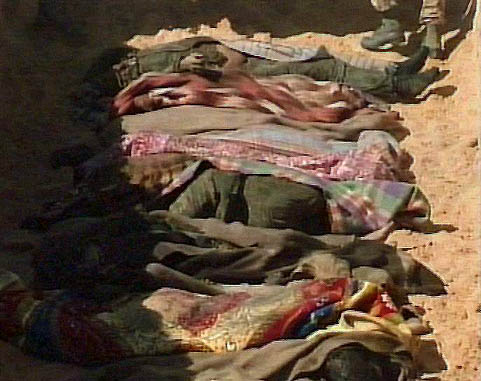
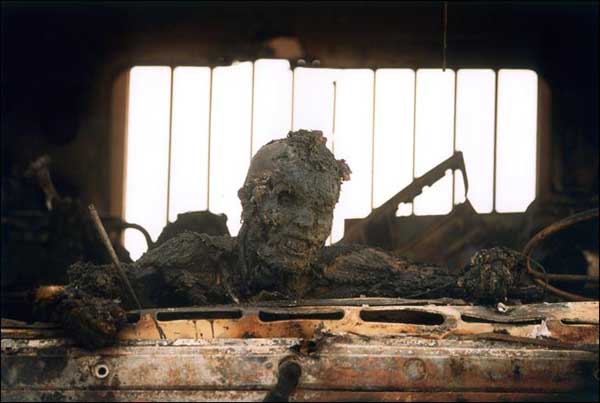
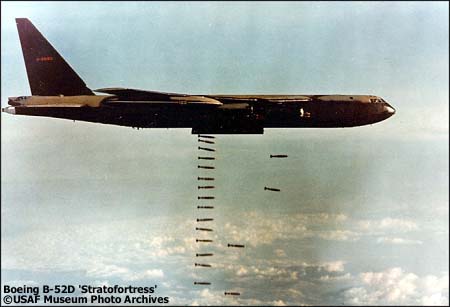
Since the end of World War 2 the most indiscriminate and obscene weapon of war to be used has been the B-52 bomber. After smaller aircraft and ground artillery had had created a 20 km traffic jam on the Mutla Ridge early in 1991, it was B-52s which carpet bombed those trapped there, massacring them in a period of hours. This became known as the “Highway of Death” and the B-52s which were responsible for the slaughter flew from Diego Garcia.

Most B-52s that flew in the 1990-1 “Gulf War” were based in Diego Garcia. The near obsolete bombers dropped one third of the aerial tonnage and every time they dropped ordnance it was, by the very nature of the weaponry, a war crime of disproportionate and/or indiscriminate killing.

Paul Walker wrote:

B-52s were used from the first night of the war to the last. Flying at 40,000 feet and releasing 40 – 60 bombs of 500 or 750 pounds each, their only function is to carpet bomb entire areas. … B-52s were used against chemical and industrial storage areas, air fields, troop encampments, storage sites, and they were apparently used against large populated areas in Basra.

Language used by military spokesman General Richard Neal during the war made it sound as if Basra had been declared a “free fire zone”…. On February 11, 1991, Neal told members of the press that “Basra is a military town in the true sense…. The infrastructure, military infrastructure, is closely interwoven within the city of Basra itself” He went on to say that there were no civilians left in Basra, only military targets. … Eyewitness accounts Suggest that there was no pretense at a surgical war in this city. On February 5, 1991, the Los Angeles Times reported that the air war had brought “a hellish nightime of fires and smoke so dense that witnesses say the sun hasn’t been clearly visible for several days at a time . . . [that the bombing is] leveling some entire city blocks . . . [and that there are] bomb craters the size of football fields and an untold number of casualties.”

This was the opening of a period of genocide against Iraq. In 1998, during the sanctions period which was estimated in 1996 to have cost 500,000 children’s deaths, B-52’s from Diego Garcia launched 100 aerial cruise missiles as a major part of Operation Desert Fox. While officials, wonks and security studies hacks are triumphal about the efficacy of strikes against “regime” targets this comes from the long-standing habit of conflating civilian and military targets.

The patently false stated aim of Operation Desert Fox was to “degrade” the mythical WMD programme. The targeting of “command and control”, WMD industrial and “concealment” sites, and the Basra oil refinery were all deleterious to the people of the stricken country. Only retrospectively did the think-tank pundits decide that the real aim must have been regime destabilisation not WMD, but as with the sanctions inflicting misery and hardship on Iraqis only strengthened the governing regime. From 600-2000 civilians died along with an unknown number of military personnel who were attacking no one and had no chance to defend themselves or fight back.

In 2001, Diego Garcia was the most important base in launching attacks on Afghanistan. This was a high-altitude no boots-on-the-ground approach by the US which led predictably to a power vacuum, rampaging warlords, insoluble instability, refugee crisis, food insecurity and everything else we have since seen unfold. Like Iraq, the country is being slowly tortured to death. In 2003, Diego Garcia was once again central to US efforts against Iraq. Readers are probably somewhat familiar with what has happened in the area since.

Diego Garcia has never had legitimate “defence purposes”. It is a strategic asset of empire and it is used to maintain control over the Middle East, South Asia and parts of Africa. The base is there primarily for the purpose of killing large numbers of people at once when other means of exerting power are unsuitable, undesirable or unavailable. Its role is distinctly and inescapably genocidal.

Here’s the thing: it is difficult for activists to recruit people by accusing the government of war crimes, let alone mass-murder and genocide. A web search will show that even antiwar websites and writers tend mention Diego Garcia’s role in bombing only in passing while focussing either on its role in torture and “extraordinary renditions”, or on the injustice perpetrated against the islanders.

It is easy to see why the plight of the Chagossians appeals in the same way that seeing rabbits tortured in testing cosmetics was so rousing in the 1980s. The moral dimensions of the issue are readily apparent and very few people need to re-examine their ideology, challenge their beliefs, or question their loyalties. The Chagossian cause is just, but it is not right to ignore other crimes which are even more monstrous. It is not right, and it is not wise. Without undermining the “strategic necessity” argument then there can never be a victory. The Chagossians have already won in court – several times – but they remain in exile. Why? Because “defence purposes”.

People may not want to hear the truth about imperial aggression and the suffering inflicted in their names, but they can at least understand that giving the US a base in the Indian Ocean from which to bomb people has not made the United Kingdom in any respect safer. No one can suggest that carpet bombing Iraq reduced the threat of terrorism or Saddam’s WMD. If we do not accept that there are valid “defence purposes” then there are no legally or morally valid “strategic” reasons for keeping the Chagos Archipelago. That is something that we must always bear in mind when working in this cause – there is no strategic justification and the UK has no right to be there at all.

The cause of Mauritius is also just. They are the rightfully sovereign country deprived due to “strategic” decisions taken in 1964-5 which were no more defensible than the depopulation decisions of 1970-1. Mauritius recently won a case against the UK in the Permanent Court of Arbitration, but the UK denies the jurisdiction of the court and the court cannot rule on the issue of sovereignty. Mauritius is taking the case to the International Court of Justice for an “advisory” ruling, but that is only as good as the publicity it generates. They need allies, especially among UK activists who can keep the issue on the agenda at home.

For this reason I contacted Mhara Costello, an activist and poet who uses the pen name Tamerishe. Along with her poem “Once Upon a Palestine” she also wrote “Just a Word” which deals with the abuse of the term “terrorist”. It seemed an appropriate qualification. We formulated a petition that would incorporate a direct challenge to the narrative frame which ensures that critiques always remain atomised, specific and isolated – hermetically and prophylactically sealed away from infecting the self-righteous self-love of civilised Britons.

The characters allowed for e-petitions to HMGUKGB&NI are predetermined and restrictive, and this is what Mhara posted:

HMG should agree with Mauritius to an ICJ case regarding the Chagos Islands.

The Republic of Mauritius claims sovereignty over the Chagos Archipelago, but that claim is disputed by the UK. If the UK government agrees the International Court of Justice can hear and judge the issues as a “Contentious Case” in accordance with international law.

At issue is more than sovereignty. The UK forcefully removed the inhabitants of the islands and leased Diego Garcia as a US military base. The treatment of the islanders is cruel and unjust, and has been ruled unlawful. The US military base sends bombing sorties which cause countless deaths and may constitute crimes of aggression or terrorism. The base is also implicated in torture, illegal rendition, and concealment of illegal munitions. More at: http://johnpilger.com/videos/stealing-a-nation.

The first response was silence. The after prodding the following belated reply:

Dear Mhara,

Thank you for your email. I apologise for the length of time it has taken to process your petition. We can accept the central request of your petition, but we cannot publish the second paragraph because it does not comply with our rules. This means that your petition would read:

HMG should agree with Mauritius to an ICJ case regarding the Chagos Islands.

The Republic of Mauritius claims sovereignty over the Chagos Archipelago, but that claim is disputed by the UK. If the UK government agrees the International Court of Justice can hear and judge the issues as a “Contentious Case” in accordance with international law.

If you could let me know that you are happy with this, we could publish your request immediately.

To which Mhara responded:

No, I am not happy removing the second paragraph. I would be willing to amend it. Can you be more specific please, regarding your objections? In what way does the petition not comply with the rules? Please cite which rules have been breached? I am unable to identify any (inadvertently) I may have overlooked.

She then sent a second reminder and eventually received a longer email including the following:

We cannot publish the second paragraph of your petition, because we have not been able to establish that the very serious allegations you make are true. I hope you will understand that we cannot publish allegations of unlawful conduct. We would be happy to look at alternative wording for this paragraph, if you would like to propose some. It would need to be worded moderately and fall within our rules. You might reasonably say, for example, that many people believe that the former inhabitants of the Chagos Islands have been very badly treated by the Governments of the UK and the USA, and that this ought therefore to be examined by the ICJ. 

They are saying that you can’t detail allegations that you want addressed in court, because you have to prove the truth of the allegations before petitioning to have the matter adjudicated. This response is a bureaucratic Catch-22 piece of nonsense. It must be assumed that, as intended, the petition itself is troubling. The offending paragraph deliberately broadens the issue as much as possible within the character limit. One petition is unlikely to really shake the UK establishment, but it may yet frighten them because it takes matters into a realm which they cannot control. What is more, there is a hook in it.

When they commit crimes or act unjustly the greatest vulnerability of the authorities is their perceived legitimacy. When they are forced to overtly display illegitimacy it breaks their support structure. Even in the face of mass popular condemnation, a government can act with blatant injustice as long as they have a cover story – a lie which, however unconvincing, allows those who really want to give them unconditional support to believe in benign intent or even the ineffable divine schemes of “security”, which lie beyond mortal ken. In this case the UK might be in an awkward position if the question were debated because it does not want to negotiate directly with Mauritius. To explain why they do not wish the matter adjudicated by the ICJ the UK government might either have to say it prefers bilateral talks or it would have to say that it does not think its actions should be subject to adjudication under international law because “defence purposes”. That would bring the spotlight back onto the criminal uses of the criminally acquired Chagos Archipelago.

Right at the moment the “perceived legitimacy” of the UK government may already be close to breaking. Foreign entanglements must surely seem even less attractive to the UK public than February 2003, when a million marched in London to protest the looming invasion of Iraq. The sordid aftermath of shame from that act continues while the ongoing Balkanisation of the oil rich Arab world is surely one of the most inglorious blood-lettings in the unpleasant history of conflict. Even for those who do not understand that US/UK intervention created the fractures and fervour that wrack the region, it is hard to see any nobility in backing the Saudis, the Israelis and the “moderate” forces that fight alongside al-Nusra.

Meanwhile, the establishment seems to have to put the UK public in its rightful place of silent subjugation more often than it would normally need to. It seems that every time that there is a popular consensus in the general population or some significant segment of it, they need to be reminded that their democratic voice must be conveyed through a mediating wah-wah pedal that is under the foot of their social superiors. Whether it is giving Thatcher an appropriate send-off, or naming a sea-vessel, or when Labour Party members mistakenly choose a leader whose views coincide with those of ordinary people. Much more of this and people will start demanding that the hollow sham of modern democracy have some populist stuffing shoved back in it, and once government’s start giving in to popular demands it just encourages more; things could spiral out of control and before you know it you are dealing with a sovereign self-emancipated people who do not want a society run by and for a controlling greedy and/or power-obsessed few.

That is why even an e-petition can frighten Her Britannic Majesty’s mighty Royal Government. They need people to continue to be their own worst enemies. They need people to sabotage their own efforts. They need people to think that those within the establishment have a greater understanding of issues and how to tackle them. They need them to make their own protests against specific injustice into an embrace and an endorsement of the system itself.

Let’s show them that we won’t play that stupid game any more.

US Rule in Occupied Earth (or Everything You Need to Know About Genocide, but Never Knew to Ask) Part 2: Days of Revolt

Standard

gaza-israel-palestine2

Audio: http://www.radio4all.net/index.php/program/82160

or direct link to mp3: https://ia801508.us.archive.org/34/items/20150808USRulePart2/20150808%20US%20Rule%20Part%202.mp3

Soundcloud: https://soundcloud.com/on-genocide/20150808-us-rule-part-2

Chris Hedges “Days of Revolt” [not directly related]: https://vimeo.com/135629801

[Below is a transcript which is about 95% complete and which contains links to some material that is cited in the commentary]

I ended Part 1 by castigating those who seek justice and redress from authorities like the ICC. This is not an era in which forward progress can be made through existing institutions. I am not against meaningful reform but working towards it has now become a form of rear-guard action in a war that the people are losing. Those who wield power in Western societies have become far too good at wielding power. They are not meaningfully opposed or moderated, and that means that they will continue down a path of social destruction, even at their own expense.

If it makes it easier to swallow, the point I am making is actually very closely linked to a point that Chris Hedges has been emphasising in the last few years. Actually it is more than one point, really, because Hedges is promoting revolt and he is saying that this age is one that needs rebels – true dissidents. He is fond of citing Václav Havel and sentiments he conveyed such as this: “The dissident does not operate in the realm of genuine power at all. He is not seeking power. He has no desire for office and does not gather votes. He does not attempt to charm the public, he offers nothing and promises nothing. He can offer, if anything, only his own skin — and he offers it solely because he has no other way of affirming the truth he stands for. His actions simply articulate his dignity as a citizen, regardless of the cost.” This resonates with the earlier quote from Dr Thiranagama cited in Part 1: “Objectivity, the pursuit of truth and critical, honest positions, is crucial for the community, but is a view that could cost many of us our lives.” Neither sentiment leaves room for sugar-coating the truth or leaving out parts of the truth on the grounds that they are confrontational, or may alienate potential allies. Moreover, they do not allow one to decide that others do not have the intellectual capacity to grasp the whole truth and must be spoon-fed half-truths and white lies calculated to bring support to the cause you think is righteous.

The other key thing about real dissidents is that they don’t think that they can convince the powerful of the error of their ways. It is actually quite disturbing that the voices we hear criticising power are dominated by a privileged tone that projects shared interests and innate benevolence onto people such as Clinton, Obama or Kerry. Whether people overtly state this belief or not, it is inherent in any discussion that suggests that if the powerful could only be brought to see things from our perspective they would end their harmful practices. It is the equivalent of an Auschwitz inmate trying to persuade a guard that the Nuremburg Laws were both immoral and against the interests of Germany. The guard is unlikely to want to hear what you are saying, but if you do manage to persuade them where does that leave you? Or him? It is also a type of fallacy.

To assume that our leaders act with the best intentions is generally treated as being more conservative and intellectually credible than to suggest otherwise. In fact, to do so is to impute motive. It is a bankrupt practice and it is automatically applied selectively in such a way that enemy regimes are assumed to act with ill-intent whilst our leaders are presumed to mean well at least for their own countries if not for humanity as a whole.

The most common argument used to deny that the US has committed genocide is that there was no intention to commit genocide because US leaders have no such intent. Those who use such arguments do not look for evidence of intentionality any more than they would look for evidence of unicorns, because they already know that that evidence doesn’t exist. If you confront them with the fact that there is, say, more evidence of US intent to commit genocide in Cambodia than there is of Khmer Rouge intent to commit genocide, they will be upset because they know that the words and acts that seem to indicate US intentionality are a misrepresentation of the actual inner processes of US officials, but the words and acts that suggest Khmer Rouge intentionality are revelations of their true nature.

In the final analysis, though, whether our leaders are monstrous psychopaths or normal people trapped within a monstrous system is irrelevant. In fact, this is a false dichotomy between agential individuals and mere cogs. Whether or not one considers Western leaders to be demonically evil they must accommodate to the degree to which the regimes in which they function are diseased and criminal. For example, a President of the United States, a US Secretary of Defense and a US Secretary of State must all commit war crimes in order to function within a system that requires it of them. The same can be said of the UK Prime Minister, Foreign Minister and Minister of Defence. Even should someone in that position have a change of heart, like Robert McNamara did, they could never be trusted to set things right because they cannot help but live in denial. Likewise, as Chris Hedges points out, there is no longer any point in putting faith in individuals or groups to work to reform the regime within its power structure. In a recent talk with Truthdig editor Robert Scheer, Hedges specifically references Elizabeth Warren and Bernie Sanders and says: “…we’ve got to stop placing our faith in particular individuals. That’s just not how power responds. Power responds when it feels threatened.”

Hedges points out that working within the system is not an avenue to change, and closing it may seem negative, but it is actually a source of hope. It is unfortunate that it takes severe crisis and dysfunction to bring this point about, but it is only once people stop placing faith in fantasies that they can act in their own interests. We have seen in the US that faith placed in Barack Obama was taken as unconditional, because there were no electoral alternatives for people who aren’t hateful or stupid. Depending on your viewpoint this has either freed or forced Obama into being a tool of elite vested interest while making enough rhetorical obeisance to public will to keep the shabby and translucent façade of democracy from collapsing into a pile of dust. This is why, paradoxically, our political elites would act with more humanity if we treated them as being baby-eating reptilian invaders from outer space because then they would feel constrained not to act like baby-eating reptilian invaders from outer space.

Just as we cannot elevate heroes to effect transformation it is also true that we cannot transform by debasing villains. Modern states with their Inquiries and Commissions and Committee Investigations have developed a huge amount of expertise in channelling justified outrage into ever-decreasing spirals of ever narrower objection. These processes end with the anticlimax of a drivelling pseudo-apology: “We’re sorry because we tried to bring too much freedom to the world and we messed up because we we’re too damned democratic and our vicious free press stabbed us in the back.” The model resembles the appalling Frost-Nixon interviews where David Frost went out of his way to systematically absolve Nixon of every one of his truly momentous crimes. But every porn production must have it’s cumshot, and after hours of this fellatio Nixon ejaculates: “I let the American people down”. And what a powerful confession that was! A little bit like John Wayne Gacy apologising for bringing disrepute to the amateur clown fraternity as if that was his only crime: “I let the clowns of this great land of America down”.

In this vein, when modern Western states do take actions against their own personnel they follow these rules:

  1. Unless there is an inconvenient senior officer who could do with being taken down a peg, like Janis Karpinsky, ensure that you choose as few people as possible from as low in the hierarchy as possible.
  2. Decontextualise and minimise the crimes. Maintain above all that they are aberrant isolated acts not linked to anything broader. Their isolation shows that they are the exception that proves the rule of our fundamentally benevolent nature.
  3. Portray the accused as victims of the brutality generated by the savagery of their victims’ society.
  4. Give as lenient a judgement as humanly possible.
  5. Reverse the judgement with a pardon or reduction in sentence as soon as humanly possible.
  6. Milk the proceedings as much as possible to provide “proof” that yours is a society of laws whilst tacitly or explicitly reiterating that the genesis of the crimes lay in the unwanted contact with the unlawful and brutal society of the victims.

But going back to the shell game of will-they won’t-they criminal proceedings, Israel has this procedure down to a fine art. And like all truly brilliant acts of public diplomacy, this practice exerts a disciplinary influence on both supporters and opponents of Israel’s foreign policy at home and abroad. Israel can keep Palestinian human rights activists running on a treadmill that they can’t justify leaving because there is always hope that a judicial process will provide some small relief from the greater tides of injustice. But it is some time since Israeli courts have done anything significant to constrain the Israeli occupation forces, which includes the courts themselves, and they barely do anything to constrain Israeli settlers either.

There is also a broader problem that is encouraged by Israel or the ICC dangling the prospect of criminal convictions in that it helps obscure the systematic criminality of the occupation. The recent news of the death of 18 month old Ali Dawabsha has highlighted what Ali Abunimah describes as a “hypocritical display… [of] crocodile tears”. By unreserved condemnation of a singular act, Israel’s leaders quite clearly intend to create a false image that acts to obscure the greater systematic violence. The problem is not just that Zionists use this technique, but that anti-Zionists end up being drawn into doing exactly the same thing in slightly different circumstances.

For example, Charlotte Silver of the Electronic Intifada has reported that an Israeli, Lieutenant Colonel Nerya Yeshurun, was recorded ordering the shelling of a medical facility. Of course it must be reported when such evidence comes to light, but this tends to become what I would term “over-proving”. Not only did we already have eyewitness reports from Palestinians and international observers of such crimes, but Israeli personnel had already confessed such actions to Breaking the Silence.

As it stands, it is good that supporters of Palestinian human rights can point to this recording as being symptomatic because it shows that few Israelis consider it wrong to commit war crimes. On the other hand, if the focus becomes pursuing the punishment of Yeshurun on the grounds that he is a blatant war criminal and the prima facie evidence is impossible to ignore, then you get into very bad territory for the cause of Palestine.

Every erg of human energy that activists put into trying to get Yeshurun punished will be worse than a waste. Focussing on the one criminal risks entering an endless spiral of diminishing convolution. It will produce a discourse that combines screeching to the converted with a naïve belief that you can somehow shame your enemies into admitting that they are actually the bad guys. At the same time every bit of focus on Yeshurun’s blatant crime will devalue the clear testimony of Israeli whistle-blowers, of international observers and, above all, the voices of the Palestinian victims themselves. Perhaps even worse it will devalue the shared consensus experience. The media coverage of Operation Protective Edge in many countries was sufficient for most people to see that the narrative construction of a “conflict” is a farce. Despite the unusual number of Israeli casualties, what people saw and felt in their guts was a one-sided slaughter. Yet that comprehension is being eroded by a continuous miscontextualisation and the focus on individual crimes only furthers that diminishment of the greater truth.

And the odd thing is that the gut response of the uneducated layperson is a more sound legal opinion than than the mediated educated opinions of the mealy-mouthed weasels who function as international jurists. As long as Israel maintains its occupation and/or blockade of Gaza they cannot justify their actions under Article 51 of the UN Charter as being self-defence. That is true even if Gazan militants commit war crimes. That means that every single Palestinian killed by Israel outside of Israel’s borders, whether they are an armed militant or not, has been murdered. You can make a very good argument that even Palestinians who are killed inside Israel’s recognised borders are murder victims, because the Palestinians’ actions are still legitimate self-defence. This all means that by selecting certain individuals and prosecuting them you are inevitably suggesting that murder is legitimate if it is carried out in a certain manner, but not legitimate if it is committed while breaking other rules. You can see why I think that this is problematic. I am concentrating on the practical political realities here, but even in sentimental terms what does it mean to go after Yeshurun? What does it mean for the memories of those children murdered at the behest of Israeli officers and politicians who were careful enough not to be recorded ordering personnel to commit obvious war crimes? Where is their “justice”?

The mass murders committed by Israel are also part of a larger process of genocide. As with the Tamils a slow process of genocide will sometimes incline the perpetrators to commit acts of acute mass violence to weaken resistance to ongoing low-grade state violence and structural violence. Some Israelis, with a kind of schizophrenic and unnerving honesty, refer to this as “mowing the lawn”.

There are distinct genocidal similarities between Israel’s occupation of Palestine, Sri Lankan occupation policies, and US interventions in a number of countries both currently and in the past. However, the real reason that I bring up Israel here is the issue of the ICC, which bears some further attention still.

Earlier I posted a long condemnation of the ICC which was also a condemnation of those who are promoting an ICC investigation into Israel’s most recent crimes. I can’t really summarise the thousands of words I wrote on the issue of the ICC and Israel, but one key relevant point is that the “Rome Statute” states “a case is inadmissible where… [t]he case is being investigated or prosecuted by a State which has jurisdiction over it, unless the State is unwilling or unable genuinely to carry out the investigation or prosecution.” Immediately this places jurisdictional decisions in the realms of political judgement which inevitably favours the powerful over the weak. It is worth considering what that actually means in effect. It means that facts will exert one sort of influence in the form of a discourse of ideas and information, and it means that vested power will exert influence by shaping that discourse. If we view such a process as a contest between power and truth, the first thing we must take into account is the impact of “soft-power” on perception. This is used to ensure that public perception of the truth is muddled, uncertain and contested. When the powerful commit mass violence “soft-power” is used to minimise the perception of suffering caused, but the more crucial task is to conceal intentionality.

Once the manipulation of perception creates the widest possible room for debate in public, then in private the hard-power and the covert power are used to bribe, threaten, blackmail, subvert and co-opt both individual persons and institutions up to and including entire countries. Thereafter the powerful can be sure that officials will take the least action possible, which is quite likely to be no action at all. If a country like Sri Lanka or Israel wants to ensure that occurs it may choose to pursue its own prosecutions using the six rules I outlined above which will then enable the ICC to claim that the perpetrator country is rightfully exercising jurisdiction. Naturally this will be lapped up by journalists and bureaucrats alike, who so dearly love the tautological perfection of what is, to them, the best of all possible worlds. They will then convey this unto the public who will be split between the reassured and the nonplussed, whilst independent observers will rage ineffectually about the fact that we are drowning ourselves in our own smug bullshit.

I know that many people on reading this might think that this is all an extremist’s opinion on tactics, but that there are other equally valid opinions. To them, my opinion is likely to be seen as an expression of anti-authoritarian hatred or even the spiteful envy of one who is justly marginalised. But this is not a matter of opinion at all. The historical record is so clear that the only possible way one could advocate ICC involvement is through wilful ignorance to both the ICC’s record and the entire history of prosecutions for war crimes and crimes against humanity. Equally, to hold that an elite international judicial body will dispense “justice” that is not desirable to US and European imperial interests is almost laughably intellectually lazy. It is not a secret that rising within the hierarchies of international bodies is a highly political process combining both elements of diplomatic horse-trading for some positions with a need for high ambition and the requirement that personnel be the discreet and disciplined insider type. No one in their right mind should think that the selective processes and the situational factors which constrain the behaviour of personnel at the court would ever allow them to become worthy of any level of our trust. In fact they are worthy of contempt and condemnation because, whatever their self-righteous pretensions, they profit in material terms, and gain very high social status, by taking a key role in a monstrous imperial project that has visited mass violence and immiseration through structural violence on hundreds of millions of people.

It is vital that national and international functionaries be forced to confront the injustices that they perpetrate. That is the most important fight in the world today. Part of that fight is the fight to expose the suffering brought about and the fight to humanise victims. The other part, however, is the fight over contextualisation. Contextualisation is the most crucial issue. It is important to a degree that simply cannot be overstated, because miscontextualised human suffering becomes the fuel for ever more massive crimes of mass violence such as aggression and genocide.

Every atrocity that happens in the world today is being interpreted according to an updated version of the ancient chauvinistic binary categorisation of civilisation and barbarity. We are civilised which means that when barbarians kill other barbarians we must kill barbarians to save barbarians from their own barbarity. When we kill barbarians our intent, if not our actions, must be civilised because we are civilised. It can be true of any self-identified group, but it is most acute and most stoutly defended amongst Westerners who have deep reserves of chauvinism – a sense of exceptionalism that is almost impenetrable.

There are so many ideological components to Western chauvinism that it is hard to portray the entire phenomenon accurately. I propose that we think of it in terms of being a complicated, schizophrenic and contradictory form of “white” racism. I am, of course, acutely aware that African Americans, for example, can expound this racism and no one should downplay the fact that Barack Obama embodies this racism. Nevertheless, the concept of an entity called the West arose at the same time as the concept that there were people who were in some manner “white”. In practical terms the two are inextricable because no matter how imprecise our concept of what white people are, and no matter how expansive our notion of the West is, it will always be that of a hegemonically “white” culture. Because Western Europe experienced a technologically and culturally driven explosion of imperialism that saw them impose domination on people who on average were generally darker, sometime pronouncedly so, an idea of whiteness came about, even though it was very arbitrary in terms of actual pigmentation.

Western chauvinism actually came to combine ideas of progress, capitalism, Christianity, atheism, liberalism, democracy, freedom, humanism and humanitarianism among others, but I choose to emphasise racism because it is so easy to see due to the fact that it is literally constructed as a matter of black-and-white. For that reason it becomes possible to see that whenever we essentialise any notion about the West, such as the idea that it has liberal democratic norms, it is actually a dog-whistle racial reference.

To put it in simple terms, Eurocentrism and US exceptionalism are expressions of white supremacy. That means that they inherently propound the inferiority of non-white people. If we claim that the West embodies values or so-called “norms” of, say, “democracy”, we are of necessity saying the inverse of the non-Western world. Not only does this require a completely distorted reading of history, but it is inevitably racist. Because the concept of the West cannot be disentangled from a concept of whiteness, the implications of making such statements are to reinforce notions that white people are civilised and non-white people are barbaric.

Moreover, because of the need to selectively overlook the atrocious violence of Western imperialism, Western chauvinism (or “Eurocentrism”) is inescapably a form of racism that fuels double standards. It fuels doublethink, it fuels cognitive dissonance, it fuels the vicious contradictory fanaticism of the white-hatted mass murderer of indigenous peoples whose only explanation for such brutality is that he must have caught it like a contagion from the unnatural contact with savage peoples. And thus Westerners construct an ideology in which they themselves are the victims of their own acts of mass murder.

The struggle that must be undertaken, therefore, is to counter this massive agglomeration of ideology with the following understanding – the savagery is in the act, not the actor. Yet at every level in every society since the invention of agriculture, the powerful have always tried to ensure that they are not judged by their deeds, but rather by the good intentions that they assure others they have. From the boss of a small business, to the ruler of an empire we are always enjoined to see things from their perspective and to accept a priori their fundamentally benevolent motives.

Continued in Part 3: “Lemkin’s Logic”.

Iraq: Stop The Massacre of Anbar’s Civilians

Standard

genocide-paper

The website The International Initiative to Prosecute US Genocide in Iraq is calling for endorsements for the following statement here: http://usgenocide.org/2014/iraq-stop-the-massacre-of-anbars-civilians/

Iraq: Stop the massacre of Anbar’s civilians!

Please endorse, share and distribute (See below)
Date: 18 February 2014

IRAQ: STOP THE MASSACRE OF ANBAR’S CIVILIANS!

Maliki’s use of the army against the civilian population of Anbar constitutes the defeat of the policies Iraq has been following since 2003 and cements the divorce between the people of Iraq and the current sectarian government.

This new round of bombing has already produced 300,000 displaced, adding to the tragedy of the millions of Iraqi citizens already displaced by the failed and brutal US occupation.

While states are legally obliged to refrain from assisting other states to undertake internationally criminal acts, the United States is upping its supply of arms and military advisors to Iraq, along with intelligence cooperation. A new US “Surge” is in the making and will only bring more death and destruction.

Maliki’s government cannot wantonly kill civilians and claim a “State of Law”:
— Collective punishment is illegal under international law.
— Shelling water and electricity facilities, religious buildings, and hospitals are war crimes and crimes against humanity.
— The scale and target of the Maliki military strikes and shelling is utterly disproportionate and illegal and criminal in the face of the legitimate demands of the Anbar tribes.
— The lack of proportionality itself constitutes a war crime and crime against humanity.
— It is paramount for people everywhere to mobilise now to save Fallujah’s and Anbar’s civilians, understanding that their suffering mirrors the impact of the fascist sectarian regime that the US occupation created.

We appeal to all individuals of conscience, to all those who support human rights, to all progressives who believe in democracy and the right to self-determination, to the UN Security Council, to the president of the UN General Assembly, to members of the UN General Assembly, to the European Commission and member states, to the European Parliament and peoples, to Islamic and Arab states and people and their organisations, and to all human rights, anti-war and civil society organisations to:

1. Order the Iraqi government to stop its use of wanton shelling, air force attacks, and heavy artillery against the civilian population in keeping with the responsibility of states to protect civilians under the provisions of the Fourth Geneva Convention and its additional protocols.
2. Constitute an independent investigative committee to document the war crimes and crimes against humanity committed in Anbar and submit its findings to the International Criminal Court.

Abdul Ilah Albayaty
Hana Al Bayaty
Ian Douglas
Eman Ahmed Khamas

We call on all to join us, sign and spread this appeal. To endorse, email to: hanaalbayaty@usgenocide.org

Abdul Ilah Albayaty is an Iraqi political analyst. Hana Al Bayaty is an author and political activist. Ian Douglas is an independent political writer who has taught politics at universities in the US, UK, Egypt and Palestine.

Related Posts

I endorsed the statement with the following text:

I am writing to endorse your statement condemning state violence against civilians in Anbar. My name is Kieran Kelly. I have a Master’s degree in history from Massey University in Aotearoa/New Zealand. My Master’s thesis placed the Iraq Genocide in the context of prior genocides committed by the US under the guise of military actions. I consider the current violence in Iraq to be the direct result of deliberate and systematic policies of destruction aimed at the people of Iraq as such. Both the intentionality of these acts and their links to current divisions within Iraq are amply demonstrated by frequent references by US officials to the desirability of fostering division or even partition along sectarian and ethnic lines in Iraq. In line with these stated policies the actions of US forces in Iraq – though seemingly “mishandled” in the normal politico-military sense – efficiently implemented policies which inflicted economic, social, cultural, religious, and physical destruction. This included inflicting massive direct and indirect mortality; fostering eliticidal violence against academics; disruption and degradation of health services; ecocidal pollution with toxic and radioactive materials; and generating communal strife, division and violence.
The current violence does not merely threaten a subsidiary genocide against Iraq’s Sunni population (as suggested by Struan Stevenson) but also is an expression of the ongoing US genocide embodied through their material and political support for the Maliki regime’s divisive, oppressive and violent policies. The fact that the US is also inevitably channeling arms and money to Islamist opponents of the Baghdad regime (through its destabilisation programme in Syria) only serves to illustrate that it is the Iraqi people who are the target, not particular segments or formations. A strong Iraqi people (whether unified democratically or under brutal force) is inherently antithetical to US imperial interests. The objections they raise to putatively objectionable political or religious ideologies (and also their denunciations of leaders as being equivalent to Hitler) are simply rationalisations for morally unacceptable imperial policies including genocidal policies which inflict mass deaths.

The Cambodia Precedent: Justifying New Crimes on the Basis of Past Crimes

Standard

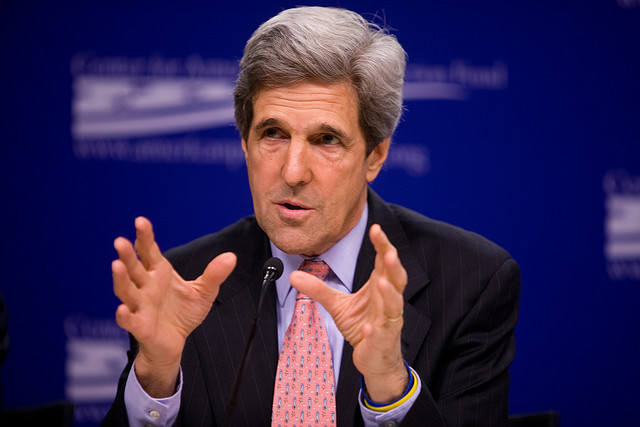
For John Kerry the incoming Secretary of State, the bombing of Cambodia by the US was illegal. But, even as Kerry reaffirms his condemnation of US actions in Cambodia, it comes to light that in June his colleagues in the Senate Judiciary and Intelligence committees were issued a white paper from the Department of Justice which claimed US intervention in Cambodia as being a legal precedent for the administrations use of targeted killings using drone strikes. In fact, “legal precedent” might be too strong a term, because what is actually cited is an address given by legal counsel to the State Department to a legal forum. Yes, they are using a speech rather than an adjudication as a claim of precedence, much as one might in some future time quote John Yoo as the legal precedent for a systematic programme of child torture by testicular crushing. On the other hand, the carpet bombing of Cambodia was one of the most brutal and notorious war crimes of the post-WWII era and not only has no one been prosecuted for the crime, but the principle perpetrator was awarded the Nobel Peace Prize a few years later – perhaps this is exactly the sort of precedent that the Obama administration looks towards.

With all of that in mind, it is worth revisiting exactly what the US did to the people of Cambodia. Then we can understand exactly what sort of moral precedent applies here – the sort that would make almost any organised crime boss, or terrorist, or psychopathic serial killer blanch with horrified disgust. If you think I’m exaggerating, read on.

3488968132_5ebe2568e7_z

In 2007 Barack Obama said: “The President does not have power under the Constitution to unilaterally authorize a military attack in a situation that does not involve stopping an actual or imminent threat to the nation.” In questioning John Kerry about Obama’s departure from that principle in Libya, Rand Paul elicited from Kerry, a reaffirmation that he, Kerry, still believed that the bombing of Cambodia was illegal. One might wonder, then, whether Obama’s new Secretary of State is going to oppose his famous “drone” assassination programme. I broach the subject because the Department of Justice rationalised the use of deadly force in other sovereign territories citing Cambodia as a precedent. This is an excerpt from their recently released White paper:

The Department has not found any authority for the proposition that when one of the parties to an armed conflict plans and executes operations from a base in a new nation, an operation to engage the enemy in that location cannot be part of the original armed conflict, and thus subject to the laws of war governing that conflict, unless the hostilities become sufficiently intense and protracted in the new location. That does not appear to be the rule of the historical practice, for instance, even in a traditional international conflict. See John R. Stevenson, Legal Adviser, Department of State, United States Military Action in Cambodia: Questions of International Law, Address before the Hammarskjold Forum of the Association of the Bar of the City of New York (May 28,1970)…, (arguing that in an international armed conflict, if a neutral state has been unable for any reason to prevent violations of its neutrality by the troops of one belligerent using its territory as a base of operations, the other belligerent has historically been justified in attacking those enemy forces in that state).

Now, let me start off by saying something absolutely clearly. The idea that the US can legally engage in a programme of assassinations using hellfire missiles fired from unmanned aerial vehicles is a patent falsehood – a complete joke – a non-starter – a parody – a stupid idea that no one should take seriously. A single ad hoc emergency strike might be justified as self-defence under Article 51 of the UN Charter, but a programme cannot be as self-defence because, under the charter, it can only be applied to imminent threats. This aspect of law isn’t rocket science, nor hidden within some mystical realm of legalese. The standard legal textbook dealing with this subject is Yoram Dinstein’s, War, Aggression and Self-Defense, now in its 4th edition. It is a pretty straightforward book (and I’m no lawyer) and on this particular subject it is so unequivocal that it is impossible that any superior authority might find some crucial flaw which would invalidate Dinstein. The reason it is so unequivocal is that the US arguments have already been ruled against by no lesser body than the International Court of Justice. The reason for this is that the US has already deployed almost the exact same reasoning to justify its actions against Nicaragua.

On Nicaragua v. United States of America, the ICJ ruled “By twelve votes to three, Rejects the justification of collective self-defence maintained by the United States of America in connection with the military and paramilitary activities in and against Nicaragua the subject of this case; …. By twelve votes to three, Decides that the United States of America, by training, arming, equipping, financing and supplying the contra forces or otherwise encouraging, supporting and aiding military and paramilitary activities in and against Nicaragua, has acted, against the Republic of Nicaragua, in breach of its obligation under customary international law not to intervene in the affairs of another State….” And goes on to add other grounds of violation, including a similar finding against the US mining of Nicaragua’s main port. Dinstein explores the US self-defence claims and notes that although self-defence was ruled out on other grounds this did not prevent judges from further noting that the three requisite conditions of immediacy, necessity, and proportionality were also unsustainable.1

In the Nicaragua case, as now, the US argued that conditions of immediacy, necessity and proportionality were met, but then, as now, these are just empty words disproved by the simplest of geographical facts. Such claims are even further disproved by publicly available details of the US assassination programme, such as the use of “signature strikes” and the use of “double tap” follow up strikes. These practices demolish self-defence arguments even as they raise further questions about breaches of International Humanitarian Law (such as the Fourth Geneva Convention (1949)) and International Human Rights Law (such as Article 3 of the Universal Declaration of Human Rights which affirms “the right to life, liberty and security of person”).

So, how much does citing US actions in Cambodia strengthen the feeble claims of legal rationale for drone strikes? I would say somewhat less than not at all, partly because US military actions in Cambodia were clearly not legal and partly because they too failed the test of self-defence (hence arguably being crimes against the peace) but they were also gross breaches of International Humanitarian Law, and should be classified as genocide – which is considered an “aggravated crime against humanity

2478271872_9763673fd7_z

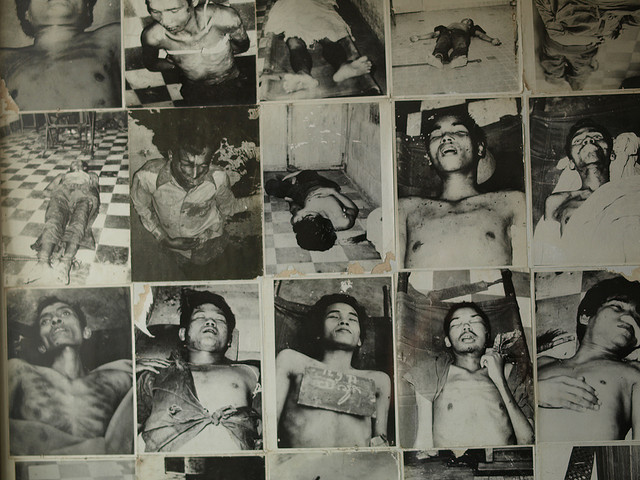
When people think of genocide and Cambodia, they tend to think of the Khmer Rouge, and the “Killing Fields”; of their evidently insane Democratic Kampuchea regime which began its “Year Zero” in 1975. But a Finnish Inquiry Commission designated the years 1969 to 1975 in Cambodia (a time of massive aerial bombardment by the US and of bitter civil war wholly sustained by the US) as Phase 1 of the ‘Decade of Genocide’.2Estimates of Cambodian deaths resulting from the 1969-75 war range from Vickery’s 500,000 killed3 to a credible 1 million excess deaths estimated by Sorpong Peou.4 Given that the Cambodian population was an estimated 6 or 7 million in the period of the Second Indochina War, this gives us a figure of between 1 in 6 and 1 in 14 of all Cambodians killed.

US actions inside Cambodian borders began years before the devastating carpet bombing. The US ‘Studies and Operations Group’ conducted attacks with US Special Forces personnel in Cambodia throughout the 1960s. In 1967 these were institutionalised as “Salem House” (later known as “Daniel Boone”). This programme was kept secret from the US congress and conducted a total of 1,835 missions. Their primary activity appears to have been the laying of “sanitized self-destruct antipersonnel” mines anywhere up to 30 kilometres beyond the border. Their supposed mission was intelligence gathering, but throughout the whole programme they only captured 24 prisoners.5 The Special Forces troops usually disguised themselves as Vietnamese PLAF fighters and sometimes murdered civilians in false-flag operations.6

In 1970 Sihanouk was overthrown by General Lon Nol7 and Prince Sirik Matak with tacit support from Washington and probable assistance by the CIA. Washington recognised the new regime within hours.8 So fast was recognition of Lon Nol’s government that it must have precluded any possibility that the changes on the ground were being assessed, which strongly suggests that the US must have had detailed foreknowledge in order to have any confidence in its judgement. Sihanouk’s overthrow made civil war unavoidable.

In 1969, before the above events, the US began bombing Cambodia in what was known as “Operation Menu”. From Saigon, US General Creighton Abrams insisted that he had “hard evidence” that the Central Office for South Vietnam headquarters (COSVN HQ) had been located in the “Fish Hook” salient of Cambodia.9 The problem was that no such place ever existed, though for years the US had mounted operations to crush it when they claimed it was located in South Vietnam.10 Once under way, Operation Menu spread to other areas. Despite the carpet bombing of area supposed to contain COVSN HQ, in April 1970 Abrams claimed that the headquarters still existed as a fortified underground bunker with 5000 personnel.11 In May US and RVN forces invaded Cambodia, the action justified in part as an attempt, yet again, to wipe out the COVSN HQ “which had become the Holy Grail of the American war”.12 The US/RVN invasion simply, and predictably, drove communist forces deeper into Cambodia.13

It is a known and predictable effect that the killing of civilians drives people to take up arms, it is a “counterproductive” counter-insurgency tactic which actually strengthens the enemy.14 It is worth remembering that the famous maverick US Army officer John Paul Vann made the same observation in 1962.15One of the most striking examples of generating an enemy by killing civilians, is what occurred in Cambodia from 1969 onwards. Ben Kiernan repeatedly cites evidence in numerous consecutive instances that US/RVN aerial bombardment strengthened the Khmer Rouge insurgency, and, more specifically the anti-Vietnamese faction of the Khmer Rouge under Pol Pot.16 In 1969, the Khmer Rouge consisted of perhaps 4000 – an ultimately unthreatening insurgency. By the end of 1972, they were able, with DRV logistical support, to “hold their own” against Lon Nol’s armed forces, which, at US instigation, had been enlarged to between 132,000 and 176,000 (not counting “ghost” soldiers, who existed only on the books of the corrupt officers who collected their pay) and had massive US/RVN air support.17 In William Shawcross’s words, “the new war was creating enemies where none previously existed”18 and by this stage, Lon Nol’s regime was already reduced to the control of shrinking and fragmenting enclaves.19

When the the US generated a war in Cambodia they had already had a great deal of experience in Vietnam and Laos, and what occurred in Cambodia is, in many ways, a naked exposure of the logic behind the genocidal war system, less obfuscated because, ironically, Cambodia was a “sideshow” where it was not the details but the whole war which was kept obscure from the public.

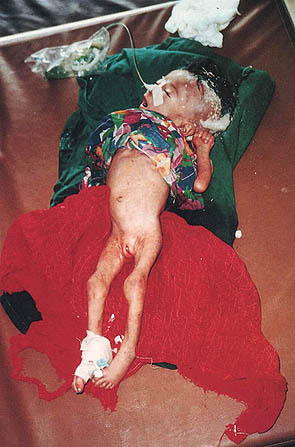
Within a year of Lon Nol’s coup, as mentioned, the economy of Cambodia was virtually destroyed, not only by bombing, but also by US aid. Aid was channelled to the import of commodities and surplus US agricultural goods. It also underwrote the Cambodian government and armed forces: “By the end of 1970, the government was spending five times its revenue and earning nothing abroad.”20 Most of the population became reliant on US aid to eat, and rice supplies were kept at the minimum level needed to prevent food riots. By 1975, malnutrition was widespread and many children starved to death.21

Going back in time to 1970, less than two months after the coup that brought Lon Nol to power, the US invaded Cambodia, along with ARVN forces. They did not bother to forewarn Lon Nol who found out after Richard Nixon had announced the invasion publicly.22 This invasion along US and RVN bombing and the civil war made refugees of around half of the Cambodian population.23Lon Nol was outraged by the invasion and when later briefed by Alexander Haig (then military assistant to Kissinger) about US intentions he wept with frustration. According to Shawcross, “He wished that the Americans had blocked the communists’ escape route before attacking, instead of spreading them across Cambodia. … The Cambodian leader told Haig that there was no way his small force could stop them. … [Haig] informed Lon Nol that President Nixon intended to limit the involvement of American forces…. They would be withdrawn at the end of June. The the President hoped to introduce a program of restricted military and economic aid. As the implications of Haig’s words for the future of Cambodia became clear to Lon Nol, he began to weep. Cambodia, he said, could never defend itself.”24

B-5222

As has been detailed, US actions, particularly in bombing, were directly responsible for creating the communist enemy which overthrew Lon Nol. The bombing between 1969 and 1973 took up to 150,000 lives.25 If averaged out, over 33 tons of ordnance were used to kill each Khmer Rouge insurgent.26 Despite the fact that Vietnamese pilots bombed any Cambodian they could, which aided only the Khmer Rouge, Lon Nol acceded to a US demand that he request an increase in VNAF bombing in 1971.27 By May 1972, the Lon Nol regime had control of perhaps 10 per cent of the country and continued to lose territory which was thereafter fragmented into ever smaller enclaves.28 The result was by that stage foregone, and yet the war dragged on for three years with the greater part of the 1 million deaths occurring after that point.

In 1970, when Henry Kissinger briefed Jonathan “Fred” Ladd, who was slated to conduct the war in Cambodia, he told him, “Don’t even think of victory; just keep it alive.”29 The point of the US bombing was not to win a military victory – it was to destroy Cambodia as part of an Indochina “exit strategy” – and that is a clear instance of genocide under the United Nations Convention on the Prevention and Punishment of the Crime of Genocide. When the US Congress finally blocked aid to Cambodia and South Vietnam, it was with the belated realisation that such aid would not give any hope of victory or improve a bargaining position. Senator Mike Mansfield spoke out, “Ultimately Cambodia cannot survive…. Additional aid means more killing, more fighting. This has got to stop sometime.”30

So that was the end of the US involvement in Cambodia, and their legal culpability. The Khmer Rouge took over Phnom Penh, and the refugees were shocked to see that the black-clad cadres were mostly young teens, fanatical and brutalised by half a young lifetime of fighting and death. The US was not responsible for the fantasies of the Pol Pot clique, who believed that supernatural amounts of food could be produced without recourse to machine power, nor for their refusal to accept aid. But the US had deliberately brought the Cambodian population to the brink of starvation – destroying farmland and driving peasants off the land. Perhaps 500,000 or more died of starvation. Hundreds of thousands were executed for political or ideological reasons, murdered by the Khmer Rouge who the US had largely brought into existence. And when the Vietnamese put the regime to an end (and despite what you may read about this being justifiable as “humanitarian intervention” it was in fact legitimate self-defence – if you don’t believe me you can read about Khmer Rouge foreign policy, border attacks, and espoused official desire to exterminate all Vietnamese) when the Khmer Rouge were supplanted, the US insisted that they retain a seat at the UN and started giving aid to their guerilla forces.

Drone 5860787655_2b5f5feff3_z

So, do I think that the Cambodia precedent is a good one to justify an assassination programme? No, I do not. But then again I am not from the US, and perhaps I am failing to grasp the subtle point that next to no “Americans” died in Cambodia (none that were officially acknowledged) therefore it did not happen. I don’t want to be offensive, but if they do not wish to be complicit with the crimes of the US regime, US anti-drone campaigners must avoid all trace of exceptionalism. I am sure they mean no harm, but why allow yourselves to be drawn into this ridiculous framework of seeing the drone programme as being primarily a question of “the targeting of Americans without due process.” There have been 5 US citizens killed with US drones whereas at least 4000 non-US citizens have been killed. Why would anyone, in those circumstances, give primacy to concern over “US citizens” and “due process”? This fetishisation of the idolised US Constitution is getting old. Besides which, the US Constitution’s “Supremacy Clause” (Article 6, Clause 2) actually gives treaties the same status as federal law – which would include the Nuremberg Charter and the UN Charter, among other things. Furthermore, by allowing the issue to be framed in such a manner, psychologically you set yourself and others up for being mollified by cosmetic measures offered to guarantee the rights of US citizens while retaining the right to kill foreigners at will. Do you really believe that being a US citizen or being born in Denver makes someone more human?

1 Yoram Dinstein, War, Aggression and Self-Defence (3rd ed.), Cambridge: Cambridge University Press, 2001, pp 184-5.

2 Edward Herman and Noam Chomsky, Manufacturing Consent: The Political Economy of the Mass Media. London: Vintage, 1994 (1988), p 260.

3 Ibid, p 263.

4 Sorpong Peou, Intervention & Change in Cambodia: Towards Democracy? Singapore: Institute of Southeast Asian Studies, 2000, p 54.

5 Ibid, pp 64-5.

6 Ben Kiernan, The Pol Pot Regime: Race, Power, and Genocide in Cambodia under the Khmer Rouge. New Haven and London: Yale University Press, 1996, p 18.

7 The US had developed ties with Lon Nol in the 1950s and by 1970, according to CIA officer Frank Snepp, he was one of two candidates being groomed by the CIA to take Sihanouk’s place (William Shawcross, Sideshow: Kissinger, Nixon and the Destruction of Cambodia. London: Fontana, 1980 (1979), pp 114-5).

8 Ibid, pp 114-23; William Blum, Killing Hope: U.S. Military and C.I.A. Interventions Since World War II (2nd ed.), Monroe: Common Courage Press, 2004, pp 137-8; Peou, Intervention & Change in Cambodia, pp 125-6.

9 Shawcross, Sideshow, p 19.

10 Marilyn Young, The Vietnam Wars 1945-1990, New York: Harper Perennial, 1991, pp 72, 186; Tucker, Vietnam, p 129; Turley, The Second Indochina War, pp 79-80.

11 Shawcross, Sideshow, p 140.

12 Young, The Vietnam Wars, p 245.

13 Shawcross, 1979, p 151.

14 David Keen, Endless War? Hidden functions of the ‘War on Terror’. London, Ann Arbor: Pluto Press, 2006, pp 58-61.

15 Neil Sheehan, A Bright Shining Lie: John Paul Vann and America in Vietnam (New York: Vintage 1989 (1988), p pp 106-111.

16 Kiernan, The Pol Pot Regime, pp 19-23. Also see Peou, Intervention & Change in Cambodia, p 128.

17 Shawcross, Sideshow, pp 73, 180, 194-5, 261.

18 Ibid, p 249.

19 Ibid, p 254.

20 Ibid, p 220.

21 Ibid, p 317-9.

22 Ibid, p 149.

23 Peou, Intervention & Change in Cambodia , p 127.

24 Shawcross, Sideshow, p 163.

25 Kiernan, The Pol Pot Regime, p 24.

26 Ibid, p 19.

27 Shawcross, Sideshow, p 186.

28 Ibid, pp 254-5.

29 Ibid, p 169.

30 Nigel Cawthorne, Vietnam: A War Lost and Won. London: Arcturus Publishing, 2003, p 213.

Media Lens Alert – ‘Flatten All Of Gaza’ – The ‘Benghazi Moment’ That Didn’t Matter

Standard

The short film exposes the structure which perpetuates pro-Israel media bias in the US and then contrasts it with a more balanced reporting – ironically from the BBC which is facing serious criticism for its pro-Israel bias.

Below is a Media Lens alert. For those unfamiliar with Media Lens they, in their own words, “check the media’s version of events against credible facts and opinion provided by journalists, academics and specialist researchers. We then publish both versions, together with our commentary, in free Media Alerts and invite readers to deliver their verdict both to us and to mainstream journalists through the email addresses provided in our ’Suggested Action’ at the end of each alert. We urge correspondents to adopt a polite, rational and respectful tone at all times – we strongly oppose all abuse and personal attack.”

Media Lens are at their best when they are exposing war propaganda and in this alert they deal with an individual whom I find particularly alarming – Dr Juan Cole. I don’t know what sort of person Dr Cole is, although I could proabably hazard a few guesses as to how he comes to be the way he is. What I can say is that at crucial times he does the US government an immense service by selling war to those most likely to vociferously and actively oppose war. To prove the point I have appended clips of his debate with Vijay Prashad on Democracy Now! His efficacy as a war propagandist, even on an avowedly antiwar news outlet, is quite something to behold.

‘Flatten All Of Gaza’ – The ‘Benghazi Moment’ That Didn’t Matter

November 27, 2012 By: David Edwards

On March 30, 2011 – eleven days into Nato’s war on Libya – Professor Juan Cole wrote from his armchair at the University of Michigan:

‘The Libya intervention is legal [sic] and was necessary to prevent further massacres… and if it succeeds in getting rid of Qaddafi’s murderous regime and allowing Libyans to have a normal life, it will be worth the sacrifices in life and treasure. If NATO needs me, I’m there.’

Cole thus declared himself ready to suit up and reach for the sky with Nato’s bombers. It was an extraordinary moment.

The rationale, of course, was the alleged risk of a massacre in Benghazi by Gaddafi’s forces. Cole told Democracy Now!:

‘They mounted tanks, 30, 40, 50 tanks, sent them into the downtowns of places like Zawiyah, and they just shelled civilian crowds, protesters… And then they started rolling the tanks to the east, and they were on the verge of taking the rebel stronghold, Benghazi. And there certainly would have been a massacre there in the same way that there was in Zawiyah, if it hadn’t been stopped at the last moment by United Nations allies.’

This was mostly a product of the fevered atmosphere generated every time state-corporate propaganda targets a ‘New Hitler’ for destruction (Gaddafi, Milosevic, Saddam Hussein, Assad, et al). Two or three weeks of sustained moral outrage from Washington, London and Paris, echoed across the media, are more than sufficient to generate the required hysteria. Almost anything can then be claimed, with even rational questioning denounced as ‘apologetics for tyranny’. In The Politics of Genocide, Edward Herman and David Peterson wrote:

‘The vulgar politicisation of the concept of genocide, and the “emerging international norm” of humanitarian intervention, appear to be products of the fading of the Cold War, which removed the standard pretexts for intervention while leaving intact the institutional and ideological framework for its regular practice during those years.’ (Herman and Peterson, The Politics of Genocide, Monthly Review Press, 2010, pp.10-11)

With mainstream political parties no longer exercising restraint on the war wagon, the need to ‘do something’ can be turned on and off like a tap.

By way of a rare exception, Seumas Milne noted in the Guardian of Gaddafi that ‘there is in fact no evidence – including from other rebel-held towns Gaddafi re-captured – to suggest he had either the capability or even the intention to carry out such an atrocity against an armed city of 700,000’.

But most of the press was untroubled by a lack of evidence – the West was simply right to act. A leader in The Times commented on October 21, 2011:

‘Without this early, though sensibly limited, intervention, there would have been a massacre in Benghazi on the scale of Srebrenica.’ (Leading article, ‘Death of a Dictator,’ The Times)

An Independent editorial agreed:

‘Concern was real enough that a Srebrenica-style massacre could unfold in Benghazi, and the UK Government was right to insist that we would not allow this.’ (Leading article, ‘The mission that crept,’ Independent, July 29, 2011)

‘We Must Blow Gaza Back To The Middle Ages’

With the above in mind, consider that, on November 16, on the third day of Israel’s latest assault on Gaza, with at least 18 Palestinians already killed, the BBC reported:

‘Israel’s aerial bombardment of Gaza has intensified after it authorised the call-up of 30,000 army reservists, amid reports of a possible ground offensive.’

Israel’s cabinet quickly approved the activation of 75,000 reservists, as well as hundreds of Merkava main battle tanks, armoured bulldozers and other assault vehicles, which were transported into position for attack.

Was a massacre looming? The Israeli deputy prime minister Eli Yishai appeared to promise as much on November 18:

‘We must blow Gaza back to the Middle Ages destroying all the infrastructure including roads and water.’

A prominent front-page article in the Jerusalem Post by Gilad Sharon, son of the former Israeli prime minister, Ariel Sharon, openly advocated mass killing:

‘We need to flatten entire neighborhoods in Gaza. Flatten all of Gaza. The Americans didn’t stop with Hiroshima – the Japanese weren’t surrendering fast enough, so they hit Nagasaki, too.

‘There should be no electricity in Gaza, no gasoline or moving vehicles, nothing. Then they’d really call for a ceasefire.’

Was the call to ‘Flatten all of Gaza’ beyond the pale of respectable discourse? Apparently not for the BBC, which quoted a less frenzied comment by Sharon three days later.

Recall the human cost of Operation Cast Lead, Israel’s three-week offensive waged between December 2008 and January 2009. The Israeli human rights group B’Tselem reported:

‘The magnitude of the harm to the population was unprecedented: 1,385 Palestinians were killed, 762 of whom did not take part in the hostilities. Of these, 318 were minors under age 18. More than 5,300 Palestinians were wounded, of them over 350 seriously so.’

There is no question, then, that a ‘Benghazi moment’ had arrived for Gaza around November 16 or shortly thereafter. A Cast Lead-style massacre of hundreds, perhaps thousands, of civilians was a very real possibility. If Hamas rockets had killed more civilians, for example in Tel Aviv, it might well have happened.

Whereas Benghazi was being torn apart by a Western-fuelled insurgency, Gaza is under decades of military occupation and years of siege, greatly strengthening the moral case for external intervention. Escape from a ground assault would have been completely impossible for Gaza’s 1.6 million people, about half of them children. And whereas Benghazi was up against Gaddafi’s tin pot army, Gaza was targeted by the most advanced weaponry US taxpayers’ money can buy. Gaza, certainly, was facing a cataclysm beyond anything Gaddafi could have inflicted on his own people.

By any reasonable accounting, then, the case for a no-fly zone, indeed a no-drive zone – some kind of humanitarian intervention – was far more compelling for Gaza than it had ever been for Libya. And yet our search of the Lexis media database found no mention in any UK newspaper of even the possibility of setting up a no-fly zone over Gaza. There was no reference to Gaza’s ‘Benghazi moment’.

By contrast, many ‘Benghazi moments’ have been identified in Syria. A leader in the Independent commented in July:

‘It was the imminent threat to civilians in Libya’s second city, Benghazi, that clinched the argument at the UN for outside intervention. But with multiplying reports that the fight is on for Syria’s second city, Aleppo, the signs are that even government air strikes will not spur a similar Western and Arab alliance into action. Morally, that has to be deplored.’

We saw no commentary suggesting that Western military action might have been justified to prevent a massacre of civilians in Gaza.

Moral ME – The Armchair Warriors Doze Off

In 1999, David Aaronovitch (then of the Independent) made an announcement on Nato’s war to ‘defend’ Kosovo that equally stunned and inspired readers (Juan Cole among them, perhaps):

‘What would I myself be prepared to sacrifice in order to stop the massacres and to strike an immense blow against the politics of racial and ethnic nationalism? Would I fight, or (more realistically) would I countenance the possibility that members of my family might die?’

His answer:

‘I think so… So yes, for this cause, if the government asked me to, I’d do what was necessary without complaining a lot.’ (Aaronovitch, ‘My country needs me,’ The Independent, April 6, 1999)

Presumably, with Gaza facing another massacre this month, Aaronovitch must again have been eager to swap his armchair for a cockpit to ‘strike an immense blow’ against racial and ethnic nationalism. Not quite:

‘Thinking about how to write about Gaza without just repeating laments of last decade. Sometimes seems little that is both true and useful to say.’

No fighting to be done, it seems, and not even much to be said – it was just all very sad. As Edward Herman and Noam Chomsky commented in Manufacturing Consent of a similar case:

‘While the coverage of the worthy victim was generous with gory details and quoted expressions of outrage and demands for justice, the coverage of the unworthy victims was low-keyed, designed to keep the lid on emotions and evoking regretful and philosophical generalities on the omnipresence of violence and the inherent tragedy of human life.’ (Herman and Chomsky, Manufacturing Consent, Pantheon Books, 1988, p.39)

Leading Guardian columnist Jonathan Freedland also shook his head sadly and wondered whether Israelis and Palestinians would be ‘locked in a battle that drags on and on, perhaps till the end of time?’ Freedland focused on ‘the weariness’: ‘I feel it myself, a deep fatigue with this struggle, with the actions of both sides’. ‘So yes, I’m weary’, ‘weary of it’, ‘I’m tired’, ‘I’m tired’, ‘I’m tired’, ‘I’m weary’, ‘And I’m especially tired’, ‘I feel no less exhausted. For I’m weary’, ‘I’m tired, too’, ‘And I’m weary’, ‘this wearying’… and so on.

Prior to the onset of this moral ME, Freedland had been the very picture of interventionist vim and vigour. In March 2011, he wrote an energetic piece on Libya titled, ‘Though the risks are very real, the case for intervention remains strong.’ A key obstacle was that ‘Iraq poisoned the notion of “liberal interventionism” for a generation’. No matter:

‘If those nations with the power to stop these pre-announced killings had stood aside, they would have been morally culpable. Benghazi was set to become another Srebrenica – and those that did nothing would share the same shame.’

Last February, ignoring the chaos he had helped make possible in Libya, Freedland wheeled out the same arguments in response to the Syrian crisis. The article featured a picture of Syrian children holding up a cartoon of a green-headed Assad pointing a Kalashnikov at the head of a little girl holding an olive branch. Freedland wrote:

‘The 2003 invasion of Iraq has tainted for a generation the idea once known as “liberal interventionism”.’

He added: ‘We have new problems now. Fail to see that and we make the people of Homs pay the price for the mistake we made in Baghdad.’

And Tripoli! Freedland had clearly not wearied of the price paid by the victims of ‘liberal interventionism’ in Afghanistan, Iraq and Libya.

‘Terror Attack’ In Tel Aviv

One week into Israel’s Operation Pillar of Cloud, on a day when 13 Palestinians were killed – with more than 136 people in Gaza killed by that point in 1,500 attacks since the operation began on November 14 – 28 people were injured in a Tel Aviv bomb attack. ITV News’s international editor Bill Neely commented: ‘Tel Aviv bus bomb is first terror attack there in 6 years.’ And: ‘Israeli Police confirm terror attack.’

We wrote to Neely: ‘Bill, are the attacks on Gaza “terror attacks”? Have you described them as such?’

Neely replied: ‘Media Lens; Love what U try 2 do – keep us all honest – but pedantry & refusing 2 C balance hs always bn ure weakness.’

Neely wrote again to us and another tweeter: ‘U & Media Lens R absolutely right. Language is v. important. But a bomb on a bus, like a missile, is terror weapon.’

Neely clearly agreed that missiles were also weapons of terror. So we asked him: ‘Bill, agreed. Given that’s the case have you ever referred to Israel’s “terror attacks” in a TV news report?’

Neely responded: ‘Just to be clear, do you think British bombs on Afghanistan are terrorism? Or on Berlin in 44?’

We answered: ‘Very obviously. Winston Churchill thought so, too.’

We sent a comment written by Churchill to Arthur Harris, Commander-in-Chief of RAF’s Bomber Command in 1945:

‘It seems to me that the moment has come that the bombing of German cities simply for the sake of increasing the terror, though under other pretexts, should be reviewed.’ (Blitz, Bombing and Total War, Channel 4, January 15, 2005)

Neely wrote back: ‘States use terror – the UK has in war, but groups do 2 & we shd say so.’

We tried again: ‘Bill, you’re not answering. You’ve described Hamas attacks as “terror” on TV. How about Israeli, US, UK attacks?’

Neely simply wouldn’t answer our question. But how could he? The truth, of course, is that ITV would never refer to these as ‘terror attacks’. Words like ‘terror’, ‘terrorism’, ‘militant’, ‘regime’, ‘secretive’, ‘hermit’ and ‘controversial’ are used to describe the governments of official enemies, not our own government and its leading allies.

‘Is This What They Mean By The Cycle Of Violence?’

The November 21 bus bombing, injuring 28 Israelis (initially reported as ten injured), was a far bigger story for the media than the killing of 13 people in Gaza that day. The bias was reflected in the tone of coverage. The BBC reported ‘Horror in Israel’ whereas they had earlier referred to a ‘difficult night for people in Gaza’ after 450 targets had been struck with scores of people killed.

Ordinarily, the BBC loves to compare the line-up of hardware available to combatants, for example here and here. But during Operation Pillar of Cloud, the broadcaster was far more interested in comparing the ranges of Hamas’ home-made rockets. In this deceptive example of BBC ‘balance’ two maps show ‘Areas hit in Gaza by Israel’ and ‘Areas hit in Israel and the West Bank by Gaza militants’ (only the Palestinians are ‘militants’). The impression given is of two roughly equal threats.

The BBC graphic also shows the exact ‘Range of Hamas rockets.’ But there was no graphic of this kind comparing Palestinian and Israeli firepower. Perhaps the juxtaposition of home-made weapons and a long list of very powerful high-tech weapons would have been too absurd, even embarrassing.

The final death toll of the latest massacre is horrifying: 103 of the 158 people killed in Gaza were civilians. Of these, 30 were children – twelve of them under ten-years-old. More than 1,000 Palestinians were injured. Six Israelis were killed, two of them soldiers. This infographic provides a shocking comparison of numbers killed on both sides since 2000. And this excellent little animation asks: ‘Is this what they mean by the cycle of violence?’

Inevitably, president Obama said: ‘we will continue to support Israel’s right to defend itself’.

Noam Chomsky has been a rare voice making the counter-argument:

‘You can’t defend yourself when you’re militarily occupying someone else’s land. That’s not defense. Call it what you like, it’s not defense.’

Obama also said: ‘There is no country on Earth that would tolerate missiles raining down on its citizens from outside its borders.’

Try telling that to the many bereaved in Pakistan, Afghanistan and Yemen. Irony is dead, it seems – killed by drone-fire!

Suggested Action

The goal of Media Lens is to promote rationality, compassion and respect for others. If you do write to journalists, we strongly urge you to maintain a polite, non-aggressive and non-abusive tone. Write to:

Jonathan Freedland at the Guardian

Email: jonathan.freedland@guardian.co.uk

Twitter: @j_freedland

Email us: editor@medialens.org

Amnesty International and Liberal Imperialism – Video, Audio, Illustrated Transcript.

Standard

The following is a commentary, meaning that it is me editorialising a lot. Some listeners or readers may find some of what is said to be opaque. I am particularly aware that my use of the term “liberal” may be unfamiliar and problematic. I won’t go into what it is exactly that I mean by “liberal”, but it is broadly consonant with the usages in political science when describing regimes, policies or ideological formations. It is a definition of liberal that doesn’t fall apart when one tries to put it in a broader context.

In contrast, Chris Hedges has recently written of The Death of the Liberal Class. Everything Hedges writes makes perfect sense and everyone knows what he means when he uses the term ‘liberal’. What Hedges would be hard-pressed to do is to reconcile this usage of the term liberal with other unavoidable usages such as as a way of describing the inescapably (if not virulently) liberal policies of “conservatives” and “neo-conservatives”. I’m sure that Hedges is aware of this. What he is doing is referring to self-identified “liberals” which roughly corresponds to what US political scientists refer to as “welfare liberals”.

I don’t believe that there is any such thing as a “welfare liberal”. It is very well understood in political science that most in the US who identify as “conservative” are actually liberals, and I would argue that anti-socialist sentiment has driven many to misidentify themselves as liberals. Most “welfare liberals” are very much at one with their fellow liberals in the “conservative” camp. The putative divide between them is much as the divide between Republican and Democrat – not really a divide at all.

If, at times, it seems that I am overstating matters out of some callow need to dramatise and you feel that my credibility is tarnished, I would urge consideration of the following. 1) It is not possible in this medium to demonstrate the evidence and reasoning behind every position I take; 2) conservatism is not neutral – it is a positive affirmation of an orthodox position; 3) in many cases the orthodox position is not even a reasoned position, but rather simply unexamined “commonsense” received ideology, in other cases it is specious; 4) thus by the avoidance of statements which cannot be demonstrated I would, of necessity, be promulgating fallacies; 5) if there really are things that you simply cannot allow to pass unremarked, please feel free to contact me with and questions and I will happily explain the basis of any such assertions on my part.

I hope that makes this talk a little clearer.

Here is a video version.

Or download audio from here:

Intro

Hello and welcome to this On Genocide audioblog commentary. Today I tackle the vexed question of whether Amnesty International are still the profoundly compassionate force for good which inspired millions like me in past times or have become a pack of mass-murdering sociopaths or are merely the pandering toadies of a pack of mass murdering sociopaths? I can reveal in advance that the answer is yes.

Part 1: The KONYism of Amnesty International

I received a phone call the other day from a telemarketer working for Amnesty International. He informed me that he was calling to raise awareness about events in Syria. He cited an urgent need for international action under the United Nations Security Council. Part of my response was to ask why Amnesty International felt a need to “raise awareness” over Syria, which is hardly absent from mainstream news reporting, while not having done so with their own reports of atrocities and ethnic cleansing in post-Gadaffi Libya.

Image

In a formal sense, Amnesty International remains politically neutral, however, Amnesty has an extremely problematic record. In October 1990 Amnesty gave crucial support to the fraudulent, and now infamous claim that Iraqi personnel had murdered premature babies by removing them from incubators. Image

They would later retract that support, but less than three weeks after the incubator lies Amnesty released a report on atrocities carried out by Iraqis in Kuwait. The report contained unconfirmed as well as independently verified reports of atrocities. Atrocities were definitely taking place, but why dramatise the report with unconfirmed allegations? Amnesty’s answer: to “raise awareness”? But, the entire world was already watching. Saddam Hussein was the most vilified person on the planet (except among some Arabs). George Bush had labelled him as worse than Hitler.

Image

And it was not as there were no atrocities taking place elsewhere such as Myanmar and Honduras, nor even that they were not occurring in military occupations such as those of Western Sahara, East Timor, Palestine and West Papua.

Amnesty produced this report as the US was trying to gain support for unleashing the greatest mass violence on the world since the invasion of Afghanistan by Soviet forces. Amnesty must have known that this was going to involve massive suffering. To be absolutely clear, bombs dropped by US warplanes (even smart bombs) do not build schools, they do not organise elections, and they do not emancipate women (except in giving the equality of the grave).

Image

I mention this because most news and entertainment media treatment of the subject would have you believe that they do these things. What bombs actually do is kill, maim and destroy bringing the suffering of physical pain, fear, grief and material loss.

Amnesty International played a crucial role in in unleashing Desert Storm and the repercussions dwarf by far any good that Amnesty has done in this world since its inception.

Part 2: What did Amnesty enable in Mesopotamia?

It is worth understanding just how much the scale of suffering brought about with Amnesty’s crucial support outweighs the suffering they prevent in their fights against political imprisonment, torture, and capital punishment. The numbers are simply beyond a level that Amnesty could realistically dream of helping. But these victims suffered too, and their suffering is equally tragic, equally unjustified and equally obsene.

Operations Desert Shield, Desert Storm and Desert Sabre can now be seen as the inauguration of a two decades long genocide which took hundreds of thousands of Iraqi lives – probably in excess of 2 million.(1)

Image

The US was never interested in any human rights as their betrayal of anti-Baathist rebels revealed. Famously, General Norman Schwartzkopf gratuitously allowed the rather surprised Iraqi military to use helicopter gunships against the uprisings that President Bush had personally and explicitly encouraged to take up arms against the Iraqi regime. Also, while US forces had allowed Iraq’s Republican Guard to withdraw intact from Kuwait, on the so called “highway of death”, they massacred hapless conscripts who, by some accounts, were mutineers.

Image

In these accounts by exiles (who had fled Iraq after the Basra uprising was brutally crushed) those killed on Highway 80’s Mutla Ridge were conscripts headed to join the anti-Saddam uprising which had grown out of the antiwar movement in and around Basra.

There is some controversy over the numbers killed by US warplanes on the Mutla ridge. Initial military eyewitnesses and journalists such as Peter Turnley described and documented a large scale of mortality (perhaps thousands).

Image

Later arriving journalists, most notably Michael Kelly, saw less evidence of mortality but given the undenied disposal of bodies by US personnel this is hardly surprising.(2) The explanation given later was that vehicles were abandoned before being attacked. Photographs of the vehicles are widely available, although they are often from long after the event. It is clear that they were almost all attacked, whether it is conceivable that most were abandoned at this point, or indeed whether it is conceivable that they were not abandoned at this point, I leave to the reader’s judgement.

Image

Regardless of what exact portion of vehicles were occupied when attacked hundreds or maybe thousands of human beings died. Violent death is always obscene, but the photographs and descriptions of the victims here seem sometimes beyond obscenity. Helpless, fleeing, posing no conceivable threat to Allied forces, many victims were burnt alive while trapped in their vehicles.

Image

Schwarzkopf said: “This was a bunch of rapists, murderers and thugs who had raped and pillaged downtown Kuwait City and now were trying to get out of the country before they were caught.” It is exactly this sort of application of mass condemnation (in this case, given substance and verisimilitude by Amnesty itself) that often underlies massacres and other atrocities, but along with reports of a column of mutineers, there are also reports of Palestinian refugees and even Kuwaiti hostages who were among those fleeing along Highway 80.

In Desert Storm, (the bombing campaign conducted under a specious air power doctrine which, like “Shock and Awe”, invented a military significance for civilian infrastructure(3)) the US had attacked all sorts of civilian targets including power generation and water treatment and so forth. It is a war crime to attack such targets, of course, and it is difficult to see how the US could even claim some military advantage. It made no difference to the military outcome what civilians were killed and what civilian infrastructure was destroyed. The military “contest” was so uneven, the opposing forces so disparate, that even the killing of Iraqi military personnel was gratuitous as well as grotesque.

What followed thereafter was the “sanctions regime”, a cruel slow form of genocide inflicting the greatest suffering of all on children. As water-borne disease and malnutrition condemned tens of thousands of under-5’s to avoidable deaths, ironically it was Iraq’s premature infants that were forced to share incubators and were dying for lack of simple bottled oxygen.

Image

(In another irony, Madeleine Albright, who felt that 500,000 dead infants was “worth it” as a price for Iraqi containment, would in 2012 be the keynote speaker at an Amnesty International event, but I’m getting ahead of myself.) Maybe in 1990 Amnesty was doing nothing more that to report Iraqi atrocities in that same way as any other, but the context of impending war was unmistakeable and they helped bring about one of the greatest mass atrocities of the post-WWII era.

Part 3: Unrepentant

Did Amnesty, seeing this horrifying mistake, take steps to ensure that in future it would not simply become a source of atrocity propaganda for Western warmongers? Clearly not. Instead its formal neutrality and its original central purpose are being corrupted by expedience and by the corrosive permeation of the Western discourse of humanitarian intervention.

The context is this: Since World War II the state that has committed the most war crimes is the United States; the state that has caused the most deaths of innocents (notwithstanding China’s Great Leap Forward) is likewise the US. One might use different modes and criteria of calculus, but any consistent and defensible reckoning will return the same answer. When it comes to the use of mass violence, when it comes to the use of deadly ordnance, none can even be considered in the same league as the US. Horrible atrocities such as the Soviet bombing of Herat, the Russian bombing of Grozny or the Syrian shelling of Hama are as buckets next to the swimming pools of blood from North Korea, South Korea, North Vietnam, South Vietnam, Laos, Cambodia, Afghanistan and Iraq.

Image

Further context: every large-scale mass atrocity and the majority of those on a smaller scale is preceded by atrocity propaganda wherein the future victim group is portrayed as perpetrators. Sometimes the atrocities are fictitious or massively exaggerated; sometimes one blames one’s own atrocities on an enemy; sometimes false-flag atrocities are actually staged; and sometimes the atrocities are real. The attribution and contextualisation, however, are fantastically important. The actual perpetrators (often impossible to distinguish in any event) become of no importance whatsoever, the perpetrators become defined instead by a group membership. They become, as Schwarzkopf put it “a bunch”.

ImageImageImage

But, instead of learning the lesson of 1990, instead of taking steps to avoid becoming a source of atrocity propaganda which facilitates massive suffering and death, Amnesty has more often acted to embrace the very same US imperialist causes which facilitate atrocities. But Amnesty and others, including some alternative news outlets, actively jump at any opportunity to join with the US State Dept. and White House in condemnation of human rights abuses. It is as if they wish to ensure that everyone knows that they aren’t really anti-American, or anti-government, they do have haircuts, they do have jobs. It is as if the tension of having to oppose authority is suddenly released and they can get on with their job of righteous opposition to wrongdoing without fear of being criticised, misapprehended, scorned or argued with. Like the dissidents who, after years of hopeless opposition to Bush Jr’s crimes of aggression, so passionately embraced the slogan “Out of Iraq, into Darfur”, they themselves embrace the advocacy and support of war crimes.

Image

By not rejecting outright the discourse of humanitarian intervention and of “R2P” Amnesty may become a party to war crimes while its history of refusing to determine the legality of military actions as a whole (for example, the Iraq Invasion or Operation Cast Lead) means that only selected suffering and death is worthy of protest. This is an extremely dangerous mixture. It means that as long as the conduct of the war is in accordance with International Humanitarian Law they are not going to comment on “lawful” killings, even in cases of aggression wherein these “lawful” killings are actually unlawful murders. They deal with “human rights” and apparently there is no right not to be maimed or painfully killed, or to have your family killed, or your children killed by a foreign military power.

Image

In addition, Amnesty International has of late, like so many others, been embracing what might be described as KONYism. By this term I mean the enthusiastic and rigid insistence on criminal proceedings be taken against official villains who are generally not powerful (often spent forces and no longer a threat); are generally non-Caucasian and certainly not Westerners; and, ipso facto, are from the poorer countries in the world.

Image

This functions to put a black face in people’s minds when thinking of atrocities, the face of savagery – a twisted uncivilised creature of personal violence and sadism. But the greatest culpable mass-murderers sit in offices, no matter what their skin colour, and usually don’t personally torture maim and kill. Amnesty has become a keen proponent of prosecutions in the International Criminal Tribunals for the former Yugoslavia and for Rwanda as well as the International Criminal Court.

Image

Both the ICTY and ICTR are seen by critics as overly politicised at the expense of justice. As ad hoctribunals they are unavoidably selective, while the ICC seems merely to be avoidably selective but selective nonetheless. Its indictments are, without exception, against the enemies and defiers of the US, a state which itself refuses to allow its own personnel to be subject to ICC prosecution. By analogy, it is as if the Mafia controlled a criminal court and used it against small-time rivals – sure those prosecuted may be guilty of heinous crimes, but there is still a massive injustice in that their very indictment advances the purposes of even greater criminals.

Image

Supporters of such courts claim that we cannot allow impunity. Indeed, there are many times when impunity is tantamount to incitement. Some claim that the culture of tit-for-tat atrocities in some civil conflicts stems in part from impunity. So Amnesty International, set up to oppose political imprisonment, is a big proponent of this system which arguably creates political prisoners and inarguably creates selective impunity along strict and consistent lines of privileging the most powerful state actors and their leaders, who, not coincidentally, are quantifiably the greatest abusers of human rights. But its actually even worse than that because the current ‘international justice’ regime has become a massive impediment to conflict resolution. Evincing at all times self-righteous condemnation for the irredeemable evil malefactors, it is made increasingly clear to the enemies of the West that they will not escape Western vengeance. What, for example, can Bashar al-Assad glean about Western intentions? Should he look to Saddam Hussein’s fate?

ImageImage

Or maybe Gaddaffi’s? In the latter instance the ICC was so prompt in announcing an intent to prosecute and issuing an arrest warrant that Gaddaffi knew from very very early in the piece that his fate, at best, would be to end his days in prison. Not a great incentive to find a peaceful solution. What about Charles Taylor? His immunity under peace accords which had ended conflict and killingwas immediately undermined by the US Congress inducement of $2 million for his capture. The precedents all send a very clear message. Or how about Sudan’s OmarHassan al-Bashir, a man who now knows that his safety and freedom requires that he cling to power no matter what the cost?

Amnesty would claim, no doubt, that its stance stems from principles – they don’t change whether the perpetrator state is China or the US, Iran or Israel, Syria or Turkey. Is this true? In reality they exclude from their remit the most serious crimes committed by the US. Moreover, they clearly have decided, in the cases of Syria or Joseph Kony for example, to emphasise those instances where they are in accord with Western governments. Without shame they refer to this as “awareness raising” when it is clear that these are the instances of very heightened public awareness in the West. In these instances groups like Amnesty International and Human Rights Watch are massive force multipliers in propaganda wars waged by Western institutions and leaders who might otherwise have fragile credibility on the subject of human rights and be vulnerable to countercharges.

If Amnesty wanted to base itself on principle, it would base itself around opposition to the suffering caused by state violence. In conflict it can’t simply choose only to oppose jus in bello infringements (those relating to the conduct of war) as if jus ad bellum matters (the legality of the war itself) were of no relevance. Firstly, one cannot simply treat something as presumed legal because one does not wish to determine its legality. Secondly, Amnesty can’t ethically justify ignoring suffering simply because it may be legal – much of their energies are spent opposing the use of the death penalty which in most relevant jurisdictions is completely legal.

Image

Consider the implications of Amnesty’s stance. Amnesty strongly condemned Israel’s use of white phosphorous in Gaza on the ground that it was indiscriminate, hence illegal. But that immediately means that Amnesty’s area of concern is not whether Israel inflicted horrible suffering and death, but whether this was lawful. Consider a child – it could be in Fallujah, it could be in Gaza, it could be in the next place – a victim of white phosphorous (WP). WP wounds and fatalities are particularly horrific in all instances. Fragments of WP can burn right through flesh and bone – they may continue burning until surgically removed. The remnants may still cause problems through toxicity and the very nature of the burns may cause crippling and agonising complications that last a lifetime. More horrifying than that, however, is that fine partially oxidised particles of WP can form a cloud where in both oxygen and moisture are depleted, a cloud that is forced downwards by airbursts as practiced in Fallujah and Gaza.Image

We know that in Fallujah this property must have been deliberately exploited because “shake ‘n bake” fire missions were described in a US military journal as being used against positions immune to high explosive artillery. Such a cloud might penetrate, for example, into the shelter of a family. Imagine this hypothetical child, cowering fearfully in a shelter, whose eyes start to burn as the phosphorous particles ignite on the eyeball itself. The child draws breath to scream and the child is as good as dead, because now the particles are in the lungs themselves. Many square meters of surface area are burning, a child is actually dying from being burnt from the inside out. This is not completely speculative. There are photographs from Fallujah of children who seem to have died in this manner.

Image

Amnesty’s stance is to oppose the illegal use of white phosphorous, but this death could have resulted from the legal use of WP (except of course that it is not legal if the war isn’t legal, but that’s no concern of Amnesty’s). So you can see why I believe that the only possible stance of principle is to oppose the suffering caused by state violence. How can anyone say that its sometimes OK to inflict agonising death on a child as long as it is “lawful”? Yes, I do inevitably mean that Amnesty must oppose all war casualties, but remember that under international law (including the UN Charter) war is actually illegal. All casualties of war are crimes, and rightly so since these are actual human beings and there is no morally justifiable reason for saying its OK to kill some of them. Even if they are military personnel they still feel pain and fear, their passing still leaves grief. If a party is forced to take life out of a need for national self-defence, then the aggressor, under a precedent established at Nuremburg, is culpable for that loss of life.

So what should Amnesty do? Well, the fact is that there are more limits on doing good than there are on doing harm. On Syria they need to revert to marshaling intelligence and moral force and eschew alignment with state actors and advocacy of any form of “international action” based on a UNSC resolution. In general, advocacy of an international governmental response should be confined to cases of international aggression, Amnesty should harness citizen activism, not lobby states or international bodies. The whole world should, in addition, move away from the self-righteous demonisation of the ICC and strengthen the International Court of Justice or other mechanisms for holding states (not individuals) accountable and for putting an end to ongoing crimes such as occupations, blockades or aggressive sanctions regimes which inflict mass suffering.

Part 4: Or are Amnesty Really Evil Lizards Psychopaths After All?

Image

The vast majority of people are in one of two camps – either Amnesty is a bunch of misguided bleeding heart lefties unintentionally helping the terrorists of this world, or they are unimpeachable fighters for justice, human rights and dignity. If one reads the Global Research website, however, it is replete with admirable writers and thinkers, such as Francis Boyle and Felicity Arbuthnot, for whom Amnesty is more of less The Enemy, whether they like it or not. Of course such critics understand that Amnesty members and activists try to live up to Amnesty’s founding principles, but in practical terms they have to deal with an organisation that is far more effective in promoting injustice, indignity and human suffering. It is probably worth contemplating this vast disparity between the commonplace perceptions of of Amnesty and those of what, in the final analysis, are a small subset of radical dissidents. Nevertheless it is these few dissidents who tend to have fact and logic on their side. In the final analysis Amnesty might as well be run by the evil alien lizards, and I think the explanation for this state of affairs lies in the nature of liberalism.

John Pilger recently described liberalism as the world’s most powerful and violent ‘ism’” in an article linking liberal ideology to imperial state policies. At a later date I will doubtless be detailing all of the evils which can be ascribed to liberalism (always a fun topic) but here I will confine myself to saying that any ideology which claims to have tenets which are “good” in moral terms and by extension whose adherents are “good” as adherents (and inescapably better morally than non-adherents) is prone to violent hypocrisy and cognitive dissonance. A liberal can enthusiastically endorse condemnations of liberal atrocities, because those atrocities aren’t really liberal because liberal means good. You could ascribe the same behaviour to a Communist, a Muslim, or a Christian. The more predominant and self-satisfied an ideology is, the more violent and schizophrenic it becomes. There are two differences between liberalism and and other such ideologies. The first is that liberalism has made a quantum leap in its ability to subsume and subvert its own critics and their condemnations. The second is that liberal schizophrenia is being deliberately harnessed by the most massive imperial military in human history.

Imagine liberal interventionismn as being a call to enforce liberal political and economic governance within which is a “bundle”. The liberal “bundle” includes humanitarian aspects, or at least it seems to. Take women’s rights, liberals believe that imposing liberal governance and norms improves women’s rights. If women actually suffer under the imposition of liberalism, then things aren’t liberal enough. Either that or the liberal will trot out racist or cryptoracist rationalisations which either blame the victim directly or blame their, often equally suffering, male compatriots. In the final analysis, the imposition of liberal governance has not been a great boon for women and girls in places such as Southeast Asia and Latin America. In fact, compared with advances for women’s rights under socialist regimes of various types, liberal feminism has been beyond pathetic. Even in the West the women’s rights for which liberals claim credit have mostly come through grassroots left-wing agitation, like many other progressive changes.

So the liberal “bundle” is really kind of agnostic when it comes to humanitarian matters. Their ideology says that they have the cure, but they don’t care if the cure actually works. Likewise the economic aspects of the bundle are supposed to do all sorts of wonderful things, but they don’t and when liberals bother to concern themselves with that inconvenient fact, they tend to say that more drastic liberalisation is the answer.

Image

Liberal interventionism is now often expressed as humanitarian interventionism. This is one of several Newspeak terms which attend the liberal interventionist discourse. “Intervention” being understood to be military in nature, it means that causing destruction and death is “humanitarian”. Here is where the creepy post-Orwellian brilliance of it comes, through: out of two sets of strident fanatics for explicitly liberal intervention in the US, one bunch deliberately positions itself as being right-wing and calls itself neoconservative and another lot characterises itself as being left-wing and calls itself liberal. They use exactly the same tropes, evince exactly the same motives and call for exactly the same interventions. There is only one significant difference, and I’ll get to that shortly. Perhaps the epitome of the latter variety, the liberals, is Samantha Power, the very image of a bleeding heart who wants to drop humanitarian bombs.

Image

Journalist David Reiff tells of her response to his suggestion that “her reasoning on foreign policy was similar to that of neoconservatives who supported the Iraq War. “She said, jokingly, ‘I am not Paul Wolfowitz,’ and I said, ‘Yeah, actually, I think you are,’”

Power, along with Clinton and Obama, thrives by taking the moral high ground and harnessing opposition to the liberal imperialism of neocons and others who identify themselves as more right-wing (and may or may not take more socially and culturally conservative positions). The take the very energy of outrage at US imperialism and channel into support for… US imperialism. Pretty nifty, huh?

There is another of that ilk named Susanne Nossel – a former State Department employee who “would have worked for and with Hillary Clinton, Madeleine Albright, Samantha Power and Susan Rice, and undoubtedly helped them successfully implement their “Right to Protect (R2P)” – otherwise known as “humanitarian intervention” – as well as the newly created “Atrocities Prevention Board.”

ImageShe credits herself with having come up with the term “Smart Power” which is so often now on Clinton’s lips.(4) I won’t go into the complicated process of paring away the meaningless rhetoric around the term “smart power”. What it means, put simply, is exactly the same liberal imperialism pursued by Bush and his neocon allies, dressed up a bit differently. One can already detect that a key differentiation is in the way these costumes are gendered – smart power is sly and feminine whereas Bush era cowboy style is masculine and muscular. Thus, one could summarise the Obama vs. Romney foreign policy debate in two short lines (saving us a great deal of time). Romney calls Obama a wimp. Obama calls Romney an idiot. Then we all go home.

It is all just making a virtue of necessity. Bush era unilateralism isn’t practicable, nor realistically desirable for current imperial geostrategic wants. If, for example, they wished to repeat their actions against Iraq on Iran they would be looking at a decade or so of genocidal sanctions that isolate the Iranian people and increase an inescapable dependency on their increasingly oppressive regime. Only then, when international public revulsion and regional disobedience among client states threaten to destroy the genocide regime – would it be desirable to unleash the gung ho bulldozer of a Bush/neocon style war machine.

So that’s what Nossel is about, and guess what her job is now? That’s right, she’s the CEO of Amnesty International USA. That’s why people are referring to Amnesty as a “shill” or the “propaganda arm” of NATO or as an “imperialist tool”. Consternation has particularly been fueled by Amnesty USA’s crucial support for NATO’s ongoing occupation of Afghanistan. In an excellent article Ann Wright and Colleen Rowley write of “announcements posted online as well as billboard advertisements on Chicago bus stops, telling ‘NATO: Keep the Progress Going!‘” these “beckoned us to find out more on Sunday, May 20, 2012, the day thousands of activists marched in Chicago in protest of NATO’s wars.” Image

Another article is worth quoting at length where it takes up the same story of what Amnesty was doing on the very day that people were mobilising to oppose war:

…Amnesty USA put on a “shadow summit” of its own during the NATO meeting, featuring Madeleine Albright, Bill Clinton’s notorious secretary of state, who will be forever remembered for her chilling response to a question on 60 Minutes about sanctions imposed on Iraq in the 1990s. Correspondent Lesley Stahl asked, “We have heard that a half million children have died. I mean that’s more children than died in Hiroshima. And, you know, is the price worth it?” Albright responded, “I think this is a very hard choice, but the price–we think the price is worth it.”

With a veritable war criminal as one of its star speakers, Amnesty USA’s shadow summit launched a campaign that, for all intents and purposes, called for the extension of NATO’s “good works” in Afghanistan. Its speakers and promotional materials recycled George Bush’s “feminist” justification of the invasion and occupation–that NATO would liberate women from Taliban rule.

Image

The article then examines the realities of womens lives in occupied Afghanistan, finding claims of progress “laughable” – “As Sonali Kolhatkar, founder of the Afghan Women’s Mission, and Mariam Rawi, of the Revolutionary Association of Women of Afghanistan, wrote:

Under the Taliban, women were confined to their homes. They were not allowed to work or attend school. They were poor and without rights. They had no access to clean water or medical care, and they were forced into marriages, often as children. Today, women in the vast majority of Afghanistan live in precisely the same conditions, with one notable difference: they are surrounded by war.”

Part 5: Conclusions

  1. Yes to mass-murdering sociopaths. People like Nossels are mass murderers. OK she may not be a sociopath, but then again she might be. We don’t know, and why would we care. Some mass murders believe deeply that they will make the world a better place; others are driven by hatred, fear or insanity; and others still are monstrously callous and simply don’t care for the suffering they cause. In this I agree with the biblical sentiments – know people from their actions, but leave the judging to some hypothesised supernatural omniscient being because we aren’t in a position to judge.
  2. Yes to toadies enabling mass-murder. Amnesty members want to do good, but self-satisfaction is unreflexive and causes complacency. Amnesty members need to discriminate more in terms of what they support and what they don’t. It might sound complicated, but it isn’t. When Amnesty is calling for petition writing and pressure to be put on a government which is commiting abuses it’s all good. When they are calling for petitions and pressure to be put on a government to “intervene” in another state, it is not good at all, it is the opposite of good, which some of us like to refer to as “bad”.
  3. Yes to compassionate voice for good. Of course most Amnesty members, volunteers and staff are fundamentally committed to alleviating human suffering. Perhaps it should be no surprise then, that there is a movement to reform Amnesty International from within. Staff and members have expressed disquiet and there is also a Code Pink petition campaign.

I would argue that reform of Amnesty is worth pursuing. It might be too much to expect deep principled reform, but even at worst a curtailing of pro-imperialist efforts in order to regain lost credibility and avoid critical scrutiny deprives the empire of a very significant tool, albeit temporarily. A more confrontational approach, aiming to publicise Amnesty’s “true nature” and reveal it for what it effectively is might seem attractive and understandable, but most people are never really going to understand the premise that this renowned humanitarian organisation is engaged in warmongering with postmodern jingoism. That makes Amnesty and suchlike a bit of a tarbaby, which is also quite handy for the US empire as a form of distraction. If you want to attack something just attack the policies and the false justifications behind them. People will work out for themselves that Amnesty is behaving inappropriately from that context.

I would like to thank you for listening to this commentary. A transcript, complete with photographs, hyperlinks and even a few good old fashioned endnote citations is available at the On Genocide blog, which is at ongenocide.wordpress.com. There is also a facebook page called – you guessed it – On Genocide. If you like the facebook page I promise to post no more than 3 or 4 items a day, including, of course, updates to the blog.

(1) Kieran Kelly, Context of the Iraq Genocide (https://ongenocide.com/wp-content/uploads/2012/02/context-of-iraq-genocide.pdf), pp 176-9.

(2) Michael Kelly, Martyr’s Day: Chronicle of a Small War, New York: Random House, 1993.

(3) Michael R. Gordon and Bernard E. Trainor, The Generals’ War, Boston: Little, Brown and Company, 1995, p 80.

(4) Wright and Rowley, op cit.

Other links:

Great article on Suzanne Nossel

RAWA – Revolutionary Association of Women of Afghanistan