For John Kerry the incoming Secretary of State, the bombing of Cambodia by the US was illegal. But, even as Kerry reaffirms his condemnation of US actions in Cambodia, it comes to light that in June his colleagues in the Senate Judiciary and Intelligence committees were issued a white paper from the Department of Justice which claimed US intervention in Cambodia as being a legal precedent for the administrations use of targeted killings using drone strikes. In fact, “legal precedent” might be too strong a term, because what is actually cited is an address given by legal counsel to the State Department to a legal forum. Yes, they are using a speech rather than an adjudication as a claim of precedence, much as one might in some future time quote John Yoo as the legal precedent for a systematic programme of child torture by testicular crushing. On the other hand, the carpet bombing of Cambodia was one of the most brutal and notorious war crimes of the post-WWII era and not only has no one been prosecuted for the crime, but the principle perpetrator was awarded the Nobel Peace Prize a few years later – perhaps this is exactly the sort of precedent that the Obama administration looks towards.
With all of that in mind, it is worth revisiting exactly what the US did to the people of Cambodia. Then we can understand exactly what sort of moral precedent applies here – the sort that would make almost any organised crime boss, or terrorist, or psychopathic serial killer blanch with horrified disgust. If you think I’m exaggerating, read on.
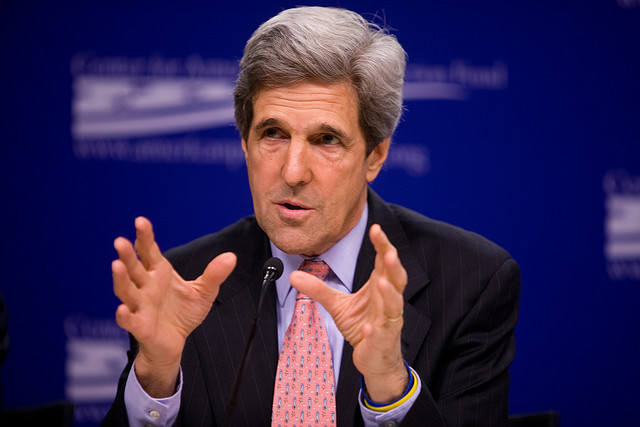
In 2007 Barack Obama said: “The President does not have power under the Constitution to unilaterally authorize a military attack in a situation that does not involve stopping an actual or imminent threat to the nation.” In questioning John Kerry about Obama’s departure from that principle in Libya, Rand Paul elicited from Kerry, a reaffirmation that he, Kerry, still believed that the bombing of Cambodia was illegal. One might wonder, then, whether Obama’s new Secretary of State is going to oppose his famous “drone” assassination programme. I broach the subject because the Department of Justice rationalised the use of deadly force in other sovereign territories citing Cambodia as a precedent. This is an excerpt from their recently released White paper:
The Department has not found any authority for the proposition that when one of the parties to an armed conflict plans and executes operations from a base in a new nation, an operation to engage the enemy in that location cannot be part of the original armed conflict, and thus subject to the laws of war governing that conflict, unless the hostilities become sufficiently intense and protracted in the new location. That does not appear to be the rule of the historical practice, for instance, even in a traditional international conflict. See John R. Stevenson, Legal Adviser, Department of State, United States Military Action in Cambodia: Questions of International Law, Address before the Hammarskjold Forum of the Association of the Bar of the City of New York (May 28,1970)…, (arguing that in an international armed conflict, if a neutral state has been unable for any reason to prevent violations of its neutrality by the troops of one belligerent using its territory as a base of operations, the other belligerent has historically been justified in attacking those enemy forces in that state).
Now, let me start off by saying something absolutely clearly. The idea that the US can legally engage in a programme of assassinations using hellfire missiles fired from unmanned aerial vehicles is a patent falsehood – a complete joke – a non-starter – a parody – a stupid idea that no one should take seriously. A single ad hoc emergency strike might be justified as self-defence under Article 51 of the UN Charter, but a programme cannot be as self-defence because, under the charter, it can only be applied to imminent threats. This aspect of law isn’t rocket science, nor hidden within some mystical realm of legalese. The standard legal textbook dealing with this subject is Yoram Dinstein’s, War, Aggression and Self-Defense, now in its 4th edition. It is a pretty straightforward book (and I’m no lawyer) and on this particular subject it is so unequivocal that it is impossible that any superior authority might find some crucial flaw which would invalidate Dinstein. The reason it is so unequivocal is that the US arguments have already been ruled against by no lesser body than the International Court of Justice. The reason for this is that the US has already deployed almost the exact same reasoning to justify its actions against Nicaragua.
On Nicaragua v. United States of America, the ICJ ruled “By twelve votes to three, Rejects the justification of collective self-defence maintained by the United States of America in connection with the military and paramilitary activities in and against Nicaragua the subject of this case; …. By twelve votes to three, Decides that the United States of America, by training, arming, equipping, financing and supplying the contra forces or otherwise encouraging, supporting and aiding military and paramilitary activities in and against Nicaragua, has acted, against the Republic of Nicaragua, in breach of its obligation under customary international law not to intervene in the affairs of another State….” And goes on to add other grounds of violation, including a similar finding against the US mining of Nicaragua’s main port. Dinstein explores the US self-defence claims and notes that although self-defence was ruled out on other grounds this did not prevent judges from further noting that the three requisite conditions of immediacy, necessity, and proportionality were also unsustainable.1
In the Nicaragua case, as now, the US argued that conditions of immediacy, necessity and proportionality were met, but then, as now, these are just empty words disproved by the simplest of geographical facts. Such claims are even further disproved by publicly available details of the US assassination programme, such as the use of “signature strikes” and the use of “double tap” follow up strikes. These practices demolish self-defence arguments even as they raise further questions about breaches of International Humanitarian Law (such as the Fourth Geneva Convention (1949)) and International Human Rights Law (such as Article 3 of the Universal Declaration of Human Rights which affirms “the right to life, liberty and security of person”).
So, how much does citing US actions in Cambodia strengthen the feeble claims of legal rationale for drone strikes? I would say somewhat less than not at all, partly because US military actions in Cambodia were clearly not legal and partly because they too failed the test of self-defence (hence arguably being crimes against the peace) but they were also gross breaches of International Humanitarian Law, and should be classified as genocide – which is considered an “aggravated crime against humanity”
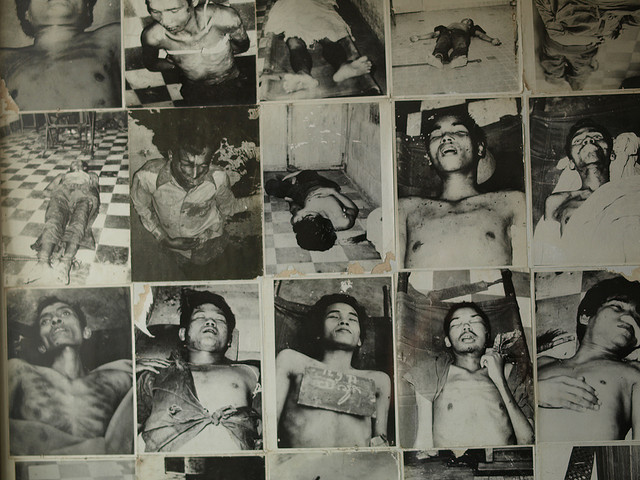
When people think of genocide and Cambodia, they tend to think of the Khmer Rouge, and the “Killing Fields”; of their evidently insane Democratic Kampuchea regime which began its “Year Zero” in 1975. But a Finnish Inquiry Commission designated the years 1969 to 1975 in Cambodia (a time of massive aerial bombardment by the US and of bitter civil war wholly sustained by the US) as Phase 1 of the ‘Decade of Genocide’.2Estimates of Cambodian deaths resulting from the 1969-75 war range from Vickery’s 500,000 killed3 to a credible 1 million excess deaths estimated by Sorpong Peou.4 Given that the Cambodian population was an estimated 6 or 7 million in the period of the Second Indochina War, this gives us a figure of between 1 in 6 and 1 in 14 of all Cambodians killed.
US actions inside Cambodian borders began years before the devastating carpet bombing. The US ‘Studies and Operations Group’ conducted attacks with US Special Forces personnel in Cambodia throughout the 1960s. In 1967 these were institutionalised as “Salem House” (later known as “Daniel Boone”). This programme was kept secret from the US congress and conducted a total of 1,835 missions. Their primary activity appears to have been the laying of “sanitized self-destruct antipersonnel” mines anywhere up to 30 kilometres beyond the border. Their supposed mission was intelligence gathering, but throughout the whole programme they only captured 24 prisoners.5 The Special Forces troops usually disguised themselves as Vietnamese PLAF fighters and sometimes murdered civilians in false-flag operations.6
In 1970 Sihanouk was overthrown by General Lon Nol7 and Prince Sirik Matak with tacit support from Washington and probable assistance by the CIA. Washington recognised the new regime within hours.8 So fast was recognition of Lon Nol’s government that it must have precluded any possibility that the changes on the ground were being assessed, which strongly suggests that the US must have had detailed foreknowledge in order to have any confidence in its judgement. Sihanouk’s overthrow made civil war unavoidable.
In 1969, before the above events, the US began bombing Cambodia in what was known as “Operation Menu”. From Saigon, US General Creighton Abrams insisted that he had “hard evidence” that the Central Office for South Vietnam headquarters (COSVN HQ) had been located in the “Fish Hook” salient of Cambodia.9 The problem was that no such place ever existed, though for years the US had mounted operations to crush it when they claimed it was located in South Vietnam.10 Once under way, Operation Menu spread to other areas. Despite the carpet bombing of area supposed to contain COVSN HQ, in April 1970 Abrams claimed that the headquarters still existed as a fortified underground bunker with 5000 personnel.11 In May US and RVN forces invaded Cambodia, the action justified in part as an attempt, yet again, to wipe out the COVSN HQ “which had become the Holy Grail of the American war”.12 The US/RVN invasion simply, and predictably, drove communist forces deeper into Cambodia.13
It is a known and predictable effect that the killing of civilians drives people to take up arms, it is a “counterproductive” counter-insurgency tactic which actually strengthens the enemy.14 It is worth remembering that the famous maverick US Army officer John Paul Vann made the same observation in 1962.15One of the most striking examples of generating an enemy by killing civilians, is what occurred in Cambodia from 1969 onwards. Ben Kiernan repeatedly cites evidence in numerous consecutive instances that US/RVN aerial bombardment strengthened the Khmer Rouge insurgency, and, more specifically the anti-Vietnamese faction of the Khmer Rouge under Pol Pot.16 In 1969, the Khmer Rouge consisted of perhaps 4000 – an ultimately unthreatening insurgency. By the end of 1972, they were able, with DRV logistical support, to “hold their own” against Lon Nol’s armed forces, which, at US instigation, had been enlarged to between 132,000 and 176,000 (not counting “ghost” soldiers, who existed only on the books of the corrupt officers who collected their pay) and had massive US/RVN air support.17 In William Shawcross’s words, “the new war was creating enemies where none previously existed”18 and by this stage, Lon Nol’s regime was already reduced to the control of shrinking and fragmenting enclaves.19
When the the US generated a war in Cambodia they had already had a great deal of experience in Vietnam and Laos, and what occurred in Cambodia is, in many ways, a naked exposure of the logic behind the genocidal war system, less obfuscated because, ironically, Cambodia was a “sideshow” where it was not the details but the whole war which was kept obscure from the public.
Within a year of Lon Nol’s coup, as mentioned, the economy of Cambodia was virtually destroyed, not only by bombing, but also by US aid. Aid was channelled to the import of commodities and surplus US agricultural goods. It also underwrote the Cambodian government and armed forces: “By the end of 1970, the government was spending five times its revenue and earning nothing abroad.”20 Most of the population became reliant on US aid to eat, and rice supplies were kept at the minimum level needed to prevent food riots. By 1975, malnutrition was widespread and many children starved to death.21
Going back in time to 1970, less than two months after the coup that brought Lon Nol to power, the US invaded Cambodia, along with ARVN forces. They did not bother to forewarn Lon Nol who found out after Richard Nixon had announced the invasion publicly.22 This invasion along US and RVN bombing and the civil war made refugees of around half of the Cambodian population.23Lon Nol was outraged by the invasion and when later briefed by Alexander Haig (then military assistant to Kissinger) about US intentions he wept with frustration. According to Shawcross, “He wished that the Americans had blocked the communists’ escape route before attacking, instead of spreading them across Cambodia. … The Cambodian leader told Haig that there was no way his small force could stop them. … [Haig] informed Lon Nol that President Nixon intended to limit the involvement of American forces…. They would be withdrawn at the end of June. The the President hoped to introduce a program of restricted military and economic aid. As the implications of Haig’s words for the future of Cambodia became clear to Lon Nol, he began to weep. Cambodia, he said, could never defend itself.”24

As has been detailed, US actions, particularly in bombing, were directly responsible for creating the communist enemy which overthrew Lon Nol. The bombing between 1969 and 1973 took up to 150,000 lives.25 If averaged out, over 33 tons of ordnance were used to kill each Khmer Rouge insurgent.26 Despite the fact that Vietnamese pilots bombed any Cambodian they could, which aided only the Khmer Rouge, Lon Nol acceded to a US demand that he request an increase in VNAF bombing in 1971.27 By May 1972, the Lon Nol regime had control of perhaps 10 per cent of the country and continued to lose territory which was thereafter fragmented into ever smaller enclaves.28 The result was by that stage foregone, and yet the war dragged on for three years with the greater part of the 1 million deaths occurring after that point.
In 1970, when Henry Kissinger briefed Jonathan “Fred” Ladd, who was slated to conduct the war in Cambodia, he told him, “Don’t even think of victory; just keep it alive.”29 The point of the US bombing was not to win a military victory – it was to destroy Cambodia as part of an Indochina “exit strategy” – and that is a clear instance of genocide under the United Nations Convention on the Prevention and Punishment of the Crime of Genocide. When the US Congress finally blocked aid to Cambodia and South Vietnam, it was with the belated realisation that such aid would not give any hope of victory or improve a bargaining position. Senator Mike Mansfield spoke out, “Ultimately Cambodia cannot survive…. Additional aid means more killing, more fighting. This has got to stop sometime.”30
So that was the end of the US involvement in Cambodia, and their legal culpability. The Khmer Rouge took over Phnom Penh, and the refugees were shocked to see that the black-clad cadres were mostly young teens, fanatical and brutalised by half a young lifetime of fighting and death. The US was not responsible for the fantasies of the Pol Pot clique, who believed that supernatural amounts of food could be produced without recourse to machine power, nor for their refusal to accept aid. But the US had deliberately brought the Cambodian population to the brink of starvation – destroying farmland and driving peasants off the land. Perhaps 500,000 or more died of starvation. Hundreds of thousands were executed for political or ideological reasons, murdered by the Khmer Rouge who the US had largely brought into existence. And when the Vietnamese put the regime to an end (and despite what you may read about this being justifiable as “humanitarian intervention” it was in fact legitimate self-defence – if you don’t believe me you can read about Khmer Rouge foreign policy, border attacks, and espoused official desire to exterminate all Vietnamese) when the Khmer Rouge were supplanted, the US insisted that they retain a seat at the UN and started giving aid to their guerilla forces.

So, do I think that the Cambodia precedent is a good one to justify an assassination programme? No, I do not. But then again I am not from the US, and perhaps I am failing to grasp the subtle point that next to no “Americans” died in Cambodia (none that were officially acknowledged) therefore it did not happen. I don’t want to be offensive, but if they do not wish to be complicit with the crimes of the US regime, US anti-drone campaigners must avoid all trace of exceptionalism. I am sure they mean no harm, but why allow yourselves to be drawn into this ridiculous framework of seeing the drone programme as being primarily a question of “the targeting of Americans without due process.” There have been 5 US citizens killed with US drones whereas at least 4000 non-US citizens have been killed. Why would anyone, in those circumstances, give primacy to concern over “US citizens” and “due process”? This fetishisation of the idolised US Constitution is getting old. Besides which, the US Constitution’s “Supremacy Clause” (Article 6, Clause 2) actually gives treaties the same status as federal law – which would include the Nuremberg Charter and the UN Charter, among other things. Furthermore, by allowing the issue to be framed in such a manner, psychologically you set yourself and others up for being mollified by cosmetic measures offered to guarantee the rights of US citizens while retaining the right to kill foreigners at will. Do you really believe that being a US citizen or being born in Denver makes someone more human?
1 Yoram Dinstein, War, Aggression and Self-Defence (3rd ed.), Cambridge: Cambridge University Press, 2001, pp 184-5.
2 Edward Herman and Noam Chomsky, Manufacturing Consent: The Political Economy of the Mass Media. London: Vintage, 1994 (1988), p 260.
3 Ibid, p 263.
4 Sorpong Peou, Intervention & Change in Cambodia: Towards Democracy? Singapore: Institute of Southeast Asian Studies, 2000, p 54.
5 Ibid, pp 64-5.
6 Ben Kiernan, The Pol Pot Regime: Race, Power, and Genocide in Cambodia under the Khmer Rouge. New Haven and London: Yale University Press, 1996, p 18.
7 The US had developed ties with Lon Nol in the 1950s and by 1970, according to CIA officer Frank Snepp, he was one of two candidates being groomed by the CIA to take Sihanouk’s place (William Shawcross, Sideshow: Kissinger, Nixon and the Destruction of Cambodia. London: Fontana, 1980 (1979), pp 114-5).
8 Ibid, pp 114-23; William Blum, Killing Hope: U.S. Military and C.I.A. Interventions Since World War II (2nd ed.), Monroe: Common Courage Press, 2004, pp 137-8; Peou, Intervention & Change in Cambodia, pp 125-6.
9 Shawcross, Sideshow, p 19.
10 Marilyn Young, The Vietnam Wars 1945-1990, New York: Harper Perennial, 1991, pp 72, 186; Tucker, Vietnam, p 129; Turley, The Second Indochina War, pp 79-80.
11 Shawcross, Sideshow, p 140.
12 Young, The Vietnam Wars, p 245.
13 Shawcross, 1979, p 151.
14 David Keen, Endless War? Hidden functions of the ‘War on Terror’. London, Ann Arbor: Pluto Press, 2006, pp 58-61.
15 Neil Sheehan, A Bright Shining Lie: John Paul Vann and America in Vietnam (New York: Vintage 1989 (1988), p pp 106-111.
16 Kiernan, The Pol Pot Regime, pp 19-23. Also see Peou, Intervention & Change in Cambodia, p 128.
17 Shawcross, Sideshow, pp 73, 180, 194-5, 261.
18 Ibid, p 249.
19 Ibid, p 254.
20 Ibid, p 220.
21 Ibid, p 317-9.
22 Ibid, p 149.
23 Peou, Intervention & Change in Cambodia , p 127.
24 Shawcross, Sideshow, p 163.
25 Kiernan, The Pol Pot Regime, p 24.
26 Ibid, p 19.
27 Shawcross, Sideshow, p 186.
28 Ibid, pp 254-5.
29 Ibid, p 169.
30 Nigel Cawthorne, Vietnam: A War Lost and Won. London: Arcturus Publishing, 2003, p 213.

 On Genocide