The Korean Genocide Part 4: War or Genocide?
(In Part 3 I presented matters relating to the opening of “major hostilities” in late June of 1950. I eschewed conclusions because of the unanswered questions around events. However I believe that it would be possible to present the case that the US was the instigator of these events due to the circumstance which surround the events (even if those events are themselves are difficult to discern). There is no smoking gun, as such, but there is a very strong case. The US desired this “war”, they had foreknowledge of the timing of its outbreak, and the window of time in which the US could benefit (by forestalling the impending conquest of Taiwan and the looming collapse of the Rhee regime) was very, very, narrow by this point. The US was actively deceptive in claiming to be unprepared to intervene, yet the rapidity of the deployment of the US Navy to the Taiwan Straits, and the instantaneous commitment of troops to Korea showed that planning and decision-making had taken place already. There is also a clear flurry of secretive activity by US officials and personnel leading up to the outbreak of hostilities as well as inter-client activity between the Guomindang and the Rhee régime. Lastly, though the unpreparedness of the ROK Army can be explained as a deliberate softening in order to draw forces into the equivalent of the “centre”, nothing on Earth can explain the depth of DPRK unpreparedness. And, as Sherlock Holmes tells us, when faced with choosing between the unlikely and the impossible, the unlikely must be true. )

The period which begins on 25 June 1950 and ends 27 July 1953 is conventionally termed “The Korean War”. A war of three years, as with wars in general, is almost inevitably going to be described in narrative terms and there are good reasons for this. Peoples’ lives were utterly dominated by major discreet events with distinct chronological placements – significant military actions; a front which swept south then north then south in the initial stage and then a completely different stage with virtually no such movement; notable political events; notable massacres; notable bombing raids. The Korean people were living through the “interesting times” referred to in the apocryphal Chinese curse – times when the narrative of “major” historical events is actually the most important factor in shaping the lives of the masses.
A narrative has a beginning, a middle and an end. The beginning describes a status quo. The middle is a series of transformative events which follow an initiation event which disturbs the status quo. The end is the establishment of a new status quo. This is all convention, of course, and it is understood that the beginning and end points are static only in terms relative to the defined boundaries of the middle – boundaries of both chronology and of type when including or excluding transformative events. What then should one expect from a narrative of war? More to the point, what would one expect the end to look like? Innumerable examples of war narratives end (by any reckoning) in a manner which accords with Clausewitz’s description of the nature of war. From the Punic Wars to the World Wars, they end with one side imposing its political will on the other, at least to some extent. Before World War II, stalemates were broken when one side gained the advantage. Only very small wars would actually end with a stalemate in place. The Korean War simply does not fit that aspect of the war narrative. The very simple trick of looking at the end of the narrative, one can already discern that the events of 25/06/1950 to 27/07/1953 are more likely to conform to a narrative wherein the “middle” is characterised by genocide rather than war.
In politico-military-strategic terms the end results of the Korean War are insignificant in terms of the scale of military action. There was no regime change. There wasn’t even a change in the balance of power on the peninsula except a growth of deterrence. If anything the war acted to stop change at this level, to halt transformative events and reimpose a more stable form of the status quo ante as if to defy the rules of narrative. However, on another level the transformation was profound and shocking. Around 10 percent of Koreans, or slightly more, were dead. In the DPRK about 2 million civilians and 500,000 military had died according to Halliday and Cumings.i That is more than one of every four human beings exterminated in a three year span. Others give lower figures, but still produce shocking mortality rates such as 1 in 5, though there is the ever-present confusion of specifying only “casualties” without distinguishing killed and wounded. One estimate is that one ninth of North Korean civilians (1,000,000 people) were killed in air raids alone.ii Additionally, according to Stueck, “[i]n property, North Korea put its losses at $1.7 billion, South Korea at $2 billion, the equivalent of its gross national product for 1949. North Korea lost some 8,700 industrial plants, South Korea twice that number. Each area saw 600,000 homes destroyed.”iii The urban destruction in the DPRK was unparalleled before or since, “at least 50 percent of eighteen out of the North’s twenty-two major cities were obliterated. A partial table looks this:
Pyongyang, 75%
Chongjin, 65%
Hamhung, 80%
Hungnam, 85%
Sariwon, 95%
Sinanju, 100%
Wonsan, 80%.”iv

Pyongyang
Within months the US had run out of military targets and in less than a year they were running out of significant civilian targets and began bombing the countryside.v
The US also bombed south of the 38th parallel, when the KPA occupied areas or when there was guerilla activity. Hundreds of thousands were also massacred, almost exclusively by US and right-wing formations. Millett observes that “[i]t is no accident that Koreans often compare themselves to Jews, Poles, and Irish.”vi In the ROK there is even a word, han, which specifically denotes the repressed and accumulated grief and rage that was produced in those who loved ones were killed by the regime but who avoided even mentioning the departed, let alone grieving their loss, for fear of being killed themselves.vii If this level of trauma is present in the ROK, one can only imagine the level of psychic devastation in the DPRK.
From the point of view of narrative, then, it would seem from the end point of the narrative arc that the middle, the crucial transformational events which are the stuff of traditional history, would be more likely to take the form of genocide than that of war. It’s not quite that simple though. It cannot be denied that there was a war going on. Baudrillard could not claim that “the Korean War did not happen”, although one might observe in events embryonic forms of the sort of “simulation” that led him to claim “the Gulf War did not happen”. What one can say is that in the narrative of war US actions often seem to be difficult to explicate, especially if its role in peace negotiations is incorporated. Claims of US naivety, idealism, stupidity and arrogance are all deployed to explain US actions, along with analyses of domestic political matters and inter-élite conflict. This sort of approach is no different from that used with respect to Indochina, Iraq, Afghanistan, and many sites of lesser US involvement which would include most of the very long list of US interventions. In contrast a narrative of genocide requires no such explications. Indeed, it is almost eerie that events unfold as if smoothly following a predetermined plan of genocide, notwithstanding that prosecuting genocide does not require the precision of prosecuting war and is thus not subject to uncertainty and reversal in the same manner.
Before narrating the events of the front line, it is worth describing the genocidal character of US actions in rear areas, which is ultimately a more fundamental defining characteristic of what occurred than the battles at the front. As Cho writes:
Targeting a civilian population would be a strategy that the U.S. military “perfected” during the Korean War, leaving three million people, or 10 percent of the population, dead. The horrors that began to unravel on the Korean peninsula on June 25, 1950, were already reminiscent of a future of U.S. military domination in Asia, flashing forward to images of napalmed children running through the streets….viii
It is worth contextualising US and ROK atrocities by making a comparison with Communist atrocities. Firstly, it is worth noting that the Chinese are not linked to massacres. Their treatment of POWs was far from what one would hope, and yet far better than that meted out by other belligerents. During 1951 the Chinese even took over custody of nearly all Western prisoners due to concerns over their treatment at Korean hands and were mostly at pains to treat them reasonably (in fairly grim circumstances) and protect them from the vengeance of Korean citizens.ix The Chinese example alone should be enough to belie completely any apologistic discourse which seeks to suggest that the sort of atrocities committed by the US were some innate by-product of the type of war fought.
North Korean atrocities differed form those of the US and ROK in three ways. Firstly there is the matter of scale. Cumings estimates that KPA atrocities were about one sixth compared to around 100,000 dying at the hands of ROK security forces and right-wing paramilitaries.x It may be that Cumings is being conservative with both numbers here, but if we assume from this a figure of 17,000 victims of Communist atrocities then it becomes more like one tenth or twentieth if one accounts in addition for US massacres and ROK massacres in captured or recaptured territories. If one factors in the civilians who died under US aerial bombardment the figure becomes less than 2%.xi
Secondly, there is the matter of authorisation. As Dong Choon Kim writes: “North Korea’s Kim Il Sung strongly emphasized the prohibition against civilian killings, which seemed quite natural because the [KPA], as a revolutionary army, had to win the hearts and minds of the South Korean people.”xii Kim Il Sung also condemned revenge killingsxiii which were rife at the village level with reciprocal atrocities occurring as territory changed hands.xiv Furthermore, though the killing of POWs on or soon after capture was common, KPA officers at all levels strove constantly to end these murders.xv The authorised atrocities were restricted to the murder of political prisoners after a show of formal legal proceedings. On an individual level this is no less an atrocity than the same act carried out without the pretence of a trial, perhaps more so especially if confessions are produced through torture. It does, however, greatly restrict the scale of murder to a more individual rather than mass event. It also restricts the nature of the victims. Children, for example, would not be subject to this violence, nor generally would the apolitical, nor those without some significant form of political power.
This brings us to the third factor, the matter of discrimination. Communist atrocities particularly targetted specific individuals.xvi This was true of both authorised and unauthorised atrocities. Even surrendering soldiers and POWs are specifically “enemy combatants” who, by their nature, are or have been involved in conflict. The agency of, say, an infantryman may be virtually non-existent (outside of the fantasies promoted by recruiters), but that makes them pawns, not bystanders. There is no inherent moral difference between murdering a soldier and murdering a civilian, but there is a distinct difference. It is almost inevitable that military personnel are viewed as enemies, but enmity towards civilians, if defined in “national, ethnical, racial or religious”xvii terms, is at the very least a prerequisite for genocide. Arguably it might be said that any mass killings and/or major destruction under this condition is definable as genocide in line with Lemkin’s definition of genocide as being “against populations”.xviii
Leaving aside the POW issue, given the conditions under which the Communists committed atrocities, it seems reasonable to accept Cumings’ implicit figure of roughly 17,000 civilians killed. This means that the US and ROK forces under US command killed more than 50 times as many civilians as the Communists.xix That is a substantive difference, not only in moral terms. Behind this massive disparity is a mountain of corpses. Explanations are given which rely on the atomisation of various forms of massacre, an artificial separation of methods and circumstances of mass slaughter – panic at the advance of the KPA; fanatical anticommunism; racism; superior firepower; and the US “airpower fetish”. The disparity, however, gives lie to this because at every turn the Communists opposed the mass killing of civilians while, as will be shown; each instance of US/ROK mass murder was the result of policy. The disparate levels of atrocity mean exactly what they should suggest at first glance – one side was fighting a war, the other was committing a genocide.
To begin with the UN side of the frontline, the most well known massacre carried out by US personnel was that of No Gun Ri. This occurred from 26 July to 29 July 1950, that is to say over the space of about 3 days. The massacre began when refugees fleeing across a bridge were strafed and mortared. This much is not disputed.xx Controversy arose over the circumstances soon after the massacre rose to prominence in 1999. A narrative was promulgated throughout most of the US media that “the incident took place because the military was ill-trained and ill-equipped during the early stages of the war”xxi with the result that “the No Gun Ri story became sanitized as just another anecdotal war story that asks to be forgotten.”xxii In fact it is well documented that the US had on numerous occasions been directly ordered to open fire on refugees.xxiii According to the BBC: “Declassified military documents recently found in the US National Archives show clearly how US commanders repeatedly, and without ambiguity, ordered forces under their control to target and kill Korean refugees caught on the battlefield.”xxiv On 26 July, the day the massacre began, a letter from the US Ambassador to the ROK detailed to the State Department the US Army’s plan to open fire on refugees if they did not heed warning shots.xxv However, warning shots do not seem to have played a role in these events. According to the ROK Truth and Reconciliation Commission (TRCK) in 2007:
On July 25th, 1950, Korean villagers were forced by U.S. soldiers to evacuate their homes and move south. The next day, July 26, the villagers continued south along the road. When the villagers reached the vicinity of No Gun Ri, the soldiers stopped them at a roadblock and ordered the group onto the railroad tracks, where the soldiers searched them and their personal belongings. Although the soldiers found no prohibited items (such as weapons or other military contraband), the soldiers ordered an air attack upon the villagers via radio communications with U.S. aircraft. Shortly afterwards, planes flew over and dropped bombs and fired machine guns, killing approximately one hundred villagers on the railroad tracks.xxvi

That is the context, which became a centre of controversy (albeit specious controversy) which in turn managed to leave most people with the impression of some sort of panicked response by US personnel who were not coping. The reader may well be wondering how this could possibly address all of the issues involved in a 3 day long massacre, a period longer than panic or unpreparedness could possibly account for.
After the initial attack, the refugees fled into a culvert and a tunnel beneath the bridge. US forces set up machine guns at either end of the culvert and tunnel. For over three entire days the machine gunners killed those who tried to leave, killing, according to the TRCK, an additional 300:xxvii “‘There was a lieutenant screaming like a madman, fire on everything, kill ’em all,’ recalls 7th Cavalry veteran Joe Jackman. ‘I didn’t know if they were soldiers or what. Kids, there was kids out there, it didn’t matter what it was, eight to 80, blind, crippled or crazy, they shot ’em all.’”xxviii Soldiers with small arms would, as time passed, approach the culvert to pick off any survivors. A survivor, 12 at the time, said: “The American soldiers played with our lives like boys playing with flies.”xxix Bruce Cumings believes that there was a concerted effort to ensure that there were no surviving witnesses.xxx
We know these events occurred because of eye-witness statements, both those of survivors and those of 35 veterans who corroborate these events.xxxi Further corroboration exists in the bullet holes that remain to be seen, though plastered over, in the culvert and the tunnel to this day.xxxii Eye-witness testimony is the central evidence of these occurrences. Even the journal Archival Science is forced to concede that documents are supplementary, corroborating details rather than constituting an account.xxxiii This is true for all the massacres that occurred south of the 38th parallel. The orders that set the machinery of death in motion may be documented, but the events were not. The substance of eye-witness testimony, however, has been borne out by the mass graves to which witnesses were often able to lead investigators.xxxiv
No Gun Ri was not isolated. Over 60 further such massacres at US hands have been reported:
For example, on 11 July 1950, the US Air Force bombed the peaceful Iri railway station located far south of the combat line and killed about 300 civilians, including South Korean government officials. US warplanes also bombed and strafed gathered inhabitants or refugees in Masan, Haman, Sachon, Pohang, Andong, Yechon, Gumi, Danyang and other regions. Roughly 50 to 400 civilians were killed at each site and several times of that number were severely wounded. In dozens of villages across southern South Korea, US planes engaged in repeated low-level strafing runs of the ‘people in white,’ In the southeast seaside city of Pohang in August of 1950, US naval artillery bombarded the calm villages and killed more than 400 civilians. In addition, another fifty-four separate cases of attacks equivalent to No Gun Ri are logged with South Korean authorities but have not yet been investigated.xxxv
The one salient point that is repeated most often by veteran pilots is that they were told to target the “people in white”. White clothing was the normal and traditional Korean attire, the most common form of dress among the rural majority.xxxvi But No Gun Ri is symptomatic of more than just the systematic targeting of refugees, it also shows the gratuitous violence of individual soldiers fuelled by racism. Hungarian reporter Tibor Meray described US personnel shooting Koreans for sport at the time and stated that neither the KPA nor the ROKA could compare to US forces in brutality.xxxvii In Viet Nam years later, a veteran of the Korean War told Philip Caputo: “I saw men sight their rifles in by shooting at Korean farmers. Before you leave here, sir, you’re going to learn that one of the most brutal things in the world is your average nineteen-year-old American boy.”xxxviii
The racist violence of US personnel had begun during the occupation. Here it is worth contrasting again. Soviet troops had entered Korea as conquerors, war weary, barefoot, and brutalised. They stole, they raped and they killed. After dark they had to travel in groups of no less than three to avoid reprisals from enraged Koreans.xxxix But the official reaction was swift. Their superiors stamped out such behaviour in a matter of weeks and the damage in relations began to heal.xl In contrast, Koreans greeted the US occupation warmly,xli but after 3 months of occupation Hodge reported that hatred of US was increasing, “the word ‘pro-American’ is being added to ‘pro-Jap’, ‘national traitor’ and ‘Jap collaborator’.”xlii This wasn’t just the result of US policies, but also of the behaviour of the occupation forces:
By December 1945 most of the specific acts with which the US command contended as the occupation proceeded – open expressions of disrespect toward Koreans, lack of care in avoiding Korean pedestrians while driving American military vehicles, offensive advances toward Korean women, looting and larceny – were common.xliii
When the “replacements” arrived, conscripts taking over from Pacific War veterans, things got worse – “they lacked the training and discipline of their predecessors in the Army while possessing all the provincialism and sense of superiority of their older comrades, if not their dehumanizing experience in fighting the Japanese.”xliv Western reporters at the time found that racist contempt was the norm and that insurmountable alienation was more or less universal.xlv I cannot provide a full analysis of Hodge’s response, but it was inadequate – long on rhetoric (such as letters of exhortation to the troops), short on efficacious measures (such as widespread curfews and bans of off-duty personnel or rigorous prosecution of the more common offences, which were not necessarily minor). The fact that a commander with an entire machinery of military discipline at his disposal chose what amounted to begging his personnel to be nice shows that he was (as many have pointed out) a battlefield commander unsuited to the task of running an occupation. The fact that neither subordinates nor superiors did anything about his inefficacy, however, shows a fundamental disinterest in improving the behaviour of US personnel, a lack of will which supersedes in relevance any lack in capability on Hodge’s part.
Racist violence was fully unleashed once the War was under way. Just as the Germans had conflated Jewishness and Bolshevism, the US in propaganda and military indoctrination conflated “Asiatic”-ness and Communism.xlvi Instead of reserving animus for combatant enemies animus was directed at “gooks”, which meant all Koreans regardless of combatant status, political orientation, or gender. It is true that risks vastly differed for different locales and statuses, but it is also true the every single Korean faced at least some risk of being killed by US forces and local allies were not an exception (a circumstance also seen in South Vietnam, Iraq, Afghanistan and any other place where US forces are directly deployed). A US correspondent wrote that it was “not a good time to be a Korean, for the Yankees are shooting them all”, while a British war correspondent recorded that GIs “never spoke of the enemy as though they were people…. …[E]very man’s dearest wish was to kill a Korean. ‘Today… I’ll get me a gook.’”xlvii
When US forces went north of the 38th parallel massacres also occurred. Details are, of course, sketchier, with DPRK officialdom being an unreliable source. However, as Dong Choon Kim points out: “While it must be acknowledged that the North has politically exploited such claims, the facts on the ground force us to not discount their veracity.”xlviii In one instance an estimated 35,380 people in Sinchon were massacred but whereas the DPRK leaders claim that US personnel committed the massacre, it was in fact ROK paramilitary police and militias who were sent north (by the US) in the tens of thousands.xlix
Although subject to commands from the Rhee regime, ROK security forces were ultimately under US command.l The US military may have been involved in formulating the “special decree” which initiated widespread massacres south of the 38th parallel, but there is no doubt that it was the US which initiated the massacres by ROK security forces north of the 38th. An order was issued to “liquidate the North Korean Workers’ Party”, a mass movement which had 14% of the DPRK population as members. Mass arrests were to be followed by the production by the US of “black lists”, the unstated purpose of which is easy enough to guess.li A partial list of occasions when the US has provided clients with lists of persons who the US wishes dead due to their political beliefs or activism includes: Guatemala, 1953;lii Iraq 1963,liii 2002-3,liv 2005-7;lv Indonesia 1965;lvi Indochina 1950-75;lvii Argentina, Chile, Brazil, Bolivia, Paraguay, Uruguay, Peru, and Ecuador mid-1970s (Operation Condor);lviii Latin America 1982-91lix (note that in the latter two instances most targets were not directly chosen by the US, but under guidelines created by the US). It is pretty easy to establish that these murders are eliticidal in nature by looking at the nature of the victims. They target leading intelligentsia and students, unionists, and peasant organisers. In Viet Nam, for instance, the US even invented the term “Viet Cong Infrastructure”. Pradosdefinesthemas “ashadowynetworkofVietCongvillageauthorities,informers,taxcollectors,propagandateams,officialsofcommunitygroups,andthelike,whocollectivelycametobecalledtheVietCongInfrastructure(VCI).” “Sympathizers”werealsocounted.lx The victims are very clearly non-combatants. For example, in William Blum’s survey of US interventions (Killing Hope) there is no index entry given for “unionists”, “subversives” or “dissidents”; however, quite tellingly, one can get a fair idea of the approach to such individuals through looking up the entries on “torture, US connection to.” Out of 14 entries there are three relating to interrogation;lxi three where armed activists/guerillas/insurgents were tortured alongside unarmed political activists;lxii and 7 entries where only political dissidents are mentioned as victims.lxiii
We don’t know how many died in massacres north of the 38th parallel, but we do have some idea (very roughly) of how many died in mass executions in the south. Of 30,000 political prisoners at the outbreak of war almost all were disposed of (except for 7000 fortunate enough to be imprisoned in Seoul).lxiv This was the tip of the iceberg. An estimated 350,000 people were enrolled in the Bodoyeonmang (National Guidance League, NGL). It was putatively an organisation for monitoring and rehabilitating left-wing activists, but up to 70% of its members were simply apolitical peasants.lxv In a series of enormous mass executions (evidenced by mass graves which, again, provide grim proof of eyewitness testimony) somewhere between 100,000 and 200,000 people were slaughtered (some estimates go as high as 300,000).lxvi In Taejon, for instance, 4000-7000 were executed, and when the town was recaptured the mass graves were used as propaganda under the false claim that it was in fact the Communists who had committed the atrocity.lxvii Probably those US personnel and Western reporters who saw the bodies believed it to be true (after all the Communists were the savages) but the massacre had in fact been attended by US officials.lxviii

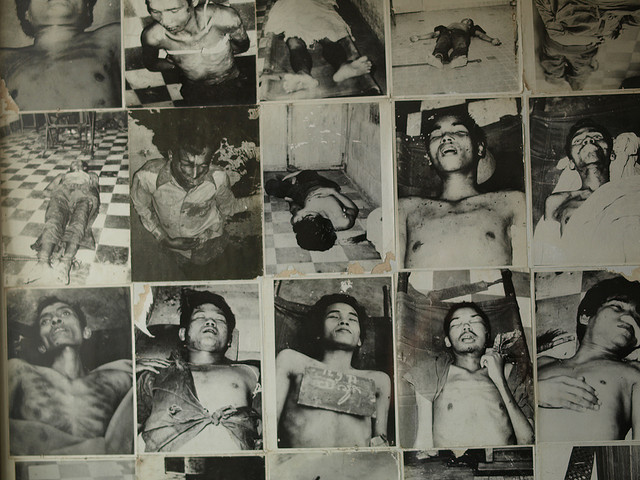
Victims at Taejon. Note, I found this picture at a site which replicates the lie that communists committed this massacre. Of 48 photos in this 2010 retrospective 4 are depicting communist atrocities (or claim to be) while only 1 depicts an ROK/UN atrocity (below).

In recaptured territory, as in the North, many deemed politically suspect due to their activities during the DPRK occupation were liquidated. In the Seoul area, for instance, 50,000 were killed by one estimate.lxix In addition, civilians in areas where guerillas operated were at risk of being murdered throughout the war. Counterinsurgency often meant slaughtering civilian men, women and children deemed by geographical criteria to be supportive of the guerrillas. In Guchang, for instance, “several thousand civilians, including babies, women, and elderly, were killed during the operations named ‘Keeping the Position by Cleansing the Fields….’”lxx The US was also using airpower against parts of the countryside deemed inimical. From 5 January 1951 the US began the wholesale use of napalm against villages deemed to be willingly or unwillingly providing some form of support for guerrillas. As Suh Hee-Kyung writes: “The objects of the bombings now included not only military targets but also civilian homes and towns suspected of harboring communist guerrillas and/or North Korean soldiers. Especially in areas that the North Korean Army and the Chinese Army had invaded, the U.S. Army applied a ‘scorched earth policy’ even if the targeted area was residential.”lxxi On 25 January 1951 Lt. General Edward Almond (commander of X Corps) defended the bombing in terms paraphrased by Cumings as, “the local population was being killed, true, but the meager population remaining appears sympathetic to and harbors the enemy.”lxxii
The US also began its bombing campaign in the North. Most of the 1 million tons of US ordinance dropped from the air in the War were used in “strategic” bombing in the North.lxxiii It is fair to say that in this small and highly urbanised half-country, this tonnage caused a greater degree of destruction than in any other time and place in human history (not counting single cities). “By 1952 just about everything in northern and central Korea was completely levelled. What was left of the population survived in caves, the North Koreans creating an entire life underground, in complexes of dwellings, schools, hospitals, and factories.”lxxiv The rough consensus figure is that 1 million civilians died from the US bombing campaign. As Cumings notes:
The United Nation’s Genocide Convention defined the term as acts committed “with intent to destroy, in whole or in part, a national, ethnical, racial or religious group.” This would include “deliberately inflicting on the group conditions of life calculated to bring about its physical destruction in whole or in part.” It was approved in 1948 and entered into force in 1951 – just as the USAF was inflicting genocide, under this definition and under the aegis of the United Nations Command, on the citizens of North Korea. Others note that area bombing of enemy cities was not illegal in World War II, but became so only after the Red Cross Convention on the Protection of Civilians in Wartime, signed in Stockholm in August 1948.
Kim Dong Choon is cautious about the subject of genocide, despite writing in the Journal Of Genocide Studies: “As we usually label genocide when the shooting and strafing were aimed at a certain race or community with clear cut boundaries and characteristics, America’s military actions towards Korean civilians may not be regarded as a genocidal incident. ([Interjects in endnote]However, as Bertrand Russell and Jean Paul Sartre argued when they established a ‘War Crimes Tribunal’… the ‘genocidal intent’ of war may be identified even when official military policies may deny such an ambition.)lxxv Of critical importance, however, is the fact that the US soldiers killed civilian refugees lacking even a modicum of self-defense, including women and children, even when no North Korean soldiers or grass-root guerilla forces threatened them.”lxxvi This needless caution on Kim’s part is saddening. The US (and the ROK forces under US command) systematically killed civilians in various completely different circumstances, and they did so under orders from the very top of the chain of command. One need only to glimpse through the various levels of mortality produced by “strategic bombing”, “counterinsurgency”, and mass executions to see that, taken as a whole, this was a staggering amount of death and (perhaps more importantly) a staggering amount of co-ordinated labour employed in causing mass civilian deaths. The level of proof required here is, in fact, far lower than that required to label the mass killings in Rwanda or Cambodia as genocides. Likewise, the economic and social destruction wrought in the North was so comprehensive that it can only be matched by the most widely acknowledged genocides.
There is more. By deliberately drawing out the negotiations for an armistice while instituting a strategy of “attrition” the war, although a very real war, was made primarily an engine of genocide by the US. In this it became a progenitor of later genocidal war systems. To illustrate this evolution it is necessary to trace the progress of the war. The narrative produced is, like that of the origins of the war, distinctly anomalous at points. In the framework of war, as it is generally understood, such actions were difficult to explain and caused alarm among allies, US personnel themselves, and even US political leaders. The US public, on the other hand, simply hated the war and it destroyed the Truman presidency – Truman holding the record for least popular President on record (with 77% disapproval) until the advent of George W. Bush.lxxvii But while from a military perspective many US actions seemed counterproductive or at least completely pointless it should be remembered that the narrative ends with the US having won for itself every single advantage that it could have won, at least from an imperial perspective. The previously fragile division of Korea was now stable and consolidated as was the US client regime in the ROK. Each half of the peninsula was tied more firmly in dependency to its superpower patron. Taiwan was saved from unification with China, while the infant PRC was greatly retarded in its development. The US was now in a state of enduring militarisation, armed with both the weaponry and the ideology which would allow the US to exert coercive imperial power over most of the globe. From this perspective an outright military victory would have been considerably less attractive, not least because US interventions would rely on the (false) implication that the Communist Bloc posed a military threat to the US.
Korea is not particularly suited to blitzkrieg, it is narrow and hilly with poor roading generally at the bottom of valleys, and a climate which makes operations of any sort difficult. Carter Malkasian describes it as suited for “strong in-depth defense”, by which he means using elevated positions of the sort which would be so bloodily contested later in the war. Inexplicably, however, the ROKA commander “wanted to contain any North Korean attack at the 38th Parallel and rejected a planned withdrawal to stronger positions, such as behind the Han river. The 38th Parallel was on comparatively flat ground, lacking ridges or river-lines on which to form a defensive.”lxxviii That is to say, such a stance is inexplicable unless it is explained, like so much else must be, as a deliberate softening of ROKA defences.
After capturing Seoul, the KPA waited about a week, apparently awaiting artillery and other supplies, before the next concentrated offensive.lxxix “Lacking detailed plans for operations south of Seoul, North Korean forces had been slow to proceed beyond the Han River.” On July 5 the KPA fought their first engagement with US forces, who did have anti-tank weapons but were nevertheless defeated. “American combatants had inadequate firepower to resist Soviet-built tanks, and North Korean soldiers were not intimidated by opponents simply because their skin was white….”lxxx On the contrary, the KPA continued to push, over-running an entire US division when Taejon was captured a week later. It took only until August 1 for the KPA to reach a point less than 50 km west of Pusan.lxxxi By this stage the KPA faced superior numbers 92,000 (47,000 of them US) to the 70,000 it could bring to the front known as the Pusan perimeter.lxxxii Only a tiny chunk of the peninsula was unconquered, but more critical for the KPA than being outnumbered was the fact that they had never prepared for this. They could not replace casualties, communications were still far from desirable efficacy, and their stretched supply lines combined with US air and naval power to make resupply difficult.lxxxiii As Malkasian explains the chance to end the war quickly was slipping away: “Better American bazookas and heavy M-26 Pershing tanks had arrived that could counter the T-34s. The North Koreans waited until 3 September to make their major assault in the Second Battle of the Naktong Bulge. However, by then North Korean strength was ebbing. With only 98,000 men, they faced 180,000 UNC soldiers.”lxxxiv
On September 15 the US X Corps made a bold and extremely well executed amphibious landing at Incheon, the port adjacent to Seoul. The DPRK expected this move but had little choice but to throw everything they could at the Pusan perimeter (in the abovementioned Second Battle of the Naktong Bulge).lxxxv It seems apparent, however, that the DPRK had prepared for withdrawal, and for troops who were cut-off to become guerillas in the hills.lxxxvi Nevertheless, this was a terrible defeat for the KPA who were more or less routed from the South, sustaining heavy casualties and equipment losses. UN forces broke out of the Pusan perimeter on September 23. Seoul fell on the 27th after bitter fighting which caused many civilian deaths.lxxxvii Only around 25,000 KPA reached the 38th parallel before UN forces.lxxxviii
The KPA continued retreating and X Corps pressed northwards. The 38th parallel, crossing which had been condemned as an act of aggression by the UNSC was, little over 2 months later, of no significance. An “imaginary line” as MacArthur put it,lxxxix the same phrase being used soon after by the US ambassador to the UN.xc (Malkasian claims that UNGAR 376, passed on October 7, authorised UN forces to proceed north of the 38th.xci The two major problems with such a contention are that a) by October the 7th UN forces were in places already more than 100 km north of the 38th and b) the resolution says no such thing.xcii)

The US rationalised crossing the 38th as a measure to prevent further aggression, but then changed to the annunciated aim of military unification.xciii The Chinese openly avowed that they would respond militarily to a march on the Yalu with PLA Chief of Staff (on Sept 26) and Chou En Lai both telling the Indian ambassador for conveyance to the US. US intelligence agencies claimed, however, to have believed otherwise.xciv When China entered the war, the US reacted at first as if nothing significant had happened then, after suffering defeats in October and November, as if a large portion of the PLA had crossed the border en masse:
As American forces rushed pell-mell back down the peninsula, observers at the time wondered why they were moving so fast, often breaking contact with an enemy not necessarily pursuing them. On December 15 a British military attaché wrote, ‘The withdrawal continues without any major enemy pressure. There were no signs of defense lines being used to halt the enemy march; it looked like a phony war, or a great hoax.’ British military attachés said in early December that the numbers of Chinese were quite exaggerated, with very few confirmed contacts with the Chinese ; furthermore, it was often impossible to judge the nationality of enemy units. The number of Chinese POWs being taken did not indicate huge numbers of troops.xcv

So yet again US led forces were inexplicably retreating rather than using the defensibility of the hilly terrain, this time back to the 38th parallel in what was known as the “Big Bug-Out”.xcvi Hyperbole exploded in Washington. This was the longest retreat in US military history, but it became transformed into the greatest defeat in US history leading to panic in the corridors of power and many very serious moves towards the use of atomic weapons.xcvii This even went as far as the transfer of necessary bomb components to Japan and Guam.xcviii The “Big Bug-Out” didn’t merely facilitate a vastly heightened level of threats from the US, it also gave a boost to the racist propaganda deployed on Western peoples, particularly those of the US. Hollywood films (more likely to be about the Pacific War than the unpopular Korean “police action”) featured scenes “of marauding Oriental troops; of bearded, unkempt American fighters inhabiting alien hovels in alien lands and dauntlessly improvising devices and designs as they go.”xcix Public affairs programming on television was unabashedly infected by official propaganda. One NBC programme was produced out of the White House by a presidential aide, who used it to declare that “[t]he barbarous aggression of the Chinese hoards [sic] in Korea is not only an attack upon the forces of the United Nations – it is an attack upon civilization itself – it is an effort to destroy all the rights and privileges for which mankind has fought and bled since the dawn of time.”c
In coming months China really did commit massive numbers of personnel (officially “volunteers”) to a series of offensives, perhaps 400,000 by mid-January.ci The KPA and the Chinese People’s Volunteers (CPV) managed to advance about 100km south of the 38thby the end of January, but by February UN counteroffensives had pushed them back across the Han and Seoul was evacuated after massive casualties on 14 March.cii The KPA and CPV continued to mount offensives, but shortages and heavy casualties inflicted by UN forces brought them inevitably to a stop.ciii
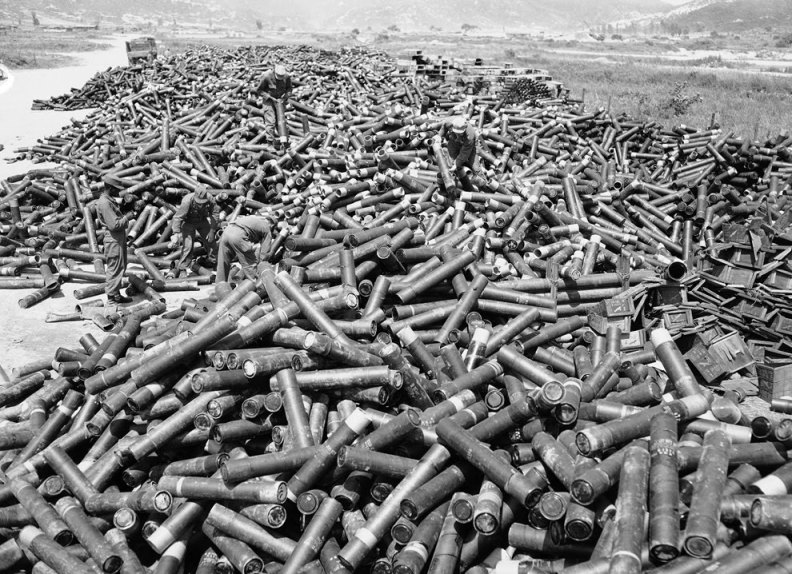
Seoul had by this stage changed hands 4 times. As UN forces retreated in January they more or less destroyed the port at Inchon and burnt down large parts of Seoul, just as they had on retreating from northern cities.civ As the UN was preparing to re-enter the city, US air and ground artillery “blasted” the city.cv Indeed, one neglected aspect of the war was that during the mobile phase (which, as has been shown, seemed a little artificial at times) all but some small pockets of the countryside were swept over at least once by the battlefront. In addition to the 1 million tons or ordnance dropped by US aircraft, US guns fired a total of 2.1 million tons of ordnance – on a peninsula less than four-fifths the size of New Zealand the US used 43% as much explosive power as it did in the entirety of World War II.cvi Massive amounts of Korean property were destroyed by UN scorched earth policies and by the profligate use of artillery in addition to the massive bombing campaign.
In late December 1950, General Matthew Ridgway took over command of the 8th Army which faced the KPA/CPF offensives. In April he was made Supreme Commander of UN forces.cvii From the first he created an offensive spirit and tactics to match. An infantryman put it thus: “We were there to kill Chinese. That’s what they told us. The army was done with retreating. General Ridgway was in charge now, and he wasn’t a retreating general. We heard it every day from the officers. ‘Fix ’em, find ’em, kill ’em.’ We went out every day and we attacked. Seems like that’s all we did was attack. We hardly ate. We hardly slept. We just attacked.”cviii
The doctrine under which this occurred was referred to as “attrition”. On the surface it seemed to have a military logic, at least in the time from January to March of 1951 in which the Communists were conducting major offensives and the UN conducting counteroffensives. In Malkasian’s words Ridgway “sought to wear down their manpower. To do so, superior UNC firepower was to be exploited to the maximum effect. The hallmark of Ridgway’s doctrine of attrition was his directive to his subordinates to maximize enemy casualties while minimizing those of the Eighth Army. Given the daunting Communist numerical superiority, conserving casualties was absolutely crucial.”cix
Implicit in the logic of this “attrition” were three concepts which as yet had no terminology, but would become central in later genocides – “body count”, “kill ratio”, and “force protection”. To understand let us contrast this “attrition” with attrition as it was understood previously by theorists such as Clausewitz. When Clausewitz wrote of a “war of attrition” he referred to the gradual wearing down of strength through the requirement of movement which fatigued personnel and caused supply problems.cx Attrition is primarily a function of ‘war of manouevre’ with the center of gravity here being lines of communication.cxi In the World Wars attrition was notably aimed at and achieved by the deprivation of strategic resources – the single most successful way of reducing the military strength of an adversary which was based so firmly in productive capacities. In Korea this sort of attrition was achieved by stretching supply lines, and this certainly provides one explanation for the two major retreats by ROK/US/UN forces. Interdiction was also a way open to the US to cause attrition. The US interdiction campaign during the Korean War was only very modestly successful. The main challenge to it was the fact that Communist forces used a far smaller tonnage of supplies than UN, or more acutely, US forces. They ran, as it were, on the smell of an oily rag.cxii Bear in mind, however, that the CPV were poorly equipped and the Communists lacked the ability to supply sustained offensives of more than about 14 days,cxiii but as the war progressed their diversified logistical operations supplied ever greater amounts of materièl to the front.cxiv (Communist logistics may have been robust and decentralised, but there was no Ho Chi Minh Trail, and one gets the inevitable impression from the partial success of the interdiction campaign that the Communists would have been highly vulnerable to a programme of interdiction which was as profligately supported as the “strategic” bombing and the “meatgrinder” version of attrition described below.)

My point, and I will return to and illustrate the point, is that the Communist forces had to be more vulnerable in their materièl inferiority than in their numerical superiority. This is true notwithstanding the early Chinese belief that “deception, stealth, and night fighting would enable their poorly armed soldiers to overcome Western technological and materiel superiority.”cxv With offensives severely limited by logistical concerns the Communists could only hope to chip away slowly at UN positions, but there was nothing to stop the UN from using its superior firepower to regain ground as proved to be the case in early 1951. Malkasian writes:
Ridgway’s first use of attrition was successful. [CPV commander] Peng [Dehuai] launched the Third Phase Offensive in sub-zero conditions on 31 December 1950. Although Ridgway was forced to abandon Seoul, his withdrawal stretched the Communist supply lines to breaking point, forcing Peng to call off the offensive. Ridgway was anxious to seize the initiative. On 15 January 1951, he mounted a reconnaissance in force, Operation Wolfhound, followed by a full-blown counteroffensive.cxvi
Others agree that it was the logistical difficulties that ended Chinese offensive actions.cxvii After the failure of the Third Phase Offensive, Peng returned to Beijing to inform Mao that the Communists could not win the war because supply lines had reached their maximum length.cxviii
Apart from the withdrawal during the Third Phase Offensive, however, Ridgway’s “attrition” had little to do with exploiting and exacerbating logistical weakness. It was about killing. After the capture of Seoul Ridgway ordered a limited offensive north of the 38th to establish the “Kansas Line” on high ground, but his whole doctrine was more generally to avoid taking territory or holding positions at the expense of casualties, while at the same time inflicting as many casualties as possible through the offensive “attrition” that became known to soldiers as the “meat grinder”. This involved staging attacks purely aimed at inflicting as many casualties as possible.cxix This was “limited war”. In fact, near the start of the “Big Bug-Out”, only 12 days after the Chinese entry into the war, and only 8 days after threatening the use of atomic weapons, Truman publicly abandoned the goal of military unification.cxx “Limited war” meant, therefore, killing as many people as possible while maintaining a military stalemate, bearing in mind that bombing and massacres were ongoing.
Mao, however, was not to reach the same conclusion as Peng regarding the impossibility of significant military gain until the failure of the Fifth Phase Offensive which came to a halt because of a lack of food and ammunition. The hungry and ill-armed CPV troops were panicked by the inevitable counteroffensive and the UN advanced somewhat north of the Kansas Line, and then stopped.cxxi Neither side was trying to win the war now, and the Chinese also began using “attrition” in the sense of trying to inflict disproportionate casualties in terms relative to total numbers available.cxxii Perhaps it made slightly more sense for the numerically superior force to engage in this behaviour, but in the broader picture it was really just playing into the US hands, allowing them to maintain deadly conflict when there was really no military purpose in the killing.
Whether one dates it to the end of the Fifth Phase Offensive or the end of the subsequent UN counteroffensive, the stalemate phase lasted more than twice as long as the mobile phase of the war, and cost more lives. The stalemate was characterised by “see-saw” battles, wherein the same ground was taken and retaken many times overcxxiii in a manner akin to the mindless butchery of World War I. But this time, off centre stage, civilians were dying in numbers much greater than the battlefield deaths and a bitter guerilla war was fought with napalm and atrocities.
Cease-fire negotiations began on 10 July 1951 and continued for just over two years. One writer characterises them thus: “Throughout the duration of the negotiations U.S. leaders produced harsh ultimatums rather than workable bargaining positions, thereby presumably obviating any form of enemy flexibility.”cxxiv The Communists tried to maximise the propaganda value of the talks, setting things up originally to give an impression of the UN being there to sue for peace,cxxv and they were able to capitalise on US dishonesty by the use of dissident Western journalists.cxxvi Early on armed Chinese troops paraded by “mistake” through the demilitarized area. They had mortars and machine guns, but the Chinese claimed that they were military police (MPs).cxxvii The US, however, made even more drastic “mistakes”. On August 22 the conference site was bombed and strafed by a “plane of unknown origin but flying from the south”.cxxviii In September the UN apologised for two “accidental” attacks the second of which took the life of a 12 year old.cxxix According to Halliday and Cumings, the Communists “claimed that these were deliberate attempts by sectors of the US military to sabotage the talks at key moments – and possibly to assassinate communist delegates. At the time the USA denied most of the charges. The official US military history later acknowledged that the USA carried out a large number of violations, including strafing and bombing the neutral zone and bombing the communist negotiators’ convoy en route to the site.”cxxx
If I were to characterise, very roughly, the nature of the negotiations it would be something like this: Often the Communists didn’t take the negotiations that seriously because the US positions were themselves so extreme as to render seriousness difficult. Nevertheless, on a number of issues the Communists would make major concessions, although with minor face-saving conditions. US officials would then vastly exaggerate the significance of such conditions and a compliant Western news media would follow the official line that it was in fact the Communists who were demonstrating a lack of good faith. The US was the only UN party at the talks and their British allies were frustrated and blamed the US rather than the Communists for the lack of progress in talks. They also believed that US military actions, publicly rationalised as being designed to force the Communists to negotiate in earnest, actually caused the Communists to harden their line.cxxxi When talks stalled over the issue of POW repatriation, the UK Foreign Office again held US intransigence to be the cause. From their Korea desk J. M. Addis minuted with words such as “rapid and unexplained changes of front on the main question and a policy of stepping up demands after concessions have been made – has not contributed to removing the suspicion that undoubtably exists on the Communist side that the Americans do not sincerely want an armistice.”cxxxii
A compromise proposed by the PRC wherein POW’s who did not wish to be repatriated could be interviewed by a neutral country was scuppered by the US bombing of 5 power stations on Yalu undertaken without consulting the British. Omar Bradley claimed it was a “purely military operation” designed to apply pressure for negotiations.cxxxiii The proposal had been a major concession by the PRC because the 1949 Geneva Convention Article 118 made repatriation compulsory without exception. At the outbreak of war the US (a ratified signatory) and the DPRK (a non-signatory) announced adherence to extant Geneva Conventions (the PRC, a non-signatory, made such an announcement in 1952).cxxxiv Additionally, while within in the camps their were many who wished to defect, others were coerced by right-wing elements by threatened starvation and torture sessions.cxxxv
On the 13th of May the US began a series of bombing raids against DPRK dams. Timed just after the laborious work of rice transplantation, before plants had taken root, the resultant floods cause utter devastation. The bombing of the Toksan dam, for example, “scooped clean 27 miles of valley” with floodwaters reaching and inundating large parts of Pyongyang. Many thousands must have drowned.cxxxvi Both stores and people were made more vulnerable by having been driven underground. But the direct mortality may be less significant than that which was to follow due to the destruction of the rice crop. As a US intelligence report puts it: “The Westerner can little conceive the awesome meaning which the loss of this staple food commodity has for the Asian – starvation and slow death.”cxxxvii
An armistice was finally signed on 27 July 1953, but Korean suffering was far from over. Today one is accustomed, for very good reasons, to contrasting the impoverished and repressive DPRK with the wealthy and democratic ROK. One might think that the massive destruction and proportionately far greater death in the DPRK would leave them much worse off than those to the South. On the contrary, however, the people of the ROK were in fact worst off. The US was determined that the ROK should be a Third World state producing primary goods only.cxxxviii “In 1961, eight years after the end of its fratricidal war with North Korea, South Korea’s yearly income stood at $82 per person. The average Korean earned less than half the average Ghanaian citizen ($179).”cxxxix They were ruled by a US client who allowed the US to dictate economic policy and then blamed him for the policies they themselves forced on the ROK.cxl The US pursued a policy of keeping de-industrialisation,cxli it destabilised the ROK economy even during the war,cxlii it caused destructive inflation,cxliii used coercion to get the ROK to effectively abdicate economic sovereignty in 1952,cxliv and when people were starving to death due to these policies, the US repressed reports of this and created false statistics claiming that ROK citizens ate more food than they had before the war.cxlv As Tony Mitchell observes, the poverty and dependency thus created acted to increase US power, US control.cxlvi
In 1961 the new military dictatorship forced the US to accept a programme of economic nationalism in the ROK, something which was probably only possible because of the existence of the DPRK. Nevertheless it is a testament to the destructiveness of the antidevelopmentalist economic regime forced on poorer states by the US that it was not until at least the mid-1970s that ROK living standards caught up with those of the DPRK, reaching an average $1000 per capita per annum income in 1977.cxlvii
In terms of repression, the torture and killings under military rule have been discussed, and it was only with great sacrifice and bravery that the South Korean people seized democracy from below in 1987. North Korea also remained a dependency – so much so that the collapse of the Soviet Union destabilised the heavily industrialised and petrochemical dependent agriculture required in a state which is sorely lacking in fertile land. This led within a few years to devastating famines precipitated by flooding.cxlviii
For US imperialists the Korean War must be counted as a resounding success. Koreans were weakened and divided into two dependencies, China weakened and tied more firmly to the USSR, Japan and Taiwan were both strengthened economically but yet made increasingly dependent on the US. The US inaugurated an interventionist imperial military system, complemented by economic, ideological and political power, which allowed it almost free rein to intervene in any state outside of the Soviet Bloc up to and including full-scale military interventions where such a thing was practicable.
What had happened to Korea can be understood in those terms used by Lemkin to subdivide elements of genocide. They had suffered genocide in the physical, social, economic, political, cultural and moral senses, leaving out only the religious and biological elements which complete Lemkin’s enumeration. The trauma lasts even to this day, even south of the “demilitarized zone” (DMZ). The suffering, the loss and grief, the crushing of the national hopes of an oppressed people, the social disintegration, the loss of heritage, the millions of dead – these were not unfortunate by-products, these were not “collateral damage”, they were the means. The US had conducted a successful functional genocide, and its very success was to bring about repetition.
iHalliday and Cumings, Korea, p 200.
iiChristopher Coker, Humane Warfare, London: Routledge, 2001, p 2.
iiiStueck, The Korean War, p 361.
ivCumings, The Korean War, p 160.
vCoker, Humane Warfare, p 80.
viMillett, The War for Korea, p 4.
viiGrace M. Cho, HauntingtheKoreanDiaspora:Shame,Secrecy,andtheForgottenWar,Minneapolis:UniversityofMinnesotaPress,2008, p 82
viiiCho, Haunting the Diaspora, p 75.
ixHalliday and Cumings, Korea, p 180.
xCumings, The Korean War, p 202.
xiThe figures on which this is based are discussed below.
xiiKim, “Forgottenwar,forgottenmassacres…”,p537.
xiiiCumings, The Korean War, p 186.
xivKim, “Forgottenwar,forgottenmassacres…”,p529.
xvCumings, The Korean War, p 187.
xviCumings, The Korean War, p 202.
xviiSee Appendix 1.
xviiiLemkin, Axis Rule, p 80.
xixFigures for civilian deaths at US and ROK hands are given below. I have not encountered any suggestion that other United Nations forces committed atrocities on a scale which would change the proportions by inclusion or exclusion from the total.
xxJudith Greer, “What Really Happened at No Gun Ri?”, Salon, 4 June 2002. Retrieved 17 November 2010 from http://www.salon.com/2002/06/03/nogunri_2/.
xxiSuhi Choi, “Silencing Survivors’ Narratives: Why Are We Again Forgetting the No Gun Ri Story?”, Rhetoric & Public Affairs, 11:3, 2008, p 373.
xxiiIbid, p 367.
xxiiiCharles J. Hanley and Martha Mendoza, “US Policy was to Shoot Korean Refugees”, Associated Press, 29 May 2006. Retrieved 17 November 2010 from http://www.washingtonpost.com/wp-dyn/content/article/2006/05/29/AR2006052900485.html.
xxivJeremy Williams, “Kill ’em All’: The American Military in Korea”, BBC, updated 17 February 2011. Retrieved 15 November 2011 from http://www.bbc.co.uk/history/worldwars/coldwar/korea_usa_01.shtml.
xxvCharles J. Hanley, “No Gun Ri: Official Narrative and Inconvenient Truths”, Critical Asian Studies, 42:4, 2010, p 589.
xxviIbid, p 590.
xxviiIbid.
xxviiiWilliams, “Kill ’em All….”
xxixCumings, The Korean War, p 167.
xxxIbid, p 168.
xxxiWilliams, “Kill ’em All….”
xxxiiValerie Perry, “LookingforNoGunRi”,KyotoJournal,49,2001.Retrieved15November2011fromhttp://www.kyotojournal.org/kjencounters/NoGunRi.html.
xxxiiiDonghee Sinn, “Room for archives? Use of archival materials in No Gun Ri research”, Archival Science, 10, 2010, pp 117-40.
xxxivKim, “Forgotten War…’, p 534.
xxxvIbid, p 523.
xxxviStueck and Yi, “An Alliance Forged in Blood…”, p 192.
xxxviiCumings, The Korean War, p 158.
xxxviiiPhilip Caputo, A Rumour of War, London: Arrow, 1978, p 137.
xxxixStueck, The Korean War, p 20.
xlAndrei Lankov, From Stalin to Kim Il Song: the formation of North Korea, 1945-1960, London: C. Hurst, 2002, p 6.
xliStueck and Yi, “An Alliance Forged in Blood…”, p 185.
xliiCumings, Korea’s Place in the Sun, p 198.
xliiiStueck and Yi, “An Alliance Forged in Blood…”, p 190.
xlivIbid, p 194.
xlvIbid, pp 195-6.
xlviBrewer, Why America Fights?…, p 142.
xlviiKorea, p 88.
xlviiiKim, “Forgotten War…”, p 531.
xlixIbid, p 536.
lIbid, p 532.
liCumings, The Korean War, p 195.
liiIbarra, “The Culture of Terror…”, p 198.
liiiTariq Ali, Bush in Babylon: The Recolonisation of Iraq, London: Verso, 2003, pp 87-8.
livMax Fuller, “Crying Wolf: Media Disinformation and Death Squads in Occupied Iraq”, GlobalResearch, 10 November 2005. Retrieved 16 April 2006 from http://www.globalresearch.ca/index.php?context=viewArticle&code=FUL20051110&articleId=1230.
lvMichael Moss, “How Iraq Police Reform Became Casualty of War”, New York Times, 22 May 2006; Max Fuller, “Silence of the Lambs? Proof of US orchestration of Death Squads Killings in Iraq”, GlobalResearch, 14 March 2007. Retrieved 16 April 2007 from http://www.globalresearch.ca/index.php?context=va&aid=5081.
lviPeter Dale Scott, “The United States and the Overthrow of Sukarno, 1965-1967”, Pacific Affairs, Summer 1985, pp 239-264.
lviiFrankL.Jones,‘Blowtorch:RobertKomerandtheMakingofViet NamPacificationPolicy’,Parameters, Vol.35,No.3 (Autumn2005),p104;Prados,The Hidden History of the Viet Nam War,pp204-5.
lviiiRoger Morris, “Donald Rumsfeld’s Long March”.
lixStokes, “Why the End of the Cold War…”, pp 583-4.
lxPrados, The Hidden History of the Viet Nam War, pp 204-5, 210.
lxiBlum, Killing Hope, pp 38, 226, 279.
lxiiIbid, pp 128-9, 200-5, 239.
lxiiiIbid, pp 72, 116, 171, 219-21, 232, 359-61, 375.
lxivKim, “Forgotten War…”, p 533.
lxvIbid, p 534.
lxviIbid, p 535.
lxviiCumings, The Korean War, p 173.
lxviiiIbid, p 175.
lxixKim, “Forgotten War…”, p 536.
lxxIbid, p 532.
lxxiSuh Hee-Kyung, “Atrocities Before and During the Korean War”, Critical Asian Studies, 42:4, p 579.
lxxiiCumings, Korea’s Place in the Sun, p 295.
lxxiiiKolko, Century of War, p 404.
lxxivCumings, Korea’s Place in the Sun, pp 295-6.
lxxvKim, “Forgotten War…”, p 542, n 31.
lxxviIbid, p 532.
lxxviiCumings, The Korean War, p 149.
lxxviiiMalkasian, The Korean War, p 20.
lxxixHalliday and Cumings, Korea, p 82.
lxxxStueck, The Korean War, p 47.
lxxxiMalkasian, The Korean War, p 24.
lxxxiiHalliday and Cumings, Korea, p 82.
lxxxiiiStueck, The Korean War, p 48.
lxxxivMalkasian, The Korean War, p 24.
lxxxvIbid, p 26.
lxxxviHalliday and Cumings, Korea, p 97.
lxxxviiMalkasian, The Korean War, p 29.
lxxxviiiStueck, The Korean War, p 86
lxxxixMichael Walzer, Just and Unjust Wars: A Moral Argument with Historical Illustrations (4th ed.), New York: Basic Books, 2006, p 118.
xcCumings, The Korean War, p 23.
xciMalkasian, The Korean War, p 29.
xciiUNGAR 376, The Problem of the Independence of Korea, 7 October 1950. Retrieved 24 November 2011 from http://daccess-dds-ny.un.org/doc/RESOLUTION/GEN/NR0/059/74/IMG/NR005974.pdf?OpenElement.
xciiiWalzer, Just and Unjust Wars, p 118.
xcivCumings, Korea’s Place in the Sun, pp 283-4.
xcvIbid, p 287.
xcviMalkasian, The Korean War, p 36.
xcviiCumings, Korea’s Place in the Sun, pp 289-91.
xcviiiIbid, pp 292-3.
xcixMarilyn Young, “Hard Sell: The Korean War” quoted in Steven Casey, Selling the Korean War: Propaganda, Politics, and Public Opinion in the United States, 1950-1953, Oxford: Oxford University Press, 2008, 1950–1953, p 221.
cBrewer, Why America Fights, p 159.
ciHalliday and Cumings, Korea, p 144.
ciiIbid.
ciiiMalkasian, The Korean War, p 45.
civHalliday and Cumings, Korea, p 141.
cvIbid, p 144.
cviKolko, Century of War, p 404.
cviiI am not going to delve into the ‘controversy’ of MacArthur’s dismissal, except to point out that one possible interpretation was that MacArthur would have been very unlikely to have supported the stalemated ‘attrition’ strategy – the ‘meatgrinder’ – that was to be employed for the rest of the war.
cviiiMalkasian, The Korean War, p 38.
cixIbid, pp 38-9.
cxClausewitz, On War, 8.1, p 264.
cxiSee for example discussion of those times when a belligerent does not seek a decisive (or any) engagement, 7.16.
cxiiBilly C. Mossman, The Effectiveness of Air Interdiction During the Korean War, Arlington: Office of the Chief of Military History, 1966. Historical Manuscripts Collection, file number 2-3.7 AD.H.
cxiiiIbid, p 5.
cxivIbid, pp 16-7.
cxvMalkasian, The Korean War, p 30.
cxviIbid, p 39.
cxviiHalliday and Cumings, Korea, p 144; Stueck, The Korean War, p 232.
cxviiiHalliday and Cumings, Korea, p 144.
cxixMalkasian, The Korean War, p 40.
cxxStueck, The Korean War, p 138.
cxxiMalkasian, The Korean War, p 45.
cxxiiIbid, p 46.
cxxiiiIbid, p 48.
cxxivRon Robin, “Behavioral Codes and Truce Talks: Images of the Enemy and Expert Knowledge in the Korean Armistice Negotiations”, Diplomatic History, 25:4 (Fall, 2001), p 625.
cxxvStueck, Rethinking the Korean War, p 151.
cxxviHalliday and Cumings, Korea, p 162.
cxxviiIbid, p 160.
cxxviiiStueck, Rethinking the Korean War, p 153.
cxxixIbid, p 156.
cxxxHalliday and Cumings, Korea, p 161.
cxxxiDockrill, “The Foreign Office, Anglo-American Relations…”, pp 101-2.
cxxxiiIbid, p 105.
cxxxiiiIbid, p 107.
cxxxivCallum A. MacDonald, “’Heroes Behind Barbed Wire’: The US, Britain and the POW issue in the Korean War”, in James Cotton and Ian Neary (eds), The Korean War in History, Manchester: Manchester University Press, 1989, p 135.
cxxxvIbid, pp 136-7.
cxxxviHalliday and Cumings, Korea, p 195.
cxxxviiIbid, p 196.
cxxxviiiTony Mitchell, “Control of the Economy During the Korean War: The 1952 Co-ordination Treaty and its Consequences”, in James Cotton and Ian Neary (eds), The Korean War in History, Manchester: Manchester University Press, 1989, p 152.
cxxxixHa Joon Chang, Bad Samaritans: The Myth of Free Trade and the Secret History of Capitalism, London: Bloomsbury, 2008, p ix.
cxlMitchell, “Control of the Economy…”, p 154.
cxliIbid, pp 152-3.
cxliiIbid, p 156.
cxliiiIbid, pp 156-7.
cxlivIbid, p 159.
cxlvIbid, pp 159-60.
cxlviIbid, p 160.
cxlviiChang, Bad Samaritans, xiii.
cxlviiiMarcus Noland, “Famine and Reform in North Korea”, Asian Economic Papers, 3:2, pp 1-40.





 On Genocide