The Korean Genocide Part 4: War or Genocide?

Standard

The Korean Genocide Part 4: War or Genocide?

(In Part 3 I presented matters relating to the opening of “major hostilities” in late June of 1950. I eschewed conclusions because of the unanswered questions around events. However I believe that it would be possible to present the case that the US was the instigator of these events due to the circumstance which surround the events (even if those events are themselves are difficult to discern). There is no smoking gun, as such, but there is a very strong case. The US desired this “war”, they had foreknowledge of the timing of its outbreak, and the window of time in which the US could benefit (by forestalling the impending conquest of Taiwan and the looming collapse of the Rhee regime) was very, very, narrow by this point. The US was actively deceptive in claiming to be unprepared to intervene, yet the rapidity of the deployment of the US Navy to the Taiwan Straits, and the instantaneous commitment of troops to Korea showed that planning and decision-making had taken place already. There is also a clear flurry of secretive activity by US officials and personnel leading up to the outbreak of hostilities as well as inter-client activity between the Guomindang and the Rhee régime. Lastly, though the unpreparedness of the ROK Army can be explained as a deliberate softening in order to draw forces into the equivalent of the “centre”, nothing on Earth can explain the depth of DPRK unpreparedness. And, as Sherlock Holmes tells us, when faced with choosing between the unlikely and the impossible, the unlikely must be true. )

https://i0.wp.com/factsanddetails.com/media/2/20080310-Korean%20war%2C%20anti%20American%202.jpg

The period which begins on 25 June 1950 and ends 27 July 1953 is conventionally termed “The Korean War”. A war of three years, as with wars in general, is almost inevitably going to be described in narrative terms and there are good reasons for this. Peoples’ lives were utterly dominated by major discreet events with distinct chronological placements – significant military actions; a front which swept south then north then south in the initial stage and then a completely different stage with virtually no such movement; notable political events; notable massacres; notable bombing raids. The Korean people were living through the “interesting times” referred to in the apocryphal Chinese curse – times when the narrative of “major” historical events is actually the most important factor in shaping the lives of the masses.

A narrative has a beginning, a middle and an end. The beginning describes a status quo. The middle is a series of transformative events which follow an initiation event which disturbs the status quo. The end is the establishment of a new status quo. This is all convention, of course, and it is understood that the beginning and end points are static only in terms relative to the defined boundaries of the middle – boundaries of both chronology and of type when including or excluding transformative events. What then should one expect from a narrative of war? More to the point, what would one expect the end to look like? Innumerable examples of war narratives end (by any reckoning) in a manner which accords with Clausewitz’s description of the nature of war. From the Punic Wars to the World Wars, they end with one side imposing its political will on the other, at least to some extent. Before World War II, stalemates were broken when one side gained the advantage. Only very small wars would actually end with a stalemate in place. The Korean War simply does not fit that aspect of the war narrative. The very simple trick of looking at the end of the narrative, one can already discern that the events of 25/06/1950 to 27/07/1953 are more likely to conform to a narrative wherein the “middle” is characterised by genocide rather than war.

In politico-military-strategic terms the end results of the Korean War are insignificant in terms of the scale of military action. There was no regime change. There wasn’t even a change in the balance of power on the peninsula except a growth of deterrence. If anything the war acted to stop change at this level, to halt transformative events and reimpose a more stable form of the status quo ante as if to defy the rules of narrative. However, on another level the transformation was profound and shocking. Around 10 percent of Koreans, or slightly more, were dead. In the DPRK about 2 million civilians and 500,000 military had died according to Halliday and Cumings.i That is more than one of every four human beings exterminated in a three year span. Others give lower figures, but still produce shocking mortality rates such as 1 in 5, though there is the ever-present confusion of specifying only “casualties” without distinguishing killed and wounded. One estimate is that one ninth of North Korean civilians (1,000,000 people) were killed in air raids alone.ii Additionally, according to Stueck,[i]n property, North Korea put its losses at $1.7 billion, South Korea at $2 billion, the equivalent of its gross national product for 1949. North Korea lost some 8,700 industrial plants, South Korea twice that number. Each area saw 600,000 homes destroyed.”iii The urban destruction in the DPRK was unparalleled before or since,at least 50 percent of eighteen out of the Norths twenty-two major cities were obliterated. A partial table looks this:

Pyongyang, 75%

Chongjin, 65%

Hamhung, 80%

Hungnam, 85%

Sariwon, 95%

Sinanju, 100%

Wonsan, 80%.”iv

https://i0.wp.com/farm4.staticflickr.com/3041/2960710443_fd7727a187.jpg

Pyongyang

Within months the US had run out of military targets and in less than a year they were running out of significant civilian targets and began bombing the countryside.v

The US also bombed south of the 38th parallel, when the KPA occupied areas or when there was guerilla activity. Hundreds of thousands were also massacred, almost exclusively by US and right-wing formations. Millett observes that[i]t is no accident that Koreans often compare themselves to Jews, Poles, and Irish.”vi In the ROK there is even a word, han, which specifically denotes the repressed and accumulated grief and rage that was produced in those who loved ones were killed by the regime but who avoided even mentioning the departed, let alone grieving their loss, for fear of being killed themselves.vii If this level of trauma is present in the ROK, one can only imagine the level of psychic devastation in the DPRK.

From the point of view of narrative, then, it would seem from the end point of the narrative arc that the middle, the crucial transformational events which are the stuff of traditional history, would be more likely to take the form of genocide than that of war. It’s not quite that simple though. It cannot be denied that there was a war going on. Baudrillard could not claim that “the Korean War did not happen”, although one might observe in events embryonic forms of the sort of “simulation” that led him to claim “the Gulf War did not happen”. What one can say is that in the narrative of war US actions often seem to be difficult to explicate, especially if its role in peace negotiations is incorporated. Claims of US naivety, idealism, stupidity and arrogance are all deployed to explain US actions, along with analyses of domestic political matters and inter-élite conflict. This sort of approach is no different from that used with respect to Indochina, Iraq, Afghanistan, and many sites of lesser US involvement which would include most of the very long list of US interventions. In contrast a narrative of genocide requires no such explications. Indeed, it is almost eerie that events unfold as if smoothly following a predetermined plan of genocide, notwithstanding that prosecuting genocide does not require the precision of prosecuting war and is thus not subject to uncertainty and reversal in the same manner.

Before narrating the events of the front line, it is worth describing the genocidal character of US actions in rear areas, which is ultimately a more fundamental defining characteristic of what occurred than the battles at the front. As Cho writes:

Targeting a civilian population would be a strategy that the U.S. militaryperfectedduring the Korean War, leaving three million people, or 10 percent of the population, dead. The horrors that began to unravel on the Korean peninsula on June 25, 1950, were already reminiscent of a future of U.S. military domination in Asia, flashing forward to images of napalmed children running through the streets….viii

It is worth contextualising US and ROK atrocities by making a comparison with Communist atrocities. Firstly, it is worth noting that the Chinese are not linked to massacres. Their treatment of POWs was far from what one would hope, and yet far better than that meted out by other belligerents. During 1951 the Chinese even took over custody of nearly all Western prisoners due to concerns over their treatment at Korean hands and were mostly at pains to treat them reasonably (in fairly grim circumstances) and protect them from the vengeance of Korean citizens.ix The Chinese example alone should be enough to belie completely any apologistic discourse which seeks to suggest that the sort of atrocities committed by the US were some innate by-product of the type of war fought.

North Korean atrocities differed form those of the US and ROK in three ways. Firstly there is the matter of scale. Cumings estimates that KPA atrocities were about one sixth compared to around 100,000 dying at the hands of ROK security forces and right-wing paramilitaries.x It may be that Cumings is being conservative with both numbers here, but if we assume from this a figure of 17,000 victims of Communist atrocities then it becomes more like one tenth or twentieth if one accounts in addition for US massacres and ROK massacres in captured or recaptured territories. If one factors in the civilians who died under US aerial bombardment the figure becomes less than 2%.xi

Secondly, there is the matter of authorisation. As Dong Choon Kim writes:North Korea’s Kim Il Sung strongly emphasized the prohibition against civilian killings, which seemed quite natural because the [KPA], as a revolutionary army, had to win the hearts and minds of the South Korean people.”xii Kim Il Sung also condemned revenge killingsxiii which were rife at the village level with reciprocal atrocities occurring as territory changed hands.xiv Furthermore, though the killing of POWs on or soon after capture was common, KPA officers at all levels strove constantly to end these murders.xv The authorised atrocities were restricted to the murder of political prisoners after a show of formal legal proceedings. On an individual level this is no less an atrocity than the same act carried out without the pretence of a trial, perhaps more so especially if confessions are produced through torture. It does, however, greatly restrict the scale of murder to a more individual rather than mass event. It also restricts the nature of the victims. Children, for example, would not be subject to this violence, nor generally would the apolitical, nor those without some significant form of political power.

This brings us to the third factor, the matter of discrimination. Communist atrocities particularly targetted specific individuals.xvi This was true of both authorised and unauthorised atrocities. Even surrendering soldiers and POWs are specifically “enemy combatants” who, by their nature, are or have been involved in conflict. The agency of, say, an infantryman may be virtually non-existent (outside of the fantasies promoted by recruiters), but that makes them pawns, not bystanders. There is no inherent moral difference between murdering a soldier and murdering a civilian, but there is a distinct difference. It is almost inevitable that military personnel are viewed as enemies, but enmity towards civilians, if defined innational, ethnical, racial or religious”xvii terms, is at the very least a prerequisite for genocide. Arguably it might be said that any mass killings and/or major destruction under this condition is definable as genocide in line with Lemkin’s definition of genocide as being “against populations”.xviii

Leaving aside the POW issue, given the conditions under which the Communists committed atrocities, it seems reasonable to accept Cumings’ implicit figure of roughly 17,000 civilians killed. This means that the US and ROK forces under US command killed more than 50 times as many civilians as the Communists.xix That is a substantive difference, not only in moral terms. Behind this massive disparity is a mountain of corpses. Explanations are given which rely on the atomisation of various forms of massacre, an artificial separation of methods and circumstances of mass slaughterpanic at the advance of the KPA; fanatical anticommunism; racism; superior firepower; and the USairpower fetish”. The disparity, however, gives lie to this because at every turn the Communists opposed the mass killing of civilians while, as will be shown; each instance of US/ROK mass murder was the result of policy. The disparate levels of atrocity mean exactly what they should suggest at first glanceone side was fighting a war, the other was committing a genocide.

To begin with the UN side of the frontline, the most well known massacre carried out by US personnel was that of No Gun Ri. This occurred from 26 July to 29 July 1950, that is to say over the space of about 3 days. The massacre began when refugees fleeing across a bridge were strafed and mortared. This much is not disputed.xx Controversy arose over the circumstances soon after the massacre rose to prominence in 1999. A narrative was promulgated throughout most of the US media thatthe incident took place because the military was ill-trained and ill-equipped during the early stages of the war”xxi with the result thatthe No Gun Ri story became sanitized as just another anecdotal war story that asks to be forgotten.”xxii In fact it is well documented that the US had on numerous occasions been directly ordered to open fire on refugees.xxiii According to the BBC: “Declassified military documents recently found in the US National Archives show clearly how US commanders repeatedly, and without ambiguity, ordered forces under their control to target and kill Korean refugees caught on the battlefield.”xxiv On 26 July, the day the massacre began, a letter from the US Ambassador to the ROK detailed to the State Department the US Army’s plan to open fire on refugees if they did not heed warning shots.xxv However, warning shots do not seem to have played a role in these events. According to the ROK Truth and Reconciliation Commission (TRCK) in 2007:

On July 25th, 1950, Korean villagers were forced by U.S. soldiers to evacuate their homes and move south. The next day, July 26, the villagers continued south along the road. When the villagers reached the vicinity of No Gun Ri, the soldiers stopped them at a roadblock and ordered the group onto the railroad tracks, where the soldiers searched them and their personal belongings. Although the soldiers found no prohibited items (such as weapons or other military contraband), the soldiers ordered an air attack upon the villagers via radio communications with U.S. aircraft. Shortly afterwards, planes flew over and dropped bombs and fired machine guns, killing approximately one hundred villagers on the railroad tracks.xxvi

That is the context, which became a centre of controversy (albeit specious controversy) which in turn managed to leave most people with the impression of some sort of panicked response by US personnel who were not coping. The reader may well be wondering how this could possibly address all of the issues involved in a 3 day long massacre, a period longer than panic or unpreparedness could possibly account for.

After the initial attack, the refugees fled into a culvert and a tunnel beneath the bridge. US forces set up machine guns at either end of the culvert and tunnel. For over three entire days the machine gunners killed those who tried to leave, killing, according to the TRCK, an additional 300:xxvii‘There was a lieutenant screaming like a madman, fire on everything, kill ’em all,’ recalls 7th Cavalry veteran Joe Jackman. ‘I didn’t know if they were soldiers or what. Kids, there was kids out there, it didn’t matter what it was, eight to 80, blind, crippled or crazy, they shot ’em all.’xxviii Soldiers with small arms would, as time passed, approach the culvert to pick off any survivors. A survivor, 12 at the time, said:The American soldiers played with our lives like boys playing with flies.”xxix Bruce Cumings believes that there was a concerted effort to ensure that there were no surviving witnesses.xxx

We know these events occurred because of eye-witness statements, both those of survivors and those of 35 veterans who corroborate these events.xxxi Further corroboration exists in the bullet holes that remain to be seen, though plastered over, in the culvert and the tunnel to this day.xxxii Eye-witness testimony is the central evidence of these occurrences. Even the journal Archival Science is forced to concede that documents are supplementary, corroborating details rather than constituting an account.xxxiii This is true for all the massacres that occurred south of the 38th parallel. The orders that set the machinery of death in motion may be documented, but the events were not. The substance of eye-witness testimony, however, has been borne out by the mass graves to which witnesses were often able to lead investigators.xxxiv

No Gun Ri was not isolated. Over 60 further such massacres at US hands have been reported:

For example, on 11 July 1950, the US Air Force bombed the peaceful Iri railway station located far south of the combat line and killed about 300 civilians, including South Korean government officials. US warplanes also bombed and strafed gathered inhabitants or refugees in Masan, Haman, Sachon, Pohang, Andong, Yechon, Gumi, Danyang and other regions. Roughly 50 to 400 civilians were killed at each site and several times of that number were severely wounded. In dozens of villages across southern South Korea, US planes engaged in repeated low-level strafing runs of the ‘people in white,’ In the southeast seaside city of Pohang in August of 1950, US naval artillery bombarded the calm villages and killed more than 400 civilians. In addition, another fifty-four separate cases of attacks equivalent to No Gun Ri are logged with South Korean authorities but have not yet been investigated.xxxv

The one salient point that is repeated most often by veteran pilots is that they were told to target thepeople in white”. White clothing was the normal and traditional Korean attire, the most common form of dress among the rural majority.xxxvi But No Gun Ri is symptomatic of more than just the systematic targeting of refugees, it also shows the gratuitous violence of individual soldiers fuelled by racism. Hungarian reporter Tibor Meray described US personnel shooting Koreans for sport at the time and stated that neither the KPA nor the ROKA could compare to US forces in brutality.xxxvii In Viet Nam years later, a veteran of the Korean War told Philip Caputo:I saw men sight their rifles in by shooting at Korean farmers. Before you leave here, sir, youre going to learn that one of the most brutal things in the world is your average nineteen-year-old American boy.”xxxviii

The racist violence of US personnel had begun during the occupation. Here it is worth contrasting again. Soviet troops had entered Korea as conquerors, war weary, barefoot, and brutalised. They stole, they raped and they killed. After dark they had to travel in groups of no less than three to avoid reprisals from enraged Koreans.xxxix But the official reaction was swift. Their superiors stamped out such behaviour in a matter of weeks and the damage in relations began to heal.xl In contrast, Koreans greeted the US occupation warmly,xli but after 3 months of occupation Hodge reported that hatred of US was increasing,the word ‘pro-American’ is being added to ‘pro-Jap’, ‘national traitor’ and ‘Jap collaborator’.xlii This wasn’t just the result of US policies, but also of the behaviour of the occupation forces:

By December 1945 most of the specific acts with which the US command contended as the occupation proceededopen expressions of disrespect toward Koreans, lack of care in avoiding Korean pedestrians while driving American military vehicles, offensive advances toward Korean women, looting and larcenywere common.xliii

When thereplacements” arrived, conscripts taking over from Pacific War veterans, things got worse – “they lacked the training and discipline of their predecessors in the Army while possessing all the provincialism and sense of superiority of their older comrades, if not their dehumanizing experience in fighting the Japanese.”xliv Western reporters at the time found that racist contempt was the norm and that insurmountable alienation was more or less universal.xlv I cannot provide a full analysis of Hodge’s response, but it was inadequatelong on rhetoric (such as letters of exhortation to the troops), short on efficacious measures (such as widespread curfews and bans of off-duty personnel or rigorous prosecution of the more common offences, which were not necessarily minor). The fact that a commander with an entire machinery of military discipline at his disposal chose what amounted to begging his personnel to be nice shows that he was (as many have pointed out) a battlefield commander unsuited to the task of running an occupation. The fact that neither subordinates nor superiors did anything about his inefficacy, however, shows a fundamental disinterest in improving the behaviour of US personnel, a lack of will which supersedes in relevance any lack in capability on Hodge’s part.
glorybrigadetc

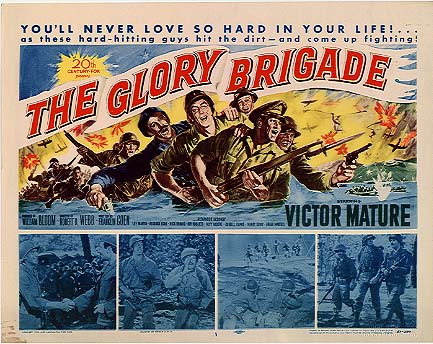
Racist violence was fully unleashed once the War was under way. Just as the Germans had conflated Jewishness and Bolshevism, the US in propaganda and military indoctrination conflatedAsiatic”-ness and Communism.xlvi Instead of reserving animus for combatant enemies animus was directed atgooks”, which meant all Koreans regardless of combatant status, political orientation, or gender. It is true that risks vastly differed for different locales and statuses, but it is also true the every single Korean faced at least some risk of being killed by US forces and local allies were not an exception (a circumstance also seen in South Vietnam, Iraq, Afghanistan and any other place where US forces are directly deployed). A US correspondent wrote that it wasnot a good time to be a Korean, for the Yankees are shooting them all”, while a British war correspondent recorded that GIsnever spoke of the enemy as though they were people…. …[E]very man’s dearest wish was to kill a Korean. ‘Today… I’ll get me a gook.’xlvii

When US forces went north of the 38th parallel massacres also occurred. Details are, of course, sketchier, with DPRK officialdom being an unreliable source. However, as Dong Choon Kim points out:While it must be acknowledged that the North has politically exploited such claims, the facts on the ground force us to not discount their veracity.”xlviii In one instance an estimated 35,380 people in Sinchon were massacred but whereas the DPRK leaders claim that US personnel committed the massacre, it was in fact ROK paramilitary police and militias who were sent north (by the US) in the tens of thousands.xlix

Although subject to commands from the Rhee regime, ROK security forces were ultimately under US command.l The US military may have been involved in formulating the “special decree” which initiated widespread massacres south of the 38th parallel, but there is no doubt that it was the US which initiated the massacres by ROK security forces north of the 38th. An order was issued toliquidate the North Korean Workers’ Party”, a mass movement which had 14% of the DPRK population as members. Mass arrests were to be followed by the production by the US ofblack lists”, the unstated purpose of which is easy enough to guess.li A partial list of occasions when the US has provided clients with lists of persons who the US wishes dead due to their political beliefs or activism includes: Guatemala, 1953;lii Iraq 1963,liii 2002-3,liv 2005-7;lv Indonesia 1965;lvi Indochina 1950-75;lvii Argentina, Chile, Brazil, Bolivia, Paraguay, Uruguay, Peru, and Ecuador mid-1970s (Operation Condor);lviii Latin America 1982-91lix (note that in the latter two instances most targets were not directly chosen by the US, but under guidelines created by the US). It is pretty easy to establish that these murders are eliticidal in nature by looking at the nature of the victims. They target leading intelligentsia and students, unionists, and peasant organisers. In Viet Nam, for instance, the US even invented the termViet Cong Infrastructure”. PradosdefinesthemasashadowynetworkofVietCongvillageauthorities,informers,taxcollectors,propagandateams,officialsofcommunitygroups,andthelike,whocollectivelycametobecalledtheVietCongInfrastructure(VCI).”Sympathizers”werealsocounted.lx The victims are very clearly non-combatants. For example, in William Blum’s survey of US interventions (Killing Hope) there is no index entry given forunionists”,subversives” ordissidents”; however, quite tellingly, one can get a fair idea of the approach to such individuals through looking up the entries ontorture, US connection to.” Out of 14 entries there are three relating to interrogation;lxi three where armed activists/guerillas/insurgents were tortured alongside unarmed political activists;lxii and 7 entries where only political dissidents are mentioned as victims.lxiii

We don’t know how many died in massacres north of the 38th parallel, but we do have some idea (very roughly) of how many died in mass executions in the south. Of 30,000 political prisoners at the outbreak of war almost all were disposed of (except for 7000 fortunate enough to be imprisoned in Seoul).lxiv This was the tip of the iceberg. An estimated 350,000 people were enrolled in the Bodoyeonmang (National Guidance League, NGL). It was putatively an organisation for monitoring and rehabilitating left-wing activists, but up to 70% of its members were simply apolitical peasants.lxv In a series of enormous mass executions (evidenced by mass graves which, again, provide grim proof of eyewitness testimony) somewhere between 100,000 and 200,000 people were slaughtered (some estimates go as high as 300,000).lxvi In Taejon, for instance, 4000-7000 were executed, and when the town was recaptured the mass graves were used as propaganda under the false claim that it was in fact the Communists who had committed the atrocity.lxvii Probably those US personnel and Western reporters who saw the bodies believed it to be true (after all the Communists were the savages) but the massacre had in fact been attended by US officials.lxviii

k19_00901090

Victims at Taejon. Note, I found this picture at a site which replicates the lie that communists committed this massacre. Of 48 photos in this 2010 retrospective 4 are depicting communist atrocities (or claim to be) while only 1 depicts an ROK/UN atrocity (below).

https://i0.wp.com/www.japanfocus.org/data/5643_image002.jpg

In recaptured territory, as in the North, many deemed politically suspect due to their activities during the DPRK occupation were liquidated. In the Seoul area, for instance, 50,000 were killed by one estimate.lxix In addition, civilians in areas where guerillas operated were at risk of being murdered throughout the war. Counterinsurgency often meant slaughtering civilian men, women and children deemed by geographical criteria to be supportive of the guerrillas. In Guchang, for instance,several thousand civilians, including babies, women, and elderly, were killed during the operations named ‘Keeping the Position by Cleansing the Fields….’lxx The US was also using airpower against parts of the countryside deemed inimical. From 5 January 1951 the US began the wholesale use of napalm against villages deemed to be willingly or unwillingly providing some form of support for guerrillas. As Suh Hee-Kyung writes:The objects of the bombings now included not only military targets but also civilian homes and towns suspected of harboring communist guerrillas and/or North Korean soldiers. Especially in areas that the North Korean Army and the Chinese Army had invaded, the U.S. Army applied a ‘scorched earth policy’ even if the targeted area was residential.”lxxi On 25 January 1951 Lt. General Edward Almond (commander of X Corps) defended the bombing in terms paraphrased by Cumings as,the local population was being killed, true, but the meager population remaining appears sympathetic to and harbors the enemy.”lxxii

The US also began its bombing campaign in the North. Most of the 1 million tons of US ordinance dropped from the air in the War were used instrategic” bombing in the North.lxxiii It is fair to say that in this small and highly urbanised half-country, this tonnage caused a greater degree of destruction than in any other time and place in human history (not counting single cities).By 1952 just about everything in northern and central Korea was completely levelled. What was left of the population survived in caves, the North Koreans creating an entire life underground, in complexes of dwellings, schools, hospitals, and factories.”lxxiv The rough consensus figure is that 1 million civilians died from the US bombing campaign. As Cumings notes:

The United Nation’s Genocide Convention defined the term as acts committed “with intent to destroy, in whole or in part, a national, ethnical, racial or religious group.” This would include “deliberately inflicting on the group conditions of life calculated to bring about its physical destruction in whole or in part.” It was approved in 1948 and entered into force in 1951 – just as the USAF was inflicting genocide, under this definition and under the aegis of the United Nations Command, on the citizens of North Korea. Others note that area bombing of enemy cities was not illegal in World War II, but became so only after the Red Cross Convention on the Protection of Civilians in Wartime, signed in Stockholm in August 1948.

Kim Dong Choon is cautious about the subject of genocide, despite writing in the Journal Of Genocide Studies:As we usually label genocide when the shooting and strafing were aimed at a certain race or community with clear cut boundaries and characteristics, America’s military actions towards Korean civilians may not be regarded as a genocidal incident. ([Interjects in endnote]However, as Bertrand Russell and Jean Paul Sartre argued when they established a ‘War Crimes Tribunal’… the ‘genocidal intent’ of war may be identified even when official military policies may deny such an ambition.)lxxv Of critical importance, however, is the fact that the US soldiers killed civilian refugees lacking even a modicum of self-defense, including women and children, even when no North Korean soldiers or grass-root guerilla forces threatened them.lxxvi This needless caution on Kim’s part is saddening. The US (and the ROK forces under US command) systematically killed civilians in various completely different circumstances, and they did so under orders from the very top of the chain of command. One need only to glimpse through the various levels of mortality produced bystrategic bombing”, “counterinsurgency”, and mass executions to see that, taken as a whole, this was a staggering amount of death and (perhaps more importantly) a staggering amount of co-ordinated labour employed in causing mass civilian deaths. The level of proof required here is, in fact, far lower than that required to label the mass killings in Rwanda or Cambodia as genocides. Likewise, the economic and social destruction wrought in the North was so comprehensive that it can only be matched by the most widely acknowledged genocides.

There is more. By deliberately drawing out the negotiations for an armistice while instituting a strategy ofattrition” the war, although a very real war, was made primarily an engine of genocide by the US. In this it became a progenitor of later genocidal war systems. To illustrate this evolution it is necessary to trace the progress of the war. The narrative produced is, like that of the origins of the war, distinctly anomalous at points. In the framework of war, as it is generally understood, such actions were difficult to explain and caused alarm among allies, US personnel themselves, and even US political leaders. The US public, on the other hand, simply hated the war and it destroyed the Truman presidencyTruman holding the record for least popular President on record (with 77% disapproval) until the advent of George W. Bush.lxxvii But while from a military perspective many US actions seemed counterproductive or at least completely pointless it should be remembered that the narrative ends with the US having won for itself every single advantage that it could have won, at least from an imperial perspective. The previously fragile division of Korea was now stable and consolidated as was the US client regime in the ROK. Each half of the peninsula was tied more firmly in dependency to its superpower patron. Taiwan was saved from unification with China, while the infant PRC was greatly retarded in its development. The US was now in a state of enduring militarisation, armed with both the weaponry and the ideology which would allow the US to exert coercive imperial power over most of the globe. From this perspective an outright military victory would have been considerably less attractive, not least because US interventions would rely on the (false) implication that the Communist Bloc posed a military threat to the US.

Korea is not particularly suited to blitzkrieg, it is narrow and hilly with poor roading generally at the bottom of valleys, and a climate which makes operations of any sort difficult. Carter Malkasian describes it as suited forstrong in-depth defense”, by which he means using elevated positions of the sort which would be so bloodily contested later in the war. Inexplicably, however, the ROKA commanderwanted to contain any North Korean attack at the 38th Parallel and rejected a planned withdrawal to stronger positions, such as behind the Han river. The 38th Parallel was on comparatively flat ground, lacking ridges or river-lines on which to form a defensive.lxxviii That is to say, such a stance is inexplicable unless it is explained, like so much else must be, as a deliberate softening of ROKA defences.

After capturing Seoul, the KPA waited about a week, apparently awaiting artillery and other supplies, before the next concentrated offensive.lxxixLacking detailed plans for operations south of Seoul, North Korean forces had been slow to proceed beyond the Han River.” On July 5 the KPA fought their first engagement with US forces, who did have anti-tank weapons but were nevertheless defeated. “American combatants had inadequate firepower to resist Soviet-built tanks, and North Korean soldiers were not intimidated by opponents simply because their skin was white….”lxxx On the contrary, the KPA continued to push, over-running an entire US division when Taejon was captured a week later. It took only until August 1 for the KPA to reach a point less than 50 km west of Pusan.lxxxi By this stage the KPA faced superior numbers 92,000 (47,000 of them US) to the 70,000 it could bring to the front known as the Pusan perimeter.lxxxii Only a tiny chunk of the peninsula was unconquered, but more critical for the KPA than being outnumbered was the fact that they had never prepared for this. They could not replace casualties, communications were still far from desirable efficacy, and their stretched supply lines combined with US air and naval power to make resupply difficult.lxxxiii As Malkasian explains the chance to end the war quickly was slipping away: “Better American bazookas and heavy M-26 Pershing tanks had arrived that could counter the T-34s. The North Koreans waited until 3 September to make their major assault in the Second Battle of the Naktong Bulge. However, by then North Korean strength was ebbing. With only 98,000 men, they faced 180,000 UNC soldiers.”lxxxiv

On September 15 the US X Corps made a bold and extremely well executed amphibious landing at Incheon, the port adjacent to Seoul. The DPRK expected this move but had little choice but to throw everything they could at the Pusan perimeter (in the abovementioned Second Battle of the Naktong Bulge).lxxxv It seems apparent, however, that the DPRK had prepared for withdrawal, and for troops who were cut-off to become guerillas in the hills.lxxxvi Nevertheless, this was a terrible defeat for the KPA who were more or less routed from the South, sustaining heavy casualties and equipment losses. UN forces broke out of the Pusan perimeter on September 23. Seoul fell on the 27th after bitter fighting which caused many civilian deaths.lxxxvii Only around 25,000 KPA reached the 38th parallel before UN forces.lxxxviii

The KPA continued retreating and X Corps pressed northwards. The 38th parallel, crossing which had been condemned as an act of aggression by the UNSC was, little over 2 months later, of no significance. An “imaginary line” as MacArthur put it,lxxxix the same phrase being used soon after by the US ambassador to the UN.xc (Malkasian claims that UNGAR 376, passed on October 7, authorised UN forces to proceed north of the 38th.xci The two major problems with such a contention are that a) by October the 7th UN forces were in places already more than 100 km north of the 38th and b) the resolution says no such thing.xcii)

https://i0.wp.com/upload.wikimedia.org/wikipedia/commons/4/41/Korean_War_HA-SN-98-07085.JPEG

The US rationalised crossing the 38th as a measure to prevent further aggression, but then changed to the annunciated aim of military unification.xciii The Chinese openly avowed that they would respond militarily to a march on the Yalu with PLA Chief of Staff (on Sept 26) and Chou En Lai both telling the Indian ambassador for conveyance to the US. US intelligence agencies claimed, however, to have believed otherwise.xciv When China entered the war, the US reacted at first as if nothing significant had happened then, after suffering defeats in October and November, as if a large portion of the PLA had crossed the border en masse:

As American forces rushed pell-mell back down the peninsula, observers at the time wondered why they were moving so fast, often breaking contact with an enemy not necessarily pursuing them. On December 15 a British military attaché wrote, ‘The withdrawal continues without any major enemy pressure. There were no signs of defense lines being used to halt the enemy march; it looked like a phony war, or a great hoax.’ British military attachés said in early December that the numbers of Chinese were quite exaggerated, with very few confirmed contacts with the Chinese ; furthermore, it was often impossible to judge the nationality of enemy units. The number of Chinese POWs being taken did not indicate huge numbers of troops.xcv

So yet again US led forces were inexplicably retreating rather than using the defensibility of the hilly terrain, this time back to the 38th parallel in what was known as the “Big Bug-Out”.xcvi Hyperbole exploded in Washington. This was the longest retreat in US military history, but it became transformed into the greatest defeat in US history leading to panic in the corridors of power and many very serious moves towards the use of atomic weapons.xcvii This even went as far as the transfer of necessary bomb components to Japan and Guam.xcviii The “Big Bug-Out” didn’t merely facilitate a vastly heightened level of threats from the US, it also gave a boost to the racist propaganda deployed on Western peoples, particularly those of the US. Hollywood films (more likely to be about the Pacific War than the unpopular Korean “police action”) featured scenes “of marauding Oriental troops; of bearded, unkempt American fighters inhabiting alien hovels in alien lands and dauntlessly improvising devices and designs as they go.”xcix Public affairs programming on television was unabashedly infected by official propaganda. One NBC programme was produced out of the White House by a presidential aide, who used it to declare that[t]he barbarous aggression of the Chinese hoards [sic] in Korea is not only an attack upon the forces of the United Nationsit is an attack upon civilization itselfit is an effort to destroy all the rights and privileges for which mankind has fought and bled since the dawn of time.”c

In coming months China really did commit massive numbers of personnel (officiallyvolunteers”) to a series of offensives, perhaps 400,000 by mid-January.ci The KPA and the Chinese People’s Volunteers (CPV) managed to advance about 100km south of the 38thby the end of January, but by February UN counteroffensives had pushed them back across the Han and Seoul was evacuated after massive casualties on 14 March.cii The KPA and CPV continued to mount offensives, but shortages and heavy casualties inflicted by UN forces brought them inevitably to a stop.ciii

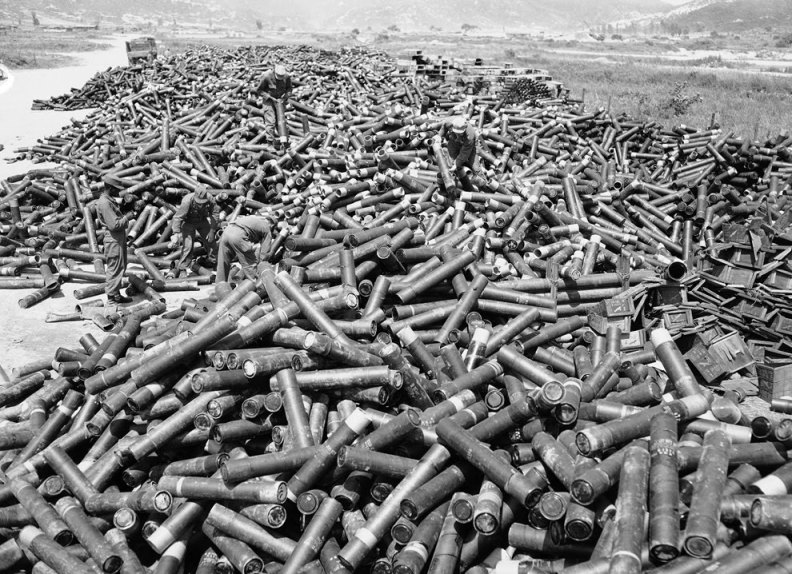
Seoul had by this stage changed hands 4 times. As UN forces retreated in January they more or less destroyed the port at Inchon and burnt down large parts of Seoul, just as they had on retreating from northern cities.civ As the UN was preparing to re-enter the city, US air and ground artilleryblasted” the city.cv Indeed, one neglected aspect of the war was that during the mobile phase (which, as has been shown, seemed a little artificial at times) all but some small pockets of the countryside were swept over at least once by the battlefront. In addition to the 1 million tons or ordnance dropped by US aircraft, US guns fired a total of 2.1 million tons of ordnanceon a peninsula less than four-fifths the size of New Zealand the US used 43% as much explosive power as it did in the entirety of World War II.cvi Massive amounts of Korean property were destroyed by UN scorched earth policies and by the profligate use of artillery in addition to the massive bombing campaign.
https://ongenocide.com/wp-content/uploads/2013/04/koreanwarartillerycasings.jpg

In late December 1950, General Matthew Ridgway took over command of the 8th Army which faced the KPA/CPF offensives. In April he was made Supreme Commander of UN forces.cvii From the first he created an offensive spirit and tactics to match. An infantryman put it thus:We were there to kill Chinese. That’s what they told us. The army was done with retreating. General Ridgway was in charge now, and he wasn’t a retreating general. We heard it every day from the officers. ‘Fix ’em, find ’em, kill ’em.’ We went out every day and we attacked. Seems like that’s all we did was attack. We hardly ate. We hardly slept. We just attacked.”cviii

The doctrine under which this occurred was referred to asattrition”. On the surface it seemed to have a military logic, at least in the time from January to March of 1951 in which the Communists were conducting major offensives and the UN conducting counteroffensives. In Malkasian’s words Ridgwaysought to wear down their manpower. To do so, superior UNC firepower was to be exploited to the maximum effect. The hallmark of Ridgway’s doctrine of attrition was his directive to his subordinates to maximize enemy casualties while minimizing those of the Eighth Army. Given the daunting Communist numerical superiority, conserving casualties was absolutely crucial.”cix

Implicit in the logic of this “attrition” were three concepts which as yet had no terminology, but would become central in later genocides – “body count”, “kill ratio”, and “force protection”. To understand let us contrast this “attrition” with attrition as it was understood previously by theorists such as Clausewitz. When Clausewitz wrote of a “war of attrition” he referred to the gradual wearing down of strength through the requirement of movement which fatigued personnel and caused supply problems.cx Attrition is primarily a function of ‘war of manouevre’ with the center of gravity here being lines of communication.cxi In the World Wars attrition was notably aimed at and achieved by the deprivation of strategic resources – the single most successful way of reducing the military strength of an adversary which was based so firmly in productive capacities. In Korea this sort of attrition was achieved by stretching supply lines, and this certainly provides one explanation for the two major retreats by ROK/US/UN forces. Interdiction was also a way open to the US to cause attrition. The US interdiction campaign during the Korean War was only very modestly successful. The main challenge to it was the fact that Communist forces used a far smaller tonnage of supplies than UN, or more acutely, US forces. They ran, as it were, on the smell of an oily rag.cxii Bear in mind, however, that the CPV were poorly equipped and the Communists lacked the ability to supply sustained offensives of more than about 14 days,cxiii but as the war progressed their diversified logistical operations supplied ever greater amounts of materièl to the front.cxiv (Communist logistics may have been robust and decentralised, but there was no Ho Chi Minh Trail, and one gets the inevitable impression from the partial success of the interdiction campaign that the Communists would have been highly vulnerable to a programme of interdiction which was as profligately supported as the “strategic” bombing and the “meatgrinder” version of attrition described below.)

https://i0.wp.com/www1.korea-np.co.jp/pk/101st_issue/Triumph_return.jpg

My point, and I will return to and illustrate the point, is that the Communist forces had to be more vulnerable in their materièl inferiority than in their numerical superiority. This is true notwithstanding the early Chinese belief that “deception, stealth, and night fighting would enable their poorly armed soldiers to overcome Western technological and materiel superiority.cxv With offensives severely limited by logistical concerns the Communists could only hope to chip away slowly at UN positions, but there was nothing to stop the UN from using its superior firepower to regain ground as proved to be the case in early 1951. Malkasian writes:

Ridgway’s first use of attrition was successful. [CPV commander] Peng [Dehuai] launched the Third Phase Offensive in sub-zero conditions on 31 December 1950. Although Ridgway was forced to abandon Seoul, his withdrawal stretched the Communist supply lines to breaking point, forcing Peng to call off the offensive. Ridgway was anxious to seize the initiative. On 15 January 1951, he mounted a reconnaissance in force, Operation Wolfhound, followed by a full-blown counteroffensive.cxvi

Others agree that it was the logistical difficulties that ended Chinese offensive actions.cxvii After the failure of the Third Phase Offensive, Peng returned to Beijing to inform Mao that the Communists could not win the war because supply lines had reached their maximum length.cxviii

Apart from the withdrawal during the Third Phase Offensive, however, Ridgway’s “attrition” had little to do with exploiting and exacerbating logistical weakness. It was about killing. After the capture of Seoul Ridgway ordered a limited offensive north of the 38th to establish the “Kansas Line” on high ground, but his whole doctrine was more generally to avoid taking territory or holding positions at the expense of casualties, while at the same time inflicting as many casualties as possible through the offensive “attrition” that became known to soldiers as the “meat grinder”. This involved staging attacks purely aimed at inflicting as many casualties as possible.cxix This was “limited war”. In fact, near the start of the “Big Bug-Out”, only 12 days after the Chinese entry into the war, and only 8 days after threatening the use of atomic weapons, Truman publicly abandoned the goal of military unification.cxxLimited war” meant, therefore, killing as many people as possible while maintaining a military stalemate, bearing in mind that bombing and massacres were ongoing.

Mao, however, was not to reach the same conclusion as Peng regarding the impossibility of significant military gain until the failure of the Fifth Phase Offensive which came to a halt because of a lack of food and ammunition. The hungry and ill-armed CPV troops were panicked by the inevitable counteroffensive and the UN advanced somewhat north of the Kansas Line, and then stopped.cxxi Neither side was trying to win the war now, and the Chinese also began using “attrition” in the sense of trying to inflict disproportionate casualties in terms relative to total numbers available.cxxii Perhaps it made slightly more sense for the numerically superior force to engage in this behaviour, but in the broader picture it was really just playing into the US hands, allowing them to maintain deadly conflict when there was really no military purpose in the killing.

Whether one dates it to the end of the Fifth Phase Offensive or the end of the subsequent UN counteroffensive, the stalemate phase lasted more than twice as long as the mobile phase of the war, and cost more lives. The stalemate was characterised by “see-saw” battles, wherein the same ground was taken and retaken many times overcxxiii in a manner akin to the mindless butchery of World War I. But this time, off centre stage, civilians were dying in numbers much greater than the battlefield deaths and a bitter guerilla war was fought with napalm and atrocities.

Cease-fire negotiations began on 10 July 1951 and continued for just over two years. One writer characterises them thus: “Throughout the duration of the negotiations U.S. leaders produced harsh ultimatums rather than workable bargaining positions, thereby presumably obviating any form of enemy flexibility.cxxiv The Communists tried to maximise the propaganda value of the talks, setting things up originally to give an impression of the UN being there to sue for peace,cxxv and they were able to capitalise on US dishonesty by the use of dissident Western journalists.cxxvi Early on armed Chinese troops paraded bymistake” through the demilitarized area. They had mortars and machine guns, but the Chinese claimed that they were military police (MPs).cxxvii The US, however, made even more drasticmistakes”. On August 22 the conference site was bombed and strafed by aplane of unknown origin but flying from the south”.cxxviii In September the UN apologised for twoaccidental” attacks the second of which took the life of a 12 year old.cxxix According to Halliday and Cumings, the Communistsclaimed that these were deliberate attempts by sectors of the US military to sabotage the talks at key momentsand possibly to assassinate communist delegates. At the time the USA denied most of the charges. The official US military history later acknowledged that the USA carried out a large number of violations, including strafing and bombing the neutral zone and bombing the communist negotiators’ convoy en route to the site.”cxxx

If I were to characterise, very roughly, the nature of the negotiations it would be something like this: Often the Communists didn’t take the negotiations that seriously because the US positions were themselves so extreme as to render seriousness difficult. Nevertheless, on a number of issues the Communists would make major concessions, although with minor face-saving conditions. US officials would then vastly exaggerate the significance of such conditions and a compliant Western news media would follow the official line that it was in fact the Communists who were demonstrating a lack of good faith. The US was the only UN party at the talks and their British allies were frustrated and blamed the US rather than the Communists for the lack of progress in talks. They also believed that US military actions, publicly rationalised as being designed to force the Communists to negotiate in earnest, actually caused the Communists to harden their line.cxxxi When talks stalled over the issue of POW repatriation, the UK Foreign Office again held US intransigence to be the cause. From their Korea desk J. M. Addis minuted with words such asrapid and unexplained changes of front on the main question and a policy of stepping up demands after concessions have been madehas not contributed to removing the suspicion that undoubtably exists on the Communist side that the Americans do not sincerely want an armistice.”cxxxii

A compromise proposed by the PRC wherein POW’s who did not wish to be repatriated could be interviewed by a neutral country was scuppered by the US bombing of 5 power stations on Yalu undertaken without consulting the British. Omar Bradley claimed it was apurely military operation” designed to apply pressure for negotiations.cxxxiii The proposal had been a major concession by the PRC because the 1949 Geneva Convention Article 118 made repatriation compulsory without exception. At the outbreak of war the US (a ratified signatory) and the DPRK (a non-signatory) announced adherence to extant Geneva Conventions (the PRC, a non-signatory, made such an announcement in 1952).cxxxiv Additionally, while within in the camps their were many who wished to defect, others were coerced by right-wing elements by threatened starvation and torture sessions.cxxxv

On the 13th of May the US began a series of bombing raids against DPRK dams. Timed just after the laborious work of rice transplantation, before plants had taken root, the resultant floods cause utter devastation. The bombing of the Toksan dam, for example,scooped clean 27 miles of valley” with floodwaters reaching and inundating large parts of Pyongyang. Many thousands must have drowned.cxxxvi Both stores and people were made more vulnerable by having been driven underground. But the direct mortality may be less significant than that which was to follow due to the destruction of the rice crop. As a US intelligence report puts it:The Westerner can little conceive the awesome meaning which the loss of this staple food commodity has for the Asianstarvation and slow death.”cxxxvii

An armistice was finally signed on 27 July 1953, but Korean suffering was far from over. Today one is accustomed, for very good reasons, to contrasting the impoverished and repressive DPRK with the wealthy and democratic ROK. One might think that the massive destruction and proportionately far greater death in the DPRK would leave them much worse off than those to the South. On the contrary, however, the people of the ROK were in fact worst off. The US was determined that the ROK should be a Third World state producing primary goods only.cxxxviiiIn 1961, eight years after the end of its fratricidal war with North Korea, South Koreas yearly income stood at $82 per person. The average Korean earned less than half the average Ghanaian citizen ($179).”cxxxix They were ruled by a US client who allowed the US to dictate economic policy and then blamed him for the policies they themselves forced on the ROK.cxl The US pursued a policy of keeping de-industrialisation,cxli it destabilised the ROK economy even during the war,cxlii it caused destructive inflation,cxliii used coercion to get the ROK to effectively abdicate economic sovereignty in 1952,cxliv and when people were starving to death due to these policies, the US repressed reports of this and created false statistics claiming that ROK citizens ate more food than they had before the war.cxlv As Tony Mitchell observes, the poverty and dependency thus created acted to increase US power, US control.cxlvi

In 1961 the new military dictatorship forced the US to accept a programme of economic nationalism in the ROK, something which was probably only possible because of the existence of the DPRK. Nevertheless it is a testament to the destructiveness of the antidevelopmentalist economic regime forced on poorer states by the US that it was not until at least the mid-1970s that ROK living standards caught up with those of the DPRK, reaching an average $1000 per capita per annum income in 1977.cxlvii

In terms of repression, the torture and killings under military rule have been discussed, and it was only with great sacrifice and bravery that the South Korean people seized democracy from below in 1987. North Korea also remained a dependencyso much so that the collapse of the Soviet Union destabilised the heavily industrialised and petrochemical dependent agriculture required in a state which is sorely lacking in fertile land. This led within a few years to devastating famines precipitated by flooding.cxlviii

For US imperialists the Korean War must be counted as a resounding success. Koreans were weakened and divided into two dependencies, China weakened and tied more firmly to the USSR, Japan and Taiwan were both strengthened economically but yet made increasingly dependent on the US. The US inaugurated an interventionist imperial military system, complemented by economic, ideological and political power, which allowed it almost free rein to intervene in any state outside of the Soviet Bloc up to and including full-scale military interventions where such a thing was practicable.

What had happened to Korea can be understood in those terms used by Lemkin to subdivide elements of genocide. They had suffered genocide in the physical, social, economic, political, cultural and moral senses, leaving out only the religious and biological elements which complete Lemkin’s enumeration. The trauma lasts even to this day, even south of the “demilitarized zone” (DMZ). The suffering, the loss and grief, the crushing of the national hopes of an oppressed people, the social disintegration, the loss of heritage, the millions of dead – these were not unfortunate by-products, these were not “collateral damage”, they were the means. The US had conducted a successful functional genocide, and its very success was to bring about repetition.

iHalliday and Cumings, Korea, p 200.

iiChristopher Coker, Humane Warfare, London: Routledge, 2001, p 2.

iiiStueck, The Korean War, p 361.

ivCumings, The Korean War, p 160.

vCoker, Humane Warfare, p 80.

viMillett, The War for Korea, p 4.

viiGrace M. Cho, HauntingtheKoreanDiaspora:Shame,Secrecy,andtheForgottenWar,Minneapolis:UniversityofMinnesotaPress,2008, p 82

viiiCho, Haunting the Diaspora, p 75.

ixHalliday and Cumings, Korea, p 180.

xCumings, The Korean War, p 202.

xiThe figures on which this is based are discussed below.

xiiKim,Forgottenwar,forgottenmassacres…,p537.

xiiiCumings, The Korean War, p 186.

xivKim,Forgottenwar,forgottenmassacres…,p529.

xvCumings, The Korean War, p 187.

xviCumings, The Korean War, p 202.

xviiSee Appendix 1.

xviiiLemkin, Axis Rule, p 80.

xixFigures for civilian deaths at US and ROK hands are given below. I have not encountered any suggestion that other United Nations forces committed atrocities on a scale which would change the proportions by inclusion or exclusion from the total.

xxJudith Greer, “What Really Happened at No Gun Ri?”, Salon, 4 June 2002. Retrieved 17 November 2010 from http://www.salon.com/2002/06/03/nogunri_2/.

xxiSuhi Choi, “Silencing SurvivorsNarratives: Why Are We Again Forgetting the No Gun Ri Story?, Rhetoric & Public Affairs, 11:3, 2008, p 373.

xxiiIbid, p 367.

xxiiiCharles J. Hanley and Martha Mendoza, “US Policy was to Shoot Korean Refugees”, Associated Press, 29 May 2006. Retrieved 17 November 2010 from http://www.washingtonpost.com/wp-dyn/content/article/2006/05/29/AR2006052900485.html.

xxivJeremy Williams,Kill ’em All’: The American Military in Korea, BBC, updated 17 February 2011. Retrieved 15 November 2011 from http://www.bbc.co.uk/history/worldwars/coldwar/korea_usa_01.shtml.

xxvCharles J. Hanley, “No Gun Ri: Official Narrative and Inconvenient Truths”, Critical Asian Studies, 42:4, 2010, p 589.

xxviIbid, p 590.

xxviiIbid.

xxviiiWilliams, “Kill ’em All….”

xxixCumings, The Korean War, p 167.

xxxIbid, p 168.

xxxiWilliams, “Kill ’em All….”

xxxiiValerie Perry, LookingforNoGunRi,KyotoJournal,49,2001.Retrieved15November2011fromhttp://www.kyotojournal.org/kjencounters/NoGunRi.html.

xxxiiiDonghee Sinn, “Room for archives? Use of archival materials in No Gun Ri research, Archival Science, 10, 2010, pp 117-40.

xxxivKim, “Forgotten War…’, p 534.

xxxvIbid, p 523.

xxxviStueck and Yi, “An Alliance Forged in Blood…”, p 192.

xxxviiCumings, The Korean War, p 158.

xxxviiiPhilip Caputo, A Rumour of War, London: Arrow, 1978, p 137.

xxxixStueck, The Korean War, p 20.

xlAndrei Lankov, From Stalin to Kim Il Song: the formation of North Korea, 1945-1960, London: C. Hurst, 2002, p 6.

xliStueck and Yi, “An Alliance Forged in Blood…”, p 185.

xliiCumings, Korea’s Place in the Sun, p 198.

xliiiStueck and Yi, “An Alliance Forged in Blood…”, p 190.

xlivIbid, p 194.

xlvIbid, pp 195-6.

xlviBrewer, Why America Fights?…, p 142.

xlviiKorea, p 88.

xlviiiKim, “Forgotten War…”, p 531.

xlixIbid, p 536.

lIbid, p 532.

liCumings, The Korean War, p 195.

liiIbarra, “The Culture of Terror…”, p 198.

liiiTariq Ali, Bush in Babylon: The Recolonisation of Iraq, London: Verso, 2003, pp 87-8.

livMax Fuller, “Crying Wolf: Media Disinformation and Death Squads in Occupied Iraq, GlobalResearch, 10 November 2005. Retrieved 16 April 2006 from http://www.globalresearch.ca/index.php?context=viewArticle&code=FUL20051110&articleId=1230.

lvMichael Moss, “How Iraq Police Reform Became Casualty of War”, New York Times, 22 May 2006; Max Fuller, “Silence of the Lambs? Proof of US orchestration of Death Squads Killings in Iraq”, GlobalResearch, 14 March 2007. Retrieved 16 April 2007 from http://www.globalresearch.ca/index.php?context=va&aid=5081.

lviPeter Dale Scott, “The United States and the Overthrow of Sukarno, 1965-1967”, Pacific Affairs, Summer 1985, pp 239-264.

lviiFrankL.Jones,‘Blowtorch:RobertKomerandtheMakingofViet NamPacificationPolicy’,Parameters, Vol.35,No.3 (Autumn2005),p104;Prados,The Hidden History of the Viet Nam War,pp204-5.

lviiiRoger Morris, “Donald Rumsfeld’s Long March”.

lixStokes, “Why the End of the Cold War…”, pp 583-4.

lxPrados, The Hidden History of the Viet Nam War, pp 204-5, 210.

lxiBlum, Killing Hope, pp 38, 226, 279.

lxiiIbid, pp 128-9, 200-5, 239.

lxiiiIbid, pp 72, 116, 171, 219-21, 232, 359-61, 375.

lxivKim, “Forgotten War…”, p 533.

lxvIbid, p 534.

lxviIbid, p 535.

lxviiCumings, The Korean War, p 173.

lxviiiIbid, p 175.

lxixKim, “Forgotten War…”, p 536.

lxxIbid, p 532.

lxxiSuh Hee-Kyung, “Atrocities Before and During the Korean War”, Critical Asian Studies, 42:4, p 579.

lxxiiCumings, Korea’s Place in the Sun, p 295.

lxxiiiKolko, Century of War, p 404.

lxxivCumings, Korea’s Place in the Sun, pp 295-6.

lxxvKim, “Forgotten War…”, p 542, n 31.

lxxviIbid, p 532.

lxxviiCumings, The Korean War, p 149.

lxxviiiMalkasian, The Korean War, p 20.

lxxixHalliday and Cumings, Korea, p 82.

lxxxStueck, The Korean War, p 47.

lxxxiMalkasian, The Korean War, p 24.

lxxxiiHalliday and Cumings, Korea, p 82.

lxxxiiiStueck, The Korean War, p 48.

lxxxivMalkasian, The Korean War, p 24.

lxxxvIbid, p 26.

lxxxviHalliday and Cumings, Korea, p 97.

lxxxviiMalkasian, The Korean War, p 29.

lxxxviiiStueck, The Korean War, p 86

lxxxixMichael Walzer, Just and Unjust Wars: A Moral Argument with Historical Illustrations (4th ed.), New York: Basic Books, 2006, p 118.

xcCumings, The Korean War, p 23.

xciMalkasian, The Korean War, p 29.

xciiUNGAR 376, The Problem of the Independence of Korea, 7 October 1950. Retrieved 24 November 2011 from http://daccess-dds-ny.un.org/doc/RESOLUTION/GEN/NR0/059/74/IMG/NR005974.pdf?OpenElement.

xciiiWalzer, Just and Unjust Wars, p 118.

xcivCumings, Korea’s Place in the Sun, pp 283-4.

xcvIbid, p 287.

xcviMalkasian, The Korean War, p 36.

xcviiCumings, Korea’s Place in the Sun, pp 289-91.

xcviiiIbid, pp 292-3.

xcixMarilyn Young, “Hard Sell: The Korean War” quoted in Steven Casey, Selling the Korean War: Propaganda, Politics, and Public Opinion in the United States, 1950-1953, Oxford: Oxford University Press, 2008, 19501953, p 221.

cBrewer, Why America Fights, p 159.

ciHalliday and Cumings, Korea, p 144.

ciiIbid.

ciiiMalkasian, The Korean War, p 45.

civHalliday and Cumings, Korea, p 141.

cvIbid, p 144.

cviKolko, Century of War, p 404.

cviiI am not going to delve into the ‘controversy’ of MacArthur’s dismissal, except to point out that one possible interpretation was that MacArthur would have been very unlikely to have supported the stalemated ‘attrition’ strategy – the ‘meatgrinder’ – that was to be employed for the rest of the war.

cviiiMalkasian, The Korean War, p 38.

cixIbid, pp 38-9.

cxClausewitz, On War, 8.1, p 264.

cxiSee for example discussion of those times when a belligerent does not seek a decisive (or any) engagement, 7.16.

cxiiBilly C. Mossman, The Effectiveness of Air Interdiction During the Korean War, Arlington: Office of the Chief of Military History, 1966. Historical Manuscripts Collection, file number 2-3.7 AD.H.

cxiiiIbid, p 5.

cxivIbid, pp 16-7.

cxvMalkasian, The Korean War, p 30.

cxviIbid, p 39.

cxviiHalliday and Cumings, Korea, p 144; Stueck, The Korean War, p 232.

cxviiiHalliday and Cumings, Korea, p 144.

cxixMalkasian, The Korean War, p 40.

cxxStueck, The Korean War, p 138.

cxxiMalkasian, The Korean War, p 45.

cxxiiIbid, p 46.

cxxiiiIbid, p 48.

cxxivRon Robin,Behavioral Codes and Truce Talks: Images of the Enemy and Expert Knowledge in the Korean Armistice Negotiations, Diplomatic History, 25:4 (Fall, 2001), p 625.

cxxvStueck, Rethinking the Korean War, p 151.

cxxviHalliday and Cumings, Korea, p 162.

cxxviiIbid, p 160.

cxxviiiStueck, Rethinking the Korean War, p 153.

cxxixIbid, p 156.

cxxxHalliday and Cumings, Korea, p 161.

cxxxiDockrill,The Foreign Office, Anglo-American Relations…, pp 101-2.

cxxxiiIbid, p 105.

cxxxiiiIbid, p 107.

cxxxivCallum A. MacDonald, “’Heroes Behind Barbed Wire’: The US, Britain and the POW issue in the Korean War”, in James Cotton and Ian Neary (eds), The Korean War in History, Manchester: Manchester University Press, 1989, p 135.

cxxxvIbid, pp 136-7.

cxxxviHalliday and Cumings, Korea, p 195.

cxxxviiIbid, p 196.

cxxxviiiTony Mitchell,Control of the Economy During the Korean War: The 1952 Co-ordination Treaty and its Consequences, in James Cotton and Ian Neary (eds), The Korean War in History, Manchester: Manchester University Press, 1989, p 152.

cxxxixHa Joon Chang, Bad Samaritans: The Myth of Free Trade and the Secret History of Capitalism, London: Bloomsbury, 2008, p ix.

cxlMitchell, “Control of the Economy…”, p 154.

cxliIbid, pp 152-3.

cxliiIbid, p 156.

cxliiiIbid, pp 156-7.

cxlivIbid, p 159.

cxlvIbid, pp 159-60.

cxlviIbid, p 160.

cxlviiChang, Bad Samaritans, xiii.

cxlviiiMarcus Noland, “Famine and Reform in North Korea”, Asian Economic Papers, 3:2, pp 1-40.

The Korean Genocide Part 3: June 1950 – Who Started It?

Standard

(In Part 2 of this post I detailed the US propensity for installing and maintaining
corrupt and brutal clients as leaders, and their preference for those with a limited
popular base of support amongst their own countrymen. I showed that south of the 38th parallel on the Korean peninsula, whilst under US military occupation, this immediately unfolded as a combination economic, political and military repression. The inevitable resistance prompted massacres at the hands of US or US-led proxy forces. I now continue with the subject of the outbreak of “major hostilities” on the 23rd or 25th of June 1950. I think the thing that will interest readers most in this is the significant circumstantial evidence which indicates the real possibility of a tacit or explicit agreement to foment war by US and USSR leaders.)

http://www.mtholyoke.edu/~park25h/classweb/worldpolitics/images/KoreanWar4.jpg
We now come to the vexed issue of the events of 25 June 1950, or as the North Koreans would have it the 23rd of June when, according to them, the ROK initiated major hostilities.1 This is when “major hostilities” broke out – the start of “The Korean War”.
However, one defensible stance is that it is a nonsense to state that the war broke out on that day. Not only had guerrilla conflict and mass-murder already claimed over 100,000 lives south of the 38th parallel, but there was ongoing extensive border fighting which was particularly intense in 1949. It was mostly, but not solely by any means, the ROK which was the initiator of hostilities.2 As Stueck writes: “Who started the firing in the predawn hours of this dreary morning remains in doubt. The Ongjin region had long been the setting for border skirmishes between North and South Korean troops, and often the South had initiated the combat. The evidence for this day in June is ambiguous, even contradictory.”3 Peter Lowe concludes that it is “impossible to determine” who attacked first.4
The conundrum of the outbreak of major hostilities tends to suggest that simple
solutions of either a “South attacks North” or “North attacks South” scenario do not fit the unusual circumstances. To begin with, as Cumings points out with regard to the question of aggression this amounts to “Korea invades Korea”.5 Yes, there were two different armies with two different associated territories, but his was not anything like the German invasion of Poland. It wasn’t even like a normal civil war. The only reason that there were two armies in the first place was the US decision to unilaterally divide the country and the subsequent US and USSR actions which destroyed the normal intercourse between the two parts. There is no historical precedent to this, but as unusual a background as this provides to June 1950, it is only the tip of the iceberg. There are what Stueck terms “ambiguous, even contradictory” factors. As will be described, both sides had plans for military unification and were building forces towards that end, but neither was actually prepared for the sudden outbreak of a major war when it did happen. I would go so far as to suggest that the unusual circumstances themselves tend to necessitate a more complex answer than simply one side attacked the other.
In this work, of course, the point of interest is the US role in the outbreak major
hostilities. Those who concern themselves with this question often characterise US
actions as a “failure of deterrence” or “failing to deter” or virtually invariant phrases.6
One writer in The Journal of Conflict Resolution, (not where one would normally expect
the advocacy of more robust militarism) wrote: “By strongly implying that it would not defend Korea… the United States had invited attack”’7 It is also in the canon of failed deterrence as standing alongside the “failure to deter” Saddam Hussein’s invasion of Kuwait.8 The problem with this is that it relies on an assumption which seems to be contradicted by the evidence, the assumption that an entity called the US actually did not want a war. One can compare this thesis with a counter-thesis thus: 1) the “failed deterrence” thesis in which a monolithic US undertook insufficient actions to prevent war; 2) the “successful provocation” thesis in which individuals from the US (including those in the Rhee regime) successfully caused the outbreak of major hostilities at a time which was entirely propitious for the US in strategic terms. An intriguing potential corollary to the latter is that, whether through coordinated collusion or merely coincident interests, this seems to have occurred with crucial support from the USSR.
It is interesting to note here that if the US failed to deter the DPRK, then the logical
implication is that it must have been the DPRK which attacked first on 25 June 1950.
Thus Stueck, who is unable to directly confirm DPRK initiation of hostilities, is able to write at great length about a “failure of deterrence” which constantly reinforces this nonfact as being factual in the reader’s mind. When dealing with only the “failure of deterrence” DPRK initiation is assumed9 and never is the possibility of deterring the ROK discussed, except to suggest that success in deterring the ROK was partly behind the failure to deter the DPRK.10 If evidence comes to light that the ROK did launch an offensive on 23 June then all of this “failed deterrence” discourse will be revealed as rather silly propaganda akin to the Germans suggesting that they had failed to deter Polish aggression in 1939, and since we can’t actually discount that possibility – it is silly propaganda. There are those who claim that we can in fact conclude that it was the DPRK which initiated major hostilities, and I will weigh such claims shortly. But before I do, I should emphasise that the only evidence we have is circumstantial, and
furthermore is violently contradictory.

Former secretary of state Dean Acheson in 1965. (Lyndon Baines Johnson Library and Museum)
In 1981 and 1990 Bruce Cumings released the two seminal volumes of his work The
Origins of the Korean War. I have been unable to acquire this work, however some have
interpreted it as pointing to a US/ROK initiation or deliberate provocation of the Korean War.11 Another viewpoint is that: “In contrast to many historians… who maintained that by his remarks, Acheson unintentionally gave North Korea the green light to invade South Korea, Cumings argues that Acheson knew precisely what he was doing and that the speech had little to do with why North Korea invaded South Korea. ‘The Press Club Speech,’ he remarks, ‘was … consistent with his conception of Korean containment in 1947, and with his world view: and so was the intervention in June 1950’ (p. 423).”12
Marilyn Young writes that Cumings largely rejects the relevance of “who started it” but outlines three hypotheses in what seem to be roughly ordered as least to most likely: an unprovoked ROK attack; an unprovoked DPRK attack; or a successfully provoked
DPRK attack which young describes as “the preferred Achesonian stance: the offence demonstrably defensive.”13
I mention this work of Cumings at this point because the traction that this work might have gained was interrupted to some extent in 1993 (not long in academic terms after the publication of the more relevant second volume of The Origins of the Korean War) by the publication of a book seized on by many as the definitive proof of an unprovoked DPRK attack. Uncertain Partners: Stalin, Mao and the Korean War14 is a diplomatic history of Sino-Soviet relations and, despite its name, only the final two chapters (about 35% of the main body) deal with the Korean war directly. One deals with the DPRK build-up to military reunification, the last with China’s entry into the war.
It is difficult to decide how much space to devote to a critique of Uncertain Partners,
but I think I must confine myself to a symptomatic exemplar. For reasons which are not at all apparent to me, several pages are devoted to describing two meetings that never occurred. The reason given?

We do so partly to suggest the kinds of information that appear to have been exchanged between Moscow and Pyongyang in these months (on which the archives do have significant documents) and partly to indicate how pseudohistory can become widely implicated in efforts to explain the origins of one of history’s tragedies.15

Their actual interest in the role of “pseudohistory” ends right there never to be
mentioned again. Instead the narrative of these meetings is simply incorporated (with a couple of reminders that these were fictional meetings) into the general flow of the chapter. One might wonder why they did not instead utilise the “significant documents” as their sources, but these are neither cited here, nor are they to be found among the 82 documents appended. In fact none of these documents deals with the subject of Korea before one dated 28 June 1950.16 Indeed throughout the chapter there was only one point made which seemed at first to support the conclusion that the DPRK attacked on 25 June, mention made of the “fact” that Mao was “in no doubt” that Kim Il Sung had launched the war.17 The supporting citation, however, merely quotes a Chinese official noting the Korean Workers Party’s determination to “wage a revolutionary war of liberation”.18 Intent, however, is not the issue, as will be shown.
The gist of this chapter of Uncertain Partners (either with or without the inclusion of
clearly unreliable sources) is that Stalin, Mao and Kim Il Sung had developed a coordinated plan of attack. This proves little, however, because Rhee also planned a
military reunification, and made no secret of the fact. He seems to have originally
envisioned invading at some time early in 1950, saying on 7 October 1949 that it would be only “3 days to Pyonyang”, while defence minister Shin Sung-Mo, after 25 October meeting with MacArthur, stated that the ROKA was “ready to drive into North Korea, If we had had our own way we would have started already….”19 Dean Acheson’s Press Club speech on 12 January 1950 explicitly rejected an US force being used to protect the ROK, putting Rhee’s plans on hold, but invasion plans were revived after Rhee met with MacArthur in February.20


Truman and Acheson had both effectively stated early in 1950 that the US would not
defend Korea militarily (even MacArthur had said as much in March 1949),21 and, on 2 May 1950, Senator Tom Connally, chairman of Committee on Foreign Relations, said that a communist take-over of Korea and Taiwan was inevitable: “the US would not go to fight for Korea”.22 However, Rhee must have either been given contrary assurances in private or have correctly read between the lines of these statements which were shown by subsequent events to be complete falsehoods. On 11 January the ROK ambassador to the US sent the following to Rhee:

I give you some encouraging news which I have received confidentially from a top level, reliable source in the Pentagon. I am informed that the State Department and the Pentagon are planning a firm stand with respect to the U.S. Oriental policy. In this anti-Communist plan, Korea will occupy an important position…President Truman will sign, very soon, authorization which will grant permission for armament for Korean ships and planes.23

Around March 1950 the DPRK achieved military superiority over the ROK24 and thus
US involvement became essential. Aware that the US could not support an attack north, the focus in the ROK became an effort to “provoke an ‘unprovoked assault’”.25
In the DPRK, meanwhile, preparations for military unification had begun in earnest in late April with major arms shipments from the USSR.26 This followed Stalin’s assent to conduct an offensive.27 Here’s where things get a little contradictory, because the Soviets sent a group of advisers to Pyongyang, supposedly as a response to Kim Il Sung’s determination to conquer the whole peninsula, but it seems that it was the Soviet advisers who took the initiative in making this happen. In Uncertain Partners a lengthy testimony from KPA Operations Director Yu Sung Chul states that the Soviet advisers took an operations plan (“[e]very army, of course, has an operations plan”) and unilaterally rewrote it entirely. The Soviets considered it too “defensive”. The original
operations plan was for a counteroffensive, but the new Soviet plan was entitled the
“Preemptive Strike Operations Plan”, though the DPRK leadership insisted immediately that it only be referred to as the “counterattack” plan.28 Goncharov et al. maintain that Kim Il Sung was the driving force behind the offensive, suggesting effectively that Kim was the tail wagging the Soviet dog29 despite also claiming that the DPRK was a “wholly dependent… Soviet satellite”.30 The story of the operations plan, however, suggests instead that this was Stalin’s war, not Kim’s, just as was claimed by the US government at the time.31
Kathryn Weathersby deals with this issue and this is how she concludes:

From 1945 to early 1950, Moscow’s aim was not to gain control over the Korean peninsula. Instead, the Soviet Union sought to protect its strategic and economic interests through the traditional Tsarist approach of maintaining a balance of power in Korea. However, in the context of the postwar Soviet-American involvement on the peninsula, such a balance could only be maintained by prolonging the division of the country, retaining effective control over the northern half.
The North Korean attempt to reunify the country through a military campaign clearly represented a sharp departure from the basic Soviet policy toward Korea. The initiative for this departure came from Pyongyang, not Moscow. In the spring of 1950 Stalin approved Kim’s reunification plan and provided the necessary military support, but only after repeated appeals from Kim and only after having been persuaded that the United States would not intervene in the conflict. Conclusive evidence of Stalin’s reasons for finally supporting the North Korean reunification plan has not yet been released, but it appears that Stalin’s motive may well have been to tie the Chinese communists more firmly to the USSR, to prevent a rapprochement between the PRC and the United States. If this interpretation is correct, it means that it was Soviet weakness that drove Stalin to support the attack on South Korea, not the unrestrained expansionism imagined by the authors of NSC-68.32

Indeed, Weathersby reveals that from the latter stages of World War II the Soviet Union was utterly consistent in recognising that it was best served by a divided Korea and that unification would risk that advent of a hostile entity in a threatening position: “Given the impossibility of establishing a ‘friendly’ government for the entire country, Moscow sought to protect Soviet security by maintaining a compliant government in power in the northern half of the country and shoring up the military strength of that client state.”33
The situation was mirrored on the US side, as has been suggested.
The obvious question here is why, if the USSR considered its interests best served by a divided Korea, did it force an aggressive “preemptive strike” plan on the DPRK and
begin immediately making substantial arms shipments beyond those required for
defence? In the situation there was ample scope for temporising and prevarication. But Soviet concerns also seem to have revolved around the situation of China and Taiwan, and here too the interests coincided to a great degree with those of the US. Here, I am sad to say, the picture gets even more confused.

http://diogenesii.files.wordpress.com/2012/06/north-korean-army-tank-regiment-during-the-korean-war-1950-1953.jpg
I return again to the narrative of Uncertain Partners wherein the contradictions of the
circumstances are unwittingly laid bare by the authors. Their understanding is that Kim Il Sung was single-mindedly driven to unify Korea by force, and that the plan was assented to by Stalin and Mao. The Chinese were focussed on finishing their civil war by eliminating the final GMD stronghold in Taiwan, but at the same time faced an urgent need to improve the desperate domestic economic situation which they believed necessitated massive demobilisations of troops. The Chinese were convinced that a DPRK offensive would bring about the direct involvement of the US and allow the US to prevent their final offensive against the GMD, while many feared that it would allow the US to attack the PRC itself.34 According to the authors “a race had begun between Kim and Mao. Each rushed to fire the first volley, an act that could doom the other’s plans.”35 The problem here is that it is difficult to see how a PRC conquest of Taiwan would have negatively affected DPRK plans. There was no claim on any side that there was such a state as Taiwan, this was a civil conflict between two formations which each claimed to be the legitimate government of China. On 5 January 1950, Truman had acknowledged Taiwan as being part of China and pledged not to intervene in the civil war, while Acheson’s 12 January Press Club speech omitted not just Korea but Taiwan from the perimeter which the US claimed as its right to defend.36 The US people, by and large, viewed the Taiwan issue as part of a civil war, not any business of the US.37
Moreover, the PRC did not act very much like it was in a “race”. To be certain it wished to take Taiwan as soon as possible, but it had every reason to do so without any consideration of possible events in Korea. The other major offshore island, Hainan, had been taken in April 195038 and in that month PLA forces began to amass for the invasion of Taiwan, but demobilisations were also an ongoing priority. Early in June the invasion of Taiwan was postponed until the summer of 1951. On June 15 Mao ordered a previously planned demobilisation of 1,500,000 troops to commence.39 On June 23, less than 48 hours from the putative outbreak of the Korean War, orders were made out to transfer 3-4 corps out of the northeast sector.40 It is true that the Chinese had transferred 40,000 Koreans from the PLA to the KPA beginning at the end of 1949, and these battlehardened troops probably gave the KPA more of an advantage over the ROKA by June 25 than the increased arms supply from the USSR, which had commenced only two months prior.41 But, the Chinese may have expected these personnel to be used defensively or to create a deterrent, after all it makes little sense for them to have knowingly provided crucial support for an offensive which they quite correctly predicted would be a disastrous setback for themselves.
From the US and USSR perspective, however, the defeat of the GMD in Taiwan was not a pleasing prospect. Stalin appears to have firstly hoped that the US would prevent the PRC conquest of Taiwan42 and secondly he hoped that China and the US would be drawn further into enmity. Weathersby recounts: “A Russian scholar who has seen the relevant documents has recounted to me that Stalin calculated that even though the United States might not defend the ROK, once it lost South Korea it would not then allow itself to suffer the additional loss of Taiwan. The United States would move in to protect Jiang Jieshi (Chiang Kai-shek), thereby preventing a rapprochement between the US and the PRC. Mao would thus be forced to continue to turn to the Soviet Union for economic and military aid.”43
So the US and USSR interests regarding the dispositions of Korea and Taiwan were identical. Additionally one might argue that it was in the US interest that China remain for the time being a comparatively weak state tied to the USSR, rather than an independent left-wing non-aligned state. What then would be the optimal outcome for both imperial powers? That somehow, against all odds, Korea would be overcome by a major war but not unified, leaving two weakened dependencies divided much as they were in 1945; that the US be given a serviceable pretext/distraction allowing it to intercede in the final stages of China’s civil war; and, perhaps more than anything else, that China, so ripe with potential, be prevented from demobilisation and an end to nearly a century of destruction and instead be drawn into even greater enfeebling conflict. No outside observer would have picked this as the likely outcome, but this is exactly what happened.

https://i0.wp.com/www.commandposts.com/wp-content/uploads/2011/06/38thPar.jpg
All accounts agree that 3 a.m. 25 June 1950 Kim Il Sung announced to his cabinet that the ROKA had launched an offensive and that in 1 hour the KPA would launch its planned counterattack. Whether there was or was not an ROKA provocation, the one thing that can be said with certainty is that either Kim was fooled, or he fooled himself.
The planned campaign to unify Korea is widely understood to have been intended to have been enacted at a later date, possibly in early August when it was expected that Rhee would refuse to comply with a DPRK proposal of nationwide elections.44 Gye-Dong Kim points to the following indications of unpreparedness: 1) the mobilisation plan was not put in place, only 6 full divisions were ready when plans called for 13 to 15; 2) “the North Koreans were not sufficiently well equipped at the time” having mostly Japanese weapons of pre-1945 manufacture.45 I would add that given that the DPRK’s military build-up was proceeding faster than that of the ROK, premature action, whether offensive or counter-offensive, must have been powerfully motivated.
The explanation given by Gye-Dong Kim is that the offensive/counter-offensive was launched at this unpropitious time because Kim sought to take advantage of the unpopularity and instability of the Rhee regime.46 The Soviet, Chinese and defector sources used by the likes of Goncharov et al., are consistent in claiming that when touting his plans for a military unification Kim would evince a conviction that 200,000 guerrillas would rise up to defeat the Rhee regime.47 In the most widely known account, given by Khrushchev, Kim claimed that he wished to “touch the south with the tip of a bayonet” which would spark internal explosion.48 One way of looking at things, therefore, is that Kim, an autocrat with unquestioned authority, was possessed of a longstanding idée fixe, an obsessive and (in the circumstances) irrational belief that demonstrative military action on the part of the KPA would spark a southern revolution.
But, another way of looking at things, one which throws very serious doubts on the “tip of the bayonet” hypothesis, is that Kim was an experienced and successful guerrilla leader who was surrounded by and incredible wealth of knowledge gained by fighting the Japanese and the GMD for decades. Along with those of Moscow faction, the Yenan faction and Kim Il Sung’s faction, these included indigenous fighters such as the the southerner Pak Hon-yong,49 who was the foreign minister.50 The leaders of Cumings’s “guerrilla state” also had some experience, in China, of conventional and mixed warfare and were advised by Soviets from an army which had fought its way from Stalingrad to Berlin. These were hard-nosed experienced leaders who had won very hard fought desperate wars, and they had not done so by being prone to wishful thinking.
Guerrilla activity in the south was at this time hugely diminished. According to US intelligence “small bands of fifteen to thirty still operated in various areas but were generally quiet.”51 The political situation in the south may have provided the opportunity for reconstituting a more formidable guerrilla movement, but such things take time.52 It seems very unlikely that the DPRK leadership really believed that 200,000 guerrillas would arise spontaneously which is what a defector claimed to have been stated by Pak Hon-yong to a secret conference on 11 May 1950.53 In fact, Goncharov et al. claim that it was the failure of the guerrilla movement which prompted the DPRK to begin planning a major military effort,54 as do Stueck,55 and Kim.56 If the DPRK really was pinning its hopes on a southern uprising, it also seems rather odd that those guerrillas that remained were not informed or prepared in any way.57
A salient matter which I have not yet mentioned is an aspect of the “counterattack” plan.
This plan, which, as will be recalled, was written by Soviet advisers without consultation, stopped at Seoul. That is to say that the planning did not extend any further than the capture of Seoul which lies only about 50 kilometres from the 38th parallel.58 The war was supposed to “only last a few days” according to Yu Sung Chul and others. Continuing after the capture of Seoul required a completely new offensive plan (again authored by the Soviets) and a complete reorganisation of the KPA into two distinct corps which were lacking in communications leaving, according to one defector, “divisions, corps and armies… disconnected” to the extent that “[e]ach unit moved on its own and each had its own plan.”59 Gye-Dong Kim’s explanation is that the actual plan was to seize Seoul as a prelude to opening negotiations. He cites a 20 June 1950 decree by the Presidium of the Supreme People’s Assembly in the DPRK which contained demands which could be read as a basis for negotiations.60 Given that the “counterattack” plan was drafted in early April, and that it replaced another that was too “defensive”, this must in fact have been the basis of planning from the beginning. This contradicts a great deal of the tenor and detail of the narrative of the planning phase constructed from various sources by Kim himself (along with Stueck, Weathersby, Goncharov et al.). The fact is that whether attack or counter-attack, there are many questions arising about the KPA’s actions on 25 June, but to even attempt answers I must first turn to the events occurring on the other side of the 38th parallel, and in Taiwan, Japan and the US.
Direct evidence is slim that the ROKA launched an attack somewhere between 10 pm on 23 June (the time claimed by the DPRK and PRC to this day)61 and 4 am on 25 June (when all parties agree the KPA guns opened fire, though not in any account along the whole front). The ROKA 17th regiment claimed to have captured Haeju by 11 am of 26 June.62 As William Blum points out, this feat would have been impossible if the KPA really were launching a co-ordinated all-out attack.63 This unit was commanded by a committed right-wing ideologue,64 and its actions may have fitted a scenario of a unilateral attack without a broader mobilisation designed to “provoke an unprovoked” response from the DPRK. This may or may not have been accompanied by over 24 hours of preliminary artillery barrage as claimed by the DPRK. There is also the possibility, however, that the capture of Haeju was simply a lie. The ROK government later retracted its claim to have captured Haeju and claimed that it was all an exaggeration by a military officer.65

Rhee, Hodge and Kim Koo
One town south of the 38th parallel was prepared for fighting to break out on the 25th.66
However, in more general terms, the ROKA was even less prepared than was the KPA for the outbreak of major hostilities. A UN inspection on 23 June found the ROKA unprepared for war and they began writing a report detailing as much on the 24th which, by the 26th, had become a report claiming an unprovoked attack by the DPRK. Of course, this is rather astonishingly suspicious timing and, as Halliday and Cumings point out, their sources were purely ROK and US officials,67 but subsequent events show that the ROKA really was unprepared for the KPA onslaught even though we can quite confidently say that the KPA itself was not bringing its full potential force to bear.
What does this all mean? Well, if the thesis tested with regard to DPRK, USSR and PRC actions was that of a co-ordinated unprovoked attack at a time of USSR and/or DPRK choosing, then the thesis I will test with regard to ROK, US and GMD actions is one of a successful provocation taking place at a time of ROK and/or US choosing. Of necessity this would mean that the Rhee regime and/or the US deliberately left their own forces unprepared for an offensive which was both expected and desired. In fact, there would have to be posited a cultivated unpreparedness, both as an alibi and as a means of luring the DPRK into attacking.
I will set the tone here with a lengthy quote, with lengthier subquotes, from Peter Dale Scott. This is what he culls from Cumings’s Origins of the Korean War:

The historian Bruce Cumings, in a volume of 957 pages, has recalled the curious behavior in previous weeks of high levels in Washington:
The CIA predicts, on June 14, a capability for invasion [of South Korea] at any time. No one disputes that. Five days later, it predicts an impending invasion. . . . Now, Corson … says that the June 14 report leaked out to “informed circles,” and thus “it was feared that administration critics in Congress might publicly raise the issue. In consequence, a White House decision of sorts was made to brief Congress that all was well in Korea.” . . . Would it not be the expectation that Congress would be told that all was not well in Korea? That is, unless a surprised and outraged Congress is one’s goal.
In his exhaustive analysis of the war’s origins, Cumings sees this U.S. deception by high level officials as a response to manipulated events, which in turn were the response to the threat of an imminent expulsion of the Chinese Nationalist KMT68 from Taiwan, together with a peaceful reunification of Korea. ….
By late June, [U.S. Secretary of State Dean] Acheson and Truman were the only high officials still balking at a defense of the ROC [the “Republic of China,” the KMT Chinese Nationalist remnant on Taiwan]….Sir John Pratt, an Englishman with four decades of experience in the China consular service and the Far Eastern Office, wrote the following in 1951: “The Peking Government planned to liberate Formosa on July 15 and, in the middle of June, news reached the State Department that the Syngman Rhee government in South Korea was disintegrating. The politicians on both sides of the thirty-eighth parallel were preparing a plan to throw Syngman Rhee out of office and set up a unified government for all Korea.”….Thus the only way out, for Chiang [Kai-shek, the KMT leader], was for Rhee to attack the North, which ultimately made Acheson yield and defend Nationalist China [on Taiwan].
Meanwhile, in South Korea,
an Australian embassy representative sent in daily reports in late June, saying that “patrols were going in from the South to the North, endeavouring to attract the North back in pursuit. Plimsoll warned that this could lead to war and it was clear that there was some degree of American involvement as well.” [According to former Australian prime minister Gough Whitlam,] “The evidence was sufficiently strong for the Australian Prime Minister to authorize a cable to Washington urging that no encouragement be given to the South Korean government.”
Cumings also notes the warning in late April from an American diplomat, Robert Strong, that “desperate measures may be attempted by [the Chinese] Nationalist Government to involve [U.S.] in [a] shooting war as [a] means of saving its own skin.” In chapters too complex to summarize here, he chronicles the intrigues of a number of Chiang’s backers, including the China Lobby in Washington, General Claire Chennault and his then nearly defunct airline CAT (later Air America), former OSS chief General William Donovan, and in Japan General MacArthur and his intelligence chief Charles Willoughby. He notes the visit of two of Chiang’s generals to Seoul, one of them on a U.S. military plane from MacArthur’s headquarters. And he concludes that “Chiang may have found …on the Korean peninsula, the provocation of a war that saved his regime [on Taiwan] for two more decades:”
Anyone who has read this text closely to this point, and does not believe that Willoughby, Chiang, [Chiang’s emissary to Seoul, General] Wu Tieh Cheng, Yi Pōm-sōk, [Syngman] Rhee, Kim Sōkwon, Tiger Kim, and their ilk were capable of a conspiracy to provoke a war, cannot be convinced by any evidence.
He adds that anti-conspiratorialist Americans “are prey to what might be called the fallacy of insufficient cynicism”69

(Yi Pom-sok, Kim Sok-won and Tiger Kim were all involved in the 17th regiment which may, or may not, have captured Haeju on or before 26 June.)70

https://i0.wp.com/www.japanfocus.org/data/ChangTaekSangKim2.jpg

Police Chief Chang Taek-sang with a man who may be Tiger Kim (left)
Indeed, there was a flurry of diplomatic activity centred around the ROK which seems very suspiciously timed in retrospect. I can add one more prominent diplomatic event to those mentioned above. The event that looms (and loomed) large in DPRK propaganda was the visit of John Foster Dulles in mid-June 1950. In particular, a photograph of Dulles with the ROK defence minister and military officers peering across the 38th parallel has been used as the iconic visual signifier of aggressive intent.71 Lowe writes that the “murky” talks leave room for “legitimate speculation”,72 adding later that:
“Mystery surrounds the precise motives for Dulles’s visit to Seoul”73 On 6 April 1950, John Foster Dulles was reappointed as an adviser to the State Department. The Republican hard-liner had been chosen reluctantly by Democrat Truman administration as a salve to “the explosion of McCarthyism”. In a broadcast dated 14 May 1950 he suggested that the US needed to “develop better techniques’ because the Soviets ‘could win everything by the Cold War they could win in a hot war.’”74https://i0.wp.com/www.kingsacademy.com/mhodges/03_The-World-since-1900/09_The-Cold-War/pictures/EVN-420-1_Dulles-at-the-38th-parallel_1950.jpgJohn Foster Dulles peers across the 38th parallel.

I. F. Stone in his 1952 classic The Hidden History of the Korean War wrote:

Chiang Kai-shek and Rhee…feared that peace would be the end of them. Dulles feared that peace would fatally interfere with the plan to rebuild the old Axis powers for a new anti-Soviet crusade…the dominant trend in American political, economic and military thinking was fear of peace. General Van Fleet summed it all up in speaking to a visiting Filipino delegation in January, 1952: ‘Korea has been a blessing. There had to be a Korea either here or someplace in the world.’ In this simple-minded confession lies the key to the hidden history of the Korean War.75

https://i0.wp.com/www.chinasmack.com/wp-content/uploads/2009/12/chiang-kai-shek-time-magazine-cover-1955-april-18.JPG

Generalissimo Jiang Jieshi (Chang Kai-Shek)

On the 18th Dulles addressed the ROK national assembly, pledging US support “both moral and material”.76 The next morning Rhee requested an unscheduled interview with Dulles. According to the official US State Department history:

Mr Dulles went to considerable lengths to explain that formal pacts, allegiences or treaties were not necessary prerequisites to common action against a common foe and that the important thing was for a government to prove by its actions that it was in fact a loyal [my emph.] member of the free world in which case it could count on the support of other members of the free world against the forces of communism.77

This is, of course, quite a testament in itself to the power that the not-as-yet fully realised Cold War paradigm, Dulles, a mere adviser to the Secretary of State, felt he could openly demand loyalty (and one may pause here to think what it could mean to be “a loyal member of the free world”) in exchange for protection.
Dulles was in Tokyo on 25 June, able to communicate directly with MacArthur as events unfolded. He was thus able to advocate an immediate aggressive response.78
What evidence, then, exists that the US actively sought to bring about war? If one hypothesises that the desirable way to bring about war would be to make the ROK an attractive target for a DPRK offensive, there are certainly considerable factors which accord with such a course of action.
To begin with, there are the “failures of deterrence” embodied in US officials’ declarations that they would not intervene militarily if either the ROK or Taiwan were attacked. On 5 January 1950, at a press conference, Truman stated: “The United States has no predatory designs on Formosa, or on any other Chinese territory. The United States has no desire to obtain special rights or privileges, or to establish military bases on Formosa at this time. Nor does it have any intention of utilizing its Armed Forces to interfere in the present situation. The United States Government will not pursue a course which will lead to involvement in the civil conflict in China.”79
On 12 January Dean Acheson gave his speech to the Press Club: “Beyond Japan, the Ryukyus, and the Philippines, the United States could not guarantee areas in the Western Pacific ‘against military attack.’ The people in such areas must rely initially on their own efforts to defend themselves, but then on ‘the United Nations which so far has not proved a weak read to lean on by . . . [those] who are determined to protect their independence against outside aggression.’”80 Mention of the United Nations is interesting because the USSR had a veto over UNSC resolutions and yet, as will be seen, failed to use it under rather strange circumstances, thus allowing the US to intervene directly but under a UN mandate.
As has already been mentioned, in May Senator Tom Connally was even more explicit that “the US would not go to fight for Korea”. Yet the US committed forces to fight in Korea and to intervene to save Taiwan with extreme alacrity. In fact, in Japan the response seems to have started some days before 25 June when “many vehicles were taken out of store facilities and… American military activities increased.”81 After less than 48 hours the US had decided on committing troops. Halliday and Cumings state that the “United Nations was used to ratify American decisions,” quoting an official JCS study: “Having resolved upon armed intervention for itself, the US government the next day sought the approval and the assistance of the United Nations.”82 On 27 June, Truman announced that the US 7th Fleet was in the Taiwan strait.83 On that same day the US began aerial and naval bombardments which included targets above the 38th parallel. On 28 June the 24th US Infantry Division had landed and took command of all ground forces in Korea.84
A threat is when party a informs party b that if b undertakes action set x then a will undertake action set y which will cause a negative impact on b. If a does not actually intend to undertake action set y then this is commonly referred to as a bluff. It is intended to deter b from doing x. If a leads b to believe that it will not undertake y and then does so this, is the opposite of a bluff. In practical terms it is a form of inducement.
Most commentators suggest that probably neither Stalin nor Kim Il Sung took US implications of non-intervention seriously, but it is absolutely clear that if the DPRK had anticipated the actual US reaction that eventuated they would not have ventured in force below the 38th parallel.
There is another manner by which the ROK was made a more tempting target than might have otherwise been the case, and that is the restrictions placed on its military build-up. The ROKA was even more poorly equipped than the KPA on 25 June 1950. The following table is taken from a Russian history of the war:85

TypeofUnit KPAForces

ROKforces

ForceRatio

Battalions

51

39

1.3:1

GunsandMortars

787

699

1.1:1

TanksandSPGuns

185

31

5.9:1

Aircraft

32

25

1.2:1

Ships

19

43

1 : 2.2

(The KPA had 172 combat aircraft, but only 32 trained pilots,86 another factor suggesting a mysteriously premature action on 25 June.)
The failure to provide tanks, aircraft and self-propelled artillery is entirely consistent with deterring any ROK offensives, but the ROKA lacked more defensive armaments also. The most noted factor is the lack of usable anti-tank weapons, something which must assuredly be of more use in deterring KPA offensive action than it would be in facilitating ROKA offensive action.87
There are hints then that the DPRK may have been deceived into thinking that the time was ripe for a push south when in fact this was most advantageous to their enemies.
I have already mentioned the ways in which the USSR, US, GMD (Guomindang) and Rhee regime benefited from an outbreak of war at this time, but it is worth elaborating further on the benefits to the US. To begin with, there is the matter of NSC-68 and the rearmament of the US. The outbreak of the Korean War is held to have been crucial in bringing about the implementation of NSC-68. The importance of this document is amply demonstrated by the fact that its fundamental structuring of the US political economy has lasted now for over 60 years, more than 2 decades longer than the
“Communist threat” it was putatively created to address. Chris Floyd describes it as “the document that more than any other engineered the militarisation of America”.88 David
Fautua writes: “Truman finally approved NSC 68 as a national security policy on 30 September 1950. By 31 May 1951, the military budget swelled to $48,000,000,000,
nearly quadrupling the prewar authorization [of $13.5 billion].”89 Winston Churchill considered that the entire importance of the Korean War was that it led to US
rearmament.90 Not only that, but the outbreak of the Korean War prompted the rearmament of NATO turning it into “an effective alliance”,91 and prompting an increase
of 3 million personnel.92 By 1953 the US had achieved and enormous “strategic asymmetry” in its favour over the Soviet Union to an extent “approaching absolute
strategic dominance”.93

https://i0.wp.com/www.history.com/images/media/slideshow/korean-war/kim-il-sung-speaks-at-mass-rally.jpg
Nor was it only the Rhee regime that was looking unsustainable on 25 June. Jiang Jieshi’s grip on power had become so tenuous that the US covert officers were themselves planning a coup against him. This, however, was a move of desperation, the GMD were widely considered to be a lost cause.94 The US had led the effort to prevent the PRC from being recognised the legitimate Chinese state in the UN,95 but the sheer ridiculousness of leaving the GMD in place as “China” while the PRC constituted the entire mainland had brought about a tide of international opinion which was getting hard to resist.96 If the PRC gained UN membership there would be absolutely no way that the US could intervene in its civil war without attracting condemnation as an aggressor. It should be noted too that, unlike Korea, Taiwan was considered to have considerable military strategic significance: “’An unsinkable aircraft carrier’ positioned 100 miles off the China coast, as General MacArthur characterized it, Taiwan was regarded by military leaders as more important than South Korea.”97 Of course, it would be inconsistent of me not to point out that such strictly military strategic matters are less significant than broader economic, geographical and demographic strategic concerns of imperial hegemony, but nevertheless this sort of “power projection” asset has a key role such considerations as well as in its own right .
UNSC Resolutions 82 to 85 are all titled “Complaint of aggression upon the Republic of Korea”. UNSCR 82, which was passed on the 25 June no less, “notes with grave concern the armed attack on the Republic of Korea by forces from North Korea” and “determines that this action constitutes a breach of the peace.”98 Two days later UNSCR 83 recommended that “members of the United Nations furnish such assistance to the Republic of Korea as may be necessary to repel the armed attack….”99 UNSCR 84 (7 July) arrogated unified command of UN forces to the US.100 There was no hurry, of course, because no other troops would arrive for a month or so, and at all stages of the war US troop numbers far outnumbered the combined numbers of other UN forces.101 In all practical senses this was a unilateral US intervention, but one occurring under a UN banner, an interesting eventuality when one reflects on Acheson’s words of January the 12th.
In fact the US was only able to obtain such timely UN facilitation due to a couple of rather felicitously timed events. The aforementioned UN report revealing, largely on the say-so of US and ROK personnel, that the ROK was not engaging in offensive actions, had actually been commenced on the 24th and a draft was available by the 26th. Halliday and Cumings summarise the circumstances of the writing process:

UNCOK members woke up in Seoul on Sunday morning to a war, wrote a report based on the limited observations of two people and whatever the Koreans and Americans chose to tell them, and then were in the care of the American military for the next three days. They left all their archives behind in Seoul, making it impossible to verify the information that UNCOK had at its disposal.102

The other fortuitous circumstance is the absence of the USSR from the UNSC. “In mid-January the Soviets walked out of the UN Security Council, allegedly to protest its failure to seat Communist China but probably actually to freeze the Mao regime out of the international organization….”103 Had the USSR been sitting it would have seemed very odd had it not vetoed UNSCRs 82 to 85. As it is, the Soviet ambassador was perfectly capable of attending just the sessions in question to exercise a veto but did not do so on direct instructions from Stalin himself, against objections from Andrei Gromyko.104 Goncharov et al. speculate that allowing UN cover obviated the risk that a subsequent formal declaration of war between the US and China would draw the USSR into World War III due to its treaty obligations.105 The US did not need to start such a war, but whether Stalin feared that they wished to or not, he was once again going above-and-beyond the call of prudent enmity and providing crucial support for the US in its attacks on those who were the Soviet Union’s supposed allies by dint of ideology, and (in this case) formal ties.
The question still remains then, why did the KPA advance south of the 38th in force at a time so propitious to the US, so seemingly crucial to the survival of Rhee and Jiang, so disadvantageous to the PRC, and so premature with regard to its own preparations? The anomaly does not disappear if one assumes that there was in fact an ROKA offensive against Haeju, or anywhere else. It would seem that some unknown factor caused the DPRK to send its forces south. A logical suspicion would be that the DPRK leadership were victims of a ruse, and exploring this option may clarify matters. Imagine, for example, that the USSR had fed false intelligence to the DPRK suggesting that the ROKA was on the verge of mutiny or ready to disintegrate with only the slightest push.
This is almost exactly what the US did with its unruly quasi-client Saddam Hussein when it supplied false intelligence to his regime in 1980, as Barry Lando explains:

To encourage Saddam to attack, the United States passed on intelligence reports exaggerating the political turmoil in Iran. All Saddam had to do was to dispatch his troops across the border and the regime would collapse. According to Howard Teicher, who served on the White House National Security Council, ‘the reports passed on to Baghdad depicted Iran’s military in chaos, riven by purges and lack of replacement parts for its American-made weapons. The inference was that Iran could be speedily overcome.’
‘We were clearly stuffing his head with nonsense, to make conditions look better than they were,’ commented Richard Sale, who covered the intelligence community for United Press International at the time. ‘The information was deliberately fabricated to encourage him to go in.’106

Such a deception would resolve the enigma of the DPRK attack, and an equivalent ruse would not be beyond the capabilities of the US. Another matter that is both suggestive and offers a shard of illumination is the sudden change of plan by the KPA on reaching Seoul. Whatever they had originally planned to do on reaching Seoul, by its fall on the 28th it was apparently obsolete and, as outlined above, a new plan to take the entire peninsula had to be hastily created. This would suggest that whatever misapprehension the DPRK laboured under was belied very rapidly after the 25th. Given what we understand of the DPRK plan it seems to me most likely that it was the sudden intervention of the US which was the unwelcome surprise. The weight of evidence suggests that the DPRK sought to seize the pretext of some ROKA action to launch a quick offensive with the optimal aim of seizing Seoul. This is how Bruce Cumings describes what some documents related to such planning reveal:

Kim Il Sung’s basic conception of a Korean War, originated at least by August 1949: namely, attack the cul de sac of Ongjin (which no sane blitzkreig commander would do precisely because it is a cul de sac), move eastward and grab Kaesong, and then see what happens. At a minimum this would establish a much more secure defense of P’yôngyang, which was quite vulnerable from Ongjin and Kaesong. At maximum, it might open Seoul to his forces. That is, if the southern army collapses, move on to Seoul and occupy it in a few days.107

In other words the plan to attack Ongjin reinforces that fact that this was intended to be a short offensive leading to negotiations from a position of superiority or, at worst, consolidated territorial gains. This would explain why full preparation and mobilisation was considered less important than seizing a pretext. The DPRK, in this case, must have been very confident that the US would not intervene. The ROK, abandoned by the US and riven by internal discontent and political instability, could be forced to negotiate terms which would lead to eventual political union. If negotiations fail to bring this about, or even while they are ongoing, the DPRK would retain its territorial gains and facilitate the relaunch of a revolutionary guerrilla war in the south which would assure eventual victory. Instead, once it was clear that the US was going to bring as much force to bear as it could as quickly as it could, the DPRK had no choice but to commit the KPA to a blitzkrieg assault, a race to the tip of the peninsula before the US could commit enough forces to prevent such a conquest. This would also explain why, following the sudden change of plan, the KPA was forced, despite being well aware of the dangers posed, to stretch its improvised communications and its supply lines in an attempt to decide the issue before it was too late.
This is all somewhat speculative, but bear in mind that it is the only way of resolving the contradictions and anomalies that appear in our current understanding of these events.
The reader may wonder why I have devoted so much effort to exploring the events culminating on 25 June 1950 when I cannot provide absolute answers as to what happened. What the reader is required to understand is that the balance of probability is firmly on the side of US foreknowledge of these events and, indeed, that it acted in some manner to bring them about. There are far too many putatively coincidental circumstances which favoured the US, and they are far too closely timed to avoid serious suspicion. The means, motive and opportunity are there. The surprise evinced by the US is belied by that haste of its commitment of forces and such postures end by looking more like conscious efforts at establishing alibis. Consider this passage from Cumings:

With all this bubbling activity, the last weekend in June 1950 nonetheless dawned on a torpid, somnolent, and very empty Washington. Harry Truman was back home in Independence. Acheson was at his Sandy Spring country farm, Rusk was in New York, Kennan had disappeared to a remote summer cottage without so much as a telephone, Paul Nitze was salmon fishing, the Joint Chiefs of Staff were occupied elsewhere, and even the United Nations representative, Warren Austin, was not at his post.108

Knowing that there is a strong likelihood of a US role in instigating the “Korean War” is
important in what follows.
1 Halliday and Cumings, Korea, p 71.
2 Ibid, p 54.
3 Stueck, The Korean War, p 10.
4 Lowe, The Origins of the Korean War, p 178.
5 Cumings, The Korean War, p 22.
6 William Stueck, for example, is the leading proponent of this view. See: Stueck and Yi, ‘An Alliance Forged in
Blood….’, p 204; Stueck; The Korean War, p 29; Stueck, Rethinking The Korean War, p 78; Stueck, “The United
States and the Origins of the Korean War: The Failure of Deterrence”, in International Journal of Korean Studies,
24:2, Fall 2010, pp 1-18; for others who echo this see Kim, ‘Who Initiated…’, p 42, and below.
7 Robert Jervis, “The Impact of the Korean War on the Cold War”, The Journal of Conflict Resolution, 24:4,
December 1980, p 581.
8 Austin Long, Deterrence: From Cold War to Long War: Lessons from Six decades of Rand Deterrence Research,
Santa Monica, Arlington, Pittsburg: RAND, 2008, p 9.
9 Stueck, “The United States and the Origins of the Korean War…”, pp 1-2 et passim.
10 Kim, ‘Who Initiated…’, pp 42-3.
11 Peter Dale Scott, “9/11, Deep State Violence and the Hope of Internet Politics”, Global Research, 22 June 2008.
Retrieved 25 June 2008 from http://www.globalresearch.ca/index.php?context=va&aid=9289.
12 Burton I. Kaufman, “Review: Decision-Making and the Korean War”, in Reviews in American History, 20:4,
December 1992, p 564.
13 Young, “Sights of and Unseen War”, p 500.
14 Sergei Goncharov, Lewis, and Xue Litai, Uncertain Partners: Stalin, Mao, and the Korean War, Stanford: Stanford
University Press, 1993.
15 Ibid, p 137.
16 Ibid, p 270.
17 Ibid, p 159.
18 Ibid, p 334, n 140.
19 Kim, ‘Who Initiated…’, p 39.
20 Ibid, p 40.
21 Stueck, The Korean War, p 30.
22 Kim, ‘Who Initiated…’, p 42.
23 Quoted in Appendix to S. Brian Willson, “Korea, Like Viet Nam: A War Originated and Maintained by Deceit”, 1
December 1999. Retrieved 3 November 2011 from http://www.brianwillson.com/korea-like-Viet Nam-a-waroriginated-
and-maintained-by-deceit/.
24 Ibid, p 41.
25 Cumings, The Korean War, p 144.
26 Goncharov et al., Uncertain Partners, p 147.
27 Ibid, p 144.
28 Ibid, p 150.
29 Ibid, pp 132-3 et passim.
30 Ibid, p 131.
31 Kathryn Weathersby, “Soviet Aims in Korea and the Origins of the Korean War, 1945-50: New Evidence
From Russian Archives”, Cold War International History Project, Working Paper No. 8, p 7.
32 Ibid, p 36.
33 Ibid, p 27.
34 Goncharov et al., Uncertain Partners, p 154.
35 Ibid, p 147.
36 Kim, ‘Who Initiated…’, p 35.
37 Stueck, The Korean War, p 75.
38 Anthony Farrar-Hockley, “The China Factor in the Korean War”, in James Cotton and Ian Neary (eds), The Korean
War in History, Manchester: Manchester University Press, 1989, p 5.
39 Goncharov et al., Uncertain Partners, p 152.
40 Ibid, p 153.
41 Farrar-Hockley, “The China Factor”, p 5.
42 Stueck, The Korean War, p 36.
43Weathersby, “Soviet Aims in Korea….”, p 35.
44 Kim, ‘Who Initiated…’, p 35.
45 Ibid, pp 37-8.
46 Ibid, p 38.
47 Goncharov et al., Uncertain Partners, p 144.
48 Ibid, p 138.
49 Lowe, The Origins of the Korean War, p 12.
50 Ibid, p 58.
51 Halliday and Cumings, Korea, p 50.
52 Mao can be used as an authority on the ‘gradual’ nature of the process in which critical developments are said to
occur ‘eventually’ (Mao Tse-tung, Guerrilla Warfare, (Brigadier General Samuel B. Griffith, trans) Fleet Marine
Force Reference Publication (FMFRP) 12-18, Washington D.C.: United States Marine Corps, Department of the
Navy, 1989, passim).
53 Kim, ‘Who Initiated…’, p 37.
54 Goncharov et al., Uncertain Partners, p 136.
55 Stueck, The Korean War, p 31.
56 Kim, ‘Who Initiated…’, p 36.
57 Goncharov et al., Uncertain Partners, p 155.
58 Kim, ‘Who Initiated…’, p 38.
59Goncharov et al., Uncertain Partners, p 155.
60 Kim, ‘Who Initiated…’, p 38.
61 Halliday and Cumings, Korea, p 71.
62 Ibid.
63 Blum, Killing Hope, p 46.
64 Korea, p 71.
65 Blum, Killing Hope, p 46.
66 Korea, p 73.
67 Ibid, p 76.
68 KMT, deriving from Kuomintang, is an alternative acronym to GMD, which derives from the differing
transliteration Guomindang.
69 Scott, “9/11 and Deep State Politics….”
70 Halliday and Cumings, Korea, pp 76-7.
71 Ibid, p 66.
72 Lowe, The Origins of the Korean War, p 174.
73 Ibid, p 183.
74 Kim, ‘Who Initiated…’, p 49, n 57.
75 Quoted in S. Brian Willson, “Korea, Like Viet Nam: A War Originated and Maintained by Deceit”.
76 Kim, ‘Who Initiated…’, p 43.
77 FRUS (1950) Vol. 7, pp 107-8.
78 Ibid, p 186.
79 Harry S. Truman, The President’s News Conference, 5 January 1950. Retrieved 6 November 2011 from
http://www.presidency.ucsb.edu/ws/index.php?pid=13678#ixzz1csnKlJI8.
80 Stueck, The Korean War, p 30.
81 Drifte, “Japan’s Involvement in the Korean War”, p 121.
82 Halliday and Cumings, Korea, pp 74-5.
83 Farrar-Hockley, “The China Factor…”, p 6.
84 I. V. Petrova, The War in Korea 1950-1953, Saint Petersburg: Izdatel’stvo Poligon, 2000, p 65.
85 Ibid, p 59.
86 Ibid.
87 See for example Bong Lee, The Unfinished War: Korea, New York: Algora, 2003, p 67; Norman Friedman, The
Fifty-Year War: Conflict and Strategy in the Cold War, Annapolis: Naval Institute Press, 2000, p 152; Gordon
Tullock, Open Secrets of American Foreign Policy, Singapore: World Scientific, 2007, p 30.
88 Floyd, “The Slander that Launched….”
89 David T. Fautua, “The ‘Long Pull’ Army: NSC-68, the Korean War, and the Creation of the Cold War U.S. Army,”
Journal of Military History, Vol. 61, no. 1 (January 1997).
90 M. L. Dockrill, “The Foreign Office, Anglo-American Relations and the Korean Truce Negotiations July 1951 –
July 1953”, in James Cotton and Ian Neary (eds), The Korean War in History, Manchester: Manchester University
Press, 1989, p 114.
91 Jeremy Black, War Since 1945, London: Reaktion Books, 2004, p 32.
92 Stueck, The Korean War, p 5.
93 Porter, Perils of Dominance, p 5.
94 Halliday and Cumings, Korea, p 67.
95 Stueck, The Korean War, p 45.
96 Kim, “Who Initiated…’, p 34.
97 Stueck, “The United States and the Origins…”, p 9.
98 UNSCR 82: Complaint of aggression upon the Republic of Korea, 25 June 1950. Retrieved 3 November 2011 from
http://daccess-dds-ny.un.org/doc/RESOLUTION/GEN/NR0/064/95/IMG/NR006495.pdf?OpenElement.
99 UNSCR 83: Complaint of aggression upon the Republic of Korea, 27 June 1950. Retrieved 3 November 2011 from
http://daccess-dds-ny.un.org/doc/RESOLUTION/GEN/NR0/064/95/IMG/NR006495.pdf?OpenElement.
100UNSCR 84: Complaint of aggression upon the Republic of Korea, 7 July 1950. Retrieved 3 November 2011 from
http://daccess-dds-ny.un.org/doc/RESOLUTION/GEN/NR0/064/97/IMG/NR006497.pdf?OpenElement.
101Malkasian, The Korean War, p 17.
102Halliday and Cumings, Korea, p 76.
103Stueck, The Korean War, pp 34-5.
104Goncharov et al., Uncertain Partners, p 161.
105Ibid, pp 161-2.
106Lando, Web of Deceit, pp 52-3.
107Bruce Cumings, “Cumings and Weatherby – An Exchange”, Cold War International History Bulletin, 6/7, 7 July
2011, p 121.
108Cumings, Korea’s Place in the Sun, p 260.

The Guardian’s Death Squad Documentary May Shock and Disturb, But the Truth is Far Worse

Standard

In what to many must seem a shocking exposé, the Guardian and BBC, after a 15 month investigation have produced a dramatic full-length documentary about US involvement in the formation and running of death squads in Iraq. One journalist describes the result as a “staggering… blockbuster”. But, by creating a false context, by omission, by deceptive emphasis and by specious analysis the Guardian and BBC have create a false and toothless critique. Indeed, though the authors would probably deny it vehemently, the impression given in this documentary is not inconsistent with the villain of the piece, James Steele, being a rogue Kurtz-like figure, with Col. James Coffman cast in the role of faithful sidekick. Other links to the established death squad practices are conspicuously absent – links such as John Negroponte’s appointment as Ambassador to Iraq and Steven Casteel’s role in forming the Police Commando units which functioned as death squads (not to mention ordering the Oregon National Guard to return rescued prisoners to their torturers). Even at the most basic level, the fundamental context was obscured, including one fact that the widespread use of death squads confirmed – the US-led “counterinsurgency” was not war, it was genocide.

Perhaps the most striking thing of all is that, after 15 months of investigation and nearly ten years after US officials set in motion the “Salvador option” in Iraq, this documentary reveals much less of substance than was being reported in 2005. In fact, it is a triumph of style over substance which packs an emotive punch, but disarms watchers by its lack of informational revelation. In January of 2005 it became public knowledge that the US was pursuing a death squad programme. In May 2005 the New York Times published the story showing Steele’s involvement in torture. In the intervening years people like Dahr Jamail continued to report on the US orchestration of death squad activity. And Max Fuller spent years and numerous articles (not to mention a website and the book Crying Wolf: Selling Counterinsurgency as Sectarian Civil War) documenting the death squad programme as well as revealing a deliberate ploy to misrepresent US-run death squads as sectarian murder.

Here is what I found wrong with James Steele: America’s mystery man in Iraq:

1) Mortality Data

One of the key distortions here is something very basic, the use of “more than 120,000” as a mortality figure. Some may argue that given the controversy over the mortality, it is only sensible to be conservative. But these figures are more than simply abstract numbers. When some people, most notoriously David Irving, put the case that only one million European Jews died during World War II, the media didn’t suddenly adopt the more conservative figure. In fact, Irving was thrown in prison. Irving’s casualty figure was crucial to his genocide denial, and the same is true of the lower figure used in “James Steele: America’s mystery man in Iraq”. A mortality of 120,000 immediately colours the way in which we perceive US actions in Iraq.

While many simply accept such figures on the basis of faith, the origins of the lowee estimates lie entirely in the work of scoundrels and fools. The figures produced by the two Lancet (“L1 and “L2)surveys indicate a far higher level of mortality and have been reinforced by sources such as the ORB poll. The nail in the coffin of these lower estimates (based on adding the Iraq Body Count figure to those in the Iraq War Logs) came when Les Roberts and students at Columbia subjected the two data sets to analysis, by pains-taking cross-referencing, showed that the two sets of data should be extrapolated to indicate a figure of a similar order, though slightly lower, than the ORB survey suggested. IBC claim that they have a different analysis of the correspondence between IWL and IBC wherein the vast majority of the IWL fatalities are in the IBC count (81%). They also claim, completely speciously, that they can distinguish combatant and non-combatant casualties. However, IWL is thought to cover only about 50% of US military reports (omitting special forces actions, for example, not to mention the incident shown in the footage released as Collateral Murder). Also remember that, as with the “mere gook rule” in Vietnam,1 US forces regularly report civilian deaths at their own hands, such as those in Collateral Murder, as being combatant deaths as a matter of policy.2 You can either conclude that IBC made an honest mistake, trust them on their analysis, and simply add another 15,000 deaths whilst also conveniently ignoring the undisputed fact that the US systematically mischaracterised non-combatant deaths as combatant deaths, or you might think that maybe IBC are not to be trusted. After all, they swore blind in defence of their figure before IWL came out, and barely skipped a beat when the figure jumped over 10% overnight.

We can also use our own brains on this topic. In 2006, the Baghdad morgue received 16,000 bodies of whom 80-85% were victims of violence. In 2005 Robert Fisk wrote: “…in July 2003 – three months after the invasion – 700 corpses were brought to the mortuary in Baghdad. In July of 2004, this rose to around 800. The mortuary records the violent death toll for June of this year as 879 – 764 of them male, 115 female. Of the men, 480 had been killed by firearms, along with 25 of the women. By comparison, equivalent figures for July 1997, 1998 and 1999 were all below 200.” We are really talking about an average of (if you will excuse some arguable rounding up) 1000 per month violent deaths until at least the end of 2007 (with the “surge” being the most violent time of the entire occupation). That gives a figure of 59,000 violent deaths. Let’s be conservative and say that right through to the withdrawal of US troops 50,000 people killed by violence ended up in the Baghdad morgue. What percentage of Iraq’s fatalities does it seem likely to you will have passed through the morgue of Baghdad? Just over 20% of Iraq’s population live in Baghdad, and many who died in Baghdad would not have been taken to the morgue. I think that estimating the Baghdad morgue data as representing any more than 10-15% of Iraqi mortality would be an offence against basic rationality and numeracy, so that too indicates that the figure of 120,000 is a massive underestimate, possibly of entirely the wrong order of magnitude. Another simple and universal yardstick is the number of orphans. The Iraqi Ministry of Labour and Social Affairs estimates that there are 4.5 million orphans (presumably those who have lost at least on parent) of whom 70% have lost parents since 2003. Is it possible that the 120,000 (which includes children) could have an average of 26.25 offspring? What about the number of widows in Iraq. One estimate is that 2.5 million Iraqi women have been widowed by the war. That seems inexplicably high, and in fact estimates range from 1 million to 3 million total Iraqi widows, but it is another indication that 120,000 is simply untenable and far below an actual conservative figure.

2) US War Aims

One of the central lies of the Iraq occupation, one of the greatest frauds ever perpetrated perhaps, is not just that the US sought some sort of peaceful independent democratic Iraq, but that it sought to impose any sort of stable unified regime at all. No doubt many US personnel were genuinely engaged in attempting to create stability, but from the beginning decisions made at cabinet level and later those emanating from the CPA, very effectively and systematically continued the work that began in 1990, and continued through years of bombing and sanctions and military action. That work was to inflict maximum damage on the fabric of Iraq’s society through attacks on social, political, intellectual, religious and economic health, and through the direct killing and immiseration of the Iraqi people. That process is called genocide.

The only evidence that the US ever sought stability is their own say so, and this is hardly surprising if you consider how unlikely it would be for them to admit instead to a desire to destabilise, weaken and fracture Iraq even further than they already had. The reader may recall that famously Gen. Eric Shinseki was over-ruled on the required number of troops for an effective occupation, and only one third of that number was committed. Some readers may be aware that State Department planning for a successful post-invasion occupation (the “Future of Iraq” project) was systematically sabotaged and subverted. Then the original occupying authority, ORHA (Office of Reconstruction and Humanitarian Assistance) was fatally undermined by understaffing, lack of resources, and lack of standing within a chain of command. It was a joke, the only real resources and agency in the country were US military, which ORHA could not exert authority over, or the extant Iraqi institutions, which the US repudiated. After 61 days ORHA was replaced with the next seemingly Joseph Heller inspired spoof of governance – Bremer’s “Coalition Provisional Authority” (CPA).

With the CPA nominally in charge, actual power devolved to a confusing patchwork of military authorities whose only focus was security. Those who have read Imperial Life in the Emerald City know that there was systematic waste, fraud and mismanagement which ensured that reconstruction money belonging to the peoples of Iraq and the US was never successfully used for reconstruction. Everything was undermined. Even James Steele: America’s mystery man in Iraq showed that a mere 6 senior civilian police were supposed to train 30,000 police in 18 months. This sort of thing happened in every imaginable area of governance. So strong is the pattern that explanations of coincidence or incompetence cannot be borne, nor can explanations of systemic failure due to virulent partisan ideology (such as Rajiv Chandrasekaran puts forward).

In the meantime, abetted by the CPA, the US military was actually generating the very insurgency that this documentary would have us believe that the US sought desperately to avoid. As David Keen, author of Endless War, discusses here a function of the “war on terror” is to generate the very enemies which the US can use to justify its “war”. I myself have written about a prior instance of this pattern of US behaviour, the Second Indochina War, wherein the US acted to create recruit, arm and finance its insurgent opposition in order to effectuate genocide against the peoples of Indochina.

In Iraq too, the US actually became the midwives and nurturers of the very insurgency they claimed to be combating. The most obvious example is that by attacking or mistreating civilians, the US acted to recruit survivors and the bereaved as their enemies. In addition, though, accounts from early on in the occupation, in amongst the chaos, US forces left massive amounts of ordnance unguarded in the middle of the desert.3 A wild goose chase for WMD that the administration knew did not exist kept US personnel from securing actual conventional ordnance.4 And in one instance the US Marines more or less simply handed 800 assault rifles, 27 pick-up trucks and 50 radios over to a newly formed Fallujan brigade which promptly and predictably continued in its established role of armed resistance to Coalition occupation in spite of this generosity.5

The US regime also subverted its own personnel’s attempts to secure Iraq’s borders from the arrival of money, arms and fighters. Luis Montalvan gives an extraordinary testimony of obfuscation over the installation of a system for tracking migration, concluding: “From 2007—from 2003 to 2007, no computer systems for tracking immigration or emigration installed—were installed along the Syrian-Iraqi border. This surely contributed to the instability of Iraq. Foreign fighters and criminals were free to move transnationally with little fear of apprehension. It is probable that significant numbers of Americans and Iraqis were wounded and killed as a result of this.”

And then there was the infamous CPA Executive Order Number 2. At a stroke it made 500,000 often armed Iraqi military personnel unemployed. Where there had been none, there was now an insurgency. It should also be noted that the first executive order droves tens of thousands of government employees out of work and inevitably the two together were a massive jump start to insurgency where no serious organised armed resistance had existed to that point.

Also, as will be discussed below, the documentary distinctly gives the impression that US backed death squad activities inadvertently helped fuel sectarian civil war. This relies on the fallacy that death squads are a “dirty war” technique of genuine counterinsurgency (which I will counter below) and ignores the evidence that the US deliberately acted to sow ethnic and sectarian division in Iraq.

3) The “Dirty War” Fallacy

The phrase “dirty war” is used in this documentary to connote that the death squads are a form of counterinsurgency, if perhaps a morally questionable one. But the phrase “dirty war” was first applied to the killings and disappearances in Argentina, not by the Junta’s critics, but by the Junta itself. It is an excuse and a rationalisation of political terror. The Argentine politicide was part of a plan of drastic, if not revolutionary, societal transformation, referred to as el Proceso. The Junta who seized power in 1976 sought a “sanitized, purified culture”.6 Under cover of fighting “terrorism” and insurgency, the Junta implemented a totalitarian anticommunist “free-market” regime by destroying any possible ideological opposition or potentially rival power structures. Feierstein writes: “All those targeted had in common not their political identity, but rather the fact that they participated in the social movements of that time.”7 Those targeted were unionists, leaders of agrarian leagues, and community workers working with the urban poor. This was done over a period of years under the guise of fighting the “dirty war” against “terrorist” guerrillas, despite the fact that Argentina’s Montonero guerrillas were a spent force within 6 months of the coup.8 Some social structures (principally the Church) were cleansed rather than disintegrated, becoming instruments of furthering authoritarian obedience.9 To further ensure unquestioning obedience, books were burned and banned, then a blanket law criminalised writing, publishing, printing, distributing or selling anything found to be “subversive” after the fact. This created a sense of uncertainty and fear. As Galeano puts it: “In this program for a society of deaf mutes, each citizen has to become his own Torquemada.”10

What stands out most in el Proceso is the disappearances. Argentina has the sad distinction of being the first place to nominalise “disappear” into “the disappeared”, just as Guatemala had earlier made its unhappy linguistic contribution with the transitive verb “to disappear [someone]”.11 To disappear someone, rather than to simply gun them down in the streets, is to bring about awful uncertainties about their fate – for the loved ones of the disappeared uncertainty prevents the grieving process and even hope becomes a torment, for everyone the imaginings of protracted torture, usually all too real, become a source of great terror. According to Antonius Robben: “Argentine society became terror-stricken. The terror was intended to debilitate people politically and emotionally without them ever fathoming the magnitude of the force that hit them.”12

I would argue that what distinguishes Argentina from “dirty wars” in Colombia, El Salvador, Guatemala, or Afghanistan and Iraq is that the Argentine Junta, perhaps unwisely in the circumstances, defeated the actual guerillas rather than ensuring their continuance to provide better cover for their ongoing autogenocide. But the pretence of war is often rather thin, surviving only because it is never challenged. Moreover, certain tactics and certain weapons systems are not even suited for military conflict at all. Look, for example, at the armed unmanned aerial vehicles which are currently used by the US government for a “targeted killing” programme. A Predator drone may carry a very lethal payload and the Reaper (formerly “Predator-B”) may carry 4 Hellfire missiles and 2 500-lb bombs. They are not suited for “fighting” opponents with an opportunity to fight back. In fact, while Obama is set on expanding drone usage even further, the US military is set to cut back on drone production because drones are not suited to “contested airspace” and require “permissive” conditions. Reading between those lines you can see that “combat” drones are in fact nothing of the sort because they do not engage in actual combat. The “hunter-killer” appellation is more honest. Reapers and Predators are for use against those who cannot fight back – like aerial death squads.

Death squads, by nature, are not a military tactic whatever their “counterinsurgency” or “counterterror” pretensions. Indeed, to the best of my knowledge, it is a universal trait for death squad programmes to seek to conflate combatant targets with non-combatant. This is not restricted to death squad activity itself, but it part of the belligerent political discourse of the putative counterinsurgent regime. During the Cold War, the enemies were the “communists” and deliberate efforts were made to create the impression that the ideological identification was equivalent to combatant status, at least in as much as legitimising killing. The same applies to the uses of the terms “Islamist” and “militant”. Part of this process is to divide the world up into two camps – as Bush Jr said “Either you are with us, or you are with the terrorists”.

But Bush wasn’t stating anything new. Early in the Cold War, in Guatemala the motto was “’For liberation or against it.’ From this Manichean vision sprung the paranoid anti-communist taxonomy that added to the list of enemies not only communists, but ‘philocommunists,’ ‘crypto-communists,’ ‘castro-communists,’ ‘archi-communists,’ ‘pro-communists,’ and finally the ‘useful fools.’”13 In 1962, the US Joint Chiefs of Staff defined “insurgency” as any illegal form of opposition to regime rule, thus including passive resistance, joining banned unions or strikes, or anything else deemed illegal by a given regime. At this time they openly embraced terror tactics, such as those conducted by death squads, as “counterterror”.14 In South Vietnam, before there was any armed insurgency, the Diem regime conducted an horrific terror (seemingly forgotten to history) thought to have cost 75,000 lives.15 Mobile guillotines travelled the countryside to execute those denounced as communists and the campaign came to a head in 1959 with the notorious Decree 10/59 under which all forms of political opposition were made treason and any act of sabotage was punishable by death. Local officials could label anyone they wished “communist” and thus secure summary sentences of death or life imprisonment.16 Then, the US deliberately created the term Viet Cong, to conflate political dissent with combatant status, and then, when their own personnel began to reinterpret VC as referring solely to combatants, the US military then came up with another term – ‘Viet Cong infrastructure’. Prados defines them as “a shadowy network of Viet Cong village authorities, informers, tax collectors, propaganda teams, officials of community groups, and the like, who collectively came to be called the Viet Cong Infrastructure (VCI).” “Sympathizers” were also counted.17 It was the “VCI” that were the main supposed targets of the “Phoenix Programme” – the US run dedicated death squad programme. Those targeted were usually tortured and/or killed,18 so the programme was a war crime in any respect, but when it was expanded throughout South Viet Nam, it was run in such a way that the vast majority of victims were not in any manner involved with the NLF. Instead of using specific intelligence to target people with at least some known connection to the NLF, lists of names were coerced from detainees physically. Cash incentives were also offered for informers, while President Thieu used the programme to kill political rivals.19 “Neutralizations” resulting from the programme were about 20,000 each year. In 1969, out of a US figure of 19,534 “neutralizations” less than 150 were believed to be senior NLF cadres and only 1 (one) had been specifically targeted.20

In Argentina most victims were not guerillas but union leaders, young students, journalists, pacifists, nuns, priests and friends of such people. 21% of victims were students; 10.7% were professionals and 5.7% were teachers or professors. 10% were Jews who were tortured in specific anti-Semitic ways. CIA noted at the time the use of “torture, battlefield ‘justice,’ a fuzzing of the distinction between active guerilla and civilian supporter…arbitrary arrest… death ‘squads’….” Generals increasingly come to understand the threats as being Peronism and unionism. “One Argentine general is quoted as having said that ‘in order to save 20 million Argentines from socialism, it may be necessary to sacrifice 50,000 lives.’”21 General Jorge Rafael Videla defined his “enemy” in the following terms: “a terrorist is not only someone with a weapon or a bomb, but anyone who spreads ideas which are contrary to our western and Christian civilization.”22

As you can see there is a crossover between main force military “counterinsurgency” activities and death squad activities. In El Salvador, by 1992 there were 6800 guerilla’s and they were faced with over 60,000 regular military and over 50,000 ORDEN paramilitaries (many acting as death squads). The UN found the government side responsible for 95% of deaths, concluding that the violence was not guerilla war, but rather repression. This was also true of the 35 year “guerilla war” in Guatemala. UN estimates over 200,000 were killed. 93% of torture, disappearance and execution committed by government forces; 3% by guerillas and 4% described as “private”. The army was involved in 90.52% of massacres, alone in 55% of cases, in collaboration for the others. “In a majority of the massacres committed by the state, especially by the army, the counterinsurgency strategy led to multiple acts of savagery such as the killing of defenceless children, often by beating them against walls…; impaling the victims; amputating their limbs; burning them alive; extracting their viscera while still alive and in the presence of others… and opening the wombs of pregnant women.” A favoured way of torturing to death was to stab someone then throw them into a pit where they would be burnt to death. Specific deliberate raping torturing killing of women and children was a “counterinsurgency” tactic. “The murder of children was adopted by the army as terrorism – as a counterinsurgency tactic, part of a scorched earth operation.” It was a way of further attacking social cohesion – destroy the graves and the children and there are no ancestors or descendants. Rape was used as weapon to destroy social cohesion.23

The same blurring even applies to the current UAV “targeted killing” programme. The targets are “militants”, not combatants, and in the Israeli “targeted killing” programme (on which the US programme is apparently modelled), though Israeli courts use an “immanent threat” justification to legitimise the strikes,24in practice no victims pose an immanent threat and less than half are even wanted militants, while the rest are, once again, community leaders or political activists.25 If, like Israel and the US, “targeted killings” are carried out with missiles, then it is guaranteed that the majority of victims will not be those specifically targeted. Thus in 2002 when the US conducted a strike on an Afghan villager because he was tall (and therefore may have been Osama Bin Laden who was also tall and may have been in Afghanistan) they also killed two bystanders who were innocent of being tall.26 In the US case, they use “signature strikes”, where there is no known target, more often than “personality strikes”, which ensures that many innocents are killed. In addtion the US uses “double tap” strikes which are follow up attacks designed to kill those who come to help the wounded. It is estimated that about 50 civilians are killed for each known terrorist, but the US has a long standing habit of labelling anyone it murders a combatant by definition.27 William Westmoreland confidently proclaimed that no civilians had ever been killed in a free-fire zone, because people in free-fire zones, whether 9 weeks old or 90 years old, were not civilians by definition.28 Similarly the US government currently defines any “military age male” as a militant unless proven otherwise, and not only do they not investigate such matters, we have no evidence that the US even tries to ascertain whom it has killed other than “military age males”.

As counterinsurgency death squad or targeted killing programmes can only be counterproductive in practical terms, not least because actual combatants are considerably harder to kill than civilians. These are much more efficient at eliminating political dissidents, activists and organisers, but at the same time inflicting terror on the general populace. We have already seen how this occurred in Argentina, but a recent report Living Under Dronesdevotes 30 pages to the non-lethal effects of social disintegration, mental trauma, economic and educational damage, health impacts, and cultural destruction. The constant presence of Reaper and Predator UAV’s audibly buzzing overhead and the constant threat of sudden incineration that accompanies the noise, creates constant grinding stress: “Drones are always on my mind. It makes it difficult to sleep. They are like a mosquito. Even when you don’t see them, you can hear them, you know they are there”. This plays the same role that disappearances do, heightening terror and trauma through “a chronic state of intense uncertainty [while] the later reappearance of highly mutilated corpses instils fear of the unknown rather than the known.”29 Signs of torture and mutilation on the bodies of loved ones creates deep psychological scars, but also militates against compromise promotes armed resistance over unarmed resistance.

The result is what is referred to as the “culture of terror” (a phrase also used to describe the post-2001 interventionism of the US). It inflicts exactly that state earlier mentioned wherein “each citizen has to become his own Torquemada.” This “culture of terror” and, indeed, the very use of deaths squads as a tactic are symptomatic of genocide, in as much as genocide was coined to denote war against peoples rather than armies. The inventor of the term “genocide”, Raphäel Lemkin, put it this way: “Genocide is the antithesis of the Rousseau-Portalis Doctrine, which may be regarded as implicit in the Hague Regulations. This doctrine holds that war is directed against sovereigns and armies, not against subjects and civilians. In its modern application in civilized society, the doctrine means that war is conducted against states and armed forces and not against populations.” It is part of a “composite and manifold” set of behaviours that signify a “coordinated plan of different actions aiming at the destruction of the essential foundations of life of a group”. The claim of those committing genocide that they are fighting “dirty wars” against insurgents has not merely been made in Argentina and Guatemala, but in every major act of genocide including the Herero genocide, the Armenian genocide, the Tutsi genocide in Rwanda (usually known as the Rwanda Genocide), the subsequent genocide against the Hutu in Rwanda and Eastern Congo, and the Bangladesh Genocide (in what was then “East Pakistan”).

If you really want to give proper context to the US backed death squads in Iraq, it is essential to recognise them as a functional part of an ongoing genocide. It is increasingly difficult to seriously maintain that two decades of systematic destruction unleashed on Iraq by the US and allies were somehow unintended. And it is more evidently fatuous than ever to make the false distinction between the genocidal sanctions period and the occupation period which only saw an increase in the tempo of death and destruction. Each period saw a multiplicity of tactics and policies which worked together in exactly the manner originally described by Lemkin when he sought to explain the new concept which he called “genocide”. As Max Fuller wrote in 2006:

Iraq’s ‘democratic opening’ was just as vital a fig leaf for all-out dirty war as Duarte’s civilian presidency was in El Salvador. At this moment all of the voices are telling us the same thing and that is that US-trained, armed and backed forces are committing yet another genocide. Islamofascism is just another cover for ruthless political, economic and social repression, with Shiite militiamen in Iraq no more needing to take their orders from Tehran than Guatemalan death squads needed to take theirs from the Vatican. The objective is not a mystery. It is total neo-colonial domination.”

4) Steele in the Heart of Darkness

One version of the Steele documentary opens with an ominous soundtrack and describes him: “…a shadowy figure, always in the background….” The impression given is that Steele was a radical and puissant figure, and there is a definite implication that he was a rogue (with the possibility left open to viewers that US officials turned a wilful blind eye). In terms of relationships with other US personnel, Steele is placed in a very short vertical chain. Top officials may have valued his knowledge and analysis, but the death squad activities are subject only to a lack of oversight by unnamed officials, with one very important exception. Steele’s sidekick, Colonel Coffman, reported to General David Petraeus, but as to how much Petraeus actually knew, we are left doubting. That is quite literally all of the interconnection shown in this documentary – it implicates two US personnel and leaves one with a question mark. The problem is that this is a completely specious, irrational and amnesiac image of the evolution of US founded death squad programmes in Iraq.

In October of 2003, Steven Casteel arrived in Iraq to become the senior US advisor to the Iraqi Ministry of the Interior. Fuller describes his background thus:

Whilst Casteel’s background is said to be Drug Enforcement Administration (DEA), the operation against Escobar was a joint intelligence effort, involving the CIA, DEA, Delta Force and a top-secret military intelligence surveillance unit knows as Centra Spike (Marihemp, SpecWarNet). The operation had no impact on Colombia’s position as the world’s major source of cocaine… with the centre of gravity ultimately shifting to dozens of micro cartels (Houston Chronicle). However, the operation did lead to the formation of a death squad known as Los Pepes, which was to form the nucleus for Colombia’s present paramilitary death-squad umbrella organisation, the AUC, responsible for over 80 percent of the country’s most serious human-rights abuses (Colombia Journal). Whilst no official connection was ever admitted, Los Pepes relied on the intelligence data held in the fifth-floor steel vault at the US Embassy in Bogota that served as the operation’s nerve centre. Lists of the death squad’s victims rapidly came to mirror those of Escobar’s associates collated at the embassy headquarters (Cocaine.org, Cannabis News).

Casteel’s background is significant because this kind of intelligence-gathering support role and the production of death lists are characteristic of US involvement in counterinsurgency programs and constitute the underlying thread in what can appear to be random, disjointed killing sprees.”

In December of 2003 Robert Dreyfuss reported that money had been set aside to form a paramilitary militia which analysts immediately pegged as being a death squad programme akin to Phoenix. The programme would bring together both former exile group members and “senior Iraqi intelligence people” from the notorious Mukhabarat of the former regime. James Steele arrived early in 2004 to run the paramilitaries which Casteel was creating, Steele had been in and out of Iraq during 2003, but wasn’t actually assigned to the paramilitaries until after June 2004 when David Petraeus took charge of the newly created “Multi-National Security Transition Command” which trained and equipped Iraqi forces. Also in June 2004 John Negroponte began his tenure as US ambassador to Iraq. It is in no way possible for me to any justice here to the intimate association that Negroponte has to death squad activities, but his record in Latin America is highly enlightening reading. Here’s a taste of his records from Dahr Jamail:

In Honduras he earned the distinction of being accused of widespread human rights violations by the Honduras Commission on Human Rights while he worked as “a tough cold warrior who enthusiastically carried out President Ronald Reagan’s strategy,” according to cables sent between Negroponte and Washington during his tenure there. The human rights violations carried out by Negroponte were described as “systematic.”

The violations Negroponte oversaw in Honduras were carried out by operatives trained by the CIA. Records document his “special intelligence units,” better known as “death squads,” comprised of CIA-trained Honduran armed units which kidnapped, tortured and killed hundreds of people. Negroponte had full knowledge of these activities while making sure U.S. military aid to Honduras increased from $4 million to $77.4 million a year during his tenure. Under his watch civilian deaths sky-rocketed into the tens of thousands. Negroponte has been described as an “old fashioned imperialist” and got his start during the Vietnam War in the CIA’s Phoenix program….”

The first of the paramilitaries under Steele’s guidance was publicly acknowledged in September 2004. In charge of one of the first Brigades was General Rashid Flayih, a former Ba’athist General who played a key role in crushing the 1991 uprising in southern Iraq (itself often misleadingly described as sectarian in nature). Moreover, as Fuller writes: “Even more significantly than the continued tenure of General Rashid Flayih, is that of General Adnan Thabit. Adnan was instrumental in establishing the Police Commandos according to Maas and is currently [ in charge of all of the Interior Ministry’s extensive security forces. Adnan is a Sunni and was a Baathist intelligence officer. Like Rashid, Adnan has a history of collaboration with the CIA.” The original prime targets were not the “Sunni insurgents” but the Mehdi Army. This Shia militia is, in US media discourse, an implacable enemy of the Sunni “insurgents” despite the fact that the Mehdi army’s leader, Moqtada al-Sadr, gave such vocal and voluble support to Sunni resistance in Falluja – even sending aid and personnel to Fallujah. Just as today Sadr’s support of the “Sunni uprising” and its demands is an unmentionable sour note spoiling the self-serving Western discourse of ethnic and sectarian fragmentation and calls for partition (Peter Galbraith, a major and influential partition advocate, has been allowed to make hundreds of millions of dollars out of his Iraq dealings).

So the death squads were US planned and run and though the sectarian aspect was deliberately inbuilt, it was both Sunni and Shia. The documentary leaves intact the impression that infiltration by Shia militias was the driving force behind the sectarian tensions, and a probable force driving the brutal excesses, rather than a calculated deliberate aspect of the death squad programme as designed by the US. Fuller shows that the implementation of the “Salvador option” created sectarian division by design to further the push for partition. Scott Ritter predicted that “the Salvador option will serve as the impetus for all-out civil war. In the same manner that the CPA-backed assassination of Baathists prompted the restructuring and strengthening of the Sunni-led resistance, any effort by US-backed Kurdish and Shia assassination teams to target Sunni resistance leaders will remove all impediments for a general outbreak of ethnic and religious warfare in Iraq.”

Rather than enlighten viewers to the comprehensive and intentional nature of the US death squad policy, the documentary makes it seem as if the callous and scary Steele had, in his ruthless pursuit of counterinsurgency, unleashed sectarian hatreds and opened up the paramilitaries to Shia militia infiltration because their vicious hatefulness and violence, though morally unacceptable to we civilised Westerners, could be harnessed to suppressing the anti-occupation resistance.

There is the deliberate implication that Steele was valued for his ability to utilise “human intelligence” and in the alternative version he is even touted as an expert as getting “actionable intelligence”. Indeed the entire documentary barely mentions the key death squad trait associated with these Special Police Commandos (disappearing live people and producing mutilated corpses). Instead it concentrates on detentions and torture under interrogation. However, I believe that the reason that the “actionable intelligence” quote is dropped from the official version is that it cannot be reconciled with the reality of the death squad activity in Iraq. The documentary, in either version, insinuates that officials did not enquire too closely into Steele’s methods because he got results. But the implication that these results had something to do with counterinsurgency is patent nonsense. At the height of death squad activity hundreds of corpses were turning up each week with signs of torture, only someone seriously deluded would believe that this torture was all done as a way of gathering real intelligence about insurgent threats to the Occupation and the puppet regime. Torture is not a very effective way of getting reliable intelligence from detainee interrogations.

In a “culture of terror” obviously torture promotes terror as has been discussed, but in death squad terror systems torture may also serve other purposes. One already touched upon is the production of what might be called “actionable intelligence” if one acknowledges that “actionable” need not mean “truthful”. As mentioned, in the Phoenix programme, torture was used to generate lists of names simply to perpetuate a largely indiscriminate terror programme. Former UK Ambassador to Uzbekistan, Craig Murray, found that pro-democracy Uzbek activists were being tortured to produce “intelligence” about “terrorists” in other countries for the use by the US and UK: “The information may be untrue, but it is valuable because it feeds into the US agenda.” (Incidentally, the same Craig Murray said of the Salvador option: “The evidence that the US directly contributed to the creation of the current civil war in Iraq by its own secretive security strategy is compelling. Historically of course this is nothing new – divide and rule is a strategy for colonial powers that has stood the test of time.”) Murray testified to the “Bush Commission” to the effect that “they needed false intelligence from torture chambers” in order to justify the war on terror. Indeed, even the justification for the invasion of Iraq had an integral element gained by torturing false intelligence from Ibn al-Shaykh al-Libi. The intelligence produced allows some officials to claim innocence or honest error. Other functionaries are genuinely innocent, actually believing the falsehoods, while others maintain ignorance with varying degrees of wilfulness. This includes those in the media, who are as much a part of this system as CIA or Pentagon employees. So if Steele was actually valued for his “human intelligence” gathering (and I think that much less likely than that he was valued for his skill at repression, terror and genocide) then the “actionable intelligence” was known to be false.

On the subject of torture, it remains to be noted that in a process similar to that used to produce self-justifying “intelligence”, there is a psychology of confession and the reification of the victim as malefactor in the mind of the persecutor. Whether in Argentine torture camps, or in the Khmer Rouge’s notorious Tuol Sleng, torturers force confessions not for external consumption, but to create a reality which justifies their cruelty even if that reality extends no further than the four walls of a single cell. In this instance, however, the US created a grotesque high-tech dystopian version, like Soviet show trials but with Hollywood pizazz. In a reality show called Terrorists in the Grip of Justice a “parade” of torture victims provided by the SPC Wolf Brigade, confessed to heinous crimes including the murders of people later revealed to be alive.

5) Reel Bad Arabs

One of the strongest distortions in this documentary is the way it isolates the Iraqi paramilitaries’ actions from those of US occupation forces. We are left with the impression that no matter what degree of knowledge US officials possessed, their crime was one of inaction – not putting a stop to things getting out of hand as their ruthless Kurtz built his private army of thugs, and as that very army was infiltrated by vengeful sectarian militias. But as with Indochina or Argentina or Guatemala or El Salvador, the existence of dedicated death squads, or paramilitaries that function as death squads does not preclude death squad type activities from regular forces. The “counterinsurgency” tactics used in South Vietnam, in El Salvador, and in Iraq essentially involve all military personnel in a campaign of terror, in which many, even if quite unwillingly, will find themselves in the role of death squad executioner.

Let us examine the realities of detention at the hands of US occupation forces in Iraq. Many men were detained in “house raids” which seemed almost invariably based on false or faulty intelligence. If that seems unlikely, consider that the US was using torture on detainees to gain information when the vast majority (estimated at 70%-90%) were innocent. Just like the paramilitary death squads, the US forces right from the beginning were torturing innocent people to get “actionable intelligence” on other innocent people. After just 6 months of US occupation, Abu Ghraib alone was crowded with 10,000 detainees. The US also gained intelligence by buying it, and replicated all of the venality and private vengeance that they cannot but have known (having gone down this road before) is an inevitable result of a denunciation system of bribery and coercion.

So within months of the invasion, terror spread to every Iraqi, because none was safe. Each night going to sleep brought the possibility of awakening suddenly to the violent invasion of a US house raid. “Military age” males were subject to detention. They were then “Persons Under Control” or PUCs. They would then pass through a chain of custody. Even before they reached the destination where interrogators were authorised to torture information out of them that they did not possess, the guards along the way might take the opportunity to “fuck a PUC” or “smoke a PUC”. The radically dehumanised process (wherein human beings labelled as “PUC”s) would make detainees inot nothing but anonymous living meat with bags on their heads in a factory-like process. Those who arrested them might understand that they are innocent of wrongdoing, they will have seen the humanity in their eyes, but, like so much else in this dystopian nightmare, all humanity was systematically effaced. So to the next tiers of people in the PUC production line, they are nothing more than a “bad guy”. Ricks even documents that some US personnel maliciously wrote “IED” on the bags of innocent detainees, just in order to prompt abuse which might easily prove fatal.30

Torture of detainees not an aberration for the US. According to Darius Rejali, contemporary US torture combines two distinct styles which he labels “French Modern” and “Anglo-Saxon Modern”.31 Key features include electrotorture, water torture, sleep deprivation and positional torture. These are what he labels “clean torture” techniques, meaning that they are physical tortures which, no matter how much agony they produce, leave no lasting scars: “Used by authoritarian states abroad, it is torture; but used at home, it is probably good policing.”32 Although Rejali emphasises on innumerable occasions that clean tortures occur in response to monitoring, I think that it is reasonable in this instance to take a more nuanced approach. The US doesn’t fear monitoring. Aside from the facts that a former President has happily admitted ordering torture and that Donald Rumsfeld is one of only very few high officials in modern times known to have ordered specific torture techniques to be used,33 systematic US torture is also well documented by NGOs, the UN, and many major news organisations outside of the US. In fact, the utility of “clean” torture is that it allows people, including torturers, to rationalise the effects as being primarily emotional or mental when they may, like water-boarding, cause excruciating physical pain. As Rejali points out even sleep deprivation causes physical pain.34 And yet these are widely understood to be psychological techniques, inducing fear and breaking down resistance.

Of course there is a great deal done by US personnel that is not among these “clean” tortures. Former interrogator Tony Lagouranis describes how “North Babel was probably the place where I saw the worst evidence of abuse. This was from August to October of 2004, so, it was well after the Abu Ghraib scandal. And we were no longer using any harsh tactics within the prison, but I was working with a marine unit, and they would go out and do a raid and stay in the detainee’s homes, and torture them there. They were far worse than anything that I ever saw in a prison. They were breaking bones. They were smashing people’s feet with the back of an axe head. They burned people. Yeah, they were doing some pretty harsh stuff.”

Somehow, however, these non-“clean”acts are erased when it comes to analysis. The entire world saw that attack dogs were made to bite naked restrained prisoners with photos such as these:

Yet whenever the use of dogs is mentioned something strange happens. For Rejali, the Nazis “set

dogs” on prisoners, but the US “threatens” with them.35 Alfred McCoy, another torture specialist

and strong critic of the US, takes the same approach, emphasising on multiple occasions the Arab

cultural sensitivities and fear of dogs. (Apparently Arabs are peculiarly sensitive to being bound

naked and blindfolded while military attack dogs savage them. Who would have thought?)

Our attitude seems to be that above all, though they might trick people into feeling fear or trick them into a “simulation” of drowning, US terror is somehow fake and unthreatening. But, for the loved ones of those taken by the US military, they were disappeared as effectively as if they had been taken by a Guatemalan death squad. Relatives would have no way of knowing where they were or even whether they were still alive for days, but often that might turn into weeks or even months. These were carceral disappearances with most victims entering a Kafkaesque realm of capricious abuse and arbitrary treatment within a characteristically massive and inhuman prison machinery. The prospect of dying in custody was also very real.

The terror inflicted through these indiscriminate detention policies as not the only way in which the US (and to a lesser degree Coalition partners) created a “culture of terror” which was part of their genocide in Iraq. US forces used ordnance guaranteed to kill civilians, such as white phosphorous, depleted uranium, cluster munitions, and large explosive munitions such as 1000lb and 2000lb JDAMs:

In addition, US forces were more intimately killing. As I have written previously:

…in excess of 100,000, civilians have been killed in a very atomised and geographically dispersed pattern with small arms by coalition forces. The closest parallel to this would be something like the Herero genocide, an early 20th Century colonial genocide.

In a work based on veteran testimony, Chris Hedges and Laila al-Arian explain that US personnel have gone“from killing – the shooting of someone who [can] harm you – to murder. The war in Iraq is primarily about murder. There is very little killing.”36 They are talking about the systematic murder of civilians in small increments multiplied many times over. This is the result of a disproportionate fear and lack of security induced within US personnel as well as such policies and tactics as: force protection; reactive firing; suppressive fire; reconnaissance by fire. These are of relevance during convoy operations, house raids and at checkpoints and I am quite confident that each of these situations has been shaped by US policy in such a way as to maximise civilian deaths, often putting US personnel in the situation of being unwilling murderers. Joshua Key describes, from early in the occupation, having to build a “corpse shack” where Iraqis could go to collect the bodies of relatives killed by his company. It was “near our front gate, so relatives could retrieve their loved ones without entering our compound.”37

And then there are also those instances when, given legitimacy by rules of engagement, US personnel quite eagerly commit murder. International Humanitarian Law and even US Field Manuals forbid the killing of non-combatants, but if the ROE redefines a civilian as a combatant, because they stopped to help a wounded person, or carry a shovel, or do something suspicious, then considerable eagerness to kill people may take over. “Delightful bloodlust” as Bradley Manning terms it. This bloodlust is systematically induced in personnel subjected to intense military indoctrination using psychologically sophisticated techniques.

The same fundamental rules of representation and discourse apply to all mainstream Western media products, including both Hollywood blockbusters and “James Steele: America’s mystery man in Iraq”. Above all, the average US person, including their heavily armed military personnel, can never be shown as a threat to the innocent. For Arabs (as for Chinese, Koreans, Vietnamese, Africans etc. etc.), one is allowed to say that violence is part of their culture, but only the bad apples of the US commit abuses. Above all, one can never suggest that civilians might fear US personnel.

Kieran Kelly blogs at On Genocide.

1 Jeffrey Record, “How America“s Own Military Performance in Vietnam Abetted the “North“s” Victory“ in Marc Jason Gilbert (ed), Why the North Won the Vietnam War, New York: Palgrave, 2002, p 125.

2 Stjepan Gabriel Meštrović, Rules of engagement?: a social anatomy of an American war crime – Operation Iron Triangle, Iraq, New York: Algora, 2008, p 171.

3 Joshua Key writes of loading 1000 rpg and mortar rounds on to a truck, driving it into the middle of the desert and just leaving it. (Joshua Key and Lawrence Hill, The Deserter’s Tale: Why I Walked Away from the War in Iraq, Melbourne: Text Publishing, 2007, pp 78-9.)

4 Thomas E. Ricks, Fiasco: The American Military Adventure in Iraq, London: Penguin, 2007, p 156.

5 Jeremy Scahill, Blackwater: The Rise of the World’s Most Powerful Mercenary Army, London: Serpent’s Tail, 2007, p 142.

6 Naomi Klein, The Shock Doctrine: The Rise of Disaster Capitalism, New York: Henry Holt, 2007, p 105.

7 Daniel Feierstein, “Political violence in Argentina and its genocidal characteristics,” Journal of Genocide Research (2006), 8(2),June, p 150.

8 Klein, The Shock Doctrine, pp 107-9.

9 Ibid, p 110.

10 Eduardo Galeano, The Open Veins of Latin America (1973), New York: Monthly Review Press, 1997, p 282.

11 Frank M. Afflito, “The Homogenizing effects of State-Sponsored Terrorism: The Case of Guatemala”, in Jeffrey A. Sluka (ed.), Death Squad: The Anthropology of State Terror. Philadelphia: University of Pennsylvania Press, 2000, pp 116.

12 Antonius C. G. M. Robben, “Disappearance and Reburial in Argentina”, in Jeffrey A. Sluka (ed.), Death Squad: The Anthropology of State Terror. Philadelphia: University of Pennsylvania Press, 2000, p 96.

13 Carlos Figueroa Ibarra, “The culture of terror and Cold War in Guatemala,” Journal of Genocide Research (2006), 8(2), June, p 198.

14 Frederick H. Gareau, State Terrorism and the United States: From Counterinsurgency to the War on Terror, Atlanta and London: Clarity Press and Zed Books, 2004, pp 29-30.

15 William S. Turley, The Second Indochina War. Boulder, Colorado: Westview, 1986, p 32 n 6.

16 David W. P. Elliott, The Vietnamese War: Revolution and Social Change in the Mekong Delta 1930-1975, Volume 1. London and Armonk, NY: East Gate, 2003, p 195-6.

17 John Prados, The Hidden History of the Vietnam War, Chicago: Ivan R. Dee, 1995, pp 204-5, 210.

18 Tucker gives figures which suggest that just less than one third: “Between 1968 and 1972 it accounted for the deaths of 26,369 people; another 33,358 were captured and 22,013 surrendered,” (Spencer C. Tucker, Vietnam, Lexington, Kentucky: University Press of Kentucky, 1999, p 151). These overly precise figures, however, should in themselves arouse suspicion, and accounts of the functioning of the programme make it seem unlikely that any accurate count of those killed was kept, although sometimes, in the words of an officer who helped oversee the programme, “they’d come back to camp with ears to prove they’d killed people,” (Christian Appy, Vietnam: The Definitive Oral History Told from all Sides. London: Ebury Press/Random House, 2006 (2003), p 361).

19 Jonathan Neale, A People’s History of the Vietnam War. New York: The New Press, 2003, p 116.

20 John Prados, ‘Impatience, Illusion and Assymetry’ in Marc Jason Gilbert (ed), Why the North Won the Vietnam War. New York: Palgrave, 2002, p 142.

21 Gareau, State Terrorism and the United States, pp 96-8

22 Feierstein, “Political violence in Argentina…” p 153.

23 Gareau, State Terrorism and the United States, pp 41-9.

24 Michael L. Gross, “Killing civilians intentionally: double effect, reprisal, and necessity in the Middle East”, Political Science Quarterly, 120.4 (Winter 2005), p569.

25 Norman G. Finkelstein, Beyond Chutzpah: On the Misuse of Anti-Semitism and the Abuse of History, London: Verso, 2005, p 132.

26 Michael Mandel, How America Gets Away with Murder: Illegal Wars, Collateral Damage and Crimes Against Humanity, London, Ann Arbor: Pluto Press, 2004, p 29.

27 See above n 1 and n 2.

28 James William Gibson, The Perfect War: Technowar in Vietnam. New York: The Atlantic Monthly Press, 2000 (1986), p 135.

29 Afflito, “The Homogenizing effects…”, p 118.

30 Ricks, Fiasco, p 271.

31 Darius Rejali, Torture and Democracy. Princeton and Oxford: Princeton University Press, 2007, pp 20; 420.

32 Ibid, p 255.

33 Ibid, p 412.

34 Ibid, p 290.

35 Ibid, p 433.

36 Chris Hedges and Laila Al-Arian, Collateral Damage: America’s War against Iraqi Civilians, New York: Nation Books, 2008, p xiii.

37 Key, Deserter’s Tale, p 84.

Argo: Time to Grow Up and Get Angry?

Standard

The truth will set you free, but first it will piss you off” – Gloria Steinem.

Image

There have been a number of critical condemnations of the film Argo. The most thoroughgoing that I have read is this one. What seems to me to be missing is any critique that successfully conveys the utter ludicrousness of expecting something other than lying propaganda to come out of a Hollywood film about the CIA in 1979. It is like expecting the Soviets to have made an accurate and unbiased account of KGB activities during the Prague Spring. I saw the preview before the film’s release, and after about 5 or 10 seconds of suspense it became apparent that it was a load of crap – the usual Orientalist stuff, straight out of the Reel Bad Arabs playbook, except with Persians instead of Arabs. The film mirrors the preview – at first it seems possible that one might be about to see a balanced and thoughtful movie, and then… not. Decidedly not.

Let me begin with some historical context. The CIA’s first coup in Iran, considered at the time “its greatest single triumph”,1 brought the Shah Mohammed Reza Pahlevi to a position of supreme power. The CIA “wove itself into Iran’s political culture”.2 They created SAVAK, a notorious “intelligence” agency, trained in torture by the CIA3 and supported by the CIA and DIA in a domestic and international dissident assassination programme.4 Repression was at its peak between 1970 and 1976 resulting in 10,000 deaths.5 By 1976 Amnesty International’s secretary general commented that Iran had “the highest rate of death penalties in the world, no valid system of civilian courts and a history of torture that is beyond belief. No country in the world has a worse record of human rights than Iran.”6

Nafeez Ahmed cites the Federation of American Scientists (FAS) who detail an extensive police state of intense surveillance and informant networks and torture “passed on to it” by US, UK and Israeli intelligence. Ahmed quotes the FAS on methods including “electric shock, whipping, beating, inserting broken glass and pouring boiling water into the rectum, tying weights to the testicles, and the extraction of teeth and nails.”7 Racism allows commentators such as Tim Weiner to blithely exculpate the CIA of fundamental guilt: “The CIA wanted SAVAK to serve as its eyes and ears against the Soviets. The shah wanted a secret police to protect his power.”8 After all, what could civilised Westerners teach Orientals about torture? But something of the real US attitude to such repression can be seen in the official reaction to the unrest developing in the late 1970s. Aside from US officials consistently urging and praising military responses to protest action, including inevitable massacres,9 the US ambassador objected strongly to a reduction in repression. In June 1978 he reported his finding that, “the Shah’s new directives to his security forces, such as instructions to desist from torture… are disorienting.”10 The funny thing about this was that it occurred after the US had forced the Shah into the liberalisation that set loose the forces that were to rip his régime apart.11 This may seem puzzling, but it made more sense for the US to push Iran into the easily vilified “enemy” hands of an Islamic theocracy than to try to maintain control over a Shah who, however repressive, was determined to develop his populous oil-rich country independently.

That is the key point that you will almost never hear about: the US was sick of the Shah. He had become too nationalistic and developmentally inclined, and they didn’t want him any more. They may not have really wanted a revolution in Iran, but they weren’t going to shed tears over the Shah’s departure. Their main fear was the strength of the secular revolutionary left, which had more popular power than the Islamists (despite SAVAK’s repression) so the US helped nurture the Islamist factions.

The CIA were far from unaware of the impending fall of the Shah’s régime, here is a quote in the film which is an instance of absolute barefaced deception: “Iran is 100% not in a pre-revolutionary state. CIA brief, November first, 1979.” Let’s not be stupid here – it is one thing to claim not to know of an impending revolution, but the film is claiming that the CIA were unaware of a revolution that had already happened. Of course some people in the CIA knew that revolution was brewing and the actual CIA brief was from August 1978 and was plainly dishonest even then. By that stage even the State Department was planning for a post-Shah Iran.12 The revolution had actually happened nearly a year before Argo claims that the CIA believed it wasn’t going to happen (the Shah fled Iran in January, Khomeini returned from exile on February 1). But Argo makers really, really, really want you to “know” that the CIA were caught flat-footed and are willing to go to considerable lengths to make you believe this lie.

Image

[By XcepticZP at en.wikipedia [GFDL (http://www.gnu.org/copyleft/fdl.html), CC-BY-SA-3.0 (http://creativecommons.org/licenses/by-sa/3.0/), GFDL (http://www.gnu.org/copyleft/fdl.html) or CC-BY-SA-3.0 (http://creativecommons.org/licenses/by-sa/3.0/)%5D, from Wikimedia Commons]

There is another deception in the film which indicates a conscious systematic attempt to indoctrinate the audience. Some describe Argo as “well-intentioned but fatally flawed”, but these “good intentions” cannot possibly be reconciled with the disgusting propaganda treatment of the issue of the shredded documents put together by Iran. The documents seized by radicals in the embassy takeover were the Wikileaks of their time. Most seized documents were not shredded and they exposed massive systematic illegality and wrongdoing by US personnel, especially the CIA. They were extremely historically significant. Iran spent years piecing together the shreds and the reconstruction was a major intelligence and propaganda coup. In the film, however, we see a very different narrative played out, and we are shown a set of very different images.

In the film, for some inexplicable reason, there were xeroxed photographic images of the staff who had escaped from the embassy when it was seized by radicals. Could this simply be a cinematic plot device for generating suspense? Not really. Any number of other devices might have been used – such as a dragnet, or informants, or surveillance (mobile or static), signals interception and cryptography. You name it, if you are willing to make stuff up, then there is quite a lot you could make up that would be potentially more suspenseful and, unlike this particular conceit, wouldn’t run such a risk of the audience losing their suspension of disbelief because of such an obvious unrealism.

Realism”, I should add, is a very import aspect of this film. It is not done in a documentary style, but is presented as a dramatisation of historical events. Let me illustrate with a quote at length from Wide Asleep in America:

[Salon’s Andrew] O’Hehir perfectly articulates the film’s true crime, its deliberate exploitation of “its basis in history and its mode of detailed realism to create something that is entirely mythological.” Not only is it “a trite cavalcade of action-movie clichés and expository dialogue,” but “[i]t’s also a propaganda movie in the truest sense, one that claims to be innocent of all ideology.”

Such an assessment is confirmed by Ben Affleck’s own comments about the film.  In describing “Argo” to Bill O’Reilly, Affleck boasted, “You know, it was such a great story. For one thing, it’s a thriller. It’s actually comedy with the Hollywood satire. It’s a complicated CIA movie, it’s a political movie. And it’s all true.”  He told Rolling Stone that, when conceiving his directorial approach, he knew he “absolutely had to preserve the central integrity and truth of the story.”

“It’s OK to embellish, it’s OK to compress, as long as you don’t fundamentally change the nature of the story and of what happened,” Affleck has remarked, even going so far as to tell reporters at Argo’s BFI London Film Festival premier, “This movie is about this story that took place, and it’s true, and I go to pains to contextualize it and to try to be even-handed in a way that just means we’re taking a cold, hard look at the facts.”

In an interview with The Huffington Post, Affleck went so far as to say, “I tried to make a movie that is absolutely just factual. And that’s another reason why I tried to be as true to the story as possible — because I didn’t want it to be used by either side. I didn’t want it to be politicized internationally or domestically in a partisan way. I just wanted to tell a story that was about the facts as I understood them.”

Image

[Angela George [CC-BY-SA-2.0 (http://creativecommons.org/licenses/by-sa/2.0)%5D, via Wikimedia Commons]

To emphasise this point, the initial part of the end credits juxtaposes images from the film with real documentary images. They show how much the actors look like the people they portray. The show how they had faithfully recreated scenes from the revolution. And they show the teeny tiny hands a the poor slave children forced to piece together shredded CIA documents. Wait a second though… don’t the hands in the real photo, despite severe cropping, look more like a woman’s hands? And why would young children be used to piece together valuable and vulnerable documents written in a language that they could not possibly understand?

For some reason the film makers took it upon themselves to invent a whole bunch of “sweatshop kids” putting together these documents. There is no conceivable reason to do so that does not involve conscious deceptive propaganda. In this case, the intent is to make deliberate emotive subliminal association. What do I mean by subliminal? As Joe Giambrone explains:

The father of modern propaganda, Edward Bernays, wrote in the late 1920s:

The American motion picture is the greatest unconscious carrier of propaganda in the world to-day. It is a great distributor for ideas and opinions.  The motion picture can standardize the ideas and habits of a nation.” (Bernays 1928)

Bernays noted the “unconscious” character of much film propaganda.  It was not necessary to directly state messages, but to let the scenarios and the story world carry the messages in the background.  Once immersed in the foreground story — whatever it was — the “unconscious” background elements were passed to the audience without critical interference and often without the viewer’s knowledge.

This subliminal quality is praised by Bernays as a positive thing, in his view. This is hardly surprising as Bernays’ concept of propaganda is broad in scope encompassing every medium and method of communication that exists.  Bernays’ seminal book Propaganda begins:

The conscious and intelligent manipulation of the organized habits and opinions of the masses is an important element in democratic society. Those who manipulate this unseen mechanism of society constitute an invisible government which is the true ruling power of our country.  We are governed, our minds are molded, our tastes formed, our ideas suggested, largely by men we have never heard of. This is a logical result of the way in which our democratic society is organized.” (Bernays 1928)”

Subliminality doesn’t mean that images are flashed too quickly to be noticed, rather that associations are made without conscious thought. It is true that you can find a great number of deliberately concealed images in advertising, but the claim that this is all that constitutes subliminal advertising is itself a deception. Advertising, in particular television advertising, is dominated by subliminal messaging, and it is not about tricky concealment. It uses repetition more than anything else, to make associations between advertised products and services with other desires – particularly, but not exclusively, sexual. If you want to sell a car, you don’t generally use brake horsepower or fuel consumption statistics. You associate it with a lifestyle, with attractive people, with status, with sex, with success, with normalcy, with excitement, with fine wine and food, and so forth. That is subliminal.

Obviously when film makers are unconsciously disseminating their own internalised propaganda they convey such messages subliminally. Subliminal means below the threshold, meaning, in this case, below the threshold of consciousness. This is a very, very significant manner in which an orthodox ideology, such as chauvinist US exceptionalism, is deepened and perpetuated. However the deliberate use of techniques designed to manipulate people by subliminal means can be far more powerful still. As an apposite example, let us examine Michelle Obama’s Oscar night appearance. Some have pointed out that Obama being flanked by military personnel as “props” suggests a desire to subliminally associate the First Lady and the presidency with military virtues. That may well be the case, but think how common it is to see faces arrayed behind political speakers in our times. Every time it is possible to do so nowadays, major US politicians will have a bunch of people in uniform behind them when they speak. But it is not strictly about the association with uniforms. Press conferences often pose colleagues behind the speaker – including military briefings almost as a matter of course – and when politicians speak to political rallies or party conferences, they are framed by a sea of supporters’ faces behind them.

Image

You see, we automatically respond to other people’s facial expressions. In fact eliciting an emotional response is as much a component of facial expression as conveying emotion is, and this occurs subliminally. Now think again of Giambrone’s description: “… the ‘unconscious’ background elements were passed to the audience without critical interference and often without the viewer’s knowledge….” The people behind the speaker are being used as a way of evoking an emotional reaction like some science fiction mind control ray. Fortunately, people are fickle creatures and often their reaction to watching the back of a speaker’s head, no matter how eloquent, is to look bored or embarrassed. But clearly the technique is being perfected, and the people chosen are those who can be relied upon to convey the right emotions, hence the predilection for military personnel and partisan enthusiasts.

Similarly, subliminal messaging in advertising and film is often also aimed at a gut level. They are not conveying particular ideas, but emotions. The victim (I mean viewer) can rationalise these emotions any way they might later choose, and the brilliance of the system is that it enlists every victim’s own inventiveness tailored in response to each specific circumstance that might challenge or belie the conditioned sentimental sense of reality. So where does this leave us with regards to Argo‘s mythical “sweatshop kids”? We have precisely four references to them. The first is in our hero’s initial briefing: “The bastards are using these [pause and do gesture to indicate need to convey novel concept] mmm sweatshop kids.” Nearly an hour later, we are shown about 5 seconds of the “sweatshop”. It actually looks very stupid if you pay attention to it, but it is over too quickly to register (more subliminality similar to that used in The Hurt Locker). What it actually shows, when the camera pulls back to reveal the scene for around one second, is dozens of children aged about five to eight sitting amidst piles of paper shreds. There is an unnatural hush, redolent with a sense of fear. Half of them are just staring into space, and there is no conceivable way that any of them could actually be doing any useful work. Accompanying the scene is one of the 16 tracks on the official soundtrack. It is called “Sweatshop” and here it is:

Note the image chosen for the album cover.

The third sweatshop scene is also brief. A boy succeeds in producing a usable image. The image is taken without thanks or reward. Then there is a cut to a particularly young and vulnerable looking child. His expression is not inconsistent with a look of anxiety. He looks to the side, as if watching the successfully reconstructed image being taken. But there is only the merest hint of curiosity or concern as his head turns back and down almost immediately, as if returning to work. This is the culmination of this sweatshop depictions.

Inevitably now you feel a queasiness and a sense of concealed horror. The coda to this, the fourth reference, is the already mentioned juxtaposition of the film scene with the documentary photo. Just to tidy away any niggling sense that the film makers might be playing you like an idiot violin.

So why the “sweatshop kids”? As I’ve mentioned the whole pictures-from-shredded-mugshots scenario is a bit too cheesy and overtly Hollywood to make great suspense. It is true that the film has some other rather implausible nail-biting parts, but these are all last minute glitches. The sweatshop storyline carries on throughout most of the movie. And there is no need at all, other than propaganda, to just decide that it should be a bunch of oppressed kids who are doing the work of putting together paper shreds. Not only is it a very silly idea – risking the onset of disbelief – but it actually destroys the main potential for suspense. Engaged adults committed to reconstructing pictures because they actively wish to apprehend the fugitives are inherently far more suspenseful than a bunch of sullen, frightened and apathetic children forced to reconstruct documents without any understanding of why they must do so.

The answer to why this is done is that one of the purposes of this film is to transform, disrupt or destroy certain “memes”. I’m quite serious in writing that. “Meme” might be a buzzword (so to speak), or even worse, yesterday’s buzzword, but it is a very appropriate word to use for those quanta of information that convey a “truth”. In particular, and far more to the point, a “meme” can belie an entire orthodox discourse. The Iranian revolution created many such memes, their power being almost entire due to the fact that they ran counter to the established official discourse. In many instances, not least those coming out of the hostage taking at the embassy, one might see young impassioned revolutionaries animated by a desire for justice and freedom who gave of themselves bravely, sacrificing without hesitation. To present that as being all there was to the story would be ludicrous. One cannot, and should not, ignore the violence and excesses of revolution whether their source is secular or religious in its expression. But to erase it altogether is equally wrong, but hardly surprising on the US part.

A proper narrative of the hostage crisis in Tehran would juxtapose the aspirations of brave, intelligent, dedicated, moral revolutionaries; the vicious excesses of revolutionary violence; the repressive nature of Shah’s régime; the repression of the revolution and the republican régime; the role of the US and the ongoing role of the CIA operating out of the Tehran embassy; the suffering and ill-treatment of the hostages in a 444 day ordeal. But that sort of narrative is balanced. It does two unwelcome things – it humanises Iranians as victims of the US régime; and it indicts the régimes of the Shah; the US, and the Islamic Republic, but not the peoples of the US or Iran. Another undesirable thing is that the idea that a CIA officer could be a hero is risible. Indeed, without trying to sound too anarchistic here, a balanced view of what the history tells us with regard to the actions of individuals is that when they act out of individual conscience they may be “heroic”, but when they act under orders as agents of régimes they will almost always be either victims or “villains” or both. So, for example, Lt. Calley and Capt. Medina were ordered to “kill anything that moves” at My Lai; but W.O. Hugh Thompson who risked his own life, the lives of his men, and threatened to kill his compatriots in order to bring that same slaughter to an end, did so because of his own sense of humanity, not from orders, or duty, or military indoctrination. Indeed, the history of Iran-US relations going back to 1953 can be seen as two peoples who share exactly the same two enemies – their own and the other’s state régimes which would have them slaughter each other. As with the trenches of the Western Front in WWI, the revelation of common humanity and circumstance is a serious threat to the “fighting spirit” required to achieve the geostrategic goals of the ruling class. In the trenches, among the troops of WWI, demonisation and atrocity propaganda were common techniques to combat the threat of “live and let live”.13 Image

The point is to ensure that people don’t start seeing anything admirable in Iran’s revolutionaries, nor see them as potential agents of their own liberation. The US will bring them “democracy” in its own time. In the lens through which the West is meant to view the lesser beings of the East – Persians (like Filipinos) are “half devil and half child”, or maybe about four-fifths devil in this instance. The point is this, the US did a bad thing by overthrowing Mossadeq – that is the official reality, complete with official apology (unlike all of the other places where the US has overthrown the rightful government). However, the way they are constructing the meaning of this fact echoes Colin Powell’s “pottery barn rule” – you know, the one that says that if you illegally invade a country you are morally obligated to occupy it for years, steal billions from its people, kill hundreds of thousands, rewrite its constitution to your own liking; and so forth. I think you get the picture. The admission of guilt in the Mossadeq overthrow is being rewritten as license, nay duty, to deal with the consequences (the repressive régime of the Islamic Republic) while the Iranian people are necessarily recast as the monstrous creations of US intervention who can only be redeemed by further US intervention – 80% devil, 20% child (the approved portions for victims of Islamofascism).Image

The shredded documents are of central importance. The makers of Argo went to extraordinary lengths to subliminally create negative associations with the issue, though not that issue alone. The entirety of the Iranian revolution is sullied, not by the association of revolutionaries with the suffering brought about by the revolution in reality, but by filthying the very characters of the participants in the same way that the orators of Occupy Wall Street movement are smeared with ordure and disfigured (figuratively) in The Dark Knight Rises. Not only was this a serious undertaking, but it was a risky one too. If someone of prominence had, in timely fashion, started pulling at the “sweatshop kids” thread they could might have caused considerable unravelling long before Oscar time. I cannot help but think of Glenn Greenwald. But Greenwald, like many other astute political critics, has been so busy critiqueing the even more repugnant CIA propaganda of the year, that it is only now after Argo has won best picture that people are posting trenchant, but comparatively simple posts criticising Argo‘s historical inaccuracy, racist monolithic depictions of fanatical Iranians, and CIA/US boosterism. Image

In a sane world, the Hollywood critics would have so totally panned Zero Dark Thirty that it was never an Oscar contender, nor seen as anything but a prurient sadistic flick for maladjusted teenagers – the contemporary equivalent of another ambivalent CIA assassination/torture propaganda flick from the previous millenium, The Evil Men Do (the difference being that while Charles Bronson was known to some as “Mr Monkey Scrotum Features”, director Kathryn Bigelow more subtly manages to place the ugliness inside of her characters, like cancerous pus that oozes just below the surface).

In a sane world? One cogent blogger writes: “What if instead of making a movie about the hostage situation and replaying the same narrative of victim Americans, villain Iranians, Ben Affleck made a movie about the 1953 coup? What if someone made a movie about the CIA teaching the Iranian intelligence agency torture methods copied from the Nazis? What if we gave a little bit more background before jumping to make labels of good guy and bad guy?” But is the audience living in a sane world?

In a sane world the audience would never accept such a portrayal of the CIA. It might be possible to have a CIA hero, if, and only if, s/he was just doing a job in an Agency context of, in film terms, rampant evil villainy. I do hate to break it to everyone, but in cinema conventions the scheming, murdering, corrupt torturers are supposed to be the “bad guys”. At best, people should perceive the idea of CIA heroes as a bit off and uncomfortable, if not disgusting or simply comical. The irony is that the hostage crisis occurred in the middle of a period when no one would have dared make a film with a CIA officer as hero unless they were a renegade being persecuted by the agency (or unless it was some violent b-grade right-wing action film starring Charles Bronson). I am not merely referring to a matter of taste here. There is something utterly basic at issue as well. Something so fundamental that it strikes at the roots of the entire film, making a nonsense of everything that is projected on to the screen.

In a sane world the central premise that the CIA was animated by a concern for the preservation of the lives of 6 human beings, just because they were US citizens and innocent of wrongdoing, would be widely and immediately apparent as utter unadulterated nonsense. In 1979 many people were aware, and they seem to have since forgotten, that the CIA was happy enough to kill innocent US citizens themselves when it seemed expedient. Unknown numbers of deaths were brought about by the reckless drug experiments undertaken on thousands of unwitting victims. As investigations such as those of the “Church Committee” showed the CIA’s lack of concern for their victims’ safety alone established that these innocent US citizens were as disposable to the CIA as toilet paper. Enough people would have known this that no such movie as Argo could have been a large mainstream Hollywood hit without it raising serious questions about what exactly the CIA’s real motives were.

What were the CIA’s real motives? Let me begin by saying that I can understand why the fugitive diplomats would have feared for their lives at the hands of the Iranian government. I understand why Western diplomats such as the Canadians and the gratuitously maligned UK and New Zealand diplomats took steps to help them evade capture and escape. Nevertheless, in the cold light of day and historical retrospect, the greatest risk to the lives of the fugitives was from the CIA, not the Iranian régime. The film as much as gives that away at one point when a CIA character says: “Six Americans get pulled out of a Canadian diplomat’s house and executed it’s a world outrage. Six Americans get caught playing movie make-believe with the CIA at the airport and executed, it’s a national embarrassment.” The audience doesn’t see a problem with that, because they are preconditioned to expect that the “Mad Mullahs” will gladly cause “world outrage” because they froth at the mouth and hate everyone and everything Western, and because the film keeps telling us that they will execute them publicly and juxtaposing such claims with grotesque imagery based on real executions.

Let us take a step back from our conditioning here and remember that:

  1. contrary to the depiction of the film (which would have us believe that the embassy was stormed three days after the CIA reported no sign of “pre-revolutionary” activity) the revolutionary régime had been in power for over 9 months – long enough to stop screaming fanatical slogans and spraying spittle everywhere; and long enough to develop a degree of concern about international perceptions and diplomacy.
  2. One very central point about the hostage crisis which is omitted is the shady US role in its origins. Even if one dismisses some things as conspiracy nonsense, the perfectly well established and uncontroversial facts of the “October Surprise” conspiracy were also omitted from Argo. They were omitted because they would show that the US establishment tended to see the hostages as disposable pawns
  3. If the “mad mullahs” really were so determined to do public beheadings of US citizens as Argo claims, they had reasonably easy access to 52 others, some of whom they could very credibly have tried for spying and for committing other crimes in Iran.
  4. Another point about the hostage crisis, so crucial and central to the history that it absolutely had to be obscured, is that the Iranian régime was making a show of being at arm’s length from the actions of the kidnappers. You see they had learnt a thing or two from being at the receiving end of the CIA’s dirty tricks – (im)plausible denial being one of them.
  5. The US discourse around these events was ripe, it was fecund, it was completely laden with what I call “stuff”. The blindfolded hostages. The young radicals. The red headbands. The yellow ribbons. The counting of the days. And above it all the stern visage of the Grand Ayatollah (Big Brother) Khomeini.
    Image

[By Mr.minoque (Own work) [CC-BY-3.0 (http://creativecommons.org/licenses/by/3.0)%5D, via Wikimedia Commons]

Tropes were flying through the air thick and fast, attaching themselves to memes with such violence that if you weren’t careful you could lose an eye. The resulting one-eyed narrative is positively mythic in quality.

The mythic narrative (where everything was larger than life) was a propaganda coup for the US régime, particularly for the CIA, who had been having a hard time of it since 1974 and weren’t exactly anyone’s favourite people, as has already been mentioned. The US government got to pull its “helpless giant” act – always a favourite, particularly to distract from dirty hands. The CIA and their Hawk allies were able to use the whole thing as leverage against Carter and do their bit to get him replaced by Reagan (that was the essence of the aforementioned “October surprise”).

Taking all of this into account, we can conclude that if the Iranian régime had gotten hold of the fugitives, then they might have simply put them with the other hostages, but that would have spoilt the pretence of the independence of the kidnappers. They might have killed them, furthering their international pariah status. Or, they might have done the thing that posed the greatest threat to the CIA. They might have protected them from those whom they would explain as being regrettably but understandably over-enthusiastic young revolutionaries. They might have interrogated them to check that they weren’t spies (for form’s sake), and then given them a nice escort to the airport for a civilised journey home as seen on TV by the entire globe. Having done that, the Iranian régime would suddenly look more reasonable, especially to non-aligned countries, and a little bit of a crack would appear in the US demonisation discourse. A crucial crack, because although the Iranian régime would remain brutally repressive to its own people, it would be plainly apparent that it was actually rational and subject to appeals other than brute force.

So you tell me: Is it more realistic that the CIA, an organisation that had shown itself in no uncertain terms to be both brutal and callous, would care deeply for the lives of 6 citizens? Or would they care more about geopolitical manoeuvres and the domestic political game against Carter? We need to get back to where we were in 1979 with regards to what was considered credible in film. In their own way of distorting history and privileging US personnel’s suffering over that inflicted by US personnel, films of the time like The Deer Hunter and Apocalypse Now were bad enough, but Argo would not have been seen as a serious film in 1979. 1979 was more than 10 years after Patrick McGoohan’s The Prisoner had taken a postmodern pickaxe to the serious dramatic pretensions of spy adventures. In 1979, the small screen saw Alec Guiness playing George Smiley in an adaptation of Tinker, Tailor, Soldier, Spy that was at least as grim and disillusioned and unheroic as the more recent film adaptation, while on the big screen Roger Moore’s James Bond saved the word from evil space shuttle hijackers in Moonraker (featuring that guy with steel teeth!). There was no in-between. That should tell you all you need to know.

Conclusion – Get Angry

In Sheldon Wolin’s conception of “inverted totalitarianism” one of the few differences between US totalitarianism and Fascist or Communist totalitarianism is that under Fascist corporatism or Communism the state exerts a central control over corporations and in inverted totalitarianism that arrangement is, umm, inverted. I’m always a bit sceptical about the use of the word totalitarian. It functions better, to my mind, at highlighting a tendency rather than being used as some absolute characterisation. But Wolin’s usage can easily accommodate this, and he is absolutely correct in characterising the locus of state power in US society. (Some people might pick a fight with him over the locus of power in Fascist and Nazi societies, but there are two sides to that argument.) The point is, however, that restricting our understanding of what constitutes the “state” in the US to government only and not including corporate power is foolish and untenable.

Hollywood produces state propaganda not because Karl Rove tells them to – he just gives them some suggestions and they are happy to oblige. Hollywood produces state propaganda because Hollywood is part of the state, a big and important part of the state. As I have written elsewhere, the corporatist powers of the US régime form an “empire complex”, a team that might squabble, but pulls in the same direction. Newscorp stands shoulder to shoulder with the DoD, Goldman Sachs walks arm in arm with the Dept. of Treasury, while the FDA seems little more than a deformed growth and mildly irritating growth on Monsanto’s back. You get the picture anyway. The non-governmental “stakeholders” of the imperial state are more numerous and often bigger than the biggest governmental peers. This is state propaganda – straight from the politburo with the rubber stamp of approval as state propaganda given by the people who made the film in the first place, because they are part of the politburo.

So we must stop catering to those who claim that Ben Affleck means well, or that Hollywood liberals are not jingoistic right-wing scumbags, or that the CIA was ever anything but rotten at the core. Mark Ames writes a fantastic retrospective on some of the unsavoury violence of the CIA. The only time they ever had real limitations put on them was during the administration of this guy called Jimmy Carter:

As everyone knows, Carter’s presidency was one long bummer. But what most people don’t know — or have forgotten — is that Carter did more than any president to bring the national security state under control. Especially the CIA, which Carter gutted, purged, and chained down with a whole set of policies and guidelines meant to protect American citizens’ civil liberties.

In his first year in office, Carter purged nearly 20% of the Agency’s 4500 employees, gutting the ranks of clandestine operatives, sending hundreds of dirty trickster vets into the private sector to seethe for the next few years. Carter signed an executive order worked out with Frank Church and the Senate committee on intelligence putting more serious limits on the CIA’s powers — unequivocally banning assassinations, restricting the CIA’s ability to spy domestically, and putting their covert operations under strict oversight under the president, Congressional committees and the attorney general. The CIA’s paramilitary was even disbanded, though not banned.

What happened to Carter, according to former US, Iranian, Israeli and Russian officials, is that there was this, like, hostage crisis thing, right? It was in Tehran in Iran, OK? Maybe you’ve heard of it? Anyway, this guy who worked for the CIA, called George H. W. Bush, went to Paris in October of 1980 to make deal with Iranian officials to delay reaching a deal with the US on releasing the hostages because any such deal might have gained Carter some votes. It worked. Carter was voted out. The CIA found new funds, new respectability, new drugs and arms to sell, new torturers and death squads to train, and new lies to tell. Yay.

And then liberal Ben Affleck and liberal George Clooney made a movie about what great guys the CIA are. How should we act when the wilfully blind watch this smug flag-waving offensive propaganda and tell us that we’re being unfair and political to criticise it? Do we go on the defensive? “Yes, but Edward Said wrote…”; “It is entertainment, but…”; “Yes, but when you analyse the protrayal of the Islamic male…”? Or do we show them our anger, our distaste, and our disdain? Why the hell should we be apologising for just pointing out basic known facts that people like to forget as much as possible? They’re the CIA. They are murderers. They were murderers. That is the reality. Grow up. Santa Claus does not exist, and if there is any such thing as a “hero” in real life then, by definition, they aren’t loyal CIA officers. Grow up.

Get angry.

1Tim Weiner, Legacy of Ashes: The History of the CIA, London: Penguin, 2007, p 105.

2Ibid.

3William Blum, Killing Hope: U.S. Military and C.I.A. Interventions Since World War II (2nd ed.), Monroe:

Common Courage Press, 2004, p 72.

4Roger Morris, “The Undertaker’s Tally (Part 1): Sharp Elbows,” TomDispatch, 1 February 2007. Retrieved 2

February 2007 from http://www.tomdispatch.com/index.mhtml?pid=165669.

5 Frederick H. Gareau, State Terrorism and the United States: From Counterinsurgency to the War on Terror,Atlanta and London: Clarity Press and Zed Books, 2004, p 172.

6 Blum, Killing Hope, p 72.

7 Nafeez Mosaddeq Ahmed, Behind the War on Terror: Western Secret Strategy and the Struggle for Iraq,

Gabriola Island, BC: New Society, 2003, pp 38-9.

8 Tim Weiner, Legacy of Ashes, p 105.

9 Ahmed, Behind the War on Terror, pp 43-5.

10 Ibid.

11 Amin Saikal, Islam and the West: Conflict or Cooperation, New York: Palgrave MacMillan, 2003, p 73.

12 Gary Sick, All Fall Down: America’s Tragic Encounter with Iran. New York: Penguin Books, 1986, p 98.

13 Eric J. Leed, No Man’s Land: Combat and Identity in World War I, Cambridge: Cambridge University Press,1979, p 107; J.G. Fuller, Troop Morale and Popular Culture in the British and Dominion Armies 1914-1918, Oxford: Clarendon Press, 1990, p 17.

Is Obama Really Batman?

Standard

You can be excused just about anything if you’re a hero, because no one asks inconvenient questions. – Terry Pratchett.

Image

There are many ways in which various incarnations of Batman have appealed to people over the years, but central is the trope of counterterror – the revenge fantasy of the impotent. You see, Batman has superhuman powers. Yes, I am aware that the authors make it very clear that he does not have superhuman powers, but then they depict him doing things which are beyond human capabilities – hence he actually has superhuman powers. Using his super powers he brings fear to those who inflict fear. He is the victim who has become the righteous assailant. But there is a little bit of a problem here – if the “hero” is a violent nutcase with an odd costume fetish, why would we trust his moral compass? Why would we rely on his literally self-righteous narrative? In the same vein, why should we take Obama’s word that he has to kill people to prevent terrorism when the alleged terrorists cause much less terror and death than Obama? It turns out that people tolerate Obama because he seems to face an evil more unspeakable, more terrible, and yet more outrageous and comical than any evil known to history. It is not al-Qaeda, nor is it Kim Jong Un. It is the same evil that Batman faces.

Image

Nerd Rage Revenge Fantasy

There is reassurance in the idea of a powerful paternal figure that protects. But when you have been bullied; when you have been made to feel helpless, weak and scared; when your delusions of potency are shattered, maybe you want more than reassurance – maybe you want VENGEANCE. The tables must be turned. The tormentor must become the tormented. You don’t need a father figure anymore, you need a you figure. But an empowered you, a superhuman you, a terrifying you. You need the superhuman powers because you face a superhuman threat – the villains.

The villains are given superhuman power by the scary demon mask which is given to them by magic storytellers known as the corporate media. They terrorise. The mask they wear is the horror mask of primal and basic fear. Criminals and terrorists are not represented as human beings but as crime and terror made flesh. You cannot reason with them. You cannot even buy their forbearance. They will take your money and kill you anyway – because they are driven to kill. There are no ways of mediating or ameliorating the risk of becoming a victim. You hide behind locks, gates and guards, and you cheer for the preventive violence of vigilantes in or out of uniform.

If you are thinking that they take the horror villain mask from the fictional murderer of Hollywood and place it on the real murderers of the evening news, you would only be partly right. The horror mask is used, of course, but there are no “real” murderers on the evening news. Instead of a human being the news media version of a murderer is a cypher, a vehicle for the urge to kill, murder itself embodied and made flesh. They are even less real than their fictional Hollywood counterparts and it is the same when the murderers are “terrorists”. Proof of the unreality is in the irrelevance of actual guilt. The Central Park Five wore the horror mask, as did Damien Echols, and many other innocents such as those imprisoned and tortured in Guantánamo. These are all fictional unreal murderers and terrorists (despite the fact that they correspond to actual real people) who epitomise murder and terror. Their alien nature, their irrationality, their opacity all make them much greater sources of fear. But then there is the intriguing thought that one can also fight terror with terror.

Image

Enter the Batman!

The nature of Batman is such that he takes the terror felt by the public and projects it back at the supposed source of their terror. No, he doesn’t go around scaring the crap out of studio owners and heads of news departments, that would be too sensible. He terrorises the “baddies”, and a central part of the canonical backstory is that he too is a victim, having seen his parents senselessly gunned down as a child. The fear makes everyone a victim, and he is the victim granted the power to fight back.

Out of the dark, just as the tattoed thug is in the act of terrorising (his victim usually a woman), a dark figure drops from above. The tables are turned – the terroriser is now the terrorised – a highly gendered process in which the “bad guy” suddenly develops a very high pitched squeaky voice which is decidedly girly. Usually there is also some sort of phallic kerfuffle occuring – the bad guy’s pistol droops impotently, or Batman’s weapon is bigger, or disarmament is shown as symbolic castration. All good family fun.

This all occurs in exactly the same way in the world of Obama. The discourse of terrorism is one of the horror mask beneath which is the simplistic fiction of cardboard-cutout evil. Terrorists, like violent urban criminals, are animated by innate animus – a pure and unadulterated hatred. They hate our freedoms, we were told, and Obama has done almost nothing but reinforce that notion. Terrorists are killing machines. It is in their nature. You cannot negotiate with terrorists because they are all irrational fanatics. And so, like the urban criminals, the only choice is to incapacitate or eliminate them. As Prince Harry put it: “If there’s people trying to do bad stuff to our guys, then we’ll take them out of the game.” (He didn’t preface the comment with “Holy Playstation Batman!”, but he might well have, because the UK really does good line in being sidekick to a deranged vigilante).

The fear of the terrorist or criminal actually relies on the deliberate omission of any hint of rational motive or circumstantial cause. There is “no negotiating with terrorists”. The only admissable response is the response of the strongman, the Obataman who fights terror with terror. Otherwise people might think that all of this counterterror stuff (which actually creates more terrorists than it kills) is really about deliberately sowing instability and strife in order maintain a US strategic predominance which is, in fact, counter to the interests of the US people (but pretty good if you happen to be ExxonMobil).

Is the analogy with Batman a fair one? To be strictly honest, while Dick Cheney rather overtly embraced what he himself described as “the dark side”, Obama is in a sense more discreet than Cheney or Batman. Part of the appeal of the use of drones is that it seems clinical and detached. Obama specifically claimed “very few” civilian casualties from “very precise, precision strikes against Al Qaeda and their affiliates” in a programme that is “kept on a very tight leash.” So it seems like a programme that just gets “the worst of the worst”. Just like Guantánamo. The frequency of the drone strikes just goes to show how serious the threats to the US are. It also reveals the vigilance of the intelligence forces who strike at every credible threat as soon as it is detected. It is a bit like a whack-a-mole game. The public can be very reassured by the frequency of lethal action without having to ask themselves irrelevant questions such as: who?; where?; how old?; or, how can some impoverished person from one of the most undeveloped regions of the planet pose a credible threat against a country that spends such obscene amounts on “defense” and “homeland security”?

On the other hand, to give Batman his due, despite his broody wierdness and silly voice, he usually resists the temptation to actually murder people, and he doesn’t kill children at all. Obama, by contrast, murders children on a very regular basis, which is not a normal part of the “hero” job description.

Image

The Credibility Problem

Batman and Obama do share a certain fundamental problem, and their propagandists resolve this problem in the same manner. In the final analysis, Batman is an extremely emotionally disturbed vigilante who dresses up as a bat. Yes, this is obvious, and he is a superhero (sort of) but he dresses up as a bat to fight crime. That’s pretty loopy. Likewise, Obama is a serial murderer and war criminal. It might be difficult for people to grasp this at first, but many political leaders in the world are not murderers or war criminals. I know that seems completely mad, but it is true. Heaps and heaps of world leaders don’t even have assasination programmes!

Obama and Batman each have a kind of lame excuse. In the case of Batman it is that while he is actually a bit mad, he almost always has certain internal constraints on his behaviour. It isn’t that comforting really. It is a little like claiming that a sexually motivated burglar who likes to sniff underwear and watch people sleeping is actually alright because, out of hundreds of break-ins, the perpetrator has only sexually assaulted a sleeping victim on a couple of occasions. Similarly, Obama assures us that the people he murders aren’t really murdered, because he has some lawyers who have written down some very important legal words which explain exactly why it is not actually murder but perfectly legal killing and we would be able to see these very important words but they have to be secret because of security. This is nothing more than a sophisticated Third Millenium version of the Nixon defence (if the President does it, it must be legal). These first-line excuses would not protect Obama and Batman from the derision, condemnation and legal proceedings they so richly deserve, but they are supplemented by something far more powerful – flattering contrasts.

How do you make a violent mentally disturbed vigilante in an outrageous costume seem morally acceptable? By pitting him against villains who are even more violent, more mentally disturbed, and more outrageously costumed. Yes, I’m talking about people like Michelle Bachmann and Glenn Beck. You might ask, what about Osama Bin Laden, Muammar Gaddafi and the new kid on the block, Mokhtar Belmokhtar? They are all very well, but for all of their rather suspiciously excessive and picturesque fiendishness, eventually people start to notice that they kill a lot less people than the “good guys”. That is one of the reasons why Bush kept sliding in the polls, eventually even the most brainwashed had to notice that he had lost the moral high ground (and the only excuse that he ever had for pursuing a very criminal foreign policy was to cite moral righteousness). So they had to change from a John Wayne president to a Bruce Wayne president. And you have to admit that Obama seems inherently sane and reasonable when juxtaposed with supervillains like The Newt, Bibi Yahoo, The Enarray, Doctor Romnesia and “Whitey” O’Reilly.

I could probably just start listing completely freakish and weird individuals and groups who position themselves to the right of Obama and it would be a very long list indeed. But you can probably think of a few without my assistance. Obama has managed to seem extremely rational, humane, caring and progressive merely by rejecting some extremely deranged stances taken by his domestic political opponents. Take the Republican primary circus, for example. That was one hell of a freak show and the national convention was a suitably bizzarre coda. And the Republican candidate? A completely unelectable billionaire who refuses to release his tax returns, probably because it would show people how he managed to score millions in taxpayer bailout money by holding the government to ransom in 2008 (the deal was legal, just very very immoral, and concealing it may yet land Romney in prison). And yet they managed to make the election into a credible two-horse race, though only with the mainstream media bending over backwards to keep pretending that Romney’s assertions were worthy of report despite 533 documented lies over the space of 30 weeks of campaigning.

The fact is that Obama only has to say the sort of things that a ten-year old kid would say about the day’s issues, and it seems as if he were the only help of salvation in the face of the sort of reactions his opponents evince. Take the issue of mentally ill people massacring children with weapons which are purpose-built for killing people. Obama said: “We’re going to need on making access to mental health at least as easy as access to a gun. We’re going to need to look more closely at a culture that, all too often, glorifies guns and violence.” Those words almost made him sound like a radical, because very powerful voices were saying that the answer to mass shootings was more guns.

Other issues where Obama’s opponents manage to make him look reasonable even when he is being inhumane or criminal include foreign policy and immigration. Obama has deported record numbers of people (400,000 last year) at enormous expense (ICE and Customs and Border enforcement cost at least $19 billion in 2012). Yet, because he says much less callous things than Republicans, he gets a free ride on the issue. Obama presided over 20,000 air strikes in his first term, nearly equal to the number in both Bush Jr. terms. But Romney’s neocon studded team and the Iran War enthusiasts make Obama seem restrained if not dovish. Obama has been steadfast and seemingly obsequious in support of Israel, but the inevitable opposition to illegal Israeli settlements in the West Bank and Netanyahu’s silly charade of insulted objection, make Obama seem like an “honest broker” (the US has to oppose the illegal settlements, otherwise they could not pretend to support the “peace process” to find a “two-state” solution).

Image

How Many Jokers?

So there we have it. Batman needs The Joker, otherwise he looks too much like a dangerous lunatic himself. For Obama, one joker is not enough. It takes a whole slew of maniac clowns to make Obama seem alright, and for good reason. Here is a test. Read the list of children killed by drone strikes in Pakistan and Yemen compiled by the Bureau of Investigative Journalism. Think about the dead children. (It is an incomplete list. Many victims will never be known.) Then some day when you are in a crowd, picture Obama and think “This guy kills kids. He actually kills children.” Then look at all of the people around you. Do any of them kill children? Not very likely, is it? Normal people don’t kill children. If you found out that one of the people around you had murdered numerous children, how would you react? Now ask yourself, why don’t you react that way to Obama? Isn’t it time to forget about the freakish clowns and see him for what he really is?

Bomber in Chief: 20,000 Airstrikes in the President’s First Term Cause Death and Destruction From Iraq to Somalia | Alternet by Nicolas J.S. Davies

Standard

Bomber in Chief: 20,000 Airstrikes in the President’s First Term Cause Death and Destruction From Iraq to Somalia | Alternet.

http://youtu.be/eHVwLgvIPN

Bomber in Chief: 20,000 Airstrikes in the President’s First Term Cause Death and Destruction From Iraq to Somalia

AlterNet / By Nicolas J.S. Davies

Day after day, U.S. air strikes have conclusively answered the familiar question of 9/11: “Why do they hate us?”

Photo Credit: AFP

Many people around the world are disturbed by U.S. drone attacks in Afghanistan, Pakistan, Yemen, Somalia and elsewhere. The illusion that American drones can strike without warning anywhere in the world without placing Americans in harm’s way makes drones dangerously attractive to U.S. officials, even as they fuel the cycle of violence that the “war on terror” falsely promised to end but has instead escalated and sought to normalize. But drone strikes are only the tip of an iceberg, making up less than 10 percent of at least 20,130 air strikes the U.S. has conducted in other countries since President Obama’s inauguration in 2009.

The U.S. dropped  17,500 bombs during its invasion of Afghanistan in 2001. It conducted  29,200 air strikes during the invasion of Iraq in 2003. U.S. air forces conducted at least another  3,900 air strikes in Iraq over the next eight years, before the Iraqi government finally negotiated the withdrawal of U.S. occupation forces. But that pales next to at least 38,100 U.S. air strikes in Afghanistan since 2002, a country already occupied by U.S. and NATO forces, with a government pledged by its U.S. overlords to bring peace and justice to its people.
The Obama administration is responsible for  at least 18,274 air strikes in Afghanistan since 2009, including at least 1,160 by pilotless drones. The U.S. conducted at least 116 air strikes in Iraq in 2009 and about  1,460 of NATO’s 7,700 strikes in Libya in 2011. While the U.S. military does not publish figures on “secret” air and drone strikes in other countries, press reports detail a five-fold increase over Bush’s second term, with at least  303 strikes in Pakistan125 in Yemen and 16 in Somalia.
Aside from the initial bombing of Afghanistan in 2001 and the “shock and awe” bombing of Iraq in March and April 2003, the Obama administration has conducted more air strikes day-in day-out than the Bush administration. Bush’s roughly 24,000 air strikes in seven years from 2002 to 2008 amounted to an air strike about every 3 hours, while Obama’s 20,130 in four years add up to one every 1-3/4 hours.
The U.S. government does not advertise these figures, and journalists have largely ignored them. But the bombs and missiles used in these air strikes are powerful weapons designed to inflict damage, death and injury over a wide radius, up to hundreds of feet from their points of impact. The effect of such bombs and shells on actual battlefields, where the victims are military personnel, has always been deadly and gruesome. Many soldiers who lived through shelling and bombing in the First and Second World Wars never recovered from “shell-shock” or what we now call PTSD.
The use of such weapons in America’s current wars, where “the battlefield” is often a euphemism for houses, villages or even urban areas densely populated by civilians, frequently violates otherwise binding rules of international humanitarian law. These include the  Fourth Geneva Convention, signed in 1949 to protect civilians from the worst effects of war and military occupation.
Beginning in 2005, the U.N. Assistance Mission for Iraq (UNAMI) issued quarterly reports on human rights in Iraq. They included details of U.S. air strikes that killed civilians, and UNAMI called on U.S. authorities to fully investigate these incidents.  A UNAMI human rights report published in October 2007 demanded, “that all credible allegations of unlawful killings by MNF (multi-national force) forces be thoroughly, promptly and impartially investigated, and appropriate action taken against military personnel found to have used excessive or indiscriminate force.”
The UN human rights report included a reminder to U.S. military commanders that, “Customary international humanitarian law demands that, as much as possible, military objectives must not be located within areas densely populated by civilians. The presence of individual combatants among a great number of civilians does not alter the civilian nature of an area.”
But no Americans have been held criminally accountable for civilian casualties in air strikes, either in Iraq or in the more widespread bombing of occupied Afghanistan. U.S. officials dispute findings of fact and law in investigations by the UN and the Afghan government, but they accept no independent mechanism for resolving these disputes, effectively shielding themselves from accountability.
Besides simply not being informed of the extent of the U.S. bombing campaigns in Iraq and Afghanistan, the U.S. public has been subject to military propaganda about the accuracy and effectiveness of “precision” weapons. When military forces detonate tens of thousands of powerful bombs and missiles in a country, even highly accurate weapons are bound to kill many innocent people. When we are talking about 33,000 bombs and missiles exploding in Iraq, 55,000 in Afghanistan and 7,700 in Libya, it is critical to understand just how accurate or inaccurate these weapons really are. If only 10 percent missed their targets, that would mean nearly 10,000 bombs and missiles blowing up something or somewhere else, killing and maiming thousands of unintended victims.
But even the latest generation of “precision” weapons is not 90 percent accurate. One of the world’s leading experts on this subject, Rob Hewson, the editor of the military journal Jane’s Air Launched Weapons, estimated that  20 to 25 percent of the 19,948 precision weapons used in the “shock and awe” attack on Iraq in 2003 completely missed their targets. The other 9,251 bombs and missiles were not classified as “precision” weapons in the first place, so that only about 56 percent of the total 29,199 “shock and awe” weapons actually performed with “precision” by the military’s own standards. And  those standards define precision for most of these weapons only as striking within a 29 foot radius of the target.
To an expert like Rob Hewson who understood the real-world effects of these weapons, “shock and awe” presented an ethical and legal problem to which American military spokespeople and journalists seemed oblivious. As he told the Associated Press, “In a war that’s being fought for the benefit of the Iraqi people, you can’t afford to kill any of them. But you can’t drop bombs and not kill people. There’s a real dichotomy in all of this.”The actual results of U.S. air strikes were better documented in Iraq than in Afghanistan. Epidemiological studies in Iraq bore out Hewson’s assessment, finding that tens of thousands, maybe hundreds of thousands, of Iraqi civilians were killed by U.S. air strikes.  The first major epidemiological study conducted in Iraq after 18 months of war and occupation concluded:

Violent deaths were widespread … and were mainly attributed to coalition forces. Most individuals reportedly killed by coalition forces were women and children … Violence accounted for most of the excess deaths and air strikes from coalition forces accounted for most violent deaths.

When the same team from Johns Hopkins and Baghdad’s Al Mustansariya University did  a more extensive study in Iraq in 2006 after three years of war and occupation, it found that, amidst the proliferation of all kinds of violence, U.S. air strikes by then accounted for a smaller share of total deaths, except in one crucial respect: they still accounted for half of all violent deaths of children in Iraq.
No such studies have been conducted in Afghanistan, but hundreds of thousands of Afghans now living in refugee camps tell of  homes and villages destroyed by U.S. air strikes and of family members killed in the bombing. There is no evidence that the pattern of bombing casualties in Afghanistan has been any kinder to children and other innocents than in Iraq. Impossibly low figures on civilian casualties published by the U.N. mission in Afghanistan are the result of small numbers of completed investigations, not comprehensive surveys. They therefore give a misleading impression, which is then amplified by wishful and uncritical Western news reports.
When the UN identified only 80 civilians killed in U.S. Special Forces night raids in 2010, Nader Nadery of the Afghanistan Independent Human Rights Commission, who worked on the UN report, explained that  this was based on completed investigations of only 13 of the 73 incidents reported to the UN for the year. He estimated the number of civilians killed in all 73 incidents at 420. But most U.S. air strikes and special forces raids occur in resistance-held areas where people have no contact with the UN or the Human Rights Commission. So even thorough and complete UN investigations in the areas it has access to would only document a fraction of total Afghan civilian casualties. Western journalists who report UN civilian casualty figures from Afghanistan as if they were estimates of total casualties unwittingly contribute to a propaganda narrative that dramatically understates the scale of violence raining down from the skies on the people of Afghanistan.
President Obama and the politicians and media who keep the scale, destructiveness and indiscriminate nature of U.S. air strikes shrouded in silence understand only too well that the American public has in no way approved this shameful and endless tsunami of violence against people in other countries. Day after day for 11 years, U.S. air strikes have conclusively answered the familiar question of 9/11: “Why do they hate us?” As Congressmember Barbara Lee warned in 2001, we have “become the evil we deplore.” It is time to change course. Ending the daily routine of deadly U.S. air strikes, including but by no means limited to drone strikes, should be President Obama’s most urgent national security priority as he begins his second term in office.

Nicolas J. S. Davies is author of Blood On Our Hands: The American Invasion and Destruction of Iraq. He wrote the chapter on “Obama At War” for the just released book, Grading the 44th President: A Report Card on Barack Obama’s First Term as a Progressive Leader.

The Israel Lobby Thing – A New Improved Formula Commentary, Now with Hitler Jokes and 18% More Verbiage at No Extra Cost!

Standard

01israel_lobby_home_book[1][1]

For those of you who are unfamiliar with the issue, some people claim that the “Israel Lobby” shapes US foreign policy in the Middle East. I disagree, and the reasons why I disagree are explained in the following commentary. There are two accompanying written pieces which are cited. The first, here, is an orphan fragment from an abandoned draught dealing with attributes of US imperialism. Grafted on to the end is another orphan fragment about the qualities which made Iraq a natural target for US genocide in the imperial context. And here is a second piece which deals with US neocolonialism with the most relevant part (at the start) describing the reasons behind the US tendency to align with kleptocratic and violently authoritarian client regimes. A few other interesting links can be found in the transcript below.

The audio can be downloaded or streamed at A-Infos and comes in 32Kbps or 128Kbps.

UPDATE 20130116:

I have already received a comment that it seems as if I am accusing all users of terms like “Jewish Lobby” and “Jewish Money” of being hateful racists in this commentary. I don’t mean too, but I do stand by my use of the term “bigotry”. This form of usage (e.g. “Jewish Money”) marries a prejudicial negative connotation to a particular group of people – hence it is bigotry. But I don’t mean to suggest that everyone who employs such language is a bigot. They may quite innocently be partaking in a discourse of bigotry without actually thinking through the implications of what is being said or written. The hazard is in letting that sort of thing stand unchallenged, which is how deep-seated bigotry can often take root. 

What I wanted to suggest in my commentary is not that you have to hate Jews to believe the W&M thesis, but rather that people who do hate Jews find it really, really attractive. I was genuinely shaken by how quickly my online disputants back in 2006 turned to racism. I think that Israeli policy is creating a whole new generation of anti-Jewish racists in many countries around the world, and I think that in the US the Walt and Mearsheimer thesis gives them a very sharp and dangerous focus in providing a discourse of treason against the United States. Zunes is absolutely correct to point out the parallels between this and that scapegoating of Jews that has occurred historically.

Zunes articles on the Israel lobby issue can be found here and here and here.

I know that this is going to confuse people, but here is where I stand: I support a one state-solution in Palestine; I support the BDS movement; I believe that the Israel lobby has a ridiculously disproportionate influence over US domestic politics at the congressional level and, more importantly, at the street level, but I firmly believe that the idea that the Israel lobby determines in any manner or degree US foreign policy is utterly stupid. I admire Jeff Blankfort and Noam Chomsky; Stephen Zunes and Stephen Gowans, but see ways in which every single one of them is guilty of inadvertantly (though sometimes rather wilfully) becoming apologists for and ideological supporters of US imperialism. On the other hand I see nothing admirable, nor even excusable in Stephen Walt and John Mearsheimer who are not only more fatuous than the aforementioned, but also, given their Professorial positions as political scientists and so-called “neo-Realists”, do not have any excuse for being such idiots.

So, how did I get to be this “neither fish nor fowl” creature? And how can I persuade you to join me in this annoying world where weighty matters are not reducible to sound bites? Firstly I can point out that there is a simple way of looking at these things. The idea that a tiny state such as Israel, a virtual dependency of the US, dictates US foreign policy is silly. It is that simple. It is the very same far-fetched excuse as those who suggest that the US was drawn into the Korean War by the machinations of Syngman Rhee, and drawn into Indochina by systemic inertia. This is blatant apologism for repeated acts of genocide whose fundamental similarities alone are enough to indicate intentionality. But I am aware they my simply stating this stuff leaves much to be desired and much to be answered, particularly “what are the drivers of US foreign policy?”, and why do I so confidently discount the role of the Israel lobby in this when it is demonstrably powerful in US politics?

05045-0419064645-AIPAC_Lobby

Before I start however, I want to have a bit of a self-pitying whinge. I’m aware that I’m probably making no friends by taking a stance which contradicts everyone else’s stance. But instead of getting angry at me for taking much the same line as Zunes and Chomsky, remember that I am also alienating those people who agree with Chomsky on the subject of Palestine (a dying breed, admittedly). Before you write to gainsay my claims I would ask that the following matters be of consideration: One, that you ask yourself, can your stance be reconciled with the pattern of historical events (including analogous situations) such that you are not claiming some peculiar exceptionalism for US society that you would find unreasonable in other societies? Two, is there a theoretical consistency to what you are claiming, or does the attempt to translate into theoretical terms expose contradictions which once again are suggestive of an insupportable claim of exceptionalism. You might ask yourself, “what theory? What is this guy on about?” The fact is, however, that each time you link a cause with an effect, you are doing so in theoretical terms. What I am concerned about is those who have a world view wherein theories contradict themselves.

On last thing remains with regard to the fact that I chose to comment on matters where I disagree with everyone. I could do otherwise, I could choose a more agreeable path of greater agreement, but the result might be a little bit like – “so I hear that the Earth actually circles the Sun, I reckon that’s probably true, so that’s maybe something we can agree on. They tell me that the majority of dogs have four legs and, well its only anecdotal, I know, but almost every single dog I’ve seen has four legs, and I’ve seen quite a few dogs. They also say that Hitler wasn’t a very nice person. I’d more or less agree with that proposition. They didn’t give him a Nobel Peace prize, which is probably a good thing I think we can agree. I mean, they must have been tempted, if they’re like they are now. You know, that whole non-aggression pact with the Soviet Union, I reckon that nowadays that’d probably have netted Hitler and Stalin a peace prize each. Hitler, instead of killing himself, could have simply pointed out that he was sincere, that he sincerely believed that Jews were a form of demographic Weapon of Mass Destruction and that Poland was in possession of millions of Weapons of Mass Destruction with the potential to reach as far as New York city, if they weren’t denied entry. He could have become a peace envoy just like Tony Blair, trying to find common ground in decolonising struggles such as in Indonesia or Indochina. Ahh, if only they were as civilised then as we are now….” Sorry, got a bit off-track there, but hopefully you get my point, which is that if I talked about what I agreed with, it would be boring and pointless and then I’d just start making stupid jokes just to relieve the tedium.

15qKu1rvr6cco1_500

At this point I was going to introduce matters with a brief summary of what I had written in another context about the US empire, but it is too complicated and it can’t be presented in theoretical terms because existing theory, as we shall see, is woefully inadequate. So I have created a pdf from the exerpt with a grafted on bit about why there was a strategic imperative for the US empire to commit genocide in Iraq. OK, it’s massive, but at least look through it and I will summarise the pertinent bits for you here and, hopefully, you can see that my reasoning is based on solid evidence.

The US empire is based on power structures which are now often referred to, not unreasonably, as corporatist. Corporatism is as good a word as any, but it should not be linked explicitly with Fascism per se. Structurally it is akin to feudalism in that it accords so-called “regnal rights” to entities which are not theoretically sovereign. Indeed US “corporatism” is the continuity of that form of regime which has persisted through transitions from feudal, to early modern mercantilist, to liberal. In the year 1900 its highest expression was in the liberal British Empire. There was no “revolving door” at this time, government and private interests only separated when circumstances dictated that they must. The supposedly sovereign governmental structure constituted far, far less than half of the state power wielded in the imperial polity. In 1902 John Hobson noted that the British Empire was a drain on the wealth of the majority of the people of Britain and the majority of the capitalist enterprises of Britain. He wrote: “Seeing that the Imperialism of the last three decades is clearly condemned as a business policy, in that at enormous expense it has procured a small, bad, unsafe increase of markets, and has jeopardised the entire wealth of the nation in rousing the strong resentment of other nations, we may ask, “How is the British nation induced to embark upon such unsound business”; The only possible answer is that the business interests of the nation as a whole are subordinated to those of certain sectional interests that usurp control of the national resources and use them for their private gain.”

16Britishempire

But the nature of these “certain sectional interests” was far from random: shipping, coal, arms, finance, and military contracting. These were the beneficiaries of empire, but they were also the tools. These are strategic industries. They were the British military-industrial complex – the empire complex if you will. None of these interests were separable from the Crown, nor, more to the point, was the reverse the case. The English had transitioned from feudalism by transforming it into mercantile terms (awarding charters and patents and so-forth) and into liberal Locke-ian terms by allowing enclosure and outright ownership to effectively deepen privilege, rather than challenge it. It is true that they instituted direct rule in India and ended private imperialism through the East India company, but this was occuring at a time of the expansion of scope, depth and complexity of state power and much of it was in non-governmental hands (The Bank of England serves as a good example here). After this British corporate rule was part of the “informal” empire which included more-or-less the entirety of South America, and semi-formal possessions like Egypt. These places were run by private British finance interests, interpenetrated with other empire complex interests which were of course interpenetrated with Her Majesty’s Government and could rely on military incursions and other interstate actions when required.

If there were strategic sectional interests making up the empire complex, there were also strategic resources. Mainly this meant coaling stations at this level, and the British were able to use their naval supremacy to ensure their naval supremacy. Gold, however, was also a form of strategic resource, and it is important to note that the British view of gold was that strategic denial was a good as possession. If they couldn’t have it then they would make sure no one else would get it, thus bolstering the value of their own reserves. Then the British discovered the potential of oil, a strategic resource like no other. While the French were bled white on the Western Front the British used the cover of the Great War to grab oil. By 1920 they had virtually cornered the entire world supply outside of the United States, but they had ceded financial hegemony to New York and Washington thanks to war costs.

An Anglo-US petroleum condominium later formed and became the basis of a shared empire complex in which the UK is the junior partner. Domination of oil meant the ability to deny all hard power (economic or military) to those reliant on those petrochemical resources. For complicated reasons (which you can read about if you want) the US also chose to tie its financial hegemony directly to its ability to militarily dominate oil resources. Nowadays the empire complex is far more expanded than that of the British empire. It includes a large array of “sectional interests” which are all of direct strategic relevance. Many are directly related to matters of life-and-death – arms and military; water; energy; pharmaceuticals and food – others are similarly fundamental to societal funtioning such as finance and media. It is not just about an “iron triangle” these are interlocking iron triangles and profit is both central and incidental at the same time. That is how it works. The “sectional interests” are the imperial state, but they cannot dominate the imperial state for some hypothetical private ends that are separate from imperial ends.

11petrodollar-system-101

The other thing to note is that imperial elites are not tied to the interests of the mother state, nor the people thereof, nor the people of subjugated regions. They are almost entirely independent of the welfare of nations and their peoples and almost entirely dependent on the massive unrelenting centripetal coercive power which holds empires together. That is why they kill so many people and ravage whole societies and economies. That is, in very simple terms, why empires are as inherently genocidal as settler-colonial enterprises. This is also why many empires all but destroy their home economies. The Romans did, the Spanish did, the British did and now the US does with deindustrialisation, outsourcing and so forth. (There is also the need to maintain stratification domestically, which you may also read about at some length if you wish).

In theory terms what I am proposing here is a form of Realism, in that it doesn’t have anything to do with national character or ethics or specific ideologies and so forth. The power relations determine the behaviours. Traditionally Realism is often distrusted as being inherently amoral and for being a kind of apologism because it implies that horrendous behaviour is the result of inevitable laws. There is a logical fallacy in this, however, in that Realists might recognise potential ways of diminishing the capacity to inflict mass violence and the possible advantages to be gained through mass violence. What they tend to emphasise, however, is the continuity of strategic interests that are not altered by idealism or ideology; the personality of rulers or the theology of governments. Realism is about power relations.

One result of this is that it may have a “normative” aspect, which is the term used by academics to describe their own prescriptiveness. Thus a Realist might proclaim that it was a horrible mistake by France to alienate and attack the newly formed Soviet Union when they had inevitable shared interests. It is quite a strong Realist current that includes progenitors such as Hobbes and Machiavelli, but in modern self-professed “Realists” it does tend to beg the question of why (if reality is failing to live up to allegedly “Realist” norms) the term Realism is applied to what, in the final analysis, is the promotion of an ideal of amoral power relations. The fact is that if you are going to call yourself a “Realist” then more than a tiny bit of normative content indicates a broken model. Realism, by its very nature, should be able to accommodate actuality within its analytical framework and, to be quite honest, it could only be academics that might seriously take real political actors to task for not acting “real” enough.

So proper Realism requires a model which reflects actuality. Realism evolved in a fairly empirical manner, as a counter to mythologised anthropomorphism and idealism. It was clear that changes in regime and ruler did not prevent repeated patterns of behaviour. I planned to say more on this, but I’m going to have to cut it short. Suffice it to say that Realism evolved from being centred on the nation-state to neo-realism (or structural realism) which posits constraints on nation-state behaviour through international structure, which has been built upon and challenged in various ways.

Standing apart from this are a bunch of lowercase realists – people who are basically realistic, but not aligned to a given dogma. The most obvious one of these in Noam Chomsky, who takes a clearly realist stance, but one that emphasises elite interests and elite power over the nation-state and its security. Others are similarly realistic in outlook, but unattached to a school of thought – they are agnostic realists and tend to look for confluences of imperatives and powers rather than impose a prior framework.

So here is where my stance fits in with all of that. And I apologise for any jargon and over-simplification, but this is all taking too long to explain as it is. 1) Nation-states belong in the classical Realist model to a large extent. 2) Empires do not. 3) The world and its people do not function under a paradigm of relative gains (except in some immediate circumstances), but imperial power does. 4) Nation-state elites are tied to the welfare of the nation-state and its people; imperial elites are less so, or not so, or even benefit in relative gains terms from immiseration. I’m using “nation-state” here to stand for any unitary polity which, in some degree, might even include some historical empires, but if you squint your eyes, you’ll see what I’m getting at.

You can see a good example of this in Mike Davis’s Late Victorian Holocausts wherein the British Empire destroyed communal economic resources and famine protections causing many millions to die, when neighbouring princely states, though much weaker and poorer, saw no famine despite a devastating drought.

So, I am saying in realist terms that empires are run by imperialists who cannot but serve the imperial interest, such as it is. The US empire has committed genocides in Korea, Indochina and Iraq and each time Pollyanna’ish opponents have squealed that such things are not in the “national interest”. Well, maybe not, but as the US continues its rollout of new regimes in the Middle East and bullies most of the states of the world most of the time into doing its bidding, it is very difficult to see how so much power was accrued through so many “mistakes”.

Security” is often fetish for political analysts, and not just Realists, which I believe has more to do with a desire for vicarious drama and a sense of self-importance than with actual issues of security. There is a whole bunch of academics who I tend to think of as the “security geeks”. They style themselves as latterday players of the “Great Game” on the “Grand Chessboard”, living out peurile fantasies of power and relevance. Most of them are uppercase Realists, and they tend to be in think tanks or University departments with “Strategic” in the title. These people believe that US, UK and NATO actions are undertaken for genuine security reasons. If not security reasons they are inclined to accept humanitarian intervention or reject it, but they don’t question its sincerity. In other words, these people are hopelessly naïve and easy prey for ruthless political and military leaders. What makes them more to be loathed than pitied is their unbelievable arrogance. Iraq is the perfect example – a security threat that even these idiots couldn’t believe in. When faced with the plain and very clear fact that political leaders were lying about a security threat…. No, let me be very specific – when faced with the fact that political leaders were engaged in a very complex systematic attempt to deceive not only through lying but through misrepresentation, dissimulation, and the manufacture of fraudulent evidence – when faced with that, did they say “Oh my goodness! These people are lying to us. They are making huge efforts to try and deceive us. They must be covering something up”? No. Not a chance. They smugly pronounced that they were not deceived, unlike the political leaders who were so incredibly less intelligent than clever people like them that they believed their own lies.

Well done guys. You spotted that Iraq wasn’t really a security threat (even if some of you were a bit slow on it). That’s right, not a big security threat to the United States like all of those other really threatening poor countries such as Laos, Haiti, and Panama. Let’s not forget that tropical menace to world peace known as Grenada. What about Nicaragua and Reagan’s assertion that if the Sandinistas weren’t defeated there would be Soviet tanks rolling across the Rio Grande? Do you remember Jack Nicholson in that movie saying “You can’t handle the truth!”? The “truth” referred to, and embraced by the movie, was that only savage men like Nicholson could “provide freedom”. How? By occupying Guantánamo, that well known bastion of freedom. According to the movie, lives are saved by vicious thuggish frontiersmen who have to face down the iron disciplined and robotically fanatical Cubans – yes the Cubans, all of that rum and jazz and partying is just a front – in an eyeball to eyeball macho contest. But if Cuba is such a threat, why exactly do they continue to allow the US to occupy part of their country? Surely, if they were really all that, they could chuck Jack Nicholson and any number of wannabe Davy Crocketts out.

102150898483_aae3daec96

So, these Realists and assorted security geeks (all of whom probably love that movie and think that it raises substantive issues) get all tetchy at people like George W. Bush, because he’s so frustratingly stupid. Not smart like them. Imagine a weedy self-important accountant sneering at Tony Soprano because he had failed to claim on the hardhats in his construction business and thus had paid several hundred dollars more tax than required. The US has used international mass violence so many times since World War II that it really is impossible to quantify. It would be fairly impossible to point to any one of these and say with any sort of assurance that they made the US more secure, yet there are many instances when a fairly robust argument could be made that they made the US less secure. Hmmmm…, nearly 70 years of frequent interventions that don’t make the US more secure? Maybe, I know this is a bit of a weird thing to say, but maybe US security is not the goal. Let us not forget also, that despite 50 years of very clever people pointing out that the US empire is destroying itself with its hubris and over-reach, it is now quantifiably more strategically predominant and far more comfortable about acting outside of international law, defying the bulk of other nations, and enforcing its will on the majority, if not the entirety of the planet. Personally, I do believe that this is the high tide mark, and the beginning of the end, but I also know that others in the past have misinterpreted the active consolidation of imperial power as weakness, failure and loss, because of the naïve beliefs I have already mentioned.

There is another matter, in that, in the US it seems that some of those who would oppose imperial aggression feel that they must point out its wrongheaded counterproductive stupidity. Again, their ability to believe themselves so much more intellectually able to determine policy than those who actually do so is quite something to behold, but I feel too that there is an element of fear that accompanies this arrogance. The fear seems to be that any suggestion that there might be an ounce of rationality and purpose in US aggression would be to concede far too much in the battle for the hearts and minds of “Middle America”. It is always funny that the bourgeois fear the fascist instincts of the working class (who don’t tend to have any) while ignoring the growing tendency of their own kind to be goosestepping around the place.

This, to me, is where Walt and Mearsheimer come in. The first aspect of their appeal to anti-imperialists is that they tick this box, the box that says that the Iraq invasion was a horrible mistake from the perspective of maintaining US power in the international arena. But that is far from the end of it. There is an unreasonable and quite irrational tendency to give these guys far more credit than they deserve and the causes are actually quite broad.

Firstly there is their academic standing. On this, I would have to say that they are actually letting themselves down as much as anyone else. It is not their theoretical content that is at fault (though clearly insufficient) it is this silly, naïve understanding of US interventions, the basis of which is both the academic arrogance I have already discussed, and a chauvinist and ultimately exceptionalist reading of US interventions.

07jewish_lobby

The next reason for cleaving to Walt and Mearsheimer is the nature of their most strident critics. Who doesn’t want to believe these guys when their critics include Dershowitz, Kissinger and Albright? That is only scratching the surface of repugnant people who criticise them and the nature of these criticisms tends to be exactly the same sort of specious bullying that is systematically used to silence real criticism of Israel and Zionism.

Then there is anti-Jewish bigotry. In 2006 I debated the Walt/Mearsheimer thesis on comment sections online, and it didn’t take very long before those I was debating tended to forget that they were supposed to be referencing Israeli policy and Zionism and started referencing “The Jews”, sometimes with supplementary epithets. I was shocked. These young educated people obviously hated “The Jews” and weren’t that reticent to show it. Two things were obvious from this: one was that Israeli policy was fueling hatred of Jews (this was obvious from the context of what was written); and also that the Walt and Mearsheimer thesis is immensely appealing to people who hate Jews. But there is another aspect of anti-Jewish bigotry which is more subtle and widespread. Perhaps it is ironic in a world where one may be accused of being a Nazi just for supporting Palestinian human rights, but a sort of anti-Jewish bigotry is widely accepted. One, it seems, can talk about individual or collective US Jews with the inextricable inference that they are supporters of Zionism and Israeli aggression and oppression. The discourse of the “Israel Lobby” over and over again references “Jewish backers”; “Jewish money” and “Jewish voters”. This is a form of prejudice generally known as bigotry. The weird thing is that US Jews are increasingly cool towards Israel, while Zionists (including non-Jewish Zionists) are very keen on suggesting that to be Jewish is to support Israel and to oppose Israel is to hate Jews.

08iraq_iran_odometer2

The last thing that causes people to love Walt and Mearsheimer so much is the thing that disturbs me the most. What seems to be a desire to avoid facing up to the reality of US genocides, a need to cling on to the myths of childhood. I’m not just talking here about a need to see the US as the Good Guys, I’m talking more than that about the need to see the cartoon villain behind genocide. Genocide needs to be committed by sadistic brutal twisted Nazis; fanatically inhuman communist Asians; or brutal bestial savage Africans. I honestly think that this need to find some sort of exogenous force to explain US brutality makes people very irrational.

Let us be very clear: the Walt and Mearsheimer thesis is that the US national interest was harmed by the 2003 invasion of Iraq and that it happened because of the pernicious and powerful Israel lobby. Listen to these excerpts from the 2006 Working Paper:

Most recently, the Bush Administration’s attempt to transform the region into a community of democracies has helped produce a resilient insurgency in Iraq, a sharp rise in world oil prices, and terrorist bombings in Madrid, London, and Amman. With so much at stake for so many, all countries need to understand the forces that drive U.S. Middle East policy.

The U.S. national interest should be the primary object of American foreign policy. For the past several decades, however, and especially since the Six Day War in 1967, the centerpiece of U.S. Middle East policy has been its relationship with Israel. The combination of unwavering U.S. support for Israel and the related effort to spread democracy throughout the region has inflamed Arab and Islamic opinion and jeopardized U.S. security.

.

…[T]the overall thrust of U.S. policy in the region is due almost entirely to U.S. domestic politics, and especially to the activities of the “Israel Lobby.” Other special interest groups have managed to skew U.S. foreign policy in directions they favored, but no lobby has managed to divert U.S. foreign policy as far from what the American national interest would otherwise suggest, while simultaneously convincing Americans that U.S. and Israeli interests are essentially identical.

So the US was trying to turn the Middle East into a “community of democracies” was it? Does that sound sensible to you guys? I don’t know whether I need to refute Walt and Mearsheimer or whether, in the cold light of day it is obvious to anyone listening or reading that they are talking utter crap. I also love the way they slipped in a racist swipe at the democracy hating Arabs and Muslims.

06anti_semitism_by_latuff2

The problem with the Walt/Mearsheimer paper is its depiction of the United States. Israel is described in realistic and accurately cynical terms, its myths debunked fearlessly, but the US is in no way analysed in such terms. The vision is instead of a Disney version of the US, benevolent not because it tries to be, but because it is inherently so. Doing bad things is abberrant, not natural to the US. Israeli apartheid is against US “core values” and so forth.

W&M actually use the term “tail wagging the dog” to explain US Middle East policy, but what do they think real US national interest is? In some matters, there’s room for debate that their simple-minded approach just does not acknowledge. So, for example, they decry the antagonism generated amongst the Arab populace when, in fact, an inimical “Arab street” is probably of more use to US empire than a friendly one. In other matters they just simply have it back-to-front. For example, they condemn US policies which drive up oil prices, but not only have these high oil prices brought about an extraordinary run of record profits for giant oil companies (in which Bush administration members had very strong interests) but the high prices and continued control of oil resources (including options for strategic denial) has maintained US dollar hegemony and ensured the continued interdependence of China with the US.

13petrodollar75

So let me once more emphasise that “The Israel Lobby and US Foreign Policy” is not serious analysis. Call it silly, call it fatuous, call it fantasy – it is junk, just like junk science or junk economics. O.K. these guys probably weren’t paid to come up with this, but junk humanities like this are often paid for at the bookstand. This stuff belongs alongside Huntington’s Clash of Civilisations; or The Tragedy of the Commons; or Niall Fergusson; or Max Boot; or Thomas Friedman.

Obviously I have a problem with the fact that W&M do not distinguish between national interest and imperial interest – which has been THE driving force in US foreign policy even before it was formalised when NSC-68 was adopted in 1950. More than that however, the problem is that they portray the Iraq invasion of 2003 as some sort of outgrowth of an aberrant Middle East policy – the result of the tail wagging the dog. But how abberant is it? Iraq is the third genocide committed by the US since World War II in which they have systematically killed civilians in the millions. Much of the death comes about through repeated systematic bevaviours extended over periods of years such that the orthodox denials of intentionality are simply ludicrous. In Korea, in Indochina and in Iraq the systematic mass murder of civilians has been a central policy of the US, and this is beyond dispute. (Iraq is problematic in that there was no self-evident systematic intense aerial bombardment specifically aimed at civilians, but along with the established fact of systematic killing though sanctions, mortality data from the occupation period indicate systematic, if atomised, killing by occupation forces induced to commit acts of murder by deliberately created situational, procedural, and psychological conditions). These are just the three most obvious and most deadly genocides by an imperial polity that is genocidal by inclination and whose interventions are usually somewhere along a genocidal spectrum even if the term “genocide” itself is reserved only for certain cases. Of its own accord, or through proxies, the US has an many occasions encompassed the deaths of thousands, tens of thousands or sometime hundreds of thousands of civilians. It is also a central actor in a global system of structural violence which has taken tens of millions of lives and which Nafeez Mossadeq Ahmed argues is a system of “structural genocide”.

So here is my synthetic bit. I propose that the dog wags the tail. Israel is a strategic asset to US empire and that is why the “Israel lobby” is allowed so much influence domestically. More than that, the “Israel lobby” is a strategic asset to the empire complex within the US itself, as a means of disciplining legislators and countering democratic forces. Suitably, since democratic forces are so seldom a major driver of legislators’ actions, there is a far more important accompanying movement to silence dissent at the community level, in the media, within universities, and so forth.

04obama-aipac

How then is Israel a strategic asset? There is more to this than just the MENA region, but that is as good a place to start as any. When the British first decided to give support to Zionism in Palestine, there was dissent and differences of opinion, but one of the most important strains – really a deciding one even as far back as 1916 – was the belief that a Jewish state surrounded by Arabs would be an inevitable dependency and a strategic asset against those Arabs. Remember that this came when the British had decided that they wanted to control all of the world’s oil. According to W&M Israel was of limited strategic utility during the Cold War, but now only fuels Middle East instability and Islamic extremism. But the US empire relies on Middle East instability and, for similar reasons, has quite a love affair with Islamic extremism. After all, it is getting a little difficult to sustain this line of Al Qaeda as the quintessential existential enemy when the US is so often aligned with or even providing material support for them and affiliate groups. They’ve inherited this love of fundamantalist Islam from the Brits, who used it to head off secular modernism and Islamic modernism in Egypt, first in the late nineteenth century, then in the twenties and thirties where their support was crucial in the formation of the Muslim Brotherhood. It is the same as Israel’s role in the formation of Hamas. Sure, these Islamists don’t make great clients, but they make much better enemies than secular nationalists and socialists. The US even helped steer the Iranian revolution into the hands of the theocrats, creating a fantastic enemy and one that totally hated the Soviet Union to boot. Quite a strategic coup really, and the US still reaps the benefits today.

Once again let me say that the US needs instability. It can’t intervene without instability and it can’t threaten to intervene. The US doesn’t spend loads of money “projecting power” into the region with air, naval and ground troop presences to prevent the Red Army from taking over, it does it to make sure that oil profits are spent on US military hardware or used to buy US treasury bonds or kept in Western financial institutions as US dollar reserves. Iraq, for example, is aiming to have 110 billion in US dollar reserves in 2013. Imagine that, a country torn by strife, riven by poverty and unemployment and they just put all of that money into the US treasury. Wow! I guess they learnt a lesson somewhere along the line.

US military presence is also to ensure that oil is only sold for US dollars so that an other surplus producers also maintain dollar reserves. Having Israel there, a very well-armed military dependency constantly claiming to be existentially threatened by its neighbours, is a massive strategic boon to the US. It is a classic divide-and-rule strategy in a form not dissimilar to the manner in which the US chose Christian minorities as clients in Korea and Indochina and privileged landowners as clients in Latin America. Choosing a privileged minority to form a “comprador” class is a very old imperial tactic dating back at least as far as the Han and Roman empires. I’d be very surprised not to find evidence going as far back as the Assyrians who had the first empire as we would understand it. The British practised it as a matter of course, and while their alignment with the Sunni Arab world is an exception which I am not informed enough to explain, it is both noteworthy and fateful firstly that this choice would later allow the imposition of Sunni client monarchies in areas where Shi’i happened to inhabit the oilfields; and secondly that long before any thought of Zionism in Palestine the British acted to separate Jewish populations from the other peoples of the Middle East, notably in Baghdad.

This isn’t a secret either – this is enunciated doctrine. The Nixon Doctrine, which was a doctrine of informal imperialism, was translated by Melvin Laird in its applicability to the Middle East as support for “cops on the beat” explicitly there to discipline Arab populations. But Israel’s utility is also outside of the region. Israel is the tool which the US uses for dirty tricks in many parts of the world, parts in which Israel has no discernible interest at all. These include a history of providing support for apartheid South Africa and arms and support to authoritarian Latin American regimes when the US (and other Western nations) could not allow itself to provide direct support.

Now, I would like to remind people here that what I am discussing is the Israel Lobby’s influence on US foreign policy. The influence of bullying Zionists on the political discourse within the US is not something I would seek to deny or minimise. But let me now put the decision to invade Iraq into context. Let’s start with neoconservatives. Yes, neoconservatives are vehement supporters of Israel. Yes, disproportionate numbers are Jewish. But if you actually look at the history of the neoconservative movement, it is not just about Leo Strauss and Irving Kristol. The whole public intellectual side of neoconservatism has always been married to an institutional side, which predates it, dedicated to extending US influence into global domination. Most prominently it uses organisations like the Committee for the Present Danger or the Project for a New American Century to create the illusion of threats or idealistic goals as a means of justifying brutal imperialism. Using false pretexts, such as the defence of Israel, is bread and butter for these people. Now let us look at Richard Perle. This is a guy who is a born-and-bred Usaian, who has dedicated his political career to spreading US global dominance. So what is more striking – that whilst serving in the Bush administration he is actually formally giving policy advice to Israel or that he has dual citizenship and therefore might possibly be of dubious loyalty.

0369268

But the neocons and the Israel lobby were not alone in supporting the invasion of Iraq. In fact, despite the ostentatious enthusiasm of the neocons, it is worth considering the other interests that stood to gain from the Iraq invasion and had obvious influence. Take the oil industry. The Bush administration was so tied to the oil industry it isn’t funny. In 2005 Exxon Mobil became the largest corporation by revenues on the planet and posted world record breaking annual profits 5 times. Then there is the military-industrial complex. The arms industry not only has capacious lobbying power, it has penetrated every single congressional district as an employer. It is not hard to see what effect that has on congressional voting behaviours. But that isn’t all, because really there is an empire complex bigger than the direct military-industrial aspect. During the war in Indochina, the US government inducted certain non-armaments industries into a war economy based not on the exploitation of conquest, but solely on funneling taxpayer monies to these corporations under the guise of prosecuting war. Prominent among these were Halliburton (which owned Brown and Root); Dow chemical; Monsanto; and Bechtel. Need I belabour the interconnection here with the US government in general, or the Bush administration in particular?

And then, there is the government itself. In the lovely little fantasy land that W&M infest, the US national interest is best guarded by robust, but fundamentally honourable means. Off course, sometimes you’ve got to break eggs to make an omelet, but on the whole, despite their hard-nosed pretensions, W&M are suckers for the US pretence of fundamental righteousness. Many within the bureaucratic state apparatus share that belief, but the actual tenor of US strategic behaviour is different, and it is not hard to perceive that difference. US imperial policy has quite aptly been compared to pre-WWII Japanese imperial policy. There is a putatively defensive purpose, but translated into unlimited aggression by a belief that only unchalleged dominance provides security. Global “Full Spectrum Dominance” is an official policy aim. Obama’s rhetorical shift towards multilateralism does nothing to change that underlying fact. Believing that the US can attempt to achieve “Full Spectrum Dominance” without committing genocidal mass murder is like believing that the Third Reich could achieve its desired Lebensraum without genocidal mass murder. So it is the people who are willing to take the steps which the vast majority would reject as morally unacceptable who dictate policy despite the qualms of their colleagues, and they do so by dissimulation (as with the neocon pretence of a fanatical desire to spread democracy).

So how does the Israel lobby stack up against these forces? It doesn’t. It is puny in comparison. What makes the W&M hypothesis even sillier is that they themselves claim that Israel doesn’t benefit from the the policies dictated by the Israel lobby. I’m not kidding. For Jeff Blankfort (and I should say here that despite disagreeing vehemently on this issue, I have as much respect for Blankfort as I have disdain for Walt and Mearsheimer), for Blankfort the fact that Israel does not benefit from US foreign policy supposedly dictated by the Israel Lobby justifies the label “the Jewish Lobby”. Why is that acceptable? Because the backers and lobbyists are Jewish, so forget Jewish people because only the rich scumbags actually count? If that’s the “Jewish Lobby” imagine what the “Caucasian Lobby” must be like!

So here is my synthetic contribution: the Israel Lobby is as powerful as it is because it is a dependant subsidiary of the Empire Lobby, which is the enforcement arm of the Empire Complex, the part used to ensure that any vestigial remnants of democratic governance are fully suppressed. It is not entirely an original idea. Norman Finkelstein incidentally but unavoidably showed the historical evolution of the Israel Lobby as subservient to US imperialism. He documents this in his book The Holocaust Industry which can be downloaded for free, so I suggest actually reading it rather than dismissing Finkelstein because of his wrongheadedness over the BDS movement and the idea of a one-state solution in Palestine.

This brings me to my final point, more an addendum than a conclusion. I am taking a stance which puts me in some unfortunate company. It is not that I have anything against Norman Finkelstein as a whole, he has done some fantastic work. But his BDS stance is silly. Likewise Chomsky, who is still astute on most issues at 84, sounds like he is completely senile and out of touch every time I have heard him discuss Palestine in the last few years (not least because he devotes more attention to what activists should be doing than what Israel and the US should be doing). I think that maybe they fear that a bottom-up movement will cause a sudden collapse of the Zionist apartheid state which will cause chaos and suffering. I too fear that that might be the case, but I know that the continued push for a so-called “two-state solution” through the “peace process” is nothing but camouflage for slow cruel genocide. It is a risk, but we must bet that the better aspects of human nature will win through if we empower the people, because the institutions that are currently empowered are inhuman by nature.

Then there is my closest ally on the subject of the Israel Lobby, Stephen Zunes. OK, so I’ll begin with what I think is wrong with Zunes. I’m not sure when I read his book Tinderbox but, naturally, I didn’t have a problem with him pointing to Zionism as the driving force behind US policy in the ME as being a red herring. But he had his own red herrings. He kept on about how much of a policy mistake it was to alienate the Arab Street and how they inadvertantly or through short-sighted amoral expedience keep accidently promoting Islamist terrorists. OK, I have already mentioned this stuff, but let me be quite clear – from what I think is a more rigorous theoretical position the US empire benefits from a hostile Arab mass (preferably alienated from an elite who are dependent on US support to maintain their dominance – another common imperial practice perfected by the US which you can read about at the blog if you so desire) and the US empire gains a great deal from the existence of credible Islamist terrorist organisations whose efficacy is greatly exaggerated to justify attacks on peoples in Muslim dominated countries. You can argue that my theory reads too much into US intentions and that (and this is often reported by insiders) things are much less co-ordinated and much more myopic in the actual halls of power. I would counter this by saying that my theory actually coincides with real observed events – you cannot explain decades upon decades of consistent systematic repetition as being a series of errors.

(A quick aside here to say that theoretical approaches positing some systemic cause for a systematic but unintentional and counterproductive sequence of actions and policies are completely untenable. Without directed and knowledgeable human intent, such systems would be destroyed or derailed very quickly by changing circumstances. In my honours thesis, which you can read at the On Genocide blog, I demonstrate this with regard to such theories when applied to the US genocides in Indochina. Like a Law of Large Numbers, you can be certain that within any large polity with complex power structures, someone with influence intends that an action taken have the foreseeable outcome which follows. Thus, systemic theories should explain how structures reliably empower certain agents over others, not seek to say that structures themselves cause events. That sounds obvious when I say it, but believe me it is a point that escapes political scientists regularly, and I think that this is driven by the psychological imperative to avoid at all costs the realisation that our own peers commit the inexcusable acts that we like to ascribe only to those whom we dehumanise and demonise).

So that was my problem with Zunes’s Tinderbox. It had the same sort of built in apologism as Walt and Mearsheimer (albeit to a lesser extent) because instead of acknowledging full US culpability for its most heinous and bloody acts it is constantly portraying them as errors. This isn’t a minor point, either. The idea of blundering (whether the motive is idealism, venality, or amoral realism) is THE central prop of US public diplomacy. Look at any insider exposé that criticises US policy but which does not result in the author being hounded, prosecuted, persecuted, exiled and/or bumped off. You will not find a single one of these that does not frame everything as a series of mistakes, and in most cases (to ensure the point is taken) these books are even given titles that tells the reader that without even having to open the book.

Stephen Gowans has also levelled criticisms at Zunes with which I concur. Zunes promotes US imperial interests by critiqueing Third World enemies of Western Imperialism and supporting so-called “democracy-promotion” efforts which are aimed at destabilisation and regime change. Previously, when discussing Amensty International, I dealt with the tendency of some supposed critics of US foreign policy who so bend over backwards to demonstrate an even-handed ability to critique enemies of the US that they actually become vicious interventionists promoting war crimes. The regimes targetted are not necessarily the most pleasant, but in 1939 Poland had an oppressive authoritarian government and supporting German effort to destabilise it would not have been morally justifiable. No Third World regime is so bad that the Balkanised, destabilised, neoliberal, neocolonial fake democracy that the West seeks to impose would not be far, far worse. Look at Iraq. Saddam Hussein was one of the most horrible murderous dictators of the era, yet his crimes against Iraqis pale in comparison to those committed by the US and UK. This applies to Syria and Libya, where Western inflicted suffering has only just begun. This applies to Sudan, now split into two countries with two sets of civil wars. As Gowans points out, Zunes is involved in organisations which are controlled and funded by proven scumbag imperialists.

Where Gowans goes wrong is in overegging the case. In a 2008 article he made wildly exaggerated claims which portrayed Zunes as being “tightly connected to Western governments and ruling class activist foundations” and as a systematic promoter of Western imperialism. I would invite listeners and readers to check out Zunes’s work and see whether they think that this is feasible. Listen to the recent interview on KPFA’s Flashpoints and ask yourself – is this really an imperialist?

No. Sorry. The idea is stupid. And because of the wrongheadedness of Gowans’s over-reach, Zunes wrote a very robust rebuttal of Gowans’s 2008 article, and didn’t even have to deal with the crux issue of aiding US imperialism by supporting the destabilisation of US enemies. Now Gowans, and others of a similar inclination are convinced that Zunes is “the enemy” though his stupidity or worse, and that they can respond to his contentions with ad hominem dismissals. That’s just crap. Get a grip people, and a sense of perspective. Zunes is clearly a cogent and effective critic of US imperialism, whatever mistakes he might make. Likewise, anyone who has a profile dominated by persuasive anti-imperial influence cannot be treated as being a crypto-imperialist. We all make mistakes, and most people are actually at least a little compromised by institutional affiliation, but Gowans’s attitude towards Zunes is a bit like those who claim that Noam Chomsky is actually in the pay of the Pentagon (a rumour Chomsky inadvertantly started many years ago by highlighting the irony that he worked from a building built and furnished with Defense Department money).

So that is why I don’t accept ad hominem attacks on Zunes (because they mischaracterise him) but I should remind you that ad hominem arguments are widely considered invalid in any respect. If someone is right, they are right. Stephen Zunes writings on the Israel lobby are analytically sound and have an empirical backing (in that he actually tests W&M’s contentions by looking at campaign contributions, congressional voting records, and electoral circumstances). If anyone knows of any actual contending analysis – not gainsaying Zunes on ad hominem or baseless theoretical grounds – let me know and I will read it.

There I will have to leave it.

The Real John Kerry

Standard

Stephen Zunes has a piece in FPIF pointing out that John Kerry is a lying warmonger. He writes a great deal about Kerry’s support for the Iraq invasion, for Israeli aggression, and he writes of an extremely duplicitous record of clear deliberate deception.

Despite all the good he may have done in the 1980’s John Kerry’s role, even in the days of Winter Soldier, was marked with dishonesty. His antiwar activities at that time was perfectly consistent with deliberate co-optation as a means of self-empowerment and could also be viewed as subverting or discrediting the GI resistance movement. His attempts to procure false testimony from individuals could, if successful, have greatly undermined the Winter Soldier investigations. This is especially obvious in light of the effect that false testimony from people such as “Chuck Onan” [sic] had on the perception of testimonies detailing atrocities. The existence of a few fabricators has allowed widespread dismissal of well-documented atrocities even to this day.

As to Kerry’s anti-imperialist activities in the 1980’s, it is more difficult to characterise them as disingenuous. I know from Zunes’s recent interview on Flashpoints that he finds this inconsistency evidence of sincerity, albeit only the sincerity of being a genuine lying warmonger. Yes he lies, but his lies are real lies not the fake lies of those bought out by the Israel lobby. The silliness of that characterisation does indicate a real problem, though. How can one ever know, or even make informed judgement on a known deceiver’s inmost self. The same problem applies to Kerry as applies to certain Straussian neocons who (rather quietly) advocate complete deception in public life – the adoptation of a false persona and a method acting approach to politics. Such behaviours are normal in sociopaths and, to use an alternative psychological paradigm, “social dominators”.

There is also a sense, worth considering, that major political figures in the US are incorporate more than simply the individual at the centre, and that the rules of the game force sociopathy on each of these enterprises. Take Obama Inc. – obviously there is an individual at the centre, but there is also a team. Part of the way such entities seem to function, now, is to build up political capital by siding with the people against the political establishment, but only when such “maverick” behaviour is futile and harmless. This may coincide with the dictates of conscience (as with McCain’s stance against torture), but a conscience which is switched on and off according to dictates of tactical advantage is no conscience at all. The effect can be seen by looking at Obama’s opposition to the 2003 invasion of Iraq, an opposition which changed absolutely nothing in concrete terms. When it came to campaign time in 2008 that one vote was capitalised on and made disproportionately significant over an otherwise hawkish voting record.

Back to Kerry, there is also footage worth reviewing of Kerry’s blasé reaction to a dissident student being brutalised and tased in front of him.

The cops in that video showed the reality of the situation better than any discussion of his life of privilege and manipulation. They knew by instinct that the questioner was transgressing when posing his questions because of his lack of deference. In the end they took him down for the crime of lèse majesté (or at least its aristocratic equivalent). US culture is one of virtual worship of elites – political elites, military elites, celebs, it doesn’t matter. There is a genuine belief abroad that these are superior beings and that being impolite to them, gainsaying them, being angry at them is a form of crime. The irony is that most of them, like Kerry, are lowlife parasites far less worthy of respect than the average person.

A Global Perspective on American Child Deaths

Standard

A Global Perspective on American Child Deaths.


You come from a culture where it is okay to kill children,’ the Iraqi woman said. We were sheltering against the wall of a building in Fallujah in April 2004 while the city was under attack by US forces.


I began to protest, but she continued, in broken English: ‘Let me say it another way. You come from a culture where your people think it is okay to kill our children.’


What could I say? There were several little bodies at my feet, bloodied remains laid out on the footpath and covered with thin sheets. The children had been shot by US snipers that day, among at least 1000 civilians killed in that ferocious attack.


Pakistani children light candles to pay tribute to Sandy Hook Elementary School shooting victims in southern Pakistani port city of Karachi   Read more http://www.prafulla.net/graphics/photography/in-photos-the-world-grieving-for-sandy-hook/


This Iraqi woman knew there would be no collective outrage at the killing of Fallujah’s children. No front-page headlines. We would not know their names, see their faces or hear their stories. Their killers would not be pursued, labelled ‘mad’ or ‘evil’, or made to face a court. There would be no calls for ‘change.’


Some commentators have compared the response to deaths of the children in the small American community of Newtown with the young victims of US wars. The point is valid. A life is a life, and all life is precious; a fact that has enough weight of its own without the need to draw comparisons.


Yet the dark, shocking words of the Iraqi woman in Fallujah have been haunting me these past days as the grief of the Newtown shootings has overwhelmed us all.


What might be helpful at this time is to build on this grief and passion of the US and international community, and allow it to shape a wider discussion; to trigger a new empathy for grieving parents everywhere, an empathy that crosses borders, and which might result in change for children worldwide who are affected by US policy.


Whenever I’ve been with parents grieving their children lost in the violence of recent wars, the same questions has emerged out of their grief and anger: ‘How would the US President feel if his children were killed in a bombing? How would Americans feel? How would your people feel?’


The question grasps at the hope that if those in the West made the effort to imagine how they might feel to lose a child violently to a drone strike, a missile, or a sniper, the result would be greater empathy and understanding.


The endless, heartbreaking cries at yesterday’s prayer vigil for the Newtown victims provided a glimpse of the horror, the emptiness, the confusion that grieving parents feel. The profound love parents have for children is something all cultures have in common.


In an amazing scene, Pakistani children held a candlelight vigil in Karachi, in solidarity with children from Sandy Hook Elementary School. They held a sign that read: ‘Connecticut School Killing: We feel your pain as you would feel our pain.’ The children were referring to the (according to the Bureau of Investigative Journalism) 176 children who’ve been killed by US drone strikes in Pakistan since 2004; ‘collateral damage’ in the ‘war on terror’.


Americans are now accusing the powerful Nation Rifle Association of treating victims of US gun massacres as ‘collateral damage’ of the right to bear arms — the ‘price’ that has to be paid for freedom.


The deaths of the Newtown children and of Pakistani children may both be the result of self-interested US political policy and an all-pervasive culture of violence. But there’s one major difference that grieving parents in Pakistan, Iraq, Afghanistan and Gaza would point out.


The Newtown killings are considered an act of someone who is ‘sick’ or ‘mad’, and are universally condemned. But their children are killed at the hands of an intelligent, sophisticated, technologically advanced society which is fully aware of what it is doing. These deaths receive little attention, let alone condemnation.


This reality created an awkward elephant in the room during Barack Obama’s passionate call for change at yesterday’s prayer vigil. ‘This is our first task, caring for our children,’ he said. ‘If we don’t get that right, we don’t get anything right. That’s how, as a society, we will be judged.’


He talked about victims who ‘much of the time their only fault was being at the wrong place at the wrong time. We can’t tolerate this anymore. These tragedies must end. And to end them, we must change. Are we prepared to say that such violence visited on our children year after year after year is somehow the price of our freedom?’


When I imagined Obama’s words ‘our children’ as referring to all the children of the world who are impacted by US war policy, I shivered with hope.


Perhaps the grieving parents of Newtown, who share the loss of parents in Pakistan and Afghanistan, can lead him to this bigger, more compassionate version of ‘our children’.


When I speak to ordinary people around Australia about children as the victims of war, there is outrage. People care, they want to know their names, see their faces, hear their stories.


For this natural empathy to be activated we need the mainstream media to broaden their scope, and western leaders such as Obama to broaden their circle of care.


Donna Mulhearn is a freelance journalist and peace activist. She will return for her fifth visit to Iraq early next year. Follow Donna on Twitter

Standard

I am almost hesitant to post this, because a common trope of dehumanising propaganda is to portray children as potential military threats and fanatical ideologues. One only needs to look at Israeli propaganda featuring RPG wielding Palestinian children to see this embodied. The implicit notion is that if even the innocent children are programmed to kill then the entire adult population must be rabid lunatics. Of course, this is the inverse of the truth. It is pretty easy to make children into fanatics, that is why militaries seek to recruit personnel as young as possible, and that is the significance of this article. All going well, however, the maturation process, the loss of innocence that accompanies our growth into adulthood, accompanies a growth of empathy and a loss of simplistic self-assurance. The blacks and whites become greys.

Bearing that in mind, though, this footage and the accompanying article are fascinating both in exposing the historical and current systemic extremism in Israel, and in giving a more universal perspective on aspects of miliatrism.

occupiedpalestine's avatarOccupied Palestine | فلسطين

Dec 14, 2012

“I picture a dead Arab and that makes me happy” says young Israeli boy.

Another child tells the interviewer he predicts “he’s going to kill 85 people”

More in this video:

Israeli children share their thoughts on Arabs


Israel’s military indoctrination of children

By Stephen Lendman

Israel is one of the world’s most militarised societies, routinely recruiting children as young as 13 to perform military service in defiance of international law, writes Stephen Lendman

The modern roots of Zionism go back to its founding at the First Zionist Congress in Basle, Switzerland, in 1897, its programme being the “establishing for the Jewish people of a publicly and legally assured home in Eretz Yisrael”. Five decades later, this was accomplished by dispossessing indigenous Palestinians, denying them the right to their land, creating a new Jewish identity, legitimising Jews as rightful owners, and using superior military force to support…

View original post 4,075 more words