Gaza — What is Genocide?

Standard

[NOTE: This was originally delivered as a speech at a vigil in Wakatū/Nelson but footage of the speech was lost so I re-recorded it and appended text below]

What is genocide? Legally it is described in the United Nations Convention on the Prevention and Punishment of the Crime of Genocide, which tells us “genocide means any of the following acts committed with intent to destroy, in whole or in part, a national, ethnic, racial or religious group, as such:

(a) Killing members of the group;

(b) Causing serious bodily or mental harm to members of the group;

(c) Deliberately inflicting on the group conditions of life calculated to bring about its physical destruction in whole or in part;

(d) Imposing measures intended to prevent births within the group;

(e) Forcibly transferring children of the group to another group.”

The convention does not mention complete extermination, it does not mention Nazis nor gas chambers, and it does not mention special intent. These things are not intrinsic to genocide.

Being focused on criminal acts, the convention reflects the concept of genocide, but it does not describe its nature. This has allowed a vacuum into which people have poured their prejudices in order to demonise those they hate and wash clean the blood from the hands of they support.

The convention defines genocide in legal terms but it does not define it in terms of meaning. This has made the concept and the law vulnerable to political power and manipulation. The way we discuss genocide is fraught with double-standards. People who know nothing about the concept are the keenest to police its usage. They proclaim, as Piers Morgan recently did that it is not “technically” a genocide unless a million people die. Yet we accept as uncontroversial the finding that Australia committed genocide when it took Aboriginal and so-called “mixed-race” children from their families. In contrast it is desperately controversial to suggest that the 76 year-long co-ordinated multifaceted unrelenting and often savagely violent programme by Zionists to cleanse Palestinians from the land of Palestine is genocidal.

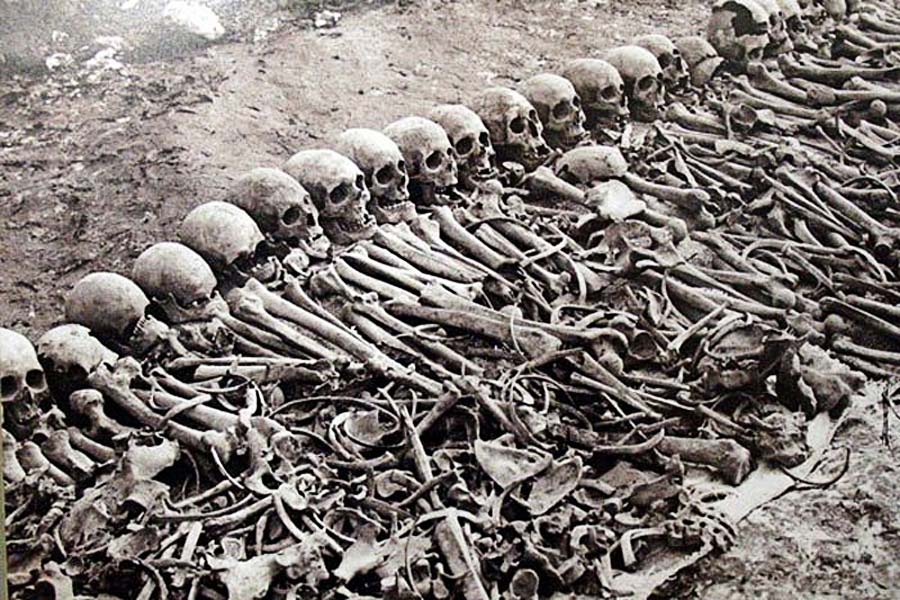
So, to understand the law, we need to ask – what is genocide? Raphael Lemkin created the word and the idea. He was a lawyer, but most importantly he was a driven humanitarian. Ethnically Polish and Jewish, he grew up in what is now Western Ukraine. From a young age he developed a deep abhorrence for mass violence against people because of their identity. Pogroms against Jews; historical instances of persecution and massacres of Christians; and the horrors of the Armenian Genocide (which happened when he was 15) all shaped him profoundly.

In 1939 Lemkin was forced into a gruelling and dangerous flight when Germany invaded Poland, leaving behind his life as a prosecutor in Warsaw. When safe, he devoted himself to trying to understand the unprecedented brutality unleashed on the world at that time. He came to realise that violence against people because of their group identity (which he had previously termed “barbarism”) was not in fact distinct from the destruction of the cultural, social and political institutions of that group (which he had previously termed “vandalism”). Combining these two concepts he coined the term “genocide” and said it denoted “a coordinated plan of different actions aiming at the destruction of essential foundations of the life of national groups….”

If there is one sentence that Lemkin wrote that captures best the meaning of genocide it is that genocide is war directed against subjects and civilians not against sovereigns and armies. The key word is war, and Lemkin made clear that he knew that those who commit genocide do so as a form of warfare. He wrote that “the Germans prepared, waged, and continued a war not merely against states and their armies but against peoples. For the German occupying authorities war thus appears to offer the most appropriate occasion for carrying out their policy of genocide.” Genocide can sometimes occur in other forms, but it is almost always portrayed by perpetrators as armed conflict.

Genocide is a policy, it is a strategy. Violent hatred is less a cause of genocide than it is a consequence of it. The dehumanisation and demonisation of the victim group is a top-down process that seeks to shape the minds of the ordinary men and women who carry out acts of violence so that all members of the victim group are seen as a threat, and as a target. The key to getting people to commit acts of genocide is not getting them to hate it is getting them to believe that their genocidal violence is an act of warfare, an act of defence.

IDF soldier Guy Zaken was a bulldozer driver who testified the he had “run over terrorists, dead and alive, in the hundreds.” Why does he call them “terrorists”? In the context, it is not a meaningful descriptive term. These people cruelly mangled (to death or in death) would mostly have been non-combatants if there were truly hundreds. The word “terrorists” has no meaning here at all other than to make the victims sound dangerous and worthy of extermination. Genocide makes even a small child a threat. As an ordinary Zionist recently put it, “By the time they are 6, they are already radicalized! They are the TERRORISTS of the future!”

Genocide is a “coordinated plan” – a process, a strategy, a policy. But really, what is genocide? It is what the victims experience that truly defines what genocide is. Genocide unleashes the violence of murder, rape, and torture; it unleashes the aggression of those who glory in destroying heritage, community, culture, family, and home. More than that, though, it prevents any possibility of appeal to the human traits of mercy, compassion, or even simple empathy. It turns perpetrators into implacable machines; unmoved by the tears of those whose homes are demolished; unconcerned by their own acts of murder; unreachable by the grief of a parent cradling their dead child; inured to the suffering of those shot, crushed or burnt; untouched by the pleas of those who do not want to die; happy to destroy food needed by starving people; callous in the face of inhuman living conditions that spawn disease; indifferent to the terror of a people living under ever-present threats and unending loss; able to look at the people who endure the relentless terror of bombing; missiles, shelling and drones, and call those people terrorists.

What is genocide? There can be no better answer than that it is what is happening now in Gaza.

Gaza’s “Safe Zone” is a Concentration Camp

Standard

Al-Haq, the oldest and most established Palestinian human rights organisation, released an important report about genocide in Gaza, but it should not be important at all. Everyone should already understand that genocide is an established fact. Al Haq should not feel any need to further state that obvious fact. The report should be a matter of academic interest, detailing a grotesque aspect of the deadly campaign in Gaza. There should be no official or scholarly doubt over the gravity, lethality, unjustifiability, and criminality of Israel’s acts in Gaza; and above all there should be no denying their intrinsically genocidal nature. Instead there is yet another powerful and heartrending report trying to break through the wall of equivocation that our media, politicians, scholars and civil society create. (By “equivocation” I mean the practice of portraying the most unambiguous issue of our time as being a quagmire of uncertainty and controversy.)

Al-Haq’s report details a practice of displacement and concentration. It is important to note here that 20th century history revealed the crucial and baleful role that population concentration plays in oppression and mass violence. This was recognised by theorists like Hannah Arendt and Giorgio Agamben, but also by Raphäel Lemkin. Lemkin invented the term “genocide” and later explicitly linked the idea to “concentration camps”, but he did not mean the term in the rigid sense of institutions that were explicitly labelled as such by the states that created them. He wrote, for example, of “concentration camps” used in the genocide against Plains Indians in 19th century USA. The name itself is not important, it is the concentration of a population in areas without the normal collective autonomy and social functions that is important, whether they be named “camps”, “reservations”, “ghettos”, “strategic hamlets”, or “safe zones”.

These concentration zones are always extreme and intense sites of structural violence. Normal structural violence is described by Dr Paul Farmer as “social arrangements that put individuals and populations in harm’s way…. The arrangements are structural because they are embedded in the political and economic organization of our social world; they are violent because they cause injury to people….” In concentration zones structural violence is intensified by the destruction of normal social arrangements that allow for mutual aid and collective self-defence. Victims in concentration zones are stripped naked of all but the most primitive protection and reduced to a status akin to that of livestock unable to resist being herded or separated or ultimately culled.

All structural violence is created and maintained through acts and threats of physical violence, but in a concentration zone these acts are far more frequent and they are by nature omnipresent. It could be towers, wires and guards; or it could be drones, airstrikes, snipers, and threatening texts. The people within the zone cannot escape the heavy weight of potential death that is laid upon them. With or without barbed-wire the result is an entire population confined to a place where ordinary life is abolished. Mimicking the situation of displacement camps, concentration zones make the temporary vulnerability and loss of autonomy of refugees into a permanent twilight of contingent life. Left to their own devices people in refugee camps will reconstitute a way of living (however immiserated) but these concentration zones are kept in hellish condition of dysfunction. Concentration zones are a product and producer of dehumanisation, making extermination ever more thinkable, ever more practical, and ever more proximate.

The United Nations Convention on the Prevention and Punishment of the Crime of Genocide prohibits both “Causing serious bodily or mental harm to members of the group” and “Deliberately inflicting on the group conditions of life calculated to bring about its physical destruction in whole or in part”. Clearly these are outcomes intrinsic to the creation of concentration zones. By nature such acts of concentration are genocidal on the surface, but can it be merely an allowable expedient of war? In short, no. It can never be justified as “unintentional” (though you would think otherwise from the way our legal, political, journalistic, and scholarly institutions have repeatedly and reliably whitewashed Western genocides). As I will explain, the logic of concentrating a given racial, ethnic, national or religious group as such en masse (i.e. on the basis of their belonging to the group) is genocidal and justifications of military necessity do not and can not withstand scrutiny.

Mao Zedong said that “The guerilla must move among the people as a fish moves in the sea”. He was only saying what imperialist counterinsurgency leaders have believed for a long time. The first acknowledged “concentration camps” were those arising from the Spanish “reconcentration” programme. The stated aim could validly be put in terms of drying the sea in which the guerillas swam. Equally validly, though, it can be seen as an aggression against the people themselves, an expression of animus from a hostile military overlord.i Needless to say these first concentration camps imposed cruel imprisonment conditions that led to mass deaths from starvation and disease. Soon afterwards the British replicated the process, the counterinsurgency rationale, the unspoken animus, and the cruelty, deprivation and mass death. The Germans used concentration camps in both its West African and East African colonies with the same horrific outcomes with the added atrocity that celebrated Nobel Laureate Robert Koch murdered thousands in medical experiments.

Ignoring the peculiar (but also illuminatingii) example of concentration camps in the German Third Reich, there is a clear pattern established here. These early examples alone serve to elucidate the current case in Gaza. Clearly concentration practices cause harms constitutive of genocide as outlined above. Intent is baked into the practice because the harms are intrinsic and it is not possible to undertake coordinated actions such as building camps, violently forcing unwilling masses into those camps, and manning those camps without clear intent. If the concentrated group is a protected categoryiii (assuming this is not merely a short-term displacement), then the acts are therefore genocidal. The Al Haq report details many ways in which, without actually constructing a camp in the “safe zone”, Israel has taken equivalent and even more elaborate measures to concentrate the people into an area where normal life is abolished in every practicable way.

The claim throughout history is always one of military necessity, but it must be made very clear that the existence of a military rationale does not preclude genocidal intent. Quite apart from the fact that these practices have a long history of being militarily counterproductive, even if there were military benefits the genocidal nature is undeniable. The intent is to take actions that cause harm to the protected group, therefore the harm is intentional. The analogy sometimes used is that if I shoot someone dead in the street I cannot then claim that I did not have intent to murder because I didn’t specifically want them dead (e.g. I wanted their sneakers and the expedient I chose was to shoot them in order to facilitate the acquisition). If the act is wilful then motive is immaterial to the criminal intent of the act. If proscribed harms are being done to a protected group in order to achieve a counterinsurgency goal the acts are still genocidal even if the military goal is furthered by those acts. It is actually worth taking a second to think about the moral bankruptcy of those people who suggest that it is okay to commit these acts and they are not genocidal by reason of having a military motive.

Concentration is inherently genocidal and I think there is an illuminating parallel here with the use of economic sanctions that target entire populations. Like many genocidal practices, such sanctions are normalised to the point where anyone suggesting that they constitute the crime of genocide has traditionally been treated like a lunatic, but the hundreds of thousands of deaths caused by sanctions against Iraq in the 1990s changed that to some extent. In reaction the US and its minions such as the UK have of late been very careful to stress the “targeted” nature of contemporary sanctions. In the past, however, it was openly stated that “pain” was to be inflicted on national populations in order to induce them to act against their governments. This “pain” translates to serious suffering, premature deaths and sometimes mass deaths amongst individuals who suffer this purely because of their membership of the national group. Only a despicable racist would think it acceptable that the US government and its Western cronies could inflict such suffering for their own ends. And only a despicable racist would lend any credence to the galling arrogant claims made in these circumstances that the suffering is inflicted in the best interests of the victim group. This sham of benevolent intent towards the victims is a ghoulish habit seen often in genocides, where even the desire to exterminate may be couched in terms of humane euthanasia.

The Al-Haq report contains many chilling and sickening details of the humanitarian pretences adopted by Israel during repeated acts of forcible displacement. The report links these to ongoing genocidal acts, but for me the fact of continued concentration is in and of itself a clear indication of genocide. It almost becomes a problem that there are too many ways in which Israel’s action in Gaza have been clearly genocidal since October 2023. The Gaza Holocaust should be understood in similar terms to that of the Nazi Holocaust. Even though the scale is much less, they are both overdetermined as genocides. Genocide is manifold by nature, but current actions far exceed the norms of genocide. It must be understood that there is no “Gaza Genocide”, there is a Holocaust arising from an ongoing Palestinian Genocide.

The Palestinian Genocide itself has happening for 76 years at a minimum. It is easy to infer the existence of genocide from the circumstances which make the Palestinians enemies of Israel by dint of their mere existence. If Israel wanted to end the genocide it would have to seek a political solution that returned sovereign autonomy to all Palestinians and settled legitimate grievances. That would mean complying with, among other things, the part of UNGA resolution 194 which reads “refugees wishing to return to their homes and live at peace with their neighbours should be permitted to do so at the earliest practicable date, and that compensation should be paid for the property of those choosing not to return and for loss of or damage to property which, under principles of international law or equity, should be made good by the Governments or authorities responsible.” The only way that would leave a “Jewish State” would be with massive compromise and expense. (Massive, that is, except by comparison to the endless billions that have been poured into the genocide by Israel’s international sponsors who clearly do not want an end to the genocide. The US and UK seek to dominate the Middle East by using Israel to permanently destabilise the region and have done since the Balfour Declaration).

Without according rights owed to all Palestinians, actions taken by Israel to control Palestinians in 1948 borders (recognised Israeli territory), 1967 (occupied territories), or diaspora settings (such as Lebanon) are unavoidably inclined to be genocidal. Legally Palestinians have considerable leeway to take action in self-defence and against occupation. This includes armed attacks against Israeli forces even in recognised Israeli territory. By nature Israel’s responses are certain to cause serious harm to Palestinians as such because ultimately it is the continued existence of Palestinians as such that is the source of the problem for Israel. Zionist leaders have always claimed that Palestinians have a choice to act a certain way that would end Israeli violence, but that was never the case and the growth of Israeli settlements in Palestinian territory in the last 20 years makes even the pretence a transparent mockery. Apart from leaving their homeland, there is nothing conceivable that Palestinians can do to end Israeli violence against them, so the violence of the occupation itself is intrinsically and inescapably genocidal.

Concentration such as we have seen in Gaza is an act of genocide, one of numerous instances. Of late there have been some who say that “genocidal acts” may somehow exist as a technical truth that does not justify saying that “a genocide” is occurring. I cannot think of a more evil twisting of thought. The basis of this perversion is that the victims cannot possibly be considered worthy of being labelled victims of “a genocide”, so if the law literally enumerates multiple ways that they are victims of genocidal acts, it all must in some manner be a less meaningful, less condemnable thing – something (not coincidentally) that our leaders do not feel obliged to act forcefully to stop.

The Gaza Holocaust is an extreme and overdetermined instance of genocidal acts occurring in the circumstance of a long extant and historical genocide. Concentration in the “safe zone” is just one of the many acts in this Holocaust that we should recognise immediately as being genocidal. Al Haq’s report almost seems redundant, yet we need to break through. We need to support those who write such unambiguous works and do not undermine them with qualifications, equivocations or false equivalences. Sadly this is not just about our ongoing unsuccessful attempts to end the slaughter in Gaza. When a ceasefire comes that will not end the suffering and death. We must realise that we are also fighting for the lives of the survivors and to prevent future victims of the next onslaught in Gaza, or in the West Bank, or in southern Lebanon, or ultimately perhaps anywhere in the world.

Notes:

i I want to be very clear that animus is not a requisite of genocidal intent. You do not need to harbour a personal hatred of a group to commit genocide against that group. Hitler himself would affect a dispassionate view of the “Jewish race” in order to fit genocide into the faux-ethics of social Darwinism. Notwithstanding this there is a very important misunderstood role for animus in genocide. Genocide is generally a product of militarism. In all empires, in times of armed conflict, and in times where an internal enemy is portrayed as a military threat (circumstances which cover the vast majority of genocides) decision-making often devolves to racist, chauvinistic, or otherwise hateful military leaders. Even under norms of civil control once the military is involved in state action it is military leaders that make decisions over whether people live or die. They decide what is militarily expedient even if there is civil control over strategy and those tactical practices may be the most deadly part of a genocide. We have been widely remiss in our failure to incorporate into analyses the psychological tendencies of military commanders who, (by selection and through the reinforcement of culture) are aggressive, domineering, authoritarian, and ideologically chauvinistic regarding nation, branch, regiment etc. (I would be very surprised if there were not also a bias towards racial, religious, ethnic, political and cultural chauvinism that is significantly more pronounced than among the general population).

The importance of military decision-making is that it feeds into a dynamic that inclines towards genocide. Even if we ignore, for the moment, considerations of genocide there are other serious matters of illegality and immorality. Tactics of concentration or other military responses that either displace risk onto non-combatants (e.g. use of human shields or disproportionate use of firepower as under the US “force protection” doctrine) or inflict collective punishment, are all morally and legally invalid. The only legal and moral way to deal with an insurgency (assuming it enjoys some level of popular political support) is a political and policing approach. This does not necessarily preclude the involvement of military personnel, but history has shown repeatedly that the normal military response to insurgency is to treat the associated civilian population as the enemy.

The dynamic that needs to be understood very clearly is that treating civilians as hostile is predictably and inevitably counterproductive in counterinsurgency (Malayan Emergency notwithstanding) and blended political/military approaches (such as the US employs) tend only to produce an illegitimate and hated collaborator class. On the other hand the typical military approach to counterinsurgency is very functional in committing genocide. Thus, when such things stretch on for years and even decades the genocidal intentionality is writ large.

ii It is fascinating that the Nazi regime instituted a prison camp system for those considered political and social enemies of the Reich and from the first (Dachau) referred to these camps as “concentration camps”. It is one of many facts demonstrating that Nazi ideology was overtly based on prior imperial practices, but adapted for a greater totality. In the long run the concentration camp system would actually function in much the same manner as its imperial forebears (though admittedly at a larger scale and within an extensive complex of ghettos, labour camps, death camps, POW camps and death squads). The Nazi innovation of rounding up the internal enemy in concentration camps wasn’t entirely unprecedented (e.g. the Tsarist and Soviet use of penal colonies for political dissidents, or equally the British and French use of penal colonies for political crimes and class repression), but the clear identification with the imperialist practice was new. Equally this innovation did not die with the Third Reich. During the Cold War US client states would also use camps for internal enemies, especially immediately after right-wing coups, and authoritarian socialist regimes (especially China) have used comparable camps in different forms and times.

The Nazi concept of the Konzentrationslager was that of a zone of lawlessness and naked power. They saw the innately genocidal aspects of concentration camps (whose harms stem like night follows day from the radical disempowerment of individual and society) and decided to harness that mode of oppression for wider purposes. A lesson that must not be ignored is that this mode immediately began expanding and permeating society.

iii In contrast political groups are not under the supposed “protection” of the genocide convention. Politicide, however, is not a lesser evil. The evil of these practices is in how much suffering they cause. The crucial thing to bear in mind is that neither is ever never morally justifiable. To inflict harm on someone because of their intrinsic group identity or because of the political beliefs they hold is always wrong and condemnable. You might want to think of that next time you come across people justifying lethal action because the person was a “communist” or “Hamas” or even “terrorist” without some realistic indication that they were an actual combatant.

A Fiction of War

Standard

To continue its genocide Israel must first convince the world that it is fighting a war. It targets civilians and claims they are “human shields” who have become collateral damage. It leaves Palestinians with no choices, demanding of them the impossible, and then claims that they are choosing war. Israel simulates war to commit genocide.

The “thinking” behind Israel’s tactics of genocide in Gaza is not directly practical. In practical terms it would be easier to simply name a “final solution” of extermination and work from that basis. Yet the current modalities of genocide are crucial in creating a fiction of war, a lie that the one-sided violence of genocide is warfare in the sense characterised by Clausewitz as being “policy carried out by other means”, which is often quoted with the word “policy” replaced by “diplomacy”. In the case of Israel we can also say that diplomacy is genocide carried out by other means. Israeli diplomacy invariably aims to create the fiction of war – a sense that the violence inflicted by Israel is a form of two-sided “conflict” rather than the one-sided murder that it is.

None of this is without precedent. Genocide is always a process, not an event. Colonial genocides in particular are seen at the time as a series of asymmetric wars, each treated by the aggressor as having separate causes and aims.

The most complete sequence of colonial genocide can be seen over the centuries violent expansion by the English, then British, then USA killing and dispossessing the indigenous people of what is now the continental USA. This genocide (or these genocides) began as discrete events of massacre and warfare, becoming increasingly more asymmetric. Treaties and interregna of “peace” became means of ethnic cleansing and periods of “[d]eliberately inflicting on the group conditions of life calculated to bring about its physical destruction in whole or in part” (a punishable act of genocide as described in the UN Convention on the Prevention and Punishment of the Crime of Genocide). Through this time clearly genocidal non-warfare acts such the slaughter of bison and the promulgation of genocidal ideology were ongoing. The genocide grew in sophistication as it moved West, reaching California as a combination of bureaucratised and systematic mass-murder that would be a direct inspiration for Adolf Hitler’s genocidal policies.

When the victims are reduced to a tiny fraction of the original population with an even tinier fraction of the dominion that they once held the genocide does not end. Genocidal policies enter new phases. Some tribes are declared extinct so that survivors have no recognised identity nor historical claim against dispossession. Children are taken then sent to residential schools to “kill the Indian, and save the man” (frequently without achieving the latter). Other policies aim to destroy languages and other foundations of cultural identity. This leads to the last phase, that of assimilating the remnants. This phase is perhaps better exemplified in Aotearoa, Canada and Australia but is broadly indicative of the sequence of genocide in the US. In the last phase the surviving population is inducted at the bottom of the class system. The systems of class oppression are used on them as inherited from British class society, but enhanced by a racial element into “structural racism”. In this phase (which may still be considered genocidal) state instruments of coercion fall unevenly on the remaining indigenous population. Ideologically, like the lower classes, it is made to seem natural that they would need to be subject to greater surveillance, control and correction by the state. This expresses itself through the violence of policing and criminal justice and through the violent and prescriptive aspects of the state “welfare” apparatus. One indication that this can legitimately be thought of as genocide is the sobering fact, for example, that more Canadian indigenous children are taken from parents now by the state than were taken at the height of the acknowledged “genocide” enacted through the residential school system.

I have gone on this digression regarding genocide in the US because it is such a comprehensive example of genocide. It is not only complete but it is fractal, such that different pieces can be carved out and will still show much the same thing an a smaller scale in time and space. The elements of genocide tend to follow a progression, but when one modality is to the fore it does not mean that others are absent. This is true of the genocide against Palestinians which is expressed differently for Palestinians in Gaza, those in Areas A, B, and C of occupied West Bank and East Jerusalem, and those Palestinians who are citizens of Israel. All of the elements of colonial genocide that I have described are there.

The dominant modality or idiom of genocide against Palestinians we see at the moment is akin to that of nineteenth century California such as described in Benjamin Madley’s eye-opening 2017 book An American Genocide: The United States and the California Indian Catastrophe, 1846-1873. The most obvious differences come from the vastly expanded capabilities that technology gives the state of Israel, but the basic structure is the same – the maximum amount of surveillance, control and categorisation juxtaposed with systematic mass killing. The killing can be linked to open espousal of extermination by some elements of the Israeli state (military, government, capital and ideological/media) but the exterminatory nature is deniable in that it is not implemented in a direct comprehensive manner. The logic of extermination is there in the totalising nature of the choice of whom to kill. Though Israel often effects genocide by eliminating crucial people, such as medical or educational staff, we have ample evidence now that on the whole Israel’s violence is aimed at all Palestinians as such. The fact that there is no “final solution” does not mean that it is not a process of extermination. Over time, however, if not ended this genocide will follow the same path that other colonial genocides have followed, destroying Palestinians as such. If the current upsurge in genocidal violence becomes a new norm (like Operation Cast Lead which became a precedent for systematic mass-murder carried out with impunity) then Palestinians will effectively be cleansed from the occupied territories in one or two decades at most.

This genocidal slaughter is all underwritten by fake peace processes, the fake “two-state solution” and a form of diplomacy that (as I already stated) amounts to genocide carried out by other means. In the recently published What Does Israel Fear from Palestine? author Raja Shehadeh tells of personally attending a fake peace conference at which he was scolded for calling the occupied territories “occupied”. Shehadeh concludes that “[r]eal peace would mean a reconfiguration of the myth….” A peaceful democratic Jewish state is no longer possible and the actual apartheid state that exists cannot and could never survive without conflict.

Fake “peace” diplomacy is in fact conflict diplomacy designed to ensure that a plausible state of conflict always exists as cover for a genocidal process (which has a clear direction of travel along a road towards total erasure of Palestinians as such from the occupied Palestinian territories). I have referred to this as Israeli diplomacy, but in truth it is US diplomacy also. The Oslo process was designed by the US and it led to an impossible situation for Palestinians. There was literally nothing real that they could concede in return for peace and statehood, but Israel was able to create and maintain a façade of making demands for security. It is a paper-thin pretence that is completely belied by their settlement activities and much else besides. There is no legitimate reason why the US would accept any of this if they were at all invested in the “Oslo process”, the “peace process”, or the “roadmap for peace”. On the contrary, the US spent decades repeatedly insisting that “final status issues” (i.e. those that actually lead to peace) are an exclusively bilateral concern and did not shift that position as Israel systematically and ostentatiously made any promised resolution impossible. The consistency of the US in this regard reveals the bad faith in which they drew up the parameters of this “peace process”. This means, ipso facto, that they are the knowing architects of the fake peace process, which is to say the permanent conflict process that is a crucial foundation of the ongoing genocide. Therefore, this is a US genocide.

It is by no means abnormal for those committing genocide to use a pretext of armed conflict as cover for their activities. When Lemkin invented the term genocide he stated that: “For the German occupying authorities war thus appears to offer the most appropriate occasion for carrying out their policy of genocide.” This sentiment seems to be echoed in the words of another person – Adolf Hitler (also, in a way, an authority on genocide). Hitler wrote: “This partisan war has its advantages as well. It gives us the opportunity to stamp out everything that stands against us.” As a rule, if armed conflict is serving as a pretext for another undeclared policy, that policy must certainly be genocide.

There are good reasons for believing that Israel cannot achieve its aims through genocide because the world has changed since similar colonial genocides succeeded. But that is only true if we make it true. Those people lost to historic genocides were almost voiceless, but the problem now is not voicelessness, it is deafness. The deafness of Western leaders and those of certain lackey countries. They cling to a malicious malevolent mendacious obtuseness. It is violent genocidal racism that hides behind specious arguments and a phoney concern for Jewish safety. Central to all of this toxic hatred is the fiction of war – the pretence that a stateless impoverished people pose a threat to the 6th most powerful military in the world – a contention based on the racist notion that Palestinians reject peace because they have an irrational hatred that drives them to perpetuate a conflict in which they lose much more than their powerful enemies.

It is foul fascist nonsense, this victim-blaming fiction of war. There are no half-measures left to us in response. We need to drive the genocide supporters and genocide deniers off the air and out of office. Moreover, the genocide will not end until Palestine is free. A ceasefire will not bring real peace, just a different phase of genocide. Only a single democratic state and an international commitment to reparation and stability will bring peace, justice and an end to genocide.

The Gaza Genocide: “Genocide” is the Necessary Word

Standard
Portrait photograph of Raphäel Lemkin

What is happening in Gaza currently is genocide. The power of the word is not because of its power to shock, but because of its accuracy. Now that the word is out of the bag, now that it has gained currency, we cannot allow it to be put back. Establishment voices have long since twisted the usage of the term genocide to serve power rather than justice and peace. If activists do not educate themselves they will find any mention of genocide turned against them as evidence of hyperbole, bias, and (of course) anti-Semitism.

Most genocide scholars seem to understand that Israel is perpetrating genocide against Palestinians, but as Rashed, Short and Docker wrote on the subject in the journal Holy Land Studies (2014, Vol. 13): “Genocide Studies knows it is being watched and can be threatened with vilification at any moment, even in a preemptive gratuitous way.” The result is that those few who do speak out are are represented as being in the minority, when they are allowed to speak out at all. In contrast the highly partisan scholars who deny genocide are regularly presented as the authorities on the subject. Such “experts” are very effective in sounding plausible to the public and to journalists when they are not. They play on people’s expectations and the public’s sense that responsible governmental and non-governmental bodies are constrained by truth and reason.

Once we grasp that what is happening is genocide much of the commentary will be revealed as sickening theatre that clings to a fantasy world where killing civilians is a tragic miscalculation. Seth Moulton, for example, has enough enough self-importance to lecture the Israelis that they are in a “counterinsurgency” and they need an “end-game” and that (according to the revolutionary insight that he shares with Stanley McChrystal) killing civilians will actually make enemies. He even went on Al Jazeera to remind Israel that it should remember the need to win the “hearts and minds” of Gazans. This was on 11 November, after a month of slaughter, and he is worried that Israel might not be winning “hearts and minds” in Gaza! What world is he living in? The same can be said, and has been said, for Piers Morgan demanding that Israel must do more for the patients in Al Shifa hospital.

We are in a war for history, fighting so that truth overcomes power. As George Orwell famously pointed out, the war for the past is the war for the future. What is happening in Gaza is very similar to what happened in 2004 during the Second Battle of Fallujah. That horror has been turned into a videogame where, in some sort of sick revisionism, players are meant to minimise civilians casualties while killing the Iraqi “bad guys”. Meanwhile wikipedia will tell you that there were few civilians in Fallujah (source: the US military) and that at most 800 civilians were killed, despite much eyewitness evidence of a higher level of civilian death.

Unlike Fallujah, where media were vigorously excluded, the world can see what is occurring in Gaza. Yet our collective memory is very short. As the outspoken Irish MEP Clare Daly has said: “…after they’re done the lies are exposed, but there’s never any reckoning.” She is talking of a reckoning for Israel, but those who support them internationally also face no reckoning and pay no price. That must change but unless we can name the genocide and get people to understand what that means, the dead we see before our eyes each day will be written out of the history books and the memory will fade to nothing. The genocide will be framed as a reaction to terrorism aimed only at destroying the violent threat posed by Hamas. We will debate the “errors” and “miscalculations” that led Israel to “indiscriminately” kill civilians in their understandably over-zealous efforts to wipe Hamas off the map. Some will say they were entirely justified, but “critics” will say they were in fact very naughty because they should have been more careful in their otherwise righteous attempt attempt to destroy Hamas. The single word “genocide” can change all of that.

Ideas are important. During the late 1960s, as people became ever more informed about what the US was doing in Viet Nam, official pronouncements began to ring hollow and then started to seem increasingly deranged. Politicians, generals and most journalists became trapped in the network of lies that allowed them to mischaracterise their violent aggression as a morally valid battle against “internal aggression”. The facts became more widely known because activists used various demonstrations and teach-ins to bypass the mostly hopeless print and broadcast media. As knowledge grew, the people clinging to the lies started to seem buffoonish, and that was a major step towards undermining the US ability to maintain its perpetual war.

The Idea of Genocide

Genocide may be among the most important concepts to come out of the 20th century, but it is hobbled by misuse, abuse, and most of all by biased denial. It has become incredibly hard to tell people what the word means because it has been highly distorted by both bad actors and well-meaning fools. It is also so emotive that it is normal to have incredibly strong convictions about what is and is not genocide while having no ability to define the term at all.

I would like to ask the reader to forget received wisdom and focus on the following facts about genocide. The first is that the man who invented the term, Raphäel Lemkin, defined it as being war conducted against people in contrast to war conducted against rulers and their military forces. The second is that Lemkin was always clear that genocide did not necessarily mean physical extermination. The third is that it is a process. It is “a coordinated plan of different actions” that share an aim. “Aim” is the word chosen by Lemkin originally, but “intent” is the common word used today. As I will elaborate later “aim” and “intent” are not the same as “purpose” and “motive”.

As a process, genocide is therefore not found in a single act, nor can it meaningfully be talked about as such. There is no such thing as “attempted genocide”. Nor is genocide a matter of degree. Something does not become genocide because it crosses an arbitrary red line. The commentariat can argue about whether violence has “risen to the level of genocide” but they are talking utter crap. Genocide occurs when numerous acts, which may or may not be crimes in themselves, are concerted to cause destruction of a people “in whole or in part” by inflicting physical or mental harm on a people including the erasure of identity.

Genocide is policy, albeit unwritten policy. Our habit of viewing this vast process as being a criminal “act” is wilful ignorance. Nothing could better illustrate that point than an Al Jazeera English panel discussion on the genocide in Gaza wherein their specialist genocide pundit refused to use the term for the most extraordinary reasons. Geoffrey Nice, the head prosecutor in the genocide case against Slobodan Milosovic, and thus the “expert” on theAl Jazeerapanel, was the only guest to demur at calling the genocide for what it is. He stated that genocide only exists when a perpetrator has a certain “state of mind”. He implied that you can’t name something genocide until a perpetrator has been convicted of the crime.

To put things into perspective, millions of people around the world are involved in actions that are necessary parts of the current slaughter in Gaza. As I will show there is clear evidence that there are co-ordinated actions with genocidal intent. The nature of the actions show this to be true. According Geoffrey Nice, the barrister and putative legal expert on genocide, he won’t use the term genocide because it has to be established that a criminal defendant had a genocidal “state of mind”. This would mean that he and other official types fully intend to deny genocide until the unlikely event that years later one or more individuals is tried and someone like him manages to convince a panel of judges that they can prove beyond reasonable doubt what a defendant’s state of mind was some years before.

Of course, one does not need a criminal conviction to conclude that Rwandans, Sudanese, Iraqis or Serbs are guilty of genocide. Mostly you just need a colour chart (though the US State Department will let you know when skin tone is not diagnostically sufficient).

Geoffrey Nice shows his true face when he uses some some tricky and improper language. He uses the term “wish” when the term “intend” is correct, and when he should say that actions are taken against people because of their identity, he inserts the word “simply”, emphasising the word with noticeable emotion. By saying “wishes to” and “simply because” he implies that “special intent” must come from special animus. This creates the impression that genocide is something undertaken by those we see as the Other: our enemies, the irrational demons that our leaders and politicians have already decried as being hateful monsters. In contrast, people like Henry Kissinger cannot commit genocide no matter how many people they cause to be killed because Kissinger doesn’t hate the people he kills. Mr Nice and his ilk could never use their courtroom telepathy to read genocidal intent his “state of mind” because they have twisted the meaning of “intent” to incorporate a motive of irrational hatred. But this portrayal of genocide as the product of slavering unthinking hatred stands in stark contrast with Lemkin’s notion of a calculated, complex, cold-blooded bureaucratic process.

In Eichmann in Jerusalem Hannah Arendt shows that genocidal violence on an industrial scale could occur at the hands of people who harbour no special hatred for their victims. Some have claimed that Arendt mischaracterised Eichmann, but the more general point has proved robust (in contrast with Daniel Goldhagen’s contrary thesis in Hitler’s Willing Executioners which is vigorously denounced by historians). Genocidal intent does not need to be demonstrated by the rhetoric of hate and extermination because neither is a precondition of genocide.

Different Israelis will have different and multiple reasons for participating in the genocidal violence and oppression that is visited on Palestinians. I do not think it would be over-generous to the Israeli people to say that the predominant motive is a quest for security. They claim that what they do is in self-defence. If we accord them the generous concession that we believe that they believe they are acting in self-defence, it does not mean that they are not committing genocide, nor even that they are not harbouring a racist hatred of Palestinians. If I said “I am not a racist, I am just scared of black men” you would be correct in telling me that I am actually a racist. Israelis who think that they are threatened by Palestinians as such being given by full sovereignty or full democratic rights are racist and genocidal. It is not that there may be no threat, but that they think with a double-standard that displaces all of the onus onto Palestinians without recognising any Palestinian right to establish relations that mitigate threats to their own collective.

There are also Israelis on the right, including hundreds of thousands of illegal settlers, for whom the genocide serves an overt expansionist plan of a “greater Israel” (as seen in Likud’s original party platform from 1977 which states “between the Sea and the Jordan there will only be Israeli sovereignty”). Most Israelis, though, simply believe that you cannot make peace with Palestinians unless you asserted total dominance over them. Arguably the second stance is more racist than the first, but both of them lead to the exact same genocidal policies. Two distinct motives leading to the same policy of genocide. Motive and intent are not the same thing.

Israelis have had a massive military advantage over Palestinians since before Israel even existed. Palestinians suffer due to this, far more than Israelis suffer. The racist claim is that Palestinians are too irrational and/or deceitful to make peace. Israel’s military occupation of the West Bank and Gaza displaces almost all of the risk and violence upon the Palestinian people with Israel operating security forces in the West Bank and blockading Gaza. Israelis are a rich people not allowing a poor people any autonomy because that would increase the power of Palestinians to oppose Israeli power. Not coincidentally the policy to suppress Palestinian power under a rationale of defence happens to allow illegal settlements to flourish in the West Bank. Whether the motive is defensive or expansionist hardly matters to the genocidal nature of the actions. Attempting to defend yourself by reducing another people to a point of inescapable weakness is a classically genocidal move that will inevitably lead to a logic of extermination because an oppressed people will always have some means to resist while they remain alive.

When Israel claims to be acting in “self-defence” we should know that this means attacking the people of Palestine as such – imprisoning, immiserating and killing them because it is their very identity, their cohesion and their bodies that Israel considers a threat. Taking this logic to its conclusion they will never consider themselves secure from threats until no Palestinians exist. The logic behind Israel’s actions is the logic of genocide. In the words of John Docker, genocide is a “composite and manifold” process. It does not begin nor end with periods of heightened mass violence such as Gaza is suffering at the time of writing this. The genocide began in 1947, but the current massacre can only truly be understood as part of that long tortuous generational crime.

Debasing the Coin”: The Tendentious Policing of the Word “Genocide”

“Genocide” is clearly one of the most misused words in the English language. This is not because it is overused, if anything it is more often underused. The problem is that people treat genocide as if the word were defined by some level of atrocity. Even supposedly serious genocide scholars embrace undefined subjective standards then accuse those who disagree of acting to “debase the coin” of the hallowed word. They want to police the usage of the term so that it fits an ideological notion of savagery and hatred. This tends to prejudicially exonerate richer, whiter countries who kill more clinically and from higher altitude while using better platitudes.

It is easy to understand the evasions and distortions used on the term “genocide” by analogy with the word “rape”. “Rape” is legally defined as a crime using the concept of consent. For decades, however, people have struggled to assert that rape is a matter of consent in the face of those who believe that “real rape” is when a stranger uses overt violence in an act that is either a form of abduction or burglary. Rape that happened outside of these circumstances has historically been downplayed, dismissed or ignored entirely. I could argue here very serious trauma can occur without someone beating a victim or holding a knife to their throat, but that is not the point. Comparing trauma and damage is an invidious trap that only serves to wrongly diminish, if not erase, a crime. The crime of rape cannot be denied by setting a minimum level of trauma or type of coercion because it is about consent.

Rape is rape is rape. Genocide is genocide is genocide. A genocide does not need to be compared or related to Holocaust to judge if it is worthy of the name. In fact, when Raphäel Lemkin coined the term he mostly eschewed reference to the ongoing extermination of European Jewry, of which he was well aware. Why? Because extermination or attempted extermination is a concept that does not need special elaboration and insight. Despite the fact that the word he invented – “genocide” – sounds as if it references immediate killing of a genos, it is a far broader term that encompasses violent extermination in a strategic spectrum.

In the very first paragraph on the subject of genocide Lemkin wrote:

Generally speaking, genocide does not necessarily mean the immediate destruction of a nation, except when accomplished by mass killings of all members of a nation. It is intended rather to signify a coordinated plan of different actions aiming at the destruction of essential foundations of the life of national groups, with the aim of annihilating the groups themselves. The objectives of such a plan would be disintegration of the political and social institutions, of culture, language, national feelings, religion, and the economic existence of national groups, and the destruction of the personal security, liberty, health, dignity, and even the lives of the individuals belonging to such groups.

In describing genocide Lemkin, a Polish Jew, cited German occupation policies in many nations targeting many ethnic groups, referring most often not to Jews but to other ethnicities, particularly Poles. Lemkin had long been concerned with both the physical killing of ethnic groups and the destruction of their cultural and social cohesion. He attempted in 1933 to create two international crimes: “barbarism” which entailed mass violence against ethnic groups; and “vandalism” which entail attacks on “works of cultural or artistic heritage”. In simple terms the word “genocide” came from the final crystallisation of his sense that these are not separate phenomena and are part of a wider practice of which direct violence is only a component. Lemkin’s first published discussion of genocide was a very short chapter in a large book. Lemkin cast his net wide, suggesting some form of genocide for many different nations ranging from the “Germanisation” of those considered racial cousins, to the mass killing of Poles, Russians and Jews.

There may be no more important thing to note about the concept of genocide than the fact that had Lemkin chosen to focus his attention on the genocide of Jews, to be consistent he would have begun his accounting of genocide no later than Hitler’s assumption of the Chancellorship of Germany. Some scholars have actually criticised this aspect of Lemkin’s conception because it means that non-lethal acts of discrimination such as firing Jewish civil servants and academics were acts of genocide. Once again they feel that this “debases the coin”. But Lemkin’s unadulterated version of genocide is the only way in which the term can be used to save lives. Understanding that a genocide is occurring means that people can rise up to stop the acts before they progress to the stage of mass killing. Isn’t that more important than waiting until the killing is over then putting someone in prison?

Genocide is thus such a broad and sensitive concept that the terms that have been invented to avoid using the g-word are redundant and ridiculous. Words like “ethnocide”, “sociocide” and “culturecide” largely serve the bad-faith purpose of concealing genocide. People are often more comfortable using “Apartheid” or “ethnic cleansing” because these words are considered more reasonable and measured, but our only criterion should be accuracy. The habit of politesse has predictably that favoured the most powerful while scruples about accusing members of the developing world of genocide have equally predictably been eroded to mere pretension.

This selective usage of the word genocide creates strange illogic. For example, how is a state is meant to ethnically “cleanse” land while not committing genocide? Bear in mind that Lemkin specifically wrote that one possible aim of genocide was the imposition of the “national pattern” on “the territory alone, after removal of the population and the colonization by the oppressor’s own nationals.” It would seem that “ethnic cleansing” is a very straightforward manner to achieve this genocidal outcome. Forced transmigration is not specifically prohibited under the United Nations Convention on the Prevention and Punishment of the Crime of Genocide (UNCPPG), but it doesn’t need to be. There is no practical way of ethnically cleansing people from an area without committing acts prohibited as constitutive of genocide and if your aim is to remove a protected category of person from an area entirely then that is clear genocidal intent.

To illustrate, let us examine the words of another vaunted “expert” Omer Bartov who expounded his reckons on the link between ethnic cleansing and genocide during a Democracy Now! interview: “there is a connection between the two, because often ethnic cleansing becomes genocide. That happened, in fact, in the Armenian genocide in World War I….” I can not for the life of me understand what he thinks happened. Does he believe that Armenians were just delivered eviction letters and told that the government would like them to march into the wilderness at their first possible convenience and the Armenians went in quiet obedience without any violence being visited on them? Does he think that forcing them to leave their homes was not “causing serious bodily or mental harm to members of the group” and “deliberately inflicting on the group conditions of life calculated to bring about its physical destruction in whole or in part”? Does he think that the Trail of Tears was not genocidal?

One reason for Bartov’s weird attitude may be that he was almost certainly brought up (in Israel) to believe that Palestinians had conveniently ethnically cleansed themselves at the perfect time to allow Israel to declare itself a state. Israel concocted a lie – a lie still repeated by Israelis and pro-Israel leaders and journalists – that Palestinians responded to a call from Arab allies and decided to leave just at the right time for Jewish majority state to be created where such a thing had previously been impossible. Jews made up less than one-third of the population of Palestine and would have been a minority in any conceivable geographical partition. We have now known for decades that there was a co-ordinated plan to empty “Arab” population centres for reasons of “self-defence”. I won’t detail the infamous Plan Dalet and the controversies that surround its intent, but suffice it to say during its implementation there was widespread violence including a number of massacres. Palestinians fled as intended. Israel managed to create a Jewish majority state that encompassed 78% of Palestine. Israel immediate acted to ensure that none of the refugees could return under the grotesque rationale that by fleeing they had given up their rights of residence and citizenship. This is despite the fact that Israel’s recognition by the UN was contingent on compliance with UNGA resolution 194 which ordered that Palestinian refugees be allowed to return immediately. Then Israel systematically lied so that Israeli children, like Bartov, were raised to believe in the immaculate self-cleansing of 700,000 Palestinians.

Ethnic cleansing is a useful concept, but it cannot occur outside of the concept of genocide. It is not a lesser crime against humanity in some unwritten hierarchy of badness. It is an act of genocide which accompanies other acts including the inevitable acts of violence that must occur to facilitate ethnic cleansing.

Genocide is a concept that could allow us to see and stop the ongoing violence of the powerful against the powerless, but only if the word is reclaimed and used with rigour. This has to come from the grassroots. People with status and those deemed to be experts are far too compromised. Those selected as what passes now as public intellectuals are usually those whose words appeal to one or more billionaires. Nowadays the problem is more one of amplification and algorithms than one of gatekeepers, but the answer is the same as it was in the 1960s. Activists must engage in their own education, creating intellectual constituencies for voices that serve truth and justice rather than money and power.

In the mean time the genocide experts and campaigners that most people will see are all servants of the status quo, however much crocodilian sentimentality they display. They want to “punish” the crime of genocide, which means sending old men to the Hague when of necessity the defendants have long since lost their ability to harm others. Then without proof or any attempt at self-interrogation they claim that locking up these old men helps prevent other genocides. They want to prevent the “real genocides” which are like the “real rapes” – i.e. those committed by political enemies, the poor, and the non-white. The US, meanwhile, is the suit-wearing serial rapist of this analogy whose victims are at best ignored if not punished and persecuted for the act of naming the crime committed against them. Israel is the kid brother who needs big brother to bail him out, but shares almost the same level of impunity.

It is time for an international movement to end the ability of states to openly commit genocide without fear that it will be named. At the moment it is comparatively easy to condemn Israel’s genocide because many top officials loudly proclaim their genocidal intent with regards to the current massacre in Gaza. What we have to ask is if we think it is acceptable that the same acts would not be considered genocide if the Israelis exercised greater control over such communications. Do we as activists think it is wise to allow the perpetrators of a crime to be able to control whether the world believes the crime is taking place? Because that is the current situation and if we rely on Israelis to keep announcing their genocidal intent we will find that the well will run dry very quickly.

Genocidal Intent

Intentionality is an important part of the notion of the crime of genocide. In the crime of genocide it is not the individual acts that make the crime but the genocidal intent behind those acts. This is known as dolus specialis or “special intent”, however, this phrase is tendentious and prejudicial. We should use the term “genocidal intent” because “special intent” has inescapable connotations of exceptionality, if not rarity, that are sadly unjustified when it comes to genocide. It is also over-emphasised and almost mystified as something unique to genocide. Intent is also highly relevant to the criminality of other acts. I could knock someone else’s property into my open bag with intent to steal or without intent to steal. It may not be possible to determine criminality by the act alone. In many jurisdictions a mens rea (Latin for guilty mind) or niyaa (Arabic for intention) is crucially important and often necessary for an act to be considered criminal at all, regardless of the consequences of the act.

There is a notion that “special intent” is to be found in the words of the perpetrators of genocide rather than their actions. This is untenable, if not unserious, for many reasons. Genocide scholar Raz Segal referred in the very early stages of the onslaught on Gaza to a “textbook case of genocide”. Obviously this is a brave and welcome stance, but he has fallen into the trap of emphasising the dramatic genocidal rhetoric of Israeli leaders. Their talk of “flattening” or “erasing” Gaza is hard to ignore, but it is not relevant to whether or not they are committing genocide.

The emphasis on the overt confessions of people committing genocide leaves us in the

unjustifiable position of judging the nature of someone’s actions on the basis of whether or not they choose to incriminate themselves. It also leaves the hopeless circumstance of arbitrarily deciding who is and is not sufficiently highly placed, or influential, or practically involved to count as being able to evince genocidal intent when genocide is a collective set of diverse actions. Moreover, the rhetoric cited is without exception exterminatory, not merely genocidal. Remember that this is a rigged game. If an African leader, especially an opponent of Western hegemony, ever used terms like “flatten” or “erase” regarding enemy territory in time of conflict they would undoubtedly be pursued by the ICC until their dying day. In the case of an Israeli leader, though, any exterminatory rhetoric is likely to prove poor evidence of genocidal intent as soon as they are able to point out they did not in fact fully flatten Gaza, and that their plans and actions always fell short of completely erasing the people living in Gaza. The Israelis and their genocidal comrades will simply say that the passion that followed the shock of October 7 led to understandable hyperbole and that no operations ever aimed at enacting such drastic policies. By trying to go beyond the required proof of genocide Raz Segal may find that the “textbook case” is a will-o-the-wisp which will disappear, leaving him enmired in the bog of interminable apologism.

We need to always keep in mind that genocide is a set of actions that share a genocidal intent, not a genocidal purpose. The distinction between intent and purpose is crucial as can be seen in the analogy of murder. If I hate someone so much that I kill them out of loathing that is murder, but equally if I kill them because I want to steal their wallet it is still murder. In fact if I kill a complete stranger simply because they are blocking my view of the sunset and shooting them seemed less bother than asking them to move, it is still murder. I don’t need any particular animus aimed at the victim in order to have murderous intent. That is why “special intent” is such a terrible phrase. It is used to create a false historical narrative of genocides whose archetypes in the Holocaust and the Rwanda genocide are heavily mythologised. All of the complexities and contradictions of these mass events removed to create a simplified arc that begins and ends with bad guys who want to exterminate a people because of an implacable hatred.

Israel has clearly shown a pattern of targeting civilians. This is not “indiscriminate”. They are choosing to target civilians. This is a discriminate choice. They target hospitals and ambulances. This is a war crime under the Geneva Conventions. The IDF even tweeted revealing their deliberate and discriminate choice to attack making the false claim that that they became “legitimate military targets” if Hamas used them (the tweet was soon removed). The IDF has plenty of legal expertise to draw on and those who decide the policies and rules of engagement know that they are committing war crimes. The fact that they choose to do so is not just a crime in itself, it is evidence of genocidal intent. The disparity in military capacity between Hamas and Israel is so vast that any strategic calculation would show that the gains from, say, attacking Al Shifa hospital are vastly outweighed by the massive strategic losses they are sustaining in the international diplomatic world and the world of public opinion.

We have all seen what is happening. More than half of Gaza’s hospitals are effectively condemned by Israel and more than half of its population have been displaced, but neither the displaced persons nor the hospitals in the south are safe from direct violence nor the indirect violence brought about by lack of food, water and fuel. When many people fled south, leaving behind much including food preparation facilities, Israel bombed many bakeries. They have ensured that humanitarian relief is a small fraction of what is needed.

Clearly Israel has breached the UNCPPG under the first three prohibited acts of Article 2: “(a) Killing members of the group; (b) Causing serious bodily or mental harm to members of the

group; (c) Deliberately inflicting on the group conditions of life calculated to bring about its

physical destruction in whole or in part….” The fact that they are doing so in multiple different ways acting in concert towards the same aim is what makes this a “textbook case of genocide”.

The main way to discern genocidal intent is through the fact that multiple different actions by the perpetrator work towards the same outcome. The intent is evident in the actions. It is not tenable to suggest there it is possible to repeatedly contravene the acts prohibited in the UNCPPG without genocidal intent. If you can identify those acts as being inflicted on a protected group as such then that is enough to demonstrate intent. Statistically there is no question that the victims of Israeli direct and indirect acts of violence are overwhelmingly non-combatants, and the discrimination between Palestinians and Jewish citizens of Israel is so stark that I don’t think I need to enumerate it here.

As mentioned, relying on emotional and/or racist outbursts as evidence of genocidal intent is problematic on two counts. Firstly it allows Israel to conceal genocide simply by exerting greater discipline over its officials. Secondly there is an easy defence for Israel in that they can point out that such pronouncements were mere rhetoric and were not incorporated into doctrine, policy, strategy or tactics. Israeli actions are all that are needed to prove genocidal intent, but if we did want to use Israeli statements to prove intent it should be those evince an intent because they proclaim a purpose that cannot be obtained without committing genocide.

Genocidal intent is shown when Israel refuses to define its borders; when it funds, supports, and defends illegal settlements; when it openly talks of aspirations to annex Palestinian territory; and when Netanyahu pointedly displays maps at the UN that exclude the Occupied Palestinian Territories from existence. Genocidal intent is chillingly hinted at in all discussions of the “demographic threat” posed by a growing Palestinian population. As mentioned, no people will cleanse themselves voluntarily from their homes.

To give some perspective I will refer to something I wrote (p. 60) regarding the genocidal intent of Germans during World War II. The point I made was that the “Final Solution” was not documented as such until after it was well under way. They had already begun murdering all of Europe’s Jews, but they had not recorded an explicit intent and had events happened slightly differently might never have done so. Some have claimed that this means that Judeocide was a “bottom-up” process that was begun by widespread anti-Semitism then adopted by the leadership. I counter by pointing out that from the very first draft of the German Eastern strategy, Generalplan Ost, a future was envisioned in which tens of millions of people, including all Jews, would disappear from Eastern Europe. The fact that people seem reluctant to see these plans as evidence of genocidal intent seems quite eccentric to me, but it fits the pattern of ignoring the banal, detached and bureaucratic origins of genocidal thinking in favour of a more dramatic and demonic evidence. Israel is never likely to create a “Final Solution”, but it has its own equivalents of Generalplan Ost.

I am not suggesting here that Israel intends to kill or starve all Palestinians but I will refer back to my earlier point about ethnic cleansing being inherently genocidal. I will also remind readers that at the time writing Israel is killing hundreds of Palestinians every day. Moreover their ongoing siege, their forced displacement, and their attacks and destruction of medical and other essential facilities have already began to take a huge toll. Al Shifa hospital has been losing patients due to lack of generator fuel and other supplies to such an extent that it has had to bury 179 bodies in a mass grave. All of the ICU patients died. Hunger and infectious disease are both on the rise and anyone who has studied genocide or colonial history can tell you that the combination of hunger and disease is by far the greatest killer in times of genocide.

Referencing territorial ambitions also far exceeds what is needed to prove genocidal intent. Maintaining the territorial status quo while deliberately enforcing conditions of life on Palestinians that maintain weakness and poverty clearly involves inflicting “serious bodily or mental harm”. As one article explains:

In early 2006, Dov Weisglass, then a senior advisor to Prime Minister Ehud Olmert, explained that Israeli policy was designed “to put the Palestinians on a diet, but not to make them die of hunger.” In 2012 it was revealed that in early 2008 Israeli authorities drew up a document calculating the minimum caloric intake necessary for Palestinians to avoid malnutrition so Israel could limit the amount of foodstuffs allowed into Gaza without causing outright starvation.

Lemkin pointedly left “mass killing” until last when detailing the ways in which genocide is committed through physical means. Before killing came “Racial Discrimination in Feeding” and “Endangering of Health”.

It is worth reading just how many different forms of discriminatory practice that Lemkin considered to be genocidal. Craig Mokhiber resigned from the UN, citing a “textbook case of genocide” against Palestine. Like Raz Segal I can only applaud the use of the term, but decry the reasoning behind it. Mokhiber says that a “sense of impunity” has caused Israeli officials to say the quiet bits out loud when normally one has to comb “dusty archives” and “secret correspondence to see what they were really up to….” To be fair he does reference discriminatory actions, but he is still suggesting that the genocidal intent is to be found in hateful, vengeful and exterminatory rhetoric. Like Segal he links the “textbook” nature to the extremities of Israeli posturing. In reality, though, the textbook is the UNCPPG and “special” intent is merely “the intent cause destruction in whole or in part”. From that perspective “special intent” is not a really high bar. If we really wanted to know what a “texbook” case looked like we would use the examples set out by Lemkin in Axis Rule in Occupied Europe.

Reading Lemkin gives a very different idea of genocide and genocidal intent than the public is likely to hear from “experts”. Under “Techniques of Genocide” Lemkin lays out a diverse set of policies of destruction. I have already dealt with the “Physical” techniques, but the others are laid out below with illustrative quotes.

“Political” –“…local institutions of self-government were destroyed and a German pattern of administration imposed.”

“Social” – “The social structure of a nation being vital to its national development, the occupant also endeavors to bring about such changes as may weaken the national, spiritual resources.”

“Cultural” – “Not only have national creative activities in the cultural and artistic field been rendered impossible by regimentation, but the population has also been deprived inspiration from the existing cultural and artistic values.”

“Economic” – “The destruction of the foundations of the economic existence of a national group necessarily brings about a crippling of its development, even a retrogression. The lowering of the standards of living creates difficulties in fulfilling cultural-spiritual requirements. Furthermore, a daily fight literally for bread and for physical survival may handicap thinking in both general and national terms.”

“Biological” – “…a policy of depopulation is pursued. Foremost among the methods employed for this purpose is the adoption of measures calculated to decrease the birthrate the national groups of non-related blood, while at the same time steps are taken to encourage the birthrate of the

Volksdeutscheliving in these countries.”

“Religious” – “…through the systematic pillage and destruction of church property and persecution of the clergy, the German occupying authorities have sought to destroy the religious leadership of the Polish nation.”

“Moral” – “In order to weaken the spiritual resistance of the national group, the occupant attempts to create an atmosphere of moral debasement within this group. According to this plan, the mental energy of the group should be concentrated upon base instincts and should be diverted from moral and national thinking.”

It becomes very obvious from Lemkin that destroying a genos “in part” means weakening that genos through such “techniques” or, more properly, through acts proscribed in the UNCPPG. The International Criminal Tribunal for Yugoslavia ruled “the part must be a substantial part of that group. The aim of the Genocide Convention is to prevent the intentional destruction of entire human groups, and the part targeted must be significant enough to have an impact on the group as a whole.” But this is case law for criminal cases brought against individuals. It is highly subjective and makes the presumption that the wording of the UNCPPG is to be ignored in favour of what the court thinks is the unwritten intention behind the convention. It begs numerous practical questions such as what is meant by “entire human groups” and in what timeframe is this meant to occur.

It seems as if the entire case-law of genocide is a gigantic argument from consequences that will only ever serve victor’s justice. As I will show below, moving away from the wording of the UNCPPG as a reflection of Lemkin’s concept of genocide leads to absurdities. Therefore genocidal intent requires no declaration of specific hatred, merely the demonstrated intent to weaken a people through proscribed means. Consistent actions against an identifiable protected group are in themselves evidence of intent as personnel cannot be impelled without such an intent. Moreover, extending full or partial impunity to one’s own people for committing crimes such as assault, theft, abduction, vandalism, rape and murder is essential to genocide. Once legitimate lawful purposes for providing such immunity are ruled out, there is clear genocidal intent.

As it happens Israel has a long documented history of undertaking the sort of acts of destruction that constitute genocide. I do not have the time to provide sources for each, but Israel has killed and imprisoned political and community leaders; it has attacked and vandalised community and arts organisations; it has attacked health providers; it has attacked and harassed worshippers and places of worship; it’s personnel have deliberately damaged places of religious and historical significance such as the Church of the Nativity; it has destroyed archaeological sites, graves and architecture in such a manner as to erase signs of a Palestinian identity from the land. Norman Finklestein’s book Beyond Chutzpah alone contains a litany documented acts by Israel that are clearly constitutive of genocide. The rationale of maintaining a power disparity (i.e. weakening Palestinians as such) is openly avowed. The book came out in 2005, before there even was a siege of Gaza and before the repeated mass violence against Gaza. In 2008-9, 2012, 2014 and 2021 Israel attacked Gaza killing mostly civilians and inflicting great damage on civilian homes, property and infrastructure. Israeli officials sometimes refer to this as “mowing the lawn”.

If we put too much emphasis on the current slaughter and the heightened rhetoric that has accompanied it we risk putting ourselves in a position that effaces the banal genocide of the day-to-day realities of Israel’s occupation and slow ethnic cleansing of East Jerusalem and in the West Bank. This would imply a version of genocide that starts when Israel starts dropping bombs, then stops when there is a ceasefire, but then starts again when bombs fall a few years later.

Genocide Does Not Have an On-off Switch

The orthodox view of genocide has little to to with Lemkin’s original idea. The UNCPPG obliges all states that have ratified the convention to take action. When it came into force in 1951 the US was committing genocide. They killed at least one million Korean civilians with a bombing campaign alone. Political and military leaders used racist and exterminatory rhetoric every bit as overt as that used by Israeli leaders today. It was, by those standards, a “textbook case of genocide”. Yet, as historian Bruce Cumings noted, under the wording of the UN Convention the US was committing genocide while under the auspices of UN Command itself (The Korean War, p 149).

What the US was doing in Korea was horrific and condemnable, and the world might be a much better place if the member states of the UN had acted to stop the slaughter because of its genocidal nature, but it can hardly surprise anyone that it did not. Nor can it be any surprise that governments failed to recognise subsequent US genocides in Laos, Viet Nam, Cambodia, Afghanistan, and Iraq (that is not even to mention the fact that many other US actions including sanctions programmes are clear intentional acts prohibited under the UNCPPG). As things currently stand the Genocide Convention has become a joke. The logic of Lemkin’s notion was smothered in its infancy because it was made into law and states were expected to act against something that was still a common practice of powerful countries.

Expediency has forced the official world to twist and contort the notion of genocide into one that does not so obviously inculpate the US, its allies, and its most powerful rivals. Then the subjective and irrational received version of “genocide” became a useful tool for the powerful to delegitimate leaders or regimes that are obstacles to the exercise of power. It is now also a tool of interstate public diplomacy, wielded in the most brazen cynical manner. The orthodox notion of genocide is encrusted with the dripping filth of realpolitik, but many caught up in the glamour of performative human rights work imbibe this ordure as if it were ambrosia, doing the work of the oppressor while basking in the self-righteous glow of false humanitarianism. Unwittingly, even those who want to use the term “genocide” in more worthy causes are trapped into mirroring the subjective and undefinable usages of the self-serving.

Katherine Gallagher, a senior attorney for the Centre for Constitutional Rights (CCR) which has filed a case against the Biden administration to block their further assistance in the ongoing genocide. By this they clearly mean the current assault on Gaza. In an interview with Democracy Now! Gallagher says the following: “And in recognition of the severity, that this is the crime of crimes, when it requires the specific intent to destroy a group, a national or ethnic group, in whole or in part, that is such a serious crime that states are obligated to take all measures within their control, all measures possible, from the second, from the minute they learn of the possibility of genocide, to stop that.”

Such constructions of “genocide” are full of absurdities. Take the “crime of crimes” assertion. What does it even mean? I could make a robust case that the US sanctions against Iran are genocidal on the basis that they fit the literal terms under which genocide is defined in the UNCPPG. In contrast I could very successfully argue that the Atlantic slave trade was not genocidal because it does not fit the literal terms of the UNCPPG. Should we argue that this is wrong because the Atlantic slave trade caused much greater death and suffering than the Iran sanctions? Or, should we just be fucking grown-ups and realise that words are not toys and that no useful categorical term is ever going to correspond to “a bad thing that I don’t like”.

Perhaps one of the most ridiculous things is the way that the passage of time is ignored. Take the question of intent. What is the shelf-life of an expression of genocidal intent? If Israelis keep doing exactly the same things but stop making racist statements about it, when does it stop being genocide and become a nicer form of killing people? At the other end of the spectrum, how far back can we obtain our “specific intent”. Plenty of early Zionists sounded pretty genocidal. Ze’ev Jabotinsky believed that a Jewish majority could only be established by force, saying that “All natives resist colonists” and comparing Palestinians to Sioux and Aztecs. To be clear “force” means killing members of the group, which is covered in the UNCPPG. The nicer Zionists distanced themselves from his rhetoric, but it didn’t stop them from using force to establish a substantial Jewish majority in 78% of Palestine.

If Jabotinsky is too right-wing or it is objected that he died before Israel existed, then we might look to the infamous words of Golda Meir who said that there was “no such thing as Palestinians”. Her reasoning is based on specious historical assertions, but in terms of genocidal intent it is perhaps the most chilling manner of creating the moralistic space for an intent to destroy a people – to suggest that their existence as a people is already a fiction. Is that not in some ways worse than calling them “animals”?

Likewise the passage of time is ignored when it comes to defining those acts that constitute genocide. Gallagher references the same three prohibited acts from the UNCPPG mentioned above – “…killing, causing serious bodily or mental harm, and creating the conditions of life intended to destroy a population, in whole or in part.” It is very clear from the context that Gallagher and the CCR are referring to recent events in Gaza, but when exactly do they think that Israel has not been “…killing, causing serious bodily or mental harm, and creating the conditions of life intended to destroy a population, in whole or in part”? If both of the latter acts are separate and sufficient in themselves to be considered genocide (as the convention makes completely clear) why is it that genocide is only being talked about now that killing is happening on an industrial scale?

The emphasis on killing also begs the question of what level of killing is sufficiently low for people to consider the genocide to be over. Would it be 10 a day? 1 a day? 1 a week? What is “substantial” enough? And then if they drop below that quota does the genocide start again when they next exceed that quota? Or does that make a new genocide altogether? Israel has repeatedly attacked Gaza. This attack may be worse, but it is not qualitatively different from Operations Cast Lead, Protective Edge or Pillar of Cloud. What conceivable real world criteria would allow someone to say that genocide is happening now, but that it wasn’t happening 3 months ago, or back to 2007, or back to 1967, or back to 1947. No sensible distinction can be made. The occupation is the genocide.

And what of the West Bank? If Israel is committing genocide in Gaza then the group it is committing genocide against is Palestinians as such. Are we supposed to believe then, that they are not committing genocide in the West Bank? If not, why not? Is it a matter of body count? Is it the bombing? What is it that makes one genocide and another not. Israeli military and settler violence is growing on the West Bank, as it was before October 7. Villages are being ethnically cleansed. There is killing. There is mental and physical harm. That is indisputable. People are also subject to conditions of life which are calculated to bring about their destruction in whole or in part. This is in part the confinement, restrictions and deprivations along with property destruction that are justified by the state of Israel as security measures, or it is the theft and destruction by Jewish settlers of Palestinian property (which occurs with state support) which can only be motivated by the desire to weaken and immiserate the Palestinians. Read Lemkin again. This is what he was talking about. The occupation is the genocide.

The Occupation IS the Genocide

As I have previously written:

Lemkin focussed originally on occupied Europe, but he saw the same processes in the conquest of the Americas and he spent much more time studying and writing about genocide in the Americas than about Germany’s genocides in Europe. He characterised Indian reservations as being a form of concentration camp and symptomatic of genocide. As you can imagine, this sort of thing did not go down well in 1950s USA. He was unable to find publishers for his later works. As John Docker has said: “We can only mourn that Lemkin’s manuscript writings were not published as he hoped, for in them the inherent and constitutive relationship between genocide and settler-colonialism is strongly argued, given subtle intricate methodological form, and brought descriptively to life.” Lemkin died poor and comparatively obscure 1959. Only 6 people attended his funeral. Had he lived longer he would have recognised that the strategic hamlet programme in Viet Nam was also symptomatic of genocide and I am sure he would have made the leap that links genocide to all forms of imperialism, not merely settler-colonialism.

Whether related to settler-colonialism or not, genocide reveals itself best in military occupations because they allow the full panoply of genocidal behaviour to manifest. Lemkin saw genocide as a combination of ancient and modern practices. On one occasion it might be the visceral slaughter of a massacre, on another the dispassionate exercise of issuing papers that reclassify people as no longer having the right to live in their homes. One might reduce the food intake available to a people who have been previously deprived of subsistence resources, or create a policy of retaliatory violence. One might order a carpet bombing raid or institute a military doctrine of “force protection” guaranteed to cause mass civilian death and widespread terror. In short, genocide can manifest as wanton violence and destruction or targeted violence and destruction. It can involve policies designed to control, to destroy, to immiserate, to alienate, or to provoke.

Lemkin had a long list of genocides that included every people subjected to modern-era settler colonialism, including Jabotinsky’s Aztecs and Sioux. Not one of these genocides stopped and started. He did not think that different policies at different times against the same people could have been different and distinct genocides because that would have been historically stupid and contrary to the very insight that led to him coining the term genocide. Equally, none of these genocides had to pass a court determination that someone was criminally culpable – despite the fact that Lemkin was a lawyer who fought hard to make genocide a crime. I highly doubt there was a single case where he thought that a people had been attacked and subjugated but he could not use the term genocide until he found some “dusty archives” showing a “specific intent”.

Israel has always had a genocidal intent towards the Palestinian people because they used the Arab world’s rejection of the non-binding UN partition plan to use acts of mass violence to ethnically cleanse a large swathe of Palestine. Retrospect makes these events seem inevitable, but Zionists who did not subscribe to Jabotinsky’s view could have prevented this and waited, agitating for a Jewish homeland that had it’s security guaranteed without being a Jewish majority state. That is what many claimed to believe in. Instead they chose a violent path that of necessity and by intent involved the destruction in part of the Palestinian people. While they insist that safety can only come from a Jewish majority state, which is the overwhelmingly prevalent stance, they are both practising apartheid and demonstrating a clear genocidal intent towards the Palestinian people.

The occupation is the genocide. Palestinians both inside and outside the Occupied Palestinian Territories (OPT) have the inalienable right of return to their ancestral homeland. It is recognised in international law and UN resolutions and Israeli efforts to get Palestinian leaders to abrogate that right have failed, and must always fail. Yet they insist that the security of a Jewish majority state must always oppose those human rights. They seek to impose ever more control and extraterritorial power over the OPT and in doing so they seek to permanently subjugate the indigenous and refugee Palestinians living there. In the West Bank, as with Gaza, conditions of life are dictated by the occupying power and they are clearly calculated to restrict economic, political and military power. That is genocide. In innumerable ways they restrict and degrade cultural, artistic, recreational, spiritual, and intellectual life. That too is genocide. The occupation is the genocide.

Two Choices. Two Futures.

It feels at the moment as if change is in the air. We sense that public sentiment has irrevocably turned against the occupation of Palestine and in favour of Palestinian freedom. People are reminded of the struggle against South African apartheid, but it is not clear that public sentiment can force real change, especially if activists remain in the mode where they stay fixated on “awareness” and public sentiment while neglecting tactics that address the power structures of society. Western societies have become so undemocratic, especially two-party systems such as the US and UK, that no amount of public opinion seems able to change some types of government policy.

While it seems that Israel is is over-reaching now and no one will ever forget this cruel slaughter, we should not forget that this seemed true to some extent during Operation Cast Lead in 2008-9. In the 2009 “Al Fakhoora (Al-Fakhura) School Incident” around 40 were killed by Israeli shelling. The reaction of global outrage was immediate. Even the UK government called for an immediate ceasefire. Al Fakhoora was so symbolic that a major Qatari higher education charity programme is named in memory of the massacre. In contrast recent strikes on the very same school costing 15 lives (4 November) then around 200 lives (18 November) have seen no such reactions from officials.

Even as it loses public sentiment Israel is winning the propaganda war by changing norms and making that which was universally unacceptable into that which must be discussed and weighed. For example the debates about Al Shifa hospital, which seem at first to be conspicuous failures of propaganda, exploit known media practices to create a long running multi-cycle news story that seems, due to the rules of reportage, to suggest that there may be some legitimate room for debate about whether Israel can legally attack a hospital. Meanwhile, having fixed the media as if they were an armed opponent drawn by a feint, Israel is wreaking widespread destruction against Palestinian hospitals and clinics, including even some in the West Bank.

As things currently stand Israel looks to continue a systematic attack on Palestinian medical facilities that is clearly genocidal while fostering debates about different individual sites, such as Al Shifa and the October 17 blast at Al-Ahli “Baptist” Hospital. In the latter case there were probably hundreds of deaths (though not the 500 initially reported) and Western media has spent incredible resources into proving that Israel’s claim that the blast was caused by a misfired Palestinian rocket is theoretically possible. In other circumstances this would be justified, but the weight of circumstantial evidence against Israel makes this exercise in vulgar empiricism seem misguided at best. There had already been 51 attacks against Gaza’s medical facilities from 7 to 17 October. Israel had thrice ordered the hospital evacuated from the 13 October. Since then Israel has continued to attack medical facilities and there are no functioning medical facilities left in the north of Gaza. Yet there is still serious debate about whether by some amazing stroke of luck for Israel the Palestinians accidentally took out a facility that Israeli forces were clearly intending to attack immanently. This shows the hazards of a narrow focus that excludes a greater context. Attacks on on medical facilities need to be viewed as a whole, and when viewed as a whole they clearly fit the definition of genocide.

The best tool that activists can use to exert actual power is to change the framing of the narrative. Leaders cannot be brought to follow the democratic will whilst they can evade direct statements of that will. Avoiding democracy is now a massive industry. It has developed from the humble self-taught rhetorical tricks of slippery politicians into the complex discipline and practice of political communications. Increasingly this is less about content and persuasion than it is about misdirection; luring people into narrative lines that turn into cul-de-sacs where resolution of contended issues is impossible. This means that there are always plausible reasons to be given for not acting to stop the slaughter in Gaza. Issues of consequences, of timing, of efficacy, of legality and even of fairness are used to excuse collaboration, including the collaboration of inaction.

There is a chance for real change and a free Palestine. We need to dismantle the narrative structure that perpetuates injustice. We need to challenge those telling people that what they see with their eyes is mere anecdote and that wiser heads feel that a certain amount of mass killing is a necessary unstoppable part of our best-of-all-possible rules-based international system.

The best signs of hope in these times have come from those who have defied and pushed back against narrative frameworks that seek to keep them on the defensive, having to condemn Hamas and affirm Israel’s right to defend itself then, as I wrote earlier, “…take the stance of a supplicant begging for moderation, clemency, or mercy”. The concept of genocide is a key tool in dismantling the narrative oppression that cripples our ability to fight physical oppression.

Two possible futures lie ahead of us. I will be detailing those futures how to shape them in a subsequent article, but suffice it to say that without real radical change that involves serious material consequences and constraints for Israel, the genocide will continue. The bombs will stop falling, but the people of Gaza will live in dire and horrific circumstances. Palestinians will suffer deprivation and death while Israel, though blamed by most, will continue its charade of allowing humanitarian aid at the expense of its own interests. Eventually desperation will drive one or more Palestinians into a salient act of violence that allows Israel to let out its war-cry of “self-defence”.

And the bombs will begin dropping again.

Then UN officials and the genocide experts can talk gravely of “a potential genocide” again, worrying if the killing might cross their unmeasurable imaginary line into being “the crime of crimes.” Then Israel will stop bombing and the world will keep it’s silence until the next “potential genocide”. And the next. And the next.

This leaves us only only two choices: unending genocide or free Palestine.

Jews and Genocide

Standard

An audio commentary: http://www.radio4all.net/index.php/program/82622

 A sort of companion piece to the article “The Refugee Crisis and the New Holocaust” which explores the political misuse of Holocaust exceptionalism and Judeocide exceptionalism to mask the genocidal nature of empires past and present.

link to mp3: https://archive.org/download/20150908JewsAndGenocide/20150908Jews%20and%20Genocide.mp3

Partial transcript with hyperlinks:

Jews and Genocide

Zionists like to lay special claim to the term genocide on behalf of all Jews, but now anti-Zionists have taken to supporting this. Some anti-Zionists and supposed anti-imperialists have repeated the false claim that the term was invented to denote the killing of Jews. The only reason that I can see for this is to maintain a false image of genocide as an act of exceptional villains. In fact genocide is a normal behaviour of imperial and colonial powers. Despite many attempts to rehabilitate empires as being on some level noble – all imperial and colonial projects are inescapably genocidal.

However, a number of Jewish nationalist ideologues claim that the only true genocide was that carried out by the Germans against Jews. These people are called “Holocaust exceptionalists”, and their claims are broadly understood by genocide scholars as being nonsense supported by falsehoods. It is fair to surmise that Holocaust exceptionalists are generally ardent Zionists. That is why I have been alarmed to see their most central and fundamental lie being spread by anti-Zionists, anti-imperialists, and antiwar writers. That lie is the idea that the word genocide was ever in any way meant to be a way of describing Judeocide in particular.

One writer went so far as posting that the word genocide “was invented… in order to stress the difference between murdering Jews and killing lesser breeds.” This lie is so easy to disprove that it is laughable. Anyone can spend 30 minutes reading Chapter 9 of Raphael Lemkin’s Axis Rule in Occupied Europe (which can be found here) and they will know that there is no way that Lemkin meant the “genocide” term to be exclusively applied to Jews or to the Judeocide that was happening even as he wrote.

When people refuse to accept or even to re-examine a demonstrably false claim it is because it is an essential foundation of a much larger lie. For Zionists the obvious need is to make Israel morally immaculate and incapable of doing wrong. Holocaust exceptionalists have to perform serious mental contortions to avoid confronting the fact that genocide was not intrinsically related to Judeocide, but apparently the Zionists are not alone in this. When I have tried to correct others on this issue I am met with resounding silence and even censorship. The question is why don’t these antiwar and anti-Zionist people want to face up to a very simple truth? What do they have to hide? Or what are they hiding from?

Genocide is an incredibly important word. That is the reason that the meaning of the word is suppressed. It is a term, like “terrorism”, that is thrown around with great passion by people who would never in a million years be able to explain what they actually mean when they use the term.

Many people bandy the term genocide about with great emotion and no thought. However, there are also people who scorn others for inappropriately using the term when they too would be completely incapable of giving a real definition. The whole discourse between these two sides is even more idiotic than the sum of its parts because it is like a debate without any reasoning. The conflict is invariably between a party who believes that it is a badge of passion, courage and moral engagement to claim that something is genocide, and another that believes labelling something as genocide is premature, rash, irrational, partisan or lacking in scholarly standards.

Unacceptable Ideas

You might wonder how this widespread idiocy came to pass. It is very simple. At the end of World War II a traumatised world wanted to know how the events they had lived through had come to pass. They wanted to criminalise the German and Japanese leaders and they wanted to understand what had led these societies to cause such violence. People wanted to understand this as criminality and pathology. But there were two areas into which inquiring minds might wander which were metaphorically signposted with skull-and-crossbones and the legend “STAY OUT!”

The first area relates to the war that had just been. The victors in this “Good War” were in reality drenched in the blood of the innocent and that was a very delicate matter. We have just passed the 70th anniversary of the bombings of Hiroshima and Nagasaki, and there is still a suppression of the fact that those bombings were not military in intent. They were not aimed at winning the war against Japan. Nor was the even more deadly campaign of firebombing that preceded the atom bombs. In fact most of the “strategic” bombing carried out by the US and UK in World War II was simply mass murder of civilian populations, and it was militarily counterproductive – a misuse of resources that hindered military progress. I could illustrate this in detail, but let me try to save time and effort by using a comparison. The Soviet Union produced more armaments than anyone else in the war. They did not build bomber fleets to bomb German cities. To do so would have been an unthinkable, nigh suicidal, waste of resources. The Western Allies had the luxury of wasting their most valuable materiel and personnel on a project of mass murder, but the underlying strategic calculus is the same – it was militarily counterproductive.

With the deaths of millions of civilians weighing on the consciences of leaders and on the collective conscience of the people’s who had fought against the greater evil of Axis, the last thing anyone would want would be the suggestion that the actions of the Allied leaders in killing civilians were in some intrinsic and essential way linked to the atrocities committed by Japan and Germany. Both collectively and individually, both consciously and unconsciously, people knew not to explore any notion that would suggest that mass killings of civilians by Allies had any fundamental and immutable connection to the mass killings of civilians by Axis powers.

This is best summed up by Justice Robert Jackson’s opening statement at the Nuremberg Trials, “…the record on which we judge these defendants today is the record on which history will judge us tomorrow. To pass these defendants a poisoned chalice is to put it to our own lips as well.” Please note that he is not talking about a future trial of a future regime, but the way “history” will judge “us” – meaning Jackson and his contemporaries. The discourse of aggressive war that was created at Nuremberg was closely and precisely shaped to construct a crime of which the Germans were guilty but of which the Allies were not. That is why Hermann Göring at times shouted out “What about Hamburg?” and “What about Hiroshima?” Göring knew that wasn’t a legal defence in and of itself, he was trying to fracture the narrative framework with which his prosecutors and judges legitimated themselves.

And then there is another no-go area – another place from which the collective consciousness (and most individual consciousnesses) shied away in fear. In addition to avoiding any suggestion that Axis atrocities might bear any resemblance to the Allied habit of incinerating innocent human beings by the tens of thousands, it was also imperative that there be no suggestion whatsoever that Japanese and German conquest and occupation might in any way resemble the colonial and imperial policies of Britain, France and the US.

The Frightening Truth

To be very clear: the Allies killed millions in World War II, but the Axis powers killed tens of millions. Within reason, aggression can justly be called “the supreme international crime differing only from other war crimes in that it contains within itself the accumulated evil of the whole.” Thus, to suggest that there is a moral equivalence between Axis and Allied crime is not really acceptable. (It is equally unacceptable to claim a moral equivalence between Nazi crimes and those of Communist regimes in the USSR or China).

That said, however, the atrocities that the Germans and Japanese committed against the peoples of Europe and Asia inevitably resemble the crimes of other colonising and imperially hegemonic powers. Both of these Axis powers, along with Italy, consciously wanted to repeat the imperialist and colonialist conquests of the British and French. The difference is that with changes of technology the intensity and speed were unprecedented. What would have been 50 years of killing for the British Empire was squeezed into 5 years. Yet the principle was the same, and I cannot help but think that the main reason that people saw a moral distinction between German imperial expansion in Europe and, say, British expansion in Africa was that most of the victims of the Germans were White.

Meanwhile policies of deliberately and systematically killing civilians came to dominate the so-called “strategic bombing” of the UK and US during the war. They too bore chilling similarities to the policies of mass killing pursued by the Germans and Japanese. Eric Markusen and David Kopf published a book called The Holocaust and Strategic Bombing which documents parallels in the way the Germans and the Western Allies were justifying ever greater mass killings with pretensions of clinical detachment and inevitability, along with eerily similar euphemisms – such as the German “evacuation” and the British “dehousing”.

The fact is that there is an essential and fundamental connection between the actual extermination of peoples, such as the Aboriginals of Tasmania, the “hyperexploitation” such as lead to millions of deaths at Potosí and 10 million in King Leopold’s Congo, and the social and cultural destruction accompanying the economic and political subjugation of imperial or neocolonial domination. Within that framework there are also practices of ethnic cleansing and of any systematic attempt to reduce a non-military population through killing, preventing births, or reducing material wellbeing to lower lifespans.

The Germans did, or attempted to do, all of the above to various peoples under the Nazi leadership of the “Third Reich”. In many ways this project was inchoate and even contradictory, and yet viewed from enough distance it had a distinct singular form. One man, Raphael Lemkin, saw it and recognised in it “a coordinated plan of different actions aiming at the destruction of essential foundations of the life of national groups.” He called that “genocide”.

Disney Genocide

Lemkin had a profound insight which had three things in common with other fundamental changes in paradigmatic thinking. The first is that it had a long gestation. Lemkin didn’t just base his idea on German policies under Hitler, he had been researching and thinking about these issues since he was a teenager nearly three decades earlier. He was horrified by the Armenian genocide and spent his early adulthood trying to understand and encapsulate that violence, with the particular aim of making it an “international crime”.

The second is that its significance was much greater than the originator himself understood at the time. Later, Lemkin himself, much to the detriment of his career and political standing, made a clear link between genocide and settler-colonialism. He spent a great deal of his time writing about the genocidal destruction of indigenous peoples in the Americas. In my opinion he did this despite wishing to think the best of his new home in the United States. Had he lived longer he would have been forced to confront the fact that imperialism is inherently genocidal even when it is not engaged in settler colonial expansion. Rather than seeking to impose the “national pattern” of the imperial centre it seeks to impose an “imperial pattern” which is equally alien to the victim group but which also cements their subjugation in an ethnoracial imperialist hierarchy. This is achieved with exactly the same social, political, cultural and economic destruction and the same forced displacement, concentration and mass killing that characterises settler-colonial genocides. This is true regardless of whether the empire is predominantly formal, informal, or neocolonial.

The third thing that happens when new revolutionary ideas arrive is that people try to cling on to outmoded beliefs and ways of thinking. They are resistant, and in the case of genocide this resistance has been nourished by political interests and given a fertile discursive medium by the historical experiences of the internal and external relations of Germany’s Third Reich. The nature of genocide was obscured from the very genesis of the term by a strident and loud imagery of Nazi exceptionalism.

An exceptionalist emphasis was one of two opposing reactions to the unprecedented suffering inflicted on the world by the Nazi regime. The other emphasis was to try to understand what conditions had led to members of our species doing or allowing things that seem to be unvarnished evil from the outside. A lot of good and bad things came out of line of thought, but I would argue that it greatly profited societies to think of the German experience as one to be studied and avoided. It is from this tradition, which is always at least partly relativistic, that sprung concepts like Hannah Arendt’s “banality of evil” and our understanding of the psychology of authoritarians. I think that a very frightening aspect of contemporary life is that our understanding of these Nazi traits fades, and as the understanding fades the traits themselves become more and more manifest in ever more shamelessly inhuman official discourse. Two recent examples being the US “Law of Warfare” field manual which authorises the killing of journalists and the West Point professor who wants the military to kill lawyers and scholars who oppose US military actions to the list of targets – not to mention attacking mosques and various other enemies of US military freedom.

In contrast to those who sought deeper understanding of Nazism, all forms of exceptionalism involve taking supposedly unique aspects of something and presenting them as essential and defining characteristics. This vastly overstates the substance of those aspects that are claimed as being exceptional and, if accepted, makes comparisons impossible. This exceptionalist approach can be seen in the famous Disney wartime propaganda film “Education for Death”. It is understandable that there was a desire to dramatise the oppressive and invasive nature of the Nazi regime, but it encapsulates a fetishistic approach that is literally a cartoon version of reality. As propaganda this is to be expected, but after the war it is not as if people said to themselves: “Now that that is over I need to take a more nuanced view of the National Socialist government in Germany if I am to truly grasp the nature of that regime and its atrocities.”

The danger of exceptionalist narratives is that they deny context and refuse to allow comparisons. The upshot of this is that people emphasise the wrong things in the fetishistic and cartoon manner which I mentioned. Thus US exceptionalists create a fetish out of surface aspects of their constitution that they are formally and informally indoctrinated at a young age to view as essential parts of “democracy”. In reality, the excessive focus and attention then given to the “democratic” nature of US governance actually makes it far easier for undemocratic power relations to develop and entrench themselves.

Similarly, an exceptionalist narrative about Nazi Germany emphasises surface appearances and destroys any ability to learn and to avoid repetition. To use a reductio ab Hitlerum analogy, it is like saying that everything will always be okay as long as the highest political office is not occupied by a man with a funny moustache.


Holocaust Exceptionalism

Here is a multi-choice question:

The US has just won a war against the forces of darkness embodied by Germany and Japan. There is a new word around called “genocide”. Are you inclined to think that this word means a) what Hitler did to the Jews, b) what Hitler did to the Jews and what was done to the indigenous people of North America in order to create the US – illustrate your answer with reference to the screen appearances of John Wayne.

Clearly no ordinary citizen of the victor states would want to think that the crime of genocide, which saw millions of Jews systematically murdered, was a very prominent part of their own proud national heritage. Canada, Aotearoa, the US, and Australia didn’t want to see their origins as stained by comparison to the roving mass-murders of the Einsatzgruppen. The USSR didn’t want to see the Terror Famine in Ukraine or Stalin’s ethnic cleansing transmigrations as bearing any resemblance to the Camps in which so many of their own died. And the old imperial powers, France and Britain, didn’t want to see their bejewelled traditions of civilising hegemony equated in any way to gassing children.

In the fertile ground of Nazi exceptionalism that was already established it was inevitable that Holocaust exceptionalism take root, not just as the explicit belief of hardliners, but also as the default starting point for general layperson’s discourse. The base belief is that the Holocaust is the defining archetype of what genocide is and that other events are “genocidal” to the extent that they can be compared to the Holocaust.

What is this Holocaust that they are talking about? Part of the problem is that this is an extremely slippery concept. The real problem is that people don’t want a robust definition of the Holocaust. They want to be able to know what it is without having to cogently delineate that knowledge. For most people the Holocaust is emotive but vague. It is misunderstood not in the manner that one might misunderstand historic events like the War of the Roses or the reign of Emperor Qin Shi Huang, but rather the impressionistic imagery is so powerful as to drown out actual detail. This is understandable, but still regrettable.

The Holocaust is so overwhelming that a film like Schindler’s List had to be made in monochrome because even the sombre and washed-out cinematic tones that are conventionally used for Eastern Europe in World War II are insufficient for an actual concentration camp. Genocide is literally made to be black-and-white. Our sensitivities to the issue are so high that misters used to cool visitors to Auschwitz today caused an international outcry because they were reminiscent “the Holocaust showers” (as one news bulletin called them). There were, of course, no actual “Holocaust showers”. The realities are not any less horrifying than the nightmare images, but they are more complicated. In fact, the realities are more horrifying than the symbolic beliefs, and once you know them you can’t unlearn them. That is why people create a totemic imagery of the Holocaust. They can feel all of the horror, grief and outrage without the crippling depression. Most of all, they don’t feel the burden of obligation to end suffering. Instead, steeped in the dark cartoon visions of “Holocaust showers”, they are more able and more likely to inflict suffering because they are artificially separating the suffering of certain human beings from other members of the same species.

The symbolic or cartoonish approach to conceptualising the Holocaust has the advantage that you do not have to be categorical about something to make it a defining character. It is possible to retain the notion that the Holocaust is encapsulated in the conspiracy of the Final Solution, in the Judeocide, and in the gas chambers of death camps. Everything that is not part of that vision is either forcibly incorporated or essentially ignored.

To clarify my point, let me draw your attention to the role of a) gas chambers and b) the Final Solution. These things are synonymous with genocide in most people’s minds, but Lemkin never included them in his description of genocide for the very simple reason that he didn’t know about them. Moreover, if these things had not existed it might have meant that many more Jews would have survived in relative terms, but most European Jews would still have been killed by the genocide policies that Lemkin described. Those Jews who died were joined by many millions of others who died as a result of genocide. The Final Solution and the gas chambers are clearly linked to genocide in that they are a way of enacting genocide that is entirely consistent with the logic of genocide take to its greatest extreme – that of extermination. These things are linked to genocide, but they do not typify let alone embody genocide.

The end result is that the paradigmatic exemplar of genocide, the Holocaust, is a misrepresentation of itself, let alone genocide as a whole. For some that means that the Holocaust was the only genocide. For most, however, it means that when one decides to use the “g-word”, one constructs the newly acknowledged genocide as being a reflected image of that mythologised Holocaust. By maintaining that exceptionalist purity one never needs to accept something as genocide if one does not want to. In fact, people can get very angry when someone labels something genocide on the basis that to do so is to accuse the perpetrator of being as bad as the worst atrocities of German mass murder. Conversely you can appropriate the imagery of the Holocaust for anything you don’t like, particularly if you can label it anti-Semitic. In an extreme example a man was filmed at a rally opposing the “Iran nuclear deal” recently where he yelled that Obama was releasing money to “the terrorist Nazi regime which is building nuclear gas chambers!”


Kelly’s Law

If you are attempting establish the moral validity of acts by refuting any comparison to Hitler’s acts, you are defending the indefensible.

Most readers will probably be familiar with Godwin’s Law: “As an online discussion grows longer, the probability of a comparison involving Nazis or Hitler approaches”. The most common corollary is that the party that makes the analogy has lost the argument. It is dated now, and perhaps it was always more inclined to be used against critical thought than to promote it. I propose instead that what we need now is a “law” that states that if you are attempting establish the moral validity of acts by refuting any comparison to Hitler, you are defending the indefensible. This is true whether the reaction is the gut reaction of an Israeli who spits and yells with genuinely distraught anger at the suggestion that Israel is committing genocide; or whether it is the snide put-downs of a pundit, politician, bureaucrat or academic who sneers at those who claim that the US or UK or France has committed genocide.

The corollary of Kelly’s Law is that not only must the person refuting the Hitler comparison be defending the indefensible, but they are almost certain to be demolishing a straw man in doing so. To say that someone has committed genocide is not the same as saying that they are morally equivalent to Hitler in the same way that saying the we evolved through processes of natural selection is not the same as calling someone a monkey. For example, in his book Empire Niall Ferguson first himself compares the actions of British forces during the Indian Mutiny to those of the SS against Jews, but then concludes that the British weren’t actually as bad as the SS as if that somehow makes things better.

Nazi exceptionalism and Holocaust exceptionalism are the gift that keep on giving. As long as you avoid building death camps with giant gas chambers and crematoria then you can incinerate and starve hundreds of thousands. It is like teflon coating for genocide perpetrators. It shields them from all serious accusations of intentional wrongdoing because any attempt to suggest a systematic purpose behind Western mass violence is delegitimised as being an invalid attempt to equate our leaders with the Nazis. I fear that this will continue until the point where it Western governments, particularly the US, actually do become the moral equivalent of the Nazis – and that moment does get closer over time.

A New Holocaust

People don’t want to face up to the reality of genocide, because they will then have to admit that Western states are committing massive acts of genocide right now. The Western interventions most apparent in the Middle East, Africa and Central Asia have created mass destruction and mass death.

The tempo of violence that exists now does not even match that of the bombing during the Korean War, let alone the enormous scale of violence of World War II. However, this violence never ends. It seems destined to continue for eternity and the scale of death continues to creep upwards. Western interventions of many types have sowed conflict and instability and they keep tearing at these open wounds, often blaming the victims. I cannot shake the feeling that if Germany had not been at war, Nazi genocide policies would have been enacted at the same slowly accumulating pace.

The destruction and the violence are often meted out by enemies of the United States, but I think people are beginning to grasp that to greater or lesser extents the US is often the creator and sponsor of these enemies. Moreover these enemies are often materially dependent on the US either directly or through allied regimes. That is the new reality, or at least one of the new realities. Lemkin’s understanding of genocide was of disparate acts that could only be related to each other when you grasped the underlying strategic reasoning,

That is why anti-Zionists are embracing Holocaust exceptionalism. Israel provides such easy cartoon villains, Netanyahu and a cabinet of political colleagues that seems unable to go two months without a minister openly calling for the extermination or ethnic-cleansing of non-Jews. They might as well have a leader with a funny moustache. It is facile and comforting, but it is stupid. Israel does not have the power to effectuate all this destruction, nor does it control the US. Everything the US has done has followed a trajectory it has clearly been on since 1945. Trying to explain it current genocidal actions is like trying to explain the trajectory of a cannonball by a stiff gust that arose during its flight without any suggestion that there might have been a cannon involved at any point.

The Refugee Crisis and the New Holocaust

Standard

The world has suddenly realised that there is a “refugee crisis”. There are more refugees now than at any time since World War II. The number has grown three-fold since the end of 2001. The problem is treated as if it arose just recently, but it has been a long time coming. The pressure has been building and building until it has burst the dams of wilful ignorance.

Death and despair has migrated to the doorsteps of Europe. But tens of millions of people do not simply abandon home and native land for an insecure dangerous future of desperate struggle. The forces that have created this crisis are massive and historic in scale. People are now confronted with a tiny fraction of the horrors that have been visited upon millions and millions in the last 14 years. The refugee crisis is merely a symptom of the far greater and far more brutal reality. This is not just a “current crisis” to last a dozen news cycles, and it will not be resolved by humanitarian support.

The current crisis is similar in magnitude to that of World War II because the events causing it are nearly as epochal and momentous as a World War. Those who leave their homelands now face much greater peril of death than asylum seekers faced 20 years ago, yet despite this their numbers have swollen to the tens of millions.

The crisis has been caused by a new Holocaust, but it is one we refuse to acknowledge. The facts of the mass violence and mass destruction are not hidden. We can see the destruction and death that follows Western intervention, but we have been living in wilful ignorance and denial, just as the Germans denied the obvious fact and nature of German genocide. We don’t want to understand. However, like the Germans under Nazism, our self-serving ignorance is nurtured and magnified by a propaganda discourse that is in our news and entertainment media, and also in our halls of education and the halls of power.

We do not understand the genocidal nature of US-led Western interventions because we do not understand the nature of genocide. We have allowed Zionist and US imperialist elites to dictate that genocide be understood through a lens of Holocaust exceptionalism, Nazi exceptionalism, and Judeocide exceptionalism. But genocide was never meant to be specifically Nazi nor anti-Semitic in nature. The word “genocide” was coined by a Jew, Raphael Lemkin, but was never intended to apply specifically to Jews. It was meant to describe a strategy of deliberately visiting violence and destruction on “nations and peoples” as opposed to visiting it on armies. Lemkin wrote a great deal about genocide against the native people’s of the Americas, but that work went unpublished.

The truth is that there is widespread genocide in the Middle East, Africa and Central Asia. A new Holocaust is upon us and the refugee numbers are the just tip of a genocidal iceberg. By bombing, invading, destabilising, subverting, Balkanising, sanctioning, corrupting, indebting, debasing, destroying, assassinating, immiserating and even enraging, the US has led “a coordinated plan of different actions aiming at the destruction of essential foundations of the life of national groups….” That is where tens of millions of refugees have come from, but we refuse to see the fact of coordination. We blind ourselves to clear indications of Western agency and intentionality. We twist ourselves in knots to avoid seeing coherence or any pattern in US foreign policy. We are blinded by nonsense from pundits about party-political rhetoric and power struggles in DC, and we ignore the monolithic elephant of coherent imperial strategy that is threatening to crash through the floor and destroy the room altogether.

Westerners don’t want to face the truth of what their governments are doing – particularly NATO governments, and the US government most of all. The millions who died in Iraq were victims of a genocide that was intended to kill Iraqis in such numbers. The victims were not incidental to some other project. The same was true in Korea and Viet Nam, but it is also true in Syria, in Libya, in Yemen, in Somalia, in the DR Congo, and in many other places. The destruction, the death, the misery and the chaos are not “failures” of “ill-advised” policy. This is not even some sort of “Plan-B” where the US creates failed states when it cannot install the regime it wants. This is Plan-A and it is becoming harder and harder to deny the fact.

Wars no longer end. We cannot simply pretend that there is no reason for that. Wars no longer end because instability and conflict are the deliberate means of attacking the people – the means of destroying their nations as such. That is what “genocide” means, and that is why we avoid the knowledge. This knowledge will destroy comforting delusions and reveal the cowardly false critiques of those who think that the US government is “misguided” in its attempts to bring stability. The US doesn’t bring stability, it doesn’t seek to bring stability. It destabilises one country after another. It infects entire regions with a disease of acute or chronic destruction, dysfunction and death.

This is a Neo-Holocaust. It slowly builds and grinds. It is the gradual, frog-boiling way to commit genocide. And, like the dullard masses of a dystopian satire, we keep adjusting every time it presents us with a new “normal”. It is a postmodern, neocolonial Holocaust of mass death and mass deprivation. It rises and falls in intensity, but will not end until the entire world awakes and ends it in revulsion.

Crisis”

There are now more refugees than at any time since World War II. It bears repeating. The numbers have tripled since 9/11 and the launch of what has been labelled the “Global War on Terror” and the “Long War”. The situation has become akin to that in World War II, but we seem to be quite comfortable treating it as if it wasn’t a response to a single phenomenon. In WWII it was self-evident that people were fleeing war and genocide, but we apparently accept the tripling of refugee numbers now as resulting from all sorts of different causes. The only factor we are supposed to perceive as linking these crises appears to be Islamist terrorism, even though in the most prominent cases the terrorism arrives after the Western intervention and conflict.

We can no longer excuse the habit of treating each victim of US/NATO intervention as having separate endogenous sources of conflict. Yes, there are ethnic and religious fissures in countries, and yes there are economic and environmental crises which create instability. But, when the opportunity arises weapons flood into these hotspots. There is always an influx of arms. It is the great constant. But many other thing might also happen, particularly economic destabilisation and “democracy promotion”. There is no single playbook from which the US and its partners are making all their moves. There are major direct interventions, such as the invasions of Iraq and Afghanistan, the bombing of Libya, and the creation of South Sudan. There are proxy interventions such as the bombing of Yemen, incursions into DR Congo, and fomenting civil war in Syria. Add into this the continuous covert interventions, economic interventions, destabilisations, sanctions, coups, debt crises then you can see a differentiated complex of systematic genocide that very closely resembles the differentiated complex of systematic genocide initially described by Raphael Lemkin in 1944.

The tempo of violence that exists now does not even match that of the bombing during the Korean War, let alone the enormous scale of violence of World War II. However, the difference is that this violence never ends. It seems destined to continue for eternity and the scale of death continues to creep upwards. I cannot shake the feeling that if Germany had not been at war, Nazi genocide policies would have been enacted at the same slowly accumulating pace. The destruction and the violence are often meted out by enemies of the United States, but I think people are beginning to grasp that to some extent the US is often the creator and sponsor of these enemies. Moreover these enemies are often materially dependent on the US either directly or through allied regimes.

Cumulatively, this has still become an historic era of mass death that in some respects resembles the “hyperexploitation” and socio-economic destruction of “Scramble for Africa” and in other respects resembles German genocide policies in occupied Europe. In future, when people come to add up the human cost of this new Holocaust they won’t be trying to prove their credibility by being conservative. Conservatism in such matters is nothing but purposeful inaccuracy and bias. When they calculate all of the excess mortality that has resulted from military, proxy, covert and economic intervention by the West in the post-9/11 era it will be in the tens of millions. It is already of the same order of magnitude as the Nazi Holocaust, and it is far from over.

We see a drowned boy in on a beach and the suffering strikes home. That is a tragedy, but the obscenity is not in the death of a small child. The obscenity is in the fact that it was an act of murder by Western states. Now try to picture what that obscenity looks like multiplied, and multiplied, and multiplied until the boy, Aylan Kurdi, is just a grain of sand on that beach. It seems almost serene, but that is an illusion. We are socialised to lack what is called “statistical empathy” and that lack makes us irrational. Whenever we face the statistics of human pain and loss we must learn to counter this unnatural detachment by making ourselves face the full individual humanity of victims. The key to understanding the Holocaust is not to obsess about the evil Nazi race hatred and cruel machinery of death, it is to picture a child dying in agony in the dark of a crowded gas chamber and to juxtapose that with the callous indifference of Germans, of French, of English and of many others to the fate of that child at the time.

Without compassion, we are intellectually as well as morally stunted. Understanding the ongoing holocaust means you must picture a burned child dying slowly, crying for help that will never come, in the dark rubble of a shelled home next to the corpses of her mother and father. Now juxtapose that with the callous indifference we are induced to feel until we are told that it is officially a crime committed by villains rather than regrettable collateral damage stemming from benignly intended Western acts. After the fact we care, but at that time of the Judeocide almost every country sent Jewish refugees back to certain death. People reacted with callousness and also vile contempt to Jewish refugees, almost exactly like the British tourists who have recently wished mass death on the “tides of filth” that are ruining their playground on the Greek isle of Kos.

To avoid the truth, we select only certain victims as being worthy and fully human. When it becomes officially correct to feel compassion, we create cartoon villains to blame who, by their very conception, are aberrations and departures from a systemic norm. It might be the Zionist lobby, or Netanyahu or Trump or the Kochs or the military-industrial complex, but it must be something other than business as usual. This thinking is cowardice. It is stupidity. It is self-serving. It is morally and intellectually bankrupt. There is a new Holocaust happening now and it is the logical outcome of US imperialism.

In the final analysis, the refugees are the result of years of conflict, destruction and suffering. The scariest thing is that we are incapable of stopping the progress of this plague because we will not face up to the principles behind it. It has become a one-way street. Areas that are lost to civil strife can never find peace. Cities reduced to rubble can never be rebuilt. Communities that are torn apart can never again knit together. Worse will come and it will not end until the US empire is destroyed. Please let us find a way to do that without another World War.

US Rule in Occupied Earth (or Everything You Need to Know About Genocide, but Never Knew to Ask) Part 4: You Are Next

Standard

Leunig - How to do it

http://www.radio4all.net/index.php/program/82288

direct link to mp3: https://ia801508.us.archive.org/12/items/20150817USRulePart4/20150817%20US%20Rule%20Part%204.mp3

Lemkin defined genocide as being a form of warfare, but instead of it being military warfare “against sovereigns and armies” it was war against “subjects and civilians”. We do not need to distinguish between the sort of internal “war” declared against a minority within a state and the sort of “war” that is waged against a foreign people. So, for example, the Japanese “3 Alls Policy” of “Kill all. Burn all. Loot all,” was genocidal because it was aimed at the Chinese people and was not a truly military scorched earth policy.

Lemkin focussed originally on occupied Europe, but he saw the same processes in the conquest of the Americas and he spent much more time studying and writing about genocide in the Americas than about Germany’s genocides in Europe. He characterised Indian reservations as being a form of concentration camp and symptomatic of genocide. As you can imagine, this sort of thing did not go down well in 1950s USA. He was unable to find publishers for his later works. As John Docker has said: “We can only mourn that Lemkin’s manuscript writings were not published as he hoped, for in them the inherent and constitutive relationship between genocide and settler-colonialism is strongly argued, given subtle intricate methodological form, and brought descriptively to life.” Lemkin died poor and comparatively obscure 1959. Only 6 people attended his funeral. Had he lived longer he would have recognised that the strategic hamlet programme in Viet Nam was also symptomatic of genocide and I am sure he would have made the leap that links genocide to all forms of imperialism, not merely settler-colonialism.

Whether related to settler-colonialism or not, genocide reveals itself best in military occupations because they allow the full panoply of genocidal behaviour to manifest. Lemkin saw genocide as a combination of ancient and modern practices. On one occasion it might be the visceral slaughter of a massacre, on another the dispassionate exercise of issuing papers that reclassify people as no longer having the right to live in their homes. One might reduce the food intake available to a people who have been previously deprived of subsistence resources, or create a policy of retaliatory violence. One might order a carpet bombing raid or institute a military doctrine of “force protection” guaranteed to cause mass civilian death and widespread terror. In short, genocide can manifest as wanton violence and destruction or targeted violence and destruction. It can involve policies designed to control, to destroy, to immiserate, to alienate, or to provoke.

Perpetrators of genocides like to claim that their actions are military in intent. Sometimes they are deliberately deceiving and sometimes they are wilfully lying to themselves. The greatest lie they tell themselves and others is that attacking the civilian population and its infrastructure is a valid way of degrading military strength. This is the lie that was behind of the “strategic bombing” of civilian areas in World War II and was used to implement the genocidal sanctions against Iraq. These are very instructive examples of genocide undertaken in the guise of warfare, yet, instead of looking at those I want to focus on counterinsurgency.

Imagine a materially and/or numerically inferior people who occupy land that you covet. You start taking their land by force and/or start using your superiority to coerce their departure through inflicting some form of pain. Eventually resistance will ensue. The resistance may or may not have been part of the plan, but it now becomes the excuse for ever greater violence against the people as such. War against a people as such is, by definition, genocide. When you deconstruct counterinsurgency programmes throughout history you will find that this pattern of genocide is common to many.

I already mentioned the Japanese “3 Alls” campaign. The excuse for this genocidal behaviour was that it was a way of combating the People’s Liberation Army which drew sustenance from the people themselves. Mao said, “The guerrilla must move amongst the people as a fish swims in the sea.” But the point is that the people wouldn’t have supported the PLA if it did not in some way embody their collective will. The Japanese, by contrast, were inimical to the Chinese people. Their occupation was already genocidal, if they hadn’t been strategically inclined to inflict destruction of Chinese people as such, then they would have dealt with any insurgency by actions, policing or military, that were restricted to the PLA itself. In fact, the genocidal strategic imperative was greater for the Japanese than the military strategic imperative because such “counterinsurgency” is inherently counterproductive militarily.

To put it in simple terms you win a counterinsurgency by winning the “hearts and minds” of the people and thus isolating the guerillas from the material support of the people and delegitimising them so that violence against them does not cause the people to hate you. But, if your strategic designs are against the fundamental welfare of the people themselves you cannot win their hearts and minds and so it is inevitable that when armed resistance arises the response, if you do not alter your strategic aims, will be genocidal.

It is no great secret that the way to win against an insurgency is to win the acceptance of the people and then treat the guerillas as a separate military or policing operation. The reason this is not done is not that people don’t know it, but because they cannot accommodate the will of the people even to the degree that would get them to cease supporting the conflict of armed resistance. In short, for demostrategic reasons they are enemies of the people and they are at war with the people. It doesn’t matter of it is a tribe of 300, or a nation of millions, the same applies. Just as the genocidal acts of the Japanese drove people into the arms of the PLA, the same pattern has been enacted throughout Latin America, Southeast Asia, and in Eastern Europe during the Partisan War. In fact, Hitler said: This partisan war has its advantages as well. It gives us the opportunity to stamp out everything that stands against us.” It is well worth remembering at this point that Lemkin described Hitler’s genocides as being “a new technique of occupation aimed at winning the peace even though the war itself is lost.”

Since the First Indochina War, the US has shown unmistakeable signs that it welcomes and even fosters insurgent resistance as a way to channel its military might into genocidal violence and destruction. Few people realise how much of the US effort in Indochina went into systematically attacking civilians without even the pretext of a nominal insurgent presence. They did this on the basis that the people themselves were the sea in which the guerilla swam. The entire Phoenix Programme, for example, was aimed at civilians. “Free-fire zones” were, among other things, designed to re-designate non-combatants as legitimate targets for death. Under this logic missions of mass death could be carried out without any hint that an actual combatant might be present. US personnel were also trained to view the people of Viet Nam through a hostile racial lens. That and the way the GIs were deployed created a systematic situational predisposition for US personnel to view the the people of Viet Nam to be their enemy. If the US had wanted it to, a fraction of the money they spent on fighting in Indochina could have been spent in ways that won the “hearts and minds” of the local peoples. But that would have empowered the people. The Vietnamese, for example, would have been very thankful and then have firmly continued to move towards reunifying their country and exercising self-determination.

The US now exerts more hegemony over Viet Nam by having visited genocidal destruction and lost the military struggle than it could ever have done by making the concessions needed to allow it to achieve military victory. The state of Viet Nam was far less damaged by US destruction than the people of Viet Nam. The war had actually left the country as a military powerhouse and regional hegemon. On the other hand, bottom-up development was crushed. When industrialisation took hold it was not some form of strategic development that empowered the proleteriat and the nation, it was low-wage light manufacturing for the benefit of Western multinationals and Western consumers. That is a profound strategic victory for the US empire.

Viet Nam’s ongoing weakness means that it is subject to the governance of the “Washington Consensus” institutions which use debt and trade to prevent development in a for of structural violence, but at least there seems to be little prospect of hostile military action from the US. Iraq, on the other hand, seems to be slated for an eternal grinding and inhuman violence punctuated by periods of mass slaughter. Iraq has become like Prometheus to the US Zeus. Zeus ordered his servants Force and Violence to chain Prometheus to a rock where each night an eagle would tear out his liver. This was partly in revenge for Prometheus tricking Zeus out of what Zeus thought he deserved to be given as offerings by humans, and partly because Prometheus, a friend to humanity, had given fire to humans. In many respects the analogy is chillingly apt. For the US, even backing successful coups in Iraq didn’t produce regimes that were willing to make sure that Iraqi oil wealth was used to benefit US hegemony, thus Iraq cheated the US out of its due.

Due to a combination of petroleum, geography, demography, culture and history the Iraqi people, as such, are indelible enemies of US empire. Even under Saddam Hussein oil resources were nationalised and oil profits went into national development. Iraq is too large to be a rich rentier state with a small wealthy citizenry and it is too small for the oil profits to be inaccessible by the bulk of the population as in Nigeria. This is a big problem for an imperial polity, ie the US empire, that specifically uses control of petroleum as a method of strategic hegemony.

The result is that if you want to see an almost exhaustive exemplar of genocide then you should look to what the US has done in Iraq. It has been, to paraphrase Lemkin, “a coordinated plan of different actions aiming at the destruction of essential foundations of the life of [Iraqis], with the aim of annihilating [Iraq itself]. The objectives of [the] plan [are the] disintegration of the political and social institutions, of culture, language, national feelings, religion, and the economic existence of national groups, and the destruction of the personal security, liberty, health, dignity, and even the lives of the individuals belonging to such groups.” To outline the Iraq Genocide I can go through each one of Lemkin’s “techniques of genocide”. He enumerated these in Chapter 9 of Axis Rule in Occupied Europe, which, as you will recall, is where the term “genocide” originates. His descriptions of techniques of genocide can be very closely mapped to US actions in Iraq. And remember that this is the original defining document on what genocide actually is and you can go through it point by point and see how well it applies to US actions. The process is far too complex to detail fully here, but I will give a rough outline and hopefully you can use your own faculties and prior knowledge to fill in some gaps.

  1. Thee first technique of genocide was labelled Political – this would include the entire “De-Baathification” process; the period of rule by Paul Bremer; the suppression of mass demonstrations, of political dissent and of organised labour; the subversion of sovereignty; and the imposition of constitutional arrangements.

  2. Social – changing the legal structure; abolishing unionism; targeted killings of community leaders; fomenting sectarian division; disruption family social and economic life by targeting “military-age males” for disappearance or death. One of the biggest social impacts has come from the eliticidal killings of intellectuals and certain professionals such as doctors. This began with “Debaathification”, and then there were kidnappings, then the US instituted the “Salvador Option” and since that time intellectuals have often been targeted by death squads.

  3. Cultural – To paraphrase Lemkin by merely changing the word “regimentation” to “chaos” and the word “Poland” to “Iraq”: “Not only have national creative activities in the cultural and artistic field been rendered impossible by chaos, but the population has also been deprived inspiration from the existing cultural and artistic values. Thus, especially in Iraq, were national monuments destroyed and libraries, archives, museums, and galleries of art carried away.” Let me repeat: “…national monuments destroyed and libraries, archives, museums, and galleries of art carried away.”

  4. Economic – to quote Lemkin again: “The destruction of the foundations of the economic existence of a national group necessarily brings about a crippling of its development, even a retrogression. The lowering of the standards of living creates difficulties in fulfilling cultural-spiritual requirements. Furthermore, a daily fight literally for bread and for physical survival may handicap thinking in both general and national terms.” In 2013 Iraq passed the $100 billion US dollar mark for post invasion oil sales, and yet Iraqis still languish in poverty.

  5. Biological – in this category Lemkin discussed measures that the Germans used to lower birthrates particularly by geographically separating the men and women. The US has pursued policies which separate men from women en masse, but not to such an extent that it would affect the birthrate significantly. Bear in mind, however, that the physical and environmental aspects of genocide against Iraqis have also acted to reduce birthrates and may be even crueller than dividing families.

  6. Physical – Lemkin divided this into 3 subcategories: a) Discrimination in feeding – by 1998 it was calculated that 1 million had died because of sanctions imposed on Iraq. In infants particularly this was from a combination of disease and malnourishment. The perpetrators – the US and the UK – blamed the Iraqi government, but the rationing system in Iraq was as efficient and equitable as could reasonably be expected. In fact it cannot be denied that in this regard the Ba’ath government provided a far better and far less corrupt service than any large-scale service provided by the US government or any US contractor in Iraq. In reality, the deaths were the result of the deliberate withholding of essential nutrition and medications; b) Endangering of health – in addition to the sanctions preventing medications from reaching Iraq they also prevented medical equipment from being replaced. This was a slow torturous atrocity whose intentionality cannot be questioned. Then during the invasion and occupation US military forces systematically targeted medical personnel and medical facilities. This was something that Dahr Jamail was at pains to document at the time and compiled into an alarming report in 2005. Not content with merely bombing hospitals and systematically murdering health workers, the occupation authorities also used the same sort of destructive policies they used on economic assets – giving both US and Iraqi money to corrupt contractors who had been formally been made immune to both Iraqi and US law and were thus guaranteed impunity in advance. While facilities struggled to cope with mass violence and to rebuild that which was degraded during the sanctions period, Iraqi funds were misspent on lining the pockets of rich US contractors. c) Mass killing – the shocking results of the mortality survey in 2006, known as “Lancet2” or “L2”, have now been vindicated. As well as a very high rate of violent death L2 showed that up to 2006, where known, most people were killed by coalition forces and most people were killed by small arms. Total mortality in Iraq due to the invasion is above one million. If this is added to the fatalities caused throughout the previous 13 years the figure in considerably in excess of 2 million.

  7. Religious – Here I could cite the numerous attacks on and destructions of Mosques carried out by Coalition forces in the first few years of the occupation. But it is impossible to avoid mention of the sectarian and religious conflicts caused by the occupation. This is portrayed as something that is an endemic problem, but that is a complete lie. Westerners don’t seem to grasp how unusually blood-drenched Christianity is, and how sickeningly racist it is to project that peculiar tradition of violent intolerance onto others in order to avoid seeing Western culpability in fomenting bitter divisions. Just to be clear, it is not Christian theology that originated the violence of the religion, but rather the fact that it became the state religion of a thousand year-old empire that had the established habit of brutally killing those it considered to be ideologically heterodox. Indeed, Christians themselves had frequently been victims of this impulse. Once Christianity was bedded in to Roman politics it was inevitable that the Roman approach to heresy would reassert itself. Then the Church split, with Rome becoming the centre of a quasi-sovereign multinational “Papal monarchy”. This Western church found that its power was greatest when it was fighting heretics and infidels and it became addicted to bloody Crusades. These were not just to the Holy Land, but also included the brutal genocide of the Albigensian Crusade. After that was the Inquisition and then the Reformation set off the wars of religion which killed millions upon millions. That is not even to mention the indelibly Christian flavour of Western imperialist violence which continues to this day. Buddhism, Hinduism and Islam all have violence in their past and present, but none have a history that compares to this. For that reason I get very angry when people talk about the sectarian violence in Iraq as being the result of some ancient enmity. Very little of the violence in Islam’s history has a sectarian origin. Western historians talk about Shi’a political participation in the original Sunni ruled Caliphate as being “political quietism”, but even that is projecting a Western standard coloured by things like the massacre of Huguenots in Paris. I could go on, but I hope you get the point.

  8. Moral – Lemkin wrote: “In order to weaken the spiritual resistance of the national group, the occupant attempts to create an atmosphere of moral debasement within this group. According to this plan, the mental energy of the group should be concentrated upon base instincts and should be diverted from moral and national thinking. It is important for the realization of such a plan that the desire for cheap individual pleasure be substituted for the desire for collective feelings and ideals based upon a higher morality.” I think that this is a subjective area, but I think that the imperial pattern that the US tries to replicate everywhere, including at home, is one of atomised consumerism. In Iraq’s case this meshes with the social, cultural and economic destruction mentioned above.

  9. Environmental – Lemkin did not have this category, but it seems now a salient and highly important technique of genocide. Lemkin had no environmental awareness, as such, because of the times in which he lived, but some people now use the term ecocide to refer to systematic environmental destruction and I believe that ecodide is best understood as being one of these techniques of genocide. In Iraq the US has systematically caused environmental degradation by destroying infrastructure and contaminating areas with toxins, radioactive material and unexploded anti-personnel ordnance. Perhaps the most well known pollutant is depleted uranium, but recent studies in Fallujah show that it is only one part of a toxic cocktail that causes birth defects and cancer. Practices like using burn pits have also created deadly exposure to toxins for both Iraqis and US personnel. Like Agent Orange, these are slow motion chemical weapons attacks, and like a gas attacks there is always some “blowback” onto your own personnel (for a war leader, sacrificing pawns is necessary to win the game). Like Agent Orange, the pollution will kill for generations, causing health problems and heart-rending grief. Worse than even Agent Orange, however, some of these pollutants will stay for as long as we can foresee – a legacy of death and suffering that is practically eternal.

The Iraq occupation was a watershed moment, but it was not an aberration. It was part of an increasingly genocidal imperial policy that has blossomed into a series of ongoing neocolonial postmodern holocausts. The US sows conflict and instability and ensures that there is never any conclusion. Through direct or proxy interventions the US has created one eternal warzone after another. There is now a string of destabilised states, many of them so-called “failed states”, whose people are denied any path to peace. The situation is proliferating: Yemen, South Sudan, Libya, Syria, Iraq, Afghanistan, Somalia, western Pakistan and eastern DR Congo. These are the acute cases, but there are many other countries have a lower level of chronic violence and instability.

These spreading zones of violence are a new form of genocide that slowly effectuates “the destruction of essential foundations of the life of national groups”. Can it be said that the goal is to “annihilate” these nations? Yes it can, because the goal is to annihilate them as such. It is imprinted in the logic of the genocide. Because the violence provokes resistance, the logic of the genocide will demand unending violence. The violence creates its own strategic imperative for continuation while at the same time the institutions created to carry out that violence gain substance and a life of their own.

History will record the current era as a time of neocolonial slaughter much like the spasm of imperialist violence at the end of the 19th century – an increasingly mechanised blood-letting that foreshadowed the slaughter of World War I. However, genocide is not a discrete and absolute phenomenon. It is never the case that “a genocide” is committed in isolation. The current genocides have long historical roots. US “counterinsurgency” in the “Indian Wars”, in Latin America and in Asia, is cross-pollinated with South Africa’s “Total War” against its neighbours, and Indonesia’s genocides, and Israel’s invasions of Lebanon. This has created a system of in institutional knowledge rife with various techniques of Balkanisation and destabilisation.

By playing Hawks off against Doves, US imperialists create room for themselves to inflict unending violence without ever allowing the perception of control that a military victory would give. Retired General Mike Flynn believed that the US needed to use more military force to defeat IS but has also said: What we have is this continued investment in conflict. The more weapons we give, the more bombs we drop, that just … fuels the conflict.” This is a complaint that has gone right back to 1950, becoming particularly prominent during the 2nd Indochina War. Military officials try to explain that they are hamstrung and prevented from achieving military victory, but rather than taking their claims seriously they are written off as being overzealous madmen. The fact is that apart from some insane proposals to use nuclear weapons, the military types do have a point. Military decisions are avoided for the same reason that counterinsurgencies become counter-productive, because the real enemy is the people and a military victory would only hinder the strategic goal of crushing the people themselves.

It would also be wrong and artificial to separate genocidal wars abroad from domestic governance. The institutions of genocide that Germany created when it committed genocide in East Africa are considered important antecedents of the later genocides in Europe. But the first people that the Germans put in concentration camps were German political dissidents. The first Nazi mass killings were of disabled Germans. Military war, genocide, and the quotidian oppression of domestic governance partake from each other. In the US there is a long interplay between the criminal justice system and the genocidal attacks on peoples of other countries. This is inseparable from the past genocides of colonisation. Ajamu Baraka, writing on the recent death in custody of anti-police brutality activist Sandra Bland wrote “The struggle in the U.S. must be placed in an anti-colonial context or we will find ourselves begging for the colonial state to violate the logic of its existence by pretending that it will end something called police brutality and state killings.”

Mass incarceration, domestic torture, police killings, and mass surveillance are all institutions that feed and feed from genocide abroad. In this sense you can see that it becomes an impediment to argue that a given phenomenon is “a genocide”, instead we need to acknowledge that a phenomenon such as US mass incarceration is genocidal and not “a genocide”.

A famous quote from Martin Niemöller begins: “First they came for the Socialists, and I did not speak out because I was not a Socialist.” It ends: “When they came for me, there was no one left to speak out.” That is the nature of genocide. If we do not find a way to end the genocidal interventions in the Third World our turn will come, and collectively it already has. An elite habituated to meeting obstacles with genocidal violence will enact it on their own people, and that has already begun. If an innocent Caucasian is brutalised by a US policing and mass incarceration system that is primarily aimed at people of colour, that does not make that person an aberration of collateral damage but rather an indication that those institutions will be used against whomever it serves. The divisions between some “Them” and some “Us” are lies. They mean nothing, but we are made to feel that the mass violence perpetrated by our governments on distant foreigners is no threat to us, and may even be to protect us. It is not true. Every death we allow to happen places us all at greater risk, places our loved ones at greater risk. And one day, when it happens where you live, those who might speak for you will be dead or silenced.

But speaking out now has to be an act of true revolt. Ours is an age in which there is no more crucial imperative than that of demolishing the lies of elite ideology. Western regimes are almost impervious to the opinion of the masses, so mass education is far less important than deprogramming the apparatchiks that populate our boardrooms, newsrooms, seminar rooms and lecture theatres. We do not need to educate the masses. What will they do when they are educated, be knowledgeably powerless? No, we need to enrage the masses and delegitimise the elites. Their intellectual and moral pretensions are hollow.

To do this more than anything we need two things. One is to rediscover the knowledge and analysis of imperial power, and the other is to understand that imperialist violence, including structural violence, is genocidal in nature. Elite Western ideology was struck a blow by the end of the Cold War. By the late 1990s analysis of “globalisation” had begun to merge with a new, and not exclusively Marxist or Marxian, interest in the US empire. By now this has been almost completely expunged. In its place we have the traditional dullard stance of those who, without ever having to trouble their brains for confirmation, take it as granted that the default approach of the US is to seek to create stability and spread democracy. Less Pollyanna-ish, but equally blind are those who view US foreign policy as a variety of “realism” in response to “national security threats” such as “Islamist terrorism”. Most infuriating of all are the opponents and critics of US foreign policy who are now dominated by beliefs that US foreign policy is controlled by the Israel Lobby and/or acts primarily in order to deliver profits to the military-industrial complex. These are not only tropes of repugnant apologism, they are fatuous ahistorical and anti-intellectual conceptual cul-de-sacs which make cogent analysis impossible. They clearly satisfy deep-seated psychological needs, but they mainly fulfil the role of concealing continuities and preventing people from seeing the true shape of US imperial interventions.

To illustrate the potency of the term genocide imagine how difficult it would have been for the US to justify its actions in Iraq, if academic and media interlocutors had seen the pattern of genocide in US actions. Currently continuity and intentionality are concealed by simply replacing and recycling varying excuses made to limitlessly amnesiac intelligentsia. No one steps back and asks whether the current excuse for genocidal violence actually makes sense in the larger picture. Saddam might invade his neighbours again? Bomb the water infrastructure! Saddam has WMDs? Starve the people! There is resistance to our occupation? Dismantle all of the economic infrastructure and destroy historic sites! Insurgency? Kill! ISIS? Bomb! Iraqis don’t love us? Bomb some, arm others, then arm the ones you bombed and bomb the ones you armed! If it wasn’t so horrifically serious, it would be a pathetic joke.

Understanding the genocidal nature of this violence is the only way to end the cycle of mutating rationalisations. If they can’t launch a bombing campaign with a lie about a gas attack, the next lie will come along shortly and eventually one will stick. Take Gaza, for example. Israel’s violence has been justified as being: “Because Hamas. Because rockets.” But already you can see the beginnings of a new trendier discourse being established, where it is the failure of Hamas to control Salafists that will justify future genocidal violence. “Because ISIS. Because rockets.” And when that wears out there will be another excuse. And if we don’t escape the parameters of discourse set by the idea that Israeli actions are related to security (whether you agree with them or not), then there will never be an end to potential excuses. While we debate the merits, they will kill more. And so it will continue.

To conclude, then, I hope that Anuradha Mittal learns what I have said here and I hope she decides that it is not a good idea to give a detailed hour-long account of a genocide and to baulk at using the word “genocide” itself. What she described was a people who were dispossessed, had their movement controlled, were cut of from the native soil that provided them economic and psychological health, had family lives shattered, were traumatised, were deprived of materials of culture and religion, had social networks destroyed or degraded, and finally had their history, their agency and ultimately their humanity expunged from the official state narrative of history. If that isn’t genocide then there can be no such thing.

I would also like Chris Hedges and Laila al-Arian to reflect on the fact that they published a book in 2008 that specifically claimed that US personnel were systematically murdering Iraqis in large numbers, but never used the word genocide. Perhaps they can now see that they effectively orphaned their work and made it irrelevant by not giving the systematic killing its rightful context as being genocidal mass killing. To put the murders they talk about in any real context that relates them to the bombing, sanctions, economic destruction, social disintegration and civil war absolutely requires that the word and the concept of genocide be used.

The word must be used because the genocide continues in Sri Lanka just as it does in Iraq. The situation in Iraq is well known, but what Mittal describes is also alarming because the Sri Lankan government seems to use weakness to deepen persecution. They seem to have exploited the military weakness of the Tamil Tigers at the end of the civil war to conduct mass murder and they have used their victory to rewrite history to further denigrate the Tamils. That forebodes further armed mass violence. By the appropriate use of the term genocide, however, public alarm and discontent can be wakened. Once people actually grasp the meaning of the word it will be much easier for groups such as Tamils to awaken people and much harder for perpetrators to convince them to stay asleep.

Perhaps most important of all is the potential to cause a “revolt of the guards”. This is something that Howard Zinn famously advocated at the end of a People’s History of the United States and it is also something that Chris Hedges refers to frequently. The fact is that when people come to understand that they are engaged in a necessarily atrocious and criminal enterprise they are liable to stop. The concept of genocide can open peoples’ eyes to the cruelty in which they have become enmeshed.

But the power of the word does not end there. Many of the war resisters within the US military who acted against the genocide in Indochina used the term genocide to justify their actions, or refusal to act. It is a very powerful position to take, to say: “This is genocide, and I will not partake in genocide”. If someone says “this war is immoral” the counter-argument is that it is not for them to decide what is moral. But if you say “this is genocide” then any disputant is inevitably going to have to argue that it is not genocide and that opens up the discourse to discussions of human suffering as opposed to notions of threats and security and combat that dominate the discourse of war.

The fact is that there are clearly people out there who will actually argue that it is sometimes right to commit genocide. In that sense perhaps spreading a greater understanding of the term does risk “debasing the coin”. These people will crawl out of the woodwork, and then there will be a discourse of genocide and genocide-lite. Various reasons will be put forward that some genocide is tolerable, maybe necessary, and even, perhaps, sometimes a moral good. But most people will never buy into that. Genocide necessarily means deliberately inflicting suffering on the innocent. In practice military warfare also means this, but proponents can always argue that such suffering an unfortunate side-effect of an otherwise perfectly moral enterprise of destruction killing and maiming. When something is appropriately labelled and understood as genocide, the perpetrators have no place to hide. That is what we need.

US Rule in Occupied Earth (or Everything You Need to Know About Genocide, but Never Knew to Ask) Part 3: Lemkin’s Logic

Standard

greedchains

Audio: http://www.radio4all.net/index.php/program/82190

or direct link to mp3: https://ia801508.us.archive.org/16/items/20150811USRulePart3/20150811%20US%20Rule%20Part%203.mp3

Soundcloud: https://soundcloud.com/on-genocide/20150811-us-rule-part-3

The misuse of words is a key way to ensure that the ideological hegemony of the powerful is not disrupted when they commit acts that ordinary people find abhorrent. In 1946 George Orwell wrote “In our time, political speech and writing are largely the defense of the indefensible. Things like the continuance of British rule in India, the Russian purges and deportations, the dropping of the atom bombs on Japan, can indeed be defended, but only by arguments which are too brutal for most people to face, and which do not square with the professed aims of the political parties.” A couple of years later he famously satirised this as “Newspeak” – a language of journalists and intelligentsia which systematically stripped the language of all meaningful terms, replacing them with good, bad, plus-good, plus-bad, double-plus-good, and double-plus-bad. A key aspect of using a concept of double-plus-bad or double-plus-good is that it cannot be argued against because it doesn’t have a concrete definition. We do this in a low-grade level as human beings because we are lazy and proud. We like to impress and to win arguments by using buzzwords in the place of thought. But at the higher levels of discourse (at the double-plus-bad and double-plus-good level) the use of language becomes systematically controlled in a way that shows clear purpose.

The higher one’s social ranking, the more constricted and controlled one’s vocabulary and hence thought. In part this is due to conscious propaganda manipulation coming from government and corporate interests which have long targeted “opinion leaders” with propaganda and left the messaging to “trickle down” (in the words of the US Government’s “Vietnam Information Group”). Orwell satirised this as being a “Party Line”, portraying it as a centrally coordinated effort, but what he was really suggesting is that the system functions the same whether there is a “Politburo” giving orders or not. The point is, that the ideology is internalised and the elites become their own and each other’s thought police. That was what Orwell analogised as being constant surveillance and inescapable broadcasting. The constant unstoppable nagging of the television and the inescapable omnipresent surveillance in 1984 were allegories for the internalised orthodox ideology.

The actual centralised dissemination of ideology is relatively crude, as the comparative failure of the Vietnam Information Group illustrates. The decentralised co-optation of elites is more subtle, more profound and more robust. It harnesses people’s imaginations, but more importantly it harnesses their ability to avoid imagination and thought. In real life what this may mean is that a word that does have a definition, has that definition suppressed and people use the word as if there was no actual definition at all. An obvious example is the word “terrorism”.

The word “terrorism” is used in a manner that has little to do with any actual stable definition. Originally terrorism referred to advocating the use of terror during the French Revolution. It was actually put forward as a way of minimising state violence because the emphasis on generating terror would maximise the disciplinary effects of violence. In other words, if you scare the shit out of people you don’t need to kill as many to make them all behave the way you want them to. It’s an old idea, of course, just named and given a post-enlightenment rationalisation. That form of terrorism is still very current everywhere that there is a military occupation. More broadly, though, terrorism came to denote a warfare technique where violence is used to terrorise the general population as a way of exerting pressure on a state power without having to inflict military defeats. As a technique of asymmetric warfare it has an obvious appeal, but it is usually counterproductive and a gift to your enemies. Indiscriminate attacks, like the terror-bombing campaign waged by Britain against Germany, tend to consolidate public support behind government and military leaders.

In real terrorism, the regime that rules the target population generally benefits. Moreover, ever since there has been the asymmetric use of terror, state regimes have labelled all asymmetric warfare as terrorism. In fact they have lumped in as many actions of their enemies under the category of terrorism as possible and, without exception, this is done as a way of garnering support for their own acts of terrorism, which they call “policing”, “security operations”, “counterinsurgency” or “counterterror”. The use of the term “counterterror” is quite interesting because it allows states to overtly signal to their personnel that they are to use terror tactics, but it has enough linguistic slippage to provide deniability.

In propaganda discourse terrorism is never something that stands alone, you tie it to other things like ethnicity and religion. The Germans of the Third Reich were not induced simply to hate distinct groups of people. Their propaganda system, just like ours, conflated various plus-bads and double-plus-bads to make them all seem like a great interlocked multifaceted double-plus-badness. Criminals were bad and perhaps deviants, sexual deviants who were decadent, devolved creatures, Jews or Jew-like, who are all lefties, socialists, Communists, and they want to destroy Germany. So the enemy was the criminal-queer-Jew-decadent-racial-deviant-Commie. If someone was shown to be one, they were tainted with all others. And if they were demonstrably not homosexual, for example, it didn’t matter because there was a more profound way in which they actually were – they embodied the real essence of the category rather than the mere outward form. And even though the Nazis related all of this to racial and cultural hygiene, the fact is that the most common immediate excuse for using violence against these Chimerical enemies was terrorism.

Germans used the concept of terrorism for exactly the same reasons as it is used now:

1) Because regimes like to pretend that terrorism threatens the stability of the entire society, notwithstanding that actual terrorism does not generally destabilise regimes, even if it disrupts society.

2) Because each individual will feel that they could be a victim. Terrorists are not going to stop to ask your political opinion before they kill you. This makes people feel as if they are on the side of the government because they share a common enemy.

3) Because calling people terrorists provides the all important sense of reciprocity that makes state violence against the “terrorists” seem justified. Britain, France, Israel and the US have all, just like Germany, used the label of “terrorism” to denominate entire populations as being terroristic in some essentialised way. This is used to make genocidal violence and terrorism against those populations seem justified.

In one of the most striking examples of late, Israel has just passed a law giving themselves permission to force feed hunger strikers in the manner practiced by the US and recognised elsewhere as torture. Telesur reports that security minister Gilad Erdan explained: “Prisoners are interested in turning a hunger strike into a new type of suicide terrorist attack through which they will threaten the state of Israel.”

Once upon a time, academics would have at least kept in the backs of their minds the notion that terrorism was a politically misused term. However, instead of that translating into publicly railing against the hypocritical misuse of the term by Western terrorist governments, their public contribution would tend to be along the lines of reminding people that “one man’s terrorist is another man’s freedom fighter”. Like most fatuous clichés, this has the advantage of seeming thought-provoking whilst, in fact, being thought-killing. That was the typical liberal educated view – not to actually attempt to put things into a robust linguistic framework that could facilitate real analysis, but to imply that it is all a matter of opinion anyway.

As bad as that sounds, it all changed for the worse after 2001. Suddenly there was a boost for academic “security” specialists. People who had perhaps been more marginal in terrorism studies and security studies found that their way of defining terrorism (by taking the people they wanted to call “terrorists” and working backwards) were suddenly more prominent. The response from more level-headed academics was, of course, to immediately concede the middle ground to them and allow them to set the agenda. This meant that state terrorism, which was never incorporated into “terrorism studies” anyway, was now unmentionable. The idea that no definition of terrorism should prejudicially exclude a certain type of perpetrator is apparently alien to respectable scholars. Dissenting academics turned to “critical security studies” and the new “critical terrorism studies”. But these are self-marginalising positions which by their very names tell us that practitioners do not study a thing, but rather study the way that thing is discussed. The existence of something like “critical terrorism studies” necessarily embeds an orthodox “terrorism studies”. In practice, this provides a dual academic track wherein those who question what they are told voluntarily concede the greatest authority to those who are more inclined to parrot what they are told.

To force those who use words like “democracy” and “terrorism” to only do so in accordance with robust fully contextualised definitional criteria would be to deprive potential aggressors of a potent tool against thought. This is just as true of the term “genocide”, but there is an additional significance to the term. A true understanding of genocide will do more prevent its misuse as a way of eliciting a desired uncritical emotional response. This is because genocide differs as a concept in that understanding genocide will also strip away ability for perpetrators, especially repeated perpetrators such as the United States of America, to conceal the immorality of their intents as well as their actions. The meaning and applicability of the term genocide not only belies the rhetoric of moral righteousness, wherein the US strikes for freedom and to protect the innocent from evil-doers, but also the equally repulsive rhetoric of blunders, of inadvertence, and of self-driven systemic dysfunction. Applying the concept of genocide to US foreign policy reveals a conscious systematic intentionality in a project that very few people would consider morally acceptable. But to apply the term genocide, we need to recover the original meaning, which is to say a stable meaning that does not contradict itself and can be reconciled with historical usage.

To understand what genocide means it is best to trace the thinking of Raphael Lemkin, who invented the term. Lemkin was a Polish Jew who was passionate about history. When he was a teenager the Armenian holocaust had a huge impact on him. This was understandably emotional but was also a profound intellectual impact. He saw in these horrible events something related to the history of the persecution of Jews and the violence of pogroms. He became a lawyer and in the 1933 he advocated that new international laws be passed banning acts which would be considered crimes against the law of nations. He proposed two new international crimes which were, in brief terms, killing people on the basis of their ethnic, religious or national identity (barbarity”) and the destruction of items of culture, places of worship and so forth (vandalism”). Amusingly, his collective term for the crimes of “barbarity” and “vandalism” was “terrorism”.

Lemkin’s genius was not, despite his intents, in naming a crime but rather in naming a strategic behaviour. It would be better if genocide had never been thought of as a crime. Genocide is something that the powerful do to the weak and, despite the mythology, legal remedies do not work between parties of highly disparate power. Whilst people like to claim that laws are an equaliser that provides the weak with a tool to fight the powerful, that is not the historical experience of criminal law nor of international law. Power includes the power to police and enforce law and the power to defy law, thus the law must always be obeisant to power. Admittedly, one can theorise a society wherein a social contract made all people equal before the law, such as posited by Jean-Jacques Rousseau, but in practice that would have to be a society with no significant hierarchical differentiation. The hegemonic group in any society has always used different forms of law, including criminal law, against lower classes and ethnic minorities or, when desirable, women, the LGBT community, religious groups, or people who hold undesirable political opinions. Law, in short, is inescapably predisposed to be a tool of the powerful against the weak. That is not to say that people cannot use the law for the benefit of the weak, but that is a function of individuals working against the general inclination of the system.

The limits of laws can be be demonstrated by a counter-factual thought experiment. Imagine that Lemkin had succeeded beyond his wildest dreams in 1933 and that the current UN Genocide Convention had been signed and ratified by all countries including Germany in 1933. Would that have impacted the passage of the Nuremberg Race Laws in 1935? Well it didn’t stop South Africa instituting draconian “Pass Laws” in 1952, so one would have to say no. In fact there is no way in which our historical experience of the UNCG seems to suggest it would have constrained Germany in any way at all. By the time people in Allied countries were reacting to German genocides with demands for action, their governments were already at war with Germany. Moreover, their excuse for not acting against the infrastructure of extermination was the over-riding need to win the war, and argument that would not have been altered by the existence of a genocide convention. On the other hand, in 1938 the existence of a genocide convention might have strengthened Germany’s claims that ethnic Germans were being persecuted in the Sudetenland and given more legitimacy to the Munich Agreement which gave Germany the Sudetenland and left Czechoslovakia nearly defenceless against future German aggression.

That is why it is actually a pity that Lemkin was a crusading lawyer, because his great insight was in inventing a theoretically rich term which was the crystallisation of considerable historical knowledge. The breakthrough he made was to realise that the violence he had called “barbarity” and the destruction he had called “vandalism” could be reconceptualised as a single practice called “genocide”. This is absolutely fundamental to understanding what genocide means.

Here is how Lemkin introduced the subject:

Generally speaking, genocide does not necessarily mean the immediate destruction of a nation, except when accomplished by mass killings of all members of a nation. It is intended rather to signify a coordinated plan of different actions aiming at the destruction of essential foundations of the life of national groups, with the aim of annihilating the groups themselves. The objectives of such a plan would be disintegration of the political and social institutions, of culture, language, national feelings, religion, and the economic existence of national groups, and the destruction of the personal security, liberty, health, dignity, and even the lives of the individuals belonging to such groups. Genocide is directed against the national group as an entity, and the actions involved are directed against individuals, not in their individual capacity, but as members of the national group.

“The following illustration will suffice. The confiscation of property of nationals of an occupied area on the ground that they have left the country may be considered simply as a deprivation of their individual property rights. However, if the confiscations are ordered against individuals solely because they are Poles, Jews, or Czechs, then the same confiscations tend in effect to weaken the national entities of which those persons are members.”

So Lemkin’s first example of an act of genocide is the confiscation of property from “Poles, Jews or Czechs….” This is a concept in which mass violence against people’s physical bodies is only one facet of a larger practice. In other words, when the Canadian government admitted recently to committing “cultural genocide” they were not truly apologising, but using slimy evasive apologetics. There is no such thing as “cultural genocide”, there is only genocide. Pamela Palmater introduced her reaction thus: “What happened in residential schools was not ‘cultural genocide’. It wasn’t ‘language genocide’. And it wasn’t ‘almost genocide’. What happened in residential schools was genocide. Canadian officials targeted Indians for assimilation and elimination purely for economic and political reasons.”

When Palmater wrote that she was merely introducing an extended argument, but she made a much more revealing comment about the nature of genocide when speaking on Democracy Now!:

“I know there was a focus on culture and that people were abused and beaten for speaking their language and culture, and they were clearly denied their identity. But for many of these children, upwards of 40 percent, they were denied their right to live. And that goes far beyond culture. Think about at the same time the forced sterilizations that were happening against indigenous women and little girls all across the country. Sterilization has nothing to do with one’s culture, but, in essence, the one’s right to continue on in their cultural group or nation-based group. The objective was to get rid of Indians in whatever way possible. Culture was one aspect of it, but also denying them the right to live or to procreate was an essential part of this.”

The key sentence is: “The objective was to get rid of Indians in whatever way possible”. Palmater knows that that does not mean the literal extermination of every single person that is even nominally Indian. What it means is erasing Indians from the places that they are not wanted at that historical moment. As Lemkin wrote, “Genocide has two phases: one, destruction of the national pattern of the oppressed group; the other, the imposition of the national pattern of the oppressor. This imposition, in turn, may be made upon the oppressed population which is allowed to remain or upon the territory alone, after removal of the population and the colonization by the oppressor’s own nationals.This can be achieved through killing, assimilation, immiseration or dispossession. This can be achieved through transmigration – the ancient Assyrians, the Atlantic slavers, and the Soviet Union all uprooted populations to weaken them by taking them from their native soil. Equally, mass settler migration to the US, to Aotearoa, to West Papua, to Tibet or to Palestine imposes a new “national pattern” on the land.

The connection to native soil has profound personal aspects that might be considered spiritual, cultural or psychological, but let us not ignore the more immediately physical and concrete factors. Uprooting people utterly destroys their economic independence and can seriously degrade social interconnections that help provide the essentials of life. Thus, the famous susceptibility that colonised people have to Old World diseases has often struck when they are forced away from the land on which they rely for sustenance. People use the excuse of a purely biological fact (namely, the lower efficacy of immune response in populations that have not had generations of exposure to certain pathogens) to conceal the degree to which those who die of disease are often outright murder victims. When those who survive are relocated it may be to camps, ghettos, or reservations that provide little for independent existence. In fact the genocide perpetrator will place them in a subordinate and precarious position, exerting as much control over them as possible whilst creating the greatest degree of appearance that the victim population are separate and autonomous. Once again we are referring to the position of included exclusion, but with the pretence that the situation is the inverse – that the victims are autonomous and choose their own situation. All of this makes victim blaming much easier and allows further genocidal depredations to take place should the perpetrators discover the need for further dispossession.

This is what is facing a number of Western Australian Aboriginal communities currently. These communities are dependent on government supplying services, as are we all, but the cost of supplying services to Aboriginal communities will no longer be subsidised by the federal government, and the WA state government is refusing to make up the shortfall. Australian Prime Minister Tony Abbott said: “What we can’t do is endlessly subsidise lifestyle choices if those lifestyle choices are not conducive to the kind of full participation in Australian society that everyone should have.” That could be said about any rural community because they all cost more to provide services to. In fact, mathematically there must always be places that cost more to provides services to than the average, and this same Western Australian government has just announced that it will be spending $32 million to upgrade rural water facilities that happen to be in the electorate of the Minister for Water.

Abbott’s words are particularly incendiary, though, because even if these are the traditional lands of the people living in these communities, when you look at the whole picture of colonisation in Australia the most heavily populated and resource rich lands are now all full of the descendants of settlers. The places that Aboriginal people can most easily maintain cultural autonomy and cohesion are those that were economically marginal to the early settlers, and those places were generally more marginal and sparsely by the indigenous people for the same reasons. Moreover, there is the fact that continued occupation of traditional lands might lead to the granting of native title. (You might think that 40,000 years is long enough to justify any such claim, but in legal terms let us not forget that until 1967 Aboriginal people were counted as wildlife not humans.) Some of these communities might be economically underdeveloped, but they do happen to be adjacent to large amounts of mineral wealth. Many put this latest attack against Aboriginal communities in the context of the 7 year old “intervention” in rural Northern Territories communities. As John Pilger has documented in the film Utopia the intervention was based on lies and seems more to do with exerting control over lands that are a potential source of strategic mineral wealth.

If official Australia is trying to dispossess Aboriginal people as such from land over which they want to exert control it is genocide. However, I do not want to overemphasise the significance of “ethnic cleansing” in a way that replicates the over-emphasis on mass murder that is more common. As scholar John Docker puts it, Lemkin took great care to define genocide as composite and manifold”. Acts of genocide are interrelated and interlocking events that create a network though space and time. Genocide against Aboriginal peoples has at various times and in various places meant extermination, enslavement, imprisonment, theft, fraud and impoverishment. Famously the genocide of Aboriginal peoples also involved the “stolen generation” of abducted children taken from Aboriginal parents and raised by “white” Australians.

The UN Genocide Convention specifically references the “forcible transfer” of children. This came from Lemkin’s observations of the Germanisation of other Caucasians. Lemkin and all those who contributed to the wording of the Genocide Convention would have had this sort of “denationalisation” in mind. Even though the abduction of Aboriginal children was occurring at the time that the Convention was written, I don’t think the people of the time really thought that it would apply to different “racial” groups, or at least those with generally distinct appearance. Regardless of the rhetorical equivocations on the subject, nobody thought that Aboriginal children would become white because they were raised by white parents or in white institutions. It was not a transfer into the hegemonic group, it was a transfer out of connection with others of the victim group. In fact, taking children was and is a way of trying to create that which all wielders of political power are innately inclined to want. They want to create human husks, cyphers who act only according to the stimuli given to them. Taking children functions in the same way that transmigration or concentration functions. It strips agency and magnifies the power of the perpetrator over the bodily existence of the victims. It is intended to also provide control over the mental existence of the victims, usurping their decision-making and imposing the “rationality” of the perpetrator.

There is a lot to unpack here. Genocide is actually the expression of a desire for complete power, a fantasy which is not unique to genocide at all. People become pure objects to be moved and used at will. Their own independent existence and agency is nullified even to the point where if it is determined that they are to die it is achieved with the mere flick of a switch. This sort of power cannot be achieved without exerting destructive violence. For individuals torture might be used to produce “learned helplessness” in order to exert this sort of power over them. Genocide aims to exert this power over defined groups who are connected by familial relations. As with torture, the power relation that it creates and the violence in which it is expressed, become the ends as well as the means.

I will relate this all back to mass murder and systematic annihilation in Part 4, but first let me mention race. Race and racism are social constructs but the important thing to realise is that racial discourse does not generate genocide. It may provide fertile ground, but the seed itself is from elsewhere.

Genocide has a dynamic relationship with racism or other forms of group hatred. A significant part of that is the systematic inculcation of hatred in a perpetrator population. This is a very old part of warfare and genocide, generally signalled by leaders who promulgate atrocity propaganda. This propaganda might be a story about soldiers killing babies, or it could be about how the enemy leader’s great-great-grandfather murdered an honoured ancestor. The idea is that the intended perpetrators will view any of the intended victims as somehow linked to the crime in some essential way. The violence of warfare and/or genocide naturally fuels the sense that membership in a group makes one guilty of the crimes of any of that group. In the former Yugoslavia it has been found that ethnic animosities were generated by acts of genocide, not the other way around. This is true whether the animosity is towards perpetrators or victims. If you are part of a group that is perpetrating genocide you will have a driving need to hate the victims. This is because we are socialised in such a way that to see some from our group as the “bad guys” in relation to the Other is like an act of painful self-mutilation that hurts, maims, and causes social death.

The point is that genocide is not an expression of racial hatred as such and it does not conform to the logic of racial thinking. If you believe that some undesirable trait or stain is carried in the “blood” in accordance with racial theories, it makes no sense to transfer children from the victim population. Hitler appeared to be conscious of this at least in the case of Jews. In a letter to Martin Bormann he wrote: “We use the term Jewish race merely for reasons of linguistic convenience, for in the real sense of the word, and from a genetic point of view there is no Jewish race. Present circumstances force upon us this characterization of the group of common race and intellect, to which all the Jews of the world profess their loyalty, regardless of the nationality identified in the passport of each individual. This group of persons we designate as the Jewish race. … The Jewish race is above all a community of the spirit. … Spiritual race is of a more solid and more durable kind than natural race. Wherever he goes, the Jew remains a Jew.” This is the other face of the coin revealed by Palmater in the quote above: “The objective was to get rid of Jews in whatever way possible”, not because of some special singular property of Jews but because of the entire multiplicity of everything that created the group identity of Jews.

With Native Americans in Canada and with Jews in Germany the object was to efface a group as such in order to allow the expansion of the hegemonic national identity. For Hitler this was philosophically linked with group will, but the same conclusions can be reached by your average prosaic greedy white supremacist who wants to get their hands on mineral resources, votes, or an expanded tax base. But Hitler’s genocidal activities and intents did not stop at the borders of Germany or Greater Germany. He wasn’t just attacking an internal minority he was also attacking ethnic and national groups outside of Germany’s borders for the purposes of imperial expansion and he was doing so using the same process – the process of genocide.

We have so overemphasised the concept of genocide as being an attack on an internal minority that even genocide scholars write about Jewish victims of German genocide as if they were a German minority. For Lemkin’s memory this is doubly abusive because he was a Polish Jew, as were half of the Jews killed by Germany. Lemkin’s prime exemplar of genocide, when he coined the term, was Poland. He mentioned many victim groups, including Jews, but the most commonly cited group he used to demonstrate “techniques of genocide” were the Poles, as such. He understood that Jews were slated for annihilation, but genocide had to be shown as a much broader phenomenon.

In genocide what is attacked is the sum of all of those things that make the victim group a group. We don’t have a term for this thing. At the risk of creating confusion I am just going to label the entire collection of inherent connections that provide a group identity its “demotic” and I think the unique essence that is created can be referred to as the “demotic idiom”. I do this to ground the terms by reference to the complex, but concrete, phenomenon of language. I also wish to make reference to demos because genocide is a strategic response to demographic circumstances. Genocide can be thought of as a demostrategic phenomenon.

So the demotic of the group is what is attacked in genocide. It is aimed at the victim group – the genos – as such. Thus the demotic is all of those things that make the group the group as such, and those things contribute strength and richness to the demotic idiom, which is, of course, unique. This would be individual and collective property, folklore, places of worship, sports stars, social welfare programmes, poets, statuary, language and public transport infrastructure – to name just a few random things. For convenience I am going to ignore weaknesses and say that anything that contributes in any way to the group identity as such is part of the demotic and is therefore potentially a target of genocide. You can attack an entire group by killing a single poet, for example.

Lemkin didn’t really quite understand the implications of the breadth of genocide. Instead of what I refer to as the demotic, he referred to a “biological aspect” to what had previously been called “denationalisation”. He specifically referenced the fact that Hitler viewed biology in essentialist terms: “Hitler’s conception of genocide is based not upon cultural but biological patterns. He believes that ‘Germanization can only be carried out with the soil and never with men.’” Therefore there is a contradiction here between the public Hitler of Mein Kampf and the private Hitler, confessing to Bormann that he doesn’t actually believe the literal truth of those words.

In fact, there is no “biological aspect”. Genocide is in that sense a misnomer. What Lemkin had mistaken for biological was actually the familial aspect of the demotic. Racial ideology and differences in phenotype notwithstanding, a genos is actually a social construct. It is a socially constructed demographic entity and it is reproduced primarily through child-rearing. The family is where language, customs, and the simple fact of self-identification are passed to the individual by their parents and other relatives. Moreover, even beyond the fundamental inscribing of group character on the individual, without which the group would not even exist, the familial interconnection carries through in later life. Connections with family form the closest social bond. Almost always individuals share group membership in the genos with those relatives with which they share the most significant social bonds. Inevitably, then, the familial interconnections correspond with biological structure and genetics and are the most significant sustenance of the demotic idiom.

Genocide scholars emphasise the fact that it is the way that perpetrators define the group that is important, not the way victims self-identify. Here is where we run into what seems to be a problem, because perpetrators tend to define victims in biological racial terms. However, it may be that someone’s life is spared on the basis that they do not display the “racial” characteristics by which the perpetrator claims to identify the victim group, but then again it might not. Ultimately the racial hygiene pretensions of some genocide perpetrators must be treated as hollow because the biological pretensions of racial discourse are hollow and unstable. No genos can actually be defined by “race”. The nature of human diversity is such that even the originating defining character of a genos is unstable. In fact, the hard defining lines that may form around a genos tend to be in reaction to racism, persecution and genocide. It is these things that prevent pluralistic integration.

I feel that I am drifting away from the central points about genocide, even though the problematics of identity are very important. Getting back to the demostrategic logic of genocide, there are several prominent motives for committing genocide, but in reality they are not as distinct as we might think. A settler-colony that wishes to cleanse the land of the indigenous is ultimately trying to achieve the same thing as an imperial power that wishes to crush and insurgent people which is much the same as a nationalist state that wants to erase a discordant minority and exert greater control through uniformity. The point is that all of these are undertaken by visiting destruction on the demotic idiom in the form of violence against the people and the destruction and degradation of those aspects of existence which collectively provide substance to the group.

Continued in Part 4: “You Are Next”.

US Rule in Occupied Earth (or Everything You Need to Know About Genocide, but Never Knew to Ask), Part 1: State of Exception

Standard

Armenian-genocide-bones

Audio: http://www.radio4all.net/index.php/program/81982

or direct link to mp3: https://ia601504.us.archive.org/29/items/20150728USRulePart1/20150728%20US%20Rule%20Part%201.mp3

[Below is a transcript which is about 95% complete and which contains links to some material that is cited in the commentary]

It would be a vast understatement to say that the word “genocide” is not well understood. In politics, in academia and in normal everyday communication the word is almost exclusively misused and abused.

You might believe that the normal everyday usage (or, sometimes the usage of those with the authority of knowledge) is definitive. What a word means is what meaning is given to it. In most cases I would agree. The usage by ordinary people of a word is where the word usually derives its meaning. Not, however, when that usage contradicts itself. Not when that usage can only misrepresent the actualities that it purports to describe. And not when it is completely divorced from its original meaning.

For example, a recent Buzzfeed article refers several times to the British “attempting” genocide against Aborigines. That makes no sense. Genocide isn’t a single act, like burglary. Genocide either happens, or it doesn’t. We don’t refer to the genocide of Jews in World War II as “attempted genocide”. We don’t even refer to an “attempted genocide” in Rwanda. People have a vague notion that genocide must somehow mean complete extermination, except that they are not consistent in that. Genocide is used in different ways according to political criteria,. This isn’t merely slippage, but it actually requires that people do not have an actual definition of the word. It is a word that has had its meaning suppressed because the concept that the word represents is a dangerous concept. It is a concept which cannot be held on an ideological leash. It will drag the holder into the brambles of radical unorthodoxy rather than let itself be led to the park to chase a frisbee.

Any limit to our vocabulary is a limit to our thinking. Our society, like all others, constrains our vocabularies so that some thoughts are unthinkable. We may live in a pluralistic multinational global culture that is in many ways organic and diverse, but the repression of thought to which I refer is systematic and purposive and it is in the service of power. All languages have words or phrases that others lack, but I am not suggesting that merely lacking the word for a concept is systematic repression. Instead, words like “genocide” or “terrorism” are stripped of stable rational meaning whilst being vested heavily with emotive affect. This is the process that creates an orthodox idiom – which is to say a systematically and coherently circumscribed mode of language and thought.

This meanings are, as I have said, suppressed rather than erased. It would be wrong to view these words simply as “empty signifiers” as if the arbitrary nature of language meant that one could exert one’s will over language with full control. That is a type of vulgar postmodernism – a megalomaniac fantasy such as Karl Rove was indulging when he said: “We’re an empire now, and when we act, we create our own reality. And while you’re studying that reality—judiciously, as you will—we’ll act again, creating other new realities, which you can study too, and that’s how things will sort out.”

Outside of Rove’s self-aggrandising fantasies, you cannot simply assign meanings to words at will. They must fit within a network of intelligibility that is grounded in a history of usage. Instead of simply redefining words what orthodox usage does is to load a word with emotion and political ideology whilst suppressing its basic and fundamental defining characteristics (which may be more or less broad, more or less faceted, and more or less mutable over time). This leads to an unstable and contradictory usage. That isn’t a problem to the orthodox ideologue but rather a great boon. It allows the word to be used differently according to need. Furthermore, because of the emotionality attached people will fight against any attempts to reinstate a stable and comparatively objective usage.

Genocide is exactly such a word. It first appeared in a work called Axis Rule in Occupied Europe, published in 1944. It’s original meaning cannot be erased because it is part of a network of inter-contextualised signifiers which exist in history. At the same time, though, that meaning is thoroughly obscured. People argue that something is genocide because it is really bad, while other people argue that you can’t call something genocide because it is not bad enough and to label it genocide would be an insult to victims of real genocide.

The meaning of “genocide” has not changed over time because the meaning was suppressed from the beginning. It was always a dangerous notion. People wrongly think that it was purely a response to the German atrocities that Winston Churchill referred to as “a crime without a name”. But Raphael Lemkin, who invented the term genocide, had long been thinking on this topic and what he described was a far broader and more historically significant phenomenon which didn’t merely describe acts of mass murder, but made sense of them. Unfortunately for Lemkin’s future career, once the logic of genocide is grasped it will reveal truths that are unpalatable and unacceptable. In the 1950s Lemkin devoted much of his attention to the genocides of indigenous people in the Americas, particularly North America. Lemkin established a clear intrinsic link between settler-colonialism and genocide and had he lived longer he would inevitably had to have recognised that the link between genocide and all forms of imperialism was nearly as inescapable.

Genocide is not, and never has been, something that you switch on and off. It is not a discrete act. It is not distinct from war and militarism, nor authoritarianism and political oppression. The institutions of genocide that a state creates will not end until they are eradicated. The German genocide in East Africa at the beginning of the 20th century created institutions which would later be instruments of genocide, but were also tools of repression used on political dissidents. Likewise, the institutions of genocide that are deployed in the Middle East and Africa are continuations of genocidal practices from Asia and Latin America, and are already imprinted in the nature of policing in the USA and in the authoritarian rhetoric and policies of David Cameron and the Conservative government in the UK.

Many contemporary thinkers from Sheldon Wolin and Giorgio Agamben to Jeff Halper and Chris Hedges are trying to grapple with the increasingly arbitrary nature of the state, its increasing hostility to humanity, and the increasing precarity of the people. (When I refer to the state here, I am referring to the nexus of governmental and “private” power which exercises effective sovereignty, not to the narrow concept of a governmental state power with formally recognised sovereignty). If we are to understand this situation in a way that will help to end its deadly progress, the greatest single step that we could take at this time is to reacquire the term “genocide”. Lemkin used it to describe the phenomenon that was the driving force behind German occupation policies in Europe. This inevitably also applied to Germany itself, though that was not Lemkin’s focus. For Lemkin the concentration camp was the defining institution of genocide. But Lemkin meant the term broadly. He considered Indian Reservations to be a form of concentration camp and would have most likely conceded that its is the power structure created by the barbed wire enclosures that is more important than the wire itself. For Giorgio Agamben the prevailing logic of the concentration camp is that of the “inclusive exclusion” and he has contended that that is the “biopolitical” paradigm of our age. The term “biopolitical” in its broader sense, refers to the way in which power exerts control over bodies, and I will argue that on a large scale the “biopolitical” becomes the “demostrategic”. At the large-scale demostrategic level, this paradigm of power may express itself in the very phenomenon of genocide that Lemkin first described.

In this series of articles I am going to draw threads together that show the need make appropriate usage of the term genocide as a way of revealing a pattern of destruction and mass violence that is interconnected. It is the millions of deaths in the Democratic Republic of the Congo; it is the permanent dysfunction and instability of Somalia and Libya; it is Plan Colombia; it is Iraq and Afghanistan; it is mass surveillance and it is the Trans-Pacific Partnership Agreement; it is Haiti and its is the political and drug related violence in Mexico; it is the “huge concentration camp” of Gaza and it is al-Sisi’s Egypt. This is the nature of US Rule on the Occupied Earth. It is all of a piece. It is all shaped by genocide. It is all becoming more genocidal.

Sadly, even the best intellectuals seem only to vaguely grasp that the term “genocide” has actual an definitional meaning. In contrast those who are more inclined to be opinionated or generally less inclined to to use cogent thinking are only too happy to forcefully tell people that their usage is not only wrong but offensive and dangerous. It is like the poem by Yeats, which, as it happens, foreshadowed the rise of Nazism,

“The best lack all conviction, while the worst

Are full of passionate intensity.”

Israel Shamir, for example, has let his anger at the misuse of the term genocide obliterate his mental faculties. He recently wrote that Lemkin coined the word genocide “in order to stress the difference between murdering Jews and killing lesser breeds. The word is quite meaningless otherwise.” He must know at some level that this is untrue, but he writes with thoughtless rage. The effect is to tell his readers not to even think about genocide – “It would be good to ban this word altogether.” That is not going to prevent the misuse of the word. In fact it plays into the hands of those who misuse the term in order the perpetrate aggression and genocide. The way to end the misuse is to treat the word genocide the way you would treat any other. When genocide is asserted we should expect that the usage is justified based on definitional criteria. As it is, telling a readership that already opposes imperialism and Zionism that the word “genocide” has no meaning only makes it easier to exploit the term for propaganda purposes.

“Genocide” is a word that itself exists in a state of exception. People will scream at you for suggesting that it can be weighed or compared in any way with anything else. Even some genocide scholars call it a “sui generis” phenomenon, meaning that they want to say that it cannot be defined, but they reserve the right to label some things as being genocide on the basis that they themselves know what it is when they see it. Moreover, there is a broad intellectual trend to treat genocide as a sacred word which only special experts may employ, because any improper usage would be hyperbole and damaging to one’s credibility.

Sadly this was the case on the radio programme Against the Grain, which is from broadcast Berkeley by KPFA (a storied non-profit radio station which also broadcasts the superb programme Flashpoints).

Against the Grain is aptly named. In a world of growing anti-intellectualism, interviewers and producers C. S. Soong and Sasha Lilley do their work with a depth that is hard to find elsewhere in political analysis. They interview intellectuals with the sole aim of facilitating the transmission of ideas and information. No words are wasted on flattery or extraneous personal detail. Above all, when Soong or Lilley conduct an interview they are very conversant with the material they are discussing. Most impressive to me, though, is that they never assume that the interviewee can’t explain something to the audience. They don’t try to avoid things on the grounds that they might bore or confuse us mere plebs, instead they chop them up with timely interjections so that they are digestible and so that the flow is maintained. In other words, they make it as easy for the audience as possible, but they don’t pander in any way.

Pandering is, of course, the one of the great intellectual plagues of our age. Ideas that came from the realms of marketing and mass entertainment have spread to infect all corners of society. The ideology of using a restricted vocabulary of words and ideas in order to never tax people’s brains by asking them to learn something new is an obvious recipe for disaster. You cannot learn if you are never presented with anything you do not already know. Pandering makes people stupider on the whole, but it also makes substantive change impossible. Pandering is not just about avoiding inflicting the pain of thought on people, it is also about not disturbing ideology. In political activism pandering is rife, and it is always represented as being “tactical” and “realistic”. That is why I appreciate a programme, like Against the Grain, that pulls no punches and tells it like it is.

However, if there is one thing on which people are guaranteed to pander in both intellectual and ideological terms it is the topic of genocide. People mystify it and misuse it. They sneer at the people who dare to suggest that the US or Israel or the UK is committing genocide, because they “know” that anyone making such an accusation is just engaging in political sloganeering. This is supposedly “debasing the coinage” in the words of the late Michael Mandel, showing that even the most admirable people can be very stupid when it comes to this topic.

Equally admirable people show that there is another face to this debased coin, using the term “genocide” to try to raise the alarm on the world’s horrors. A recent example of this was an interview with Professor David Isaacs on the plight of asylum seekers held on Nauru. What he reveals is an alarming and inhumanly cruel situation. It is a situation that cries out for action. But then he says that he is told “don’t use the g-word, the genocide word, … or people will think you are too extreme”. He is thinking exactly the same way that Mandel thinks, but from the other direction. In their construction “genocide” is a type of currency that is to expended when our subjective sense of alarm tells us that something is really really really bad.

For this reason, I was disappointed but not exactly surprised when the subject of the “g-word” was broached on Against the Grain and then treated as some special mystical term whose applicability could only be determined by the most authoritative authorities. This was towards the end of an otherwise excellent interview about the plight of Sri Lanka’s Tamils now, 6 years after the end of the 26 year-long civil war.

What was described by interviewee Anuradha Mittal is a textbook example of genocide. In genocide the killing of the victim population as such is not the end it is the means. When he first coined the term “genocide” Raphaël Lemkin wrote the following:

“Genocide has two phases: one, destruction of the national pattern of the oppressed group; the other, the imposition of the national pattern of the oppressor. This imposition, in turn, may be made upon the oppressed population which is allowed to remain or upon the territory alone, after removal of the population and the colonization by the oppressor’s own nationals.”

In other words, the Sinhalisation of both the Tamil peoples and the land to which they belong is a defining genocidal characteristic. The direct violence of genocide arises because resistance is inevitable. The deprivation of social, cultural, religious, economic, and linguistic capital is itself a form of violence which victims cannot help but resist.

Mittal’s interview reveals that it was persecution and communal violence that initially drove some Tamils into an armed separatist movement. Now in the aftermath of the long bloody civil war she gives details of conditions based on a recently released report that she authored. Once you understand the concept of genocide, what she is describing in every aspect is symptomatic of genocide. Everything she talks about is characteristically genocidal, from the way the hegemonic victor tries to enforce a certain historical narrative through memorials, to the way the land is imprinted with a state, military, religious or linguistic character to alienate it from Tamils. In fact, the most salient and striking genocidal features are not the mass violence, but the unusual things such as having military run tourist resorts in occupied territory. That sort of behaviour only makes sense in the context of genocide.

At one point Mittal quotes Dr Rajani Thiranagama: “Objectivity, the pursuit of truth and critical, honest positions, is crucial for the community, but is a view that could cost many of us our lives. It is undertaken to revitalize a community sinking into a state of oblivion.” In that spirit, it is absolutely essential that genocide be understood for what it is. Without full and frank comprehension it will never end, even if the intensity of direct violence waxes and wanes.

Consider the persecution of Jews under the Reconquista, when Spain and Portugal were conquered by Christians 500 years ago. The persecution arose from a confluence of interests of state-building political elites, religious authorities seeking to increase power, and individuals looking to acquire land and other property sowed seeds of violence that would continue through the ages. The state sought to integrate Jews as “Conversos”, but the state also sought to repudiate that conversion in order to enforce uniformity, exercise religious authority and sieze property. In other words, the Converso’s became the “included exclusion” – the very circumstance to which concentration camp inmates are subjected. From that came the concept of “Crypto-Jews”, leading to the ideological linking of Judaism with occult conspiracy. Additionally the concept of ineradicable and heritable “blood guilt” was used. This not only fuelled future pogroms, but arguably formed a key ideological foundation of all modern racism. In the same manner, until the genocide of the Sri Lankan state is comprehended, exposed and repudiated by consensus, the ideological tools for future genocidal violence will remain intact. Tamil resistance, whether violent or not, will be delegitimised as “terrorism” and this will in turn be used to legitimate violent and deadly repression.

That is why my heart sank so low when the conversation on Against the Grain turned to genocide. There was a general tone shared by Soong and Mittal that was suggestive of the “ultimate crime” which the exchange portrayed as being beyond mere “war crimes”. Then Mittal said that the question of whether genocide had occurred should not be prejudged but should be decided by the “international community”. This makes me want to ask, what does that mean? Is it somehow above your pay grade to weigh the evidence? Is genocide something so controversial that only the high and mighty can pontificate on it? This is anti-intellectualism. Mittal is tacitly stating that we should not think about such things and that the thinking should be left to authorities. And what authorities are these? The term “international community” effectively means the US State Dept. or what Noam Chomsky has labelled as “IntCom”. This is true regardless of the intent of the speaker because if you promote the “international community” then those who control the usage of that term in political discourse get to decide what it entails and your original intent is meaningless.

Things took a turn for the worse when Mittal brought the ICC into the conversation. I don’t know what mania is gripping people at the moment, but every advocate for victims of persecution seems to think that the solution will be found by putting people in the dock at the Hague. I think that this is some sort of woefully misplaced yearning for a corrective patriarchal authority figure, and it poisons our discourse on genocide and on war crimes. People think that wrongs must be righted by the exercise of power in order to grant some psychologically satisfying sense of balance. This is quite divorced from practical realities including that of actually ending today’s atrocities, rather than fixating on a tiny percentage of those that occurred a generation ago. Does anyone actually look at the record of the ICC? There are some informed apologists for the ICC out there, but even they don’t defend it actions thus far as much as they claim that it will do better things in the future. Critics like David Hoile cannot be countered except with speculation about how wonderful the ICC will be at some future point. Hoile is an old Tory who may or may not be in the pay of Sudanese war criminals, but when he (a right-wing white man who was once photographed with a “Hang Nelson Mandela” sticker on his tie) debated the ICC in the pages of New Internationalist, he was far more convincing in suggesting that the ICC was institutionally racist than Angela Mudukuti, who argued that “attempting to undermine its legitimacy with allegations of racism will take the global international criminal justice project no further.” It is well worth looking up that debate for the sheer surrealism of the fact that the young bleeding-heart African woman effectively tells the old hairy white male Tory that he needs to be more trusting of the authorities or he will harm their efforts to run the world in an orderly manner. Whatever one thinks of Hoile, though, he has published a 600 page volume on the ICC which is full of substantive criticisms that stand regardless of his history or motives.

The fact is that if you don’t accept in advance that the ICC is both benevolent and a repository of expertise and authority, it is pretty difficult to see anything good in its patchy record of expensive and unacceptably lengthy proceedings all of which are against Africans. As an instrument of justice it is inefficient, dysfunctional and pathetic beyond belief; as an instrument of neocolonial domination it is very expensive, but probably considered worth the price by the European powers which bankroll its activities; as a propaganda instrument capable of making slaves scream out for more chains and whips, it is clearly priceless beyond measure.

The fact is that many national courts and international bodies can chose to exercise so-called “universal jurisdiction” over cases of genocide anywhere in the world. The ICC is a very silly place into which to channel one’s energies, but are prosecutions in general any better? There are two problems here. … Labelling genocide as a crime has become a very harmful distraction. It is this, more than anything, that has turned the term into one that is so misused for political ends. Genocide is represented as “an act” and the “crime of crimes” that exists in the world of black-and-white morality where its ultimate evil justifies acts of great violence, and makes people feel the glow of self-righteous anger.

People like to call for prosecutions because it is an instant source of gratification. The judicial system becomes a proxy instrument of violence either as combat or retribution. This is appealing to those who are in one way or another impotent. Prosecutors are symbolically taking the role of their antecedents, champions of weak who fought in trials by combat. Sometimes the most fervent advocates of this form of state violence are “pacifists”. The problem seems particularly acute in the US where the punitive impulse runs very deeply. It seems that US citizens are induced to feel acutely threatened and constrained by the domestic or foreign Other and are thus prone to support police, judicial or military state violence.

You might think that it is good that state violence be used against those found guilty of genocide and, to the extent necessary, those merely accused of the crime. That is fine if you call it what it is – retribution. If you consider that to be justice, then your concept of justice is retributive. I know that some would also argue that victims gain a sense satisfaction and closure, but since the vast majority of the victims of mass violence will never have access to this “satisfaction” it is a rather hollow and bitter virtue.

People talk about prosecutions as if they will have practical beneficial ramifications in ending violence. This flies in the face of the historical record. No one is ever prosecuted before they are in one manner or other defeated. In some cases they might be the sacrificial offering by a criminal grouping that consolidates itself by allowing one member to be culled, but more often it is simply a matter of victor’s justice. The accused is defeated by hard power means before they are ever detained. They might be very guilty of heinous crimes, but guilt is in fact incidental to a thoroughly political process.

Meanwhile, the ICC enthusiasts claim to be all about ending impunity. If you actually just step back for a second you will see that the application of international criminal justice in the ICC, ICTY, ICTR and in national courts does absolutely nothing to end impunity. Instead of viewing Charles Taylor and Slobadan Milosevic as villains who deserved punishment, imagine what message their prosecutions sent to the world. It is the same message sent by the deaths of Saddam Hussein and Muammer Ghaddafi, and that message is that the only hope for someone who is targeted by the US is to fight to the death. Making peace and going into exile is not an option. International criminal justice is only victor’s justice against the vanquished and a neocolonial weapon in fighting Third World nationalists.

The only other way that someone responsible for mass violence might be prosecuted is when the real war is won on their home turf. That real war is the intellectual and moral struggle – the fight to expose the means and ends of those who commit mass atrocities and, above all, the fight to vanquish apologetics. Jay Janson, who writes in Dissident Voice and Counter Currents, castigates people like me for not constantly calling for prosecutions of US officials and for not condemning every single citizen of each and every Western state to be a war criminal. He is right though, to point out that we must never stop referring to the crimes of the US “hyper-empire” as crimes. But history shows that the crimes do not end until the regime itself is recognised as criminal. It is not enough to recognise individual acts as crimes or actors as criminals. A majority of US citizens once recognised US interventions in Indochina as war crimes, but it changed nothing because it was constructed as a failing and a failure, not as a success.

Fatuous pundits and lying politicians like to claim that the US relies on “international legitimacy” and that this makes military interventions failures, but if you examine the history of US war crimes and crimes against humanity you can see that they follow the Maoist principle that all power comes from the barrel of a gun. They coerce other countries, including close allies, into treating them as legitimate. The real problems for the US regime that arose from the aggressions against Indochina were a dispersed and pluralistic domestic insurrection, that might have consolidated into a revolution, and a mutinous military. Once they had those problems solved they went back to serial aggression and serial genocide and many millions have died as a result. Therefore, it is necessary to create a consensus that the political establishment is criminal as a whole. Once that fight is won you can choose to try and move forward with prosecutions, as in Argentina, or with a truth and reconciliation process, as in South Africa.

Prosecutions are not a road to change. You can’t expect the corrupt institutions of a corrupt society to take any action that does not make the problem worse. The best that a campaign calling for prosecutions can be is an awareness raising campaign. If you really think that if you mobilise people and push hard enough some top-down bureaucratic judicial body will make a positive difference, then you need to find out what time it really is. We don’t need to lock Bush and Blair in prison, we need to de-legitimise them, disempower them, disempower those who support them, and end the criminal regimes of which they are merely transient components. It is true that if George W. Bush were in prison he wouldn’t be able to charge $100,000 to give a speech for a charity raising money for amputee veterans. But as grotesque and freakish as that is, the Bushes, the Clintons and Tony Blair only get so much money because a whole stratum of society worships power. In a situation that is equally reminiscent of pre-revolutionary France and Nazi Germany, our elites simply do not have any functioning morals. Without coercion they will never even acknowledge a moral component to the exercise of power, but will fawn all the more over those that commit war crimes because that is an exercise of great power.

Continued in Part 2: “Days of Revolt”.

Viet Nam Lost the American War (as did Laos and Cambodia)

Standard

photographer-philip-jones-griffiths-in-vietnam-21-638

Photograph by Philip Jones Griffiths © Philip Jones Griffiths / Magnum Photos

[G]enocide is a new technique of occupation aimed at winning the peace even though the war itself is lost” – Raphaël Lemkin, 1944.

In 2008 I wrote a post-graduate research paper about the “Vietnam War”. I believe I showed quite clearly that Viet Nam lost its war with the United States by any reasonable criteria apart from the most obvious surface events. We are now at the 40th anniversary of the time when North Vietnamese tanks rolled into Saigon. Christian Appy has just published a piece criticising a popular revisionism that misrepresents the events of 40 years ago as an uncontextualised brutal Communist takeover. But what if our misapprehensions go deeper than Appy implies? What if we insist the Viet Nam won the war for ideological reasons and ignore the very compelling evidence that they lost the war, despite their military victory in the field? Drawing heavily on that past work, but giving it a new angle, I will show that the US actually won the “war” because all along their true energies were devoted to visiting destruction on Vietnamese, Cambodians. And Laotians. The word for this behaviour is “genocide”.

Genocide is a concept with an explanatory power that has been ignored and surpressed. It has been misrepresented and it is now generally used simply to indicate extreme condemnation – even more so than the word “terrorism”. Yet it does have a specific meaning, one which provides great insight into the nature of historic events. The problem, if anything, is that it explains things too well, whilst the US is heavily reliant on confusion and obfuscation to escape the moral censure and determined anger it should face for the mass-killings and mass-destruction it has carried out.

US citizens in particular, but Westerners in general, seem to have a gut fear of any suggestion that US actions in Indochina had a coherent rationale. Key beliefs about the fundamental nature of the civilised West and the US in particular are destroyed when we are forced to face the fact that the savage violence that we all must admit was undertaken was in fact part of the project, not an unintended by-blow. Moreover, those who oppose US military violence have been indelibly imprinted with notions of military and political incompetence. As if instinctually, they seem to fear that any suggestion that the US achieved a strategic success would empower the triumphalism of the ‘Murican meatheads they seem to feel surrounded by.

40 years ago the Khmer Rouge occupied Phnom Penh and the Pathet Lao were beginning the last phase of taking control of Laos. On April 30, 1975 tanks from the People’s Army of Viet Nam (PAVN) entered Saigon. It was the end of the Second Indochina War – known in Indochina as the “American War” and known in the US as the “Vietnam War”. The Communists, and some other anti-imperialists who worked under their leadership, had won.

But what sort of victory was this? Throughout the course of fighting the US grew constantly in wealth and strength, while Viet Nam, Cambodia and Laos were weakened in ways they have never recovered from. In relations after the war the US clearly took on the role of victor imposing terms on the defeated. Despite an overblown, if not hysterical, public discourse of defeat and anguish in the US there was never any real question of substantive material damage to the US, nor any possibility that the US Government (USG) would have its actions dictated by Indochinese governments.

The Communist led movements and governments defeated the US militarily, but the shrieks of dismay uttered by US “patriots” and “liberals” alike about their defeat have little to do with reality. In every possible substantive material way the post-War history of Indochina is that of weakened defeated countries that would eventually submit to the hegemony of the US under the neoliberal “Washington Consensus”. What happened?

In this article I will show how much the war waged by the US hurt the countries of Indochina and how this in itself became the basis of a US victory. To understand how this happened we need to put aside some preconceptions and re-appropriate the term “genocide”. When Raphaël Lemkin first coined the term genocide he described it as a war not merely against states and their armies but against peoples.”[1]

Once I have clarified the distinction between military war and genocide, the nature of US actions will become clear. This is not about a secret conspiracy to commit genocide, US officials overtly rejected military contestation and opted for attacking the peoples of Indochina without feeling the need to conceal a genocidal intent. They openly embraced tactics which caused mass civilian deaths without any embarrassment.

Many contemporary observers commented on the genocidal nature of US mass violence in Indochina. Some used the term “genocide”, some didn’t, but they have all been effaced from the historiography of the Second Indochina War. Apart from a few easily dismissed Leninistic anti-imperial analyses, the orthodox criticism of US policy was created by Washington elites and amounts to little more than a skein of propaganda stitched together by insider gossip and coloured by a sickening lurid coat of racially informed chauvinism and mirror-blindness.

Pyrrhic Victory or Defeat?

On April 30, 1975 PAVN tanks rolled through the streets of Saigon. When Republic of Viet Nam (RVN) leader Duong Van Minh offered to officially relinquish power, tank commander Col. Bui Tin famously responded: “There is no question of your transferring power. Your power has crumbled. You cannot give up what you do not have.” In that respect this was a classic total military victory – the annihilation of the political power of the opponent.

The military theorist Carl von Clausewitz defined tactical victory as possession of the field of battle.[2] Possessing the entire contested territory at the end of hostilities would seem to signal victory in war. But Clausewitz didn’t believe that there was such a thing as strategic victory. He is best known for contending that war was “a continuation of policy by other means” and his wisdom is proven by the case of Indochina. His vision of war was of a limited and circumscribed aspect of violent contestation within a strategic dynamic relationship. Clausewitz knew the military action he theorised about could only ever be part of a greater picture.

It must also be noted that the RVN regime wasn’t the real enemy of the PAVN. It was an entity created, shaped, controlled and sustained by the US – as was Lon Nol’s regime in Cambodia and, to a large extent, the Lao regime under Souvanna Phouma. The Second Indochina War really was the “American War”. The US was the real enemy but the PAVN tanks never rolled into Washington DC; they never broke down the gates of the White House; and however much we might regret it, Bui Tin was never in a position to sneeringly depose Richard Nixon.

Moreover, the progress towards the victory in the field had been horrendously destructive. Each of the Indochinese states, and the people therein, have suffered immensely, whereas the US has no loss that is even remotely comparable. In deaths, for example, the US losses relative to population are less than 0.4 per cent of Cambodian losses (that is excluding the losses after 1975);[3] less than 0.5 per cent of Vietnamese losses;[4] and less than 0.3 per cent of Laotian losses.[5] If we estimate total Indochinese deaths as 4.5 million, of an estimated population of 42 million we get a figure of well over 10 per cent of the population killed, equivalent to 20 million US deaths.

Then there is the economic situation. The US GDP more than doubled in constant dollar terms between 1954 and 1975 and continued strongly afterwards, doubling again by 1997.[6] By contrast, Cambodia didn’t really have an economy by 1975. In fact it had been largely destroyed by the end of 1970, primarily this was caused by a massive influx of US “aid”.[7] By 1973, of less than 7 million Cambodians, an estimated 3,389,000 had been made refugees.[8] The bombing and civil war had reduced the capacity for growing food to such a level that the “sources close to the U.S. government” calculated that if the US government cut all food aid (which they did) 1 million deaths would result.[9] Whatever chances Laos had for development, they were surely crushed by a destructive and divisive war, and Laos remains one of the poorest places on the planet.[10] As for the Vietnamese, the war and subsequent US economic sanctions were devastating. By 1990 the per capita GDP was only $114.[11]

In 1990 Viet Nam began extending economic reforms known as doi moi (renovation). Under doi moi, Viet Nam has achieved much greater formal economic activity (GDP), but only by submitting to the “Washington Consensus”.[12] Among other things this means no price supports for staples such as rice, which in turn means that the real income of the poorest has dropped.

Former US military commander in Viet Nam, Gen. William Westmoreland, characterised doi moi as proof of US victory.[13] He also once said: “We’ll just go on bleeding them until Hanoi wakes up to the fact that they have bled their country to the point of national disaster for generations. They will have to reassess their position.”[14] The one major asset the Vietnamese gained from the war, massive scrap metal resources, was privatised causing government steel mills to stand idle (banned by law from importing scrap) while Viet Nam’s scrap steel was exported at “substantially below world-market values”.[15]

Some perspective on these decades of poverty is given by economists Adam Fforde and Suzanne Paine. Their analysis is that the DRVs “neo-Stalinist” economic approach was highly suitable for a united Viet Nam in the 1950s, but not so for North Viet Nam alone and not, after the destruction of the war and two decades of separate development, suitable for a reunified Viet Nam.[16] In other words the “American War” and the sanctions that followed meant the difference between a relatively prosperous populous nation with a degree of industrialisation, and a dysfunctional underdeveloped economic backwater that was forced to join the international economic order as a provider of cheap labour for the light manufacturing requirements of tax-averse and wage-averse multinationals. The implications are sickening.

In the meantime, the US claimed that it was trying to prevent the rise of the Democratic Republic of Viet Nam (DRV) as a regional military hegemon. But its actions belied those words. I do not have the space and time to detail this but the key points are: 1) The US drove the very reluctant DRV to war; 2) The US was antagonistic to negotiated settlements throughout; 3) Equally the US was extremely antagonistic to neutralism in Laos, RVN and Cambodia; 4) The US was antagonistic to political pluralism in RVN. These factors all far outweigh any efforts by the US to attrit PAVN military strength. The famous bombing campaign “Rolling Thunder”, for example, had the effect of strengthening civilian support for war against the US while increasing DRV dependence on Soviet aid.[17]

In essence the US manufactured the military victory of the North under a monolithic Communist regime – like a self-fulfilling prophecy. I am not saying that Hanoi’s Communist leaders did not themselves work to consolidate power, nor that they would not have eventually seized power after the war. But that is speculation.

Effectively, the US role was to transform the political hegemony enjoyed by the Communists during the First Indochina War, into a military hegemony. This makes perfect sense as a deliberate strategic move. Indeed, throughout the Cold War the US was clearly quite comfortable with poor repressive Communist dictatorships which were dependent on the Soviet Union. In contrast, it hated and crushed regimes that had pluralistic governance that were Communist or Socialist led, or were independently nationalistic and inclusive of left-wing political factions. Of course the US claimed that it was acting against an impending totalitarian takeover, but its actions declare otherwise.

You might still think that this all mean that the Communists won, but that it was a Pyrrhic victory. On paper, Viet Nam won the right to $3.3 billion in reparations payments (diplomatically referred to as reconstruction “aid”) from the US. But the post-War years revealed who was really the victor.

Viet Nam wanted to normalise relations, but they also wanted to get that money. They tried using the issue of cooperation over POW, MIA, and KIA remains repatriation as a negotiating lever, but of course this was just a propaganda gift to the US. They tried to tie normalisation to the payment of the promised “aid”, but the US trade embargo on Viet Nam was hurting them far more than it was hurting the US. Far from paying them money, the US forced Viet Nam to spend huge amounts of its meagre finances on finding remains of US servicemen – an estimated $US1.7 million in per body in 1994 currency. The US lifted its trade sanctions in 1994, once Viet Nam was firmly part of a US dominated system of globalised economic and trade governance.

Impoverished Laos was never placed under sanctions, but Cambodia’s nightmare is also that of a defeated power, not a victor. In April 1975 years ago, with food production devastated and roughly half of the population crowded into Phnom Penh, units of Khmer Rouge began a brutal cleansing, emptying the overcrowded city completely. The forces that occupied the capital were predominantly very young, impressionable, and traumatised. Many were teens who had lived through five years of brutal warfare and who were commanded by an extremist political leadership who were already halfway to the crescendo of paranoid lunacy they would reach by 1978. The country was an unbelievable mess, and the “victors” were deranged ideologues dealing with circumstances which were themselves completely insane.[18]

Even without knowing what atrocities the Khmer Rouge would later commit, does it really seem that they were victorious over the US in 1975? And what about the people of Cambodia? It is important to distinguish between the people and their rulers because the US began secretly supporting the Khmer Rouge at the height of their violence[19] and continued to support them when they fought a guerrilla war against the Viet Nam backed government that had replaced them. Cambodia, like Viet Nam, was thence subject to US sanctions. I think that it is fair to say that although the Khmer Rouge defeated the US on the battlefield, the US soon began supporting them because they were demonstrable enemies of the Cambodian people.

It was the US that destroyed Cambodian neutralism. They claimed to be fighting communism, but their action were to spread communism whilst destroying Cambodia and killing its people to no discernible military end. A Finnish Inquiry Commission designated the years 1969 to 1975 in Cambodia as Phase 1 of the ‘Decade of Genocide’.[20]

Destroying Cambodia

In some respects US actions in Cambodia were the clearest and most successful expression of the model of genocide used in Laos and the RVN. US officials never made any cogent case for their actions in military terms. In a normal politico-military sense, US actions were very predictably counterproductive.

Before US intervention there seemed to be little threat of a communist takeover of Cambodia. The Cambodian Khmer Issarak (insurgents who had strong ties with, but formal independence from the Vietminh) had been unrepresented at the 1954 Geneva Conference and hence, unlike the Pathet Lao and the Vietminh, went unrecognised in the settlement.[21] Most of the Khmer Issarak (over 2000) left Cambodia with Vietnamese anti-colonial forces (Vietminh) who had been operating in Cambodia and based themselves in North Vietnam until their return after 1970.[22]

Although not immediately threatened by armed and trained leftists, Prince Norodom Sihanouk (the head of State from 1955 until 1970) adopted a neutralist position. He could not afford to be enemies with the Vietnamese. Nevertheless, under Sihanouk there was one serious leftist rebellion after his refusal to endorse candidates in the 1966 election closed the doors of electoral struggle to the left wing. The 1967-68 “Samlaut Rebellion” resulted in perhaps 10,000 deaths; greater than those incurred by Cambodians in the First Indochina War against French rule.[23] Although Sihanouk often viciously repressed the left of his own country, any concrete moves against the forces of the DRV or the NLF would have brought about his downfall. The US was, however, less than understanding of the delicate position – at least in its deeds. Although publicly supportive of neutralism, Washington worked hard to destabilise and cripple Cambodia, its actions driving Sihanouk into an ever closer relationship with Hanoi, Beijing and the NLF.[24]

The US “Studies and Operations Group” conducted attacks with US Special Forces personnel in Cambodia throughout the 1960s. In 1967 these were institutionalised as “Salem House” (later known as “Daniel Boone”). This programme was kept secret from the US congress and conducted a total of 1,835 missions. Their primary activity appears to have been the laying of “sanitized self-destruct antipersonnel” mines anywhere up to 30 kilometres beyond the border. Their supposed mission was intelligence gathering, but throughout the whole programme they only captured 24 prisoners.[25] The Special Forces troops usually disguised themselves as PLAF fighters and sometimes attacked civilians in “false-flag” operations.[26]

In 1970 Sihanouk was overthrown by General Lon Nol and Prince Sirik Matak with tacit support from Washington and probable assistance by the CIA. The US had developed ties with Lon Nol in the 1950s and by 1970, according to CIA officer Frank Snepp, he was one of two candidates being groomed by the CIA to take Sihanouk’s place.[27] Washington recognised the new regime within hours.[28] So fast was recognition of Lon Nol’s government that it must have precluded any possibility that the changes on the ground were being assessed, which strongly suggests that the US must have had detailed foreknowledge in order to have any confidence in its judgement.

Sihanouk’s overthrow made civil war unavoidable. Many, including US personnel, thought that part of the reason for overthrowing Sihanouk was the fact that he allowed arms to flow to the PLAF,[29] yet the supply of arms coming from Cambodia to the PLAF was often conducted by pro-US officers,[30] including Lon Nol, and it continued unabated once Sihanouk was overthrown.[31] As I detail below, the US had created a system in Indochina where its own clients were suppliers of arms to its enemies.

In 1969, before the above events, the US began bombing Cambodia in what was known as “Operation Menu”. From Saigon, US General Creighton Abrams insisted that he had “hard evidence” that the Central Office for South Vietnam headquarters (COSVN HQ) had been located in the “Fish Hook” salient of Cambodia.[32] The problem was that no such place ever existed, though for years the US had mounted operations to crush it when they claimed it was located in South Vietnam.[33]

Once under way, Operation Menu spread to other areas. Despite the carpet bombing of area supposed to contain COVSN HQ, in April 1970 Abrams claimed that the headquarters still existed as a fortified underground bunker with 5000 personnel.[34] In May US and RVN forces invaded Cambodia, the action justified in part as an attempt, yet again, to wipe out the COVSN HQ “which had become the Holy Grail of the American war”.[35] The US/RVN invasion simply, and predictably, drove communist forces deeper into Cambodia.[36]

The results of the bombing were those of generating an enemy by killing civilians, a recurrent practice of the US. Ben Kiernan repeatedly cites evidence in numerous consecutive instances that US/RVN aerial bombardment strengthened the Khmer Rouge insurgency, and, more specifically the anti-Vietnamese faction of the Khmer Rouge under Pol Pot.[37] In 1969, the Khmer Rouge consisted of perhaps 4000 – an ultimately unthreatening insurgency. By the end of 1972, they were able, with DRV logistical support, to “hold their own” against Lon Nol’s armed forces, which, at US instigation, had been enlarged to between 132,000 and 176,000 (not counting “ghost” soldiers, who existed only on the books of the corrupt officers who collected their pay) and had massive US/RVN air support.[38] In William Shawcross’s words, “the new war was creating enemies where none previously existed”[39] and by this stage, Lon Nol’s regime was already reduced to the control of shrinking and fragmenting enclaves.[40]

Within a year of Lon Nol’s coup the economy of Cambodia was virtually destroyed, not only by bombing, but also by US aid. Aid was channelled to the import of commodities and surplus US agricultural goods. It also underwrote the Cambodian government and armed forces: “By the end of 1970, the government was spending five times its revenue and earning nothing abroad.”[41] Most of the population became reliant on US aid to eat, and rice supplies were kept at the minimum level needed to prevent food riots. By 1975, malnutrition was widespread and many children starved to death before the Khmer Rouge victory.[42]

Less than two months after the coup that brought Lon Nol to power, the US invaded Cambodia, along with ARVN forces. They did not bother to forewarn Lon Nol who found out after Richard Nixon had announced the invasion publicly.[43] This invasion along US and RVN bombing and the civil war made refugees of nearly half of the Cambodian population.[44] Lon Nol was outraged by the invasion and when later briefed by Alexander Haig (then military assistant to Kissinger) about US intentions he wept with frustration. According to Shawcross, “He wished that the Americans had blocked the communists’ escape route before attacking, instead of spreading them across Cambodia. … The Cambodian leader told Haig that there was no way his small force could stop them. … [Haig] informed Lon Nol that President Nixon intended to limit the involvement of American forces…. They would be withdrawn at the end of June. The the President hoped to introduce a program of restricted military and economic aid. As the implications of Haig’s words for the future of Cambodia became clear to Lon Nol, he began to weep. Cambodia, he said, could never defend itself.”[45]

US actions, particularly in bombing, were directly responsible for creating the communist enemy which overthrew Lon Nol. The bombing between 1969 and 1973 took up to 150,000 lives.[46] If averaged out, over 33 tons of ordnance were used to kill each Khmer Rouge insurgent.[47] Despite the fact that Vietnamese pilots bombed any Cambodian they could, which aided only the Khmer Rouge, Lon Nol acceded to a US demand that he request an increase in VNAF bombing in 1971.[48] By May 1972, the Lon Nol regime had control of perhaps 10 per cent of the country and continued to lose territory which was thereafter fragmented into ever smaller enclaves.[49] The result was by that stage foregone, and yet the war dragged on for three years with the greater part of the 1 million casualties occurring after that point.

In 1970, when Henry Kissinger briefed Jonathan “Fred” Ladd, who was slated to conduct the war in Cambodia, he told him, “Don’t even think of victory; just keep it alive.”[50]

When the US Congress finally blocked aid to Cambodia and South Vietnam, it was with the belated realisation that such aid would not give any hope of victory or improve a bargaining position. Senator Mike Mansfield spoke out, “Ultimately Cambodia cannot survive…. Additional aid means more killing, more fighting. This has got to stop sometime.”[51]

Ooops, we destroyed your country. Our bad :-(

Because the violence in Cambodia was a “sideshow” with little official acknowledgement, US officials did not have complex explanations for their actions. Historians have largely concluded that the US was in the grips of irrationality, but their evidence of irrationality is, in a nutshell, that the US acted in a militarily counter-productive and genocidal manner. They automatically rule out the possibility that US actions were cogent acts of genocide. They build a framework of knowledge by applying that presumption to various historical events and thus generating the historical “evidence” of systemic irrationality and dysfunction among US decision-makers.

Moreover, people like Lyndon Johnson ensured that history recorded how reluctant they were to fight. The reluctance was more apparent than real. Johnson made a very vocal show of having his hand forced. He famously referred to the conflict as that “bitch of a war”.[52] In addition, he called it a “god-awful mess”, and himself as “hooked like a catfish”[53] and “trapped”.[54] He had a habit of thinking out loud with regard to the war, wondering “how he could maintain ‘his posture as a man of peace’” and making it clear that all the options available to him were unpalatable.[55] He would have frequent theatrical outbursts of indignation against hawkish advisers and, on one occasion, the constant changes of regime in the RVN which his own administration engineered.

According to Schulzinger, “The succession of military regimes drove Johnson nearly apoplectic. ‘I don’t want to hear any more of this coup shit,’ he exploded to aides”. Johnson was not the only one to have the audacity to condemn the US brokered coups; Maxwell Taylor, who as US Ambassador to Saigon had first forced a change of Government on the US installed Nguyen Khanh, then had partaken in the destabilisation of Khanh’s second government. When the utterly predictable coup resulted, Taylor is reported to have railed at the coup leaders ‘we Americans [are] tired of coups,’.[56].

The most bizarre Johnson outburst I have come across is an instance where a Major was, for no apparent reason, made to hold a map during a meeting between Johnson and the Joint Chiefs of Satff (JCS), becoming “an easel with ears”. Later he described the event to Christian Appy. First the JCS made some recommendations. “At that moment, Johnson exploded. I almost dropped the map. He just started screaming these obscenities. They were just filthy. It was something like: ‘You goddamn fucking assholes. You’re trying to get me to start World War III with your idiotic bullshit – your ‘military wisdom.’ He insulted each of them individually. ‘You dumb shit. Do you expect me to believe that kind of crap? I’ve got the weight of the Free World on my shoulders and you want me to start World War III?’ He called them shitheads and pompous assholes and used the f-word more freely than a marine in boot camp. He really degraded them and cursed at them. The he went back to a calm voice, as if he’d finished playing his little role….”[57]

Frederik Logevall describes Johnson’s behaviour as a “charade” undertaken because “Johnson wanted history to record that he agonised.”[58] But Johnson was not the only one. Not only was John Kennedy also in the habit of thinking out loud with regard to Indochina, but so was Eisenhower.[59] Kennedy would frequently profess peace whilst in the midst of making arrangements for escalation.[60] This conscious and consecutive manipulation of public and historical perception makes any expression of reluctance at any level of US government or military of extremely dubious evidential value.

Moreover, other US officials – notably Westmoreland, Nixon and Kissinger – were far more forthcoming about their genocidal intents. Noam Chomsky has said this: “On May 27, the New York Times published one of the most incredible sentences I’ve ever seen. They ran an article about the Nixon-Kissinger interchanges. Kissinger fought very hard through the courts to try to prevent it, but the courts permitted it. You read through it, and you see the following statement embedded in it. Nixon at one point informs Kissinger, his right-hand Eichmann, that he wanted bombing of Cambodia. “I want them to hit everything,” he said. And Kissinger loyally transmits the order to the Pentagon to carry out “a massive bombing campaign in Cambodia. Anything that flies on anything that moves.” That is the most explicit call for what we call genocide when other people do it that I’ve ever seen in the historical record.”

These sorts of statements, revealing an intent to target civilians or civilian infrastructure, are commonplace among officials at all sorts of levels. Westmoreland personally encouraged personnel to kill civilians.[61] He also approved the Phoenix programme which, by its inescapable nature, involved the murder of civilians (namely “non-combatants” as defined in international law).[62]

Historians might ignore or minimise statements of genocidal intent that they would never ignore had they come from, say, a Rwandan Hutu leader in 1994. In fact, a great deal of effort has gone into trying to find such statements, but the ICTR has found no clear expressions of genocidal intent until after the genocide was in progress. The way people discuss the 1994 genocide in Rwanda you would think that the inverse was true. But rhetorical pronouncements are actually less significant than orthodox historiography would have you think. What is clear from Indochina, and is also absent in the case of Rwanda, is that there was clearly articulated genocidal policy that was acted upon – as opposed to “stated policy” which is mere rhetoric. There were policies that either overtly evidenced genocidal intent or tacitly evidenced genocidal intent in a manner that was impossible to mistake.

In the next section I will show policies that either seemed designed to deliberately cause mass civilian deaths or made mass civilian deaths inevitable whilst promising little or no military benefit and ultimately being inherently counterproductive. Before I do, however, I want to showcase an overtly genocidal policy known as “graduated response”.

Graduated response” was not important as a military strategy so much as it was as a public relations strategy. Graduated response was an Orwellian construction – the rationale given was that by bombing North Vietnam the US would force the DRV to negotiate. This was based on three completely specious assertions – the first being that the insurgency in the South was a result of “communist aggression” and therefore controlled by Hanoi; the second is that the US would itself have negotiated in good faith; the third, and most breathtakingly baldfaced, is that the US began small and got bigger, initially only bombing the DRV to show the DRV that they would bomb the DRV.

In 1965 McGeorge Bundy explained graduated response in a memorandum, although “explained” might be too strong a word. Bundy states: “We cannot assert that a policy of sustained reprisal [graduated response] will succeed in changing the course of the contest in Vietnam…. At a minimum it will damp down the charge that we did not do all we could have done….” Bundy also talks of showing “U.S. willingness to employ this new norm in counter-insurgency….” It is worth remembering that this “new norm” in “counter-insurgency” is not interdiction bombing of supply routes, it is strategic bombing of the DRV, guaranteed to bring massive suffering to the civilian population.[63]

The military objected strenuously to graduated response, under the misapprehension or pretense that the given rationale was all true.[64] The military objections existed within a discourse of callous but pragmatic militarists and of concerned but naïve civilians who underestimate Hanoi’s legendary willingness to sacrifice its own people.[65] No doubt, many officials debated earnestly in these racially informed terms, but they were debating the merits of one fiction over the merits of another.

The air war in Indochina bore no resemblance in practice, to that which was espoused in theory. For a start, it could only be applied to the bombing of North Vietnam which was the recipient of less than one sixth of the bombs dropped by the US during the war.[66] Secondly, what actually occurred bore no resemblance to the increasing “slow squeeze” that is central to the story. Admittedly the tempo did increase between the initiation of the bombing campaign “Rolling Thunder” in April 1965 and the end of that year, but this was due to the US committing more and more resources to the air war. Bombing in Laos and South Vietnam increased at a far greater rate than in North Vietnam.[67]

Nor could the bombing campaign against North Vietnam be considered “limited” by any standards other than those of the bombing of Laos and South Vietnam. The campaign ran for 3 years and dropped an average of one 500 pound bomb every 30 seconds. By the end 860,000 tons had been dropped, three times as much as was dropped on Europe, Asia and Africa in World War II.[68] Whatever industrial capabilities that were not destroyed outright had to be decentralised at very high costs to efficiency. Agriculture was also affected and it is estimated that the campaign destroyed 10 to 15 years of economic growth. Three major cities and twelve of twenty-nine provincial capitals had been flattened. According to Robert McNamara’s estimate, at one point in 1967 1000 civilians were being killed each week.[69]

Nor can it truly be claimed that the US sought a negotiated settlement. Lyndon Johnson twice expressed a wish to negotiate, once offering “unconditional talks”, but these offers were not addressed to the DRV regime, but rather to US domestic audiences in speeches.[70] Not surprisingly, Hanoi took these offers with a grain of salt, when they heard of them, and released a list of its aims, presumably hoping that the US would respond by saying that none of the DRV’s desires were negotiable.[71] Instead the US government held up the list of points as proof that Hanoi did not want to negotiate, and when Hanoi tried to clarify that it was in fact willing to negotiate, it was ignored by the US government and media. In fact Hanoi had made several moves to try an institute negotiations which the State Department and even the hawkish Ray Cline (at the time, acting Director of Central Intelligence) agreed were probably real.[72]

Because the US was not actually willing to negotiate, “graduated response” is not really a strategy, and provides no actual rationale for US behaviour. By claiming to seek negotiations which the US would not itself allow, the US could continue bombing without any military strategic rationale, without having to give a reason. To maintain the illusion the Johnson administration would periodically cease bombing before any planned escalation. James William Gibson writes that the, “sense in which the [bombing] pause was for political appearances only can be discerned in most memoranda.”[73]

The really striking thing about “graduated response”, though, is that there was no real pretense that the bombing was designed to degrade military capabilities to improve military outcomes in the field. If the point was to drive the DRV to negotiate by “reprisal” then it is obvious that this is not a military exercise at all. The inevitable non-combatant casualties and damage to civilian infrastructure and property is no longer “collateral damage” in an attack on military targets, it is part of the intentional target. So even if the US had been trying to force the DRV to negotiate, there were using genocidal means to do so and they showed genocidal intent. It is a very clear breach of the United Nations Convention on the Prevention and Punishment of the Crime of Genocide (UNCG) which prohibits the intentional destruction “in whole or in part” of a “national, ethnical, racial or religious group”.

Mass Murder in Viet Nam

There is no denying that the US visited systematic destruction on Laos, Viet Nam, and Cambodia. Those who deny the genocides usually do so on the grounds that the US did not have a genocidal intent. As I showed, the policy of graduated response shows that genocidal intent existed. But even genocide scholars often seem to think that “genocidal intent” only exists when that genocidal intent is itself a motive. This is the equivalent of saying that if I kill you in order to steal your watch I am not guilty of murder because I am was just using deadly means incidentally, as a means of acquiring your watch.

Genocide scholars are by no means above splitting hairs over intentionality in order to keep Western atrocities free of the stain of being labelled genocide. They largely reject even-handed simplicity. A straight-forward approach would inevitably force them to take intellectual stances that are politically uncomfortable with regard to settler-colonial history, US foreign policy, globalisation and neoliberalism, and, last but not least, Israel. Instead of maintaining clarity, these scholars tie themselves in knots of obfuscation, and in doing so they add more and more elements of unnecessary subjectivity to increasingly unreal and ornate theoretical constructs. They do so whilst complaining that the subject itself is too taxing and slippery for even the greatest of minds.

Mark Levene, to pick one example, described Spanish acts towards indigenous people at Potosí as the wholesale destruction of their political structures and autonomous power so that, suitably subjugated, their populations could be put to enforced work, in effect enslaved, in order to enrich their new Castilian masters.”[74] According to Levene, this is merely “hyper-exploitation” because it lacks exterminatory intent. He writes, “this was not a policy or strategy geared towards killing the natives or their replacements outright but extracting as much labor out of them as possible….”[75] This statement is quite simply wrong. These people were intentionally worked to death just like millions Jews, Slavs and Roma were worked to death by the Germans. There is no recognition given by Levene that up to 8 million people in Hispaniola were completely exterminated by the same empire using the same institutions,[76] even though he acknowledges their extinction as a result of contact with Europeans. Instead he merely writes, “There are conditions in which extermination may also emerge out of hyper-exploitation, most obviously when native peoples revolt against their oppressors, leading to the latter’s retributive over-kill.”[77]

Levene is formulating a typical expression of Western exceptionalist doublethink. He acknowledges acts of near inconceivable savagery, but then creates an interpretation which suggests that this savagery is only the accidental by-product of a far more essential Western rationality. This is nothing but conventional self-replicating racism. Levene automatically seeks evidence of rational self-interest on the part of Western actors, which then over-rides any evidence of racial animus and appetitive savagery. Conversely, when dealing with non-Western actors he seeks evidence of animus which then effaces issues of rational self-interest.

The irony is that Levene does an excellent job elsewhere of analysing the Revolutionary French genocide against the people of the Vendée when there was a counter-revolutionary insurgency. Therein he balances the passionate brutality and the cold calculations of a bureaucratic machinery of mass-murder. I assume that for someone like Levene it is somewhat easier to see savagery as a symptomatic part of Western culture if it is a revolutionary savagery. The funny thing is that historians of the period who are not familiar with the concept of genocide accuse him of imputing a genocidal motive because they can’t distinguish between intent and motive. I would laugh, if I wasn’t so busy raging ineffectually from the margins.

I have shown that in one policy, the US demonstrated genocidal intent towards Viet Nam, or at least the northern part of it. But one of the things that made the concept of genocide so brilliant from the first was that Lemkin always understood that genocide would, by nature, be expressed in many different ways. John Docker describes Lemkin’s conception as being “composite and manifold… a coordinated plan of different actions aiming at the destruction of the essential foundations of life of a group.”[78]

The genocide in South Viet Nam was more intense than anywhere else in Indochina, but also more complex and confusing. Much was similar to the situation in Cambodia. People were driven from the countryside to be concentrated in urban slums, a process Samuel Huntington described as “refugee generation”.[79] The RVN was also made economically dysfunctional by US “aid”. The result was a partly surreal country of militarism, consumerism, grief, poverty and degraded anomie. This was the society documented by Philip Jones Griffiths in his book-length photo-essay Vietnam Inc. which showed maimed civilians, beggars, drugs, and child soldiers. It showed that the war permeated everything. It was a world populated by a lost people ripped out of normality and placed in a new landscape strewn with alien protrusions of war machinery, billboards, craters, corpses and girly bars. Griffiths explicitly contextualised it all as a twisted form of business enterprise.[80] He later told Christian Appy, “The closer you got to the war… the more you objected to what you saw. Eventually I believed that what America was doing in Vietnam was genocide.”[81]
photographer-philip-jones-griffiths-in-vietnam-Little TigerCalled “Little Tiger,” rumored to have killed two “Vietcong women cadre”—his mother and teacher. Vietnam, 1968. Photograph by Philip Jones Griffiths © Philip Jones Griffiths / Magnum Photos

Here are some quotes from Lemkin that are apposite:

  • The destruction of the foundations of the economic existence of a national group necessarily brings about a crippling of its development, even a retrogression. The lowering of the standards of living creates difficulties in fulfilling cultural-spiritual requirements. Furthermore, a daily fight literally for bread and for physical survival may handicap thinking in both general and national terms.”[82]
  • In order to weaken the spiritual resistance of the national group, the occupant attempts to create an atmosphere of moral debasement within this group. According to this plan, the mental energy of the group should be concentrated upon base instincts and should be diverted from moral and national thinking. It is important for the realization of such a plan that the desire for cheap individual pleasure be substituted for the desire for collective feelings and ideals based upon a higher morality. Therefore, the occupant made an effort in Poland to impose upon the Poles pornographic publications and movies. The consumption of alcohol was encouraged, for while food prices have soared, the Germans have kept down the price of alcohol, and the peasants are compelled by the authorities to take spirits in pay agricultural produce. The curfew law, enforced very strictly against Poles is relaxed if they can show the authorities a ticket to one of the gambling houses which the Germans have allowed to come into existence.”[83]
  • Their general plan was to win the peace though the war be lost, and that goal could have been achieved through successfully changing the political and demographic interrelationships in Europe in favor of Germany. The population not destroyed was to be integrated in the German cultural, political and economic pattern.”[84]

It might surprise people that Lemkin put so much emphasis on cultural, economic, political, social and moral destruction. He didn’t actually devote any more time to the physical destruction of group members than he did to the seven other “techniques of genocide”. When he first described genocide even his account physical destruction was not particularly focussed on killing. He was more detailed about the way in which differential access to food was being used to increase mortality rates. Nevertheless, our common understanding quite naturally leads us to link genocide with mass killings of civilians. Even today there is a degree of interest and attention paid to the intimate acts of murder and massacre that US personnel undertook. In 2003 Michael Sallah started reporting based on atrocities uncovered but kept quiet by the US Army Criminal Investigation Command (CIC). In 2006, with Mitch Weiss, he published Tiger Force, in which the eponymous elite military unit were revealed to have prolifically tortured, raped, murdered and mutilated.[85] In 2007 a German book was published by Bernd Greiner which drew heavily on the files of the Vietnam War Crimes Working Group (VWCWG) to document how US actions became “a war against civilians”. An English translation was published in 2010.[86] The VWCWG was formed in response to the My Lai massacre. It was intended to ensure that the US military was never again caught unprepared by revelations of atrocities. Like the CIC it uncovered many atrocities, documented them and buried them again. Since 2004 most of their files have effectively been blocked from public access.[87] In 2005 Nick Turse published a doctoral dissertation based on VWCWG documents.[88] This led to a series of articles in the LA Times with Deborah Nelson, which formed the basis of The War Behind Me in 2008.[89] Last, but by no means least, came Turse’s book Kill Anything that Moves in 2013.[90]

Collectively these works reveal a horrifying pattern of war crimes – brutal intimate crimes of personal savagery. They add immeasurably to the often derided testimonies of dissident GIs and veterans who tried to tell people what was happening. But this emphasis on massacre at close quarters threatens to overshadow the greater picture of civilian deaths. Most US personnel did not personally kill civilians and most civilians who were killed by US personnel died without their killers ever being close enough to see the terror and pain on their faces. These acts were part of a larger picture of killing.

Bernd Greiner deliberately chooses to isolate acts of violence in “close proximity” from violence at an “anonymous distance”.[91] Instead of placing the situationally generated personal violence within the context of other systematic acts of mass murder, he contextualises the violence by regurgitating the orthodox scholarship that contends that everything the US did was the result of miscalculating, maladaptation and dysfunction. He even repeats the irrational, but common, contention that “assymetrical warfare” makes material superiority “more of a curse” than a blessing.[92] Like Levene he is artificially separating the intimate brutal mass-murder from the calculated dispassioned policies of mass-murder in order to explain each and abberations in terms which, without the artificial cognitive distance, would readily be revealed to be contradictory.

The real story is only understood by seeing how the distant mass murder and the intimate mass murder both fit within the context of “composite and manifold” acts of destruction of which they are only a part.

At one point Turse and Nelson travelled to part of Quang Nam province to find the site of a massacre detailed in US investigation files. They had an uncertain location. In three days of looking for the site they were shown a total of 5 massacre sites where a total of 8 different massacres had occurred, 5 committed by US personnel. They were unable to find the site of the massacre:we thought we’d be looking for a needle in a haystack of hamlets, not a haystack of massacres.”[93] The factors which lead to such widespread mass murder were not cultural but rather systemic results of deliberate choices. US personnel were primed through indoctrination and then situated in such a manner as to generate a predisposition towards atrocities. US personnel were placed in what Robert Jay Lifton has referred to as “atrocity-producing-situations”. The problem is that even after 40 years of consistently creating these “atrocity producing situations” even Lifton himself will not entertain the notion that the atrocities are an intended result.

I will begin, then, by printing the testimony of S. Brian Willson. He was one of very few people who was forced to confront intimately the results of an airstrike on a village. The Vietnamese farmers had extraodinarily strong ties to their land and practiced a Confucian reverence for the shrines of ancestors. So, predictably, when a free-fire zone was declared many would remain behind, sleeping in bunkers and often living with the nightmare of nightly shelling. Those people faced the further risk of aerial bombardment. S. Brian Willson was assigned to guard Bin Tui, an airbase in South Vietnam, in which position he was given the duty of helping assess bombing missions, in April 1969, to ensure that pilots were not deliberately missing their targets. His description of the first such mission includes, “…a sea of bodies. Probably 100 to 120 corpses. A few of them were moving, most were still. This was 15 minutes after the bombing.” The village had been bombed in the middle of the day, when the healthy adults were at work in the fields, so the victims were all the children, the elderly, the infirm and childminders. The military situation was such that just two officers were able to arrive 15 minutes after the bombing without any endangerment to themselves. Willson’s companion, an VNAF Lieutenant replied to Willson’s protestations: “They’re communists, this is a victory,” and they left the wounded to die. Willson believed there was some mistake, but soon discovered that, because the entire province had been declared a free-fire zone, the villages were systematically being destroyed without reference to whether or not there was intelligence of enemy activity. Willson described this as “a deliberate systematic plan to wipe out the civilian population.”[94] In a written account of the same event, Willson adds, “At one dramatic moment I encountered at close range a young wounded woman lying on the ground clutching three young disfigured children. I stared, aghast, at the woman’s open eyes. Upon closer examination, I discovered that she, and what I presumed were her children, all were dead, but napalm had melted much of the woman’s facial skin, including her eyelids.”[95]

Free-fire zones unavoidably make a mockery of Greiner’s attempt to keep intimate and distant violent separate. In South Vietnam the number and extent of free-fire zones kept expanding. By the beginning of 1967, according to Neil Sheehan: “Free-fire zones proliferated so rapidly with new red lines on maps for laying waste that it was no longer possible to keep track of their number and the total area they encompassed.”[96]

The spread of free-fire zones was only made possible by the fact that US armed forces did not actually occupy or “pacify” rural South Vietnam, a circumstance which will be examined below. By 1969 they encompassed 75% of South Vietnam.[97] Though the Rules of Engagement (ROE) officially specified otherwise, examples abound of the military authorities encouraging troops to consider all persons in a free-fire zone to be a legitimate target. Weiss and Sallah detail multiple instances where it is clear that Tiger Force had been led to believe that “free-fire” meant that they had complete discretion and could legitimately kill whoever they wanted.[98] Eventually the Orwellian logic predominated to such an extent that Westmoreland, in 1969, was able to baldly claim that absolutely no civilians had ever been killed by the US in designated free-fire zones, because no-one in a free-fire zone was a civilian, by definition.[99]

This had been building for a long time. For many years the US had used militarily counterproductive tactics which systematically killed civilians and were a major impetus in fuelling the armed insurrection against the US-installed regime in Saigon. As early as 1962, with the war continually gaining momentum, US Colonel John Paul Vann observed an ARVN tactic of randomly shelling and bombing civilian structures which “kills many, many more civilians than it ever does VC and as a result makes new VC.”[100] When he and Colonel Daniel Boone Porter confronted Westmoreland’s predecessor, General Paul Harkins, with an appeal “to stop this self-defeating slaughter”, in Neil Sheehan’s words, “he turned out to be as dense in his own way as the Saigon commanders. Instead of using his influence to put a halt to the bombardments he was furthering them.”[101]

It should be noted here that with respect to major military policies, doctrines and significant recurrent tactics, the ARVN followed the dictates of the US military. The US exercised veto power over their allies actions because they were so essential a point of supply. As Roger Warner observed this gives the US complete power over the strategy of dependents like the Hmong forces in Laos.[102] In 1969 ARVN General Cao Van Vien said: “We Vietnamese have no military doctrine because the command of all operations in Vietnam is in the hands, is the responsibility, of the American side. We followed the American military doctrine.”[103] The fact is that the US simply dictated to the various RVN regimes what numbers and what kinds of forces it desired,[104] and when a regime was insufficiently compliant it was overthrown.

As it happened, despite further years of experience which confirmed Vann’s prognosis that randomly killing civilians would increase the numbers of the NLF, the US armed forces and those of their allies employed a virtually identical method of employing artillery, which they termed Harassment and Interdiction (H&I) fire. This was unobserved artillery fire, usually employed every night on places such as cross-roads in designated free-fire zones. It was not until the US had been doing this for 3 more years that General Creighton Abrams (who replaced William Westmoreland) urged his commanders to reduce the amount of H&I fire.[105]

In fact, the H&I tactic was only one way in which the US either directly or indirectly assured that civilians would be injured or killed by US ordnance. The most obvious being the free-fire zones. These were essentially identical, in terms of logic, to the way the Saigon commanders had justified their “butchery and sadism” to John Paul Vann in 1962, by the assertion that geographical location was proof of sympathies, and sympathy with the “Viet Cong” made for a legitimate target.[106] Before the term free-fire zone was invented, the phrase used was “solid VC areas” and by 1963 some US personnel had adopted the logic behind the characterisation: the USAF 362nd Squadron began shooting civilians for sport in these “de facto free-fire zones”.[107]

The way free-fire zones worked was through the way actions were allowed under the US armed forces ROE. US troops on the ground were still bound, in theory at least, to respect civilian life, but any person who ran, regardless of age, was a “VC”, and hence was to be killed. Philip Caputo, a USMC Lieutenant who was later to become a reporter and antiwar activist, asked the obvious question at the time: “Why should the act of running identify someone as a communist?”[108] Note that he is not questioning the rightness of killing someone unarmed because they had a particular political orientation. Turse finds the “purest expression” of the ROE logic on a death certificate which lists external cause of death as “Running from U.S. forces.”[109]

For those operating machine-guns in helicopters or boats, and for those able to strafe with aeroplanes, this rule became a license for mass-murder among those who wished to commit such an act. Gibson gives the example of testimony by a helicopter gunner:

“We had another rule, the use of evasive action. Anyone taking evasive action could be fired upon. Evasive action was never explained to me. It normally entailed someone running or trying to evade a helicopter or any fire.

“My unit, the gunships in my unit had installed MP sirens. Police sirens on the helicopter and we used these for psychological effect, to intimidate people.

“There is one incident I recall where we new over a large rice paddy, and there were some people working in the rice paddy, maybe a dozen or fifteen individuals, and we passed over their heads and they didn’t take any action, they were obviously nervous, but they didn’t try to hide or anything. So we then hovered a few feet off the ground among them with the two helicopters, turned on the police sirens and when they heard the Police sirens, they started to disperse and we opened up on them and just shot them all down.”

Gibson gives another such example before concluding: “United States forces thus consciously created conditions specified by rules of engagement to open fire and produce a body count.”[110] It would not take a lot of such behaviour before, predictably, the Vietnamese would run as soon as they saw a US helicopter or boat. Herman and Chomskly quote the “pro-Western” Japanese journalist Katsuichi Honda who described machine-gunners “firing away at random at farmhouses” and “using farmers for targets as if in a hunting mood”.[111]

In terms of the scale of suffering and death the actions of machine-gunners are nearly insignificant when compared with the consequences of aerial bombardment. For both air and ground artillery purposes anyone within a free-fire zone was a legitimate target. When a new free-fire zone was declared, leaflets were dropped on the villagers instructing them to assemble at certain points to be taken away by helicopter to a new life, generally in a camp or as a refugee. What followed the leaflet drop was known as the “mad minutes” because after as little as an hour had elapsed since the leaflets were dropped, the US would begin artillery bombardment.[112]

Another institution which promoted the killing of civilians was the body count. As Joanna Bourke said: “The ‘body count’ of the Vietnam War formalized psychological processes of dehumanisation….”[113] It should be said at the outset that “body counts” and “kill ratios” are not some logical outcome of an attrition policy. Attrition is about destroying an enemy’s forces and given the situation in South Vietnam[114] it would have made far more sense to emphasise achieving this by the capture or destruction of weapons and supplies. The body count in Vietnam was not just about facilitating violence against enemy combatants, it also created an incentive and inclination to kill civilians. Marilyn Young concluded thatlogic seemed to have no end short of the progressive elimination of the population of the South.”[115]

The practice of counting civilian dead as the enemy was known as the “mere gook rule”, and was the direct result of “pressure from on high for ever larger body counts”.[116] Jonathan Neale summarises the logic: “In effect, the American plan was to kill the Vietnamese until they gave up. The pressure for this was relentless. The Pentagon demanded statistics. In some rear unit’s the officers chalked the cumulative kills on a board. Officers knew their careers would depend on their numbers. And although the officers seldom said, ‘Kill all the civilians you can,’ they seldom criticized anybody for doing that, and often praised them.”[117] According to Gibson: “Producing a high body count was crucial for promotion in the officer corps. Many high-level officers established ‘production quotas’ for their units, and systems of ‘debit’ and ‘credit’ to calculate exactly how efficiently subordinate units and middle-management personnel performed.”[118] There were often rewards for kills as a former GI recalls: “There was a real incentivizing of death and it just fucked with our value system. In our unit guys who got confirmed kills would get a three-day in-country R and R.”[119] Perhaps more significantly, a failure to meet a “production quota” could sometimes mean being returned immediately to dangerous duty.[120]

A further institution which promoted the killing of civilians was the “search and destroy” mission. The search and destroy mission is mainly notable as an inherent part of of the ‘Fire-power/Attrition’ strategy, but such things are all inter-connected. The significance of search and destroy missions in terms of killing civilians is very well summed up by Michael Bernhardt, who was present at the My Lai massacre: “I think something like My Lai probably had happened many times before. It was just a matter of scale. Here’s the thing. The whole war effort was built on three pillars-the free-fire zone, the search-and-destroy mission, and the body count. The free-fire zone means shoot anybody that moves. The search-and-destroy mission is just another way to shoot anything that moves. I call it the portable free-fire zone – you tote it around anywhere you go. And the body count is the tool for measuring the success or failure of whatever you’re doing. When you’ve got those three things it doesn’t take a genius to figure out how it’s going to end up.”[121]

These circumstances, along with the abovementioned institutions, created a situational predisposition to kill civilians which might be strongly at odds with the actual values of the individual serviceman. Gibson insists that “atrocities against Vietnamese routinely resulted from the production logic in which the war was conceptualized and fought.”[122]

A very significant circumstance was the endemic racial animus amongst US troops, usually against East Asians as a whole. In training US military personnel were taught to hate their enemy in explicitly racial terms such as “gook”, “slope”, “dink”, “gooner” and “zipperhead”. These terms did not, of course, distinguish combatant status, nor political affiliation, nor even nationality and ethnicity. The result was that even Asian American’s were in danger of being shot because in the belief that they were Vietnamese (one was advised to dye his hair blond and whistle dixie when it got dark).[123] Many, if not most, combat troops came to see all Vietnamese as the enemy, but ironically there was considerable respect for their actual armed opponents, the PLAF and PAVN.[124] Contempt and hatred was particularly extended to their allies: “Many [US Troops] now regarded the ARVN, indeed all Vietnamese, with open contempt. At the same time they came to think of the VC/PAVN as a resourceful and able foe.”[125]

Adding to this was the sense of fear that derived from sense of being universally hated and the hysteria generated therefrom. eale, before detailing the common ways in which US troops would commit serious acts of violence against children for sport, writes: “The old soldiers told the new soldiers the truth [sic]: those children hate us. They know where the mines are. They want us to die.” Having established this “truth” Neale goes on to detail the common practice of throwing full cans of c-rations at childrens heads to split them open.[126] Other such “truths” about the local population would spread amonst the troops, including the belief that Vietnamese children sold poisoned Coke,[127] that the Vietnamese would rig their own babies with explosives to kill GIs, and that prostitutes would boobytrap their vaginas with broken glass.[128]

These rumours are symptomatic of a larger sense of panic and insecurity, and their infantile nature should not distract from the deadly seriousness of the mental condition of the US troops. Former medic George Evans describes the circumstances under which two young boys had died: “I found out they’d been hit by an American military truck and that there was this kind of game going on in which, supposedly, guys were driving through town gambling over who could hit a kid. They had some disgusting name for it, something like ‘gook hockey’.”[129]

Such behaviours are both a result and a cause of an alienation, a massive gulf between Vietnamese and US servicemen, but one of the greatest reasons for that separation lay in the US policy of 1 year tours of duty. As a former ARVN interpreter explains: “The GIs didn’t understand anything at all about Vietnam. They always talked about being here for just one year. Look at their calendars- XXX every day. Everywhere GIs lived they had their calendars, marking off every day, counting the days. By the time they had some understanding, it was time to leave.”[130] The whole culture of the US personnel was one in which Vietnam was not even real, while the US was the “World”.

Just as soldiers of other nations have been, US military personnel were desensitised to violence, fear, pain, and death as part of their formal training. A sample of boot camp experiences is given by Gibson:

“We were told that “the only good gook is a dead gook, and the more gooks you kill, the more slant-eyes you can kill in Vietnam, that is the less you will have to worry about them killing you at night.”

“Now in this training they referred to the Vietnamese as dinks or gooks. The impression was that they were something less than human. I had a drill sergeant in AIT [Advanced Infantry Training] reply to a question, ‘What is it like over there?’; and he told us, he said, ‘It is like hunting rabbits and squirrels.’

“…the main word was, ‘Kill. Kill. Kill.’ all the time, they then pushed it into your head twenty-four hours a day. Even before you sat down to eat your meals, you had to stand up and scream ‘Kill’ before you could sit down and eat.”[131]

Gibson also prints some of the chants used in drill, such as: “VC, VC, kill, kill, kill. Gotta kill, gotta kill, ’cause it’s fun, ’cause it’s fun.”[132] Obviously desensitisation not only facilitates the killing of the enemy, but it is a blunt instrument which also promotes killing per se. One of the most famous of all boot camp cadences from the Vietnam era had the refrain: “Napalm sticks to kids!” Perhaps this particular desensitising phrase was relevant to the conditions that the personnel were about to face, but it has nothing whatsoever to do with combat and the ability to perform the role of a soldier.

It is also a departure from normal military practice to induce unreasonable fear in the soldiers being trained. One former air hostess described the men en route to Vietnam: “These were boys destined for combat and they had been told in training what their expected mortality rate was. I remember an air force Blue Beret actually told me they were trained to die. He didn’t expect ever to go home.”[133] Actually, US casualties were extremely light in the Second Indochina War with less than 2% of those who served in or over Indochina being killed. Naturally the burden was not even and some faced a much higher risk. Nevertheless, in comparison with the odds faced, even by their own countrymen and women, in World War II, these were not in themselves figures which should have induced despondency.

Nevertheless, the sense of peril permeated everything. William Calley, who massacred civilians at My Lai, had this to say about his training: It was drummed into us, ‘Be sharp! On guard! As soon as you think these people won’t kill you, ZAP! In combat you haven’t friends! You have enemies!’ Over and over at OCS we heard this, and I told myself, I’ll act as if I’m never secure. As if everyone in Vietnam would do me in. As if everyone’s bad.”[134]

The fear felt by US troops was increased by the failure or outright refusal of their commanders to create securely policed occupied territory. Instead massive base camps were constructed which were like small cities, such as one Long Binh which “boasted movie theaters, slot machines, steam baths, restaurant complexes, lawns and flower beds….”[135] This was another factor which kept the US personnel segregated from the local population (except in I Corps where the Marines referred to their compatriots as ‘ice-cream soldiers’),[136] and created a situation where there were highly Americanised islands of safety in a sea of Vietanmese hostility and danger.

Another effect of US tactics at this time was that when on patrol or Search and Destroy missions, ground forces were essentially being used as bait. They would walk until making “contact” (which the US’s own figures indicate was almost always a case of coming under fire from the enemy) and then radio in air and ground artillery strikes.[137] Actually, this manner of emphasising fire-power may have been an effective way of minimising US casualties,[138] but it led to a strong sense of spatial insecurity. Spencer Tucker wrote: “The dominant idea was to locate its enemy using infantry as a reconnaissance force and then destroy him with artillery and air power. Notoriously wasteful of matériel resources, this indiscriminate method meant that innocent civilians often got caught in the crossfire. It also lead to ‘firebase psychosis’ whereby US commanders grew reluctant to commit troops beyond the range of firebase support.”[139] All of this, for the actual ground troops, must have created a complete sense of demoralising powerlessness.

There was also a sense of futility generated. The author Tim O’Brien told Christian Appy: “It was just a blur of going from village to village through paddies with no sense of destination, or mission, or purpose. You’d just wake up and go to a village, search it, and leave. Somebody might die or not, and you’d come back a month later to the same damn village and do it again. It was like going in circles and not really achieving anything. You weren’t winning hearts and minds and you weren’t winning ground. You didn’t know who to shoot unless they were shooting at you. The enemy seemed to be everywhere and nowhere.”[140] The result was that, in one former infantryman’s words, “…slowly as fear mounted frustration and rode down a crippled confidence, as callousness started taking over from condescension in our attitude to the Vietnamese, our vision blurred, clouded over, and refocused. Where before we had found it difficult to see the enemy anywhere, now we saw him everywhere. It was simple now; the Vietnamese were the Viet Cong, the Viet Cong were the Vietnamese. The killing became so much easier now.”[141]

Of course, atrocities committed by troops on the ground contibuted only a tiny part of the overall suffering in south Vietnam, let alone Indochina as a whole. But they must have played a very significant role in encouraging people to take up arms against the US. They also give insight into the US military effort as a whole. What is striking about accounts of atrocities is that frequently there is no trigger as such, merely a momentary failure of will against ongoing pressures which effectively made murder the path of least resistance. Tiger Force (an elite unit) were pressured into being “productive”, through the usual means, but as their habitual killing of civilians became known to superiors they were actually consciously used as a death squad (I can think of no other term) by battalion commanders. Sallah and Weiss give considerable detail about this process which is too complicated to summarise here, but on at least 8 occasions they highlight the centrality of orders coming from officers not in the field.[142]

Genocidal logic or Military Illogic?

I think it is safe to reduce my thesis here to the following: The US committed genocide in Indochina and because of that Viet Nam lost the “war” in far more substantive ways than it won by achieveing a military victory. In some ways you could say that both sides won in the terms on which they chose to fight. But the US, a global hegemon, had the luxury of playing the longer game and was also able to force the each of the Indochinese regimes (ally, enemy or neutral) into a internationalised high-tech industrial conflict that none of them would have chosen.

I should note here that though much of this article is copied from a post-graduate research paper I wrote in 2008, there is much of relevance in that dissertation that I have not relayed here. The most important is that the US forced its opponents to fight, despite considerable reluctance. It shouldn’t surprise anyone really, but no one wanted to go to war with them most powerful military on the planet.[143]

Another thing which is detailed throughout the paper is the way the militarily counterproductive actions of US forces helped maintain and sustain their enemies. I have alluded to the fact that killing civilians helps recruit enemies, and as it happens Ben Kiernan has just this week published, with co-author Taylor Owen, an article reitierating: “During the four years of United States B-52 bombardment of Cambodia from 1969 to 1973, the Khmer Rouge forces grew from possibly one thousand guerrillas to over 200,000 troops and militia.”

The US also acted in ways which ensured that their enemies were well armed. An indication of how crucial the US was in arming the PLAF can be gotten from the figure given by investigative reporter I. F. Stone, who revealed estimates that in 1965 97.5 per cent of PLAF weapons were of non-communist origin.[144] Some of these may have been captured weapons from the Korean War, transshipped via China, but this is nevertheless an eye-opening figure.

Insurgencies do tend to arm themselves by raiding, but the US military facilitated this inestimably. They maintained a series of easily over-run watchtowers which advisers such as John Paul Vann, believing them to be a result of ARVN stupidity, actually referred to as “VC supply points.”[145] These watchtowers were remnants of the First Indochina War and had been a disastrous burden on the French war effort, tying up 70% of French forces. By 1953 even the French knew that the towers were worse than useless. Bernard Fall described them as “downright ridiculous”.[146] And yet they remained in place right through to the Americanisation of the war. Philip Caputo was astounded to see them in 1965: “If this was a real war zone what were those anachronisms doing here? Their only conceivable us would be as registration points for VC mortar batteries.”[147]

Trading with the enemy also played a very large role in supplying insurgents. US aid was often known to go directly to the enemy. Gibson asks the question, “Why would the war-managers willingly acquiesce in the theft of so much American aid, especially when it sometimes ended in the grasp of the enemy?” The possible answers he provides are that it was either the price the US had to pay for GVN officials to co-operate or that the US could not intervene because to do so would belie the pretence of RVN sovereignty.[148] Neither of these explanations comes close to sufficing because, as Gibson’s own exposition reveals, the system was one created by the US from scratch. The US was also unconstrained by the pretence of sovereignty, and RVN sovereignty was only ever an excuse for not taking actions that were considered undesirable but which it behoved the US to evince support for. Finally it should be noted that GVN officials could have been bought off quite sufficiently without fostering an arms supply for the NLF. ARVN corruption was largely a result of pathetic pay rates – pay rates set by the US.[149]

US profligacy with fire-power also helped the PLAF – a Captain from the tunnel complex at Cu Chi said: “We hardly received any… weapons from the North. … We needed explosives and fortunately soon found them lying all around us on the ground.”[150] Tucker, writing of the earlier parts of the war, summarises the situation with these words, “new weapons that the US provided the ARVN merely meant that the VC would now capture newer, better American weapons….”[151]

Not content with arming and supplying their enemies, it can be argued that the US even contrived to provide them, rest, recreation and medical facilities which also provided sanctuary from the US military’s own offensive operations. I refer here to the Chieu Hoi (“Open Arms”) programme, putatively set up to facilitate defections from the PLAF. This programme was administered by the GVN, but designed, overseen and funded by the US. It consisted of centres spread around South Vietnam where defectors could safely go. It is generally considered to have been a great success because of the large numbers of defectors reported and because of its “cost-effectiveness”, reportedly only $125.12 per “returnee”.[152] But a social psychologist sent in 1966 to study US “psywar” efforts later wrote, “there was no way to know if the so-called ‘defectors’ were what they claimed to be. Anyone who showed up at one of these centers and claimed to be a ‘defector’ was given a bed. We do know that some genuine VC moved into these centers whenever U.S. Army divisions began military operations in their area. Thus the centers became ‘safe havens’ when the heat was on and even provided medical treatment to those wounded in action….”[153]

It is often said that the Vietnamese used their cunning oriental Sun Tzu-inspired military ways to turn US strength against itself. The US is generally represented as being almost stupidly and obtusely plain and open. Gabriel Kolko, for example, said that US officials didn’t really have a concept of historical trends.[154] The truth is almost the complete opposite. The US applied a great deal of abstruse and convoluted ideas which often employed deception. In fact the US had highly sophisticated intelligence and strategy formulation systems. They applied psychosocial and anthropological disciplines rigorously. The US produced large “Psychological Operations” reports on each of the three Indochinese nations in the late 1950s (note well that they produced one report for Vietnam) which the material, social, cultural and psychological milieu of each nation and how to exploit it. However parochial the viewpoint may have been, the US was therefore working with complex and highly informed rather than ignorant and simple-minded premises.[155] Incidentally, the US was also able to bring considerable anthropological acumen to bear when it came to working with the Hmong of Laos[156] and the Montagnards of Vietnam.[157]

In contrast, the PLAF and PAVN were almost completely confined to strictly military actions attacking the physical and moral military strength of their enemies. Their most important military leader, Vo Nguyen Giap, was a keen student of Clausewitz, of T. E. Lawrence, and of Mao Tse Tung who was also heavily influenced by Clausewitz.[158]

The most bitter irony is not the racism of those who assume that Vietnamese leaders would never employ strategic and tactical thinking from Western theorists, but rather that the relative weakness of the DRV regime meant that they could not afford anything but a fully committed outright military struggle. The French, whose war was paid for by the US, would make no concessions to the Viet Minh until they were clearly defeated. But what they won on the battlefield was stripped from them at the negotiating table. The DRV was in dire economic straits due to the ravages of war and colonialism, which, ultimately, was the reason that they even allowed Vietnam to be divided at the Geneva Conference despite having shown they were capable, if the war continued, of winning a complete politico-military victory.[159] The Viet Minh occupied most of Vietnam and Laos and had won a major victory at An Tuc near the 14th parallel. They wanted a temporary division at the 13th or 14th parallel and knew that by accepting a division at the 17th parallel they were facilitating a partition.[160] Douglas Pike, a US official as well as a scholar, puts it forthrightly: “Ironically the agreement in Geneva benefited all parties except the winners.”[161]

So ultimately, despite racial stereotyping, the enemies of the US could do nothing but fight a relatively straightforward military struggle, using the best tactics available to them, until the self-fulfilling prophecy of Communist tanks entering Saigon came to pass. It was the US that exploited Hanoi’s own strengths against it, making the 1973 peace agreement akin to the 1954 peace agreement. This time, however, when the US did not live up to the deal it was inevitable that the DRV would finish the military conquest, creating “visuals” that appeared as the conquest of an aggressor, not an act of liberation or reunification.

The US left to the military victor a deeply divided country which they had partitioned for 21 years. The economy was stretched thin in the North and fragmented, poisoned and half-immolated in the South. Kiernan and Owen write that the latest research suggests that “from 1961 to 1972, American aircraft dropped approximately one million tons of bombs on North Vietnam, and much more on rural areas of South Vietnam – approximately 4 million tons of bombs, 400,000 tons of napalm, and 19 million gallons of herbicides.”

The evidence that the US committed genocide in Indochina is overwhelming. There were statements of clear genocidal intent; there were policies that embodied genocidal intent; every other major policy, practice, or common tactic seemed to belong to a system which maximised the death and destruction visited on the peoples of Indochina. This system seemed equally to be hostile to military efforts, and US actions also blocked all avenues to peace apart from total conquest by Communist-led anti-US forces. This left 3 countries bearing enormous physical, psychological, cultural, social, political, ecological and biological wounds.

To clarify, I think it is safe to reduce the possibilities to two interpretations. A) The US was trying to fight a war, but was for various reasons unable to act in a logical politico-military manner and despite its material superiority was defeated by a weaker but more coherent enemy. B) The US was always engaged in the business of genocide. Recurrent decisions were made on the basis of the desirability of inflicting varying forms destruction on the peoples of Indochina as such. This destruction included, but was not limited to, mass physical violence on a scale which cannot be explained in military terms. The genocide gave the US an effective victory over Laos, Cambodia and Viet Nam despite the military defeat suffered by the US.

We can think of these as hypotheses A and B. Obviously these are not experimentally falsifiable in the way that the ideal scientific hypothesis is. We can’t re-run the entire war and see if it looks different if we ensure there is no genocide, but it is still illuminating to put these in the context of what is considered meritous for hypotheses in science. Most important among those meritous qualities are explanatory power, parsimony and predictive ability.

So how do they stack up?

Hypothesis A doesn’t actually explain events very well. It does explain why Khmer Rouge soldiers took over Phnom Penh 40 years ago, and why Bui Tin told Minh he had no power to surrender. However, it doesn’t really explain the events leading up to that conclusion. US militarists are fond of saying that the US was never defeated in the field in Vietnam. That is utter nonsense, of course, but they never lost anything to force of arms that they couldn’t get back (except morale). There is a very clear disjuncture between all of the years of military success and the finalé of defeat that doesn’t comport with hypothesis A.

Hypothesis B explains a surprising amount. It isn’t a complete explanation for everything, but almost everything the US did in Indochina fits within the framework of genocide. To name a few such things: cluster munitions; strategic hamlets; Operation Speedy Express; Operation Menu; one-year tours of duty; the Phoenix Programme; Agent Orange; child soldiers and ghost soldiers.[162]

Hypothesis A is very far from parsimonious. In fact in important respects, hypothesis A is not a hypothesis at all, but a presumption which has spawned innumerable ornate theories or theorycules about US politics, culture, decisionmaking, psychology, dysfunction, and so forth. For example, I have documented four different variants of quagmire thesis, all of which are distinct from concepts of stalemate, inadvertence, groupthink, and imperial presidency.[163]

According to common perception Hypothesis B might seem to lack parsimony. In the common imagination a project of genocide is something hatched by maniacal plotters behind closed doors and enacted by brutal fanatics. One could argue that this is a perfect description of what occurred in Indochina, but it is subjective. It presupposes that the observer will see the plotters and those who execute the plots as the “other”. It makes people think that they have to reconceptualise the way that US society works because they believe, by definition, that the ordinary functioning of US political power precludes a series of officials all systematically choosing to commit genocide over a period of time. They believe that it would involve special secrecy and Byzantine conspiracy. The reality is far more banal. The maniacal plotters are rational and ordinary men and women, just as the Nazi leaders were. The brutal fanatics are also just ordinary people – frighteningly so. There was a lot of secret conspiracy, that has been well established particularly with regard to the Nixon administrations, but much that was genocidal was simply done in the open.

In fact, hypothesis B requires only a partial corollary. The corollary is that even if the main thrust of US activity was defined by a project of genocide, many personnel, if not entire institutions, engaged earnestly in counter-insurgency, winning hearts and minds and trying to establish democarcy and prosperity. The reason that this is only a partial corollary is that any such substantive effort was systematically undermined or subverted. Every bright idea that was fed into the US came out twisted into another interation of genocide. Efforts at “pacification” for example, spawned genocidal operations like Speedy Express. “Inkblot” counterinsurgency became “strategic hamlets”, “enclave strategy” and “refugee generation”. For any scholars of the 2nd Indochina War who still harbour doubts over the genocide, ask yourself whether it is really possible that all of those well-meaning and often very clever sounding military, political and civil actions somehow all came to inflict damage on the people they were supposed to help or co-opt.

Finally, I will turn to the predictive power of the hypotheses. Obviously this is not 1975, and it is not scientifically valid to make “predictions” in retrospect. But I am not doing science here, I am using concepts that are applied to science in order to show that the commonly accepted orthodox view of the 2nd Indochina War is hopelessly pathetic. That said, let us imagine what hypothesis A would predict. It would predict the “Vietnam Syndrome” and the massive reorganisation of the US military that followed the war. It would be highly consonant with the advent of the Powell Doctrine. In other words, the US military itself behaved very much like it had been defeated in a war. But in other respects the US did not seem like it had lost a war. As mentioned, it was not in any way subject to the power of the victors. In terms of international hegemony the US continued to grow in strength with its financial hegemony actually improving after it dropped the gold standard. The “Third World” – meaning the non-aligned countries – became the “Third World” – meaning impoverished debt-vassals to Western capital. The US won the Cold War and the Laos, Viet Nam and Cambodia embraced the “Washington Consensus”.

More strikingly, though, is the fact that with some reluctance on the part of the US military, the US has started making exactly the same “mistakes” repeatedly and for very protracted periods. Since 2001, the US has been on a spree of war-fighting “mistakes”. In fact, even whilst the war was still happening in Indochina, they were making the same “mistakes” in Latin America and continued to make those “mistakes” for as long as they could.

To put this in perspective there is no country on Earth that comes close to the US in its experience of fighting against insurgencies and irregular warfare once you account for Indian Wars, Cuba, Philippines, every Marine campaign from the Halls of Montezuma to the shores of Tripoli, The Pacific War, Korea, Indochina, the entire Western hemisphere, “advisors”, “trainers”, schools, AFRICOM, CENTCOM and more besides. In fact, I dare say that all other countries in the history of humanity put together have not equalled the US in the sheer number of person hours devoted to counter-insurgency. So how then do we accept the constant diagnosis given by respected analysts who explain US “failures” in terms of their inability to fight insurgencies? Are we that stupid?

Now the counter-insurgency and conventional military “failures” are proliferating, and they all happen to experience the social, cultural, economic, ecological and political destruction, along with mass deaths, that signify genocide. Places like Libya, Iraq, Afghanistan, Pakistan, Syria and Somalia resemble Lemkin’s description of the effects of German genocide very closely.

Hypothesis B might lead one to predict all of this. It could predict that genocidal events would occur in the Western hemisphere admixed with genuine counter-insurgency and politicidal violence by established comprador oligarchs. It would predict that client minorities in Apartheid South Africa and Israel would use the same tactics. It would predict that, as much as possible, the US would avoid the public and military morale problems that meant that it could not indefinitely continue violence against Indochina. In that vein, hypothesis B strongly resonates with actions such as declaring no-fly zones such as that imposed on Iraq during the sanctions period. It would predict that the US would often avoid “boots on the ground” of they were likely to cause exponentially mounting opposition. But where it had found them worthwile once, it would want to keep sending them back even after they had been withdrawn.

Hypothesis B would predict that once the hegemony of the US was threatened on a global scale its genocidal practices would spread. It would militarily intervene in ever more countries in order to weaken the nations and the peoples that threatened to break free of its control. It would exploit the weakness and instability it created in each intervention to perpetuate further destruction creating further weakness and instability which would allow further destruction. This would continue and proliferate until stopped by a fundamental change – either the complete collapse of US power altogether or a change in public perception which causes the genocidal acts to be clearly seen as genocidal and morally unacceptable. US military and economic power is immense and will not simply vanish overnight, so the first option is a guarantee of years of continued destuction, immiseration and death.

A or B?

[1] Raphael Lemkin, Axis Rule in Occupied Europe: Laws of Occupation – Analysis of Government – Proposals for Redress, Washington, D.C.: Carnegie Endowment for International Peace, 1944, pp 80-1.

[2] Carl Von Clausewitz, On War, 2.2.29. Ware: Wordsworth Editions, 1997, p 93.

[3] Estimates of Cambodian deaths resulting from the 1970-75 war range from Vickery’s 500,000 killed (Herman and Chomsky, Manufacturing Consent, p 263) to a credible 1 million excess deaths Sorpong Peou, Intervention & Change in Cambodia: Towards Democracy? Singapore: Institute of Southeast Asian Studies, 2000, p 54. Given that the Cambodian population was an estimated 6 or 7 million in the period of the Second Indochina War, this gives us a figure of between 1 in 6 and 1 in 14 of all Cambodians killed. The US lost around 59,000 (Gibson, A Perfect War, p 9) out of a population around 200,000,000; or 1 in 3390. This gives a range of between 0.18 and 0.41 per cent.

[4] Between 1.8 and 3.2 million Vietnamese died (Neale, A People’s History, pp 75-6; S. Brian Willson, ‘Bob Kerrey’s Atrocity, the Crime of Vietnam and the Historic Pattern of US Imperialism’, in Adam Jones (ed.), Genocide, War Crimes and the West, p 169; Robert K. Brigham, ‘Why the South Won the American War in Vietnam’ in Marc Jason Gilbert (ed), Why the North Won the Vietnam War. New York: Palgrave, 2002, p 98) giving a range of between 1 in 9 and 1 in 16. This gives US percentages as being between 0.27 and 0.47 percent.

[5] Laos is extremely problematic in terms of counting the lives lost. The New York Times gives an estimated figure of 350,000 (Herman and Chomsky, Manufacturing Consent, p 260). That is around 1 in 9, but the figure may be too low when one considers that, in addition to civil war, the Laotians in this period were subjected to 500,000 bombing missions which dropped over 2 million tons of bombs (Willson, ‘Bob Kerrey’s Atrocity…,’ p 168).

[6] Bureau of Economic Assessment, “Current-Dollar and “Real” Gross Domestic Product” [Computer spreadsheet file]. Retrieved 25 January 2008 from http://www.bea.gov/national/xls/gdplev.xls.

[7] William, Shawcross, Sideshow: Kissinger, Nixon and the Destruction of Cambodia. London: Fontana, 1980 (1979), pp 220-1.

[8] Ben Kiernan, The Pol Pot Regime: Race, Power, and Genocide in Cambodia under the Khmer Rouge. New Haven and London: Yale University Press, 1996, p 19.

[9] Herman and Chomsky, Manufacturing Consent, p 264.

[10] It ranks 139th on the Human Development Index, which is two places below Cambodia (United Nations Development Programme, ‘Country Fact Sheet – Lao People’s Democratic Republic’. Retrieved 21 April 2015 from http://www.un.org/en/development/desa/policy/cdp/ldc/profile/country_103.shtml Also: http://en.wikipedia.org/wiki/List_of_countries_by_Human_Development_Index#Low_human_development).

[11] Hy V. Luong, ‘Postwar Vietnamese Society: An Overview of Transformational Dynamic’ in Hy V. Luong (ed.), Postwar Vietnam: Dynamics of a Transforming Society. Oxford: Rowman and Littlefield, 2003, pp 12, 14.

[12] Nicholas Minot; Francesco Goletti, ‘Export Liberalization and Household Welfare: The Case of Rice in Vietnam’ in American Journal of Agricultural Economics, Vol. 80, No. 4. (Nov., 1998), p 743. Minot and Goletti actually (to their own evident surprise) projected a slight overall drop in poverty, but they do so on the basis of changes in real income which do not take into account that rural persons are better able to acquire food without income expenditure. They also slightly underestimate the level of urbanisation – they use the 1990 figure of 20 per cent, when by the time of their writing the figure was over 23 per cent (Michael DiGregorio, A. Terry Rambo, Masayuki Yanagisawa, ‘Clean, Green, and Beautiful: Environment and Development under the Renovation Economy’ in Hy V. Luong (ed.), Postwar Vietnam: Dynamics of a Transforming Society. Oxford: Rowman and Littlefield, 2003, p 189.) and do not account for future urbanisation. Michel Chossudovsky suggests that the Vietnamese did, in the actual event, become considerably poorer (Michel Chossudovsky, The Globalisation of Poverty and the New World Order. Shanty Bay, Ontario: Global Outlook, 2003, p 168).

[13] Gilbert, ‘Introduction’, p 26.

[14] Cawthorne, Vietnam: A War Lost and Won, pp 77-8.

[15] Some of the metal was actually sold back to Viet Nam by a Japanese conglomerate at market rates (Chossudovsky, The Globalisation of Poverty…, pp 172-3).

[16] Adam Fforde and Suzanne H. Paine, The Limits of National Liberation. Beckenham, Kent: Croom Helm, 1987, pp 127-8.

[17] Robert D. Schulzinger, A Time for War: The United States and Vietnam, 1941-1975. Oxford: Oxford University Press, 1997, pp 172-3.

[18] John Pilger, “Year Zero” in John Pilger (ed.), Tell Me No Lies: Investigative Journalism and Its Triumphs, London: Vintage, 2005, pp 120-157. See also Alexander Laban Hinton, Why Did They Kill? : Cambodia in the Shadow of Genocide, Berkeley: University of California Press, 2005;

[19] Peou, Intervention & Change in Cambodia, p 143; Spencer C. Tucker, Vietnam. Lexington, Kentucky: University Press of Kentucky, 1999, p 196.

[20] Herman and Chomsky, Manufacturing Consent, p 260.

[21] Wilfred Burchett, The China, Cambodia, Vietnam Triangle. Chicago and London: Vanguard Books and Zed Press, 1981, pp 41-2.

[22] Shawcross, Sideshow, p 238.

[23] Ben Kiernan ‘The Samlaut Rebellion, 1967-68’ in Kiernan, Ben, and Boua, Chanthou (eds). Peasants and Politics in Kampuchea, 1942-1981. London: Zed Press, 1982, pp 166-172.

[24] Shawcross, Sideshow, pp 52-3, 55-7

[25] Shawcross, Sideshow, pp 64-5.

[26] Kiernan, The Pol Pot Regime, p 18.

[27] Shawcross, Sideshow, pp 114-5.

[28] William Blum, Killing Hope: U.S. Military and C.I.A. Interventions Since World War II (2nd ed.), Monroe: Common Courage Press, 2004, pp 137-8; Peou, Intervention & Change in Cambodia, pp 125-6; Shawcross, Sideshow, pp 114-23;

[29] Partly because the MACV produced figures 5 times as high as the more likely CIA figure. The Central Intelligence Agency agreed there was a flow through Cambodia, but its National Intelligence Estimate in 1968 put the level at only two thousand tons. Pacific Command intelligence essentially accepted the CIA estimate. The State Department argued that “what reliable evidence is available does not suggest that the operation is of the magnitude MACV describes.”’ Even the Pentagon questioned MACV methodology. CIA analyst Paul Walsh conducted ‘quite a sophisticated’ study, arriving ‘at a figure of something like six thousand tons from 1967 to early 1970. By then MACV’s claims were up to about eighteen thousand.’ (Prados, The Hidden History of the Vietnam War, p 236.

[30] Shawcross, Sideshow, p 64.

[31] Shawcross, Sideshow, pp 202, 221, 251.

[32] Shawcross, Sideshow, p 19.

[33] Marilyn B. Young, The Vietnam Wars 1945-1990. New York: Harper Perennial, 1991 pp 72, 186; William S. Turley, The Second Indochina War. Boulder, Colorado: Westview, 1986, pp 79-80; Tucker, Vietnam, p 129.

[34] Shawcross, Sideshow, p 140.

[35] Young, The Vietnam Wars, p 245.

[36] Shawcross, 1979, p 151.

[37] Kiernan, The Pol Pot Regime, pp 19-23. Also see Peou, Intervention & Change in Cambodia, p 128.

[38] Shawcross, Sideshow, pp 73, 180, 194-5, 261.

[39] Shawcross, Sideshow, p 249.

[40] Shawcross, Sideshow, p 254

[41] Shawcross, Sideshow, p 220.

[42] Shawcross, Sideshow, pp 317-9.

[43] Shawcross, Sideshow, p 149.

[44] Peou, Intervention & Change in Cambodia , p 127.

[45] Shawcross, Sideshow, p 163.

[46] Kiernan, The Pol Pot Regime, p 24.

[47] Kiernan, The Pol Pot Regime, p 19.

[48] Shawcross, Sideshow, p 186.

[49] Shawcross, Sideshow, pp 254-5.

[50] Shawcross, Sideshow, p 169.

[51] Nigel Cawthorne, Vietnam: A War Lost and Won. London: Arcturus Publishing, 2003, p 213; William C. Westmoreland “A Look Back” (1988). Retrieved 25 April 2015 from https://ongenocide.com/material/.

[52] Cawthorne, Vietnam: A War Lost and Won, p 64.

[53] Edward Cuddy, “Vietnam: Mr. Johnson’s War. Or Mr. Eisenhower’s?” The Review of Politics, 65:4, Autumn 2003, pp 360-1.

[54] Frederik Logevall, “Lyndon Johnson and Vietnam”, Presidential Studies Quarterly, 34:1, March 2004, p 100.

[55] Schulzinger, A Time for War, pp 146, 166.

[56] Schulzinger, A Time for War, pp 169-70.

[57] Christian Appy, Vietnam: The Definitive Oral History Told from all Sides. London: Ebury Press/Random House, 2006 (2003), pp 120-3.

[58] Logevall, ‘Lyndon Johnson and Vietnam’ p 101.

[59] Schulzinger, A Time for War, pp 99, 111; Fred I. Greenstein and Richard H. Immerman, ‘What Did Eisenhower Tell Kennedy about Indochina? The Politics of Misperception.’ The Journal of American History, Vol. 79, No. 2. (Sep., 1992), p 584. These authors, I should point out, take the vocalisations and equivocating as a symptom of reluctance: “The events that culminated in United States military intervention in Vietnam were marked by continuing disagreement and ambivalence on the part of American policy makers, who sought to arrive at outcomes falling between what Eisenhower at one point described as the ‘unattainable’ and the ‘unacceptable.’”

[60] Schulzinger, A Time for War, p 111.

[61] Michael Sallah and Mitch Weiss, Tiger Force. London: Hodder and Stoughton, 2006, pp 29-30

[62] Tucker, Vietnam, p 151; John Prados, ‘Impatience, Illusion and Assymetry’ in Marc Jason Gilbert (ed), Why the North Won the Vietnam War. New York: Palgrave, 2002, p 141.

[63] McGeorge Bundy, ‘Memorandum for the President, February 7, 1965,’ in Gareth Porter and Gloria Emerson (eds), Vietnam: A History in Documents (abridged). New York: New American Library, 1981 (1979), pp 295-9.

[64] Harry Summers, On Strategy: A critical analysis of the Vietnam War. New York: Presidio Press, 1995 (1982) pp 117-8.

[65] Many authors are happy to suggest that the US was mistaken because it thought that Hanoi would not be so complacent about the deaths of its own people. By this means the whole public relations paradigm of graduated response reverses victim and perpetrator in the same manner as a large bully using a smaller child’s hands to hit his face while saying, ‘stop hitting yourself.’ Jeffrey Record writes that the air campaign against the DRV failed because: ‘As a fiercely nationalistic totalitarian state prepared to sacrifice entire generations of its sons to achieve Vietnam’s reunification, North Vietnam was a very poor candidate for coercion through bombing,’ (Record, ‘How America’s Military Performance…’, in Gilbert (ed.), Why the North Won the Vietnam War, p 128). Cawthorne, referring to US use of fire-power more broadly reads into a Defense Department report that Hanoi calculatedly maintains a level of casualties just below its birth rate (Cawthorne, Vietnam: A War Lost and Won, p 114). This sort of ‘analysis’ relies on unexamined racial notions and also the unexamined presumption that the DRV leaders were presented with any choices in regard to either war on the ground or the air campaigns.

[66] Turley, The Second Indochina War, p 87.

[67] Gibson, A Perfect War, p 330.

[68] Cawthorne, Vietnam: A War Lost and Won, pp 96-7.

[69] Turley, The Second Indochina War, pp 92-5.

[70] Qiang Zhai, ‘Opposing Negotiations: China and the Vietnam Peace Talks, 1965-1968,’ The Pacific Historical Review, Vol. 68, No. 1. (Feb., 1999), p 25.

[71] ‘The four points were: recognition of the fundamental rights of the Vietnamese people to peace, independence, sovereignty, unity, and territorial integrity, accompanied by unilateral American withdrawal and the unconditional cessation of military operations in South and North Vietnam; American respect for the Geneva Agreement of 1954 settlement of South Vietnamese problems by the South Vietnamese people in accordance with the program of southern revolutionaries without outside interference; and no foreign interference in the peace process leading to the reunification of Vietnam,’ (Pierre Asselin, ‘Hanoi and Americanization of the War in Vietnam: New Evidence from Vietnam,Pacific Historical Review, Vol. 74, No. 3, p 433, n 21.

[72] Logevall, ‘Lyndon Johnson and Vietnam’ pp 106-7.

[73] Gibson, A Perfect War, pp 333-4.

[74] Mark Levene, Genocide in the Age of the Nation-State, Volume II: The Rise of the West and the Coming of Genocide, London, New York: I.B. Tauris, 2005, p 13.

[75] Levene, Genocide in the Age of the Nation-State: Volume II, p 13.

[76] Adam Jones, Genocide: A Comprehensive Introduction, London: Routledge, 2006, p 71.

[77] Levene, Genocide in the Age of the Nation-State: Volume II, pp 10, 13.

[78] John Docker, Raphael Lemkin’s History of Genocide and Colonialism, Paper for United States Holocaust Memorial Museum, Center for Advanced Holocaust Studies, Washington DC, 26 February 2004, p 5.

[79] Samuel P. Huntington, “The Bases of Accomodation” in Foreign Affairs, 46:4, July 1968, pp 648-9.

[80] Philip Jones Griffiths, Vietnam Inc., Sydney: Phaidon, 2001.

[81] Appy, Vietnam, p 242.

[82] Raphaël Lemkin, Axis Rule in Occupied Europe: Laws of Occupation – Analysis of Government – Proposals for Redress, Washington, D.C.: Carnegie Endowment for International Peace, 1944, p 89.

[83] Lemkin, Axis Rule, pp 89-90.

[84] Raphaël Lemkin, “Genocide”, American Scholar, 15:2 , April 1946, p 227.

[85] Michael Sallah and Mitch Weiss, Tiger Force. London: Hodder and Stoughton, 2006.

[86] Bernd Greiner, War Without Fronts: The USA in Vietnam, London: Vintage, 2010.

[87] Greiner, War Without Fronts, p 11.

[88] Nicholas Turse. Kill Anything That Moves: United States War Crimes and Atrocities in Vietnam, 1965–1973. Ph.D. thesis, Columbia University, 2005.

[89] Deborah Nelson, The War Behind Me: Vietnam Veterans Confront the Truth about U.S. War Crimes, New York: Basic Books, 2008.

[90] Nicholas Turse. Kill Anything That Moves: The Real American War in Vietnam, New York: Metropolitan Books, 2013.

[91] Greiner, War Without Fronts, pp 12-3.

[92] Greiner, War Without Fronts, p 31.

[93] Nelson, The War Behind Me, p 127.

[94] This description is from a speech given in Los Angeles at the United Methodist Church in North Hills on July 20, 2003 which was recorded by the L.A. Sound Posse. S. Brian Willson, ‘US Intervention in Korea’. Los Angeles: 20 July 2003. Retrieved 28 April 2015 from http://www.radio4all.net/index.php?op=program-info&program_id=7485.

[95] S. Brian Willson, “Biography”. Retrieved 28 April 2015 from http://www.brianwillson.com/bio.html

[96] Neil Sheehan’s A Bright Shining Lie: John Paul Vann and America in Vietnam, New York: Vintage 1989 (1988), p pp 617-8.

[97] Turley, The Second Indochina War, p 66.

[98] Sallah and Weiss, Tiger Force, pp 77, 164, 290-2.

[99] Gibson, A Perfect War, p 135.

[100] Sheehan, A Bright Shining Lie, pp 106-111.

[101] Sheehan, A Bright Shining Lie, p 111.

[102] Roger Warner, Shooting at the Moon: The Story of America’s Clandestine War in Laos, South Royalton, Vermont: Steerforth Press, 1996, p 82.

[103] Summers, On Strategy, p 168.

[104] Tucker, Vietnam, p 96; Shawcross, Sideshow, p 178.

[105] Tucker, Vietnam, p 150.

[106] Sheehan, A Bright Shining Lie, pp 109-110.

[107] Noam Chomsky, For Reasons of State, New YorK; New Press, 2003, p 21.

[108] Philip Caputo, A Rumor of War. London: Arrow, 1985 (1977), p 74.

[109] Gibson, A Perfect War, p 138.

[110] Herman and Chomsky, Manufacturing Consent, p 195.

[111] John Pilger, Heroes, London: Vintage, 2001, (1986) p 191.

[112] Helen Emmerich quoted in Gibson, A Perfect War, p 141.

[113] Joanna Bourke, An Intimate History of Killing: Face to Face Killing in 20th Century Warfare. London: Granta, 1999, p 220.

[114] Briefly put, the US was running a very expensive interdiction campaign in the air and supplies were very difficult to move South from the DRV. The southern forces needed very little in the way of supplies to continue an insurgency whose pace they determined themselves, but it was nevertheless true that supplies and weapons were of inestimable value.

[115] Young, The Vietnam Wars, p 187.

[116] Jeffrey Record, ‘How America’s Own Military Performance in Vietnam Abetted the “North’s” Victory’ in Marc Jason Gilbert (ed), Why the North Won the Vietnam War. New York: Palgrave, 2002, p 125.

[117] Neale, A People’s History of the Vietnam War, p 85.

[118] Gibson, A Perfect War, p 112.

[119] Appy, Vietnam, p 365.

[120] Gibson, A Perfect War, p 120.

[121] Appy, Vietnam, p 350.

[122] Gibson, A Perfect War, p viii.

[123] Appy, Vietnam, p 358.

[124] Neale, A People’s History of the Vietnam War, p 94.

[125] Tucker,Vietnam, p 152.

[126] Neale, A People’s History of the Vietnam War, p 96.

[127] Caputo, A Rumor of War, p 107.

[128] Cawthorne, Vietnam: A War Lost and Won, p 60.

[129] Appy, Vietnam, p 452.

[130] Appy, Vietnam, p 375.

[131] Gibson, A Perfect War, pp 181-2.

[132] Gibson, A Perfect War, pp 182.

[133] Appy, Vietnam, p 107.

[134] Gibson, A Perfect War, p 182.

[135] Record, ‘How America’s Military Performance…’, in Gilbert (ed.), Why the North Won the Vietnam War, p 127.

[136] Caputo, A Rumor of War, p 65.

[137] Neale, A People’s History of the Vietnam War, pp 87-8.

[138] Gibson, A Perfect War, pp 110-2.

[139] Tucker, Vietnam, p 131.

[140] Appy, Vietnam, p 543.

[141] Neale, A People’s History of the Vietnam War, pp 90-1.

[142] Sallah and Weiss, Tiger Force, pp 29-30, 240, 250, 261, 278, 279, 285, 292.

[143] See: Beyond Stalemate, pp 61-80.

[144] Chomsky, For Reasons of State, p 44.

[145] Sheehan, A Bright Shining Lie, p 101.

[146] Gibson, A Perfect War, pp 61-2.

[147] Caputo, A Rumor of War, p 54.

[148] Gibson, A Perfect War, pp 258-60.

[149] Schulzinger, A Time for War, p 191.

[150] Neale, A People’s History of the Vietnam War, p 100.

[151] Tucker, Vietnam, pp 92-3.

[152] Larry Cable, Unholy Grail: The US and the wars in Vietnam, 1965-8. London: Routledge, 1991, p 155.

[153] James O. Whittaker, ‘Psychological Warfare in Vietnam’ in Political Psychology, Vol. 18, No. 1. (Mar., 1997), p 168.

[154] Gabriel Kolko, Vietnam: Anatomy of War 1940-1975. London: Allen and Unwin 1986, p 48.

[155] Shawcross, Sideshow, pp 56-8.

[156] Warner, Shooting at the Moon, p 108

[157] John Prados, The Hidden History of the Vietnam War, Chicago: Ivan R. Dee, 1995, p 74.

[158] Phillip Davidson, Vietnam At War: The History 1946-1975, Oxford: OUP, 1991, p 20.

[159] Kolko, Anatomy of War, p 64.

[160] Gibson, A Perfect War, p 67.

[161] Douglas Pike, Viet Cong: The Organisation and techniques of the National Liberation Front of South Vietnam. Cambridge, Massachusetts: MIT Press, 1968 (1966), p 51.

[162] All of which can be found in Beyond Stalemate.

[163] All of which can also be found in Beyond Stalemate.