Bomber in Chief: 20,000 Airstrikes in the President’s First Term Cause Death and Destruction From Iraq to Somalia | Alternet by Nicolas J.S. Davies

Standard

Bomber in Chief: 20,000 Airstrikes in the President’s First Term Cause Death and Destruction From Iraq to Somalia | Alternet.

Bomber in Chief: 20,000 Airstrikes in the President’s First Term Cause Death and Destruction From Iraq to Somalia

AlterNet / By Nicolas J.S. Davies

Day after day, U.S. air strikes have conclusively answered the familiar question of 9/11: “Why do they hate us?”

Photo Credit: AFP

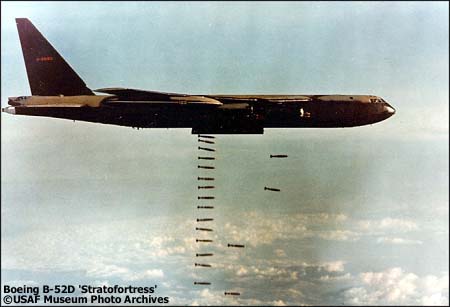
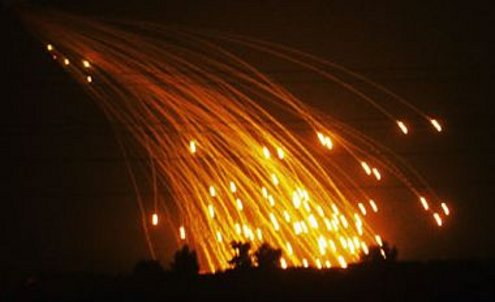
Many people around the world are disturbed by U.S. drone attacks in Afghanistan, Pakistan, Yemen, Somalia and elsewhere. The illusion that American drones can strike without warning anywhere in the world without placing Americans in harm’s way makes drones dangerously attractive to U.S. officials, even as they fuel the cycle of violence that the “war on terror” falsely promised to end but has instead escalated and sought to normalize. But drone strikes are only the tip of an iceberg, making up less than 10 percent of at least 20,130 air strikes the U.S. has conducted in other countries since President Obama’s inauguration in 2009.

The U.S. dropped  17,500 bombs during its invasion of Afghanistan in 2001. It conducted  29,200 air strikes during the invasion of Iraq in 2003. U.S. air forces conducted at least another  3,900 air strikes in Iraq over the next eight years, before the Iraqi government finally negotiated the withdrawal of U.S. occupation forces. But that pales next to at least 38,100 U.S. air strikes in Afghanistan since 2002, a country already occupied by U.S. and NATO forces, with a government pledged by its U.S. overlords to bring peace and justice to its people.
The Obama administration is responsible for  at least 18,274 air strikes in Afghanistan since 2009, including at least 1,160 by pilotless drones. The U.S. conducted at least 116 air strikes in Iraq in 2009 and about  1,460 of NATO’s 7,700 strikes in Libya in 2011. While the U.S. military does not publish figures on “secret” air and drone strikes in other countries, press reports detail a five-fold increase over Bush’s second term, with at least  303 strikes in Pakistan125 in Yemen and 16 in Somalia.
Aside from the initial bombing of Afghanistan in 2001 and the “shock and awe” bombing of Iraq in March and April 2003, the Obama administration has conducted more air strikes day-in day-out than the Bush administration. Bush’s roughly 24,000 air strikes in seven years from 2002 to 2008 amounted to an air strike about every 3 hours, while Obama’s 20,130 in four years add up to one every 1-3/4 hours.
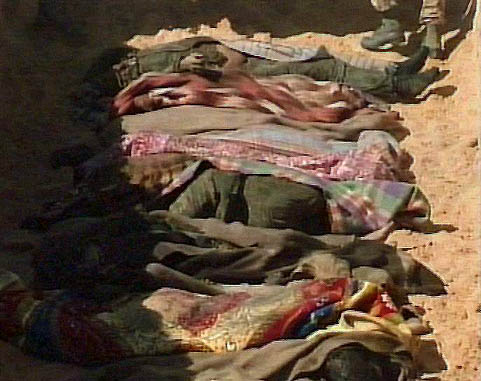
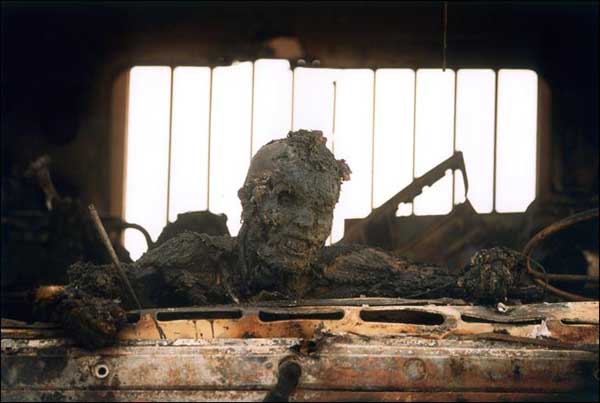
The U.S. government does not advertise these figures, and journalists have largely ignored them. But the bombs and missiles used in these air strikes are powerful weapons designed to inflict damage, death and injury over a wide radius, up to hundreds of feet from their points of impact. The effect of such bombs and shells on actual battlefields, where the victims are military personnel, has always been deadly and gruesome. Many soldiers who lived through shelling and bombing in the First and Second World Wars never recovered from “shell-shock” or what we now call PTSD.
The use of such weapons in America’s current wars, where “the battlefield” is often a euphemism for houses, villages or even urban areas densely populated by civilians, frequently violates otherwise binding rules of international humanitarian law. These include the  Fourth Geneva Convention, signed in 1949 to protect civilians from the worst effects of war and military occupation.
Beginning in 2005, the U.N. Assistance Mission for Iraq (UNAMI) issued quarterly reports on human rights in Iraq. They included details of U.S. air strikes that killed civilians, and UNAMI called on U.S. authorities to fully investigate these incidents.  A UNAMI human rights report published in October 2007 demanded, “that all credible allegations of unlawful killings by MNF (multi-national force) forces be thoroughly, promptly and impartially investigated, and appropriate action taken against military personnel found to have used excessive or indiscriminate force.”
The UN human rights report included a reminder to U.S. military commanders that, “Customary international humanitarian law demands that, as much as possible, military objectives must not be located within areas densely populated by civilians. The presence of individual combatants among a great number of civilians does not alter the civilian nature of an area.”
But no Americans have been held criminally accountable for civilian casualties in air strikes, either in Iraq or in the more widespread bombing of occupied Afghanistan. U.S. officials dispute findings of fact and law in investigations by the UN and the Afghan government, but they accept no independent mechanism for resolving these disputes, effectively shielding themselves from accountability.
Besides simply not being informed of the extent of the U.S. bombing campaigns in Iraq and Afghanistan, the U.S. public has been subject to military propaganda about the accuracy and effectiveness of “precision” weapons. When military forces detonate tens of thousands of powerful bombs and missiles in a country, even highly accurate weapons are bound to kill many innocent people. When we are talking about 33,000 bombs and missiles exploding in Iraq, 55,000 in Afghanistan and 7,700 in Libya, it is critical to understand just how accurate or inaccurate these weapons really are. If only 10 percent missed their targets, that would mean nearly 10,000 bombs and missiles blowing up something or somewhere else, killing and maiming thousands of unintended victims.
But even the latest generation of “precision” weapons is not 90 percent accurate. One of the world’s leading experts on this subject, Rob Hewson, the editor of the military journal Jane’s Air Launched Weapons, estimated that  20 to 25 percent of the 19,948 precision weapons used in the “shock and awe” attack on Iraq in 2003 completely missed their targets. The other 9,251 bombs and missiles were not classified as “precision” weapons in the first place, so that only about 56 percent of the total 29,199 “shock and awe” weapons actually performed with “precision” by the military’s own standards. And  those standards define precision for most of these weapons only as striking within a 29 foot radius of the target.
To an expert like Rob Hewson who understood the real-world effects of these weapons, “shock and awe” presented an ethical and legal problem to which American military spokespeople and journalists seemed oblivious. As he told the Associated Press, “In a war that’s being fought for the benefit of the Iraqi people, you can’t afford to kill any of them. But you can’t drop bombs and not kill people. There’s a real dichotomy in all of this.”The actual results of U.S. air strikes were better documented in Iraq than in Afghanistan. Epidemiological studies in Iraq bore out Hewson’s assessment, finding that tens of thousands, maybe hundreds of thousands, of Iraqi civilians were killed by U.S. air strikes.  The first major epidemiological study conducted in Iraq after 18 months of war and occupation concluded:

Violent deaths were widespread … and were mainly attributed to coalition forces. Most individuals reportedly killed by coalition forces were women and children … Violence accounted for most of the excess deaths and air strikes from coalition forces accounted for most violent deaths.

When the same team from Johns Hopkins and Baghdad’s Al Mustansariya University did  a more extensive study in Iraq in 2006 after three years of war and occupation, it found that, amidst the proliferation of all kinds of violence, U.S. air strikes by then accounted for a smaller share of total deaths, except in one crucial respect: they still accounted for half of all violent deaths of children in Iraq.
No such studies have been conducted in Afghanistan, but hundreds of thousands of Afghans now living in refugee camps tell of  homes and villages destroyed by U.S. air strikes and of family members killed in the bombing. There is no evidence that the pattern of bombing casualties in Afghanistan has been any kinder to children and other innocents than in Iraq. Impossibly low figures on civilian casualties published by the U.N. mission in Afghanistan are the result of small numbers of completed investigations, not comprehensive surveys. They therefore give a misleading impression, which is then amplified by wishful and uncritical Western news reports.
When the UN identified only 80 civilians killed in U.S. Special Forces night raids in 2010, Nader Nadery of the Afghanistan Independent Human Rights Commission, who worked on the UN report, explained that  this was based on completed investigations of only 13 of the 73 incidents reported to the UN for the year. He estimated the number of civilians killed in all 73 incidents at 420. But most U.S. air strikes and special forces raids occur in resistance-held areas where people have no contact with the UN or the Human Rights Commission. So even thorough and complete UN investigations in the areas it has access to would only document a fraction of total Afghan civilian casualties. Western journalists who report UN civilian casualty figures from Afghanistan as if they were estimates of total casualties unwittingly contribute to a propaganda narrative that dramatically understates the scale of violence raining down from the skies on the people of Afghanistan.
President Obama and the politicians and media who keep the scale, destructiveness and indiscriminate nature of U.S. air strikes shrouded in silence understand only too well that the American public has in no way approved this shameful and endless tsunami of violence against people in other countries. Day after day for 11 years, U.S. air strikes have conclusively answered the familiar question of 9/11: “Why do they hate us?” As Congressmember Barbara Lee warned in 2001, we have “become the evil we deplore.” It is time to change course. Ending the daily routine of deadly U.S. air strikes, including but by no means limited to drone strikes, should be President Obama’s most urgent national security priority as he begins his second term in office.

Nicolas J. S. Davies is author of Blood On Our Hands: The American Invasion and Destruction of Iraq. He wrote the chapter on “Obama At War” for the just released book, Grading the 44th President: A Report Card on Barack Obama’s First Term as a Progressive Leader.

Shedding crocodile tears while collaborating with US-led sanctions

Standard
 As with Iran, the sanctions regime against the Syrian people is beginning to show its genocidal character.
Franklin Lamb
Are the Arab League and Organization of Islamic Cooperation targeting Syria’s civilian population?Damascus– One powerful image from Damascus that has become seared into this observers mind these days is when I walk by a Western Union office. Most of them remain open despite the brutal US-led sanctions which in their pervasive effects target almost entirely the civilian population.
Obama mulling Syria

But all Western Union offices were closed last Thursday and Friday due to heavy snowfall, some say the deepest here for more than a quarter century. Still, some Syrians braved the extreme cold and could be seen huddled outside some branches, evidently in vain hope that they might open and their families might eat.

One of the few economic lifelines not yet cut by the ever strangling, profoundly immoral and illegal US-led sanctions with their throat-hold tightening around the civilian population in Syria in order to achieve regime change, “WU” as it’s known, has become, for some, literally a lifesaver. This is because its money transfer service is still allowing family and friends from abroad to send in assistance to Syria for their desperate families caught up in this regional contest between Resistance and a return to Western hegemony.

Peering in the window or stepping inside a Western Union outlet in Damascus, reminds this observer of scenes from Western Unionthe floor of the New York Stock Exchange or a European bourse wherein traders wave pieces of paper or other objects trying to get the attention of someone. But in Syria those trying to submit their ten digit Money Control Transfer Number (MTCN) numbers and ID’s in order to collect cash, are not wearing clothes from the fashion houses. Rather, given the frigid temperatures and lack of mazot(heating oil that 90% of the population here relies on for heat) they are tightly bundled. Women and kids generally wrapped tight in thick head scarves.

Last week this observer went into the Western Union office in central Damascus to collect some cash sent from Canada for a family that had managed to escape from Aleppo. The place was packed but orderly. I smiled to myself as I thought about my own country when sometimes during a Black Friday type sale, the scene of waiting in queue collapses into yelling, insults, fights, throwing objects, threats, all to save a few dollars or get one’s hands on the, soon to be trashed, “must have” sale item.

The stressed but committed staff behind the WU counter could not give assurance how long I would have to wait but graciously did agree to take my passport and I could return later. On arriving after about three hours, my MCTN # had just been processed and I was in and out fast. I can’t imagine that I will see a yellow and black Western Union sign ever again without thinking about US sanctions targeting the Syrian civilian population.Hiram Sibley

An historical irony is that it was a Syrian gentlemen, Mr. Hiram Sibley, one of the thousands of Syrians who emigrated to the United States in the mid-19th Century (the first and largest Arab migration then and since came from Syria) who in 1851 established the New York and Mississippi Valley Printing Telegraph Company with the goal of creating one great telegraph system with unified and efficient operations. Four years later Western Union was born and became an American icon and thirty three years on it had become one of the top ten companies listed on the New York Stock Exchange the day it opened in 1888.

The reason Western Union is able to avoid the US-led sanctions that include medicines and food (White House claims to the contrary notwithstanding), is quite simply that the US Treasury Department cannot easily face the domestic American political fallout from curtailing Western Union anywhere.

According to a July 2012 US Senate Banking Committee memo, were Treasury to be seen as tampering with Western Union’s $7 billion annual revenues, there would be a significant problem. Already there are growing complaints from US businesses flooding the White House & Congress claiming that sanctions imposed on Syria are costing American businesses hundreds of millions of dollars in lost profits — even more regarding US sanctions on Iran. So to date the Office of Financial Assets Control (OFAC) at Treasury has kept its hands off Western Union and this is good for Syrian civilians.

For these reasons a thin lifeline — a reed really — exists for many in Syria with families and friends abroad able to use WU’s “Money in Minutes” to help them. It’s a relatively small factor in the larger Syrian crisis but it does help many.

Much more significant than Western Union remaining open, and the subject of much current criticism here, is the lack of assistance to Syria’s severely sanctioned civilian population from the Arab League and the Organization of Islamic Cooperation, neither of which lack officials who are wringing their hands in public these days, in mock anguish it is claimed, over their brothers and co-religionists “victimization.”

Claiming solidarity with the Syrian people, on 11/12/2011 the Arab League suspended the membership of Syria (Lebanon and Yemen voted no and Iraq abstained) and cancelled its monitoring mission in Syria on 1/28/12. The Organization of Islamic Cooperation suspended Syria’s membership on 5/15/12 at a summit of Muslim leaders in Mecca. Saudi Arabia, the summit’s host, has led all Arab League and OIC calls for the Syrian rebel opposition
to be armed, which Foreign Minister Saud al-Fasial described in February and since as “an excellent idea.”

By their actions, the OIC and the Arab League are themselves sanctioning the Syrian people in brutal forms and doing nothing to object to the immoral and illegal aspects of the American sanctions. Both organizations stand accused of abandoning their charters in order to maintain profitable relations with NATO countries as they funnel large sums of money and weapons to various militias inside Syria. It is their “agents,” the jihadist groups, who have turned on the Syrian civilian population increasingly resorting to theft, kidnapping for ransom, rape, sale of children and killing hundreds according to UN agencies.

In one poignant interview near Omayyad Square the other day, a solemn, long bearded Sunni Sheik told this observer that the American sanctions are also directly targeting Islam because the sanctions constitute an attack on Islamic values. When pressed for specifics, he reluctantly replied, “Because your countries sanctions are impoverishing our people and forcing our Muslim women into prostitution. These sanctions are also flooding the streets with Muslim beggars, both adults and children. I am sure you have seen them, here in Damascus, across Syria and in bordering countries. But the claimed protectors of our holy sites are silent and shed only insincere tears in public. But if they resisted these sanctions they could defeat them. What is required in a 1970’s type Arab boycott of American and western companies until these anti-Muslim sanctions are lifted.”

The honorable gentleman has a point.

UNHCRThe Arab League’s recent ministerial-level meeting held in Cairo was called to focus on the Syrian refugees file. But the rather pathetic quick one day deliberations ignored the causes of the suffering of the civilian population as well as the fact that most of the 22 countries comprising the Arab League have been a main cause behind the displacement of the Syrian civilian population. Both the AL and the OIC stand accused here in Syria of participation in the sanctions which are decimating the Syrian people’s livelihood. Some AL and OIC officials are shedding crocodile tears about
the miserable living conditions of the Syrian refugees “in spite of spending millions on recruiting mercenaries and salifi-takfiries, training them and purchasing weapons for the terrorists,” the Sheik explained.

One frustrated American NGO director, affiliated loosely with the World Food Program, expressed her frustration: “If these organizations (AL and OIC) wanted to aid Syrian refugees they should stop supplying the gunmen with weapons and money and stop inciting sedition in Syria.”

The Arab League Secretary General, Nabil al-Arabi, still does not get it.

He used last week’s Arab League session to insist on foreign intervention and regime change, renewing the AL demand that the UN Security Council deploy international forces in Syria.

The Lebanese Foreign Minister, Adnan Mansour, offered his views of the Syrian refugee’s displacement. Notable causations, he claimed, are the flow of weapons and money into Syria, the entry of foreign gunmen and not joining a political dialogue. To his credit, Mansour called on the AL and OIC to “shoulder their responsibilities towards the refugees through ensuring their humanitarian, medical, livelihood, educational and services requirements in order to ease their daily suffering.”

As for the Kuwaiti Minister, he considered that the US-led sanctions were not a problem but rather that the suffering of the Syrian people was caused by the failure of the UN Security Council to meet the demands of the AL for immediate military intervention in Syria. He also insisted that Kuwait has mobilized all its resources to ensure that financial and relief resources alleviated the suffering of the Syrian refugees.

To date, the Syrian refugees, victims of US led and AL-OIC complicity, have not received any of the assistance Kuwait, the Arab League or the Organization of the Islamic Conference has promised. Rather, these organizations appear to be propping up the US-led sanctions.

Meanwhile, according to officials, Syria’s government has just authorized the UN World Food Program to extend its reach in the country where 2.5 million people are suffering from hunger. Ertharin Cousin, spokeswoman of the WFP, announced on Tuesday that Syria is allowing the organization to work with local aid groups to reach more of those in need. To boost the number of people receiving emergency assistance, the Syrian government last week drew up a list of 110 local NGOs authorized to participate in the aid effort.

WFP is working closely with the Syrian Arab Republic Red Crescent Society (SARCS) which, thanks to more than 9000 volunteers, are operating the following facilities to serve every Syrian and Palestinian without consideration of sect or political views: Damascus 15, Damascus countryside 68, Suwayda 2, Homs 71, Idelb 2, Aleppo 185, al-Raqqah 52, al-Hasakah 52, Dayr al-Zawr 4, and Quneitra 12.

Unlike the Arab League and the Organization of the Islamic Conference, SARCS, the World Food Program, and more than 40 other NGO’s can be observed any day of the week confronting and attempting to ameliorate the profoundly immoral and illegal US-led sanctions — manifold actions, not crocodile tears — in aid of the civilian population of Syria.

Franklin Lamb is doing research in Syria and can be reached c/o fplamb@gmail.com

Source: Al-Manar Website

19-01-2013 – 09:47 Last updated 19-01-2013 – 10:41 | 1525 View

moorbey's avatarDogma and Geopolitics

http://www.almanartv.com.lb/english/catpage.php?frid=41

Are the Arab League and Organization of Islamic Cooperation targeting Syria’s
civilian population?

Franklin Lamb

Damascus — One powerful image from Damascus that has become seared
into this observers mind these days is when I walk by a Western Union
office. Most of them remain open despite the brutal US-led sanctions which in
their pervasive effects target almost entirely the civilian population.
But all Western Union offices were closed last Thursday and Friday due to
heavy snowfall, some say the deepest here for more than a quarter century.
Still, some Syrians braved the extreme cold and could be seen huddled outside
some branches, evidently in vain hope that they might open and their
families might eat.

One of the few economic lifelines not yet cut by the ever strangling,
profoundly immoral and illegal US-led sanctions with their throat-hold
tightening around the civilian population in Syria in order…

View original post 1,658 more words

The Israel Lobby Thing – A New Improved Formula Commentary, Now with Hitler Jokes and 18% More Verbiage at No Extra Cost!

Standard

01israel_lobby_home_book[1][1]

For those of you who are unfamiliar with the issue, some people claim that the “Israel Lobby” shapes US foreign policy in the Middle East. I disagree, and the reasons why I disagree are explained in the following commentary. There are two accompanying written pieces which are cited. The first, here, is an orphan fragment from an abandoned draught dealing with attributes of US imperialism. Grafted on to the end is another orphan fragment about the qualities which made Iraq a natural target for US genocide in the imperial context. And here is a second piece which deals with US neocolonialism with the most relevant part (at the start) describing the reasons behind the US tendency to align with kleptocratic and violently authoritarian client regimes. A few other interesting links can be found in the transcript below.

The audio can be downloaded or streamed at A-Infos and comes in 32Kbps or 128Kbps.

UPDATE 20130116:

I have already received a comment that it seems as if I am accusing all users of terms like “Jewish Lobby” and “Jewish Money” of being hateful racists in this commentary. I don’t mean too, but I do stand by my use of the term “bigotry”. This form of usage (e.g. “Jewish Money”) marries a prejudicial negative connotation to a particular group of people – hence it is bigotry. But I don’t mean to suggest that everyone who employs such language is a bigot. They may quite innocently be partaking in a discourse of bigotry without actually thinking through the implications of what is being said or written. The hazard is in letting that sort of thing stand unchallenged, which is how deep-seated bigotry can often take root. 

What I wanted to suggest in my commentary is not that you have to hate Jews to believe the W&M thesis, but rather that people who do hate Jews find it really, really attractive. I was genuinely shaken by how quickly my online disputants back in 2006 turned to racism. I think that Israeli policy is creating a whole new generation of anti-Jewish racists in many countries around the world, and I think that in the US the Walt and Mearsheimer thesis gives them a very sharp and dangerous focus in providing a discourse of treason against the United States. Zunes is absolutely correct to point out the parallels between this and that scapegoating of Jews that has occurred historically.

Zunes articles on the Israel lobby issue can be found here and here and here.

I know that this is going to confuse people, but here is where I stand: I support a one state-solution in Palestine; I support the BDS movement; I believe that the Israel lobby has a ridiculously disproportionate influence over US domestic politics at the congressional level and, more importantly, at the street level, but I firmly believe that the idea that the Israel lobby determines in any manner or degree US foreign policy is utterly stupid. I admire Jeff Blankfort and Noam Chomsky; Stephen Zunes and Stephen Gowans, but see ways in which every single one of them is guilty of inadvertantly (though sometimes rather wilfully) becoming apologists for and ideological supporters of US imperialism. On the other hand I see nothing admirable, nor even excusable in Stephen Walt and John Mearsheimer who are not only more fatuous than the aforementioned, but also, given their Professorial positions as political scientists and so-called “neo-Realists”, do not have any excuse for being such idiots.

So, how did I get to be this “neither fish nor fowl” creature? And how can I persuade you to join me in this annoying world where weighty matters are not reducible to sound bites? Firstly I can point out that there is a simple way of looking at these things. The idea that a tiny state such as Israel, a virtual dependency of the US, dictates US foreign policy is silly. It is that simple. It is the very same far-fetched excuse as those who suggest that the US was drawn into the Korean War by the machinations of Syngman Rhee, and drawn into Indochina by systemic inertia. This is blatant apologism for repeated acts of genocide whose fundamental similarities alone are enough to indicate intentionality. But I am aware they my simply stating this stuff leaves much to be desired and much to be answered, particularly “what are the drivers of US foreign policy?”, and why do I so confidently discount the role of the Israel lobby in this when it is demonstrably powerful in US politics?

05045-0419064645-AIPAC_Lobby

Before I start however, I want to have a bit of a self-pitying whinge. I’m aware that I’m probably making no friends by taking a stance which contradicts everyone else’s stance. But instead of getting angry at me for taking much the same line as Zunes and Chomsky, remember that I am also alienating those people who agree with Chomsky on the subject of Palestine (a dying breed, admittedly). Before you write to gainsay my claims I would ask that the following matters be of consideration: One, that you ask yourself, can your stance be reconciled with the pattern of historical events (including analogous situations) such that you are not claiming some peculiar exceptionalism for US society that you would find unreasonable in other societies? Two, is there a theoretical consistency to what you are claiming, or does the attempt to translate into theoretical terms expose contradictions which once again are suggestive of an insupportable claim of exceptionalism. You might ask yourself, “what theory? What is this guy on about?” The fact is, however, that each time you link a cause with an effect, you are doing so in theoretical terms. What I am concerned about is those who have a world view wherein theories contradict themselves.

On last thing remains with regard to the fact that I chose to comment on matters where I disagree with everyone. I could do otherwise, I could choose a more agreeable path of greater agreement, but the result might be a little bit like – “so I hear that the Earth actually circles the Sun, I reckon that’s probably true, so that’s maybe something we can agree on. They tell me that the majority of dogs have four legs and, well its only anecdotal, I know, but almost every single dog I’ve seen has four legs, and I’ve seen quite a few dogs. They also say that Hitler wasn’t a very nice person. I’d more or less agree with that proposition. They didn’t give him a Nobel Peace prize, which is probably a good thing I think we can agree. I mean, they must have been tempted, if they’re like they are now. You know, that whole non-aggression pact with the Soviet Union, I reckon that nowadays that’d probably have netted Hitler and Stalin a peace prize each. Hitler, instead of killing himself, could have simply pointed out that he was sincere, that he sincerely believed that Jews were a form of demographic Weapon of Mass Destruction and that Poland was in possession of millions of Weapons of Mass Destruction with the potential to reach as far as New York city, if they weren’t denied entry. He could have become a peace envoy just like Tony Blair, trying to find common ground in decolonising struggles such as in Indonesia or Indochina. Ahh, if only they were as civilised then as we are now….” Sorry, got a bit off-track there, but hopefully you get my point, which is that if I talked about what I agreed with, it would be boring and pointless and then I’d just start making stupid jokes just to relieve the tedium.

15qKu1rvr6cco1_500

At this point I was going to introduce matters with a brief summary of what I had written in another context about the US empire, but it is too complicated and it can’t be presented in theoretical terms because existing theory, as we shall see, is woefully inadequate. So I have created a pdf from the exerpt with a grafted on bit about why there was a strategic imperative for the US empire to commit genocide in Iraq. OK, it’s massive, but at least look through it and I will summarise the pertinent bits for you here and, hopefully, you can see that my reasoning is based on solid evidence.

The US empire is based on power structures which are now often referred to, not unreasonably, as corporatist. Corporatism is as good a word as any, but it should not be linked explicitly with Fascism per se. Structurally it is akin to feudalism in that it accords so-called “regnal rights” to entities which are not theoretically sovereign. Indeed US “corporatism” is the continuity of that form of regime which has persisted through transitions from feudal, to early modern mercantilist, to liberal. In the year 1900 its highest expression was in the liberal British Empire. There was no “revolving door” at this time, government and private interests only separated when circumstances dictated that they must. The supposedly sovereign governmental structure constituted far, far less than half of the state power wielded in the imperial polity. In 1902 John Hobson noted that the British Empire was a drain on the wealth of the majority of the people of Britain and the majority of the capitalist enterprises of Britain. He wrote: “Seeing that the Imperialism of the last three decades is clearly condemned as a business policy, in that at enormous expense it has procured a small, bad, unsafe increase of markets, and has jeopardised the entire wealth of the nation in rousing the strong resentment of other nations, we may ask, “How is the British nation induced to embark upon such unsound business”; The only possible answer is that the business interests of the nation as a whole are subordinated to those of certain sectional interests that usurp control of the national resources and use them for their private gain.”

16Britishempire

But the nature of these “certain sectional interests” was far from random: shipping, coal, arms, finance, and military contracting. These were the beneficiaries of empire, but they were also the tools. These are strategic industries. They were the British military-industrial complex – the empire complex if you will. None of these interests were separable from the Crown, nor, more to the point, was the reverse the case. The English had transitioned from feudalism by transforming it into mercantile terms (awarding charters and patents and so-forth) and into liberal Locke-ian terms by allowing enclosure and outright ownership to effectively deepen privilege, rather than challenge it. It is true that they instituted direct rule in India and ended private imperialism through the East India company, but this was occuring at a time of the expansion of scope, depth and complexity of state power and much of it was in non-governmental hands (The Bank of England serves as a good example here). After this British corporate rule was part of the “informal” empire which included more-or-less the entirety of South America, and semi-formal possessions like Egypt. These places were run by private British finance interests, interpenetrated with other empire complex interests which were of course interpenetrated with Her Majesty’s Government and could rely on military incursions and other interstate actions when required.

If there were strategic sectional interests making up the empire complex, there were also strategic resources. Mainly this meant coaling stations at this level, and the British were able to use their naval supremacy to ensure their naval supremacy. Gold, however, was also a form of strategic resource, and it is important to note that the British view of gold was that strategic denial was a good as possession. If they couldn’t have it then they would make sure no one else would get it, thus bolstering the value of their own reserves. Then the British discovered the potential of oil, a strategic resource like no other. While the French were bled white on the Western Front the British used the cover of the Great War to grab oil. By 1920 they had virtually cornered the entire world supply outside of the United States, but they had ceded financial hegemony to New York and Washington thanks to war costs.

An Anglo-US petroleum condominium later formed and became the basis of a shared empire complex in which the UK is the junior partner. Domination of oil meant the ability to deny all hard power (economic or military) to those reliant on those petrochemical resources. For complicated reasons (which you can read about if you want) the US also chose to tie its financial hegemony directly to its ability to militarily dominate oil resources. Nowadays the empire complex is far more expanded than that of the British empire. It includes a large array of “sectional interests” which are all of direct strategic relevance. Many are directly related to matters of life-and-death – arms and military; water; energy; pharmaceuticals and food – others are similarly fundamental to societal funtioning such as finance and media. It is not just about an “iron triangle” these are interlocking iron triangles and profit is both central and incidental at the same time. That is how it works. The “sectional interests” are the imperial state, but they cannot dominate the imperial state for some hypothetical private ends that are separate from imperial ends.

11petrodollar-system-101

The other thing to note is that imperial elites are not tied to the interests of the mother state, nor the people thereof, nor the people of subjugated regions. They are almost entirely independent of the welfare of nations and their peoples and almost entirely dependent on the massive unrelenting centripetal coercive power which holds empires together. That is why they kill so many people and ravage whole societies and economies. That is, in very simple terms, why empires are as inherently genocidal as settler-colonial enterprises. This is also why many empires all but destroy their home economies. The Romans did, the Spanish did, the British did and now the US does with deindustrialisation, outsourcing and so forth. (There is also the need to maintain stratification domestically, which you may also read about at some length if you wish).

In theory terms what I am proposing here is a form of Realism, in that it doesn’t have anything to do with national character or ethics or specific ideologies and so forth. The power relations determine the behaviours. Traditionally Realism is often distrusted as being inherently amoral and for being a kind of apologism because it implies that horrendous behaviour is the result of inevitable laws. There is a logical fallacy in this, however, in that Realists might recognise potential ways of diminishing the capacity to inflict mass violence and the possible advantages to be gained through mass violence. What they tend to emphasise, however, is the continuity of strategic interests that are not altered by idealism or ideology; the personality of rulers or the theology of governments. Realism is about power relations.

One result of this is that it may have a “normative” aspect, which is the term used by academics to describe their own prescriptiveness. Thus a Realist might proclaim that it was a horrible mistake by France to alienate and attack the newly formed Soviet Union when they had inevitable shared interests. It is quite a strong Realist current that includes progenitors such as Hobbes and Machiavelli, but in modern self-professed “Realists” it does tend to beg the question of why (if reality is failing to live up to allegedly “Realist” norms) the term Realism is applied to what, in the final analysis, is the promotion of an ideal of amoral power relations. The fact is that if you are going to call yourself a “Realist” then more than a tiny bit of normative content indicates a broken model. Realism, by its very nature, should be able to accommodate actuality within its analytical framework and, to be quite honest, it could only be academics that might seriously take real political actors to task for not acting “real” enough.

So proper Realism requires a model which reflects actuality. Realism evolved in a fairly empirical manner, as a counter to mythologised anthropomorphism and idealism. It was clear that changes in regime and ruler did not prevent repeated patterns of behaviour. I planned to say more on this, but I’m going to have to cut it short. Suffice it to say that Realism evolved from being centred on the nation-state to neo-realism (or structural realism) which posits constraints on nation-state behaviour through international structure, which has been built upon and challenged in various ways.

Standing apart from this are a bunch of lowercase realists – people who are basically realistic, but not aligned to a given dogma. The most obvious one of these in Noam Chomsky, who takes a clearly realist stance, but one that emphasises elite interests and elite power over the nation-state and its security. Others are similarly realistic in outlook, but unattached to a school of thought – they are agnostic realists and tend to look for confluences of imperatives and powers rather than impose a prior framework.

So here is where my stance fits in with all of that. And I apologise for any jargon and over-simplification, but this is all taking too long to explain as it is. 1) Nation-states belong in the classical Realist model to a large extent. 2) Empires do not. 3) The world and its people do not function under a paradigm of relative gains (except in some immediate circumstances), but imperial power does. 4) Nation-state elites are tied to the welfare of the nation-state and its people; imperial elites are less so, or not so, or even benefit in relative gains terms from immiseration. I’m using “nation-state” here to stand for any unitary polity which, in some degree, might even include some historical empires, but if you squint your eyes, you’ll see what I’m getting at.

You can see a good example of this in Mike Davis’s Late Victorian Holocausts wherein the British Empire destroyed communal economic resources and famine protections causing many millions to die, when neighbouring princely states, though much weaker and poorer, saw no famine despite a devastating drought.

So, I am saying in realist terms that empires are run by imperialists who cannot but serve the imperial interest, such as it is. The US empire has committed genocides in Korea, Indochina and Iraq and each time Pollyanna’ish opponents have squealed that such things are not in the “national interest”. Well, maybe not, but as the US continues its rollout of new regimes in the Middle East and bullies most of the states of the world most of the time into doing its bidding, it is very difficult to see how so much power was accrued through so many “mistakes”.

Security” is often fetish for political analysts, and not just Realists, which I believe has more to do with a desire for vicarious drama and a sense of self-importance than with actual issues of security. There is a whole bunch of academics who I tend to think of as the “security geeks”. They style themselves as latterday players of the “Great Game” on the “Grand Chessboard”, living out peurile fantasies of power and relevance. Most of them are uppercase Realists, and they tend to be in think tanks or University departments with “Strategic” in the title. These people believe that US, UK and NATO actions are undertaken for genuine security reasons. If not security reasons they are inclined to accept humanitarian intervention or reject it, but they don’t question its sincerity. In other words, these people are hopelessly naïve and easy prey for ruthless political and military leaders. What makes them more to be loathed than pitied is their unbelievable arrogance. Iraq is the perfect example – a security threat that even these idiots couldn’t believe in. When faced with the plain and very clear fact that political leaders were lying about a security threat…. No, let me be very specific – when faced with the fact that political leaders were engaged in a very complex systematic attempt to deceive not only through lying but through misrepresentation, dissimulation, and the manufacture of fraudulent evidence – when faced with that, did they say “Oh my goodness! These people are lying to us. They are making huge efforts to try and deceive us. They must be covering something up”? No. Not a chance. They smugly pronounced that they were not deceived, unlike the political leaders who were so incredibly less intelligent than clever people like them that they believed their own lies.

Well done guys. You spotted that Iraq wasn’t really a security threat (even if some of you were a bit slow on it). That’s right, not a big security threat to the United States like all of those other really threatening poor countries such as Laos, Haiti, and Panama. Let’s not forget that tropical menace to world peace known as Grenada. What about Nicaragua and Reagan’s assertion that if the Sandinistas weren’t defeated there would be Soviet tanks rolling across the Rio Grande? Do you remember Jack Nicholson in that movie saying “You can’t handle the truth!”? The “truth” referred to, and embraced by the movie, was that only savage men like Nicholson could “provide freedom”. How? By occupying Guantánamo, that well known bastion of freedom. According to the movie, lives are saved by vicious thuggish frontiersmen who have to face down the iron disciplined and robotically fanatical Cubans – yes the Cubans, all of that rum and jazz and partying is just a front – in an eyeball to eyeball macho contest. But if Cuba is such a threat, why exactly do they continue to allow the US to occupy part of their country? Surely, if they were really all that, they could chuck Jack Nicholson and any number of wannabe Davy Crocketts out.

102150898483_aae3daec96

So, these Realists and assorted security geeks (all of whom probably love that movie and think that it raises substantive issues) get all tetchy at people like George W. Bush, because he’s so frustratingly stupid. Not smart like them. Imagine a weedy self-important accountant sneering at Tony Soprano because he had failed to claim on the hardhats in his construction business and thus had paid several hundred dollars more tax than required. The US has used international mass violence so many times since World War II that it really is impossible to quantify. It would be fairly impossible to point to any one of these and say with any sort of assurance that they made the US more secure, yet there are many instances when a fairly robust argument could be made that they made the US less secure. Hmmmm…, nearly 70 years of frequent interventions that don’t make the US more secure? Maybe, I know this is a bit of a weird thing to say, but maybe US security is not the goal. Let us not forget also, that despite 50 years of very clever people pointing out that the US empire is destroying itself with its hubris and over-reach, it is now quantifiably more strategically predominant and far more comfortable about acting outside of international law, defying the bulk of other nations, and enforcing its will on the majority, if not the entirety of the planet. Personally, I do believe that this is the high tide mark, and the beginning of the end, but I also know that others in the past have misinterpreted the active consolidation of imperial power as weakness, failure and loss, because of the naïve beliefs I have already mentioned.

There is another matter, in that, in the US it seems that some of those who would oppose imperial aggression feel that they must point out its wrongheaded counterproductive stupidity. Again, their ability to believe themselves so much more intellectually able to determine policy than those who actually do so is quite something to behold, but I feel too that there is an element of fear that accompanies this arrogance. The fear seems to be that any suggestion that there might be an ounce of rationality and purpose in US aggression would be to concede far too much in the battle for the hearts and minds of “Middle America”. It is always funny that the bourgeois fear the fascist instincts of the working class (who don’t tend to have any) while ignoring the growing tendency of their own kind to be goosestepping around the place.

This, to me, is where Walt and Mearsheimer come in. The first aspect of their appeal to anti-imperialists is that they tick this box, the box that says that the Iraq invasion was a horrible mistake from the perspective of maintaining US power in the international arena. But that is far from the end of it. There is an unreasonable and quite irrational tendency to give these guys far more credit than they deserve and the causes are actually quite broad.

Firstly there is their academic standing. On this, I would have to say that they are actually letting themselves down as much as anyone else. It is not their theoretical content that is at fault (though clearly insufficient) it is this silly, naïve understanding of US interventions, the basis of which is both the academic arrogance I have already discussed, and a chauvinist and ultimately exceptionalist reading of US interventions.

07jewish_lobby

The next reason for cleaving to Walt and Mearsheimer is the nature of their most strident critics. Who doesn’t want to believe these guys when their critics include Dershowitz, Kissinger and Albright? That is only scratching the surface of repugnant people who criticise them and the nature of these criticisms tends to be exactly the same sort of specious bullying that is systematically used to silence real criticism of Israel and Zionism.

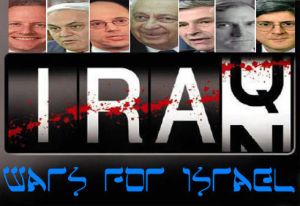
Then there is anti-Jewish bigotry. In 2006 I debated the Walt/Mearsheimer thesis on comment sections online, and it didn’t take very long before those I was debating tended to forget that they were supposed to be referencing Israeli policy and Zionism and started referencing “The Jews”, sometimes with supplementary epithets. I was shocked. These young educated people obviously hated “The Jews” and weren’t that reticent to show it. Two things were obvious from this: one was that Israeli policy was fueling hatred of Jews (this was obvious from the context of what was written); and also that the Walt and Mearsheimer thesis is immensely appealing to people who hate Jews. But there is another aspect of anti-Jewish bigotry which is more subtle and widespread. Perhaps it is ironic in a world where one may be accused of being a Nazi just for supporting Palestinian human rights, but a sort of anti-Jewish bigotry is widely accepted. One, it seems, can talk about individual or collective US Jews with the inextricable inference that they are supporters of Zionism and Israeli aggression and oppression. The discourse of the “Israel Lobby” over and over again references “Jewish backers”; “Jewish money” and “Jewish voters”. This is a form of prejudice generally known as bigotry. The weird thing is that US Jews are increasingly cool towards Israel, while Zionists (including non-Jewish Zionists) are very keen on suggesting that to be Jewish is to support Israel and to oppose Israel is to hate Jews.
08iraq_iran_odometer2

The last thing that causes people to love Walt and Mearsheimer so much is the thing that disturbs me the most. What seems to be a desire to avoid facing up to the reality of US genocides, a need to cling on to the myths of childhood. I’m not just talking here about a need to see the US as the Good Guys, I’m talking more than that about the need to see the cartoon villain behind genocide. Genocide needs to be committed by sadistic brutal twisted Nazis; fanatically inhuman communist Asians; or brutal bestial savage Africans. I honestly think that this need to find some sort of exogenous force to explain US brutality makes people very irrational.

Let us be very clear: the Walt and Mearsheimer thesis is that the US national interest was harmed by the 2003 invasion of Iraq and that it happened because of the pernicious and powerful Israel lobby. Listen to these excerpts from the 2006 Working Paper:

Most recently, the Bush Administration’s attempt to transform the region into a community of democracies has helped produce a resilient insurgency in Iraq, a sharp rise in world oil prices, and terrorist bombings in Madrid, London, and Amman. With so much at stake for so many, all countries need to understand the forces that drive U.S. Middle East policy.

The U.S. national interest should be the primary object of American foreign policy. For the past several decades, however, and especially since the Six Day War in 1967, the centerpiece of U.S. Middle East policy has been its relationship with Israel. The combination of unwavering U.S. support for Israel and the related effort to spread democracy throughout the region has inflamed Arab and Islamic opinion and jeopardized U.S. security.

.

…[T]the overall thrust of U.S. policy in the region is due almost entirely to U.S. domestic politics, and especially to the activities of the “Israel Lobby.” Other special interest groups have managed to skew U.S. foreign policy in directions they favored, but no lobby has managed to divert U.S. foreign policy as far from what the American national interest would otherwise suggest, while simultaneously convincing Americans that U.S. and Israeli interests are essentially identical.

So the US was trying to turn the Middle East into a “community of democracies” was it? Does that sound sensible to you guys? I don’t know whether I need to refute Walt and Mearsheimer or whether, in the cold light of day it is obvious to anyone listening or reading that they are talking utter crap. I also love the way they slipped in a racist swipe at the democracy hating Arabs and Muslims.

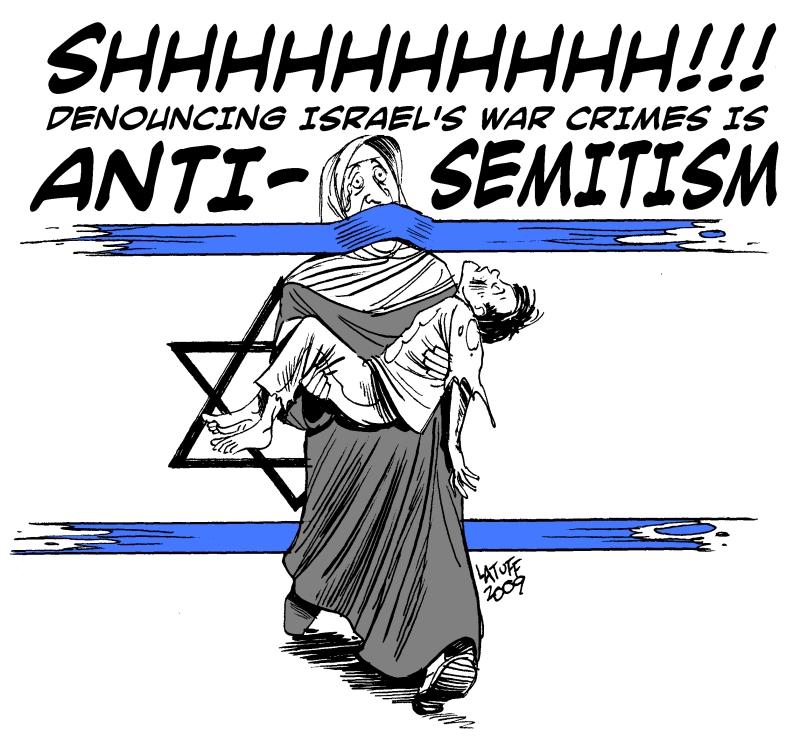
06anti_semitism_by_latuff2

The problem with the Walt/Mearsheimer paper is its depiction of the United States. Israel is described in realistic and accurately cynical terms, its myths debunked fearlessly, but the US is in no way analysed in such terms. The vision is instead of a Disney version of the US, benevolent not because it tries to be, but because it is inherently so. Doing bad things is abberrant, not natural to the US. Israeli apartheid is against US “core values” and so forth.

W&M actually use the term “tail wagging the dog” to explain US Middle East policy, but what do they think real US national interest is? In some matters, there’s room for debate that their simple-minded approach just does not acknowledge. So, for example, they decry the antagonism generated amongst the Arab populace when, in fact, an inimical “Arab street” is probably of more use to US empire than a friendly one. In other matters they just simply have it back-to-front. For example, they condemn US policies which drive up oil prices, but not only have these high oil prices brought about an extraordinary run of record profits for giant oil companies (in which Bush administration members had very strong interests) but the high prices and continued control of oil resources (including options for strategic denial) has maintained US dollar hegemony and ensured the continued interdependence of China with the US.

13petrodollar75

So let me once more emphasise that “The Israel Lobby and US Foreign Policy” is not serious analysis. Call it silly, call it fatuous, call it fantasy – it is junk, just like junk science or junk economics. O.K. these guys probably weren’t paid to come up with this, but junk humanities like this are often paid for at the bookstand. This stuff belongs alongside Huntington’s Clash of Civilisations; or The Tragedy of the Commons; or Niall Fergusson; or Max Boot; or Thomas Friedman.

Obviously I have a problem with the fact that W&M do not distinguish between national interest and imperial interest – which has been THE driving force in US foreign policy even before it was formalised when NSC-68 was adopted in 1950. More than that however, the problem is that they portray the Iraq invasion of 2003 as some sort of outgrowth of an aberrant Middle East policy – the result of the tail wagging the dog. But how abberant is it? Iraq is the third genocide committed by the US since World War II in which they have systematically killed civilians in the millions. Much of the death comes about through repeated systematic bevaviours extended over periods of years such that the orthodox denials of intentionality are simply ludicrous. In Korea, in Indochina and in Iraq the systematic mass murder of civilians has been a central policy of the US, and this is beyond dispute. (Iraq is problematic in that there was no self-evident systematic intense aerial bombardment specifically aimed at civilians, but along with the established fact of systematic killing though sanctions, mortality data from the occupation period indicate systematic, if atomised, killing by occupation forces induced to commit acts of murder by deliberately created situational, procedural, and psychological conditions). These are just the three most obvious and most deadly genocides by an imperial polity that is genocidal by inclination and whose interventions are usually somewhere along a genocidal spectrum even if the term “genocide” itself is reserved only for certain cases. Of its own accord, or through proxies, the US has an many occasions encompassed the deaths of thousands, tens of thousands or sometime hundreds of thousands of civilians. It is also a central actor in a global system of structural violence which has taken tens of millions of lives and which Nafeez Mossadeq Ahmed argues is a system of “structural genocide”.

So here is my synthetic bit. I propose that the dog wags the tail. Israel is a strategic asset to US empire and that is why the “Israel lobby” is allowed so much influence domestically. More than that, the “Israel lobby” is a strategic asset to the empire complex within the US itself, as a means of disciplining legislators and countering democratic forces. Suitably, since democratic forces are so seldom a major driver of legislators’ actions, there is a far more important accompanying movement to silence dissent at the community level, in the media, within universities, and so forth.

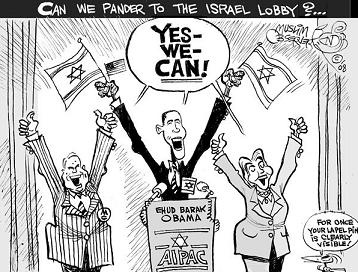
04obama-aipac

How then is Israel a strategic asset? There is more to this than just the MENA region, but that is as good a place to start as any. When the British first decided to give support to Zionism in Palestine, there was dissent and differences of opinion, but one of the most important strains – really a deciding one even as far back as 1916 – was the belief that a Jewish state surrounded by Arabs would be an inevitable dependency and a strategic asset against those Arabs. Remember that this came when the British had decided that they wanted to control all of the world’s oil. According to W&M Israel was of limited strategic utility during the Cold War, but now only fuels Middle East instability and Islamic extremism. But the US empire relies on Middle East instability and, for similar reasons, has quite a love affair with Islamic extremism. After all, it is getting a little difficult to sustain this line of Al Qaeda as the quintessential existential enemy when the US is so often aligned with or even providing material support for them and affiliate groups. They’ve inherited this love of fundamantalist Islam from the Brits, who used it to head off secular modernism and Islamic modernism in Egypt, first in the late nineteenth century, then in the twenties and thirties where their support was crucial in the formation of the Muslim Brotherhood. It is the same as Israel’s role in the formation of Hamas. Sure, these Islamists don’t make great clients, but they make much better enemies than secular nationalists and socialists. The US even helped steer the Iranian revolution into the hands of the theocrats, creating a fantastic enemy and one that totally hated the Soviet Union to boot. Quite a strategic coup really, and the US still reaps the benefits today.

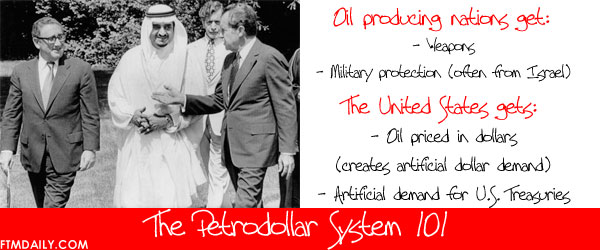
Once again let me say that the US needs instability. It can’t intervene without instability and it can’t threaten to intervene. The US doesn’t spend loads of money “projecting power” into the region with air, naval and ground troop presences to prevent the Red Army from taking over, it does it to make sure that oil profits are spent on US military hardware or used to buy US treasury bonds or kept in Western financial institutions as US dollar reserves. Iraq, for example, is aiming to have 110 billion in US dollar reserves in 2013. Imagine that, a country torn by strife, riven by poverty and unemployment and they just put all of that money into the US treasury. Wow! I guess they learnt a lesson somewhere along the line.

US military presence is also to ensure that oil is only sold for US dollars so that an other surplus producers also maintain dollar reserves. Having Israel there, a very well-armed military dependency constantly claiming to be existentially threatened by its neighbours, is a massive strategic boon to the US. It is a classic divide-and-rule strategy in a form not dissimilar to the manner in which the US chose Christian minorities as clients in Korea and Indochina and privileged landowners as clients in Latin America. Choosing a privileged minority to form a “comprador” class is a very old imperial tactic dating back at least as far as the Han and Roman empires. I’d be very surprised not to find evidence going as far back as the Assyrians who had the first empire as we would understand it. The British practised it as a matter of course, and while their alignment with the Sunni Arab world is an exception which I am not informed enough to explain, it is both noteworthy and fateful firstly that this choice would later allow the imposition of Sunni client monarchies in areas where Shi’i happened to inhabit the oilfields; and secondly that long before any thought of Zionism in Palestine the British acted to separate Jewish populations from the other peoples of the Middle East, notably in Baghdad.

This isn’t a secret either – this is enunciated doctrine. The Nixon Doctrine, which was a doctrine of informal imperialism, was translated by Melvin Laird in its applicability to the Middle East as support for “cops on the beat” explicitly there to discipline Arab populations. But Israel’s utility is also outside of the region. Israel is the tool which the US uses for dirty tricks in many parts of the world, parts in which Israel has no discernible interest at all. These include a history of providing support for apartheid South Africa and arms and support to authoritarian Latin American regimes when the US (and other Western nations) could not allow itself to provide direct support.

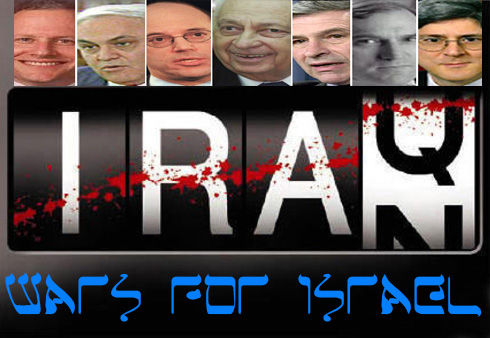
Now, I would like to remind people here that what I am discussing is the Israel Lobby’s influence on US foreign policy. The influence of bullying Zionists on the political discourse within the US is not something I would seek to deny or minimise. But let me now put the decision to invade Iraq into context. Let’s start with neoconservatives. Yes, neoconservatives are vehement supporters of Israel. Yes, disproportionate numbers are Jewish. But if you actually look at the history of the neoconservative movement, it is not just about Leo Strauss and Irving Kristol. The whole public intellectual side of neoconservatism has always been married to an institutional side, which predates it, dedicated to extending US influence into global domination. Most prominently it uses organisations like the Committee for the Present Danger or the Project for a New American Century to create the illusion of threats or idealistic goals as a means of justifying brutal imperialism. Using false pretexts, such as the defence of Israel, is bread and butter for these people. Now let us look at Richard Perle. This is a guy who is a born-and-bred Usaian, who has dedicated his political career to spreading US global dominance. So what is more striking – that whilst serving in the Bush administration he is actually formally giving policy advice to Israel or that he has dual citizenship and therefore might possibly be of dubious loyalty.

0369268

But the neocons and the Israel lobby were not alone in supporting the invasion of Iraq. In fact, despite the ostentatious enthusiasm of the neocons, it is worth considering the other interests that stood to gain from the Iraq invasion and had obvious influence. Take the oil industry. The Bush administration was so tied to the oil industry it isn’t funny. In 2005 Exxon Mobil became the largest corporation by revenues on the planet and posted world record breaking annual profits 5 times. Then there is the military-industrial complex. The arms industry not only has capacious lobbying power, it has penetrated every single congressional district as an employer. It is not hard to see what effect that has on congressional voting behaviours. But that isn’t all, because really there is an empire complex bigger than the direct military-industrial aspect. During the war in Indochina, the US government inducted certain non-armaments industries into a war economy based not on the exploitation of conquest, but solely on funneling taxpayer monies to these corporations under the guise of prosecuting war. Prominent among these were Halliburton (which owned Brown and Root); Dow chemical; Monsanto; and Bechtel. Need I belabour the interconnection here with the US government in general, or the Bush administration in particular?

And then, there is the government itself. In the lovely little fantasy land that W&M infest, the US national interest is best guarded by robust, but fundamentally honourable means. Off course, sometimes you’ve got to break eggs to make an omelet, but on the whole, despite their hard-nosed pretensions, W&M are suckers for the US pretence of fundamental righteousness. Many within the bureaucratic state apparatus share that belief, but the actual tenor of US strategic behaviour is different, and it is not hard to perceive that difference. US imperial policy has quite aptly been compared to pre-WWII Japanese imperial policy. There is a putatively defensive purpose, but translated into unlimited aggression by a belief that only unchalleged dominance provides security. Global “Full Spectrum Dominance” is an official policy aim. Obama’s rhetorical shift towards multilateralism does nothing to change that underlying fact. Believing that the US can attempt to achieve “Full Spectrum Dominance” without committing genocidal mass murder is like believing that the Third Reich could achieve its desired Lebensraum without genocidal mass murder. So it is the people who are willing to take the steps which the vast majority would reject as morally unacceptable who dictate policy despite the qualms of their colleagues, and they do so by dissimulation (as with the neocon pretence of a fanatical desire to spread democracy).

So how does the Israel lobby stack up against these forces? It doesn’t. It is puny in comparison. What makes the W&M hypothesis even sillier is that they themselves claim that Israel doesn’t benefit from the the policies dictated by the Israel lobby. I’m not kidding. For Jeff Blankfort (and I should say here that despite disagreeing vehemently on this issue, I have as much respect for Blankfort as I have disdain for Walt and Mearsheimer), for Blankfort the fact that Israel does not benefit from US foreign policy supposedly dictated by the Israel Lobby justifies the label “the Jewish Lobby”. Why is that acceptable? Because the backers and lobbyists are Jewish, so forget Jewish people because only the rich scumbags actually count? If that’s the “Jewish Lobby” imagine what the “Caucasian Lobby” must be like!

So here is my synthetic contribution: the Israel Lobby is as powerful as it is because it is a dependant subsidiary of the Empire Lobby, which is the enforcement arm of the Empire Complex, the part used to ensure that any vestigial remnants of democratic governance are fully suppressed. It is not entirely an original idea. Norman Finkelstein incidentally but unavoidably showed the historical evolution of the Israel Lobby as subservient to US imperialism. He documents this in his book The Holocaust Industry which can be downloaded for free, so I suggest actually reading it rather than dismissing Finkelstein because of his wrongheadedness over the BDS movement and the idea of a one-state solution in Palestine.

This brings me to my final point, more an addendum than a conclusion. I am taking a stance which puts me in some unfortunate company. It is not that I have anything against Norman Finkelstein as a whole, he has done some fantastic work. But his BDS stance is silly. Likewise Chomsky, who is still astute on most issues at 84, sounds like he is completely senile and out of touch every time I have heard him discuss Palestine in the last few years (not least because he devotes more attention to what activists should be doing than what Israel and the US should be doing). I think that maybe they fear that a bottom-up movement will cause a sudden collapse of the Zionist apartheid state which will cause chaos and suffering. I too fear that that might be the case, but I know that the continued push for a so-called “two-state solution” through the “peace process” is nothing but camouflage for slow cruel genocide. It is a risk, but we must bet that the better aspects of human nature will win through if we empower the people, because the institutions that are currently empowered are inhuman by nature.

Then there is my closest ally on the subject of the Israel Lobby, Stephen Zunes. OK, so I’ll begin with what I think is wrong with Zunes. I’m not sure when I read his book Tinderbox but, naturally, I didn’t have a problem with him pointing to Zionism as the driving force behind US policy in the ME as being a red herring. But he had his own red herrings. He kept on about how much of a policy mistake it was to alienate the Arab Street and how they inadvertantly or through short-sighted amoral expedience keep accidently promoting Islamist terrorists. OK, I have already mentioned this stuff, but let me be quite clear – from what I think is a more rigorous theoretical position the US empire benefits from a hostile Arab mass (preferably alienated from an elite who are dependent on US support to maintain their dominance – another common imperial practice perfected by the US which you can read about at the blog if you so desire) and the US empire gains a great deal from the existence of credible Islamist terrorist organisations whose efficacy is greatly exaggerated to justify attacks on peoples in Muslim dominated countries. You can argue that my theory reads too much into US intentions and that (and this is often reported by insiders) things are much less co-ordinated and much more myopic in the actual halls of power. I would counter this by saying that my theory actually coincides with real observed events – you cannot explain decades upon decades of consistent systematic repetition as being a series of errors.

(A quick aside here to say that theoretical approaches positing some systemic cause for a systematic but unintentional and counterproductive sequence of actions and policies are completely untenable. Without directed and knowledgeable human intent, such systems would be destroyed or derailed very quickly by changing circumstances. In my honours thesis, which you can read at the On Genocide blog, I demonstrate this with regard to such theories when applied to the US genocides in Indochina. Like a Law of Large Numbers, you can be certain that within any large polity with complex power structures, someone with influence intends that an action taken have the foreseeable outcome which follows. Thus, systemic theories should explain how structures reliably empower certain agents over others, not seek to say that structures themselves cause events. That sounds obvious when I say it, but believe me it is a point that escapes political scientists regularly, and I think that this is driven by the psychological imperative to avoid at all costs the realisation that our own peers commit the inexcusable acts that we like to ascribe only to those whom we dehumanise and demonise).

So that was my problem with Zunes’s Tinderbox. It had the same sort of built in apologism as Walt and Mearsheimer (albeit to a lesser extent) because instead of acknowledging full US culpability for its most heinous and bloody acts it is constantly portraying them as errors. This isn’t a minor point, either. The idea of blundering (whether the motive is idealism, venality, or amoral realism) is THE central prop of US public diplomacy. Look at any insider exposé that criticises US policy but which does not result in the author being hounded, prosecuted, persecuted, exiled and/or bumped off. You will not find a single one of these that does not frame everything as a series of mistakes, and in most cases (to ensure the point is taken) these books are even given titles that tells the reader that without even having to open the book.

Stephen Gowans has also levelled criticisms at Zunes with which I concur. Zunes promotes US imperial interests by critiqueing Third World enemies of Western Imperialism and supporting so-called “democracy-promotion” efforts which are aimed at destabilisation and regime change. Previously, when discussing Amensty International, I dealt with the tendency of some supposed critics of US foreign policy who so bend over backwards to demonstrate an even-handed ability to critique enemies of the US that they actually become vicious interventionists promoting war crimes. The regimes targetted are not necessarily the most pleasant, but in 1939 Poland had an oppressive authoritarian government and supporting German effort to destabilise it would not have been morally justifiable. No Third World regime is so bad that the Balkanised, destabilised, neoliberal, neocolonial fake democracy that the West seeks to impose would not be far, far worse. Look at Iraq. Saddam Hussein was one of the most horrible murderous dictators of the era, yet his crimes against Iraqis pale in comparison to those committed by the US and UK. This applies to Syria and Libya, where Western inflicted suffering has only just begun. This applies to Sudan, now split into two countries with two sets of civil wars. As Gowans points out, Zunes is involved in organisations which are controlled and funded by proven scumbag imperialists.

Where Gowans goes wrong is in overegging the case. In a 2008 article he made wildly exaggerated claims which portrayed Zunes as being “tightly connected to Western governments and ruling class activist foundations” and as a systematic promoter of Western imperialism. I would invite listeners and readers to check out Zunes’s work and see whether they think that this is feasible. Listen to the recent interview on KPFA’s Flashpoints and ask yourself – is this really an imperialist?

No. Sorry. The idea is stupid. And because of the wrongheadedness of Gowans’s over-reach, Zunes wrote a very robust rebuttal of Gowans’s 2008 article, and didn’t even have to deal with the crux issue of aiding US imperialism by supporting the destabilisation of US enemies. Now Gowans, and others of a similar inclination are convinced that Zunes is “the enemy” though his stupidity or worse, and that they can respond to his contentions with ad hominem dismissals. That’s just crap. Get a grip people, and a sense of perspective. Zunes is clearly a cogent and effective critic of US imperialism, whatever mistakes he might make. Likewise, anyone who has a profile dominated by persuasive anti-imperial influence cannot be treated as being a crypto-imperialist. We all make mistakes, and most people are actually at least a little compromised by institutional affiliation, but Gowans’s attitude towards Zunes is a bit like those who claim that Noam Chomsky is actually in the pay of the Pentagon (a rumour Chomsky inadvertantly started many years ago by highlighting the irony that he worked from a building built and furnished with Defense Department money).

So that is why I don’t accept ad hominem attacks on Zunes (because they mischaracterise him) but I should remind you that ad hominem arguments are widely considered invalid in any respect. If someone is right, they are right. Stephen Zunes writings on the Israel lobby are analytically sound and have an empirical backing (in that he actually tests W&M’s contentions by looking at campaign contributions, congressional voting records, and electoral circumstances). If anyone knows of any actual contending analysis – not gainsaying Zunes on ad hominem or baseless theoretical grounds – let me know and I will read it.

There I will have to leave it.

The Deep Wound of Wounded Knee » Counterpunch: Tells the Facts, Names the Names

Standard

The Deep Wound of Wounded Knee » Counterpunch: Tells the Facts, Names the Names.

From the Lakota to Gaza

The Deep Wound of Wounded Knee

by JOHNNY BARBER

December 29th marks the 122nd anniversary of the Massacre at Wounded Knee. It is a story that remains fresh in the lives of many indigenous peoples across America. Each generation is taught to never forget.

In 1891, reviewing the history leading up to the massacre, Commissioner of Indian Affairs Thomas Morgan said,

“It is hard to overestimate the magnitude of the calamity which happened to the Sioux people by the sudden disappearance of the buffalo. The boundless range was to be abandoned for the circumscribed reservation, and abundance of plenty to be supplanted by limited and decreasing government subsistence and supplies. Under these circumstances it is not in human nature not to be discontented and restless, even turbulent and violent.”

Commissioner Morgan was not empathetic about the plight of the indigenous people. He was just stating facts. One year prior to the massacre, in Oct 1889, he issued a policy paper stating his convictions regarding the native population.

“The Indians must conform to “the white man’s ways,” peaceably if they will, forcibly if they must. They must adjust themselves to their environment, and conform their mode of living substantially to our civilization. This civilization may not be the best possible, but it is the best the Indians can get. They cannot escape it, and must either conform to it or be crushed by it. The tribal relations should be broken up, socialism destroyed, and the family and the autonomy of the individual substituted.”

The Wounded Knee Massacre is still commonly depicted as a “battle” that no one can be blamed for, but if blame is assigned it is always made clear that a Lakota fired the first shot. This is the justification for all that followed. A century after the murders, Congress issued an apology, expressing “deep regret” for the events on that day in 1890 when upwards of 370 men, women, and children were gunned down as they fled for their lives. But the Wounded Knee Massacre was not an anomaly, nor was it an accident. Wounded Knee is the entire history of indigenous peoples relationship with Imperialism made manifest in a single event.

“I did not know then how much was ended. When I look back now from this high hill of my old age, I can still see the butchered women and children lying heaped and scattered all along the crooked gulch as plain as when I saw them with eyes still young. And I can see that something else died there in the bloody mud, and was buried in the blizzard. A people’s dream died there. It was a beautiful dream.” Black Elk.

The ancestors of the victims commemorate the massacre in order to honor those who have fallen and to foster healing of their still devastated communities. The ancestors of the perpetrators ignore inflicting the wound and the wound festers.

From Wounded Knee, where just days after the massacre a young newspaper editor named Frank Baum (later to become famous for the children’s story “The Wizard of Oz”) opined, “The Pioneer has before declared that our only safety depends upon the total extermination of the Indians. Having wronged them for centuries, we had better, in order to protect our civilization, follow it up by one more wrong and wipe these untamed and untamable creatures from the face of the earth.“

To Vietnam, where Lyndon Johnson’s call to win hearts and minds of the civilian population was corrupted by GI’s to, “When you have them by the balls their hearts and minds will follow.”

To Iraq, where Madeline Albright was asked if the deaths of ½ million children during sanctions was worth it, she replied “I think this is a very hard choice, but the price — we think the price is worth it.”

To Gaza, where Dov Weisglass said, “The idea is to put the Palestinians on a diet, but not to make them die of hunger.”

To Iran where a new sanctions regime is in place and the state department claims, “The sanctions are beginning to bite,” and dozens of places in between, the wound festers.

In each case, the power with the superior military claims that the occupied and oppressed are dangerous and threaten the very existence of the state, even as the state starves the population, restricts their every move and denies them the most basic rights under the guise of “security”.  All attempts by the “enemy” to seek peace are ignored or derided as “lies” while the theft of land and/or resources continue unabated. Each time the oppressed demand their rights or dare to strike back against their oppressors, the oppressor claims that the people are motivated by hate and seek the annihilation of the state. Negotiations are viewed as a sign of weakness and are rarely pursued unless they can be used as a tool to further oppression. The oppressors continually talk about “pursuing peace” as they systematically destroy any and all opposition.

We kill by starvation, we kill by denying medicine, and we kill by isolation. When that doesn’t silence dissent of the “malcontents” we do not hesitate to kill with bullets and bombs. Remember Commissioner Morgan’s words, “This civilization may not be the best possible, but it is the best they can get. They cannot escape it, and must either conform to it or be crushed by it.”

One day we too will be crushed by this flawed concept of civilization.

The Dahiya doctrine is a military strategy in which the Israeli army deliberately targets civilian infrastructure as a means of inducing suffering on the civilian population, making it so difficult to survive that fighting back or resisting occupation are no longer practical, thereby establishing deterrence. The doctrine is named after a southern suburb in Beirut with large apartment blocks. Israeli bombs flattened the entire neighborhood during the 2006 Lebanon War. But this doctrine is not a modern strategy for controlling populations. Nor is putting the people of Gaza on a “diet” new- subjugating an entire population through a combination of poverty, malnutrition, a struggle over limited resources, and violence is the American way, adopted by our closest allies, (and “the only democracy in the Middle East,” with the “most moral army in the world,”) the Israelis.

Dec 27th marks the 4th anniversary of the beginning of Operation Cast Lead, (the name derives from a popular Hannukah children’s song about a dreidel made from cast lead.) During this attack on Gaza, 1,417 people were killed (330 children), 4336 were wounded. 6,400 homes were destroyed. Hospitals, mosques, the power plant, and the sewage system were deliberately targeted.

Israel accuses Hamas of war crimes for shooting rockets without guidance systems indiscriminately into Israel. Israeli officials claim that “Hamas hides behind civilians” as a justification to bomb civilian population centers and infrastructure. Killing civilians in Gaza using precision munitions, is a war crime, no matter who is hiding behind them.

After the recent killing of 20 children in a Newtown, Connecticut grade school, President Obama, wiping tears from his eyes said,

“This is our first task — caring for our children.  It’s our first job.  If we don’t get that right, we don’t get anything right.  That’s how, as a society, we will be judged. And by that measure, can we truly say, as a nation, that we are meeting our obligations?“

The just completed eight-day Israeli operation against Gaza called the Pillar of Cloud (The name is derived from a Biblical passage) saw three generations of the al-Dalu family wiped out in a single bombing, including 4 children between the ages of 1 and 7 years old. The surviving son does not speak of surrender, relinquishing the families land, or disappearing. He demands justice. His tears are mixed with fury. Can he be blamed?

As the ceasefire went in to effect there was one consistent message from the people of Gaza. We are here. This is our home. We will never leave. They will have to kill every one of us.

Upon cessation of the bombing, our Congress immediately voted to replenish Israel’s bombs and munitions in order for Israel to “protect itself”. The wound festers.

In his speech the President went on to say,

“If there is even one step we can take to save another child, or another parent, or another town, from the grief that has visited Tucson, and Aurora, and Oak Creek, and Newtown, and communities from Columbine to Blacksburg before that — then surely we have an obligation to try.”

Wounded Knee has not disappeared. The Lakota people remain. Gaza has not disappeared. The Palestinian people remain. In Afghanistan, Iraq, Pakistan, Yemen, Libya, and Somalia people grieve for the loss of their children. The violence wrought upon them in our name continues.  If we can take one step to save another child, we have an obligation to try.

Johnny Barber recently returned to the US from Gaza. He can be reached at: dodger8mo@hotmail.com

Amnesty International and Liberal Imperialism – Video, Audio, Illustrated Transcript.

Standard

The following is a commentary, meaning that it is me editorialising a lot. Some listeners or readers may find some of what is said to be opaque. I am particularly aware that my use of the term “liberal” may be unfamiliar and problematic. I won’t go into what it is exactly that I mean by “liberal”, but it is broadly consonant with the usages in political science when describing regimes, policies or ideological formations. It is a definition of liberal that doesn’t fall apart when one tries to put it in a broader context.

In contrast, Chris Hedges has recently written of The Death of the Liberal Class. Everything Hedges writes makes perfect sense and everyone knows what he means when he uses the term ‘liberal’. What Hedges would be hard-pressed to do is to reconcile this usage of the term liberal with other unavoidable usages such as as a way of describing the inescapably (if not virulently) liberal policies of “conservatives” and “neo-conservatives”. I’m sure that Hedges is aware of this. What he is doing is referring to self-identified “liberals” which roughly corresponds to what US political scientists refer to as “welfare liberals”.

I don’t believe that there is any such thing as a “welfare liberal”. It is very well understood in political science that most in the US who identify as “conservative” are actually liberals, and I would argue that anti-socialist sentiment has driven many to misidentify themselves as liberals. Most “welfare liberals” are very much at one with their fellow liberals in the “conservative” camp. The putative divide between them is much as the divide between Republican and Democrat – not really a divide at all.

If, at times, it seems that I am overstating matters out of some callow need to dramatise and you feel that my credibility is tarnished, I would urge consideration of the following. 1) It is not possible in this medium to demonstrate the evidence and reasoning behind every position I take; 2) conservatism is not neutral – it is a positive affirmation of an orthodox position; 3) in many cases the orthodox position is not even a reasoned position, but rather simply unexamined “commonsense” received ideology, in other cases it is specious; 4) thus by the avoidance of statements which cannot be demonstrated I would, of necessity, be promulgating fallacies; 5) if there really are things that you simply cannot allow to pass unremarked, please feel free to contact me with and questions and I will happily explain the basis of any such assertions on my part.

I hope that makes this talk a little clearer.

Here is a video version.

Or download audio from here:

Intro

Hello and welcome to this On Genocide audioblog commentary. Today I tackle the vexed question of whether Amnesty International are still the profoundly compassionate force for good which inspired millions like me in past times or have become a pack of mass-murdering sociopaths or are merely the pandering toadies of a pack of mass murdering sociopaths? I can reveal in advance that the answer is yes.

Part 1: The KONYism of Amnesty International

I received a phone call the other day from a telemarketer working for Amnesty International. He informed me that he was calling to raise awareness about events in Syria. He cited an urgent need for international action under the United Nations Security Council. Part of my response was to ask why Amnesty International felt a need to “raise awareness” over Syria, which is hardly absent from mainstream news reporting, while not having done so with their own reports of atrocities and ethnic cleansing in post-Gadaffi Libya.

Image

In a formal sense, Amnesty International remains politically neutral, however, Amnesty has an extremely problematic record. In October 1990 Amnesty gave crucial support to the fraudulent, and now infamous claim that Iraqi personnel had murdered premature babies by removing them from incubators. Image

They would later retract that support, but less than three weeks after the incubator lies Amnesty released a report on atrocities carried out by Iraqis in Kuwait. The report contained unconfirmed as well as independently verified reports of atrocities. Atrocities were definitely taking place, but why dramatise the report with unconfirmed allegations? Amnesty’s answer: to “raise awareness”? But, the entire world was already watching. Saddam Hussein was the most vilified person on the planet (except among some Arabs). George Bush had labelled him as worse than Hitler.

Image

And it was not as there were no atrocities taking place elsewhere such as Myanmar and Honduras, nor even that they were not occurring in military occupations such as those of Western Sahara, East Timor, Palestine and West Papua.

Amnesty produced this report as the US was trying to gain support for unleashing the greatest mass violence on the world since the invasion of Afghanistan by Soviet forces. Amnesty must have known that this was going to involve massive suffering. To be absolutely clear, bombs dropped by US warplanes (even smart bombs) do not build schools, they do not organise elections, and they do not emancipate women (except in giving the equality of the grave).

Image

I mention this because most news and entertainment media treatment of the subject would have you believe that they do these things. What bombs actually do is kill, maim and destroy bringing the suffering of physical pain, fear, grief and material loss.

Amnesty International played a crucial role in in unleashing Desert Storm and the repercussions dwarf by far any good that Amnesty has done in this world since its inception.

Part 2: What did Amnesty enable in Mesopotamia?

It is worth understanding just how much the scale of suffering brought about with Amnesty’s crucial support outweighs the suffering they prevent in their fights against political imprisonment, torture, and capital punishment. The numbers are simply beyond a level that Amnesty could realistically dream of helping. But these victims suffered too, and their suffering is equally tragic, equally unjustified and equally obsene.

Operations Desert Shield, Desert Storm and Desert Sabre can now be seen as the inauguration of a two decades long genocide which took hundreds of thousands of Iraqi lives – probably in excess of 2 million.(1)

Image

The US was never interested in any human rights as their betrayal of anti-Baathist rebels revealed. Famously, General Norman Schwartzkopf gratuitously allowed the rather surprised Iraqi military to use helicopter gunships against the uprisings that President Bush had personally and explicitly encouraged to take up arms against the Iraqi regime. Also, while US forces had allowed Iraq’s Republican Guard to withdraw intact from Kuwait, on the so called “highway of death”, they massacred hapless conscripts who, by some accounts, were mutineers.

Image

In these accounts by exiles (who had fled Iraq after the Basra uprising was brutally crushed) those killed on Highway 80’s Mutla Ridge were conscripts headed to join the anti-Saddam uprising which had grown out of the antiwar movement in and around Basra.

There is some controversy over the numbers killed by US warplanes on the Mutla ridge. Initial military eyewitnesses and journalists such as Peter Turnley described and documented a large scale of mortality (perhaps thousands).

Image

Later arriving journalists, most notably Michael Kelly, saw less evidence of mortality but given the undenied disposal of bodies by US personnel this is hardly surprising.(2) The explanation given later was that vehicles were abandoned before being attacked. Photographs of the vehicles are widely available, although they are often from long after the event. It is clear that they were almost all attacked, whether it is conceivable that most were abandoned at this point, or indeed whether it is conceivable that they were not abandoned at this point, I leave to the reader’s judgement.

Image

Regardless of what exact portion of vehicles were occupied when attacked hundreds or maybe thousands of human beings died. Violent death is always obscene, but the photographs and descriptions of the victims here seem sometimes beyond obscenity. Helpless, fleeing, posing no conceivable threat to Allied forces, many victims were burnt alive while trapped in their vehicles.

Image

Schwarzkopf said: “This was a bunch of rapists, murderers and thugs who had raped and pillaged downtown Kuwait City and now were trying to get out of the country before they were caught.” It is exactly this sort of application of mass condemnation (in this case, given substance and verisimilitude by Amnesty itself) that often underlies massacres and other atrocities, but along with reports of a column of mutineers, there are also reports of Palestinian refugees and even Kuwaiti hostages who were among those fleeing along Highway 80.

In Desert Storm, (the bombing campaign conducted under a specious air power doctrine which, like “Shock and Awe”, invented a military significance for civilian infrastructure(3)) the US had attacked all sorts of civilian targets including power generation and water treatment and so forth. It is a war crime to attack such targets, of course, and it is difficult to see how the US could even claim some military advantage. It made no difference to the military outcome what civilians were killed and what civilian infrastructure was destroyed. The military “contest” was so uneven, the opposing forces so disparate, that even the killing of Iraqi military personnel was gratuitous as well as grotesque.

What followed thereafter was the “sanctions regime”, a cruel slow form of genocide inflicting the greatest suffering of all on children. As water-borne disease and malnutrition condemned tens of thousands of under-5’s to avoidable deaths, ironically it was Iraq’s premature infants that were forced to share incubators and were dying for lack of simple bottled oxygen.

Image

(In another irony, Madeleine Albright, who felt that 500,000 dead infants was “worth it” as a price for Iraqi containment, would in 2012 be the keynote speaker at an Amnesty International event, but I’m getting ahead of myself.) Maybe in 1990 Amnesty was doing nothing more that to report Iraqi atrocities in that same way as any other, but the context of impending war was unmistakeable and they helped bring about one of the greatest mass atrocities of the post-WWII era.

Part 3: Unrepentant

Did Amnesty, seeing this horrifying mistake, take steps to ensure that in future it would not simply become a source of atrocity propaganda for Western warmongers? Clearly not. Instead its formal neutrality and its original central purpose are being corrupted by expedience and by the corrosive permeation of the Western discourse of humanitarian intervention.

The context is this: Since World War II the state that has committed the most war crimes is the United States; the state that has caused the most deaths of innocents (notwithstanding China’s Great Leap Forward) is likewise the US. One might use different modes and criteria of calculus, but any consistent and defensible reckoning will return the same answer. When it comes to the use of mass violence, when it comes to the use of deadly ordnance, none can even be considered in the same league as the US. Horrible atrocities such as the Soviet bombing of Herat, the Russian bombing of Grozny or the Syrian shelling of Hama are as buckets next to the swimming pools of blood from North Korea, South Korea, North Vietnam, South Vietnam, Laos, Cambodia, Afghanistan and Iraq.

Image

Further context: every large-scale mass atrocity and the majority of those on a smaller scale is preceded by atrocity propaganda wherein the future victim group is portrayed as perpetrators. Sometimes the atrocities are fictitious or massively exaggerated; sometimes one blames one’s own atrocities on an enemy; sometimes false-flag atrocities are actually staged; and sometimes the atrocities are real. The attribution and contextualisation, however, are fantastically important. The actual perpetrators (often impossible to distinguish in any event) become of no importance whatsoever, the perpetrators become defined instead by a group membership. They become, as Schwarzkopf put it “a bunch”.

ImageImageImage

But, instead of learning the lesson of 1990, instead of taking steps to avoid becoming a source of atrocity propaganda which facilitates massive suffering and death, Amnesty has more often acted to embrace the very same US imperialist causes which facilitate atrocities. But Amnesty and others, including some alternative news outlets, actively jump at any opportunity to join with the US State Dept. and White House in condemnation of human rights abuses. It is as if they wish to ensure that everyone knows that they aren’t really anti-American, or anti-government, they do have haircuts, they do have jobs. It is as if the tension of having to oppose authority is suddenly released and they can get on with their job of righteous opposition to wrongdoing without fear of being criticised, misapprehended, scorned or argued with. Like the dissidents who, after years of hopeless opposition to Bush Jr’s crimes of aggression, so passionately embraced the slogan “Out of Iraq, into Darfur”, they themselves embrace the advocacy and support of war crimes.

Image

By not rejecting outright the discourse of humanitarian intervention and of “R2P” Amnesty may become a party to war crimes while its history of refusing to determine the legality of military actions as a whole (for example, the Iraq Invasion or Operation Cast Lead) means that only selected suffering and death is worthy of protest. This is an extremely dangerous mixture. It means that as long as the conduct of the war is in accordance with International Humanitarian Law they are not going to comment on “lawful” killings, even in cases of aggression wherein these “lawful” killings are actually unlawful murders. They deal with “human rights” and apparently there is no right not to be maimed or painfully killed, or to have your family killed, or your children killed by a foreign military power.

Image

In addition, Amnesty International has of late, like so many others, been embracing what might be described as KONYism. By this term I mean the enthusiastic and rigid insistence on criminal proceedings be taken against official villains who are generally not powerful (often spent forces and no longer a threat); are generally non-Caucasian and certainly not Westerners; and, ipso facto, are from the poorer countries in the world.

Image

This functions to put a black face in people’s minds when thinking of atrocities, the face of savagery – a twisted uncivilised creature of personal violence and sadism. But the greatest culpable mass-murderers sit in offices, no matter what their skin colour, and usually don’t personally torture maim and kill. Amnesty has become a keen proponent of prosecutions in the International Criminal Tribunals for the former Yugoslavia and for Rwanda as well as the International Criminal Court.

Image

Both the ICTY and ICTR are seen by critics as overly politicised at the expense of justice. As ad hoctribunals they are unavoidably selective, while the ICC seems merely to be avoidably selective but selective nonetheless. Its indictments are, without exception, against the enemies and defiers of the US, a state which itself refuses to allow its own personnel to be subject to ICC prosecution. By analogy, it is as if the Mafia controlled a criminal court and used it against small-time rivals – sure those prosecuted may be guilty of heinous crimes, but there is still a massive injustice in that their very indictment advances the purposes of even greater criminals.

Image

Supporters of such courts claim that we cannot allow impunity. Indeed, there are many times when impunity is tantamount to incitement. Some claim that the culture of tit-for-tat atrocities in some civil conflicts stems in part from impunity. So Amnesty International, set up to oppose political imprisonment, is a big proponent of this system which arguably creates political prisoners and inarguably creates selective impunity along strict and consistent lines of privileging the most powerful state actors and their leaders, who, not coincidentally, are quantifiably the greatest abusers of human rights. But its actually even worse than that because the current ‘international justice’ regime has become a massive impediment to conflict resolution. Evincing at all times self-righteous condemnation for the irredeemable evil malefactors, it is made increasingly clear to the enemies of the West that they will not escape Western vengeance. What, for example, can Bashar al-Assad glean about Western intentions? Should he look to Saddam Hussein’s fate?

ImageImage

Or maybe Gaddaffi’s? In the latter instance the ICC was so prompt in announcing an intent to prosecute and issuing an arrest warrant that Gaddaffi knew from very very early in the piece that his fate, at best, would be to end his days in prison. Not a great incentive to find a peaceful solution. What about Charles Taylor? His immunity under peace accords which had ended conflict and killingwas immediately undermined by the US Congress inducement of $2 million for his capture. The precedents all send a very clear message. Or how about Sudan’s OmarHassan al-Bashir, a man who now knows that his safety and freedom requires that he cling to power no matter what the cost?

Amnesty would claim, no doubt, that its stance stems from principles – they don’t change whether the perpetrator state is China or the US, Iran or Israel, Syria or Turkey. Is this true? In reality they exclude from their remit the most serious crimes committed by the US. Moreover, they clearly have decided, in the cases of Syria or Joseph Kony for example, to emphasise those instances where they are in accord with Western governments. Without shame they refer to this as “awareness raising” when it is clear that these are the instances of very heightened public awareness in the West. In these instances groups like Amnesty International and Human Rights Watch are massive force multipliers in propaganda wars waged by Western institutions and leaders who might otherwise have fragile credibility on the subject of human rights and be vulnerable to countercharges.

If Amnesty wanted to base itself on principle, it would base itself around opposition to the suffering caused by state violence. In conflict it can’t simply choose only to oppose jus in bello infringements (those relating to the conduct of war) as if jus ad bellum matters (the legality of the war itself) were of no relevance. Firstly, one cannot simply treat something as presumed legal because one does not wish to determine its legality. Secondly, Amnesty can’t ethically justify ignoring suffering simply because it may be legal – much of their energies are spent opposing the use of the death penalty which in most relevant jurisdictions is completely legal.

Image

Consider the implications of Amnesty’s stance. Amnesty strongly condemned Israel’s use of white phosphorous in Gaza on the ground that it was indiscriminate, hence illegal. But that immediately means that Amnesty’s area of concern is not whether Israel inflicted horrible suffering and death, but whether this was lawful. Consider a child – it could be in Fallujah, it could be in Gaza, it could be in the next place – a victim of white phosphorous (WP). WP wounds and fatalities are particularly horrific in all instances. Fragments of WP can burn right through flesh and bone – they may continue burning until surgically removed. The remnants may still cause problems through toxicity and the very nature of the burns may cause crippling and agonising complications that last a lifetime. More horrifying than that, however, is that fine partially oxidised particles of WP can form a cloud where in both oxygen and moisture are depleted, a cloud that is forced downwards by airbursts as practiced in Fallujah and Gaza.Image

We know that in Fallujah this property must have been deliberately exploited because “shake ‘n bake” fire missions were described in a US military journal as being used against positions immune to high explosive artillery. Such a cloud might penetrate, for example, into the shelter of a family. Imagine this hypothetical child, cowering fearfully in a shelter, whose eyes start to burn as the phosphorous particles ignite on the eyeball itself. The child draws breath to scream and the child is as good as dead, because now the particles are in the lungs themselves. Many square meters of surface area are burning, a child is actually dying from being burnt from the inside out. This is not completely speculative. There are photographs from Fallujah of children who seem to have died in this manner.

Image

Amnesty’s stance is to oppose the illegal use of white phosphorous, but this death could have resulted from the legal use of WP (except of course that it is not legal if the war isn’t legal, but that’s no concern of Amnesty’s). So you can see why I believe that the only possible stance of principle is to oppose the suffering caused by state violence. How can anyone say that its sometimes OK to inflict agonising death on a child as long as it is “lawful”? Yes, I do inevitably mean that Amnesty must oppose all war casualties, but remember that under international law (including the UN Charter) war is actually illegal. All casualties of war are crimes, and rightly so since these are actual human beings and there is no morally justifiable reason for saying its OK to kill some of them. Even if they are military personnel they still feel pain and fear, their passing still leaves grief. If a party is forced to take life out of a need for national self-defence, then the aggressor, under a precedent established at Nuremburg, is culpable for that loss of life.

So what should Amnesty do? Well, the fact is that there are more limits on doing good than there are on doing harm. On Syria they need to revert to marshaling intelligence and moral force and eschew alignment with state actors and advocacy of any form of “international action” based on a UNSC resolution. In general, advocacy of an international governmental response should be confined to cases of international aggression, Amnesty should harness citizen activism, not lobby states or international bodies. The whole world should, in addition, move away from the self-righteous demonisation of the ICC and strengthen the International Court of Justice or other mechanisms for holding states (not individuals) accountable and for putting an end to ongoing crimes such as occupations, blockades or aggressive sanctions regimes which inflict mass suffering.

Part 4: Or are Amnesty Really Evil Lizards Psychopaths After All?

Image

The vast majority of people are in one of two camps – either Amnesty is a bunch of misguided bleeding heart lefties unintentionally helping the terrorists of this world, or they are unimpeachable fighters for justice, human rights and dignity. If one reads the Global Research website, however, it is replete with admirable writers and thinkers, such as Francis Boyle and Felicity Arbuthnot, for whom Amnesty is more of less The Enemy, whether they like it or not. Of course such critics understand that Amnesty members and activists try to live up to Amnesty’s founding principles, but in practical terms they have to deal with an organisation that is far more effective in promoting injustice, indignity and human suffering. It is probably worth contemplating this vast disparity between the commonplace perceptions of of Amnesty and those of what, in the final analysis, are a small subset of radical dissidents. Nevertheless it is these few dissidents who tend to have fact and logic on their side. In the final analysis Amnesty might as well be run by the evil alien lizards, and I think the explanation for this state of affairs lies in the nature of liberalism.

John Pilger recently described liberalism as the world’s most powerful and violent ‘ism’” in an article linking liberal ideology to imperial state policies. At a later date I will doubtless be detailing all of the evils which can be ascribed to liberalism (always a fun topic) but here I will confine myself to saying that any ideology which claims to have tenets which are “good” in moral terms and by extension whose adherents are “good” as adherents (and inescapably better morally than non-adherents) is prone to violent hypocrisy and cognitive dissonance. A liberal can enthusiastically endorse condemnations of liberal atrocities, because those atrocities aren’t really liberal because liberal means good. You could ascribe the same behaviour to a Communist, a Muslim, or a Christian. The more predominant and self-satisfied an ideology is, the more violent and schizophrenic it becomes. There are two differences between liberalism and and other such ideologies. The first is that liberalism has made a quantum leap in its ability to subsume and subvert its own critics and their condemnations. The second is that liberal schizophrenia is being deliberately harnessed by the most massive imperial military in human history.

Imagine liberal interventionismn as being a call to enforce liberal political and economic governance within which is a “bundle”. The liberal “bundle” includes humanitarian aspects, or at least it seems to. Take women’s rights, liberals believe that imposing liberal governance and norms improves women’s rights. If women actually suffer under the imposition of liberalism, then things aren’t liberal enough. Either that or the liberal will trot out racist or cryptoracist rationalisations which either blame the victim directly or blame their, often equally suffering, male compatriots. In the final analysis, the imposition of liberal governance has not been a great boon for women and girls in places such as Southeast Asia and Latin America. In fact, compared with advances for women’s rights under socialist regimes of various types, liberal feminism has been beyond pathetic. Even in the West the women’s rights for which liberals claim credit have mostly come through grassroots left-wing agitation, like many other progressive changes.

So the liberal “bundle” is really kind of agnostic when it comes to humanitarian matters. Their ideology says that they have the cure, but they don’t care if the cure actually works. Likewise the economic aspects of the bundle are supposed to do all sorts of wonderful things, but they don’t and when liberals bother to concern themselves with that inconvenient fact, they tend to say that more drastic liberalisation is the answer.

Image

Liberal interventionism is now often expressed as humanitarian interventionism. This is one of several Newspeak terms which attend the liberal interventionist discourse. “Intervention” being understood to be military in nature, it means that causing destruction and death is “humanitarian”. Here is where the creepy post-Orwellian brilliance of it comes, through: out of two sets of strident fanatics for explicitly liberal intervention in the US, one bunch deliberately positions itself as being right-wing and calls itself neoconservative and another lot characterises itself as being left-wing and calls itself liberal. They use exactly the same tropes, evince exactly the same motives and call for exactly the same interventions. There is only one significant difference, and I’ll get to that shortly. Perhaps the epitome of the latter variety, the liberals, is Samantha Power, the very image of a bleeding heart who wants to drop humanitarian bombs.

Image

Journalist David Reiff tells of her response to his suggestion that “her reasoning on foreign policy was similar to that of neoconservatives who supported the Iraq War. “She said, jokingly, ‘I am not Paul Wolfowitz,’ and I said, ‘Yeah, actually, I think you are,’”

Power, along with Clinton and Obama, thrives by taking the moral high ground and harnessing opposition to the liberal imperialism of neocons and others who identify themselves as more right-wing (and may or may not take more socially and culturally conservative positions). The take the very energy of outrage at US imperialism and channel into support for… US imperialism. Pretty nifty, huh?

There is another of that ilk named Susanne Nossel – a former State Department employee who “would have worked for and with Hillary Clinton, Madeleine Albright, Samantha Power and Susan Rice, and undoubtedly helped them successfully implement their “Right to Protect (R2P)” – otherwise known as “humanitarian intervention” – as well as the newly created “Atrocities Prevention Board.”

ImageShe credits herself with having come up with the term “Smart Power” which is so often now on Clinton’s lips.(4) I won’t go into the complicated process of paring away the meaningless rhetoric around the term “smart power”. What it means, put simply, is exactly the same liberal imperialism pursued by Bush and his neocon allies, dressed up a bit differently. One can already detect that a key differentiation is in the way these costumes are gendered – smart power is sly and feminine whereas Bush era cowboy style is masculine and muscular. Thus, one could summarise the Obama vs. Romney foreign policy debate in two short lines (saving us a great deal of time). Romney calls Obama a wimp. Obama calls Romney an idiot. Then we all go home.

It is all just making a virtue of necessity. Bush era unilateralism isn’t practicable, nor realistically desirable for current imperial geostrategic wants. If, for example, they wished to repeat their actions against Iraq on Iran they would be looking at a decade or so of genocidal sanctions that isolate the Iranian people and increase an inescapable dependency on their increasingly oppressive regime. Only then, when international public revulsion and regional disobedience among client states threaten to destroy the genocide regime – would it be desirable to unleash the gung ho bulldozer of a Bush/neocon style war machine.

So that’s what Nossel is about, and guess what her job is now? That’s right, she’s the CEO of Amnesty International USA. That’s why people are referring to Amnesty as a “shill” or the “propaganda arm” of NATO or as an “imperialist tool”. Consternation has particularly been fueled by Amnesty USA’s crucial support for NATO’s ongoing occupation of Afghanistan. In an excellent article Ann Wright and Colleen Rowley write of “announcements posted online as well as billboard advertisements on Chicago bus stops, telling ‘NATO: Keep the Progress Going!‘” these “beckoned us to find out more on Sunday, May 20, 2012, the day thousands of activists marched in Chicago in protest of NATO’s wars.” Image

Another article is worth quoting at length where it takes up the same story of what Amnesty was doing on the very day that people were mobilising to oppose war:

…Amnesty USA put on a “shadow summit” of its own during the NATO meeting, featuring Madeleine Albright, Bill Clinton’s notorious secretary of state, who will be forever remembered for her chilling response to a question on 60 Minutes about sanctions imposed on Iraq in the 1990s. Correspondent Lesley Stahl asked, “We have heard that a half million children have died. I mean that’s more children than died in Hiroshima. And, you know, is the price worth it?” Albright responded, “I think this is a very hard choice, but the price–we think the price is worth it.”

With a veritable war criminal as one of its star speakers, Amnesty USA’s shadow summit launched a campaign that, for all intents and purposes, called for the extension of NATO’s “good works” in Afghanistan. Its speakers and promotional materials recycled George Bush’s “feminist” justification of the invasion and occupation–that NATO would liberate women from Taliban rule.

Image

The article then examines the realities of womens lives in occupied Afghanistan, finding claims of progress “laughable” – “As Sonali Kolhatkar, founder of the Afghan Women’s Mission, and Mariam Rawi, of the Revolutionary Association of Women of Afghanistan, wrote:

Under the Taliban, women were confined to their homes. They were not allowed to work or attend school. They were poor and without rights. They had no access to clean water or medical care, and they were forced into marriages, often as children. Today, women in the vast majority of Afghanistan live in precisely the same conditions, with one notable difference: they are surrounded by war.”

Part 5: Conclusions

  1. Yes to mass-murdering sociopaths. People like Nossels are mass murderers. OK she may not be a sociopath, but then again she might be. We don’t know, and why would we care. Some mass murders believe deeply that they will make the world a better place; others are driven by hatred, fear or insanity; and others still are monstrously callous and simply don’t care for the suffering they cause. In this I agree with the biblical sentiments – know people from their actions, but leave the judging to some hypothesised supernatural omniscient being because we aren’t in a position to judge.
  2. Yes to toadies enabling mass-murder. Amnesty members want to do good, but self-satisfaction is unreflexive and causes complacency. Amnesty members need to discriminate more in terms of what they support and what they don’t. It might sound complicated, but it isn’t. When Amnesty is calling for petition writing and pressure to be put on a government which is commiting abuses it’s all good. When they are calling for petitions and pressure to be put on a government to “intervene” in another state, it is not good at all, it is the opposite of good, which some of us like to refer to as “bad”.
  3. Yes to compassionate voice for good. Of course most Amnesty members, volunteers and staff are fundamentally committed to alleviating human suffering. Perhaps it should be no surprise then, that there is a movement to reform Amnesty International from within. Staff and members have expressed disquiet and there is also a Code Pink petition campaign.

I would argue that reform of Amnesty is worth pursuing. It might be too much to expect deep principled reform, but even at worst a curtailing of pro-imperialist efforts in order to regain lost credibility and avoid critical scrutiny deprives the empire of a very significant tool, albeit temporarily. A more confrontational approach, aiming to publicise Amnesty’s “true nature” and reveal it for what it effectively is might seem attractive and understandable, but most people are never really going to understand the premise that this renowned humanitarian organisation is engaged in warmongering with postmodern jingoism. That makes Amnesty and suchlike a bit of a tarbaby, which is also quite handy for the US empire as a form of distraction. If you want to attack something just attack the policies and the false justifications behind them. People will work out for themselves that Amnesty is behaving inappropriately from that context.

I would like to thank you for listening to this commentary. A transcript, complete with photographs, hyperlinks and even a few good old fashioned endnote citations is available at the On Genocide blog, which is at ongenocide.wordpress.com. There is also a facebook page called – you guessed it – On Genocide. If you like the facebook page I promise to post no more than 3 or 4 items a day, including, of course, updates to the blog.

(1) Kieran Kelly, Context of the Iraq Genocide (https://ongenocide.com/wp-content/uploads/2012/02/context-of-iraq-genocide.pdf), pp 176-9.

(2) Michael Kelly, Martyr’s Day: Chronicle of a Small War, New York: Random House, 1993.

(3) Michael R. Gordon and Bernard E. Trainor, The Generals’ War, Boston: Little, Brown and Company, 1995, p 80.

(4) Wright and Rowley, op cit.

Other links:

Great article on Suzanne Nossel

RAWA – Revolutionary Association of Women of Afghanistan

Dead Enough: The Reality of the “Lesser Evil”

Standard

To all those now hailing the re-election of Barack Obama as a triumph of decent, humane, liberal values over the oozing-postule perfidy of the Republicans, a simple question:

Is this child dead enough for you?

This little boy was named Naeemullah. He was in his house — maybe playing, maybe sleeping, maybe having a meal — when an American drone missile was fired into the residential area where he lived and blew up the house next door.

Read futher at Chris Floyd’s Empire Burlesque: Dead Enough: The Reality of the “Lesser Evil”.

First Lecture

Standard

So anyway, some time ago I recorded a first bumper sized audioblog/podcast/lecture thingy. I used Audacity, a free open-source audio editor. This was the first time I’d used the software, my net previous experience being a little bit of mucking around with SoundForge about 15 years ago. I recorded the lecture. It took quite a while, but I only got it into a fairly raw form. I planned to do more, but I kept having technical difficulties. Nearly 90 minutes of multi-track high bit-rate audio turned out to be a bit much for my poor wee laptop to handle. A month later I was just about to trash the whole thing, and maybe start again another time. Then I thought, bugger it, I’ve done this much, I might as well put it out there so here it is.

Yes, it is imperfect. No, I am not a fluent or eloquent lecturer, but I hope to improve. Yes, it may be difficult to understand what I’m getting at, however I’m not sure that that is even a flaw. If it was simple to follow what I was saying it would indicate that my words are already familiar in some sense, and that I was conveying nothing truly unknown to the listener. This is a long lecture, full of all sorts of stuff that may be interesting or moving. My ultimate intent is to convey an analytical idiom which will render transparent the strategies behind the most fateful and monstrous acts of our time, but it is enough at this point to understand the context of suffering, of duplicity, of callousness, of humanity, and that thing which ironically we refer to as ‘inhumanity’.

BEFORE YOU START

As yet, I don’t have a projected structure for a lecture series, however I do want these ‘podcasts’, or whatever, to have a lecturish feel and to be a way of moving towards a structured series with a central thesis. To this end I have decided to have a ‘set text’ for each lecture. I am not, of course, suggesting that you should ‘read’ a text, canonical or otherwise, and then I will explain how you should interpret it. Rather, I think that having a text which is ‘read’ in advance of a lecture immediately activates the engagement of the listener. You can’t ‘read’ a text without some implicit analysis. One makes judgements on meaning and significance. If the text is relevant to the lecture, then you enter into a heightened level of engagement wherein the lecturer’s contentions are not merely passively accepted or rejected but become subjected to the faceted multivalent impressionistic judgements which our brains are so good at, and which partially compensate the limits of language.

The text, a moving speech by S. Brian Willson, is one I chose to set a tone. It is the first 15 minutes that concern this lecture most of all – an eyewitness account of the just how bad US actions in South Vietnam could be; the consequences and the callous cruelty that lay behind them. I feel I must emphasis that there is no violent obsenity that Westerners are somehow unable or even less likely to do than other peoples. Again and again I come across instances where those who witness Western brutality, even first-hand, still must construct in their minds some sense in which the brutality is essentially un-Western. Yes we are civilised, but civilised people are just as capable of dashing a baby’s brains out against a wall as barbarians are – you may not believe that at this point, but it is true. In Vietnam a veteran of the Korean War told Philip Caputo: ‘I saw men sight their rifles in by shooting at Korean farmers. Before you leave here, sir, you’re going to learn that one of the most brutal things in the world is your average nineteen-year-old American boy.’i It is impossible to proceed properly while clinging on to old delusions. Even our treasured ‘liberal values’, on proper examination, incorporate: advocacy of mass murder; authoritarianism [yes I do mean that there is a ‘liberal authoritarianism’]; racial and ethnic hatred; and rabid fanaticism.

THE SET TEXT:  Brian Willson’s speech

THE LECTURE ITSELF: Soundcloud or A-Infos Radio Project

In this lecture I introduce mself and introduce the thesis that major US interventions in Korea, Indochina and Iraq are best considered as genocide. Leaving aside, for this lecture, a precise (or even imprecise) definition of genocide, I use, as an expedience, the deliberate systematic mass killing of civilians as being consonant with the concept of genocide. I discuss the systematic mass-killing of civilians by the US in the Phillippines; Korea; Indochina; and, perhaps most surprisingly to some, in the latter stages of World War II.

Other Links:

Brian Willson’s webpage.

Brian Willson’s autobiography: Blood on the Tracks.

Mountaineater (opening music): Soundcloud;  Facebook; MySpace.  “If you thought HDU were capable of wreaking sonic destruction, this trio will leave you gasping” Real Groove

David Rovics (“Who Would Jesus Bomb”): davidrovics.com; lastFM; MySpace; Soundcloud. “If the great Phil Ochs were to rise from the dead today, he would probably be hailed as the new David Rovics.” Andy Kershaw, BBC; “David Rovics is the musical version of Democracy Now!” Amy Goodman, Pacifica.

FEEDBACK RULES

I welcome feedback. I need feedback. But allow me to clear on thing up right now:

characterising US interventions as genocide is not a political stance and is not something I just made up on a whim.

Yes, I do have political leanings and they do influence my judgement, and I would be grateful to anyone who indicated to me any instance where my political or moral stance had caused partiality in intellectual judgement by, for instance, not giving enough credence or weight to claims made by those whose politics I dislike. Politically, morally and ethically I am opposed to imperialism and military aggression and that interest was what led me first to employ genocide as an analytical characterisation (as is explained in the introductory lecture). If, however, I was writing or speaking purely in the interests of my political beliefs I would address all sorts of things, but probably just avoid the issue of genocide the way most anti-imperialists do.

I apply the term genocide because it is the appropriate term… the appropriate term… for US interventions in Korea, Iraq, and Indochina (no doubt there are other instances, such as Afghanistan, but I cannot comment with authority). If you want to disagree you had better be prepared with a knowledge of the nature of those interventions, a knowledge of the concept of genocide, and a knowledge of other instances of genocide. If you are going to deny US genocides please do not do so in exactly the same terms which others use to deny the Holocaust or other genocides. Likewise, even if you have a PhD, even if you have tenure, do not assume that you have superior knowledge on a subject you have never studied. I realise that in some people’s worldview I must be wrong a priori because my claim is so wildly opposed to the broad accepted consensus view among the intellectual classes. It is a point which makes me somewhat bitter so I will simply confine myself to stating that a trust in orthodoxy is what transforms some of the most potentially useful and incisive intellects into the greatest pack of useless idiots on the face of the planet.

iPhilip Caputo, A Rumour of War, London: Arrow, 1978, p 137.

Intro of Intros – The scope of topics discussed

Standard

Generally speaking, genocide does not necessarily mean the immediate destruction of a nation, except when accomplished by mass killings of all members of a nation. It is intended rather to signify a coordinated plan of different actions aiming at the destruction of essential foundations of the life of national groups, with the aim of annihilating the groups themselves. The objectives of such a plan would be disintegration of the political and social institutions, of culture, language, national feelings, religion, and the economic existence of national groups, and the destruction of the personal security, liberty, health, dignity, and even the lives of the individuals belonging to such groups. Genocide is directed against the national group as an entity, and the actions involved are directed against individuals, not in their individual capacity, but as members of the national group.
The following illustration will suffice. The confiscation of property of nationals of an occupied area on the ground that they have left the country may be considered simply as a deprivation of their individual property rights. However, if the confiscations are ordered against individuals solely because they are Poles, Jews, or Czechs, then the same confiscations tend in effect to weaken the national entities of which those persons are members.
Genocide has two phases: one, destruction of the national pattern of the oppressed group; the other, the imposition of the national pattern of the oppressor. This imposition, in turn, may be made upon the oppressed population which is allowed to remain or upon the territory alone, after removal of the population and the colonization by the oppressor’s own nationals. – Lemkin, Axis Rule in Occupied Europe, p 79.

That is how the inventor of the term ‘genocide’ introduced the concept.  There is a certain problem in that the ‘destruction of the national pattern’ cannot be taken as an absolute, but I will save that for another post.  Instead I will use Lemkin’s image of genocide as  ‘a composite of different acts of persecution or destruction’ (Axis Rule, p 92) as an entrée into the wide range of topics which pertain to the subject of genocide.

To start with there are the elements of genocide enumerated by Lemkin himself: Economic, social, physical, biological, cultural, political, religious, and moral.  Each of these is a separate topic in its own right, but in genocide a number work in synergistic union in a ‘coordinated plan’.  Popular imagination for understandable reasons gives primacy to the physical aspect of destruction – the acts of mass murder.  For me also, and within this blog, it is the systematic killing of civilians that is of salient importance.*  That said, however, it should be recognised that, taking a dispassionate view, the central aspect of genocide is economic destruction (known in and of itself as econocide).  Economic destruction is the only single aspect listed by Lemkin that can be realistically utilised to effect all others, including physical destruction (notwithstanding that all of these things are inter-related such that any social destruction, for example, may have an economic effect).  A later post will discuss econocide and contentions that it alone may constitute genocide (‘economic genocide’) and the contention that ongoing structural violence against the peoples of poorer states is a form of genocide (‘structural genocide’).

Economics, therefore, will be central to much of the the writing within this blog.  They are a key aspect of the perpetration of genocide, and no exception need be made here for the Holocaust or the Shoah, and there is often an economic strategic consideration which provides a central motive in the perpetration of genocide.  Of particular interest, something which will be recurrent in posts, is the adoption of an antidevelopmental approach which may come in the form of econocide, but which may also be an impelling strategic factor motivating genocide itself.

Imperialism is linked to both an antidevelopmental paradigm of domination (dating back to the early modern period) and to genocide itself.  Lemkin explicitly linked genocide to colonialism (meaning ‘settler colonialism’) but in practice it is almost as intrinsic to imperial hegemony as it is to colonialism.  One may see that this is implicitly hinted at in the third paragraph quoted above, although one must expand and elaborate on ‘the imposition of the national pattern of the oppressor.’

War and the military provide another set of topics.  Most genocides** involve military personnel as the main direct perpetrators of mass murder.  Moreover, most genocides** are characterised by perpetrators as a form of warfare.  The creation of a perpetrator of genocide begins with whatever chauvinist or other enabling ideologies are abroad in civilian life, continues with military indoctrination and training, and is brought to fruition by the situational*** elements generated in alleged wars.

This brings me to ideology.  Ideology is of crucial importance, but it is not, as it is so often portrayed, the driving force behind genocides.  Every indication is that genocide is not prompted by a particular hatred, but rather that a pre-existing ideology of hatred is an element that is less motive than enabling.  Further, it is clear that those who would undertake genocide deliberately stoke the flames of hatred, while genocide itself fans those very flames among perpetrators.  I aim to demonstrate that the seeming ‘chicken-and-egg’ problem posed by the role of ideology can be resolved in favour of regarding ideology as distinctly subservient to strategic considerations among planners of genocide.

Ideology is also distinctly subservient in a arena of international relations, but nevertheless may be of some import if it, for example, facilitates inadmissable independent development and economic sovereignty.  More relevant concerns are geostrategic in nature.  More to the point are those strategic concerns which are affected by populations – thus, for example, an oil rich state with a small population does not present the same challenges to US imperial hegemony that an oil rich state with a large population does.  The religious, cultural, ideological, political and social nature of these populations also has a bearing.  ‘Geostrategy’ doesn’t really convey the full sense of this aspect, indeed it really refers to distinct matter, so I am forced to coin the phrase ‘demostrategy’.****

I could continue, but I bet this sort of generalised and abstract exposition is pretty boring to read.  The point I wanted to make is that genocide relates directly to a very wide variety of topics.  Economics, imperialism, military matters, ideology, geostrategy and demostrategy are not exhaustive by any means.  And as the reader will find, if they read further, there is also a great deal to be added on the subject of the misuse of the term genocide.

* I will be posting on the issue of systematic mass murder in contrast to extermination or intended extermination at some point, hopefully soon.

** Strictly speaking I should not claim to be writing of ‘most genocides’ without explaining why I exclude those sets of acts which fit the definition of genocide but which do not involve mass murder.  Arguably such ‘genocides’ are greater in number than those involving mass murder, but I am arbitrarily excluding from my considerations all putative genocides which do not bring about mortalities of 100,000 or more.  That is very crude and baseless, I do understand, but there is a method in my madness which will be elucidated upon at a later date.

*** A jargon word meaning ‘circumstantial’, presumably adopted because of the confusing connotations given to the term ‘circumstantial’ by literature, film and television dealing with issues of criminal justice.

**** I don’t like the academic tendency to coin terms at the drop of a hat, so when this one sprung from my head like some scholarly demon-spawn, dripping the ichor of tautology, I recoiled.  Unfortunately the beast insinuated itself into my thoughts because it just such a useful catch-all for the sort of strategic factors which I consider to be paramount in motivating genocide.